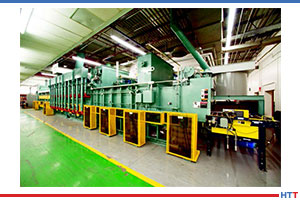
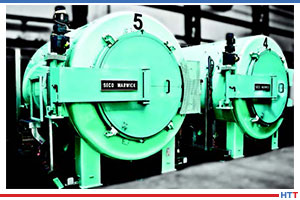
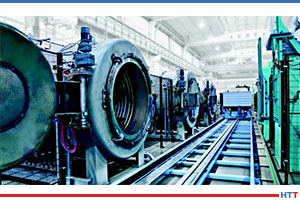
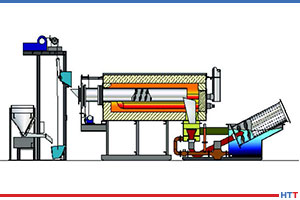
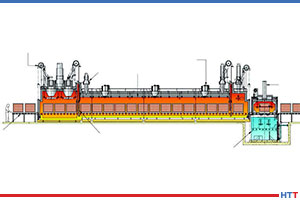
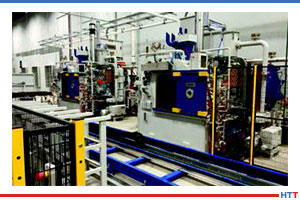
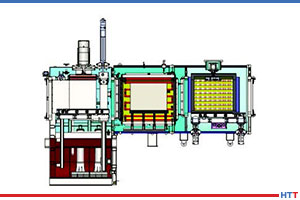
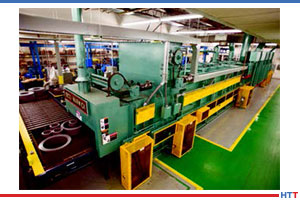
A medical device manufacturer has upgraded its in-house heat treating capabilities with a dual-chamber furnace system, which will give the company the same pyrometry requirement in its medical device production as materials and parts produced for the aerospace and defense industry in terms of furnace/oven calibration, classification and performance requirements.
Richard Conway, DELTA H chief technology officer and founder
Straits Orthopaedics in Penang, Malaysia, commissioned DELTA H TECHNOLOGIES for a second dual-chamber aerospace heat treat (DCAHTTM) furnace system. The furnace system, controls, and software are designed for full compliance to the medical accreditation program “MedAccred” as well as the US FDA’s recent recognition and adoption of the Society of Automotive Engineers (SAE) Aerospace Materials Specification 2750 (AMS2750) pyrometry standard.
Mr. TH Su, CEO of Straits Orthopaedics
“Previously medical device pyrometry standards varied somewhat from manufacturer to manufacturer,” said Richard Conway, DELTA H chief technology officer and founder. “With the adoption of the well-established AMS2750 standard, there is a consistent requirement across the industry. For DELTA H this is an exciting opportunity in a market that now has the same uncompromising demands for performance and accountability which our thermal processing systems are designed for.”
“DELTA H is making great contributions to our heat treating technology which is delighting all our customers,” Mr. TH Su, CEO of Straits Orthopaedics.
A multinational manufacturer of ships, industrial machinery, and aircraft headquartered in Tokyo, Japan, recently entered into an agreement to acquire the regional jet program from a Montreal-based manufacturer of regional airliners, business jets, and equipment for public transport.
Mitsubishi Heavy Industries, Ltd. and Bombardier Inc. announced they have entered into a definitive agreement, whereby MHI will acquire the maintenance, support, refurbishment, marketing, and sales activities for the CRJ Series aircraft, including the related services and support network located in Montréal, Québec, and Toronto, Ontario, and its service centers located in Bridgeport, West Virginia, and Tucson, Arizona, as well as the type certificates.
Seiji Izumisawa, president and CEO of MHI
“This transaction represents one of the most important steps in our strategic journey to build a strong, global aviation capability. It augments these efforts by securing a world-class and complementary set of aviation-related functions including maintenance, repair, and overhaul (MRO), engineering and customer support,” said Seiji Izumisawa, president and CEO of MHI. “The CRJ program has been supported by tremendously talented individuals. In combination with our existing infrastructure and resources in Japan, Canada and elsewhere, we are confident that this represents one effective strategy that will contribute to the future success of the Mitsubishi SpaceJet family. MHI has a decades-long history in Canada, and I hope this transaction will result in the expansion of our presence in the country and will represent a significant step in our growth strategy.”
Alain Bellemare, president and CEO, Bombardier Inc.
“We are very pleased to announce this agreement, which represents the completion of Bombardier’s aerospace transformation. We are confident that MHI’s acquisition of the program is the best solution for airline customers, employees and shareholders. We are committed to ensuring a smooth and orderly transition,” said Alain Bellemare, president and CEO, Bombardier Inc. “With our aerospace transformation now behind us, we have a clear path forward and a powerful vision for the future. Our focus is on two strong growth pillars: Bombardier Transportation, our global rail business, and Bombardier Aviation, a world-class business jet franchise with market-defining products and an unmatched customer experience.”
The CRJ production facility in Mirabel, Québec, will remain with Bombardier. Bombardier will continue to supply components and spare parts and will assemble the current CRJ backlog on behalf of MHI. CRJ production is expected to conclude in the second half of 2020, following the delivery of the current backlog of aircraft.
An oil and gas OEM specializing in technology, products, and services recently announced it will expand its heat treating capabilities when it assumes responsibility of a Houston-based oilfield services company’s forging operations.
Under the terms of the agreement, AFGlobal, based in Houston, Texas, will assume all operational responsibility in its assumption of Dril-Quip’s forge facilities and equipment located at its Houston manufacturing campus with an option to acquire those same assets. AFGlobal will supply Dril-Quip with its forging needs while also using the assets to further support AFGlobal’s OEM business in the broader oil and gas market as well as other existing markets, including industrial, aerospace, defense, and transportation.
Curtis Samford, president and CEO for AFGlobal
“We are excited to partner with Dril-Quip, not only for their forging needs but also to strengthen our offering for our core energy clients in drilling and pressure pumping,” commented Curtis Samford, president and CEO for AFGlobal. “Furthermore, we see this as another major step in our ongoing expansion into the broader industrial, aerospace, defense, and transportation markets. This equipment significantly expands our existing capabilities in both open- and closed-die forging and nearly doubles our ring rolling capability and capacity. These assets also provide us with further expansion opportunities for heat treating and machining.”
A global leader in primary and metalworking industrial process fluids recently announced an agreement to acquire the operating divisions of a UK company that provides specialty chemicals, operating equipment, and services to industrial end markets.
Quaker Houghton plans to purchase Norman Hay plc, which serves a number of industries including aerospace, automotive, oil and gas, and power generation through four divisions:
Ultraseal, a leading global provider of impregnation technology, including porosity sealants, and associated chemistry and equipment for die cast components;
SIFCO ASC, a leading global provider of surface treatment solutions through selective electroplating, anodizing, chemical solutions and engineering solutions;
Surface Technology, a specialty provider of surface treatment solutions including coatings, thermal sprays, plating and other ancillary services; and
Norman Hay Engineering, a leading provider of design and engineering services that support surface treatment plants and equipment for the Ultraseal, SIFCO ASC and Surface Technology businesses as well as additional third-party industrial engineering applications.
Michael F. Barry, chairman, CEO, and president of Quaker Houghton
Quaker Houghton intends to operate the acquired divisions as a stand-alone business within its Global Specialty Businesses platform while it completes the integration of Quaker Chemical and Houghton International.
“This acquisition represents an opportunity to add new technologies with good growth characteristics in attractive core market segments with high barriers to entry such as die-casting, automotive OEM and aerospace,” said Michael F. Barry, chairman, CEO, and president of Quaker Houghton. “We also believe it provides a strategic opportunity to take advantage of external market trends such as the light-weighting of vehicles and 3D printing where we have the opportunity to leverage our global footprint and complementary geographic strengths. In addition, Norman Hay’s engineering expertise, which includes robotics applications, strengthens the existing equipment solutions platform inside Quaker Houghton and further positions the Company for Industry 4.0.”
Norman Hay plc was established in 1946 as a decorative electroplating business and has evolved into a global specialty chemicals sealant, surface coatings, and engineering group. The company is headquartered at its modern, state of the art production facility in Coventry, England. The company has approximately 400 employees with production and R&D facilities across Europe and the United States.
This article was written by Dr. Vadims Geza, chief scientist at CENOS. More information on CENOS Platform can be found here.
Induction is becoming an increasingly popular choice for heating steel billets prior to forging due to its ability to create high heat intensity quickly and within a billet, which leads to low process-cycle time (high productivity) with repeatable high quality, occupying minimal space on the shop floor. It is more energy-efficient and inherently more environmentally friendly than most other heat sources for steel billets.
In this article, the author demonstrates a simulation example on how to optimize a progressive induction heating system for a steel billet. The method used is CENOS Platform, a 3D simulation software which focuses specifically on induction heating and uses open source components and algorithms.
CENOS platform is capable of simulating various types of induction heating for forging. It is possible to simulate both static heating and progressive heating where the billet is moved through the coil with constant velocity. In accomplishing this simulation, coil design is not a limitation: both single coil and multi-coil are possible to simulate. Besides the coil, it is also possible to simulate any material and frequency.
The functional performance of the software
CENOS is a finite element method-based, computer-aided engineering desktop software for 2D and 3D physical process simulation and computational modeling of induction heating, induction hardening, brazing, annealing and tempering of steel, aluminum, copper, and other materials.
The simulation process consists of three steps:
Choose the workpiece geometry (from built-in templates or create your own CAD file).
Define induction heating parameters (frequency, voltage, time, etc.).
Run 2D or 3D simulation of your choice.
At the conclusion, results like temperature and magnetic field are displayed in 3D renderings, plots, and more. Apparent power, induced heat, and inductance are logged into an Excel file.
3D Simulation example—comparison of two heating systems
In the simulation, two systems under consideration—two-stage and three-stage systems—in the progressive heating of the billet. The target for the simulation was to reach 2192°F (1200°C) ± 122°F (50°C). To check both systems, the user has to create set up for both of them, set physical parameters (material properties, frequency, current, etc.), and start the simulation.
After the simulation is done, the user will have access to different output variables, including:
Temperature distribution
Current density and Joule heat distribution
Magnetic field lines
Total, reactive and apparent power
Inductance of the coil
Coil current, voltage
In our example of billet heating, it is possible to compare both cases and the output.
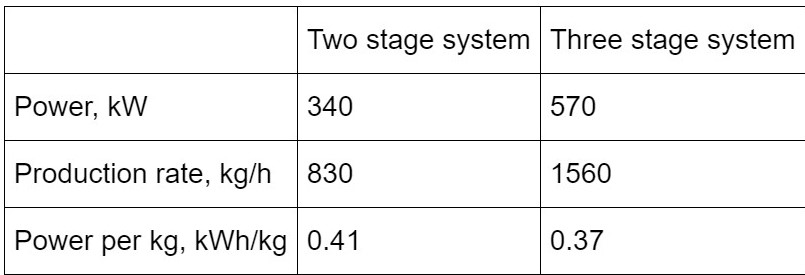
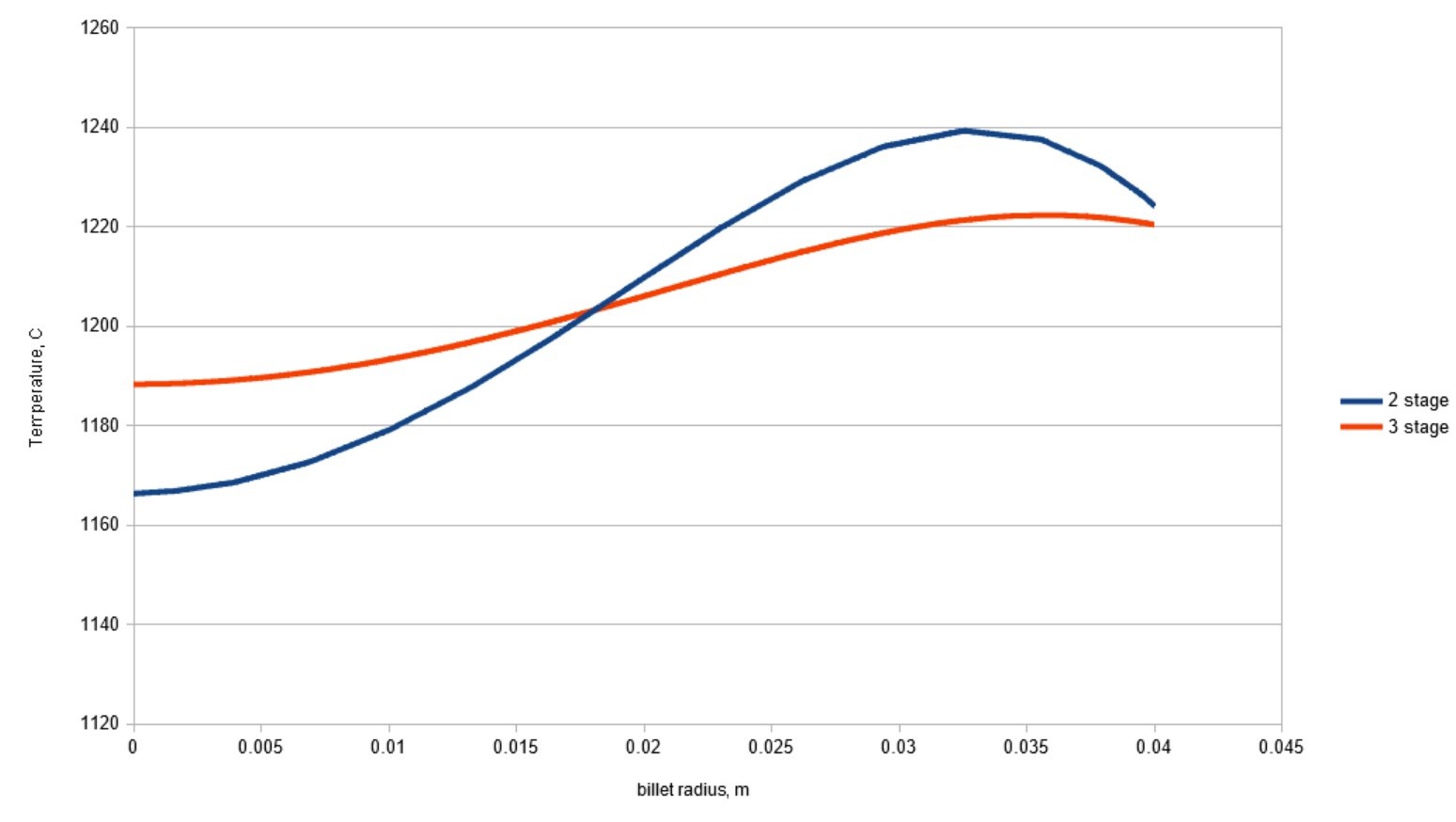
It is observable how a three-stage system can decrease power consumption and increase the production rate for this specific case. It is also possible to plot the distribution of temperature, Joule heat, magnetic field, etc. Resulting temperature distribution in the billet across the radius is shown in Figure 1. As can be seen, better temperature homogeneity is obtained in the three-stage system.
Figure 1. Temperature distribution along the billet radius at the outlet of the heating system
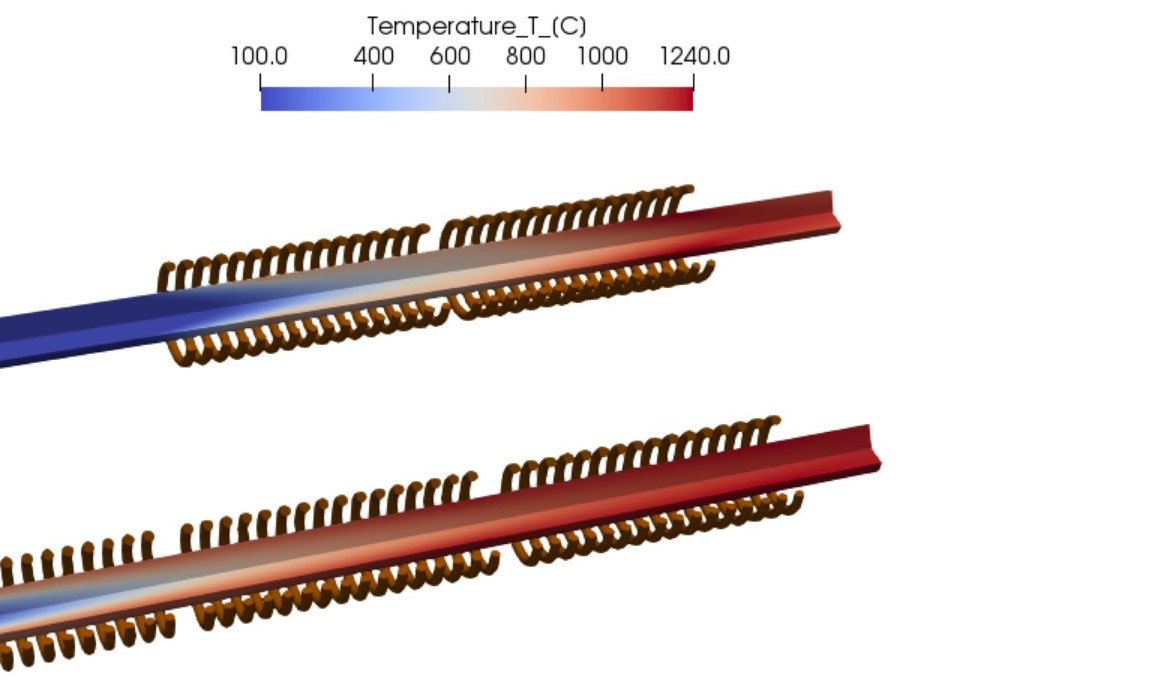
Figure 2. Temperature distribution in the long billet during scanning (progressive) induction heating.
Figure 2 shows how different systems lead to different temperature distribution. In the two-stage system, the temperature required for forging is reached with shorter coils, thus also with smaller scanning speed. This leads to worsened temperature uniformity and smaller production rates. On the other hand, the three-stage system heater gradually increases the temperature of the billet and the resulting temperature difference between core and surface is smaller.
Platform users are free to change all the input parameters and assemble the system of any number of stages required for their process.
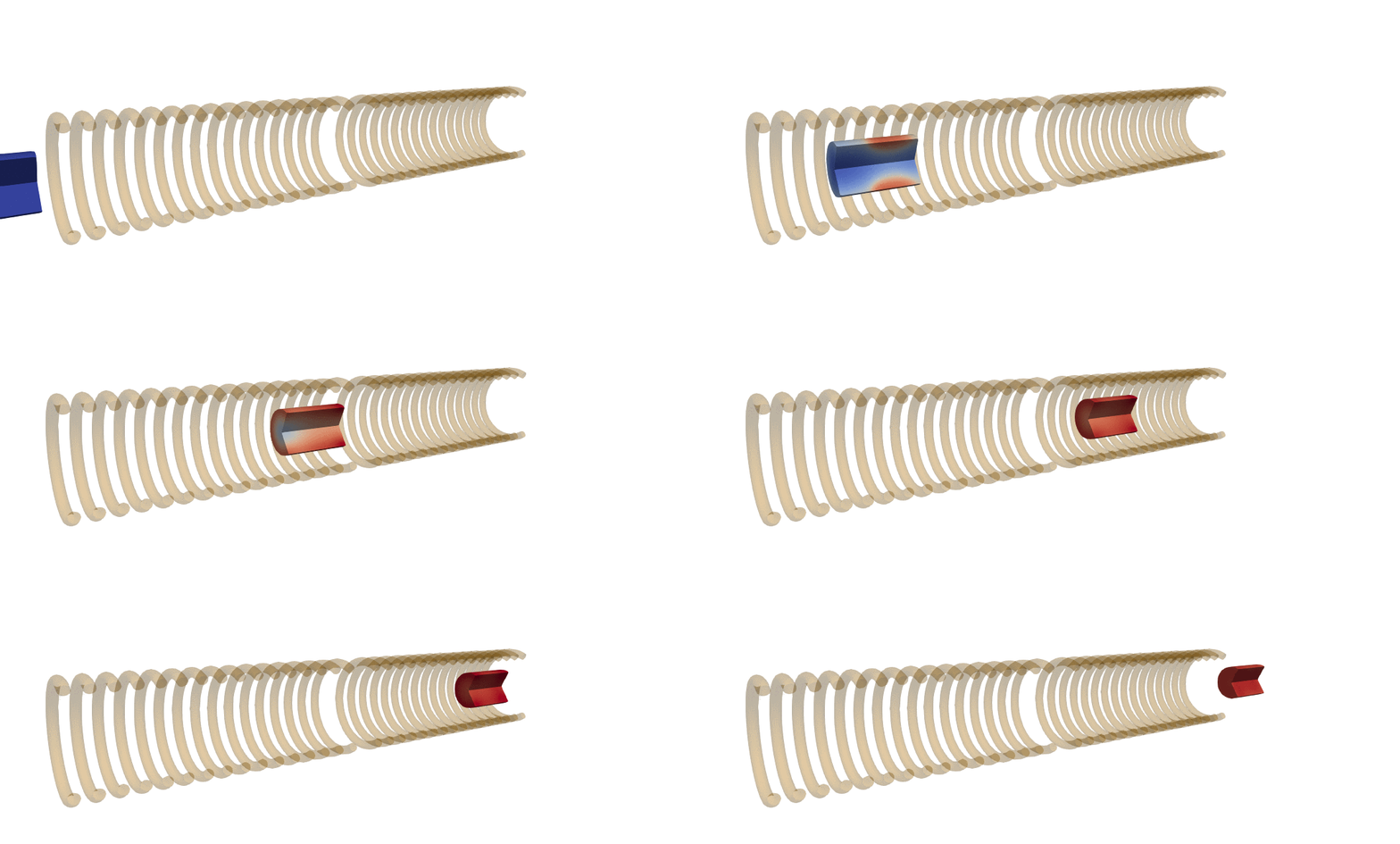
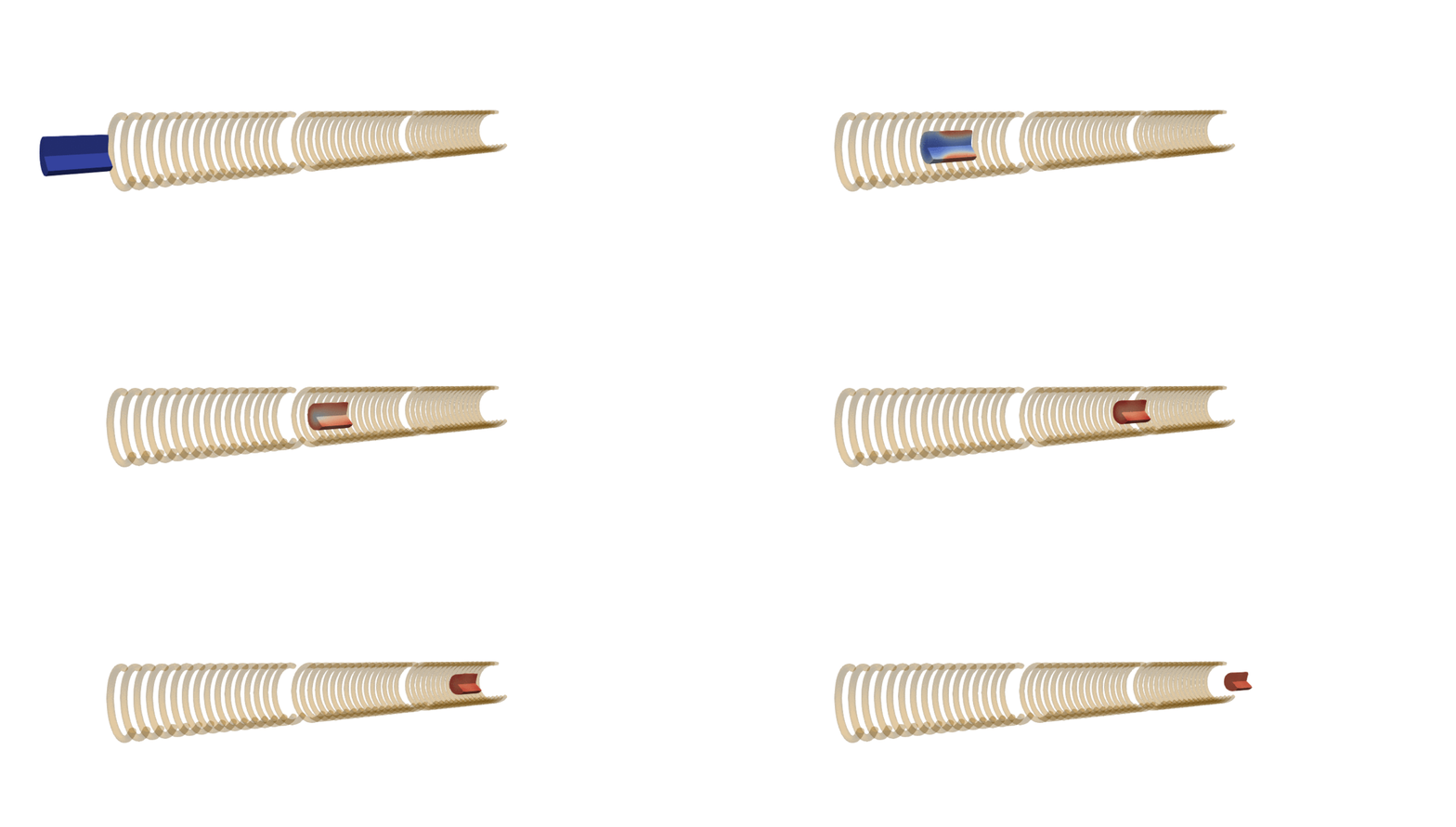
Should the same system need to be used for scanning of shorter billets where end effects play a more significant role, it is possible to set up a simulation with a moving billet. An example of temperature dynamics in such simulation are shown in GIF images below:
A simulation with a moving billet in a two-stage system.
A simulation with a moving billet in a three-stage system.
Simulation helps make better decisions for production set-up and planning
As demonstrated in the simulation example, it is possible to compare two different systems and get results. The scope and variety of different simulations are unlimited; it all depends on what problem the user wants to solve:
Dr. Vadims Geza
Heating system design—to optimize induction heating performance, improve product quality, and avoid unpleasant surprises related to subsurface overheating
The selection of power, frequency, and coil length in induction billet heating applications
The selection of right forging temperatures for plain carbon and alloy steels to avoid possible damage by incipient melting or overheating.
Main Photo Image via CENOS, courtesy of efd-induction.com
A UK-based provider of hot form quench (HFQ®) technology recently joined forces with an auto parts manufacturer to bring HFQ® technology to the North American market.
ITL’s CEO, Jonathan Watkins
The creator of HFQ® technology, Impression Technologies Ltd (ITL), a leading advanced lightweighting solution for high-strength aluminum structures, has partnered with Telos Global in Caryville, Tennessee, with the latter taking on the production of high-strength aluminum body-in-white and chassis HFQ® components, enabling the company to service OEM requirements in the SUV, pick-up truck, and electric vehicle markets. Telos will manufacture HFQ® components at its facility in Caryville, Tennessee, before expanding into Asia and Europe.
Rick Teague, CEO and founder of Telos Global
“We are delighted to have entered this strategic partnership with Telos Global, which will offer automotive OEMs a high-volume supply base for stronger, lighter, more cost-effective structures made using HFQ® Technology to a guaranteed standard,” said ITL’s CEO, Jonathan Watkins. “We look forward to working with Telos to develop a global HFQ® supply chain capability in North America as well as globally.”
“This partnership with ITL offers Telos an exciting opportunity to supply automotive customers in North America and around the world with complex components manufactured from new, high-strength aluminum alloys,” said Rick Teague, CEO and founder of Telos Global. “We believe HFQ® Technology, using Telos’ scalable production system, will offer significant opportunities for light-weighting and design flexibility at a competitive price.”
A Dozen Quick Heat TreatNewsItems to Keep You Current
Heat TreatTodayoffers News Chatter, a feature highlighting representative moves, transactions, and kudos from around the industry.
Personnel and Company Chatter
Recent changes in leadership at Nucor Corporation include the following: Retired U.S. Army Lieutenant General Nadja Y. West has been elected to join the board of directors, effective immediately. General West retired earlier this year after 37 years with the U.S. Army. In addition, John J. Ferriola will retire as chairman and CEO on December 31, 2019; the board of directors elected Leon J. Topalian to be president and COO, effective September 5, 2019, and to succeed Mr. Ferriola as CEO on January 1, 2020.
StandardAero has acquired Safe Aviation Solutions (including Safe Fuel, Accel, and B&E ACR), formerly the MRO services subsidiary of the B&E Group, which will continue to expand StandardAero’s Components, Helicopters & Accessories (CH&A) division and its portfolio of MRO and component repair services.
Dana Incorporated announced the acquisition of Nordresa Motors, Inc., a prominent integration and application engineering expert for the development and commercialization of electric powertrains for commercial vehicles.
Central Machine & Tool, a manufacturer and global distributor of quick connect/disconnect couplings, castings, clamps and bandings and provider of heat treating, fabrication, machining, and injection molding services, will now be known as PT World Headquarters. The launch of the new branding and signage included employees, staff, and guests. Matt Parrish, president, and Amy Parrish, vice-president of corporate communications, spoke about the new branding and the direction of the Enid, Oklahoma, company.
Allison Transmission Holdings Inc., a global manufacturer of medium- and heavy-duty fully automatic transmissions, announced that it has acquired the assets and certain liabilities of Walker Die Casting located in Lewisburg, Tennessee, and C&R Tool and Engineering located in Muscle Shoals, Alabama. Walker produces aluminum castings and has been a supplier to Allison for 20 years. Allison is committed to continuing the 60-year-old company’s legacy. C&R Tool and Engineering is a leading supplier of metalworking tools for use at Walker and other companies.
Constellium N.V., Amsterdam, announces that it will be the primary supplier of aluminum auto body sheet for the new Mercedes-Benz CLS model, which entered the market in March 2018.
John J. Ferriola, retiring CEO and chairman, Nucor Corporation
Equipment Chatter
A company operating in the nuclear sector recently purchased an advanced heat treatment vacuum furnace with a maximum temperature of 2408°F (1320°C) from TAV Vacuum Furnaces Spa.
A prominent aerospace equipment manufacturer is working with SECO/VACUUM Technologies (SVT) to bring the company’s low pressure carburizing and hardening work in-house. SVT will be supplying a CaseMaster Evolution® (CMe) dual-chamber vacuum oil quench furnace.
An electrically heated heavy-duty Ferris wheel batch oven has been shipped to a company in the aerospace industry by Wisconsin Oven Corporation. This Ferris wheel oven will be used to cure epoxy resins & varnishes on assorted aerospace parts. In addition, Wisconsin Oven shipped a natural gas-fired conveyor oven to the automation industry, which will be used to cure a resin formed mat.
Primetals Technologies will build a combined aluminum hot rolling mill for the production of heavy plate and strip for BaoWu Aluminium Technology Ltd., which is part of BaoWu Iron and Steel Group Co., Ltd, the highest-profile steel producer in China. The new rolling mill will be built in Sanmenxia, in the Henan province, and have an annual production capacity of 300,000 metric tons.
Kudos Chatter
Onex, Inc., recently received a plant visit from Pennsylvania State Representative Lee James. Talks surrounded the need for skilled labor in manufacturing and the valuable careers available at Onex and in the industry.
Thermal-Vac Technology is proud to be included on Inc. magazine’s prestigious Inc. 5000 list for 2019. Inc. 5000 lists the fastest-growing private companies in the United States. Thermal-Vac has grown 64 percent in the last three years. “We are excited to have our team’s hard work recognized by Inc. magazine,” CEO Heather Falcone said. “As a service business, we only grow by delivering what we promise. I think everyone at Thermal-Vac can be proud of what we’ve built.”
Heat TreatTodayis pleased to join in the announcements of growth and achievement throughout the industry by highlighting them here on our News Chatter page. Please send any information you feel may be of interest to manufacturers with in-house heat treat departments especially in the aerospace, automotive, medical, and energy sectors to the editor at editor@heattreattoday.com
A global aluminum rolling manufacturer recently reaffirmed its commitment to complete the acquisition of an Ohio-based aluminum rolled products producer, despite a U.S. Department of Justice (DOJ) lawsuit to block the transaction.
Novelis Inc. gave this statement regarding its proposed acquisition of Aleris Corporation, stating the company “intends to vigorously defend against the DOJ’s challenge”, believing it to be “without merit.”
The “acquisition will strengthen the aluminum industry’s ability to compete against steel in U.S. automotive body sheet market,” notes a release from Novelis.
Steve Fisher, President and CEO, Novelis Inc
“The DOJ lawsuit is based on the contention that the only relevant competition among automotive body sheet providers is that among aluminum manufacturers such as Novelis and Aleris. It ignores competition from steel automotive body sheet, even though steel automotive body sheet is currently used for nearly 90 percent of the market.”
“The day-to-day reality of the automotive body sheet market is aluminum automotive body sheet striving to take share from steel, and the steel automotive body sheet companies fighting back,” said Steve Fisher, president and CEO, Novelis Inc. “We are disappointed that the DOJ has missed this, but also confident that in the next phase of this process the full scope of the competition we face will be recognized appropriately. Our merger with Aleris threatens no one, and to the contrary will strengthen our ability to compete against steel, meet growing customer demand for aluminum, achieve our recycling goals, and bolster our sustainability platform worldwide.”
Assistant Attorney General Makan Delrahim of the Justice Department’s Antitrust Division
The Department of Justice filed the civil antitrust lawsuit seeking to block Novelis’s proposed acquisition of Aleris “in order to preserve competition in the North American market for rolled aluminum sheet for automotive applications.”
The Antitrust Division’s lawsuit alleges that the transaction would combine two of only four North American producers of aluminum auto body sheet.
“Automakers increasingly need aluminum auto body sheet to satisfy American consumers’ demand for larger vehicles that are lighter and more fuel-efficient. The loss of a competing supplier of aluminum auto body sheet ultimately would harm American car buyers,” said Assistant Attorney General Makan Delrahim of the Justice Department’s Antitrust Division.
The Antitrust Division has agreed with defendants to refer the matter to binding arbitration should certain conditions be triggered. The arbitration would resolve the issue of product market definition. This would mark the first time the Antitrust Division is using this arbitration authority to resolve a matter.
“This arbitration would allow the Antitrust Division to resolve the dispositive issue of market definition in this case efficiently and effectively, saving taxpayer resources,” said Delrahim. “Alternative dispute resolution is an important tool that the Antitrust Division can and will use, in appropriate circumstances, to maximize its enforcement resources to protect American consumers.”
According to legal analysts for corporate law firm Jones Day, “Most DOJ merger challenges have taken more than five months from filing of a complaint to a district court decision.”
“For this reason, the parties may have believed that pursuing arbitration on market definition—a topic that in traditional litigation can consume significant time for discovery and briefing—would provide them with deal certainty sooner than litigation. DOJ, in turn, may have viewed the decision as consistent with its larger policy goal of streamlining the merger review process.”
A Michigan-based heat treatment operation specializing in salt quenching and austempering recently announced that it has been acquired by a leading surface technology company.
Richard Wright, COO of the US Division of Aalberts Material Technology
In the 100% acquisition, Applied Process of Livonia, Michigan, will join the Material Technology group within Aalberts N.V. (Aalberts), a Dutch industrial technology company which operates in over 50 countries. The Material Technology group offers a unique combination of advanced heat and surface treatment technologies utilizing a global network of service locations with excellent local knowledge to customers active in general industries, automotive, aerospace and power generation.
Harold Karp, Applied Process president and CEO
“Aalberts is very excited that Applied Process is joining our team of world-class service providers,” said Richard Wright, COO of the US Division of Aalberts Material Technology. “Applied Process is the world-wide leader in austempering heat treatment, and we look forward to supporting their efforts to expand their technology and service offerings.”
“We are very excited to be part of the Aalberts family,” Harold Karp, Applied Process president and CEO. “We especially look forward to the synergistic opportunities of providing a broader and stronger service offering to our customers that will come from the technical expertise and other businesses within Aalberts.”
The Applied Process brand will continue on, as will the entire leadership team.
“For years, I have always told people who ask me that my machines pretty much don’t care if a part is hard or soft,” says James Richards of James Engineering.
In a simple experiment, Richards ran several parts through multiple machining and finishing processes to determine whether the hardness or softness of certain steel alloys had any effect on chamfering. What he found regarding hardness or softness did not surprise him. What he did note were the different outcomes that resulted from heat treating the part before or after chamfering.
“We have yet to find a material that we cannot create a chamfer and/or edge finish on. As to whether we chamfer before or after heat-treating—that’s a very different story.” ~ James Richards
This week’s Technical Tuesday highlights Richards’ article “Chamfering: Hard vs Soft Parts and Before vs After Heat Treating”, which appeared in the July 2019 issue of Gear Technology.