Boeing landed an order for 100 787 Dreamliners from United Airlines. Plans are in place to purchase 100 737 MAX jets, too. Both the 787 and 737 are known to have at least 20% better fuel efficiency than the aircrafts they are to replace.
The deal is the largest 787 order in Boeing's history. The 787 is listed from $248 to $338 million, but it's normal for airlines to negotiate significant discounts. With this acquisition, United Airlines hopes to expand with more international flights.
Boeing will begin deliveries of the Dreamliners in 2024.
Read more and watch a video about the new orders here.
Find heat treating products and services when you search on Heat Treat Buyers Guide.com
Sometimes our editors find items that are not exactly "heat treat" but do deal with interesting developments in one of our key markets: aerospace, automotive, medical, energy, or general manufacturing. To celebrate getting to the “fringe” of the weekend, Heat TreatToday presents today’s Heat Treat Fringe Friday press release: a look at the future of heat treating and 3D printing in aerospace engines and energy turbines.
Find out more about the possibilities of bringing additive manufacturing and heat treating turbine and engine components; and read on to see what's happening at MIT.
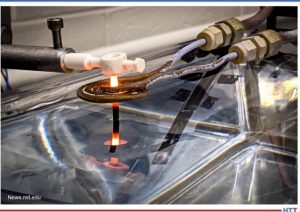
A new MIT-developed heat treatment transforms the microscopic structure of 3D-printed metals, making the materials stronger and more resilient in extreme thermal environments. The technique could make it possible to 3D print high-performance blades and vanes for power-generating gas turbines and jet engines, which would enable new designs with improved fuel consumption and energy efficiency.
There is growing interest in manufacturing turbine blades through 3D-printing, but efforts to 3D-print turbine blades have yet to clear a big hurdle: creep. While researchers have explored printing turbine blades, they have found that the printing process produces fine grains on the order of tens to hundreds of microns in size — a microstructure that is especially vulnerable to creep.
Zachary Cordero
Boeing Career Development Professor in Aeronautics and Astronautics
MIT
Zachary Cordero and his colleagues found a way to improve the structure of 3D-printed alloys by adding an additional heat-treating step, which transforms the as-printed material’s fine grains into much larger “columnar” grains. The team’s new method is a form of directional recrystallization — a heat treatment that passes a material through a hot zone at a precisely controlled speed to meld a material’s many microscopic grains into larger, sturdier, and more uniform crystals.
“In the near future, we envision gas turbine manufacturers will print their blades and vanes at large-scale additive manufacturing plants, then post-process them using our heat treatment,” Cordero says. “3D-printing will enable new cooling architectures that can improve the thermal efficiency of a turbine, so that it produces the same amount of power while burning less fuel and ultimately emits less carbon dioxide.”
Materials Science student
Oxford University
MIT
“We’ve completely transformed the structure,” says lead author Dominic Peachey. “We show we can increase the grain size by orders of magnitude, to massive columnar grains, which theoretically should lead to dramatic improvements in creep properties.”
Cordero plans to test the heat treatment on 3D-printed geometries that more closely resemble turbine blades. The team is also exploring ways to speed up the draw rate, as well as test a heat-treated structure’s resistance to creep. Then, they envision that the heat treatment could enable the practical application of 3D-printing to produce industrial-grade turbine blades, with more complex shapes and patterns.
“New blade and vane geometries will enable more energy-efficient land-based gas turbines, as well as, eventually, aeroengines,” Cordero notes. “This could from a baseline perspective lead to lower carbon dioxide emissions, just through improved efficiency of these devices.”
Cordero’s co-authors on the study are lead author Dominic Peachey, Christopher Carter, and Andres Garcia-Jimenez at MIT, Anugrahaprada Mukundan and Marie-Agathe Charpagne of the University of Illinois at Urbana-Champaign, and Donovan Leonard of Oak Ridge National Laboratory.
This research was supported, in part, by the U.S. Office of Naval Research.
Watch this video from Thomas to see a visual of some of the heat treating advances.
Find heat treating products and services when you search on Heat Treat Buyers Guide.com
Shane Eddy President Pratt & Whitney Source: LinkedIn
Pratt & Whitney staged a ribbon-cutting event for its new turbine airfoil plant in Asheville, NC. The plant forecasts 800 new jobs at the foundry location through 2027.
Described as an “advanced casting foundry,” the plant will have casting capability for airfoil structures for turbofan and high-pressure jet engines. Production of specialty alloy parts with directionally solidified and single-crystal oriented structures will take place along with onsite machining, coating, and finishing capabilities. The new airfoil operation in North Carolina will start in Q2 2023, casting airfoil structures for commercial and military jet engines.
“Pratt & Whitney’s new Asheville facility . . . will support growing demand for GTF engine-powered aircraft and for the F135 engine, which powers the F-35 Lightning II,” stated Shane Eddy, president of Pratt & Whitney.
Find heat treating products and services when you search on Heat Treat Buyers Guide.com
The most recent launch of NASA’s Artemis 1 Mission included a large titanium manifold housing designed to rapidly propel astronauts away from the main rocket in case of a catastrophic explosion or any other unexpected event. This critical part was vacuum heat treated by Solar Atmospheres of Western PA.
Titanium manifold weldment after vacuum heat treatment and shown on the Artemis 1 Orion Spacecraft Source: NASA
Michael Johnson Sales Manager Solar Atmospheres of Western PA
On Wednesday, November 16, 2022, NASA’s unmanned Orion spacecraft launched successfully from Cape Canaveral at 1:47 am for a six-week test flight around the moon and back. This launch marks the first iteration of NASA’s moon-to-Mars Artemis 1 program. For the 2014 Orion launch, NASA introduced the Launch Abort System (LAS). Once fired, the LAS will accelerate the astronauts away from the main rocket at forces up to 10 to 15 times normal gravity (“G’s”).
“Before the mighty Artemis rocket left Earth’s atmosphere with 8.8 million pounds of thrust, many of the components and support hardware had already experienced a lunar-like atmosphere here in western Pennsylvania,” commented Michael Johnson, sales director at Solar Atmospheres. “Many of the [6AL-4V] titanium and Inconel components were processed well below 1×10⁻⁵ Torr throughout thermal processing. Although our crew here on Earth were wearing nitrile gloves, it’s overwhelming to know we had a hand in heat treating these critical parts.”
Find heat treating products and services when you search on Heat Treat Buyers Guide.com
Trevor Jones President Solar Manufacturing, Inc. Source: Solar Manufacturing, Inc.
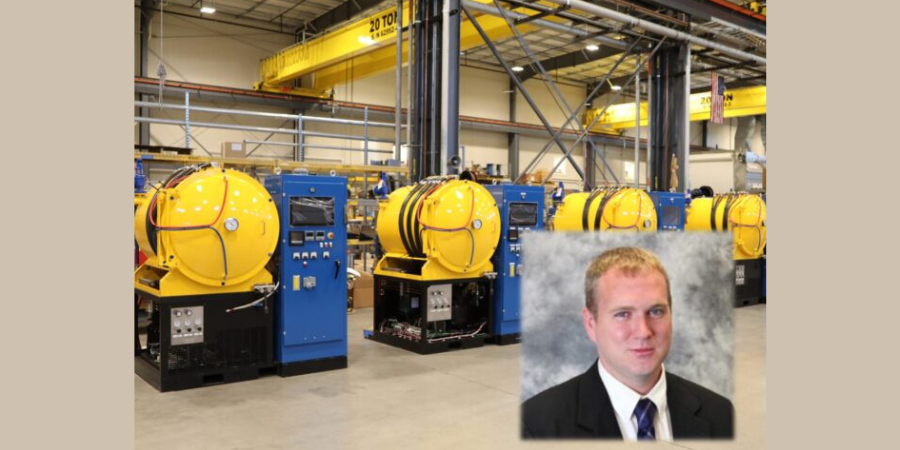
A vacuum furnace manufacturer in North America has acquired purchase orders for ten vacuum furnaces this 3rd quarter. The furnaces will be shipped to companies in the following market sectors: aerospace, commercial heat treating, and additive manufacturing.
Solar Manufacturing Inc. is based out of Pennsylvania, and the new systems will be sent to locations throughout North America. The various types of new furnace orders ranged in size from the compact Mentor® and Mentor® Pro series to a large production furnace with a work zone of up to 72” in length.
“[S]trong quotation activity levels seem to indicate customers are optimistic to expand after the pandemic ramifications continue to ease," commented Trevor Jones, President of Solar Manufacturing.
Find heat treating products and services when you search on Heat Treat Buyers Guide.com
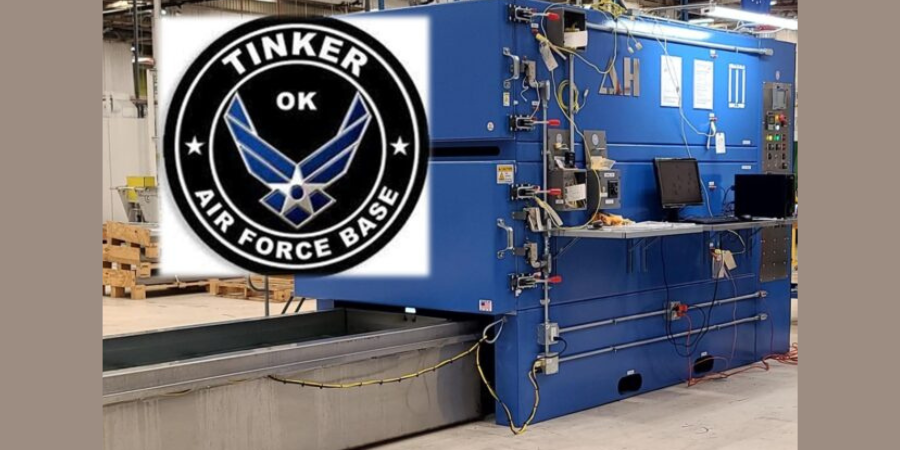
A heat treat system for use in the aerospace and defense industry was recently delivered to Tinker AFB, OK - USAF. The system is certified to AMS2750G and will be used to heat treat aluminum as well as other metals for use on military aircraft.
Richard B. Conway Founder/Director/ CTO DELTA H® Technologies, LLC Source: DELTA H
DELTA H® and Phillips Federal delivered the furnace to Tinker AFB, which will be used for for heat treating aviation grade aluminum for military purposes. Third party services for calibration and qualification were performed by Andrew Bassett, president of Aerospace Testing and Pyrometry. The certifications for instrumentation, temperature uniformity surveys, and system accuracy testing were completed through ATP’s new Aerospace Compliance Software (ASC) to AMS2750G.
The Dual Chamber Aerospace Heat Treat (DCAHT ®) system has a certified TUS volume of 24” wide, 16" high, 72" long. In addition to aluminum, the system can be used for PH stainless steel aging, as well as titanium and ferrous alloy processes. Training was provided to several operators, QC personnel, and two “Trainers” qualified to train other operators.
“As an USAF veteran," commented Richard B. Conway, founder, director, and CTO of DELTA H. "[I]t is a deep honor to do all we possibly can to assure that our Warfighters have the finest heat treating equipment available for defending our nation."
Find heat treating products and services when you search on Heat Treat Buyers Guide.com
Readers are checking out recent AMS2750 Rev. G changes and want some more information from Heat Treat Today about a specific clarification. Read the correspondence about the implications of AMS2750 Rev. G paragraph 3.1.1.5 about how to measure junction construction.
Douglas Shuler, lead auditor at Pyro Consulting, has written numerous articles with Heat Treat Today about AMS2750 standards. Check them out by searching "Doug Shuler" at www.heattreattoday.com.
READER QUESTION: After combing the new AMS2750 Rev. G, I found that paragraph 3.1.1.5 no longer allows thermocouples to be tack welded directly to parts, OR to representative dummy parts. This has been standard practice for decades. So I dug into it further with the folks from PRI and it turns out to be true. They’re now expecting load thermocouples to be either placed inside of a part (ends twisted and inserted), or inside the hole of a dummy block.
I’d done some searching online and there isn’t a single source talking about this major change. This could lead to a lot of failed upcoming Nadcap audits.
Doug Shuler Lead Auditor Pyro Consulting
Douglas (Doug) Shuler (Pyro Consulting) for Heat Treat Today: Historically (i.e. prior to Rev. F), AMS2750 was silent on measuring junction construction. In Rev. F, the construction of the measuring junction was as follows:
Measuring junctions shall be made by any combination of twisting and/or welding the thermal elements provided there is no addition of filler metal.
This raised concerns about both the use of quick tips and spot welding to make the measuring junction. The AMEC AMS2750 revision team engaged with Cleveland Electric Laboratories to perform testing on these measuring junctions as compared to the twisting/welding combinations.
The conclusion of the tests were that both quick tips and spot welding to a part/heat sink became unstable at temperatures above 2000°F. The quick tip crimping point and the spot welds showed rapid oxidation and increased errors in a short period of time. Based on the results of these tests the AMEC AMS2750 revision team put forth the following update in Rev. G:
Measuring junctions shall be made by either of the following methods:
Any combination of twisting and/or welding the thermoelements provided there is no addition of filler metal (including ungrounded and grounded MIMS).
Spot welding the thermoelements directly to a part, simulated part, or heat sink is permitted for temperatures ≤2000°F or 1100°C.
This allows spot welding measuring junctions for process temperatures at or lower than 2000°F. The team and AMEC members decided that quick tips were to unstable to permit their use going forward.
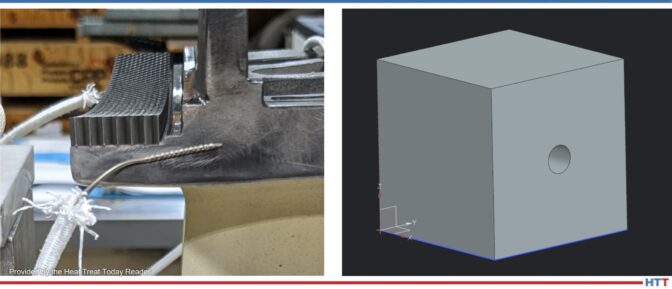
READER FOLLOW-UP: Our current method that we’re using is to twist the thermocouple using a set of Twister Pliers, then tack-weld that twist onto the part (first photo below). We’ve been doing this for parts up through brazing temperatures (~2150°F) without issue. We recently ran a furnace run around 2100°F with parts tack-welded as I’ve described AND had T/Cs that were just twisted with no tack weld. We noticed there was no significant difference in the temperature the TCs were reading. This was also our technique that we used at my previous company.
The way I read AMS2750 Rev. G was: You may twist and weld thermocouples to a part, but only for temperatures less than or equal to 2000°F.
To comply with Rev. G, we have gone ahead and made heatsink blocks to make sure we’re in compliance. Our new method of temperature measurement is twisting the wires and sticking the twisted end down inside of a block of solid metal (like the one I’ve shown below).
Source: Heat TreatToday Reader
We welcome your inquiries to and feedback on Heat Treat Today articles. Submit your questions/comments to editor@heattreattoday.com.
American titanium producer Perryman Company, in Houston, PA, has placed an order for the supply of two forging machines: a high-speed open-die forging press in the pull-down design and a hydraulic radial forging machine with two forging manipulators as well as the order and production control system for the entire forging line. The titanium materials are intended for parts in the aerospace industry and for medical applications.
The open-die forging press from SMS group will be used to forge cast titanium billets first to the required size. After that, they can be finish-forged in the radial forging machine to produce bars – round, square or flat – up to a maximum length of 14,000 millimeters.
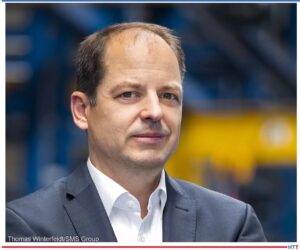
Dr. Thomas Winterfeldt Head of Forging Plants SMS Group SMS Group
"We see strong growth in the aerospace industry and medical sector," emphasized Frank Perryman, president and CEO of Perryman Company. "This [new forging line] enables us to produce forgings for turbines and safety-relevant structures that comply with our high quality standards."
"With the whole SMS plant package, including digitalization tools and technology packages, Perryman is able to increase its production efficiency and maintain consistent quality levels," said Dr. Thomas Winterfeldt, head of forging plants at SMS group.
The forging line is scheduled to go on stream in Q1 2024.
Find heat treating products and services when you search on Heat Treat Buyers Guide.com
Edwards Air Force Base, an historic airfield engaged in experimental aviation, is expanding its heat treat capabilities with two dual chamber furnaces.
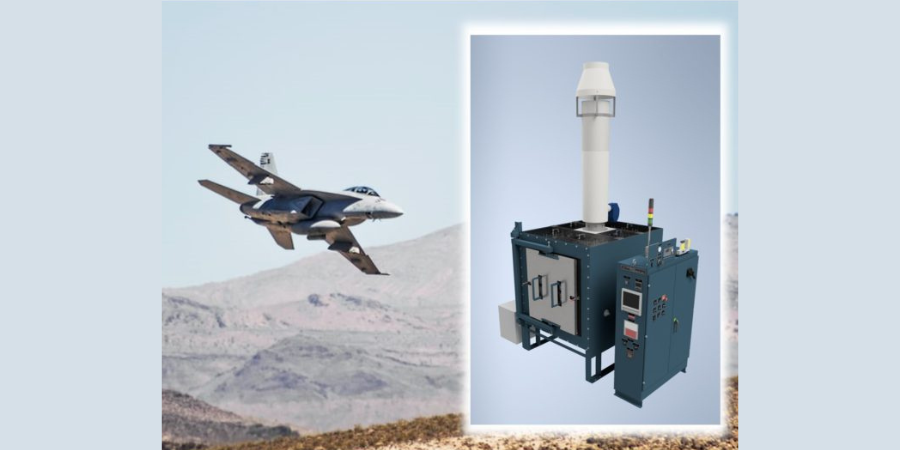
DELTA H®delivered the two Defender Series dual chamber aerospace heat treating (DCAHT®) systems. These systems were developed for specific requirements of the armed forces; they meet the pyrometry standards of USAF/NAVAIR Tech Order 1-1A-9 and qualify to SAE AMS2750G.
Defender Series are "deployable" and has stackable chambers that can be configured with 500°F, 1200°F or 2000°F maximum temperatures as either dual or single chamber systems. They serve as "universal heat treating systems" for hangar sheet metal back shops that are tasked with “keeping them flying” – and are “mission essential” equipment. In addition to Edwards AFB, these systems are located at Texas and Kansas Air National Guard facilities as well as Beale AFB in Northern California to date.
Find heat treating products and services when you search on Heat Treat Buyers Guide.com
GHH Series Box Furnace for Ceramic Matrix Composites Source: L&L Special Furnace Company, Inc.
A U.S. manufacturer with a plant in the Midwest received and commissioned a large high-temperature box furnace for processing ceramic matrix parts that will be used in military and aerospace applications.
L&L Special Furnace Company, Inc.'s GHH3350 has an effective work zone of 32” wide x 30” high x 50” deep. The furnace is capable of reaching temperatures up to 3100°F/1700°C under partial atmospheric pressure. A vacuum pump helps to remove oxygen prior to beginning the thermal cycle. The case is sealed for use with inert atmosphere.
Find heat treating products and services when you search on Heat Treat Buyers Guide.com







 Find heat treating products and services when you search on Heat Treat Buyers Guide.com