

Leone

Inside the Carbon Nanotube Method for Airplane Production


Source: Design and Development Today


A modern airplane’s fuselage is composed of multiple sheets of different materials, not unlike a phyllo dough pastry. Once these layers are stacked and molded into the shape of a fuselage, they are transferred into warehouse-sized ovens and autoclaves, where the layers fuse together to form a resilient, aerodynamic shell.

MIT engineers have now developed a method to produce the same high level of composites without the enormous ovens. This discovery may speed up the manufacturing of airplanes and other large, high-performance composite structures.

In this HTT Best of the Web Technical Tuesday feature, Design and Development Today introduces us to carbon nanotubes, their usefulness in potentially taking airplane manufacturing to new heights, and what the future of the research surrounding this discovery looks like.

Brian Wardle, professor of aeronautics and astronautics at MIT

An excerpt: “‘If you’re making a primary structure like a fuselage or wing, you need to build a pressure vessel, or autoclave, the size of a two- or three-story building, which itself requires time and money to pressurize,’ says Brian Wardle, professor of aeronautics and astronautics at MIT. ‘These things are massive pieces of infrastructure. Now we can make primary structure materials without autoclave pressure, so we can get rid of all that infrastructure.'”

Read More: www.designdevelopmenttoday.com/industries/aerospace/news/21110057/a-new-approach-to-making-airplane-parts?lt.usr=70118934

Photo Credit: Melanie Gonick, MIT

Inside the Carbon Nanotube Method for Airplane Production Read More »

Aluminum Alloy Powder Developed for Automotive 3D Printing

A Canadian additive manufacturing powder producer, in partnership with McGill University in Montreal, has announced the results of a research project on its aluminum alloy powders. Extensive testing undertaken by the university has revealed that the Equispheres’ powders are suitable for sintering with binder jet 3D printing technology. Equispheres claims that the combination of binder jet 3D printing with aluminum alloy powder can have a significant impact on the automotive industry. 

Dr. Mathieu Brochu, Associate Professor at McGill

“We are excited to begin work with Equispheres’ binder jet printing partners in the next phase to fully understand all aspects related to sintering of complex shape components and the fundamental relations with new specialized binder agents,” said Dr. Mathieu Brochu, Associate Professor at McGill and Canada Research Chair in Pulse Processing of Nanostructured Materials.

Equispheres has developed a method of powder atomization that creates spherical metal powders. On the strength of its proprietary technology, Equispheres has previously received a $5 million investment from American global aerospace and defense company Lockheed Martin. The company also received an $8 million investment from early stage and SME financing bank BDC Capital, due to its focus on the environmental advantages of 3D printing.

Currently, Equispheres is collaborating with key partners to develop specialized binder agents that are required for aluminum and for specific automotive applications.

Photo Credit: Equispheres

Aluminum Alloy Powder Developed for Automotive 3D Printing Read More »

15 Quick Heat Treat News Chatter Items to Keep You Current

Heat Treat Today offers News Chatter, a feature highlighting representative moves, transactions, and kudos from around the industry.

Personnel & Company Chatter

    • Mike Smith has joined Magnetic Specialties, Inc. as their new Business Development Manager.
    • Ipsen USA has announced the completion of its 2019 Corporate Academy class, which is part of an initiative to grow service capacity globally. Seven graduates will step into positions as field service engineers after several months of training and passing their final exam.
    • Tom Gundic recently joined Solar Atmospheres’ facility in Greenville, South Carolina, as their new plant manager.
    • Isostatic Toll Services Bilbao is pleased to announce the official opening of its new plant in Abanto-Zierbena, Spain, on January 29th.
Heating Furnace at Uddeholm AB, which is taking part in the electrical heating project
  • The Swedish Energy Agency has granted a new project that will explore the possibilities of electrifying heating processes. It will evaluate the potential of replacing gas-fired furnaces with electrically heated furnaces for material heating. Kanthal, part of the Sandvik Group, is taking part in the project.
  • Sean Toland has taken on the position of executive Vice President of Operations for Wire Experts Group, the parent company to Pelican Wire and Rubadue Wire, the second of which Toland is already serving as president.
  • NSA Industries, a provider of metal fabrication, machining, powder coating, and assembly operation, has acquired Vitex Extrusion, a provider of aluminum extrusions, machining, and fabrication services for solar and automobile customers.
  • Jon K. Tabor is retiring from the position of Chairman Emeritus of Allied Mineral Products effective March 31, 2020. He will remain on Allied’s Board of Directors.
  • Vincent Esteve has been promoted to Business Development Manager at the ECM USA, Inc. subsidiary in Pleasant Prairie, Wisconsin.
  • Wisconsin Oven has shipped a Natural Gas (Direct) Fired Continuous Duty Conveyor Oven to an American manufacturer to be used for stress relieving steel snap rings used in automotive parts.
  • L&L Special Furnace Co, Inc. has shipped five model GS1714 furnaces to a worldwide leading manufacturer of chemicals and chemical coating products located in the Midwestern US.
  • Tenova LOI Thermprocess recently received an order from Joint Stock Company Pervouralsk Pipe Plant in Russia for a new roller hearth continuous furnace system for bright annealing stainless steel pipes in a 100% H2 atmosphere.
  • Lindberg/MPH announced the shipment of two Electrically Heated Nitrogen Atmosphere Pit Furnaces to the automotive industry for the purpose of heat treating automotive parts.
  • Kittyhawk Products OR LLC has been awarded Nadcap® accreditation for Heat Treating/Hot Isostatic Pressing (HIP). Kittyhawk Inc has held Nadcap® accreditation since 2014.

    From Left to Right: Quality manager, AM/NS Calvert, Bobbie Hesley; GM supplier quality engineer, Mark Wu; AM/NS Calvert CEO, Jorge Oliveira and team members from the AM/NS hot dip galvanizing lines.
  • ArcelorMittal USA was recently honored with the General Motors Supplier Quality Excellence Award for three production facilities: AM/NS Calvert, Calvert, AL; Indiana Harbor; and I/N Tek and I/N Kote, New Carlisle, IN.


Heat Treat Today is pleased to join in the announcements of growth and achievement throughout the industry by highlighting them here on our News Chatter page. Please send any information you feel may be of interest to manufacturers with in-house heat treat departments especially in the aerospace, automotive, medical, and energy sectors to editor@heattreattoday.com

15 Quick Heat Treat News Chatter Items to Keep You Current Read More »

Heat Treat Tips: Atmospheres, Thermocouples, and Flow Power

Heat Treat Today’s 101 Heat Treat Tips provides an opportunity to learn the tips, tricks, and hacks shared by some of the industry’s foremost experts.

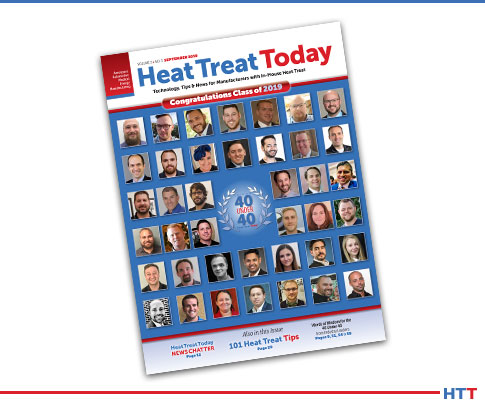
For Heat Treat Today’s latest round of 101 Heat Treat Tipsclick here for the digital edition of the 2019 Heat Treat Today fall issue (also featuring the popular 40 Under 40).

If you have a heat treat-related tip that would benefit your industry colleagues, you can submit your tip(s) to anastasia@heattreattoday.com  or editor@heattreattoday.com.


Today’s tips come to us from AFC-Holcroft, covering Thermocouples, Atmospheres, and Flow Power.


Heat Treat Tip #4

Pack Your Thermocouples

When a thermocouple is used with an open-ended protection tube, pack rope or fiber between the thermocouple and the protection tube to prevent cold air infiltration from influencing the reading.


Photo Credit: Super Systems, Inc. (SSi)


Heat Treat Tip #7

A Good Fit

If a thermocouple fits loosely in a protection tube, avoid errors by ensuring that the tip maintains good contact with the tube.


Photo Credit: Super Systems, Inc. (SSi)


Heat Treat Tip #25

Oxygen Analysis as a Cost Saver

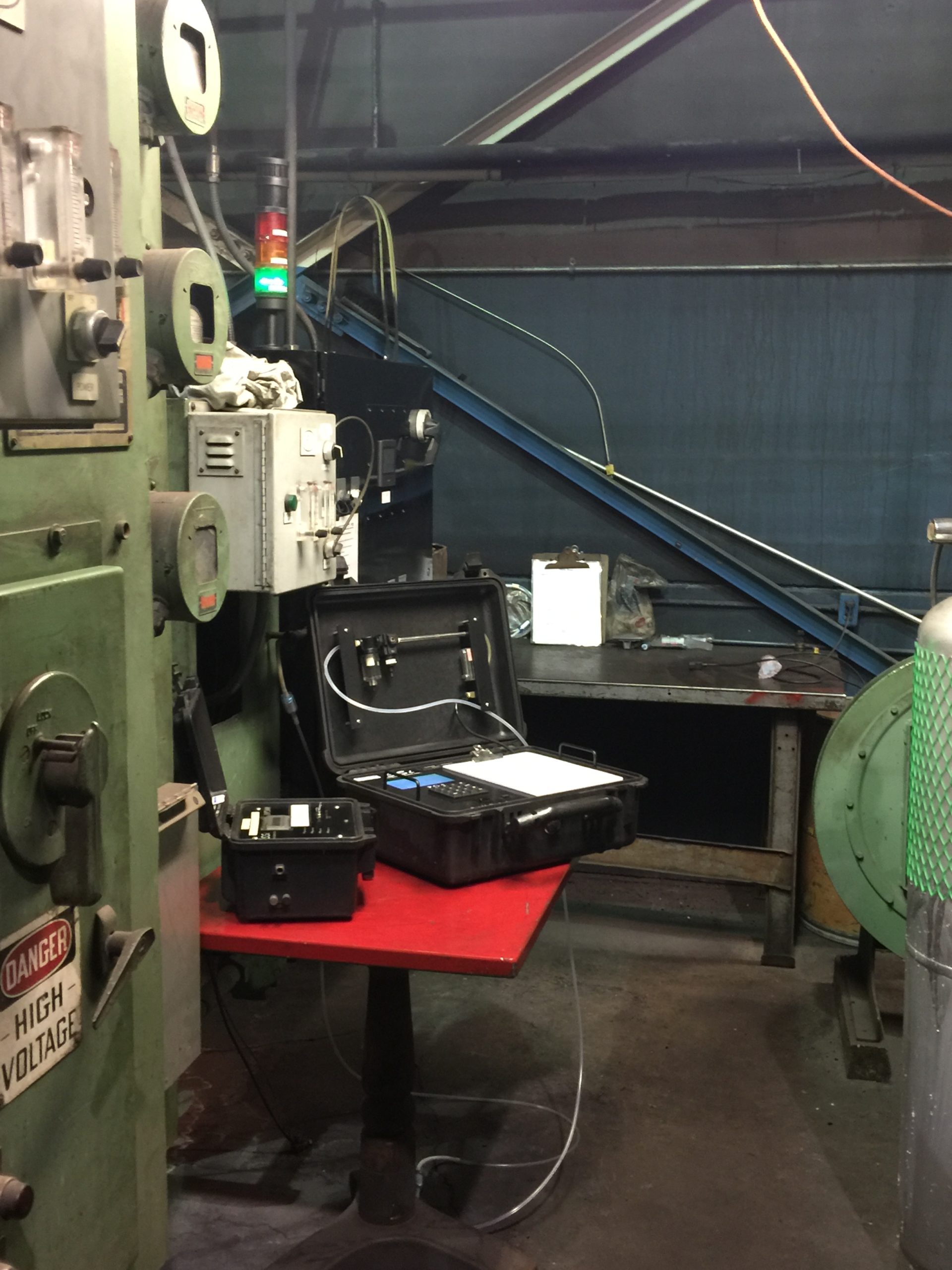
Investing in and using an oxygen analyzer on a regular basis can provide significant fuel cost savings and, at the same time, optimize uniformity and maximize capacity.


Photo Credit: Super Systems, Inc. (SSi)


Heat Treat Tip #26

Flow Power

Pressure varies as the square of the flow. This means that to double the flow, with all else being constant, pressure must increase by a factor of 4. Also, power increases as the cube of the flow. Doubling the flow produced by a fan or blower requires an 8-fold increase in horsepower.


Heat Treat Tip #77

Puzzling Polarity?

If unsure of the polarity of a type K thermocouple, remember that the negative (red) leg is magnetic; the positive (yellow) is not.


Heat Treat Tip #94

Copper as a Leak Check

If maintaining dew point is a problem, and it’s suspected that either an air or water leak is causing the problem, run a piece of copper through the furnace. Air will discolor the copper; water will not.


Heat Treat Tip #97

Optimum Dew Point

It is much easier to produce low dew point gas in a generator (within reason) than it is to lower the dew point after the atmosphere is in the furnace using enriching gas.


Photo Credit: Super Systems, Inc. (SSi)

Heat Treat Tips: Atmospheres, Thermocouples, and Flow Power Read More »

Reader Feedback: Reusing Non-expendable Base Metal Thermocouples

Here is what readers are saying about recent posts on Heat Treat Today. Submit your comments to editor@heattreattoday.com.

Jason Schulze has written numerous articles for HTT about AMS2750E. Check them out by searching “Jason Schulze” at www.heattreattoday.com


Jason Schulze, Aerospace Heat Treating
Jason Schulze, Conrad Kacsik

READER QUESTION: As per AMS2750E, what is the number of reuses for nonexpendable base metal thermocouples (N type MIMS TCS) above 980°C? Our application is TUS and SAT from 700°C  to 1250°C. We would like to use N type MIMS thermocouples for both TUS and SAT. Recalibration period is specified as 3 months for N type thermocouples in AMS2750E. But no details are provided for the number of reuses above 650°C.

Jason Schulze (Conrad Kasik) for HTT: The number of permitted uses depends on the intended use of the thermocouple. For example, if the Type N thermocouples are used at 980°C (1796°F) as load thermocouple, the maximum permitted use would be 3 months or 180 uses, whichever comes first. If the thermocouple is used as a resident SAT thermocouple, it would need to be replaced every three months. In this case, the usage limit would be limited to 3 months. This will not be changing when the new version of AMS2750F is released.


We welcome your inquiries to and feedback on Heat Treat Today articles. Submit your questions/comments to editor@heattreattoday.com.

Reader Feedback: Reusing Non-expendable Base Metal Thermocouples Read More »

The Class of 2019 40 Under 40: Heather Falcone & Trisha Rouse

Heat Treat Today is privileged to oversee the 40 Under 40 recognition awards highlighting a group of young, up-and-coming talent in the North American heat treat industry every year. This year’s Class of 2019 is no disappointment–a group of industry elite, significant contributors to the heat treat market.

Every couple of weeks we highlight two of the current class of recipients. This week we introduce Heather Falcone of Thermal Vac Technology Inc. and Trisha Rouse of General Motors.


Name: Heather Falcone

Company: Thermal Vac Technology Inc.

Position: CEO

Heather’s passion lies in breaking things: whether it’s revenue goals, glass ceilings, or tired rhetoric, her 17-year track record in one of the world’s most exacting industries shows a dedication to destroying the status quo. As CEO of Thermal-Vac Technology, she has led the company to a 65% growth rate in the past four years, resulting in the company being recognized in several awards. She is a recognized trainer, writer, and public speaker on a variety of topics and her professional associations include: voting member of NADCAP heat treat task group, professional member of MTI, and participant in other professional societies and peer advisory groups. Her impact at Thermal-Vac is demonstrated in the implementation of several projects, such as a fully compliant NIST 800-171 and DFAR 252.204-7012 cyber security program and a foundational business management system called EOS, as well as the implementation and successful accreditation to AS 9100:D and ISO 9001:2015. As an Ironman triathlete, alpine hiker, wife, and mother, Heather seeks to promote growth and opportunity outside of people’s comfort zones with an invitation to be “Green and Growing”, to reject mediocrity, and embrace their unique talents to create meaningful and lasting legacy impact.

Nominated by: Thermal Vac Technology


Name: Trisha Rouse

Company: General Motors

Position: Senior Materials Engineer

Trisha Rouse is a brilliant materials engineer. Holding a position of Senior Materials Engineer at GM, she is currently supporting the Transmission Gear and Shaft Program Management Team of GM, providing metallurgical expertise for new product development as well as supporting the resolution of production and customer concerns. Her experience in the industry is unique as she has background in not only design but also running metallurgical labs, working with customers, and overseeing production deadlines. Trisha has a great personality and is alumna of Michigan Technological University’s Material Science and Engineering program.

Nominated by: Dr. Valery Rudnev, FASM, IFHTSE Fellow, “Professor Induction”; Director, Science and Technology, Inductoheat, Inc, an Inductotherm Group Company


Read more about the feature at Heat Treat Today’s 40 Under 40 resource page and find out more about each of this year’s winners by clicking on their image. To nominate someone for the Class of 2020 40 Under 40, please click here.

The Class of 2019 40 Under 40: Heather Falcone & Trisha Rouse Read More »

Inside GKN Powder Metallurgy’s Acquisition of Forecast 3D

Picture two men sitting at a bar table watching a video on a smartphone. As they enthuse about how much they love it, a bystander might be tempted to think they’re just killing time goofing off. “It’s fantastic technology,” the man with the phone, Forecast 3D founder and CEO Corey Weber, says of the Multi Jet Fusion (MJF) process featured in the time-lapse video that shows a Californian facility in the dead of night illuminated only by the passing of a dozen lights flashing over a dozen powder beds through until the morning. As he pulls back his smartphone, he and Guido Degen, GKN Powder Metallurgy’s President of Additive Manufacturing, look pleased with both the technology and themselves.

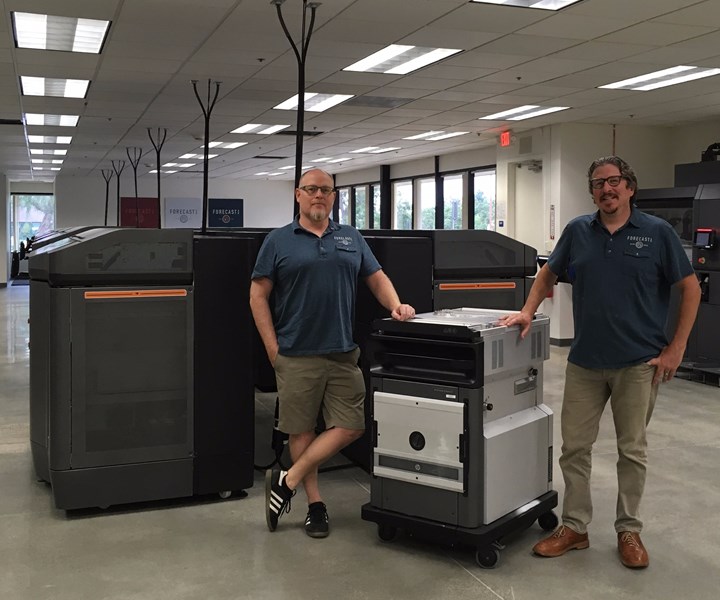
Corey and Donovan Weber, Forecast 3D, and Guido Degen, GKN

GKN Powder Metallurgy’s acquisition of Forecast 3D appears to be natural synergy. Much of Forecast 3D’s expertise exists in polymer 3D printing, serving the aerospace and medical markets on the West Coast. GKN’s focus is metal parts, the bulk of which is for the automotive market in Central Europe and the Midwest of the United States. When GKN highlighted the contrasting technological expertise that exists in both companies, the figureheads at Forecast were on the same wavelength.

Corey and Donovan Weber, the two brothers who founded Forecast 3D, shown in 2017 at their 3D Manufacturing Facility in Carlsbad, California.

“We knew that the opportunity is much bigger than the size of our pockets,” Weber acknowledges. “We needed resources and our goal was to get someone that shared our vision. We found those with GKN. . . . And, honestly, it’s kind of a relief because now we can really focus on polymers and let them handle metals.”

To read more from the original article, click here: https://www.tctmagazine.com/3d-printing-news/gkn-powder-metallurgy-forecast-acquisition-deal/


Inside GKN Powder Metallurgy’s Acquisition of Forecast 3D Read More »

DELTA H Commissions Heat Treating System to AAR Corp

DELTA H commissioned a Dual Chamber Aerospace Heat Treat (DCAHTTM) to AAR Corp. at Indianapolis International Airport. AAR is a leading provider of aviation services to commercial airlines and governments worldwide. At its Indianapolis MRO facility it performs heavy maintenance with a focus on the Boeing 737.

Kelly Sauer,
VP of Quality, AAR

The DELTA H dual chamber furnace meets our needs as an effective, efficient and complaint heat treatment solution,” stated Kelly Sauer, AAR Corp’s Vice President of Quality.

Ellen Conway Merrill,
VP, DELTA H

“As the largest independent MRO in North America and one of the top five MRO providers in the world, it’s truly humbling to have earned AAR’s trust for their in-house heat-treating capabilities,” stated Ellen Conway Merrill, DELTA H Vice President. “The commissioning service at AAR Indianapolis included full qualification testing as well as training certificates for operators and QC/QA. The DELTA H DCAHTTM furnace system enabled AAR to quickly qualify for not only aluminum, but also aging of PH stainless steel and titanium.”

The DELTA H DCAHTTM furnace features dual chambers operable to 1200°F and 500°F with precision control and temperature uniformity, and a roll-away stainless-steel quench tank. The system qualifies as Class 2 (+/-10°F) per AMS2750E and includes all controls, data acquisition technology, and spares parts package to be in full compliance with all aerospace pyrometry standards and National Aerospace and Defense Contractors Accreditation Program (Nadcap).

DELTA H Commissions Heat Treating System to AAR Corp Read More »

Powder Metal Company Serving Automotive Industry to Add Sintering Furnace

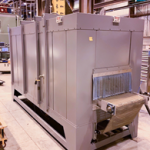
A company specializing in manufacturing high volume, ferrous-based powder metal components in the automotive market has placed an order with Abbott Furnace Company for an electrically heated continuous belt sintering furnace to be delivered in the 2nd quarter of 2020. The furnace is rated at 2,150° F and also includes the unique Abbott Varicool Cooling System.

Additionally, Abbott is also fulfilling an order for an electrically heated continuous belt soft magnetic alloy processing furnace from a manufacturer in the powder metal industry providing components to the metals and mining market. Their furnace will also ship in the 2nd quarter of 2020. The furnace has a maximum temperature of 1850° F in an air, nitrogen, or steam atmosphere and includes a Delube chamber, oxidation chamber, water-jacketed cooling chamber, and a Thermostack thermal oxidizer.  The furnace will be controlled through an Allen Bradley Micrologix PLC. This furnace design will help the P/M industry to grow in the electrification segment of the market.


Powder Metal Company Serving Automotive Industry to Add Sintering Furnace Read More »

Meet Rio Tinto’s Revolutionary New Alloy

Global mining and metals specialist Rio Tinto is taking orders for its new aluminum wheel alloy known as Revolution-Al™. Researchers at its Arvida Research and Development Centre in Quebec, Canada, have spent more than five years developing a stronger car wheel alloy that would help cut fuel consumption and improve both safety and handling. The London-based firm says it received its first order for the new Revolution-Al™ alloy in September 2019 and that it designed the alloy to be easy to recycle.

Jerome Fourmann,
Technical Director,
Rio Tinto

“We wanted to offer automakers a new, innovative alloy that allowed them, through styling and design, to reduce the weight of the wheels, which is very important to improving fuel efficiency – because, in the end, people want to drive not just the safest but also the greenest and most innovative cars,” states Jerome Fourmann, a technical director at Rio Tinto.

According to Rio Tinto, Revolution-Al™ is 15 to 20 percent stronger than the current predominant wheel alloy, A356.2. They claim this translates to a 7 percent weight reduction and improved fuel efficiency or battery range. Additionally, Rio Tinto claims, Revolution-Al™ can be cast in existing facilities and requires less time to produce a wheel, thereby reducing the cost and increasing the rate of production.

The improved alloy features numerous claims; for instance, it is said to be 15 to 20% stronger than the traditional A356.2 alloy, has a seamless transition with existing casting processes, and requires a 2-hour shorter ageing cycle for heat treatment than the A356.2 alloy.

Jean-Francois Laplante,
Industrial Product and Investment Director,
Rio Tinto

It is worth noting that industrial trials of the new alloy, along with an official OEM test program, featured an optimized automotive wheel design, and Revolution-Al™ passed all OEM trials. What’s more, the alloy can be recycled onto itself, eliminating the need for selling the scrap at a discount.

“The current wheel alloy has been around for a long time and now we’re coming to the market with a new way of doing things,” says Rio Tinto Industrial Product and Investment Director Jean-Francois Laplante. “We were super excited when we saw the result.”

Photo Credit: Light Metal Age

Meet Rio Tinto’s Revolutionary New Alloy Read More »

Skip to content