

John Clarke

Natural Gas Revisited

OCNatural gas is the dominant energy source used by heat treaters and its price and availability is critical to all U.S. industry, so let’s look at the data and nail down some simple quantitative facts and maybe answer this pressing question: How will the war in Ukraine impact natural gas production and consumption?

This column is a Combustion Corner feature written by John Clarke, technical director at Helios Electric Corporation, and appeared in Heat Treat Today’s May 2022 Induction Heating print edition.

If you have suggestions for savings opportunities you’d like John to explore for future columns, please email Karen@heattreattoday.com.


John B. Clarke
Technical Director
Helios Electric Corporation
Source: Helios Electrical Corporation

As political pundits seek to explain the cause and impact of the war in Ukraine, I am struck by the lack of quantitative information they use to support their opinions and analyses. Given the complexity of the U.S. energy market, with a myriad of imports and exports between countries (especially Canada and Mexico), it is no wonder that people can support any preconception they have by simply omitting this import or that export. As always, we will focus exclusively on natural gas.

Let’s start with some basic facts. FACT: 40% of our electricity in the U.S. in 2021 was generated using natural gas1 and 20% of electricity generated in Europe is from natural gas2 — so even a vacuum furnace runs on a substantial quantity of this fuel.

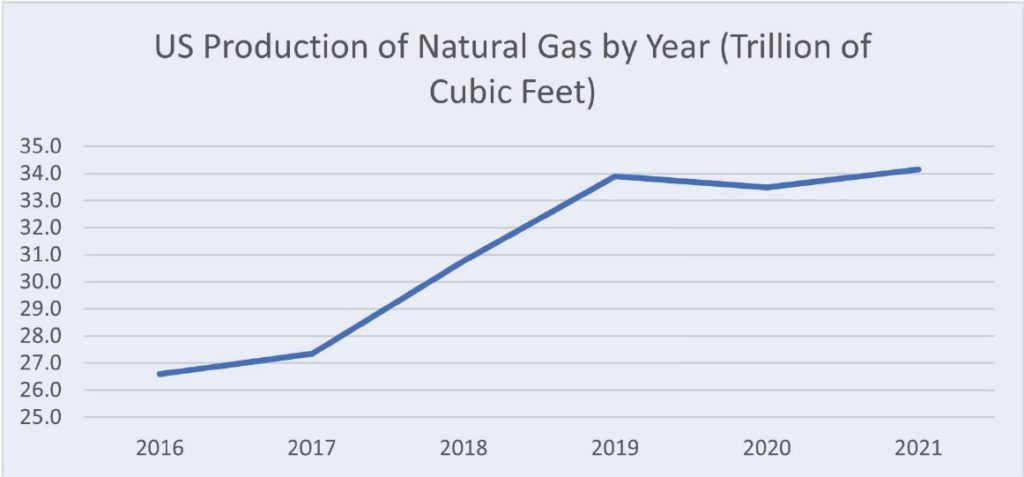
One of the challenges when discussing energy markets is the many different units of measure people use to describe production, consumption, and costs. Our preferred unit of measure for natural gas production and consumption will be trillion cubic feet or 1 quadrillion British Thermal Units (BTU)* per year (one cubic foot of natural gas contains 1000 BTU (HHV)). To put this in perspective, if we pay $4.70 per mmBTU** — one trillion cubic feet is valued at 4.7 billion dollars. In 2021, the United States produced 34.1 trillion cubic feet or roughly 161 billion dollars of dry natural gas.


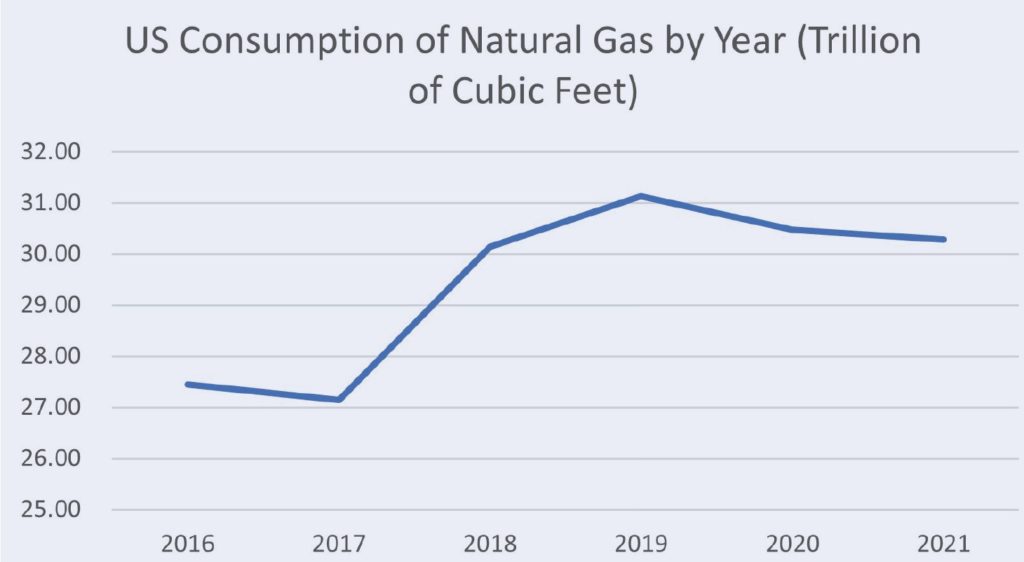
FACT: U.S. production of natural gas was at an all-time high in 2021 and is rising.3, 4 The U.S. is the largest producer of natural gas in the world by a significant margin. U.S. consumption has fallen over the last two years because of our COVID recession — but it is projected to rise in 2022.


Liquified Natural Gas (LNG) Exports

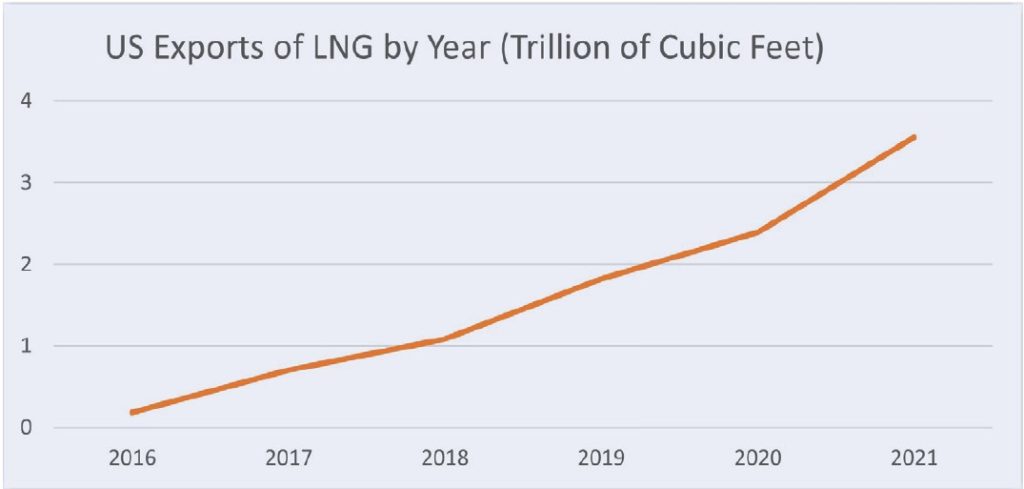
Natural gas can be exported via ship in its liquified state. The following graph shows the U.S. exports of LNG in recent years.5 Our ability to export LNG is limited by facilities that compress and cool the gas to its liquid state and the availability of tankers to move the gas across the ocean. Both ports and ships require significant capital investments and take time to construct — so there is a limit to the rate we can expand exports. Even as we export LNG, we continue to import some natural gas from Canada — but we are obviously a net exporter of natural gas by a considerable margin.

FACT: In 2021, the U.S. exported roughly 10% of the natural gas it produced as LNG. The U.S. is currently the largest exporter of LNG6 while Russia is the largest exporter of gaseous natural gas. Australia and Qatar are also major players in the LNG export market, and we may see these three countries vying for the top spot in the coming decade. The big advantage enjoyed by LNG is once liquified, it is a fungible source of energy — it can be exported to anywhere with a suitable port. Gaseous natural gas must travel through a pipe.

In 2021, the European countries in the Organization for Economic Co-operation and Development (OECD) together imported about 80% of the natural gas they use. Of this number, roughly 6.6 trillion cubic feet per year is imported from Russia, the largest importers of Russian gas include Germany — 1.70, Turkey — 0.95, Italy — 0.92, and France — 0.62 trillion cubic feet per year.

The U.S. has significantly expanded its LNG supplies to Europe in 2019—20217 to an annual rate of 1.86 trillion cubic feet in January of 2022,8 but LNG import capacity is still limited — with additional import facilities coming online in the next few years. Prior to 2019, Europe had little volume of LNG imports, so all the movement of natural gas was by pipeline.

While our price for natural gas in the U.S. has gone up considerably in the last year (approaching a mean of about $5.00 per mmBTU on the spot market), the price in Europe is running about six times as much — $30.00, with recent spikes as high as $60.00 per mmBTU. So, we load a typical LNG tanker with $15 million in natural gas in the U.S., and in 20 days, we lose 4% of the load to vapor, which we burn to power the ship, and offload $86 million at a port in Germany. Of course — this is an oversimplification, but the point is obvious. This price differential will continue to drive the market to invest in new production, LNG ports and ships — and apply upward pressure to our domestic price.

With or without the instability caused by the Russian invasion of Ukraine, we can expect a reliable supply of natural gas to fuel our furnaces and generate our electricity in the United States, but we can also expect higher prices to remain with us for the foreseeable future. Can the U.S. supplant Russia’s natural gas imports? The data indicates the answer is yes — but it will take time and investment. No matter what the outcome of the current war, the West will question the reliability of Russia as an energy supplier and explore all options to lessen their dependency on Russia’s oil and natural gas exports.


*1 BTU is the energy required to heat 1 pound of water, 1 degree Fahrenheit.

**Rough Henry Hub Price per mmBTU of natural gas at time of publication

References

[1] “Electricity explained: Electricity in the United States,” EIA.gov, March 18, 2021, https://www.eia.gov/energyexplained/electricity/electricity-in-the-us.php#:~:text=Natural%20gas%20was%20the%20largest,power%20plants%20use%20steam%20turbines.

[2] Statistical Review of World Energy — 2021. PDF File, 2021, https://www.bp.com/content/dam/bp/business-sites/en/global/corporate/pdfs/energy-economics/statistical-review/bp-stats-review-2021-eu-insights.pdf.

[3] Kirby Lawrence and Troy Cook, “EIA forecasts U.S. natural gas production will establish a new monthly record high in 2022,” EIA.gov, December 16, 2021, https://www.eia.gov/todayinenergy/detail.php?id=50678.

[4] “Natural Gas Summary,” EIA.gov, February 28, 2022, https://www.eia.gov/dnav/ng/ng_sum_lsum_a_EPG0_FPD_mmcf_a.htm.

[5] “Liquefied U.S. Natural Gas Exports,” EIA.gov, February 28, 2022, https://www.eia.gov/dnav/ng/hist/n9133us2A.htm.

[6] Mundahl, Erin. “We’re #1! U.S. Ends 2021 as World’s Largest LNG Exporter,” energyindepth.org, January 5, 2022, https://www.energyindepth.org/were-1-u-s-ends-2021-as-worlds-largest-lng-exporter/.

[7] Victoria Zaretskaya and Warren Wilczewski, “Europe relies primarily on imports to meet its natural gas needs,” EIA.gov, February 11, 2022. https://www.eia.gov/todayinenergy/detail.php?id=51258.

[8] EU-US LNG Trade: US liquefied natural gas (LNG) has the potential to help match EU gas needs, PDF File, March 2022, https://energy.ec.europa.eu/system/fi les/2022-02/EU-US_LNG_2022_2.pdf.

About the Author:

John Clarke, with over 30 years in the heat processing area, is currently the technical director of Helios Corporation. John’s work includes system efficiency analysis, burner design as well as burner management systems. John was a former president of the Industrial Heating Equipment Association and vice president at Maxon Corporation.


Find heat treating products and services when you search on Heat Treat Buyers Guide.com


Natural Gas Revisited Read More »

The “Known – Unknown”: Preparing Your Facility for Unpredictable World Events

op-edThe “Known – Unknown,” the “Undiscovered Country,” the “Movement from cocksure ignorance to thoughtful uncertainty.” It doesn’t matter if you get your catch phrase from Donald Rumsfeld, Star-Trek, or that plaque your mother kept above the kitchen sink, the implication is the same: we really don’t know what the future holds. But, the Unknown of which I speak in this article is natural gas prices.

This column is a Combustion Corner feature written by John Clarke, technical director at Helios Electric Corporation, and appeared in Heat Treat Today’s March 2022 Aerospace print edition.

If you have suggestions for savings opportunities you’d like John to explore for future columns, please email Karen@heattreattoday.com.


John B. Clarke
Technical Director
Helios Electric Corporation
Source: Helios Electrical Corporation

Does “What happens in Eastern Europe stays in Eastern Europe” hold true? Unfortunately — no.

We have learned from recent and ongoing supply chain issues just how interconnected our economy and manufacturing sector is with the rest of the world. The standoff in Ukraine has the potential to impact the world energy markets for years to come, and I suspect this impact will be felt no matter what transpires. I am certainly no expert, but I have a sinking suspicion that our country offered some American methane molecules to Germany to stiffen their resolve to cancel the Nord Stream 2 pipeline. If the EU works to reduce their dependency on Russian natural gas, a significant portion of worldwide exports are removed from the supply side of the equation. From a practical standpoint, these shifts in supply will take some years to achieve, but we have seen a new realization on the part of business and governmental leaders about the importance of robust and reliable supplies of commodities, and manufactured goods and manufacturing capacity. So, less natural gas supply with rising demand equates to higher prices. And as we have discussed previously, liquefied natural gas transportation from the U.S. to the rest of the world is connecting our natural gas market with the world market — and our natural gas price will be affected by consumption and production factors worldwide, just as the price we pay for petroleum oil today is determined in New York, London, and Riyadh — following the consumption patterns in Beijing, Sydney, and Tokyo.

Ok — let’s get back to what we can do in our own facilities to insulate ourselves, to some degree, from unpredictable world events.

Recuperation, or preheating combustion air using the waste heat exiting the furnace or oven is a time proven method to reduce fuel gas consumption. Before we quantify the effect of preheating air, we need to briefly discuss what affects this heated air has on the combustion process. Higher combustion air temperatures are associated with the following:

  1. Peak flame temperatures are increased. As less energy is used to heat the incoming air, the energy in the natural gas can raise the products of combustion (CO2, H2O and N2) to a higher temperature than would be achieved without combustion air preheating. This can be either beneficial or problematic for a specific application. If the work being heated can accept increased radiation from these higher temperatures — heating rates are improved and throughput increased, but these higher temperatures may reduce the life of furnace components, or, in extreme cases, lead to a catastrophic failure.
  2. Flame speeds are increased, so the combustion process concludes in less space. Again, this is a double-edged sword, benefiting some and leading to a loss on temperature uniformity in others.
  3. Total products of combustion required for any quantity of heat input is reduced. Mass flow is especially important in systems where the operating temperature is below approximately 1200°F. If the energy saved leads to a loss in temperature uniformity, it may be a Pyrrhic victory.
  4. NOx formation is increased. Burner technology has come a long way in recent years to allow for systems to use these higher temperatures without greatly increasing NOx emissions, but the rule of thumb is that by increasing the combustion air temperature from 70°F to 800°F, we basically double NOx formation.

Each of these drawbacks, other than NOx formation, may be a plus rather than a minus for any application. Float glass furnaces (plate glass used in windows) and ingot reheat furnaces are examples of applications where recuperation was applied a century or so ago, at a time where fuel costs where not much of a factor. In both cases, the increased flame temperatures accelerated the heat transfer to either the glass or the steel, increasing production. These applications required furnace temperatures where combustion without preheating would have been impractical — as most of the energy would have been lost in the flues, and very little heat would be available to do any useful work.

What questions should I ask? How much can I save? What is my project’s estimated payback? All are critical questions. To start with, can your existing furnace accept these higher flame temperatures, and can you capture the heat and apply a cost-effective heat exchanger? An example would be a radiant tube furnace. Applying recuperation may require an upgrade in the alloy used in the burner and radiant tube. In direct fired applications, will my uniformity suffer? In general, this is a greater concern at temperatures below 1600°F. As the operating temperatures increase, we can generally expect better uniformity. (I can hear the furnace and burner experts reading this cry “foul,” and they are right, it is not wise to rely on my generalizations — always consult an expert about your specific application.)

How much will it cost? With recuperation, it is best to take advantage of an experienced person’s mistakes, rather than making them on your own. Consult a qualified contractor, OEM, or consultant to help with the application and costs.

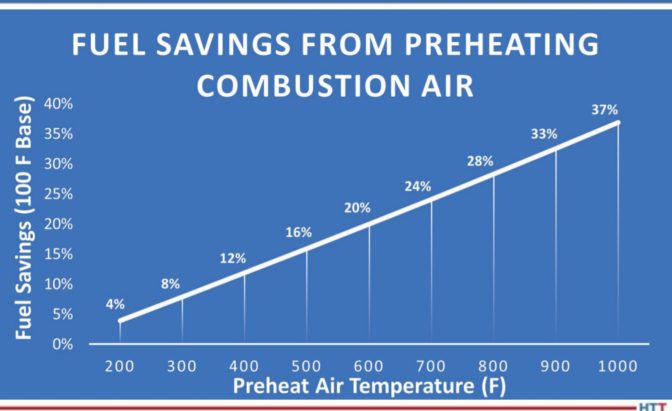
How much can be saved? To answer that question, I provide the above graph. It is not the end all be all but will provide a rough estimate of potential savings. It is for an application with an exhaust temperature of 1600°F operating with 15% excess air.

As we can see, in this application, if we apply recuperation to preheat the air to 800°F, we will save 28% of the natural gas we would otherwise consume.

Before investing your money, an individual analysis of each application is required. This article’s purpose is simply to motivate the reader to invest the time necessary to properly determine, as I mentioned last month, if they have “uncashed checks” lying around their shop.

As always, please let me know if you have any questions.

About the Author:

John Clarke, with over 30 years in the heat processing area, is currently the technical director of Helios Corporation. John’s work includes system efficiency analysis, burner design as well as burner management systems. John was a former president of the Industrial Heating Equipment Association and vice president at Maxon Corporation.


Find heat treating products and services when you search on Heat Treat Buyers Guide.com


The “Known – Unknown”: Preparing Your Facility for Unpredictable World Events Read More »

Are You Holding on to Uncashed Checks?

op-ed

To not invest money in worthwhile projects makes as much sense as not depositing your paycheck. In this column, we will briefly look at energy and gas “checks” you might have received in the mail but have yet to cash.

This column is a Combustion Corner feature written by John Clarke, technical director at Helios Electric Company, and appeared in Heat Treat Today’s February 2022 Air & Atmosphere Furnace Systems print edition.

If you have suggestions for savings opportunities you’d like John to explore for future columns, please email Karen@heattreattoday.com.


John B. Clarke
Technical Director
Helios Electric Corporation
Source: Helios Electrical Corporation

The late Fred Schoeneborn, a long-time energy consultant and friend, described energy savings opportunities that have been identified but not exploited as uncashed checks. To expand on Fred’s metaphor, not to look for opportunities to save natural gas is the equivalent of not collecting and opening your mail.

A furnace or oven is a box that contains the work being processed and the heat used in the process. It is an imperfect box because we are always losing heat. While it is imperfect, there are often opportunities to improve your oven’s performance, saving energy and generally improving quality. (You may notice if you have read a few of my columns, energy savings and quality improvements nearly always coexist.)

At the start of this series, we asked several questions. This time we will consider the following:

  1. Is my furnace or oven at the correct internal pressure?
  2. Is it time to rebuild door jams?
  3. How much fuel is wasted because I am not containing heat within the furnace or letting excessive air reduce my combustion efficiency?

Furnace pressure (in a non-vacuum application) is the simple function of the volume of the material introduced vs. the area of all the openings in our box. The obvious inputs are the products of combustion for direct fired systems, or the atmosphere for indirect systems.

What is the optimum pressure for my system? In general, the best pressure is the lowest pressure at which no tramp or unwanted air can enter the system and contaminate the atmosphere or upset the temperature uniformity. The lower the pressure, the less chance we will have excessive losses around door seals or other furnace penetrations. Most commonly, these pressures are measured in the hundredths or tenths of inches of water column.

In many applications, door sealing surfaces or jams take quite a beating. Their maintenance is expensive in terms of money, labor, and lost production. Expensive, yes, but the cost of NOT maintaining these surfaces may be much more. Losses are a result of radiant and convective losses, but most significantly, product quality because of atmosphere contamination or areas of the furnace not reaching setpoint temperature. When should we maintain these surfaces? In general, the best results I have observed are people who schedule surface maintenance periodically based on wear and available furnace downtime.

Calculating the savings from these fuel savings is more difficult, but in general, maintaining a consistently uniform interior work area saves more than the energy conserved.

About the Author:

John Clarke, with over 30 years in the heat processing area, is currently the technical director of Helios Corporation. John’s work includes system efficiency analysis, burner design as well as burner management systems. John was a former president of the Industrial Heating Equipment Association and vice president at Maxon Corporation.

Are You Holding on to Uncashed Checks? Read More »

Heat Treat Tomorrow – Hydrogen Combustion: Our Future or Hot Air?

OCDoug Glenn, publisher of Heat Treat Today, moderates a panel of 5 experts who address questions about the growing popularity of hydrogen combustion and what heat treaters need to do to prepare. Below is an excerpt of this lively and compelling discussion. 

To view the 1-minute trailer or register to watch this FREE video, go to www.heattreattoday.com/2021-09-H2-Vid

Today’s Technical Tuesday was originally published in Heat Treat Today's December 2021 Medical & Energy print edition.


Introduction

Doug Glenn (DG): Welcome to this special edition of Heat Treat Radio, a product of Heat Treat Today. We’re calling this special episode “Heat Treat Tomorrow: hydrogen combustion. Is it our future or is it just a bunch of hot air?” This discussion is sponsored by Nel Hydrogen, manufacturers of on-site hydrogen generation systems. I’m your host, Doug Glenn, the publisher of Heat Treat Today and the host of Heat Treat Radio. I have the great privilege of moderating this free-for-all discussion today with five industry experts who I’d like to introduce to you now.

Perry Stephens
Electric Power Research Institute (EPRI)

Dr.-Ing. Joachim G. Wünning
President
WS Wärmeprozesstechnik GmbH

First, Perry Stephens. He is the principle technical leader of the Electric Power Research Institute (EPRI) and currently leads the end-use technical subcommittee of the low carbon resource  initiative (LCRI) which is a collaborative eff ort with the Gas Technology Institute (GTI), and nearly 50 sponsor companies and organizations. They aimed at advancing the low carbon fuel pathways on an economy-wide basis for the achievement of decarbonization. EPRI is a member of the Industrial Heating Equipment Association (IHEA).

Joachim Wuenning (Joe Wuenning) is the owner and CEO of WS Thermprocess Technic Gmbh [WS Wärmeprozesstechnik GmbH] in Germany and WS Thermal Process Technology, Inc. in Elyria, Ohio. Joe’s company has been on the cutting edge when it comes to hydrogen combustion. In fact, the last time I heard you, Joe, was at the Thermprocess show in Düsseldorf, where you gave the keynote address regarding the advent and development of hydrogen combustion. Joe’s company has been a leader in hydrogen combustion. Joe’s company is an IHEA member as well. Joe is our European representative, and may provide us with a different perspective.

John Clarke is the technical director of Helios Electric Corporation (Fort Wayne, Indiana), a company that specializes in energy and combustion technologies. John is also a regular columnist for Heat Treat Today and a past president of IHEA.

Jeff Rafter is vice president of sales and marketing for Selas Technologies out of Streetsboro, Ohio and has a rich history in the combustion industry as well, including many years with Maxon Corporation. He’s got 28 years of industrial experience in sales, research and development, and marketing. He’s a combustion applications expert in process heating, metals refining, and power generation and has also served 10 years on the NFPA 86 committee and holds a patent for ultra-low NOx burner designs. He is also an IHEA member.

Finally, we have Brian Kelly with an equally rich history in combustion, spending most of his years at Hauck Manufacturing in Lebanon, PA, where he did a lot in sales and engineering before they were purchased by Honeywell. Brian currently works for Honeywell Thermal Solutions and is also an IHEA member.

Gentlemen, thank you for joining us. Let’s just jump right in. Brian, since I picked on you last, let’s go to you first on the questions.

Is Hydrogen Combustion the Future?

DG: Is this hydrogen combustion thing coming? And, if so, how soon and what’s driving it?

Brian Kelly (BK): It is coming and there is going to be a lot of back and forth in that it doesn’t make sense and all that. It is here. We’re seeing inquiries from customers that ask, “Hey, do we have burners that do this, control systems and stuff that do that?” The news that I get emails on, for example, is that with one of the steel companies in Europe, they already said their plan is totally going to be hydrogen. We’re delivering billets right now of hydrogen.

So, yes, it’s coming. Is it coming soon? It’s here today. Widespread? That’s going to be a longer road. I think you’re going to hear from people that know more about it than I do, but, certainly from industry buzz, we’re testing burners, we’re making sure our burners run on partial hydrogen, full hydrogen, safety valves, control valves, and all that is definitely within a lot of the testing that we’re doing right now beyond the usual R&D on lower emissions burners and things of that nature.

Jeff Rafter (JR): I have a slightly different answer, but I agree with Brian. I think hydrogen combustion has been here for over a century. The difference has been, it’s been largely restrained to a few industries that have a regular hydrogen supply. A great example would be refining and petrochemical industries. We have had, for literally decades, burners designed to burn pure hydrogen, for example, in applications like ethylene crackers.

The fundamentals of hydrogen combustion are very well known. The next evolution that we’re currently in the process of seeing is taking more industries into an availability of hydrogen as a fuel and modifying designs and process heating equipment to accept it. There are fundamentally a lot of changes that occur when you switch the fuel, and we can get into more of those later with more relevant questions, but it doesn’t come without challenges. There is quite a bit to be done, but I think the fundamental science is already well-known. There is a lot of design work to be done and there is a lot of economic and supply development yet to be had.

John Clarke (JC): Yes, I certainly think it is coming, but the timing is uncertain. And, when I say “coming,” I mean deployed in a certain or large volume. When we simply talk about hydrogen, I do think the order of deployment is somewhat predictable and when it comes to pure hydrogen, I think it will likely be deployed first for transportation, and only after that need is met, as a process heating fuel, widely. Now, if there is a breakthrough in battery technology, this order of deployment may change. But, right now, it looks like hydrogen represents an opportunity for higher energy density for long haul transportation. And, if we’re pushing hard to reduce CO2 or carbon emitted, I think policy will be implemented in a means to maximize a reduction of carbon. That’s where I think they’ll be pushing harder.

Now, that said, partial hydrogen, blending hydrogen into natural gas, is likely to occur perhaps sooner than that.

Joachim Wuenning (JW): Not really. I think a lot of things were said correctly and I strongly believe it has to come. If you believe in climate change, it must happen because we cannot use fossil fuels forever. I also don’t believe that we will have an all-electric world. I don’t believe in nuclear power, so we cannot get all our energy from that, therefore, chemical energy carriers will be necessary for storage and long-haul transportation. Is it coming soon? Of course, it is hard to predict how fast it will be. Now, fossil fuel is cheap so it will be hard to compete with as hydrogen is likely to be more expensive.

But certainly, what we see is the requirement from our customers to have hydrogen ready burners. Because, if they invest in equipment at that point, why would they buy a natural gas only burner. They should, of course, look for burners which are able to do the transition without buying all new equipment again. So, we have a lot of projects momentarily to demonstrate the ability of the equipment to run with hydrogen or natural gas and, preferably, not even readjusting the burners if you switch from one to another gas.

Perry Stephens (PS): I’ll try to add something a little different. At EPRI, we’re charged with providing the analysis and data from which other folks, like these gentlemen, are going to try to base important business decisions. Our work hasn’t focused specifically on hydrogen, but, more generally, the class of alternate energy carriers — molecules, gas, or liquid — that can be produced in low carbon first energy ways through renewable energy sources. A lot of our work is focused on understanding the pathways from the initial energy which as a biomass source, solar, wind, could be nuclear, could be hydro. These sources of electric power that ultimately have to be used to produce this low carbon hydrogen. One other pathway is hydrogen or hydrogen-based fuels produce the steam methane reformation process which uses a lot of hydrocarbons but would then require carbon capture and sequestration. The CO2 from these processes could be employed in a circular economy fashion. So, we look at all of these.

The real challenge is the challenge of cost. How do you produce this hydrogen or alternate fuel? And there are many other potential fuel molecular constructs that could be deployed. Ammonia is one being discussed in some sectors. And then how do you transport them, store them, and what is their fuel efficiency and the cost of either new equipment or conversion of existing equipment to deploy those. We’re not specifically focused on hydrogen. It is a very important energy carrier. It can be blended with fossil fuels in the near-term and then maybe expanded in the long term to higher percentages up to pure hydrogen depending on the application, depending on where you produce it. These costs must be evaluated and that is a big job that we’re doing at EPRI with our LCRI initiative right now. We are trying to understand that techno economic analysis, that is, what makes the most sense for each sector of the economy.

Why Not Electricity?

DG: Thanks, guys. Joe had mentioned global warming, a driving force here. Why not electricity? Why don’t we just convert everything over to electricity? Perry, you’re with EPRI, let’s start with you on that. Instead of going just straight-out hydrogen, why not just go to electricity?

PS: I think the question again rephrased might be, “when electricity and when hydrogen” because I think that’s really what we’re trying to decide. There are interesting areas of research involving catalysis techniques that dramatically improve the net energy efficiency of chemical processes, for example, that might make direct electrification of certain processes more competitive. There are electric technologies for the low- to midrange temperatures that are attractive and use pieces of the electromagnet spectrum to produce transformation of products, heating and/or other transformations, that are very cost effective today. So, we judge that a portion, maybe something approaching 30% of the remaining fossil fuel, could be electrified. A certain chunk, a quarter, maybe reduced consumption through energy efficiency, 30% or more through electrification. It’s that difficult-to-electrify piece. Steam-based processes and other direct combustion processes where electric technologies — for one reason or another, don’t look like they offer a strong solution, at least today — that we’re really concerned with. And, both in steam production and direct combustion of fossil fuels today, many cases we’re looking at having to have some sort of alternate combustible fuel.

JC: I’m not sure I completely agree with your question. In some ways, clean hydrogen, or environmentally or low carbon hydrogen, is electricity. It is simply a different means of storing electric power because the source of that is going to be some sort of renewable power, more likely than not, photovoltaics, wind, hydroelectric; those are going to be the electricity we use to break down the water to generate the hydrogen that we then go ahead and store. So, the alternative is whether we use batteries or hydrogen to store this electricity and make it available either in a mobile setting, in a car or a truck, or off-peak times, at times when we are not able to generate electricity from renewables.

I think the question really is more along the line of end use. When are we going to be using electricity for the final end use? We’re kind of process heating guys around this table. I think it’s going to come down to economics, for the most part. And I don’t think we’re quite there yet.

JW: Electricity is fine for some applications. I’ve driven an electric car for the last 10 years, but in long range, I drive the fuel cell hydrogen car from my father, so different technologies for different purposes. There might be batch processes where I can have a break of a week if there is no sunshine and do the batch processing when electricity is available. But if I have a continuous furnace with 100 megawatts which should run 365 days a year, it will be tough to produce the electricity constantly from a renewable basis to fulfill all these requirements. I think it’s just more economic and makes more sense to use the right technology for the right processes. It’s not an either/or. Use the right technology for the right application.

BK: I would just back what Joe says. It can be selective to industry, the furnace type, or the type of material being processed. I know I’ve dealt in my career with a lot of the higher temperature type applications — ceramics and heat treating and things of that nature. If you start getting above 2000 degrees Fahrenheit and up, and especially dealing with airspace, uniformity has a lot to do with it.

Electricity can be hard to get that uniformity without moving fans and having fans that operate at higher temperatures is another challenge. It’s extremely challenging and a big cost factor. What most people have said here is that it is probably not either/or. We see a lot of electricity being used but we’re fossil fuel burner guys, so we’re going to push that efficiency and that kind of cost.

You’re not going to want to miss the rest of this thought-provoking discussion. To watch, listen, or read in its entirety, go to www.heattreattoday.com/2021-09-H2-Reg.

Heat Treat Tomorrow – Hydrogen Combustion: Our Future or Hot Air? Read More »

How to Lower the Cost of Operating Your Burner System

We continue to consider the topic of natural gas pricing and reduction and its impact on heat treaters. Much of the discussion in this month’s article initially appears to deal with process quality or consistency. But understand, process consistency and energy savings are inextricably linked.

This Technical Tuesday column appeared in Heat Treat Today’s December 2021 Medical and Energy print editionJohn Clarke is the technical director at  Helios Electric Corporation and has written about combustion related topics throughout 2021 for Heat Treat Today.

In February 2022, we will continue this series. Please forward any questions or suggestions to our editor Karen@heattreattoday.com.


John B. Clarke
Technical Director
Helios Electric Corporation
Source: Helios Electrical Corporation

No matter what method we pursue to save natural gas, it is safe to assume it will require some investment — time and/or materials. Furthermore, we want a payback from this investment. To calculate the payback, we need to estimate the cost of the project as well as the value of the natural gas saved. We can generally nail down the cost of a project by obtaining quotes for materials and labor, but it is more difficult to know what the future cost of natural gas will be; and without knowing the savings, the payback is at best an educated guess.

As we have discussed in previous articles, demand for North American natural gas is increasing for electrical power generation as well as liquified natural gas (LNG) export to areas in the world with limited supplies. These are steady, predictable demands and less susceptible to seasonal variations in temperature. Less heating demand during warmer winters is generally offset by greater electrical power generating demands during warmer summers.

Let us revisit recent trends in the cost of natural gas. The graph below depicts the spot price for 22 consecutive trading days ending November 2, 2021.

Figure 1. Henry Hub price for natural gas

Beware of the displaced origin on the graph below — it makes the fluctuations in the spot price appear greater than they are, but it is done to indicate a range of prices — generally around $5.50/mmBTU. (Once again, neither the author nor Heat Treat Today presents the opinion of future prices for any purpose other than to further our discussions of energy saving project paybacks.)

Last month, we posed three questions:

  1. How do I know when the material I am heating is at the desired temperature?
  2. Do I have excessive factors of safety built into my process to compensate for not knowing the temperature at the core of the part being heated?
  3. How much fuel can I save with a shorter cycle?

Much of the discussion in this month’s article initially appears to deal with process quality or consistency. But understand, process consistency and energy savings are inextricably linked.

What temperature is my furnace or oven?

You walk up to the controls and read 1650°F. Is that the temperature of your oven? The answer is a definite “maybe” because the temperature displayed on a single loop temperature controller is simply the reflection of the small voltage generated by one thermocouple. This is obvious, or else we wouldn’t need to run temperature surveys. But the question is — do we have to live with this shortcoming? The answer to this question is a definite “no”! Modern control instrumentation makes it easy to use many thermocouples to sense the temperature of the furnace throughout the chamber. Then take the mean of these values to calculate the temperature and use this average value for the input to our temperature control loop. By comparing the readings of temperatures at various points in the furnace chamber, we can sense if all the work being heated is near to the desired setpoint.

No furnace load is perfect — there is always some non-uniformity of mass or surface area. With multiple sensing points, the more massive and slower to heat portion of the load will influence the nearest thermocouple. The furnace control can be designed to hold until the coolest thermocouple in the chamber reaches some minimum temperature. Perhaps this is now the trigger for a soak timer.

In addition to measuring multiple chamber temperatures and inferring the actual temperature of the work, the proportional integral derivative, or PID, temperature control algorithm provides a good deal of insight as to how close the work is to the desired furnace temperature. All PID controllers or programmed functions provide an output value. For our discussions, we will assume the output is between 0-100%. This output is used to control the heating element(s) of burners’ input levels. The advantage of the PID loop is that it calculates the required value more rapidly than a conventional on/off control — providing us the near steady values for our furnace temperatures.

Let’s imagine we adjust the temperature setpoint of our empty furnace to 1650°F. We will allow it to come to temperature and wait an hour until it is soaked out, so that the refractory and internal components are at some steady state temperature. The PID loop will settle to some average value; we will assume this value is 35%, which represents the holding consumption of the furnace. The heat entering the furnace is in equilibrium with the heat being lost through the refractory, up the flue, around the door, etc.

Now we load the furnace with 4000 pounds of thick steel parts, where the mass/surface area ratio is very high. The furnace thermocouple(s) will reach 1650°F in one hour; but, if we look at the PID loop output, it will take time for it to fall to 35%. The time between the indicated 1650°F and the output falling to 35% is a period when the work continues to absorb heat and conduct it to its core. When the output stabilizes at 35%, we know the work is soaked out at temperature — in other words, the surface and core of the parts are at the furnace setpoint temperature.

Do I have excessive factors of safety built into my process to compensate for not knowing the temperature at the core of the part being heated?

With added insight into the actual temperature of the work being heated, excessive soak times can be reduced without risk. It also allows for the running of light and heavy loads with the same program.

How much fuel can I save with a shorter cycle?

Building on the same hypothetical; assume the input to this furnace is 4,000,000 BTU/Hr and 1,000 hours are saved per year — the savings will be roughly 4,000,000 BTU/Hr x 0.35 (holding consumption) x $5.50/mmBTU x 1,000 Hours per year, or $7,700/year. Now, perform this modification on four furnaces. Add to this savings the increased confidence that the work is at temperature before the soak period is initiated, better consistency for varying part loading, and I think we can agree — we have a project. The only question is, will we cash the check?

About the Author:

John Clarke, with over 30 years in the heat processing area, is currently the technical director of Helios Corporation. John’s work includes system efficiency analysis, burner design as well as burner management systems. John was a former president of the Industrial Heating Equipment Association and vice president at Maxon Corporation.

How to Lower the Cost of Operating Your Burner System Read More »

Stop the Burn: 3 Tips to Cut Natural Gas Costs

op-edFor the next series of articles on heat treaters and combustion, the focus will be on the cost of natural gas and how we can reduce its consumption. Given significant movements in natural gas prices, it is essential we shift our focus to this important pocketbook issue.

This Technical Tuesday column appeared in Heat Treat Today’s November 2021 Vacuum Furnace print editionJohn Clarke is the technical director at  Helios Electric Corporation and is writing about combustion related topics throughout 2021 for Heat Treat Today.


John B. Clarke
Technical Director
Helios Electrical Corporation
Source: Helios Electrical Corporation

What Is the Cost To Operate My Burner System?

We will begin this and future articles by looking at natural gas prices and price forecast(s) that are published by the Department of Energy’s Energy Information Agency (EIA). Unlike the price for gasoline, we don’t drive past large, illuminated billboards displaying the current price of natural gas on our way to work, even though it is a significant operating cost for all heat treaters. Even if you operate primarily electrically heated equipment, natural gas is likely used to generate your electrical power. Obviously, neither Heat Treat Today or this author make any claims as to the accuracy of these projections. In other words, please don’t shoot the messenger. The American taxpayer funds this agency and it is only reasonable that we see what they have to say.

Let’s start with a quick definition. Henry Hub is a gas pipeline located in Erath, Louisiana that serves as the official delivery location for futures contracts on the New York Mercantile Exchange. This hub connects to four intrastate and nine interstate pipelines. It is unlikely any industrial consumer pays the Henry Hub price alone for the natural gas they consume. There are a great many other factors that determine the price that appears on your monthly bill; but the Henry Hub price is indicative of pricing trends and represents a consistent way to discuss the cost.

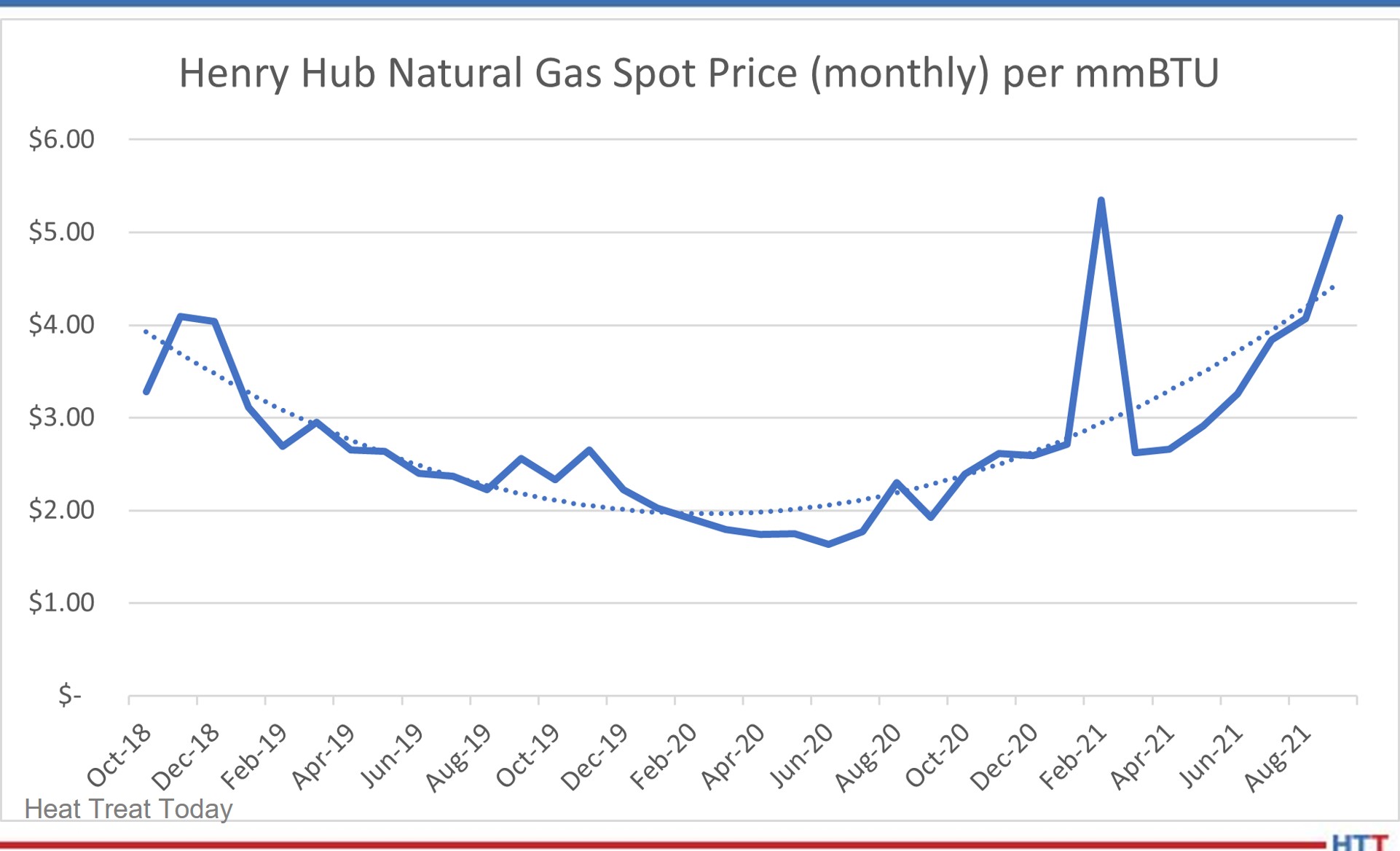
A good website to bookmark in your browser is www.eia.gov/naturalgas/weekly/. It is a quick read and will be the primary reference for my monthly sidebar. Let’s first look at the spot price trend. The spot price is the current price at which a natural gas can be bought or sold for immediate delivery at the Henry Hub. There is volatility in the price of natural gas because of supply, demand, and trading activities (speculation), but when we expand the time horizon, it provides a representative look at the pricing trend. This trend will be reflected in the price we will pay in the future. The prices quoted are in terms of U.S. Dollars per 1,000,000 BTU — roughly 1,000 SCF of natural gas.

The EIA also provides forward-looking projections — but we will leave it to the reader to explore this information on the EIA website. The intent of this series of articles is not to provide the basis of trading futures, but rather to provide some ideas on how to save money.

We can see a definite upward trend. When we combine this data with our understanding that natural gas is increasingly being used to displace coal to generate electricity and North America’s increasing capacity to export liquified natural gas (LNG), there is reason to believe this is a durable trend. We can expect to pay more next year than the recent past to heat our equipment. And in time, this higher fuel cost will lead to higher electrical rates.

How Can I Save Natural Gas?

To save natural gas, we can optimize our processes, reduce unnecessary air, and contain heat within the furnace and/or capture the energy that leaves our system to preheat work or combustion air. Ideally, we should take advantage of all these opportunities — provided the effort pays for itself. In general, operators of heat processing equipment are aware of these opportunities but are not always confident when determining the payback for their investments in time and capital. We will endeavor to bring clarity to these decisions by not only discussing opportunities, but also discussing how to quantify the value of the opportunities. The following are the questions that will be answered in future articles:

Optimizing the Process:

  1. How do I know when the material I am heating is at the desired temperature?
  2. Do I have excessive factors of safety built into my process to compensate for not knowing the temperature at the core of the part being heated?
  3. How much fuel can I save with a shorter cycle?

Reducing Air or Containing Heat:

  1. Is my furnace or oven at the correct internal pressure?
  2. Is it time to rebuild door jams?
  3. How much fuel is wasted because I am not containing heat within the furnace or letting excessive air reduce my combustion efficiency?

Reducing the Heat Exiting the System:

  1. Can I justify installing recuperators to preheat combustion air?
  2. Can the heat from my system be used to preheat work? If so, will I shorten my cycle time and save fuel?

No one likes rising energy prices, but if the trend is up, it is better to recognize reality and invest accordingly. It is our wish that future columns will provide ideas and tools to help you get the most from the energy you consume. If you have specific requests or questions that might guide our discussions, please let us know.

About the Author:

John Clarke, with over 30 years in the heat processing area, is currently the technical director of Helios Corporation. John’s work includes system efficiency analysis, burner design as well as burner management systems. John was a former president of the Industrial Heating Equipment Association and vice president at Maxon Corporation.

Stop the Burn: 3 Tips to Cut Natural Gas Costs Read More »

Nuts and Bolts of Combustion Systems – Safety Shutoff Valve

op-edSafety shutoff valves are the last line of defense against a potentially catastrophic incident. When conditions require, they interrupt the flow of fuel to the burner(s) and oven. There are many options when selecting fuel safety shutoff valves for your application. The construction and application of these devices is highly regulated by interlocking standards created by many different organizations. The goal of this article is to clarify how to comply with the most common standard affecting the reader: NFPA 86.

This column appeared in Heat Treat Today’s 2021 Trade Show September print editionJohn Clarke is the technical director at  Helios Electric Corporation and is writing about combustion related topics throughout 2021 for Heat Treat Today.


John B. Clarke
Technical Director
Helios Electric Corporation
Source: Helios Electric Corporation

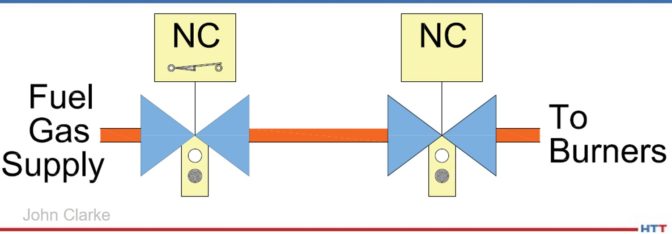
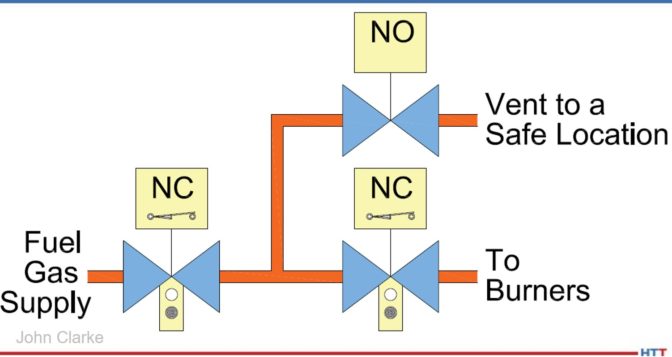
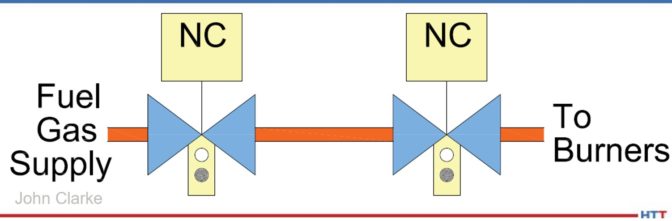
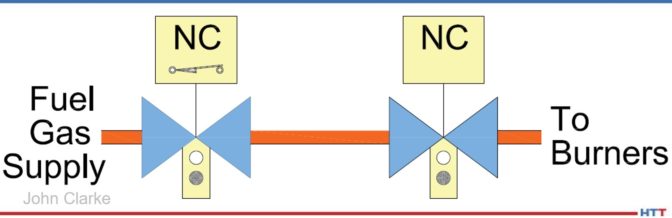
To start, we must define our terms. The 2019 edition of NFPA 86* defines a safety shutoff valve as a “normally closed valve installed in the piping that closes automatically to shut off the fuel, atmosphere gas, or oxygen in the event of abnormal conditions or during shutdown.”1 A valve is “normally closed” (NC) if it closes automatically when power is removed. A furnace or oven typically has as few as two or more safety shutoff valves. [Author’s note: If the system uses radiant tubes for heating, and all the criteria are met, it may be acceptable to use only one valve in series, but this exception is not recommended by the author and will not be covered in this article.] There are two common arrangements for safety shutoff valve arrays—the Simple Double Block (Illustration 1) and the Double Block and Vent (Illustration 2). While both arrangements are compliant with the current version of NFPA 86, the vent is NOT required. In other words, Illustration 1 and Illustration 2 below are both acceptable.

The simple double block arrangement consists of two automatic, normally closed (NC) valves piped in series. It provides redundancy—both valves must leak for fuel gas to pass to the burner system. A double block and vent has two automatic, NC valves piped in series with a third automatic normally open (NO) valve installed between the NC valves. The purpose of the NO valve is to provide a path for any fuel gas leaking past the first NC valve to move to a safe location. Whether one should deploy a double block and vent approach depends on several considerations: Is the NO valve supervised? Is the selected vent location safe? And how will the system be inspected?

Illustration 1

Illustration 2

To start with, if the NO vent valve’s coil or wiring fails, it will remain open even when the system is operating—venting fuel gas. This is not only expensive, but high concentrations of vented fuel gas are an environmental and safety hazard. The solution to this concern is installing a monitored vent valve that only opens the NC valves after the vent valve is proven to be closed. This is typically accomplished with a proof-of-closure position switch that only closes after the vent valve is fully closed.

The next concern is the location and maintenance of the vent. The vent must terminate at a safe location that can accept the entire flow of fuel gas in the event of a failure. Therefore, hazards such as fresh air intakes and sources of ignition must be avoided at all costs. It is also important to periodically inspect the vent piping to ensure it remains unobstructed—insects and rodents may find the vent line a comfortable place to nest and bring up their young.

The last challenge is the periodic inspection of the vent valve and the vent piping—it is generally a challenge to test whether a vent line meets the design criteria, and leaking fuel gas can be vented without excessive backpressure.

A simple double block provides redundancy without the complexity of the vent. Good design practice, with proper valve selection, combined with proper fuel filtration greatly improves the reliability and longevity of both systems.

Valves used for safety shutoff valve applications must be listed by an approval agency for the service intended.2 Furthermore, depending on the flow rate, the valves must be equipped with either a local indicator showing the valve position and a means to prove the valve is closed.

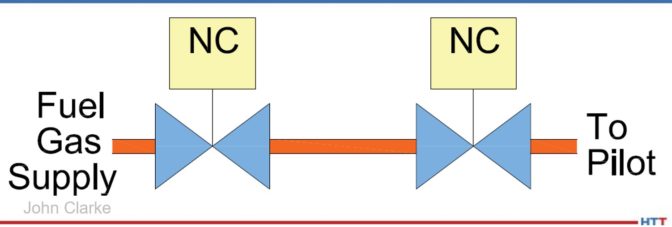
For fuel gas flows below or equal to 150,000 BTU/hour, two safety shutoff valves in series will suffice. See Illustration 3 below. This is very typical for pilot lines.

Illustration 3

For fuel gas flows greater than 150,000 BTU/hour and less than or equal to 400,000 BTU/hour, two safety shutoff valves in series with local position indication are required. Local indication is generally a window where an operator can see the actual position of the valve—open or closed—without relying on any electrical circuit or pilot light. See Illustration 4 below.

Illustration 4

For fuel gas flows greater than 400,000 BTU/hour, NFPA 86 requires two safety shutoff valves in series with local position indication. One valve must be equipped with a valve closed switch (VCS) that closes after the valve is fully closed, or a valve proving system (VPS) that runs a tightness check which must be utilized. The signal from either this VCS or VPS must be included in the burner management system’s (BMS) purge permissive string to ensure no fuel gas is flowing during the system preignition purge. The VCS must not actuate before the valve is fully closed. This is typically accomplished by using valve overtravel, where the valve closes first, then the mechanism continues to move until the VCS is actuated. This arrangement is depicted in Illustration 5 below.

Illustration 5

For the arrangement depicted in Illustration 5, NFPA only requires one valve be supervised with a VCS—the additional costs of supervising both valves are very low and will enhance safety.

Whatever the method used to shut off the fuel to burners or pilots, the array of valves must be inspected and tested annually or per the manufacturer’s recommendations, whichever period is the shortest. All systems must be designed to be tested—with provision provided to cycle valves in test mode and the ability to measure any potential leakage. We will explore how a fuel train should be “designed to be tested” in an upcoming article.

The one thing to always remember—safety shutoff valves are always deployed to provide redundancy, so that any one component failure will not prevent a safe interruption of fuel gas; but, as with all systems, there may be unforeseen events that can lead to complete failure. Only qualified people should design, operate, and maintain combustion systems.


References

[1] National Fire Protection Association – NFPA 86 Standard for Ovens and Furnaces 2019 Edition (NFPA, Quincy, Massachusetts, May 24, 2018) 3.3.82.2 pp 86-14.

[2] National Fire Protection Association – NFPA 86 Standard for Ovens and Furnaces 2019 Edition (NFPA, Quincy, Massachusetts, May 24, 2018) 13.5.11.1 pp 86-49.

About the Author:

John Clarke, with over 30 years in the heat processing area, is currently the technical director of Helios Electric Corporation. John’s work includes system efficiency analysis, burner design as well as burner management systems. John was a former president of the Industrial Heating Equipment Association and vice president at Maxon Corporation.

Nuts and Bolts of Combustion Systems – Safety Shutoff Valve Read More »

Heat Treat Radio #63 (Special Video Edition): Heat Treat Tomorrow – Hydrogen Combustion: Our Future or Hot Air?

Doug Glenn, publisher of Heat Treat Today, moderates a panel of 6 industry experts who address questions about the growing popularity of hydrogen combustion and what heat treaters need to do to prepare. Experts include Joe Wuenning, WS Thermal; Jeff Rafter, Selas Heat Technologies; Brian Kelly, Honeywell Thermal Solutions; John Clarke, Helios Electric Corporation; and Perry Stephens, EPRI.

Get IMMEDIATE access to this 60-minute, highly-informative discussion.

Heat Treat Radio #63 (Special Video Edition): Heat Treat Tomorrow – Hydrogen Combustion: Our Future or Hot Air? Read More »

Moving Beyond Combustion Safety — Designing a Crystal Ball

In June, we spent a good deal of time discussing a simple pressure switch to emphasize the many considerations that are necessary for proper installation. Now we will expand the discussion to how the switch works and what steps we can take to detect a failure that is likely to occur sometime in the future.

This column appeared in Heat Treat Today’s 2021 Automotive August print edition. John Clarke is the technical director at  Helios Electric Corporation and is writing about combustion related topics throughout 2021 for Heat Treat Today.


John B. Clarke
Technical Director
Helios Electric Corporation
Source: Helios Electric Corporation

A pressure switch is a Boolean device — it is either on or off — so how can we evaluate its performance in a manner where a potential failure can be detected before it occurs? The simple answer is time — how long does it take for the switch to respond to the condition it is intended to sense? What is the period between starting an air blower and the pressure switch closing? Has this time changed? Is a change in this time period to be expected, or does it portend a future failure?

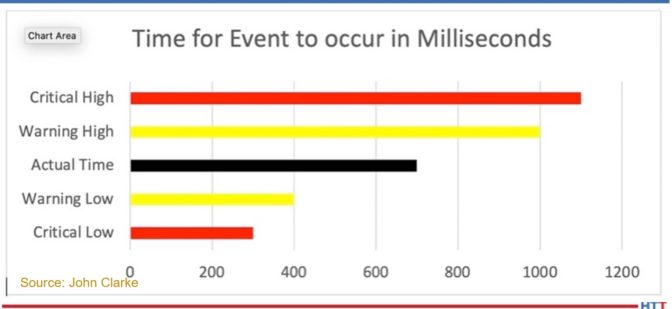
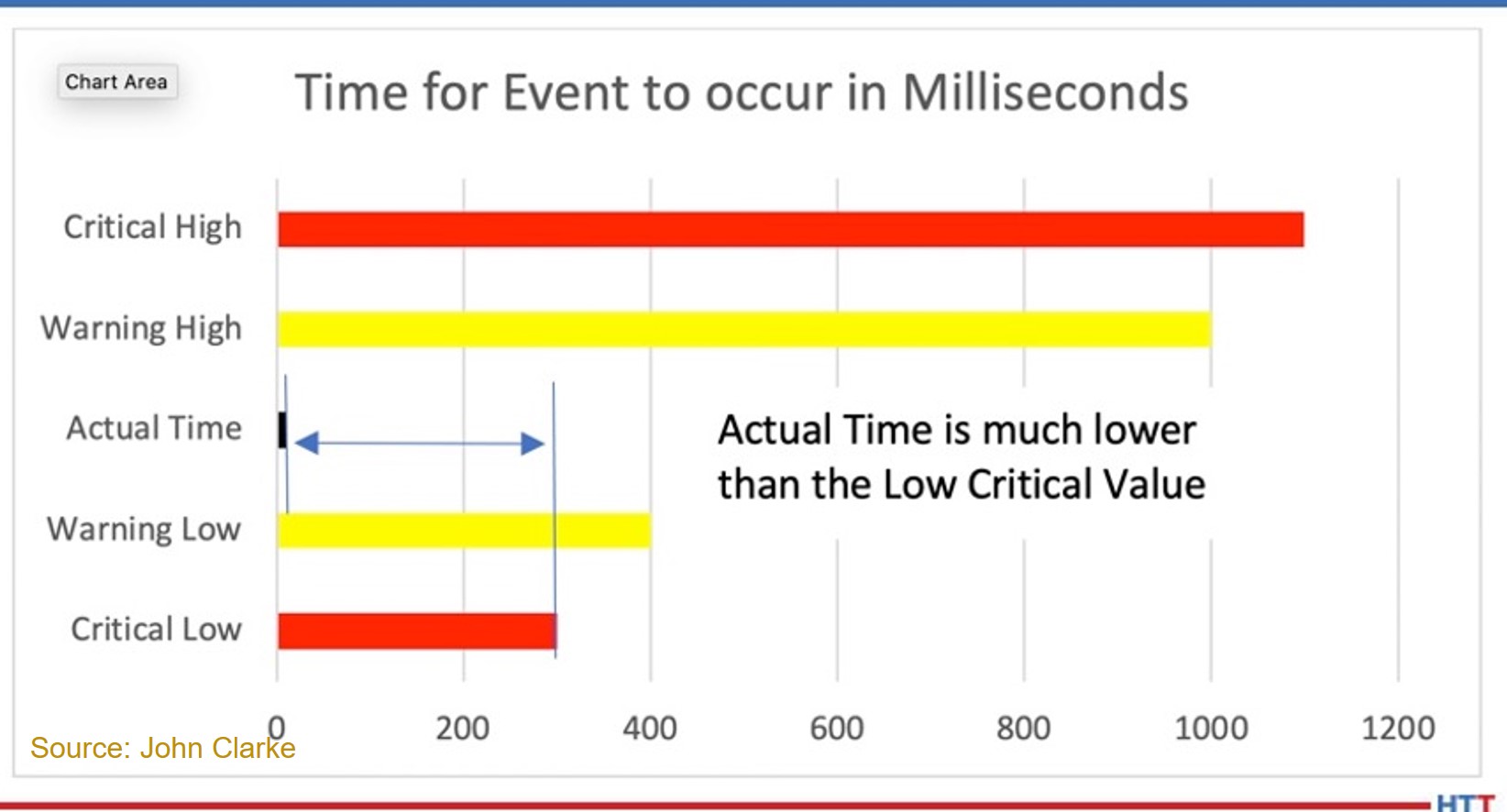
A simple approach to evaluating this pressure switch’s time is to create predetermined limits — if the switch responds either too rapidly or too slowly — an alarm is set and the operator is alerted. Graph 1 illustrates this approach.

In Graph 1, the black band represents the time between the action (the start of the air blower) and the pressure switch closing. There is a warning band (yellow) — both high and low — that provides the early warning of a system performance problem. There is also a critical band (red) — both high and low — that provides the point at which the feedback for the pressure switch is determined to be unreliable. If the switch is part of a safety critical interlock, the system should be forced to a safe condition (in the case of a combustion system, with the burner off and a post purge being executed) if required.

Graph 1

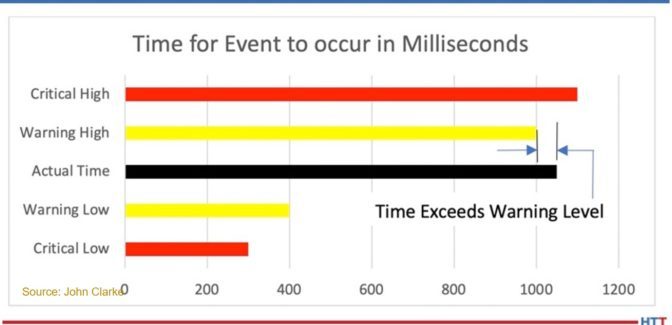
Graph 2 depicts when a switch closing time exceeds the warning level. It could be the result of a problem with the blower and/or the pressure switch, but the deviation is not sufficiently large as to undermine confidence in the switch’s ultimate function.

Programmatically, if the time exceeds the warning band, and an alarm is registered, the responsible maintenance person is notified. If that is in the warning band, it can be addressed as time allows.

Graph 2

The warning bands give us the crystal ball to potentially see a problem before it causes a shutdown. As it is continuously monitored by the programmable logic controller (PLC), it may provide an increased level of safety, but that is dependent on a number of factors that are beyond the scope of this article.

The switch can be not only too slow to respond: an unusually fast response is a reason to be concerned as well. It could be that the pressure switch setpoint has been set too low — so low that it no longer provides useful feedback. Graph 3 is an example with an unusually fast response.

If the time is less than the “Critical Low” preset value, the switch’s feedback is determined to be unreliable. In this case, the setpoint may have been changed during a maintenance interval or even worse — the switch may be jumpered (this assumes we have an interlock string wired in series). The critical values are NOT intended to provide forward looking estimates of required maintenance — they are simply an enhanced safety measure.

This scenario assumes that the response of a component is consistent. In our example of a pressure switch monitoring an air blower, we can assume the time the blower required to reach full speed, the time for a pressure rise time in the air piping, and the responsiveness of the switch is consistent. These time intervals may not be consistent. The air supplied to the blower could be sourced from outside the building (temperate climate), which could cause air density changes between a cool, dry day and a hot, moist day. In this instance, what can be done to detect a failure?

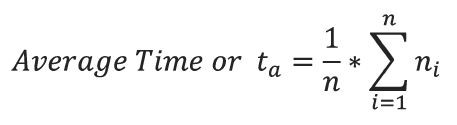
An approach where we see fluctuations in the timing even in instances where all the components are operating properly would be to run a moving average of the time based on the last n operations. Then we compare the moving average to the last time and confirm that any change falls within a specific range.

Step 1 would be to average the last n values for the time required for the switch to trip. Then compare this value (ta) to the last time and see if the deviation exceeds the preset values. Let us assume if the time varies by more than 20% a warning should be issued to the maintenance staff.

Now this method will accommodate rapid fluctuations – but if the performance of the component degrades in a near linear fashion, this formula will not detect a premature failure.

An alternate approach would be to execute this routine on the first n cycles, as opposed to continuously updating the average. Using this method, the performance of the specific component is captured. Or this averaging can be executed on demand or based on the calendar or Hobbs timer.

These concepts are far from new, and it has only been because of the recent expansion in PLC memory storage capacity and processing power that it has been reasonable to perform this analysis on dozens of components on a furnace or oven. Remember, it is a shame to waste PLC processing time and memory!

One or more of these approaches, or similar approaches analyzing time, can indeed be a crystal ball that gives us warning of any of a number of potential failures — warning before a system shutdown is required.

About the Author:

John Clarke, with over 30 years in the heat processing area, is currently the technical director of Helios Electric Corporation. John’s work includes system efficiency analysis, burner design as well as burner management systems. John was a former president of the Industrial Heating Equipment Association and vice president at Maxon Corporation.

technical Tuesday

Moving Beyond Combustion Safety — Designing a Crystal Ball Read More »

Moving Beyond Combustion Safety — Plan the Fix

Last month we began the discussion about the relationship between combustion safety and uptime, highlighting how combustion safety, reliability, emissions, and efficiency are inseparable. This month, we will explore the subject in greater detail and outline a path that can both reduce the risk of an incident and protect the bottom line.

This article written by John Clarke, technical director at Helios Electric Corporation, appears in the annual Heat Treat Today 2021 Buyer's Guide June print edition. Return to our digital editions archive on Monday June 21, 2021 to access the entire print edition online!


John B. Clarke
Technical Director
Helios Electrical Corporation
Source: Helios Electrical Corporation

How many times have we heard the tale about the man with the leaky roof? He cannot fix his roof when it is raining, and the roof doesn’t need repaired when it is not. This story is also applicable to heating system maintenance, perhaps more so than other plant maintenance activities because it so seldom “rains.” Ovens and boilers tend to be very reliable. (This statement is true for equipment operating at low or moderate temperatures, less so for equipment operating above 1832°F (1000°C).) It is exactly when the machine is properly producing parts that the planning for combustion safety, availability, and performance must occur.

The first critical step we must take is to understand that combustion safety, routine maintenance, tuning, and calibration are parts of a larger work strategy. To focus solely on the annual inspection of safety components while ignoring system tuning will not only compromise tuning and efficiency, but also the safety. We have seen how managerial reactions to high profile incidents have caused some firms to dispatch teams to annually examine valves and pressure switches. This effort is highly compromised if it does not include all aspects of system maintenance as well as capturing what is learned each time to improve future inspections and equipment designs. There is data beyond pass and fail that is valuable if we wish to optimize the performance of our equipment

Let us assume it is a clear sunny day, and we are ready to invest some time in preparing to improve our combustion system starting with a deep dive examination of two pressure switches: the low fuel gas pressure switch (LFGPS) and high fuel gas pressure switch (HFGPS). These ubiquitous components are present on nearly every fuel train and are vital for safe operation. As their names imply, they monitor the fuel pressure and shut the safety valves if the fuel gas pressure is either too high or too low.

These switches must be listed for the service they provide by an agency independent of the manufacturer – UL, TUV, FM, etc. Simply looking for a stamp may not be enough; take the time to read the file or standard being applied by the agency and determine if it describes the application. Next, ask if the pressure switch carries the basic ratings expected, like the enclosure rating (Nema or IP). Is a Nema 1 switch operating in a Nema 12 area? Temperature ratings must be confirmed. All too often a component rated for 32°F (0°C) is applied in an outdoor environment in cold climates, or one with a maximum rating of 120°F (50°C) is applied next to the hot wall of a furnace. The component may operate out of specified environmental ranges for some time, but to apply a component in this manner is betting against the house – sooner are later we are going to lose. Ask the people of Texas if the bet against sustained cold temperatures in early 2021 was worth it.

"John Clarke, Technical Director, Helios Electrical The first critical step we must take is to understand that combustion safety, routine maintenance, tuning, and calibration are parts of a larger work strategy"

Next, let us look at the contact(s) rating of the switch and how it is applied to the burner management circuit. More often than not, these switches are in control circuits fused for more current than the contact rating. If the switch rating is too low, the electrical designer has an option to use an interposing relay to increase the current carrying capacity to this device. This relay is an added component, and as such, adds yet another possible point of failure. If the relay is interposed, is it dedicated to this one switch? Multiple devices being interposed by a single relay is prohibited by NFPA 86, for good reason. Is the relay designed to fail safely? That is, will a relay coil burn out or wiring fault close the critical safety valves? Is the wire gauge suitable for the current carried and protection device used?

Next, is the switch mounted in a safe location free from possible vibration or the foot of an eager  furnace operator? If the switch must be changed, are clearances provided to perform this maintenance? What is the mean time to replace (MTTR) the component? Is the way the device is wired providing a path for combustible gas to enter the control enclosure and cause an explosion? Flexible conduit, without a means to seal the connection, is a very common error. Use a properly specified cord and consider using some type of connector to terminate the wiring at the switch. A simple 7/8-16 or DIN connector not only provides additional protection from combustion gas getting into the electrical conduit but is also a great benefit when changing the component in a rush and helps to isolate the component’s control circuit during testing and calibration.

Is the pressure switch suitably protected from bad “actors” in the fuel gas? Perhaps soot is present that could foul narrow passages or H2S that could result in corrosion. These are rare conditions, but coke oven gas may not be as clean as purchased natural gas. Do we need to specify stainless steel components? Would a filter make sense to protect the switch and increase the intervals between maintenance?

Finally, let’s discuss pressure ratings. Unfortunately, nomenclature varies by manufacturer. What is the maximum pressure the device can sustain and not fail, i.e., leak fuel gas into the environment? Many switches can experience a pressure surge without risk of leakage, but the high-pressure event will damage the switch internally. It is important when determining if this rating is adequate to consider possible failure modes that might expose the pressure switch to excessive pressure. As a rule of thumb, a pressure switch must be able to sustain a surge pressure delivered to the inlet of the pressure reducing regulator immediately upstream of the device. Think of it this way, if the upstream regulator experiences a failure, the full pressure delivered to this regulator will pass to the pressure switch in question.

Other obvious pressure ratings are the maximum and minimum set points. The pressure switch should be set to trip as close to the middle of the range as possible and should never be set close to either the minimum or maximum setpoint. Is the pressure switch manually or automatically reset after a trip? In general, it is best practice that the LFGPS resets automatically, and the HFGPS requires a reset by the operator. This recommendation is because LFGPS trips each time pressure is removed from the system, and it is generally understood that the system needs fuel to operate. On the other hand, a high-pressure event is exceedingly rare, and the operator should be made aware of this unusual event.

This article has discussed a lot about the simple pressure switch. It appears to be a heavy lift to perform this analysis on every pressure switch in a facility, but take comfort, once the exercise has been completed on the first system, it is much easier to replicate what has been learned to properly assess other systems. We should most definitely insist that our OEM provides this data, in detail, when new equipment is supplied. Why did we review all these specifications? Because I have been around for a while and have seen nearly every one of these errors in the application of pressure switches on operating combustion equipment.

Next month, we will expand on the pressure switch discussion to describe the tune/calibration and testing processes. I hope this deep and specific dive has been of value. If you have any questions or comments, please let me know.

About the Author:

John Clarke, with over 30 years in the heat processing area, is currently the technical director of Helios Corporation. John’s work includes system efficiency analysis, burner design as well as burner management systems. John was a former president of the Industrial Heating Equipment Association and vice president at Maxon Corporation.

Moving Beyond Combustion Safety — Plan the Fix Read More »

Skip to content