

featured

Voices in Heat Treat: Vacuum Brazing Revisited

The heat treat industry is rich with knowledgeable leaders, resourceful problem solvers, and innovative teams. One of our favorite things to do here at Heat Treat Today is to draw attention to the wealth of expertise in the field, so we are pleased to launch the Voices in Heat Treat series, pointing readers to a treasure house of recorded interviews and discussions diving into the fundamentals of thermal processing.

In this and coming articles drawn from the audio library at Solar Atmospheres, we will summarize topics on everything from basic heat treating how-tos, preventative maintenance, and troubleshooting to the history of hot zone designs, temperature uniformity surveys, and the distinctions to take into consideration when processing different kinds of metals and alloys. In today’s installment, our industry experts focus on vacuum brazing and the uniqueness of heat treating titanium.


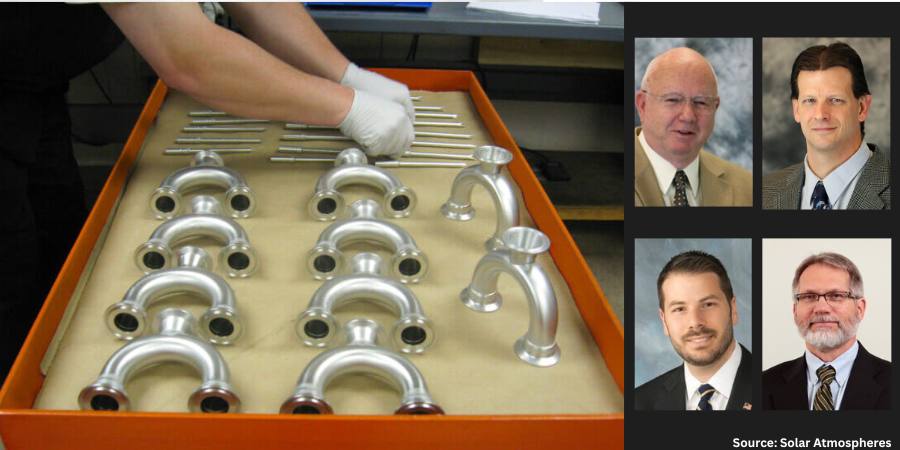
In the premiere article of this series, Bill Jones, founder and CEO of Solar Atmospheres and Solar Manufacturing, interviews industry leaders about the advantages of vacuum furnace brazing. Read the highlights of their discussion about the process, in particular when used with stainless steel and titanium. The summary of a fourth episode recorded earlier has been added, expanding on the topic of the advantages of processing titanium in a vacuum furnace. The experts are Calvin Amenheuser, vice president of the Hatfield plant, and Mike Paponetti, sales manager of the southeast. Jim Nagy, senior vice president of Solar Manufacturing, hosts the episodes. A summary of each conversation is below, followed by links that will take you directly to that podcast episode.

Bill Jones and the Team Speak on Vacuum Brazing, a 3-Part Series

“Advantages of Vacuum Furnace Brazing”

December 2015

Brazing to form strong metallurgical bond where the brazed joint becomes a sandwich of different layers, each linked at the grain level

This episode is the first in a series on vacuum furnace brazing, with an overview of different types of brazing processes and why vacuum furnace brazing is superior to other joining methods, particularly torch brazing and welding.

The conversation explores various reasons why a vacuum furnace is well-suited to perform brazing because it provides:

  • a controlled, consistent atmosphere cycle after cycle
  • uniform heating throughout the hot zone
  • a controlled rate of heating
  • the elimination of air to prevent the formation of oxidation of the metal
Vacuum Furnace Brazing vs. Alternative Methods

Both Cal Amenheuser and Mike Paponetti speak about vacuum brazing being a superior process to alternative methods. Mike noted that torch brazing is effective for low volume loads, but the process risks flux entrapment and could produce messy, overheated and possibly carburized parts. In contrast, vacuum furnace brazing allows for higher volume loads, providing a repeatable process, precise temperature measurements, and versatility.

Brazing applications from parts to rockets

Calvin added that while welding melts the materials and produces a strong joint, the surrounding material is weaker. With vacuum furnace brazing, the brazed joint is just as strong or stronger afterward as before.

Finally, the panelists compared how batch vacuum furnace brazing eliminates distortion that is typical with torch brazing and welding because of hot zone uniformity. A batch furnace operator can modify the process to meet the demand of the load, and furnace charts provide proof of reveal what exactly happened during the run so that successful recipes can be repeated.

Click here to listen to this episode.

“Vacuum Brazing of Stainless Steel”

February 2016

In this episode, second in the series on the vacuum furnace brazing, the Solar team reconvened to discuss advantages of and concerns with nickel-based and copper-based brazing alloys.

All agree that nickel-based alloy offers a cleaner braze but emphasize precautions must be put in place to avoid metal erosion and cracking. While readily available and a good match for low carbon steel, copper flashes during the braze. Inert gas is recommended to decrease evaporation of the copper-based alloy.

Click here to listen to this episode.

“Processing Titanium in Vacuum Furnaces: Active Brazing of Titanium in a Vacuum Furnace”

April 2016
In this third and final episode on the topic of vacuum furnace brazing, Bill Jones, Calvin Amenheuser, and Mike Paponetti consider significant challenges to brazing titanium, which is the need to reduce surface oxide to allow the process to take place and why active brazing is suggested as a means to meet that challenge. What follows is an informative discussion on composites that allow producing companies add to the material, like hydrated titanium, zirconium, and indium, to help overcome oxides, which are effective at wedding to the surface.

Click here to listen to this episode.

Additional Notes on Titanium

“Processing Titanium in Vacuum Furnaces: Advantages”

February 2013

175,000 pounds of 6Al-4V titanium in Solar’s 48-foot-long vacuum furnace

Although recorded earlier than and thus separately from the series on vacuum furnace brazing, this summary of an episode is included in this article to provide context about the advantages of processing titanium in a vacuum furnace. This is a solo Bill Jones episode.

Bill Jones highlights how vacuum furnaces provide a pure atmosphere for processing titanium compared to an argon atmosphere, saving machining costs and time. Additionally, vacuum processing uses forced inert gas quenching to cool titanium as opposed to water quenching which results in a more uniform result and eliminates part distortion. Finally, fixturing parts properly in a vacuum furnace with graphite allows heat treaters to preserve the part shape and avoid movement.

Click here to listen to this episode.

We share these resources from the audio library at Solar Atmospheres.



Voices in Heat Treat: Vacuum Brazing Revisited Read More »

Wrocław University of Science and Technology Enhances Metallurgy Research Capabilities with Nitriding System

Wrocław University of Science and Technology (WUST) is expanding its R&D capabilities in heat treatment and materials testing with a horizontal nitriding system. The furnace will support the university’s efforts in metallurgical research and collaborations with regional manufacturing industries, including testing forging dies for the automotive industry.

Marcin Stokłosa
Technical Sales Manager
NITREX Poland

The newly acquired Nitrex system is equipped with Nitreg® controlled nitriding technology for optimizing surface hardness, and Nitreg®-S technology for nitriding stainless steel. The system enables Poland-based WUST to conduct next-level materials research and leverage new technological and scientific capabilities to support industrial projects, optimizing heat treatment processes and enhancing the surface properties of metal parts. Furthermore, the furnace meets the stringent AMS 2759/10 standard for nitriding steel and AMS 2750 standard for temperature uniformity.

“While Nitrex primarily serves businesses in sectors such as automotive, aerospace, and manufacturing,” said Marcin Stoklosa, technical sales manager – EMEA region at Nitrex Poland, “our partnership with WUST underscores our commitment to advancing academic research and fostering innovations that directly benefit practical applications and advance metallurgical science globally. . . . I look forward to seeing WUST’s continued leadership in metallurgical research and its impact on both academia and industry.”

The press release is available in its original form here.


Wrocław University of Science and Technology Enhances Metallurgy Research Capabilities with Nitriding System Read More »

18 News Chatter To Keep You Current

Heat Treat Today offers News Chatter, a feature highlighting representative moves, transactions, and kudos from around the industry. Enjoy these 18 news items.


Equipment

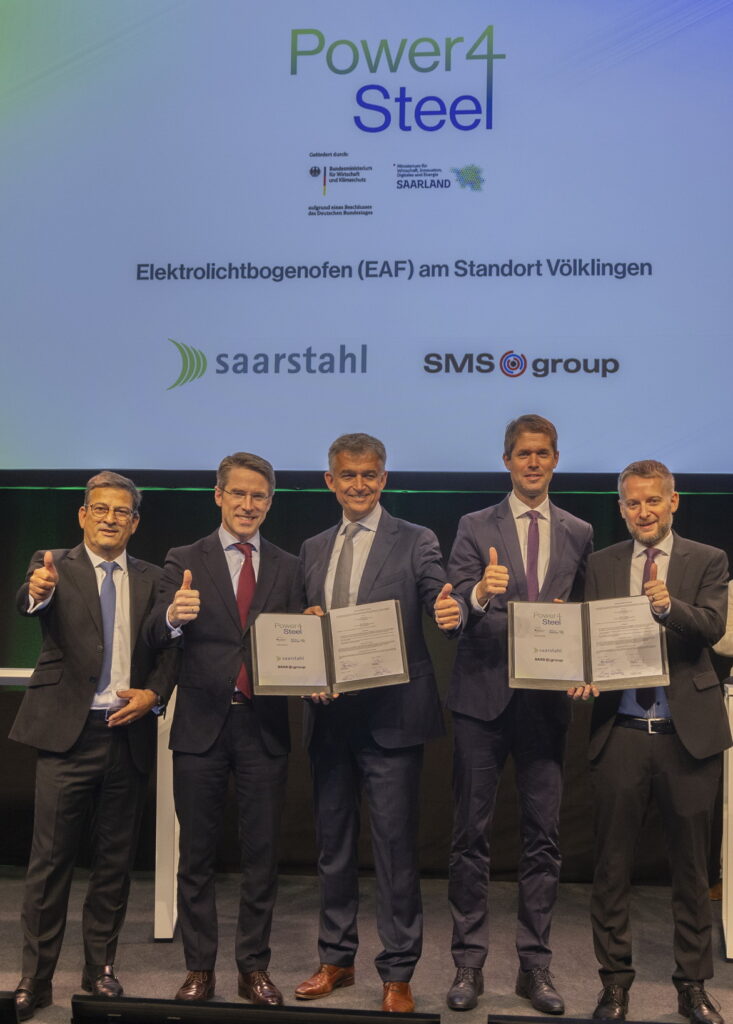
  1. Saarstahl expands its production with an alternate current-electric arc furnace (AC-EAF) supplied by SMS group.
  2. A Class A safety oven equipped with a solvent monitor and roll-in rack, meeting the stringent safety requirements of industries working with volatile materials, was recently shipped by industrial and laboratory ovens manufacturer Blue M
  3. A manufacturer in the defense industry has received shipment of a gas-fired walk-in batch oven from Wisconsin Oven Corporation, to be used for curing filament wound composite materials.

Company & Personnel

  1. Sean Patrick Murphy has been named product manager for laboratory and R&D furnaces at Centorr Vacuum Industries. He will be responsible for representing over 30 different vacuum furnace product lines to national laboratories, universities, and industrial sectors.
  2. Charles (Charlie) Caldwell joins the team at Solar Atmospheres of Michigan Inc. as the quality manager for its new facility in Chesterfield.
  3. Steel Goode Products LLC (SGP), a thermal spray specialist, has recently been acquired by Aalberts N.V., a provider of thermal spray coating and finishing services. The acquisition includes two operating facilities in Texas and one in Ohio.
  4. The Wirco, Inc, team recently announced Chris Robbins as the new director of business development and Chad Kumfer to the position of director of sales.
  5. Daniel Sonnenberg joins Nitrex Heat Treating Services as the new business development lead for North America. Daniel will focus on identifying and cultivating relationships with potential customers. His goal is to foster trust and drive growth by building enduring partnerships that deliver sustained value over time.
  6. Dave Deiwart has begun a new position as president at Tracer Gas Technologies, based in Yorktown, Indiana. This follows a brief retirement after 35 years of providing leak detection and vacuum application support and training. Dave’s new focus will be on providing training and consulting.
  7. Nel Hydrogen Electrolyser AS, a fully owned subsidiary of Nel ASA, has been awarded a grant from the EU Innovation Fund of up to EUR 135 million (over $145.4M USD) for industrialization of its next-generation pressurized alkaline technology. The technology is currently being prototyped, and the potential industrialization is planned at Herøya, Norway.
  8. OTTO JUNKER GmbH, system providers for metallurgic processes and metal refinement, recently announced that the new business division OTTO JUNKER Solutions, which was established in late 2023, will be further expanded. The company’s focus will be on the development and implementation of green technologies. The new division is headed by R&D expert Tobias Mertens.

Kudos

  1. Constellium SE has received the Supplier of the Year Award from Stellantis, recognized for its overall best-in-class performance as a long-time partner.
  2. Gary Sharp, founder of Advanced Heat Treat Corp, has been honored with the Legends of Manufacturing Award at the Iowa Manufacturing Conference.
  3. Global Thermal Systems (GTS) Mexico’s pyrometry laboratories recently completed the reaccreditation process in the ISO/IEC 17025 standard.
  4. Rex Heat Treat has achieved its fourth consecutive merit-status Nadcap certification under the leadership of Conner Popo, quality assurance manager, and Vindon Griffin, technical services manager. 
  5. Aalberts surface technologies Dzierżoniów recently celebrated its tenth anniversary. Through acquisition and expansion, the company has grown from 16 employees in 2014 to a current team of over 90 employees, serving the automotive, aerospace, power, fasteners, agriculture, and mining sectors.
  6. The Metal Treating Institute (MTI) recently celebrated its 2024 YES Management Training Program graduates at the final reception of Furnaces North America (FNA) 2024.
  7. Bennett Heat Treating & Brazing Co. received the 2024 Master Craftsman Award, also known as the Heat Treater of the Year Award, at the Metal Treating Institute’s Final Night Dinner & Awards Ceremony following FNA 2024. The award was announced by Doug Glenn, publisher of Heat Treat Today along with a scholarship check for the heat treater to bestow upon a deserving young student going into heat treat.

Find Heat Treating Products And Services When You Search On Heat Treat Buyers Guide.Com

18 News Chatter To Keep You Current Read More »
Cincinnati Radiator Bolsters Aluminum Brazing Capabilities with New VAB Furnace

Cincinnati Radiator, a manufacturer of radiators and cooling products, recently expanded its production capabilities at its Fairfield, Ohio, facility with the addition of a vacuum aluminum brazing (VAB) furnace. This acquisition will enable the company to perform in-house radiator core brazing.

The VAB furnace, with a weight capacity of up to 2,000 lbs, is the third manufactured and installed by Ipsen.

Prasenjit Ray
General Manager
Cincinnati Radiator
Source: Ipsen

“This furnace has so many recipes for us to use,” said Prasenjit Ray, general manager of Cincinnati Radiator. “We were planning to test it out for two months, but we weren’t expecting to get production-quality within those two months. What shocked and surprised me was that the first cores that came out were perfect. We’ve produced 10 (in the first month) and it runs like a new Cadillac.”

“We knew that we needed a way to make cores here. When customers had to rely on cores processed in China, it could mean a four-month lead time. If we had our own furnace, we could operate a just-in-time production,” said Ray. “We went with John Pease (Ipsen Regional Sales Representative) and Patrick McKenna (Ipsen USA President & CEO) to California to see a company operating two Ipsen VAB furnaces. Our team knew that, once we saw them in operation, we wanted to work with another company within the United States. Ipsen could offer great aftermarket support, and the delivery was worth the wait.”

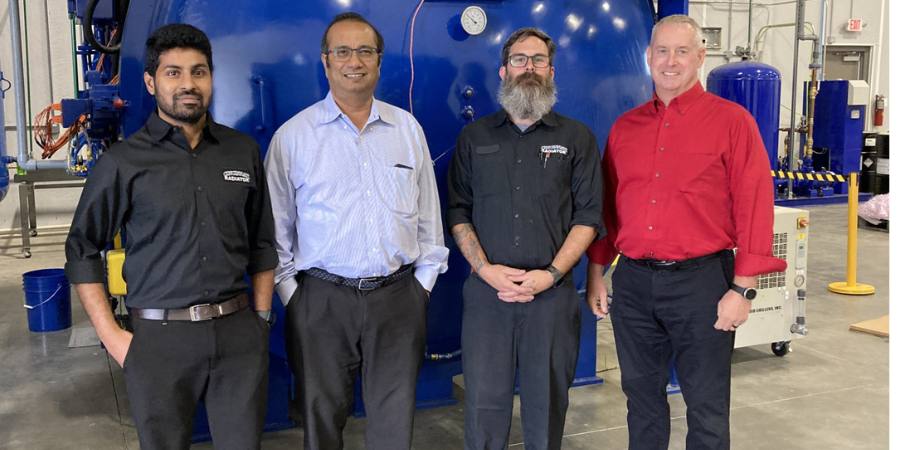
Main image (left to right): All of Cincinnati Radiator: Abhilash Uppala, Manufacturing Engineer; Prasenjit Ray, General Manager; Michael Petitt, Assistant Operations Manager; and James “Tom” Aynes, Accounting Manager. Source: Ipsen.

The press release is available in its original form here.


Cincinnati Radiator Bolsters Aluminum Brazing Capabilities with New VAB Furnace Read More »

News from Abroad: New Technologies and Sustainability Initiatives Result in Industry Growths and Closures

Today’s News from Abroad installment highlights some of the ups and downs in the global heat treating market which are largely driven by new technologies and sustainability initiatives. In growth news, a heat treater expands its product line with industrial furnaces and technologies and an Italian company invests in sustainable technology. In addition, a UK steelmaker closes its last remaining blast furnace.

Heat Treat Today partners with two international publications to deliver the latest news, tech tips, and cutting-edge articles that will serve our audience — manufacturers with in-house heat treat.heat processing, a Vulkan-Verlag GmbHa publication, serves mostly the European and Asian heat treat markets, and Furnaces International, a Quartz Business Media publication, primarily serves the English-speaking globe.

Heat Treater Expands Product Line To Include Vacuum Furnaces

Aichelin product range expands with vacuum furnaces and technologies
Source: AICHELIN

AICHELIN Group has expanded its product range to include innovative industrial vacuum furnaces and technologies. The modern, flexible, and environmentally friendly solutions were presented for the first time at the ‘HärtereiKongress’ in Cologne from October 8 to 10. The new vacuum furnaces are sold, designed, and produced by the joint venture company AICHELIN ST Vacuum GmbH, which was founded in May. With the addition of this important market segment, AICHELIN is now a full-service provider for heat treatment solutions.”

READ MORE: “AICHELIN expands into the industrial vacuum furnace market” – at heat-processing.com

Italian Company Boosts Green Transition With Investment in ARP

Delna S.p.A. team at Tenova’s acid regeneration plant in Italy
Source: Tenova

Tenova, a developer and provider of sustainable solutions for the green transition of the metals industry, has been awarded a contract by Delna S.p.A., an ArcelorMittal CLN Distribuzione Italia Group company and primary provider of pickling service of coils and wire rod, for its plant in Brivio, Italy, for an acid regeneration plant (ARP) with a capacity of 2.000 l/h. Delna’s investment will boost the green transition of its plant, recovering the waste acid used in its pickling line and therefore minimizing its environmental footprint. The new ARP will be equipped with the BLUEdriven™ cutting-edge package solutions that will be controlled by a customized monitoring process, increasing production flexibility and optimizing operative costs, while guaranteeing minimal environmental impact.”

READ MORE: “Tenova to supply an Acid Regeneration Plant for Delna in Italy at heat-processing.com. 

UK Steel plant shutters last remaining blast furnace

Final furnace shuts down at Tata’s UK plant
Source: Tata Steel

Tata Steel has begun the process of winding down operations at blast furnace 4 at Port Talbot and engineers have already started altering the raw materials poured into the top of the furnace to prepare for decommissioning. Blast furnace 5 was closed in July. The closure is part of Tata’s transition towards a greener form of steelmaking as it plans to build a £1.25 billion electric arc furnace for the Port Talbot site by 2027, which produces steel by melting scrap metal. The new Labour government agreed a taxpayer-backed deal earlier this month for the Port Talbot plant in which it will provide £500 million towards the construction of the new electric arc furnace at the site, with the plant’s Indian owners, Tata Steel, paying £750 million.”

READ MORE: “Tata Steel’s UK plant shutters last remaining blast furnace” at furnaces-international.com. 


Find Heat Treating Products And Services When You Search On Heat Treat Buyers Guide.Com

News from Abroad: New Technologies and Sustainability Initiatives Result in Industry Growths and Closures Read More »
Ask the Heat Treat Doctor®: How Do Parts Fail?

The Heat Treat Doctor® has returned to offer sage advice to Heat Treat Today readers and to answer your questions about heat treating, brazing, sintering, and other types of thermal treatments as well as questions on metallurgy, equipment, and process-related issues.


Product failures (Figure 1) can often be traced to deficiencies in design, materials, manufacturing, quality, maintenance, service-related factors, and human error to name a few. Examples of failures include misalignment, buckling, excessive distortion, cracking, fracture, creep, fatigue, shock, wear, corrosion, and literally hundreds of other mechanisms. Let’s learn more. 

Figure 1. Image of damage to left fuselage and engine; fire damage to nacelle.
Source: National Transportation Safety Board
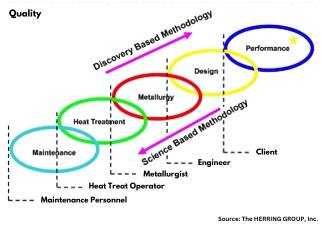
Figure 2.: Model of material science depicting— key interactions and /interrelationships
Source: The HERRING GROUP, Inc.

Whatever the source, it is important to recognize that it is next to impossible to separate the product from the process.  Performance, design (properties and material), metallurgy (microstructure), heat treatment (process and equipment), and maintenance are all interconnected (Figure 2).  

When considering ways to prevent failures from occurring, one must determine the factors involved and whether they acted alone or in combination with one another. Ask questions such as, “Which of the various failure modes were the most important contributors?” and “Was the design robust enough?” and “Were the safety factors properly chosen to meet the application rigors imposed in service?” Having a solid engineering design coupled with understanding the application, loading, and design requirements is key to avoiding failures. If failures do happen, we must know what contributed to them.  

Let’s review a few of the more common failure modes. 

Fracture Types on a Macroscopic Scale  

Applied loads may be unidirectional or multi-directional in nature and occur singularly or in combination. The result is a macroscopic stress state comprised of normal stress (perpendicular to the surface) and/or shear stress (parallel to the surface). In combination with the other load conditions, the result is one of four primary modes of fracture: dimpled rupture (aka microvoid coalescence), cleavage, decohesive rupture, and fatigue. 

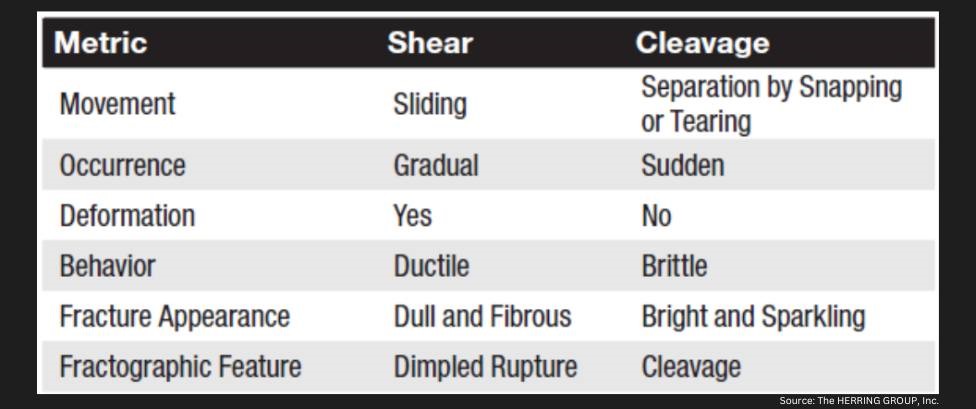
Virtually all engineering metals are polycrystalline. As a result, the two basic modes of deformation/fracture (under single loading) are shear and cleavage (Table 1). The shear mechanism, which occurs by sliding along specific crystallographic planes, is the basis for the macroscopic modes of elastic and plastic deformation. The cleavage mechanism occurs very suddenly via a splitting action of the planes with very little deformation involved. Both of these micro mechanisms primarily result in transgranular (through the grains) fracture. 

Fracture Types — Ductile and Brittle  

Numerous factors influence whether a fracture will behave in a ductile or brittle manner (Table 2). In ductile materials, plastic deformation occurs when the shear stress exceeds the shear strength before another mode of fracture can occur, with necking typically observed before final fracture. Brittle fractures occur suddenly and exhibit very little, if any, deformation before final fracture. (The following is based on information found in Wulpi, 1985.)

Ductile fractures typically have the following characteristics: 

  • Considerable plastic or permanent deformation in the failure region 
  • Dull and fibrous fracture appearance 

Brittle fractures typically have the following characteristics:

Contact us with your Reader Feedback!
  • Lack of plastic or permanent deformation in the region of the fracture 
  • Principal stress (or tensile stress) is perpendicular to the surface of the brittle fracture 
  • Characteristic markings on the fracture surface pointing back to where the fracture originated  

When examined under a scanning electron microscope, fracture surfaces seldom exhibit entirely dimpled rupture (i.e. ductile fracture) or entirely cleavage (i.e. brittle fracture), although one or the other may be more prevalent. Other fracture modes include intergranular fractures, combination (quasi-cleavage) fractures and fatigue fractures. 

Fracture Types — Wear 

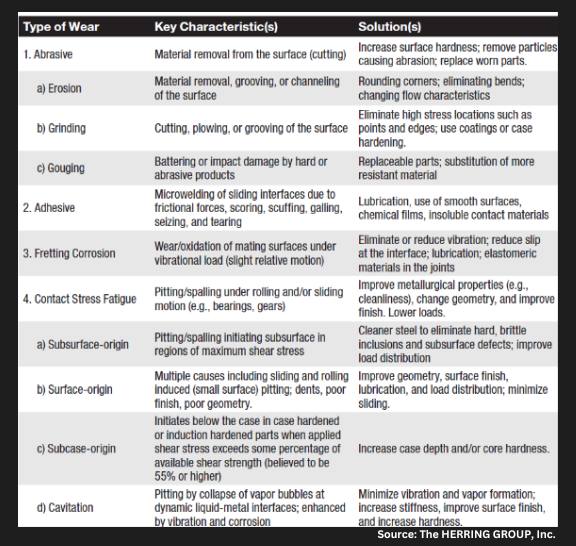
Wear (Table 3) is a type of surface destruction that involves the removal of material from the surface of a component part under some form of contact produced by a form of mechanical action. Wear and corrosion are closely linked, and it is important not only to evaluate the failure but to take into consideration design and environment and have a good understanding of the service history of a component. 

Fracture Types — Corrosion 

Corrosion is the destruction of a component by the actions of chemical or electrochemical reactions with the service environment. The major types of corrosion include galvanic action, uniform corrosion, crevice corrosion, stress-corrosion cracking, and corrosion fatigue. The mechanisms and effects created by each of these are well documented in the literature, as in Fontana and Greene’s Corrosion Engineering (1985) and Uhlig’s Corrosion and Corrosion Control (1985). It is critical to understand that the effects of corrosion are present to some degree in every failure analysis, which is one of the reasons why protecting fracture surfaces is so critical when sending parts for failure analysis. 

Table 1. Differences between shear and cleavage fracture (Data referenced from page 23 of Wulpi, see References.)
Source: The HERRING GROUP, Inc.
Table 2. Typical characteristics of ductile and brittle fractures
Source: The HERRING GROUP, Inc.
Table 3. General categories of wear
Source: The HERRING GROUP, Inc.

Final Thoughts

To avoid failures or their reoccurrence, it is important to document each step in the design and manufacture process (including heat treatment). In addition, careful documentation of failures if/when they occur is of critical importance as is assembling a team of individuals from different disciplines to perform a comprehensive investigation. This includes a thorough failure analysis to assist in determining the root cause (there is only one) and to avoid it from happening in the future. 

References

Airline Safety. www.AirlineSafety.com. Accessed September 2024.

Fontana, M. G., and N. D. Greene. Corrosion Engineering, 3e. McGraw-Hill Book Company, 1985.

Herring, Daniel H. Atmosphere Heat Treatment, Volume Nos. 1 & 2. BNP Media, 2014/2015.

Lawn, B.R. and T. R. Wilshaw. Fracture of Brittle Solids. Cambridge University Press, 1975.

Shipley, R. J. and W. T. Becker (Eds.). ASM Handbook, Volume 11: Failure Analysis and Prevention. ASM International, 2002.

Uhlig, H. H. Corrosion and Corrosion Control. John Wiley & Sons, 1963. 

Wulpi, Donald J. Understanding How Components Fail. ASM International, 1985.

About the Author

Dan Herring
“The Heat Treat Doctor”
The HERRING GROUP, Inc.

Dan Herring has been in the industry for over 50 years and has gained vast experience in fields that include materials science, engineering, metallurgy, new product research, and many other areas. He is the author of six books and over 700 technical articles.

For more information: Contact Dan at dherring@heat-treat-doctor.com.

For more information about Dan’s books: see his page at the Heat Treat Store.


Find Heat Treating Products And Services When You Search On Heat Treat Buyers Guide.Com


Ask the Heat Treat Doctor®: How Do Parts Fail? Read More »

MIHEU Expands with 4th Vacuum Furnace

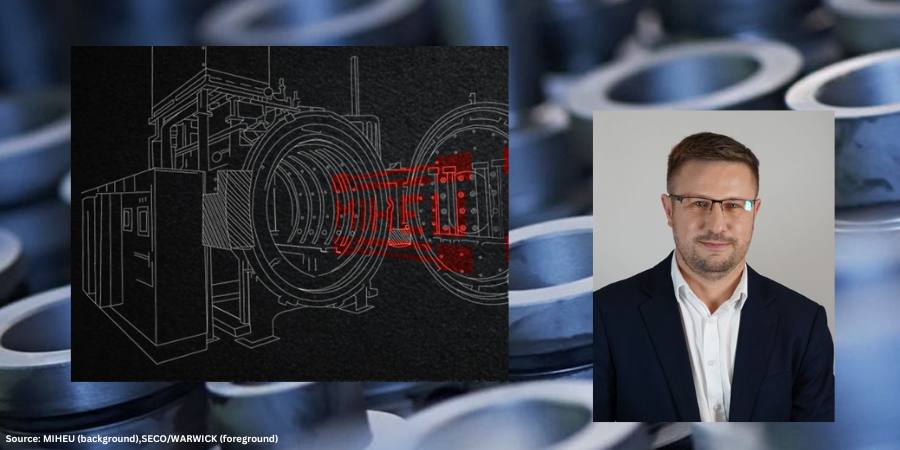
MIHEU, a commercial heat treater for the steel processing industry, recently expanded its vacuum furnace line for processing large dies at its hardening plant with a single-chamber vacuum furnace.

The SECO/WARWICK furnace will allow MIHEU to increase processing capacity while maintaining precision, joining three other vacuum furnaces purchased from the supplier. The vacuum furnace with high pressure gas quenching includes large load capacity and workspace with an option to make adjustments for an oversized load.

Jędrzej Malinowski
Sales Manager
SECO/WARWICK Group
Source: LinkedIn

“The Vector vacuum furnace will solve the challenge of hardening large dies, because it uses a large working space,” said Jędrzej Malinowski, sales manager of SECO/WARWICK. “The furnace is equipped with convection heating — a system which improves the heat transfer efficiency when heating at lower temperatures, as well as directional cooling, which allows for cooling problematic shape elements in various ways.”

“We wanted a solution which would shorten the heat treatment cycle time,” commented Aleš Prikeržnik, managing director at MIHEU Slovenia. “By expanding our machine park with a new vacuum furnace, we will significantly shorten the waiting times for customer orders. . . . We already have three such solutions and we are very pleased with their operation.”

MIHEU is a Slovenian commercial heat treating center with a range of additional services, including traditional hardening and tempering in oil in pit furnaces, carburizing, carbonitriding, nitrocarburizing, hardening in vacuum furnaces, and all types of nitriding, gas and plasma nitriding processes.

The press release is available in its original form here.


MIHEU Expands with 4th Vacuum Furnace Read More »

FNA Week in Heat Treat Social Media

Welcome to a special edition of Heat Treat Today’s This Week in Heat Treat Social Media. We’ve discovered a furnace-full collection of posts that document the excitement of the past week at Furnaces North America (FNA). From the arrival of booth materials to the final speech at the MTI awards ceremony, they’re all here: check out these posts and videos for a roundup of FNA and heat treat social media.

As you know, there is so much content available on the web that it’s next to impossible to sift through all of the articles and posts that flood our inboxes and notifications on a daily basis. So, Heat Treat Today is here to bring you the latest in compelling, inspiring, and entertaining heat treat news from the different social media venues that you’ve just got to see and read! If you have content that everyone has to see, please send the link to editor@heattreattoday.com.


1. Lightening the Pre-Show Heavy Lifting

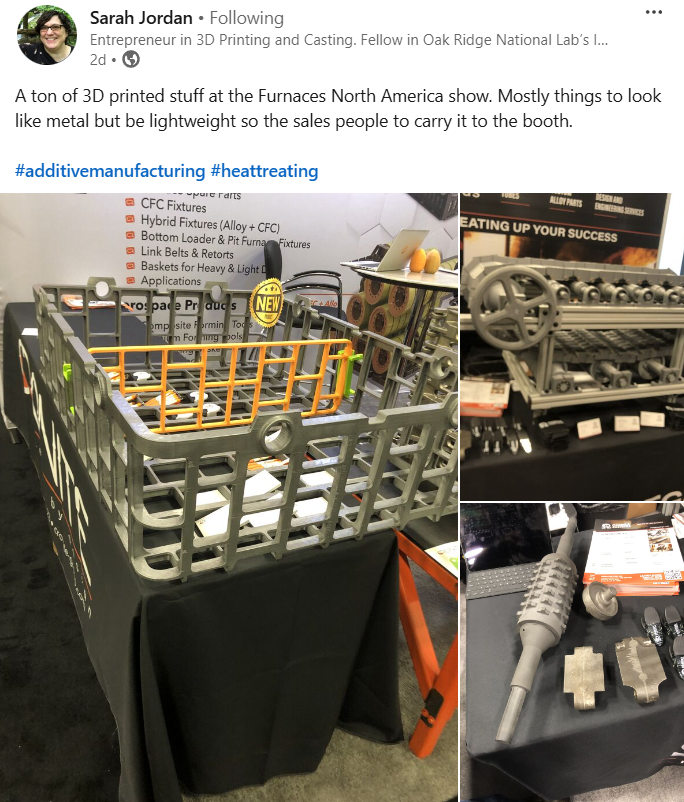
A good show is more than just what happens from curtain rise to curtain fall. Whether it’s a play on the stage or a trade show in a convention hall, there is a lot of work that goes into setting up and tearing down . . . sometimes back-breaking work. The advent of 3D printing has made that task a little easier, and ironically, at FNA 2024, that means models set out for display were processed with 3D printing to preserve the look of metal while making it easy for team to carry to the floor. Thanks to Sarah Jordan for bringing this post to the web.

2. Kudos and Awards from Beginning to End

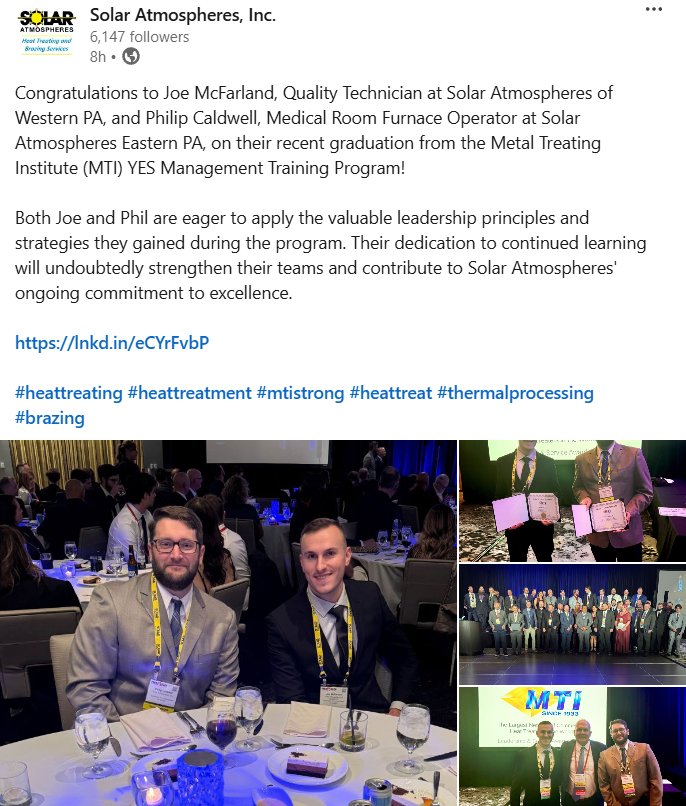
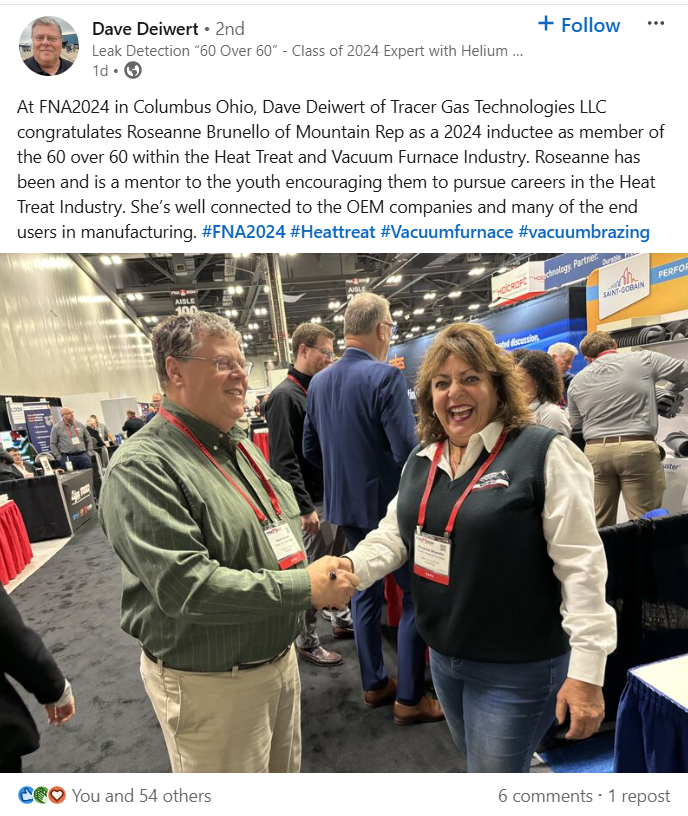
We love it when social media is full of the faces of the heat treat industry, and this week is no exception. We found individual recognition posts, the celebration of Heat Treat Today’s 40 Under 40, and the Metal Treating Institute‘s honorees at the awards ceremony on the last night of the show.

Look these posts up on LinkedIn here: Dave Deiwert; JUMO Process Control; Paulo Heat Treating; Brazing and Metal Finishing; Solar Atmospheres, Inc.; and Gasbarre Thermal Processing Systems.

3. Presenting . . .

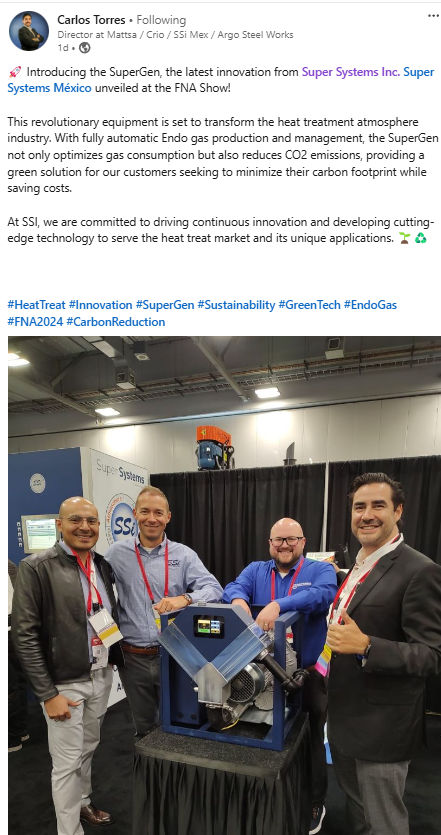
Eyes and ears were open and trained on all that’s new in heat treating presented at FNA 2024, whether in technical sessions; impromptu, on-the-floor demonstrations; or new product reveals.

Look these posts up on LinkedIn here: Carlos Torres; Solar Atmospheres, Inc.; SAFECHEM; and Nitrex.

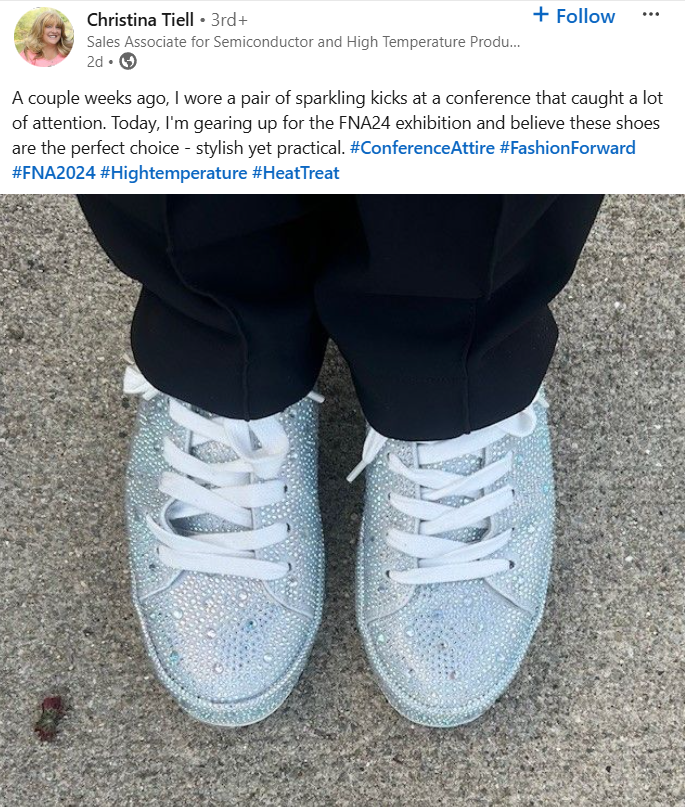
4. Sparkling Shoes and Aching Feet

‘Nuff said.

Look these posts up on LinkedIn here: Christina Tiell and Heather Falcone.

5. The Camera Turned on Us

What does Heat Treat Today do when at FNA? Here’s the link to the reel.

Look this post up on LinkedIn here.

Hope to see you next year at ASM Heat Treat Show and the year after at FNA 2026!


Find Heat Treating Products and Services When You Search on Heat Treat Buyers Guide.com

FNA Week in Heat Treat Social Media Read More »
Day 2 at FNA: Awards Abound for Heat Treaters

The final day of Furnaces North America (FNA) began for Heat Treat Today with the presentation of a plaque to Timothy Joseph Wright (T.J. Wright), who served as a Major General in the U.S. Army, as well as a critical player in the history of heat treating, specifically as a past president of Wirco.

Two of his sons, Matthew Wright, vice president of marketing at pyrometry software company C3 Data, and Nathan Wright, CEO of C3 Data, joined T.J. at their booth for the presentation, as did his nephew, Chad Wright, current president of Wirco.

  • Read the article displayed on the plaque here.
  • Listen to an interview with T.J. on Heat Treat Radio’s podcast, found here.
  • And check out a video of the presentation here.

Heat Treat Today wishes to thank T. J., for his life of service to the country and to others and to the whole Wright family for their kindness and partnerships with us.

The day ended with the Metal Treating Institute’s (MTI) final event where MTI Yes Management Training graduates were recognized, awards were given to individuals and companies who have uniquely served the industry and MTI, and the 2025 MTI officers and board of trustees were announced.

Look for upcoming articles highlighting MTI news from the event!

Main image (left to right): Matthew Wright, T.J. Wright, Nathan Wright, Chad Wright


Day 2 at FNA: Awards Abound for Heat Treaters Read More »
Best of the Web: Precise Control of Protective Atmospheres

Source: Super Systems, Inc.

Achieving the elimination of oxidation during thermal treatment has driven heat treaters for decades and resulted in a wide variety of approaches. The obvious method is to flow an inert gas such as nitrogen into the furnace in order to drive out both air and moisture. By itself, however, this technique is inadequate.

The zirconia carbon sensor has been used for nearly three decades to control the carbon potential in many carburizing applications. Today’s best of the web article examines the use of the zirconia carbon sensor in a variety of annealing and special treatment applications and considers how the sensor millivolt output is preferred because it relates directly (not empirically) to the free oxygen concentration in the surrounding environment.

An Excerpt:

“While it is desirable to avoid oxidation during thermal treatment, the achievement of adequate control using one of the ‘getter’ gases requires that the sensor millivolts achieved be established at some value higher than the vee formed by the iron reaction at temperatures below 1375ºF and the carbon reaction above that temperature. The vee will demonstrate the lower limit, but the practical level should be established by evaluation of product quality, getter cost and possible sooting. The appropriate level will be limited by such things as furnace leaks, atmosphere agitation, work porosity, time of treatment, etc.”

Read the entire article from Super Systems, Inc., by clicking here: “Precise Control of Protective Atmospheres


Find Heat Treating Products And Services When You Search On Heat Treat Buyers Guide.Com


Best of the Web: Precise Control of Protective Atmospheres Read More »

Skip to content