Readers are checking out Heat Treat Today's magazine from February 2023. The annual Air & Atmosphere Furnace Systems edition has a piece that sparked a comment from a reader. The letter from the publisher Doug Glenn entitled ± 0.1°F – The Debate discusses revision to AMS2750 regarding compliance temperature.
Would you like to weigh in on the topic? Submit your question, comments, thoughts, or queries here or email Bethany Leone at editor@heattreattoday.com.
Here is an excerpt from the article:
“Both Revision D and E of AMS2750 required compliance temperatures to be ±2°F or ±1.1°C (“or ±0.2%” was added in Revision E). That pesky “.1” in ±1.1°C appears to be the source of this most current “situation.” The folks using °C were recording temperatures down to 1/10th of a degree, while the folks using °F — which was not a small number of people — were not. So, the standards committee needed to make a decision on what to do about this discrepancy. The options were to round up or down or to the nearest integer for both °F and °C people OR require EVERYONE to record their temperatures down to 1/10th of a degree. After surveying end-users, the committee decided that end-users wanted to be required to record the 1/10th of a degree rather than round it up or down to the nearest integer. Thus, the new AMS2750 standard requires accuracy to 1/10th of a degree.”
The article prompted this feedback from reader Aaron Crum:
“I could not agree with you more. This is like measuring a piece of lumber with a tape measure, but being required to record the number in microns. Making requirements more stringent just for the sake of it costs companies real money with no improvement to the process or the product. I hope this gets removed in the next revision.
Thanks for the good write-up Doug!”
We welcome your inquiries to and feedback on Heat Treat Today articles. Submit your questions/comments to editor@heattreattoday.com.
Are you trying to figure out what heat treat equipment investments you need to make in-house and what is better being outsourced? This conversation marks the continuation of Lunch & Learn, aHeat TreatRadio podcast series where an expert in the industry breaks down a heat treat fundamental with Doug Glenn, publisher ofHeat TreatTodayand host of the podcast, and theHeat TreatTodayteam. This conversation with Dan Herring, The Heat Treat Doctor®, zeros in on heat treat ovens versus atmosphere furnaces.
Below, you can watch the video, listen to the podcast by clicking on the audio play button, or read an edited transcript.
The following transcript has been edited for your reading enjoyment.
Contact us with your Reader Feedback!
Doug Glenn: Welcome everybody. This is another Lunch & Learn event with the staff of Heat Treat Today and the illustrious Dan Herring, The Heat Treat Doctor®. Dan, we’re always very happy to spend some time with you.
We are here to learn a little bit about some basics about heat treat equipment, mostly ovens, air and atmosphere furnaces, and possibly vacuum furnaces.
Dan Herring: It’s always a pleasure, Doug, and hello everybody.
It is an exciting topic for me because I happen to love heat treat equipment. Let’s start with industrial ovens.
All About Ovens (01:42)
Years ago, industrial ovens were very easy to differentiate from furnaces. I’m going to give you my understanding of the differences between ovens and furnaces, and then talk a little bit about some general characteristics of all types of heat-treating equipment.
Ovens are typically designed for low-temperature operation. When I talk about low-temperature operation, years ago the definition was “under 1,000° F.” That definition has changed over the years. We now usually say either under 1250°F or under 1400°F. All of that being said, there are some ovens that run all the way up to 1750°F. But what we’re going to concentrate on are, what I call, “the classic temperature designations for ovens.”
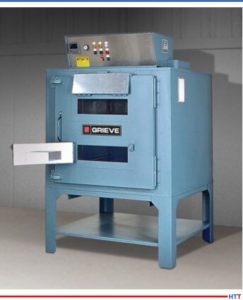
Universal oven from Grieve Source: Grieve
First of all, ovens are typically rated at 500°F, 750°F, 1000°F, or 1250°F. If you see a heat treat operation that’s running — certainly under 1450°F — but even under 1250°F, it may be being done in either an oven or a furnace.
Let’s talk about some of the distinguishing characteristics of ovens, so everyone gets a feel for it.
Ovens always have a circulating fan. If you see a piece of equipment without a circulating fan, it can’t be an oven. At these low temperatures, the heat transfer — in other words, how you heat a part — is done with hot air or circulating hot air. So, ovens always have fans.
In most cases — and years ago in all cases, but today in most cases — ovens are metal lined. If you were to open the door of an oven and look in, and you see a metal-lined chamber, that would typically be an oven.
The fan and the type of insulation or lining that’s used is very characteristic for distinguishing features of ovens.
Today, however, there are ovens that use fiber insulation and even some ovens that have refractory-insulated firebricks, refractory in them. The lines are a little bit blurred, but typically you can distinguish them by the fact that they have fans and are metal lined.
Ovens come in either “batch” or “continuous” styles. If the workload inside the unit, the piece of equipment, is not moving, we call that a batch style furnace. If the workload is somehow being transferred through the unit, we call that a continuous furnace. Ovens and furnaces can be both batch and continuous.
Ovens and furnaces can both be either electrically heated or gas fired.
One of the distinguishing characteristics of ovens is that if they are gas fired, they are, what we call, “indirectly heated.” This means your burner, your combustion burner, is firing into a closed-ended tube, a radiant tube, as we call it, so that the products of combustion do not “intermix.” They do not create an atmosphere that’s used inside the oven. In fact, the majority of ovens run with an air atmosphere – that’s another distinguishing feature.
However, there are ovens that can run inert gases. Those ovens typically have continuously welded shells. Again, that’s an exception rather than a rule, but there are ovens of that type.
There are also vacuum ovens out there. We actually have an oven chamber on which we can pull a vacuum. They are less common than their cousins, the air ovens, but they are out there in industry.
We have the method of heating and type of movement of the hearth or movement of the load that typically is consistent between ovens and furnaces.
What I’d like to do is just show everybody a couple of pictures of some very typical, what I’m going to call, “batch ovens.”
Doug Glenn: Because ovens are typically low temperature, you’re able to have metal on the inside, right? If it was higher temperature, you’d start experiencing warping. Is that the primary reason why you tend to see metal in an oven and not in a furnace?
Dan Herring: That’s correct, Doug.
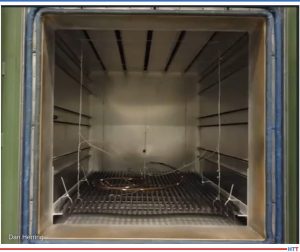
"Metal lined oven" Source: Dan Herring
The lining can be made of steel: it can be made of “aluminized’ steel,” it can be made of zinc-gripped steel (those are just coatings), it can be just steel, and they can be made of stainless steel (a 300 series stainless steel). That’s why you have the different temperature ratings and the different types of materials that this metal interior can be made from.
If you open the door of a metal-lined oven or an oven that had a metal lining, you would typically see what’s pictured here.
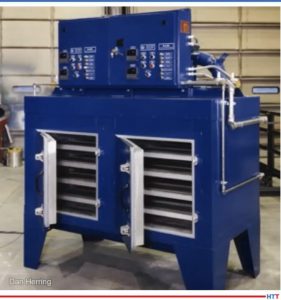
"Double door shelf oven" Source: Dan Herring
Ovens can be very small or they can be very, very large. What you’re seeing on the screen is a “double door shelf” oven.
It is very similar to your ovens at home. You open the door, there are shelves, and you can put trays on the various shelves. These can be small, to the point where, sometimes, they can sit on a benchtop. Sometimes they can be very, very large and be floor-mounted, as this one is.
This is an example of a batch oven, something that you would load, and the load stays stationary within the oven. Then, when you’re ready, you unload it.
Ovens can come in slightly larger sizes.
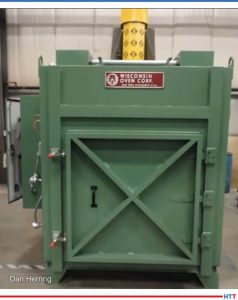
"A larger horizontal oven . . . . a fan system sitting at back" Source: Dan Herring
That’s a picture of a larger, horizontal oven. The door on this particular oven is closed shut, but you can see the fan system — that’s that yellow arrangement that’s sitting in back of this particular oven.
There is another style of oven.
"Walk in oven" Source: Dan Herring
We call this a “walk-in” oven — very creative, because you can walk into it. I’ve seen batch ovens that are very, very small and very, very large — ones that will fit on a benchtop and ones that are a hundred feet long.
You can see the heat source on the right hand side. Remember, whether it’s electrically heated with sheathed elements or if it’s gas-fired with, typically, an atmospheric-type burner, again, you have circulating air past either the electric elements or circulating air past the tube into which the burner is firing. You’re relying on convection — or moving hot air — to transfer that heat energy to your load.
These are just some different styles of different types of ovens, so everyone can see them. I don’t want to take too long, but I’ll show you another picture of one.
"Industrial oven . . . . typical oven in typical heat treat shop" Source: Dan Herring
This is an industrial oven. You can see the fan; it has a yellow safety cover on it. You can see the fan mounted on top, and this is a typical oven that you’d find at a typical heat treat shop.
Ovens have the characteristics that I pointed out. I’ll bring up one more picture which you might find interesting.
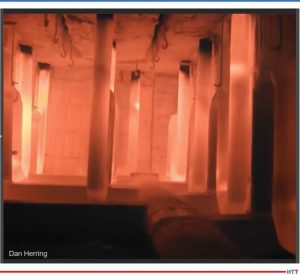
"Monorail conveyor oven . . . . with u-shaped radiant tubes" Source: Dan Herring
Since there are a variety of oven shapes and sizes, this happens to be a monorail conveyer oven. What you’re looking at is the inside of the oven. You’ll notice that in the ceiling there are hooks. The loads are actually placed on the hooks and sent through or pulled through the oven. This happens to be a gas-fired unit, and you can see that it has U-shaped radiant tubes into which you’re firing.
This oven is fiber-lined and not metallic-lined. You’ll also notice that because you see different colors of the tubes, this particular shot was taken and you destroyed the uniformity of temperature within the oven. Usually, they’re very tight.
Ovens are typically in the ±10°F range for temperature uniformity, sometimes in the ±5°F range.
Those are basically some pictures of ovens, whether they be batch or continuous, for everyone to see and think about, from that standpoint.
Q&A on Ovens (16:58)
Bethany Leone: What is the reason for the increase in temperature range for what classifies an oven?
Dan Herring: The main reason is the materials of construction have gotten better, so we’re able to withstand higher temperatures. But going to some of these temperature ratings, one of the things that heat treaters look at is if I have a process that runs at 1,000°F or 970°F (let’s take an aluminum heat treat example where a process is running at 970°F), I could run that in an oven rated at 1,000°F but I’m right at the upper limit of my temperature.
It's much better to buy an oven rated at 1250°F and then run a process such as 970°F where I have a margin of safety of the construction of the oven, so the oven will last longer.
However, industrial ovens tend to last forever. I’m the only person on this call old enough to have seen some of these ovens retired. It’s not unusual that an oven lasts 40 or 50, or sometimes 60 years.
Ovens are used in the heat treating industry for processes such as tempering, stress relief, for aluminum solution heat treatment, aluminum aging operations, and to do some precipitation hardening operations that run in these temperature ranges. Ovens are also commonly found in plating houses where you’re doing a hydrogen bake-out operation after plating. You also do various curing of epoxies and rubbers and things of this nature in ovens.
There are a variety of applications. Ovens are used also for drying of components. Ovens are used for drying of workloads, these days, prior to putting in your heat treating furnace. Many times, our washers are inefficient when it comes to drying. You take a wet load out of a washer and put it into a low-temperature oven, maybe running between 300°F and 750°F. Consequently, you both dry the washing solution off the parts and you even preheat the load prior to putting it into the furnace.
Heat Treat Today team enjoying a Lunch & Learn session
Doug Glenn: One of the things I’ve always distinguished ovens by is the term “panel construction” opposed to “beam construction.”
If you can imagine a sheet of metal, some insulation, and another sheet of metal – that’s a panel. It’s got enough insulation in it because the temperatures are not excessively high, but you really only need those three layers. You take those panels, you put them in a square or whatever, put a lid on it, put a bottom on it, and you basically have an oven, right?
Where furnaces are not typically constructed that way; they are constructed more where you have a support structure on the outside and then a heavy metal plate and then you build insulation on the inside of that. It doesn’t even need to have metal on the inside — it can be brick or another type of insulation.
Many people claim — and I’m sure there are some very strong ovens — that the oven construction is not as hardy, not as rugged. That’s one other minor distinction, but the main distinction is ovens tend to be lower temperature.
Dan Herring: Yes, that’s very correct, Doug. In panel-type construction, there is typically mineral wool insulation in between the two panel sheets; and it’s rated for obviously very low temperature.
There are, what we call, “light duty” and “heavy duty” ovens. Heavy duty ovens have that plate and support structure — those I-beams or channels — supporting the external structure.
Doug Glenn: You reminded me of something, Dan: We talk about ratings – oven ratings, furnace ratings, and that type of stuff. That’s pretty important and we haven’t really discussed that much. But if a furnace is rated at a certain temperature, you do not want to take that furnace beyond that temperature because there are real safety issues here.
There was one picture that Dan showed where you could see the metal interior, and there was like a gasket, if you will, around the whole opening. That gasket is only rated to go up so high in temperature. If you go over that temperature, you’d end up deteriorating that gasket, if you will. It could cause a fire, it could cause a leak, it could cause all kinds of issues. And that’s only one example.
One other one he mentioned was fans. There is almost always a fan in an oven, and if you take the temperature of that oven over its rated temperature, all of sudden the bearings in that fan start . . . well, who knows what’s going to happen.
You always want to know the rating of your oven and furnace, and don’t push the rating.
Dan Herring: Yes, if you exceed temperature in an oven, typically the fan starts to make a lot of noise and you know you’re in trouble. You only do that once. But those are excellent points, Doug, absolutely.
So, the world of ovens -- although it’s they’re an integral part of heat treating -- are a “beast unto themselves,” as I like to say. Construction is a factor, and other things.
All About Atmosphere Furnaces (24:50)
Furnaces, interestingly enough, can be rated both to very, very low temperatures all the way up to very, very high temperatures. In other words, you can see industrial furnaces running at 250° or 300°F or 500°F or 1000°F, — at typical temperatures that you would associate with oven construction — but you can also see furnaces running at 1700°F, 1800°F, 2400, 2500, 3200°F. There are some very interesting furnaces out there.
But furnaces, although they can run in air — and there are a number of furnaces that do — they typically run some type of either inert or combustible atmosphere inside them. Furnaces typically have an atmosphere, and they do not always have a fan. The rule is the higher you go up in temperature, the more any moving part inside your furnace becomes a maintenance issue. Many times, furnaces do not have fans in them.
They can be electrically heated. They could also be gas-fired. In this particular case, they can either be direct-fired or the burners are actually firing into the chamber; and the products of combustion become your atmosphere. They could be indirect-fired — like we discussed with ovens — into a radiant tube as a source of heat or energy.
Furnaces typically have plate construction. It’s typically continuous welded, they have channels or I-beams surrounding the structure to make it rigid, insulation is put on the inside. Traditionally it’s been insulating firebrick, but in what I’ll call recent years (20 years or so) fiber insulations have come about, and they perform very, very well.
Fiber insulations reduce the overall weight. They have advantages and disadvantages. A refractory-lined unit can have a great thermal mass due to the storage of heat inside the insulation, so when you put a cold load into a brick-lined furnace, the heat from the lining will help heat the load up quickly.
You don’t have quite the same heat storage in a fiber insulation. At the same time, when you go to cool a furnace, a fiber-lined furnace will cool very quickly as opposed to a refractory furnace which cools a lot slower.
Again, furnaces can be batch style, they can be continuous style, they can be fairly small in size. The smallest ones that I’ve seen, typically, are about the size of a loaf of bread. Conversely, you have furnaces that are so large you can drive several vehicles or other things inside of them.
A 14-foot long car bottom furnace Source: Solar Atmospheres of Western PA
As a result of that, what distinguishes them are typically their temperature rating and the fact that they use an atmosphere. Some of the atmospheres are: air, nitrogen, argon. I’ve seen them run endothermic gas and exothermic gas which are combustible atmospheres, or methanol or nitrogen-methanol which are also combustible atmospheres; they can run steam as an atmosphere. I’ve seen furnaces running sulfur dioxide or carbon monoxide or carbon dioxide as atmospheres. The type of atmosphere that is used in an industrial furnace can be quite varied.
We have several different furnace categories that typically are talked about: Batch style furnaces are configured as box furnaces. They are very similar in shape to the ovens that we looked at. Pit style furnaces are where you have a cylindrical furnace that actually is quite tall and fits down, usually, into a pit that’s dug in the factory floor.
You also have mechanized box furnaces. Those, typically, today, would be called integral quench furnaces or sometimes batch quench furnaces or “IQs.” There are belt style furnaces, gantry, tip-up, and car-bottom furnaces. There is a wide variety of batch style furnaces, all of which have the characteristic that once you put the load into the chamber, it sits there until it’s been processed and until it's time for you to remove it.
The exception is in an integral quench furnace. You push the load typically either directly into the heating chamber or into a quench vestibule and then into a heating chamber; you heat it in one chamber, you transfer it out, and you quench it into another chamber.
Those are some of the distinguishing features of batch style equipment. I’ve got a couple of pictures here that you might find interesting.
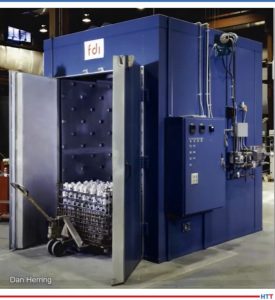
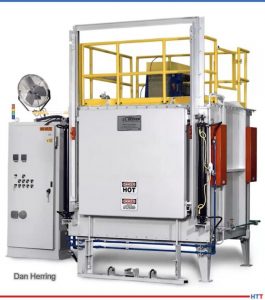
"A box furnace . . . . sometimes difficult by sight alone to tell an oven or box furnace" Source: Dan Herring
Here is a “box furnace.” You might say, “Oh, my gosh, it looks like an oven!” I see a fan on top, and it’s a box style. From the outside, it’s hard to tell whether it’s an oven or a furnace.
When you look at this unit, you might see that it’s made of plate construction. It would be difficult to tell if this unit were a heavy-duty oven or furnace unless you, of course, opened the door and looked inside. You would typically see either fiber insulation or insulating firebrick in these types of units.
Sometimes, just by sight alone, it’s very difficult to tell if it’s an oven or a furnace. But there are other telltale signs.
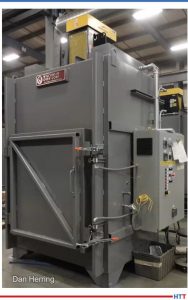
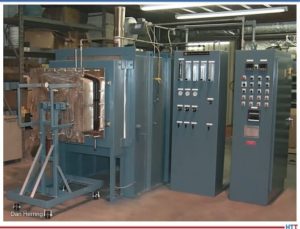
"A box furnace with retort" Source: Dan Herring
Now, this is a box furnace with a retort inside it. The workload is placed, in this case, into a metal container that’s physically moved on a dolly into the furnace itself. This is what we call a box furnace with a retort.
The process takes place inside the retort. You’ll notice that there’s a flow-meter panel there, of different gases, that are introduced directly into the retort. This style of furnace is very interesting because the furnace itself, outside the retort, is simply heated in air. It’s a relatively inexpensive construction. Also, when the time comes that the process is finished, usually you can remove the retort and introduce or put a second retort into the furnace while the first retort is cooling outside the furnace. It lends to increased production, from that standpoint.
But this is typically a box furnace; it looks like a big box. The shell does not have to be continuously welded because the process takes place inside the retort. You might be able to see, just past the dolly, there is a dark color and that is the blackish retort that’s actually being put in.
Doug Glenn: I think the reasoning of the retort is to protect the airtight atmosphere, right?
Dan Herring: That’s correct, Doug. The idea is the fact that it’s an effective use of your atmosphere.
The other thing you can do with a box furnace with a retort is you can pull a vacuum on the retort. As a result of this, you can actually have a “hot wall” vacuum furnace. That is what is defined as a hot wall vacuum.
The next type of atmosphere furnace we’re going to look at is pretty distinct or pretty unique: This is a pit style furnace.
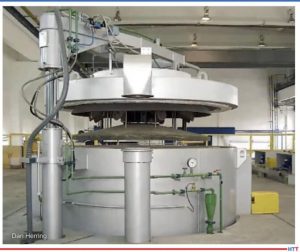
"A pit style furnace . . . . there is probably 4X as much furnace below the floor" Source: Dan Herring
What you’re seeing here is only that portion of the furnace that is above the floor. There is probably four times as much furnace below the floor as there is above. OSHA has certain requirements: there must be 42 inches above the floor not to have a railing or a security system around the pit furnace, because you don’t want to accidentally trip and fall into a furnace at 1800°F. We don’t want to say, “Doug was a great guy, but the last time I saw him . . .”
In this particular case, there is a fan which is mounted in the cover of this pit style furnace. Most pit furnaces are cylindrical in design; however, I have seen them rectangular in design. Some of them have a retort inside them; unlike the picture of the box furnace with the retort, the retort is typically not removable, in this case. Of course, there are exceptions. There are nitriding furnaces that have removable retorts.
I think this is a very distinctive design. If you walked into a heat treat shop, you’d say, “You know, that’s either a box furnace or an oven.” Or, if you looked at this style of furnace, you can clearly see it’s a pit furnace, or what we call a pit furnace.
Two other examples, one of which is just to give you an idea of what we call an “integral quench furnace.” I think this is a good example of one:
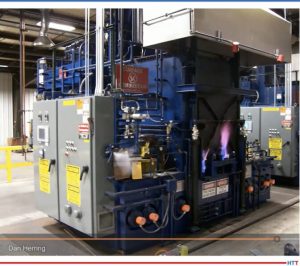
"An integral quench furnace, an in-out furnace" Source: Dan Herring
They’re made by a number of manufacturers. The integral quench furnace is probably one of the more common furnaces you’re able to see. It has, in this case, an oil quench tank in front and a heating chamber behind.
This would be an “in-out” furnace; the workload goes in the front door and comes out the front door. But once the workload is loaded into an area over the quench tank (which we call the vestibule), an inner door will open. The load will transfer into the heating chamber in back. That inner door will close, the workload will be heated and either brought up to austenitizing temperature, carburized or carbonitrided, the inner door will then open, the load will be transferred onto an elevator and either lowered down into a quench tank (typically oil) or, if the unit is equipped with a top cool, the load is brought up into the top cool chamber to slowly cool.
These styles of furnaces do processes like hardening, carburizing, carbonitriding, annealing, and normalizing. You typically don’t do stress relief in them, but I’m sure people have. These furnaces have a wide variety of uses and are quite popular. Again, the style is very distinctive.
They typically run a combustible atmosphere, and you can see some of that atmosphere burning out at the front door area.
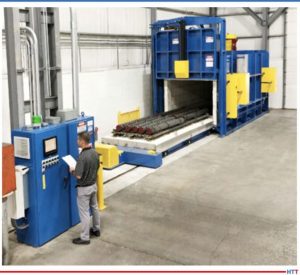
There are also, what we call, continuous furnaces or continuous atmosphere furnaces. They are furnaces where you have a workload and somehow the workload is moving through the furnace. A good example of that is a mesh belt conveyor furnace.
There are also what we call incline conveyor, or humpback-style furnaces. The mesh belts are sometimes replaced, if the loads are very heavy, with a cast belt: a cast link belt furnace. The furnaces can sometimes look like a donut, or cylindrical, where the hearth rotates around. We put the workload in, it rotates around, and either comes out the same door or comes out a second door.
A lot of times, rotary hearth furnaces have a press quench associated with them. You’re heating a part, or reheating a part in some cases, getting it up to temperature, removing it, and putting it into a press that comes down and tries to quench it by holding it so that you reduce the distortion.
There are other styles of furnaces typical of the “faster” industry which are rotary drums. Those furnaces you would load parts into, and you have an incline drum (typically, they’re inclined) with flights inside it. The parts tumble from flight to flight as they go through the furnace, and then usually dump at the end of the furnace into a quench tank.
For very heavy loads, there are what we call walking beam furnaces where you put a workload into the furnace. A beam lifts it, moves it forward, and drops it back down. Walking beam furnaces can handle tremendous weights; 10,000 to 100,000 lbs in a walking beam is not unusual. Any of the other furnaces we’re looking at wouldn’t have nearly that type of capacity.
There are some other fun furnaces: shaker furnaces. How would you like to work in a plant where the furnace floor is continuously vibrating, usually with a pneumatic cylinder so it makes a tremendous rattle, all 8 or 10 hours of your shift? That and a bottle of Excedrin will help you in the evening.
As a last example, the monorail type furnaces where we saw that you hang parts on hooks. The hooks go through the furnace and heat the parts.
I’ll show you just a couple of examples of those. These are not designed to cover all the styles of furnaces but this one you might find interesting.
"A humpback style furnace" Source: Dan Herring
This is a typical continuous furnace. This would be a humpback style furnace where the parts actually go up an incline to a horizontal chamber and then go down the other side and come out the other end. These furnaces typically use atmospheres like hydrogen, which is lighter than air and takes advantage of the fact that hydrogen will stay up inside the chamber and not migrate (or at least not a lot of it) to floor level.
Atmosphere Furnaces Q&A (47:30)
Evelyn Thompson: Are the inclined sections of the furnace heated? Why do the parts need to go up an incline? Just to get to the heated part of the furnace?
Dan Herring: If you’re using an atmosphere such as hydrogen, it’s much lighter than air. If you had a horizontal furnace just at, let’s say, 42 inches in height running through horizontally, the hydrogen inside the furnace would tend to wind up being at the top of the chamber or the top of the furnace, whereas the parts are running beneath it! So, the benefit of hydrogen is lost because the parts are down here, and the hydrogen tends to be up here.
By using an incline conveyor, once you go up the incline, the hydrogen covers the entire chamber and therefore the parts are exposed to the atmosphere.
I did a study a few years ago: About 5–6% of the types of mesh belt furnaces in industry are actually this incline conveyor type.
Another good example is the fact that people like to run stainless steel cookware. I’ve seen pots, pans, sinks, etc. Sometimes you need a door opening of 20 or 24 inches high to allow a sink body to pass into it. Well, if that were a conventional, horizontal furnace, you’re limited to, perhaps, 9 to maybe, at most, 12 inches of height.
Typically you never want to go that high, if you can help it. 4–6 inches would be typical. So, there would be a tremendous safety hazard, among other things, to try to run a door opening that’s 24 inches high. But in an incline furnace, the height of the door can be 20, 24, 36 inches high. The chamber is at an 11° angle, and you must get up to the heat zone, but they run very safely at that.
Karen Gantzer: Could you explain what a retort is?
Dan Herring: Think of a retort — there are two types — but think of one as a sealed can, a can with a lid you can open, put parts in and then put the lid back on. The retort we saw in that box style furnace is that type. It is a sealed container. We typically call that a retort.
Now, in that pit furnace we saw, there could be a retort inside that one and they could be sealed containers, but typically they’re just open sides, that are made of alloy. Sometimes we call those “retorts” as opposed to “muffles” or “shrouds,” in another case. Muffles don’t have to be a sealed container, but they typically are. That’s the way to think of them.
Karen Gantzer: Thank you, Dan, I appreciate that.
Bethany Leone: Dan, thank you for joining us. It was really a valuable time.
The Metal Treating Institute (MTI), recently held its 2023 Spring Meeting in Naples, FL. The three-day event included a mixture of business and fun with highlights including money raised for the scholarship fund, keynote speaker Joe Theismann, and educational/informative sessions for attendees.
MTI CEO Tom Morrison discussed the diversity of the events encapsulated in the three days of the meeting:
"What is great about MTI’s Spring Meeting is when you have the best minds in heat treating in one room, only great things can happen. Through key experts and round table discussions, MTI members worked through key issues like workforce development, lean manufacturing, predictive maintenance, and managing costs in inflationary times. MTI also raised $35,000 for the MTI Educational Foundation through raffling off a series of NFL jersey’s, footballs and helmets signed by MTI’s featured speaker, Super Bowl winning quarterback, Joe Theismann from the Washington Redskins."
MTI Board of Directors under the leadership of President Jim Orr (center) meets to help guide the organization to greater heights. Source: Heat Treat Today
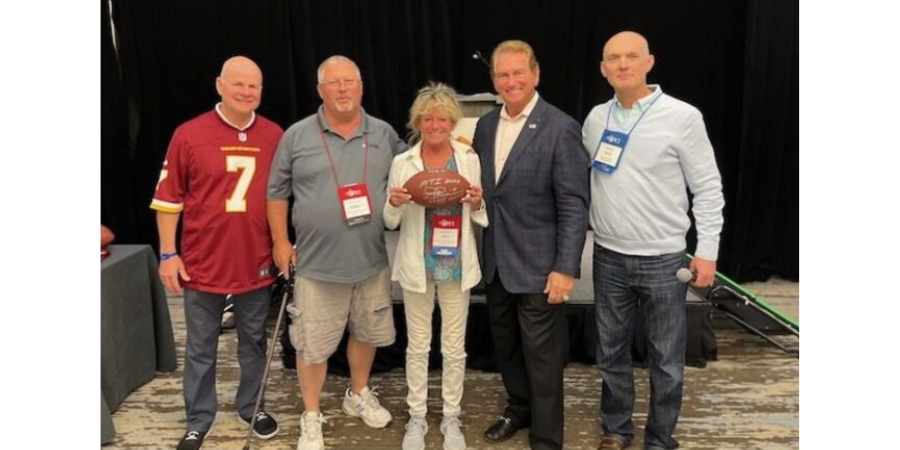
L-R: Jim Orr, Penna Flame & MTI President; Robert & Judy Rudy, Queen City Steel Treating; Joe Theismann, Featured Speaker; Doug Glenn, Heat Treat Today & MTI Educational Foundation Treasurer Source: Heat Treat Today
L-R: Joe Theismann, Featured Speaker; Lesley Wright, Wirco, Inc. Source: Heat Treat Today
L-R: April Uhlenburg, former MTI First Lady & Tom Morrison, MTI CEO Source: Heat Treat Today
L-R: Doug Glenn, publisher of Heat Treat Today & MTI Educational Foundation Treasure awards a custom Washington Redskins helmet to the highest bidders – Leslie & Chad Wright of Wirco, Inc. Also pictured is DL Wright, Wirco, and George Motes, who custom designed the helmet. Source: Heat Treat Today
L-R: Stacey Liebke, ECM USA & Karen Gantzer, Associate Publisher of Heat Treat Today. Source: Heat Treat Today
Joe Theismann autographs the back of Jim Orr, Penna Flame & current MTI President during an MTI Educational Foundation fundraising event with raised in excess of $35,000. Source: Heat Treat Today
MTI Spring Meeting evening dinner at the Naples Grand Hotel, Naples, FL Source: Heat Treat Today
Find heat treating products and services when you search on Heat Treat Buyers Guide.com
Heat Treat Today publishes eight print magazines a year and included in each is a letter from the publisher, Doug Glenn. This letter first appeared in Heat Treat Today's March 2023 Aerospace Heat Treating print edition.
Doug Glenn Publisher and Founder Heat Treat Today
Depending on where you live, “green” started to appear outside in March.
Contact us with your Reader Feedback!
Such was the case this March with Heat Treat Today. Our efforts were “greening up” around here as well. With the push for sustainability and environmental corporate responsibility, we decided to start the industry’s first and only “green” heat treat annual magazine edition and quarterly e newsletter. The Heat Treat Today team has been working on these items for several months now, but we are officially announcing them this month and encouraging you to watch for them both in May.
Whether you’ve been mandated to make your in-house heat treat operation more sustainable, or you want to do it simply because it’s the right thing to do, we’re here to help.
NEW Green Technologies in Heat Treat Annual Print Edition
Heat Treat Today's May print magazine will be the inaugural yearly focus on Green Technologies in North American heat treat. We’ll have articles and special editorial sections focused on sustainable technologies currently or soon-to-be available in the North American heat treat industry. This highly-focused issue will give industry suppliers a chance to shout loud and far about the technologies they have that will help you make your in-house heat treat operation more sustainable and productive. We anticipate topics such as:
Induction heating equipment
Electrical furnaces and ovens, including vacuum furnaces
High-efficiency gas-fired equipment
High-efficiency burners
Efficiency-maximizing control systems
Energy-saving insulating materials
Emission control or capture
Eco-friendly quench media
Economizing cooling systems
Industrial gas economizing systems
High-efficiency radiant tubes
High-efficiency heating elements
Potentially, there will be many other topics added to this list. There should be something for everyone who is interested in making their in-house heat treat operations, or commercial heat treat shop, more sustainable. I hope you look forward to receiving your copy and enjoying the content . . . in May!
NEW Quarterly Heat TreatGreen E-Newsletter
Sustainable technologies come into the market more than once a year, so, Heat Treat Today is launching a new quarterly e-newsletter this May that focuses on sustainable heat treat technologies for the North American marketplace. This e-newsletter, aptly named Heat Treat Green, will also focus on emerging and currently available sustainable technologies and products that will help your heat treat operations reduce environmental waste in a responsible manner. We anticipate that this e-newsletter will be deployed in the months of February, May, August, and November each year.
Do You Have a Green Story To Tell?
In both the annual magazine edition and the quarterly e-newsletter, we’d be interested in publishing your in-house heat treat sustainability story if you have one to tell. Our readers benefit from hearing what other manufacturers are doing to make their heat treat operations more sustainable. Many chief compliance officers or others in your organization responsible for promoting sustainable practices are typically quite interested in telling their sustainability stories. If that’s you or your company, we’d like to help you get the word out to the North American heat treat industry. Please contact our editors at editor@heattreattoday.com, and we’ll be sure to be in touch
Finally, if you’re a supplier to the North American heat treat industry and your product has a sustainability story to tell, you also should contact our editors: editor@heattreattoday.com.
Keep your eyes peeled for Heat Treat Green!
Find heat treating products and services when you search on Heat Treat Buyers Guide.com
Changes are inevitable, but the world today is shifting oh so rapidly, keeping us on our toes. Two men from different parts of the world, both with significant experience within the heat treating community, reflect on the implications of these changes in the heat treat industry. With each new topic, will their views align?
The experts are Thomas Schneidewind, editor-in-chief of heat processing magazine, and Doug Glenn, publisher and founder of Heat TreatToday. Thomas’s expertise lies in the European market while Doug’s resides in the North American market. We will feature their responses in each print magazine. Will their views run parallel or perpendicular? Time will tell. Enjoy this sixth installment of an ongoing column, first published in Heat TreatToday’s March 2023 Aerospace Heat Treatingprint edition.
Has digitalization come to heat treat operations? If so, how?
Thomas Schneidewind, Editor-in-Chief, heat processing magazine
Thomas Schneidewind Editor-in-Chief heat processing Magazine
Have you heard about the speaking furnace in the smart heat treat operations in Kleinachenbuchbach?
Contact us with your Reader Feedback!
You are right! There is no speaking furnace and no city with this name – not as far as I know. But if you think about the future of hardening shops or just have a look in the R&D departments of furnace builders, you will get an idea what the heat treat shop will look like in twenty years. Two topics will clearly shape the industry: decarbonization and digitalization. Decarbonization is the leading theme; digitalization is its enabler.
Digitalization is an important catalyst that makes decarbonization possible. It enables us to create and play out a multitude of scenarios in the shortest possible time, to exchange information globally in seconds, to free ourselves from time-consuming routine work, and to conserve, develop, and pass on knowledge gained from experience. Further, artificial intelligence (AI) has already started to augment all of our businesses, and this trend will continue to accelerate over the next years. Every company needs to think of itself as a technology company, redesign its processes, and ensure its employees have the skills needed for a world where we increasingly collaborate and work with capable and intelligent machines.
Digitalization is a key to success for small and medium sized enterprises in the heat treatment industry and a key to change the traditional heat treat shop into a smart, green, and profitable company. As the owner of a heat treat operation, you can concentrate on your business. While you talk to clients, do business, and invest in green technologies, maybe someday you will talk to your furnace and it will give you answers to much bigger questions than those connected to temperature, time, and hardness.
Doug Glenn, Publisher, Heat Treat Today
Doug Glenn Publisher and Founder Heat TreatToday
The answer to the question is a simple “yes.” Depending on what is meant by “digitalization,” it has been in heat treat operations for a number of years. The proliferation of digital chart recorders, for example, is clear evidence of that digitalization.
What digitalization will mean in the future is a mystery. One might say that digitalization is an ever-expanding final frontier, a place where we will be able to explore strange new worlds, to seek out new life and new civilizations, to boldly go where no man has gone before! (I hope you Trekkies appreciate that reference.)
To view a video, scan the code for “Cutting edge technology allows Quintus Technologies to deliver optimum technical support.”
It is, more seriously, an ever-evolving, strange new world, which currently is not widely embraced in the North American heat treat industry. Where we do see more of it is in larger companies with in-house heat treat operations. These larger companies have the IT and engineering horsepower to invest in deeper and deeper levels of digitalization.
Today, it is common for heat treat furnace manufacturers to perform computer upgrades and equipment troubleshooting remotely. It is rare, however, to see equipment servicing being performed via augmented reality (AR) where an on-site maintenance person or engineer wearing something similar to holographic glasses is helped by a “field” service technician who is hundreds or even thousands of miles away. But this type of AR-assisted field service does happen. For example, a hot isostatic press manufacturing company is promoting their ability to perform remote AR-based service. To view a video, scan the code below or do a web search for: “Cutting edge technology allows Quintus Technologies to deliver optimum technical support.” Pretty inspiring.
Find heat treating products and services when you search on Heat Treat Buyers Guide.com
Heat Treat Today publishes eight print magazines a year and included in each is a letter from the publisher, Doug Glenn. This letter first appeared in Heat Treat Today's February 2023 Air & Atmosphere Furnace Systems print edition.
Doug Glenn Publisher and Founder Heat TreatToday
When dealing with temperatures in excess of 1000°F, one would think that a ±0.1°F variation would not be a big deal. Apparently, not!
Contact us with your Reader Feedback!
As of the most recent AMS2750 standard, 1/10th of a degree Fahrenheit matters — and if your process recorders are not recording temperatures down to 1/10th of a degree, you are out of compliance.
This is a big deal and a real hardship for many in the Heat Treat Today audience.
At the most recent Nadcap meeting held in Pittsburgh this last October, I had the chance to discuss this most recent stringent requirement with some of the people who were responsible for putting it in the standard. Even after talking to them, I’m not sure I fully understand why it is we went in this direction, and I’m not alone.
The Background
"the new AMS2750 standard requires accuracy to 1/10th of degree." Source: Heat TreatToday
Here’s a very short explanation of how we got here. Both Revision D and E of AMS2750 required compliance temperatures to be ±2°F or ±1.1°C (“or ±0.2%” was added in Revision E). That pesky “.1” in ±1.1°C appears to be the source of this most current “situation.” The folks using °C were recording temperatures down to 1/10th of a degree, while the folks using °F — which was not a small number of people — were
not. So, the standards committee needed to make a decision on what to do about this discrepancy. The options were to round up or down or to the nearest integer for both °F and °C people OR require EVERYONE to record their temperatures down to 1/10th of a degree. After surveying end-users, the committee decided that end-users wanted to be required to record the 1/10th of a degree rather than round it up or down to the nearest integer. Thus, the new AMS2750 standard requires accuracy to 1/10th of a degree.
Thoughts
Even as I type it, it doesn’t make sense. Why would end-users want to record temperatures down to 1/10th of a degree? If you’re at 1750°F, a full 1°F amounts to only 0.05% of your total temperature. It is inconceivable that 1% makes that much of a difference in nearly 100% of all standard heat treat processes. In those very few processes where temperature tolerances ARE required to be that tight, SAE’s AMEC committee could have come up with a separate standard.
Most temperature recorders and reporting devices don’t currently allow for the display of anything to the right of the decimal, especially above temperatures at or above 1000°F. That’s because no instrumentation company in the history of heat treating ever anticipated that end-users would want to know, much less be required to record, anything to the right of the decimal.
Even if recorders and other instruments were capable of displaying 1/10th of a degree readings, most temperature sensing devices are nowhere near that accurate. Special case T/Cs can do it in certain situations, but by and large, thermocouples are calibrated to ±2°F or higher. How much sense does it make to worry about recording 1/10th of a degree accuracy from a thermocouple (and wire) that is rated at ±2°F or ±5°F.
Let’s pretend for a minute that our thermocouples could accurately and consistently record temperatures down to 1/10th of a degree. The question that really needs to be asked is: Just because we CAN do it, does that mean we SHOULD do it? As stated earlier, for that vast majority of heat treatment processes a full degree of temperature variance won’t typically make a difference.
As some of the people I’ve talked to about this situation have readily admitted, well-intended quality committees such SAE’s AMEC committee, who have inadvertently started this little kerfuffle, are not perfect. This would be a case in point. The men and women who make up the heat treat industry’s quality systems are excellent people: highly detailed and well-motivated. But, as all of us are, they are prone to over-do the things they’re good at. In this case, that’s deciding to take it down to 1/10th of a degree when rounding to the next closest integer probably would have done the trick.
Postscript: I’m open to your responses to this column, positive or negative. And, assuming there is no foul language or threats of physical violence (!), we would be glad to publish your comments. Please let us know what you think: htt@heattreattoday.com
Find heat treating products and services when you search on Heat Treat Buyers Guide.com
Changes are inevitable, but the world today is shifting oh so rapidly, keeping us on our toes. Two men from different parts of the world, both with significant experience within the heat treating community, reflect on the implications of these changes in the heat treat industry. With each new topic, will their views align?
The experts are Thomas Schneidewind, editor-in-chief of heat processing magazine, and Doug Glenn, publisher and founder of Heat TreatToday. Thomas’s expertise lies in the European market while Doug’s resides in the North American market. We will feature their responses in each print magazine. Will their views align? Time will tell. Enjoy this fifth installment of an ongoing column. This column was first published in Heat TreatToday’s February 2023 Vacuumprint edition.
To what extent have high energy prices affected heat treaters?
Thomas Schneidewind, Editor-in-Chief, heat processing magazine
Thomas Schneidewind Editor-in-Chief heat processing Magazine
In Europe, many companies are in shock. The energy crisis threatens the existence of energy-intensive companies. The hardening industry is coming under pressure as sharp price increases for electricity and gas lead to business losses. This is because the higher prices cannot be passed on to the customers, whose contracts do not allow price increases during the term of a contract. Most hardening shops are small or medium-sized businesses, while their customers are large companies and corporate groups.
Contact us with your Reader Feedback!
Hardening plants must find short-term solutions to cushion the cost shock and ensure the survival of their business. Add this with a view to the long-term goal of decarbonization. Because, in the future, process heat must be carbon free. Whether energy-intensive production is still possible in Europe in the future will be decided by the flexibility and inventiveness of the industry. The task now is to find intelligent answers and to reduce the use of fossil fuels more quickly than planned.
An important step in this direction is the modernization of existing plants – retrofitting can become the efficiency turbo that saves the day in difficult times. Hardening plants should further develop electrically operated equipment and strive for intelligent furnace control. The use of energy saving motors for pumps, circulators, and fans is another option. Insulation on side walls and ceilings in high temperature furnaces and energy recovery from waste heat are among the basic measures.
Modern burner technology also offers the potential to reduce energy consumption. Hydrogen as a heating gas will become an important option in the future. Hydrogen fueled burners have been around for some time but are not currently used in contract hardening shops. Because there are good ideas and positive trials, but no long-term experience and reliable cost comparisons, it will take a little longer until a significant introduction in contract heat treatment takes place. Until then, there are still some problems to be solved, such as safety, availability, investment costs, and especially the price of green hydrogen.
One thing is certain: investments are necessary. OEMs are already making high demands on future carbon-neutral processing and delivery in their contracts, since many automotive manufacturers are striving for a climate-neutral value chain – dictated by regulatory framework conditions. Hardening shops first must survive this difficult phase to then benefit from modernization investments. The aim is to offer customers carbon-neutral heat treatment. Companies can only achieve this by using green technologies. There is no other way.
Doug Glenn, Publisher, Heat Treat Today
Doug Glenn Publisher and Founder Heat TreatToday
In North America, energy is typically one of the top three expenses in nearly all heat treat processes. Commercial heat treaters know this well because it is their business to know the costs associated with their livelihood. Manufacturers with in-house heat treaters, on the other hand, often don’t properly allocate all the true costs associated with their heat treating processes. However, energy costs are fairly easy to allocate, even for them, and it’s safe to say: energy prices are skyrocketing.
The impact of rising energy prices can be measured in the price for each BTU that goes into the heat treat process. Often, 50% to 200% increases have not been unusual in the U.S.
But less obvious costs that are not so easy to measure also impact heat treaters. For example, transportation, which is energy intensive, adds to overall processing costs, especially if not done in-house.
Even LESS obvious is the effect that rising energy costs have on quality, innovation, and standard operating procedures (SOP). When corporate profits plummet due to rising energy costs, all aspects of the business are scrutinized, not just the areas where energy is most intensively used. This oftentimes results in cuts to “non-essential” expenses, which may mean reducing new product or process development initiatives, cutting back on borderline or “unnecessary” quality or safety measures (!), and re-examining SOPs to make further cuts.
The rising cost of energy could even impact the competency of heat treat operators. During COVID, I spoke to a nurse who explained that quality of care was reduced when a large number of nurses left the profession because they chose not to take the vaccines or boosters. Patients receiving emergency medical care did not notice any shortage of personnel, but the fact was that the nurses filling the critical roles were not as proficient or qualified as the expert nurses they replaced. In a similar way, when energy prices skyrocket and cuts must be made, the internal allocation of resources may compromise some aspects of the business that are not as clear to the customer.
When energy prices rise as drastically as they have, companies will examine how they can cut costs and help maintain profits, which is a GOOD and appropriate thing. It will take time for heat treaters to adjust to the recent energy price spike. Adjustments won’t be cost-free. The question is: Which part of the company will pay?
Find heat treating products and services when you search on Heat Treat Buyers Guide.com
In preparation for Heat Treat Radio episode #87 (looking at ways to increase productivity especially with data management) coming tomorrow, take a look at these three articles from the Heat Treat Today files to get you warmed up. No matter where you are in the digitization process, you'll find something to help here.
Taking the step from a paper and whiteboard system to a computerized system is a big jump. Maybe that's been done, maybe that's still being considered. Already digital? Then there are always efficiency and organization improvements to run an even more productive shop. Lastly, what does the future hold? How best to stay on the cutting edge of data management?
Read this original content article for guidance and encouragement in the use of digital systems for the heat treat shop.
1. Heat Treat Control Panel: Best Practices in Digital Data Collection, Storage, Validation
Heat Treat Today asked six heat treat industry experts a controls-related question, "As a heat treat industry control expert, what do you see as some of the best practices when it comes to digital data collection and storage and/or validation of instrumentation precision?" This article gives reasons for why you collect and store data and some helpful ideas for making sure those records are preserved.
Contact us with your Reader Feedback!
One expert had this to say: "electronic data must be validated for precision; checked; and calibrated periodically as defined by internal procedures or customer standards. Data must be protected from alteration, and have specific accuracy and precision."
Read the entire piece to get even more perspectives.
2. Heat Treat Case Study: Predicative Maintenance with Digital Thyristor Power Control
Tony Busch Sales Application Engineer Control Concepts
Tony Busch, sales application engineer at Control Concepts, Inc., takes a look at digital maintenance systems. These systems play a part in recording and monitoring data, and they contribute to the overall productivity of the heat treat shop. This article makes a strong case for intelligent controllers.
"Digital power controllers can calculate resistance and provide precise power control. Predictive maintenance is achieved by knowing when an element has reached its useful life. Intelligent power control includes embedded algorithms with teach function to calculate data and predict what is likely to happen next in the life of a heating element," emphasizes Busch.
Find out more about the benefits of digital connectivity here.
3. DUAL PERSPECTIVES: The Heat Treat Shop of 2050
Global ideas emerge in this article, as two men from very different locations, give some thoughts about digitization in the next 20 years or so. Hear from each expert - one representing the European market; one representing the North American market - as they discuss the role of technology, the human element, and heat treating of the future.
Thomas Schneidewind says, "digitization must always remain only a tool, not an end in itself." He reminds readers that importance always must be placed on the human element. Doug Glenn counters with, "For commercial heat treat shops where variability is high and volumes are relatively low, much of the same will be true with less and less human interaction needed."
Explore the rest of the forecast from Thomas Schneidewind, the editor-in-chief of heat processing magazine, and Doug Glenn, the publisher and founder of Heat TreatToday here.
Find heat treating products and services when you search on Heat Treat Buyers Guide.com
Changes are inevitable, but the world today is changing so rapidly that it’s constantly keeping us on our toes. Do two men from different parts of the world, both with significant experience within the heat treating community, have vastly different perspectives on the happenings in the heat treat industry?
We want to find out, so we asked a question that focuses on the world of heat treating to Thomas Schneidewind, the editor-in-chief ofheat processing magazine, and Doug Glenn, the publisher and founder ofHeat TreatToday. The question: How does government policy regarding ESG in the U.S. and nuclear power initiatives in Europe impact in-house heat treaters?
Thomas’s expertise lies in the European market while Doug’s resides in the North American market. We will feature their responses in each print magazine. Will their views align? Time will tell. Enjoy this fourth installment of an ongoing column. This column was first published in Heat TreatToday’sNovember2022 Vacuumprint edition.
How does government policy regarding ESG in the U.S. and nuclear power initiatives in Europe impact in-house heat treaters?
Thomas Schneidewind, Editor-in-Chief, heat processing magazine
Thomas Schneidewind Editor-in-Chief heat processing Magazine
The energy crisis paralyzes Europe. The European Union has been arguing for a long time about which energy is green. Finally, the European Commission classified both nuclear energy and gas-fired power plants as green energy production. This was a compromise between France and Germany in the discussion about the taxonomy that regulates in which energy sources investments should be made. Today, environmental associations are suing against this compromise, considering neither nuclear energy nor gas-fired power plants to be green energy.
Contact us with your Reader Feedback!
However, the discussion is long outdated. The Russian war of aggression on Ukraine has changed energy policy. Many nuclear power plants in France are at a standstill. Germany no longer receives gas from Russia, and the sabotage of the Nord Stream 1 and 2 pipelines is a politically motivated attack on the European energy market. Today, Europe is suffering from a major energy crisis. There has never been such a crisis in the energy sector in Europe since the Second World War. There is too little energy on the European market. At the moment, the focus is on security of supply.
This crisis threatens the existence of energy-intensive companies such as heat treatment shops. The hardening industry is also coming under pressure because it cannot pay the high electricity and gas prices. Entrepreneurs must find short-term solutions to cushion the cost shock, and ensure the survival of their business -with a view to the long-term goal of decarbonization. Because in the future, process heat must be CO2 free. A clear trend in this context is the switch from gas-heated industrial furnaces to electrically heated systems, whether resistance heating or induction. Managers must face these diverse issues today and respond quickly
Experts and practitioners will be talking about sustainability, materials, processes, and innovations in heat treatment at several events this fall. For example, in October, after a two-year pandemic break, the Hardening Congress (HK) was finally held again in Cologne. Here, too, the energy crisis was a dominant topic. We are talking about the future of Europe which must compete with the U.S. Many investment decisions are being put on hold because the uncertainty in Europe is currently too large. Europe, but especially Germany, faces a new recession.
Doug Glenn, Publisher, Heat Treat Today
Doug Glenn Publisher and Founder Heat TreatToday
Tremendously. A distinctive mark of the U.S. is that we’ve trusted the Market – what Adam Smith called the “Invisible Hand.” We haven’t believed that economies need to be planned or managed; attempts to manage or plan an economy result in more damage than good. We’ve believed that if proper natural or biblical law guardrails are established and enforced, the economy would run itself, self-adjusting as necessary. Today, many have lost faith in the Market. Instead, we put our faith in political processes and political leaders to handle the economy. Because we’ve lost faith in the Market, questions such as the one we’re addressing today make sense to ask. Government policy should have nothing to say about the type of energy we use, the people we hire, or the ideals we hold. Nonetheless, that is NOT the world we live in, so let’s address the question.
Nuclear Power Initiatives
This is really not an initiative; it is more of a “de-initiative” – a closing down of nuclear power plants in Europe (except France) – and the incentive to do so is not economic. According to those who know, nuclear is the cheapest, most reliable form of energy, vastly less expensive than “renewables.” So, in the hands of the Market, nuclear and natural gas generation power plants would win the day. Nuclear is being abandoned for purely political reasons. The effect on heat treaters and all other consumers of electricity: higher prices for energy, either in the form of explicitly higher prices per BTU or higher taxes to incentivize more expensive “renewable” energy sources.
Environmental, Societal, and Governance
As far as ESG goes, government policies in these areas will only increase the cost of doing business.
ONE of the three categories represents an area where the government might have a right to be heard: environmental. But even there, government’s scope is vastly overplayed – that is, if you have faith in the Market! Societal and governance are recent (non-economic) constructs being forced on businesses, NOT for the benefit of the end-consumer, but for the benefit of a vocal minority who believe the world should be a certain way and are using government policies to make it so.
For in-house and commercial heat treaters, ESG pressures and government recommendations or policies will raise the cost of doing business and ultimately the cost of the final product for consumers with very little measurable benefit for anyone. For in-house and commercial heat treaters, ESG pressures and government recommendations or policies will raise the cost of doing business and ultimately the cost of the final product for consumers with very little measurable benefit for anyone.
Find heat treating products and services when you search on Heat Treat Buyers Guide.com
Heat Treat Today publishes eight print magazines a year and included in each is a letter from the publisher, Doug Glenn. This letter first appeared in Heat Treat Today’s December 2022 Medical and Energy Heat Treat Issue print edition.
Doug Glenn Publisher and Founder Heat Treat Today
It’s roughly noon on November 8, 2022, and I’m sitting outside Starbucks in downtown Beaver, Pennsylvania, about 40 minutes from downtown Pittsburgh, enjoying an unseasonably mid-70s, pure blue sky day. I live another 40 minutes away near New Castle, PA, but I’m here in Beaver to see the newest Glenn grandchild and stopped at Starbucks to buy a triple-shot decaf espresso – the mid-afternoon drink of choice for my wife — which the barista’s have affectionately dubbed “Why Bother.” (Think about it . . . three shots of DECAF espresso. Why bother?)
Contact us with your Reader Feedback!
There’s plenty of human activity here in downtown Beaver. People walking and talking. Many conversations and warm greetings — handholding, smiling, kids with parents, cars passing, movement and activity everywhere.
This moment in Beaver reminds me of the Altstadt in Dusseldorf, Germany in June of any given year. Aldstadt, which means “old town,” is the hub of activity in the evening after each of the five days of Thermprocess, the world’s largest heat treating trade show held every four years at the Messe (fairgrounds) in Dusseldorf, Germany. In fact, walking and eating dinner in the Aldstadt is one of the highlights of participating in Thermprocess.
If you’ve never heard of Thermprocess and you’re involved in the heat treating industry, you need to know about it. It is one of four co-located metals trade shows held in mid-June every four years in Dusseldorf. It is an event to behold, and one highly recommended by the author of this column. In addition to Thermprocess, there is GIFA (a foundry event), NEWCAST (a casting event), and METEC (a metallurgical event). All-in-all, over 70,000 visitors and over 2,000 exhibitors flood the Messe every four years.
Düsseldorf, Germany Source: Unsplash.com
In 2023, Thermprocess is being held from June 12-16, and I would like to personally invite you to join me in Dusseldorf. As the largest heat treat event in the Western world (and arguably, the ENTIRE world), Thermprocess offers North American participants an opportunity to expand their view of what is happening in the heat treating/thermal processing world. And a broader perspective is exactly what we need. For those of you who have ever attended one of the larger manufacturing events here in North America, IMTS for example, Thermprocess and her three sister shows are MUCH bigger and better.
The Messe, where the event is located, is easily twice to three times the size of McCormick Place in Chicago, where IMTS is located. It would easily take you 20 minutes to walk from one end of the Messe to the other. During the full week it is open, the Messe is packed with metals-related exhibits and activities. It is not humanly possible to see all that is available to be seen.
Heat Treat Today is encouraging North American heat treat suppliers who market internationally to exhibit. We are putting together a group of like-minded North American exhibitors to join us. Assuming we get enough companies to join us, we will exhibit close to one another and share resources to make it more affordable for all concerned. We’ll share things like food & beverage, interpreters (if needed), and meeting rooms. By the way, unlike many North American shows, it is not unusual for people to actually strike deals and sign contracts at Thermprocess.
If you’re not a heat treat industry supplier, we encourage you, as a consumer of heat treat products, services, or supplies, to attend the event. The technology that you will see will be eye-opening. Please let us know if we can be helpful getting you to Dusseldorf in June 2023.
Find heat treating products and services when you search on Heat Treat Buyers Guide.com







 Are you trying to figure out what heat treat equipment investments you need to make in-house and what is better being outsourced? This conversation marks the continuation of Lunch & Learn, a

























 If you’re not a heat treat industry supplier, we encourage you, as a consumer of heat treat products, services, or supplies, to attend the event. The technology that you will see will be eye-opening. Please let us know if we can be helpful getting you to Dusseldorf in June 2023.