Nitriding systems have expanded the operations at two global companies: a gear manufacturer for the automotive industry and a fuel injection systems manufacturer for the marine machinery industry. In both cases, the systems will be integrated into existing installations in order to increase production capacity.
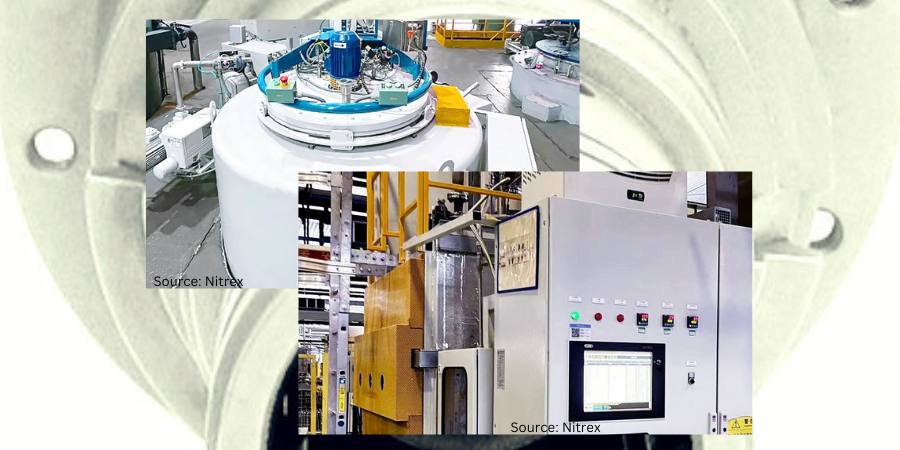
NXHL-910512 nitriding furnace Source: Nitrex
A Chinese gear manufacturer has added a fourth Nitrexnitriding furnace to its automated gear production, which includes the manufacturing of transmission gears, transfer case gears, synchronizers, and engine-gear rings for both local automotive OEMs and global markets.
“This expansion goes beyond capacity enhancement; it elevates the manufacturer’s in-house capabilities and tightens production controls,” said Tao Liu, sales manager at Nitrex China. “It allows the company to focus resources on driving innovation and sustainability across domestic and international vehicle markets, including the growing new energy vehicle (NEV) sector.”
A third Nitrex nitriding system has been installed at a manufacturer specializing in high-performance fuel injection systems for diesel engines in maritime vessels. The new NX-815 batch furnace with a 3300 lb. (1,500 kg) load capacity is specifically tailored for processing carbon steel and stainless steel parts and meets stringent requirements of the shipbuilding and industrial marine industries.
“As environmental regulations propel the shift towards alternative energy-powered ships, our advanced nitriding technologies play a crucial role. We are proud to support their expansion into stainless steel applications,” said Tao Liu.
Press releases are available in their original form hereand here.
Readers are checking out Heat TreatToday’smagazine, and the April/May 2024 Sustainable Heat Treat Technologies print editionhas a piece that sparked a comment from a reader. The letter from publisher Doug Glenn, entitled “The DOE IS Coming After YOUR Job“, debates the question of policy-driven market forces over economy-driven indicators.
Would you like to weigh in on the topic? Submit your question, comments, thoughts, or queries here or email Bethany Leone at editor@heattreattoday.com.
Here is an excerpt from the publisher’s page:
“On the fourth slide of a presentation entitled, ‘Cross Sector Technologies Meeting: Day 2, Nex-Generation Enabling Technologies,’ presented by Mr. Chan on May 30, 2023, we find the following:
DOE Commitment to Industrial Decarbonization (slide title)
‘Industrial Heat Shot™ — Developing technologies to reduce process heating GHG emissions by 85% by 2035′
‘Industrial Decarbonization Roadmap — Net-zero CO2 emissions by 2050′
The same slide goes on to list four international organizations that the U.S. has joined to ‘decarbonize’ energy-intensive industries. Those four organizations are:
Net-Zero World Initiative
G7 Industrial Decarbonization Agenda
Mission Innovation’s Net-Zero Industries Mission
UNIDO’s coordinated Industrial Deep Decarbonization Initiative”
This publisher’s page prompted this feedback from loyal reader Jim Conybear:
“I enjoy keeping up with the industry through Heat Treat Today. I read your recent editorial, “The DOE is Coming After Your Job”. Although you make some interesting and provocative comments, I think you did a disservice to the work being done by the DOE. Without their efforts, we would be even further behind in our needed efforts to combat the wasteful use of energy. The headlines you extracted from the presentation by Isaac Chan, fourth slide . . . do not mean that there is an either/or decision on fossil fuels. They are, in fact ,very good goals to pursue if we are to continue to make progress.
I have known Isaac Chan since his early days with the Gas Research Institute and the DOE. Never did he advocate the elimination of all combustion processes. On the other hand, he has led many industry and government programs that enabled our industry in particular to reduce costs and improve productivity by identifying and supporting more efficient, environmentally compatible processes.
Isaac Chan is a friend to our industry, not the enemy. I would enjoy seeing an interview with him to present a more realistic assessment of the problems and potential solutions to our carbon excesses.”
We welcome your inquiries to and feedback on Heat TreatToday articles. Submit your questions/comments to editor@heattreattoday.com.
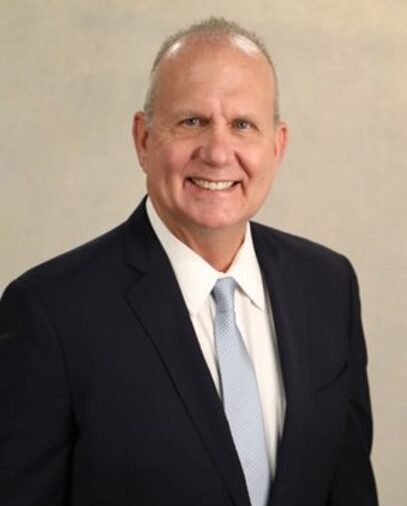
Robert (Bob) Hill, FASM President Solar Atmospheres of Michigan Source: Solar Atmospheres
After successfully relocating and commissioning ten vacuum furnaces into their current facility, Solar Atmospheresof Michigan Inc. is poised for further expansion. Bulldozers have commenced work on a new 20,000-square-foot building, which will more than double the current footprint at their Chesterfield, Michigan, location.
Bob Hill, president of Solar Atmospheres of Michigan, commented, “This expansion will create a larger shipping and receiving area to better serve our customers’ needs and position us for future growth. Come watch us grow!”
Source: Solar Atmospheres
This press release is available in its original form here.
If curiosity were a person, Brynna Keelin Kelly-McGrath would be her name. Having risen at Moog, Inc. to the position of materials and process engineer, Brynna shares her early STEM interests and how she stays up-to-date on industry trends and ideas. In this highly engaging NextGen profile on Heat TreatRadio — with host and Heat TreatToday’s publisher, Doug Glenn — get to know this talented metallurgist.
Below, you can watch the video, listen to the podcast by clicking on the audio play button, or read an edited transcript.
The following transcript has been edited for your reading enjoyment.
Meet Brynna Keelin Kelly-McGrath (01:00)
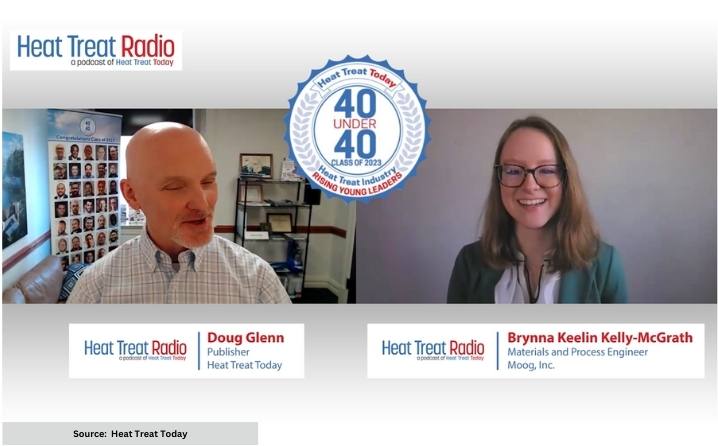
Doug Glenn: Let’s jump into today’s Heat Treat Radio episode with Brynna Keelin Kelly-McGrath from Moog, Inc. It’s a great pleasure to be here today with Brynna, who is one of our 40 Under 40 Class of 2023 award recipients. First off, congratulations on that award, and welcome to Heat Treat Radio.
Brynna Keelin Kelly-McGrath: Thank you so much. That was an honor.
Doug Glenn: Brynna lives just south of Buffalo, New York. As you know, this interview is to get to know you a little bit more — how you got into metallurgy, heat treating, and all that good stuff. Let’s start way back. Give us a little bit about yourself as a younger person, maybe high school age and moving on up through, and then how you got involved with heat treating and metallurgy.
Check out Brynna’s 40 Under 40 profile. Click the logo.
Brynna Keelin Kelly-McGrath: Sure. I grew up in a little town called West Falls, south of Buffalo, New York, and about 20 minutes from Moog. While I was in high school, I took AP chemistry and physics and fell in love with those topics. I knew from a younger age that I was going to wind up being an engineer eventually; I just didn’t know what kind. But I was pretty sure I wanted to be a chemical engineer, so I toured a couple of colleges.
At one of them, I met with a materials science professor to talk about the differences between chemical and materials science engineering. I was sold. I was all set and ready to go be a polymers engineer. I picked Purdue University, started going there, and was absolutely loving it.
The summer after my freshman year, I got an internship with Moog, which was right around the corner from my hometown. The internship was primarily metallurgical, due to the nature of Moog’s products, and I absolutely loved it. I was not expecting to like it, and it was just so great. So, I transitioned all of my coursework over to metallurgy, and I kept coming back to Moog for internships, and that was fantastic.
Learning from Industry Experts (03:32)
When I started off at Moog, it was right around the time when two of our subject matter experts in heat treatment were transitioning to retirement. I started learning as much as I could as fast as I could about heat treatment. There was obviously a lot to learn there, but it was a great time.
After working at Moog for a couple of years, I decided I wanted to go back and pursue my other passion, which was manufacturing engineering. So, right now I’m working on a master’s degree after work to combine metallurgy and manufacturing.
“When I started off at Moog, it was right around the time when two of our subject matter experts in heat treatment were transitioning to retirement. I started learning as much as I could as fast as I could about heat treatment.”
Brynna Keelin Kelly-McGrath, Moog
Doug Glenn: Wow. You’re a classic overachiever. That’s pretty good. And you said Purdue, correct?
Brynna Keelin Kelly-McGrath: Yeah.
Doug Glenn: Okay. And you did your undergrad there. Did you actually end up graduating with a materials engineering degree or a metallurgy degree?
Brynna Keelin Kelly-McGrath: Materials science and engineering.
Brynna shares how she got started in the industry. Source: Heat Treat Today
Doug Glenn: All right. Good. You spent the summers back at Moog and enjoyed that. You know, we see a lot of the older generation retiring, so you’re filling the brain drain, as we say, which is great. Are there are many other young people at Moog?
Brynna Keelin Kelly-McGrath: Yeah, their internship co-op program has been fantastic in bringing in a lot of students right out of college and getting them hooked on our product line and the sort of manufacturing we do. And we’re definitely getting more recent college graduates. But, you know, with people retiring, those are some awfully big shoes to fill.
Doug Glenn: For sure. What exactly does Moog make at your facility? They’re a large corporation; I know they usually make a lot of automotive, maybe aerospace, components but are you able to say specifically what Moog does there?
Brynna Keelin Kelly-McGrath: We specialize in high precision motion actuation systems. From a metallurgical side, we’re working with a ton of really cool materials. So it’s not just steels or aluminum, it is a lot of aerospace applications, defense. The materials and process engineering group is physically orchestrated on our headquarters campus as well as the space and defense building, so we do get to see quite a bit of that. From the metallurgical perspective, there is a lot to see and work on.
Doug Glenn: You mentioned you were thinking about being a chemical engineer, but then you saw the materials. Do you remember what it was about that and metallurgy that attracted you? Anything specific?
Brynna Keelin Kelly-McGrath: I remember sitting through that talk with a materials professor at Purdue, and he was talking about what the day to day of a chemical engineer versus materials engineer looks like. I will not pretend that he wasn’t biased, because he was a materials professor. But the work he described for materials engineering was so diverse, and there were options for different settings and what you could end up working on — from being in a steel mill to working in a lab like I do. There are a lot of options, a lot of cool things. The slogan at Purdue was something along the lines of: you can’t make it without materials.
Brynna’s Family Background (07:30)
Doug Glenn: That’s really neat. So, I haven’t asked you about your family at all. What did they think when you told them, hey, I’m thinking about being a materials engineer or a metallurgist?
Brynna Keelin Kelly-McGrath: My father is an industrial engineer, and my mother is a pharmacometrician, so they’re both in the stem field already. I think it was no surprise that I was going to pursue engineering and then, metallurgical engineering specifically. I think they were happy to encourage me to pursue any of my passions. And my father knew a couple of materials engineers and thought that it would work out for me. They were excited.
Undergraduate Research (08:16)
Doug Glenn: They were very supportive. That’s great. When you did your undergrad at Purdue, did you have to work on a final paper or any specific projects that were of interest to you?
Brynna Keelin Kelly-McGrath: I did some undergraduate research in the metallurgy realm. But my senior project for graduation was along the lines of characterizing shot for shot peening and the degradation of shot and the residual stress that it imparts. It was like a cool mix of FEA modeling with actually characterizing the material. It was a neat project.
Doug Glenn: Have you had to do any of that at Moog?
Brynna Keelin Kelly-McGrath: There’s a fair deal of materials characterization. We have shot peening, but I’m not super involved with it.
Current Work at Moog (09:35)
Doug Glenn: Gotcha. That’s interesting. Can you describe what your typical day at Moog looks like now and what you’re working on?
Brynna Keelin Kelly-McGrath: Sure. My typical day is a good deal of talking with all types of engineers, explaining metallurgical concepts. Because we work on a lot of different materials, there’s a lot to understand there. A good portion of my role is talking with other engineers about how a heat treatment procedure works or what’s metallurgically happening, how to modify a manufacturing sequence, how to design so that the product’s going to work.
But then I also specifically work in a failure analysis lab. This could be anything from something’s coming off the manufacturing line a little bit wrong or something failed in the field. We’ve got a beautiful characterization lab full of all the toys that you could think of, including two SEMs and a chemical lab. There’s a good deal of analysis there, too.
Doug Glenn: You seem like a person who enjoys your work. Is there any specific story or instance of something happening, either in school or at work, that really made you happy that you were in metallurgy and heat treat?
Brynna Keelin Kelly-McGrath: Oh, goodness. That’s a good question.
I would have to say I’ve had a couple projects at work, without getting into too many specifics, where we discovered something new metallurgically that we didn’t know was happening before. And then working through that, how did we not know it before? What do we know about it now? And what are we going to do to utilize this new thing that we discovered and take advantage of it? From a heat treat perspective, sometimes that means modifying our procedures, modifying our fixturing, creating something new.
It’s neat to see the modifications happen and come up with the new parts on the other end. It’s been very exciting to work on interdisciplinary teams like that.
“My typical day is a good deal of talking with all types of engineers, explaining metallurgical concepts. Because we work on a lot of different materials, there’s a lot to understand there. A good portion of my role is talking with other engineers about how a heat treatment procedure works or what’s metallurgically happening, how to modify a manufacturing sequence, how to design so that the product’s going to work.” Source: Heat Treat Today
Doug Glenn: Yeah. I’m curious about this. You’ve been out in the work world for how many years?
Brynna Keelin Kelly-McGrath: Three and a half.
Doug Glenn: Okay. So, you’ve been out of school and working four years, and the amount you know about metallurgy and heat treating now is four years’ worth. Does it kind of amaze you the amount of stuff we don’t know?
Brynna Keelin Kelly-McGrath: Absolutely. Metallurgy is an old science, but you know we’re still [developing] the tools and technology and it’s great to find out new things.
Doug Glenn: Right. A lot of people get involved and say, “Well, I don’t want to go into metallurgy and heat treat because it’s a mature industry,” but I was curious if you felt the same way.
It’s really quite fascinating because there is a lot that happens. Like you were saying at Moog when you discovered things, a lot of stuff that’s happening and we really don’t know why. The more we can discover about it, the better.
Brynna Keelin Kelly-McGrath: Absolutely.
Top Industry Resources (12:58)
Doug Glenn: Let me ask you this. You obviously come from a smart family; you’ve got parents who are well educated, and you are as well. What are some of the metallurgical/heat treat resources that you use to stay current?
Brynna Keelin Kelly-McGrath: I think the best resource that’s out there is people. The network that I’ve been growing comes from a variety of different sources. I’m part of a few industrial committees, and it’s just a great way to meet people from all ends of the spectrum of metallurgy — from those producing the material to those making something out of it to the people who are going to use it all the way down the line.
Finding other metallurgists in those realms, and also through venues like ASM and our local Buffalo chapter — meeting people who have more experience than I do and have seen it before. If I’m seeing something for the first time, there’s definitely someone who spent their whole career on that. It’s really great to tap into those resources. That’s my number one.
And then my second choice would be the ASM handbooks. I’ve always got at least two open on my desk.
“I think the best resource that’s out there is people.”
Brynna Keelin Kelly-McGrath, Moog
Doug Glenn: Those are great resources. ASM over the years has pumped out some very, very good stuff. Is there anything else about your work or your schooling that is of interest or excited you that you’d like to share?
Brynna Keelin Kelly-McGrath: I really liked working at Moog because it’s a cool application where I can use my metallurgical knowledge along with this new manufacturing knowledge that I’m building up. That was my favorite intersection with my undergrad degree. And now I get to actually try that out in a working sense. That’s been great.
Doug Glenn: And you’re doing a master’s in industrial engineering?
Brynna Keelin Kelly-McGrath: The University of Michigan.
Doug Glenn: Remotely, I’m assuming?
Brynna Keelin Kelly-McGrath: Yes.
Doug Glenn: Very nice. And how far along are you, and how much longer do you have to go there?
Brynna Keelin Kelly-McGrath: I’m hoping to graduate in December, so I’m coming closer to the finish line.
Doug Glenn: Congratulations. That’s really good.
Rapid-Fire Round (15:44)
Doug Glenn: I want to move off of metallurgy and heat treat just to learn a little bit more about Brynna. All right, so these quick questions are what I call the rapid-fire round. Brace yourself. Are you a Mac or a PC person?
Brynna Keelin Kelly-McGrath: I am a Mac person through and through. I love my Mac.
Doug Glenn: Do you use a Mac at work?
Brynna Keelin Kelly-McGrath: I wish, but no.
Doug Glenn: We have an ongoing debate here. We had a couple people that came into the organization with Macs, and I’ve always been a PC guy. So, anytime there’s a computer problem, we tease each other, “Well, that’s because you’re working on a Mac/you’re working on a PC.” Well, that’s good to know. And for your phone: Are you an Apple phone person?
Brynna Keelin Kelly-McGrath: Yeah, I’ve got an iPad. And I just got a new MacBook Air the other day.
Doug Glenn: You’re hardcore. Very good.
So, we’re a publishing company here at Heat Treat Today. And I like to ask this question: When you consume media, do you prefer hard copy or digital?
Brynna Keelin Kelly-McGrath: I prefer digital. I like to have all of my work life very organized by topic, and it’s way easier for me to organize everything if I have a digital copy of it. So even if it’s a print copy, I’ve been known to scan and file it the way that I file everything else.
Doug Glenn: Okay. Now what do you value more in work — a flexible work schedule or high pay?
Brynna Keelin Kelly-McGrath: I’m going to go with flexible work schedule. I’ve had some people close to me who have the high pay but no flexibility. And they’re the ones more jealous, so I’m going to go with that. I’ll take the flexibility.
Doug Glenn: That’s a great answer. Here’s one: Would you rather work remotely or in an office?
Brynna Keelin Kelly-McGrath: In an office 100%, I am definitely of the variety that likes to be around people. I would rather have people to talk to face to face than doing it over Teams.
Doug Glenn: I kind of assumed you were like that. How did you handle all the isolation that came with the recent pandemic?
Brynna Keelin Kelly-McGrath: I was still in college at that time for most of Covid. Purdue was only remote for half of one semester. It was a reasonably short time. And then the rest of the time we had limited capacity in classrooms and things. But when I was coming back for my internships, our department was classified as essential. We were coming into the office every day, and that was good, I enjoyed that.
Doug Glenn: So, you didn’t necessarily really have a lot of the isolation or as much as you might have had.
Brynna Keelin Kelly-McGrath: Yep.
Doug Glenn: That’s good. Okay, I won’t keep going down that road. I think that whole time period has been very impactful on our society. And I’m curious how people feel it has affected them.
I know you love working at Moog, but if you had a dream job, what would it be?
Brynna Keelin Kelly-McGrath: I don’t know. I think someday down the line, it would be cool to have my own manufacturing business. I don’t have a product in mind at the moment, but in my thoughts it has to do with metallic components and heat treatment, because that’s my passion. That would be great.
Doug Glenn: Very interesting, owning your own company and manufacturing something metal. You know what? That’s where it starts. You’re three and a half years out, and you’ve got time to develop more specificity over time. But that’s good to even know that you’re moving in that direction.
I assume you don’t work all the time. What do you do? What do you do in your free time? What do you like? What are your passions outside of work?
Brynna Keelin Kelly-McGrath: The number one time consumer at the moment is that master’s degree. But then, you know, on a pure fun basis, my husband and I are avid golfers. And all of the very short Buffalo summer we’re trying to be out there on the golf course.
“But then, you know, on a pure fun basis, my husband and I are avid golfers. And all of the very short Buffalo summer we’re trying to be out there on the golf course.” Source: Richard-7 / Getty Images Signature
Brynna Keelin Kelly-McGrath: I’m also a bluegrass fiddler. I play in a couple bands. And that’s pretty fun, too. It’s almost Saint Patrick’s Day.
Doug Glenn: You’re a musician? You know, I’ve heard that there are some engineering schools who don’t ask you if you play an instrument, they ask you what instrument you play because there is a correlation somehow or other between music and engineering. Maybe it’s the methodical-ness, the orderliness, and all that stuff.
Brynna Keelin Kelly-McGrath: Neat, I didn’t know that.
Doug Glenn: If you’re playing bluegrass fiddle, I assume you play some by ear. I mean, I assume you’ve got some sort of natural talent there. Is that safe to say?
Brynna Keelin Kelly-McGrath: Yeah, I started that at a decently young age. And now my husband and I are learning piano as well, so it’s been fun.
Doug Glenn: What does your husband do by chance?
Brynna Keelin Kelly-McGrath: He’s a software engineer.
Doug Glenn: Two engineers in one house. That’s got to be interesting dinner time talk. That’s wonderful.
Okay. Last question for you. I give people an option here. You can answer any one of these three. What would be your favorite app, movie, or magazine?
Brynna Keelin Kelly-McGrath: The first thing that came to my mind when you asked that question was Audible. At the moment, I’m hooked on reading, or listening, to a lot of books. I consider it reading in the little bits of downtime here and there grocery shopping and driving in the car and things like that. It’s nice to spend that time a little bit more productively.
Doug Glenn: I’m with you. I think that’s great. I assume maybe you can even do some of your school reading on Audible?
Brynna Keelin Kelly-McGrath: I haven’t tried that yet. Honestly.
Doug Glenn: Sometimes people learn better by actually reading. But other people learn better by listening, so that’s fine.
If you were to encourage young people to really look into metallurgy materials, what would you tell them? What would be your encouragement to them?
Brynna Keelin Kelly-McGrath: I think the most impactful thing for me at that age was actually getting to see what they do. At Moog, I act as a tour guide for a lot of high school students. I try to show them as closely as possible what we do and what a day looks like. Because it’s great to think about the theory, but at the end of the day when you graduate with that degree, you’ve got to go work. I encourage high school students to get out there and see as many jobs as possible. Shadow people — I guess that would be my advice.
Doug Glenn: That’s good. Well, Brynna, thanks so much. Congratulations again on being awarded 40 Under 40 this last year. And thanks for taking some time to chat with us.
Brynna Keelin Kelly-McGrath: Thank you so much.
About The Guest
Brynna Keelin Kelly-McGrath Materials and Process Engineer Moog, Inc. Source: Brynna Keelin Kelly-McGrath
Brynna Keelin Kelly-McGrath received her bachelor’s degree in Materials Science and Engineering from the Purdue University Honors College. She is currently working on a master’s degree in Manufacturing Engineering from the University of Michigan Ann Arbor. Brynna conducts metallurgical support for day-to-day heat tree issues and non-conformances across several divisions within Moog, Inc. She was recognized in Heat Treat Today’s 40 Under 40 Class of 2023.
Contact Brynna by visiting Moog, Inc.’s website: www.moog.com.
The search for sustainable solutions in the heat treat industry is at the forefront of research for industry experts. In this article, provided by IHEA Sustainability Initiatives, a path to sustainable decarbonization is suggested that cuts through the murky waters of changing terms and shifting protocol and charts instead a navigable course with updated definitions and industry resources, such as IHEA’s upcoming Decarbonization SUMMIT in Indianapolis, IN, this fall.
This Sustainability Insights article was first published inHeat Treat Today’sMay 2024 Sustainabilityprint edition.
There is no hotter topic (no pun intended) than decarbonization. Just about everywhere you go and everything you read or listen to talks about sustainability and decarbonization. As leaders and stewards in the industrial heating industry, the Industrial Heating Equipment Association (IHEA) is committed to being at the forefront of providing valuable information and developments around the topics of sustainability and decarbonization. For the past 18 months, IHEA has been developing and delivering a highly successful Sustainability Webinar Series; continuously updating terms and definitions, frequently asked questions, and resources for the industry on the IHEA website; and, in its biggest step, is now offering a comprehensive Decarbonization SUMMIT from October 28–30, 2024 in Indianapolis, IN.
Current IHEA President and Sustainability Committee Chair Jeff Rafter states, “All IHEA members are continuously being asked about ways to decarbonize their processes. As the industry association dedicated to all things ‘heating,’ we feel it is our duty to present an unbiased view of what’s happening now, how companies can begin the process of lowering their carbon emissions on their current equipment, while beginning to look at all the alternatives that are coming and how those might fit into their operations. There is no question that change is imminent. We want to be the resource that the industry uses for information on all options to begin to decarbonize operations.”
While not much is going to happen overnight, “Legislation is going to be coming,” notes IHEA Board Member Mike Stowe, who is serving on the ISO Decarbonization Committee. “The best thing companies can do is begin preparing now. Take a look at your current operations and start making changes that improve efficiency now. Educate yourself and your staff on technologies that will help you lower carbon emissions. Be ready for what lies ahead.”
IHEA is ready to help the industry take the next step by hosting its first Industrial Heating Decarbonization SUMMIT. This event is designed to start shaping the future of manufacturing heating processes. It will include keynote addresses by industry visionaries; ways to begin your decarbonization process now; a look ahead at various technologies that can also help you decarbonize; case histories and a panel discussion on decarbonization collaboration; networking with industry leaders, and a tabletop exhibition that showcases cutting-edge technology.
Themes Running Throughout the SUMMIT Will Focus On:
Low Carbon Fuels in Industrial Processes
Carbon Capture and Storage Technologies
Global Benchmarking
Economics and Business Concerns
Innovations in Clean Technologies
DOE (Department of Energy) Programs and Tools
Policy Frameworks for Decarbonization
Target Audience for the SUMMIT:
CEOs and Executives from Industrial Companies
Sustainability Officers and Environmental Managers
Government Officials and Policymakers
Researchers and Academics in Clean Technology
Sustainability Engineers and Program Managers
Directors of Sustainable Manufacturing
Utility Representatives
“We are in a unique position,” comments IHEA President Jeff Rafter. “There has never been an issue like this that has faced our industry. Working together and bringing the industry together at a SUMMIT gives everyone a forum to learn, share ideas and best practices, review recent technologies, and begin lowering carbon emissions as an industry. No one is going to do this alone.”
IHEA’s tabletop exhibits that will accompany the SUMMIT programming will allow attendees to get a close look at a wide array of information that will help them in their decarbonization efforts. Those interested in reserving a tabletop should visit summit.ihea.org. Tabletops are expected to sell out quickly.
As IHEA works its way towards the SUMMIT in the fall, the Sustainability Webinar Series is still underway. Nearly 1,000 people have logged on over the past year since the first webinar was launched. Upcoming Webinars include:
May 16
Increasing Available Heat to Lower CO2 Emissions
June 20
Understanding Carbon Credits & Net Zero
July 18
U.S. Codes & Standards
August 15
Renewable Fuels
Additional webinars will be supplemented to this list regularly. IHEA’s webinars are free to attend. You can register by going to IHEA’s website (www.ihea.org) and clicking on the Sustainability logo on the home page. Then scroll down and click on the “Sustainability Webinar Series” to review and register for the upcoming webinars. If you have a sustainability topic you would like us to address, please email the topic to anne@goyermgt.com, and we’ll work to create a webinar.
An international manufacturer of electric vehicles (EVs) is adding an advanced retort pit furnace for the production of EV chassis. The equipment’s larger working space will allow for the nitriding of very large die elements needed to produce this automotive equipment.
Maciej Korecki Vice President of Vacuum Business Segment SECO/WARWICK Source: SECO/WARWICK.com
“This is the fourth SECO/WARWICKfurnace for this global manufacturer of electric vehicles. Our product solves the challenge of nitriding dies for the production of large-sized chassis, using a working space with a diameter of 1,600 mm and a height of 2,800 mm. We delivered a similar solution to this partner last year,” said Maciej Korecki, vice-president of the SECO/WARWICK Vacuum Segment.
The equipment provided to the company has a compact design with vacuum purging, electric heating supported by an internal circulation fan, and an external cooling system. The retort and heating system’s special design as well as the gas installation ensures long and reliable operation in industrial conditions. The solution is based on a standard vertical VR retort furnace with an enlarged working space (Ø 1600 mm/63 in and 2800 mm/110.2 in effective height), which will allow the manufacturer to nitride the huge dies used for electric car chassis.
The press release is available in its original form here.
Ever wish you had a map to follow when navigating your power source? In the following Technical Tuesday article, Brian Turner, sales applications engineer at RoMan Manufacturing, Inc., charts the route that power takes from the source to the load and back again in a vacuum furnace.
This informative piece was first released in Heat Treat Today’s June 2024 Buyers’ Guide print edition.
In a vacuum furnace, the journey from the load (the material being heat treated) to the incoming power involves a complex arrangement of components that deliver, control, and monitor electrical energy. Here’s a breakdown of the path from the source to the load and back to the source of incoming power of a vacuum furnace:
Load
The material — either an item or batch of items — that is undergoing heat treatment; can be metals, ceramics, or composites.
Heating Elements
Common materials for heating elements include graphite, molybdenum, or tungsten, depending on the temperature range and application.
Electrical Feedthrough
These are used to transmit electrical power or signals through the vacuum chamber wall. They often contain insulated conductors and connectors to ensure safe transmission without leaking air into the vacuum environment.
Conductors
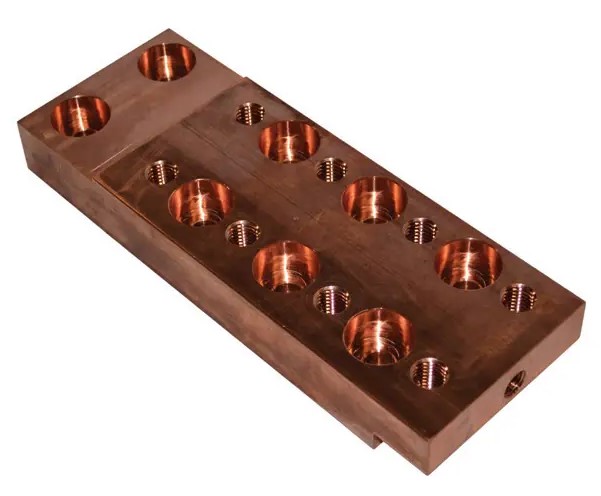
The most common methods to connect power from a vacuum power source to the furnace’s feedthrough include air-cooled cables, water-cooled cables, and copper bus bar. Power efficiency can be improved when selecting the length, size, and area between conductors. This can be achieved by close coupling the power system to the electrical feedthroughs, reducing resistance and inductive reactance, and improving the power factor.
Machined Copper Bar Source: RoMan Manufacturing, Inc.
Controlled Power Distribution Systems
The furnace market today generally relies on three primary types of control power distribution systems: VRT, SCR, and IGBT. Each of these technologies employs different methods to regulate the power input to the furnace, which in turn generates the required heat.
VRT (Variable Reactance Transformer)
The VRT controls AC voltage to the load, this is accomplished by a DC power controller that injects DC current into the reactor within the transformer.
The SCR controls the AC output voltage and can be paired with a transformer to step the voltage up or down and close couple to the furnace feedthroughs.
IGBT (Insulated-Gate Bipolar Transistor)
Balanced three-phase voltage is rectified through a bridge circuit to charge a capacitor in the DC bus. The IGBT network switches the DC bus at 1000Hz to control the AC output voltage to a Medium Frequency Direct Current (MFDC) power supply.
MFDC power supply transforms the AC voltage to a practical level and rectifies the secondary voltage (DC) to the heating circuit.
A line reactor on the incoming three-phase line mitigates harmonic content.
Control Systems
These systems manage the furnace’s operation, including driving the setpoint of the power system, temperature control, vacuum levels, and timing. They often consist of programmable logic controllers (PLCs), human-machine interfaces (HMIs), sensors, and other automation components.
Incoming Power
This is the origin of the furnace’s electrical energy, typically from a utility grid. It provides alternating current (AC), which is distributed and transformed within the furnace system to power all necessary components. In industrial settings, power companies usually charge for electricity based on several factors that reflect both the amount of electricity used and how it’s used. Some common charges/penalties are energy consumption (kWh), demand charges (kW), power factor penalties, and time-of-use (TOU) reactive power.
Conclusion
The careful arrangement of heating elements, electrical feedthroughs, conductors, and controlled power distribution systems allows for precise temperature control, ultimately impacting the quality of the processed material. Understanding the role of various control systems, such as VRT, SCR, IGBTs, and transformers is crucial for optimizing furnace performance and managing energy costs
About the Author:
Brian Turner Sales Applications Engineer RoMan Manufacturing, Inc. Source: RoMan Manufacturing, Inc.
Brian K. Turner has been with RoMan Manufacturing, Inc., for more than 12 years. Most of that time has been spent managing the R&D Lab. In recent years, he has taken on the role as applications engineer, working with customers and their applications.
U.S. Army Receives T901 Engines for UH-60 Black Hawk Flight Testing
The U.S Army recently received two T901 engines from a global aerospace propulsion, services, and systems provider. The engines have been slated for the Improved Turbine Engine Program’s UH-60 Black Hawk integration and testing.
The T901-GE-900 was developed by GE Aerospace in response to a need from the U.S. Army for increased power and reduced fuel consumption with a design that incorporates 3D-modeling, the use of ceramic matrix composites (CMCs), and 3D-printed (additive) parts. The use of CMCs and additive manufacturing enables the engine to produce more power with less weight.
Amy Gowder President & CEO Defense & Systems GE Aerospace Source: GE Aerospace
“This delivery represents the beginning of a new era and a pivotal moment in our ongoing work with the U.S. Army,” said Amy Gowder, president and CEO, Defense & Systems at GE Aerospace. “The T901 engine will ensure warfighters will have the performance, power, and reliability necessary to maintain a significant advantage on the battlefield.”
This transaction follows the first ever ground run of an aircraft powered by a T901 engine, which took place in April, when a T-901 engine powered Sikorsky’s Future Attack Reconnaissance Aircraft (FARA) prototype, Radar X, gathering data to support the engine’s integration into the service’s UH-60 Blackhawk and AH-64 Apache.
“Our team is immensely proud to announce the latest T901 deliveries to the U.S. Army,” said Tom Champion, director of GE Aerospace’s T901 program. “At every stage, these engines have demonstrated a level of performance that will undoubtedly help meet the demands of military missions for decades to come.”
Source: GE Aerospace
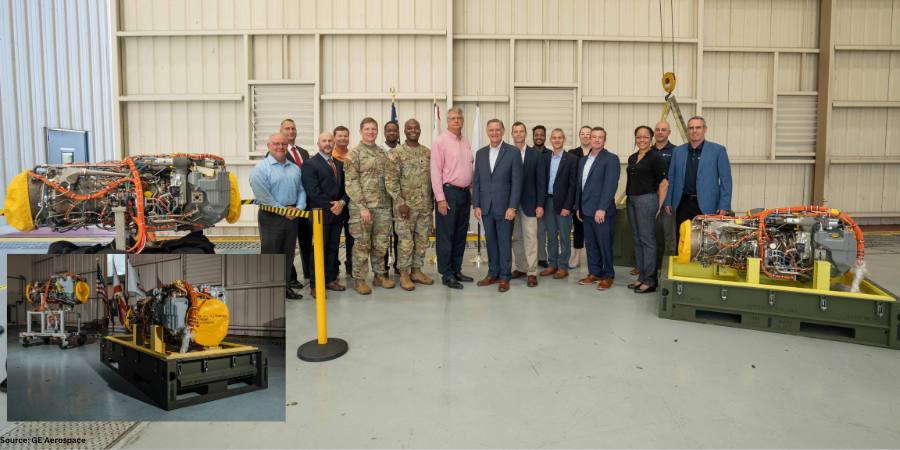
The next-generation rotorcraft engines were unboxed during a ceremony at Sikorsky’s facility in West Palm Beach, Florida.
Photo: GE Aerospace T901 engines unboxed during a ceremony at Sikorsky’s West Palm Beach facility. Source: GE Aerospace
The press release is available in its original form here.
Toyota Material Handling is investing nearly $100M for a new 295,000-square-foot facility at its Columbus, Indiana, headquarters, adding 85 manufacturing jobs by June 2026. The project will house Toyota’s manufacturing processes, which include the production of electric forklifts and material handling products.
“We are excited about this significant strategic expansion to our Columbus campus,” said Tony Miller, senior vice president of Engineering, Operations & Strategic Planning at Toyota Material Handling, at a recent groundbreaking ceremony. “Electric products are more popular than ever, and we are committed to doing whatever it takes to keep up with increased demand.”
“Electric forklifts make up 65% of the North American market and this trend towards electrification in the material handling industry will continue to grow,” said Brett Wood, president & CEO of Toyota Material Handling North America and senior executive officer for Toyota Industries Corporation (TICO). “This investment is one of the largest in our history and signifies TICO’s commitment to the North American market, the state of Indiana, the city of Columbus, and most importantly, our dealers and our customers.”
Photo Pictured L to R: Brett Wood, Toyota Material Handling North America President & CEO; Eric Holcomb, Governor of Indiana; Bill Finerty, Toyota Material Handling President & CEO; Tony Miller, Toyota Material Handling Senior Vice President of Engineering, Operations & Strategic Planning
The press release is available in its original form here.