



CONTROLS NEWS

ERP Task Force Addresses Changing Software Landscape

A new industry task force will provide heat treating companies with educational resources and peer guidance as they evaluate enterprise resource planning (ERP) systems amid recent consolidation among software providers serving the industry. The initiative is intended to help companies assess shop management systems based on their individual operational requirements rather than recommend a particular software platform.

The Metal Treating Institute (MTI) announced the formation of its ERP Task Force as its Summer Board Meeting on July 21. The member-led group was established following Steelhead Technologies’ acquisitions of Cornerstone Systems, Inc., provider of Visual Shop by CSI, and Throughput Consulting, Inc., provider of Bluestreak and Bright AM. MTI said the acquisitions have prompted heat treaters to evaluate their long-term ERP strategies and better understand their options within the changing software landscape.

ERP systems can support production scheduling, inventory, client orders, quality documentation, accounting, compliance, and reporting across heat treating operations. Selecting, implementing, or transitioning between systems can affect productivity, operational efficiency, customer service, and profitability. The task force will include member companies with ERP implementation experience and heat treating industry expertise.

“Technology is transforming every aspect of our industry, and ERP systems are becoming increasingly critical to operating efficient, data-driven businesses,” said Deidra Minerd, operations manager at Euclid Heat Treating and 2026 president of MTI. “The recent acquisition of Visual Shop and Bluestreak has created understandable questions throughout our membership.”

“Rather than allowing companies to navigate these decisions alone, MTI is bringing Members together to learn from one another, share experiences, access options and make better-informed decisions,” Minerd added.

Tom Morrison, CEO of MTI, emphasized that the task force will remain vendor-neutral.

“The ERP Task Force is not intended to recommend one software platform over another,” Morrison said. “Instead, its mission is to provide unbiased education and practical guidance so Members can evaluate the solutions that best align with their individual business needs, growth objectives, and operational requirements.”

The task force will begin providing educational resources, peer discussions, and additional programming over the coming months. MTI said it will communicate additional details to its membership as the initiative develops.

Press release is available in its original form here.

ERP Task Force Addresses Changing Software Landscape Read More »
Steelhead Acquires Visual Shop, Bluestreak

Steelhead Technologies, a software provider serving the heat treating and metal finishing industries, has acquired Visual Shop and Bluestreak, bringing together three providers of manufacturing execution, quality management, and job shop management software for North American heat treaters and metal finishers. The acquisition expands its software offering while retaining the industry expertise developed by each organization.

Visual Shop, developed by Cornerstone Systems, and Bluestreak have both provided software for heat treating and metal finishing job shops for decades. Steelhead said clients of all three companies will have access to a unified platform combining manufacturing execution, quality management, enterprise resource planning, and shop floor management capabilities.

Steelhead plans to continue investing in software capabilities for heat treating operations, including support for furnace calibrations, operator certifications, sample testing, sensor integration, and cybersecurity initiatives related to CMMC compliance. The company said the combined organization will continue drawing on the technical expertise of Visual Shop and Bluestreak teams.

Jeff Halonen
CEO and Co-Founder
Steelhead Technologies

“Heat treating job shops have been under decades of competitive pressure from offshoring, workforce challenges, and volatility in costs,” said Jeff Halonen, CEO and co-founder of Steelhead Technologies. “With demographic changes and AI completely changing the operational landscape, the challenges remain as steep as ever. At the same time, top government officials and contractors are urgently bringing back work by reshoring and scaling production. Job shops must leverage technology to rapidly increase capacity and capability without adding head count to solve every challenge.”

“To stay competitive in the long term, we would need to build a new product on a modern platform. Steelhead has a great product and shares our philosophy of providing outstanding customer service,” said Kevin Pluedeman, president of Cornerstone Systems (Visual Shop). Todd Wenzel, president and founder of Bluestreak adds, “By joining forces with Steelhead, we are bringing the institutional knowledge and specialized features of Bluestreak together with Steelhead’s modern infrastructure.”

The announcement also included comments from Exactatherm, a commercial heat treater in Mississauga, Ontario, which has implemented Steelhead’s software. Vraj Shah, quality manager at Exactatherm, said the company has used the platform to simplify employee training, improve access to Nadcap audit records, reduce lead times to approximately 10 days, and shorten inventory hold times.

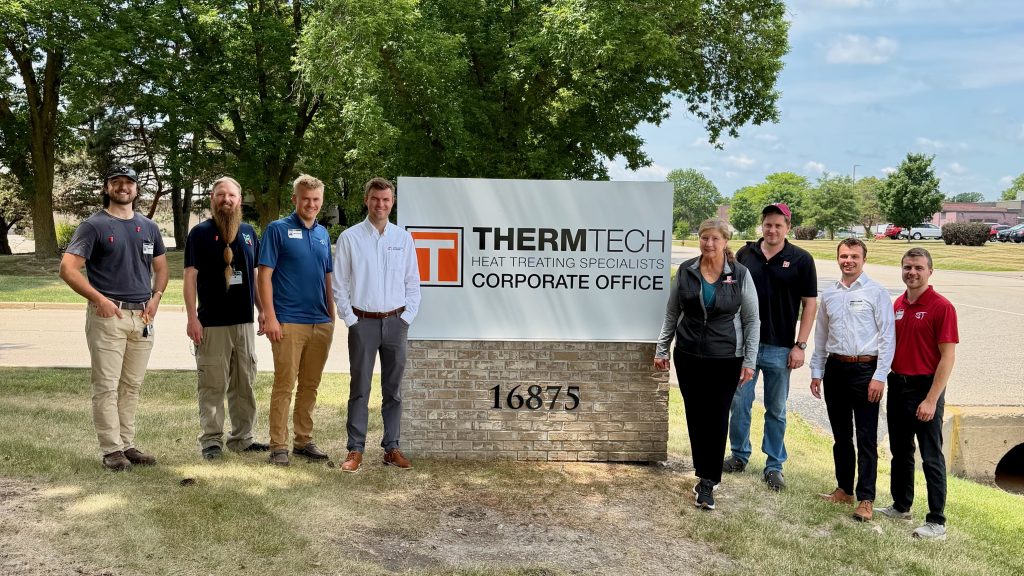
ThermTech partners with Steelhead to implement their AI-powered platform. | Image Credit: Steelhead Technologies

As part of the announcement, commercial heat treater ThermTech said it is partnering with Steelhead as it implements the company’s software platform. The system combines manufacturing execution, quality management, ERP, financial, and customer service functions into a single platform. The company also said its engineering team will work with Steelhead to further develop heat treating-specific capabilities.

Press release is available in its original form here.
Stay tuned for more: Heat Treat Today’s Doug Glenn recently sat down with Steelhead Technologies CEO Jeff Halonen for a deeper dive into the acquisition and its implications for the heat treating industry. The full interview will be published soon.

Steelhead Acquires Visual Shop, Bluestreak Read More »

US Department of War Pauses CMMC Phase II Rollout

Defense suppliers gain additional time as the U.S. Department of War (formerly the U.S. Department of Defense) reviews its Cybersecurity Maturity Model Certification (CMMC) program. However, Heather Falcone, founder and principal of Falcone Consulting, LLC and Heat Treat Radio host and producer, cautions manufacturers with in-house heat treating and commercial heat treaters against interpreting the pause as a relaxation of their cybersecurity obligations.

What the Announcement Revealed

The U.S. Department of War has suspended the transition to Cybersecurity Maturity Model Certification (CMMC) Phase II requirements while it conducts a comprehensive review of the program.

The suspension pauses pending and future Phase II implementation milestones across Department of War solicitations and contracts. However, Phase I self-assessment requirements remain in effect, and contractors must continue protecting covered defense information under existing contractual requirements, including DFARS clause 252.204-7012. During the 60-day review period, cybersecurity compliance will continue through NIST SP 800-171 Revision 2 self-assessments and select government-led assessments.

Kristin A. Davies
Chief Information Officer
U.S. Department of War

The review is intended to reduce compliance burdens on small, medium-sized, and non-traditional defense suppliers while maintaining cybersecurity protections. A newly established CMMC Reform Task Force will evaluate industry feedback and submit recommendations within 60 days.

“In support of Secretary Pete Hegseth’s directive to reduce compliance barriers for small and medium-sized businesses, we are suspending the CMMC Phase II requirements and initiating a 60-day study of the future of this program,” said Kristin A. Davies, chief information officer for the Department of War. “Robust cybersecurity and operational resilience remain critical to protecting American innovation and supporting warfighter readiness. We believe the Defense Industrial Base (DIB) can achieve both, while we reduce unnecessary government red tape.”

What This Means for Heat Treaters: An Industry Expert Weighs In

While the announcement delays the rollout of Phase II certification requirements, Falcone said manufacturers should avoid assuming that cybersecurity preparation can be put on hold.

Heather Falcone
Founder and Principal of Falcone Consulting LLC / Host and Producer of Heat Treat Radio

“The most dangerous interpretation of this announcement would be that cybersecurity preparation can stop,” Falcone said. “Phase II has been suspended, but manufacturers remain responsible for protecting defense information and meeting their existing contractual requirements. Companies should use this period to confirm their scope, close material NIST 800-171 gaps, and strengthen the evidence supporting their compliance.”

Falcone described the announcement as a meaningful reprieve for many small and midsized captive and commercial heat treaters that supply the defense industry. Many companies, she noted, have been preparing for significant compliance costs while lacking dedicated cybersecurity staff or access to enough certified assessors.

“A rushed implementation could consume capital that would otherwise support equipment upgrades, workforce development, capacity expansion, and other investments the defense supply chain needs,” she said.

She added that the review provides an opportunity to address longstanding concerns over how controlled unclassified information (CUI) is identified, marked, and shared throughout the defense supply chain, as well as the availability of qualified assessors and the affordability of compliance for small manufacturers.

“This suspension acknowledges the capacity and cost problems small manufacturers have been raising for years,” she said. “A successful CMMC reset should preserve a serious cybersecurity baseline while giving small defense suppliers requirements they can clearly understand, afford, and execute.”

Although the November implementation deadline has been suspended, Falcone recommends that heat treaters continue strengthening their cybersecurity programs while reviewing spending decisions driven solely by the former deadline. She also encourages companies to consult with prime contractors before changing any contract-specific commitments.

Learn More About CMMC

For readers looking for additional background on cybersecurity requirements for defense suppliers:

Press release is available in its original form here.

US Department of War Pauses CMMC Phase II Rollout Read More »

Controls Upgrade Modernizes Steel Mill Operations

Steel Dynamics Inc. (SDI) is modernizing automation systems at its Butler, Indiana, hot strip mill through a controls upgrade that supports rolling operations and associated thermal processing functions within the facility. By updating the automation architecture that supports rolling and temperature-controlled manufacturing operations throughout the mill, the project is expected to help maintain stable production and support future operational requirements.

SDI has commissioned SMS group, a provider of technology and plant solutions for the metals industry. SMS groups will replace legacy process automation systems with a new generation platform across the mill’s hot strip production line, which includes equipment and processes that rely on coordinated temperature control throughout steel manufacturing.

The upgrade will replace the existing X-Pact® ProBAS automation system with the latest X-Pact® Embedded platform. The project scope includes migration of process automation functions, hardware replacement, and software updates designed to minimize disruption to production while extending the life of the facility’s automation infrastructure.

The Butler facility produces hot-rolled steel products for a range of end markets. The project is designed to improve operational reliability, maintainability, and long-term performance for steel production serving automotive, construction, and industrial markets.

Press release is available in its original form here.
Main image caption: First coil production with the modernized process automation is scheduled for late 2026. Image Credit: SMS group

Controls Upgrade Modernizes Steel Mill Operations Read More »

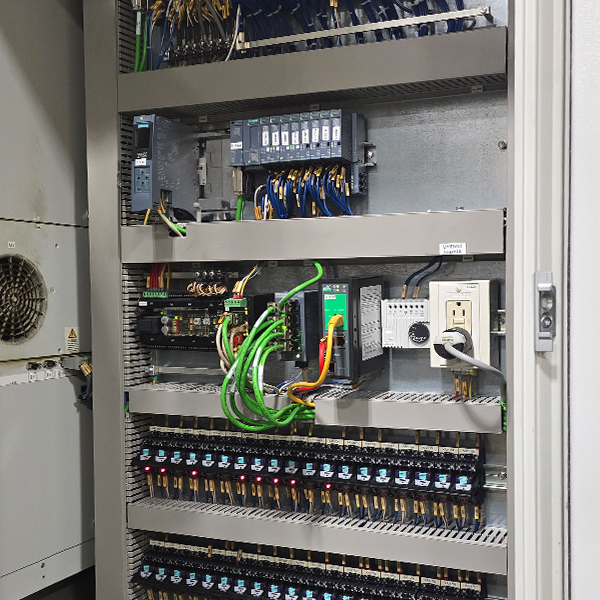
Andis Vacuum Furnace Controls Get An Upgrade

Andis Company, a U.S.-based manufacturer of grooming tools, has completed a controls upgrade on a vacuum heat treat furnace used for hardening components. The upgrade supports continued operation of a system critical to its production.

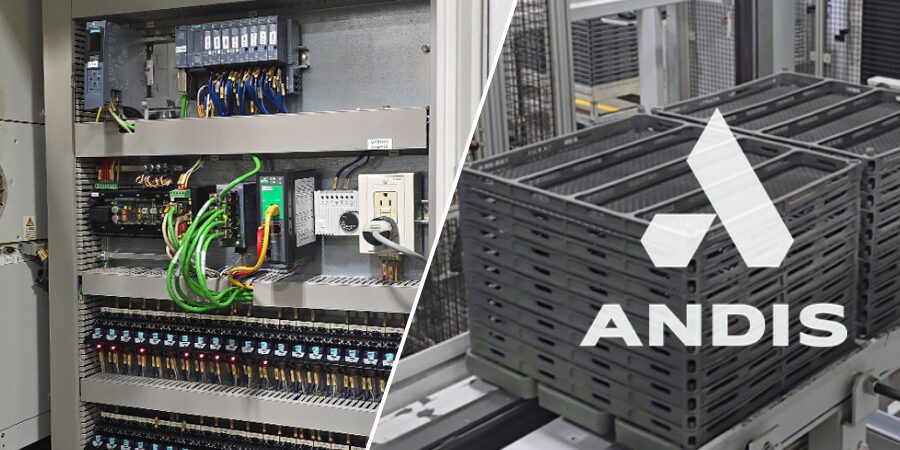
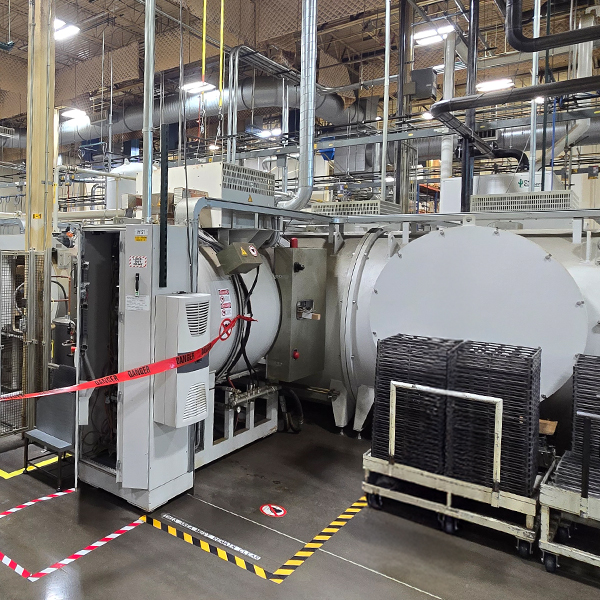
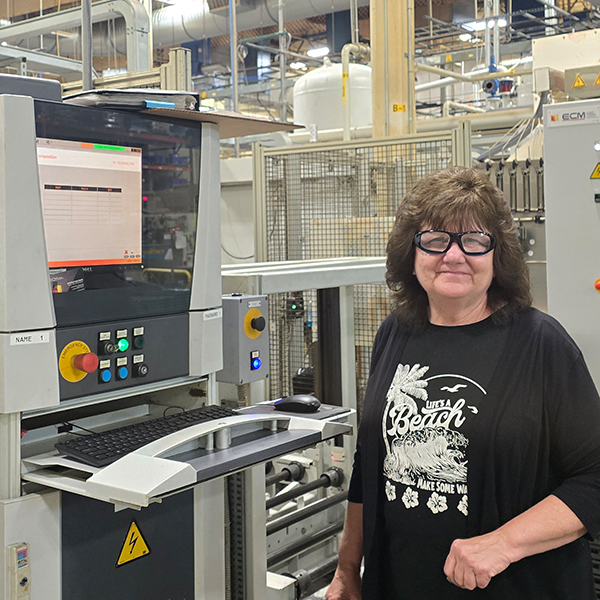
Andis Company finalized a PLC system overhaul on its ECM FLEX vacuum furnace, transitioning from an aging S7-300 processor and Profibus network to a newer S7-1500 series processor with Profinet communication. The upgrade also included remote input/output integration across the system. ECM USA supported the project planning and on-site execution, with the work completed on schedule and with minimal disruption to production.

The three-cell hardening modular furnace operates at approximately 950°C (1724°F) and includes a 20-bar gas quench, along with loading/unloading automation. Installed roughly 15 years ago to replace molten salt baths, the system supports clean heat treatment to avoid part discoloration and reduce the need for post-heat treat cleaning. The furnace remains central to Andis’s Wisconsin operations.

Tom Hoffelder
Director of Manufacturing Support and Innovation
Andis Company

The upgrade was initiated in 2025 following end-of-support announcements for legacy controls. “In 2025, we determined that we needed to fully replace the CPUs in our ECM vacuum heat treat system after Siemens announced end-of-support for significant portions of the controls,” said Tom Hoffelder, director of manufacturing support and innovation at Andis Company. “Because reliable day-to-day operation of our heat treat system is critical to our business, we worked closely [with ECM] to define the project scope and map out the execution plan.”

The project focused on modernizing hardware, improving long-term reliability, and maintaining throughput during installation. The updated controls and HMI remained familiar to operators, allowing the system to return to full production without additional training, Hoffelder added.

Press release is available in its original form here.

Andis Vacuum Furnace Controls Get An Upgrade Read More »

JISCO Commissions Integrated CSP® Hot Strip Mill Line

JISCO Carbon Steel, a global steel producer serving international markets including North America, has commissioned a new integrated CSP®-HSM line at its Jiayuguan facility following an upgrade and expansion project. The new production line combines Compact Strip Production (CSP®) with a hot strip mill (HSM) into a fully integrated system with complete automation. The move increases annual production capacity from 2 million to 4.5 million tons and enhances operational flexibility and stable production performance.

The newly commissioned line integrates CSP® casting and rolling with a newly installed hot strip mill, creating a continuous production route that allows rapid switching between production modes. According to the company, the system enables fast ramp-up and stable rolling performance while maintaining controllable quality from the start of operations. Importantly, the expansion was executed without interrupting ongoing CSP® production.

The upgrade includes the installation of new mechanical equipment and a complete automation package designed to coordinate casting and rolling operations. The automation system supports process control, operational stability, and consistent production results across product grades.

Technology and automation systems for the integrated CSP®-HSM line were supplied by SMS Group, which provided engineering, mechanical equipment, and its X-Pact® automation platform, including models and visualization systems for coordinated line control.

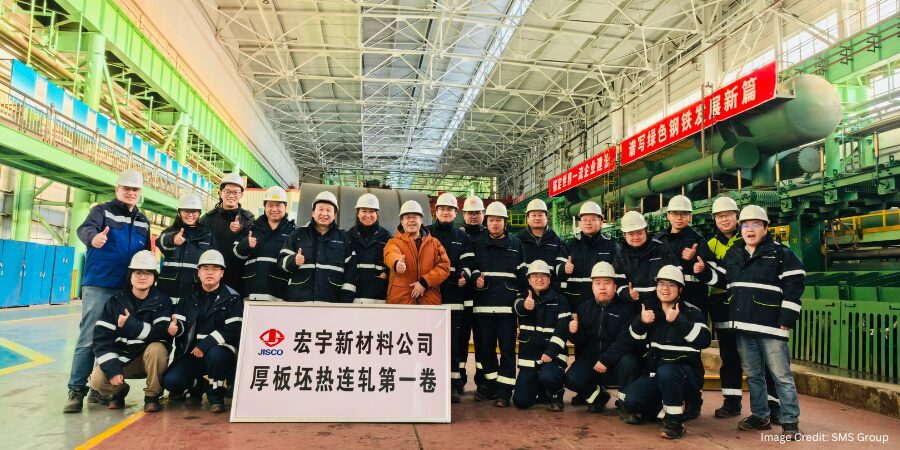
Commissioning ceremony on February 2, 2026, at JISCO’s site. | Image Credit: SMS Group

“Bringing the world’s first integrated CSP®-HSM line into production is a strategic leap for JISCO Carbon Steel. We now have the flexibility to align products and processes with customer needs in real time, backed by stable, repeatable quality from day one,” said Mr. Qiao Degao, CEO of JISCO Hongyu New Materials Co., Ltd. “SMS group’s automation technology and disciplined project execution were essential to meeting our schedule and performance targets.”

With the line now in operation, JISCO expands its production capacity and strengthens process integration between casting and hot rolling, positioning the Jiayuguan facility for increased throughput and operational flexibility in the flat steel market.

Press release is available in its original form here.
Main image shows the SMS Group team at JISCO after the successful first coil. Image Credit: SMS Group

JISCO Commissions Integrated CSP® Hot Strip Mill Line Read More »

Loy Instrument Partners To Expand Capabilities

Loy Instrument, Inc., which supplies process control and combustion solutions for heat treaters in multiple industries, has been acquired by Relevant Industrial, LLC (Relevant), a leading provider of industrial equipment and engineered solutions. This partnership enhances the company’s ability to serve clients in industries such as aerospace, metals, refining, petrochemical, manufacturing and power generation.

John Carte
CEO
Relevant Industrial LLC

Loy, headquartered in Indianapolis, Indiana, has over 80 years of industry knowledge and a team with more than 900 years of combined experience. This acquisition marks a significant milestone for Relevant, strengthening its position as an industry leader and expanding its geographic footprint into Indiana, Ohio, Kentucky and Michigan.

“Joining Relevant Industrial is an exciting step for Loy Instrument, our employees, and our customers,” said Ken Bradway, president of Loy Instrument, Inc. “Together, we’ll leverage our combined expertise and resources to expand our capabilities and continue delivering exceptional solutions to the industries we serve.”

“The addition of Loy Instrument’s expertise strengthens our ability to tackle complex challenges in combustion and process control, providing even greater value to our customers,” said John Carte, CEO of Relevant Industrial. “We’re excited to welcome this exceptional team into the Relevant family and look forward to driving innovation together.”

The press release is available in its original form here.


Loy Instrument Partners To Expand Capabilities Read More »

Automotive Component Manufacturer Bolsters Heat Treat Operations

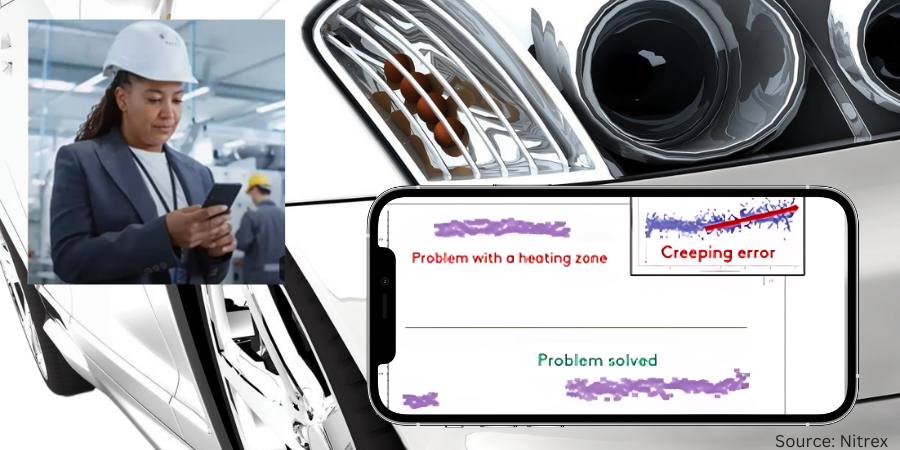
An automotive component supplier has digitized its heat treatment operations with the implementation of a digitalization platform, an upgrade intended to align the company’s operations with the accuracy and precision requirements of the global automotive market.

Daniel Gonschorek
Sales Manager
UPC-Marathon Technical
Source: LinkedIn

With this upgrade, the manufacturer has transitioned from using multiple systems to manage its heat treatment processes, streamlining furnace operations with the QMULUS digitalization platform from UPC-Marathon, a Nitrex company.

“Our collaboration with this tier 1/2 supplier has yielded significant improvements in their operational workflows,” said Daniel Gonschorek, technical sales manager at UPC-Marathon.

“The integration of QMULUS is not only advancing their internal processes but also delivering tangible gains in efficiency and performance,” he added. “By enhancing production efficiencies and reducing waste, QMULUS supports their commitment to innovation and aligns with the highest quality and sustainability standards. This digital transformation positions them strongly within the competitive automotive supply chain.”

The press release is available in its original form here.


Automotive Component Manufacturer Bolsters Heat Treat Operations Read More »

Heat Treater Overhauls Aging System To Upgrade Carburizing Processes

An Italian heat treater enhanced its operations with the installation of control cabinets, allowing for real-time data analysis and more efficient management of its carburizing processes. The improvement helped minimize downtime and optimize furnace performance.

Daniel Panny
Product Manager and Head 
UPC-Marathon Europe

Despite the robustness of their three batch IQ furnaces, T.T.M. Trattamenti Termici dei Metalli Srl identified an opportunity to redefine their approach to furnace controls and automation and partnered with UPC-Marathon, a Nitrex company, to breathe new life into their aging systems. The project entailed the installation of control cabinets equipped with advanced process controllers, the integration of the controllers into a SCADA system for advanced monitoring and control capabilities. To complement T.T.M.’s technological upgrades, UPC-Marathon also installed a new gas cabinet.

“This strategic investment in modernizing the furnace controls with UPC-Marathon proved not only highly effective in resolving immediate challenges with aging controls but also more cost-effective than replacing the three furnaces,” said Daniel Panny, product manager and head of UPC-Marathon Europe.

The press release is available in its original form here.


Find heat treating products and services when you search on Heat Treat Buyers Guide.Com

Heat Treater Overhauls Aging System To Upgrade Carburizing Processes Read More »

MIT-Backed Startup Tackles Heat Treaters’ High Electricity Bills

A group of graduates from MIT and Duke University identified manufacturing as an industry overburdened by rapidly growing energy costs and proposed a technology to provide electric bill savings of up to 30%. They will be piloting this technology with a U.S. heat treater, ThermoFusion, a Californian heat treater and brazer.

EQORE, a startup tackling energy issues for manufacturers, is developing smart energy storage systems. They aim to cut industrial energy bills by a third while offering a payback period of 1–3 years. Connected behind the meter, an EQORE system serves as an optimizing filter for electric equipment without changing its operation in any way. The system consists of a wall-mounted computing unit and a compact floor-mounted battery pack. It can be installed inside or outside of a facility and only needs a connection to the electric panel and internet.

The founding team features backgrounds in energy storage engineering from Tesla and Apple, as well as software and business development, and is supported by an innovation fund at MIT. The technology specifically targets reducing demand charges, which can account for 60–70% of industrial electricity costs. Demand charges penalize high variability in electric usage, a characteristic of heat treating facilities like ThermoFusion. For these facilities, a single peak in power usage can drastically increase the entire bill. Remarkably, in some locations in the U.S., demand rates have doubled since 2022. 

After talking to over 200 businesses, utility representatives, and energy experts, the team concluded that the solutions to the demand issue remain limited. Available power optimizations disrupt customer operations, while independent power generation like solar is often out of reach due to its decade-long repayment periods. EQORE’s solution empowers clients to reduce energy costs while maintaining existing production levels.

Their team is actively looking to engage with more pilot customers and is open to collaborations.  

The original press release is available upon request.


Find heat treating products and services when you search on Heat Treat Buyers Guide.Com


MIT-Backed Startup Tackles Heat Treaters’ High Electricity Bills Read More »