Heat Treat TV: Cost of Heat Treat Poor Quality Highlighted

Heat Treat TV

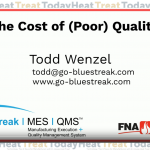
The cost of poor quality — with an eye toward eliminating it — was the topic of discussion at a recent heat treat industry conference (Furnaces North America). Todd Wenzel, President of Bluestreak|Throughput Consulting, made the presentation on October 4th in Nashville. By clicking on the image below, you’ll be taken to a post-event re-recording of the presentation.

Cost of Poor Quality Lead Slide

Heat Treat TV: Cost of Heat Treat Poor Quality Highlighted Read More »

Federal Firearms License Secured by AHT Corp.

WATERLOO, IA—Advanced Heat Treat Corp. (AHT) recently announced that it has received a Federal Firearms License (FFL) issued by the U.S. Department of Justice, Bureau of Alcohol, Tobacco, Firearms and Explosives at their facility in Monroe, Michigan. AHT now has licenses at all four of the company’s locations in Iowa, Alabama and most recently, Michigan. All licenses are available to view or download on the Quality section of their website: www.ahtcorp.com under the “About” section.

“While we are no stranger to processing firearms, the addition of this license will allow us to better serve those customers whose parts require an FFL,” stated Gary Sharp, President and CEO. “Our firearm customers have recently experienced better lubricity and corrosion resistance with one of our trademarked processes, UltraOx®, so we wanted to be better equipped to handle all of their parts for aesthetics and consistency. We are excited to now be able to expand that offering to our Michigan customers.”

Federal Firearms License Secured by AHT Corp. Read More »

MPG Announces Expansion of Indiana Facility

Metaldyne Performance Group (NYSE: MPG), a leading provider of highly engineered components for use in powertrain and suspension applications for the global light, commercial and industrial vehicle markets, announced plans to expand its operations in North Vernon, Ind., creating up to 126 new jobs by 2019.

The Michigan-based company will invest $30.6 million to lease and equip a 32,400-square-foot facility in North Vernon. With construction scheduled to begin later this month and operations slated to begin in 2018, the new building will be adjacent to its current 130,000-square-foot facility in North Vernon. Connected by a breezeway, the two buildings will provide expanded space for the company to increase production of its powder forged connecting rods, which major automobile manufacturers use to improve fuel-efficiency in their gasoline and diesel engines.

MPG currently employs more than 12,000 associates around the world, including nearly 200 in North Vernon. The company plans to begin hiring highly-skilled CNC machine operators and engineers in the first quarter of 2017.

“Our North Vernon manufacturing operations has been a strong performing plant for MPG and its customers for many years,” said Doug Grimm, president and chief operating officer at MPG. “We are excited about this new expansion, and we appreciate the support from the state of Indiana.”

The Indiana Economic Development Corporation offered MPG conditional tax credits and training grants based on the company’s job creation plans. These tax credits are performance-based, meaning the company is not eligible to claim incentives until local applicants have been hired. The city of North Vernon has also approved additional incentives at the request of the Jennings County Economic Development Commission.

“MPG, formerly operating as Metaldyne, has been a member of this community for many years and we are extremely pleased they chose the North Vernon facility for their expansion project,” said North Vernon Mayor Mike Ochs. “We very much appreciate their commitment and investment which will impact not only Jennings County but south central Indiana.”

Founded in 2014 from the merger of three metal-forming technology companies, today MPG is the world’s largest supplier of powder forged connecting rods. With its high-strength, lightweight designs, the company’s rods are ideal for use in high-efficiency engines, using a high-yield process that minimizes material waste. MPG operates more than 60 facilities around the world.


 

MPG Announces Expansion of Indiana Facility Read More »

Liberty House Group Creating Steel Sector in the UK

BOTW-50w  Source:  Recycling Today

The London-based metals trading and manufacturing company Liberty House Group (LHG) has launched a metal recycling business called Liberty Metal Recycling (LMR), which it says is a step toward it achieving its Greensteel vision to create a competitive and sustainable steel sector in the United Kingdom.

Read More:  Liberty House Group Launches Metals Recycling Business

Liberty House Group Creating Steel Sector in the UK Read More »

Remix S.A. Commissions Gas Fired Rotary Hearth Furnace

REMIX S.A., Poland, commission a 4,500 kg/h gas-fired rotary hearth furnace for preheating titanium alloys used in the aerospace/aircraft industry. The furnace, with a working temperature of 1,300°C, was commissioned at a leading Central European forging company who supplies critical forged parts to a variety of industries worldwide.

The furnace utilizes high-efficiency recuperative burners and the entire system complies with AMS 2750E standards.

In late 2015, Remix also supplied this same company with a 3,000 kg maximum capacity washing-drying unit for removing oil from oil-quenched parts.

Remix S.A. Commissions Gas Fired Rotary Hearth Furnace Read More »

HEAT TREAT BASICS: Hot Forging vs. Cold Forging — What’s the Difference?

BOTW-50w  Source:  Weldaloy

What exactly is the difference between hot forging and cold forging? Are there advantages to one over the other? In this article, we explain both the differences and the advantages of each method.

Read More:  Hot Forging vs. Cold Forging: What’s the Difference?

HEAT TREAT BASICS: Hot Forging vs. Cold Forging — What’s the Difference? Read More »

IBC Advanced Alloys Supplies Newport News Shipbuilding

IBC Advance Alloys announces that it is now an “Approved Forging Supplier” with Newport News Shipbuilding, a division of Huntington Ingalls Industries.  Newport News is the largest shipbuilding company in the U.S. and is the sole designer, builder, and re-fueler of U.S. Navy aircraft carriers and one of two providers of U.S. Navy submarines.

The announcement marks the second such attainment by IBC of approved forging supplier status with a world-class shipbuilder in as many weeks.  On September 13, IBC announced that it received “Approved Forging Supplier” status with General Dynamics’ Electric Boat Division (see that press release here).

“Achieving approved forging supplier status with Newport News is another significant advance for IBC, and positions us to grow our forged products business,” said Major General Duncan Heinz (USMC, ret.), President and CEO of IBC.

IBC’s qualification with Newport News positions the Company to provide forged product to Newport News through approved suppliers.  The qualification was awarded after Newport News conducted due diligence of IBC’s Copper Alloys Division facility in Franklin, Indiana.

Newport News builds the most advanced ships in the world using its expertise in nuclear propulsion, naval design, and manufacturing, and it is currently building the new Ford-class aircraft carriers and Virginia-class fast-attack submarines, and performing Refueling and Complex Overhaul (RCOH) on Nimitz-class aircraft carriers. With approximately $4 billion in revenues and more than 20,000 employees, Newport News has built more than 800 ships, including both naval and commercial ships.

IBC Advanced Alloys Supplies Newport News Shipbuilding Read More »

Weldaloy’s Aluminum Heat-treating Capacity Increased

On the heels of a recent expansion of their seamless rolled ring capabilities, Weldaloy continues to grow with the addition of a new low temperature aluminum aging oven. The new oven will increase Weldaloy’s aluminum heat-treating capacity.

Ovens created specifically for aluminum can reduce cycle times and increase productivity by optimizing temperature uniformity through adequate airflow. This translates to a better product that can be made in a repeatable recipe.

“We’re receiving more and more requests for large aluminum work, so we needed to add this low temperature aluminum aging oven to be able to increase our capacity and meet production needs. This addition will allow us to produce more parts in the same amount of time for our customers while maintaining quality,” said Kurt Ruppenthal, Vice President & General Manager at Weldaloy.

Many of the new opportunities for aluminum work have come from the oil and gas industry and the aerospace industry, as well as from the private space sector. Weldaloy recently achieved the AS9100C certification for their Quality Management System, which has opened the door for them to work with more aerospace companies that require certification of their suppliers.

“We look forward to continuing to grow our aluminum capabilities to meet the increase in demand,” said Ruppenthal.

Weldaloy’s Aluminum Heat-treating Capacity Increased Read More »

Carbon Sensor Troubleshooting

Jim Oakes, Super Systems, Carbon Sensor Troubleshooting, Stephen Thompson

by Stephen Thompson – President – Super Systems, Inc.

There are several key components in all atmosphere control systems. When a difficulty arises, it is important to identify the cause with minimum effort and expended time. The procedure that follows is designed to aid in that process.

INTRODUCTION

The starting point for any troubleshooting procedure is to properly identify the symptom that necessitates it. The cause of the symptom can often be elicited by answering some preliminary questions. Is this a startup problem, or has the system been operating under control? If this is a startup problem, it is necessary to establish that all system components have been properly connected and configured for the application. If the system has been operating properly and there has been either a gradual or sudden change in the control performance, it may conceivably be a problem with the probe. In order to establish the correct performance of the carbon sensor, resist the temptation to remove the sensor from the furnace. All of the tests outlined here must be done while the sensor is located in the furnace, at temperature, and exposed to a reducing atmosphere. This procedure can be performed on the SSi Gold Probe and on most other manufacturers’ sensors. We strongly recommend that you call us at 800-666-4330 before you remove the probe.

NOTE: IF YOU HAVE ALREADY REPLACED THE PROBE AND THE PROBLEM PERSISTS…..THE PROBE MAY NOT BE THE PROBLEM!

PROCEDURE

Does a shim stock analysis, a 3-gas analysis (SSi PGA3000) or a dew point analysis (SSi DP2000) verify the indicated value from the probe? If the values are close to the same, the problem is not likely the Gold Probe. If the values are not similar, continue with the following steps:

  1. Verify that both mV and t/c cables between the sensor and the controller are clean and connected firmly to the Gold Probe and controller terminals. Verify polarity.
  2. Verify that the reference air supply is connected to the reference air fitting. This will be the fitting closest to you when you face the probe. It has been found that on occasion the reference air has been connected in error to the burn off fitting, causing low readings.
  3. Check that the reference air is flowing. Disconnect the air supply at the probe and submerge it in a cup of water. Bubbles verify the flow.
  4. Verify that no air is flowing into the burn off fitting by submerging the burn off tubing in a cup of water. (Flow can occur if the burn off air pump is subject to external vibration.)
  5. Leak test- this test can detect a cracked or broken substrate in your Gold Probe. Verify that reference air is flowing at 0.5 to 2.0 scfh. Turn off the reference air for one minute and read the Gold Probe output millivolts. Turn the reference air back on and note the change in mV. It should not display more than a 5 mV increase.
  6. Is the controller COF set to the proper value? This factor is referred to by other descriptions such as Process Factor, Furnace Factor, CO Factor, Circulation Factor, Calibration Factor, etc. The factor may require adjustment to eliminate any offset or discrepancy between the indicated carbon potential and the actual achieved result in the work pieces or shim stock.
  7. Do the sensor temperature and MV output as measured by an independent digital calibrator agree with the indicated values on the controller with one sensor and one t/c lead disconnected? If not, there is most likely a controller calibration problem or a cable problem.
  8. Does the Gold Probe mV signal return to within 1mV of it’s original value in 1 minute as measured by a digital VOM after it has been shorted for 5 seconds? If it does not, go to step 10.
  9. Probe impedance (resistance) test-this is one of several electrical tests that determine the electrical integrity and reliability of the Gold Probe. Some contemporary controllers can perform it. If yours does not, conduct this simple test: at process temperature, disconnect the controller cable at the Gold Probe mV output and measure the mV value with a VOM. Then shunt the signal with a 100 kilohm resistor. After 10 seconds, read the new mV value, divide the original value by the new value, subtract 1 from the result and multiply by the value of the shunt resistor (=100K). The calculated value is the sensor resistance in kilohms, which should be less than 25 kilohms.
  10. If the problem is not corrected by probe and/or furnace burnout as described in the Gold Probe Manual and your system manual, and the problem is a faulty probe, contact SSi at (800)666-4330 and describe your problem to our technician. You may then request a Returned Material Authorization for repair or replacement of your Gold Probe.
  11. WARNING- even though you suspect a faulty sensor, DO NOT remove your Gold Probe from a hot furnace at a rate faster than 2 inches per minute. Cool the sensor on an insulating medium to avoid thermal shock. This will prevent damage that is expensive to repair.

Author information:
Stephen Thompson
Super Systems Inc.
7205 Edington Drive, Cincinnati,  OH 45249
Phone: 513-772-0060
Fax: 513-772-9466
www.supersystems.com

Carbon Sensor Troubleshooting Read More »

New Brazing Audit Criteria Released by MedAccred

In response to industry demand, the MedAccred program has recently released new audit criteria for brazing. AC8102/1 MedAccred Audit Criteria for Heat Treating – Brazing will be used during MedAccred audits conducted at companies performing brazing in an atmosphere or vacuum furnace or  in a dip salt bath.

The new audit criteria were developed by the MedAccred Heat Treating Task Group which is comprised of technical experts from Johnson & Johnson, Stryker, GE Healthcare, Medtronic, Applied Thermal Technologies, Bodycote, Harterei Gerster, Hansen Balk, Lake City Heat Treating, Paulo Products and Solar Atmospheres. To date the Task Group is one of the most successful within the MedAccred program. It has released six audit criteria in total and has several companies who have already achieved accreditation; these include Solar Atmospheres, Hansen Balk and Bodycote.

The industry chairperson of the Heat Treating Task Group is Bruce Dall, Senior Staff Quality Engineer – Metal Injection Molding of Stryker. He is very proud of the achievements of the program to date:  “I would like to thank my fellow members of the Heat Treating Task Group for their hard work and the commitment they have shown in the development of these new audit criteria for brazing. In most other environments we are competing organizations but when we come together as a MedAccred Task Group, we are able to put aside our rivalries in the interest of quality and working towards consistently safer products for our patients. The fact that we are now seeing suppliers stepping forward to pro-actively gain a Heat Treating accreditation MedAccred is a strong indication of how important this program will be to the future of the industry and I am proud to be at the forefront of this effort.”

Companies interested in gaining accreditation for Heat Treating are encouraged to contact Justin McCabe, MedAccred Co-Lead (jmccabe@p-r-i.org) for more information. Companies achieving accreditation will be listed on MedAccred’s Qualified Manufacturers List (located at www.eAuditNet.com).

New Brazing Audit Criteria Released by MedAccred Read More »