Welcome to another episode of Heat Treat Radio, a periodic podcast where Heat Treat Radio host, Doug Glenn, discusses cutting-edge topics with industry-leading personalities. Below, you can either listen to the podcast by clicking on the audio play button, or you can read an edited version of the transcript. To see a complete list of other Heat Treat Radio episodes, click here.
Click the play button below to listen.
Metal Treating Institute CEO, Tom Morrison, talks with Heat Treat Today’s Doug Glenn about 2018’s largest heat treat event, Furnaces North America, which will be held in Indianapolis, Indiana, from October 8-10, 2018. Find out why manufacturers with in-house heat treat shops should not only attend FNA 2018, but why they should send the entire team to this once-every-two-year event. And when you come to the end of the podcast, click over to Heat Treat TV to see a recently released FNA 2018 promotional video that will whet your appetite for the event.
Tom Morrison, CEO, Metal Treating Institute
Doug Glenn, Publisher, Heat Treat Today
FNA 2018
To find other Heat Treat Radio episodes, go to www.heattreattoday.com/radio and look in the list of Heat Treat Radio episodes listed.
A tubes and related services supplier for the world’s energy industry recently announced it will restart select areas of its mill in Conroe, Texas, to support the company’s ramp-up of heat treatment and finishing of pipe products in the U.S.
Tenaris, headquartered in Luxembourg, also has manufacturing facilities in Bay City and Houston, Texas, which will both contribute to the resumption of operations at Conroe.
“We are prepared to respond to the increased demand for the domestic supply of pipe,” said Luca Zanotti, Tenaris President, USA. “Reviving areas of the plant will allow us to maximize production from our new mill in Bay City expediting the finish, prep, and delivery of our products while raising the current level of activity at the plant that, during the downturn, remained opened as a service center.”
At Conroe, Tenaris pipe products will be heat treated and then finished, which includes threading, inspecting, testing, stenciling, and prepping the pipe before being dispatched.
In preparation for the restart, Tenaris will form a team of more than 100 employees – internal and external hires – who will be trained to operate the two areas of production as well as bringing equipment back online and performing tests to ensure the lines are operating as required.
“Market conditions have been improving over the past year with a higher price of oil, increased drilling activity and actions by the U.S. administration to support domestic manufacturing. We look forward to expanding our team and resuming industrial activity inside the plant to further support and deploy our strategy in the US,” added Zanotti.
An industry leader in monolithic refractories based in Illinois recently announced a partnership with a maritime repair specialist to deliver retrofit supplies and services to the world’s cruise ship operators, extending the reach of advanced heat treatment technology and improving the reliability of onboard boilers and incinerators.
Brad Taylor, president and CEO of Plibrico
Nordic Made Boiler Services Inc. (NMBS), headquartered in Denmark, will use Plibrico’s Plico™ brand high alumina- and alumino-silicate monolithic refractories in the retrofitting of cruise ship boilers and waste incinerators needed to ensure passenger safety and comfort.
“Partnering with Nordic Made Boiler Services enables Plibrico to help improve maritime operations the world over reducing cruise ship costs and their energy consumption,” said Brad Taylor, president and CEO of Plibrico. “Combining our refractories with NMBS’s retrofit solutions means that together we can extend the reach of our most advanced heat treatment technology.”
NMBS operates in a variety of industries in addition to the maritime market and will be the exclusive distributor for Plico materials in Norway, Sweden, Finland, Denmark, Poland, Spain, Holland, and Belgium. It will also be joining the Plibrico PliPartner™ network of certified installation and repair companies. The partnership will take full advantage of Plibrico’s high-quality aluminosilicate and high-alumina monolithic refractory materials. Demonstrating superior insulating properties, Plibrico refractories’ insulating properties facilitate the containment of heat generated by the marine boiler, minimizing heat loss and ensuring reliable hot water for ship passengers.
An international automotive technology supplier headquartered in Canada recently opened a 225,000-square foot aluminum casting facility in Telford, England, which will supply structural castings to Jaguar Land Rover, a leading vehicle manufacturer in the U.K.
Ben Goater, general manager of Cosma Castings U.K.
Magna’s new operations will see use of its patented vacuum die-casting process in which advanced lightweight aluminum castings help maximize strength and stiffness and minimize weight, improving fuel economy, safety, and handling. As electrified and hybrid powertrains become more common in the automotive industry, high-pressure aluminum castings can be a key factor in reducing overall vehicle weight.
“With this new aluminum casting facility, we have established a world-class center of excellence to bring the most advanced structural casting technologies to the U.K.,” said John Farrell, president of Cosma International, which is the operating unit of Magna and supplies a comprehensive range of body, chassis and engineering solutions to automakers around the world. Magna now has nine manufacturing facilities with more than 2,200 employees throughout the U.K.
“The manufacture of aluminum castings is an important building block for the next generation of all-aluminum and multi-material vehicle architectures,” said Ben Goater, general manager of Cosma Castings U.K.
Photo credit: Magna and caption: “Magna officials were joined by Ian Harnett from Jaguar Land Rover (center) and members of local government to celebrate the grand opening of Magna’s new aluminum casting facility in Telford, England.”
With its unique ability to be used in the shaping of other materials, tool steel, which includes a variety of carbon and alloy steels, is a particularly valuable property for tool manufacturers as well as manufacturers of components and parts that require the same degree of distinctive hardness, resistance to abrasion and deformation, and ability to hold a cutting edge at elevated temperatures.
The three-phase process of heat treating tool steel — annealed, austenite, and martensite — ensures the tool retains these qualities, achieves intended functionality, and meets performance specifications. In addition,
“The phases that define the process of heat treating tool steel alter the microstructure of the steel itself. Observable under a microscope, heat treatment rearranges the atoms of the iron, carbon, and any other metal components, which serves to give the final material specifically desired properties.” — L&L Special Furnace
Multiple factors can influence the final product, including the appropriate hardening and tempering temperatures depending on the type of steel.
This table provides general recommendations for the appropriate hardening and tempering temperatures based on steel type, as well as the recommended type of quench process. — L&L Special Furnace
“Heat treating tool steel does more than adding significant value to the treated material—it makes the use of the tool steel possible. Without properly applied heat treating, tools simply wouldn’t work or couldn’t even be made. Modern metallurgical engineering is essential to the production and manufacturing of tool steel and all of its applications.” — L&L Special Furnace
Photo credit (main image): Youtube.com and caption: “Visual indication of tool steel phase change to austenite when heat treating. Small pools of iron are forced from the steel as the volumetric change takes place and small amounts of carbon are burned off.”
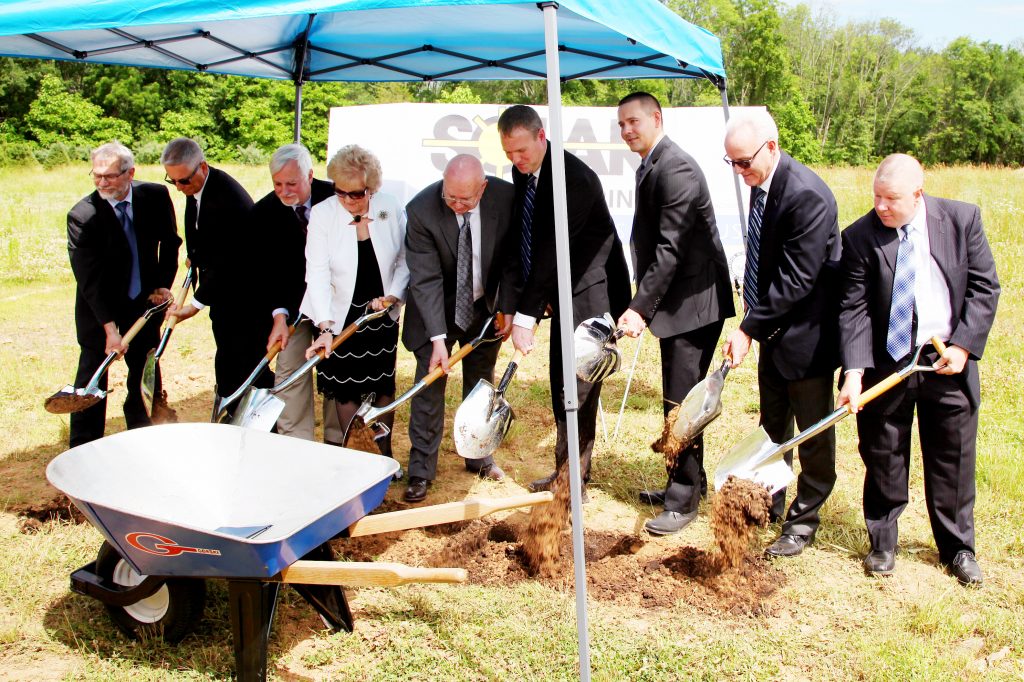
With the recent groundbreaking at a site in Sellersville, Pennsylvania, a leading vacuum furnace manufacturer launched its plans to reunite its manufacturing operations under one roof in order to combine its staffing and production efforts into an expanded space.
Solar Manufacturing Inc. celebrated this new chapter in its history with a groundbreaking ceremony for a new manufacturing facility at the Sellersville Business Campus in Bucks County, Pennsylvania. Due to substantial growth in recent years, Solar Manufacturing has been operating out of two separate manufacturing facilities located a few miles apart. The nearly 60,000 square-foot building will be built on 8.55 acres and is expected to be completed in early 2019. The new building will contain a two-story office space of nearly 20,000 square feet and 40,000 square feet of crane-served, manufacturing space.
"Solar Manufacturing has been very fortunate to experience steady growth over the past 15 years," said Bill Jones, CEO. "We needed more manufacturing space to expand and grow our business. Bucks County and Sellersville Borough have been very supportive and welcoming. It is an ideal location for us."
Solar Manufacturing is a member of the Solar Atmospheres family of companies, which is based with headquarters in Souderton, Pennsylvania, has four US commercial heat treating facilities with over 60 vacuum furnaces in operation, and services the aerospace, medical, automotive, defense, and other industries with heat treating equipment. This move to the Sellersville location will free up space for Solar Atmospheres' growing operations.
Pictured left to right: Jim Nagy, President; Bob Wilson, VP of Engineering; Scott Jacoby, Corporate Controller; Myrtle Jones, Owner; Bill Jones, CEO/Owner; Trevor Jones, CEO; Nick Cordisco, Service Manager; Pete Reh, VP of Sales; Rick Jones, International Sales Manager
Main image photo credit: Madeleine Cook, The Morning Call. Caption: CEO of Solar Manufacturing Inc., Trevor Jones, receives a certificate from his grandfather, owner William Jones, during the groundbreaking ceremony for a new manufacturing facility on June 21, 2018, in Upper Bucks County.
A U.K.-based industrial gases company that supplies liquefied natural gas process technology and equipment to heat treaters and companies with heat treating operations recently introduced its new gas density sensor at POWDERMET 2018, the International Conference on Powder Metallurgy & Particulate Materials, held June 17-20 in San Antonio, Texas.
Air Products announced that this novel sensor has been designed to measure hydrogen concentration in sintering furnaces that use a nitrogen-hydrogen blend as the hot zone atmosphere, aiding metals processors in improving quality control and comply with regulatory requirements. As part of the conference’s Sintering Atmosphere Control technical session, Air Products’ Dr. Liang He presented “Hot Zone Nitrogen-Hydrogen Atmosphere Monitoring with Gas Density Sensor”, which included beta test results of continuously measuring an industrial sintering furnace atmosphere composition for better production process control and consistent product quality.
A Baker’s Dozen Quick Heat Treat News Items to Keep You Current
Heat TreatToday offers News Chatter, a feature highlighting representative moves, transactions, and kudos from around the industry.
Personnel and Company Chatter
Based in Lima, Ohio, Heat Treating Technologies recently installed its third heat treating furnace as the final step of a $3 million expansion project, to be used to process parts for agriculture and automotive industries.
Mark Hemsath has been hired as director of nitriding and special vacuum furnaces at SECO/VACUUM Technologies, LLC. Hemsath has previously worked with SECO/WARWICK Corp. and Advanced Heat Treat Corporation in Waterloo IA, and operated his own heat treat furnace manufacturing and alloy fabricating company. He will be the primary contact for gas nitriding furnace applications in North America and will handle special vacuum furnace products throughout North America.
The new president and chief executive officer of Norsk Titanium AS, an aerospace-grade titanium components manufacturer based in Plattsburgh, New York, will be Michael J. Canario.
A company that manufactures high-temperature refractories and specializes in the toll firing business serving a variety of industries such as aerospace, automotive and petrochemical recently completed the task of relining the bricks on one of their roller hearth kilns, which can now reach greater operating temperatures – up to 2,650 ºF (1,454ºC). In addition, Ipsen Ceramics has also announced a collaboration with ceramics distributor, Carpenter Brothers, based in Milwaukee, Wisconsin.
Expansion at Heat Treating Technologies
Mark Hemsath, director of nitriding & special vacuum furnaces, SECO/VACUUM Technologies
Michael J. Canario, president/CEO, Norsk Titanium
Ipsen Ceramics upgrades kiln
Equipment Chatter
A leading aerospace manufacturer of landing gear and associated components based in New Zealand recently purchased a large resistance box furnace and quench tank from L&L Special Furnace Co., Inc. The furnace is equipped with a pyrometry package for AMS2750E class 3 equipment with temperature uniformity of +/-15°F throughout the operating range.
A custom environmental reach-in temperature/humidity/vacuum cycling chamber was recently shipped by Tenney Environmental to a company in the agriculture industry for use in testing food grade material.
A high-temperature horizontal air flow cabinet oven was shipped from Grieve to a customer which will use it for heat treating at its facility. The No. 1045 is a 1250°F (677°C) oven measuring 38” W x 38” D x 38” H.
A Gruenberg truck-in oven was recently shipped to the technology industry by Thermal Product Solutions. The oven is rated for Class A operation to handle processing solvents per the NFPA 86 specifications and has a maximum temperature rating of 650° F and work chamber dimensions of 144” W x 84” D x 72” H.
Six propane gas fired enhanced duty walk-in series ovens were purchased by a material testing laboratory to be used for hydrogen embrittlement relief of various parts. The batch ovens commissioned from Wisconsin Oven Corporation have a maximum operating temperature of 500° F and work chamber dimensions of 8’0″ wide x 4’0″ long x 4’0″ high and were designed with the capacity to heat 1,020 lbs. of steel and 220 lbs. of a stainless-steel load cart from 70° F to 480° F within 60 minutes when loaded into an ambient oven.
L&L Special Furnaces
Tenney Environmental
Grieve Corporation
Thermal Product Solutions
Wisconsin Oven Corporation
Kudos Chatter
Dana Incorporated was recognized as the 2018 Outstanding Power Electronics Solution Provider for its Long® ThermaTEK™ insulated-gate bipolar transistor (IGBT) cooling solutions. The award was presented during the 10th Annual Green Vehicle Convention in Shanghai, China.
PJSC Magnitogorsk Iron and Steel Works’ (“MMK”) most powerful unit, hot-rolled products Mill 2000, produced 527,500 tonnes of metal in May 2018, setting an all-time record for monthly output. It was the highest production volume at the mill since its commissioning in 1994, beating the previous monthly record of 526.2 ths tonnes set in January 2015.
Solar Atmospheres of Western PA recently continued its merit status for NADCAP Nondestructive Testing for penetrant inspection. Solar Atmospheres specializes in Method A (water washable) Fluorescent Penetrant inspection and is able to accommodate parts of varying sizes in their world class NDT cell. Solar has its own in-house Level 3 inspector as well as six Level 2 inspectors and one Level 1 inspector.
Professional fastener manufacturer ARP is celebrating its 50th anniversary in 2018. “It was 1968 when Gary Holzapfel—whose background was in aerospace fastener manufacturing—developed some bolts and studs for his racer friends that were a marked improvement over what was available at the time. This lead to the founding of Automotive Racing Products Inc. … ARP proudly does everything in-house, which includes engineering, R&D, forging, heat-treating, machining, finishing, packaging and distribution in its ISO 9001:2008 and AS9100 registered California facilities.”
Dana Incorporated
MMK
Solar Atmospheres
ARP
Heat TreatToday celebrates with our heat treatment industry partners by highlighting their accomplishments and announcements here on our News Chatter page. Please send any information you feel may be of interest to manufacturers with in-house heat treat departments especially in the aerospace, automotive, medical, and energy sectors to the editor at editor@heattreattoday.com.
With the restart of the second of its two blast furnaces, a major U.S. steel producer expects to step up its supply of American-made steel to support customers demand.
U. S. Steel President and Chief Executive Officer David B. Burritt
United States Steel Corporation recently announced it will restart “A” blast furnace at its Granite City Works, an integrated steelmaking plant in Granite City, Illinois.
“We are excited to announce that after the restart of the “A” blast furnace on or around October 1, all of the steelmaking operations at Granite City will be back online, helping us meet an increased demand for American-made steel that has only grown since our March announcement,” said U. S. Steel President and Chief Executive Officer David B. Burritt. “After careful consideration of market conditions and customer demand, including the impact of Section 232, the restart of the two blast furnaces at Granite City Works will allow us to serve our customers’ growing demand for high-quality products melted and poured in the United States.”
A U.K.-based company that designs and manufactures aluminum matrix composites (AMCs) components has been appointed to work on a two-year, $40.5 million (£28m) project titled “Large Landing Gear of the Future.”
Alvant, located in Basingstoke, United Kingdom, is participating in this project at the invitation of project-leader Safran Landing Systems, the international high-technology group and Tier 1 supplier of systems and equipment to the aerospace and defense industries. The project aims to make use of new materials and manufacturing methods to develop and demonstrate technologies that will reduce landing gear weight, fuel burn and noise, at the same time as improving reliability and lowering ownership costs.
Current landing gear systems are typically stronger and heavier than necessary because an outstanding safety record has resulted in proven techniques being perpetuated. However, they account for approximately three per cent of aircraft weight, with a corresponding effect on fuel consumption. Safran believes it is possible to reduce this without diminishing the gear’s capabilities or safety.
Richard Thompson, commercial director of Alvant
Alvant’s work on this project will be funded by a $675,000 (£513,000) grant from Innovate UK. This will enable the design, manufacture and testing of an AMC brake rod, targeting a 30 per cent weight reduction over an equivalent titanium component whilst maintaining the same strength as steel.
AMCs are advanced composite materials in which the aluminum is reinforced with a secondary high-performance material, typically a long fibre, short fibre, or particulates. Compared to unreinforced metals, AMCs have higher strength, greater stiffness, lower weight, superior wear resistance, and lower coefficients of thermal and electrical conductivity. AMCs also offer advantages over polymer fibre reinforced materials, such as carbon composites, including higher transverse strength and stiffness, a higher thermal operating range, better wear resistance, superior damage tolerance, and easier reparability.
“A key objective of the Large Landing Gear project is to test and demonstrate as many technology advances as possible,” said Richard Thompson, commercial director of Alvant. “Alvant’s AMCs are a sustainable solution that enhance product capabilities. This is a very attractive proposition for many industries, in particular, aerospace. Alvant looks forward to demonstrating this while working in conjunction with Safran. This landing gear component is just one of the many ways in which AMCs can help aerospace firms retain strength while reducing weight.”





 Welcome to another episode of Heat Treat Radio, a periodic podcast where Heat Treat Radio host, Doug Glenn, discusses cutting-edge topics with industry-leading personalities. Below, you can either listen to the podcast by clicking on the audio play button, or you can read an edited version of the transcript. To see a complete list of other Heat Treat Radio episodes, click here.