A German automaker entered into a joint venture with a Canton, Michigan-based, provider of metalforming technologies and products to build a press shop of the future.
Albrecht Reimold, Member of the Executive Board for Production and Logistics at Porsche AG
Porsche AG and Schuler, Inc, have agreed to create a so-called Smart Press Shop as part of a networked Industry 4.0 approach. The new press shop’s pioneering technologies will enable the highly flexible production of complex car body parts, whereby the focus will be on aluminum body panels and small batch production.
“Porsche wants to use the joint venture to lay the foundations for the future of sports car manufacturing,” said Albrecht Reimold, Member of the Executive Board for Production and Logistics at Porsche AG. “We plan to exploit future technologies and innovations in order to make our processes even more efficient. By dovetailing design, development, car body planning, toolmaking, and production within the Porsche Group, we can significantly influence the quality of our sports cars.”
“Porsche and Schuler will be using a press shop that sets new standards in two respects – in terms of manufacturing performance, as well as the digital networking and readability of data streams along the entire production process,” said Domenico Iacovelli, Schuler CEO. “Not only Porsche will benefit from this major step forward, but ultimately other manufacturers as well.”
Domenico Iacovelli, Schuler CEO
The systematic further development of process know-how in the field of metalforming will be achieved in part by the end-to-end networking of production data and the use of machine learning. Porsche and Schuler aim to set new standards in the field of predictive maintenance and intelligent production control.
The joint venture will operate as an independent company (GmbH & Co. KG) held in equal proportions by Schuler AG and Porsche. Each of the two companies will invest a double-digit million euro amount in the joint venture. The location of the new company has not been finally decided yet.
A global leader in materials manufacturing, headquartered in Windsor, Berkshire, United Kingdom, has recently shortened lead time for its braze alloy service in the U.S., specifically in support of mission critical components used in aerospace, medical and industrial applications.
Morgan Advanced Materials, which manufactures specialist products, using carbon, advanced ceramics, and composites, announced that its Braze Alloys business has enhanced service for customers using its braze alloy solutions. The FTSE 250 company can provide precious and non-precious braze alloys, pre-sintered preforms (PSPs), and braze inhibitors like Stopyt, that prevent the unwanted flow of molten brazing filler metals.
Braze Alloys manufactures braze alloys in configurations that are specific to customers’ requirements. A large number of assemblies that are made using Morgan materials are designed to tight specifications, while the alloys themselves can be developed to suit requirements. Many applications of braze alloys are used in research and development projects and information and data are needed quickly for small-run orders. To facilitate this urgency from contract braze houses, Morgan has created a dedicated resource to handle these inquiries, while reducing lead times on commonly used alloys.
Adam Ebert, Business Development Manager at Morgan’s Braze Alloys Business
“One of Morgan’s strongest competencies is its superior materials research and development. This is a key reason for why our braze alloys are so popular and trusted,” said Adam Ebert, Business Development Manager at Morgan’s Braze Alloys Business. “We’re keen to continue delivering our knowledge and our braze alloys in as quick a timeframe as possible. This has seen us reduce our lead times on some of the most common braze alloy products, including our popular Nioro alloys, as well as gold-copper alloys and copper-silver alloys. We’re now aiming for a three-day turnaround on any product across the whole of the US.”
Morgan launched its Metals and Joining Center of Excellence (CoE), located in Hayward, California, in October 2017 to deliver new material science and process solutions.
A U.K.-headquartered company with a solid-state alloy powder technology recently announced its launch of the world’s first industrial-scale metal alloy powder production facility based on the company’s process.
Metalysis will produce valuable alloy powders at the new plant, located in the company’s Materials Manufacturing Centre in Wath upon Dearne, South Yorkshire, U.K.
The Generation 4 (“Gen4”) project was mechanically completed on time in Q4 2017. It has since undergone hot commissioning, trial runs, optimization and handover to Operations, signaling Metalysis’ transition into commercial production following more than a decade of phased technology development.
Dr. Dion Vaughan, Chief Executive Officer, Metalysis
Gen4 is the first facility to take Metalysis’ solid-state, modular, electrochemical process to industrial scale and can produce tens-to-hundreds of tonnes per annum of high value, niche and master alloys. It creates a new U.K. source of supply for global end-users in advanced manufacturing disciplines including aerospace, automotive, batteries, light-weighting, magnets, mining and 3D printing consumables.
A standout benefit of Metalysis’ technology is its multi-metal capability, which enables it to produce alloy “recipes” that comparable processing routes cannot. Where conventional technologies are unable to elegantly combine elements with melting and density differentials, this technology can because it is a solid-state process. Gen4 enables Metalysis to commercially produce a demand-driven product mix of titanium alloys; master alloys including Scandium-Aluminide, which continues to pose excellent launch product potential as announced on 11 June 2018; compositionally complex alloys including High Entropy Alloys; magnet materials; high-temperature materials; and Platinum Group Metal alloys.
“In powering up and operating our industrial plant, Metalysis is poised to achieve its target to generate significant profits from our new South Yorkshire production facility,” said Dr. Dion Vaughan, Chief Executive Officer. “Ours is a true British success story with international implications. Metalysis has grown from the ‘lightbulb moment’ at Cambridge University in the late-1990s, relocated to South Yorkshire to benefit from regional excellence in operational skillsets in the early-2000s, and now onwards towards a bright commercial future.”
A leading provider of engine and airframe services based in Scottsdale, Arizona, recently signed an exclusive, long-term engine maintenance agreement with a Phoenix-based air carrier for its CF34-8E5 engines powering a fleet of 42 Embraer 175 regional aircraft.
Mike Lotz, president and Chief Financial Officer of Mesa Air Group
StandardAero worked out this deal with Mesa Airlines, which provides scheduled passenger service to 110 cities in 39 states, the District of Columbia, Canada, Mexico, Cuba, and The Bahamas.
“StandardAero’s operational performance, exceptional customer service and program flexibility are some of the key traits that form the foundation of our long and trusted partnership making entering into this new MRO agreement an easy decision,” said Mike Lotz, president and Chief Financial Officer of Mesa Air Group, the commercial aviation holding company of Mesa Airlines.
“We are delighted in the confidence placed in StandardAero with this exciting new engine maintenance agreement to support Mesa Airlines CF34-8E5 engines,” said Todd Sywake, Vice President – Business Development and Strategy for StandardAero’s Airlines and Fleet Division. “StandardAero focuses on creating a world-class, hassle-free customer experience while developing custom tailored MRO solutions to help lower our partners’ operating costs.”
The privilege of unveiling the Heat Treat Today 40 Under 40 Class of 2018 comes with the disappointment that not every one of the nominees could be included in the final count, even though each young, up-and-coming, talented heat treating professional whose name was submitted is making a significant difference in their field. We will be back next year looking for candidates for the 40 Under 40 Class of 2019, and in fact, you can begin the process right now. Click here to nominate the young professional you have in mind who is not listed among the finalists or honorable mentions.
Consider this list a preview:
The individuals pictured are those we acknowledge in 2018 with an Honorable Mention for their contribution to their company, their dedication of service to their customers, their commitment to pursue skills and knowledge about their field. You should know that we at Heat Treat Today are rooting for you and have already rolled the names of any qualified Honorable Mentions into the nominations for the Class of 2019.
Heat Treat Today encourages the rest of you to keep your eyes open for young professionals you encounter within your heat treating sphere, especially in the captive heat treatment industry, who deserve recognition and encouragement to stick to the path that will take the industry to greater heights of technology, quality control, standards, and leadership.
The 2018 Honorable Mentions
Matt Clinite / Ipsen USA
David Cunningham / L&L Special Furnace Co., Inc.
Justin Dzik / Fives North American Combustion
Tim Garner / Advanced Heat Treat Corp.
Adam Kane / Advanced Heat Treat Corp.
Jonathan Markley / SECO/WARWICK Corporation
Tim Mohr / Paulo
Jason Plowman / HeatTek, Inc.
Matt Watts / Ultra Electronics
Piotr Zawistowski, president, SECO/VACUUM (source: SECO/WARWICK)
A Chicago-area automotive part supplier encountered frequent cracking of variable valve timing plates that were sent to a third party for heat treatment. The problem resulted in the company spending lots of time and money on part testing as well as wasting lots of steel. After a thorough examination of the manufacture and heat treatment of the parts, Paulo metallurgists identified the cause of the cracking and recommended a custom solution to keep it from happening in the future. The following is a case study on the part failure investigation and resolution by Rob Simons.
Case study of a part failure investigation and resolution
Being an integral part of customers’ success means more than just regularly receiving parts and treating them according to spec.
Sometimes a customer approaches a heat treater in search of answers to a problem they can’t quite grasp.
In this case, a Chicago-area supplier of automotive components needed to know why parts it sent off for heat treating kept coming back cracked. They were spending too much time and resources on tests and throwing out too many failed parts.
Persistent cracks in variable timing plates
Our customer produces variable valve timing plates for domestic automobile models. Variable valve timing (VVT) plates are part of a system designed to optimize engine performance by changing the lift, duration, and timing of valve lift events.
Variable Valve Timing Plates (Photo credit: Underhood Service http://www.underhoodservice.com/variable-valve-timing/)
In this case, the life cycle of these parts began in a steel mill, where coils of AISI 1045 carbon steel were produced. The parts were then annealed in preparation for fine blanking at our customer’s facility. Then, the parts would be through hardened and sent to the automotive manufacturer.
But our customer noticed that many of the parts came back cracked. This was the source of two big problems:
The customer had to perform inspections on every part that was returned from the heat treater, which came at significant expense of time and resources.
To satisfy the terms of its contract with the automotive manufacturer, our customer had to make far more parts than it would have ordinarily needed to on the assumption that many of the parts would not be acceptable. It cost too much money, and too much steel was wasted.
The customer approached metallurgists at Paulo to figure out what was wrong and what could be done to make it right.
Forensic heat treatment analysis
Our first task was to figure out what the customer’s heat treater was doing to the parts.
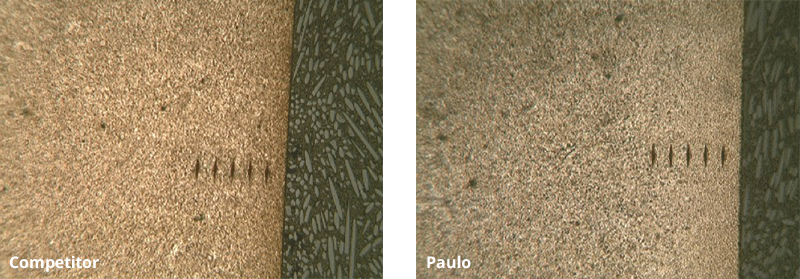
Upon our inspection, we noticed the parts were quite brittle. A closer look at the microstructure of the parts’ surfaces revealed they had been carbonitrided.
Meanwhile, we consulted with personnel at the mill and steel processor where the steel originated. We learned that the coils of 1045 steel were annealed in a nitrogen environment. Annealing is an important process that spheroidizes carbides in the steel which aids in fine blanking. In the case of our customer, the VVT plates could not be formed to the specified tolerance if they weren’t first annealed.
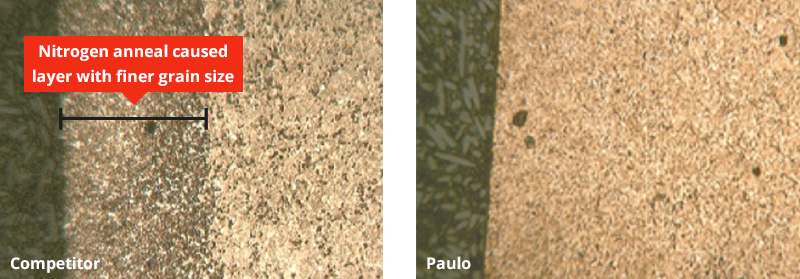
But the nitrogen present in the anneal was a problem. 1045 steel includes aluminum as a grain refining element. When aluminum and nitrogen combine during annealing, aluminum nitrides form. Aluminum nitrides create a much finer grain on the part surface, which prevents the full hardening of the material. We suspected our customer’s heat treater attempted to overcome the defect by carbonitriding. But instead of hardening, the parts just got brittle. That’s because 1045 steel lacks the hardenability that would be required to overcome the fine grain size that resulted from the presence of aluminum nitrides.
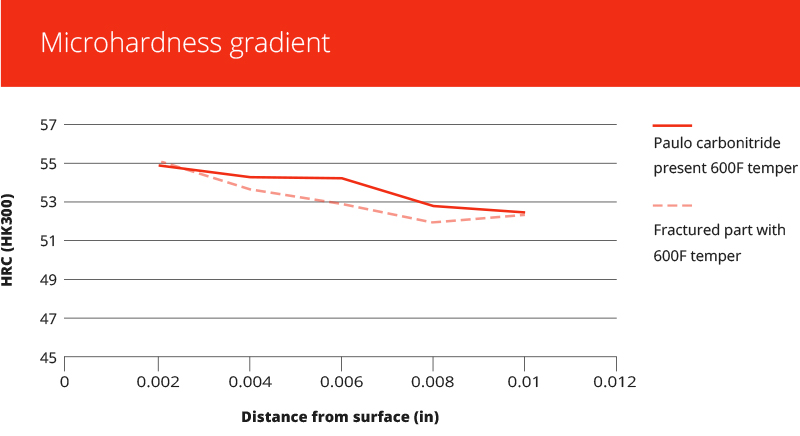
To confirm our suspicion, we ordered the same material from the customer’s mill and then carbonitrided the parts as we believed the previous heat treater had. Our post-treatment analysis of the parts shows the successful recreation of the failure mode.
A custom-developed solution
We believed the most direct way to solve the problem was to eliminate the factors that caused it at the start. We again approached the mill, this time to see if they could anneal the steel in a different environment. They said they could not.
The next best thing would be to “spike” the 1045 steel with another alloying element that would add hardenability despite the fine grain sizes that result when nitrogen and aluminum interact during annealing. We pinpointed chromium as the ideal alloy, and after some trial and error, we identified a formula for the chromium spike that would result in fully-hardened parts without cracks after through hardening.
Today, the customer’s mill still produces the 1045 steel with our recommended chromium spike. And as of mid-2018, we’ve treated 25 million variable valve timing plates for this customer.
This case study illustrates the importance of a few key lessons suppliers should keep in mind. First, stay in touch with what’s going on further up the supply chain. You may be able to react to problems more quickly or stop them altogether.
Second, have a working knowledge of part materials and the chemistry at play during any manufacturing process. Armed with this knowledge, you can ask key questions as you vet potential heat treatment partners. It could end up saving you time and expense in the long run.
Finally, know where to get a second opinion, and have a backup heat treater ready in case your primary partner can’t do what you need them to do.
Rob Simons is a metallurgical engineer specializing in ferrous heat treatments with 35 years of experience in the industry. He earned a degree in metallurgical engineering from the University of Missouri – Rolla in 1982 and most recently was a featured presenter at the ASM Heat Treat 2017 conference. He has been at Paulo for over 30 years.
A leading supplier of monolithic refractory products recently partnered with a company that provides safety equipment for foundries to install four 166 sq ft emergency collection pits with 64 sq ft breakout inlets at a new foundry site in Warner Township, Michigan.
Allied Mineral Products is the U.S. representative for Silmeta Systems, which has installed over 500 emergency collection pits (ECP) worldwide, and the two companies collaborated in the integration of ECPs at the new facility under construction for EJ Americas, which provides metal fabrication products for manhole covers and frames, junction boxes cleanout, monument boxes, and other related products.
During EJ’s review of the prospective suppliers for the foundry project, the team saw photos of an of an emergency collection pit (ECP). Since EPCs are new to the US market and most foundry teams have not seen them, the EJ staff was curious and wanted to know more. An ECP completely separates molten metal from any water present, eliminating the possibility of a steam explosion. The elimination of explosion risk coupled with the sizing of the pits to contain the full contents of the furnace results in no injuries or significant property damage due to furnace breakouts. After researching emergency collection pits, the leadership team decided to integrate ECPs into their new facility and contracted with Silmeta Systems, which is the only supplier of these type systems which had already installed ECPs in the US.
Allied serves as the one-stop shop in the U.S. for Silmeta ECPs, through their management of marketing, sales, and technical support in addition to producing the castables and managing construction.
In May 2019, the forging industry will come together to showcase their products and services at Forge Fair, North America’s largest event dedicated exclusively to the forging industry. More than 1,650 forging professionals from across the globe come to Forge Fair to learn about new products, make purchasing decisions and network with each other. No other industry event offers suppliers and forgers the platform to connect with more qualified potential customers. Attendees will include everyone from C-level executives to purchasers, representing OEMs, and Tier 1 and Tier 2 manufacturing companies.
Exhibitors! Go to www.forgefair.org to learn more about the show, and reserve your booth space today.
From material selection to the shipment of finished parts, Forge Fair will showcase innovations in heating, tooling, equipment, testing, automation, conservation of resources, process and plant improvements and technology for all types of forging operations.
Why should you attend Forge Fair 2019?
MEET with more than 150 industry producers and suppliers from around the world
HEAR about the latest forging trends and technologies at more than 60 exhibitor presentations
NETWORK with industry professionals
ENJOY complimentary hot buffet meals, receptions, and new in 2019, an industry night networking event
LEARN about advancements in the forging industry that will affect your business in 2019 and beyond
Join industry peers and colleagues for three days of new products and technologies, industry presentations and peer-to-peer networking. Attendee registration will be opening soon.
Click here to be included in the upcoming communications, and they’ll keep you in the loop with updates and new information on as plans are laid for the forging industry’s premier trade show.
An Ohio-based supplier of engineered steel components for multiple applications has recently begun construction on a facility that will manufacture a material other than steel: aluminum.
Ellwood Group Inc, which manufactures steel for the energy, aerospace, automotive and general manufacturing industries is building a new aluminum casting facility at its Ellwood Engineered Castings site in Hubbard, Ohio.
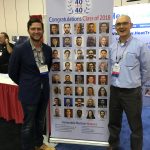
The week that gave us Furnaces North America 2018 is winding down. This is also the week that Heat Treat Today launched its inaugural print edition, as well as a digital version of the print edition, with the popular 40 Under 40 feature, highlighting the Class of 2018, enthusiastic, forward-thinking, skilled professionals who are making a difference in the heat treating industry before they turn 41. We invited the 40 Under 40 ’18 members who were at FNA to visit us at the Heat Treat Today booth to pick up their own copy of the print magazine — and one for their moms, as well — and for a photo session to share with local or company media. We are posting the photos below that we were able to capture, plus a few others here from FNA 2018.