QUENCHING TECHNICAL CONTENT

Process Innovation to Reduce Distortion During Gas Quenching

“High-pressure gas quenching (HPGQ) attempts to reduce temperature nonuniformities by reducing the cooling rate; however, this is generally not sufficient to eliminate shape change. Shape change can be predicted by heat treatment simulation software, but it is difficult to reproduce the exact same cooling conditions in the vessel for each batch. Therefore, the distortion of the components will not be consistent from batch to batch.”

Read the case study to see one response to this issue in this original content from Heat Treat Today by Justin Sims, lead engineer at DANTE Solutions.

This article first appeared in the latest edition (March 2020) of Heat Treat Today’s Aerospace Heat Treating magazine.


Distortion is generally described by a size change and a shape change. In heat treatment of steels, size change is unavoidable and is mainly due to the volumetric difference between the starting microstructural phase and the final microstructural phase. Shape change of steel parts from heat treatment is due to nonuniform thermal and nonuniform microstructural strains as a result of nonuniform cooling or heating, alloy segregation, poor support of the component while at high temperature, thermal expansion or contraction restrictions, or residual stresses from prior forming operations. Nonuniform cooling or heating can be as fundamental as the temperature gradient from the part surface to its core, or as complex as the flow of fluid around a component feature. Both can result in nonuniform strains, resulting in a shape change. If the stresses causing these strains exceed the yield strength of the material, then permanent shape change will occur. Size change can be anticipated and is predictable, while shape change, or distortion, is usually unanticipated and more difficult to predict.[1-2] 

Justin Sims,
Lead Engineer,
DANTE Solutions

Most thermal processes try to control these nonuniformities using methods of low complexity such as part orientation and rack design. Quenching systems, for example, are generally designed to remove as much thermal energy from the work pieces as possible and to do this as quickly as possible. High-pressure gas quenching (HPGQ) attempts to reduce temperature nonuniformities by reducing the cooling rate; however, this is generally not sufficient to eliminate shape change. Shape change can be predicted by heat treatment simulation software, but it is difficult to reproduce the exact same cooling conditions in the vessel for each batch. Therefore, the distortion of the components will not be consistent from batch to batch.

In response to this issue, a prototype gas quenching unit capable of controlling the temperature of the quench gas entering the quench chamber was devised. With the DANTE Controlled Gas Quench (DCGQ) unit, it is possible to have control of the thermal and transformation gradients in the component by controlling the temperature of the incoming quench gas, thereby significantly reducing, or eliminating entirely, the shape change caused by quenching. In doing so, the size change can easily be predicted by heat treatment simulation software, and post-hardening finishing operations can be reduced or eliminated. This process is ideal for thin parts or components with significant cross-sectional changes. Atmosphere Engineering (now part of United Process Controls) in Milwaukee, Wisconsin constructed the unit and provided the logic to control it. All experiments with the unit were conducted at Akron Steel Treating Company in Akron, Ohio. The project was funded by the U.S. Army Defense Directorate (ADD).

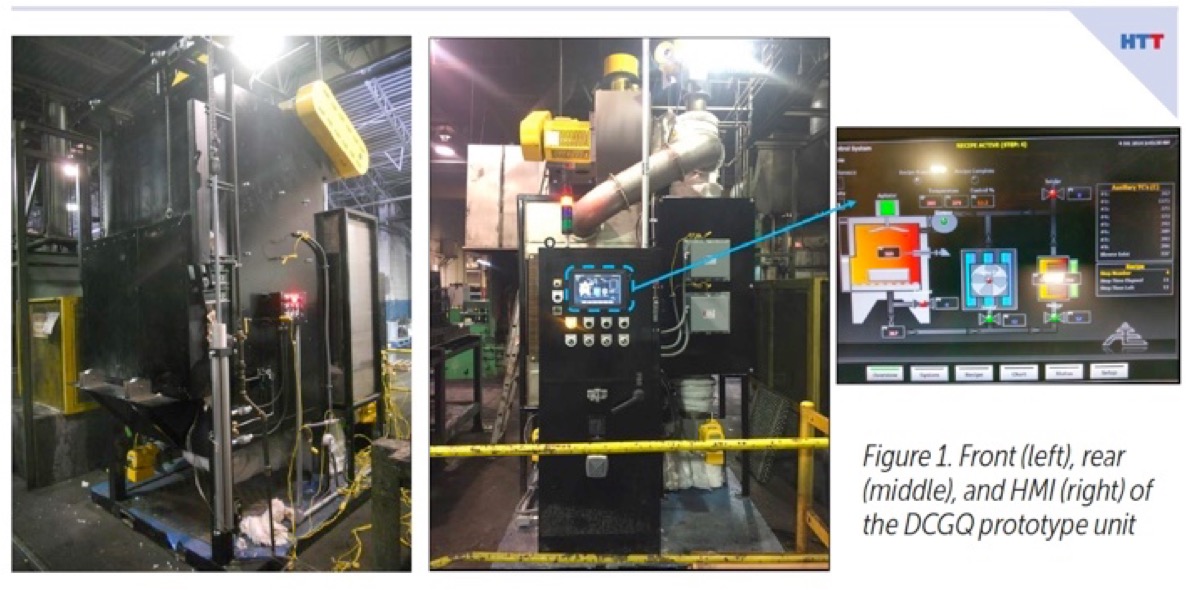
Figure 1 (left) shows the front of the unit, while Figure 1 (middle) shows the back of the unit. The back of the unit contains the human machine interface (HMI), shown in Figure 1 (right), where process parameters can be modified and DCGQ recipes entered. The prototype unit has a working zone of nine cubic ft. and is capable of quenching loads up to 100 lbs. at one atmosphere of pressure.

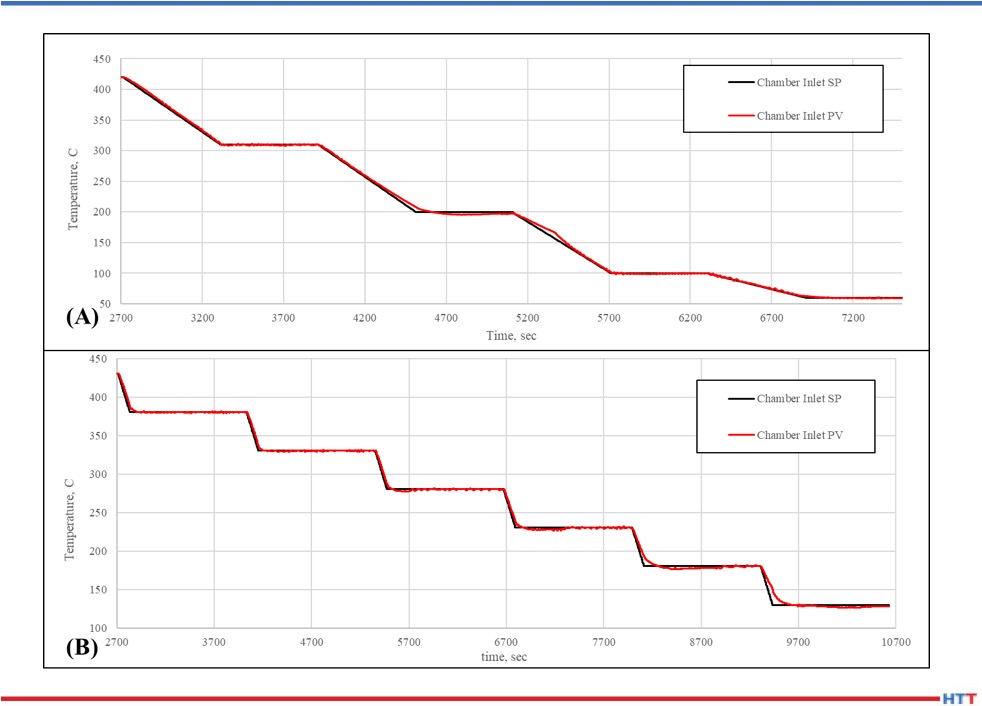
Figure 2. Comparison of quench gas temperature entering the
quench chamber versus the recipe setpoint temperature for
two different DCGQ process recipes

The ability of the unit to maintain continuity between the recipe setpoint temperature and the actual temperature entering the quench chamber is absolutely paramount. Figure 2 shows two schedules, one aggressive and one conservative, comparing the recipe setpoint (Chamber Inlet SP) to the actual quench gas temperature (Chamber Inlet PV). Figure 2 also shows that the prototype unit has good control of the quench gas temperature between 752°F (400°C) and room temperature, the martensite transformation range for most high hardenable steel alloys. There is some deviation between the two temperatures below 392°F (200°C) for the aggressive schedule as the setpoint reaches its set temperature, due to the relatively small temperature difference between the quench gas and the shop air. This small temperature difference makes it slightly difficult for the air-to-air heat exchanger used in the design to keep up with the rapid drop in temperature, but overall there is very good control of the quench gas temperature.

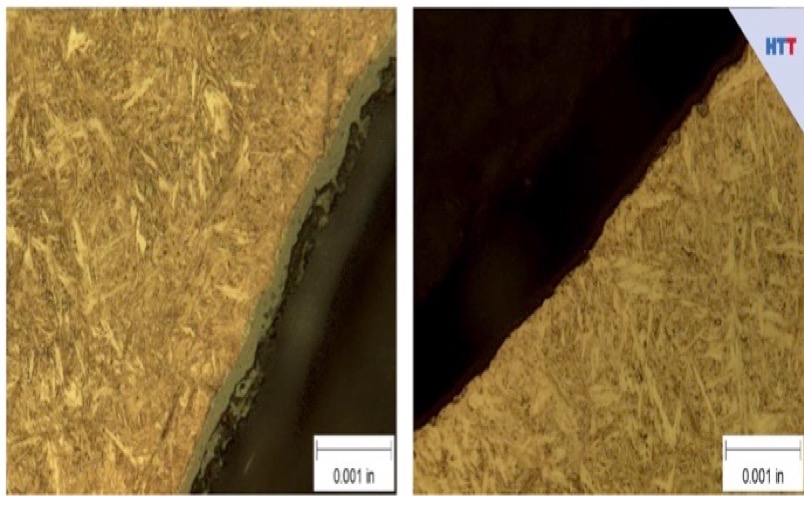
Figure 3. Micrograph of DCGQ (left) and HPGQ (right) processed coupons, mag. 1000X
There is a copper layer on the surface of the DCGQ processed coupon.

Microstructural examination was conducted on Ferrium C64 coupons processed using the DCGQ process and coupons processedusing a 2-bar HPGQ. C64 was chosen for this study due to its extremely high hardenability and its high tempering temperature. Figure 3 compares the microstructures of the two processes at a magnification of 1000X, and no significant difference is detected. The DCGQ coupons required two hours to complete the transformation, whereas the HPGQ coupons transformed in a few minutes. There is no indication that the slow rate of transformation damaged the microstructure or mechanical properties in any way. Tensile and Charpy properties were equivalent between the two processes.

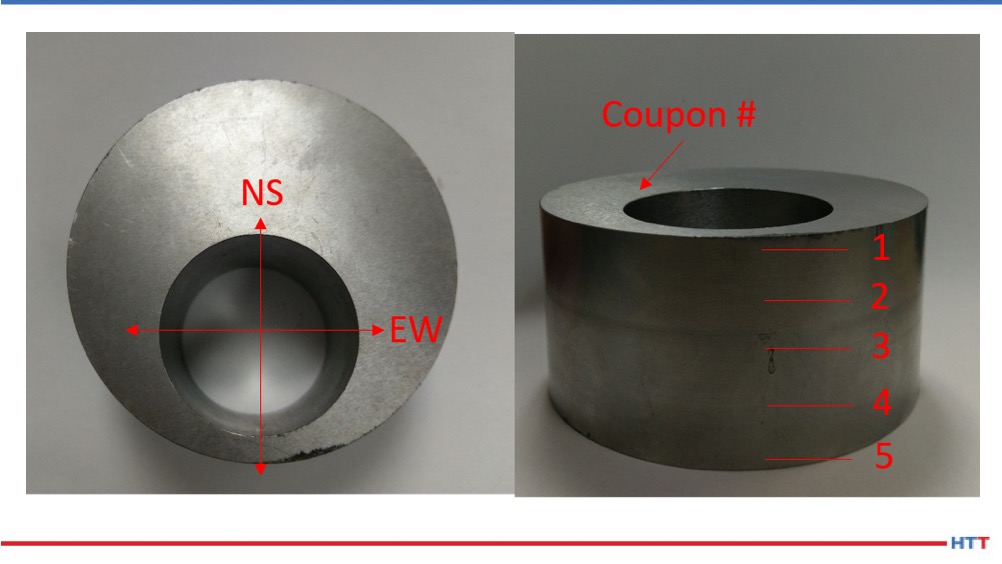
Distortion coupons, thick disks with eccentric bores, were designed and manufactured with the goal of evaluating the distortion response when subjected to a DCGQ process, and then compared to coupons subjected to a standard 2-bar HPGQ operation. All coupons were manufactured from the same Ferrium C64 bar stock. All coupons were cryogenically treated and tempered at 595°C for eight hours after quenching.

Figure 4. Nomenclature and locations used for out-of-round measurements on the distortion coupon

Figure 4 shows a distortion coupon with the nomenclature and locations used for measuring the out-of-round distortion of the eccentric bore. Due to the uneven mass distribution, the north-south direction will generally be larger than the east-west direction. Five measurements were then made along the axis of the coupon using a Fowler Bore Gauge.

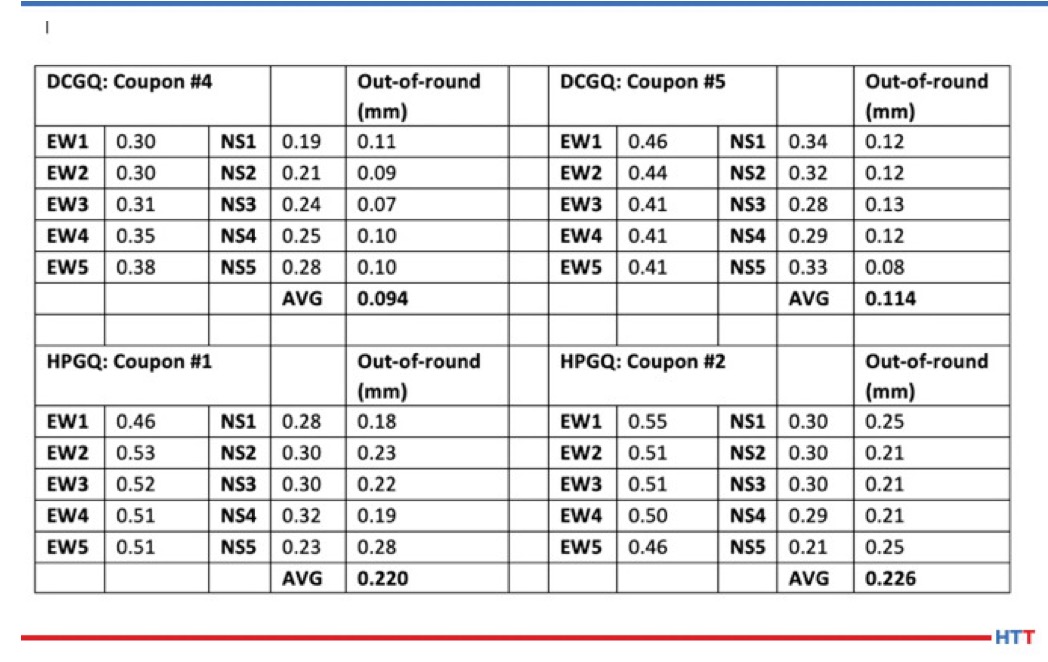
Table 1. Out-of-round distortion measurements of the distortion coupon for a DCGQ and HPGQ process

Table 1 shows the results from four coupons; two hardened using the DCGQ process and two processed using the standard 2 bar HPGQ for C64. The individual measurements (EW1, NS5, etc.) are relative and are dependent on the reference value used for the bore gauge. The individual measurements give an indication of the variation in distortion in the axial direction. The out-of-round measurements are actual values, as they are the difference between the actual measurements. The DCGQ process gave significantly less distortion than the HPGQ process.

While the values reported show a 50% reduction in out-of-round distortion for the DCGQ process, a larger gain could have been realized if two other conditions were addressed. First, the coupon for DCGQ was placed directly into a 1832°F (1000°C) preheated furnace since the prototype unit does not have austenitizing capabilities. Controlled heating, just like controlled cooling, should be utilized to realize the full potential of this process. Second, the DCGQ schedule was designed for another coupon geometry that was processed together with these distortion coupons. Therefore, the schedule was not optimum for this coupon geometry.

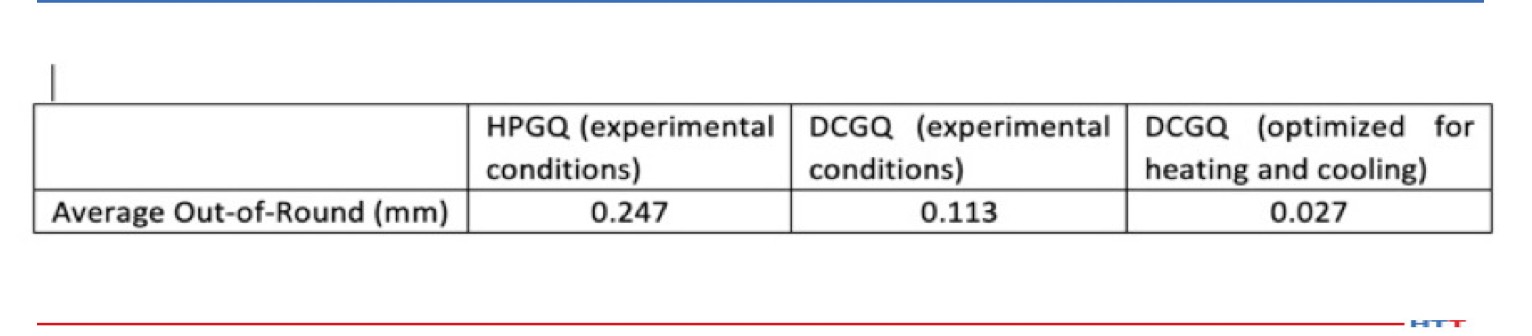
Table 2. DANTE simulation results comparing HPGQ and DCGQ using the experimental conditions and a DCGQ with optimized heating and cooling schedulesMARCH 2020

Table 2 compares the DCGQ simulation results in which the two processes executed on the experimental coupons were compared to an optimized process, including controlled heating and cooling schedules designed for this coupon. The optimized schedule predicts an order of magnitude reduction in out-of-round distortion. Comparison of the measurements from the HPGQ and DCGQ experiments in Table 1 to the model predictions in Table 2 shows that the model predictions agree closely with the experimental results.

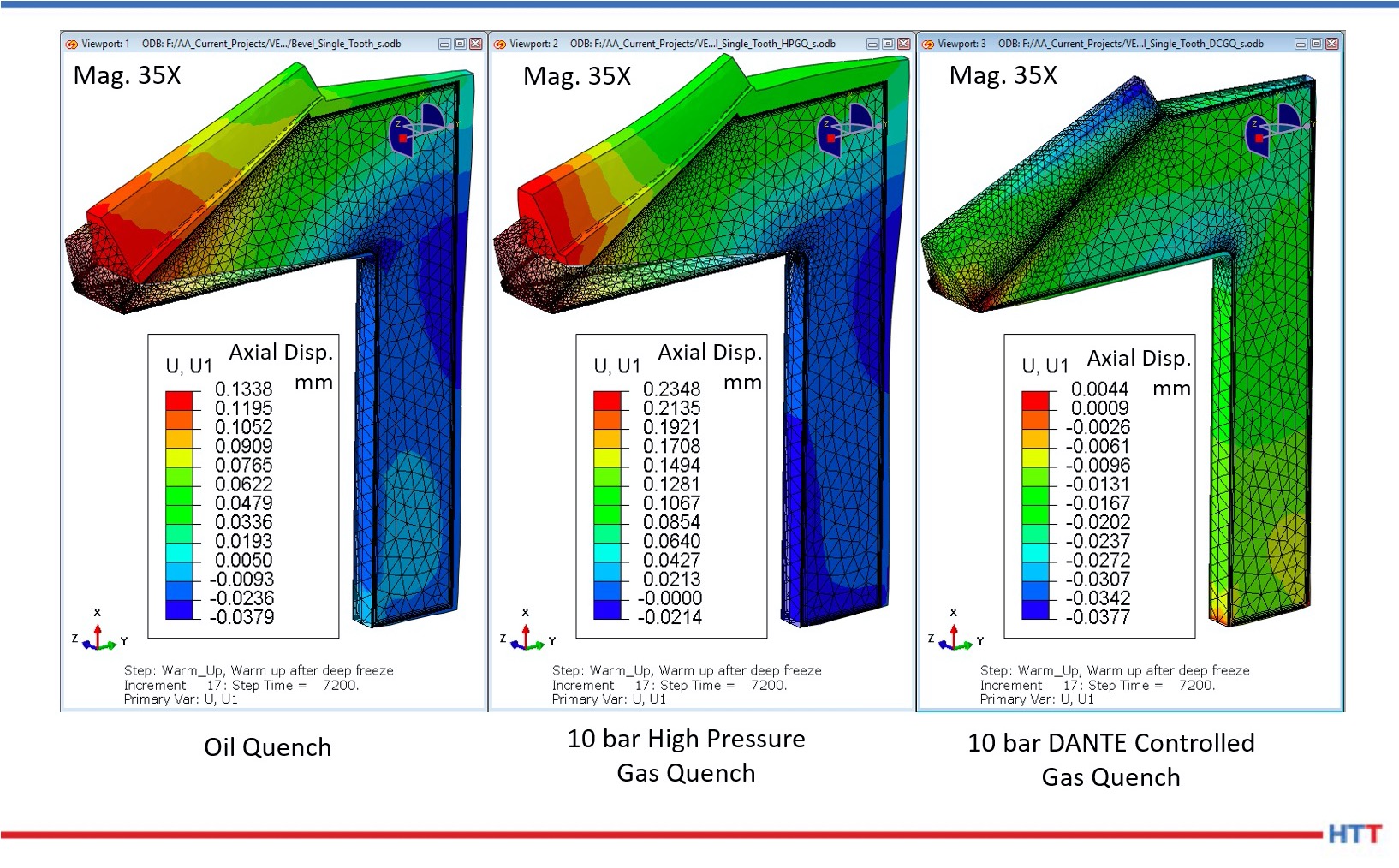
Simulating the application of the DCGQ process to a gear geometry, the predicted warpage of a bevel gear was examined. The simulation looked at the differences between an oil quench, 10 bar HPGQ, and a 10 bar DCGQ process. From Figure 5, it is clear that the HPGQ process is predicted to produce the most distortion. Even though the 10 bar gas quench has a slower cooling rate than the oil quench, less distortion is not guaranteed since a slower rate does not guarantee a more uniform phase transformation.[3] In this case, both heating and cooling were controlled for the DCGQ simulation.

Figure 5. Comparison of oil quench, HPGQ, and DCGQ processes for a bevel gear

In summary, a prototype gas quenching unit has been constructed with the ability to accurately control the temperature of the quench gas entering the quench chamber. Experimental results have shown that mechanical properties and microstructure are equivalent between the DCGQ process and a 2-bar HPGQ process for Ferrium C64. Thick disks with eccentric bores were machined and then heat treated using DCGQ and HPGQ. It was shown that the DCGQ process reduced distortion in these disks by 50%. Simulation using DANTE then showed that the distortion could be reduced further if controlled heating and cooling are used. Finally, a comparison was made between an oil quench, HPGQ, and DCGQ processes for a bevel gear. This comparison showed that the HPGQ process was predicted to cause the most distortion. HTT

References

[1] Prabhudev, K.H., Handbook of Heat Treatment of Steels, Tata McGraw-Hill Publishing, 1988, p.111-114

[2] Sinha, Anil Kumar, ASM Handbook, Vol. 4: Heat Treating, ASM International, 1991, p.601-619

[3] Sims, Justin, Li Zhichao (Charlie), Ferguson B. Lynn, Causes of Distortion during High Pressure Gas Quenching Process of Steel Parts, Proceedings of the 30th ASM Heat Treating Society Conference, ASM International, 2019, p.228-236


About the Author: As an analyst of steel heat treat processes and an expert modeler of quench hardening processes, Justin Sims was the lead engineer for designing and building the DANTE Controlled Gas Quenching (DCGQ) prototype unit. This system was developed to minimize distortion of quenched parts made of high hardenability steels, while still achieving the required properties and performance.

For more information, contact Justin at DANTE Solutions


Process Innovation to Reduce Distortion During Gas Quenching Read More »

Heat Treat Tips: Aqueous Quenching

One of the great benefits of a community of heat treaters is the opportunity to challenge old habits and look at new ways of doing things. Heat Treat Today’s 101 Heat Treat Tips is another opportunity to learn the tips, tricks, and hacks shared by some of the industry’s foremost experts.

For Heat Treat Today’s latest round of 101 Heat Treat Tips, click here for the digital edition of the 2019 Heat Treat Today fall issue (also featuring the popular 40 Under 40).

Today’s tips come to us from Quaker Houghton and Contour Hardening, covering Aqueous Quenching. This includes advice about effective filtration in removing particulates in aqueous quench systems and tips for aqueous quenchant selection.

If you have a heat treat-related tip that would benefit your industry colleagues, you can submit your tip(s) to anastasia@heattreattoday.com  or editor@heattreattoday.com.


Heat Treat Tip #5

Remove Particulates

Adding a strong magnetic filter in line after the main filtration system is an effective way to remove fine, metallic particulates in an aqueous quench system.

Submitted by: Contour Hardening


Heat Treat Tip #9

Aqueous Quenchant Selection Tips

Greenlight Unit (source: Quaker Houghton)

1. Determine your quench: Induction or Immersion? Different aqueous quenchants will provide either faster or slower cooling depending upon induction or immersion quenching applications. It is important to select the proper quenchant to meet required metallurgical properties for the application.
2. Part material: Chemistry and hardenability are important for the critical cooling rate for the application.
3. Part material: Minimum and maximum section thickness is required to select the proper aqueous quenchant and concentration.

Aqueous Quenching (source: Quaker Houghton)

4. Select the correct aqueous quenchant for the application as there are different chemistries. Choosing the correct aqueous quenchant will provide the required metallurgical properties.
5. Review selected aqueous quenchant for physical characteristics and cooling curve data at respective concentrations.
6. Filtration is important for aqueous quenchants to keep the solution as clean as possible.
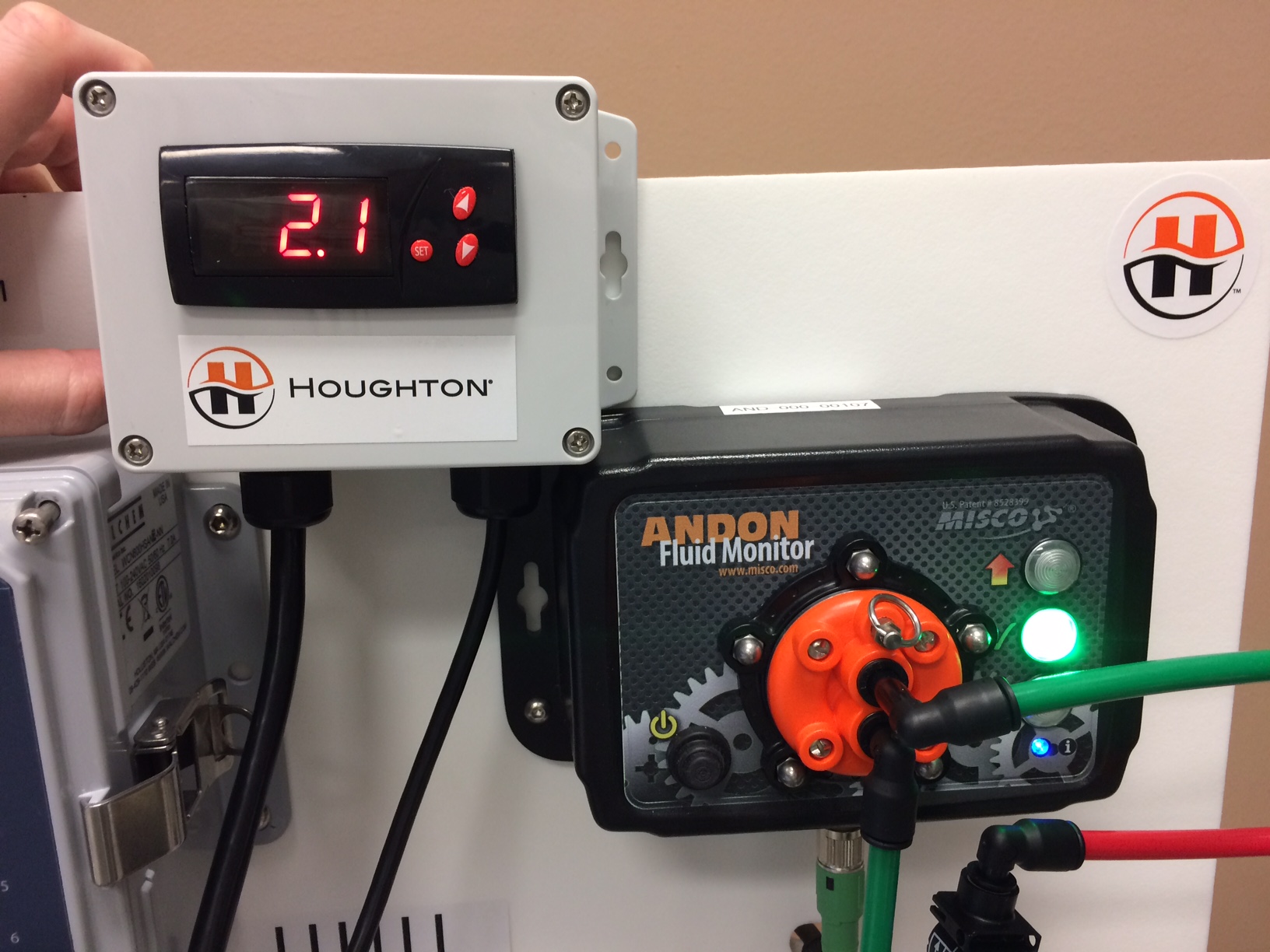
7. Check concentration of aqueous quenchant via kinematic viscosity, refractometer, or Greenlight Unit. Concentration should be monitored on a regular basis to ensure the quenchant’s heat extraction capabilities.

Greenlight Display (source: Quaker Houghton)

8. Check for contamination (hydraulic oil, etc) which can have an adverse effect on the products cooling curves and possibly affect metallurgical properties.
9. Check pH to ensure proper corrosion protection on parts and equipment.
10. Check microbiologicals which can foul the aqueous quenchant causing unpleasant odors in the quench tank and working environment. If necessary utilize a biostable aqueous quenchant.
11. Implement a proactive maintenance program from your supplier.


Submitted by: Quaker Houghton


Heat Treat Tips: Aqueous Quenching Read More »

Using Virtual Tools for Quenching Process Design

By validating CFD simulation results with thermocouple data, Ford Motor Company is now using virtual tools to study aluminum cylinder head quenching process and gains valuable information for process design and optimization. James Jan and Madhusudhan Nannapuraju presented a study titled “CFD Investigation of Quench Media and Orientation Effects on Structural Stress Induced in the Intense Quenching Processes for Aluminum Cylinder Heads” at Heat Treat 2017 as part of the proceedings of the 29th ASM Heat Treating Society Conference, October 24–26, 2017, Columbus, Ohio, USA. (Copyright © 2017 ASM International® All rights reserved.)

This article is a synopsis of the study, which can be read in its entirety here: “CFD Investigation of Quench Media and Orientation Effects on Structural Stress Induced in the Intense Quenching Processes for Aluminum Cylinder Heads”


Heat treatment is a common manufacturing process to produce high-performance components. Although heat treatment incorporating a quenching process can produce parts with durable mechanical properties, an unwanted effect of intense quenching is the induced thermal residual stress, which often is a leading cause for quality issues associated with high cycle fatigues. During the product development cycle, it is not uncommon to switch between air and water quenching and change quench orientation in order to minimize residual stress. However, the choice of quench media and quench orientation is often determined by intuitive engineering judgment at best and trial-and-error iterative method at worst.

In recent years, digital verification using finite element analysis (FEA) is gaining popularity because of its efficiency. The computational method to predict the residual stress involves two calculations. The first step is to calculate the temperature history; then the temperature data is used as thermal-load-to-structure analysis for stress and deformation calculation.

A popular method for temperature calculation is the heat transfer coefficient (HTC) method, however, the biggest drawback of HTC method is that the method relies on thermocouple measurement for calibration and the calibrated HTC may not be applicable to different design and quenching process. With the advancement in computation fluid dynamics CFD technologies, the temperature history in quenching now can be accurately calculated. Since thermal residual stress is directly linked to non-uniform temperature distribution in the metal, spatial temperature gradient is evaluated to study the performance of different quench media and configuration.

Figure 1: Heat treatment process for aluminum cylinder heads and quality concern associated with quenching process.

Air Quench Process for Cylinder Heads

The main heat extraction mechanism in air quenching is forced convection. In our CFD model, it is assumed that the buoyancy effect and radiation heat transfer have a negligible impact on the accuracy. The CFD simulation results are compared with thermocouple readings, and the overlapping curves illustrate an excellent agreement and validate our model.

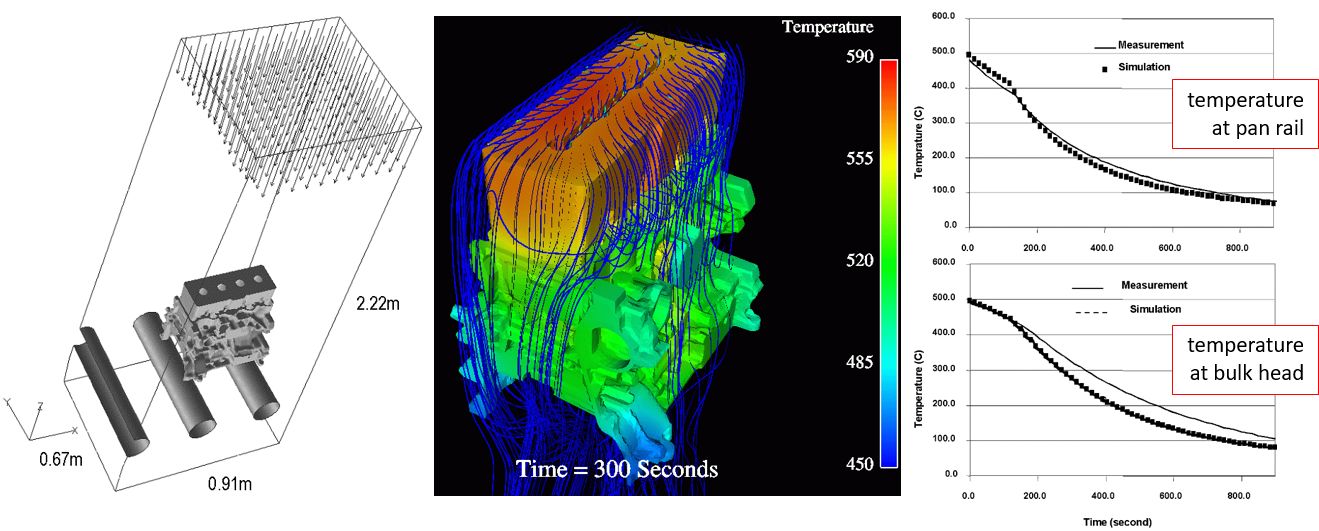
Figure 2: CFD model and comparison to thermocouple measurement for air quenching a cylinder block with riser attached.

We use CFD to study and compare four different air quenching configurations. One unique advantage of CFD simulation over physical testing is its capability to visualize flow patterns and to identify low heat transfer regions under stagnant air pockets. The quenching configuration (a), (b) and (c) represent a conveyer style quenching environment, (d) represents a basket style quenching environment. See Figure 3.

Figure 3: Air flow and air pockets surrounding cylinder head for all air quenching configurations, 60 seconds into quenching.

The cooling curve plot shows that the cylinder head quenched in a basket (d) cools faster compared to those quenched on a conveyer (a), (b), and (c). According to the temperature gradients plot, basket quenching (d) cools faster at a higher temperature gradient than conveyer quenching (a) and (c). The only exception is (b). In-depth investigation of the location of high-temperature gradient indicates that the regions between the water jacket and intake port are susceptible to high residual stress.

Figure 4: Cooling curve and temperature gradient for all air quenching configurations.
Figure 5: High-temperature gradient locations for conveyer quenching (a) and basket quenching (d), 60 seconds into quenching.

Water Quench Process for Cylinder Heads

The physics of water quenching is much more involved than air quenching. Ford Motor Company adapted the quench model framework by AVL FIRE™, which is based on the Eulerian-Eulerian multiphase model, and developed our own proprietary database to simulate the water boiling process. Extensive work has been done on computation and experiments to validate the numerical methods. The CFD simulations compared to lab experiment on cooling curves provide strong evidence that our CFD model is accurate and that it can predict temperature profile on every quenching orientation without calibration.

Figure 6: Experimental and CFD simulation for cylinder block; cooling curves from CFD and thermocouple are plotted together for comparison.

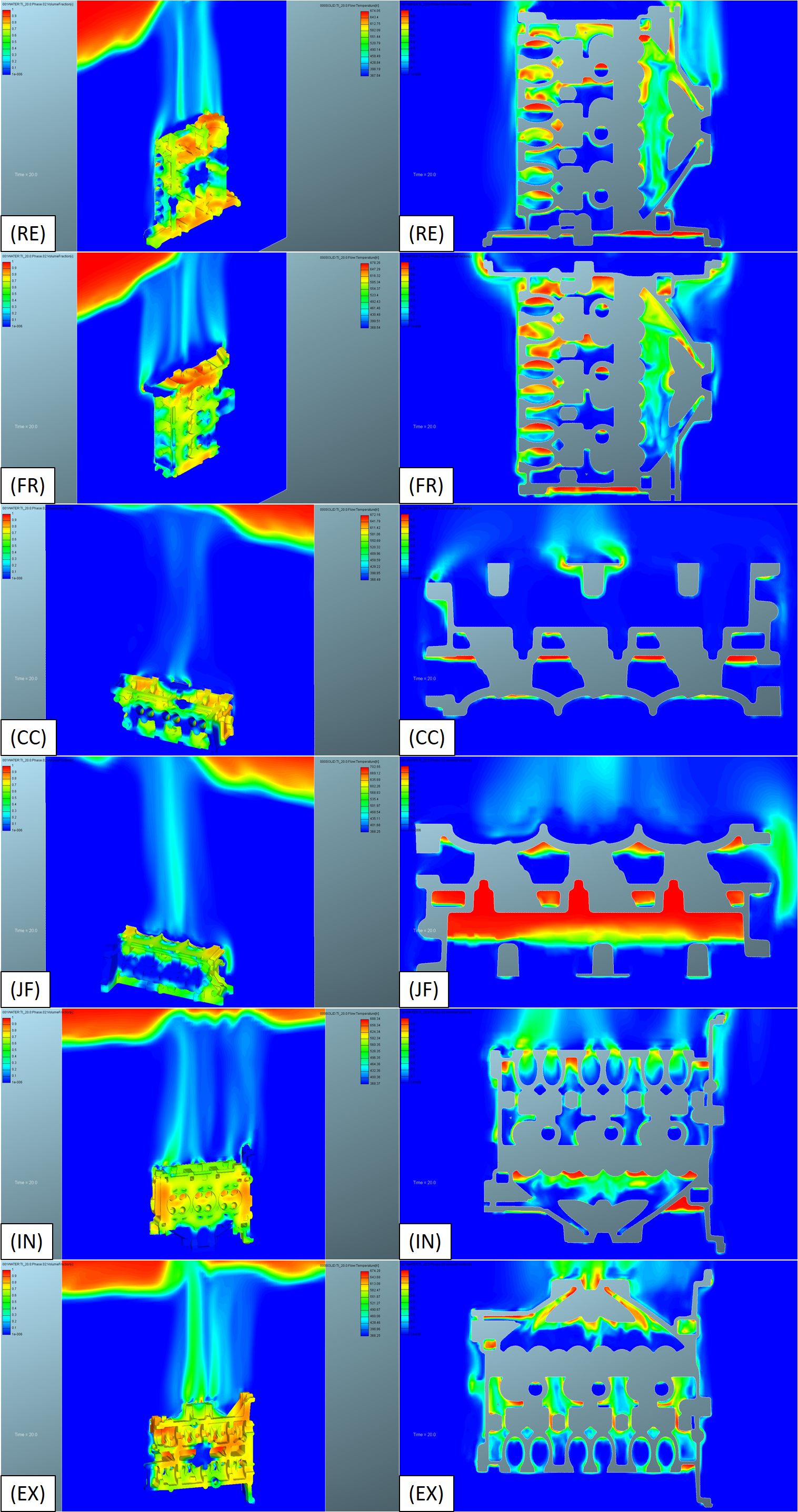
Six different quench orientations are studied, and the vapor patterns and vapor pockets are plotted for in-depth investigation. The cooling curve and temperature gradient plot illustrate that orientation has little impact on overall cooling characteristics, and maximum temperature gradient is similar except that they occur at different time, even though the vapor pattern and locations of vapor pockets are drastically different in each quenching orientations.

Figure 7: Vapor Pattern and Vapor Pocket Entrapped inside Cylinder Heads, 20 seconds into quenching.
Figure 8: Cooling curve and maximum temperature gradient for all water quenching configurations.

Observing the location of the high-temperature gradient, for rear face up (RE) and cam cover face up (CC) quenching, high-temperature gradient appears in the intake port area, similar to the air quenching cases. Since the high-temperature gradient is observed near the intake port for all quenching cases, both air quenching and water quenching, very likely it is a design-related issue.

Figure 9: High-Temperature Gradient Locations for Rear Face up (RE) and Cam Cover Face up Quenching (CC), 20 seconds into Quenching.

Comparison of Air and Water Quenching Process

The underlying heat extraction for air and water quenching is very different. While air quenching relies on convection heat transfer to cool the metal, water quenching relies on water to vapor phase change to take the heat away. Therefore, metal cools significantly faster in water quenching than in air quenching. The maximum temperature gradient for water quenching is also much larger than air quenching. Since water only vaporizes in areas in contact with a hot surface, the heat loss is a local phenomenon subject to vapor escape route and the supply of fresh water. In other words, the heat transfer may not be as smooth as air quenching and it is reflected in the fluctuation of high-temperature gradient plot.

A much higher temperature gradient in water quenching does not necessarily generate much higher residual stress. We can also see in the plot that the duration of peak temperature gradient only lasts about 15 seconds. In this duration, the metal may exceed yielding stress and plastic deformation starts. However, the final deformation also depends on how long the state of stress stays in plastic deformation zone.

Figure 10: Cooling curve and maximum temperature gradient for selected air and water quenching configurations.

Conclusions

The rapid, large temperature drop in the quenching process has two opposite effects on the eventual outcome. On one hand, the large cooling rate produces metals with better quality, but it also induces residual stress. Thanks to the advancement of 3D CFD methodology, now the metal cooling in the quenching process can be much better understood using computer simulations. By using validated air and water quench modeling method, we compared the cooling curves and temperature gradient to evaluate quenching performance for various quenching configurations.

For air quenching processes, the study finds that cylinder heads cool faster in basket quenching than in conveyer quenching environment. The explanation is that airflow is accelerated when passing through the narrow gaps between cylinder heads in basket quenching. For water quenching processes, the study finds the orientation has little effect on the overall cooling rate as well as maximum temperature gradient except for a time shift in the maximum gradient. The results also show that the temperature gradient in water quenching is significantly larger than air quenching but last a much shorter period of time. Studying the temperature gradient for all air and water quenching case reveals a weak spot between the intake port and water jacket. Since this spot appears in all quenching cases, it should be remedied by a design change rather than changing the manufacturing process alone.

References

  • Koc, M., Culp, J., Altan, T. “Prediction of Residual Stresses in Quenched Aluminum Blocks and Their Reduction through Cold Working Processes,” Journal of materials processing technology, 174.1 (2006), pp342-354.
  • Wang, D.M., Alajbegovic, A., Su, X.M., Jan, J., “Numerical Modelling of Quench Cooling Using Eulerian Two-Fluid Method”, Proceedings of IMECE 2002, ASME-33499 Heat Transfer, vol. 3, 2003, pp. 179-185. LA, USA.
  • Srinivasan, V., Moon, K., Greif, D., Wang, D.M., Kim, M., “Numerical Simulation of Immersion Quench Cooling Process”: Part I, Proceedings in the International Mechanical Engineering Congress and Exposition, IMECE2008, Paper no: IMECE2008-69280, Boston, Massachusetts, USA, 2008.
  • Srinivasan, V., Moon, K., Greif, D., Wang, D.M., Kim, M., “Numerical Simulation of Immersion Quench Cooling Process”: Part II, Proceedings in the International Mechanical Engineering Congress and Exposition, IMECE2008, Paper no: IMECE2008-69281, Boston, Massachusetts, USA, 2008.
  • Kopun, R., Škerget, L., Hriberšek, M., Zhang, D., Stauder, B., Greif, D., “Numerical simulation of immersion quenching process for cast aluminium part at different pool temperatures”, Applied Thermal Engineering 65, pp. 74-84, 2014
  • Jan, J., Prabhu, E., Lasecki, J., Weiss, U, “Development and Validation of CFD Methodology to Simulate Water Quenching Process,” Proceedings of the ASME 2014 International Manufacturing Science and Engineering Conference, Detroit Michigan, 2014.


Photo credit for all images: Ford Motor Company; cited in “CFD Investigation of Quench Media and Orientation Effects on Structural Stress Induced in the Intense Quenching Processes for Aluminum Cylinder Heads”, Heat Treat 2017: Proceedings of the 29th ASM Heat Treating Society Conference October 24–26, 2017, Columbus, Ohio, USA.


Using Virtual Tools for Quenching Process Design Read More »
Distortion Analysis of Landing Gear During Oil Quench: A Case Study

Charlie Li

A thermal process modeling company used its heat treatment simulation software to explore oil quench sensitivities on the distortion of a large landing gear made of 300M, a vacuum melted low alloy steel that includes vanadium and a higher silicon composition.

DANTE Solutions, an engineering consulting and software company specializing in metallurgical process engineering and thermal/stress analyses of metal parts and components, was approached to examine local stagnant oil flow and immersion, among other sensitivities, for this critical aerospace component.

Zhichao (Charlie) Li, Ph.D., vice president of DANTE Solutions, was the lead researcher and author of this study.


Case Study

Problem Statement

Part:

3 modes of distortion that are of concern
  • 2.5 meter tall landing gear
  • 0.25 meter main tube diameter
  • AISI 300M material

Problem:

  • Large distortions after oil quenching in the following distortion modes:
    • Bow in XY-Plane
    • Bow in YZ-Plane
    • Straightness of a Blind Hole
  • All distortion modes shown in the figures make assembly of the entire structure very difficult.
  • Immersion into the oil tank is the main focus of the distortion analysis.

Process Description

  • Part is austenitized in pit furnace at 1607°F (875°C).
  • A 45-second step is included for the removal of the landing gear from the pit furnace.
  • 75-second open-air transfer from pit furnace to oil quench tank. The landing gear is immersed into the oil with a speed of 203.2 mm/sec, with the immersion direction shown in the figure. It takes 11.885 seconds to immerse the entire gear in the oil tank.
  • The landing gear is held in the oil for 5 minutes.
  • Tempering not considered, due to negligible effects on distortion.
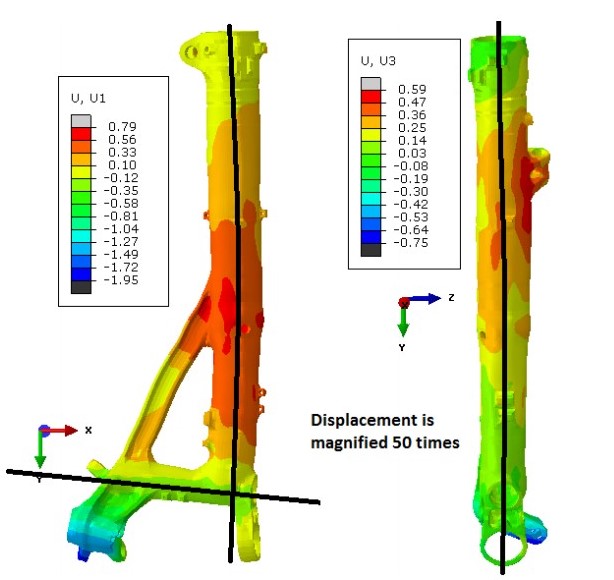
Temperature (°C), Austenite (fraction), horizontal displacement (mm), and vertical displacement (mm) at the end of the immersion process; section cut, looking inside the part.

Model Description

  • Model contains 281,265 nodes and 258,272 hex elements.
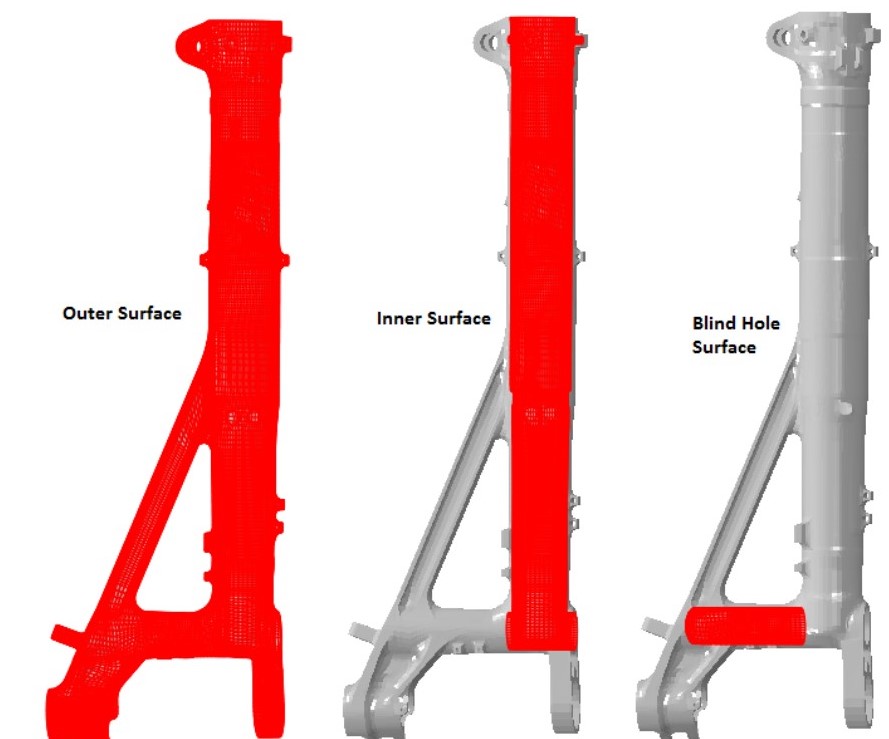
  • 3 surfaces defined for heat transfer boundary conditions.
  • Oil flow stagnation is expected inside the main tube (Inner Surface) and the blind hole.
  • Different thermal boundary conditions are applied to the outer surface and the inner surface, as shown to the right.
  • The blind hole and the inner surface have the same thermal boundary conditions in the baseline model.
  • During immersion, oil enters the blind hole first and then begins to fill up the main tube.
  • In the baseline model, the oil level rising speed inside the bore is assumed to be 20% of the landing gear immersion speed.


Modeling Approach

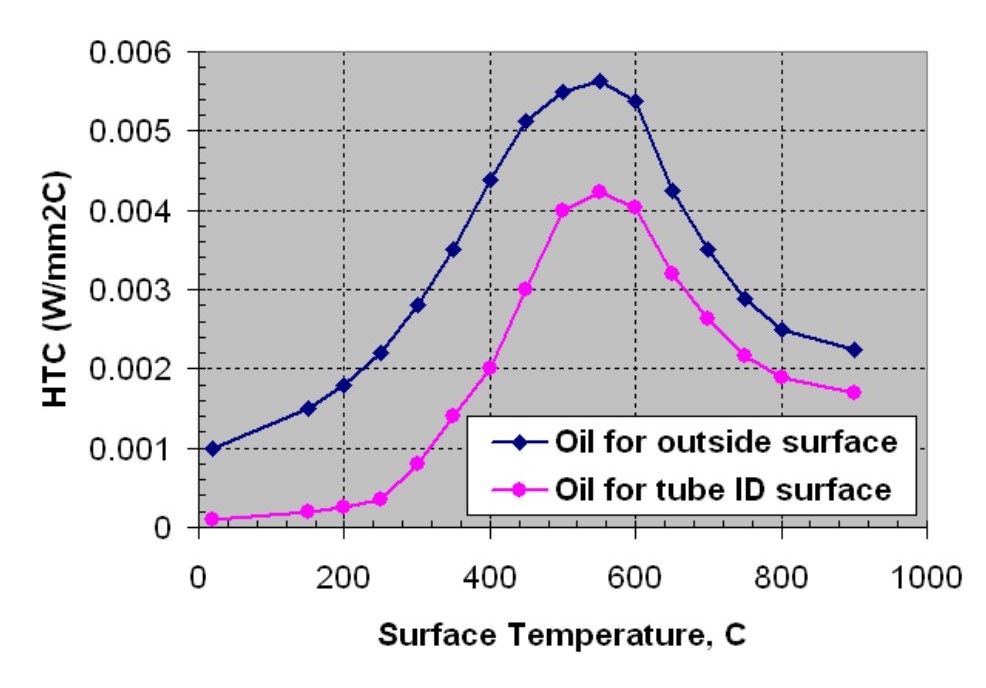
  • Define heat transfer coefficients as a function of temperature for the oil tank.
    • Thermocouples placed at various locations on a dummy landing gear, which was
      approximately the same overall dimensions and mass. Improve 300M material data in DANTE material database using dilatometry testing.
  • Improve 300M material data in DANTE material database using dilatometry testing.
  • Perform sensitivity study to determine phenomena critical to distortion modes of interest.
    • Oil flow stagnancy in blind hole during immersion: The more stagnancy, the lower the heat transfer on this surface. Baseline assumed to be the most stagnant. Two faster heat transfer rates examined.
    • Oil flow stagnancy around structural support arm: The more stagnancy, the lower the heat transfer on this surface. Baseline assumed to be least stagnant. Two slower heat transfer rates examined.
    • Oil fill rate of the main tube during immersion into the oil: The slower the oil fills up the main tube, the larger the temperature and phase transformation gradient is in the axial direction of the tube. Baseline assumed the slowest fill rate. Three faster fill rates were examined.
    • Immersion direction: Immersion direction sets up axial temperature/phase transformation gradients and also determines how the main tube is filled. The Baseline immersion direction causes oil to enter through the blind hole first and then into the main tube. Opposite immersion direction is examined, which causes oil to enter the open end of the main tube first.

Blind Hole Quench Rate Sensitivity

Figure 8. Temperature (°C) in the blind hole at the end of immersion for the three cases.
  • Heat transfer is increased in the blind hole during the
    immersion process; all other heat transfer rates
    remain the same as the baseline model during
    immersion.
  • All heat transfer rates are identical to the baseline
    after the part is fully immersed in the oil.
  • Baseline model assumes blind hole heat transfer is
    equivalent to the main tube inner diameter heat
    transfer during and after the immersion process.
  • Rate 2 has a faster heat transfer rate than the baseline.
  • Rate 1 has a faster heat transfer rate than Rate 2.
  • Figure 8 shows a significant difference in temperature between the three cases at the end of the immersion process.
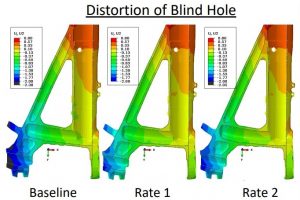
  • Heat transfer rates explored in the blind hole do not contribute
    to the tilting of the blind hole.
  • Figure 9 shows that the angle of the hole is the same, regardless of the quench rate.
  • Modification of the blind hole to increase the heat transfer rate
    in the hole to help improve the straightness of the blind hole is not necessary.
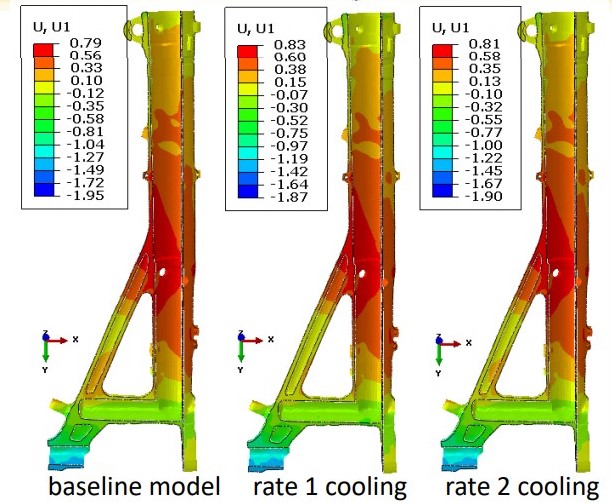
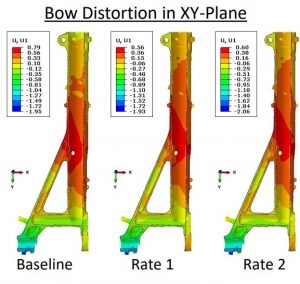
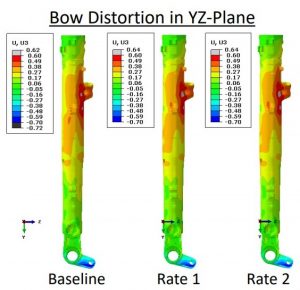
  • Heat transfer rates explored in the blind hole do not contribute significantly to the bow distortion in the XYPlane or the YZ-Plane.
  • Figure 10 shows that the bow distortion is made slightly worse by increasing the heat transfer rate in the blind hole during immersion, but is not significantly worse.
  • Modification of the blind hole to increase the heat transfer rate in the hole to help improve the bow distortion is not necessary.
Figure 9
Figure 10.

Structural Beam Quench Rate Sensitivity

  • Reduced heat transfer of the structural arm is examined.
    • Oil flow stagnancy is assumed to reduce heat transfer rate on arm.
    • 2 slower heat transfer rates compared with baseline.
    • Baseline assumes the same heat transfer rate on the structural arm as on the main tube OD.
  • Figure to the left shows the reduced heat transfer rate surfaces of the structural arm.
  • Rate 1 is slower than Baseline.
  • Rate 2 is slower than Rate 1.
  • Figure below shows the temperature difference in the structural beam at the end of the immersion process.
  • Approximately 212°F (100°C) difference between Baseline and Rate 1
  • Approximately 392°F (200°C) difference between Baseline and Rate 2


  • Bow distortion in xy-plane has a non- Distortion of Blind Hole linear response to oil stagnancy around the structural beam.
  • Rate 1 produced the least amount of bow in xy-plane.
  • Baseline produces the greatest amount of bow in xy-plane.
  • Distortion of blind hole has a non-linear response to oil stagnancy around the structural beam.
  • Rate 1 produced the straightest blind hole.
  • Baseline produces the greatest amount of distortion of the blind hole.
  • Bow distortion in yz-plane has no sensitivity to oil stagnancy around the structural beam.
  • The non-symmetric mass near the top of the landing gear has the most influence on the yz-plane bow distortion.
  • Figure 15 shows lower bainite phase fraction at the end of the quenching process.

    Figure 15
  • Slower heat transfer rate of the structural beam results in significantly different amounts of lower bainite.
    • The slower the heat transfer, the more lower bainite formed.
  • Increased amounts of bainite reduce bow distortion in xy-plane, but the response is non-linear.
    • Rate 2 caused slightly more distortion than Rate 1, but less distortion than the Baseline.
  • Increased amounts of bainite reduce distortion of the blind hole, but the response is non-linear.
    • Rate 2 caused slightly more distortion than Rate 1, but less distortion than the Baseline.

Oil Fill Rate in Main Tube Sensitivity

  • The rate at which the oil fills the main tube is critical to the phase transformation timings and the phases formed.
  • The immersion speed of the landing gear is 203.2 mm/sec.
  • Baseline assumes the inside of the tube fills up at 20% of this value (40.64 mm/sec).
  • Three different fill speeds were explored:
    • 50% (101.6 mm/sec)
    • 100% (203.2 mm/sec)
    • 200% (406.4 mm/sec) Assumes pressure build up forces oil up the inside of the tube.
  • Figure 16 compares temperature inside tube at end of immersion for four cases.
Figure 16


  • The oil fill rate of the main tube during the immersion process has a very significant effect on all three modes of distortion.

From top left clockwise

  • Bow distortion in yz-plane has a non-linear response to the fill speed (Figure 17)
    • 50% produces the worst bow
    • 100% & 200% are very similar, with 200% slightly worse
  • Bow distortion in xy-plane has a non-linear response to the fill speed (Figure 18)
    • 50% produces the least bow
    • 100% produces the worst bow
  • Straightness of the blind hole has a linear response to the fill speed (Figure 19)
    • Slowest fill speed has least distortion
    • Fastest fill speed has the worst distortion

  • Difference in lower bainite was the cause for differences in distortion with respect to oil stagnancy around the structural beam previously shown.
  • Differences in distortion from the oil fill rate of the main tube are not caused by microstructural phase differences.
  • Figure 18 shows that Martensite and Lower Bainite are the same for all fill speeds.
  • Differences in distortion are caused by the transformation timing along the axis of the landing gear.


Immersion Direction Sensitivity

Figure 19
  • Distortion sensitivity to the immersion direction was examined.
  • Figure 19 compares temperature profile at the end of the immersion process for the two immersion directions.
  • The Baseline has oil enter the blind hole first and then fill up the tube at a rate that is 20% of the immersion speed.
    • Oil spills over the top of the tube and the tube is flooded with oil.
  • The reversed immersion has oil enter the tube first and fills at the immersion speed.
  • Figure 20

    Reversing the immersion direction also reverses the axial temperature gradient.

    • Martensite transformation starts at the open tube end when the immersion direction is reversed.
    • Martensite transformation starts by the blind hole first for the Baseline.
    • Reversing the axial phase transformation gradient can have significant effects on bow distortion and axial displacement.
  • Figure 20 shows the vertical displacement around the blind hole for the Baseline and the Reversed Immersion.
  • Reversing the immersion direction had a very minor impact on the straightness of the blind hole.
    • Closed side of blind hole was pulled further down by reversing the immersion direction, but the closed side
      Figure 21

      was not pulled up as much.

  • Figure 21 shows the bow distortion in the XY-Plane for the Baseline and the Reversed Immersion.
  • Reversing the immersion direction has a significant effect on the bow distortion in the XY-Plane, nearly doubling it.
  • Reversing the immersion direction has no effect on the bow distortion in the YZ-Plane.


Conclusions

  • Four process parameters were evaluated for distortion sensitivities for a large landing gear component:
    • Oil stagnancy inside a blind hole, oil stagnancy around a structural support beam, oil fill rate into the main tube as the landing gear is lowered into the oil tank, and immersion direction of the landing gear.
  • Three distortion modes were evaluated:
    • Bow distortion in XY-Plane, bow distortion in YZ-Plane, and straightness of a blind hole.
  • Bow distortion in the XY-Plane IS significantly affected by oil stagnancy around structural support beam, oil fill rate up the main tube, and the immersion direction.
    • Bow distortion in the XY-Plane is mainly controlled by the behavior of the structural support beam.
  • Bow distortion in the XY-Plane IS NOT significantly affected by oil stagnancy in the blind hole.
  • Bow distortion in the YZ-Plane IS significantly affected by oil fill rate of the main tube.
    • Bow distortion in the YZ-Plane is mainly controlled by a fitting near the open end of the tube that contributes to non-symmetric mass around the main tube in that area.
  • Bow distortion in the YZ-Plane IS NOT significantly affected by oil stagnancy in the blind hole, oil stagnancy around the structural support beam, or the immersion direction.
  • Straightness of the blind hole IS significantly affected by oil stagnancy around structural support beam and the oil fill rate up the main tube .
    • Straightness of the blind hole is mainly controlled by the structural support beam behavior.
  • Straightness of the blind hole IS NOT significantly affected by oil stagnancy inside the blind hole or the immersion direction.
  • Modifications to the quenching process were made to improve the distortion response of the landing gear.
    • Modeling results were used to direct the modifications.
    • Customer considered changes proprietary and did not share.
  • Benefit of using heat treatment simulation over physical experiments to perform sensitivity studies was shown.
    • Ability to modify, and see the effects of, just one process parameter with simulation is easy.
    • Ability to modify, and see the effects of, just one process parameter with experiments is very difficult, if not impossible.
    • Cost of simulation is minimal.
    • Cost of physical experiments can be very high.


Text developed from powerpoint version. Click here to view or for more information on DANTE case studies.


Distortion Analysis of Landing Gear During Oil Quench: A Case Study Read More »
Heat Treat Tips: Quenching

During the day-to-day operation of heat treat departments, many habits are formed and procedures followed that sometimes are done simply because that’s the way they’ve always been done. One of the great benefits of having a community of heat treaters is to challenge those habits and look at new ways of doing things. Heat Treat Today101 Heat Treat Tips, tips and tricks that come from some of the industry’s foremost experts, were initially published in the FNA 2018 Special Print Edition, as a way to make the benefits of that community available to as many people as possible. This special edition is available in a digital format here.

In today’s Technical Tuesday, we continue an intermittent series of posts drawn from the 101 tips. The category for this post is Quenching, and today’s tips–#8, #38, and #81–are from three different sources: Dan Herring,  “The Heat Treat Doctor®”, of The Herring Group; Combustion Innovations; and Super Systems, Inc. 


Heat Treat Tip #8

14 Quench Oil Selection Tips

Dan Herring,  “The Heat Treat Doctor®”, of The Herring Group

Here are a few of the important factors to consider when selecting a quench oil. 

  1. Part Material – chemistry & hardenability 
  2. Part loading – fixturing, girds, baskets, part spacing, etc. 
  3. Part geometry and mass – thin parts, thick parts, large changes in section size 
  4. Distortion characteristics of the part (as a function of loading) 
  5. Stress state from prior (manufacturing) operations 
  6. Oil type – characteristics, cooling curve data 
  7. Oil speed – fast, medium, slow, or marquench  
  8. Oil temperature and maximum rate of rise 
  9. Agitation – agitators (fixed or variable speed) or pumps 
  10. Effective quench tank volume 
  11. Quench tank design factors, including number of agitators or pumps, location of agitators, size of agitators, propellor size (diameter, clearance in draft tube), internal tank baffling (draft tubes, directional flow vanes, etc.), flow direction, quench elevator design (flow restrictions), volume of oil, type of agitator (fixed v. 2 speed v. variable speed), maximum (design) temperature rise, and heat exchanger type, size, heat removal rate in BTU/hr & instantaneous BTU/minute.
  12. Height of oil over the load 
  13. Required flow velocity through the workload 
  14. Post heat treat operations (if any) 

Submitted by Dan Herring,  “The Heat Treat Doctor®”, of The Herring Group.

Heat Treat Tip #38

Oil and Water Don’t Mix

Keep water out of your oil quench. A few pounds of water at the bottom of an IQ quench tank can cause a major fire. Be hyper-vigilant that no one attempts to recycle fluids that collect on the charge car.

Submitted by Combustion Innovations

Heat Treat Tip #81

Quench Oil Troubles

According to Super Systems, Inc., there are one of three problems to consider if your quench is just not cutting it. Although SSI focuses more on atmosphere control systems, when parts come out soft, the problem isn’t always the atmosphere – sometimes it’s the quench. Here are three things to consider regarding your quench:

  • First, check the composition of the quench media. Is it up to spec? Does it need to be refreshed?
  • Is the quench receiving adequate agitation to thoroughly quench the load?
  • Is the quench at the right temperature? If the bath is too warm when the load enters, quenching won’t go well!

Submitted by Super Systems, Inc.


Photo credit: Heat Treat Today FNA 2018; Super Systems, Inc.


If you have any questions, feel free to contact the expert who submitted the Tip or contact Heat Treat Today directly. If you have a heat treat tip that you’d like to share, please send to the editor, and we’ll put it in the queue for our next Heat Treat Tips issue. 

Heat Treat Tips: Quenching Read More »
Testing Underway for Innovative Gas Quenching Unit


A Cleveland-based heat treatment software and engineering firm, specializing in metallurgical process engineering and thermal/stress analysis of metal parts, recently announced that mechanical and fatigue testing is underway on an innovative gas quenching unit designed to minimize component distortion during the hardening process.

The DANTE Controlled Gas Quenching (DCGQ) unit is capable of quenching single components following a time-temperature schedule designed for a specific component and steel alloy using the DANTE software.

DANTE Solutions proposed the concept of the process and the DANTE Controlled Gas Quench (DCGQ) unit and collaborated with Milwaukee-based Atmosphere Engineering (now part of United Process Controls), which built the unit, and Akron Steel Treating. The project is funded by the US Army Defense Directorate (ADD), and the aim market is aerospace, where high hardenability steels are used for gears, bearings, and shafts.

Justin Sims, mechanical engineer, DANTE Solutions

According to Justin Sims, a mechanical engineer with DANTE Solutions, the project began with Phase 1, wherein the team had to “make sure that a relatively slow cooling rate through the martensite transformation did not degrade material properties.”

“Phase 1 showed that we had comparable results for hardness, tensile properties, Charpy impact properties, and bending fatigue to the standard quenching practice for Ferrium C64,” said Sims. “We then initiated Phase 2 and had a unit built that was capable of controlling the temperature of the incoming quench gas to within +/- 5°C.” Phase 2 will end December 2018 after two years. The Phase 1 process currently has a patent pending.

Mechanical & Fatigue testing is currently underway at Akron Steel Treating Company where the unit is installed, and samples have been processed to compare the DCGQ process to standard HPGQ of high alloy steels. The current steel under investigation is Ferrium C64. Sims noted that DANTE is overseeing the processing of the test materials, and commercial metallurgical testing companies are performing the tests.

Tensile Testing Metallurgical Laboratory completed the hardness, tensile and Charpy impact testing, and the results are similar for conventionally hardened C64 samples and DCGQ processed samples. IMR Test Labs is conducting the bending fatigue tests. The US Army at Fort Eustis will conduct the rolling contact fatigue tests.

“We have hardness, tensile, and Charpy impact results from the unit we can share with anyone who is interested,” said Sims. “Distortion, bending fatigue, and rolling contact fatigue are currently being evaluated and the results will be available before the end of 2018.”

“We believe that the DANTE Controlled Gas Quench (DCGQ) process, patent pending, has the potential to change the way heat treating is performed on high hardenability steels,” added Sims. “By controlling the temperature of the incoming quench gas, components experience a near uniform transformation to martensite. This near-uniform transformation has the potential to eliminate post-heat treatment correction operations by minimizing part distortion and allowing designers to account for the size change distortion in the initial design of a component. To date, mechanical and dynamic properties for Ferrium C64 processed using the standard hardening process and the DCGQ process has been identical. Bend fatigue and rolling contact fatigue are currently being evaluated.”


All images provided by DANTE Solutions.

Testing Underway for Innovative Gas Quenching Unit Read More »
Joe Powell Comments on Marquenching and Austempering

Last week, we ran a news release about ThermoFusion in California expanding their heat treat capabilities to include marquenching and austempering (click here to see that release). In that short article, some comments were made about the aggressiveness of various quench methods and their effect on distortion and cracking.

Joe Powell, of Akron Steel Treating Company, Integrated Heat Treating Solutions, LLC, IQDI Products, LTD., and IQ Technologies Inc, one of the heat treat industry’s foremost experts on quenching, wrote in to help educate all of us a bit more on the finer points of quenching. Below are his comments. Joe can be reached at JoePowell@akronsteeltreating.com.


Doug,

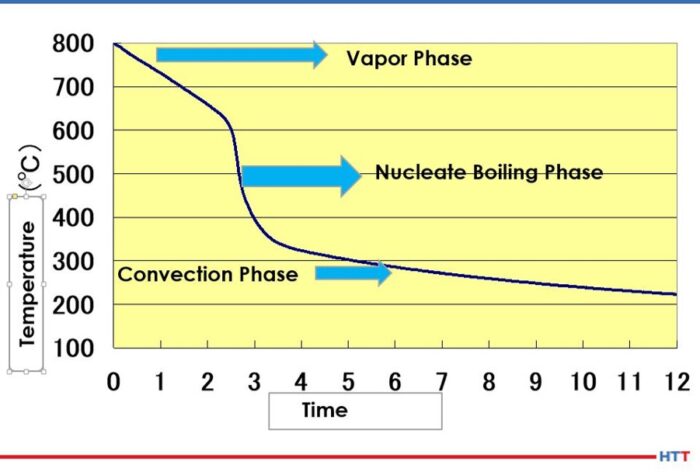
In your recent article, you stated that Marquenching and Austempering use a “less aggressive” quench cooling rate, “and reduce distortion caused by rapid temperature change (thermal shock)” which is only half true.  The main mechanism that allow a molten salt quench to reduce distortion is the elimination of mixed phase cooling – there is no slow film boiling (gas) phase cooling mixed with the high-evaporative cooing phase of nucleate boiling, but only a single phase of all liquid convection cooling.   It’s the non-uniformity of cooling at the surface of the part that will distort or crack the part not so much the rate of cooling.

Joe

Joseph A. Powell, President
Akron Steel Treating Company

Integrated Heat Treating Solutions, LLC
IQDI Products, LTD. 
IQ Technologies Inc

Joe Powell Comments on Marquenching and Austempering Read More »
Distortion of Gears and Sliding Sleeves for Truck Gear Boxes – a Systematical Analysis of Different Heat Treatment Concepts


Schüler, J. Kleff, V. Heuer, G. Schmitt, T. Leist


A systematical approach regarding different distortion potentials in the process chain describes the influence on dimensional and shape changes of gears and sliding sleeves after case-hardening, like part geometry, cold and hot forming of blanks, carburizing concept and temperature profile, oil and gas quenching, as well as individual press and batch hardening. The results show an excellent potential of the new SyncroTherm® concept compared to the conventional case-hardening process for gears and sliding sleeves. Stable distortion characteristics even at elevated temperatures and without decreasing to hardening temperature as well as a good performance after two-dimensional batch quenching instead of the much more expensive individual press quenching were found in this study. Very sensitive part geometries are still a challenge. A clear limitation was found when processing cold formed blanks without annealing before soft machining.


Authors: Andreas Schüler, Dr.-Ing. Jörg Kleff, ZF Friedrichshafen AG, Alfred-Colsman-Platz 1, 88046 Friedrichshafen, Andreas.Schueler@zf.com (Corresponding  author)

Dr. Volker Heuer, Gunther Schmitt, Dr. Thorsten Leist, ALD Vacuum Technologies GmbH, Hanau


1. Introduction

Fig. 1. Process chain for transmission parts

Case hardening is the most common heat treatment for gears, shafts and synchronizer parts used in gear boxes for automotive and commercial vehicle applications. A combination of high fatigue resistance as well as good machinability and reliable process stability in heat treatment ensures transmission components with maximum strength, excellent performance and cost efficient production. In order to decrease the costs for hard machining and reduce the risk of grinding burns the knowledge of distortion characteristics for the individual part as well as distortion carrier potentials of the entire process chain is essential for an improved series production with minimum stock removal [1]. Even today with much higher requirements relating to lightweight design of automotive part geometries this aspect becomes more and more important [2]. Predictable and stable distortion characteristics are still a challenge especially for sensitive parts with thin cross-sections, non-symmetric design and a global production with many different suppliers in the process chain. In a constant pursuit for optimizing, ZF in Friedrichshafen investigated the potential of new heat treatment concepts with the advantages of reduced costs, quicker processes and less distortion. A comparison of the new heat treatment concept SyncroTherm® from ALD Vacuum Technologies was performed with the conventional benchmark concepts of a) case-hardening of gears in a pusher-type furnace with atmospheric gas carburizing and oil quenching and b) press quenching of sliding sleeves directly after gas carburizing in a rotary furnace. The “SyncroTherm®” heat treatment concept combines the benefits of smaller furnaces and two-dimensional batches, fast low-pressure carburizing (LPC) at elevated temperatures and reduced distortion by applying high-pressure gas quenching and the possibility of part-related individual quenching parameters [3].


2. Standard processes for transmission components at ZF Friedrichshafen

2.1 Material, forging and machining

The material for transmission components like gears and synchronizer parts is the case-hardening steel ZF7B which is a modified 20MnCr5. The process chain is shown in Figure 1. The material for automotive and commercial vehicle applications is usually continuously casted and formed to different bar geometries in the steel mill. The forging supplier performs either hot or cold forming of blanks. The gears investigated in this study were all hot formed and later F/P-annealed with an isothermal transformation in order to ensure a good machinability of the ferritic/ pearlitic microstructure. The forged blanks are soft machined by turning and teeth milling. Measurements of characteristic dimensions, shapes and teeth geometries were performed before and after heat treatment in order to describe the distortion behavior. Grinding the bore and teeth flanks is usually performed as the last process before assembling into the gear box. Two different process chains were investigated for the siding sleeve. The first one was similar to the gears with hot forming, F/P-annealing and soft machining. The other process chain for similar part geometry of the sliding sleeve was cold rolling and broaching of the internal spline without F/P-annealing. Different dimensions and shapes which are sensitive to distortion were measured before and after case hardening.


2.2 Case-hardening  in  pusher-type furnaces

The typical final heat treatment of gears is case-hardening in a pusher-type furnace. The gears are charged in three-dimensional batches of around 220 kg per batch including fixtures. The batches of helical and planet gears which were investigated in this study were loaded by different layers of gears on grids (Figure 2). Depending on the case-hardening depth with an individual cycle time the batch is pushed through the furnace with the different linked processes pre-washing, pre-heating at 480 °C, carburizing at 940 °C, decreasing to hardening temperature 850 °C, oil quenching, washing, tempering at 170 °C and cooling down to approximately 50 °C.

Fig. 2. Schematic depiction of pusher furnace (l.) and 3D batch of helical gears (r.)


Fig. 3. Schematic depiction of press hardening cell (l.) and press hardening tools (r.)


Fig. 4. ALD SyncroTherm® furnace (l.) and 2D batch of helical gears (r.)
Fig. 4. ALD SyncroTherm® furnace (l.) and 2D batch of helical gears (r.)


2.2 Case-hardening in rotary furnaces and press quenching

More distortion critical synchronizer parts, like the sliding sleeve, are carburized in a rotary furnace at 930 °C with different levels in the furnace.For a three-track press quench three parts are laying on a tablet and the tablet moves in a cycle time of approximately 70 s through the rotary furnace in order to achieve the required case-hardening depth of around 0.5 mm. The parts are quenched directly from carburizing temperature 930 °C and different tools are fixed to the part before quenching which is shown in Figure 3. During the quenching process the inner diameter of the sliding sleeve shrinks onto the mandrel with similar tooth geometry as the internal spline of the part. This behavior enables a constant inner diameter and position of teeth with less run-out and scattering. In order to adjust the flatness the sliding sleeve is pushed by a pressure piece onto the support ring during quenching. All tools are designed with oil drillings in order to achieve an efficient and uniform quenching of the cross-section. The distortion characteristics of press quenched parts are extremely depending on the design of individual tools and the quenching parameters like temperature and flow of the quenching oil or retention force of the pressure piece. Most synchronizer parts are ready for assembling after press hardening and shot blasting, no additional hard machining is performed anymore.


3. Investigation

The main idea of ALD-SyncroTherm® concept is a small and flexible furnace that can realize a quick low-pressure carburizing process (LPC) at elevated temperatures and reduced distortion behavior of the carburized parts by using an adjustable high-pressure gas quenching. Differently from the standard processes at ZF, parts are loaded in one single 2D-layer on light carbon-fibre tablets, as shown in Figure 4, and then directly heated up to carburizing temperature real quick, which can be up to 1050 °C. The LPC furnace with its small floor space of e. g. a turning machine has up to six single carburizing slots, where each tablet can be heat treated individually. After the carburizing process has been finished, the parts are transported to the internal gas quenching chamber where the parts are quenched directly from carburizing temperature (see Figure 4 left) [4].


Fig. 5. Time/temperature profile for helical gears with CHD 0.8 mm


Fig. 6. Analyzed parts: planet gear, helical gear and sliding sleeve (from left)


This is also a deviation to the direct batch quenching process at ZF where the part temperature is lowered to hardening temperature 840 °C before quenching with respect to distortion. Figure 5 shows a comparison of three different time/ temperature profiles which were tested within this analysis in order to achieve a CHD of 0.8 mm. The standard batch hardening process in a pusher-type furnace is compared to two different LPC processes with variation in carburizing temperature. In order to reduce distortion already during heating, the parts in the standard process at ZF are not being heated up to carburizing temperature directly but have a pre-heating step at 490 °C in order to equalize the core and surface temperature. For the LPC process with carburizing at 980 °C the overall process time is much shorter due to the higher temperature and the missing pre-heating step and the direct quenching from carburizing temperature. The reduced process time is even more pronounced when carburizing is performed at 1050 °C. All three profiles have been tested with different common parts for truck and bus transmissions. Figure 6 shows the three types of parts that have been chosen. The tests have been performed with a small planetary gear for bus transmissions and a heavier and bigger helical gear for heavy truck transmissions. Both gears are direct hardened at ZF by using the batch hardening process in a pusher-type furnace. Other experiments have been performed with two different types of sliding sleeves but similar geometry, as shown in Figure 6. Both types of sliding sleeves were processed differently: one type is machined from cold formed blanks whereas the other type is machined from hot formed and F/P-annealed blanks. Due to their high distortion potential, the standard process for sliding sleeves at ZF is carburizing in rotary furnaces with a consecutive press quenching. For each part many different dimensions, shapes and tooth geometries were measured before and after heat treatment in order to describe the individual distortion characteristics. Here, just critical features are shown which are representative for the distortion characteristics. For gears those are the internal diameter of the bore and the angular flank deviation fHb of the teeth. For the sliding sleeves the diameter of the internal spline and the flatness of the end face are the critical characteristics.


4. Results

4.1 Metallographic results

Metallographic results of the different tests were analyzed by investigation of one part from each batch since a correct metallographic result is the premise for the later analysis of the distortion and evaluation of the LPC process. Table 1 shows the different metallographic results of the analyzed parts from experiments at different carburizing temperatures and the results of the ZF benchmark processes, as a comparison. It shows that the LPC furnace is able to produce correct and repeatable metallographic results within specification regarding CHD, surface hardness and core strength.

Fig. 7. Grain sizes of planet gear after carburizing at 980 °C and 1050 °C

For bigger cross sections, like for the helical gear, the lower core strength is explainable due to the lower quenching speed of gas quenching compared to oil quenching in general and even further reduced gas quenching speed with respect to distortion of this gear. Additionally the amount of retained austenite could be maintained well within the required specification (max. 30 %) with the ALD furnace, even after quenching directly from carburizing temperature. Figure 7 shows micrographs of the grain sizes from core and surface samples taken from the heat treated parts with carburizing at 980 °C and 1050 °C and etched according to Bechet-Beaujard. Whereas the samples which were carburized at 980 °C show a homogeneous distribution of fine grains with grain size classes 5 and finer, the samples carburized at 1050 °C show an inhomogeneous distribution and very coarse grains with grain size classes up to 1 and coarser. These findings where confirmed through all performed experiments. This shows that conventional ZF case-hardening steel grades can already provide grain size stability up to 980 °C but not higher. For carburizing the parts at 1050 °C significant grain growth will occur in conventional grades. In order to prevent coarse grains microalloyed case-hardening steels are definitely necessary in order to meet the grain size specification [5]. Even knowing this fact already at the beginning, distortion experiments were performed at the higher temperatures, nevertheless, in order to analyze also the effect of grain growth on the part geometry and on distortion characteristics after heat treatment.


4.2 Comparison of distortion results – internal diameter of planet gears

In order to analyze the distortion of the internal bore, it was measured in three different levels of the bore. Figure 8 shows the location of the measuring levels M1-M3 within the internal bore of planet gears and the respective results from the green parts (12 sample parts), the benchmark process (24 sample parts) and the LPC experiment at 980 °C (12 sample parts).

Table 1. Metallographic results


Fig. 8. Barrel shape of the internal diameter of the planet gear after direct hardening


Fig. 9. Comparability (l.) and Stability (r.) of the internal diameter at higher carburizing temperatures


Whereas the three average values of the green parts show a perfect cylindrical form of the bore with almost no scattering, the measurement of the ZF benchmark process carburized at 940 °C shows a clear barrel shape of the internal bore with higher scattering. The same shape change can be observed in the results from the LPC experiment, although the value of the shape change and the scattering is less pronounced. The significantly lesser scattering of the heat treatment distortion compared to the benchmark process was even realized during experiments with a high carburizing temperature of 1050 °C (see Figure 9 left). Moreover the average value stays on the same level as after the experiment at 980 °C even if a significant grain growth was determined with no negative influence on distortion characteristics. The smaller diameter of the bore compared to the ZF process is explainable with the direct quenching from carburizing temperature without lowering the temperature, as it is done during the ZF process. These results are very stable even after carburizing at 1050 °C and were confirmed by two additional batches with same heat treatment parameters (Figure 9 right).


4.3 Comparison of distortion results – angular deviation of flank line fHβ

The value fHβ describes the angular deviation of a measured line along the tooth flank (see Figure 10) from the theoretically defined line of the tooth flank. It was measured on the left and on the right flank of three teeth per gear with a distance of 120° on the circumference. The same teeth and flanks have been measured before and after heat treatment. The results show that the fHβ of both flanks is highly influenced by the case hardening process. If compared to the measurements of the green parts, where the average value of the deviation is almost 0 mm with a maximum range of 0.02 mm, the average deviation after the benchmark heat treatment  is 0.03 mm with a wide range for both flanks up to 0.08 mm.


Fig. 10. Comparison of flank line deviation of helical gear standard and LPC process
Fig. 10. Comparison of flank line deviation of helical gear standard and LPC process


Fig. 11. Comparison of flank line deviation of planet and helical gear


The results of the LPC experiments are comparable to the benchmark process and even slightly better. While average deviation of both tooth flanks is on the same level as the value after the ZF process, the range is slightly smaller. The maximum range for the LPC tests at 980 °C is 0.06 mm even if the parts were directly quenched from carburizing temperature. Figure 11 shows that the average angular deviation and the range are less influenced by the heat treatment concept and the carburizing temperature of the process. Especially for the LPC process, negative influences on distortion may be compensated by adapted and optimized gas quenching parameters. Comparing the much smaller planet gear (tooth width 34 mm, helical angle 7°) with the bigger helical gear (tooth width 50 mm, helical angle 23°) different characteristics regarding the average and range of angular deviation can be determined. The planet gear shows a similar average of fHβ before and after heat treatment for both heat treatment concepts and different carburizing temperatures. The range of fHβ is slightly increased after heat treatment and is similar for the benchmark and the LPC process. For the bigger helical gear it is different. The average of fHβ changes after heat treatment significantly and the range is much higher. There is also a significant difference between the benchmark and the LPC process for the average of fHβ but not for the range of fHβ. This is a clear indication for more sensitive distortion characteristics of the helical gear. The significant difference in distortion behavior is mainly influenced by the bigger helical angle of the wider helical gear compared to the narrower planet gear with the smaller helical angle [6].


4.4 Comparison of distortion results – sliding sleeves

Sliding sleeves are distortion critical parts and therefore are case hardened and press quenched as a standard process in the ZF Company. In order to define the distortion of sliding sleeves, the internal diameter and the flatness where investigated. Different from the batch quenching in the LPC furnace, both characteristics are being controlled during press quenching of the ZF benchmark process by using individual press hardening tools. The investigation has been performed with 10 pieces of green parts, 25 pieces for the benchmark process and 10 pieces for each of the LPC experiments. For a better comparability of the results, the values of the measurements have been standardized and fitted into the tolerance band so that a value of 0 mm indicates the exact center of the allowed tolerance.


4.4.1  Cold formed

The investigation of the sliding sleeves machined from cold formed blanks shows how the press hardening tools of the ZF benchmark process influences the internal diameter by forcing it to shrink onto a defined tool diameter of the hardening mandrel. The intended negative deviation of the green parts of 0.05 mm from the ideal diameter, based on long-term experiences, is corrected after the ZF heat treatment (Figure 12). Additionally the press hardening tools reduce the scattering of dimensional and shape changes to a minimum. The results after carburizing at 960 °C and gas quenching in a batch of the LPC furnace display a tremendous heat treatment distortion and scattering of results in a large range. Even with optimized quenching parameters the range is nearly 1.0 mm. The reason for this worse distortion behavior can be explained by the high amount of residual stresses after cold forming of the blanks which are not removed by later annealing and soft machining.


Fig. 12. Distortion results of the internal diameter (l.) and flatness (r.) of cold formed sliding sleeves


Fig. 13. Distortion behavior (l.) and stability (r.) of the internal diameter of hot formed sliding sleeves
Fig. 13. Distortion behavior (l.) and stability (r.) of the internal diameter of hot formed sliding sleeves


A heating experiment where the parts were heated up to 960 °C without carburizing and afterwards slowly cooled down to room temperature was performed. This test was done in order to define the amount of distortion that is induced by residual stresses from former process steps already during heating. It clearly shows a high distortion potential of the sliding sleeves machined from cold formed blanks. Whereas the average diameter does not change the scattering is very large and, with a range of 0.65 mm, almost as wide as after the complete process with carburizing and quenching (Figure 12 left). This assumption was also confirmed by the distortion analysis of the parts flatness (Figure 12 right) where similar distortion behavior can be observed. This means that, without controlling dimensions by hardening tools, sliding sleeves that are machined from cold formed blanks cannot be heat treated within the required specification.


4.4.2  Hot formed

The distortion of sliding sleeves machined from hot formed blanks with a later F/P-annealing before soft machining, which reduces the residual stresses from prior process steps to a minimum, is significantly different compared to the cold formed sliding sleeve without F/P-annealing like previously described. The average diameter of the sliding sleeve after the ZF benchmark process is located near the upper tolerance with a slightly wider scattering (Figure 13 left) than after the heat treatment of cold formed sliding sleeves. Even by using optimized hardening tools for each part geometry the individual distortion behavior depends also on the forging lot and hardenability of the individual steel heat. Although some parts were outside of tolerance the final gage test applied on these parts showed that they are still usable for assembly. The heating experiment in the LPC furnace without carburizing reveals a smaller distortion potential due to minimized residual stresses of the hot formed and F/P-annealed blanks. Looking at the range of the diameter, it is just slightly wider when compared with the range of the green parts. This minimal distortion regarding the range can be preserved even after a completed experiment with carburizing and optimized gas quenching. Still, without the limiting function of a hardening mandrel, the average diameter shrinks as much as 0.38 mm after the heat treatment (Figure 13 left). The reproducibility of the described behavior of the LPC experiment with hot formed sliding sleeves was confirmed by two additional experiments with carburizing temperatures of 960 °C and of 1050 °C (Figure 13 right). Even the sliding sleeves from the final test that were carburized at 1050 °C show an average diameter that remains stable at the same level as those carburized at 960 °C. The additional scattering, that results of a higher quenching intensity, is minimal and in total still less than the tolerance band width of 0.2 mm. Therefore, producing sliding sleeves with the LPC process that fit the requirement might be possible if the dimensions of soft machining are adjusted with respect to the distortion behavior after heat treatment. This conclusion bears the potential of reducing heat treatment costs for distortion critical parts made from hot formed and F/P-annealed blanks by replacing the cost intensive press quenching followed by washing and shot blasting with a batch quenching process in the LPC furnace. However, this potential has to be investigated more in-depth before changing the process chain.


5. Summary

This paper describes a systematical analysis of different distortion potentials for case hardening processes. Different influences on distortion characteristics were investigated and defined such as different part geometries, process chains, carburizing concepts, temperature profiles and quenching methods. The main focus was on the comparison of the new SyncroTherm® concept by ALD Vacuum Technologies GmbH with established case hardening processes at ZF Friedrichshafen AG. The results show an excellent potential of the new LPC concept for gears and sliding sleeves. Stable distortion characteristics even at elevated temperatures and without decreasing to hardening temperature as well as a good performance after two-dimensional batch quenching instead of the much more expensive individual press quenching were found. However, very sensitive part geometries, such as sliding sleeves, are still a challenge. A clear limitation regarding the SyncroTherm® concept was found for sliding sleeves machined from cold formed blanks without F/P-annealing before soft broaching the internal spline.


References

  1. Raedt, H.-W.: Initiative Massiver Leichtbau. Presentation HeatTreatmentCongress, 22-24.10.14, Cologne, AWT e. V., Bremen , 2014
  2. Zoch, H.-W.: Distortion Engineering – Interim results after one decade within the Collaborative Research Center. Proc. 3rd Int. Conf. on Distortion Engineering, 1416.09.11, Bremen, H.-W. Zoch, Th. Luebben (Eds.), 2011, p. 569‒579; Mat.-wiss. Werkstofftechn. 43 (2012) 1‒2, p. 9‒15, DOI: 10.1002/mawe.201100881
  3. Heuer, V.; Löser, K.; Schmitt, G.; Ritter, K.: Einsatzhärten im Fertigungstakt. HTM J. Heat Treatm. Mat. 68 (2013) 3, p. 113‒123, DOI: 10.3139/105.110184
  4. Heuer, V.; Leist, Th.; Schmitt, G.: Distortion control through synchronized vacuum heat treatment. Proc. 5th Int. Conf. on Distortion Engineering, 23-25.09.15, Bremen, H.-W. Zoch, Th. Luebben (Eds.), 2015, p. 183‒192
  5. Hippenstiel, F.; Kohlmann, R.; Bleck, W.; Clausen, B.; Hoffmann, F.; Pouteau, P.: Innovative Einsatzstähle als maßgeschneiderte Werkstofflösung zur Hochtemperaturaufkohlung von Getriebekomponenten. HTM J. Heat Treatm. Mat. 57 (2002) 4, p. 290‒298
  6. Heeß, K.: Maßund Formänderungen infolge Wärmebehandlung von Stählen.
  7. ed., Expert Verlag, Renningen, 2007. – ISBN 978-3-8169-3067-9


Bibliography

DOI:10.3139/105.110285

HTM J. Heat Treatm. Mat. 71 (2016) 2; page 90-98

© Carl Hanser Verlag GmbH & Co. KG ISSN 1867-2493


Distortion of Gears and Sliding Sleeves for Truck Gear Boxes – a Systematical Analysis of Different Heat Treatment Concepts Read More »
Skip to content