


MANUFACTURING HEAT TREAT

Thermal Processing for Firearms: The Essential Guide

OC

What do gas nitriding, hot isostatic pressing (HIPing), black oxide coating, and high pressure gas quenching have in common? They all are key processes in heat treating firearm components.

Written by Rob Simons, manager of metallurgical engineering at Paulo, this in-depth Original Content article covers Paulo’s perspective on the thermal processing of firearms components and best practices for handling and lot traceability.

Check out more of Heat Treat Today’s Technical Tuesday articles by searching “technical tuesday” in the search bar.


Rob Simons
Manager of Metallurgical Engineering
Paulo

While many industries are continuing to reel from the ongoing coronavirus pandemic, the firearms industry in the United States is booming. Over the past decade, the sector’s strong growth has only accelerated in 2020, fueled by consumers’ response to the pandemic and ongoing civil unrest. According to the NSSF’s 2020 Firearm and Ammunition Industry Economic Impact report, the firearms industry is responsible for well over 300,000 American jobs—a figure that has doubled since 2008.

Consumer demand for firearms also drives the need for heat treatment services for this highly regulated industry. Proper thermal processing is critical for safety and also plays a key role in delivering the quality finish that manufacturers want and consumers expect. In this article, we’ll share our firearms heat treatment expertise, delving into the common processes, specifications, and considerations of servicing this thriving industry.

Key Heat Treatment Processes for Firearms Components

Gas Nitriding
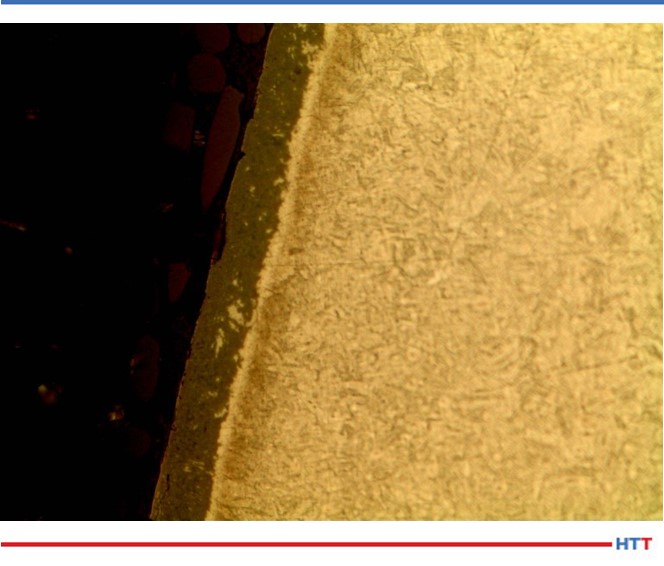
Nitrided 17-4.

Gas nitriding is used to case harden parts that must retain softer, more ductile cores. Because it is carried out at a lower temperature, gas nitriding helps prevent the part distortion that can sometimes occur as a result of conventional heat treatment. In addition to hardness characteristics, parts are often nitride coated for cosmetic purposes and to enhance corrosion resistance. Nitriding results in a beautiful, highly durable black coating that is often used in place of black oxide coatings or other blackening processes. Nitride coating is much harder than the alternatives, so the black finish will stand up to heavy use significantly longer.

Components and Materials Commonly Treated With Nitride Coating

Nitride coating is typically performed on outwardly visible components (and those you’d see while cleaning the gun) such as handgun slides and barrels, as well as muzzle devices such as flash hiders, muzzle breaks, and compensators.

These components are usually manufactured using the following materials, which can be nitrided to achieve the desired black finish and case hardness:

  • 4140 steel. AISI 4140 is a chromium-, molybdenum-, and manganese-containing low alloy steel (usually referred to as chrome-moly steel). It has high fatigue strength, abrasion and impact resistance, toughness, and torsional strength.[1]
  • Grade 416 stainless steel. Grade 416 steel is a free-machining, martensitic stainless steel with a machinability of 85%. [2]
  • Grade 410 stainless steel. Grade 410 stainless steels are general-purpose martensitic stainless steels containing 11.5% chromium. Grade 410 steels have good corrosion resistance properties which can be further enhanced by hardening, tempering, and polishing.[3]
  • Grade 420 stainless steel. Grade 420 stainless steel is higher incarbon than 410 with a minimum chromium content of 12%.
  • 4340 steel. AISI 4340 alloy steel is a low alloy steel containing chromium, nickel, and molybdenum. When heat-treated, it exhibits high toughness and strength. This material is considered extreme duty and is typically used for higher-end firearms.[4]
  • 17-4 stainless steel. 17-4 stainless steel is an age-hardening martensitic alloy combining high strength with the corrosion resistance of stainless steel. It is relatively cost-effective and more weldable than other martensitic alloys.[5]

Nitriding Specifications

The most common measurement that firearms manufacturers specify in desirable nitriding results is intermetallic depth. Typical specifications fall between four and 25 microns of white layer depth. The amount of allowable porosity within the case depth is also commonly specified, and while there are varying ranges, less than 50% porosity is a typical target.

While porosity is often regarded as an undesirable characteristic, there are advantages to some porosity in the finished material. These microscopic voids can hold oils and enhance corrosion resistance. The resulting porosity in nitrided materials allows the coating to last dramatically longer than phosphate- or black-oxide-coated steels.

Some manufacturers utilize blanket aerospace specifications such as AMS 2757 or AMS 2959/12 because they encompass the desired porosity and case hardness depth for nitrided firearms components.

Vickers hardness testing is our preferred method for evaluating intermetallic depth in nitrided components. While 850 HV is typically the top achievable hardness for stainless steel, our team has consistently achieved 2000 HV with our nitriding processes. Higher-end hardness is beneficial for firearms components because it enhances wear resistance in components that slide against each other.
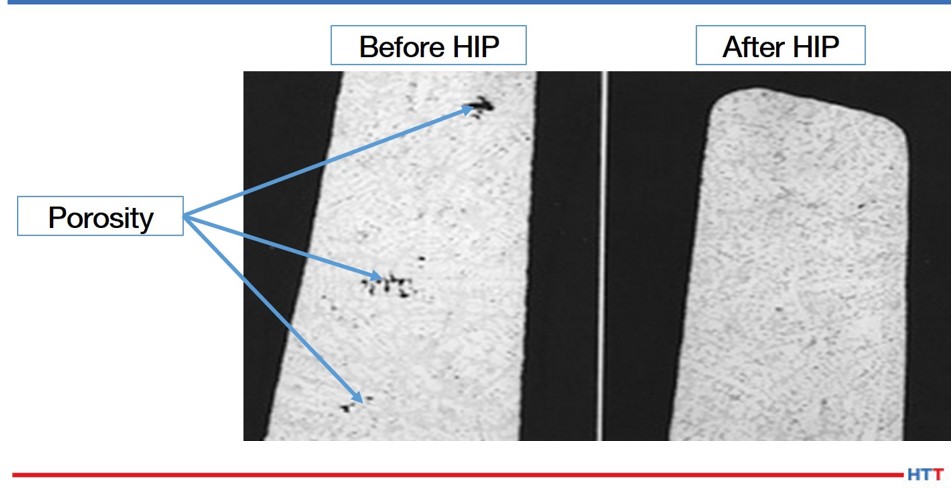
Casting of unknown material showing consolidation of macro pores through HIP.

Hot Isostatic Pressing (HIP)

With hot isostatic pressing, parts are heated to very high temperatures in a sealed chamber capable of generating very high pressures in the presence of inert gas. During processing, heat and pressure combine to close the voids that formed during part manufacturing, eliminating weakness in the parts. Most firearms components respond well to standard coach cycles for HIP, which commonly run at 2050–2200°F and 15,000 psi.

Firearms Components and Materials Commonly Processed With HIP

HIP is especially well suited for removing porosity from metal injection molded (MIM), additively manufactured (AM), and investment cast parts.

MIM is a fast, cost effective way to produce fire control components such as hammers, triggers, and safety selectors, especially for AR-15’s. Traditionally, MIM components have had a reputation in the industry for being inferior to those manufactured with conventional machining because they have been known to fail early in the field.

Common MIM grades used in the manufacturing of firearms include 4140 steel, 17-4 stainless steel, and…

  • FL-4605. FL-4605 is a low alloy steel with prealloyed manganese, molybdenum and nickel content for enhanced hardenability.[6]
  • 420 stainless steel. 420 stainless steel is relatively high in carbon with a minimum chromium content of 12%, which gives it the highest hardenability of stainless steel grades.[7]

Additive manufacturing has not yet been widely adopted in the firearms industry, but we have seen it increasingly used in the manufacture of suppressors. These components—commonly known as silencers—trap the expanding gas as the weapon is fired to reduce noise, and are used for military sniper rifles. AM is an ideal method of manufacture for these components due to their complex geometry that is difficult or even impossible to achieve with traditional machining.

Investment casting is another process we see used in the production of handgun frames, specifically in the M1911 pistol.

MIM, AM, and investment castings all have one thing in common: these manufacturing methods leave voids behind in the internal structure of parts. HIP eliminates unwanted porosity in these parts, increasing their toughness, gross strength, and fatigue life which allows firearms components to withstand being repeatedly subjected to high impact.
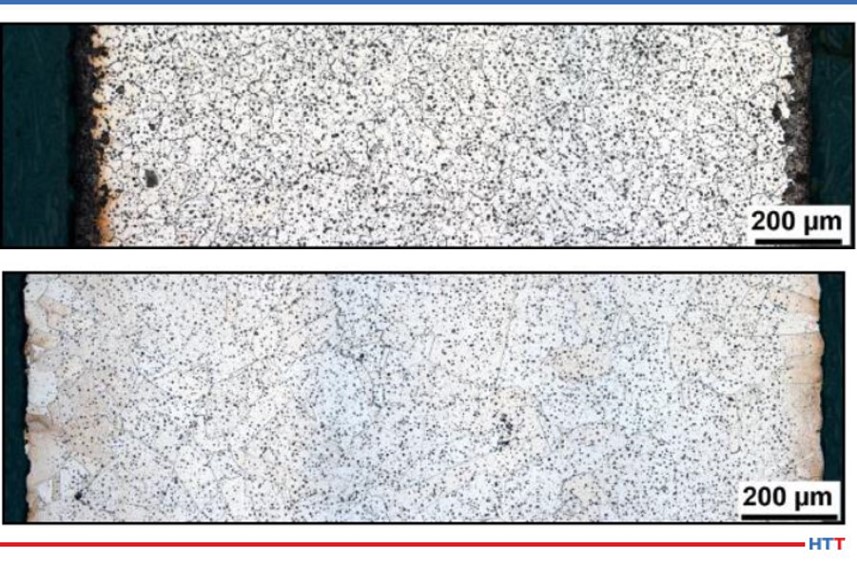
MIM 316L before (top) and after (bottom) HIP. Porosity has been consolidated, but there are solid inclusions in the material.

HIP Specifications

For additive manufactured firearms components, we encounter two primary specifications:

  • ASTM F3301, a specification that outlines standards for thermal post-processing for metal parts made with powder bed fusion. ASTM F3301 identifies hot isostatic pressing as an acceptable means to stress relieve additive manufactured components.
  • ASTM F3055, the standard specification for additive manufacturing nickel alloy with powder bed fusion. In this specification, HIP is required for Class B, C and D components and is considered optional for Class G.

In both specifications, components must be processed under inert atmosphere at no less than 100 MPa within the range of 2048 to 2165°F (1120 to 1185°C). Parts must be held at the selected temperature within ∓27°F (15°C) for 240 min ∓60 min, and cooled under inert atmosphere to below 797°F (425°C), or to parameters as agreed upon between the component supplier and purchaser.

Black Oxide Coating

Black oxide gives firearms a sharp black appearance, enhances corrosion resistance, and minimizes light reflection. Unlike paint, black oxide doesn’t add any additional thickness to gun components. The desired result in the black oxide process is creating magnetite (Fe3O4), an alloy of iron and oxygen, on the surface of the metal. The black oxide process enhances corrosion resistance by adding rust preventive oils to the metal part.

While it doesn’t last as long as gas nitride coating, black oxide is still a popular, cost-effective option to give visible gun parts the perfect black look. Finding a partner that can provide heat treatment and black oxide under one roof can reduce your transportation costs, speed up turnaround time, and simplify your overall process since one supplier owns the final results.

Firearms Components and Materials That Use Black Oxide Coating

Like nitriding, black oxide coating is used on outwardly visible components like slides, barrels, and muzzle devices including flash hiders, muzzle breaks, and compensators. It can be applied to any carbon steel component, but it will not adhere to stainless steel.

Specifications for Black Oxide Coating

Unlike nitriding and HIP, we rarely encounter standard specifications when it comes to black oxide results. However, as a best practice we work with customers to establish boundary samples for each part number treated with black oxide so we can compare our results to what both sides agreed upon as a desirable appearance.

High Pressure Gas Quenching

High pressure gas quenching can be performed in a vacuum furnace as an alternative to oil quenching for any firearms components that are near net shape or completely finished—or where distortion is a chief concern. In high pressure gas quenching, parts are austenitized under vacuum. Then, the chamber is backfilled with inert gas, which is heavily agitated by powerful motors.

High pressure gas quenching results in cleaner parts than oil quenching, but it has other benefits that can prove highly valuable for firearms components. This process can take a conventional 4140 alloy and make it achieve the same properties as a vacuum arc remelted (VAR) 4340, a much higher quality nickel-based material. This can allow firearms manufacturers to see similar hardness and strength results in everyday components as those they would expect from an extreme duty material like 4340.

Handling and Traceability for Firearms Components

No heat treater should make a habit of losing any type of parts, but the implications for serialized firearms components are more severe than any other mass-produced components. Serialized components are what the U.S. government considers the firearm—it refers to the part that features the serial number, usually the lower frame assembly and sometimes the barrel or slide.

Firearms components to be treated with gas nitriding that have AMS 2757 or AMS 2759/12 identified as the standard are also subject to the recordkeeping guidelines outlined in the specification. AMS 2757 requires that documentation includes the equipment and approved personnel’s identification, date of processing, number of parts, alloy, lot identification, and actual thermal processing times and temperatures at a minimum.

Proper handling of firearms components by heat treaters is essential to keep the supply chain running smoothly. Improperly heat treated parts will either wind up in the scrap bin or require reprocessing, and lost parts can result in an ATF audit or investigation. At our company, we’ve engineered our process to prevent issues from occurring in the first place. Here are a few examples of how we do it:

  • Electronic tracking. Each lot of parts is assigned a barcode that links to electronic records of all relevant information about the job—process parameters, specifications, shop orders, etc. The process parameters on the parts’ barcode are integrated with equipment, so when parts are scanned for processing, the furnace will be automatically set to the proper parameters according to the parts’ recipe. This helps us prevent parts from being improperly heated or subject to the wrong process altogether.
  • Secure storage. In Paulo plants that process firearms, we use locked cages and secure vaults to protect serialized components. All access to these areas is monitored and recorded to maintain accountability and, if applicable, adhere to AMS specifications.
  • Specialized handling. To give our firearms customers more peace of mind and to safeguard against errors in our process, we’ve also engineered secure fixturing for many components that allows them to remain locked throughout the entire heat treatment and finishing process.

In addition to a Federal Firearms License (FFL), heat treaters should also have a documented quality management system in place. Choosing an ISO 9001-certified supplier can help give manufacturers confidence in a heat treating partner’s ability to maintain quality operations. Maintaining other certifications such as IATF 16946 and CQI-9 is also a good sign that your partner is well equipped to handle firearms work.

Conclusion

The firearms industry relies on its thermal processing partners to sustain its growth. Proper heat treatment and metal finishing results in better performing, longer lasting firearms for our military and law enforcement, which helps keep our country safe. In uncertain times, the firearms industry represents a bright spot in the U.S. economy that we are proud to support.

About the Author: Rob Simons is manager of metallurgical engineering at Paulo where he leads the commercial heat treating industry’s largest in-house metallurgy team. Rob continuously spearheads research and innovation at Paulo that lead to advanced capabilities and better results for the company’s customers. Rob holds a bachelor’s degree in Metallurgical Engineering from the Missouri University of Science & Technology.

About Paulo: Founded in 1943, Paulo is one of the largest providers of thermal processing and metal finishing solutions in North America. Headquartered in St. Louis, Paulo operates six divisions servicing the United States and northern Mexico.

[1] https://www.azom.com/article.aspx?ArticleID=6769

[2] https://www.azom.com/article.aspx?ArticleID=971

[3] https://www.azom.com/article.aspx?ArticleID=970

[4] https://www.azom.com/article.aspx?ArticleID=6772

[5] https://www.azom.com/article.aspx?ArticleID=4220

[6] https://www.ssisintered.com/materials/low-alloy-molybdenum-nickel-steels

[7] https://www.azom.com/article.aspx?ArticleID=972

(photo source: william isted at unsplash.com)

All other images are provided by Paulo.

Article updated on Thursday 4/29/2021 at 3:22pm.

Thermal Processing for Firearms: The Essential Guide Read More »

Heat Treat Radio #44: Rethinking Heat Treating (Part 4 of 4) — Direct from the Forge

In this episode, Heat Treat Radio host Doug Glenn talks with Joe Powell of Integrated Heat Treating Solutions in this fourth and final episode about bringing heat treating into the 21st century. This episode covers Direct from Forge Intensive Quenching – forge shops, listen up!

You are about to listen to the 4th and final episode in a series on rethinking heat treatment, with Joe Powell, of Integrated Heat Treating Solutions.  You can find the previous episodes at www.heattreattoday.com/radio.

Below, you can either listen to the podcast by clicking on the audio play button, or you can read an edited version of the transcript.


The following transcript has been edited for your reading enjoyment.

DG:  Joe, if you don't mind, take us on a 30,000 foot overview of what you've been doing at Integrated Heat Treating Solutions.

JP:  What we've been doing for the past 23 years at Integrated Heat Treating Solutions and the last 75 years at Akron Steel Treating is applying heat treatments to parts made by others.  We had over 1200 customers on our customer list at Akron Steel Treating and they use various materials.  We kind of grew up in the shadow of the Cleveland market, which is the largest market for heat treaters, and there is the largest number of commercial heat treaters in the Cleveland market.  This was possibly outnumbered by Detroit at one time, but I still think that we're probably the number one market for heat treating in this part of the country.

What has happened over the last century, in the 20th century, is that heat treating has become very, very good.  New equipment has been developed like controls, thermocouples, oxygen probes, vacuum furnaces, vacuum quenching, high pressure vacuum quenching, oil skimmers, new quenchants made with reverse solubility polymers - all of these things have come together and made heat treating very, very good.  However, as part of that, there has been a commoditization of heat treatment.  That means that heat treating became so good that parts rarely crack or distort unacceptably, and companies have devised methods for correcting the distortion through hard turning, grinding, straightening, flattening, you name it.  And the part makers and the heat treaters got along, in a kind of peaceful coalition, to get the parts out the door to the end user.

However, in the 21st century, that is just not good enough.  In lean manufacturing, you have to offer an integrated solution for what you're doing.  The entire value chain for making a product has to be on the same page; they have to be in alignment.  The processes have to be in the proper order.  What we're trying to do with Integrated Heat Treating Solutions is bring the last dimension of part design, what we call the Z dimension, to the part makers, their designers, and their material suppliers, so that we present a solution that delivers the optimal amount of value and eliminates the waste from heat treatment, or forging, as we'll talk about today.

[1] Defense Logistics Agency, "About," https://www.dla.mil/AboutDLA/
[2] DFIQ FIA Technical Committee Presentation, "Evaluation of Intensive Quenching Hardening Process Immediately After Completion of Hot Forging Operations," 2018.
[3] Forging Process Improvement Using Intensive Quench, 2019.
DG:  Right. In these four episodes we've been talking to people about bringing heat treating into the 21st century.  On your website, integratedheattreatingsolutions.com, there is a good illustration table that shows what heat treating was like in the 20th century and what it is like in the 21st century.  That's basically what we're talking about.  Just a quick recap of the previous three podcasts we've done: It all revolves around a customized heating, but more importantly, a customized quenching of materials so that the distortion of those parts is predictable, and that the part design can be altered so that there is essentially no post heat treatment processing.  In other words, you can pretty much eliminate grinding or any type of machining, straightening, and that type of thing.  Once heat treated and quenched with the technologies that you're talking about, the part is essentially pack and go.

We've talked about several examples, but the two we talked about in the recent podcasts were an 18” bevel gear, which was quite interesting.  Then we talked about a fracking pump valve seat, which was also quenched in this way.  So today, you and I want to talk about, as you alluded to, the forging industry.  We're going to talk about something called (direct from the) forge intensive quenching (DFIQ).  If you don't mind, tell us what that is.  For those people in the forging industry, what is direct from forge intensive quenching?

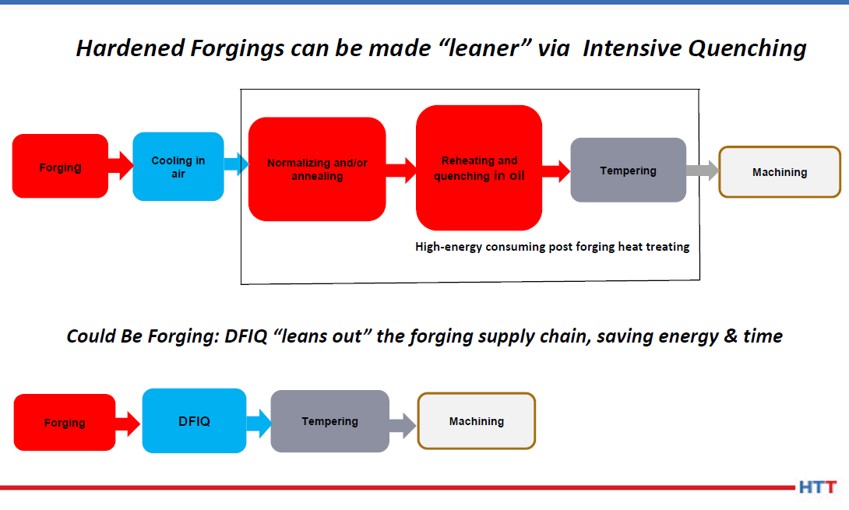
JP:  It's the principle that the forging processes use a lot of BTUs of heat to heat up a billet, and then bang it into a shape and get the grain flow going in the direction that will be great for the part mechanical properties.  Once that forged shape is attained and the grain flow is attained, the part is usually allowed to cool at the end of the forging trim die line, and those cooling forgings will all cool at different rates.  Because they cool at different rates, you have some fast cooling on the surface, the corners and the thin sections; but you have some very slow cooling in the core.  At the end of the day, the part needs to be heated a second time in a normalization process, which heats the part to a high temperature and then does a controlled cooling of the part to align the grains of the part and the size of the grains to remove the kind of mishmash of structure that is present in an as-forged part.  Then, if the part is going to be hardened at some point, and usually there is a lot of rough machining that goes on to remove the scale from the forging process, machining is necessary to remove the scale from the steel mill that has basically been hammered into the surface of the forging.  All of that rough machining is done to basically present a rough machine part that can then be heat treated.  So, companies like Akron Steel Treating or the captive heat treats at the forging plants will then heat the part a third time to the austenitizing temperature. If the part is made out of a martensitic steel, they'll quench it, usually in oil or polymer, and then possibly temper it to stabilize the part, and present it to the part maker for final machining, grinding and whatever final processing needs to be done to turn that forging into a useful part with the desired mechanical properties.

Akron Steel Treating doesn't do a lot of forged heat treat.  We do some aerospace parts for braking systems for airplanes, called torque tubes, which is basically the hub of the braking system.  Those torque tubes are generally made out of forgings which we see after forging, and then see again after 50% of the material is removed. Then the part is heat treated. In those instances, direct from the forge intensive quenching is not going to work.

Direct from the Forge Intensive Quenching

This direct from the forge intensive quench (DFIQ) project came out of a desire by the Forging Industry Association (FIA), which incidentally Akron Steel Treating has been a member since 2012.  We've always felt that we could create more streamlined processing as well as a better part with leaner material if we worked together with the forgers and integrated the heat treat process with the forging process. Companies like the TimkenSteel Company have come out with low alloy materials that are forged all the time, and then they do a controlled cooling where they'll actually air cool the forging.  With the alloying elements that are in there, they are able to come up with mechanical properties directly from the forge after a controlled air cool.  No normalization is needed and no further austenization, or third heating, is needed.  Basically, the part is air quenched and tempered right there in a controlled manner from the hot forge.

Some folks in India and Japan have tried several times to do direct from the forge liquid quenching using oils directly from the forge.  What they found is that the oil quench catches on fire, and if they can keep it from catching on fire by enclosing the quench under an inert atmosphere, they're still going to have the problem of the very high heat, like 2000°-2200° F, creating a steam blanket of hot oil, or in the case of polymer water, a steam blanket of polymer water mix around the outside of the part. This then produces an inability to uniformly quench the part because the thin sections will very quickly quench out, the thick sections will sit there under a blanket of gas and essentially those two mixes of nucleat boiling - very fast evaporative cooling in the thin sections and a full-blown gas blanket on the thick sections - create a nonuniform shell around the outside of the forging.  As that part cools under that nonuniform shell, it is also going to thermally shrink in a nonuniform way.  Also, when it cools to the martensite start temperature, it's going to start transformation and face change in a nonuniform way in that shell.

The successes of direct from the forge quenching didn't happen until this project we started in 2015 with the Defense Logistics Agency (DLA), which “manages the global supply chain – from raw materials to end user to disposition – for the Army, Marine Corps, Navy, Air Force, Space Force, Coast Guard, 11 combatant commands, other federal agencies, and partner and allied nations,” and the FIA tech committee members who sat down and asked: “Do you think we can do this in water?”  If we can do it in water, we obviously eliminate the fire hazard, but how do we eliminate the boiling hazard, or the boiling issue in the nonuniformity?  And that's where we had, at that time, 15 years of experience in applying the intensive quenching process or intensive quench process.

Luckily, John Tirpak, who was then working with the DLA and the FIA as a technical advisor, saw the benefit in giving it a try.  We had done lots of parts that people had said, over the years both at Akron Steel Treating and Euclid Heat Treating, couldn’t be done.  And we did it.  We applied it in the case of the valve seat to ductile iron to replace an 8620 carburized seat.  So, we have this great flexibility, we have this great new tool, we just need to use it, or at least try it, at the forge.  And that's what the DLA funded.  They basically gave us a budget for the building of a prototype unit which was built and is pictured in the final report It shows the test parts that were actually quenched directly from the forge at Bula Forge in Cleveland, and then we moved the prototype unit next to Welland Forge in Canada and finally to Clifford-Jacobs Forge in Illinois.

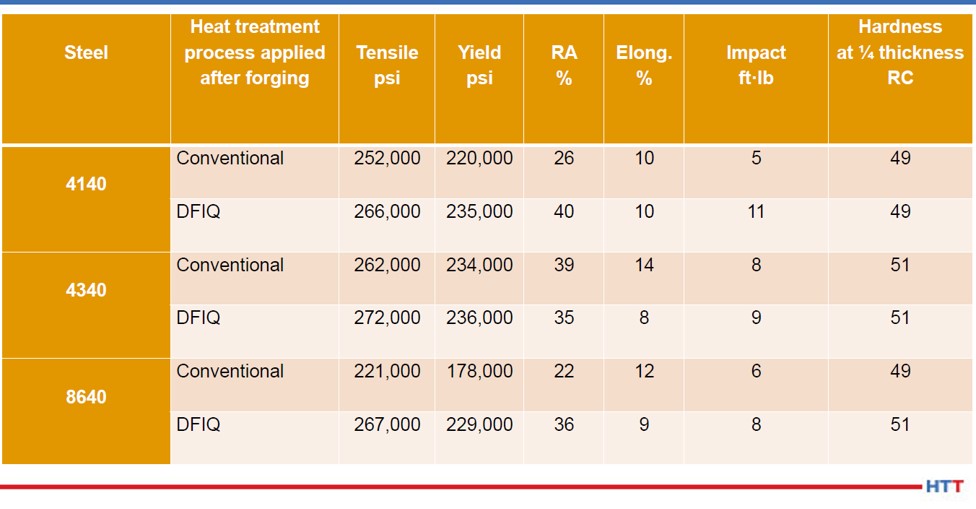
The upshot of all of this was that once we figured out that if we could remove the film boiling from the outside of the hot forging, we could basically set the shell, and once the shell is set, we get, on most parts and most geometries, a martensite shell that is formed.  That martensite shell continues to form down into the layers of the onion below the surface as the martensite temperature is reached and that martensite transformation continues by conduction, very uniformly through the mass of the part.  What you end up with is a part that comes out of the quench pretty much like it went through a normalization process and then a third reheating and an oil quench and a temper.  We get some self-tempering as well because we interrupt the intensive water quench before the part is fully cooled.  Nonetheless, we found in the first phase of testing that parts should be tempered in a tempering furnace to develop the full effects of the tempering process, so that process is still done after the parts come out of the quench.  But you eliminate the normalization process and the third reheating for an oil quench and temper that would normally be required.

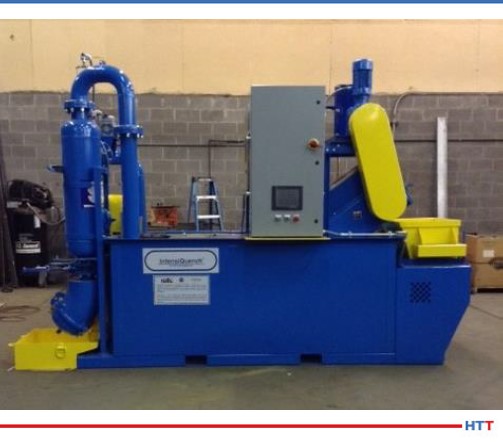
Examples of DFIQ equipment
(Photo source: Joe Powell)

DG:  Can you tell us what parts were actually run?

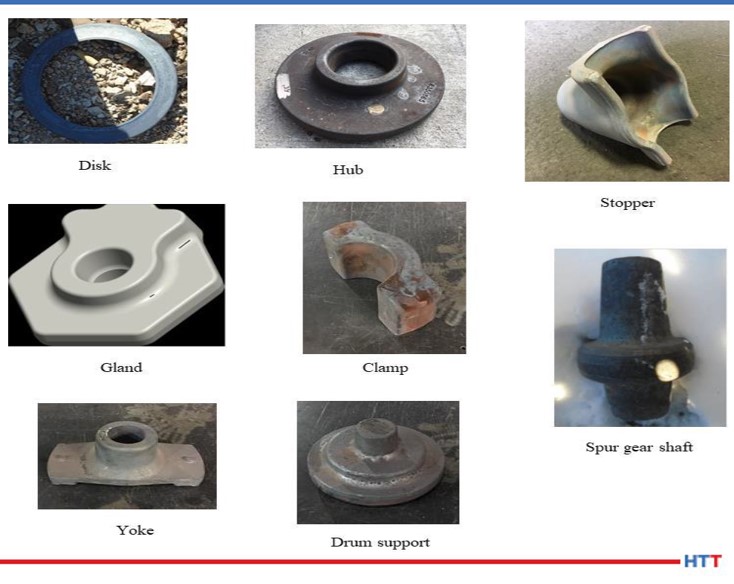
JP:  Yes, there were a variety of parts, and they're all pictured in that report.  They ranged from a link that weighed, I believe, close to 50 pounds all the way down to a tine that was on a tiller machine (ground engaging tool) that went into a piece of farming equipment.  One of the parts in between was a pintle adapter that was basically a mounting post for a machine gun for the Army.  This part went through several operations.  It's documented in the report, but we basically saved $13 per part to the Army by eliminating the multiple steps that took place after forging and just incorporated it into an integrated heat treating solution right there at the trim die.

DG:  How did that look?  Let's take the tine, for example.  It's stamped out on a forge press.  You've got a hot piece of metal put on a forge press stamped out.  Then, one at a time, these parts are taken off of the forge press and immediately put in a quench?

JP:  After they come out of the trim die, they're still pretty hot - they're still austenitic, and range in temperature from like 1900°F all the way up to 2200°F - and then they go directly into the quench.  15-45 seconds later another one comes out of the trim die and goes down into the shoot and up the conveyor and into a box to await tempering.  We time the conveyor so that the dwell time in the intensive water quench is properly timed so that the core still has enough heat to self-temper, but not too hot that it over tempers the part.

DG:  I'm curious about the part.  After the part comes off the trim die, is it manipulated?  Is there a manipulating hand that comes in and grabs it, takes it off, puts in the quench tank?

JP:  In the case of the prototype, the manipulating hand was the forger.  He came with tongs and provided a very 19th century placement of that part.  But, obviously, all of this stuff can be automated and integrated, and with the proper equipment can be done in a way that is seamless from the time the billet is heated all the way through.

DG:  Tell me this, that tine again, when the guy took it off the trim die, did he just throw it in an intensive quench tank or was it fixtured?

JP:  Picture an elevator platform.  It was placed on an elevator and then the elevator went down between two panels that presented water at very high flow to the part and knocked off the film boiling.  I should add, the tine was the thinnest part and the enthusiasm at Clifford-Jacobs was very, very high because once they figured out that this worked, the guys on the floor said, “Let's try this part, let's try that part, let's try this part.”  And of course, in the first test at Bula Forge, we actually tested at least four different alloy materials and so all of those variables would have to be integrated into the design.  I call it the Z dimension of the design.  You pick the right material, you have the right forging temperature of the billet, and you don't overheat it.  One of the lessons learned in the four-year study is that if you overheat the forging to “help with die life” - that overheating of the forging to 2400°F (almost to the melting point) - the grains blow up.  No amount of intensive quenching is going to bring them back.  So, you've got to keep the temperature around 2150°F; that's about the maximum in Fahrenheit.

All I can say is that if you maintain a forging temperature uniformly around 2150°F in the billet, we can devise a quenching system that will blow the film boiling off and set that shell in the part in all but the thinnest parts in the prototype.  We did about 150 tines in a row with the protype, and then the water heated up because we only had so much chilling capacity in the water tank.  But as the water heated up, the quench wasn't as effective, and the tines actually exhibited some cracks when we ran another 150 - that's because there was film boiling in the mounting holes.  The lesson learned was you have to have a flow, but you also have to have some pressure in order to instantly impact that part.  That instant impact is key in the proprietary processes that Integrated Heat Treating Solutions is developing to bring the next version of the DFIQ unit to make it able to do the thinner parts without cracking.

DG:  DFIQ, of course, standing for direct from forge intensive quench.

You've referred to a study multiple times and that study is a 2019 study called, Forging Process Improvement Using Intensive Quench.  It looks like that was, as you mentioned, funded by the DLA in either 2014 or 2015. We will make that report available and people can take a look at it.  Anyone that is a forger in a forge shop, or a captive forge would certainly want to take a look at that.  Would forge press companies be interested in this?  Could they build quenches into the actual press itself so that this process could be, more or less, in line?

JP:  Yes, absolutely.  Again, it is a different paradigm for them.  Just like I mentioned before, all the heat treating equipment makers call themselves furnace companies and all the forging equipment makers call themselves press makers or forging die makers.  The reality is the process continues and the mechanical properties in the setting of those grain flows happen in the heat treating process; the refinement of those grains happens in the heat treating process which happens in the quenching process.  So, again, we need to integrate that quench into the forming equipment.  Again, I have no intention, as Integrated Heat Treating Solutions or Akron Steel Treating, of getting into the business of building systems- that's not my thing.  My thing is  to develop a robust process that can be applied and implemented using automation and new equipment with the proper pumps and material handling that is all integrated into a seamless process.

DG:  Let's talk very briefly about the benefits.  We've already alluded to quite a few of them, but let's try to enumerate them here.  What are the benefits to a captive forge shop in considering a DFIQ type system- why do it?  What's the commercial value?

JP:  We can save up to 66% of the energy that's needed to heat treat that part.  The part comes off the trim die and is cooled in a box or set aside somewhere.  Next, it needs to be reheated and normalized.  Then, it has to be reheated a third time and austenitized before quench and temper, and that's a lot of energy.  And it's also not usually done at the forge plant.  It's usually done either at a captive heat treat that is integrated with the forging company or it goes to a commercial heat treat where they use huge continuous furnaces to reheat the parts and quench and temper them.  I'm not going to make a lot of friends in the areas that do this, but if we're going to compete in the world and make great parts, be lean, save energy, and also have safe carbon emissions, we've got to stop heating parts that don't need to be reheated if you can avoid it.  I'm not going to claim that it works on each and every part and that it should be used for each and every part.  I'm just saying that there's a lot of parts that could be made a lot more efficiently if we would quench them right at the trim die.

DG:  So, one of the benefits you just mentioned is potentially saving 66%, basically two-thirds, because you don't have to do a second and third heat.  What else do we have?

JP:  What you can have is better uniformity of mechanical properties. You can also elicit more hardenability out of a particular alloy by having this higher ability to harden with a very, very fast quench.  That intensity of quench locks in mechanical properties that are unattainable in a typical oil quench or polymer water quench. One example of that is a forging that we do for a company, in fact it was one of the companies in the study.  It's a 44” gear rack- it's 44 inches long, about 5 inches wide and about 4 inches thick. This gear rack is used as a piece of mining equipment and actually 10 of them are used on each side of a tower.  This gear rack allows the spinning, drilling rig to go up and down and spin as it is drilling holes in the earth.  This part was traditionally made from 4330 material but the end use customer, the people using this piece of mining equipment, said they’d really like to be able to replace and repair these gear racks when they get worn or a tooth gets broken.

If we could do this in the field, that would be great; but with 4330 material, we can't because we have to pre- and post-heat the weld when we replace or repair a tooth in the field. That’s just not practical in some cases, especially if this piece of equipment is on the side of a mountain and it's pretty cold outside.  So, is there a way to get field repairability?  That's a topic the DLA is very interested in because equipment used by the Army is often times used in very cold environments, so is there a way to repair that piece of equipment without taking it offline or bringing back for repairs?

For this particular gear rack, after they forged it to a rough shape with the gear teeth in on one side and it looked pretty much like a gear rack that was ready for rough machining, they wanted to be able to still get the same mechanical properties from a leaner hardenability steel like 4130 to replace the 4330, so that they could weld it in the field without pre- and post-heating to avoid cracking the part for the weld.  They came to us at Akron Steel Treating and they asked if we could this with our 6,000-gallon batch system.  We didn’t know.  I took a look at the jominy curve for 4330 and the jominy curve for 4130 and said it's going to be close. The thing is 4” inches thick by 5” wide, and I just didn’t know.  But I was willing to try. That has always been my favorite answer, “Let's try it.” If it blows up or it doesn't work, I'm going to learn something.  You might not be happy because I blew up your part, but I learned a lot and I'm happy and we're going to move on.

So, they gave us five actual parts made out of 4130 and we heat treated them in our 6,000- gallon system. Next, we sectioned them and found that they turned out very, very uniform.  They had the right surface hardness all over the part and also had the right core hardness throughout the 44” length.  Then they did some field trials, and everybody was happy.

DG:  So, in that case, the benefit is potentially being able to replace higher alloy parts with lesser alloy parts, field repairability, lower cost to manufacture the part, and easier to machine. You also talked about the fact that you can do significant energy savings which also potentially shortens the lead time because you're not having to go through two or three processes, but only one.  The one thing we haven't mentioned, which I think probably should be mentioned explicitly, although we've alluded to it, is the elimination of some environmentally unfriendly quench media.

JP:  It's a water quench.  You use just a little of restorentative salt and that's it.  It's water.

DG:  And obviously you've got better mechanical properties which you've also mentioned.

JP:  There's one more chapter to this and it ties back to podcast #2.  First of all, we do these parts 15 at a time on racks in our controlled atmosphere furnace and then transfer all of them to the handling cart and quench them in our 6,000-gallon system.  We noticed that when they went into the quench, they were straight, but when they came out of the quench, they were all uniformly bowed about 1 inch at the middle of the 44” length.  We mentioned to the customer, that when it's time to redo these forging dies, they should bow the forging so that it comes out of the trim die with a 1” bow in the opposite direction. Once it quenches, it will quench to fit and be relatively straight and will avoid the cold straightening operation that is done after heat treat and temper to get the part straight enough so it can be rough machined.

Again, time savings as well as monetary savings and we're not imparting cold strains into the part that has been hardened after heat treat, which is a no-no, because those cold strains can find a discontinuity in the material or an inclusion, and the two combined can, once in a great while, literally blow up as it is being straightened and fly across the room into two pieces.  Cold straightening is something you want to avoid if at all possible.

DG:  So, again, the benefit there is that you can go back to the part designer and the heat treater.

Let's back out again to 30,000 feet.  We're not talking about the gear racks anymore, just talking generally.  In your concluding thoughts, what is the main message we're trying to communicate here?

JP:  The integration of lean and heat treating and forging.  I think bringing all that together, all of that lean thinking and applying it to the part design at the front end, and the material selection at the front end, so that we deliver the most added value with the least amount of waste in the process to the end user.

DG:  I would like to wrap up by saying this too, there are a large number of people who are in the Heat Treat Today audience that I think ought to be interested in this.  Basically, anybody who is a captive heat treater, manufacturer with their own in-house heat treat who is doing oil quenching, or anything of that sort, and currently doing it in batch, ought to be thinking about contacting Joe to see if they can eliminate that batch process and put the heat treat directly in line.  Those are manufacturers.

Also, as we just talked today- the forging shops ought also to be interested in this.  Taking forge parts of the finish/trim forge and putting them directly into a quench.  But there is one other group that also ought to be interested in this and ought to be talking to you Joe, and that is the heat treat equipment manufacturers who have a stake here.  They have a stake here because their current batch processes, if we continue to move down this path into the 21st century, they could be on the cutting edge of providing the type of equipment that can be potentially more inline and more quench type equipment.  For what it's worth, I think that's worth mentioning.

JP:  Yes.  The 21st century of heat treating is moving towards induction heating and individual part by part quenches.  That is really the only way to control distortion consistently, and also to effectively get the most that an alloy hardenability has to offer for the end user, in terms of strength and ductility.

DG:  If these people want to get in touch with you, Joe, what's the best way for them to do that?

JP:  Through the website integratedheattreatingsolutions.com or ihtsakron.com.  The other person who is working with me very closely in the FIA technical committee is Rick Brown.  Rick Brown is a former executive at TimkenSteel here in Canton, OH.  He helped develop a supply chain for making parts out of seamless tubing that Timken made and still makes, and that supply chain included not only cutting up tubing into rings and making parts out of those rings, but also heat treatment, and in some cases, forging.  Rick has a wealth of experience.  He's a great guy and is one of our Integrated Heat Treating Solutions consultants who helps people at the part makers, part designers and end users get the most value out of the heat treating and forging processes. We're all working towards that goal of moving heat treatment from the 20th century fully into the 21st century.


Resources:

[1] Defense Logistics Agency, "About," https://www.dla.mil/AboutDLA/

[2] DFIQ FIA Technical Committee Presentation, "Evaluation of Intensive Quenching Hardening Process Immediately After Completion of Hot Forging Operations," 2018.

[3] Forging Process Improvement Using Intensive Quench, 2019.

(photo source: janjf93 at pixabay.com)


Doug Glenn, Publisher, Heat Treat Today

Doug Glenn, Heat Treat Today publisher and Heat Treat Radio host.


To find other Heat Treat Radio episodes, go to www.heattreattoday.com/radio and look in the list of Heat Treat Radio episodes listed.

Heat Treat Radio #44: Rethinking Heat Treating (Part 4 of 4) — Direct from the Forge Read More »

GEBERIT Group Expands Vacuum Furnace Capabilities

HTD Size-PR LogoGEBERIT Group, a European leader in sanitary products, will expand their annealing capabilities with two vacuum furnaces at their production plant in Ozorków. Both furnaces have larger working spaces than the standard: 900 x 900 x 1200 mm (HxWxL) to 900 x 900 x 2400 mm. These changes will allow the manufacturer to double the efficiency of the furnaces in one technological process.

As GEBERIT builds its independence by investing in heat treatment processes, some of the processes that they had carried out in traditional atmospheric furnaces will now be performed in these modern Vector vacuum furnaces supplied by North American SECO/VACUUM‘s parent company, SECO/WARWICK.

SECO/WARWICK Vacuum Furnaces
Source: secovacusa.com

Sławomir Woźniak, SECO/WARWICK Branded
Sławomir Woźniak
CEO
SECO/WARWICK
Source: secowarwick.com

“We chose the SECO/WARWICK Vector furnaces,” commented Mirosław Spasiński, head of the Technical Department of GEBERIT in Ozorków, “due to the guaranteed quality and efficiency but also the high cleanliness of the surfaces of the processed details, which is very important to us, as the elements are displayed in open GEBERIT sanitary installations, thus aesthetics play an important role.”

“An individual approach to the furnace design” notes Sławomir Woźniak, CEO of SECO/WARWICK Group, “is a project that requires expert engineering knowledge. [Our] engineers have the knowledge and experience that are needed to adjust the technology and its parameters so that it ensures the safety and failure-free operation of the device, but above all that the solution meets the expectations and needs of the client.”


(photo source: CDC at unsplash.com)


GEBERIT Group Expands Vacuum Furnace Capabilities Read More »
Heat Treater Expands Vacuum Processing Capabilities

Derek Dennis
President
Solar Atmospheres California
Source: solaratm.com

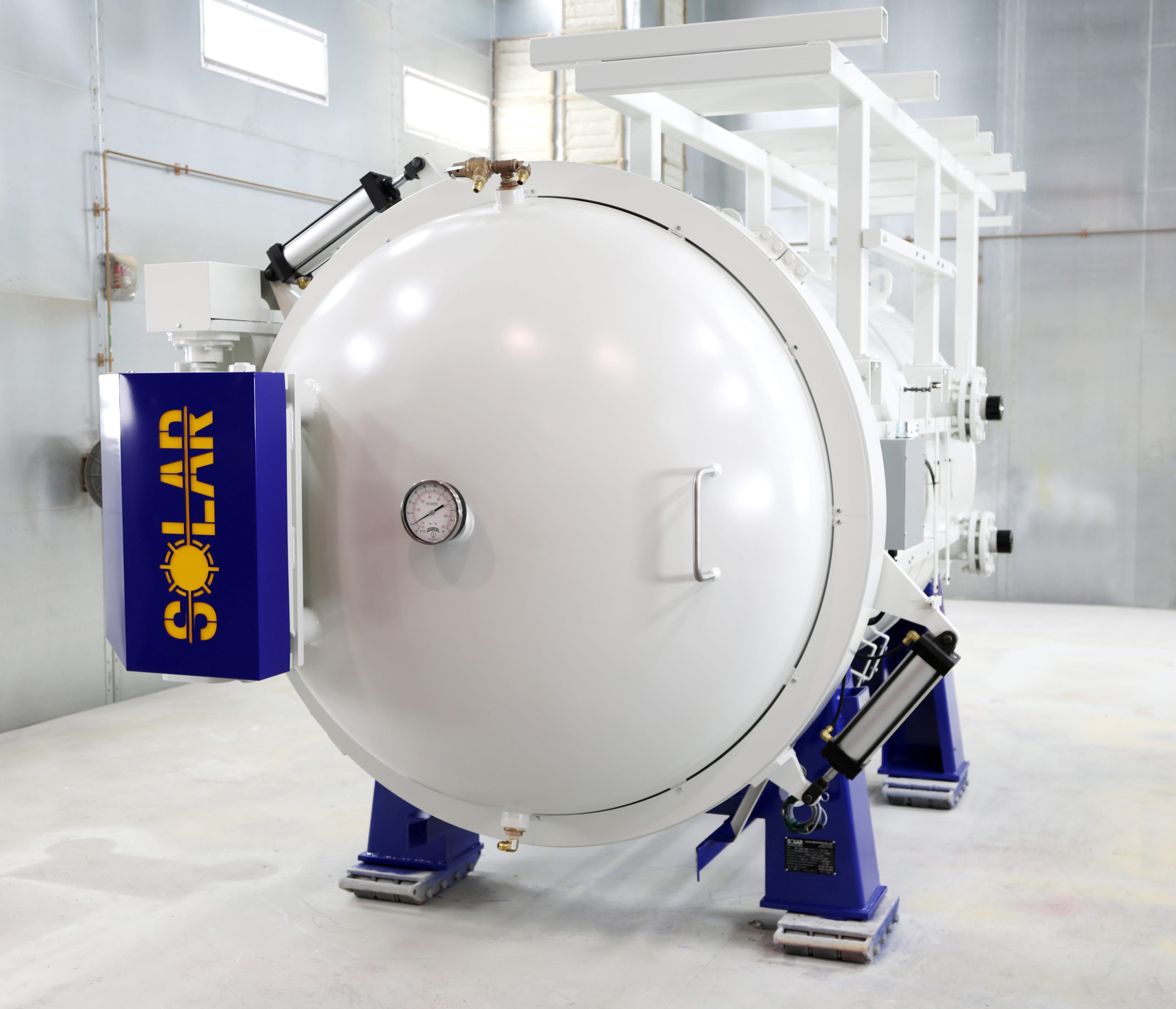
HTD Size-PR LogoWest coast heat treater Solar Atmospheres of California (SCA) recently added additional large furnace capacity to their inventory of vacuum equipment. The furnace was specifically designed to process a variety of materials that require optimum performance during controlled heating and cooling, vacuum processing, positive pressure processing, and differential pressure processing.

Key equipment characteristics include 84” x 144” all graphite and CFC hot zone, temperature uniformity ±10°F, 2-bar high performance 800 HP cooling system. Additionally, the furnace has a maximum operating temperature of 2650°F and a maximum loading capacity of 50,000 lbs. SCA worked closely with sister company, Solar Manufacturing, to design and fabricate the equipment to meet all prime requirements and AMS 2750 standards.

“We are very pleased to add the additional large furnace capacity,” SCA President Derek Dennis states. “Each new furnace installation is built on a building block approach from the personal knowledge and experience accumulated by operating previous furnace models. I really appreciate the ability to bounce different ‘out of the box’ ideas to our manufacturing team, who then takes those ideas and makes them a reality. Often, the team takes the ideas to another level before the final build plans go to the shop floor.”


All images provided by Solar Atmospheres.


Heat Treater Expands Vacuum Processing Capabilities Read More »

Captive Heat Treater to Receive Vacuum Furnace

HTD Size-PR LogoA captive heat treater in New England will receive a 10-bar gas quenching vacuum furnace. The model features high pressure gas quenching and vacuum carburizing. With temperature uniformity of ±10°F, it is consistent with AMS2750F requirements.

Jason Davidson
Northeast Regional Sales Manager
Solar
Source: solarmfg.com

"The research and development done with our sister company, Solar Atmospheres, on the alloy selection, carburizing, and recipe process development, was instrumental to the sale of the furnace," states Jason Davidson, Northeast regional sales manager at Solar. He adds that the customer valued the additional resource that the sister company had to offer.

The furnace has a graphite insulated hot zone with a work area measuring 24” wide x 24” high x 36” deep and a load weight capacity up to 2,000 pounds. Its maximum operating temperature of 2400°F.

You can see these dimensions in the video below that the supplier, Solar Manufacturing, shared on Twitter.

(photo source: Solar Manufacturing)


Captive Heat Treater to Receive Vacuum Furnace Read More »
Heat Treating with Nitriding for Forging Die Durability

Source: Advanced Heat Treat Corp.

Edward Rolinski
Senior Scientist
Advanced Heat Treat Corp.

Mike Woods
President
Advanced Heat Treat Corp.

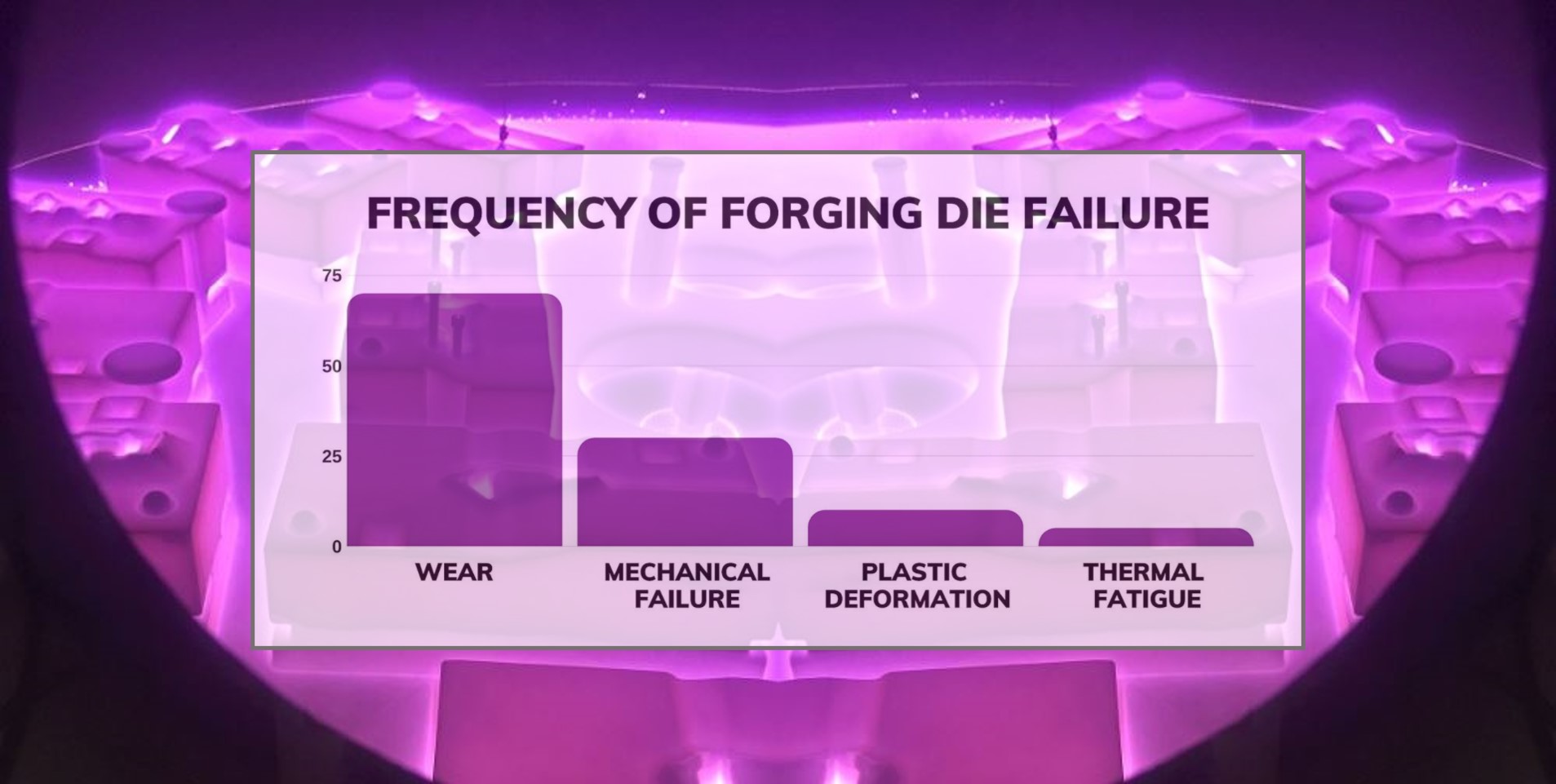
Why do forging dies fail? How can heat treating prevent failure? And what specific role does gas- or plasma-assisted nitriding treatment play in enhancing metal structure?

Heat Treat Today brings you this Best of the Web feature article this Technical Tuesday to answer these questions. Written by Dr. Edward Rolinski and Mike Woods of Advanced Heat Treat Corp., this article explains the impact of forging process, material and press type; heat treatment for forging dies; and nitriding forging and stamping dies.

An excerpt: "Surface properties critical for die performance can be further elevated by a surface-treatment process employing a multi-gradient design strategy, a novel plasma, multi-step treatment with formation of the nanostructured layer/coating developed by Advanced Heat Treat Corp."

Read more: "Enhancing Forging Dies' Durability with Ion Nitriding."

(Image created with images from original AHT Corp. article)


Heat Treating with Nitriding for Forging Die Durability Read More »

Take a Tip or Two

One of the great benefits of a community of heat treaters is the opportunity to challenge old habits and look at new ways of doing things. Heat Treat Today’s 101 Heat Treat Tips is another opportunity to learn the tips, tricks, and hacks from some of the industry’s foremost experts.

Heat Treat Today’s latest round of 101 Heat Treat Tips is featured in Heat Treat Today fall issue (also featuring the popular 40 Under 40).

Today’s selection includes tips from Dr. Valery Rudnev, Grammer Vacuum Technologies, Inc., and L & L Special Furnace Co., Inc. This selection includes tips related to induction heating, vacuum furnaces, and temperature uniformity.


Heat Treat Tip #3

Avoid Axle Shaft Cracks After Induction Tempering

Situation: In induction scan hardening of axle shafts, there was NO cracking occurred after scan hardening (case depth varies from 5 mm to 8 mm). Cracks appeared in the spline region after induction tempering.

Solution: Most likely, the cause of this problem is associated with a reversal of residual stress distribution during induction tempering. Reduce coil power for tempering and increase time of induction tempering. Multi-pulse induction tempering applying lower power density might also help. As an alternative, instead of modifying temper cycle, you can also try to reduce quench severity by increasing the temperature of the quenchant and/or its concentration.


(Dr. Valery Rudnev, FASM, Fellow of IFHTSE, Professor Induction, Director Science & Technology, Inductoheat Inc., An Inductotherm Group company)


Heat Treat Tip #26

TZM Moly Grids

Source: Grammer Vacuum Technologies, Inc.

A very commonly observed failure mechanism with a moly post hearth assembly is bending of the moly posts. They will stay fairly straight at the center of the hearth area, but they can distort badly toward the outer sides of the work zone. The outer rows of vertical posts end up leaning away from each other. This is due to the very high linear thermal expansion coefficient of nickel-iron alloy grids (usually 330 SS or Inconel). With a high load on the nickel alloy grid, it is not able to slide on the perpendicular hearth beams as the temperature rises. The outer hearth post rows are forced in an outward direction. The quenching of the furnace load does not reverse all of this effect and over time results in the severe bending of the hearth posts.

By replacing the stainless steel or nickel alloy grids with a moly or TZM alloy moly grid, which exhibits very low thermal expansion, the hearth life can be increased. For comparison, the figure shows the coefficients of linear thermal expansion for commonly used grid materials. For example, a 36” wide 330 SS grid at 70°F grows to 36.6” wide at 2200°F.

Another significant benefit of TZM moly grids is use at higher furnace process temperatures without the problem of a softened, sagging grid that cannot support the load properly.

Source: Grammer Vacuum Technologies, Inc.


(Grammer Vacuum Technologies, Inc.)


Heat Treat Tip #41

Ways to Increase Temperature Uniformity in Heat Treat Furnaces

  1. A (sometimes) simple way to increase uniformity in a furnace is to add a circulation fan. Circulation fans can be a quick way to add an additional 5°F tighter uniformity on a batch furnace application.
  2. Be sure that the furnace is tuned optimally to reduce/eliminate any overshoot and oscillation around setpoint.
  3. Eliminate any thermal lag by making sure that the control thermocouple and TUS thermocouples have similar sensitivity. If not, the control thermocouples can fall behind and cause the TUS thermocouples to overshoot and fail.


(L & L Special Furnace Co., Inc.)


Take a Tip or Two Read More »

Heat Treat Furnace to Expand Capabilities of Plumbing Tube Manufacturer

HTD Size-PR Logo

Keith Boeckenhauer
Managing Director
SECO/WARWICK USA

A Virginia manufacturer of high-quality plumbing tube recently commissioned a new heat treat furnace, expanding the plant’s capabilities to include aluminum extrusions. This is the first new aluminum processing equipment installation at the plant.

The supplier, SECO/WARWICK, noted that the vertical orientation of the work being heat treated is what differentiates this from others. The design allows the customer to maintain an efficient, semi-continuous process with little downtime between batches by staging loads in the drywells. The major benefit of this design is that it will allow the manufacturer to drop extrusions into the quench within 10 seconds after heat treating and soak.

Keith Boeckenhauer, managing director of SECO/WARWICK USA, commented that the company "has patented many standard processes related to aluminum heat treatment and controlled atmosphere brazing, [and is able. . .] to apply innovative designs to custom requirements."

The furnace was designed and built in Pennsylvania.

(photo source: Jacek Dylag at unsplash.com)


All other images sourced from secowarwick.com.

Heat Treat Furnace to Expand Capabilities of Plumbing Tube Manufacturer Read More »

Vacuum Gauges in Heat Treatment

Source: Vac Aero International Inc.

Which vacuum gauges are most often found on a heat treater's vacuum furnaces? What are the conditions for selecting a vacuum gauge? And how do you adapt a vacuum gauge to service floor requirements?

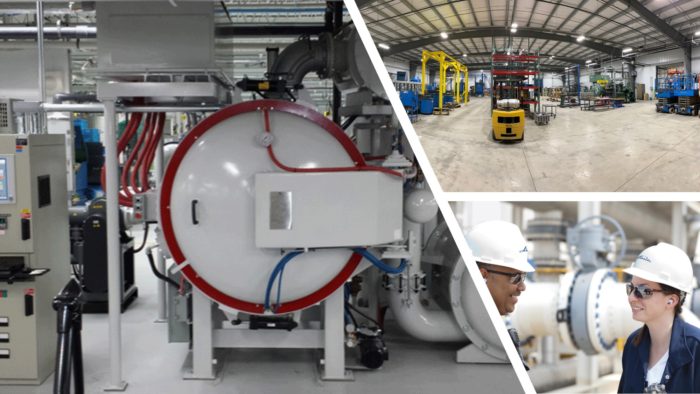
Today's feature article is a "best of the web," that gives you a roadmap when selecting the best vacuum gauge for your heat treating purposes. In this piece, you will also learn how gauges perform differently depending on their type. Read to learn more and see these differences.

An excerpt: "There are several types of vacuum gauges, each engineered for a specific function over a specific range of vacuum pressure. Common types include:

  • Mechanical gauges
  • Absolute pressure gauges
  • Thermocouples or Pirani gauges..."

Read more: "Vacuum Gauges"

(photo source: Collage with images from Vac Aero featured article, Peter's Heat Treat, and Linde website)

Vacuum Gauges in Heat Treatment Read More »

Considerations for Base Metal Thermocouple Wire Diameters

OC

Ed Valykeo
Thermocouple Specialist
Pelican Wire

John Niggle
Business Development Manager
Pelican Wire

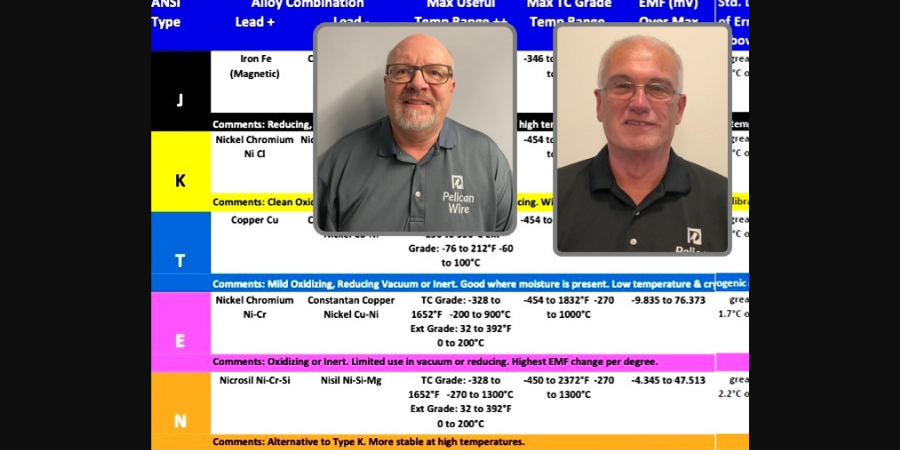
“What size wire should I use in my thermocouple assembly?” While this is a pretty direct question, the answer is more complex. In this fascinating Technical Tuesday article, learn how both the type of thermal processing as well as the stability and performance of the thermocouple contribute to selecting the right size wire. Read more in this Heat Treat Today Original Content article by John Niggle, Business Development Manager, and Ed Valykeo, Thermocouple Specialist, at Pelican Wire, Naples, FL.


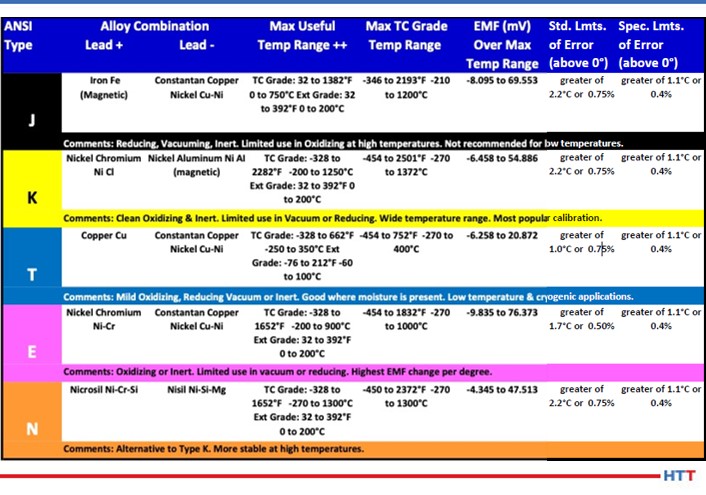
This article will discuss influences that should be considered when choosing the wire diameter in a base metal thermocouple circuit. It is important to keep in mind each thermal process will dictate the type and size of thermocouple. It is also important to understand there are several factors which influence the life expectancy of a thermocouple circuit.

We often get asked, “What size wire should I use in my thermocouple assembly?” The quick and simple answer is, “Use the largest practical size.” While this may be true, the individual thermal process should dictate the proper wire size.

The selection of a specific wire size for a given thermal process is related to the question of “expendability.” A thermocouple not exposed to harsh environments or excessive temperatures should have a long and useful life. Thermocouples exposed to corrosive atmospheres and elevated temperatures should be considered expendable. In general, if a thermocouple wire is deemed expendable then the wire should be no larger than necessary. If the thermocouple wire is exposed to excessive temperatures, or harsh environments, a larger diameter wire may be required.

There are several factors that affect the stability of thermocouple alloys:

  • Evaporation – Especially at higher temperatures certain elements evaporate more readily than others.
  • Diffusion – Alloying elements from one leg to the other.
  • Oxidation – In most cases oxidation in clean air is beneficial for thermocouple performance. As oxide film thickens with time and temperature, the overall composition of the thermoelement changes.
  • Contamination – Changes in wire composition can affect thermocouple drift. Contamination from sulfur, iron, and furnace refractories can be sources of contamination.

Each of the above factors can induce EMF (electromotive force) drift, caused by a change in alloy composition. EMF drift is the potential for the thermocouple to lose its accuracy over time. Typically, this change takes place on the surface of the wires. Since smaller diameter wire has increasing ratios of surface to volume exposure, they are more rapidly affected by surface effects. The rate at which this phenomenon progresses accelerates as the temperature increases.

(Source: Pelican Wire)

It is important to keep in mind each base metal thermocouple type has its advantages and disadvantages. The environment and temperature range contribute to the overall thermocouple performance. Using a thermocouple in the wrong environment or incorrect temperature range could increase the opportunity for adverse surface effects, regardless of the wire size.

There are other considerations when choosing a wire size in a thermocouple circuit:

  • Stem Loss – Stem conduction is heat conduction along the length of a wire. When the heat source end and the cold junction end of the wire are at different temperatures, stem conduction occurs. This temperature discrepancy produces a reading different from the actual heat source temperature. Using a larger gauge conductor could produce an error due to stem loss conduction.
  • Resistance – The industry standard is to keep total loop resistance of your circuit under 100 ohms. Loop resistance is determined by multiplying the length in feet by the resistance per double feet. Double feet is the resistance per foot of each thermocouple element. Decreasing the wire size results in the increase of resistivity of each thermoelement, which affects total circuit resistance.
  • Flexibility – Some thermocouple assemblies are run through conduit or inserted in protection tubes. As you increase the wire diameter you lose some flexibility.

Useful thermocouple life is difficult to predict, even when most of the details of an application are known.  The best test for any application is to install, use, and evaluate the performance of a design that is thought likely to succeed.  Thermocouple type descriptions are good source for determining recommendations, and prohibitions for thermocouple use.

Keeping in mind these recommendations, as well as having a better understanding on what affects thermocouple performance, should help you select the proper wire diameter for your specific application.


About the Authors: John Niggle has been the business development manager at Pelican Wire since 2013 and has prior sales experience in process instrumentation. Ed Valykeo, a 40-year veteran in the wire industry, many with Hoskins, is a thermocouple specialist who has worked with Pelican for 10 years.


Considerations for Base Metal Thermocouple Wire Diameters Read More »