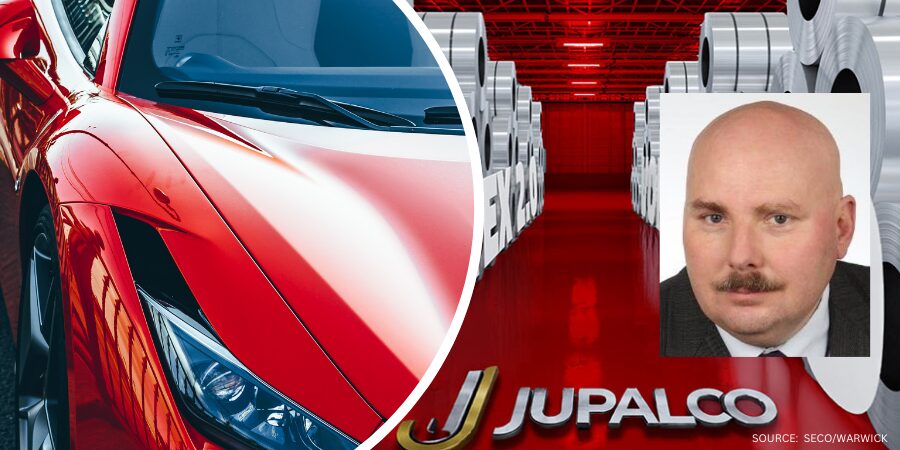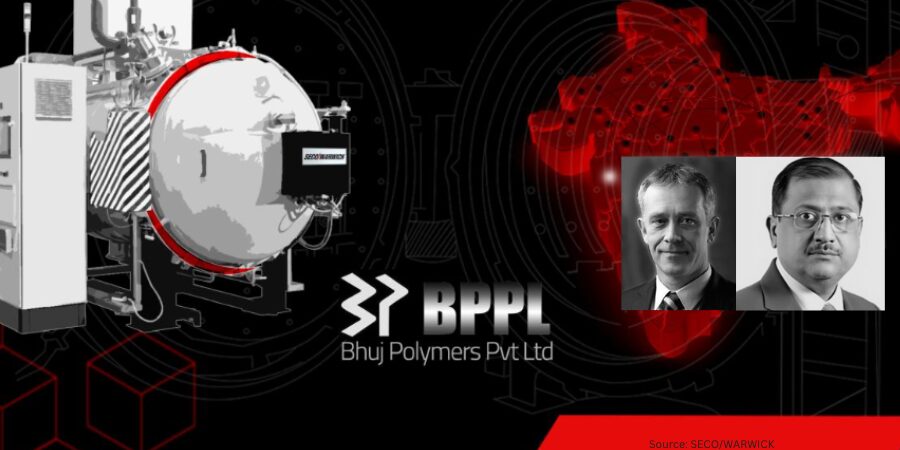
A metal heat treater is expanding their operations with a new vacuum furnace. The high-pressure quench vacuum furnace will be used for a wide range of processes such as vacuum hardening, tempering, solution treatment, aging, annealing, brazing and high-pressure gas quenching, servicing the automotive, aerospace, toolmaking and machinery sectors.
Shital Vacuum Treat will receive the furnace fromSECO/WARWICK, and it will comply with the NADCA (North American Die Casting Association) global standard for the heat treatment of tools and dies and enable faster preparation for NADCAP certification.
The single-chamber Vector vacuum furnace will be equipped with an advanced 15 bar (abs) gas cooling system, enabling rapid and uniform cooling of loads with complex geometries. It features a round heating chamber with high temperature uniformity ±5°C (9°F), convection heating up to 850°C (1562°F), and a vacuum system based on Leybold mechanical and Roots pumps.
“SECO/WARWICK is not just a supplier – they are part of our family. The new furnace will allow us to increase our production capacity and serve customers better. Quality and repeatability are paramount for us…Thanks to high-pressure cooling and the ability to work with different process gases, the furnace fits perfectly with the requirements of a commercial hardening plant that serves clients from various industrial sectors. Its NADCA compliance and readiness for Nadcap certification allows us to provide services to clients from the most demanding industries, such as aerospace and automotive,” commented Vilas Kolekar, marketing director for Shital Vacuum Treat Pvt. Ltd.
Shital Vacuum Treat Pvt Ltd in the Indian market not only provides comprehensive heat treatment services but also acts as a technology advisor.
Press release is available in its original form here.

Iperion X has received $25 million from the U.S. Department of War to support the build-out of a resilient, fully integrated, and low-cost titanium supply chain. The funds will be applied to the scale-up of production to 1,400 tpa at IperionX’s Titanium Manufacturing Campus in Virginia.
The award has come through the Industrial Base Analysis and Sustainment (IBAS) program and is part of a $42.5 million obligation expected to be granted over time. The IBAS program is designed to reinforce U.S. defense supply chains mineral-to-metal titanium that reduces reliance on imports and establishes a secure, uninterruptible domestic source of critical materials.
This latest obligation follows prior tranches of $12.5 million and $5 million, which funded long-lead items for titanium manufacturing equipment and to advance the Titan Critical Minerals Project in Tennessee.
IperionX is an American titanium metal and critical materials company that uses patented metal technologies to produce high performance titanium alloys, from titanium minerals or scrap titanium, at lower energy, cost and carbon emissions. Their Titan critical minerals project is the largest JORC-compliant mineral resource of titanium, rare earth, and zircon minerals sands in the United States. Titanium metal and critical minerals are essential for advanced U.S. industries including space, aerospace, defense, consumer electronics, hydrogen, automotive and additive manufacturing.
Press release is available in its original form here.
We’re celebrating getting to the “fringe” of the weekend with a Heat TreatFringe Fridayinstallment: Woodward, Inc, a manufacturer with in-house heat treat operations which serves the aerospace industry, has announced its plan to build a precision manufacturing facility in Greer, South Carolina, in Spartanburg County. The new site is a strategic investment for the company. The 300,000-square-foot facility is set to open in 2027 and will focus on production of servo-hydraulic actuation systems, which are critical components used in aircraft flight control.
While not exactly heat treat, “Fringe Friday” deals with interesting developments in one of our key markets: aerospace, automotive, medical, energy, or general manufacturing.
Woodward’s Nadcap certification Source: Woodward, Inc.Chip Blankenship Chairman & CEO Woodward, Inc.
Initially, most of the factory’s capacity will be dedicated to producing spoiler actuation for the Airbus A350. These critical control systems are mounted on the upper surface of aircraft wings and play a vital role in managing lift and enhancing flight performance and safety. The site has potential to expand capacity as the company meets growing demand for its aerospace technologies.
The facility is expected to create approximately 275 high-quality jobs in manufacturing, engineering, and business operations, with potential for significant workforce expansion in the future.
“The selection of Woodward to supply Airbus with spoiler actuation systems and our investment in South Carolina represent a major milestone for Woodward and our commitment to delivering leading controls solutions to our customers,” said Chip Blankenship, chairman and CEO of Woodward, Inc. “It will be a showcase manufacturing site, much like our Rock Cut campus, vertically integrated, highly automated, and built on the capabilities and methodologies in operational excellence we’ve developed through our LEAP and GTF aircraft engine programs.
“Beyond supporting the Airbus A350, this facility positions us to extend our hydraulic flight control design and industrialization expertise to additional applications as well as other commercial aircraft manufacturers. We’re proud to bring jobs and economic opportunity to Spartanburg County as we fulfill our purpose to design and deliver energy control solutions our partners count on to power a clean future.”
Henry Dargan McMaster Governor of South Carolina Source: South Carolina Office of the Governor
After an extensive nationwide search, Woodward selected Spartanburg County for its robust manufacturing infrastructure, access to highly skilled aerospace talent, and proximity to key suppliers. The investment is supported by an incentive package from the State of South Carolina, Spartanburg County, and local economic development organizations.
“When global companies like Woodward, Inc. decide to invest in our state, it further solidifies South Carolina’s impressive reputation in the manufacturing industry. We look forward to creating a long-standing partnership with the company and seeing the strong impact of these approximately 275 new jobs in Spartanburg County,” said Henry McMaster, Governor of South Carolina.
Press release is available in its original form here.
We’re celebrating getting to the “fringe” of the weekend with a Heat Treat Fringe Friday installment: Riverspan Partnershas acquired United Titanium, a leading U.S. manufacturer of engineered, mission-critical fasteners, fittings and precision components made from titanium, zirconium, and other specialty metals. United Titanium serves critical industries such as defense, aerospace, medical and dental, electronics, petrochemical processing and marine engineering.
While not exactly heat treat, “Fringe Friday” deals with interesting developments in one of our key markets: aerospace, automotive, medical, energy, or general manufacturing.
Dave Thomas Partner Riverspan Partners.
Based on Wooster, Ohio, United Titanium was founded in 1962 and offers comprehensive services such as precision machining, custom fabrication, and advanced inspection and testing.
“We have built a remarkable business together over the past five decades, and I am thrilled that the team has found an ideal partner for the next chapter,” said Mike Reardon, president of United Titanium. “Riverspan deeply appreciates the people and processes that have contributed to our success and is keen to build on those strengths to capitalize on the significant growth opportunities in our core markets. Their expertise will help United Titanium to reinforce its commitment to quality, innovation and high-touch service through further investment in our people and technology. I am excited to see the company continue to prosper.”
“We have tremendous respect for the outstanding business … United Titanium team has built, and we are excited to build on that rich legacy,” said Dave Thomas, partner at Riverspan Partners.
The company will continue to be led by the same senior team and will remain headquartered and an active community member in Wooster, Ohio. As part of the transaction, longtime industry executive Paul Schwarzbaum will join the United Titanium Board of Directors.
Press release is available in its original form here.
Two intensive furnace projects are poised to bring heat treating to the automotive brake rotor and marine propulsion systems industries. An FNC furnace has been completed which will process approximately 600,000 brake rotors per year for the automotive industry. An additional pit nitriding furnace has a capacity of 80,000 lb. and will be utilized for the production of large marine gears.
Brake Rotor Furnace
Mark Hemsath President Nitrex/UPC-Marathon Source: Linkedin
“In August our Team received Final Acceptance on two of the most difficult projects in Nitrex history…Our most sophisticated brake rotor semi-continuous FNC furnace is installed at a subsidiary of a major auto maker in Europe. Again, our team worked tirelessly to meet customer demands. I am so proud of our team and what they accomplished,” remarked Mark Hemsath, president of Nitrex/UPC Marathon.
The scale of the brake rotor furnace highlights its uniqueness. The furnace processes approximately 600,000 rotors per year, or about 1.6 metric tons per hour. If run continuously, output could approach nearly a million rotors annually.
The brake rotor furnace integrates a post-oxidation (ONC®) process, allowing control over both the color and oxide layer. This feature sets it apart from furnaces currently in use for brake rotors.
The standard load size of the brake rotor furnace is: 1200 mm x 1200 mm x 1800 mm, with a gross load capacity of up to 4 metric tons. Nitrex was able to offer an extended charge size to 2400 mm deep, which could raise throughput to about 2 metric tons per hour.
Brake rotor furnace Source: Nitrex
Pit Furnace
Nitrex’s largest pit nitriding furnace Source: Nitrex
The pit furnace represented another leap forward with a capacity of 80,000 lbs. Engineering efforts centered on maximizing productivity while maintaining the precision nitrided layers expected from smaller systems.
This furnace presented significant logistical challenges due to its sheer size and complexity in transport and installation.
Mark Hemsath remarked: “I am so proud of the effort our entire team exerted to meet schedules, quality demands and design improvements. Our largest ever precision Nitrider (4.5 meter diameter!) for deep-case nitriding of large gears was built on-site with no prior testing.”
The pit furnace is built to handle extremely large gears, typically for marine propulsion systems in very large ships where double-helix gears are standard. These gears, which can weigh 20,000 lb., require 12 days to nitride, not including heating or cooling — a stark contrast to the two-hour cycle time of the afore mentioned semi-continuous rotor furnace, which is for high volumes in automotive settings.
The furnace stands at 4.5 meters (177 inches / 14.75 feet) in diameter and 3.5 meters deep (11.48 feet), marking one of the largest precision nitriding capacities ever built with a retort lining.
Project Highlights
These projects were collaborative, drawing expertise from across the organization.
In Canada, Janusz Szymborski came out of retirement to contribute design enhancements. Lead Designer Kamil Szczudlo and Chief Engineer Marcin Doroszko from Nitrex’s Poland facility drove the design, automation, and gas flow systems, while plant manager Robert Sokolinski coordinated production and logistics. Karl Michael Winter, vice president of Engineering in Germany, worked on advanced brake rotor layer formation.
Heat TreatToday original press release, last updated on 01/21/2026 at 12:22pm.
We’re celebrating getting to the “fringe” of the weekend with a Heat TreatFringe Friday installment: a project that revolutionizes domestic steel making. Learn more about this green steel tech that plans to turn into a 500,000-tonne per year production micro-mill!
While not exactly heat treat, “Fringe Friday” deals with interesting developments in one of our key markets: aerospace, automotive, medical, energy, or general manufacturing.
Hertha Metals has founded a technology with the potential to transform domestic steelmaking. The company’s proprietary technology is powered by natural gas, hydrogen, and electricity, enabling steel production from any grade of iron ore or waste oxide, in any format, including fines and lumps. Hertha’s process has been demonstrated at a continuous 1 tonne-per-day scale at their Conroe, TX facility, with plans to scale up to 9,000-tonnes, before launching a 500,000-tonne per year micro-mill.
This semi-continuous, single-step process delivers tunable iron and steelmaking. With Flex-HERS™, the proprietary technology, Hertha Metals can tap into domestic iron ore resources and produce low-emission steel using abundant natural gas. As clean hydrogen becomes more available and affordable, they plan to switch fuels — without changing the furnace, to remove the loss of stranded assets, and future-proof a path for steel production.
Hertha Metals steel production Source: Hertha Metals
The new technology:
Enables iron and steel production from low-grade ore, fines and waste oxides
Single-step production using abundant natural gas or clean hydrogen
Scalable technology to serve multiple markets
High-performance steel alloys under development
Laureen Meroueh CEO & Founder Hertha Metals Source:Linkedin
“After three short years of heads-down building, Hertha Metals is ready to show the world what we have achieved. After more than 300 years of coal-based primary steelmaking, Hertha Metals is introducing a process that is more energy efficient, more cost competitive, and more flexible with feedstock quality.
“The team at Hertha has been hard at work, developing and scaling our single-step ore-to-steelmaking technology. We have demonstrated our technology with various ore qualities and format (including fines) at a scale of 1 tonne per day of continuous clean steel production. This is the largest novel steelmaking pilot plant demonstration in the US and I am so proud of the speed at which we got here,” said CEO and founder, Laureen Meroueh.
Heat Treat Today original press release, last updated on 09/05/2025 at 5:15am.
IperionX Limited will receive $12.5 million from the U.S. Department of Defense (DoD) to accelerate the scale-up of a resilient, low-cost, and fully-integrated U.S. mineral-to-metal titanium supply chain. The project will include scaling up to over 1,000 metric tons per year at the Virgnia Titanium Manufacturing Campus.
The $12.5 million will be applied to purchase orders for long-lead, major capital equipment required for the scale-up. Major incremental capacity categories include titanium deoxygenation, sintering and powder metallurgy consolidation systems; near-net-shape component manufacturing and ancillary infrastructure upgrades.
Anastasios (Taso) Arima CEO IperionX Source: IperionX
“This new U.S. Government obligation allows IperionX to move immediately to secure long-lead capital equipment and lock in manufacturing slots with key suppliers. It accelerates our imminent Virginia expansion beyond 1,000 tpa of high-performance titanium manufactured products, and advances a fully integrated, low-cost and traceable American titanium supply chain for defense and commercial customers. This commitment from the DoD is a strong endorsement of our technology, our team, and our mission to reshore a resilient titanium production supply chain in the United States,” said Anastasios (Taso) Arima, IperionXCEO.
In response to the strategic need for increased production capacity of domestic primary titanium metal and manufactured titanium metal components, the project scope under the Industrial Base Analysis and Sustainment (IBAS) program has been revised to prioritize accelerated expansion of IperionX’s titanium metal and manufacturing production capacity at IperionX’s Virginia Titanium Manufacturing Campus.
This project is part of a previously announced $47.1 million award to strengthen the U.S. Defense Industrial Base by accelerating the scale-up of a resilient, low-cost, and fully-integrated U.S. mineral-to-metal titanium supply chain.
Press release is available in its original form here.
Heat treatment is a hands-on science and it can be easy to forget about continuing education. In today’s edition of Combustion Corner, Jim Roberts, president of U.S. Ignition, encourages readers to continue cultivating their own heat treat learning and offers specific and practical educational resources to do just that.
This informative piece was first released in Heat TreatToday’sJune 2025 Buyers Guide print edition.
So, a furnace guy walks into a heat treating facility and says, “What’s that?”
The Flame and Man
Since the invention of fire, we as upright, walking, opposing-thumb-equipped critters have been learning to control it. We have learned at the elemental level that we can change the properties of just about anything on the planet simply by exposing that item or material to the flames. Certainly, we hold fire as one of our most fascinating benefits of our existence.
Yet, in the grand scheme of things, we are just now really learning to control at levels that our Neanderthal cousins would never have conceived, and they didn’t! Conceive the possibilities, that is. I mean, for the first 400,000 years of our human existence, (that’s a mindblower, isn’t it?), fire had four basic purposes: warmth, light to see in the dark, protection from predators/enemies, and to cook our food. Later, we discovered that by heating up the tip of certain sticks, you could make the stick useful over a longer time. It didn’t wear out as fast. And from there we figured out ways to change other materials at our behest by using the flame. Weapons and tools followed.
In the bigger picture, we only have figured out the really cool uses in the last 5,000 years — and the really, really cool stuff in the last 300 years. So, the learning curve for us has been relatively late when it comes to the heat and the flame and the ability to understand it — to really control it.
Furthering the Science of Heat
How did we get to this stage of significant control over temperatures and systems that would melt a Cro-Magnon’s noodle right there in his big ol’ skull? We used our ever-developing brains. We used intelligence to advance the art of using the flame. Others before us thought their way into our present-day future. Shouldn’t we keep the ball rolling? Isn’t this ever-evolving commitment to responsible use of the flame what we need to do? We accept the gift of those before us and strive to improve on it for the upcoming iterations of humankind. Idealistic? I think not.
The premise of temperature is basically fixed. We can put it in a furnace, we can put it in a vacuum, we can melt the very rocks our planet is made from. So, let’s use the very latest available knowledge to further the science of heat. Let’s improve the situation, both at work and personally, by using our brains and by learning about what is going on with the furnaces, the parts, the fuels, and all the methods of heating. Let’s keep learning about the latest technologies. Let’s actually control this wondrous element.
To do that, we must embrace the knowledge, we have to know what we are looking at. We need to know the history and have a vision for the future. We need to teach and be taught.
Learning the Industry
If you or your reports need to get up to speed with our industry, indeed our very science — GO TO SCHOOL! The fact you are even reading this publication shows that you are open to learning. Let’s ace the test!
Heat Treat Today runs a drink-from-the-firehose learning experience calledHeat Treat Boot Camp. You can learn the latest and greatest technologies and new technologies on the horizon in heat treating. Send yourself, send your people.
The Metal Treating Institute (MTI) runs an online certification school that teaches the ins and outs of the heat treating industry. The Industrial Heating Equipment Association (IHEA) runs an annual Combustion Seminar. Almost all the major furnace and equipment suppliers offer seminars on their specialty niche.
SECO/WARWICK produces a Global Training Seminar on continuous improvement and heat treating
Can-Eng offers analysis of specific inquiries
Ajax Tocco will come to your facility to conduct the latest schooling on your equipment
All you must do is decide that you are going to continue to learn more. How can you not with these kinds of services around you?
Don’t forget Safety. National Fire Protection Agency (NFPA) seminars are available from NFPA themselves. Industry experts who have certified trainers, like Rockford Combustion, also offer multi-day seminars on equipment safety.
I can attest to the effectiveness of these kinds of learning commitments. I have been both a student and a teacher at some of the aforementioned seminars. The scope of learning can be broad or focused. It’s up to us to keep mentally expanding, so that the lessons learned don’t get lost, and the future technologies get a fair review.
I have been watching with interest how over the last 25 or so years precise control over combustion has been evolving. The major controls and process monitoring companies have been striving to gain precise control and safety on furnace equipment for years. I might add, they have been successful in varying degrees, and safety and maintenance have improved greatly.
I just spoke recently with a company in Erie, Pennsylvania. They have developed a program that monitors each individual burner. Not only does it tell if the burner is running, but if there has been a component failure, if the burner is out of tune, it can self-correct, and if there is a failure, they shut it off. Oh, and they do that for you, from THEIR office. The technology just grows and grows, doesn’t it?
So, I know some of you were wondering where I was going with the Caveman intro, and some of you probably would have preferred that I kept going up to the point where we were cooking mammoth steaks on sizzling rocks with our Cro-Magnon buddy. But we are better than him, and we need to keep proving that. Don’t you think?
Besides, this is the final month before school is out for the summer. Let’s give education a nod here.
I am sorry if I did not mention your company, no slight intended. If so, contact your customer base to alert them to any learning experiences that may be available.
Keep learning. Until next time…
About the Author
Jim Roberts President US Ignition
For More Information: Contact Jim Roberts at jim@usignition.com.
Busch Vacuum Solutions, part of the Busch Group, a global company in vacuum and overpressure technology, has announced the development of its newest U.S. facility. As a key regional hub, the facility will specialize in the repair, service, and overhaul of vacuum pumps, vacuum systems, and overpressure equipment including turbo molecular pumps, leak detectors, valves, and accessories. The almost 60,000-square-foot facility will be located in Tempe, Arizona.
Turgay Ozan President & CEO Busch Group USA
The state-of-the-art facility is scheduled to open in October 2025. This expanded capability brings greater flexibility, technical expertise, and responsiveness to customers across the semiconductor, industrial, medical, and environmental sectors. The Tempe Service Center will provide faster turnaround times, expert support, and more efficient service delivery tailored to the unique operational needs of those across the U.S.
“This investment represents more than just added square footage. It’s about proximity, partnership, and performance. With the launch of our Tempe location, we’re better positioned to deliver unmatched value…on advanced vacuum technologies in high-performance environments,” said Turgay Ozan, president & CEO of Busch GroupUSA.
Corey Woods Mayor Tempe, Arizona
The mayor of Tempe, Corey Woods, commented, “We’re excited to welcome Busch Vacuum Solutions…Their decision to invest here speaks to the strength of Arizona’s semiconductor ecosystem, diversity of thriving industries located here, and the spirit of innovation that defines our community. The new Tempe Service Center will create skilled employment opportunities, strengthen business partnerships, and keep Tempe at the forefront of high-tech growth and excellence.”
In addition to semiconductor and industrial markets, Busch’s vacuum technology supports automotive, food and beverage, packaging, metallurgy, pharmaceuticals, plastics, and large-scale distribution. These capabilities enable more localized production and increase operational resilience across essential supply chains.
Press release is available in its original form here.
In today’s News from Abroad installment, we highlight an electrically heated aging furnace for aluminum production, an electric arc furnace as part of a £1.25 billion ($1.69 billion USD) transformation, a new electric arc furnace world record, and more!
Heat TreatTodaypartners with two international publications to deliver the latest news, tech tips, and cutting-edge articles that will serve our audience — manufacturers with in-house heat treat. Furnaces International, a Quartz Business Media publication, primarily serves the English-speaking globe, and heat processing, a Vulkan-Verlag GmbH publication, serves mostly the European and Asian heat treat markets.
The commission comes as part of the company’s strategy to increase the production of high value aluminium. Source: Furnaces International
“ALRO, one of the largest vertically integrated aluminium producers in Europe by production capacity, announces the commissioning of an electrically heated aging furnace.
“This follows a total investment of 11.5 million RON (Romanian new leu) into the project. The commission comes as part of the company’s strategy to increase the production of high value aluminium.
“The CEO of ALRO, Marin Cilianu, stated: ‘By replacing natural gas with electricity, this equipment not only brings added precision and efficiency to our production processes, but also aligns with our firm commitment to sustainable development.'”
Tata Steel’s Port Talbot EAF will reduce carbon emissions by an estimated 90%. Source: Furnaces International
“Tata Steel UK launch the construction of its electric arc furnace (EAF) facility in Port Talbot, South Wales. This is part of a £1.25 billion transformation to low CO2 steelmaking, supported by a £500 million investment from the UK Government.
“To mark the construction, Chairman of the Tata Group, Mr. Natarajan Chandrasekaran, was joined at the ceremony this week by Tata Steel CEO and Managing Director, T. V. Narendran, and Tata Steel UK CEO, Rajesh Nair, as well as government ministers.
“Mr. Chandrasekaran stated: ‘This is an important day for Tata Group, Tata Steel and for the UK. Today’s groundbreaking marks not just the beginning of a new Electric Arc Furnace, but a new era for sustainable manufacturing in Britain. At Port Talbot, we are building the foundations of a cleaner, greener future, supporting jobs, driving innovation, and demonstrating our commitment to responsible industry leadership.’”
EAFs set world record in China. Source: Furnaces International
“Two EAF Quantum electric arc furnaces (EAF) from Primetals Technologies have set a world record after achieving up to 50 heats per day. The furnaces are located at the Hubei Shunle site in Hubei Province, China.
“Figures by Primetals show that on top of achieving 48 to 50 heats a day, both EAFs can record tap-to-tap times of less than 28 minutes and have power-on and power-off times of 25 and 3 minutes respectively.”
ABP CEO Till Schreiter attends the anniversary celebration of ABP Induction. Source: ABP Induction Systems GmbH
“ABP Induction celebrated its 20th anniversary with an official ceremony: On November 1, 2005, the company was spun off from the ABB Group and started into a new future as an independent company…
“Heike Marzen, managing director of the Dortmund Economic Development Agency, praised ABP Induction as an important pillar of Dortmund’s economy. She emphasized that over the past two decades, the company…impressively demonstrated its ‘Innovative strength, commitment and sustainable development.’ Many of those present had followed the company’s development.
“Heike Marzen emphasized that ABP Induction, as ‘one of the world’s leading manufacturers of induction melts, heating systems and aftermarket services,’ is a valuable partner for Dortmund. She was particularly impressed by the innovative technologies and tailor-made solutions that ABP uses worldwide.”
The event will include 320 exhibitors and have speakers from companies such as ALFED and Hydro Aluminium. Source: Furnaces International
“UK Metals Expo returns on 10 and 11 September 2025 at the NEC Birmingham, uniting the entire metals supply chain with the manufacturing and engineering community.
“Launched in 2022, UK Metals Expo is the essential meeting place for fabricators, stockists, production specialists, procurement teams, engineers, researchers, manufacturers, and policymakers. It’s where the industry comes together to collaborate, share ideas, and do business in a welcoming, engaging environment.
“At UK Metals Expo 2025, you can meet face-to-face with leading suppliers and top technical experts ready to tackle your project challenges and deliver tailored solutions. Expect live machinery demos, automation, robotics, and AI-powered technology, plus cutting-edge materials, coatings, and processing systems.”
The BMWE is implementing important requirements of the immediate action programme. Source: Adobe Stock
“On August 6, the German Federal Government launched six projects of the Federal Ministry of Economics. In doing so, the BMWE is implementing important requirements of the immediate action programme.
“In addition to the Carbon Dioxide Storage Act and the simplification of public procurement law, four important energy projects were launched and companies and citizens were relieved.”