FEATURED NEWS

Thermocouple Wire Manufacturing Line Changes Hands


Ted Bill, president, Pelican Wire

A Florida-based manufacturer of thermocouple, resistance, and custom wire recently acquired a portion of the insulated thermocouple manufacturing business from a  technology and manufacturing company that provides thermal products and systems to heat treating operations within the automotive, aerospace, defense, and medical industries worldwide.

Pelican Wire has completed the purchase of a portion of the SERV-RITE business from Watlow Electric, based in St. Louis, Missouri. The agreement includes equipment, design and manufacturing process information and customer account data.

“I’m excited to work with our long-time partner, Watlow Electric, to provide their customers continued superior service for these high-temperature thermocouple products,” said Ted Bill, president, Pelican Wire. “This is a great example of Pelican Wire’s ongoing commitment to the thermocouple wire industry.”

“This is a very natural transition for both companies. Watlow and Pelican Wire have a long history of cooperation to ensure customers can leverage the core capabilities of both to get the best solution,” said Randy Brown, Chief System Designer, Watlow.

Randy Brown, Chief System Designer, Watlow

As quoted from the August 31, 2018 “End of Life” (EOL) statement, “Watlow has already begun transferring both design and manufacturing knowledge of the product line to Pelican Wire. Pelican Wire already manufactures these constructions, so the transition is expected to be seamless.”

Pelican Wire will begin quoting and accepting orders on new and existing wire designs on September 17, 2018, and will begin manufacturing operations on or before October 15, 2018.


Thermocouple Wire Manufacturing Line Changes Hands Read More »

UK MRO to Open Component Maintenance Center with Heat Treating, Hardness Testing

A leading independent Maintenance Repair & Overhaul (MRO) provider in the U.K. prepares to open a new Component Maintenance Centre in Northampton, England, with operations planned to start this month.

Monarch Aircraft Engineering (MAEL) has invested approximately £2 million in this new center, which will include heat treating lines compliant to industry standard for standard processing and detail fabrication requirements, as well as hardness testing.

Chris Dare, Managing Director at Monarch Aircraft Engineering

“Our new Northampton facility will enable us to more effectively and efficiently support our burgeoning line and base maintenance facilities across the UK,” said Chris Dare, Managing Director at Monarch Aircraft Engineering. “This multi-million-pound investment in new facilities, equipment and, most importantly, skilled engineering talent, is an integral part of our long-term growth plan and will play a vital role in our success in the years ahead.”

UK MRO to Open Component Maintenance Center with Heat Treating, Hardness Testing Read More »

Burners 101 for Heat Treating Efficiency and Safety


Source: Control Engineering


Running a heat treat shop is more than just firing up a furnace to treat components; it’s doing so in a way that is both efficient and safe.

Today’s Technical Tuesday is a helpful article from Control Engineering about burners for gas-fired heat treating furnaces, their differences and how they are best utilized in different heat treating applications, technological advances in controls engineering, and combustion safety. The article draws on the skills and knowledge of several in the industry who have contributed to the advances and development in burner manufacturing, operation, and safety.

A couple of excerpts:

“With a careful engineering analysis, it often is possible to obtain more efficiency by optimizing either process or system control. As an added benefit, in many cases, such optimization does not require substantial physical hardware upgrades.” ~ Michael Cochran, marketing engineer, combustion systems at Bloom Engineering Company Inc.

“The goal of both regenerative and recuperative designs is to capture heat energy that would otherwise be wasted.” ~ Control Engineering


Read more: “Understanding Burners for Heat Treating Furnaces”


Burners 101 for Heat Treating Efficiency and Safety Read More »

Fastener Maker for Auto Industry Commissions Large Heat Treating Line


A leading supplier of fasteners to the automotive industry recently commissioned a cast link belt furnace for the refinement of high-strength steel screws and nuts.

AICHELIN, headquartered in Vienna, Austria, will deliver the heat treating plant by December 2018 to fastener-maker Bulten’s Swedish Hallstahamar site. This is the second industrial furnace plant for this facility. The plant line, produced in Austria, measures over 260 feet (80 m) long and weighs nearly 40,000 pounds (over 50,000 counting liquids and components).

The electrically heated high-temperature hardening furnace and the protective-gas-tight tempering furnace will be delivered with oil or emulsion hardening baths. Measuring and switching systems are included, as well as the process control system FOCOS 4.0 for the new plant (as well as an update of the data acquisition of the existing plant) and a protective gas generator.


Fastener Maker for Auto Industry Commissions Large Heat Treating Line Read More »

A Dozen Quick Heat Treat News Items to Keep You Current

A Dozen Quick Heat Treat News Items to Keep You Current

Heat Treat Today offers News Chatter, a feature highlighting representative moves, transactions, and kudos from around the industry.

Personnel and Company Chatter

  • A partnership was recently formed between C3 Data LLC and CCPI Europe Ltd. for distribution of furnace software compliance products throughout the UK and Europe. C3 Data’s innovative software solutions are now available for streamlining furnace compliance processes for Nadcap, AMS2750, and CQI-9 for the UK & European aerospace and automotive industries.
  • The NextGenAM collaborative project, formed to establish the basis for a future system for series production using 3D printing technologies, has launched its pilot facility at Premium AEROTEC’s technology center in the German city of  Varel. Premium AEROTECEOS, and Daimler partnered in this project, and the project team has been working on assessing the additive manufacturing process to see what kind of potential it holds for automation.
  • Industry leaders and executives gathered in Atlanta from July 30 – August 1 for the second ITPS (International ThermProcess Summit). Anne Goyer, IHEA’s Executive Vice President, noted that attendee evaluations showed executives felt the speakers and their presentations were very valuable. “I have been involved in organizing conferences and summits for more than 35 years. This year’s ITPS was one of the highest evaluated events we’ve ever produced.”
  • Heat Treatment Australia’s North American operations (HTA-Los Angeles) recently moved into a new facility in Santa Fe Springs, California, as part of an ongoing improvement program to increase available services to N.A. industries. The company also reports an impending order of an age hardening furnace (12-ft) which will be delivered in January. “The new facility provides much-needed resources required to run the new equipment,” said Karen Stanton, referring to the availability of power and gas. The new address is 10140 Romandel Avenue, Santa Fe Springs, CA 90670, not far from the previous location.

Equipment Chatter

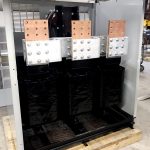
  • A Pennsylvania-based company that provides custom engineering and manufacturing of power equipment recently shipped a 360KVA, three-phase, 60HZ transformer for use in wire annealing. Magnetic Specialties produced a transformer that features an extended primary winding with multiple taps to adjust the output voltage of the high current secondary.  The tap can easily be changed via the three phase tap switch mounted to the front of the enclosure.  The delta connected secondary winding is designed for line currents up to 6,500 ARMS.  The delta connection was made with large aluminum bus bars due to the high secondary current. The core and coil, along with the custom NEMA 1 enclosure, were designed using Solidworks 3D modeling.
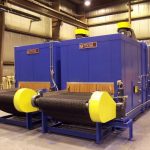
  • A tool and equipment manufacturer recently received shipment of an electrically heated, standard two-zone, belt conveyor oven to be used to temper steel parts. The furnace, shipped by Wisconsin Oven Company, has the capability to heat 1,800 pounds of steel from 70° F to 425° F within a 1-hour time period. The tempering oven has work chamber dimensions of 3’0″ wide x 34’0″ long and 1’6″ high and a maximum operating temperature of 500° F.
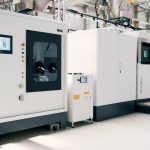
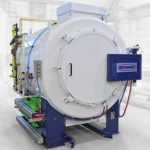
  • A North American heat treater recently expanded its capabilities by adding a new ZeroFlow® precision gas nitriding vacuum furnace. The horizontal, front-loading furnace joins another SECO/WARWICK gas nitriding furnace already in production at the customer’s facility.

Kudos Chatter

  • Professor Jerzy Michalski has been recognized as the 2018 Hephaestus Award. Organizers Nitrex Metal and United Process Controls announced the specialist in the design of gas nitriding processes and modeling of nitriding atmospheres as this year’s recipient. The award is bestowed upon individuals in the field of heat treating whose contributions have had an impact on surface engineering, materials science, and industrial processes or production techniques. The award will be presented to Prof. Michalski during the 3rd Novatherm Seminar, taking place October 3-5, 2018, in Poland.
  • Richard Sisson Jr. has been named a fellow of two materials science professional societies, the International Federation for Heat Treatment and Surface Engineering (IFHTSE), and the American Ceramic Society (ACerS). The George F. Fuller Professor of Mechanical Engineering and director of the Manufacturing and Materials Science and Engineering programs at Worcester Polytechnic Institute (WPI), who directs the Center for Heat Treating Excellence, part of WPI’s Metal Processing Institute, received the IFHTSE fellowship at the 4th International Conference on HTSE in Automotive Applications in Spartanburg, S.C., in June, where he also delivered one of the conference’s three keynote addresses.
  • Nevada Heat Treating (NHT), based in Carson City, Nevada, was recently awarded a two year merit on their Nadcap heat treat accreditation.
  • FPM Heat Treating, a leading provider of heat treat processes in the Greater Midwest Region recently announced the successful re-certification of Nadcap accreditation. FPM also reported that all three of the company’s commercial heat treating locations upgraded to the new ISO 9001-2015 certification standards.
  • Solar Atmospheres announced that all four of the company’s facilities have recently obtained certifications to AS9100 Revision D and ISO9001:2015. Solar has held AS and ISO quality management systems registration certificates since 2001. These latest releases are the most demanding international standards required of suppliers to the aviation, space, defense and medical industries.

Heat Treat Today is pleased to join in the announcements of growth and achievement throughout the industry by highlighting them here on our News Chatter page. Please send any information you feel may be of interest to manufacturers with in-house heat treat departments especially in the aerospace, automotive, medical, and energy sectors to the editor at editor@heattreattoday.com.

A Dozen Quick Heat Treat News Items to Keep You Current Read More »

Heat Treating, Metals Projects Included in DOE Program to Advance U.S. Manufacturing


The U.S. Department of Energy (DOE) recently announced the selection of 13 projects to stimulate the use of high-performance supercomputers to advance U.S. manufacturing. Heat treating research and development programs are among the finalists.

The Energy Department, in partnership with Lawrence Livermore National Laboratory, has set aside nearly $3 million in funding for the manufacturing-laboratory partnerships to assist the U.S. in bringing technologies to the market faster and gain a competitive advantage in the global economy.

Included in the list are heat treating or metals production companies with the following planned projects:

  • United Technologies Research Center – This project will develop a novel heat treatment scheme that eliminates deleterious phases from the microstructure additively manufactured aerospace components while reducing the annealing time.
  • SFP Works, LLC – This project will use computational effort to understand phase transformations that occur during the flash heat treating process in order to better control parameters to obtain the desired phase distribution and chemistry.
  • Arconic, Inc – This project will study the thermomechanics of micro-pores during the rolling process of aluminum slabs to improve yield.
  • Steel Manufacturing Simulation and Visualization Consortium – This project will create a shared database of heat exchange in 140 steel reheat furnaces whose inconsistencies lead to significant energy loss.

Selected projects will be awarded up to $300,000 in federal funding to cover the costs associated with using the supercomputers and technical expertise provided by the laboratory partners. Industry partners will provide a participant contribution of at least 20% of the DOE funding for the project.

DOE’s national laboratories have some of the most significant high performance computing (HPC) resources available, including some of the fastest supercomputers in the world. There is great potential for the U.S. manufacturing industry to use the power of HPC to solve key challenges, but many manufacturers lack access to supercomputing resources.

The High-Performance Computing for Manufacturing (HPC4Mfg) program, supported by DOE’s Advanced Manufacturing Office, unites DOE’s supercomputing capabilities and expertise with American manufacturers to optimize production processes and designs, enhance product quality, predict performance and failure, and speed up design and testing cycles while decreasing energy consumption. Manufacturer-laboratory partnerships leverage expertise in advanced modeling, simulation, and data analysis to accelerate innovation and shorten the time of adoption of new technologies in U.S. manufacturing.

The following projects were also selected for awards:

  • 3M – This project will optimize the design of emissive films on building windows for cooling via modeling of glass bead filled polymers.
  • 3M – This project will minimize energy consumption of the fiber spinning manufacturing process using computational fluid dynamics (CFD) and machine learning.
  • Alliance for Pulp & Paper Technology – This project will help create a fundamental understanding of alkali reactivity with wood components using molecular modeling.
  • GE Global Research Center – This project will extend GE Global Research Center’s TRUCHAS model to large-scale casting simulation of turbine blades.
  • KeraCel – This project will model a new plan to push energy density in Li batteries with lithium oxide garnet with the goal of lowering the required temperature to reduce porosity in sintering.
  • Seurat Technologies – This project will use the ALE3D software to optimize Seurat’s innovative laser energy flux distribution to reduce spatter during laser powder bed fusion.
  • The Dow Chemical Company – This project will model methods to reduce the thermal conductivity of Dow’s insulating foam polyurethane products while using less polymer in products.
  • Transient Plasma Systems – This project will build a comprehensive numerical model for use in understanding and optimizing key parameters in electrical pulse generation of plasmas for dilute burn combustion.
  • VAST Power Systems, Inc. – This project will optimize gas turbine combustors by developing and validating surrogate models using CFD.

Read more about the individual projects on Lawrence Livermore National Laboratory’s High-Performance Computing for Manufacturing website and at the Department of Energy’s website.

Heat Treating, Metals Projects Included in DOE Program to Advance U.S. Manufacturing Read More »

Marc Glasser on Heat Resistant Alloys

This is the first of three articles by metallurgist Marc Glasser on three individual heat resistant alloys. This article will feature RA 253 MA. Please submit your questions about heat-resistant alloys for Marc to editor@heattreattoday.com.


Alloy 253MA®, marketed in the United States as RA 253 MA®, is a unique stainless steel. It exhibits oxidation resistance to 2000°F. It has shown useful creep resistance in some high-temperature vacuum applications up to 2100°F. Since it is a stainless steel, it is more economical than heat-resistant alloys with higher nickel content. In addition, RA 253 MA exhibits higher creep strength than most heat-resistant alloys with higher nickel content. This alloy is one of the few alloys with measured creep strength up to and above 2000°F.

The Chemistry of RA 253 MA

The chemistry of RA 253 MA is shown in Table 1. The alloy contains additions of silicon and the rare earth metal, cerium, which together create a very adherent oxide up to temperatures between 1950°F and 2000°F. Furthermore, the nitrogen addition enhances the creep strength.


Table 1: RA 253 MA Chemistry

At first glance, RA 253 MA is similar to 309, in terms of chromium and nickel content. However, the silicon and cerium additions enhance the oxidation resistance and the nitrogen boosts the creep strength to more than triple that of 309 and 310 stainless steels at 1800°F. Above 1800°F, 309, 310, RA330, and 600 no longer exhibit usable creep strength, whereas RA 253 MA continues to exhibit usable creep strength up to temperatures of between 2000°F and 2100°F. Table 2 shows the creep properties (1% in 10,000 hours or 0.0001%) of RA 253 MA and other heat resistant materials.


Table 2: Creep Rates for RA 253 MA and Other Heat Resistant Materials

Average Stress, ksi, for 0.0001% per hour Minimum Creep Rate


The Implications in Light of the Performance

In practical terms, the implications of this performance include:

  1.  The ability to design parts and fixtures from thinner sections, thus reducing weights significantly, through proper engineering and design.
  2.  The ability to design and fabricate fixtures that can hold more weight per furnace load compared to a fixture of the same dimensions with a lesser alloy.
  3.  The relatively low nickel content of the alloy, allowing the material to be used successfully in OXIDIZING sulfur atmospheres.

RA 253 MA is best suited for high-temperature structural parts that will see oxidizing, inert, or vacuum environments. Other factors to be cognizant of when considering RA 253 AM include:

  1.  The alloy is a stainless steel and therefore subject to sigma phase embrittlement in the temperature range of 1150°F to 1600°F. This means that, over time, the intermetallic sigma phase can form. Sigma phase is quite brittle at room temperature. At operating temperature, the material is still ductile and usable. However, if sigma forms and the material cools to room temperature, care must be taken not to allow any shock impact. A sudden, hard impact from a forklift would be an example of such a shock impact that could break an embrittled basket. Once reheated to operating temperature, the brittleness is not a concern.
  2.  The oxidation resistance in wet (water vapor) environments decreases.
  3.  The alloy is not resistant to carburization or nitriding.
  4.  The alloy does not hold up in reducing sulfur environments.

Conclusion

In summary, RA 253 MA is an excellent choice for environments where a combination of oxidation resistance and superior creep strength are required. Its excellent creep strength allows for the fabrication of either lighter weight or higher weight capacity fixtures and components in high heat applications. Its high strength and higher nickel content compared to ferritic stainless steels make this grade worthy of consideration for automotive exhaust applications.

Even though RA 253 MA has a significantly higher price per pound than the current ferritic chromium-iron alloys, the high creep strength allows for lighter, thinner components, while nominal 11% nickel addition will provide for a more corrosion resistance than a ferritic alloy. Conversely, when RA 253 MA replaces a ferritic steel without making dimensional changes, the additional creep strength should result in a part with a longer life, which could reduce warranty costs. Finally, the higher oxidation limits can be utilized by design engineers to make a more efficient system, which can operate at higher temperatures.

253MA is a trademark material of Outokumpu.


Marc Glasser is Director of Metallurgical Services at Rolled Alloys and is Heat Treat Today‘s resident expert in process metallurgy, heat treatment, materials of construction, and materials science and testing.


Marc Glasser on Heat Resistant Alloys Read More »

IHEA Monthly Reports Shows Strong Industrial Activity


The Industrial Heating Equipment Association’s (IHEA) monthly report for July showed very strong industrial activities.

IHEA report shows that durable goods had a strong showing in July.

Among the winners were durable goods orders, industrial capacity utilization, factory orders, and capital expenditures. New automobile and light truck sales were also up.

There were, however, some downward moves. Most notably: housing starts took a huge dip, while steel consumption and metal prices both took a dip.

Several indices — the transportation activity index, the purchasing managers index, as well as the credit movement index — were all well above 50, showing continued growth even though several of them revealed minor signs of weakening.

IHEA report showed strong gains in capital expenditures in July.

A more complete explanation of each index is provided in the full report which is published monthly by IHEA for member companies.

If you’d like to receive a full copy of this 12-page report, contact Anne Goyer, Executive Director of IHEA by clicking here.

Ann Goyer, Executive Director of IHEA

IHEA Monthly Reports Shows Strong Industrial Activity Read More »

Heat Treater Expands Q&T Capacity

A Lansing, Michigan-based heat treating provider recently announced that it is increasing oil quench and temper capacity at its Atmosphere Annealing Mt. Hope Facility in Lansing, Michigan. Through the enhancement of an existing roller hearth tray furnace, the facility will double its oil quench capacity.

Sara McMurray, Director of Sales and Marketing, Premier Thermal Solutions

Premier Thermal Solutions, which operates through its wholly-owned subsidiaries, Atmosphere Annealing and NitroSteel, reported that the additional capacity will allow Atmosphere Annealing to better serve its client industries, including automotive, energy, heavy equipment, heavy truck, and rail.  The furnace will be online in Q1 of 2019.

“This is a really exciting time for our organization. With the conversion of this furnace, we will be able to react quickly to market needs, expand into new markets, and provide faster turnaround for our customers,” said Sara McMurray, Director of Sales and Marketing.

Steve Wyatt, president, Premier Thermal Solutions

“The expansion not only provides us with additional capacity to meet our customers growing demand, it also provides additional backup processing capabilities to further protect our customers’ critical supply chain,” said Steve Wyatt, President.

Premier Thermal Solutions operates plants in Lansing, Michigan, Canton, Ohio, North Vernon, Indiana, and Pleasant Prairie, Wisconsin.

Heat Treater Expands Q&T Capacity Read More »

Strengthen Your “Metal Matrix” with Precipitation Hardening


Titanium nitride precipitates in a precipitation hardened HSLA steel. Image copyright: University of Nevada, Reno via The Balance

Source: Multiple (see below)

You may know it by one name — Precipitation Hardening, or by another — Age Hardening, or Particle Hardening. Whatever term you use, if you are employing this process to strengthen aluminum, titanium, or forms of alloys, the right balance between material and application will bring you the right results.

Precipitation hardening is a heat treating method used to strengthen metal components through the utilization of controlled release of solid impurities — or precipitates — to form precipitate clusters.

“The formation of these precipitates is accomplished by using a solution treatment at high temperatures prior to a rapid cooling process. The solution heat treatment results in a single-phase solution while the rapid cooling results in a stable material by preventing the creation and propagation of lattice defects. This greatly strengthens the metal matrix. 

Precipitation hardening is typically performed in a vacuum, inert atmosphere at temperatures ranging from between 900º and 1150° F. The process ranges in time from one to four hours, depending on the exact material and the characteristics specified.” ~ The Balance

The process generally follows three steps (per AZO Materials):

  1. Solution treatment at high temperatures
  2. Rapid cooling
  3. Heat treatment to induce precipitation

According to Bodycote’s website, where more information is given regarding the process details, the outcome varies depending upon whether a solution treating-only method is used or a combination of solution treating and precipitation age hardening.


Read more about the types of metals treated by precipitation hardening, techniques, industrial applications, and more:

“Learn About Precipitation Hardening” (The Balance)

“Age Hardening – Metallurgical Processes” (AZO Materials)

“Precipitation Hardening: Stainless Steels” (Bodycote)


Photo credit: Bodycote

Strengthen Your “Metal Matrix” with Precipitation Hardening Read More »