FEATURED NEWS

A Baker’s Dozen Quick Heat Treat News Items to Keep You Current

A Baker’s Dozen Quick Heat Treat News Items to Keep You Current

Heat Treat Today offers News Chatter, a feature highlighting representative moves, transactions, and kudos from around the industry.

Personnel and Company Chatter

  • Ashleigh Walters, president of Onex, Inc., recently participated in Penn State’s 2018 Fall Engineering Speaker Series, addressing how leadership can create impact through focusing on teamwork, creativity, improved processes, and mission.
  • Wallwork Heat Treatment’s Richard Burslem recently received the Meritorious Service to Heat Treatment Industry Award at the annual Surface Engineering and Heat Treatments Awards, presented on October 12th at the Radisson Blu in Manchester by Alan Hick, the secretary of the Contract Heat Treatment Association (CHTA).
  • A high tech provider of vacuum solutions for multiple markets recently opened a new 27,000-sq ft building in Nashua, New Hampshire, to house the company’s North American headquarters for administration, sales, product management, marketing and customer care. Pfeiffer Vacuum will convert the former 24,000 square foot administration building into a Service Center of Excellence, bringing together under one roof all service activities for the major part of the Pfeiffer Vacuum product portfolio.
  • A mobile heating station where ceramic components can be heated uniformly to 400ºC has been introduced by StrikoWestofen, allowing the components of dosing furnaces to be heated up on site.
  • StandardAero recently extended its long-running relationship with leading aviation services provider Dumont Group, LLC, through a follow-on contract for Pratt & Whitney Canada (P&WC) JT15D-5R engine overhauls.
  • Novelis Inc. recently made several newsworthy announcements: 1) The company announced that it expects its new $300 million automotive aluminum sheet manufacturing plant in Guthrie, Kentucky, to be in production in mid-2020 where it will operate heat treatment and pre-treatment lines that prepare aluminum for use in vehicle parts. 2) Novelis has agreed to partner with Impression Technologies to explore innovative ways to increase the broader adoption of aluminum through the hot stamping process. Impression Technologies has the exclusive rights to Hot Form Quench (HFQ®), a unique technology used to design and manufacture components using ultra high-strength aluminum for the high volume automotive and transport markets. 3) Finally, the company unveiled plans to establish a global network of Customer Solution Centers (CSCs) to accelerate collaborative innovation between Novelis and automakers for the next generation of vehicle design.

Equipment Chatter

  • Ipsen USA recently posted a record month of sales with orders for nine TITAN® vacuum furnaces to be shipped for use in a variety of applications for companies in aerospace, automotive and commercial heat-treating industries. In addition,  Ipsen also sold seven custom units, including MetalMaster®, TurboTreater® and vacuum aluminum brazing furnaces.
  • A Hot Isostatic Press from Quintus Technologies has been purchased by Paulo to be installed in the Cleveland Division’s recent expansion and primarily support densification and heat treatment of investment castings and additively manufactured parts.
  • GE Additive and GE Aviation recently announced that the Federal Aviation Administration (FAA) has given ‘change in design’ approval to replace a conventionally manufactured power door opening system (PDOS) bracket, used on GE Aviation’s GEnx-2B commercial airline engines that power the Boeing 747-8, with an additively manufactured bracket.
  • An order for a complete walking hearth furnace plant has been received by ANDRITZ Group from Deutsche Edelstahlwerke Specialty Steel GmbH & Co. KG, Germany, for its facility in Witten, Germany. Production is scheduled to start in the second quarter of 2020.
  • The expansion agreement for an existing bell annealer facility is expected to begin production next month. Guang Xi Zheng Run New Material Technology Co., Ltd. placed an order with EBNER® for the expansion this summer. The agreement includes three HICON® workbases employing 100 % argon as a process atmosphere, two heating bells, and one cooling bell.

Kudos Chatter

  • Solar Atmospheres – Greenville, SC, announces that it has been awarded Nadcap 18-month Merit status for Heat Treating, Brazing and Carburizing. We are extremely pleased PRI has recognized our corporate commitment to quality. Achieving 18-month merit has been a goal set by Solar’s employees since opening its doors in 2015. The adherence to strict specification requirements, flawless process execution, and a daily commitment to quality processing is evident among all employees of Solar Atmospheres. The Solar Atmospheres Greenville facility has held Nadcap accreditation since 2015.
  • Meron Medical, LLC, announces the successful transition to ISO 13485:2016. Safety and quality are non-negotiables in the medical devices industry. Regulatory requirements are increasingly stringent throughout every step of a product’s life cycle, including service and delivery. With greater attention on the organization’s ability to meet applicable customer and regulatory requirements, ISO 13485:2016 focuses on the entire supply chain of the medical device industry, with added emphasis on risk management.


Heat Treat Today is pleased to join in the announcements of growth and achievement throughout the industry by highlighting them here on our News Chatter page. Please send any information you feel may be of interest to manufacturers with in-house heat treat departments especially in the aerospace, automotive, medical, and energy sectors to the editor at editor@heattreattoday.com.

A Baker’s Dozen Quick Heat Treat News Items to Keep You Current Read More »

VIM Furnace Enlisted in Purdue Project to Develop New Composite Material for Efficient Energy Use

Purdue University recently turned to an integrated furnace manufacturer for equipment to be used in an innovative project developing a new material and manufacturing process that would use solar power — as heat energy — more efficient in generating electricity.

RETECH, a SECO/WARWICK company, has provided a vacuum induction melting (VIM) furnace for the project’s research to increase efficiency of solar-generated electricity. The furnace can easily handle a wide range of materials used in everything from automotive and consumer products to critical, high-value equiax, directionally solidified or single-crystal aerospace parts.

According to the U.S. Energy Information Administration, solar power accounts for 1.3 percent of U.S. electricity. If the cost of electricity generation and energy storage for use on cloudy days and at nighttime were cheaper, the percentage of electricity generation by renewable energy sources – like solar power – would be higher.


See Retech’s video on the use of a new composite material that harnesses the sun’s heat for cheaper renewable energy: https://youtu.be/PMC3EE19ouw

VIM Furnace Enlisted in Purdue Project to Develop New Composite Material for Efficient Energy Use Read More »

Heat Treat Capabilities Included in Expansion at Aerospace Component Repair Facility

An Arizona-based aerospace repair and overhaul service recently dedicated the company’s 30,000 sq. ft. expansion of its component repair facility, located in Miami, Florida, adding heat treating capabilities, among other processes.

StandardAero Component Services announced that the additional working space and capital improvements included the installation of a state-of-the-art clean line, an additional vacuum furnace as well as water jet cleaning capabilities.  As a result, the facility will be the largest provider of aerospace and aerospace-derivative combustor overhauls in North America, and the second largest in the world.

"Since becoming a part of the StandardAero family in 2017, we have enjoyed the support and resources that the company has brought to bear on our Miami operations," said Diego Beltran, Vice President & General Manager of the Miami facility.  "We are excited for our employees here as well as for our customers as we bring more and new work into our shop to meet the growing demands in the industry."

The Miami location expansion complements StandardAero’s recent new building expansion at its Cincinnati facility and the company is still proceeding with another 30,000 sq. ft. expansion at its Hillsboro, Ohio, facility, which is expected to be completed by the end of this year.

Heat Treat Capabilities Included in Expansion at Aerospace Component Repair Facility Read More »

Tackling the Hard-ness of Hardness Testing


Source: Struers.com


Hardness testing in heat treating has evolved to a precision science necessary to provide reliability in resolving yield strength of metal materials and to assist in comparing property differences of two materials, ultimately determining “the success or failure of a particular heat-treatment operation” (Daniel Herring, “Common Pitfalls in Hardness Testing,” Gear Solutions Magazine).

According to Herring, “The Heat Treat Doctor®” (see his Heat Treat Today consultant’s page here), “Hardness testing is thought to be one of the easiest tests to perform on the shop floor or in the metallurgical laboratory, but it can be one of the hardest tests to do properly.”

Today’s Best of the Web feature offers an easy-to-follow primer on this hard testing process, providing the following:

  • Definition of Hardness Testing
  • How Hardness Tests Work
  • Selecting the Best Hardness Test Method
  • The Four Most Common Indentation Hardness Tests: their uses, suitability, and distinctives
  • How to Ensure Accuracy and Repeatability in Hardness Testing
  • Surface Preparation Requirements for Hardness Testing
  • Definition of Hardness Testing Loads
  • Indent Spacing
  • Troubleshooting for Hardness Tests

For a teaser, consider this excerpt from the article from Struers:

Factors that influence hardness testing

A number of factors influence hardness tests results. As a general rule, the lower the load you use in the hardness test, the more factors that need to be controlled to ensure an accurate conclusion of the hardness test. 

Here are a few of the most important factors to consider to ensure an accurate conclusion from a hardness test.

  • External factors such as light, dirt, vibrations, temperature, and humidity should be controlled
  • The tester and stage should be secured on a solid horizontal table, and the sample should be clamped or held in a holder or anvil
  • The indenter should be perpendicular to the tested surface
  • Illumination settings should be constant during the test when using Vickers, Knoop, or Brinell
  • The tester should be recalibrated/verified every time you change the indenter or objective lens


Read more: “Hardness Testing Is a Key Element in Many Quality Control Procedures and R&D Work”

Photo credit: Struers

Tackling the Hard-ness of Hardness Testing Read More »

Specialty Alloys Firm Enhances AM Capabilities with Powder Lifecycle Technology Acquisition

A Pennsylvania producer and distributor of premium specialty alloys recently announced it has acquired a leader in the development and supply of advanced metal powders and powder lifecycle management solutions.

Carpenter Technology Corporation, based in Philadelphia, Pennsylvania, broadens its role as a leader in solutions provider in additive manufacturing with the approximately $81 million purchase of LPW Technology Ltd (LPW), based in Widnes, Chesire, United Kingdom, with additional processing operations near Pittsburgh, Pennsylvania. The acquisition incorporates metal powder lifecycle management technology with quality control and traceability.

Tony R. Thene, Carpenter’s president and CEO

Carpenter’s alloy production includes titanium alloys, nickel- and cobalt-based superalloys, stainless steels, alloy steels, and tool steels and is used in applications within the aerospace, transportation, medical, and energy sectors.

“Our aggressive development in key aspects of Additive Manufacturing (AM) demonstrates our commitment to build on our industry-leading position in this space,” said Tony R. Thene, Carpenter’s president and CEO. “The acquisition combines LPW’s metal powder lifecycle management technology and processes with our technical expertise in producing highly engineered metal powders and additively manufactured components.”

Phil Carroll, LPW’s founder

Lifecycle management technology is becoming increasingly important to understanding how materials behave before, during, and after production in the powder-bed fusion process.  Understanding powder behavior is critical as AM becomes more widely adopted and implemented across various industries.

“LPW’s innovative platforms and enabling technology further solidify Carpenter’s position as a preferred provider of end-to-end next generation Additive Manufacturing solutions,” said Phil Carroll, LPW’s founder. “I’m extremely proud of the accomplishments we’ve achieved at LPW and I’m excited to be part of Carpenter’s continued growth and leadership in AM.”


Photo credit: Additive Manufacturing Magazine


Specialty Alloys Firm Enhances AM Capabilities with Powder Lifecycle Technology Acquisition Read More »

15 Quick Heat Treat News Items to Keep You Current

15 Quick Heat Treat News Items to Keep You Current

Heat Treat Today offers News Chatter, a feature highlighting representative moves, transactions, and kudos from around the industry.

Personnel and Company Chatter

  • The purchase of a producer of fixtures and parts in refractory alloys for heat treatment, steel, incineration, power generation, automotive, and aerospace industries was recently announced. The Safe-Cronite business unit of the Safe Group was purchased by its CEO Pierre Wittmann and a group of managers in partnership with investment funds driven by CICLAD.
  • The central laboratory of H.C. Starck, known until recently as H.C. Starck Analytical Services, announced it became an independent company with the name ChemiLytics GmbH & Co. KG. The new company will remain part of the H.C. Starck Group. The company is presented on its new webpage www.chemilytics.com to provide interested customers with an overview of the company, its core competencies, and service range.
  • Paulo, a supplier of heat-treating services for a wide range of industries headquartered in St. Louis, Missouri, officially inaugurated its first plant outside the U.S., located at the GP Escobedo industrial park in the municipality of Escobedo, Nuevo Leon. The facility started operations earlier this year providing proprietary heat-treatment processes for the automotive industry in a 50,000 square-feet footprint which is expected to expand up to 110,000 sq.-ft as new equipment keeps coming into the plant in order to serve manufacturers of aerospace components and agriculture equipment, among others.
  • A leading producer of semi-fabricated specialty aluminum products Kaiser Aluminum Corporation recently announced that it has acquired Imperial Machine & Tool Co., a leader in multi-material additive manufacturing and machining technologies for aerospace and defense, automotive, high-tech, and general industrial applications.

Equipment Chatter

  • Ipsen USA recently announced several furnace shipments, including several TITAN® vacuum furnaces from the platform product line, several custom horizontal and vertical vacuum furnaces and multiple atmosphere box furnaces all designed to meet customers’ specifications. Many of these shipments also included PdMetrics® software for predictive maintenance.
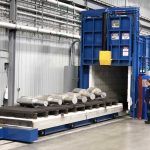
  • Gasbarre recently designed, manufactured, and commissioned a large capacity gas-fired temper furnace for a major specialty alloy manufacturing company located in the Northeastern portion of the United States. The furnace is designed to temper workloads that are 32 feet wide by 6 feet long by 4 feet high and weigh up to 40,000 lbs. The furnace utilizes the latest design and control technologies to achieve excellent temperature uniformity (±10°F) across a wide temperature range (800°F to 1400°F)
  • A new Hot Isostatic Press will soon be in operation at Lake City Heat Treating, expanding their Hot Isostatic Press capabilities for the aerospace and medical industries. With a much larger capacity of 2,000 pounds per load, Lake City will be able to expand load sizes and meet customer turnaround requirements. The new press will be housed in their new 6,000 square foot addition.
  • Solar Atmospheres of Western PA recently commissioned a new 20-foot car bottom furnace that has a total load capacity of up to 30,000 pounds. The Class 2 furnace, built by John Becker’s Heat Treat Equipment Inc., located in Canton, Michigan, was installed and fully tested for the first time in Hermitage, PA. This new piece of equipment will serve to compliment Solar’s lower temperature work – especially where surface oxidation is of little concern. It will also be used to economically process many “downstream” processes, including multiple tempering operations, which typically follow vacuum austenitizing treatments.
  • Quintus Technologies supplied a hot-isostatic press to a Chinese manufacturer to complement the additive manufacturing capabilities at Xi’an Bright Laser Technologies Co., Ltd. BLT produces 3DP parts in titanium and aluminum alloys, superalloys, and stainless, die, and high-strength steels, for a range of industrial applications, including automotive engine and structural parts, aircraft engine and structural components, mold/die, energy, electronics, and other customer segments.

Kudos Chatter

  • Materion Corporation recently announced that the Society of Automotive Engineers – Aerospace Material Specification Nonferrous Alloys Committee (SAE-AMS) has approved AMS4369 specification for SupremEX® 225XF metal matrix composite (MMC) and AMS4379 for SupremEX 225XE MMC. This represents the second AMS specification for SupremEX 225XE and applies to the extruded form of the material. With the two recently added specifications, the company now has a total of four AMS specifications for its SupremEX line of products, allowing engineers to reference a national standard for material properties.
  • Worcester Polytechnic Institute recently presented its 2018 Innovator of the Year Award to metallurgical pioneer Diran Apelian. The first WPI faculty member to receive the honor, Apelian is the founding director of WPI’s Metal Processing Institute, an internationally recognized researcher and educator, and a fellow of the National Academy of Inventors.
  • ASM International recently recognized several members for achievement at its ASM Awards Banquet, held in Columbus, OH on October 16, 2018. In addition, ASM International Trustee-Elects have been selected to serve on the 2018-2019 ASM Board of Trustees. ASM International’s trustees are charged with acting in the best interests of the society’s membership and help to lead the governance of the society. The ASM officers and trustees were officially installed in office at ASM’s Annual Meeting on October 15, 2018, also in Columbus, OH. Details can be found at ASM International’s website: https://www.asminternational.org/membership/awards/photos
  • Kanfit Ltd., a leading manufacturer of assemblies and subassemblies for the aerospace industry, announced today that it has recently achieved Nadcap re-certification for chemical processing and heat treatment following thorough audits of the Performance Review Institute. Kanfit was awarded recertification of Chemical Processing and is qualified for full Nadcap merit status of 24 months. This means that the frequency between audits has been increased from 18 months to two years. Kanfit has been Nadcap accredited for chemical processing since 2013 and has been accredited by Nadcap for heat treating since 2008.
  • GE Aviation recently produced 30,000th 3D printed fuel nozzle at its Auburn, Alabama, plant.
  • Surface Combustion Inc., Maumee, Ohio, has recently updated its website, which provides details about its standard atmosphere and vacuum furnace designs. Not only is the website mobile friendly, but also thermal processing solutions on the product, industry, and process pages are easier to navigate.

Heat Treat Today is pleased to join in the announcements of growth and achievement throughout the industry by highlighting them here on our News Chatter page. Please send any information you feel may be of interest to manufacturers with in-house heat treat departments especially in the aerospace, automotive, medical, and energy sectors to the editor at editor@heattreattoday.com.

15 Quick Heat Treat News Items to Keep You Current Read More »

Smart Alloys Break 400°C Barrier, Improve Aero Fuel Efficiency, Reduce Noise

[sc name=”aerospacepopup”]


Source: Texas A&M Today


Researchers at a Texas university recently announced a discovery involving the increased capability of high-temperature shape memory alloys (HTSMAs) that will improve fuel efficiency in jet engines and reduce airplane noise, as well as applications in several other industries.

Dr. Ibrahim Karaman, Chevron Professor I and head of Texas A&M University’s Department of Materials Science and Engineering

The team of researchers, led by Dr. Ibrahim Karaman, Chevron Professor I and head of Texas A&M University’s Department of Materials Science and Engineering, and including Demircan Canadinc, William Trehern, and Ji Ma of Texas A&M, and Fanping Sun and Zaffir Chaudhry, Technical Fellow of the United Technologies Research Center (UTRC), published their work in Scripta Materialia.

The accomplishment is critical because until now the use of HTSMAs has been limited to temperatures up to but not exceeding 400°C (752°F), but changing the elements that make up the HTSMAs allow for higher temperatures and therefore wider application.

“Karaman and his colleagues decided to try increasing the operating temperatures of HTSMAs by applying principles from another new class of materials, high-entropy alloys, which are composed of four or more elements mixed together in roughly equal amounts,” explained Texas A&M Today. “The team created materials composed of four or more elements known to form shape-memory alloys (nickel, titanium, hafnium, zirconium, and palladium), but purposefully omitted gold or platinum.”

When we mixed these elements in equal proportions we found that the resulting materials could work at temperatures well over 500 degrees C—one worked at 700 degrees C—without gold or platinum. That’s a discovery. It was also unexpected because the literature suggested otherwise. . . . What excites me is that we have just scratched the surface of something new that could not only open a completely new field of scientific research but also enable new technologies. ~ Dr. Ibrahim Karaman

Read more: “Smart Materials Could Open New Research Field”

Smart Alloys Break 400°C Barrier, Improve Aero Fuel Efficiency, Reduce Noise Read More »

9 of 11 Indices Up in IHEA Economic Report

According to IHEA’s monthly economic report to member companies, nine of the eleven indices are up and the only two that are not up are still quite strong. To get the weak indices out of the way, here they are: Purchasing Managers Index (which is still quite high), and the Transportation Activity Index (which also is quite high). Both showed slippage in September, but neither is a focus of worry.

PMI for September showed slight reductions, but is still strong overall.

Transportation Activity Index was slightly off for September, but still quite strong.

On the lead page of the report, the following summary paragraph appears:

The nine categories that ended up in positive territory include “new automobile/light truck sales” and this reflects the fact that consumers are still quite confident about their job security and have no issue with taking on debt to buy a new car or truck. The “new home sales” category is healthy, although it is important to note that there is a deepening division between the cities that are seeing growth between 20% and 40% and the those that are shrinking. It has all come down to which cities are generating jobs. The existing home market has not been quite as lively as the new home sector and it is much the larger of the two. The “steel consumption” category is still reflecting the desire on the part of steel consumers to hoard cheaper steel, but there has also been evidence of returning steel demand in everything from vehicles to pipelines to construction activity. The “metal prices” readings are all going up and that has been anticipated for some time. The only one that hasn’t is gold and that would suggest that fewer people are seeking shelter from inflation in this metal. The other industrial metals are all going up in response to increased demand.

The 12-page report goes on to offer in-depth analysis of all 11 indices and what impact each might have on the thermal processing industry. The full report is available for review from the Industrial Heating Equipment Association (www.ihea.org) and is an exclusive benefit of membership in the organization. If you’re interested in seeing a copy of the report, contact Anne Goyer, Executive Director of IHEA at Anne@GoyerMgt.com.

Ann Goyer, Executive Director of IHEA

9 of 11 Indices Up in IHEA Economic Report Read More »

Heat Treat Tips: Atmosphere Control

During the day-to-day operation of heat treat departments, many habits are formed and procedures followed that sometimes are done simply because that’s the way they’ve always been done. One of the great benefits of having a community of heat treaters is to challenge those habits and look at new ways of doing things. Heat Treat Today‘s 101 Heat Treat Tips, tips and tricks that come from some of the industry’s foremost experts, were initially published in the FNA 2018 Special Print Edition, as a way to make the benefits of that community available to as many people as possible. This special edition is available in a digital format here.

Today, we begin an intermittent series of Technical Tuesday posts of the 101 tips by category, starting with Atmosphere Control


Atmosphere Control

Heat Treat Tip 5

Out of Control Carburizing? Try This 11-Step Test

When your carburizing atmosphere cannot be controlled, perform this test:

  1. Empty the furnace of all work.
  2. Heat to 1700°F (926°C).
  3. Allow endo gas to continue.
  4. Disable the CP setpoint control loop.
  5. Set generator DP to +35°F (1.7°C).
  6. Run a shim test.
  7. The CP should settle out near 0.4% CP.
  8. If CP settles out substantially lower and the CO2 and DP higher, there’s an oxidation leak, either air, water or CO2 from a leaking radiant tube.
  9. If the leak is small the CP loop will compensate, resulting in more enriching gas usage than normal.
  10. Sometimes but not always a leaking radiant tube can be found by isolating each tube.
  11. To try and find a leaking radiant tube, not only the gas must be shut off but combustion air as well.

Submitted by AFC-Holcroft

Heat Treat Tip 13

Finding the Cause for Bad Parts

So you just ran a batch and the parts are bad. Now what? According to Jim Oakes at Super Systems Inc., here is a good checklist to use to start isolating the problem. While not exhaustive, this list can at least take you through a progression of steps to help start identifying the culprit.

Step 1:  Review the process data for abnormalities. Did the setpoint for temperature and atmosphere get set properly? Does the process chart show good control of the temperature and atmosphere? Was the time at heat correct? Was the quench and temper processes run properly?

Step 2:  Check the generator to make sure it was pumping out the right atmosphere.

Step 3:  Check the furnace atmosphere. Even if the generator is working, there may be leaks in the furnace.

Step 4:  Check carbon controller to make sure it matches furnace atmosphere reading. Verify probe accuracy and adjust carbon controller.

Step 5:  Do probe troubleshooting. And if all else fails . . .

Step 6:  Replace the probe or call Super Systems for help.

Submitted by Super Systems Inc.

Heat Treat Tip 49

What to Do When Parts Are Light on Carbon

Many factors can contribute to why parts are not meeting the correct hardness readings. According to Super Systems Inc., here is a quick checklist of how to start narrowing down the culprit:

  1. Review process data for abnormalities: The first thing to do is make sure the parts were exposed to the right recipe. Check the recorders to make sure the temperature profile and atmosphere composition were correct. Make sure all fans and baffles were working correctly. Determine if any zones were out of scope and that quench times were acceptable. If any red flags appear, hunt down the culprit to see if it may have contributed to soft parts.
  2. Check the generator. Next, check the generator to make sure it is producing the gas composition desired for the process. If available, check the recorders to make sure the gas composition was on target. If not, check the generator inputs and then the internal workings of the generator.
  3. Check the furnace atmosphere. If the generator appears to be working correctly, the next step would be to check the furnace itself for atmosphere leaks. Depending on what type of furnace you have, common leak points will vary; for continuous furnaces, common leak points are a door, fan, T/C, or atmosphere inlet seals. Other sources of atmosphere contamination may be leaking water cooling lines in water-cooled jackets or water-cooled bearings. More than likely, if the generator is providing the correct atmosphere but parts are still soft, there is a leak into the furnace. This will often be accompanied by discolored parts.
  4. Check carbon controller to make sure it matches furnace atmosphere reading (verify probe accuracy and adjust carbon controller). This can be done using a number of different methods: dew point, shim stock, carbon bar, 3 gas analysis, coil (resistance), etc. Each of these methods provides a verification of the furnace atmosphere which can be compared to the reading on the carbon controller. If the atmosphere on the carbon controller is higher than the reading on the alternate atmosphere check, that would indicate the amount of carbon available to the parts is not as perceived. The COF/PF on the carbon controller should be modified to adjust the carbon controller reading to the appropriate carbon atmosphere. If the reading is way off, it may require the probe to be replaced.
  5. Check the carbon probe.
  6. Replace the probe – CALL SSI.

Submitted by Super Systems Inc.

Heat Treat Tip 62

Double Check Carbon Potential Control
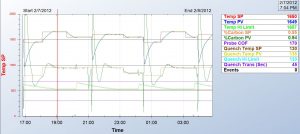
Configuring your atmosphere controller to ensure the correct carbon potential readings can sometimes be tricky. We suggest you double check your atmosphere control settings to make sure they are set up correctly. Before making a change to the carbon controller, make sure the atmosphere that the carbon probe and carbon controller are reading is matching up to an alternate method of atmosphere. This can be done using a number of different methods: dew point, shim stock, carbon bar, 3 gas analysis, coil (resistance), etc. Each of these methods provides a verification of the furnace atmosphere which can be compared to the reading on the carbon controller. The COF/PF on the carbon controller should be modified to adjust the carbon controller reading to the appropriate carbon atmosphere.

It is important to make sure that the alternate method of verifying atmosphere is done properly (sampling ports, time for atmosphere exposure, sample prep, etc).

The calculation of carbon in the atmosphere using a carbon/oxygen probe is based on the output millivolts — created based on the partial pressure of oxygen in the reference air versus partial pressure of oxygen in the furnace, the temperature of the furnace, and a calculation factor referred to as COF (CO Factor), PF (Process Factor), or Gas Factor.

The carbon controller can be modified so the COF/PF value can be changed to match up with the alternate reading. A furnace calculator on the SSI website or mobile app can help determine what these settings should be. It is important to note that you should not change these values to the point where you are masking another issue such as a bad probe or a furnace/generator issue.

Again, if the reading is way off (a setting of a COF below 130, for example), it may require the probe to be replaced.

Submitted by Super Systems Inc.

Heat Treat Tip 75

Carbon Probe Trouble Shooting

If you’re having atmosphere problems with a furnace that has been operating normally for some time, avoid the temptation to remove the carbon probe. There are several tests you can run on nearly all carbon probes while the probe is still in the furnace, at temperature, in a reducing atmosphere. Super Systems Inc. provides an 11-step diagnostic procedure in a white paper on their website, in a paper titled, “Carbon Sensor Troubleshooting” by Stephen Thompson.

Submitted by Super Systems Inc.


Heat Treat Tip 88

Slight Positive Pressures Are Best

Atmosphere furnace pressure should be only slightly above ambient. The range should be between 0.25 – 0.35 inches water column. Higher pressures in multiple zone pusher furnaces will cause carbon control issues. High pressures in batch furnaces will cause high swings when doors and elevators move.

Submitted by AFC-Holcroft

Heat Treat Tip 94

Confirm Composition of Endothermic Atmosphere
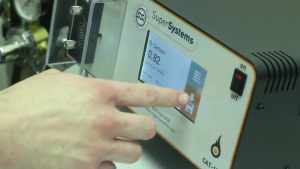
Wisdom dictates a trust-but-verify approach to your endothermic generator. Although your generator is supposed to crank out a consistent endo atmosphere, we suggest periodically verifying the integrity of that atmosphere with a dewpoint analyzer or a 3-gas analyzer. Generator control systems provide control of air gas ratio and possibly a trim system, used to maintain a dew point that could be rich (too much gas) or lean (too much air). The dew point range could typically be between 30°F and 50°F. Flowmeters are provided to maintain a base ratio (2.7 : 1) for the air/gas mixture supplied to a retort filled with nickel-coated catalyst. The gas is then passed through an air cooler (some older systems used water) to freeze the reaction so the gas can be transported through a header system to furnaces. The ratio at which the gas is generated offers a dew point that can be measured. The makeup of the endothermic gas provided by a generator is typically 40% hydrogen, 40% nitrogen, and 20% carbon monoxide. Maintaining these percentages will result in a carburizing atmosphere that is conducive to best carburizing practices.

Non-dispersive infrared analyzer (NDIR) systems are invaluable when trying to troubleshoot generator issues. The analyzer will typically measure CO, CO2, and CH4. As mentioned earlier, if we know that 20% CO is being generated, we can cross check the air/gas ratio and sticking flow meters, or determine that an adjustment of the air and/or gas ratio is required. The measurement for indication of sooted or nickel depleted catalyst can also be achieved by using an analyzer. If the indicated measurement of CH4 is higher than .5%, a burnout of the catalyst is required, using the manufacturer’s required procedures. If after a burnout the CH4 level is still high, the catalyst may need to be replaced altogether.

Submitted by Super Systems Inc.  


If you have any questions, feel free to contact the expert who submitted the Tip or contact Heat Treat Today directly. If you have a heat treat tip that you’d like to share, please send to the editor, and we’ll put it in the queue for our next Heat Treat Tips issue. 

Heat Treat Tips: Atmosphere Control Read More »

Steelmaker Commissions for Modernization of Annealing Line

A global steelmaker based in Sweden has turned to a French industrial engineering group to modernize the thermal part of its continuous annealing line at its Borlänge plant.

Fives will update the SSAB facility with the goal to increase the efficiency and capacity of the existing CAL in order to produce advanced high-strength steel (AHSS) with a view to meeting increasing demand from the automotive industry. Once complete, the line will have the capacity to produce 650 000 tons per year, up from the current production rate of 500 000 tons per year.

Fives was contracted to modernize the thermal part of the CAL by replacing the jet preheating furnace and installing inductors in cascade to increase efficiency. Fives will install a new Stein jet preheating furnace to recover the heat from the radiant tube furnace and four CELES MP inductors.

The optimized design of the preheating furnace blowing boxes and tightness of the new seal is expected to result in the recovery of more power will be recovered, allowing the strip to be preheated to higher temperatures. CELES MP inductors, a proven technology, will then increase the strip temperature before the strip entries into the radiant tube furnace.

In total, 16 MW of power will be installed as part of this project. The modernization of the thermal part will be implemented very quickly and will be completed by November 2019.

Steelmaker Commissions for Modernization of Annealing Line Read More »