

FEATURED NEWS

Inside GKN Powder Metallurgy’s Acquisition of Forecast 3D

Picture two men sitting at a bar table watching a video on a smartphone. As they enthuse about how much they love it, a bystander might be tempted to think they’re just killing time goofing off. “It’s fantastic technology,” the man with the phone, Forecast 3D founder and CEO Corey Weber, says of the Multi Jet Fusion (MJF) process featured in the time-lapse video that shows a Californian facility in the dead of night illuminated only by the passing of a dozen lights flashing over a dozen powder beds through until the morning. As he pulls back his smartphone, he and Guido Degen, GKN Powder Metallurgy’s President of Additive Manufacturing, look pleased with both the technology and themselves.

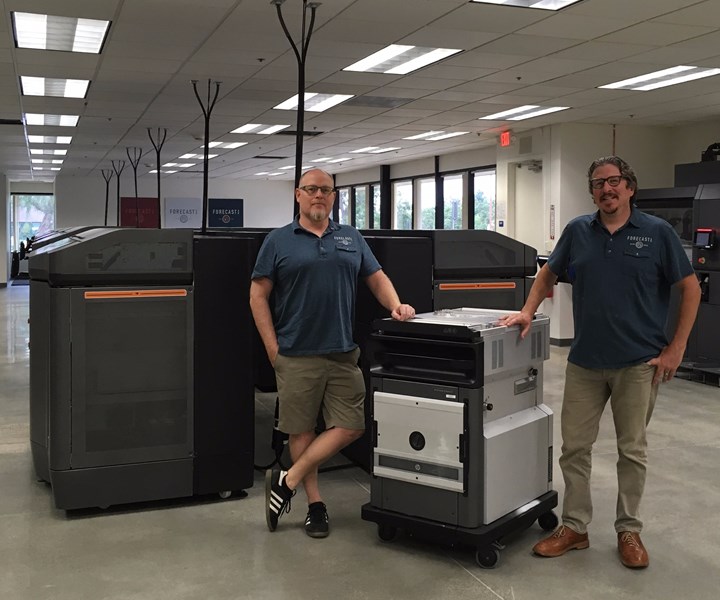
Corey and Donovan Weber, Forecast 3D, and Guido Degen, GKN

GKN Powder Metallurgy’s acquisition of Forecast 3D appears to be natural synergy. Much of Forecast 3D’s expertise exists in polymer 3D printing, serving the aerospace and medical markets on the West Coast. GKN’s focus is metal parts, the bulk of which is for the automotive market in Central Europe and the Midwest of the United States. When GKN highlighted the contrasting technological expertise that exists in both companies, the figureheads at Forecast were on the same wavelength.

Corey and Donovan Weber, the two brothers who founded Forecast 3D, shown in 2017 at their 3D Manufacturing Facility in Carlsbad, California.

“We knew that the opportunity is much bigger than the size of our pockets,” Weber acknowledges. “We needed resources and our goal was to get someone that shared our vision. We found those with GKN. . . . And, honestly, it’s kind of a relief because now we can really focus on polymers and let them handle metals.”

To read more from the original article, click here: https://www.tctmagazine.com/3d-printing-news/gkn-powder-metallurgy-forecast-acquisition-deal/


Inside GKN Powder Metallurgy’s Acquisition of Forecast 3D Read More »

DELTA H Commissions Heat Treating System to AAR Corp

DELTA H commissioned a Dual Chamber Aerospace Heat Treat (DCAHTTM) to AAR Corp. at Indianapolis International Airport. AAR is a leading provider of aviation services to commercial airlines and governments worldwide. At its Indianapolis MRO facility it performs heavy maintenance with a focus on the Boeing 737.

Kelly Sauer,
VP of Quality, AAR

The DELTA H dual chamber furnace meets our needs as an effective, efficient and complaint heat treatment solution,” stated Kelly Sauer, AAR Corp’s Vice President of Quality.

Ellen Conway Merrill,
VP, DELTA H

“As the largest independent MRO in North America and one of the top five MRO providers in the world, it’s truly humbling to have earned AAR’s trust for their in-house heat-treating capabilities,” stated Ellen Conway Merrill, DELTA H Vice President. “The commissioning service at AAR Indianapolis included full qualification testing as well as training certificates for operators and QC/QA. The DELTA H DCAHTTM furnace system enabled AAR to quickly qualify for not only aluminum, but also aging of PH stainless steel and titanium.”

The DELTA H DCAHTTM furnace features dual chambers operable to 1200°F and 500°F with precision control and temperature uniformity, and a roll-away stainless-steel quench tank. The system qualifies as Class 2 (+/-10°F) per AMS2750E and includes all controls, data acquisition technology, and spares parts package to be in full compliance with all aerospace pyrometry standards and National Aerospace and Defense Contractors Accreditation Program (Nadcap).

DELTA H Commissions Heat Treating System to AAR Corp Read More »

Meet Rio Tinto’s Revolutionary New Alloy

Global mining and metals specialist Rio Tinto is taking orders for its new aluminum wheel alloy known as Revolution-Al™. Researchers at its Arvida Research and Development Centre in Quebec, Canada, have spent more than five years developing a stronger car wheel alloy that would help cut fuel consumption and improve both safety and handling. The London-based firm says it received its first order for the new Revolution-Al™ alloy in September 2019 and that it designed the alloy to be easy to recycle.

Jerome Fourmann,
Technical Director,
Rio Tinto

“We wanted to offer automakers a new, innovative alloy that allowed them, through styling and design, to reduce the weight of the wheels, which is very important to improving fuel efficiency – because, in the end, people want to drive not just the safest but also the greenest and most innovative cars,” states Jerome Fourmann, a technical director at Rio Tinto.

According to Rio Tinto, Revolution-Al™ is 15 to 20 percent stronger than the current predominant wheel alloy, A356.2. They claim this translates to a 7 percent weight reduction and improved fuel efficiency or battery range. Additionally, Rio Tinto claims, Revolution-Al™ can be cast in existing facilities and requires less time to produce a wheel, thereby reducing the cost and increasing the rate of production.

The improved alloy features numerous claims; for instance, it is said to be 15 to 20% stronger than the traditional A356.2 alloy, has a seamless transition with existing casting processes, and requires a 2-hour shorter ageing cycle for heat treatment than the A356.2 alloy.

Jean-Francois Laplante,
Industrial Product and Investment Director,
Rio Tinto

It is worth noting that industrial trials of the new alloy, along with an official OEM test program, featured an optimized automotive wheel design, and Revolution-Al™ passed all OEM trials. What’s more, the alloy can be recycled onto itself, eliminating the need for selling the scrap at a discount.

“The current wheel alloy has been around for a long time and now we’re coming to the market with a new way of doing things,” says Rio Tinto Industrial Product and Investment Director Jean-Francois Laplante. “We were super excited when we saw the result.”

Photo Credit: Light Metal Age

Meet Rio Tinto’s Revolutionary New Alloy Read More »

StandardAero Expands Component Repair Capabilities

StandardAero has acquired a global services subsidiary based in Cork, Ireland, that provides specialized component repair and manufacturing processes for industrial, aeroderivative, and aircraft gas turbines.

TRS Ireland is a privately held company that has extensive experience as an OEM-approved specialty coating provider of engine component repair and MRO services on blades, vanes, and other hot section components for both new engines and a rising number of mature engines and a variety of applications.  The company, which has more than 180 OEM approvals/licenses and unique FAA and EASA certifications, also supports gas turbine users worldwide through its services.

Russell Ford,
Chairman & CEO,
StandardAero

“TRS Ireland has a long-standing, hard-earned reputation in the industry as a reliable service partner and will bring immediate growth and opportunity for StandardAero,” said Russell Ford, Chairman & CEO of StandardAero.

Rick Stine,
President of StandardAero’s CH&A Division

“TRS Ireland’s robust and long-tenured engineering and development team has extensive intellectual property around turbine airfoil and coating technologies and we see significant opportunities to leverage these capabilities and capacity to the fast growing aerospace and aeroderivative turbine engine repair markets,” added Rick Stine, President of StandardAero’s CH&A Division.

With the addition of TRS Ireland, StandardAero now has 40 primary repair facilities located on five continents.

StandardAero Expands Component Repair Capabilities Read More »

The Nadcap Accreditation Process Explained

          Source: Vac Aero International Inc.

Nadcap accreditation is looked on by most of the heat treating world as a significant achievement and a guarantee of quality. It not only permits a company to perform heat treating for the Aerospace/Defense industries but also tells customers that this company has a high standard of quality.

So what is it, and how does it work?

In this HTT Best of the Web Technical Tuesday feature, Vac Aero International takes readers through the entire Nadcap accreditation process from start to finish, examining what it is, how it works, and troubleshooting problem areas.

An excerpt: “Nadcap accreditation benefits not only the company being audited but helps ensure their customers receive products and services that meet or exceed both their expectations and requirements. The audit and accreditation processes result in continuous improvement in multiple areas, with deficiencies (i.e., nonconformances) identified and corrected based on specific rules (i.e., guidelines) to ensure each process meets or exceeds industry standards.”

Vac Aero gives a detailed look at the common pitfalls in the accreditation process, useful resources and training courses to help companies prepare for their audit, and what to do after the audit is complete.

Read More: The Nadcap Accreditation Process by Vac-Aero International

Photo Credit: TAV Vacuum Furnaces

The Nadcap Accreditation Process Explained Read More »

Stack Metallurgical Group Adds Vacuum Furnace to its Capabilities

Stack Metallurgical Group, a Nadcap accredited and Northwestern U.S. commercial heat treater, recently installed  a TITAN® vacuum furnace at its location in Spokane Valley, Washington. Formerly known as Inland NW Metallurgical Services, Stack Spokane is one of the company’s four locations offering metal processing services such as vacuum heat treating, induction heat treating, aluminum chemical processing, and ion nitriding. Ipsen USA  completed the installation.

Ron Decker,
General Manager, Stack Metallurgical Services, Inc.

“It was an easy choice adding another Ipsen furnace to our offering,” said General Manager Ron Decker. “We count on Ipsen for a versatile product that delivers great results.”

Installation of the TITAN® H6 2-bar vacuum furnace was completed in late 2019 and will be used to process aerospace components. Stack operates four Ipsen furnaces in Spokane and a dozen more in Portland.


Stack Metallurgical Group Adds Vacuum Furnace to its Capabilities Read More »

Airbus to Increase Production of U.S. Aircraft

Airbus will expand operations in the U.S. by increasing the production rate of A320 family aircraft at its U.S. manufacturing facility in Mobile, Alabama, to seven per month by the beginning of 2021 as part of its plans to produce 63 of this aircraft per month. With plans already in place for production of four A220 aircraft per month in Mobile by the middle of the decade, Airbus is on track to produce more than 130 aircraft in Mobile each year for its airline customers.

C. Jeffrey Knittel,
Airbus Americas Chairman & CEO

Airbus Americas Chairman and CEO C. Jeffrey Knittel said, “Airbus has been manufacturing in the U.S. for many years now through our helicopter, aircraft, and satellite products. This increase in commercial aircraft production in Mobile is an exciting expansion of our significant industrial investment in the U.S., and it continues Airbus’ positive contribution to American aerospace.”

Airbus plans to open its new final assembly line for the A220 in Mobile this year and deliver the first U.S.-made A220. They are on track to deliver their 200th U.S.-built A320 family aircraft in the summer.


Airbus to Increase Production of U.S. Aircraft Read More »

Gulfstream Awards GAMPS 5101 & 5102 Certification to Heat Treater

Gulfstream recently awarded Solar Atmospheres of Western Pennsylvania with material processing specification approvals for GAMPS 5101 and 5102. Specification GAMPS 5101 relates to the heat treatment of low alloy steels and GAMPS 5102 is associated with the annealing and precipitation hardening of PH stainless steel. Compliance to these two specifications are important to ensure that flight-critical raw materials and parts are heat treated and tested properly.

Michael Johnson,
Sales Manager
Solar Atmospheres of Western PA

“This prime approval not only gives our current customer base permission to use our location for thermal processing of Gulfstream components, it also gives them the ability to run larger loads of 40,000 – 60,000 lbs. at a time, due to our large furnace sizes,” stated Michael Johnson, Sales Manager. “The larger loads reduce the number of certifications, furnace charts, and mechanical testing documentation that is typically required post heat treating.”


Gulfstream Awards GAMPS 5101 & 5102 Certification to Heat Treater Read More »

CMC: What are They? Why are They Important?


Source: L&L Special Furnace Co., Inc


CMC stands for Ceramic Matrix Composite, and these materials are considered a subgroup of both ceramics and composite materials. CMC components are used in the energy and power, defense, aerospace, electrical, and electronics industries. In this Best of the Web Technical Tuesday feature, L&L Special Furnace Co., Inc. delves into the composition, applications, fabricating process, and uniqueness of CMCs.

An excerpt:

“CMCs are able to retain a relatively high mechanical strength even at very elevated temperatures. They offer excellent stiffness and very good stability, both mechanical, thermal, dimensional, and chemical.”


To explore more about ceramic matrix composites, read more: “What Are Ceramic Matrix Composites?”

CMC: What are They? Why are They Important? Read More »

Nitrex Acquires Furnace Manufacturer G-M Enterprises of California

Nitrex, a global provider of fully integrated heat-treating solutions and technologies based in Montreal, Canada, acquired G-M Enterprises, a manufacturer of vacuum furnaces, headquartered in Corona, California.

Mrs. Veena Jhawar, G-M Enterprises COO; Mr. Jean-François Cloutier, Nitrex CEO; Mr. Suresh Jhawar, G-M Enterprises President

The addition of G-M Enterprises will further expand Nitrex’ integrated heat treatment solutions to customers; both share the same goal of providing technologies that focus on customer workflow and efficiency while maximizing the life span and quality of engineered parts and components.

Jean-Francois Cloutier,
Nitrex CEO

“This acquisition will allow Nitrex to bolster its turnkey solutions business by bringing a new, innovative and broader mix of heat treatment systems to our customers,” said Jean-Francois Cloutier, Nitrex CEO. “We also look forward to welcoming the entire G-M Enterprises’ team into the Nitrex family.”

“Joining forces with Nitrex and becoming part of its family of companies will ensure we keep pace with our customers’ evolving needs and expectations,” says Suresh Jhawar, G-M Enterprises President. “What this means for the future of G-M Enterprises is an opportunity to enhance our products and services, expand our international presence further by leveraging the resources, expertise, and capital of Nitrex.”


Nitrex Acquires Furnace Manufacturer G-M Enterprises of California Read More »