


Leone

Top 5 Benefits of Using Induction Heating for EV Manufacturing

Alternatives to internal combustion engines have long dominated conversations in the automotive world. Discover why induction heating is playing a vital role in the production of the electric vehicle in this Technical Tuesday original content article written by Michael Zaharof, regional sales and marketing manager at Inductoheat.

This article first appeared in Heat Treat Today's May 2021 Induction print edition. Find the digital upload and other past editions here.


Michael Zaharof
Regional Sales and Marketing Manager
Inductoheat

The electric vehicle (EV) sector of the automotive market is gaining momentum. Government mandates, fuel economy standards, and increasing consumer interest are all driving the push to EV. Some platforms are further along in the process, while others are just starting to enter the space. Many new ideas and vehicle configurations are being developed to deliver the best alternative to the internal combustion engine (ICE).

This industry is learning about the best way to configure drive mechanisms and control acceleration, be it a centralized power source operating a driveline or multiple motors powering different areas of the vehicle. Heat treating the necessary components properly to impart enough strength for the much higher torque delivery is more critical than ever compared to the traditional performance characteristics of those equipped on a standard ICE platform. Induction heating plays a critical role in the EV market as it permits several unique benefits over other thermal processing methods. Whether it is heat treating, shrink fitting, curing, or surface hardening, induction heating is one technology that has already proven itself to be beneficial for the manufacturing of electric vehicles.

Deeper Case Depth

Because of the almost instant torque delivery and fast acceleration characteristics of electric motors, EV driveline components must be more robust to handle the added torsional stresses. Combined with the need for wear resistance and fatigue life, these components must be heat treated to deliver these critical properties.
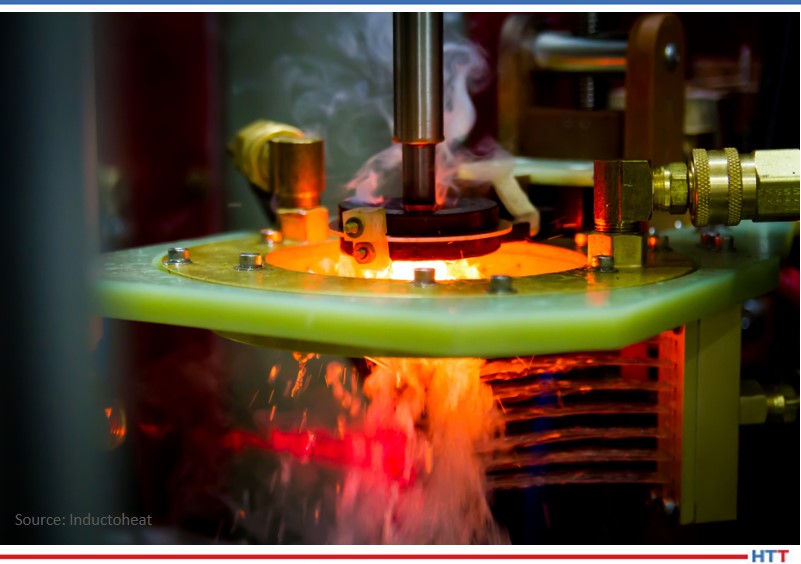
Induction heat treating of an automotive pinion

The powertrain components generally made with carbon steels (such as bearings, raceways, constant velocity joints, pinions, shafts, hubs, and gears), must be sufficiently hardened to provide enough strength, while remaining ductile enough to prevent premature failure. Induction hardening is ideal in many cases since it can deliver deeper hardened case depths, if desired, compared to other methods like conventional gas carburizing and nitriding. These alternative heat treatment methods must rely on diffusion mechanisms associated with a sustained and prolonged environment.

Alternatively, induction utilizes subsurface heating through electromagnetic current applied to a specified and customizable area achieving the desired casehardened depths. Because heat can be applied quickly to the specific area, electromagnetic induction produces much less metallurgical distortion compared to thermochemical methods that rely on through-heating and diffusion processes at high temperatures, which in some instances eliminates or diminishes the need for post heat treatment grinding or machining.

Fast & Flexible

The speed of manufacturing is an essential factor in keeping a supply chain moving and having enough product available. Many manufacturers and automotive part suppliers have adopted just in time (JIT) manufacturing workflow methodologies to increase speed to market while controlling production and inventory costs.
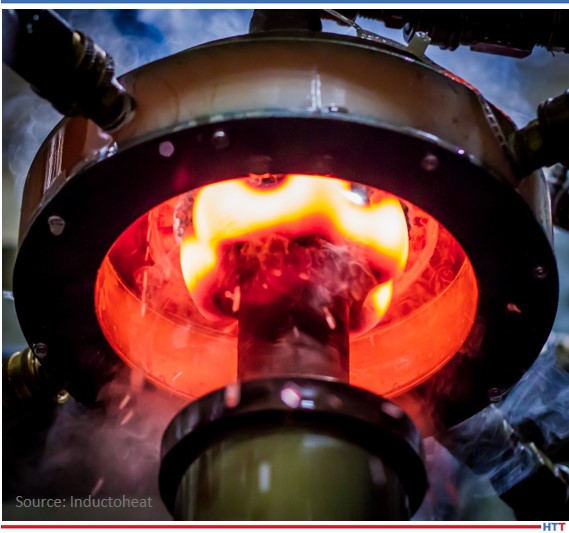
Induction heating of an automotive CV inner race

Induction hardening allows for parts to be processed as needed and in a way that does not require hours of processing time in contrast to alternative thermochemical heat treating methods. Because of the constant flow of individual parts and almost instantaneous time to heat, production can be incremental and consistent while still being flexible enough to adjust rates as needed. This flexibility and lean approach to inventory management can be more difficult when batches of parts are being processed together.

Also, because material distortion after induction heat treatment can be much lower, as previously mentioned, post-heat-treatment manufacturing operations can be reduced or eliminated.

Single Part Flow: Repeatability & Traceability

Part process flow is an important consideration when repeatability and traceability become essential, like in automotive manufacturing. When multiple parts are being processed simultaneously, such as in a furnace operation, individual parts cannot be validated while the heat treatment is in process. The part variability in batch operations can be impacted by part spacing, location in the furnace, gas concentration, and temperature from one batch to another.

Many quality standards require tight control of the heating process and data collection during heat treatment to ensure that acceptable parts are being made. Induction heating allows precise monitoring and real-time evaluation of each stage in the heat treat process. The parameters of the process cycle – such as quench temperature, quench concentration percentage, quench pressure, quench flow, energy used, frequency, and part rotation – are just some of the points that can be analyzed by today’s sophisticated sensors and signature monitoring systems.
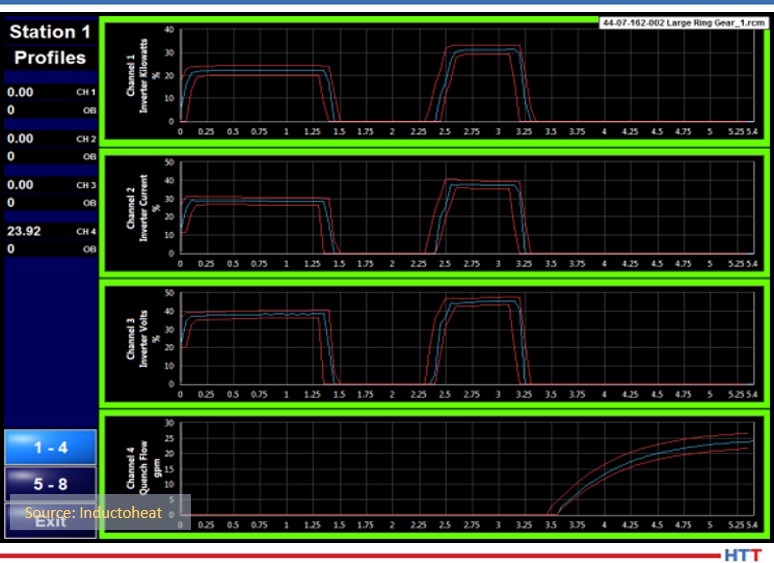
Signature monitoring system by Inductoheat

Some of the more advanced monitoring systems, like those offered by Inductoheat, allow the user to “teach” the induction machine what a “good part” signature looks like as all the data points of the process are plotted throughout the cycle and compared to established acceptable limits. As the process runs in production, the user can validate that all critical factors being monitored are in specification.

In the event of an issue in which one or more points are out of specification, the part will be rejected by the quality system. The cycle processing data can be instantly associated with each heattreated piece through part marking/reading or the most suitable such as radio frequency identification (RFID),u for example, for storage and later use by the manufacturer.

Environmentally Friendly

Induction heating uses electricity as its means of heat generation. Other methods such as carburizing and different batch heating processes employ gases such as ammonia and other chemicals in conjunction with fossil fuel-powered furnaces. Induction heating is considered a clean and environmentally friendly option for heattreating.

The process uses electrical energy and can quickly cycle through the desired operation and then sit idle until needed again. Most alternative systems require warm-up and cooldown time before and after production runs. In some cases, it is less expensive to keep the furnace running while continuing to burn natural resources and vent exhaust gases into the environment compared to shutting the system down in between uses.
More Efficient 

Induction heating is a fast and efficient operation and can be scaled up easily to meet production requirements. Induction heating machines generally take up much less floor space than gas-powered batch furnaces. As mentioned above, they can be operated when needed without lengthy preheat or cooldown sequences.

Induction heating is associated with greater heat intensity, transferring more power directly to the workpiece in a concentrated fashion, compared to most other methods that rely on heating a surrounding environment. Induction coils can be designed to apply the required current density into an exact area of the part to be heat-treated instead of heating the entire piece.

The induction process is also more efficient as energy output can be controlled precisely to apply only the necessary power needed to obtain the desired temperature profiles at the desired production rate.
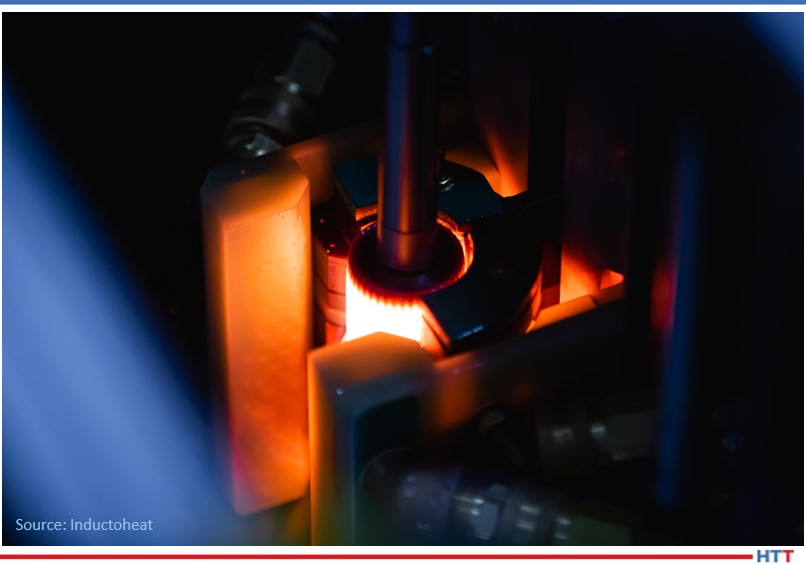
Induction heating of an automotive input shaft

Conclusion

Induction heating is a proven and environmentally friendly process that has a long history of precision and repeatability. The ability to heat parts quickly and more effectively is why many companies have opted for induction heating over other heat treat methods. Some other popular applications utilizing induction heating employed in EV production include shrink fitting, brazing, bonding, curing, battery production, stamping, forming, and varnishing of motor components.

Induction heating technologies are also dynamic, changing every day to meet new requirements and manufacturing goals. The use of multiple power levels and frequencies from a single induction inverter is one such innovation changing how some parts are being engineered and produced. Induction heating is a solution that will continue to assist the automotive manufacturing industry for years to come.

About the Author: Michael Zaharof is a regional sales and marketing manager at Inductoheat in Madison Heights, Michigan. He has been with the company since 2011 and has worked in the sales application, digital media marketing and outside sales departments. Michael has a bachelor of computer science in Information System Security. Michael currently works with customers in several states with their induction heat treating and induction forging needs.

Contact Mike at mzaharof@inductoheat.com.

Top 5 Benefits of Using Induction Heating for EV Manufacturing Read More »

Happy Memorial Day!

Heat Treat Today would like to wish everyone a Happy Memorial Day as you spend time with loved ones and reflect on the sacrifice that men and women gave to protect this nation in the hopes of it becoming a more perfect union. From the Civil War origins to the World War I symbolic adoption of poppies to Congressional affirmation of the permeant holiday as "Memorial Day," we are grateful for this moment to take a rest and give humble thanks to those now past.

Have a blessed and safe holiday!

- The team at Heat Treat Today

Happy Memorial Day! Read More »

Aalberts Surface Technologies Heat To Receive a Vacuum Furnace with Nitrogen Quenching

HTD Size-PR LogoGlobal commercial heat treater with 17 locations in North America, Aalberts Surface Technologies Heat in Kalisz (Poland), will receive a vacuum furnace with nitrogen quenching and an atmosphere furnace at their specialized commercial hardening plant. This expansion of its production line builds on their acquisition of a high vacuum furnace at their Dutch branch in Eindhoven last year.

The new SECO/WARWICK furnaces, added to the furnace that they had supplied last year, will create a production line that will be used for successive vacuum carburizing (LPC) and gas quenching (with the new CaseMaster Evolution-T vacuum furnace, or CMe-T furnace), followed by annealing (with the new BREW atmosphere furnace) to reduce the internal stress of the treated metals. Performing so many processes is possible thanks to the combination of vacuum technology with atmosphere technology.

The commercial heat treater believes that this expansion in capabilities will progress their mission. "According to our mission statement," said Wojciech Matczak, plant manager at Aalberts Surface Technologies Heat Kalisz, "‘Best-in-class’ is not about our core technologies but about our commitment to do everything we can to make our clients successful."

Maciej Korecki
Vice President of the Vacuum Furnace Segment
SECO/WARWICK
(source: SECO/WARWICK)

The three-chamber CaseMaster Evolution-T furnace has 1 ton per batch capacity and an annual output of up to 2,000 tons of parts. It can replace 3 conventional atmosphere furnaces. Additionally, it has fast cooling nitrogen chamber, achieving results similar to helium and oil cooling, creating an environmentally friendly system. Using the nitrogen taken from and discharged to the air eliminates both the use of expensive and difficult to obtain helium and harmful quenching oil. This makes it possible to reduce CO2 emissions by 300 tons annually, which is the amount generated by three standard atmosphere furnaces.

“Aalberts Surface Technologies Heat had special requirements," explained Maciej Korecki, VP, of the Vacuum Business Segment at SECO/WARWICK, "regarding the components and solutions used, and thus [the vacuum furnace] will replace the existing semi-continuous processes under protective atmosphere followed by oil quenching with complete vacuum heat treatment with low pressure carburizing and nitrogen quenching (25 bar!), delivering process precision and repeatability. . ."

The second furnace, the BREW 6810 solution, will make it possible to perform the annealing process immediately after vacuum carburizing. It can operate between 572 and 1382°F (300 and 750°C) and is equipped with a system to enable treatment under nitrogen atmosphere, preventing oxidation on the heat-treated workpieces.

Aalberts Surface Technologies Heat To Receive a Vacuum Furnace with Nitrogen Quenching Read More »

Heat Treater To Receive High Temperature Pusher Furnace

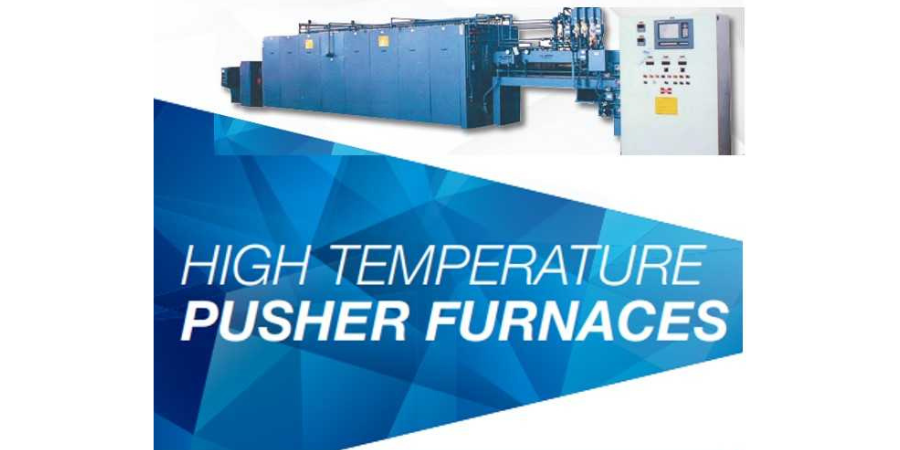
HTD Size-PR Logo A specialty tungsten alloy products manufacturer in the eastern United States will receive a high temperature pusher furnace.

The furnace, from Gasbarre Thermal Processing Systems, is designed for high temperature sintering with operating temperature capabilities up to 2750°F (1510°C). The system is electrically heated using molybdenum elements and utilizes the latest in refractory materials for efficient operation.

The pusher system processes trays 8” wide x 12” long under 100% hydrogen atmosphere and includes an automated return conveyor for effective loading and unloading.

Gasbarre was selected as the equipment provider based on their knowledge of high temperature sintering and ability to service and support the client.

Heat Treater To Receive High Temperature Pusher Furnace Read More »

Induction Hardening: Understanding the Basics

OCInduction is a curious member in the family of heat treating. Its presence is valuable, yet there’s a mystery surrounding it that has even veteran heat treaters exploring it to gain understanding. Journey through this induction hardening primer to learn about this important misfit of the heat treating world.

This Heat Treat Today Technical Tuesday original content feature, written by Kyle Hummel, P.E., COO at Contour Hardening, first appeared in Heat Treat Today's May 2021 Induction print edition. Feel free to contact Karen Gantzer at karen@heattreattoday.com if you have a question, comment, or any editorial contribution you’d like to submit.


Kyle Hummel, P.E..
Chief Operations Officer
Contour Hardening

In the world of heat treat, induction hardening just doesn’t fit in. There is no big furnace, cycle times are a matter seconds, and the entire process takes place right before your eyes rather than behind the walls of a furnace chamber. Many heat treaters have one old induction machine sitting in the corner of the shop floor, with one remaining employee who knows how to operate it.

Induction is different than all other types of heat treatment, and even many metallurgists shy away from the "black magic" that occurs during the process. When I ask customers how familiar they are with induction hardening, they usually state that they have seen it before, mention something about a coil, but that’s about the extent of their knowledge.

The purpose of this article is to give readers, who are not familiar with the induction hardening process, some background on the fundamental aspects and terminology of the process. The information encompasses the most common questions I am asked by new customers as well as information I would provide in training new employees. My hope is that it will give you enough familiarity with the process to become more comfortable engaging in a conversation about induction hardening.

Why Use Induction?

Selective hardening – Induction allows you to harden only the desired portion of a part, whereas most furnace-based heat treat processes treat the entire component. This means you can harden the particular area that you want to harden, while leaving the rest of the component soft enough to machine further.

Strength – Not only does the part become harder, but the stress (called residual compressive stress) that is induced into the part will make it stronger. Other processes can meet the improved wear resistance of the added hardness but fail to strengthen the part at all, or not as much as induction hardening.

Single piece flow – Because induction hardening is not a batch process (typically one part is hardened at a time), induction machines can be placed in a manufacturing cell, allowing the process flow to be uninterrupted.

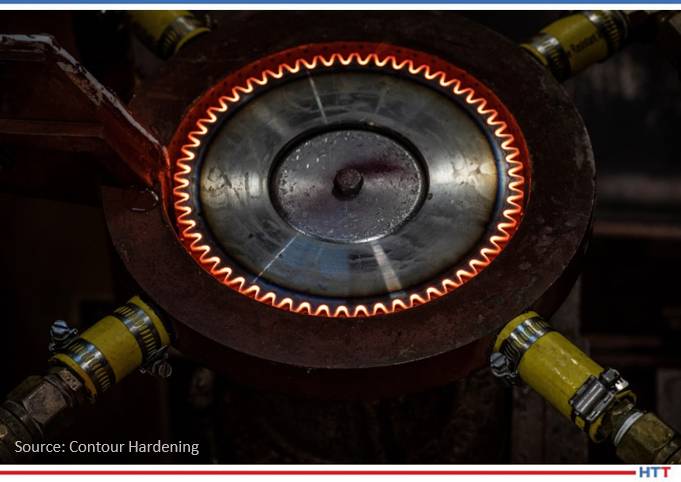
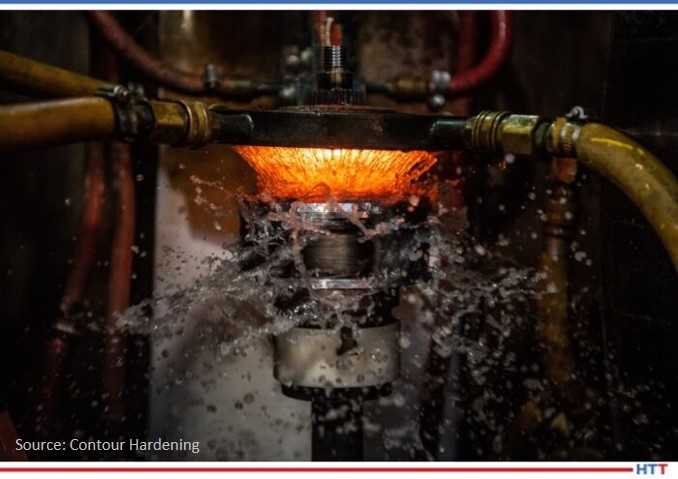
Induction hardening in action

Equipment and Tooling

Induction Hardening Machine – Systems will vary significantly in size and complexity depending on the components they are hardening. The primary components of the machine consist of a power supply, heat station (transformer), workstation, and HMI. The fluids system is composed of quenchant to cool the part being hardened and distilled water to cool the internal components of the machine. Heat time, power supply output, part rotation, and quenchant parameters should be controlled, monitored, and logged for each part.

Power Supplies – Power supplies are the most important component of the induction hardener. For the purpose of this article, we will discuss the two most important outputs of the power supply, frequency and power.

Frequency is important because it will help determine the depth of heating. Lower frequencies heat deeper into the part, and higher frequencies heat closer to the surface. To remember this, I like to use the analogy of whales using very low frequency calls to communicate over miles and miles of ocean, whereas the high-pitched squeak of a mouse can only be heard several feet away. For induction hardening, frequencies are split into two groups: medium frequency (MF) and radio frequency (RF). The MF range is typically from 3-50kHz, and RF is from 100-400kHz.

Power is important because it will determine how large of a part you can harden, and how long the heat time will need to be. The more power that a machine can output, the larger the part it can harden and the faster it can harden to a specified case depth. Typical power supply outputs for induction hardening range from 25kW to 1MW.

Coils – The induction coil is a copper conductor that is shaped in order to harden the specified area of the part. The current that flows through the coil is what produces the magnetic field, which in turn heats the part. Coils are typically part specific, since they need to be precisely constructed to heat a particular portion of the part.

Modern induction coils are water cooled and can be made of tubing or machined copper pieces that are brazed together to make a particular shape to fit the part. They are frequently equipped with sections of a material called flux intensifier, which helps to drive the magnetic field in a certain direction in order to intensify heating in that area and make the coil more efficient.

It is also common to have the quenching designed into the coil (machine integral quench, or MIQ) so that quenchant can be applied immediately after heating without the need to move the part to an auxiliary quench mechanism.

Process Basics

Single Shot – Single shot hardening is the most common method of induction hardening where the part and coil remain in the same spot during the heating process. Typically, the part is brought into proximity of the coil, the heating and quenching processes are applied to the part, and then the part is removed from the coil.

Scanning – Scanning involves heating and quenching a small portion of the part while moving either the coil or the part until the desired area is hardened. Quench is directionally applied to the part so that as a new portion of the part is heated, the previously heated section is being quenched appropriately. Scanning is frequently used to harden shafts because heating the entire shaft at once would require too much power.

Dual Frequency – Dual frequency hardening combines the benefits of the deeper heating of the lower MFs with the surface heating capabilities of higher RFs. By utilizing two different frequencies, it is possible to contour the hardening pattern more effectively on gear-like components, which further improves the strength of the part. The frequencies can either be applied consecutively (low frequency preheat followed by a high frequency final heat) or simultaneously.

Induction Tempering – Induction can also be used to complete the temper process in a few seconds rather than furnace tempering which could take hours. Induction tempering takes place after the hardening process and involves heating the part to a much lower temperature than is required during hardening. The targeted temperature for induction temper is higher than that of furnace tempering due to the decreased temper time. This softens the hardened area slightly in order to increase the toughness of the part and improve crack susceptibility.

Quenching – The quench process is just as important as the heating process with induction hardening. Almost all modern systems use a water/polymer quenchant mixture in the range of 5-20% polymer instead of using oils. The quench media is typically sprayed on to the part rather than submerging it into a bath. Quench concentration, temperature, flow, and pressure must all be monitored closely for a robust process. These parameters all function to guarantee that the part is quenched properly and consistently to ensure the correct hardness is achieved and crack susceptibility is minimized. Quench media must also be filtered to remove any process waste that could potentially clog the quench spray holes.

Inspection – Like most other forms of heat treatment, the two most common specifications with induction hardening are case depth and hardness. Most specifications will require surface hardness measurements along with effective case depths to determine the depth of hardening.

Materials – The most common materials to be induction hardened are medium to high carbon and alloy steels, cast irons, and powder metal. Induction is also becoming a popular heat treat method on certain stainless steels in different industries.

Induction hardening in action

What to Look Out For

Cracking – The rapid expansion of the part during heating followed by shrinkage from the accelerated cooldown during quenching increases crack susceptibility of induction hardened parts. Not all parts have a high risk of cracking, but part characteristics such as internal holes, sharp edges, and certain higher carbon materials will require more consideration. If cracking is an issue, the first two areas to investigate are overheating and quench severity. Reducing the quench severity (increasing quench temperature and concentration, reducing flow and pressure) is typically the most effective means of reducing cracking within an induction hardened part.

Distortion – Another side effect of the rapid expansion and contraction is part distortion. It is impossible to not distort the part with induction hardening due to the phase changes in the metal. However, with a robust and carefully monitored process, it is possible to minimize and accurately predict process distortion. Faster heating times and technical expertise in fixturing methods are two common methods to reduce distortion.

Conclusion

Although this information just begins to scratch the surface of the terminology and fundamentals of the process, hopefully it provides a starting point to those with limited experience. Like many other forms of heat treatment, it can take years to develop the knowledge and skills to gain expertise in induction hardening. I have been involved in induction for almost fifteen years, and I find there is always a new application that gives me the opportunity to learn even more.

About the Author: Kyle Hummel is a licensed Professional Engineer who has worked for Contour Hardening for 15 years as a metallurgical engineer and currently manages operations of Contour’s Indianapolis location.

For more information, contact Kyle at khummel@contourhardening.com or 317.876.1530 ext. 333

Induction Hardening: Understanding the Basics Read More »

Paulo

"We want to make sure our customers succeed, and we do that by bringing our unique approach to every job." These are words that describe the mission of Paulo, a company whose areas of expertise reside in heat treating, brazing and metal finishing.
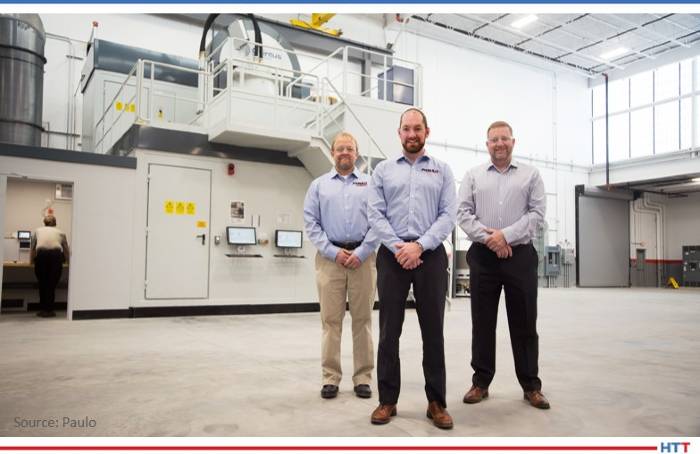
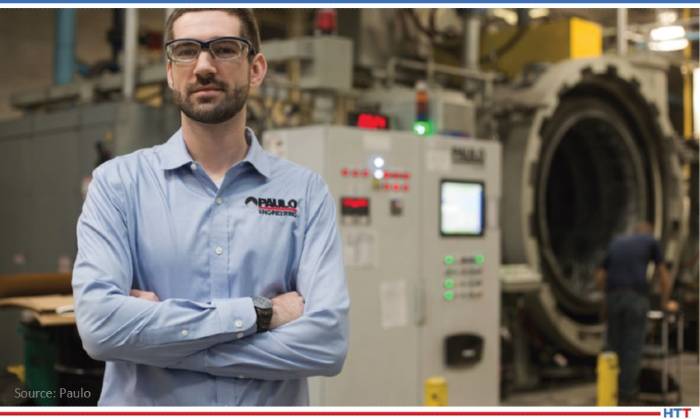

A family business founded in 1943 by Ben and Pauline Rassieur in St. Louis, Missouri, Paulo now employs 400 people and provides almost every form of heat treatment as well as zinc plating and phosphating, black oxide, brazing, and hot isostatic pressing (HIP)—their most recent addition.

(left to right) Scott Russ, William Rassieur, and Scott Herzing

The company’s large metallurgical engineering staff performs testing, process development and improvement, and compiles metallurgical reports. Through the strategic location of their six facilities and the varied processes offered, they are equipped to partner with organizations up and down the supply chain to handle everything from overnight tool and die work to millions of pounds of production work for a variety of industries all with the support of their control systems and built-in contingency planning.

A few of the services they offer are through hardening, carburizing, nitriding/FNC, solution treating/aging, austempering, and HIPing. A few of the equipment capabilities include integral quench, mesh belt, vacuum, tip-ups, and HIP.

An important heat treating capability that helps them to succeed in the company’s mission is the ability to collect data and control furnace conditions in order to deliver consistent repeatable results. Additionally, as the largest privately held heat treater in North America, they can invest to support customer’s growth as they did recently in Monterrey, Mexico, announcing a large expansion that will double the square footage.

Derek Denlinger
Paulo

Paulo has heat treated interesting and memorable parts, from those used in space and on airplanes to those that supported PPE during the pandemic. Two that had big impacts on the company’s trajectory was the brazing of 106mm artillery shells and fuel pump housings.

"Datagineering" is a word the company created to explain the blending of the best in automation, data, and human expertise. As they look to the future, their continued implementation of the company-coined verb will aid in supporting customers, continuing overall improvement, and developing technically to push boundaries and deliver the best results.

Paulo Read More »

13 Quick Heat Treat News Chatter Items to Keep You Current

Heat Treat Today offers News Chatter, a feature highlighting representative moves, transactions, and kudos from around the industry.


Equipment Chatter

  1. Foundrax Engineering Products Ltd, global Brinell test specialist, has launched the “BRINscope Duo”, a patent-pending, dual-illumination, hand-held microscope for measuring indentation diameters.
  2. TAV VACUUM FURNACES SPA received an order for a horizontal vacuum heat treatment furnace for a Brazilian company who specializes in different heat treatments (including quenching, cementation, nitriding) for the engineering industry.


Personnel/Company Chatter

  1. Mark Hemsath, former vice president of SECO/VACUUM Technologies LLC, is joining Nitrex’s Heat Treating Services Sales division. He will be taking on the role of vice president of Sales Heat Treating Services, Americas.
  2. Zachary Thomas will be assuming the role of outside sales manager at Solar Atmospheres of Western PA. He will be reporting directly to their sales director, Mike Johnson.
  3. AFC-Holcroft launched “AFC-Holcroft University,” a training program for all employees. This training offers their entire staff, including those in non-technical roles, the opportunity to learn more about the company, products, and technology.
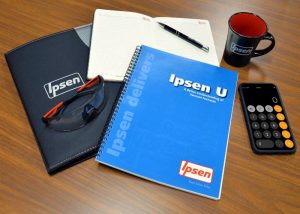
  4. Ipsen is offering on-site Ipsen U courses to accommodate large groups at client facilities. Ipsen U is a course designed to teach heat treatment fundamentals, best practices and new methods.
  5. Rockford Systems, LLC, dba Rockford Combustion Solutions, is broadening its portfolio of offerings to include field service throughout the United States, Canada and Mexico.
  6. Throughput Consulting Inc., a leading Manufacturing Execution and Quality Management System software provider, hired Joe Coleman as its new cyber security officer to assist customers and their vendors in achieving compliance of NIST 800-171, CMMC and DFARS. He will be working with the Bluestreak™ team towards this end.


Kudos Chatter

  1. Nitrex launched their new website to reflect their company’s values and brand.
  2. Solar Atmospheres Greenville, SC facility has been awarded Aerojet Rocketdyne approval, their second aerospace prime approval of 2021.
  3. Berndorf AG, parent company to AFC-Holcroft, graduated its 2020/2021 class of its Berndorf Academy, an exclusive, yearlong management training offered to select employees chosen from the corporation’s global subsidiaries. AFC-Holcroft’s Jason Crook, electrical engineering manager, was one of the graduates.
  4. Newage Testing Instruments announced the launch of its new webshop, www.store.ametekstc.com to shop for hardness testing accessories such as test blocks, indenters, and anvils that can be used with both Newage’s products as well as other Rockwell, Brinell, Vickers, and Knoop hardness testing and microhardness testing systems.
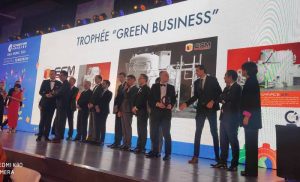
  5. ECM Technologies was recognized as one of the companies who is leading the way towards a better, brighter, greener future. ECM’s ECO Furnace was presented the Green Business Award for accomplishing a cleaner, safer, and more efficient operation in the heat treat industry; more specifically the environment benefits from a low carbon footprint (energy consumption is minimal and CO2 emissions are near 80% less).


Heat Treat Today is pleased to join in the announcements of growth and achievement throughout the industry by highlighting them here on our News Chatter page. Please send any information you feel may be of interest to manufacturers with in-house heat treat departments especially in the aerospace, automotive, medical, and energy sectors to bethany@heattreattoday.com.


13 Quick Heat Treat News Chatter Items to Keep You Current Read More »

Heat Treater Expands Controlled Atmosphere Brazing Capabilities

HTD Size-PR LogoAn industrial heat exchanger manufacturer based in the UK will receive a new controlled atmosphere aluminum brazing line. This system will allow the manufacturer to expand its range of sizes and dimensions of aluminum heat exchangers that can be brazed using the CAB technology.

The supplier of the system, North American manufacturer SECO/VACUUM parent company SECO/WARWICK, shared that the Active Only line offers the greatest flexibility within the CAB furnace range while maintaining the same performance as larger continuous lines. These capabilities were important in order to accommodate the manufacturer's wide ranging portfolio, which includes heat exchangers for various industries.

Piotr Skarbiński
Vice President of the Aluminum Process and CAB Business Segments
SECO/WARWICK Group
Source: SECO/WARWICK

The line will consist of a degreaser with afterburner and integrated energy recovery system, a spray fluxer, and an Active Only semi-continuous furnace. The system is composed of a dryer, a purging chamber, a convection-heated brazing furnace, a protective atmosphere cooling chamber, and a final cooling chamber. This will be complemented by an integrated system for loading, sequencing, stacking, transferring, and unloading the work in progress.

"We delivered our first furnace to this company 17 years ago, in 2004," says Piotr Skarbiński, Vice President of the Aluminum & CAB Products Segment at the SECO/WARWICK Group. "It was a furnace designed for the cutting-edge copper brazing technology of that time."

Heat Treater Expands Controlled Atmosphere Brazing Capabilities Read More »

Message From the Editor: Survey: Heat Treaters Who Use Induction Heating Equipment

OCEver wonder what the status of induction heat treating is in North America? Well you can stop wondering: Check out these Induction Heating Survey results that represent approximately 450 induction units.

This original content article was written by Karen Gantzer, editor of Heat Treat Today, for Heat Treat Today's May 2021 Induction print edition. Feel free to contact Karen Gantzer at karen@heattreattoday.com if you have a question, comment, or any editorial contribution you’d like to submit.


Karen Gantzer
Managing Editor
Heat Treat Today

Heat Treat Today conducted a survey with those companies that perform in-house heat treating as well as commercial heat treaters who use induction heating equipment. The results represent approximately 450 induction units, and we received very interesting and beneficial information from the questions posed. Below is a sampling of the questions and responses.

When asked the number of induction coils owned, 27% have over 100 coils, 16% own 50 to 100, and 13.5% have ownership of between 16 to 30 coils. Interestingly, 50% of respondents design and make the vast majority of their induction coils.

There were eight different power supply and transformer selections noted in the results. 62.5% use IGBT generators, while 33.3% use vacuum tube generators, and tied for third with 25% of respondents using thyristor or MOSFET generators.

Surveys. Polls. While well-designed ones can require time to complete authentically, the effort is worth the data received because it helps many make informed decisions. Heat Treat Today believes that people make better decisions when they are well-informed, and so, with that thought in mind, if you’re interested in seeing the full report of this induction survey, please email me at Karen@heattreattoday.com.

Message From the Editor: Survey: Heat Treaters Who Use Induction Heating Equipment Read More »

StandardAero to Provide PW127M and APU Services to Air Nostrum

HTD Size-PR LogoSpanish regional airline Air Nostrum L.A.M. S.A. has selected StandardAero to provide support services for the Pratt & Whitney PW127M engines powering its fleet of ATR 72-600 regional turboprops. Under the five-year agreement, StandardAero will provide PW127M hot section inspections (HSIs) and additional services from its OEM-authorized PW100 Designated Overhaul Facilities (DOFs) in Gonesse, France and Summerside, PE, Canada.

Air Nostrum has also renewed its selection of StandardAero as the exclusive support provider for the Honeywell GTCP36-150RJ and RE220[RJ] auxiliary power units (APUs) equipping the airline’s fleet of CRJ200 and CRJ900/1000 regional jets. Under these contract renewals, StandardAero will continue providing Air Nostrum with a range of services for the GTCP36-150RJ and RE220[RJ] from its Maryville, TN location, which is a Honeywell-approved Authorized Service Center for the APUs.

Lewis Prebble
President of Airlines and Fleets
StandardAero

"Against the backdrop of the current COVID-19 situation, which has significantly affected the aviation sector," said Fermín Tirado, managing director of ANEM, the new engineering and maintenance subsidiary of Air Nostrum, "it is very important to have a reliable and consistent partner delivering a competitive cost and maintaining our engines to run at peak efficiency, which contributes to reduced CO2 emissions."

"We are proud to have been entrusted by Air Nostrum for the support of their PW127M, RE220 (RJ) and GTCP36-150RJ fleets," commented Lewis Prebble, president of Airlines and Fleets for StandardAero. "We are dedicated to supporting Air Nostrum and its passengers, and look forward to continuing our close relationship for many years to come."

StandardAero is a Designated Overhaul Facility (DOF) for the P&W PW100 family, with overhaul facility locations in Summerside, PE, Canada and Gonesse, France, supported by five service center locations across the Americas, Europe, Africa and Asia.

StandardAero to Provide PW127M and APU Services to Air Nostrum Read More »