IperionX, a U.S. titanium metal and critical materials company, recently delivered its first successful titanium furnace production run at the company’s Titanium Manufacturing Campus, based in Virginia. The furnace was installed in April 2024 with full run rate target capacity of at least 125 metric tons per year anticipated by the end of the year.
Anastasios (Taso) Arima CEO IperionX Source: IperionX
IperionX announced the commissioning of the Hydrogen Assisted Metallothermic Reduction (HAMRTM) furnace, noting that the titanium de-oxygenation production run represents a technological milestone for the company with a breakthrough +60x increase in titanium production capacity. The company’s titanium metal and critical minerals are processed for the consumer electronics, space, aerospace, defense, hydrogen, electric vehicles, and additive manufacturing industries.
“Over the last two years, we have successfully operated our pilot titanium production facility in Utah, producing high performance titanium products for customers and importantly – delivering first revenues for our company,” said Anastasios (Taso) Arima, CEO of IperionX.“Today, we demonstrated that our HAMR technology works at commercial scale. We successfully increased the furnace production capacity by ~60x times and produced high performance titanium that exceeds industry quality standards.”
The HAMR furnace is produced entirely from 100% scrap titanium (Ti-6Al-4V alloy, Grade 5 titanium), with a confirmed reduction in oxygen levels from 3.42% to below 0.07%, far exceeding the ASTM standard requirement of 0.2% for Grade 5 titanium. IperionX’s proprietary HAMR technologies offer a range of competitive advantages, including lower operating temperatures, reduced energy consumption, enhanced process efficiency, and accelerated production cycles.
The press release is available in its original form here.
IperionX, a producer of high-quality titanium alloys, has commissioned a titanium production facility in Virginia.
Anastasios (Taso) Arima, CEO of IperionX, commented in a letter to the company’s shareholders: “Our Virginia titanium facility is designed to apply our HAMR [Hydrogen Assisted Metallothermic Reduction] and HSPT [Hydrogen Sintering & Phase Transformation] technologies to produce sustainable, high-quality and high strength titanium metal products at low cost.”
Full capacity is scheduled for 2026, with more than 1,000 metric tons of titanium produced per year. Using titanium powder produced on site, IperionX plans to employ unique forging technologies to produce titanium mill products and near net shape titanium products and to apply AM to produce 3D printed titanium products.
Arima also added, “We engaged with Lockheed Martin, GKN Aerospace, and the U.S. Army to replace traditional titanium mill products, in this case titanium plate, providing a new domestic and sustainable source to enhance their critical supply chains.” To aid these goals, Iperion is installing a large-scale, industrial furnace at their Virginia facility.
This letter to IperionX’s shareholders can be found here.
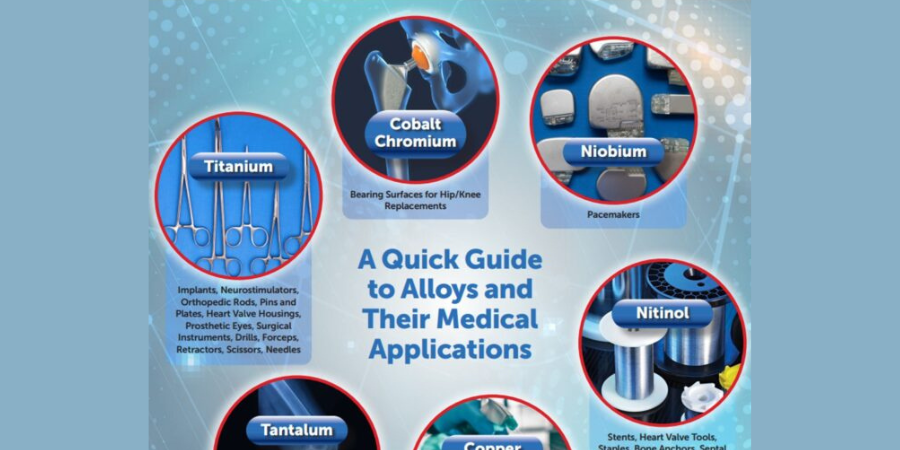
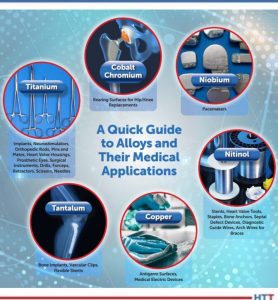
Do you know what are the most popular alloys in the medical market? What are their applications? This medical alloys reference graphic gives a quick overview of alloys and their specialized uses in the medical industry.
Ask average people walking along the street what metal/alloy comes to mind when they think of medical uses - things like hip and shoulder joints, the orthodontia their kids might wear, the forceps used to remove stitches - they might come up with the answer "titanium." While this certainly is correct, there are lots of other metals and metal alloys that are used in the medical industry. They probably wouldn't answer "nitinol," a titanium alloy. Nitinol is actually used in the aforementioned braces! Nitinol can be found in other things too: stents, staples, septal defect devices, etc. Take a look at the graphic to see what all these alloys, in fact, can do; you might be surprised!
Such important implements, devices, and components that are used in and on the human body need to be durable and reliable. These medical pieces can improve the quality of life (to put it mildly) or actually save a life (to put it dramatically). Some of these alloys are actually used in and around the heart and blood vessel system! Only the best of the best will do to make up these medical items; lives are literally preserved and saved with them.
What alloys have you found in medical applications? Maybe you have experience with a loved one or yourself incorporating one of these medical pieces in your life? Are you a heat treater involved in the making of these products? Let Heat Treat Today know in the Reader Feedback.
Download the full graphic by clicking the image below.
The most recent launch of NASA’s Artemis 1 Mission included a large titanium manifold housing designed to rapidly propel astronauts away from the main rocket in case of a catastrophic explosion or any other unexpected event. This critical part was vacuum heat treated by Solar Atmospheres of Western PA.
Titanium manifold weldment after vacuum heat treatment and shown on the Artemis 1 Orion Spacecraft Source: NASA
Michael Johnson Sales Manager Solar Atmospheres of Western PA
On Wednesday, November 16, 2022, NASA’s unmanned Orion spacecraft launched successfully from Cape Canaveral at 1:47 am for a six-week test flight around the moon and back. This launch marks the first iteration of NASA’s moon-to-Mars Artemis 1 program. For the 2014 Orion launch, NASA introduced the Launch Abort System (LAS). Once fired, the LAS will accelerate the astronauts away from the main rocket at forces up to 10 to 15 times normal gravity (“G’s”).
“Before the mighty Artemis rocket left Earth’s atmosphere with 8.8 million pounds of thrust, many of the components and support hardware had already experienced a lunar-like atmosphere here in western Pennsylvania,” commented Michael Johnson, sales director at Solar Atmospheres. “Many of the [6AL-4V] titanium and Inconel components were processed well below 1×10⁻⁵ Torr throughout thermal processing. Although our crew here on Earth were wearing nitrile gloves, it’s overwhelming to know we had a hand in heat treating these critical parts.”
Find heat treating products and services when you search on Heat Treat Buyers Guide.com
American titanium producer Perryman Company, in Houston, PA, has placed an order for the supply of two forging machines: a high-speed open-die forging press in the pull-down design and a hydraulic radial forging machine with two forging manipulators as well as the order and production control system for the entire forging line. The titanium materials are intended for parts in the aerospace industry and for medical applications.
The open-die forging press from SMS group will be used to forge cast titanium billets first to the required size. After that, they can be finish-forged in the radial forging machine to produce bars – round, square or flat – up to a maximum length of 14,000 millimeters.
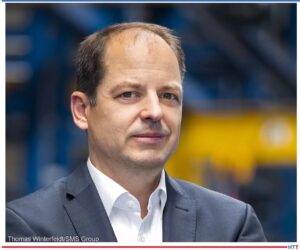
Dr. Thomas Winterfeldt Head of Forging Plants SMS Group SMS Group
"We see strong growth in the aerospace industry and medical sector," emphasized Frank Perryman, president and CEO of Perryman Company. "This [new forging line] enables us to produce forgings for turbines and safety-relevant structures that comply with our high quality standards."
"With the whole SMS plant package, including digitalization tools and technology packages, Perryman is able to increase its production efficiency and maintain consistent quality levels," said Dr. Thomas Winterfeldt, head of forging plants at SMS group.
The forging line is scheduled to go on stream in Q1 2024.
Find heat treating products and services when you search on Heat Treat Buyers Guide.com
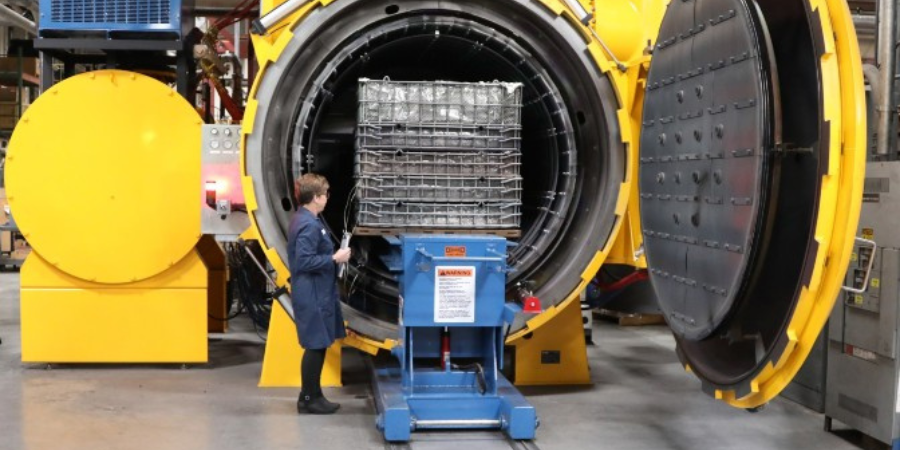
Solar Atmospheres Souderton, PA incorporated a high-production vacuum furnace with a work zone of 48″x48″x72″ and a weight capacity of up to 7,500 lbs/batch. The furnace doubles the facility’s hydriding and de-hydriding capacity in the reclamation of titanium and tantalum materials.
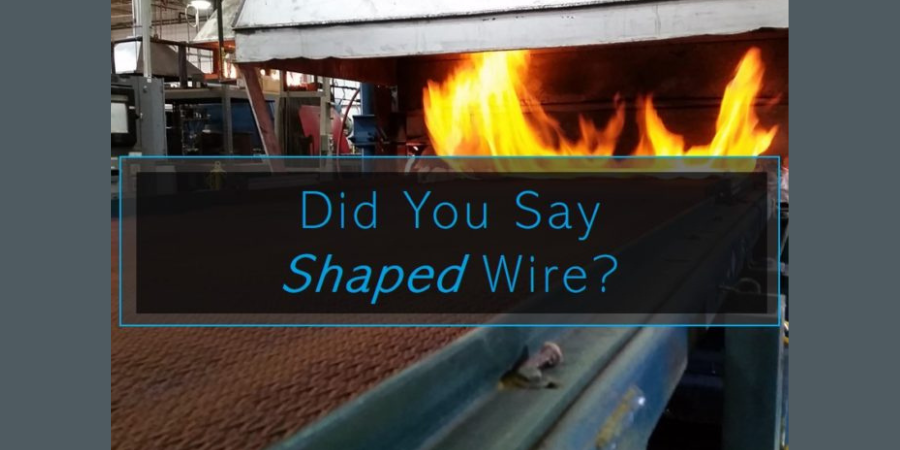
Engineered geometry increases strength, decreases stretch, and withstands thermal cycling.
For today’s Technical Tuesday, we are sharing an original content article on how innovative design of wire for mesh belts in heat treat can reduce costs to heat treaters. Technical writer Del Williams writes, that though it seems that manufacturers regard the “periodic replacement of wire belting simply a cost of doing business, innovative alternatives have been developed that can significantly prolong its life and drive down operational cost.” Read on to learn more!
Engineered geometry increases strength, decreases stretch, and withstands thermal cycling.
Whether for automotive, aerospace, or heavy equipment, manufacturers using heat treatment – which can reach temperatures up to 2400°F and vary from a few seconds to 60+ hours – need conveyor belting that can withstand the rigors of the process. However, traditional round balance weave wire belting has changed little in 100 years and often requires annual replacement, causing costly production downtime.
Heat treating is essential to improve the properties, performance and durability of metals such as steel, iron, aluminum alloys, copper, nickel, magnesium, and titanium. This can involve conveying to hardening, brazing, and soldering, as well as to sintering furnaces, carburizing furnaces, atmosphere tempering furnaces, and heat processing in annealing and quenching furnaces. Parts treated can range from bearings, gears, axles, fasteners, camshafts and crankshafts to saws, axes, and cutting tools.
Heat treat-grade balance weave belts – made of temperature-resistant stainless steel or other heat resistant alloys, suitable to be run on a conveyor with friction drive – can cost thousands of dollars, depending on the dimensions and quality. So, even though wear and premature replacement seems inevitable, such wire belting should not be considered a low-cost consumable. While many manufacturers using heat treating consider periodic replacement of wire belting simply a cost of doing business, innovative alternatives have been developed that can significantly prolong its life and drive down operational cost.
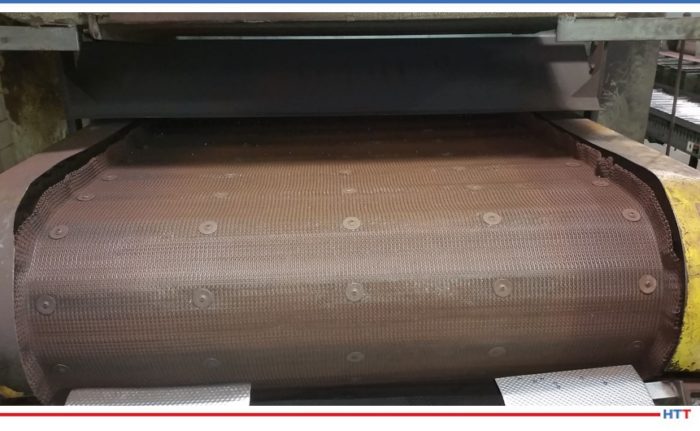
Conveyor belting for heat treating process Source: Del Williams
Although heat resistant wire belting is available, repeated thermal cycling between heating, soaking, and cooling while carrying substantial loads can continually weaken its structure until it fails. The greater and more frequent the temperature fluctuations in heat treatment steps, the shorter the wire belt’s usable life becomes.
In addition, on conveyor belts, belt stretch accelerated by heat and dynamic loading forces on the belt, is typically the main cause of breakage and failure.
Fortunately, industry innovation in the form of engineered, “shaped” wire belting has minimized these challenges. The design vastly prolongs usable life with increased strength and decreased stretch, which dramatically curtails replacement costs and production downtime.
This approach can also help to extend the longevity of wire belting used with increasingly popular powder metal parts, particularly sintered parts that may be heat treated to enhance strength, hardness, and other properties. In such cases, powder metal serves as a feed stock that can be processed into a net-shape without machining.
Resolving the Core Issues
Although conventional round wire belt has been the industry standard for generations, the geometry of the wire itself contributes to the problem.
Traditional round wire belt and even top-flattened wire belting is prone to belt stretch and premature replacement, particularly under high heat treatment temperatures. In testing, typical round and top flattened conveyor wire belt have been observed to stretch approximately 7%.
Even though many producers of conveyor wire belting simply import semi-finished product and finish it domestically, at least one U.S.-based manufacturer has gone to the root of the problem.
“Shaped” wire is designed to provide more strength in the wire belt of a given diameter so it can better withstand high heat processing conditions. This significantly prolongs its usable life.
As an example, one engineered wire belt, called Sidewinder, by Lancaster, PA based Lumsden Belting, compresses and expands wire so it is taller than it is wide with flat sides.
To begin with, the patented side flattened wire’s “I-beam” design provides 3 times greater structural support for heat treated parts compared to standard round wire. The added height of the wire also provides a longer wear life without needing heavier wire. Together, the design limits belt stretch to only 1-2%. This minimizes the potential for damaged belt. Minimal belt stretch also helps the conveyor belt to track straighter, improving production throughput with less required maintenance.
The design significantly extends the usable life of wire belt conveyors used in a variety of heat treat processes. This ranges from hardening, brazing, and soldering to sintering, carburizing, and atmosphere tempering furnaces.
It is also prolonging wire belt conveyor life in secondary powder metal processes used to improve hardness and other mechanical properties. In this vein, it could be utilized in a mesh belt sintering furnace, where compacted parts are placed in a controlled atmosphere and heated. It could also be used in processes such as quench and temper, case carburizing and induction hardening.
When heat treatment is used for hardening, followed by rapid cooling submerged in a medium like oil, brine or water, the shaped wire belt also enhances the open area for the same gauge wire. This reduces residue build up and eases cleaning, while minimizing drag.
Although the cost of the shaped wire belt is slightly more than traditional round wire, for manufacturers relying on heat treatment the gains in lifespan and production uptime can provide a speedy ROI.
About the Author: Del Williams is a technical writer based in Torrance, California. Images provided by the author.
There is so much to learn in so little time, but if you are at all interested in additive manufacturing (AM), you will want to check out this new study.
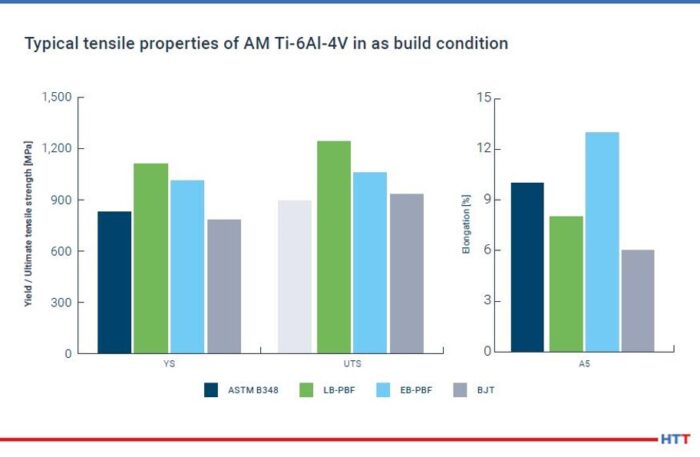
This Heat Treat Today’s Best of the Web feature is full of scholarly findings presented in an easily accessible PDF for free. Three insights that the study elaborates on are: Titanium represents largest share of materials in AM; HIP cycles are not optimized for AM; and part performance may be increased by optimized HIP cycles. The study was developed by Dr.-Ing. Maximilian Munsch, Matthias Schmidt-Lehr, and Dr.-Ing. Eric Wycisk (pictured above in that order).
An excerpt: “To increase the part performance hot isostatic pressing (HIP) is commonly used for highly demanding applications and has become a common post- process for titanium AM parts as well. However, the typically used temperature-pressure-cycles for AM are derived from HIP processes originally used for casting parts.”
Medical device industry expert witness, John McCloy, founder of Engineered Assurance, discusses what medical device manufacturers need to do to help minimize liability. Thermal processes are among the items discussed.