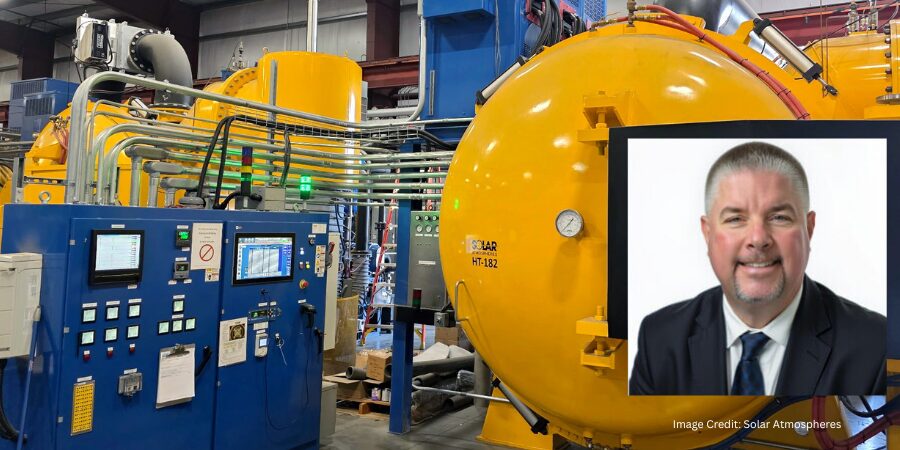
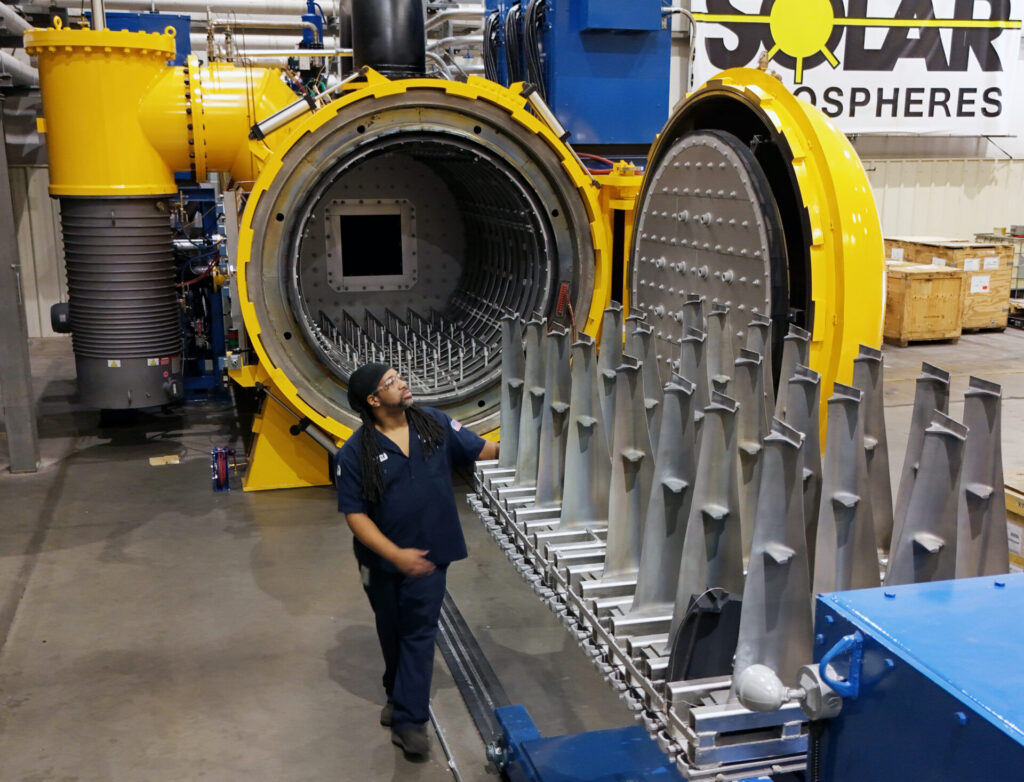
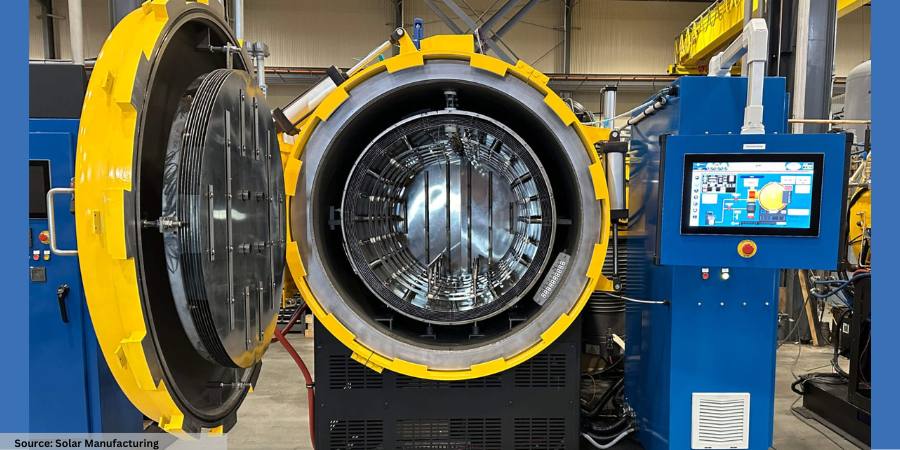
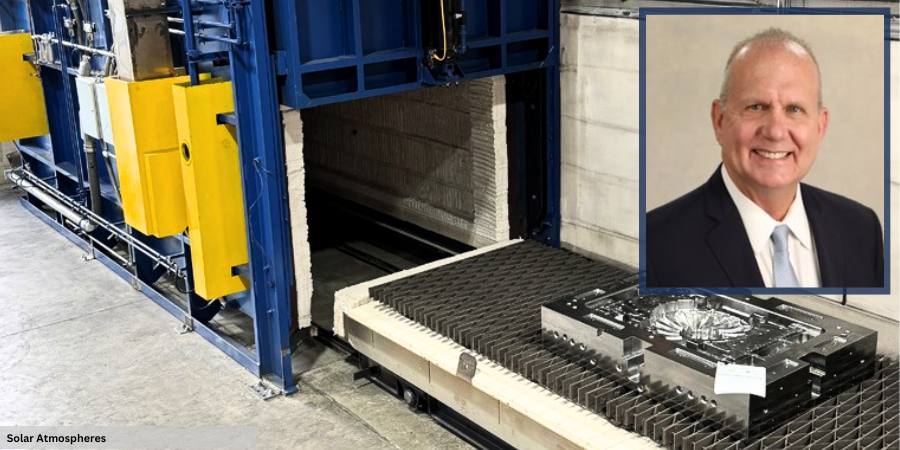
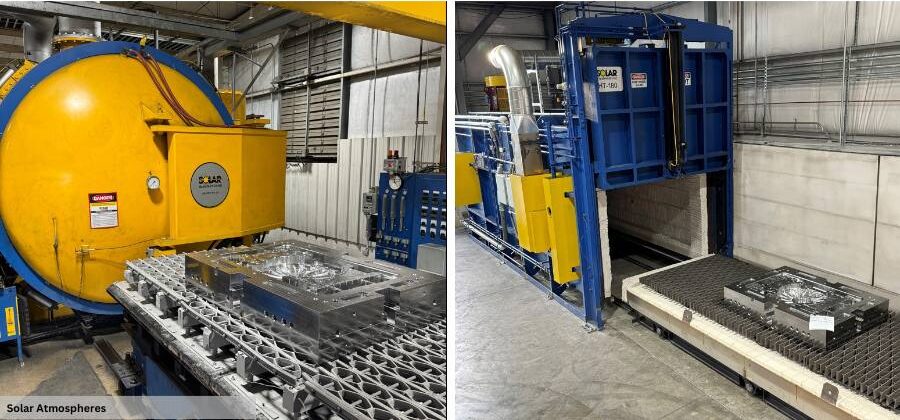
Solar Atmospheres has announced the installation and full commissioning of a new 10-bar vacuum furnace at its Fontana, California, further expanding the company’s high-pressure vacuum heat treating capacity in the western United States. The system enables vacuum heat treating and high-pressure quenching of large components essential to high-performance applications across aerospace and other critical industries.
The furnace, manufactured by sister company Solar Manufacturing, is a horizontal vacuum system with a 48″ wide x 48″ high x 96″ deep hot zone and a maximum load capacity of 12,000 pounds. Equipped with a vacuum pumping package capable of reaching an ultimate vacuum level of 1×10⁻⁶ Torr, the furnace is designed for processing titanium and other high-performance alloys that require tightly controlled, low-contamination environments.
Derek Dennis President Solar Atmospheres California
“This investment gives our [clients] another regional solution for high-pressure quenching of large components and heavy workloads,” said Derek Dennis, president of Solar Atmospheres California. It also allows the company to increase capacity and improve efficiency as demand continues to grow, he adds.
The move supports vacuum heat treating needs across aerospace, defense, medical, and power generation markets, with capacity aimed at maintaining consistent turnaround and performance.
Press release is available in its original form here.
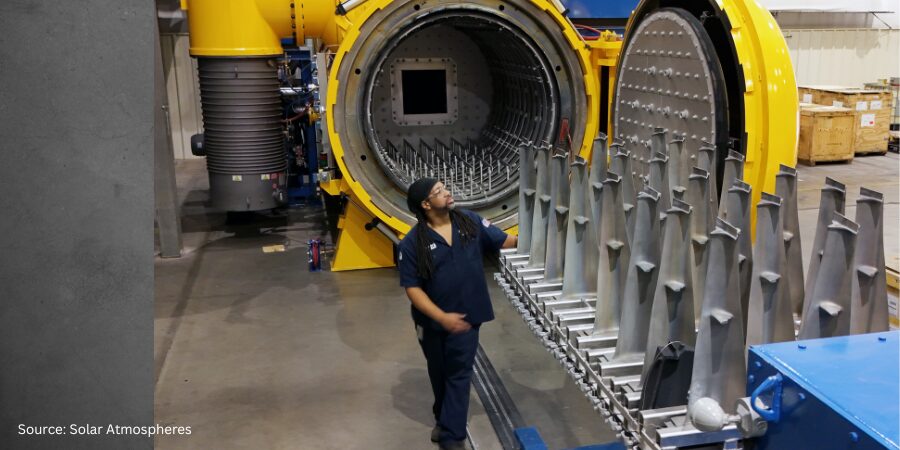
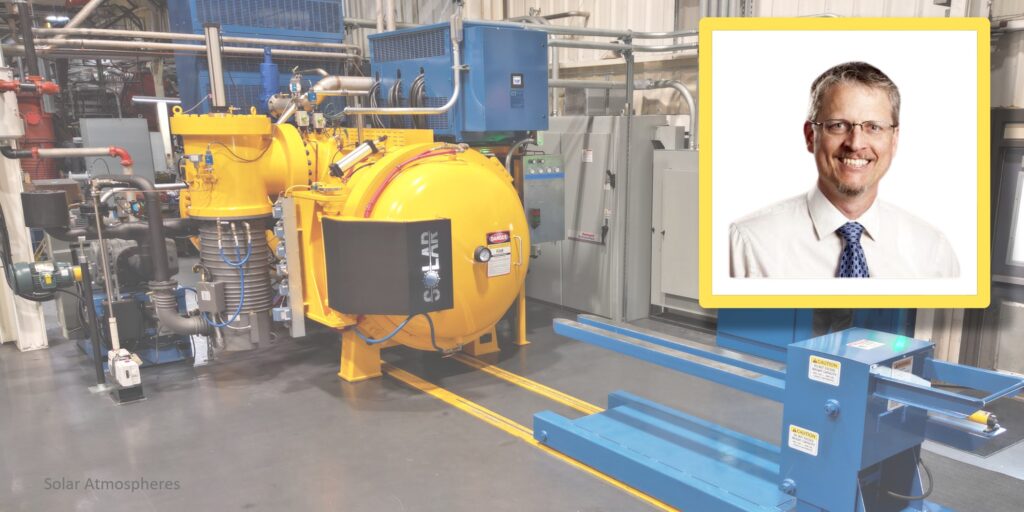
Solar Atmospheres has commissioned and installed a new 10-bar vacuum furnace at its Greenville, SC facility. The horizontal furnace can process loads up to 12,000 pounds and expands the company’s capacity for high-pressure quenching of large components and workloads.
Solar Atmospheres new 10-bar vacuum furnace Source: Solar AtmospheresSteve Prout President Solar Atmospheres Southeast
Manufactured by its sister company Solar Manufacturing, the furnace features a working zone measuring 48” wide x 48” high x 96” deep. Its pumping package achieves an ultimate vacuum level of 1×10⁻⁶ Torr, ensuring performance for processing titanium and other high-grade alloys requiring pristine vacuum environments
Steve Prout, president of Solar Atmospheres Southeast, commented: “We’re proud to offer our customers another regional option for high-pressure quenching of large components and workloads, while also providing the opportunity to reduce processing costs through economies of scale.”
Press release is available in its original form here.
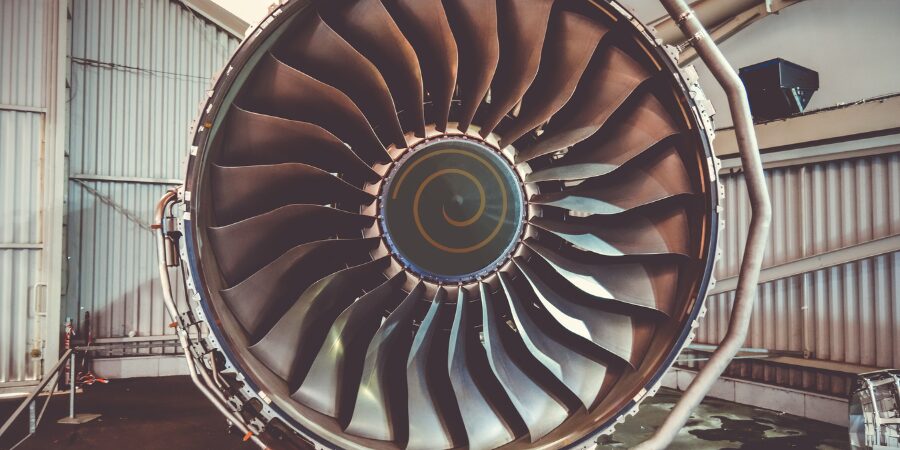
A prominent aerospace company known for producing advanced, high-precision components for the global aviation and aerospace engine industry has been shipped a vacuum carburizing furnace. Headquartered in North America, the company’s aerospace division has been a trusted resource for the aeroengine sector for decades.
Vacuum carburizing furnace for aerospace Source: Solar Manufacturing
To support the development of a specialized carburizing process, Solar Manufacturing partnered closely with the R&D team at its sister company, Solar Atmospheres, a heat treating affiliate. Collaborative testing was conducted at Solar Atmospheres’ Technology Center in Souderton, Pennsylvania, where engineers from both organizations worked together to fine-tune the process to meet the specific metallurgical specifications.
“This collaboration was invaluable in achieving the desired metallurgical results,” said Rick Jones, regional sales manager at Solar Manufacturing.
The delivered system features a graphite-insulated hot zone measuring 48” wide × 48” high × 60” deep, capable of reaching temperatures up to 2400°F (1370°C). The furnace can accommodate workloads up to 5,000 pounds and includes an internal gas cooling system that provides rapid 2-bar nitrogen quenching.
Press release is available in its original form here.
Solar Atmospheres in Souderton, PA, has commissioned two additional 2-bar vacuum furnaces, expanding its capabilities to meet demand in the aerospace and industrial gas turbine sectors. The equipment will allow the company to specialize in hydride/de-hydride processing of titanium, tantalum and niobium.
Mike Moyer Vice President of Sales Solar Atmospheres Souderton
These vacuum furnaces, produced by the heat treater’s sister company, Solar Manufacturing, feature large working hot zones (45” x 45” x 72”) and are rated for operations up to 2400°F with a precise temperature uniformity of ±10°F.
“We’re thrilled to add these advanced furnaces to Solar Souderton’s lineup,” said Mike Moyer, vice president of sales, at Solar Atmospheres. “Equipped with Solar Manufacturing’s latest control systems, they ensure efficient, safe operation — meeting our customers’ needs for competitive pricing and fast delivery. This installation reinforces our commitment to consistently high-quality service.”
More Solar Atmospheres News…
Robert Hill, FASM President Solar Atmospheres of Western PA
Solar Atmospheres of Michigan, Inc., announced the completion of its 20,000 square-foot facility expansion, marked by the official receipt of an occupancy permit from Chesterfield Township.
“Next week, we’ll begin the process of moving our Shipping and Receiving Department, along with other essential ancillary equipment, into the newly completed adjoining building,” said Bob Hill, president of Solar Atmospheres of Michigan. “This expansion is a vital step forward, enabling us to optimize workflow, boost production capacity, and further improve the quality of our vacuum heat treating services for our valued clients.”
The expanded facility will allow Solar Atmospheres of Michigan to streamline operations and meet growing customer demands from various industries.
The press releases are available in their original forms here and here.
FPM Heat Treating has announced the acquisition of a vacuum furnace, enhancing the company’s capabilities to serve the manufacturing community, especially in the automotive and aerospace sectors. The furnace will meet an increasing demand for a specialized family of parts.
Bob Ferry Vice President of Quality & Engineering FPM Heat Treating
The furnace, fully compliant with NFPA, NADCAP, AMS, CQI-9, and other critical industry standards, has been installed at FPM Heat Treating by Solar Manufacturing. With an operating temperature of up to 2400°F (1315.5°C) and a weight capacity of 5,000 pounds, the furnace processes at specialized heat treatment cycles critical for automotive components as well as precise specifications for applications within consumer products and the military/aerospace sectors.
“We are committed to meeting the growing demands of our clients in the manufacturing community,” said Bob Ferry, vice president of quality and engineering at FPM Heat Treating. “The new Solar furnace enhances our capabilities and enables us to maintain the highest standards of quality and efficiency in our operations.”
Main Image: Adam Jones, Midwest regional sales manager at Solar Manufacturing, viewing the vacuum furnace’s 48” x 48” x 72” deep insulated hot zone
The press release is available in its original form here.
The heat treat industry is rich with knowledgeable leaders, resourceful problem solvers, and innovative teams. One of our favorite things to do here atHeat Treat Today is to draw attention to the wealth of expertise in the field, so we are pleased to launch the Voices in Heat Treat series, pointing readers to a treasure house of recorded interviews and discussions diving into the fundamentals of thermal processing.
In this and coming articles drawn from the audio library at Solar Atmospheres, we will summarize topics on everything from basic heat treating how-tos, preventative maintenance, and troubleshooting to the history of hot zone designs, temperature uniformity surveys, and the distinctions to take into consideration when processing different kinds of metals and alloys. In today’s installment, our industry experts focus on vacuum brazing and the uniqueness of heat treating titanium.
In the premiere article of this series, Bill Jones, founder and CEO of Solar Atmospheres and Solar Manufacturing, interviews industry leaders about the advantages of vacuum furnace brazing. Read the highlights of their discussion about the process, in particular when used with stainless steel and titanium. The summary of a fourth episode recorded earlier has been added, expanding on the topic of the advantages of processing titanium in a vacuum furnace. The experts are Calvin Amenheuser, vice president of the Hatfield plant, and Mike Paponetti, sales manager of the southeast. Jim Nagy, senior vice president of Solar Manufacturing, hosts the episodes. A summary of each conversation is below, followed by links that will take you directly to that podcast episode.
Bill Jones and the Team Speak on Vacuum Brazing, a 3-Part Series
“Advantages of Vacuum Furnace Brazing”
December 2015
Brazing to form strong metallurgical bond where the brazed joint becomes a sandwich of different layers, each linked at the grain level
This episode is the first in a series on vacuum furnace brazing, with an overview of different types of brazing processes and why vacuum furnace brazing is superior to other joining methods, particularly torch brazing and welding.
The conversation explores various reasons why a vacuum furnace is well-suited to perform brazing because it provides:
a controlled, consistent atmosphere cycle after cycle
uniform heating throughout the hot zone
a controlled rate of heating
the elimination of air to prevent the formation of oxidation of the metal
Vacuum Furnace Brazing vs. Alternative Methods
Both Cal Amenheuser and Mike Paponetti speak about vacuum brazing being a superior process to alternative methods. Mike noted that torch brazing is effective for low volume loads, but the process risks flux entrapment and could produce messy, overheated and possibly carburized parts. In contrast, vacuum furnace brazing allows for higher volume loads, providing a repeatable process, precise temperature measurements, and versatility.
Brazing applications from parts to rockets
Calvin added that while welding melts the materials and produces a strong joint, the surrounding material is weaker. With vacuum furnace brazing, the brazed joint is just as strong or stronger afterward as before.
Finally, the panelists compared how batch vacuum furnace brazing eliminates distortion that is typical with torch brazing and welding because of hot zone uniformity. A batch furnace operator can modify the process to meet the demand of the load, and furnace charts provide proof of reveal what exactly happened during the run so that successful recipes can be repeated.
In this episode, second in the series on the vacuum furnace brazing, the Solar team reconvened to discuss advantages of and concerns with nickel-based and copper-based brazing alloys.
All agree that nickel-based alloy offers a cleaner braze but emphasize precautions must be put in place to avoid metal erosion and cracking. While readily available and a good match for low carbon steel, copper flashes during the braze. Inert gas is recommended to decrease evaporation of the copper-based alloy.
“Processing Titanium in Vacuum Furnaces: Active Brazing of Titanium in a Vacuum Furnace”
April 2016
In this third and final episode on the topic of vacuum furnace brazing, Bill Jones, Calvin Amenheuser, and Mike Paponetti consider significant challenges to brazing titanium, which is the need to reduce surface oxide to allow the process to take place and why active brazing is suggested as a means to meet that challenge. What follows is an informative discussion on composites that allow producing companies add to the material, like hydrated titanium, zirconium, and indium, to help overcome oxides, which are effective at wedding to the surface.
“Processing Titanium in Vacuum Furnaces: Advantages”
February 2013
175,000 pounds of 6Al-4V titanium in Solar’s 48-foot-long vacuum furnace
Although recorded earlier than and thus separately from the series on vacuum furnace brazing, this summary of an episode is included in this article to provide context about the advantages of processing titanium in a vacuum furnace. This is a solo Bill Jones episode.
Bill Jones highlights how vacuum furnaces provide a pure atmosphere for processing titanium compared to an argon atmosphere, saving machining costs and time. Additionally, vacuum processing uses forced inert gas quenching to cool titanium as opposed to water quenching which results in a more uniform result and eliminates part distortion. Finally, fixturing parts properly in a vacuum furnace with graphite allows heat treaters to preserve the part shape and avoid movement.
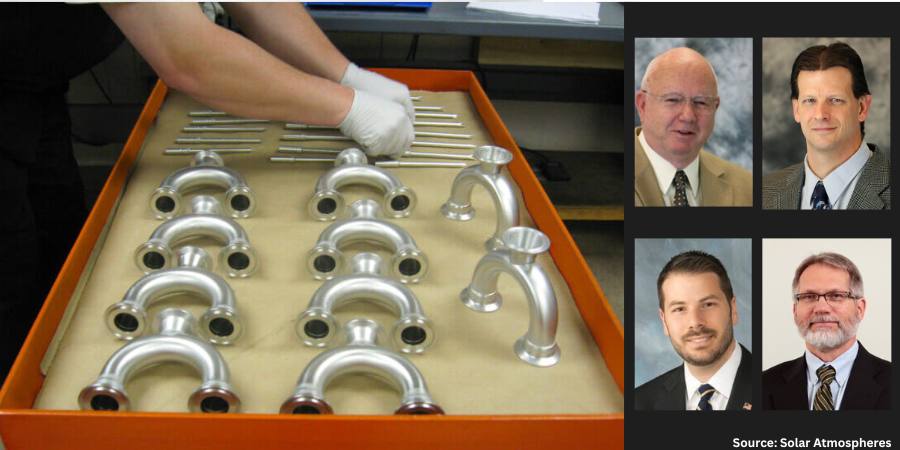
Bill Jones Founder & CEO Solar Atmospheres, Solar Manufacturing Source: Solar AtmospheresCalvin Amenheuser Vice President of Operations, Souderton plant Solar Atmospheres Source: Solar AtmospheresMichael Paponetti Sales Manager of the Southeast Solar Atmospheres, Inc. Source: Solar AtmospheresJim Nagy Senior Vice President Solar Manufacturing, Inc. Source: LinkedIn
A company developing advanced alternative renewable energy technologies large-scale industrial applications is expanding their heat treat capabilities with two identical vacuum furnaces.
The Research and Development team of Solar Manufacturing, Solar Atmospheres, assisted the client’s engineers to verify the process in the Mentor® Pro vacuum furnace prior to sending this furnace. Solar Manufacturing shipped the identical vacuum furnaces and assisted the company’s engineers to verify the molybdenum shielded hot zone operation of the new equipment at the developer’s facility. The furnace’s internal gas quenching system processes workloads to quench at 2 bar positive pressure in either nitrogen or argon gas, a flexibility that assists the company in achieving results across a wide range of metallurgical applications.
The client also finds benefit from the compact design of the Mentor® Pro features a molybdenum shielded hot zone measuring 18” wide x 18” high x 36” deep, capable of temperatures up to 2500°F, and a workload weight capacity of up to 1,000 lbs.
The press release is available in its original form here.
Robert (Bob) Hill, FASM President Solar Atmospheres of Western PA Source: Solar Atmospheres
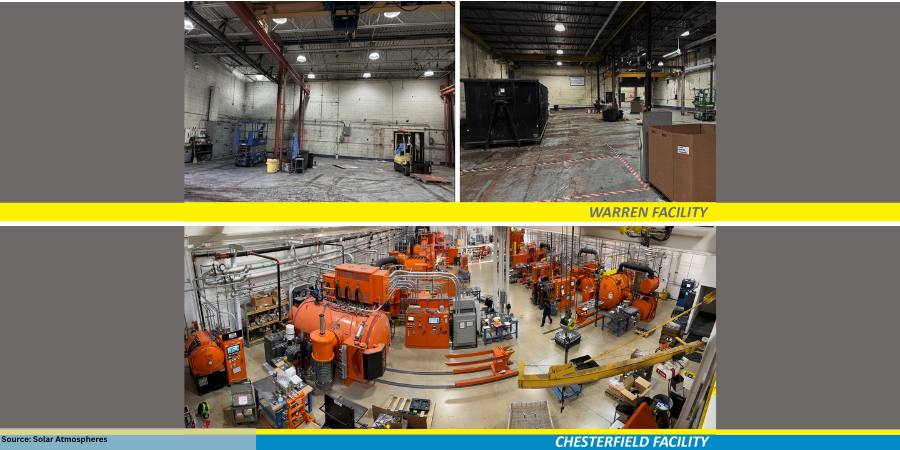
Solar Atmospheres of Michigan has successfully relocated from the old Fraser and Warren facilities to a new location in Chesterfield, Michigan. All ten furnaces (both new and existing) are fully operational at the Chesterfield plant, heralding a new era of efficiency and productivity.
This spring, construction will begin on a 15,000 square foot expansion on an adjacent lot. The expansion will allow for the investment in cutting-edge vacuum furnaces from Solar Manufacturing.
Bob Hill, president of Solar Atmospheres of Michigan, states, “Our future is very bright in Michigan. The consolidation and expansion will allow us to elevate our service standards and meet the evolving demands of our clientele across Michigan and the surrounding states. Solar of Michigan remains steadfast in its dedication to innovation, service excellence, and customer satisfaction as it ventures into this new chapter of growth and expansion.”
This press release is available in its original form here.
Find Heat Treating Products and Services When You Search on Heat Treat Buyers Guide.com
Solar Atmospheres of Western PA recently commissioned their third car bottom air furnace. This Class 2 air furnace has a maximum operating temperature of 1350°F measures 60” wide x 38” high x 168” deep.
The newly installed equipment, manufactured by Heat Treat Equipment Inc., joins two other HTE car bottom furnaces that are 14’ long and 20’ long respectively.
“After successfully hardening in vacuum at 1850°F +/- 10°F, the fully hardened die was transferred to the air car bottom furnace for the triple temper operation of 1025°F +/- 10°F.” – Bob Hill, President, Solar Atmospheres WPA and Michigan Source: Solar AtmospheresRobert (Bob) Hill, FASM President Solar Atmospheres of Western PA Source: Solar Atmospheres
Bob Hill, president of Solar Atmospheres of Western PA and Michigan, states, “the addition of this large air tempering/aging equipment compliments our five (5) state of the art vacuum car bottom furnaces very nicely. Instead of hardening and triple tempering this 6000 pound H13 die exclusively in a vacuum environment, Solar can save our customers and our company over 100 hours of valuable and expensive vacuum processing time.”
He continues, “After successfully hardening in vacuum at 1850°F +/- 10°F, the fully hardened die was transferred to the air car bottom furnace for the triple temper operation of 1025°F +/- 10°F. These large and uniform car bottom furnaces are a win/win for both the customer and for production — not exclusively for heavy parts, but also when treating long components.”
This press release is available in its original form here.
Mike Moyer Vice President of Sales, Solar Atmospheres, Eastern PA
Solar Atmospheres of Souderton PA commissioned a new vacuum furnace capable of utilizing high pressure gas quenching (HPGQ) at 20-Bar (about 300 PSI) to meet demanding cooling rate specifications for the heat treatment of nickel-based superalloys in the aerospace and power generation industries.
The vacuum furnace, manufactured by sister company Solar Manufacturing, has a working hot zone of 24” x 24” x 72” and utilizes unique hot zone design features to increase the quench rate. The furnace is rated for operation to 2400°F and temperature uniformity plus/minus 10°F.
Mike Moyer, vice president of Sales at Solar Atmospheres comments, “The furnace utilizes a 600-HP cooling motor and fan with a creative gas nozzle design to maximize gas flow as it moves through the hot zone and the heat exchanger and back across the workload.”
The full press release from Solar Atmospheres is available upon request.