

Heat Treat Radio #132: Must-Attend Heat Treat Events of 2026 and Beyond
In this episode of Heat Treat Radio, host Heather Falcone sits down with Doug Glenn, publisher of Heat Treat Today, to break down the most important heat treat industry events on the horizon. From the massive international state of the THERMPROCESS trade show to the technical knowledge of Furnaces North America, they explore where those in the industry can learn, network, and grow. The conversation also highlights Heat Treat Today’s own events, including Heat Treat Boot Camp and Helium Leak Detection seminars. Together, they offer practical guidance on choosing the right events to stay engaged and informed in today’s heat treating landscape.
Below, you can watch the video, listen to the podcast by clicking on the audio play button, or read an edited transcript.






The following transcript has been edited for your reading enjoyment.
Introduction (00:05)
Heather Falcone: Hi, I am Heather Falcone and welcome to Heat Treat Radio. Today we are talking about a variety of upcoming events in the industry in 2026 and beyond. Joining me today is Doug Glenn, publisher of Heat Treat Today, and longtime host of Heat Treat Radio. Doug has had a front row seat to this industry for years, from the technical side to the people driving it forward. He’s also someone that I consider a mentor and a friend. I’m looking forward to digging into this conversation with him.
It’s an honor to sit down together with this one, Doug, as it’s kind of a bit of a hand off and a nod to the legacy that you’ve built here.
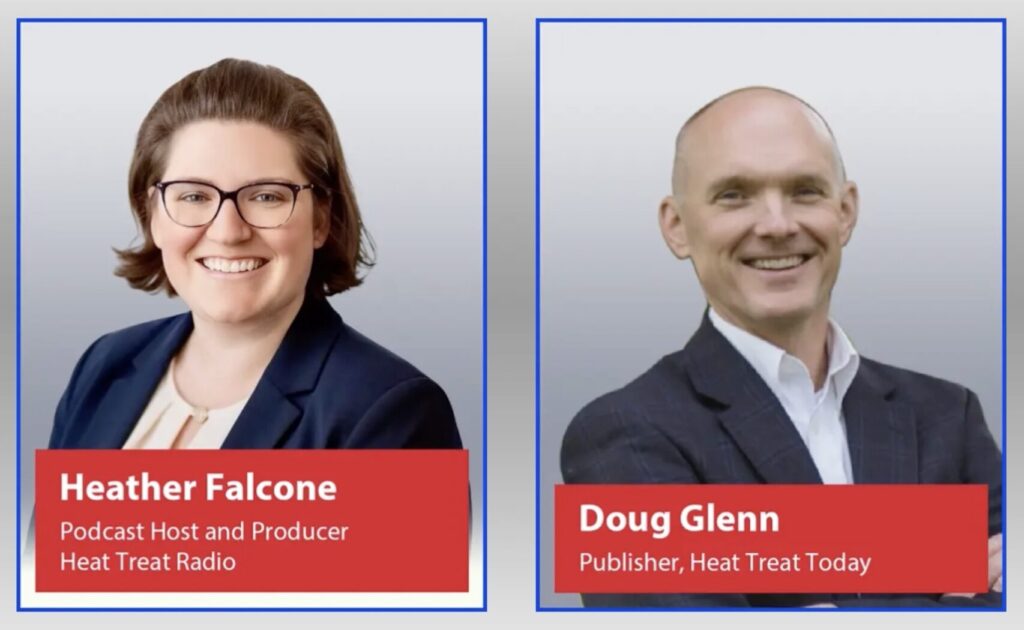
Doug Glenn: It’s a pleasure, and I couldn’t think of a better person to hand it off to. Heather, you’re doing great, and I appreciate you taking the time to do it and having the courage to do it.
Heather Falcone: Obviously, you have recorded over a hundred episodes, so I have so much to learn for you. Thank you so much for trusting me with this.
Key Events for 2026 and Beyond (1:19)
Heather Falcone: Doug, walk us through 2026 and beyond. We have so much going on for events. What are the key events that people should have on their radar?
Doug Glenn: We often say at Heat Treat Today that we believe people are happier, and they make better decisions when they are well informed. Our whole goal is to make people happy by giving them good information so they can make better decisions, and that that always works well. We do that in a variety of ways. Primarily it’s through our print publication — the technical articles that go out in that print publication. Our most popular product is our print publication. Most of that deals with heat treating, thermal processing, technologies, materials, etc.
But there’s also the element of continuing to sharpen your saw, as Stephen Covey says; keep yourself fresh. To that extent, attending industry shows, events, and educational seminars is helpful.
There’s a there’s a big show coming up in Germany in 2027. It’s called THERMPROCESS, but it’s actually one of four events that are all metals related, so we will talk about that whole quartet of shows. I will also talk about Furnaces North America because it is the leading thermal process/heat treat event of 2026. Then also we also have two Heat Treat Today events that I think might be helpful. Our Heat Treat Boot Camp, and then also our Helium Leak Detection seminars.
Those are the events I’m going to talk about today, but there are more events than that. If you are interested in learning more about important industry events, visit our website, heattreattoday.com, and look under Resource tab. There is the Industry Events calendar. That would be a real good place to start because we try to put all of the events that we think are important to most heat treaters and suppliers of the industry.
It’s important to note, when we talk about heat treat, we have to be very careful. We are not only talking about commercial heat treaters. That’s only about 10 to 15% of the audience that we reach. We are talking about captive heat treaters. That’s who Heat Treat Today is meant to be helpful to.
Heather Falcone: Reaching the broader industry at large is always our goal. Making sure that everyone has access to this. When you have an in-house heat treat operation, sometimes you can be even more isolated. So getting those companies exposed to as much information and data as possible.
THERMPROCESS 2027 (4:26)
Heather Falcone: Speaking of that, if someone can only commit to one or two events this year, I think we should really start with THERMPROCESS, because that one kind of rises to the top. We can unpack that a little bit first.
Doug Glenn: I think that’s a really good idea. The show itself, THERMPROCESS 2027 (thermprocess-online.com), is only one of four [in a trade fair quartet]. That show does not take place until June 21–25 of 2027. It’s over a year away. But the reason we need to talk about it now is because, unlike shows here in the United States, this is a huge show, and if you want to exhibit there, which many of our listeners may be suppliers in the industry, applications need to be in by the end of May of this year, not next year. So I wanted to make sure people are aware of that.
To give you a sense of what’s going on in that event, I want to provide a site map of the campus where THERMPROCESS is taking place. First thing to know is that there are four shows altogether. It’s held only every four years in Dusseldorf, Germany. Looking at the map, they call it “The Bright World of Metals,” you’ll notice the four logos across the top, which are GIFA, METEC, THERMPROCESS, and NEWCAST.
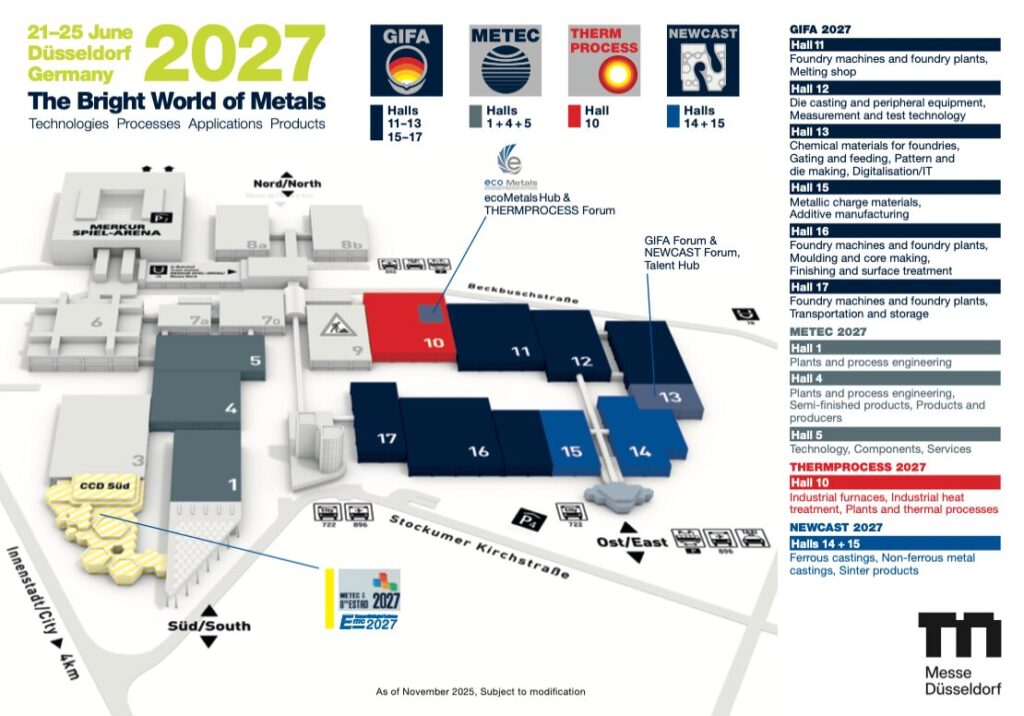
This is a huge campus. If you were to walk from the upper left corner, the Merkur Spiel Arena, all the way down to the east entrance, that would take you probably 10 to 15 minutes.
GIFA is a foundry show, and is located in halls 11 through 17. The dark blue on the map is all GIFA.
METEC is the gray on the map, halls 1, 4, and 5. This show is basically steel making, metallurgy, etc.
THERMPROCESS is in one hall, hall 10, and it’s the largest hall. It’s larger than any heat treat show here in the United States by far.
NEWCAST is basically a metallurgy show, steel processing, some forging as well. That’s in halls 14 and 15.
This show is open five days, from 9 a.m. until 5 p.m., all five days. If you were to spend your time walking through this show, it would basically take you all five days to go through this. It’s a huge event.
Let me give you a sense of this size. The total attendance for this entire event for 2023, which was the last one that they had, was 63,000 attendees. Even if you divide that by four, because there’s four different shows, that’s almost 16,000 people per show. To give you a sense of size difference in the United States: our biggest heat treat show, typically Furnaces North America or the ASM Heat Treat Show, attendance is no more than 2,500 people, including exhibitors and everything. You can get a sense that this is the right show.
It’s held in Dusseldorf, Germany. Germany of all countries in the world knows how to do trade shows. There are booths in these halls that are double decker booths, large booth displays. There are even restaurants on the upper level — it is a full event. Companies will spend millions of dollars just on this show.
My suggestion is, if you’ve never been to this show, or if you have a need for a full understanding in the thermal processing/heat treating industry, this is the premier event in the world, as far as I’m concerned. China has some big shows as well. I believe this one is more international. You will see people from all over Europe and the United States as well. 63,000 people total.
For just THERMPROCESS, there are 276 exhibitors, and the show takes up 8,400 square meters, which is about 90,000 square feet. Over on the Foundry side, obviously the biggest show here, taking up almost six halls, there are 854 exhibitors in about 41,315 square meters or 445,000 square feet of booth space. These are big shows.
Heather Falcone: It’s massive.
Doug Glenn: It is massive. There are companies exhibiting there from all over. Not only Western Europe, but Eastern Europe too, Turkey, Middle East, Saudi Arabia, China, India, etc. The United States, to be quite honest, is not always that well represented.

I think this is probably one of the more important things that I wanted to mention about this event. Heat Treat Today is promoting and sponsoring a pavilion there at THERMPROCESS. If you would like to be part of that pavilion, you can call me and we’ll see what we can do.
It’s a big deal, it’s a big show. May 31 of this year is the exhibitor deadline. For those of you who are interested in attending, which I highly recommend, thermprocess-online.com is the website.
If you’ve never been to Dusseldorf, it’s definitely worth going just to see Dusseldorf. There’s this place in Dusseldorf, a section of the town called the Altstadt, which is the old city. It’s a great place, hundreds of restaurants and great to experience the culture. It’s worth it after the show ends.
Also, the public transportation in Germany is very good. There are trams that run, which make it pretty convenient to get to the exhibit hall.
Heather Falcone: What kind of company roles do you think would be best suited to attend THERMPROCESS? Who do you think would most benefit from this event?
Doug Glenn: You would want more of your upper management personnel attending this event, not so much your furnace operators. You could do that — it would not be a problem taking the furnace operators over there. But it’s typically more engineers and up. One big difference between this show and most shows in Germany compared to shows in the United States: there is not a conference associated with it. They do offer some technical presentations, typically five or six a day in the small auditorium on the show floor. So you might get 30 different technical presentations, but this is primarily a trade show. It is a show where people sit down in their meeting rooms in their booths where they can close the door and have a private meeting, and they buy and sell there.
This is a show where if you want to do business, this is the premier event. In my 30 plus year experience, this has been the most impressive show, for thermal processing/heat treating, so I highly recommend attending.
Furnaces North America (14:28)

Heather Falcone: That’s a great point that you brought up, the difference between a trade show and the technical presentations. Compared to Furnaces North America (FNA), it’s a whole different ball game.
Doug Glenn: FNA is October 12–14, 2026 in Indianapolis. The website for that event is furnacesnorthamerica.com.
The difference is marked between THERMPROCESS and FNA. It’s just a whole different category in a variety of ways. The number of exhibitors is going to be somewhere in the range of 150 to 200, maybe right on the upper end. The trade show hours are typically a little bit shorter, maybe 11 a.m. to 5 or 6 p.m. It’s only a two-day show, not a five-day show. And there are a lot of technical sessions that are held. There’s a much better opportunity for more formal learning, if you will, where you can go to some classroom environments.
Furnaces North America is owned and operated by the Metal Treating Institute (MTI), which Heather and I are both members of, which is great. MTI is the world’s largest association of commercial heat treaters. While MTI is commercial heat treaters, Furnaces North America is really intended for captive heat treaters, as well as commercial heat treaters, to help advance the technology, knowledge of processes, and materials in the North American market.

It is a good event. It starts on a Monday night, the 12th of October, with a nice opening reception. Then Tuesday is a full day of conferences and the trade show. Wednesday, the conferences begin again in the morning, and then the trade show is open until around 2 p.m. So it’s a rather abbreviated show compared to THERMPROCESS.
Heather Falcone: It’s one of the more unique events because often, when you’re at a trade show, you do want to try and get some learning in, but you also want to get out and see the vendors on the floor. So they’ve set it up really well so that you never have to miss a concurrent session. In fact, they don’t even have the trade show floor open during the conferences. So, it ensures the exhibitors do not have to leave the trade show to attend session, and it lets people attend sessions without feeling guilty that they’re not out there hitting the booths at the trade show.
Doug Glenn: Exactly, they can actually go and do some of the learning as well. If I remember correctly, Heather, you’ve been involved with program development of FNA in the past.
Heather Falcone: Yes, I tend to do a session or so. Last time I think I talked about industry involvement, which is similar to the topic today. Getting involved in the industry is one of the best things you could do for yourself and your company.
Doug Glenn: That’s FNA in a nutshell. There are still some booths available. Although I don’t anticipate that will last long. Call or go to furnacesnorthamerica.com to check in on that, or contact me or Heather, and we can steer you in the right direction.
Heather Falcone: I honestly believe anyone would benefit from going to FNA because of the technical sessions. There’s a lot of learning to be had, even down to someone that’s more operational. It’s not just meant for that owner level. It’s pretty approachable.
Doug Glenn: I would agree. The expense of going to FNA is also substantially less than the expense of going to THERMPROCESS over in Germany. So you do see a good number of shop floor personnel at this, but it is also a good place to send your upper management personnel, depending on the size of your company, and your decision makers, as far as capital expenditures go. It is a good place to bring those people. You can gather a lot of information in a very short time walking around this show.
Heather Falcone: You can cover a lot of ground and really get some good relationship and networking going. It’s a great setup.
Heat Treat Today Events (19:20)
Heather Falcone: Let’s discuss the Heat Treat Today events, I think that there’s some truly unique offerings.

Doug Glenn: While Furnaces North America is not a Heat Treat Today-owned and operated event, we are the exclusive media sponsor of the event. But Heat Treat Today also has its own events.
Firstly, we have our most fun event, which is called Heat Treat Boot Camp. It was a brainchild of mine quite a few years ago because I tend to have a mile wide and an inch deep knowledge of the industry. I am no expert in any one area, but I have this experience of being here and absorbing over 30 years worth of information and relationships. So I thought to myself, wouldn’t it be nice to be able to share some of that information with people who are just wanting to get their heads wrapped around the North American heat treat market? What is it, who’s there, what are we doing, what are the materials — all that good stuff.
So we put together this event called Heat Treat Boot Camp. It is not heavily technical — you don’t need to know metallurgy or anything of that sort to attend. And it’s not just focused on any one piece of equipment, any one company’s equipment, or any one process, like brazing. It is cross-cutting. If you’re coming into the industry, or if you’ve been in the industry for a long time but have only focused on point X because that’s what you’re paid for, you can attend Heat Treat Boot Camp to get a broader view of this whole market. The added benefit of that is that you might find out there are other areas that your company could add that could potentially be profitable.
This is our fifth year coming up. It’s going to be held in Cleveland, Ohio, from Monday, September 14 to Wednesday, September 16, 2026. Our first four events were held in Pittsburgh, which is a great city. But we’re going to Cleveland this year, which should be very good.
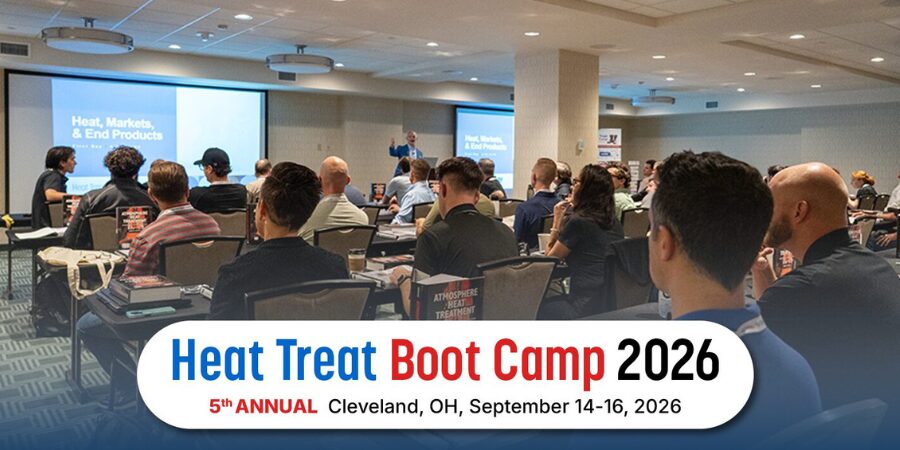
Here are the five things that we cover: heat treat markets, materials, processes, products, and players. By players, we mean, Who are the companies that manufacture the equipment… Equipment, components, supplies, materials? That’s the players.
We start the event on Monday night with a very nice opening reception. It’s usually just a nice time to get together and meet each other. Tuesday is the bootcamp day. It’s grueling, it’s a solid day of intensive learning, talking, slideshows, passing on knowledge. Thomas Wingens from WINGENS Industrial Consultancy is my partner and we teach the lectures. Thomas focuses more on the technical side because he’s a metallurgist. So he tries to explain processes and materials in terms that people who are not metallurgists can understand.
Wednesday morning is another half day of classes, and then it’s officially over at the end of the half day. However, we offer an optional heat treat plant tour afterwards on Wednesday afternoon. It is very cool actually because people who have never been to a heat treat shop can experience one.
When we were in Pittsburgh, we went to two. We alternated between Penna Flame Industries in Zelienople, PA, and Solar Atmospheres of Western Pennsylvania in Hermitage. Both are an hour from downtown Pittsburgh. Now that we’re going to Cleveland, we will be visiting Euclid Heat Treating, which is going to be a blast.
That’s bootcamp. It’s really worthwhile. You can visit heattreatbootcamp.com to learn more or you can go to our website, heattreattoday.com and look under events and hit Heat Treat Boot Camp. Feel free to register. If your company is bringing three or more people, get ahold of me and I’ll give you a discount code so you can get a little bit of a deal on registration. It’s a great event. It’s not overly technical. We had a couple company owners who bought furnace manufacturers and so have come to listen and learn. It’s meant for personnel in sales, marketing, and engineering to a certain extent as well. It’s really targeted at suppliers, but we have had quite a few captive heat treaters and commercial heat treaters who have also attended.

Heather Falcone: It’s a very approachable event and anybody should try it. This is a good opportunity for folks that are not necessarily exposed to a lot of the operations. Your HR people even. What’s a great chance to understand what your floor people are going through so that your HR can serve them better? Or accounting or anybody who hasn’t been exposed to the ins and outs of the industry. It’ll give them such a nice strategic understanding across the board without getting too heavy. Really good bang for the buck for such a short amount of time.
Doug Glenn: “Two plus years of industry knowledge in two days.” It’s like drinking out of the proverbial fire hydrant. Very worthwhile.
Helium Leak Detection Seminars (26:00)
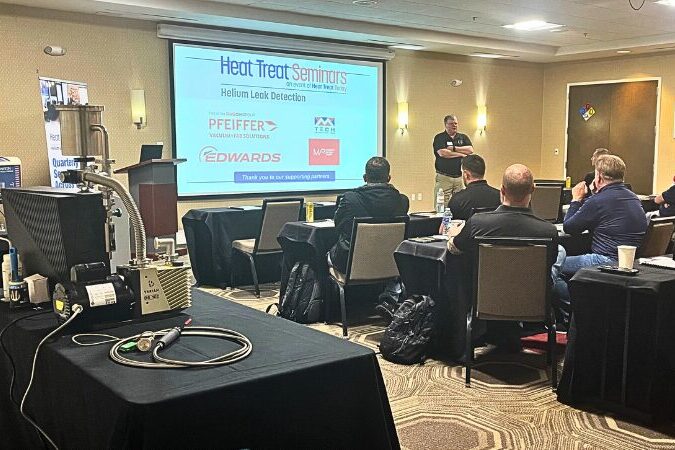
Heather Falcone: Let’s finish off by talking about Dave and the seminars.
Doug Glenn: Dave Deiwert is a helium vacuum leak detection expert who has been in the industry many, many years. These are single-day, in-person seminars where attendees will learn hands-on tips. Dave has leak detection equipment from several different suppliers. He will explain the theory behind helium leak detection, and provide solid, practical advice on how to do it. We had our first one this year in March in Charlotte, which was well attended.
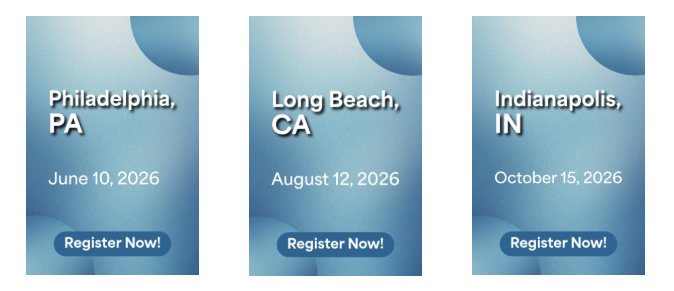
The next helium leak detection seminar is in Philadelphia on June 10th, and then we’ll have one in Long Beach, California on August 12. Our final one is scheduled the day after the Furnaces North America event ends in Indianapolis. It’s going to be located right in that neighborhood. The idea was, go to Furnaces North America, stay an extra day, and attend the Helium Leak Detection seminar. It’s scheduled for the October 15 in Indianapolis.
If you’re interested in more information on those seminars, visit heattreattoday.com/leakdetectionseminar, all one word.
Closing Remarks(28:36)
Doug Glenn: It is a lot going on. It is a lot going on, and I want to give a shout out to our in-house events director who’s just taking on the role this year, Karen Gantzer. Karen’s been doing a great job squaring all this stuff away. We give her this wild thing and she’s taken it by the horns and is getting it done.
Heather Falcone: With a smile always!
We covered a lot of ground today. I’m really excited about what we’ve got to be able to offer to the industry. This has been unpacking these, helps them understand exactly what might speak to them individually.
It was a lot of fun spending a little time with you. You’re a mentor, you’re the legacy. You brought us over a hundred episodes of radio, I’m going to say it until I’m blue in the face!
Doug Glenn: Yeah, well it’s nice to not have to ask the questions. It’s nice to actually be able to answer them, so thank you. I appreciate you allowing me to come on.
About the Guest

Publisher
Heat Treat Today
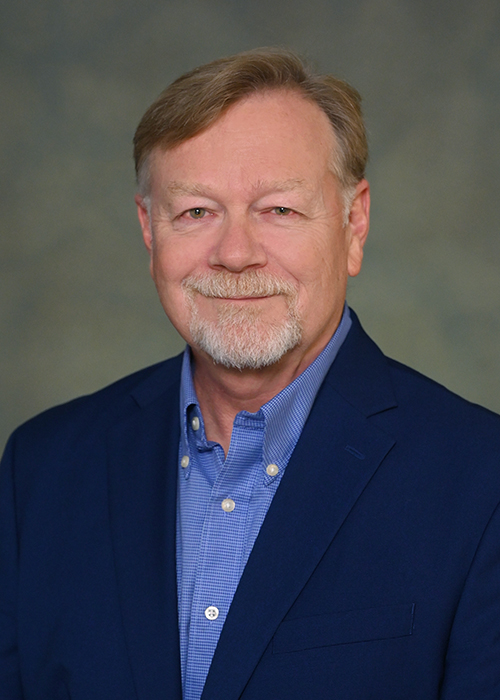
Doug Glenn is the founder and publisher of Heat Treat Today, a thermal processing industry consultant, and a longtime industry voice and conference speaker with over 30 years of experience. He spent two decades as publisher of Industrial Heating magazine, where he helped expand its global reach, and has played a key role in launching major industry events, including Furnaces North America.
For more information: Contact Doug Glenn at doug@heattreattoday.com.

Heat Treat Radio #132: Must-Attend Heat Treat Events of 2026 and Beyond Read More »