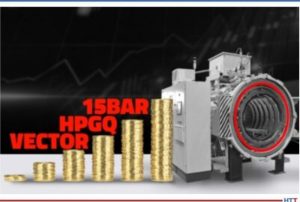
Vacuum heat treat operations expand for ZDT Glimag, an entity providing services in the field of vacuum heat treatment, laboratory tests, and production of parts for mining machines.
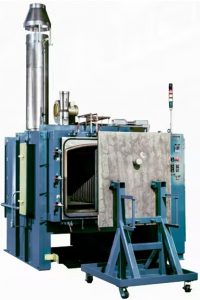
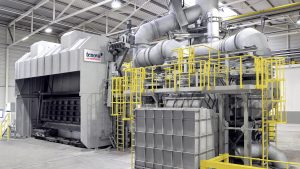
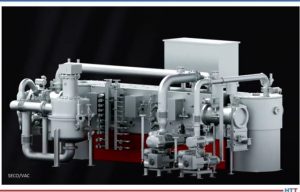
The addition of this Vector® vacuum furnace will be the third vacuum furnace from SECO/WARWICK. The current design has an operating space of 600 x 600 x 900 mm and will be equipped with numerous options to allow a wide range of heat treatment processes for various steel grades. Main processes will include vacuum brazing, FineCarb® vacuum carburizing, and high-pressure hardening. The design of the chamber size will enable efficient heat treatment of large packages of test and research elements.
The efficiency of processes is also influenced by the ability to cool at 15 bar (which, unlike the old furnaces, eliminates the need to wash the parts after the process). In combination with inverter control, the system also helps reduce power consumption peaks, which are so problematic today. Another big advantage is low heat losses and appropriate temperature uniformity in the heating chamber, which is resistant to rapid wear and is easy to use and service.
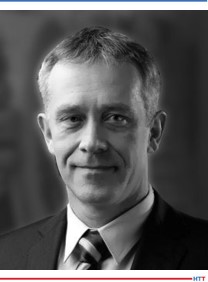
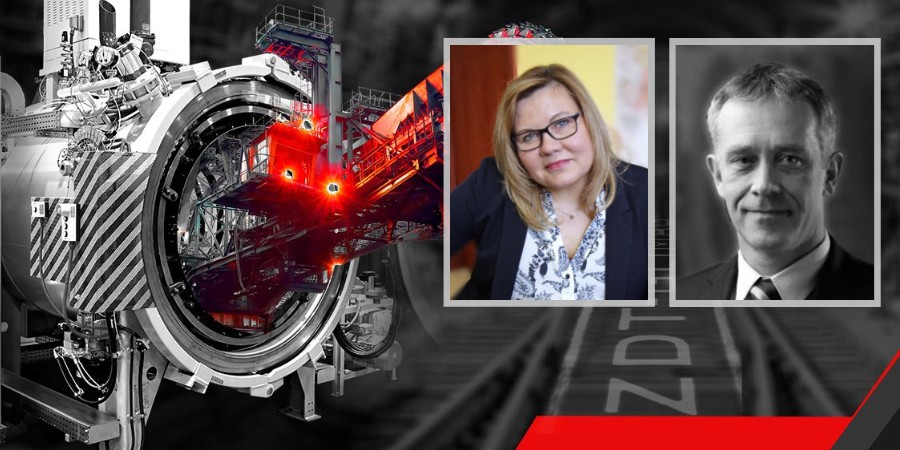
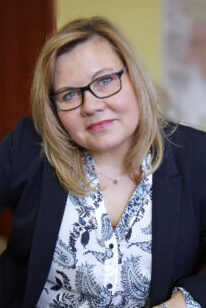
Beata Kowalewska President of the Management Board – Financial Director of ZDT Glimag Source: LinkedIn
Beata Kowalewska, president of the Management Board – Financial Director of ZDT Glimag, comments: “Since the 1960s, we have been designing prototypes, conducting research and technological tests, and implementing new technologies for mining. We are currently in the process of materializing the project titled ‘Implementation of an innovative product resulting from research and development work: a brake pad with a composite friction layer with increased abrasion resistance,’ implemented under the European Funds for a Modern Economy (FENG) 2021-2027 Program. FENG is a program supporting entrepreneurs in the area of broadly understood innovation. It places great emphasis on R&D activities.”
He continues, “The new SECO/WARWICK furnace fits perfectly into the policy of broadly understood modernity implemented in this project. It will streamline and expand the scope of heat treatment processes and improve their economics, taking into account energy savings and the graphite chamber efficiency. It will also ensure the process cleanliness and velocity. With the FineCarb® vacuum carburizing option, the technology also increases our flexibility and research capabilities. Additionally, this technology will allow us to perform more difficult processes requiring extremely low contamination levels, thanks to the ability to obtain the appropriate vacuum needed for these processes.”
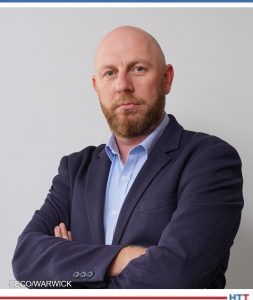
Maciej Korecki VP of the Vacuum Furnace Segment SECO/WARWICK Source: SECO/WARWICK
Maciej Korecki, VP of the Vacuum Furnace Segment in the SECO/WARWICK Group, comments on ZDT Glimag saying, “It is a center very well oriented in the metal heat treatment industry, constantly testing new, innovative solutions that in turn make the mining industry more efficient. The new Vector will introduce revolutionary changes in the hardening plant, introducing innovation and a very wide range of precise processes.”
The Vector® line vacuum furnaces can be used in most standard vacuum carburizing, hardening, tempering, annealing, supersaturation, and brazing processes. At the same time, the solution can be adapted to the recipient’s individual requirements, and therefore to a specific industry, an attribute necessary for research centers that test innovative solutions for external customers.
The solution‘s characteristic features are convection heating, i.e., a system improving the heat transfer efficiency when heating at lower temperatures, and directional cooling, which allows complex, flimsy, and long elements to be cooled in various ways, minimizing their deformations. An additional advantage is the vacuum carburizing option, which allows users to carry out precise processes to increase the steel surface hardness (carburizing) during the entire thermal process.
The original press release from SECO/WARWICK Group is available here.
Heat Treat Todayoffers News Chatter, a feature highlighting representative moves, transactions, and kudos from around the industry. Enjoy these 39 news bites that will help you stay up to date on all things heat treat.
Equipment Chatter
The precision forging manufacturer Jiangsu Pacific Precision Forging Company has placed an order with SMS group for a fully automatic MP 3150 eccentric closed-die forging press. Pacific Precision will be able to forge aluminum chassis components on a much larger scale. This new expansion provides Pacific Precision with access to the growing automotive market segment for more lightweight designs.
A commercial heat treater in Mexico purchased a third vacuum furnace from SECO/WARWICKGroup.
Ecocat India, a catalyst manufacturer, has ordered an advanced technology vacuum gas cooling furnace from SECO/WARWICK. The system will carry out brazing and annealing processes.
Several new CAB lines have been ordered from SECO/WARWICK to be delivered to manufacturers in China. Two companies specifically chose EV/CAB lines while another manufacturer purchased a CAB line.
SECO/WARWICK delivered two CAB lines and one universal chamber furnace for aluminum brazing to an automotive manufacturer in China. The systems will braze large-size coolers for vehicle batteries.
Oetzbach Edelstahl GmbH, a hardening plant, has purchased a third furnace from SECO/WARWICK.
A Swiss commercial heat treater ordered a brazing furnace to be used for nickel and silver from SECO/WARWICK.
Tenova LOI Thermprocess has completed the production optimization of a new Twin-Chamber Melting Furnace (TCF®) at E-Max Billets in Kerkrade, the Netherlands.
An Asian thread rolling die conglomerate selected a SECO/WARWICK vacuum furnace. The Vector® will be used for vacuum hardening and tempering fastener dies.
Vacuum furnace for heat treater in Mexico
SECO/WARWICK vacuum gas cooling furnace for Ecocat India
Box furnace for a manufacturer
Brazing furnaces for automotive manufacturer in China
3rd furnace for Oetzbach Edelstahl from SECO/WARWICK
SECO/WARWICK\’s brazing furnace for Swiss heat treater
TCFR for aluminum scrap recycling
Heat treated flat thread rolling dies
Company and Personnel Chatter
Hubbard-Hall has expanded its product offering and customer resources by acquiring the assets of Torch Surface Technologies, a specialty chemical company based in Whitmore Lake, MI.
New simulation software is being launched at CENOS Simulation Software. The application portfolio expands with some new electromagnetic case software apps. The first apps will be launched in Q4 or a little later.
Solar Atmospheres of California announced it has been awarded the approval to process parts for Lockheed Martin (LMCO) owned Sikorsky. The Sikorsky approval adds to the existing LMCO process specifications held for vacuum heat treatment of titanium, nickel alloys, and stainless steel per AMS 2801, AMS 2774, AMS 2759/3, and others.
Nel Hydrogen US, a subsidiary of Nel, has entered into a joint development agreement with General Motors to help accelerate the industrialization of Nel’s proton exchange membrane (PEM) electrolyzer platform. The two companies are looking to enable more cost competitive sources of renewable hydrogen.
The Supervisory Board of thyssenkrupp AGextended the appointment of Oliver Burkhard by five years. Burkhard has been a member of the Essen-based group's Executive Board since February 2013, Thyssenkrupp AG director of Labor since April 2013, and additionally CEO of thyssenkrupp Marine Systems since May 2022.
Joe Coleman, cyber security officer of Bluestreak Consulting™, has earned his Cyber AB CMMC Certification as a Registered Practitioner (RP). CMMC is a U.S. Department of Defense (DoD) program that applies to Defense Industrial Base (DIB) contractors.
CG Thermal welcomes associate process engineer Signe Laundrup to the Process Systems Group. Laundrup is a 2021 chemical engineering graduate from the University of California, San Diego. Her background is in manufacturing and research and design.
Tata Steel signed a memorandum of understanding with SMSGroup to reduce carbon emissions at Tata’s integrated steel plants across India.
Two heat treat technology companies integrate: C3 Data’s real-time pyrometry compliance software enables digital uploading of certificate data of all TT Electronics.
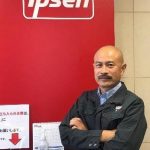
Ipsen Japan announced the addition of Mr. Masakazu Kanaka in the role of customer service director. Kanaka is responsible for the growth of all Ipsen Japan customer service business, which includes retrofits, parts, and service. He will oversee the aftermarket sales team and field service engineers.
Solar Atmospheres of California announced Honeywell approval to heat treat austenitic steels, martensitic steels, pH steels, tool steels, nickel alloys, cobalt alloys, titanium alloys, and magnetic alloys.
Aluplast – ZTG, an Altest company, recently expanded its production capacity with a second Nitrex nitriding system. The second furnace, a model N-EXT-612, is capable of processing a load of extrusion dies weighing up to 1300lbs.
Solar Atmospheres of Michigan is pleased to announce the addition of Chris Molencupp as their new sales manager.
Metal Exchange Corporation announced that Matt Rohm, current President and Chief Operating Officer (COO), will be promoted to Chief Executive Officer (CEO) of Metal Exchange Corporation effective January 1, 2023. At that time, current CEO Rick Merluzzi will assume the title of executive vice chairman, serving as an advisor to executive chairman, Mike Lefton, on key strategic initiatives for the organization, through the end of 2023.
Quintus Technologies joins the newly opened Application Center at RISE to support further development of additive manufacturing. The AM Center will also include the Quintus press model QIH 15L-2070.
Abbott Furnace Company announced that it has partnered with Obsidian Technical Group for sales and service support across much of the eastern United States.
Robert Roth announced the appointment of Nelson Sanchez as RoMan’s new president, effective January 1, 2023. Sanchez is the first non-family member to hold the office.
Hubbard-Hall hired Aaron Mambrino as chief financial officer. Her expertise lies in driving process changes to create operational synergies, developing strategic partnerships, and LEAN manufacturing.
John Savona, vice president of Americas Manufacturing and Labor Affairs, Ford Blue, will retire on March , after more than 33 years. Bryce Currie will step into the role.
AFC-Holcroft welcomed employees and their families, company retirees, and invited guests to view their newly renovated building as part of an open house.
Solar Atmospheres of California participated in the “Spark of Love” toy drive in coordination with the San Bernardino County Fire Department.
Raytheon Technologies expands Bengaluru operations with opening of Pratt & Whitney India Engineering Center. The facility is co-located with Pratt & Whitney’s India Capability Center and Collins Aerospace engineering and global operations centers.
Lucifer Furnaces in Warrington, PA, a manufacturer of heat treating furnaces and ovens for the last 80 years, has added Brett Wenger to its leadership team as vice president of sales.
Signe Laundrup, CG Thermal
Tata Steel and SMS Group to reduce carbon emissions
Mr. Masakazu Kanaka, customer service director, Ipsen Japan
Matt Rohm, CEO, Metal Exchange Corporation
Nelson Sanchez, new president of RoMan Manufacturing
Bill Disler, President & CEO of AFC-Holcroft, during the open house
Christmas toys for kids in Southern CA
Opening of Pratt & Whitney\’s India Engineering Center
Brett Wenger new vice president of sales at Lucifer Furnaces
Kudos Chatter
Global Thermal Solutions celebrates 15 years in Mexico.
Ipsen USA announced that 2023 represents a milestone anniversary. This year marks 75 years since Harold Ipsen founded the company.
Desktop Metal is sponsoring on a new season of BattleBots. The completely rebuilt robot is aided by the design freedoms and fast turnaround times of metal 3D printing.
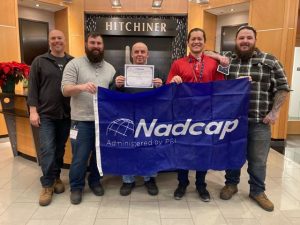
Solar Atmosphere’s Michigan and Western Pennsylvania facilities have recently been awarded Nadcap Merit status for vacuum heat treating and brazing.
In September, the Swiss Steel Group (SSG) held the 1st Hydrogen Symposium at the Henrichshütte Iron and Steel Works in Hattingen. Speakers from academia, business, and politics held lectures in four sessions.
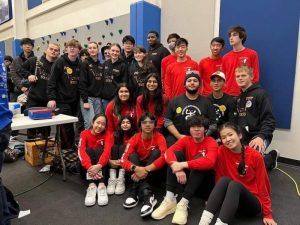
Borikengineers, a team mentored by Pratt & Whitney employees in Puerto Rico, has advanced to the Qualifiers’ Finals Competition in the FIRST Tech Challenge DC Qualifier. The team won the Judges Choice Award.
Hitchiner Manufacturing Nadcap accredited
SawBlaze on Discovery Channel\’s TV show, \”BattleBots\”
Borikengineers, Judges Choice Award winners
Heat Treat Today is pleased to join in the announcements of growth and achievement throughout the industry by highlighting them here on our News Chatter page. Please send any information you feel may be of interest to manufacturers with in-house heat treat departments especially in the aerospace, automotive, medical, and energy sectors to sarah@heattreattoday.com.
Find heat treating products and services when you search on Heat Treat Buyers Guide.com
Heat Treat Today’s Technical Tuesday feature means that on just about any given Tuesday, there will be an article that aims to educate our heat treating readers—be it in a process, equipment, metals, analysis, critical parts, or more. Enjoy this sampling of Technical Tuesday articles from the past several months.
Case Study: Heat Treat Equipment Meets the Future Industry Today
Contact us with your Reader Feedback!
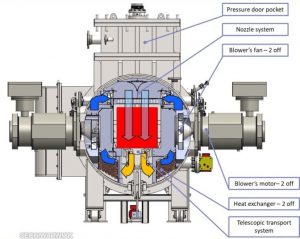
Construction and schematic furnace cross-section CMe-T6810-25 Source: SECO/WARWICK
How has one heat treat furnace supplier contended with modern challenges of manufacturing? In this case study about a shift away from traditional forms of heat treat, explorehow vacuum furnace technology has more technological horizons to bound.
Several key features discussed will be the various challenges that characterize modern industry; the differences between historical heat treat furnaces and vacuum furnaces; furnace features that can meet these obstacles; and a close look at what one equipment option from SECO/WARWICK helps. Additionally, explore the case study of a process that resulted in the following assessment: "all technological requirements have been met, obtaining the following indicators of efficiency and consumption of energy factors calculated for the entire load and per unit net weight of the load (700 kg)."
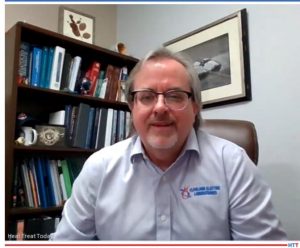
Eric Yeager of Cleveland Electric explaining the 101 of all things thermocouple Source: Heat Treat Today
How do thermocouples work? How would you tell if you had a bad one? Those ever present temperature monitors are fairly straightforward to use, but when it comes to how it works — and why — things get complicated.
This transcript Q&A article was published in the print edition last year (2022), but there was too much information to fill the pages. Online, read the full-length interview, including the final conversation about how dissimilar metals create EMF. Included in the discussion is proper care of the T/C and knowledge of when it’s time to replace.
Trends in the heat treat industry Source: Unsplash.com/getty images
What’s “hot” for heat treaters in recent months? The trends are pointing towards streamlining upgrading information systems, more efforts to reduce carbon footprint, and ensuring processes in salt quenching and electricity use are as efficient as they can be.
Each of the 6 trends included in the article demonstrates that heat treaters are making thoughtful and responsible decisions and purchases. Considerations include care for the environment and methods to help employees share and receive information needed for each job.
Read more about each of the trends to see what’s happening with equipment purchases and technology decisions and how companies are pushing to make that carbon footprint smaller.
A Quick Guide to Alloys and Their Medical Applications
Sneak peak of this medical alloys resource Source: Heat Treat Today
If you're pining for a medical heat treat quick resource in our "off-season," we have a resource for you. Whether you are a seasoned heat treater of medical application parts or not, you know that the alloy composition of a part will greatly determine the type of heat treat application that is suitable. Before you expand your heat treat capabilities of medical devices, check out this graphic to quickly pin-point what alloys are in high-demand within the medical industry and what end-product they relate to.
The alloys addressed in this graphic are: titanium, cobalt chromium, niobium, nitinol, copper, and tantalum.
Resource -- Forging, Quenching, and Integrated Heat Treat: DFIQ Final Report
Examples of DFIQ equipment Source: Joe Powell
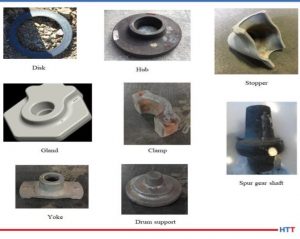
How much time and energy does it take to bring parts through forging and heat treatment? Have you ever tried to integrating these heat intensive processes? If part design, forging method, and heat treat quenching solutions are considered together, some amazing results can occur. Check out the report findings when the Direct from Forge Intensive Quenching (DFIQTM) was studied.
Forgings were tested, in three different locations, to see if immediate quenching after forging made a difference in a variety of steel samples. The report shares, “The following material mechanical properties were evaluated: tensile strength, yield strength, elongation, reduction in area and impact strength. Data obtained on the mechanical properties of DFIQ forgings were compared to that of forgings after applying a conventional post-forging heat-treating process.”
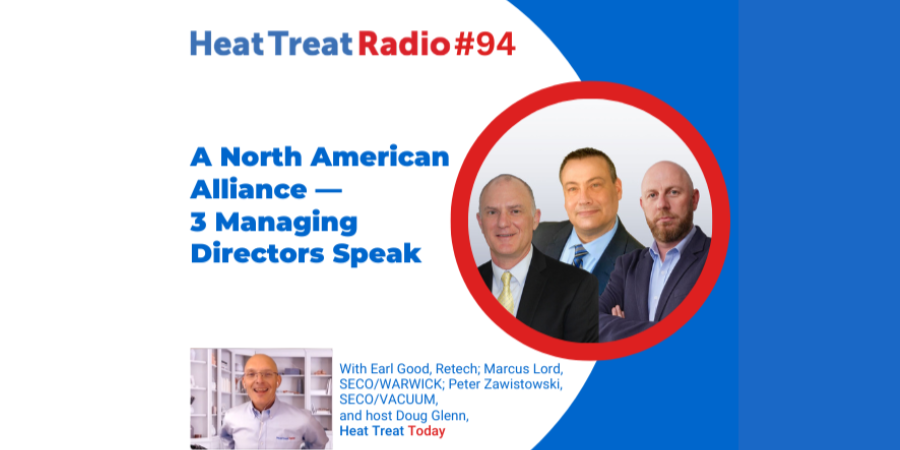
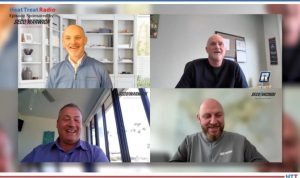
In a special Heat Treat Radio episode, three managing directors based in SECO/WARWICK Group’s North American companies speak with Doug Glenn, host of this podcast and Heat TreatToday founder and publisher, about the working synergy amongst heat treat and metallurgical market efforts. Watch, listen, and learn about how Earl Good, managing director at Retech; Marcus Lord, managing director at SECO/WARWICK; and Peter Zawistowski, managing director at SECO/VACUUM, lead the North American market with their heat treat solutions.
Below, you can watch the video, listen to the podcast by clicking on the audio play button, or read an edited transcript.
The following transcript has been edited for your reading enjoyment.
Meet the Managing Directors (01:20)
I want to start with Peter Zawistowski, managing director at SECO/VACUUM Technologies, one of the newer companies of the SECO/WARWICK GROUP. Then, we have Marcus Lord, managing director at SECO/WARWICK Corporation. Both of those companies are currently located in Meadville, western Pennsylvania. We also have Earl Good, managing director at Retech Systems, LLC, located in the Buffalo, NY, area.
Contact us with your Reader Feedback!
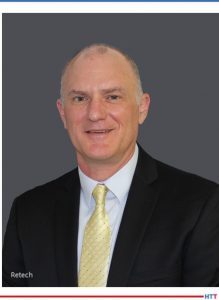
Earl Good Managing Director at Retech Systems, LLC Source: Retech
Earl Good: I’ve been with Retech 6 years in April. Time has flown by fast. There have been, certainly, some interesting developments with Retech over the years. We relocated the business from Ukiah, California to Buffalo, New York. We originally had an office on Main Street in Williamsville in 2018. We found a new facility here that allows us to do manufacturing and assembly as well as have office space. We have about 40,000 feet for manufacturing and assembly, 10,000 square feet of office space. We are actually looking for additional space because of the growth and development we’ve experienced over the last few years.
When I came into Retech, there were some issues and some challenges that the company was facing. We’ve overcome those, and we’ve certainly moved in a good direction.
Prior to Retech, I was with Metso Minerals. I worked with Metso Minerals for about 13 years. I was moved through various positions there. My last position, for the last 7 years, was the vice president of ETO (“engineer to order” group). I was responsible for four different divisions on a global basis and increased that business from about 150 million euros to about 250 million euros a year. It became the second most profitable division within Metso.
This opportunity came along, and it was a different challenge. That’s what piqued my interest here.
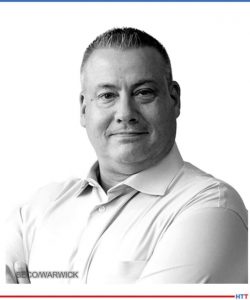
Marcus Lord Managing Director at SECO/WARWICK Corporation Source: SECO/WARWICK
Marcus Lord: I’ve been with SECO for 9 months now. I came on board at the end of June (2022), basically looking at reestablishing the SECO/WARWICK manufacturing footprint in Meadville. That’s a “work in process” right now, rebuilding the team. We have a considerable amount of folks that are looking at retirement and trying to pass on some of that legacy knowledge to new people to spur additional business growth.
Prior to SECO, I worked for Carpenter Technology Corporation for 3 years, metal manufacturing for specialty alloys. Prior to that, I did two greenfields, one for Oerlikon Metco and one for Wyman-Gordon PCC. Both of those were powder atomization materials, so a lot of “end use” more so than manufacturing of the equipment, which gives me a good understanding of what people want from equipment.
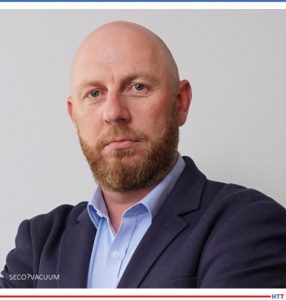
Peter Zawistowski Managing Director at SECO/VACUUM Technologies Source: SECO/VACUUM
Peter Zawistowski: I’m in Meadville, PA. It’s hard to say how long I have been with SECO/WARWICK. I’ve been there 20 years, officially, but to be honest, it’s been since as long as I can remember that I’ve been around vacuum furnaces. I was basically born inside a SECO/VACUUM furnace, so that’s how long I’ve been with the company.
I’ve gone through several different positions: service engineer, engineering, sales, and currently, managing SECO/VACUUM here in the U.S. We are responsible for our vacuum furnaces for North America.
Doug Glenn: For those who don’t know: the global headquarters for the SECO Group is in Poland. Peter actually comes from there. You agreed to relocate your family, and you’ve been in the States now for how long?
Peter Zawistowski: For quite some time; I think it’s 10 ½ years or 11.
Doug Glenn: Peter is the link back to Poland which we will talk briefly about.
Markets and Products (07:00)
Can you give a snapshot of the markets you serve and the products you supply?
Peter Zawistowski: 50% of our products are single chamber furnaces, standard from toolbar up to 25 bars of gas quench furnaces multigraphite.
The next would be vacuum oil quench furnaces in which we’ve developed a new design, I believe, 15 or 20 years ago. This is where, I think, we are leading the market. I believe the competition is 5 to 10 years behind us in this product.
We have a lot of new developments or new products like pit LPC, like 4D Quench, which is like a single piece quench. We are always looking for some custom projects. We like those; we are not afraid of those and we can do them.
Doug Glenn: In a nutshell, SECO/VACUUM Technologies is dealing primarily with vacuum heat treat furnaces and all things around that including any type of specials, customs, etc. That’s where your strengths are. Marcus, how about SECO/WARWICK Corp.?
Marcus Lord: SECO/WARWICK Corporation has a pretty big portfolio of equipment. Right now, I know a major view is on CAB lines. We’re seeing a lot of inquiries on the continuous or controlled aluminum brazing process as well as aluminum processing equipment for annealing large coils of aluminum or sheet and foil-type aluminum. Then, back to some of the roots as atmospheric-type furnaces, so roller hearths, mesh belt and things of those sort. Those are, basically, customized to the customer’s preference, so we have a huge catalog. Lately, we’ve sold some actual aluminum melting-type furnaces, so large tilt melting furnaces.
Doug Glenn: Earl, let’s go to you.
Earl Good: We supply vacuum melting equipment — melting of metals and alloys that have a high melting temperature. Our typical industry markets are aerospace, medical, defense, and energy storage. Our primary furnace types are the electron beam furnace, a PAM (plasma arc melting) furnace, and a VIM (vacuum induction melting in a bar). We also have powder atomization technology and our melt spinner technology.
R&D in melting is growing for us, because we have a couple different furnaces we can operate. We have a lot of customers who don’t have the need for an excessive amount of material. They don’t want to purchase a furnace, so they come to us asking us to melt a certain amount over the course of a month or a year.
We have a broad base of technologies that we can offer the market, which is good, because some of the aerospace work can be cyclical in nature; but the other furnaces and other options that we have make up for that.
We work with mostly titanium, nickel, and various alloys associated with aluminum and nickel.
Technological Niches (11:25)
Doug Glenn: Is there a specific technology that you feel is really your company’s strong suit? Something you really feel comfortable doing?
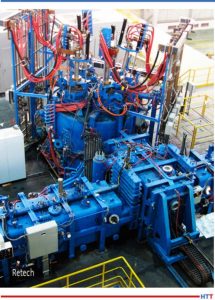
Earl Good: I’m going to highlight two different technologies: I think our PAM technology, or plasma melting technology, is the best on the market. We have more installations than anybody out there. All of our furnaces have, basically, satisfied their performance requirements.
PAM Furnace Source: Retech Systems, LLC
Another area I’d like to highlight is our powder technology. We’ve been a little bit behind some of our competitors in the market, but we’ve really developed some good things that are going to provide opportunities for us in the market. We have a number of customers coming to us to look at those opportunities now. I think those are probably the two most unique and best that we have to offer.
Peter Zawistowski: Our single chamber vacuum furnaces are one of the best in the world, currently. We also have some new products. We are trying to get to the market our 4D Quench furnace. It is a special system to vacuum carburize and then single piece quench. This is the unit we are implementing in the U.S. We are getting good references, and we are getting great results.
4D Quench Furnace Source: SECO/VACUUM
We are also focused on LPC, in general. All of our furnaces are equipped with LPC which, I think, the industry is moving to vacuum carburizing. That’s the big focus right now with SECO/VACUUM.
Doug Glenn: People are saying in many areas in heat treat, we ought to be focusing much more on quench than heating. Anybody can heat the thing up. The real key is, can you quench it? Especially when you’re talking about surface hardening and things of that sort.
Peter Zawistowski: Exactly. And in 4D Quench, this is where we can control the distortion to the level close to gas quenching; that’s the key to success.
Marcus Lord: I would say that our CAB (controlled atmosphere brazing) lines are probably the best in the world. We have a lot of competitors that we’re seeing pop up out of Asia, but I believe that we still hold the market share for that type of equipment. Like many of our other pieces of equipment, we are able to customize based upon what the customer really is needing to achieve.
I would say that with the big push to reduce carbon footprint of these manufacturers, SECO still has the technology for their bayonet electric heating processes. We’re not held up by somebody else supplying us with that type of product; we can build that in-house and supply a very efficient furnace when it comes to electric heating.
New Technologies (15:20)
Doug Glenn: Does SECO/WARWICK have anything to offer in the aluminum market?
Marcus Lord: In Poland, we are starting to offer the vortex 1 and 2.0, which is being developed. Those are options we are going to introduce along with predictive maintenance programs that have been developed out of Poland.
Doug Glenn: I want next ask about new technologies, things that either are currently commercialized, or soon to be, that you feel good about. Peter, why don’t we start with you? What do you think as far as vacuum technologies?
Peter Zawistowski: We have quite a few new technologies, but I think I will tell you more about LPC. As I said, all of our products are equipped with vacuum carburizing. I think that this is where the industry is going right now with the current trend of limiting the carbon footprint and sustainability. I know that in the U.S., it’s maybe not that common right now, but you are aware that most or all of the big European companies will have to report carbon footprint starting in 2024.
If any of the U.S. companies would like to do business with Europe, like with German automotive industrial airbuses of the world, you’ll have to do the same. To do that, you have to limit your carbon footprint.
"To do that [facilitate business in Europe], you have to limit your carbon footprint." Source: Unsplash.com/Matthias HeydeIn carburizing, you must switch technology. Right now, the most common carburizing technology or equipment is Integral Quench (IQ) furnaces, and you must do something with it. There is a need. It will happen that there will be a switch to low pressure carburizing; this is where we can help.Earl Good: A lot of our furnaces are customized. Through the R&D trials and toll melting we do, we are able to develop new technologies. There are two areas that I want to highlight.We put some time and effort into developing a small-scale atomizer that is more like a lab-type atomizer. Ours is a little bit more robust than our competitors’ units, and it has more capabilities. For example, you can melt different materials on it. We’re very eager to get that out into the market and make our first sale.
The second is our plasma gas atomizer. We do receive a lot of interest in this product right now. It’s different from what’s out there. Much of the market today, as far as powder and atomization, is batch process; the yields are not great. We believe that the plasma gas atomizer will increase yields. It allows ongoing melting which is going to provide a lot of options to customers who have the need for a more robust process, as far as their powder production.
We’re really excited about both of those and getting those out.
Doug Glenn: Is development of those products driven by the AM market 3D printing?
Earl Good: Yes, but you have universities and others who want to do things on a smaller scale, on the trial basis so as to not invest a significant amount of money. They want to see that the technology is going to work or see the products they’re developing. There is a real need for that, and I think there’s a need for something more robust than what’s on the market.
Marcus Lord: We have new technologies on aluminum processing.
The Vortex 2.0 is a new technology. I believe three Vortex 2.0 systems have been sold and are not yet fully commissioned. This will give us an upper hand on how we go about heating our materials on an efficiency standpoint, especially when we’re looking at the carbon footprint and how we are going about processing our materials.
Other than that, we have some technologies based on a customer preference, technologies that may not be a staple or standard on all our equipment.
Collaboration (22:53)
"Is it helpful that you’ve got the three separate companies working together?" Source: Unsplash.com/krakenimages
Doug Glenn: There are very few thermal processing technology companies that have the breadth of capabilities from everything from atomizing, arc melting, heat treating, vacuum heat treating, and air atmosphere heat treating. How do you cooperate to synergize these technologies? Do you find it beneficial, and/or is it helpful that you’ve got the three separate companies working together?
Earl Good: In my opinion, we haven’t worked great during my previous years here. We do get along. I think we have the opportunity to work together much more as we move forward. We started to do that in some different areas. We’re looking for a facility, right now, to spread our U.S. footprint for manufacturing and assembly. I think it will be a shared work facility.
Each of us brings a different set of skills and talents to the industry. We have the opportunity to leverage some of those to the benefit of the whole. Products are in demand that are made in the U.S., and I think we’re going to be in a good position to service that market. I think all of us are in positions where we’ve seen our businesses start to grow and improve, so I think it gives us a great opportunity to work together.
Marcus Lord: I think it is beneficial to have collaboration amongst all three of us and our different businesses. We’re able to support one another, especially from a technology aspect. If there are questions, you have an outreach program, and we are open to work with each other. Like Earl said, we’re all looking to expand. SECO Corp is looking at making an expansion and still retain the offices in Meadville, but we’re also looking for another location to be able to give us a little bit more bandwidth.
For my group, we’re looking at a lot of operations happening in Mexico. That’s something that we really need to look at from a support aspect. Being three businesses relatively close to one another, it is overall beneficial for all of us.
Peter Zawistowski: It’s not only beneficial for us, but I it is beneficial for our customers. For example: Earl is offering a furnace, and my equipment is like auxiliary equipment to his, so we can offer a full package to the customer. We have expertise across the three companies that we can support and provide all that is needed to customers. I think that is a big benefit.
Manufacturing in the United States: Present and Future (26:50)
Doug Glenn: How has manufacturing in the U.S. been in the past and what are the future plans?
Earl Good: I can throw a couple comments out. Our past manufacturing in the U.S. was done out in Ukiah, for Retech specifically. Ukiah is a great place for wineries and vineyards, but maybe not an industrial furnace manufacturer!
Originally, there was a desire for us to leave all manufacturing and assembly in the United States, by the past CEO, and then we found this facility here in Buffalo. The new CEO, Sławomir Woźniak, said, “Hey, could you guys do some manufacturing and assembly here?”
I said, “Yes!” I think my chin hit the floor, and I was drooling because I thought it was exactly what we needed.
We have the 40,000 square foot facility here that we’ve already filled. We have a customer base that wants more manufacturing and assembly. Having additional manufacturing and assembly, with what we have within Retech — in Poland, in some of the areas, China, and India — gives us a way to support all of our customers’ needs. Some customers are looking for low price options, some want things built here in the U.S. As we become maybe less globalized and more centralized as far as focus, I think we’re going to be able to support all of those different needs for our customers and do it well.
Peter Zawistowski: We are looking to start manufacturing and assembling vacuum furnaces here in the U.S. As Earl said, we had our facility in Ukiah; we had our facility in Meadville. We had two or three companies in the U.S., and we were doing it in different places. Now, we would like to consolidate and leverage the fact that we have three companies here in the U.S.
"It’s not only about manufacturing. We are also thinking about bringing some R&D activities here to the U.S." Source: Unsplash.com/Getty Image
It’s not only about manufacturing. We are also thinking about bringing some R&D activities here to the U.S. Currently, I think that more often we sell technology, not furnaces. We would like to be able to provide that service to our customers, as well, here in the U.S.
Marcus Lord: Manufacturing was part of the deal of me coming on to SECO. It was really to reestablish what was being done.
Whether or not it makes sense to do full-blown manufacturing (because that’s a huge capital expense upfront) is one thing, and then, of course, training people to be able to do the processes. It makes more sense for us to actually do subassemblies or manufacturing of maybe a smaller part of what we’re looking at, as far as the equipment, and being very specialized on what we do manufacture. That will leave the larger projects either internally or external. As you said, we can’t be really good at everything we do, so we’ll pick and choose what we’re really good at and just exploit it from that point and then grow.
Doug Glenn: There have been major supply chain disruptions over the last couple of years. Can you address supply chain issues for each of your businesses? Are you seeing any difficulties? How much is re-shoring driven by supply chain issues?
Marcus Lord: Part of the directive is to try to be able to control our supply chain and also have better control of when we’re able to deliver equipment — that’s key for most of the customers. They want lead time even more than price. Where we’re seeing the impact for our pieces of equipment is definitively PLC systems. Outside of that, we don’t see much of a disruption. Maybe with some high nickel product that we use in our bayonet heaters; outside of that, it’s restricted to those two items.
Peter Zawistowski: I think we can see the supply chain getting better. But it’s not only the supply chain, it’s also transport cost and time. Right now, we would like to ship the equipment from overseas; but it’s twice as much money and twice as much time. That’s another problem we would like to address.
Earl Good: I think the supply chain varies. What’s kind of unusual in the market right now is you have a project where part of the supply chain works well and the other part not so well. Then, with the next project, it’s the exact opposite. The feedback I get from a lot of suppliers and even some of our customers is that they still have a difficult time finding people, and when you don’t have the people it’s hard to deliver.
Generally, things are improving and hopefully they continue to go in that direction. In the electronic PLC control-type technology, that’s where we see the biggest delays, as Marcus has indicated. That’s an area that is not showing signs of getting better right now. I think, as some of these chip manufacturing facilities come online, you’ll see a big improvement there.
Doug Glenn: How would you categorize upper management in Poland and their vision and their support of what’s going on in North America?
Peter Zawistowski: Expansion in North America is one of the primary goals on the group level right now. All of us are getting a lot of support from the group management. [blocktext align="left"]Expansion in North America is one of the primary goals on the group level right now.[/blocktext]This is the philosophy of the company. We have companies in India; we have companies in China and in the U.S. That’s why we have companies in the local market because they understand the market the best. Our company, in my opinion, is very important.
Doug Glenn: Do you characterize the presence in Europe as being supporting but not micromanaging? They’re giving you freedom and giving some goals to hit and saying, “Go at it, team.”
Peter Zawistowski: There is a direction we all follow but, yes, we have a lot of freedom, ultimately, in the U.S.
Earl Good: I think the support has been great. I think we are given a lot of flexibility as far as how we go about our business and operating it. I think there is definitely a desire to see us grow in the U.S., and I think they’ll give us the tools, the technology, and the ability to do so.
Doug Glenn: Some people, in North America, will say that it’s going to be very difficult for SECO/WARWICK (any one of these three companies, not just SECO/WARWICK Corporation, but SECO/VACUUM or Retech), to survive in the North American market because they have a global headquarters in Europe. What do you say to people that would say that?
Marcus Lord: I would definitely tell them that’s untrue. This is actually the second company I’ve worked for that has most of their operations in Europe. Both of the companies have been very, very successful at going out and putting their footprint on the industry and the marketplace and actually providing equipment, depending on the technologies, that is far superior than what our competitors have.
As far as being able to go into North America: There are directives, there are things you have to follow, but that’s with all corporations. At that point, they might want others to believe we won’t be successful because we’re European-driven, but that’s very untrue.
As Peter has said, we have a lot of autonomy to run the business, we have objectives, we have KPIs that we have to hit. The major idealism is to be profitable and have quality product. With those, it’s easy to drive a business to be successful; it doesn’t matter where it’s managed from.
Peter Zawistowski: My competitor in vacuum heat treating has headquarters in Germany, and nobody seems to care. I think it’s normal. We have a big presence here in the U.S., and that’s all the better.
Earl Good: I think I would add that our competitors try to push that our headquarters are in Poland and maybe our products aren’t as good. I’m a firm believer that if you deliver a good product on time, if the product starts up well, and if you take care of your customer, it doesn’t matter where your headquarters are. Customers are going to find you. They’re going to enjoy the experience and come back to you. We’re seeing a lot of our customers come back to us for additional equipment. I think that our competitors can push that all they want. The reality of it is, if you deliver on your customer’s needs, you’re going to have success.
The Future of SECO/WARWICK in North America (37:53)
Doug Glenn: What are you optimistic about regarding the future of your specific company?
Earl Good: That’s a broad-based question, but we had a very good year in 2022. I think we’re headed to a very good year in 2023, and our focus is on continuing to grow, continuing to develop products that the market needs and wants. I think we have some good things that we’re working on in R&D, so I’m very optimistic about our future and about our direction. We’re on the right path and doing a lot of the right things.
Heat Treat Radio Source: Heat Treat Today
Marcus Lord: With SECO/WARWICK Corp., we closed the year out with a very large sale. That is continuing into 2023 where we have a growing backlog which is good. It shows we’re continuing to service the industry and also providing quality equipment. I don’t foresee that diminishing at all; I just see it growing. As we support one another, that’s the best way to continue our paths.
Peter Zawistowski: We will continue to grow. I see a big opportunity for us in the U.S. SECO/VACUUM is a fairly young company; it’s 5½ years old. I think we will get more market share by having satisfied customers.
Doug Glenn: What is most exciting about what you’re doing in the market right now?
Marcus Lord: I guess I’m a workaholic, so that really helps. I’m actually on vacation right now and here I am working. I’ve been doing emails and that’s just part of the business, right? For me, it’s putting the bridges back in place that should have always been there, that deteriorated just through the history of SECO Corp. along with SWSA, and really growing the label. All I’ve heard is negativity and what that negativity does to me is it actually drives me to make the business better. It’s more personal than it is a corporate thing because I like proving people wrong. That’s what drives me.
Earl Good: I think the energy comes from the fact that we’ve made tremendous progress over the last 5+ years. We’ve seen Retech change our image in the market; there were definitely issues and problems. The fact that we see customers coming back to us with repeat orders indicates that we are delivering to our customers, meeting their needs, and satisfying them.
I always say if you go above and beyond the customer’s expectations, everything else takes care of itself. That’s where I’d like to leave it. I think we’ve made great progress and I see good things in our future.
Peter Zawistowski: Personally, I like the fact that every day is different and every customer is different. One day I will talk to a heat treater because he needs a furnace to heat treat nuts and bolts. The next day we have to develop a new power train for a helicopter, or we have to set up a reactor for new fusion energy. I don’t think there is any other industry or anything else than heat treating that you can actually touch a number of different industries. That’s what I personally like and what drives me every day.
About the experts:
Earl Good, president and managing director at Retech Systems: He graduated from Penn State University, where obtained a Bachelor of Science Degree in Electrical Engineering. Eight years later, he received a Master of Business Administration Degree from Lebanon Valley College. Earl has spent a majority of his working career with three different companies, General Electric Environmental Services, Marsulex Environmental Technologies, and Metso Minerals. He has held roles of increasing responsibility throughout his career, including various management positions. Earl Good was appointed to the position of Member of the Management Board of SECO/WARWICK S.A. starting on January 2, 2019. Currently Vice President, Business Segment Vacuum Melting & Managing Director at Retech Systems LLC.
Marcus G. Lord, president and managing director at SECO/WARWICK USA: He earned his Business Administration BBA Executive Management degree at Cleary University. He has worldwide executive leadership experience in innovative manufacturing processes, operational excellence, sustainability initiatives in the supply chain, and operations management. Marcus has served in a multitude of roles, including Manager of new tooling and dies repair( at National Set Screw (PCC)), Director of operations( at Wyman-Gordon and Oerlikon – Metco), Executive Manager BMO (at Carpenter Technologies), General Manager – Manufacturing (at Carpenter Technologies). Currently President and Managing Director at SECO/WARWICK Corp.
Peter Zawistowski, Managing Director a SECO/VACUUM, USA: He graduated from Technical University of Czestochowa where he earned a Master’s Degree in Material Engineering. He also graduated from Executive Program in General Management (EPGM) from the Sloan School of Management at MIT (Massachusetts Institute of Technology) completing extensive training in a variety of business management courses. His work experience at SECO/WARWICK began in 2005 as melt team service manager. In 2009, he assumed director duties of the vacuum carburizing furnace group. In 2013, became Global Product Manager of the vacuum carburizing and vacuum oil quenching group and in 2014 ascended to the General Manager position for product management and sales at SECO/WARWICK Corp. in Meadville, Pennsylvania. Currently, he is Managing Director of SECO/VACUUM, North America’s newest vacuum furnace company.
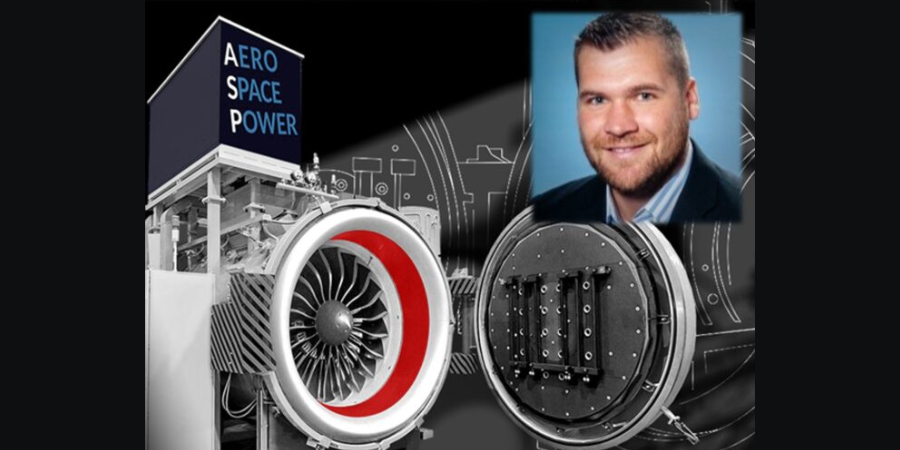
Aero Space Power, an MRO facility, has ordered a custom-made vacuum furnace tobe utilized in repair solutions for both complex aircraft engines and gas turbines in the energy industry.
Mark Peter Biro Commercial Sales Manager at Aero Space Power Source: LinkedIn
“We decided to acquire in-house heat treatment because we want to be independent in production. It will also give us much better control over the process and treated part quality," commented Mark Peter Biro, commercial sales manager, Aero Space Power. "By installing production capacity in-house and creating our own heat treatment department, we not only become independent from external suppliers, but we also significantly reduce transportation costs.”
The furnace on order from SECO/WARWICK, a company with locations in North America, is unique due to the size of the heating chamber. It has been adapted to the Aero Space Power requirements and has a working area of 51" x 39" x 59" to enable heat treatment of large components up to 55" diameter especially large aircraft parts, as well as gas turbines for the energy sector. The custom technology on order, in addition to non-standard dimensions, is designed to process work in the presence of two gases: argon (used for partial pressure) and nitrogen, which is used mainly in the cooling process. A dew point sensor for each of the gases will be included with the furnace.
Find heat treating products and services when you search on Heat Treat Buyers Guide.com
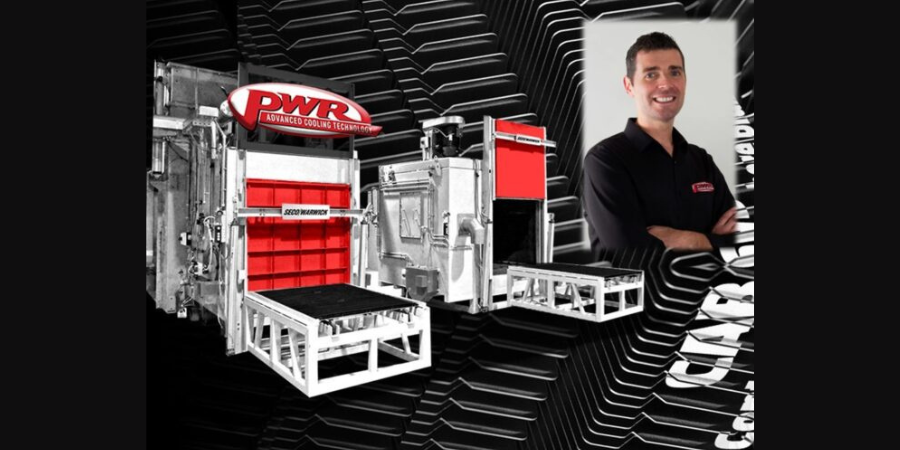
PWR Advanced Cooling Technology has ordered two universal batch CAB furnaces and a CAB continuous line. The furnaces will be used for brazing aluminum heat exchangers. The 3 solutions will go to 2 continents – Australia and North America.
PWR Advanced Cooling Technology specializes in the production of modern and efficient heat exchangers and has used SECO/WARWICK Group furnaces in the past. Two furnaces, the continuous CAB line and Universal Batch CAB Furnace, will be delivered to production plants in Australia. The second chamber furnace will be delivered at the same time to the American branch of PWR, C&R Racing Inc.
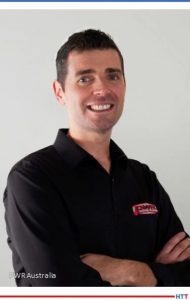
Andi Scott, general manager - advanced technology, PWR Australia Source: PWR Australia
The universal batch CAB furnace meets the requirements for protective atmosphere aluminum brazing technology (Nocolok®) and allows users to braze products in a horizontal or vertical position. The continuous CAB line performs brazing in a protective atmosphere for mass production of various heat exchangers.
“We have already ordered the company’s furnaces twice, and the current contract, although more than 25 years have passed since the first order, is the best proof that we are satisfied with the product quality, cooperation, and after-sales service.” said Andi Scott from PWR Advanced Cooling Technology.
“The current contract is special because we will deliver different solutions simultaneously to two continents but to the same customer,” commented Sławomir Woźniak, CEO of the SECO/WARWICK Group.
Find heat treating products and services when you search on Heat Treat Buyers Guide.com
Peter Zawistowski Managing Director SECO/VACUUM TECHNOLOGIES, USA Source: SECO/WARWICK
A U.S.-based international manufacturer of dies will expand their operation with a high-pressure gas quench furnace. The equipment will accommodate increasing orders for the company’s largest dies.
The manufacturer’s equipment requires the use of precisely heat treated large dies. Currently the company utilizes a pair of vacuum furnaces that have some limits. The Vector® furnace they are about to receive from SECO/VACUUM, a SECO/WARWICKGroupcompany isbottom loading with 6 bar nitrogen gas quench, 60”x 72”, with a 3-ton capacity working zone. This is room enough to treat 3 of their largest dies at once compared to only 2 per cycle for the old furnace.
“With [the furnace’s] wide range of quenching features, [the manufacturer will] have room to grow, even enabling them to conduct low-pressure carburizing processes if they ever need to,”saidPeter Zawistowski, managing director of SECO/VACUUM.
Find heat treating products and services when you search on Heat Treat Buyers Guide.com
Heat Treat Today is partnering with two international publications: heat processing, a Vulkan-Verlag GmbH publication that serves mostly the European and Asian heat treat markets, and Furnaces International, a Quartz Business Media publication that primarily serves the English-speaking globe. Through these partnerships, we are sharing the latest news, tech tips, and cutting-edge articles that will serve our audience — manufacturers with in-house heat treat.
In this installment, we look at updates on industry events around the globe, such as two celebrations, a brand new EAF, and a benchtop measurement predictor.
International Heat Treat and Metallurgy Company Sees Doubling Profits
Seco/Warwick announces positive figures for 2022. Source: Seco/Warwick
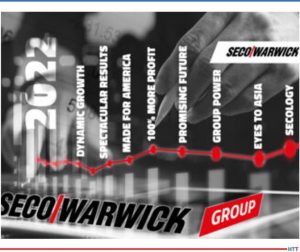
"The great results of the Group were influenced by several factors. The growth of production activities in China and dynamic market development in America. Furthermore the huge number of orders [are] related to the electromobility industry expansion. In the first three quarters of 2022, the company had over 100 % more profit than in the previous year. Sales revenues amounted to PLN 448.87 million in this period (PLN 335.09 million in 2021). . . . For Seco/Warwick, 2023 will be the year of American companies."
System aids in production of various steel grades. Source: Tenova
“Tenova, supplier of sustainable solutions for the metals industry, has recently completed the start-up of the new 70t EAF at the Valbruna ASW Inc. plant, located in Ontario, Canada. Valbruna ASW is a specialty steel producer that produces steel and stainless-steel, based in Ontario. Tenova’s latest generation EAF unit has replaced an older EAF vessel. The spout shape of the new furnace will provide an increase in melt shop productivity, says Tenova, as well as an improvement to the production reliability of manufacturing specific high-quality steel and stainless-steel grades.”
German blast furnace is 50. Source: Furnaces International
"A blast furnace in operation at thyssenkrupp Steel's Schwelgern steel mill in Germany, turned 50 years old on 6 February. Known officially as Schwelgern 1 – the Black Giant – the blast furnace is 110 meters in height and has a daily capacity of 10kt of pig iron; it is regarded as one of the biggest blast furnaces in the western world."
"The hot forged parts are picked up as they leave the press and directly placed into the measuring cell." Source: Nokra
“At METEC 2023, nokra will be showing for the first time its new alpha.hot3D system for 3D laser-based measurements of hot forging specimens. The system can predict the cold dimensions of a forged part in a matter of seconds after forging. This makes it possible to verify as early as the first few parts have been produced that the forming process is working without a hitch. If it is not, you can immediately take measures to adjust it.”
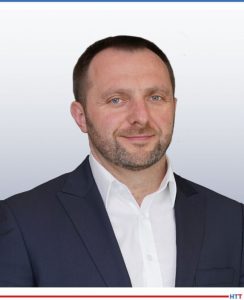
Maciej Korecki Vice President of Business of the Vacuum Furnace Segment SECO/WARWICK
A manufacturer of a wide variety of vacuum circuit breakers ordered vacuum furnaces for metal heat treatment. The circuit breakers must be brazed with high vacuum.
In 2017, the first furnaces provided were two SECO/WARWICK furnaces. The most recent expansion is three Vector vacuum furnaces that provide high vacuum level and temperature uniformity within the entire load.
"[T]he specificity of this electric power control production requires incredible precision. Circuit breakers need a high level of vacuum and temperature uniformity. They are brazed in vacuum furnaces in a very high vacuum; therefore, it was necessary to use an efficient pumping system consisting of a turbomolecular pump and a dry pump." Maciej Korecki, vice president of the Vacuum Products Segment at SECO/WARWICK Group, a manufacturer with North American locations.
Find heat treating products and services when you search on Heat Treat Buyers Guide.com
Heat Treat Today is partnering with two international publications: heat processing, a Vulkan-Verlag GmbH publication that serves mostly the European and Asian heat treat markets, and Furnaces International, a Quartz Business Media publication that primarily serves the English-speaking globe. Through these partnerships, we are sharing the latest news, tech tips, and cutting-edge articles that will serve our audience — manufacturers with in-house heat treat.
In this installment, we look at updates on industry events around the globe, such as mills, mint, and the Middle East.
Mathevon Group and Bodycote Partner for Oil & Gas Industry Solution
Mud rotors for surface coating Source: Bodycote
“Bodycote has entered into a partnership with Mathevon Group to develop the market in the [Middle East] and, in particular, Saudi Arabia. The agreement brings together Bodycote’s expertise in thermal spray coatings for the oil & gas industry and Mathevon’s knowledge of the production of internal components of gate valves for oil & gas. Mathevon is a world-class provider of safety parts in stainless steel and superalloys, which are subject to severe service applications and has a long history of servicing oil & gas OEM supply chains.”
Shiu Wing Steel to produce recycled steel Source: Furnaces International
“Shiu Wing Steel, Hong Kong’s first and only steel-rolling mill, plans to produce recycled steel to meet growing demand created by China’s green ambitions in Hong Kong and other cities in the Greater Bay Area (GBA) development zone, according to a report by South China Morning Post. The 65-year-old steelmaker plans to build an electric-arc furnace at its plant in Tuen Mun to produce 700kt (kilotons) of recycled steel a year by 2025 and expand its presence in the GBA, Dario Pong, Shiu Wing’s executive director, said in an interview.”
European Mint Chooses Vacuum Furnace To Harden Dies for Coins
Vector furnaces to harden the dies Source: SECO/WARWICK
“This is the eighth mint to choose SECO/WARWICK solutions. The Vector furnaces will be used to harden the dies necessary for the production of coins for both circulation and collector series. Vector vacuum furnaces with 15 Bar high-pressure gas quenching perfectly match the mint’s operating characteristics. Vector enables fast heat treatment while the working space is optimal for the production of dies, coins, medals and orders.”






 Heat Treat

















 In a special










 Heat Treat