


Kyle Hummel

Spotlight on 40 Under 40 Alumni

OCHeat Treat Today’s 40 Under 40 was created to bring recognition to young professionals in the industry, giving names, faces, and words to the rising generation of industry professionals. In this original content article, released on the final day to nominate someone to Heat Treat Today’s 40 Under 40 Class of 2022, we caught up with exemplary classmates from past years to hear where they are now and what comments they have about the industry.


Justin Powell

It has been 15 years since, "at the age of 19, I started working for a company that serviced high temperature furnaces and industrial combustion systems. I cut my teeth in the industry by doing burner retrofits and turnkey system installations."

Since being nominated to receive Heat Treat Today’s 40 Under 40 award, Justin says he has "started a company called MP Combustion with my very good friend, Ryan McClain. We literally started the company working out of our basements in 2019 and with the support of this wonderful industry have since grown to a team of six with hopes to expand to more employees soon. Our team works hard to support the heat treat community by supplying the best combustion equipment and technical support in the industry." Justin notes that starting MP Combustion is "easily the highlight of my career so far."

When asked what his favorite thing about the industry is, he commented, "The never-ending learning curve. I love to learn, and this industry has a seemingly endless supply of new skills to learn and hone. I also have a great admiration for the people in this industry, they are always willing to help teach and learn from one another. It's an amazing community to be a part of!"

As a final word of advice for the winners being selected to Heat Treat Today’s 40 Under 40 Class of 2022 this summer, Justin encourages them, saying, "My friends, this is only the beginning. I wish you all great success throughout your career and hope that our paths meet along the way!"

Read more about Justin here.

Jaime Sanchez

Jaime got involved in the world of heat treat seven years ago, seeking "a job opportunity in Engineering and Project Management and in automotive, power generator, or automation." Since receiving the award, Jaime has "received a promotion from Engineering Manager to Operations Manager in MATTSA FURNACE COMPANY, expanding my area of responsibilities to equipment manufacturing without [fully] leaving engineering and project management."

His aptitude to pivot is evident in what he finds most exciting about heat treating: "Every day is a new challenge for me, from receiving and managing new projects to helping our clients to solve issues or coordinate the activities of MATTSA plant with all the personnel involved. All these activities and the way I solve them make me excited every day when I arrive at my workplace."

"Receiving this nomination is an honor," Jaime shares, "it is a way of showing the world the talent you have, in addition to showing that being young is not synonymous with being inexperienced, but that our generation can do great things with a lot of dedication and effort. Never stop fighting for what you want and show that your talent is world class."

Read more about Jaime here.

Miguel Humberto Fajardo

For Miguel, it has been six years of service in the heat treat industry. "I started in 2016," he commented, "with an internship program, in the John Deere materials laboratory. I had the opportunity to collaborate in the development of suppliers, certify the quality and mechanical properties of treated parts, participate in the design of new heat treat recipes and the introduction of new processes. Those were the first steps in the world of heat treat. After the internship and thanks to that experience, I was hired as the engineer in charge of John Deere's heat treatment lines."

Over the past few years since nomination, Miguel notes that his role in heat treatment "has changed a lot. My position evolved to a Sr. level with more responsibilities and challenges, including renewing the technology of our lines, implementing improvements to make processes more efficient and achieving cost and expense reductions. I was awarded trade secrets for these upgrades." He continues, saying, "I am currently working on fully exploiting the capacity of our equipment, focusing on cost reductions, reducing gas consumption, and improving emissions."

It's the science paired with experimentation in heat treat that continues to interest Miguel: "What I like the most is that it is a true science, it requires a lot of experimentation and generating hypotheses. My colleagues tell me that they are like occult arts or magic, since two parts that look the same can be completely different inside."

To the upcoming 40 Under 40 Class of 2022, Miguel offers a challenge: "Although the literature on HT is many years old, there is always an opportunity to innovate and create different things and different ways of doing things. Experiment and ask yourself many things. and this will become more than a job, a different experience day by day. Very challenging and fun."

Read more about Miguel here.

Heat Treat Today's 40 Under 40 Authors

Check out some of the technical content that 40 Under 40 award winners have published with Heat Treat Today over the years:

Alberto Cantú - 40 Under 40 profile

Ben Gasbarre - 40 Under 40 profile

Josh Hale - 40 Under 40 profile

Mike Harrison - 40 Under 40 profile

Kyle Hummel - 40 Under 40 profile

Trevor Jones - 40 Under 40 profile

Ellen Conway Merrill - 40 Under 40 profile

Shawn Orr - 40 Under 40 profile

Justin Sims - 40 Under 40 profile

Andy Wilkosz - 40 Under 40 profile


Find heat treating products and services when you search on Heat Treat Buyers Guide.com



Spotlight on 40 Under 40 Alumni Read More »
Induction Hardening: Understanding the Basics

OCInduction is a curious member in the family of heat treating. Its presence is valuable, yet there’s a mystery surrounding it that has even veteran heat treaters exploring it to gain understanding. Journey through this induction hardening primer to learn about this important misfit of the heat treating world.

This Heat Treat Today Technical Tuesday original content feature, written by Kyle Hummel, P.E., COO at Contour Hardening, first appeared in Heat Treat Today's May 2021 Induction print edition. Feel free to contact Karen Gantzer at karen@heattreattoday.com if you have a question, comment, or any editorial contribution you’d like to submit.


Kyle Hummel, P.E..
Chief Operations Officer
Contour Hardening

In the world of heat treat, induction hardening just doesn’t fit in. There is no big furnace, cycle times are a matter seconds, and the entire process takes place right before your eyes rather than behind the walls of a furnace chamber. Many heat treaters have one old induction machine sitting in the corner of the shop floor, with one remaining employee who knows how to operate it.

Induction is different than all other types of heat treatment, and even many metallurgists shy away from the "black magic" that occurs during the process. When I ask customers how familiar they are with induction hardening, they usually state that they have seen it before, mention something about a coil, but that’s about the extent of their knowledge.

The purpose of this article is to give readers, who are not familiar with the induction hardening process, some background on the fundamental aspects and terminology of the process. The information encompasses the most common questions I am asked by new customers as well as information I would provide in training new employees. My hope is that it will give you enough familiarity with the process to become more comfortable engaging in a conversation about induction hardening.

Why Use Induction?

Selective hardening – Induction allows you to harden only the desired portion of a part, whereas most furnace-based heat treat processes treat the entire component. This means you can harden the particular area that you want to harden, while leaving the rest of the component soft enough to machine further.

Strength – Not only does the part become harder, but the stress (called residual compressive stress) that is induced into the part will make it stronger. Other processes can meet the improved wear resistance of the added hardness but fail to strengthen the part at all, or not as much as induction hardening.

Single piece flow – Because induction hardening is not a batch process (typically one part is hardened at a time), induction machines can be placed in a manufacturing cell, allowing the process flow to be uninterrupted.

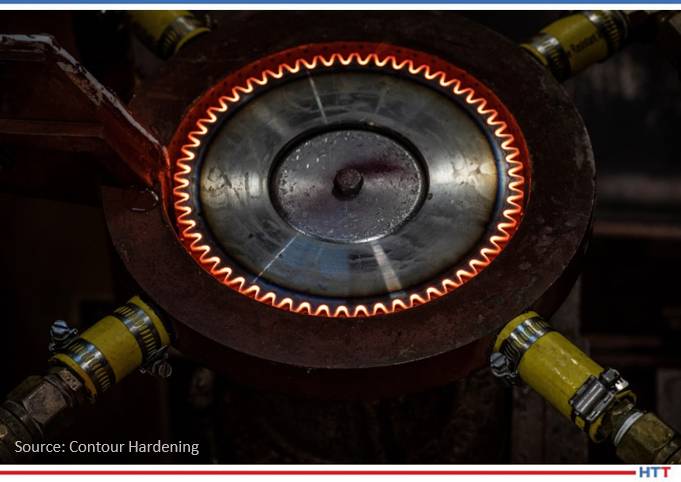
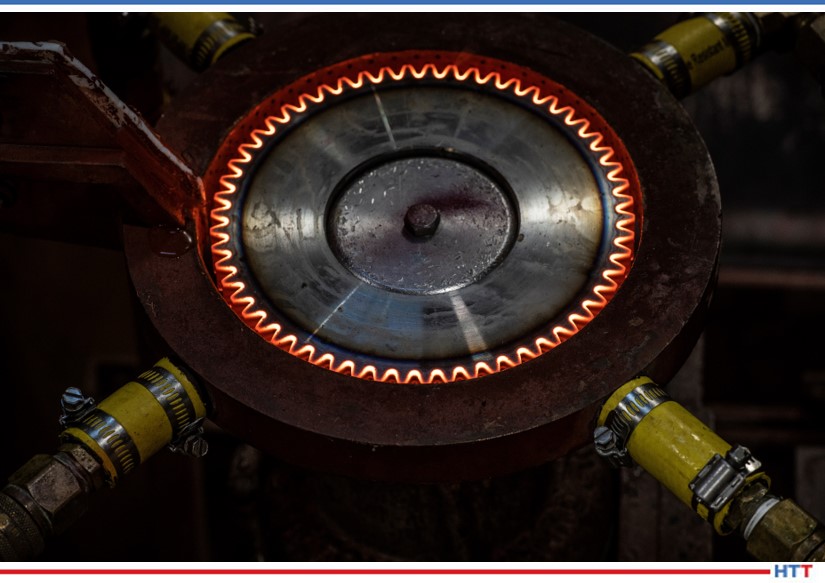
Induction hardening in action

Equipment and Tooling

Induction Hardening Machine – Systems will vary significantly in size and complexity depending on the components they are hardening. The primary components of the machine consist of a power supply, heat station (transformer), workstation, and HMI. The fluids system is composed of quenchant to cool the part being hardened and distilled water to cool the internal components of the machine. Heat time, power supply output, part rotation, and quenchant parameters should be controlled, monitored, and logged for each part.

Power Supplies – Power supplies are the most important component of the induction hardener. For the purpose of this article, we will discuss the two most important outputs of the power supply, frequency and power.

Frequency is important because it will help determine the depth of heating. Lower frequencies heat deeper into the part, and higher frequencies heat closer to the surface. To remember this, I like to use the analogy of whales using very low frequency calls to communicate over miles and miles of ocean, whereas the high-pitched squeak of a mouse can only be heard several feet away. For induction hardening, frequencies are split into two groups: medium frequency (MF) and radio frequency (RF). The MF range is typically from 3-50kHz, and RF is from 100-400kHz.

Power is important because it will determine how large of a part you can harden, and how long the heat time will need to be. The more power that a machine can output, the larger the part it can harden and the faster it can harden to a specified case depth. Typical power supply outputs for induction hardening range from 25kW to 1MW.

Coils – The induction coil is a copper conductor that is shaped in order to harden the specified area of the part. The current that flows through the coil is what produces the magnetic field, which in turn heats the part. Coils are typically part specific, since they need to be precisely constructed to heat a particular portion of the part.

Modern induction coils are water cooled and can be made of tubing or machined copper pieces that are brazed together to make a particular shape to fit the part. They are frequently equipped with sections of a material called flux intensifier, which helps to drive the magnetic field in a certain direction in order to intensify heating in that area and make the coil more efficient.

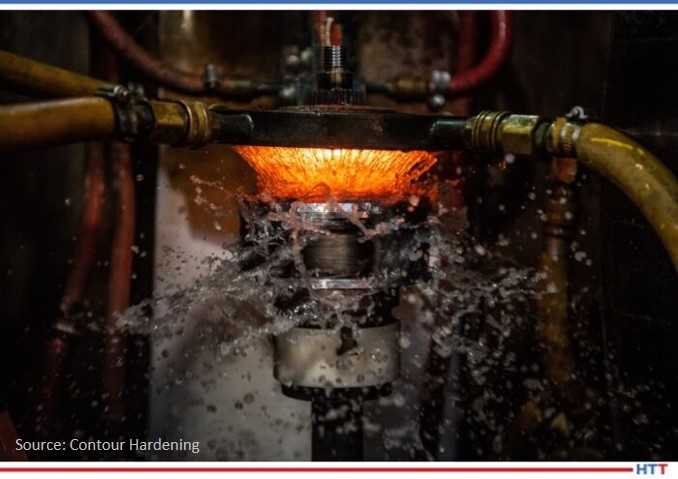
It is also common to have the quenching designed into the coil (machine integral quench, or MIQ) so that quenchant can be applied immediately after heating without the need to move the part to an auxiliary quench mechanism.

Process Basics

Single Shot – Single shot hardening is the most common method of induction hardening where the part and coil remain in the same spot during the heating process. Typically, the part is brought into proximity of the coil, the heating and quenching processes are applied to the part, and then the part is removed from the coil.

Scanning – Scanning involves heating and quenching a small portion of the part while moving either the coil or the part until the desired area is hardened. Quench is directionally applied to the part so that as a new portion of the part is heated, the previously heated section is being quenched appropriately. Scanning is frequently used to harden shafts because heating the entire shaft at once would require too much power.

Dual Frequency – Dual frequency hardening combines the benefits of the deeper heating of the lower MFs with the surface heating capabilities of higher RFs. By utilizing two different frequencies, it is possible to contour the hardening pattern more effectively on gear-like components, which further improves the strength of the part. The frequencies can either be applied consecutively (low frequency preheat followed by a high frequency final heat) or simultaneously.

Induction Tempering – Induction can also be used to complete the temper process in a few seconds rather than furnace tempering which could take hours. Induction tempering takes place after the hardening process and involves heating the part to a much lower temperature than is required during hardening. The targeted temperature for induction temper is higher than that of furnace tempering due to the decreased temper time. This softens the hardened area slightly in order to increase the toughness of the part and improve crack susceptibility.

Quenching – The quench process is just as important as the heating process with induction hardening. Almost all modern systems use a water/polymer quenchant mixture in the range of 5-20% polymer instead of using oils. The quench media is typically sprayed on to the part rather than submerging it into a bath. Quench concentration, temperature, flow, and pressure must all be monitored closely for a robust process. These parameters all function to guarantee that the part is quenched properly and consistently to ensure the correct hardness is achieved and crack susceptibility is minimized. Quench media must also be filtered to remove any process waste that could potentially clog the quench spray holes.

Inspection – Like most other forms of heat treatment, the two most common specifications with induction hardening are case depth and hardness. Most specifications will require surface hardness measurements along with effective case depths to determine the depth of hardening.

Materials – The most common materials to be induction hardened are medium to high carbon and alloy steels, cast irons, and powder metal. Induction is also becoming a popular heat treat method on certain stainless steels in different industries.

Induction hardening in action

What to Look Out For

Cracking – The rapid expansion of the part during heating followed by shrinkage from the accelerated cooldown during quenching increases crack susceptibility of induction hardened parts. Not all parts have a high risk of cracking, but part characteristics such as internal holes, sharp edges, and certain higher carbon materials will require more consideration. If cracking is an issue, the first two areas to investigate are overheating and quench severity. Reducing the quench severity (increasing quench temperature and concentration, reducing flow and pressure) is typically the most effective means of reducing cracking within an induction hardened part.

Distortion – Another side effect of the rapid expansion and contraction is part distortion. It is impossible to not distort the part with induction hardening due to the phase changes in the metal. However, with a robust and carefully monitored process, it is possible to minimize and accurately predict process distortion. Faster heating times and technical expertise in fixturing methods are two common methods to reduce distortion.

Conclusion

Although this information just begins to scratch the surface of the terminology and fundamentals of the process, hopefully it provides a starting point to those with limited experience. Like many other forms of heat treatment, it can take years to develop the knowledge and skills to gain expertise in induction hardening. I have been involved in induction for almost fifteen years, and I find there is always a new application that gives me the opportunity to learn even more.

About the Author: Kyle Hummel is a licensed Professional Engineer who has worked for Contour Hardening for 15 years as a metallurgical engineer and currently manages operations of Contour’s Indianapolis location.

For more information, contact Kyle at khummel@contourhardening.com or 317.876.1530 ext. 333

Induction Hardening: Understanding the Basics Read More »

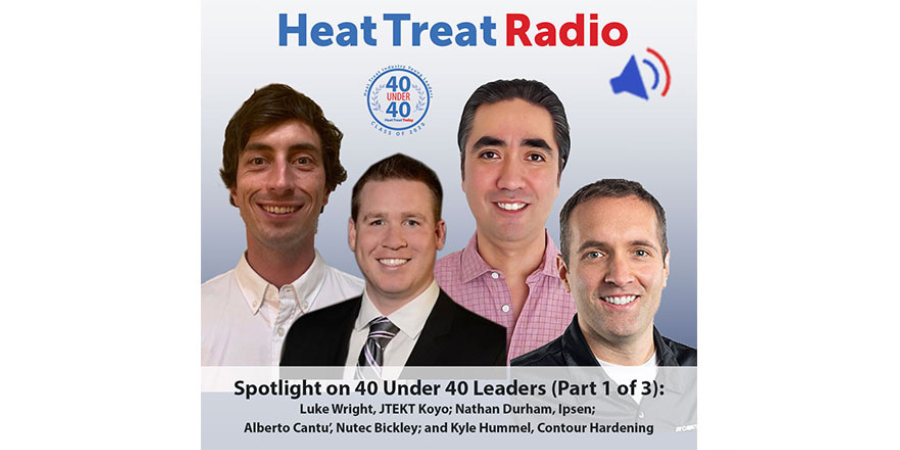
Heat Treat Radio #51: Spotlight on 40 Under 40 Leaders (Part 1 of 3)

In a special Heat Treat Radio series, 40 Under 40 winners from the class of 2020 respond with their stories and insights of their life and work in the heat treat industry. This episode features the stories of Luke Wright, Nathan Durham, and Alberto Cantú.

This episode in the series also features an update from a past alum; in this episode, Kyle Hummel of Contour Hardening  shares his journey over the last several years and how he has grown as a person in heat treat.

Below, you can listen to the podcast by clicking on the audio play button and read a few excerpts from this episode.


Luke Wright

Luke Wright
Senior Engineer
JTEKT North America Corporation / Koyo Bearings

“So, we had a void in the heat treating department. We had three new hires — 2 others including myself at the time. They kind of shuffled us around: one went to assembly and I got put in heat treat with one of the others. They figured heat treat was difficult enough for two green engineers. I kind of picked it up as I went along.

“I guess that’s kinda what I really like — sort of this black box science that everyone wants to talk about, and there’s so many things we have to just say, Well, I’m not really sure. We turn this knob and it tends to work better that way. But then, there’s also really detailed science and theory that kind of guides you and that gut feel, twist-that-knob practical application.”

“Something that I’ve been trying to do more lately in my job is to explain more about what I’m doing, what’s going on with the others around me — maintenance workers, furnace operators, or supervisors — instead of just keeping to myself or pushing them out of the way to just do the thing myself if they don’t understand: Doing a little more to work alongside people.”


Nathan Durham

Nathan Durham
Aftermarket Sales Manager
Ipsen

“As we near the end of 2020 and reflect on the many, many challenges that arose, I’m truly motivated by the diversity and resilience of our industry[…] We’ll persevere through this pandemic, and push forward into 2021.”

“During my tenure at Ipsen, I’ve realized how important it is to always remain flexible within a career and adapt to what your company and what your customer are asking you.”

“Thank you again, as I’m truly humbled to be a part, and associated with, such great company, and the future of our industry.”


Alberto Cantú

Alberto Cantú
VP Combustion, Control and Services
Nutec Bickley

“I started as an R&D manager. I had completed a PhD on the computation of fluid dynamics and used these tools to design new furnaces. But lately, I’ve been more involved in sales and business development.”

“On the one hand, the computation of power has been increasing — I’m going to say since the birth of computers, but lately more and more — but then the internet and the whole internet of things and Industry 4.0 coming together… You can do a lot of things with both the calculations and the ability to have the information in real time. I think many of these operating procedures that were mainly based on ‘rules of thumb’ and heuristics will change[…] to be based on machine learning…”

“I would suggest [for young heat treaters] to get involved in tradeshows, subscribe to newsletters, make sure you read all the news in the magazines available and in companies so that you get up-to-date in all things happening in the industry because, as I said, it’s vey exciting and I see a bright future.”


Kyle Hummel

Kyle Hummel
Chief Operating Officer
Contour Hardening

“Professionally, I’ve been honored to accept a promotion and am now responsible for overseeing our operations. And on top of that, I’m currently studying for my very last finals to get my MBA in which I’ll graduate May.”

“The heat treatment industry is such a broad field of processes and technologies that anyone can get really excited about. I also think that heat treating can offer the perfect balance of hands-on work experience as well as quality and process improvement that can keep you engaged for years as you continue to grow your career.”

“I’m personally excited to see how the heat treat industry adapts to the next five years as electric vehicles sales continue to rise in the US. I believe this will be an opportunity for heat treaters to start thinking about  how to broaden their service offerings and expanding into other industries as well.”


To find other Heat Treat Radio episodes, go to www.heattreattoday.com/radio so see all of the episodes.

Heat Treat Radio #51: Spotlight on 40 Under 40 Leaders (Part 1 of 3) Read More »

Induction Hardening: Strengthening the Automotive Industry into the Future

Kyle Hummel, Project Engineer, Contour Hardening

Induction hardening has played a critical role for decades in heat treating. In this Heat Treat Today Technical Tuesday feature, Kyle Hummel, Professional Engineer at Contour Hardening, shares his engineering insights on the necessity of induction-hardened components for automotive powertrains. As a manufacturer with in-house induction hardening or a commercial heat treater, learn about viable considerations in moving forward with your induction hardening process.

This article appeared in the edition June 2020 edition of Heat Treat Today's Automotive Heat Treating magazine.


Induction hardening has played a crucial role in the automotive industry for many decades and is poised to continue that role into the future as the industry prepares for the inevitable shift to electric vehicles. Over the past 15 years, the emphasis on fuel economy, increased quality standards, and the emergence of other heat treat methods have drastically altered the design and necessity of induction-hardened components for automotive powertrains.

Transformation of Component Design

Increased residual compressive stress, minimal distortion, and the ability to selectively harden portions of a component are some of the main characteristics that have made induction hardening a popular choice for gears and shafts in the automotive industry. From the early 1980s to the 2000s the number of gears being hardened via induction was tremendous. The strength requirements for gears in four- and six-speed transmissions demanded the added compressive stress coupled with low distortion for noise reduction that induction hardening provides. As transmissions have increased to eight, nine, and 10 speeds over the past 10 years, the peak loading conditions of the gears has decreased, opening up the availability of other heat treat options. Low distortion processes such as nitriding and ferritic nitrocarburizing have now been successfully utilized in these gear applications because the gears do not require the high amounts of residual compressive stress. As the volume of these gears has decreased, other highly complex and high-volume components still remain great candidates for induction hardening.

Constant velocity joints (CVJ) rely on induction hardening and should remain relatively unaffected by the transition to electric vehicles. CVJs are typically designed for individual vehicle platforms rather than transmission platforms which can encompass a number of different vehicles. This leads to a greater variety of different part numbers to be hardened, and most CVJs typically require hardening in more than one region. These aspects require the need for specialized equipment to harden the CVJs that are difficult to adapt to other types of components.

Automated Hardening of CVJs

In addition to CVJs, the advancements in powder metal (PM) capabilities in the past decade have also created a surge in the number of PM components that require induction. PM sprockets and other uniquely shaped components that require high wear resistance are paired with induction hardening to replace traditionally machined components.

As the technology in PM has improved, the ability to achieve full density at varying depths below the surface has recently led to the production of internal gears that can be induction hardened for added strength and wear properties. Other technically complex components such as sliding panels, stator shafts, and input shafts continue to utilize induction to increase strength and wear resistance in specific areas. As engineers continue to push the design limits of components, specialized induction hardening equipment with precision control, higher power, and shorter heat times is required to successfully develop a robust process.

Unique Technical Challenges

Induction Hardening Machine (both figures)

The technical challenges for induction heat treaters have increased with the added complexity of these components and the emphasis on several quality standards. It requires an entire team of engineers to provide input with coil design, process development, and adherence to quality standards. The days of having a print specification simply list a visual case depth and a surface hardness are a distant memory. Specifications now commonly require effective case depths at multiple locations, microstructure evaluations, and hardness and dimensional inspections. CVJs in particular can have over 35 metallurgical inspection points and over 25-dimensional inspection points. The component complexity has also led to the need for increased crack inspection. Sharp corners, thin walls, lubrication holes, and the use of higher carbon steels have led many parts to require nearly 100 percent inspection for cracks.

Along with the print specifications, heat treaters must also comply with the growing number of technical standards required to be an approved automotive supplier. IATF 16949 Quality Management System, AIAG’s Heat Treat Assessment (CQI-9), ASTM standards, and customer specific requirements can create a vast network of conditions that must be examined and constantly monitored to ensure compliance. Although these added requirements can be an inconvenience, the quality of parts being produced has significantly improved and that ultimately leads to safer and more reliable vehicles for the customer.

Adapting to the Future

Unfortunately, the technical challenges and increased quality requirements of automotive parts do not always come with higher margins. With the competition in Mexico and Asia, U.S. manufacturers with their own in-house heat treating and commercial heat treaters must continue to find ways to remain competitive. The volatility of OEM volume predictions and platform start and end dates requires manufacturers and heat treaters to be dynamic in capacity considerations. With induction hardening, having excess capacity at a variety of different frequencies and power capabilities can be crucial to landing the next job. Automotive work can frequently come in due to unplanned downtime at a competitor, or on a customer’s own heat treat line. If your organization does not have the ability to produce test samples almost immediately, that opportunity for valuable work will be missed. Having the knowledge and equipment to understand and provide testing for dimensions is another key to offering value to automotive customers. The ability to test parts green and immediately after hardening can drastically reduce scrap and rework and can be a crucial selling point to customers.

The piece by piece processing of induction hardening is suited well for automation and the benefits reach beyond simply reducing labor costs. The reduction in tooling changeovers not only reduces wasted time, it also improves the quality and consistency of the product. With tight dimensional tolerances on final parts, slight variations in heat treat patterns can be eliminated by dedicating and automating a heat treat line. The ROI for automating a cell, including temper and rust preventative application can be as little as six months with the added bonus of supplying a more consistent part to the customer.

High-volume, complex components provide special challenges for induction heating.

The modern induction hardening facility should be moving to automate not only the production itself, but also the inspections, factory information systems, and ERP systems. Inspections such as eddy current can be automated to reliably inspect 100 percent for proper hardening and even crack detection. Automated microhardness equipment can save lab technicians hours of valuable time they would have spent waiting at the tester. These technologies, when used appropriately, can result in more efficient processes that produce higher quality parts at competitive prices.

Although the landscape of the automotive industry in the next 15 years is as exciting as it is uncertain, induction hardening will continue to be a vital process that is utilized into the future. The changes over the past 15 years have produced more complex components with stricter requirements that must be processed with greater efficiency. Induction hardening suppliers must remain focused on keeping pace with the developments in technology that continue to improve the heat treat industry as a whole in order to remain relevant and be a value-added process for automotive customers.


About the author: Kyle Hummel is a licensed Professional Engineer who has worked for Contour Hardening for 14 years as a metallurgical engineer focusing on process development and quality improvement.

For more information, contact Kyle at khummel@contourhardening.com or (317) 876-1530 ext. 333.


Induction Hardening: Strengthening the Automotive Industry into the Future Read More »

The Heart of Heat Treat Today’s 40 Under 40

Heat Treat Today’s 40 Under 40 was created to bring recognition to young professionals in the industry, giving names, faces, and words to the rising generation of industry professionals. In this article, released in the final nomination period for Heat Treat Today’s 40 Under 40 Class of 2020, exemplary classmates from previous years share their views on the industry, giving words of encouragement to other young professionals, both current and future.


Kyle Hummel, P.E., Sr Metallurgical Engineer at Contour Hardening

In 2019, Kyle was nominated by Contour Hardening to receive the 40 Under 40 recognition. Since receiving the nomination, Kyle has begun an Executive MBA program at Purdue to, “expand my education in business and leadership,” Kyle wrote, “in order to improve my effectiveness in my current position as well as prepare myself for future roles.”

Over the years, Kyle has found the broad range of processes and technologies in the heat treat industry to be appealing. The heat treat industry, Kyle noted, “can offer the perfect balance of hands on work experience as well as quality and process improvement that can keep you engaged for years as you grow your career. Another advantage is that heat treaters typically supply a number of different industries, so you can get experience in multiple fields that will help steer your career choices.”

Read more about this 2019 Honoree here.

Matt Clinite, ICS Sales Manager at Ipsen USA

Similarly, Matt Clinite was recognized in last year’s 40 Under 40 Class of 2019. Over the past year, Matt has been leading his remote team of regional sales engineers, who help Ipsen’s customers secure aftermarket parts, retrofits, and field service technicians. For him, the switch to online platforms and less face-to-face contact in the era of COVID has brought him to consider the fact that the “forced adjustment” may have lasting effects on business in years to come. “For many of us extroverted professionals,” wrote Matt, “[it] is a real bummer, but I’m optimistic this will be a blip in time, and some day we will be able to continue meeting face to face.”

As a 31 years old young professional, a manager, and a father of two, Matt has critical insight into hiring and maintaining future young leaders: While many believe that the industry needs to attract young people, Matt flips the onus saying, “If you ask 10 successful people in the industry to tell you their story, 9 of them will say they fell into the industry by accident…the industry needs to retain the young people that ‘fall’ [in].” His suggestions are that employers take care of their young employees and “provide a career path that will allow them to grow financially and professionally.”

Read more about this 2019 honoree here.

A Few Words of Advice to Young Professionals

For young professionals beginning in this industry, both Kyle and Matt emphasize the importance of initiative and focused learning, especially on the job.

Kyle Hummel, Contour Hardening

  • “Learn as much as you can, and get out on the floor and understand the equipment and talk to the people who have been working in heat treat for years.” – Kyle Hummel
  • “Find someone who can be a mentor to you and help you through the learning curve – working with huge expensive furnaces and equipment can be intimidating at first, and having someone help guide you through the process will be very beneficial.” – Kyle Hummel
  • “Take it upon yourself to become known inside your organization. Find ways to get in front of senior leadership and the technical staff. Once they know who you are, find ways to continually insert yourself into projects and discussions with them.” – Matt Clinite
  • When invited to important meetings or discussions early on, “It’s ok (and often times
    best) to sit back and simply listen to the discussion. Take it all in and become a sponge.” – Matt Clinite
  • “Don’t be afraid to request meetings with leadership around topics such as: career advancement, merit increases or to voice your ideas.” – Matt Clinite

The Role of 40 Under 40

These two honorees, as well as fellow classmate Tim Mohr, Director of Strategic Programs at Paulo, and 2018 honoree, Danielle Cote at Worcester Polytechnic Institute (WPI), explained how the recognition has benefited them, and why they would encourage others to nominate their young colleagues this year or in future years.

Matt Clinite, Ipsen USA

Kyle Hummel: “Being a part of the 40 Under 40 class assists in making those connections to current or future customers, suppliers, or even competitors that you might not have made otherwise.  Heat treat is a close knit industry, and you never know when you will work with one of the other 40 under 40 winners, so it is nice to have that connection.”

Danielle Cote: Professor Cote indicated thankfulness of the honor to be a part of 40 Under 40 Class of  2018 as it provided recognition to an unrecognized field. Hear her full message at this link.

Matt Clinite: “It’s a fun thing to “tout” at the trade show and to post on LinkedIn. And of course to share the magazine with family and friends always makes for good dinner table talk. To me the best part is the comradery. I really enjoyed reaching out to (and having been reached out to) by other recipients… In 2019 I felt flattered when a well-recognized individual from the industry nominated me. I hope I can show other young professionals in the industry my appreciation by nominating them.”


Tim Mohr: Tim also recognized the networking value of his nomination. He says that his acceptance into the 40 Under 40 Class of 2019 allowed him to meet new people throughout the industry. Listen to his full testimonial below.


Read more: If you haven’t already, head over to Heat Treat Today’s 40 Under 40 to nominate a young professional in the industry.


(photo source: Hirvana Arvizu Soyhivan on www.unsplash.com)


The Heart of Heat Treat Today’s 40 Under 40 Read More »

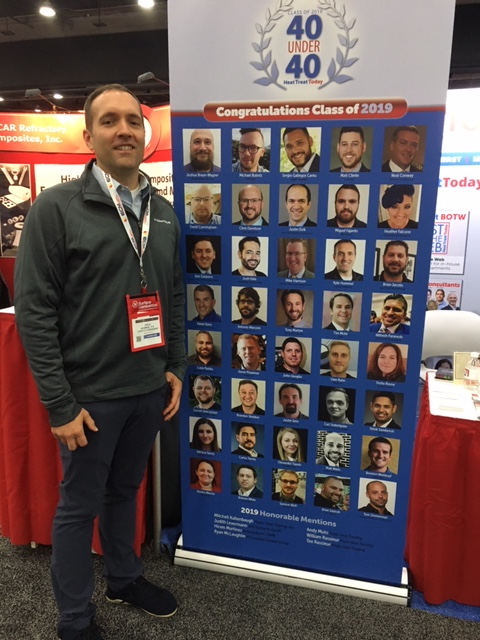
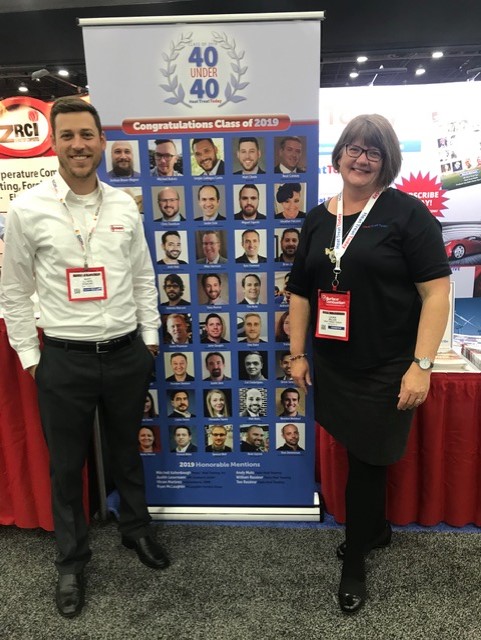
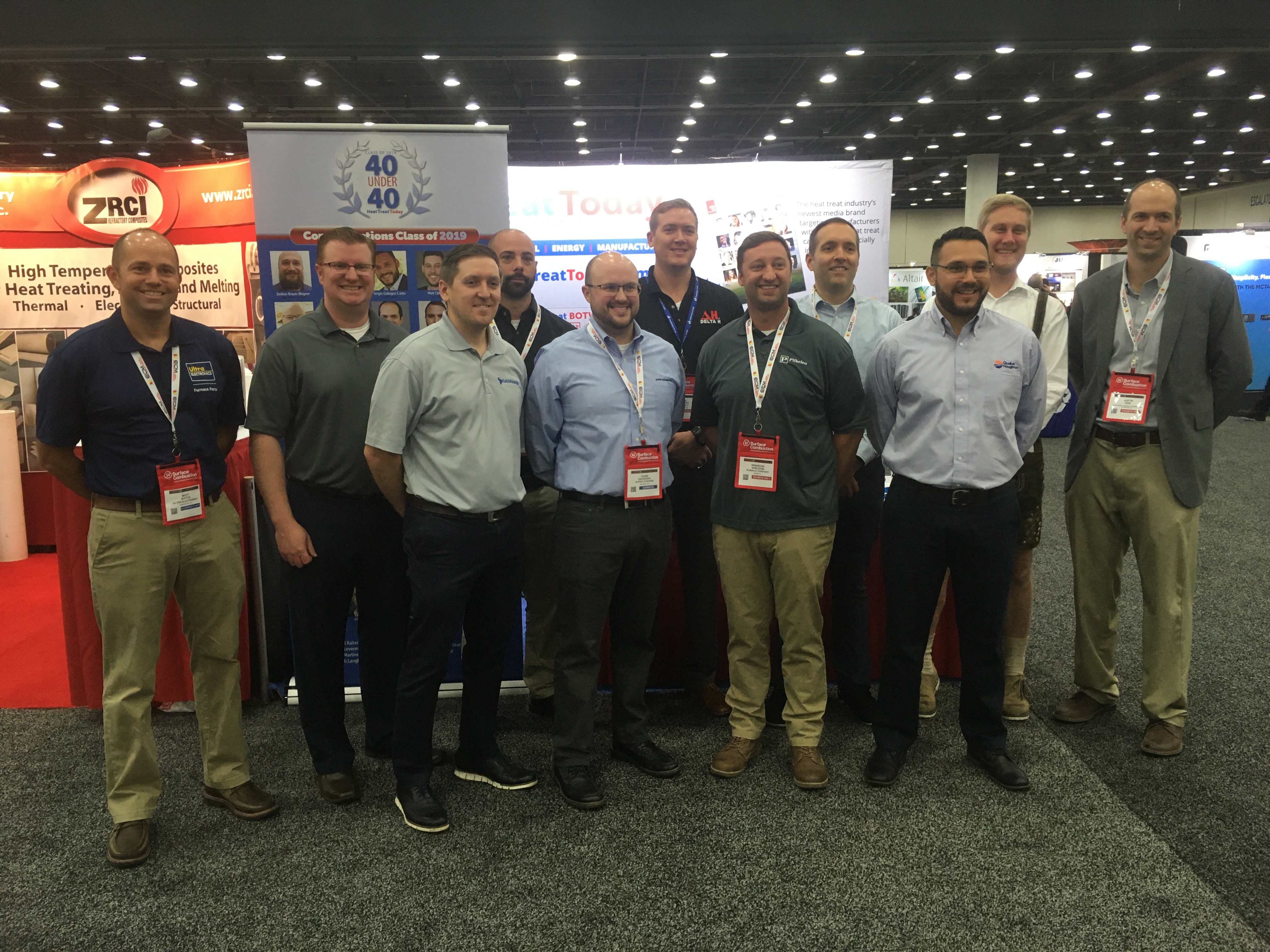
40 Under 40 Class of 2019 Members Attending Heat Treat Show 2019

The Class of 2019 40 Under 40, revealed online on October 4, was featured at the Heat Treat Today booth at the Heat Treat Show in Detroit, Michigan. Here is a group photo of most of those still present on the last day:

Matt Watts (Ultra Electronics Energy), Mike Harrison (Gasbarre), Ben Gasbarre (Gasbarre), Tom Zimmerman (ATP), Chris Davidson (SSi), Neal Conway (Delta H), Brandon Sheldon (Plibrico), Kyle Hummel (Contour), Sergio Cantu (Quaker Houghton), Uwe Rahn (Rubig), Justin Dzik (Fives)


Several recipients stopped by to get their pictures taken alongside their photo on the pop-up banner. See the gallery below, and Click here to see the announcement of the full Class of 2019.

40 Under 40 Class of 2019 Members Attending Heat Treat Show 2019 Read More »