Heat Treat Today publishes eight print magazines a year, and included in each is a letter from the publisher, Doug Glenn. This letter first appeared in Heat Treat Today'sNovember 2021 Vacuum Heat Treating print edition.
Doug Glenn Publisher and Founder Heat TreatToday
“Inflation” is in the news, and it could have a significant impact on the heat treat industry. What is it? Why is it suddenly a problem? How might it impact the heat treat industry? Below are simple answers in layman’s language, but if you want to dig deeper into inflation, let me STRONGLY recommend two books by the late Dr. Hans Sennholz (1922–2007): Age of Inflation (1979, paperbacks selling on Amazon for more than $600.00! – I guess I’m keeping my copy under lock and key!) and Money and Freedom (1985, available free in PDF format found here).
What Is Inflation?
Simply stated, it is an increase in the amount of money in the economy – period. When you “inflate” a balloon, you increase the amount of air inside the balloon. In the same way, monetary inflation is the increase in the amount of money inside the economy. Properly understood, inflation is NOT rising prices; however, rising prices CAN be, and often are, one effect of inflation. The media and much of the general public, including our governing officials, often use “inflation” and “rising prices” synonymously. They are NOT the same thing, and it helps to know the difference if you’re going to have an intelligent conversation with anyone about the topic. Short answer: Inflation is an increase in the amount of money in the economy – period.
Why Is It Suddenly a Problem?
The short answer to that question is also simple. Take a look at the chart which shows two different measures of the amount of money in the economy – M1 and M2. There is no need to define M1 and M2 for the purposes of this column, but suffice it to say that both measure the amount of money in the economy and that M1 is part of M2. Look at the far right-hand side of the chart. See anything unusual?
In 2020, the curves headed for the stars. Notice that the chart starts in 1959. We have NEVER seen this type of inflation (an increase in the money supply) since 1959 and, based on my knowledge, NEVER before in the history of this country. While a general rise in all prices is NOT inflation, one of the main effects of inflation is a general rise in all prices. Not all prices will rise at the same time or at the same rate, but if the money supply is increased (inflation) then there is more money per item to be purchased and over time, people will bid up the price of all goods and services.
Short answer: Rising prices (which is what the media mean when they say inflation”) are suddenly a problem because we are inflating the money supply at an enormous rate never seen in the history of this country; and since there is more money per item to be purchased, it is INEVITABLE that prices will rise.
This economic law is inexorable and unchangeable – much like the law of gravity. At the rate we’re inflating (increasing the money supply) we WILL have rising prices.
How Will Inflation Impact the Heat Treat Industry?
There’s nothing special about the heat treat industry when it comes to inflation (an increase in the money supply) and rising prices (one effect of inflation). Just like every other industry and every other household, manufacturers with their own in-house heat treat departments WILL be hit with increasing prices for nearly all goods and services. These rising prices are the result of the increase in the supply of money in our economy (inflation). There is no predicting how it will hit or how quickly prices will rise or when price increases will stabilize, if ever. But what we can say with certainty is that one cause for rising prices is inflation and we are inflating at rates never seen in the history of this country.
Hans Sennholz’s books, mentioned in the first paragraph of this column, are excellent resources for understanding inflation and the reasons why our rulers, both Republican and Democrat, do not have the courage to stop increasing the money supply. Our Founding Fathers warned us about what they called “fiat” money – paper money not backed by silver or gold. The U.S. Constitution clearly states that only gold and silver should be money, NOT paper (ref: Art.1, Sec. 10, Clause 1). Nonetheless, there have been supposedly “wiser” men who felt that paper money would be a better option. So here we are, inflating at unprecedented rates and bracing ourselves for what could be a very interesting ride.
Heat TreatRadiohost Doug Glenn has a timely discussion with Josh Hale of International Search Partners, North America’s only heat treat specific headhunter organization, about the exceptionally tight labor market and what captive and commercial heat treat shops can do to gain and maintain the valuable workers they’re in need of.
Below, you can either listen to the podcast by clicking on the audio play button, or you can read an edited transcript.
The following transcript has been edited for your reading enjoyment.
One of the canine "workers" at International Search Partners
Doug Glenn (DG): I don't think that we've had a non-technical issue that is as important as this one, and that is the labor shortage that is real and that most people believe is going to get only worse over the next several years. Here to discuss that with us is Josh Hale who is with International Search Partners. Josh, first off, welcome to Heat TreatRadio. If you don't mind, if you would give our listeners just a brief background about you, where you come from, and your role in helping people fill roles in the heat treat industry.
Josh Hale (JH): Yes, for sure. Thanks for having me, Doug. I've been recruiting since about 2004, and when I say recruiting, I mean helping different companies identify, hire and engage, and eventually bring on board employees at all various types of levels. We are International Search Partners. We are actually founded in 1998, so for over 20 years we've been working pretty exclusively in the heat treat space. I always kind of say we do about half our business with furnace and other manufacturers, about half with commercial heat treaters and then a mix of stuff tangential to the industry, whether that be forging companies or other kind of industrial manufacturing. Again, I've been recruiting in personnel, hiring, and job market space for a long time. I came and joined ISP and acquired the company about six or seven years ago now. ISP has a long history in heat treat, I've got a lot of history in recruiting, and here we are.
DG: You're in the right business at the right time, I can tell you, because it seems very interesting out there. I was looking at your website and I've got to deviate a little bit. So, it's not just you – apparently you've got at least one other person and two canines that are helpful to you, yes?
JH: Haha, yes! In fact, one of the canines is here in the room. If the computer wasn't mounted up I could show him off.
DG: So, you've got Jessica Maier as one of your helpers? A partner?
Jessica Maier Senior Recruiter International Search Partners
JH: Yes, exactly. Jessica works with us. She's based out of San Diego. I'm based out of Austin Texas. We both work remote, working from home. I've got the weekend vibes with the Hawaiian shirt today. I don't need to go into the office or anything. But yes, we work very consistently and tightly together. Then, there is Jim McNeal, who actually founded our company in 1998. We jokingly call him "President Emeritus," but with that emeritus status, he works with us on a few select clients here and there. Then, we've got a rotating group of consultants that we bring on board on more of an ad hoc basis, so we're prepared and able to scale, as necessary, for hot markets like this. But, the core is me and Jessica, and for smaller industries like heat treat, that works pretty well.
I would be remiss not to mention that we also have a new junior recruiter- Jessica just recently had a baby, so 2-month old Lincoln is practicing to be able to pick up the phone here pretty soon to help us out too.
DG: Well, at the time of this recording, since we're talking about babies, one of our staff members is actually in the hospital delivering.
JH: In about 25 years we'll be celebrating the new 40 Under 40 class between them.
DG: Right, exactly. And, you know, I should mention that Josh was a member of our 40 Under 40 Class in 2019.
Let's talk about this: Based on your business, you, probably more than anybody in the heat treat industry, have a good 30,000 foot view of the labor situation. Is it severe? How severe is it and what can we say about that at this point?
JH: I haven't seen anything like this in all my years of recruiting, in or outside of heat treat. I think it's affecting a lot of industries. Most of the data points I would reference on this are a little more empirical, but for example, I was in St. Louis for the ASM Heat Treat show a couple weeks ago. I was just kind of making my rounds and saying “hi” to people as I like to go to these shows to put a face behind a name with people I typically spend time on the phone with or emailing, and everybody was telling me, "Hey, we need help. Please help me find a candidate. We need candidates. Please send us resumes." That was the consistent theme. So, there is an empirical data point.
We tend to keep track of our open searches in a fluid way, if you will. Without getting into the weeds too much, what I mean by that is that we've got clients that come to us with, "Hey, we've got an empty seat, we need to fill it. Go out there and find somebody." We've got clients who come and retain our services for really urgent searches, but we actually do quite a lot of business in, what I call, “keeping our eyes open.” Like, you don't necessarily have an opening but you like to see a good talent when you come across it. Since I specialize in the industry, I can keep you in mind. We do a lot of work that way too which is less of an open position and more of a “keep your eyes open” situation.
With that, it's how we work. Typically, we may have anywhere between 20-30 real open positions and then maybe 50% more on this “keep your eyes open” thing. Right now, I have probably 50-55 actual open positions. This is twice as much as normal. Honestly, in this type of market, this is with me not doing any kind of real outbound efforts to generate new positions because I have too much to work on. Again, it's kind of empirical- it's not real data driven, but from my experience, I've never seen it like this.
DG: So, in essence, it is real; I don't think we have to convince anyone of that. From your perspective, it's pretty nearly doubled the number of open positions that you're actively looking for, and I'm sure there would be a lot of other people in that other category you mentioned about- if you find somebody, let me know.
JH: And, certainly, there is an opportunity for a lot more open positions if I were to chase after it. I'm just in a situation where there is so much business right now for existing clients that getting a new client would be difficult.
DG: Well, after this airs, you might have to hire a third and fourth partner to get things going, because, I can tell you, there's a lot of people looking.
Just anecdotally from our side, myself and my wife just got back from attending the Metal Treating Institute fall meeting this year down in your neck of the woods, down in San Antonio. To a man, to a company, to a person, everybody was looking for people to work. It could be in key, higher level management areas as well as shop floor- I need a guy that knows how to load a furnace.
In your company, specifically, very briefly: Are you guys dealing with furnace operator type people or do you tend to deal with more of the engineer/management type folks?
JH: More of the engineer/management type folks is where we really specialize. We placed a furnace operator or two in the last couple of years, but it's very rare for us. But, from talking to customers/clients/people, those hourly production type positions are definitely a situation where companies are struggling. It's kind of a long way to answer your question but historically we haven't really done a lot of work in that space because at that hourly production level you can hire somebody off the street and train them. You're not going to necessarily pay my fee to go out there and find that type of person, while in this market, more and more companies are telling me they're willing to pay a fee if we can find somebody, so it's coming up more and more.
DG: And that is the operative word – if you can find someone, which is not easy. Obviously, a lot of those jobs tend to be more regional – you can hire people locally, but it is difficult.
I want to delve into causation a bit. We know we've got a very, very tight labor market, and there are a lot of theories around about why that is. I'm curious, from your perspective, Josh, what's causing it? What's the issue here?
JH: There is a lot of theorization out there. I could spend hours going down the rabbit hole. There are some really interesting theories. In fact, did you listen to the guy speak the keynote at MTI? He talked a little bit about this idea of men not coming back to the workforce. I've listened to some of his talks and one thing that he mentions that I really buy into is this idea that the boomer generation had dual incomes, they were working and they really generated a lot of wealth and that wealth now about to get inherited by younger generations. These younger generations see that and aren't necessarily motivated to work as much.
People are moving towards the “YOLO Economy”
This is the kind of theory that I would buy into because one of the other aspects that I'm seeing a lot of in the market (and I've heard people pine on in some of the editorials out there) is this idea they call the "YOLO Economy." The YOLO Economy is, basically, the idea that you only live once. Now people are coming at this, especially coming out of COVID, like, "I don't want to go back to that job. I want to try to get the band back together. I want to go write a novel. I want to do crafts and they start a little Etsy business and sell those on-line. I can travel more." They maybe want to work part-time and travel, especially if they've got some foundation from an inheritance, I see that as a real factor here.
For someone like me, a hardworking, nose-to-the-grindstone kind of guy, this is so hard to put my mindset around, but I hear it come up a lot. It's like, "Hey, I'm done going into the office 40 hours a week."
DG: Very, very interesting. First off, YOLO is great; I hadn't heard that before, so that's helpful. But, you know, it is interesting the change in psychology, if you will. It's something only a first world nation, first world economy, which is a lot of the western hemisphere is these days, where there is enough wealth out there that they don't really need to worry about working. I'm a boomer, right? I'm on the tail end of the boomers, so yes, double income or whatever, the kids wouldn't necessarily need to worry about working and, if you don't need to work, you don't. That is the nature of man.
JH: Another factor that I think has come into play here, speaking of not working (especially COVID affected this): people are retiring earlier. If you were going to retire in three or four years and then COVID hits, "I might as well do it now," that kind of thing is coming up. That affects heat treat, especially, as it's kind of an older industry in terms of the core workforce. We're seeing a lot of that too. So, people retiring, people not wanting to go back to work- all those factors definitely affect it. There is a confluence of things. Like I said, we could go hours going down this rabbit hole – it's really interesting.
DG: Even things as political as immigration policy are certainly having an effect on the labor market.
Let's move on to this: What kind of advice would you give, Josh, to companies nowadays who are looking to fill a position, which is, essentially, as we said, pretty much everybody? From your perspective, what are some of the fundamentals they ought to be thinking about?
JH: The analogy I like to use, when people talk about recruiting or hiring, is the sports team: If you were trying to build out the world's greatest basketball team – just like you're trying to build out the world's greatest heat treat or the world's greatest furnace OEM – if you're going to try to do that, you want the best people to try out for your team.
If you take this analogy down further, when you're trying to build the world's best basketball team, you're not going to hope that LeBron James applies to join your team. You're going to go out there and tap him on the shoulder and say, "Hey, my team's really good. Come and join us. We're a championship squad." You need to take that proactive recruiting approach. That's part of the services that obviously our company offers; we specialize in this, we're in this day in and day out, and we're building up this bench of people to go out there and proactively recruit, again, not coming in and applying to a job.
But you can do that if you have your own company too. I would advise anybody who owns a business or is managing a business to have a good pipeline of people at the ready all the time. It's easy to get comfortable – I've got my team, I've got my department set up. It's not going to be like that a lot. Somebody like me might go in there and pull somebody away.
"The 'LeBron James' style of recruiting is proactive and necessary."-Josh Hale
DG: You're not doing yourself any favors with that, Josh.
JH: Well, you know, if it happens, I always tell people, you can either be a client or you can be a source, one or the other. But yes, somebody might retire, somebody might take that YOLO philosophy and leave. So, you should always have that bench going, always continually be networking. I tell people, too, you don't want to be afraid to “top-grade”: If you do have the opportunity to bring somebody in who's maybe better than the existing person, that can help you and your team and can build up the morale and the overall core a little bit better.
DG: What do you mean by that? Are you suggesting you replace a person with whom you are currently happy with somebody who’s better, or just hire them in addition to that person?
JH: If you can hire in addition to is the best solution because it widens your bench a little bit, to use the sports team analogy, if you can replace your starter, put your starter on the bench, and have a great guy who can come in and pinch hit or whatever, that helps a lot.
So just have that kind of philosophy. It's kind of a forward thinking philosophy, it's a proactive-type philosophy. I think that's the biggest thing. You can't wait until someone gives notice and leaves, now you've got an empty seat and now you’re struggling and your hair is on fire. You really need to do this constantly. That's my biggest piece of advice.
The other bullet point that comes up when I think about this, (and there are people out there that don't want to hear it), but you really need to kind of loosen your requirements a little bit. People come to me saying, "Hey, I've got an opening. We need to have XYZ on the resume and everything else." And I say, "Look, that person you're looking for just doesn't exist." You've got to be a little more realistic in your requirements and hopefully that will help attract the right people.
DG: Once they've got that person in house, one of the other big concerns here is they can gain the right people, but how do you maintain them? What type of advice would you give companies for keeping good workers?
JH: Again, it goes back to the idea of trying to be a little more forward thinking. I think COVID shifted a lot of things. I've seen a lot of stats. More and more people are allowing people to work from home. That's not always possible in the heat treat or commercial manufacturing type environment, but if it is possible to spend a day at home doing some CAD drawings, let them do that. That engages them more and makes them feel more at home.
Being creative with some of the compensation. More and more companies are paying more and more. I think wages are going to generally increase. But, at the end of the day, the market is the market, so I don't expect anybody to overpay just to hire somebody. There are other creative ways of compensation. Vacation is a big one, some work-life balance. . . There are types of benefits. Those kinds of things go a long way.
Offer autonomy, purpose, and mastery in your workplace to maintain workers.
And then, too, trying to have good morale. Morale is kind of a cliche word, but I think it carries a lot of weight. It gives you a reputation in the market as a place that you want to work for. I've heard it said that people like to work for, basically, three things: autonomy, purpose, and mastery. Get somebody in there and give them those things. Give them some opportunity to work and 'do their thing' with that autonomous nature, not being micromanaged. Give them some ability to be trained to grow and develop to create that mastery. And, if you can get them on there for a bigger purpose, that really helps a lot too. People don't want to be just a cog in the system. If they know they're contributing to, whatever it is, growth or more market share or new R&D development, these kinds of things. If they're contributing to something bigger, that's going to keep them on board and it's going to keep them passionate about it and it's going to probably help them maybe think they want to bring their friends into the fold. That's another great way to hire- the internal referral program.
DG: Have you seen, over the time you've been doing this, the motivation for people who want to work change? I know the guys you were talking about, the fellow who gave the presentation at the most recent MTI meeting, they talked about the differences in the generations- the boomers, the X, the Y, the millennials, whatever. Have you seen tangible evidence of a shift in the motivation of what really does engage the different age groups?
JH: I'm going to answer that a couple different ways. At the end of the day, nobody is working for free. Salary is a consistent hot bun for anybody looking to make a move. But I have seen, and a lot of people tell me, that one of their reasons they are looking to leave their company is stagnation. So, I talk about that kind of overall purpose. A lot of people I talk to are saying, "The company I'm with has been doing the same thing in the same way for 50 years and I'm interested in making some upgrades." I can't tell you how many times I've placed a candidate. I ask everybody I work with, "Why are looking to make a move? Why would you consider leaving your current company?" One of the consistent answers I get is, "Well, you know, I made a suggestion for an improvement and my boss told me that we're not going to do that. I know it's going to make an impact and they're not letting me." Having that, again, forward thinking, engaged employees, try their ideas out, be willing to invest in new technology. If you've still got microfiche in your company, you're doing something wrong.
DG: For those of you who don't know what that is, you better Google that one: microfiche.
JH: But I am serious. Move on to the touchscreen computers or the iPads. People are still doing stuff in triplicate in field service reports and things like this. People want to work for technologically advanced company that they can feel good about.
People want to work for technologically advanced companies that they can feel good about.
DG: I'm going to see if you know this one: I was telling somebody the other day, I said, "I still remember when I was in school using a mimeograph machine." I don't know if you know what that one is.
JH: I don't think I've heard of that!
DG: That was the way before Xerox machines. When you did hard copies, you put this thing on a drum and you basically turn it and it would crank out copies in blue. Anyhow, it's an old time one.
Let's move from the company’s perspective of advice to help a company who's looking to hire someone to just talking to the individual who might be in a position that you just talked about or maybe some other motivation like, "You know what? It's time for me to move." They need to make a move for whatever the reason might be. Is there any advice you can give those people for entering a labor market? Obviously, it's a job seeker's market, right?
JH: I'd say a couple things: One, my first piece of advice is, as you said, it is a job seeker's market. But it's now. This is not a job seeker's market forever.
Strike while the iron is hot. If you have any potential idea or any inkling that maybe there is something better out there for you, I'm of the opinion, nothing ventured, nothing gained. I use the idea of big mistake, small mistake. It would be a big mistake to pass on the opportunity to land your dream job, but the small mistake to spend 30 minutes on a phone interview with a company. I would encourage somebody to talk to anybody, to put those feelers out there, have those initial phone interviews.
Now, when you get down the process of an interview, if you decide you don't want to work for the company, you don't want to waste people's time, but for an initial phone interview, sending a resume off, it is truly nothing ventured, nothing gained. It's a big mistake to miss an opportunity but a little mistake to not even try. I would definitely encourage that.
Also, if people are really looking out for their career, if at all possible, opening up the geography helps a lot. I know for some people that's just not possible, but if you could be just a little bit more bold in looking at some potential different regions/areas, that definitely opens up the door for a lot more potential.
People ask for my advice that are looking for the next step. People have in their mind this idea that their career progression is going to be on a linear upgrade. I tell people it's not always going to be like that. If you think of it more like a step up, across, up, across – with that visual – I think it sometimes helps people. What you're going to want to do is leverage your current skills to get to that next company that can then catapult you up a bit. But it's not necessarily going to be going from engineer to engineering manager; it might be going from engineer to senior engineer with opportunity to move to engineering manager.
Be realistic in some of those expectations and not being afraid to utilize your skill set and leverage that to a new company. I hear a lot of times people saying, "Well, I've been an engineer for 10 years. I'm kind of bored with it. I don't want to do CAD drawings anymore." And I say, "But you're really good at that and that's in demand right now. Maybe get with a company where you can do 80% CAD instead of 100% CAD and spend 20% of your time on projects you like." You kind of step up instead of just going linear with the growth.
DG: What do you say to those people, (some might call them naysayers, others might call them very pragmatic people), who say, "Well the grass is always greener." What do you say to those folks who are kind of discouraging employees from looking at something else because, "You're going to go over to that company and it's not going to be what you thought it was.”
JH: There is certainly some validity to that. But, also, like I said, it's kind of a nothing ventured, nothing gained situation. I think that people who have really successful careers are bold, and they take some of these risks. Also, you've got to look at it on a case by case basis. There has been many a time when I've talked to somebody who's had a jumpy work history and maybe has had that "grass is greener" mentality a little too often. I've told them, "Look, you should probably get a couple years under your belt before you talk to me."
Find the happy medium between being too jumpy and being too stable in your career.
There are cases where that makes sense, but I think especially in heat treat, I've seen a lot of people that have been stable, they stay at their company a long time. If you've been with your company, especially going on the 10 year mark, it's kind of time to think about it. I'd say between 7-12 years, you've got to start thinking, "Are you going to retire at the company you are at now or are you going to start to make a move?" There is the opposite of being too jumpy and that's being too stable. Sometimes people look at someone like, "You've been with only one company for 30 years? You're not going to learn our ways."
There is kind of a happy medium there. Like I said, I'd tell people, look, be bold. Don't be afraid to take risks. This is a good market, and your skills are in demand. If you land with the wrong company, you'll find something else. It's not that big of a risk. But, when you're going through the interview process, ask a lot of questions. The candidate is interviewing the company as much as the company is interviewing the candidate.
DG: It's a scary thing to change jobs. I've heard statistics say that the one thing that frightens people more than public speaking is losing their job.
Now you mentioned, one of your first pieces of advice for potential job seekers was strike while the iron is hot. This is the time. You mentioned it's not going to last forever. How long do you think this tight labor market is going to be around? What's you prognostication here?
JH: For my business, I hope forever. But, seriously, I don't think so. These things are cyclical. I would say that we've probably got at least another 2-3 years that it's going to be like this. And then we'll probably see the broader economy start to shift at that time. I think, too, it's going to depend a little bit on how our industry is affected, specifically. There are some political implications. I think COVID helped quite a bit in bringing some of the manufacturing on shore, which I've read about in Heat TreatToday a couple of times. There are some things in our industry that might make it even tighter for longer.
I think, too, and maybe you have some comments on this, Doug, from the MTI meeting [in October 2021], but there seems to be a little bit of resistance in heat treat to get with some technology that can bring in some robotics and things of this nature, that would probably help with the labor market, but I think in our industry and specifics, it doesn't go that way as fast as some other industries.
DG: I think that's true. I was listening to those conversations when they were talking about the introduction of robotics. To me, my initial thought was, "Well that's easy. Robotics are easy if you've got high volume, low variable production." In other words, you're running a lot of the same part. Especially with commercial heat treating, which is not necessarily a large portion of the audience that we have, a lot of what we have are the captive heat treater, but, especially in the commercial heat treat world, you're dealing with basically a job shop which is very hard to automate.
But, with our more typical listener/reader with the captive heat treat shops, there is the opportunity for that and those things could, definitely, make a difference in the labor market. Yes, it's important. I think those people will move in that direction. I think we all will, the more comfortable we become with automation and artificial intelligence and things like that, the more we'll move in that direction.
Strike while the iron is hot.
This has been good. Is there anything else? I always like to ask the question just in case there is anything that has popped to your mind that you think would be helpful to our listeners. Anything else you would want to add?
JH: It's a really interesting time right now. I don't know that I'd add anything than what we've talked about. There is a lot of speculation out there. There are a lot of interesting analyses about what's happening. Like I said, it could be a rabbit hole we spend a lot of time going down. But, for sure, if there is anybody thinking there is even a potential opportunity, I'd strike now while the iron's hot. And, for companies looking to hire, I would get creative and try to be proactive and reach out to people and try to have that bench of candidates and try to think about how you can loosen your requirements, whether it be in-house training or maybe have somebody who hits 8 out or 10 bullet points you want instead of 10 out 10, that helps a lot.
Heat Treat Today publishes eight print magazines a year, and included in each is a letter from the publisher, Doug Glenn. This letter first appeared in Heat Treat Today'sAugust 2021 Automotive print edition.
Doug Glenn Publisher and Founder Heat TreatToday
For those who might not know, AISTech is the annual conference produced by AIST, the Association of Iron & Steel Technology (www.aist.org), under the executive directorship of Ronald Ashburn and his capable staff, most of whom work out of Cranberry Township, Pennsylvania, just north of Pittsburgh and less than one hour from where I live (Go Steelers!). AISTech was not held in 2020 due to the response to COVID-19, but it was held this year in Nashville, Tennessee, on June 29 through July 1.
Here’s what I learned at AISTech this year:
(1)The steel industry is a rugged lot. Unsurprisingly, the men and women of the North American steel industry are not easily daunted. COVID hit many industries hard, and steel is no exception, but the folks in this industry are still up and swinging. Granted, the governors of most states deemed the steel industry as “essential” for COVID purposes (with the concept of governments identifying some industries as essential and others not being a topic for another day!) thus, most of the steel industry stayed active throughout 2020.
The fact is, the steel industry is a resilient and innovative lot, even in the midst of oppressive government restrictions on pretty much the entire economy. No where was that more evident than in Nashville. According to official numbers, roughly half of the usual 8,000ish attendees to AISTech were in Nashville. A pretty decent turnout considering that AISTech was one of the first significant face-to-face events to return to Nashville. Nashville was certainly happy to host the event and many from the steel industry showed up in person, without many masks or much social distancing, to enjoy a return to relative normal.
(2) The U.S. steel industry is one of the most innovative and aggressive in the world. The keynote speaker and this year’s recipient of the Steelmaker of the Year award, chairman, president, and CEO of Cleveland-Cliffs, Lourenco Goncalves, who has a column in this issue of Heat Treat Today (see page 8), explained that when it comes to steelmaking, no country on the planet holds a candle to the United States, especially when it comes to the amount of CO2 produced for each ton of steel created.
(3) During the press conference which followed the President’s Award Breakfast on June 30th, I asked Mr. Goncalves to comment on the use of hydrogen combustion. He took me to school (in a very gracious way) on the fact that hydrogen combustion, while not an emerging technology to be ignored, was not something commercially viable in the North American steelmaking industry and probably won’t be for many years.
In Europe, where the abundance of natural gas is not so great, hydrogen might be a more viable option in the near future, but that’s not likely to be the case here in North America where natural gas is abundant and relatively cheap. He also pointed out that a large constituent of natural gas is hydrogen, so in one sense, the North American steelmaking industry is already heavily invested in hydrogen, just not 100% hydrogen.
(4) Finally, I learned that (sorry aluminum fans) it is steel’s “game to lose” when it comes to which material will be used most heavily in the future of the North American automotive industry. While aluminum body panels have been popular of late, the fact is that steel “owns” the vast majority of automobile manufacturing and will continue to do so for two reasons: 1) the development of high-strength steels, and 2) the fact that it takes exceedingly less energy and the creation of vastly less CO2 to produce a ton of steel vs. a ton of aluminum. If you’re truly “green,” steel is the (unlikely) way to go.
I leave you with this. The July 2021 Investors Presentation which is publicly available on Cleveland-Cliffs’ website has a lot of very, very interesting information not only about the company, but about the North American steel industry as it compares to other countries and how steel compares to other materials such as aluminum, composites, etc. I recommend it for those who have more than a casual interest in steel. View the report here.
Paulo Products was the recipient of the Commercial Heat Treater of the Year award presented by Heat Treat Today, in cooperation with The Metal Treating Institute (MTI). The award was initially decided and presented virtually in 2020, and was formally awarded in person on October 6, 2021 during the MTI Annual Fall Meeting awards banquet in San Antonio, Texas.
MTI awards the Commercial Heat Treater of the Year to the company that demonstrates they are making a positive impact in the community and the industry. The award is judged by a panel of previous recipients based on quality programs, pollution and hazardous waste control, community involvement, and leadership.
The award consists of a plaque and a $1,500 donation to the MTI Educational Foundation by Heat Treat Today in the name of the winning company. The donation was matched by MTI’s Educational Foundation. Paulo Products will award this $3,000 as a scholarship to a high school or college student pursuing an education towards heat treat.
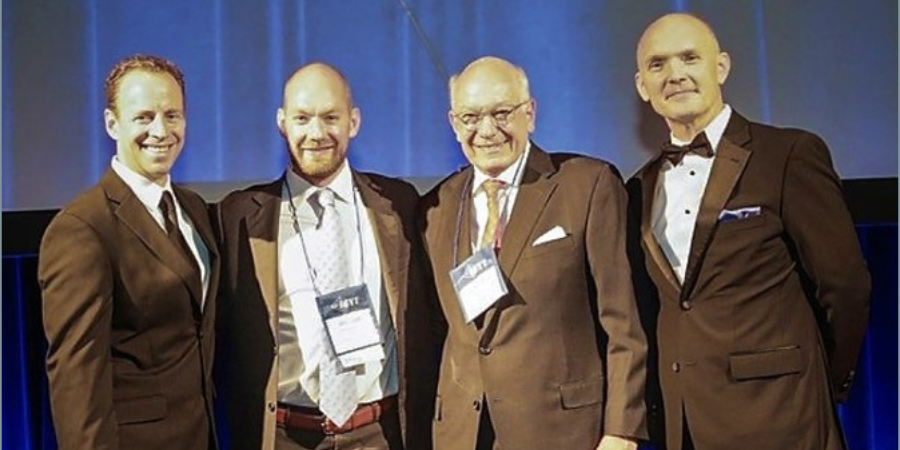
Photo: Paulo Products being recognized as 2020 Commercial Heat Treater of the Year. (L-R) Jim Oakes, Super Systems, Inc. & MTI President; Will and Ben Rassieur Paulo Products; Doug Glenn, Heat Treat Today
Heat TreatToday provides many different ways for you to keep current on heat treating technical content, news, trends, and specifications within the industry. Heat TreatRadio is one of those outlets. Publisher and Heat TreatRadio host, Doug Glenn, talked with James Hawthorne from Acument Global Technologies and Justin Rydzewski of Controls Service Inc., both of whom served on the committee, with Hawthorne being the chairman, of the latest revisions (Rev. 4) to CQI-9.
This column appeared in Heat TreatToday'sAugust 2021 Automotiveprint edition.
Check out this article for a summary of the topics and insights discussed during this four-part series, and then listen to the individual episodes to learn all you need to know about understanding and complying with CQI-9 Rev. 4.
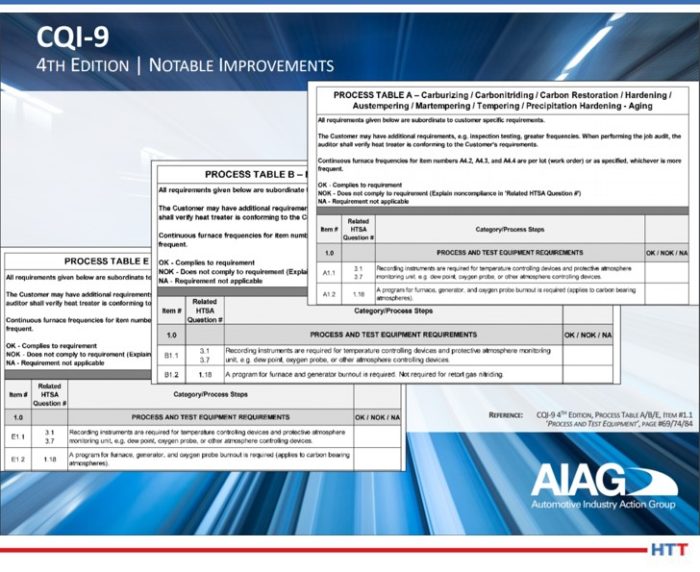
Process tables from Rollout Webinar (Source: Rollout Webinar PowerPoint)
Heat Treat Radio:
Justin Rydzewski on CQI-9 Rev. 4
(Part 1 of 4) – Pyrometry
In this first episode, Doug Glenn and Justin Rydzewski provide an overview of CQI-9 and the “why” behind the new revision as well as talking down through the pyrometry section which covers things like sensors, thermocouples, calibration, SATs, and TUS. Rydzewski was an active participant in the writing of the new revision. His company, Controls Service Inc., is an ISO/IEC 17025 accredited provider of process control systems, calibration, maintenance, and services.
Here’s an excerpt taken from the transcript of the first podcast:
Doug Glenn (DG): Give us information about CQI-9. Give us a brief history. When did it start? Who owns it? Who maintains its updates? To whom does it apply? What is its scope?
Justin Rydzewski (JR): The best way I know to describe it (because, perhaps the most widely known pyrometry specification is AMS2750) is CQI-9 is the automotive equivalent of AMS2750. There are obviously some differences between the two documents, but, in a nutshell, that’s the comparison. It is a document supported by the AIAG, the Automotive Industry Action Group. They oversee the publication of it, the drafting of it, and supervise the whole thing through that process. CQI-9 is the number. Officially, it’s called the Special Process Heat Treat System Assessment and that kind of gets the nomenclature of CQI-9 that applies to automotive heat treaters, or any performing heat treat work within the automotive industry; and several processes fall into that category. It can be from commercial heat treat to in-house heat treat, to organizations like mine that support it. It applies to anyone participating in that effort of heat treat.
DG: Let’s talk about Rev. 4. You said as soon as “3” was out, you started on “4” and it took eight to nine years to get done with “4.” What was the main reason why you needed to abandon “3”?
JR: They schedule these things out to be rewritten on a routine basis. Like most specifications, they are reviewed on some established interval of time. The biggest difference between the second edition of CQI-9 and the third edition was that the third edition removed all references to AMS2750. When 2750 was in the document, it created a world of confusion, and the guidance and errata sheets that followed were just so numerous that they made it a somewhat difficult document to adhere to.
One of the ideas we brought to the table was that maybe we should just remove all reference to it [2750] and write our own specification. So, the third edition removed the 2750 references. In doing so, it ended up being a very well written document. It was effective. The OEMs—your GMs, Fords, FCAs—were happy with the results of the document.
The prolonged active interval of that document allowed us to collect a lot of really good data about what was working, what wasn’t, what was confusing, and where additional clarity was needed. The more data we collected, the more confident we were that the fourth edition would truly make a stride toward being a more effective document.
DG: What are the major sections?
JR: It is structured very similar to the way of AMS2750 in that regard. You have four sections that divvy up a pyrometry section: thermocouples, instrumentation, system accuracy testing, and temperature uniformity survey. But, unlike AMS2750, CQI-9 is a system assessment, it is a process, it is a heat treat management system. It encompasses more than just pyrometry. Where AMS2750 is a pyrometry specification, CQI-9 is a process specification; it encompasses everything. It also includes your heat treat system assessment, which is three sections of questions regarding your heat treat operation, then you have your pyrometry which is those four sections I mentioned. Then you have your process tables. Your process tables drive all of your requirements for your particular operation, in terms of frequencies and tolerances.
To listen or read more about the CQI-9 pyrometry section, go to www.heattreattoday.com and search “Heat Treat Radio CQI-9”
Heat Treat Radio:
James Hawthorne and Justin Rydzewski on CQI-9 Rev. 4
(Part 2 of 4) – HTSAs & Job Audits
In this second installment, Doug Glenn, Justin Rydzewski, and James Hawthorne of Acument Global Technologies discuss heat treat system assessments and job audits in CQI-9 Rev. 4.
Hawthorne is a heat treat specialist in Acument’s North American facilities and handles the heat treat systems, the system’s compliance, and quality assurance for heat treat within his organization. (Acument makes fasteners—nuts, bolts, rivets, washers— for the auto industry.)
Here’s an excerpt taken from the transcript of the second podcast:
DG: James, how would you explain CQI-9 to someone who has essentially zero understanding of what it is?
James Hawthorne (JH): CQI-9 is Continuous Quality Improvement. The purpose behind it is to put together a system that will help you manage and control your process, and at the end of it, the product that you’re delivering to the end user. The intent is to give you those guidelines to help avoid potential spills or escapes or whatever else may come with that.
DG: It’s mostly heat treat related, yes? Or is there more than just heat treat there?
JH: It is the entire system of heat treat. If you look at the heat treat system assessment, the first portion of it is quality based. The second portion (Section 2) is the floor responsibilities, things that are on task that are being completed. And third, you get into the maintenance and the pyrometry portion of it, very specific to the pyrometry and very specific to atmosphere control. At the end of it, there are some very specific induction questions, because when it comes to induction, there is no real furnace at that point, so you want to focus on those key elements of induction.
DG: James, we’d like to pick your brain a bit on this. Let’s jump into some questions on the HTSAs, as we’ll refer to them, heat treat system assessments, and job audits. Let’s go right to the basics: What is an HTSA and what is its purpose?
JH: HTSA, heat treat system assessment, is a tool that has been developed to help you evaluate how you manage your heat treat system for effectiveness: effectiveness in quality management and effectiveness in the floor responsibilities. Like I mentioned earlier, understanding that through aspects of training and training effectiveness and into the final section of atmospheric control and atmosphere management and reaction to those.
The purpose here is to have one system, one document that is the rules of engagement for doing heat treat in the automotive world. What this does is allows the automotive industry to give you one spec, one thing to follow. As opposed to having, say Ford, give you ten questions where none of them are exactly the same as FCA or nine of them are the same as Ford Motor Company, where one of them has a specific question. This encompasses all of those wants and needs from the auto industry to protect themselves, to protect the end user out there in the field that may be using that heat treated component.
To listen or read more about the CQI-9 pyrometry section, go to www.heattreattoday.com and search “Heat Treat Radio CQI-9”
Heat Treat Radio:
Justin Rydzewski and James Hawthorne on CQI-9 Rev. 4
(Part 3 of 4) – Process Tables & New Resources
In this third episode, the trio talks about process tables, their importance, and key information on how to read this revision of CQI-9.
Here’s an excerpt from part 3:
JH: The heat treat system assessment (HTSA) covers the heat treat system and its assessment. There are very unique processes that are covered by CQI-9 and are captured in the process table section of the CQI-9 document.
Process Table A covers carburizing, carbonitriding, carbon restoration, austempering, and precipitation hardening or aging. Section B covers nitriding and ferritic nitrocarburizing. Process Table C covers aluminum. Process Table D covers induction. Process Table E includes annealing and normalizing the stress relief. It goes up to process Table I.
AIAG Cover CQI-9 Edition, 2020
There is a process table for each unique type of heat treat that is out there in the industry and this allows some very specific topics to be covered in those types of processes.
The first portion of it is Process and Test Equipment Requirements. What are the rules of engagement for those items? The same thing for pyrometry. There are specific call outs in the process tables. If this is part of your system, you have to play by these rules. Some of them will point you to specific sections of pyrometry. So, if you’re looking at the thermocouple and calibration of thermocouples, the process table is going to tell you that you shall conform to section P3.1 which covers all of those.
It also covers the process monitoring frequency. How often do you have to check your temperatures? What are the rules of engagement? If you have a batch style furnace that covers that process, it has certain rules for you to manage your batch process.
Then you get into things like inspection – Section 5 of the process table covers things like quenchant and solution test parameters, and the rules for checking that.
What’s really nice about the document is that it’s set up in a way where you can go to the HTSA right from the process table to see if you’re compliant to what’s listed there as the shell statement and the requirements or the frequency for checking those.
To listen or read more about the CQI-9 pyrometry section, go to www.heattreattoday.com and search “Heat Treat Radio CQI-9”
Heat Treat Radio:
Justin Rydzewski and James Hawthorne on CQI-9 Rev. 4
(Part 4 of 4) – Expert Advice
In this final installment, Doug Glenn, Justin Rydzewski, and James Hawthorne field opinion questions as well as practical implementation questions of the new CQI-9 Rev. 4.
Here’s an excerpt from the transcript:
DG: Has CQI-9 been effective in the automotive industry?
JH: I think, 100%, Doug. It’s like IATF—all of the automotive industry has to be compliant to that. Same thing with CQI-9. It provides that commonality for all heat treaters in all the different processes that are employed at their facilities, or the multiple facilities that they may have. For a company like ours, we have eight companies in North America. For the North American side of things that have heat treat furnaces in them, we have induction furnaces, we have carbonitriding furnaces, and we have stress relief furnaces. So that commonality even helps us internally with our management system and how we take steps to provide that common approach and compliance to CQI-9.
JR: I think that also bodes well up the ladder for the OEs. The more people, the more sources that you can go to in order to have work done and have it what you expect it to be, from a quality standpoint.
I think one of the things that CQI-9 has done really well is they’ve made a concerted eff ort to make that document easier to understand and to simplify things down to just its bare bone necessities, whereas some of the other specifications that exist in industry can be lacking.
The intent of CQI-9 was, to a large extent, to be something that you can do yourself and implement yourself. We’ll provide you with the guidance, put it in simple terms, and give you all the research you need to support this on your own.
To listen or read more about the CQI-9 pyrometry section, go to www.heattreattoday.com and search “Heat Treat Radio CQI-9”
Heat TreatToday publisher Doug Glenn has a second conversation with long-time thermocouple industry expert Ed Valykeo from Pelican Wire about T/C accuracy and classifications. Listen to learn more.
This is the second episode in a series of three on Thermocouples 101. Check out the first episode of the series here.
Below, you can either listen to the podcast by clicking on the audio play button, or you can read an edited transcript.
The following transcript has been edited for your reading enjoyment.
Doug Glenn (DG): Ed, welcome back. I'm glad you were brave enough to come back. Last time, Ed, we talked about a lot of good basic thermocouple stuff. We talked about, basically, Thermocouples101 which I mentioned last time, was one of the best and most well read articles on our website, which is great. We covered a lot of different things last time. I was just reviewing it, and it's interesting, we were talking about several different men as you gave a good history of thermocouples starting back in the early 1800's and talking about guys like Alessandro Volta, where we get the word volt, and Thomas [Johann] Seebeck and the Seebeck effect or the Seebeck coefficient, and things of that sort. We talked about all the different noble thermocouples, J, K, E, N, and T, and we talked about the N leg and the P leg on all of those which was all good. It was very interesting. If you didn't listen to the first episode, you ought to go back and listen to it. It's really a pretty good summary of thermocouples, a basic primer on thermocouples. We also did some things like vocabulary for ourselves; we learned what an EMF was, electromotive force and things of that sort. It was very good.
This time, I think we want to move on to, what we could commonly classify or in a big picture classify as, standardization and accuracy discussion. But, before we do, I've got a quick follow-up question from the last episode. We had mentioned that an EMF is produced when two dissimilar metals are joined together or placed together. There is a very, very, small electric current that's created. My question is: Can you do that with any metal? Is it possible? Or do you have to have only certain types?
Ed Valykeo (EV): Theoretically, yes, you could probably join any two different metals and produce some sort of voltage. However, the accuracy of that, and if doesn't mean anything, probably not. The thermocouple base metal thermocouples that we talked about last time, are industry known, used worldwide and, quite honestly, have been perfected over many, many years. So, yes, you could generate a volt probably from any two metals, but, really, to produce an accurate thermocouple, something you can measure temperature with, you're going to want to stick to the thermocouple types that we talked about.
And again, today, we're talking about the base metal thermocouples which are known as Type K, Type J, Type T, Type E and Type N. Those are the base metal thermocouples.
DG: Let's talk a little bit about standardization of these things, and accuracy. My understanding, Ed, is that there are one or more organizations out there in the world that deal with certifying, qualifying, or giving us standards for these thermocouples. Can you tell us a little bit about those organizations? Then, we'll jump in and talk more specifically about the classifications and accuracy.
EV: Sure. One of the bodies that we use is ASTM. In ASTM-E230, are all the thermocouple tables for the different types of thermocouples, not just the base metal, but also noble metal. It's a fairly lengthy book. All the thermocouples are based on the ITS-90 scale and that is the EMF output of each one of these thermocouples at prescribed temperatures. We could go into more detail with that if you'd like, but there are a number of ways that they have extremely accurate temperature medium to measure the thermocouple output. But, that's what the tables in ASTM-E230 are based on, the ITS-90 scale.
When we talk about ASTM, there are also a couple of other standards that we use, and we'll probably get into a little bit later in the conversation when we talk about calibrating the thermocouples themselves. So ASTM-E220 and ASTM-E207 are the two that are used in calibration of the thermocouples.
DG: But, basically, the organization that does that, I don't know if we want to call them a lab or not, but the organization that does is it ASTM.
EV: ASTM is one of the bodies that publishes the books that I call the standards for thermocouples. I think I won't be mistaken, but ITS-90 is really more an IST list. They control the ITS-90.
DG: Let's move into the accuracy standards, then. I think you mentioned the ASTM-E230. Is there anything else we need to talk about as far as the accuracy standards, or did we already hit it?
EV: Certainly, in the ASTM-E230, they spell out the different types of thermocouples, as I mentioned, the base metal thermocouples, but the accuracy of each one of those is listed in the ASTM-E230.
DG: What about classification? Let's talk about the guidelines for classifying these different thermocouples.
EV: Again, ASTM-E230, and there are other publications, but, again, we use ASTM here. The classification of the thermocouples are also spelled out in ASTM-E230 and basically, we talk about special limits of error, standard limits of error and extension grade thermocouple. Again, those can be found in E230.
DG: So, when we classify those, are we classifying them based on temperature deviations or the temperature tolerances? Is that, basically, what it is?
EV: Yes. It's based on temperature tolerance. I'd like to share a quick rule of thumb for classification of those thermocouples. So, special limits of error, basically from zero degrees Fahrenheit to 500 degrees Fahrenheit, it's + or - 2 degrees, and above 500 degrees it is + or - .4%. For example, at 1000 degrees, you're looking at + or - 4 degrees; if you have 2000 degrees Fahrenheit, the tolerance at 2000 would be + or - 8 degrees for special limits of error.
On the other side of that, you've got standard limits of error, and, basically, you could just double that. From zero to 500 degrees Fahrenheit, you're talking + or - 4 degrees; at 1000 degrees would be + or - 8 degrees and at 2000 degrees, + or -16 degrees.
Where there is some confusion, and maybe some people don't understand thermocouples, is when we talk about extension grade. There are actually two types of extension grade. There are standard limits of error and special limits of error extension grade. Extension grade is just exactly as it sounds. It carries that signal from your sensor all the way back to instrumentation rather than run maybe a little more expensive wire all the back to your instrumentation, you're going to put extension grade to continue that circuit back to the instrumentation. Extension grade is the same metals as the thermocouples. If you're using Type K sensor, then you're going to want to use Type K extension grade, and so on, for the rest of the base metal thermocouples. The difference is that the extension grade material is only guaranteed to meet the tolerances up to 400 degrees Fahrenheit. If you look at ASTM-E230, the tolerances only go, on extension grade, to 400 degree Fahrenheit. And, actually, Type T is a little bit different; Type T only goes to 200.
DG: In the heat treat industry, that's not really going to do us much good, right? I mean, most of our processes are well above 400.
EV: It is. That's why you would never use an extension grade as the actual sensor. This is some of the confusion out in the industry: “Well, I can just take my extension grade, create a junction and use it to measure temperature.” You probably could up to 400 degrees, but it's not guaranteed above that temperature, and you could get yourself in trouble.
DG: So, you run extension grade outside of the furnace because, obviously, you're not above 400, so you can use extension grade to run it. I think last time we talked about no more than 100 feet rule of thumb.
Extension grade is basically this: Here's your extension cord that you can run from your regular wire, either your standard limit of error or special limit of error, from that to the box.
EV: Exactly. And so, the key to understanding extension grade is the tolerances on that extension grade are the same – say if you have special limits extension grade – it's the same as your special limits thermocouple wire, + or - 2 degrees, in this case, up to 400. It's guaranteed to meet special limits of error and then the same thing on the standard limit side. You just double those tolerances. Again, it's really the temperature that it is guaranteed to.
DG: Very good. So those are the different classifications. We've got special limits of error, which is a tighter temperature tolerance, and then we've got standard limits of error, which is a little less tight, and they we've got our extension grade which is only classified up to 400 degrees anyhow.
I know some heat treat processes require very, very tight temperature tolerances, especially in things like aluminum brazing and things of that sort. Is it possible to get anything better than special limits of error?
EV: It is. The first thing I want to say is that they're not really recognized within ASTM, these tighter tolerances. But, in the industry, certainly in heat treating and in the pharmaceutical side where they typically use Type T, we've had many requests for tighter tolerance material. Some people call it quarter limit material or half limit material, there's a bunch of different names that it goes by. So, we go to our manufacturer's of the wire and request that and, most of the times, it's a no quote. It really comes down to more of a selection process.
For us here at Pelican Wire, we have a pretty good sized stocking program of bare conductor and sometimes what we can do is mix and match to try and meet the tighter tolerance material. There are a number of ways that some of the manufacturers, in fact, the heat treaters, will request special limits materials, that must meet + or - 2 degrees up to 1000 degrees and then .2% after that. It can be done and we do it on occasion.
DG: Let's follow up on that a little bit. How do you determine the accuracy of a lot of wire, or a spool of wire? How do you go about doing that?
EV: Let me back up just a little bit and start with the actual wire producer themselves: There are not any left in the States, so, basically, all the thermocouple wires are melted overseas, whether it be Germany, France, Sweden. When they melt, they try to meet special limits of error. Now you're talking each leg has to be melted separately; they don't melt them all at one time, right? So, each “melt” or “heat”, they are shooting to make special limits of error.
This is where some of the testing specifications come into play. ASTME-207 is a test method for single thermal element thermocouple wire. I don't want to confuse our listeners, but, again, if you think about a melter that just melted or heated a melt of wire and they process it down to wire, they only have one conductor. They want to know if that one conductor is going to potentially meet special limits of error. There is a testing specification that ASTM has (ASTME-207) that you can test a single leg thermocouple wire to see if it's going to meet special limits of error. What they do is they calibrate the single leg, they get their values (the EMF output), and they have the second other leg and they do the same thing. They, then, mathematically add the EMF of those two and go back and look at the standards to see if it's going to fall within the special limits of error.
That's how the melters, the folks that are melting the individual thermocouple legs, are doing it. We users, we are an insulator wire, we put the two legs together and now we have a thermocouple. The way we test those thermocouples is by using an ASTME-220, which is a comparison method. We're taking a known standard and we're calibrating the thermocouple wire against that standard and getting the temperature deviation from that. That's how we verify that the wire is meeting the tolerance that is requested by our customers, whether it's special limits of error, standard limits of error or even extension grade.
DG: When you say "a standard", what does that test actually look like? Are you taking a thermocouple that you know is good, sticking it in a hot furnace and your test thermocouple or are you just doing it through current testing or something like that?
EV: Good question. We actually use SPRTs (resistance thermocouples) high accuracy, that we use as our standard. They're calibrated at an outside firm, so we know what the output of that resistance thermometer is, and we calibrate our sample against that. The three things you need to do a temperature calibration is the temperature medium, the reference thermometer and the equipment to capture that output or measure the voltage that's being produced. Having those, we have our reference standard that we know the EMF or the temperature output of. Now, we put our thermocouple in the furnace and we compare the two. That's how you get your deviation.
DG: There are labs, I understand, that do these certifications and things of that sort, that certify the accuracy of the thermocouple. Now, Pelican Wire does that. You do have a lab and you do certifications, right?
EV: We do. We calibrate the thermocouples and we produce a test report showing the deviation of the thermocouple for the customer.
DG: Earlier, we were talking about standards and how there's the organization ASTM. How about for these labs? Do the labs have to meet some sort of outside third party certification?
EV: There is nothing that they have to do. I will say that there are a number of standards. We're ISO9001, but we're also seeking accreditation for 17025 so that our lab is accredited to IECISO17025, which just proves that we are a quality lab. We have our quality systems in place. We have our uncertainty budgets for all the equipment we use. A customer can feel confident that the calibration report that we provide is as accurate as possible.
DG: I think covers most of the things we wanted to cover in this episode. We talked about the standardization, the special limits of error, the standard limits of error, who are the bodies out there that do the certifications/classifications, if you will. I think we covered a good bit.
I think we were going to do one more episode, Ed, and I think we're going to talk about insulating materials. I understand that one of your colleagues is going to be there to talk about that with us, John Niggle.
EV: Yes. John Niggle will join the next podcast and talk a little bit about how now that we have the thermocouple wire, what kind of insulations do we put on that wire. It depends on the medium that it's going to be used in, the heat treater or whoever.
Doug Glenn
Publisher Heat TreatToday
To find other Heat Treat Radio episodes, go to www.heattreattoday.com/radio and look in the list of Heat Treat Radio episodes listed.
Creation requires endurance and continued hard work. Find out what creative applications and research services your colleagues are committed to bringing from across the heat treat industry.
These innovations could bring the next level of innovation to your industrial plants. Enjoy!
Novel Mechanical Testing Systems Powered By Finite-Element Analysis, Optimization Algorithms, and Machine Learning
- An excerpt from a Heat TreatRadioepisode with James Dean -
Doug Glenn: You may have already stated this a little bit, but briefly: indentation plastometry is basically taking an indentation to be able to test, not just hardness or not even necessarily hardness, but the deformation or the strain of material. Do you have to know the microstructure of the material when you’re doing these tests?
James Dean: That’s a good question. In principle, no. If we were to dig deep into the mechanics of what’s going on within our system and our software package, you’d come to recognize that it’s, from a mathematical point of view at least, insensitive to microstructural features. There is a numerical method underlying this – a finite-element analysis – therefore, treating this as a continuum system doesn’t take account explicitly of the microstructure.
When you’re doing the test, it’s actually helpful to know something about the microstructure simply because our technology is all about extracting bulk mechanical behavior engineering properties. Therefore, when we do our indentation test, it is important that we are indenting a representative volume of the material.
It is important that we are capturing all of the microstructural features that give rise to the behavior you would measure in a microscopic stress strain test. Otherwise, you can’t pull out those bulk, core engineering properties, and therefore, the scale on which you do the indent is important. Your indenter has to be large relative to the scale of the microstructure. So, it’s only at that level that you need to understand or know anything about the microstructure.
DG: This test is a nondestructive test, right? You said you can actually test live materials, correct?
JD: Yes.
DG: You don’t have to destroy them, you don’t have to machine them, you don’t have to make them into something you can rip apart, right?
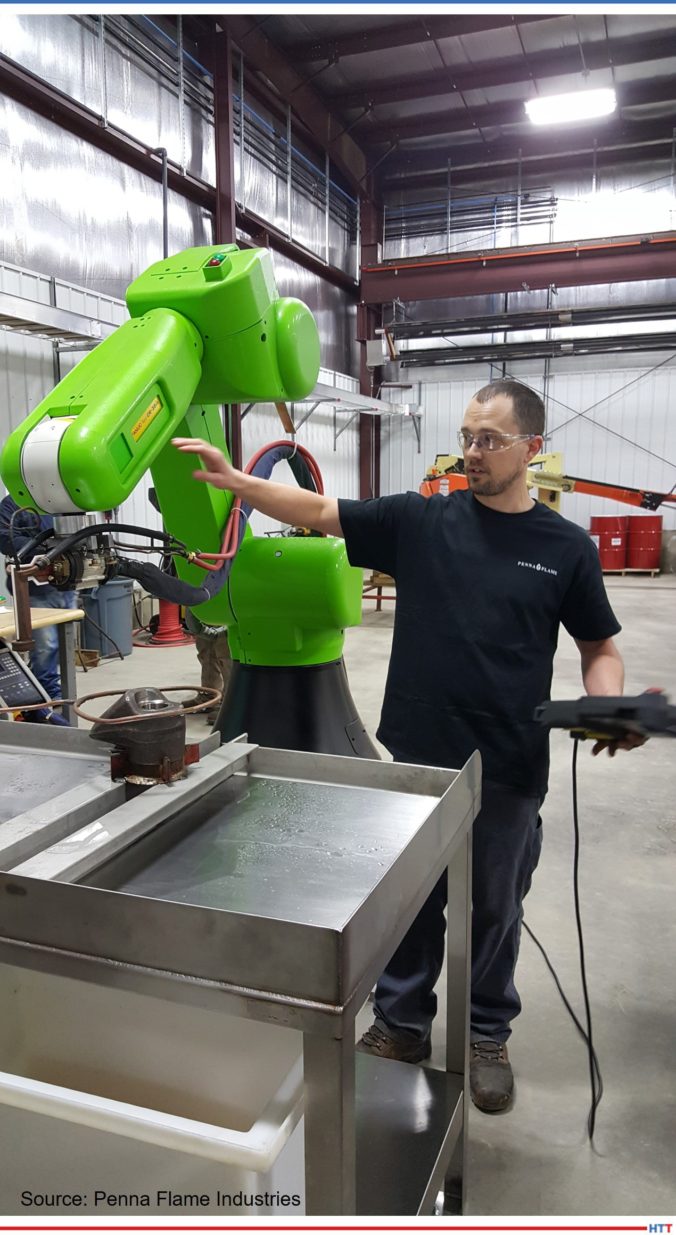
Bert demonstrates the benefits of working with a collaborative robot to induction harden steel parts. The robot gives the operator the ability to work directly next to it, as opposed to conventional robot arms where fencing and distance is required.
The computerized robotic surface hardening systems have revolutionized the surface hardening industry. These advanced robots, coupled with programmable index tables, provide an automation system that helps decrease production time while maintaining the highest quality in precision surface hardening.
A few benefits of this service are:
Increased wear resistance
Higher hardness and longer life
Less processing time
Higher efficiency and productivity
Maintain tensile strength
Quick turnaround of the project
Consistent, repeatable process
Less distortion when compared to furnace treatment
High Pressure Break Through For Additive Manufacturing
- An excerpt from a Heat TreatRadioepisode with Johan Hjärne -
DG: Doing it all- stress relief, HIP, age, or whatever. Just for clarity sake, you’ve got a typical HIP process, you’re going to heat it up, put it under very high pressure, then, normally, if you didn’t have the high pressure heat treatment capabilities, you would have to cool that part down which is typically cooled quite slowly in a conventional HIP unit, taking more time and whatnot. It then comes down to ambient, or close to ambient, where it can be held, you take it out, you put it back in another furnace (a normal furnace, not a HIP furnace), take the temperature back up, get it to the point where you want it, quick cool it, quench it, to a certain extent, to get the characteristics that you’re looking for, and you’re done. What we’re talking about here is the combination of those two processes plus potential other things like stress relief, and all that, in a single unit, correct?
JH: Yes. This has very beneficial effects on time. Many of the HIP vendors do not have HIP and heat treatment in the same facility. Now we have sold a couple of units to some new HIP vendors that have this capacity, but, historically, the HIP vendors didn’t have both HIP and heat treatment. First, the customer had to send it to a service provider for HIPing, they got the part back, they had to send it to somebody that could do the heat treat step, and then got the part back, and so on. The time, and specifically for additive manufacturing, is important. Keep in mind they can do a part pretty fast, anywhere between a day to two days, worst case a week, but then having to wait week after week after week to get the part back for the HIPing or for the heat treating.
DG: So there’s a substantial, potential time savings, for sure; not just process savings in between furnaces, but the fact that you can buy one furnace and do both of those things.
Let’s talk for just a second about what types of products are most effectively HIPed and/or, if we can, high pressure heat treated.
JH: As I said before, we really started to realize the potential with this technology with the additive manufacturing world. That is were we started to realized that we can actually make a difference here. Not only does it have a beneficial effect for the total time, but having the components under elevated temperature for a shorter period of time is actually beneficial for the microstructure; the grain doesn’t grow as much.
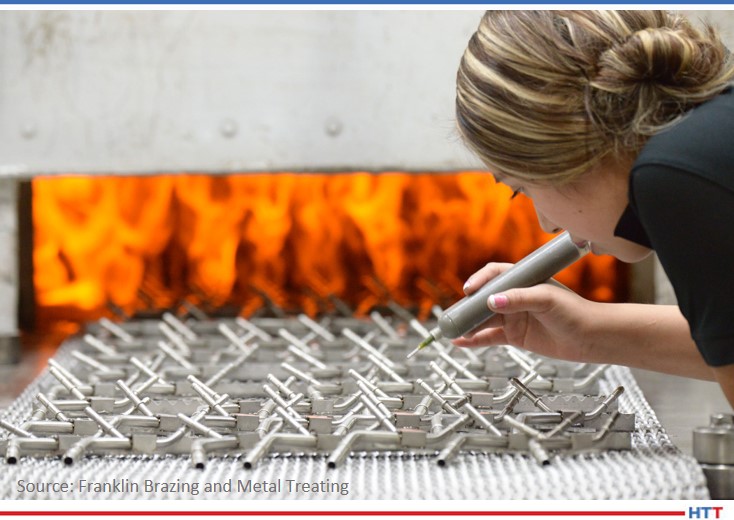
Recent improvements include a new cooling tower, chiller system, enhanced duct work, LED lighting in the plant, a renovated breakroom for the associates, a quality room for the engineering staff, a new HVAC system for the front offices, and upgrades in technology systems.
The updated technology is not only used for improving efficiency and data analysis, but also for communication. It has been key to improving operations and has had a significant impact on relationships with clients. Franklin’s ability to effectively communicate enhances collaboration, which allows FBMT’s clients to more efficiently manage their supply chains, reduce the cost of rework and scrap, and better serve their clients.
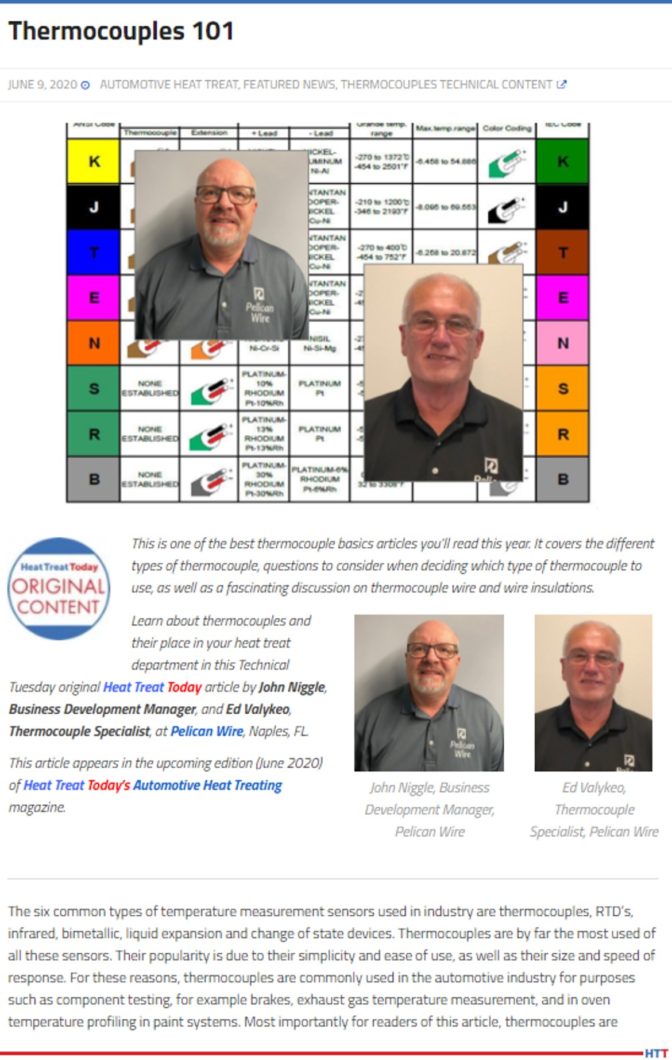
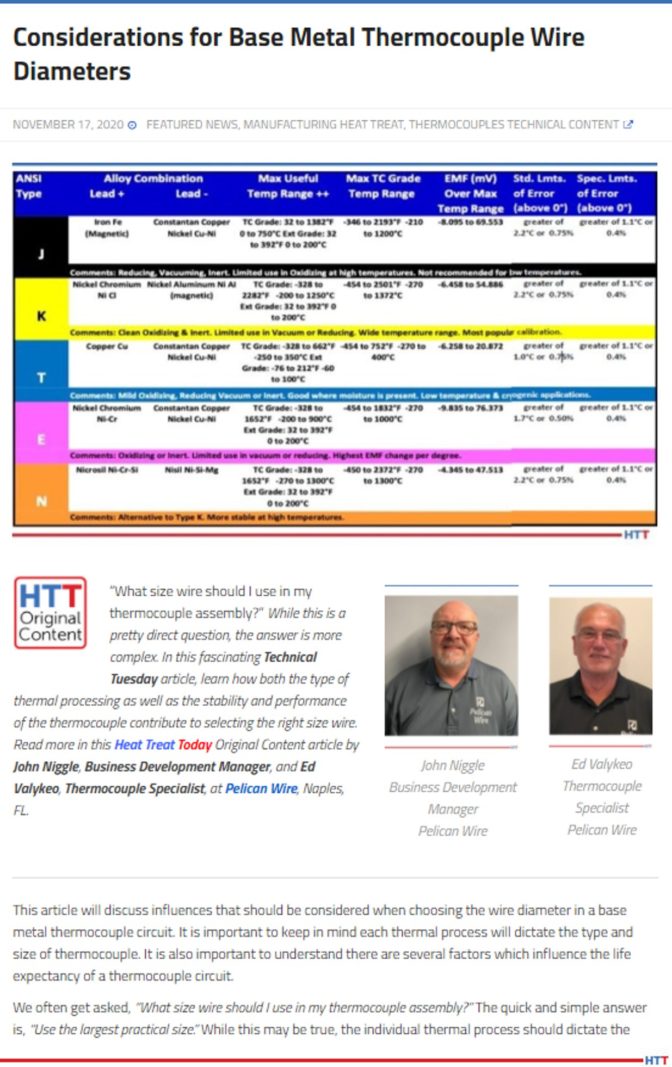
Heat TreatToday publisher Doug Glenn sits down with Ed Valykeo from Pelican Wire in the first of a three-part series on all-things thermocouples. This first episode covers the history, types, vocabulary, and other basics of understanding how thermocouples work.
Below, you can either listen to the podcast by clicking on the audio play button, or you can read an edited transcript.
The following transcript has been edited for your reading enjoyment.
Doug Glenn (DG): Ed, why don't you take a minute, as we typically do on these interviews, to talk briefly about you and your background especially your qualifications for talking about thermocouples.
CLICK the image to access the article!
Ed Valykeo (EV): I've actually been in the wire and cable industry for a little over 40 years now. I actually first started in the industry as, well maybe not a grunt, but certainly I was called a “melter's helper.” I worked at a company called Hoskins Manufacturing in Ann Arbor, Michigan where we actually melted the raw materials to make thermocouple wire, resistance wire, and a whole host of other things. I was actually the guy that, after we got done pouring that molten metal into the molds to make the ingots, was cleaning up all the mess that happens after you pour and you're pulling those ingots.
That's really where my career started, with Hoskins. As a matter of fact, it kind of ran in the family. My dad retired at Hoskins with 42 years of service with Hoskins, so it was kind of a natural progression that, eventually after I got out of the service, I ended up joining Hoskins. I was there about 18 years at Hoskins Manufacturing, again, starting out right at the bottom. I worked my way up to becoming an associate engineer working in the R&D department. That's where my career really started focusing a little more on thermocouples. I enjoyed working with thermocouples. We were developing some new products using thermocouple wire and things like that.
Ever since then, I've kind of stayed in thermocouple arena at some of the other places I've worked. After I left Hoskins, I started working for companies that insulated wire. So, we were taking the wire, like we made at Hoskins, and we were putting a whole host of insulations on it from ceramic braid to extruded products and things like that. And, again, both the companies, and even the one I'm currently employed with at Pelican, but before that I was working for a company out in New Hampshire called PMC, are real similar, it's just we insulated wire. So, we purchased the raw materials (raw wire from Hoskins or whoever) and then insulated it.
DG: For the unbaptized in this topic, what are thermocouples, how do they work, how do they come about, and then are the modern-day thermocouples any different than the thermocouples of old?
EV: I always start out with a little bit of history about thermocouples, whenever I'm talking about them, just to give people background. Thermocouples were introduced in the early 1800's with the most significant developments taking place in Europe.
One of the very first gentleman that worked on it was Alessandro Volta. You can probably recognize the name because Volta actually is the volt, today, which everybody recognizes, not just with thermocouples but, obviously, in the electrical industry too. He basically built a couple thermopiles using metals, silver and zinc and some cloth in between them, soaking them in salt water, and discovered that it would produce a voltage. That's kind of how it got started. The significance of that discovery was that there is a source of steady and reliable current flow from using dissimilar metals and saltwater and things like that.
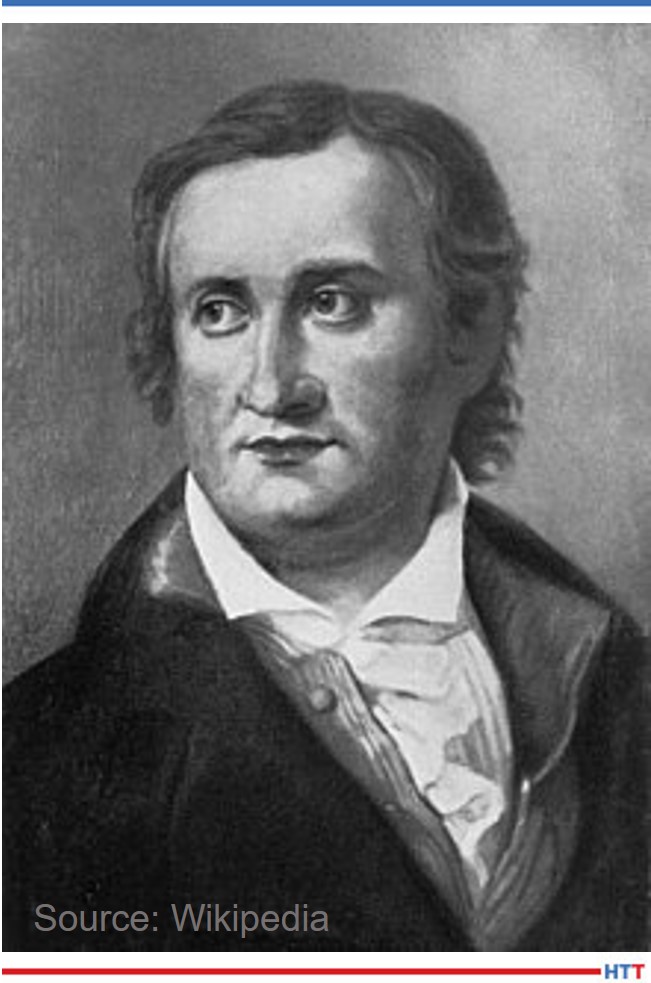
Thomas Johann Seebeck, Baltic German physicist, who, in 1822, found the relationship between heat and magnetism.
Over the years, many others have experimented with the phenomenon. Probably the most famous, anybody that's in the thermocouple industry will hear it a lot, in 1821, Thomas [Johann] Seebeck announced that he had discovered that when two dissimilar metals were placed in a closed loop and one of those junctions was exposed to a change in temperature, electrical current was produced. This production of the electromotive force and electromatic force is the electric current is known as "the Seebeck effect" or "Seebeck coefficient." It was, obviously, much later, before everything was understood and correct mathematics, but Seebeck's name will always and forever be associated with the discovery of thermoelectricity and thermocouples. Again, even to this day, even ASTM books reference Seebeck coefficient.
Some other gentlemen that we involved, again you'll recognize some of these, were Michael Faraday, Georg Ohm, Claude Pouillet, and Antoine [César] Becquerel. It was Becquerel, actually, that suggested using Seebeck's discovery for measuring high temperatures. He proposed the strength of the current generated was proportional to the change in temperature in exactly the principle behind the thermocouple. We're measuring temperature, whether it's 200 degrees or 2300 degrees. That's how the modern day thermocouple got started way back in the early 1800's.
DG: And the modern-day thermocouples are, essentially, the same as that? Have there been any major changes?
EV: In reality, Type J was the first thermocouple to really be experimented with. After Type J, then some additional thermocouple types came on board. People experimented with other metallurgical compositions to develop different millable outputs.
DG: Let me understand: Type J, what that basically the first type of thermocouple that was developed?
EV: Let me back up a little bit. Actually, the early metal thermocouples were based on what we can call noble metals. Noble metals are rare earth elements such as platinum, rhodium, tungsten and uranium. The problem with the noble metals is that noble metals are much more expensive than our base metal thermocouples, or what we call base metal thermocouples, today. Base metal thermocouples, today, typically the compositions are just a handful of elements. You have iron, nickel, chromium, copper and things like that, which is considerably cheaper than the noble metals, the platinum and rhodium and things like that.
DG: I want to learn this history a little bit, because it's just kind of fascinating to me. So, the very first ones were made of noble metals, primarily. So, they would put those together and then, basically, we said, "This is great but it's way too expensive. Can we get the same effect, if you will, (the difference in voltage, or whatever, between dissimilar metals), if we use a little less expensive metals?"
EV: Right.
DG: You’ve said there is a difference voltage when there's a difference in temperature.
EV: The EMF (electromotive force) generated by the thermocouple is linear. So, at 200 degrees, it produces this amount of voltage, at 300 degrees, it produces this much. All the thermocouples are, basically, the same principle. It's very linear. That's one thing that is good about a thermocouple- the EMF output is linear. You aren't producing a millivoltage at 200 degrees and then at 300 it goes down and then at 500 it goes back up; it's linear proportional to the temperature.
CLICK the image to access the article!
DG: I have heard in the past, and you mentioned it here, maybe we can discuss it a little bit: noble metal versus base metal. Obviously, we know noble metals, you mentioned what those are. Those are expensive; they work to do the same thing. Base metals, though, tend to be what? Which metals?
EV: As I already mentioned, the nickel, chromium, copper, and others.
DG: And those are, in fact, just less expensive, right? Essentially, they do the same thing but they're less expensive.
EV: Exactly. But, there are some other differences, too, between the noble metals and the base metal thermocouples. When you're talking noble metals, the platinum and the rhodium, and things like that, they can handle much higher temperatures than even the base metal thermocouples.
DG: I'm going to make an assumption, but probably the vast majority of the thermocouples used in the heat treat industry are probably base metal, although, I'm sure they've got some specialized ones for high temperature, which probably jump into noble metals.
EV: Absolutely. A lot of the base metal thermocouples are used in the load sensors where they're putting multiple sensors in and then the oven may be controlled by a noble metal.
DG: The different types of thermocouples. You mentioned, and I've forgotten the letter already, that there are different types. Was it Type J you mentioned?
EV: Yes, Type J.
DG: OK. We've done a study recently asking about what's the most popular one in the heat treat industry, but I know we listed down there J, E, K, N, and T. Can you run us through those and tell us what are the differences, and whatnot?
EV: J, E, K, N and T are the most common noble metal thermocouples. Obviously, you've got two dissimilar metals or, what we refer to in thermocouples, two legs of the thermocouple – the positive leg and the negative leg. So, for instance, on a Type J thermocouple, you're using iron as a positive leg, which is basically pure iron, (there are some coatings on the iron to help against oxidation and things like that), and the other leg is a copper nickel alloy. That makes up the two legs of the Type J thermocouple.
If we look at Type K thermocouple, the negative leg is the KN which is, basically, just high nickel with a little bit of chromium; the KP leg, or the positive, of Type K is higher content nickel chromium. There are also some other minor elements.
With Type T, the positive leg is pure copper. The TN leg is, again, a copper nickel alloy. So, when we talk about Type E, what is interesting is that with the Type E thermocouple, you're actually taking the Type KP leg and matching it with the TN leg. So, again, it's just a mismatch or some hodgepodge of some legs.
DG: So, you're using some lingo that I'm just picking up on and I want to make sure our listener's are, as well. You talk about a P and an N leg. Obviously, you didn't say it, but you're talking about a positive leg and a negative leg.
EV: Yes, I'm sorry. KP and KN. So it's K positive and K negative leg.
DG: Great. So, with the Type E, you're taking a few and switching them around and matching them up and seeing what you can come up with.
EV: Yes, that's the E, and I already mentioned the T. N is a relatively newcomer to the thermocouple industry. I say new, but it's still probably 40 or 50 years, I'm not sure when it was developed. But, again, the Type N is similar to the Type K where the KP leg is a nickel and the KN leg is nickel and some silicon. So, it's just a little bit different composition from the Type K thermocouple. But, there are some differences.
Some of the differences, when you're looking at the different types of thermocouples, for example, Type E has the highest EMF output of any of the thermocouples. Your question might be, "Well, why wouldn't we just use Type E because it has the highest output?" What the higher EMF output means is that the sensitivity is a little bit greater in the Type E thermocouple. Then why wouldn't we use that throughout all the industries? Well, the short answer is, a couple things: Type E has a limited temperature range, because, again, you're using that TN leg which is copper nickel alloy and the melting point of a copper nickel alloy is much lower than a nickel chromium alloy. So, that's some of the differences, and with all the thermocouple types, also.
Each one has their own EMF output at certain temperatures but one of the biggest considerations is, really, the environment that you're using the thermocouples in. Type K has good oxidation resistance; Type J, not so much, because you've got a pure iron leg which is going to oxidize much faster. That's some of the differences between the individual thermocouple types.
DG: I assume that if there's oxidation, or any type of corrosion or anything of that sort, it's going to change the EMF, it's going to change the reading and therefore that thermocouple, out the door she goes.
EV: Absolutely. And there have been even some recent changes in some of the specifications that some of the heat treaters are using nowadays where they finally realize that these thermocouples do deteriorate over time and so they start limiting the amount of uses that each thermocouple can be used in, in a bunch of different applications, but heat treating mainly.
DG: Let's pause for just a second and do a little vocabulary. You've mentioned EMF a couple of different times. Could we have just a brief review of that just to make sure? Also, I've heard about millivolts. Are those two things related? If so, how?
EV: EMF stands for electromotive force. It is, basically, when two dissimilar metals are put in contact with each other, a small voltage is generated. When we're talking about millivolts, that's exactly what we're looking at: a millivolt is 1/1000 of a volt. It's a very small amount. If you look at some of the millivolt outputs for some of these thermocouples, at 200 degrees, for example, you're putting out .560 of a millivolt. So, these are small.
DG: And you're saying that it was the Type E that has the highest millivolt of all, so the current that is produced between those dissimilar metals is the highest, but you can't always use that one because in certain temperature ranges you're going to melt one of the legs.
EV: Exactly.
DG: The millivolts are measured by what? I mean, it goes into an instrument that is able to read that? What is that instrument?
EV: Actually, some DVMs (digital volt meters) have the capacity to measure in the millivolt range. So, it could be as simple as a digital voltmeter. But, in the industry, we have temperature controllers, things like that, that you hook a thermocouple up to and it measures the EMF and then it converts it into a temperature.
DG: It will measure that millivolt and then tell us what the temperature is?
EV: Right. With the instrumentation nowadays, it has the formulas in its memory, or whatever, and can convert that millivolt into an actual temperature that you actually read on a meter.
DG: We've got an EMF which is measured in a millivolt. It's going to travel across a long wire, I assume, to some place where it's going to be read. Let's talk about that wire a little bit. The impact of this, whatever EMF is being created, millivolt, what about that wire? Tell me about it and what do we need to be careful of, etc?
EV: We're actually saving that for another podcast, but I will touch on it a little bit. So, there are limitations on the length of the thermocouple. There are a lot of different mindsets, but probably the one I've heard the most is no longer than 100 feet. So, you have your thermocouple sensor and that arrangement, the configuration, can be a number of ways. At PMC Corp. we insulate the wire. You could just take that insulation off at the end, weld the junction there, stick it and [. . .] then run it to a meter.
But in other industries, you may have it in a ceramic tube because of the temperature it's being used at. You have a ceramic tube with a connector at the end, you may run what we consider an extension wire from that point all the way back to your instrumentation. Again, the general rule of thumb, is 100 feet.
DG: Let's talk about that wire with the different types of thermocouples. What do we need to be sensitive to? What do we need to be careful about?
EV: Again, temperature range is probably the first consideration, but then also the environment that it's in. Again, each thermocouple has its limitations on the environment. Some are good in a vacuum, other thermocouples are not good in a vacuum. Some thermocouples are good just in air, (like Type K), but Type J is not so good. It still can be used in air but it will oxidize faster.
Like I said, in an environment of a vacuum, some thermocouple elements will actually leech out or evaporate out and that definitely would cause a problem with the EMF output and would have an erroneous reading. Certain acids you can use some thermocouples in, others you can't.
DG: With all of this pyrometry stuff going around, especially the AMS2750 revision, there are a lot of places where the tightness of the tolerance on the temperature really needs to be paid attention to. Are some thermocouples inherently tighter tolerance, where they can go down to + or –2, or less than that?
[blockquote author="Ed Valykeo, Pelican Wire" style="2"]Special limits of error is the tightest tolerance, and that's according to ASTM. But, there are some customers and some companies that want tighter tolerance material. So, when we talk about that, that's really a special order. Now you have to back all the way back up to the melters that melt these elements and make the thermocouple wire. It's on them to produce something that is a tighter tolerance. [/blockquote]
EV: Again, that was something we were going to touch on a little bit later, maybe on another podcast, because it can be a whole category on its own.
But, yes. If you think about in general, overall, when we're thinking about the different thermocouple types, they basically all have the same tolerances according to ASTM. The rule of thumb, that we kind of use, is from say 200 degrees to 500 degrees, the tolerance on all thermocouples are + or - 2 degrees if you want special limits of air material.
Now, there are other tolerances. In the thermocouple industry, you’ll here – at least calibration-wise – you'll hear special limits of error, standard limits of error and extension grade. Special limits of error is the tightest tolerance, and that's according to ASTM. But, there are some customers and some companies that want tighter tolerance material. So, when we talk about that, that's really a special order. Now you have to back all the way back up to the melters that melt these elements and make the thermocouple wire. It's on them to produce something that is a tighter tolerance. Once that metal is poured in that mold and it's processed down the wire, it is what it is. When they calibrate that wire, you can't really do a lot with it to change the EMF output, per se, other than there are some heat treat operations that can, what they call, stabilize, and there are processes to oxidize thermocouple wire, and things like that, but you're pretty much stuck with EMF right from the melt.
DG: And it's dependent on the material composition or quality of the material.
EV: Absolutely. In some cases, they may melt 10 melts to get 2 special limit of air thermocouple types. I don't think it's quite that bad, bur from my early melting days, we've had to downgrade many a melt because it didn't quite meet the tolerances.
DG: Just reviewing, we talked about the basic history, how they got started. We talked about the difference between noble versus base metal thermocouples. We talked about the different types. We defined EMF, electromotive force. We talked about millivolt a little bit. We talked about the wire, the differences in what we need to pay attention to as far as wire, and some other considerations like temperature range, calibration tolerance and environment.
EV: Just so you know, the only base metal thermocouples there are, at least what ASTM recognizes, are the Type J, E, K, T and N. We covered all the base metal thermocouples.
DG: Just out of curiosity, a noble metal thermocouple, what are those?
EV: There is a fairly large list of those. You've probably heard of thermocouple Type R or Type S thermocouple. Those are all made with noble metal thermocouples. It's not really considered a base metal, but tungsten uranium thermocouples. Those are in more the noble metal category Type C. There is even development of some other additional noble metals: gold is used. Thermocouples are made out of gold.
DG: Those could be expensive. Of course, some of those other metals are more expensive than gold, so, who knows?
Well, that's very interesting. So, J, E, K, N and T are all base metal thermocouples.
I want to make sure that we give appropriate credit to your company. We talked about the fact that you're from Pelican Wire, part of the wire expert group. I want to make sure that our listeners know that they can go check out your website which is pelicanwire.com. You're not obligated to do so, but would you like to give out any other information where they can get a hold of you?
EV: Yes. Through the Pelican website, you can certainly get a hold of me. Our number is on the website. It's 239-597-8555 and it goes through a central board. If anyone wants me, they can just ask for me through the operator.
Doug Glenn
Publisher Heat TreatToday
To find other Heat Treat Radio episodes, go to www.heattreattoday.com/radio and look in the list of Heat Treat Radio episodes listed.
Heat TreatTodaypublishes eight print magazines a year, and included in each is a letter from the publisher, Doug Glenn. This letter first appeared in Heat TreatToday'sMay 2021 Induction print edition.
Doug Glenn Publisher and Founder Heat TreatToday
I’m not positive, but it seems to me that it was back in 1992 or 1994 when my former employer launched the heat treating industry’s very first PRINT Buyers Guide. I remember with certainty that it was a HUGE undertaking every July. The excellent team at Industrial Heating in those days (many of whom are still there) did yeoman’s work to get this helpful resource into the industry every year. It was always a great relief when the issue finally hit the street.
Nearly 30 years later, Industrial Heating announced last year that they were no longer going to print a monthly magazine which, I believe, includes their big July Buyers Guide.
In steps Heat Treat Today. We’re big believers in print, and we’re big believers in online and print buyers guides. So, this June (next month), Heat Treat Today will officially launch its very first print and online North American heat treat industry Buyers Guide. Woo hoo!! Let the fun begin.You can preview the online Buyers Guide at www.HeatTreatBuyersGuide.com (super cool URL, eh?), although we’re not officially launching it until mid- to late- June. But go ahead, take a quick look. The big print edition will come out in late June as well.
We’re really excited about both the online and print versions of this Buyers Guide.
The online version is super-sleek. While we’ll undoubtedly make improvements as we go on, the initial look and functionality is uniquely simple and modern. It is also the very first Buyers Guide that combines both heat treat equipment and related services and commercial heat treating services. If you’re looking for either, you’ll find it at www.HeatTreatBuyersGuide.com.
If you’re an industry supplier, you should search the site for your company. If you’re not there, you should create a listing. If you are there and your listing is “unclaimed,” claim it.
We’re also very excited about the print version. There’s been a lot of talk about the death of print magazines and print directories. In fact, it was the belief that print’s days are limited that prompted the aforementioned thermal processing publication to essentially abandon print. As Mark Twain is reported to have asserted, “The rumors of my death have been vastly exaggerated.” So it is with the rumors of print’s death – vastly exaggerated.
Heat Treat Today's research arm recently conducted two broad based studies – one on batch integral quench furnace systems and another on induction heating technologies and usage – and both returned very similar results to an identical question we asked in each. The question was, “When reading through an industrial trade magazine, which do you prefer?” Here are the combined answers:
Said another way, if you drop print, you’ve lost nearly 40% of your audience. That doesn’t make sense. So, we’re not going to go that route. We’re committed to keeping print a priority and June’s Buyers Guide is no exception.
Watch for it in June, Heat Treat Buyers Guide. Or get a sneak preview now at www.HeatTreatBuyersGuide.com.
Heat TreatTodaypublishes eight print magazines a year, and included in each is a letter from the publisher, Doug Glenn. This letter first appeared in Heat TreatToday‘sJune 2021 Buyers Guide print edition.
Doug Glenn Publisher and Founder Heat TreatToday
We’re seeing the backside of COVID as it slouches off into the sunset. Masks are coming off. People are standing less than six feet apart. Hands are being shaken as opposed to elbows being bumped. And planes, trains, buses, interstate highways, office buildings, and restaurants are starting to fill up again with real live people.
So are convention centers.
Such is the case in the North American heat treat industry. . . and none too soon. ASM International recently announced that their IMAT event which includes the long-standing Heat Treat Society sponsored Heat Treat Conference and Exposition (aka Heat Treat Show) will be live and face-to-face this coming September 14-16, in St. Louis. Amen and amen!
Heat Treat Today is one of the sponsors of the ASM Heat Treat Show, and we couldn’t be happier to get together with all of our friends and colleagues at this year’s event. On page 8 of this edition, Eric Hutton explains a bit more about the event. Be sure to read his column. This publication will be heavily promoting the Heat Treat Show as something good and worthy of your attendance. Considering that the last major face-to-face industry event was the 2019 ASM Heat Treat Show, it will be a real blessing to be back in a booth, shaking hands and catching up with industry colleagues, customers, and prospects.
“People are happier and make better decision when they are well informed” has been the driving force behind all that Heat Treat Todaydoes. Our goal is to help people become well informed, and with nearly 24 months since the last face-to-face event, there is certainly a lot of informing that needs to happen. That’s why we’re excited to be one of the key promoters of this year’s event. We hope that you’ll take the time to attend the show, and bring your entire heat treat department with you.
Another way we keep people well informed is by helping them connect with suppliers who can provide them with the equipment, supplies, components, and/or services that they need. That’s exactly what this month’s issue is all about – connecting buyers and sellers of heat treat equipment and services. This is Heat Treat Today's1st Annual Buyers Guide. We’re super pleased with how it has turned out, and we are absolutely certain that next year’s Heat Treat Buyers Guide will be even bigger and better.
In the Heat Treat Buyers Guide, you will be able to find ANY heat treat equipment, supplies, components, sub-systems, or heat treating services that is known to man. If not, let us know and we’ll see if we can add it to the list of improvements for next year. On page 6, our managing editor, Karen Gantzer, explains how to get the most out of this resource. That’s a page worth referencing.
And don’t forget, all of the information presented in this annual print version of the Heat Treat Buyers Guide is updated continually at www.HeatTreatBuyersGuide.com. In the online version, you’ll be able to access the very latest information. When this print issue was going to the printer, there were still a significant number of heat treat industry suppliers who had not updated their listings. By this time next year, there will definitely be more, so don’t forget to check out the online version of this Heat Treat Buyers Guide for the very latest.
If you don’t find what you’re looking for, please let us know. We’re always glad to help.
Whether it’s the Heat Treat Buyers Guide or the upcoming ASM Heat Treat Show, we hope you become and stay well informed in 2021. If there’s anything we can do to help, please let us know. We’re wishing you the very best in 2021 – a true face-to-face, closer than six feet, hand shaking, blessed year.






 Heat Treat Today publishes eight print magazines a year, and included in each is a letter from the publisher, Doug Glenn. This letter first appeared in Heat Treat Today's November 2021 Vacuum Heat Treating print edition.