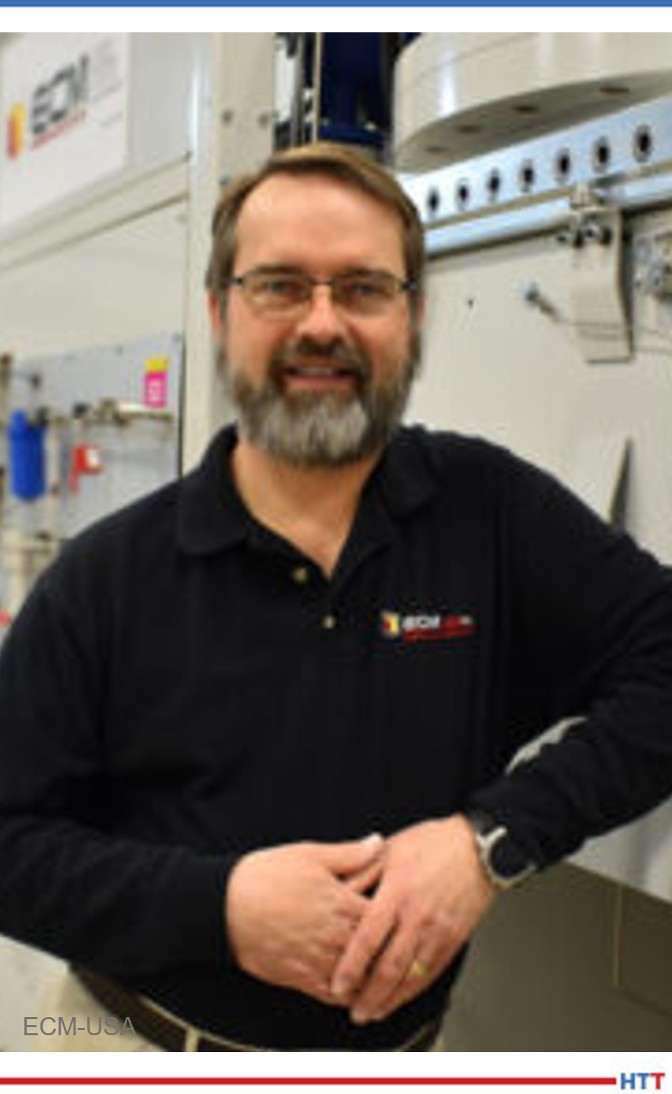
Dennis Beauchesne

Heat Treat Radio #127: The Case for Modular Vacuum Heat Treating


In this episode of Heat Treat Radio, host Doug Glenn invites Dennis Beauchesne of ECM USA to explore the technology, benefits, scalability, and sustainability of modular heat treating systems. Together, they discuss how shared utilities, automated transfers, and adaptable heating cells can replace multiple standalone furnaces without compromising quality or precision. Learn how these systems streamline and simplify operations for future expansion — one cell at a time.

Below, you can watch the video, listen to the podcast by clicking on the audio play button, or read an edited transcript.



The following transcript has been edited for your reading enjoyment.

Introduction

Doug Glenn: I am very privileged to have with me today, Dennis Beauchesne from ECM USA. We’re going to be talking about modular heat treating systems, which is a growing category of equipment.

ECM Synergy Center (00:50)

Doug Glenn: Tell me about ECM’s Synergy Center, which is where you are at right now, on the shop floor.
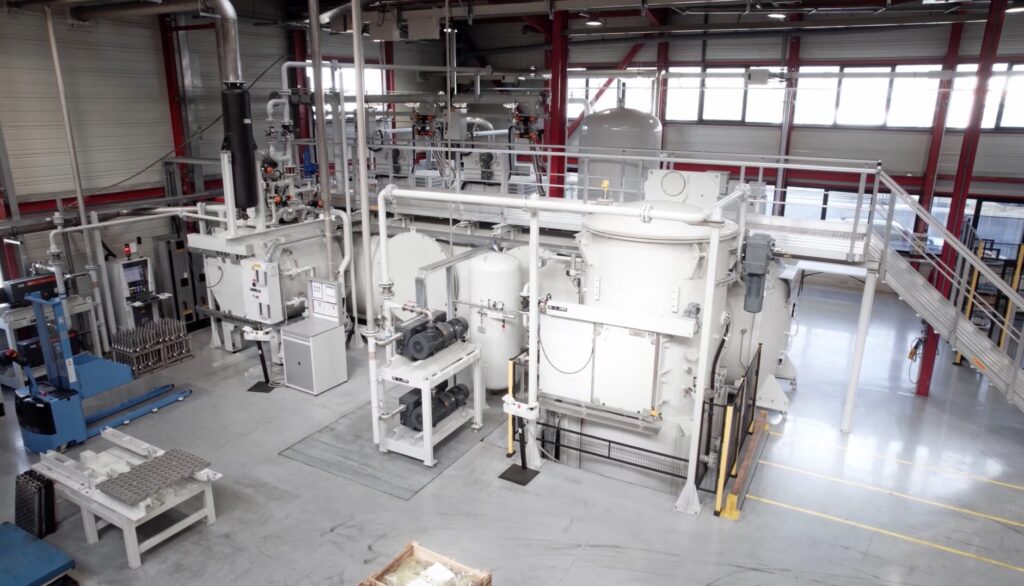
The ECM Flex 600TG vacuum furnace located in the ECM Synergy Center Source: ECM USA

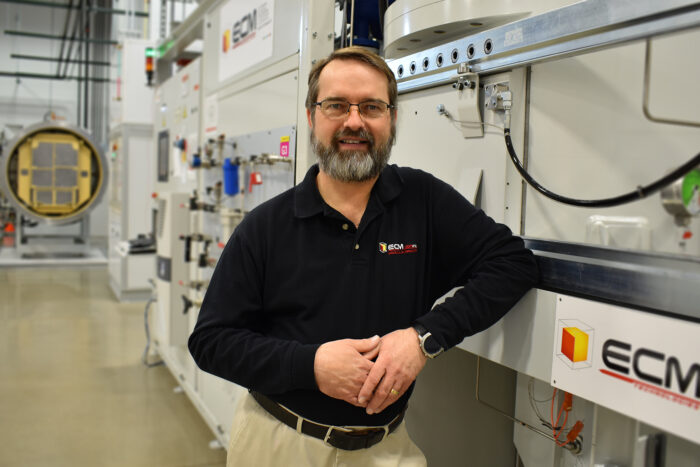
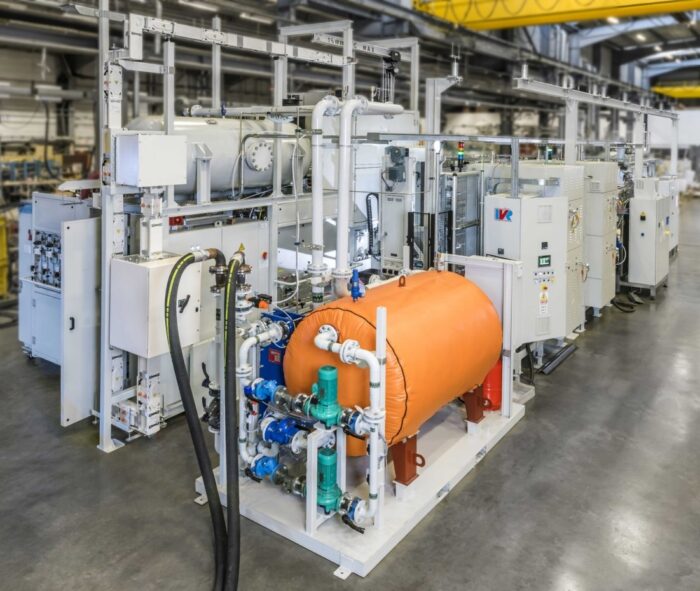
Dennis Beauchesne: I’m standing here in the middle of our Synergy Center. It’s about a 5,000-square-foot facility that is dedicated to proving out client parts for testing various processes, mostly LPC, but we also do a number of other processes here. We have a full metallurgical lab, 3D microscope, a number of tools, including a CMM that we can do before and after heat treat distortion testing for clients that want to know how much their parts move.

It’s a dedicated center just for clients to use. We also use the center for pre-completion of installations, final testing, and training, such as training on maintenance, understanding the software, and how everything works together.

Doug Glenn: It’s proof of process plus much more — helping clients’ proof of process.

Dennis Beauchesne: Absolutely. That’s a big part of convincing people that this process is for them and that it works on their part. We can send them ten different reports of an exact same material and part, but they want to know what their part will do.

What is Modular Heat Treating? (02:50)

Doug Glenn: On a very basic, rudimentary level, what is modular heat treating and how does it differ from what might be considered standard or normal heat treating?

Dennis Beauchesne: A modular heat treat system is one that works together to have more than one furnace working in the same platform. You may have a shop that has five or six vacuum furnaces separated — they each have their own door, vacuum system, electrical supply, quench motors…those types of components. Or you may have a series of batch IQ furnaces for carburizing; those systems are one off, which means they are individual, independent systems.
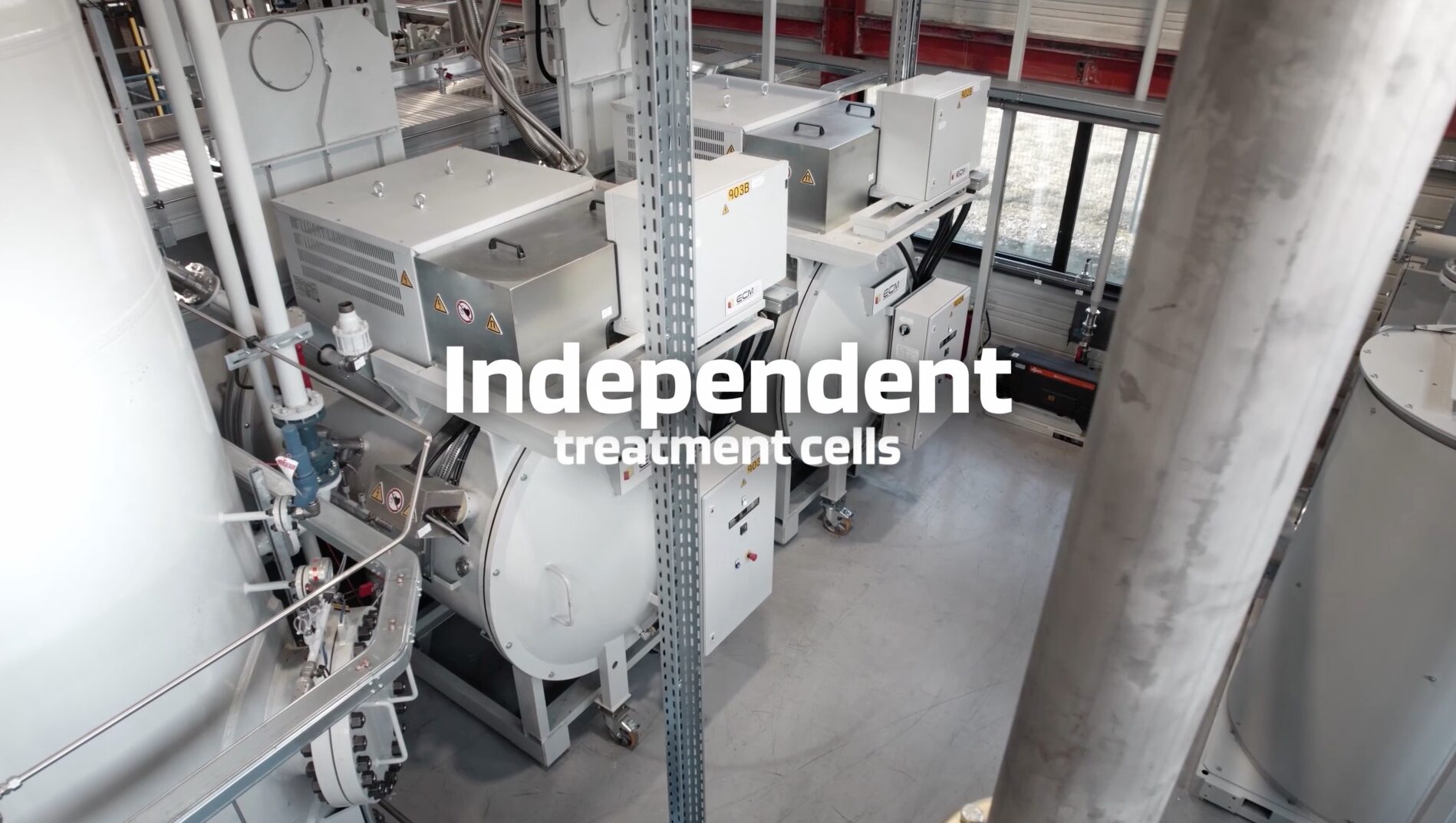
In a modular system, you try to utilize those facilities for the use of multiple heating chambers. Instead of having one vacuum furnace with one set of pumps and one gas quench motor, what we would do is have three to eight heating cells that would be utilizing one quench, depending on the process timing; that’s all done with an internal transfer car and we try to utilize one vacuum system. It’s much smaller than what you would have for three, four, or even eight cells.

If you had oil or high pressure gas quenching, which is what’s dominating right now in the modular heat treat business, you could supply basically six batch IQ hot zones to one oil quench.

The savings then are huge simply by removing five or six other quench tanks in front of this system, as well as leveraging the floor space (and the number of pits you have to dig). Other advantages including utility savings and utilizing equipment across a number of heating chambers.

Doug Glenn: This modular approach is basically separate chambers that are dedicated to doing whatever that chamber is doing, and they are all in some way interconnected. For standard units, you would heat up, pre-process, do the actual process itself, cool down, all in the same chamber. In a modular unit, you move from chamber to chamber to do each of those separate steps.

Dennis Beauchesne: Yes, I refer to it as a continuous batch.

Doug Glenn: Continuous batch. We were talking before we actually hit the record button with your colleague there, Allison DeAngelo, who just got done visiting the Heat Treat Boot Camp. We were talking about different types of furnaces, and we started talking about continuous vacuum, which of course, is almost a misnomer — a vacuum can’t be continuous because you have to open it up and break the vacuum to get stuff out. Anyhow, we talked about it basically being a batch, right? A batch furnace that’s continuous, a continuous batch furnace.

Benefits of Modular Heat Treating (06:35)

Now that we have a basic understanding of what these modular systems are, why would companies want to move from the standard type of heat treating system to a modular system?

Dennis Beauchesne: Manpower. If you are running five or six vacuum furnaces, you are going to need a number of people to open the doors, put new loads in, those kinds of tasks. With a modular system, you only have one entry or one exit area. Therefore, you are only going to load once every 15-20 minutes, and the system is going to take over and control that load going through the system.

In addition, especially in a carburizing atmosphere situation, you can have every load be a different case depth — a different process in each cell — and then the next load that goes in that same cell can be totally different from the one before. For instance, if you had a batch IQ, you typically use the same carbon potential, and you are typically going to run the next load almost identical to the one before. In contrast, with the modular system, each cell can run a different process every load.
It’s also easier to integrate automation if you are doing capacity increases.

Throughput Comparison (08:00)

Doug Glenn: What is the comparison of throughput between a standard unit and a modular unit?

Dennis Beauchesne: The throughput comparison is interesting because you typically can use a little higher temperature for a carburizing and a little higher carbon potential, and of course that’s what we specialize in here with the modular systems. You can achieve about a 30-40% gain in your cycle time. That furnace is operating very close to 100% occupancy, because when that load is done, you are moving it out right into the gas quench. Then, the next load comes and goes right into it.

Doug Glenn: You are able to increase your throughput because you have basically 100% utilization of the equipment or very close to that. Comparatively, you don’t necessarily have that in the standard equipment.

Product Quality Comparison (09:15)

Doug Glenn: Do modular systems produce higher quality products?

Dennis Beauchesne: The quality of the parts coming out of the system is improved. A vacuum environment is a very clean environment, especially if we are considering atmosphere and low pressure carburizing — it’s in a vacuum. We typically do everything in high pressure gas quenching. However, even in oil quenching under vacuum, you are going to have a much cleaner part.

Also in low pressure carburizing, the carburizing is much more uniform throughout the part because we heat it to temperature under nitrogen before the part gets to austenitizing temperature to start attracting carbon. We make sure that the full part, that’s the tooth, the root, every piece of the part, is at temperature before we start adding carbon to the load, which makes a more uniform case depth, and therefore makes a stronger part.

Doug Glenn: Since each module, each chamber, is dedicated to doing what it is supposed to do, it seems like the consistency and the reliability of the parts being processed in a modular system have a much better chance of being higher quality.

Dennis Beauchesne: You do not have six different variable chambers or six different variable systems. You just have to look at monitoring the connection between those and understanding that the vacuum levels are all the same across the levels and across the cells. Each cell can meet a different temperature and run a different process, but those are consistent across the board.

Typical Dedicated Cells/Chambers (11:10)

Doug Glenn: What would be the typical dedicated cells/chambers of a modular system?

Dennis Beauchesne: It is dependent on the processes. They are most widely used for vacuum carburizing. For pre-oxidation and preheating, we usually use an air oven outside of the system, and we connect that with an external loader. Before the load goes into the modular system, the load will go through a regular air oven, be heated to around 700°F (400°C), and then the load will be moved in.
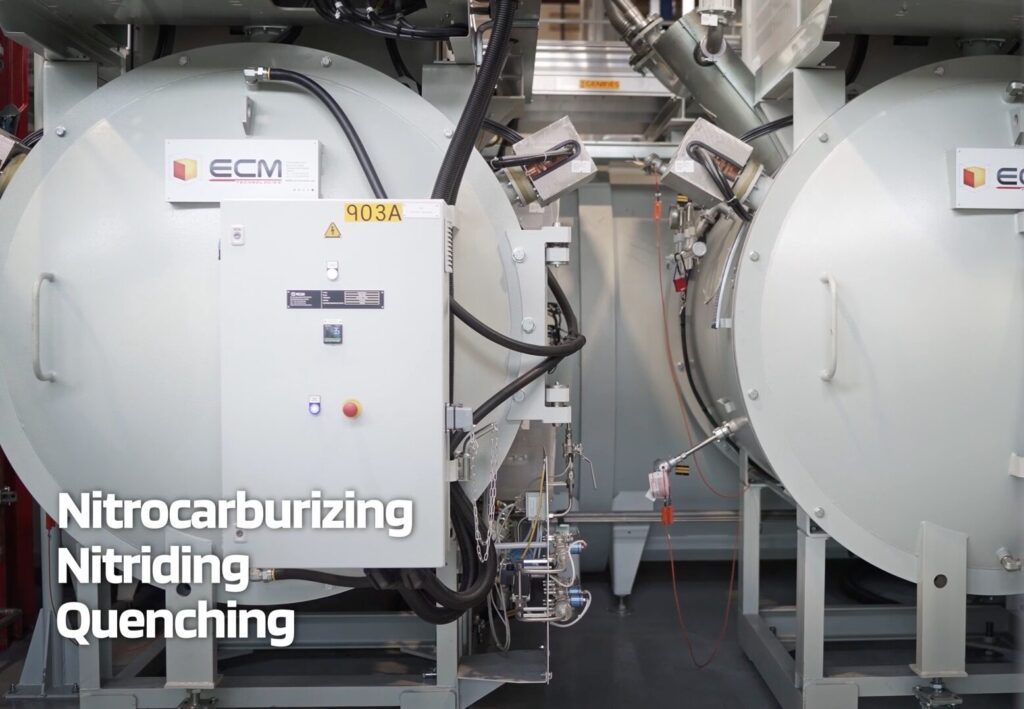
For sintering and those kinds of applications, there is a debind step or a preheat step that would be done in one cell. Some of the processes that can be done in a modular system include:

  • Low pressure carburizing
  • Low pressure carbon nitriding (LPC)
  • FNC (ferritic nitrocarburizing)
  • Nitriding
  • Debinding
  • Sintering
  • Neutral hardening

The most prominent process right now is LPC, and that is being used all over the world in these systems.

Advantages of a Modular Unit for Captive Heat Treaters (12:53)

Doug Glenn: Why would a modular unit be beneficial for a captive heat treater, someone who does their own in-house heat treating, which probably means they’ve got potentially high volume, low variability as far as their workloads?

Dennis Beauchesne: The modular unit has many different advantages. First of all, floor space. You are going to save a lot of floor space by not having multiple furnaces set up separately. You will also save utilities because you would not have as many vacuum pumps or electrical systems running these furnaces on their own. You will have some shared service and utilities in that fashion.

Doug Glenn: That would also likely lead to maintenance cost savings as well, correct?

Dennis Beauchesne: Yes, it all goes down the line. Anything that you have multiples of, you are going to have much less costs than on a joint system. The modular system might be a little larger than one singular unit, but there will be fewer of them.

For vacuum carburizing applications in a captive shop, the quality and cleanliness of the part is very, very important. Gas quenching lends itself to no oil in your plant, no washers necessary for a post-quench. Typically, there’s a washer before the process starts, but you do not have to have any wash to get the oil off of the parts with a modular unit — you do not have to reclaim the oil or the water from the washer. You would not have waste oil in your plant either or any oil on your plant floor. These are some of the reasons some of the larger captive shops have gone to the modular systems.

Also, safety: There are no open flames with a modular unit, no risks of fire on the systems. They are also easier to maintain. For a fully operational, let’s say, eight-cell system for high production, captive operation, it would only take about five hours to cool that whole system down if you had to go in and work on the whole system. In comparison, it’s going to take you three to four days sometimes to cool down a typical atmosphere, high-temperature furnace.

It also takes time to heat the system up again. In a modular system, it takes about an hour and a half to heat the system up again and then you are ready to start running. That means now you can schedule your downtime on weekends or holidays. You do not have to have staff present to run anything.

You also do not have to have a secondary equipment, like Endo generators running to feed the carburizing gas. The carburizing gas is using acetylene out of cylinders, it’s not a regenerative system. You do not need a separate piece of equipment to feed to the furnace.
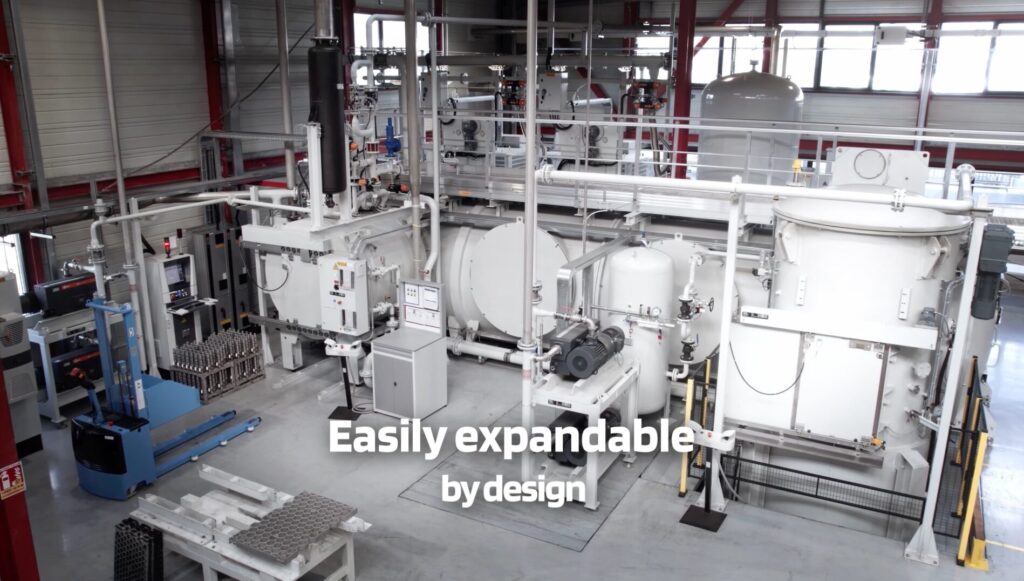
Another benefit is CapEx expansion. Typically, captive heat treaters do not want to buy everything upfront because their volumes are going to increase over time. In the beginning, they typically only need one or two cells ready to do a small amount of production so they can prove out the production and prove out the system. Then they can start building the system with more cells and more capacity later on. Generally, it’s two to three days of downtime to add a cell to a system. It’s very convenient to do that with a modular system. All of the utilities are typically alongside the modular system so that you can easily add those or add a cell to it over a short period of time, and those cells can be ordered a year or two down the road whenever you might need that.

You also can order peripheral equipment, like extra temper ovens or additional automation. You can add a robotics system to the layout as well. That’s why captive shops are very interested.

Finally, workforce: It’s a little bit easier to get someone to work on a modular system. These systems are completely clean and white. The one located in our Synergy Center has been there for eight years. We use it every single day, and it’s a very clean aesthetic environment for someone to work in. These systems are also water cooled, which means not a lot of extra heat in the building around you to work in.

Advantages of a Modular Unit for Commercial Heat Treaters (17:59)

Doug Glenn: What are some advantages of modular units for commercial heat treating?

Dennis Beauchesne: On the commercial heat treat side, modular units are typically useful because you can get multiple processes out of similar cells and you can have a system that has oil and a gas quench.

You can have a lot of flexibility in that one system that you have in the plant. I’ve visited hundreds of captive and commercial heat treaters. They generally have a number of furnaces in one area of the plant, and a number of furnaces in another area of the plant. A modular system gives you all the capability in one machine and one tool: oil quenching, gas quenching, FNC, nitriding low pressure, carburizing, carbonitriding, and neutral hardening all in one piece of equipment.
Automation and Robotics with Modular Heat Treating (18:57)

Doug Glenn: What automation and robotics advantages are there with modular systems?

Dennis Beauchesne: This is the new trend. People that have modular systems are now considering, “How do I automate the system to get more production out of it?” And what we’ve been doing the last five years especially is implementing systems that use CFC fixtures.

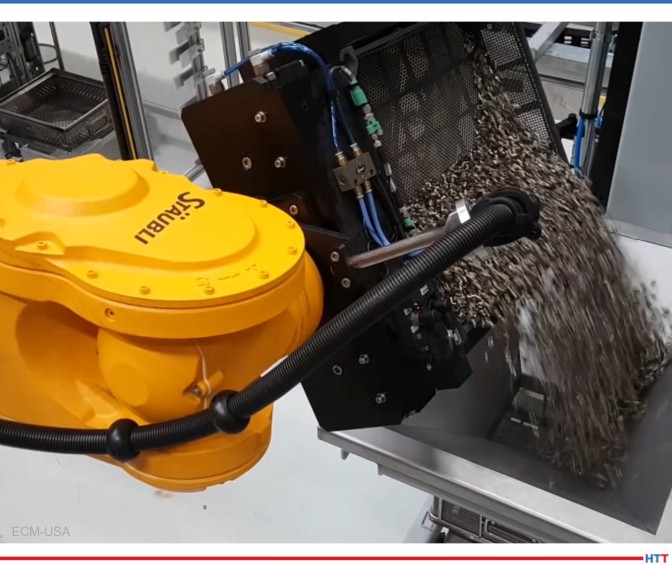
CFC fixtures are very robust in the furnace but sensitive to being controlled outside. Therefore, what we try to do is have the CFC fixtures be utilized in an automation that no humans have to interact with it. We usually use robots for external loaders and internal loaders to move the fixtures through the process.

This causes you to have a lighter load, which means less heating time, less energy being consumed. Also, the fixtures last three to four times longer if they’re not damaged. But of course, all of these systems can be using regular alloy steel as well, and we can fixture different parts. You can use baskets, we are now doing bulk loading where we have parts that are filled into baskets and then processed. We are doing that with vacuum carbonizing as well, not just neutral hardening.

So it’s really interesting to see how the limits are being pushed, as well as the different materials that we are gas quenching now. I know 20-25 years ago, we were quenching some simple materials that were very high hardenability, and today we’re quenching a lot of less hardenability steels.

Doug Glenn: Is that primarily due to increase of pressure in the quench?

Dennis Beauchesne: It’s pressure, it’s flow, it’s the intensity of the gas going through the parts. It’s also heat removal as well — heat exchangers, removing the heat out of the load faster. We also have reversing gas quench motors to reverse the flow inside from top to bottom, bottom to top, in the middle of the cycle.

Sustainability of Modular Heat Treating (22:24)

Doug Glenn: Do these systems promote sustainability and greenness?

Dennis Beauchesne: Absolutely, especially when it comes to carburizing. These systems have been compared against typical atmosphere carburizing cycles, and only about 4% of the carburizing time has gas injection, when we are actually injecting acetylene and having hydrocarbons being used in the process.

If you took the same cycle times, seven or eight hours of a carburizing cycle, you are flowing Endo gas or nitrogen methanol in the system for that full time. In contrast in a vacuum carburizing system, it’s 4-5% of the time of the cycle that you’re injecting into the furnace. Ultimately, you only have about 10% of the CO2 output that you would have in a typical atmosphere furnace.

As mentioned previously, there’s also no oil in your plant. You’re not reclaiming oil out of the water and the wash or off the floor or in your car when you leave your heat treat shop.

How Does the Modular Heat Treating System Work? (23:40)

Doug Glenn: Let’s talk through the process a little bit. You provided us with figures to aid in describing the process. We have included these. Describe how the system works.

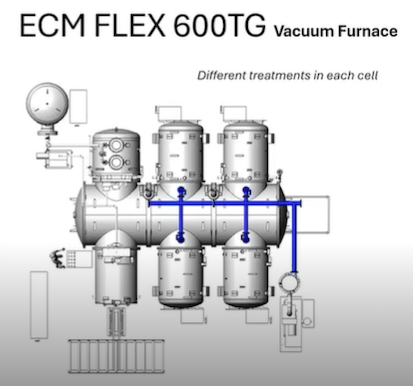
Dennis Beauchesne: This animation is a plan view of one of our Flex systems. In the center, going left to right, is a tunnel section. This tunnel section is about an 8-foot diameter. It has an automated loader that moves down left to right or horizontally, and it transfers loads from each cell to another, in and out.

On the bottom left is a loading/unloading chamber. In that loading/unloading chamber, we remove the air once the load is put in there, and then we balance the vacuum on that cell to the tunnel’s vacuum. Then we’re capable of moving that load to an available heating cell, and that would be on the right of the system — on the top right or the bottom right of the tunnel, those are heating cells. Then recipe for that particular load will be loaded into that cell. While that load is processing, another load will be moving into the tunnel and into the other heating cell as well.

On the top left is the gas quench cell, which could be in this orientation or instead have an exit on the back as well. In this system, you could do neutral hardening, carbon nitriding, LPC, a number of the processes. This is a very valuable tool, especially in a commercial heat treat heat treat shop.

Doug Glenn: Is this whole unit, including all four chambers under vacuum? I noted there are separation doors on the purge and the entry chamber. Can this area be vacuum sealed?

Dennis Beauchesne: Yes. There are vacuum seals on the loading/unloading chamber on the bottom left and then the top left. The gas quench also has a seal from a pressure standpoint. The two heating chambers have a graphite door — we call it the flap door, and it just flaps and it doesn’t really seal actually against another face of graphite. It’s graphite-to-graphite. We pull vacuum out of there through the tunnel to create the central vacuum pressure in the system. We also pull vacuum from the cell itself, and we could also have a separate door on the front of the unit if the process necessitates that or if we feel that a door is needed there by a client.

In a normal state or a standard unit, there are no hot seals on the door, only vacuum seals on the loading/unloading chamber and the gas quench.

Doug Glenn: In the animation, your vacuum pumps are down in the bottom right, correct?

Dennis Beauchesne: Exactly, that’s a process pump.

Doug Glenn: What is located in the top left?

Dennis Beauchesne: On the top left, we have a gas quench tank. We want to ensure we have enough gas pressure and volume there to quench the load quickly. It’s very important to get the gas through the gas quench quickly.
ECM Flex 600TG vacuum furnace with two added heating cells / Source: ECM USA

Now, we have added two more additional heating cells and a central tunnel section. In essence, you just doubled the space, doubled the capacity of the unit, where you only added 50% of the space of what you had for capacity before.

We are still utilizing the same gas quench and the same loading/unloading cell. We only added utilities for the two heating cells, not for a whole gas quench or oil quench capability there; this can be added in a very short time.

Doug Glenn: Now I’m gonna go let this video roll here for a minute. There we go.
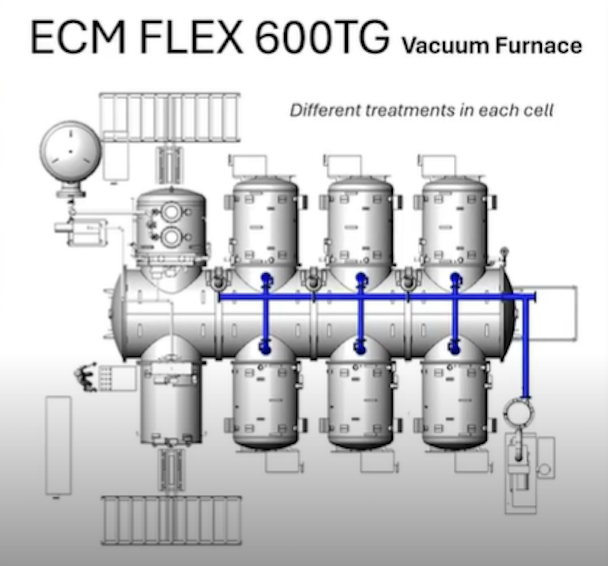
ECM Flex 600TG vacuum furnace with four added heating cells for six heating  cells total

Dennis Beauchesne: So now we added another 50% capacity with two more heating cells (six heating cells total) and a tunnel section. Typically, what you want to do is to have the tunnel sized for about five years out for your capacity and then buy the cells as you need them and have it grow so then the tunnel is ready to implement.

We have just tripled the capacity of this installation, and we are only still using the same gas quench and the same loading/unloading cell. Generally, this system could go to eight cells and have just one gas quench, that’s our typical orientation.

Doug Glenn: It looks like we also added a discharge side here. Whereas before we were going in and out.

Dennis Beauchesne: Yes, this adds to the efficiency of the system because the load is already in the gas quench when it’s finishing, so it just exits out the back, out the door.

Doug Glenn: Now what do we have here?
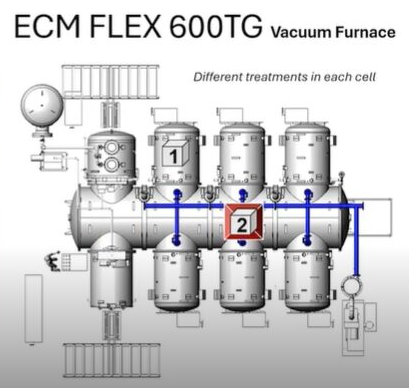
ECM Flex 600TG vacuum furnace processing different treatments in each cell. See animation above to watch the animation in motion.

Dennis Beauchesne: We have the loads entering, and the loads will go to the first cell that is available (empty). Then that recipe would be downloaded for that cell, and then the next load will go to the next available heating cell and download that recipe into that cell. These could be two different loads.

One load could be for neutral hardening; one could be for carburizing. One could be for carburizing in a low case depth. The other one could be carburizing at a deeper case. In this case, we just see the gas quench on here, but this tunnel could also be outfitted with an oil quench as well, and you could have one load go into gas, quench one load, go into oil quench or both going to either.

Doug Glenn: This gives people a sense of what the process looks like.

Processes and Materials for the Modular System (30:29)

Doug Glenn: Are there any processes or materials that do not make sense to process them through one of these systems?

Dennis Beauchesne: If you are doing a lot of annealing and normalizing, those are longer cycles. There is some regulated cooling that occurs. This is not really the type of equipment investment that you would want to make for those processes. If you were going to use it for a few loads in your plant where you received parts that weren’t annealed or you wanted to try to anneal a part for a particular process before you went to full production, you could certainly use a modular system for that, but it’s not a cost effective methodology. Neither would we recommend preheating in the cell. However, it is very flexible for a number of other processes that we have mentioned.

The size of the part is also important to note. These systems are typically 24 inches wide and about 39 inches long and about 28 inches high. However, we will soon have a new system, the Flex Max, a 12-9-9 system. It’s a 36×48 unit that comes with an oil quench and is modular, like this. We can either do an oil quench or a slow cool cell on that system. So, we will have that capability of 36×48 in that modular system.
Other than that, restrictions on material? Very few there. Like I said, you would not want to do annealing and normalizing on a lot of parts, but you could do it in these units.

Doug Glenn: It sounds like the sweet spot is surface modification type applications, and some sintering is possible with dedicated chambers.

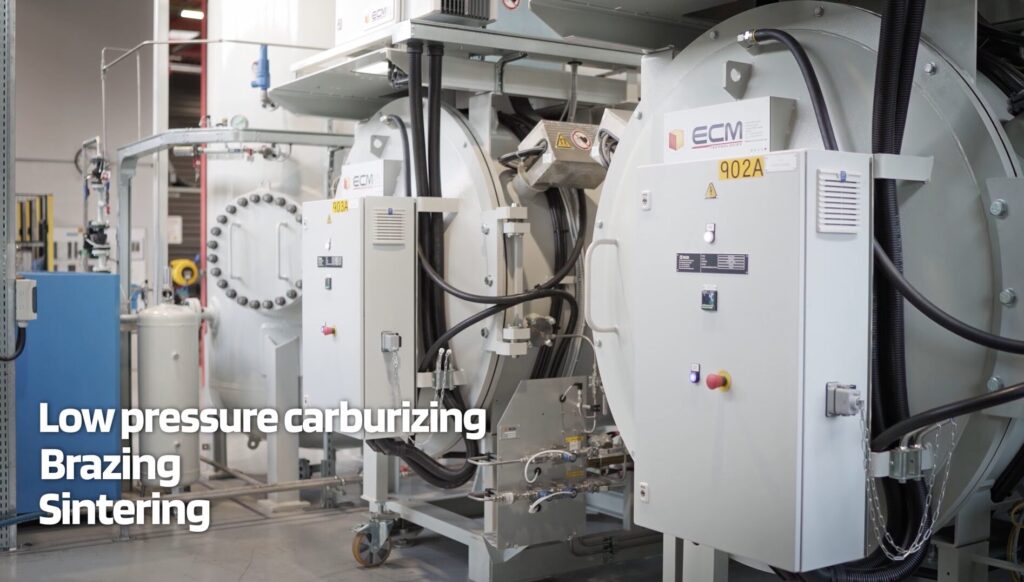
Dennis Beauchesne: Yes, sintering and brazing is also possible.

Doug Glenn: Does that include aluminum brazing?

Dennis Beauchesne: Not aluminum brazing, but some brazing applications.

Expenses with Modular Heat Treating Systems (33:03)

Doug Glenn: What would be considered capital expenses for this modular system?

Dennis Beauchesne: As far as capital expenses, it’s not a furnace-to-furnace comparison. Clients always ask how much our furnace is. But companies need to first take two steps back and take a look at their incoming material, how they would like to be able to modify that incoming material in their heat treat process to make sure that their outgoing quality is higher than it is today. That’s the kind of benefit that this type of modular system gives you — a better quality part, safety in your plant, and a better quality work environment with being able to turn the system off and not need additional personnel around.

These are all factors that have to be considered when thinking about the CapEx expenditure and investment. When we consider these factors, a modular system investment is a much better situation than looking at a furnace-to-furnace replacement, and that’s really the thought process that clients need to go through to understand the actual investment and value of the system.

Doug Glenn: What about the operational expenses?
Dennis Beauchesne: For instances, if you had a batch IQ sitting there, you would typically keep it running whether it has a load in it or not. With a modular system, you just shut off that cell that you’re not using. It does not take any more energy. If you are not working five days a week, you do not use it on the weekends — you shut it off. You do not use it during Christmas shutdown or any holiday shutdown, vacation shutdown. You’re able to shut it off and that means saving a lot of energy and labor by having it off.

Also, in the opposite way, you could run it lights out if you wanted, as well. You could stock up a number of loads on the automation before you leave, have the system operate it, run it, and have the load come back out before the morning. You could have it time start as well, if you wanted to start it on Monday at 5 AM, but you will not be there till 8 AM. You would come in and the furnace would be hot and ready to run a process.

There are a number of operational advances over the typical operational heat treat that’s out there today.

Doug Glenn: How does maintenance work with these systems? Say your heating element goes bad in cell number three, do I have to shut the whole system down to fix or can I fix number three and leave the rest of the system up and running?

Dennis Beauchesne: In this situation if you had a tunnel like we showed, you would typically shut off that cell; that is, if you knew that heating element was out or it wasn’t heating properly, you could shut off that cell, de-validate is what we call it, and then keep running the rest of the system until you had a window in your production that you could shut the whole system to get into that heating element.

If you had a system with doors on the front, it could be possible to go in the back while the system is operating. Then, it would be all based on your safety requirements for your plant and those kinds of things.

To do that, we have another system called the Jumbo, and it is much more flexible in the maintenance world. It has a vacuum car that moves down on rails and docks and mates with every heating cell on the system. In that line, the heating cell can actually be isolated from the rest of the line. You would just slide it back (It’s on wheels, it slides back about three feet away from the line), you put in a new piece of safety fence, and you continue to run your line. You can completely lock out/tag out that cell and work on it completely.

Doug Glenn: How would you approach a vacuum leak since the whole system is connected, right? I believe you mentioned these are graphite-on-graphite doors.

Dennis Beauchesne: You would want to fix the leak before you move on. Especially if it’s a bad leak. If it’s something that’s causing you to not maintain your process pressure, you certainly don’t want to do that, and that’s true with every vacuum piece of equipment.

ECM Modular Systems (38:55)

Doug Glenn: How many of these modular type systems does ECM have out in the marketplace?

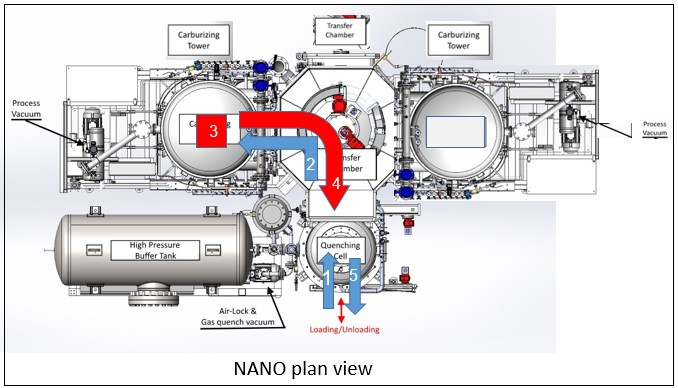
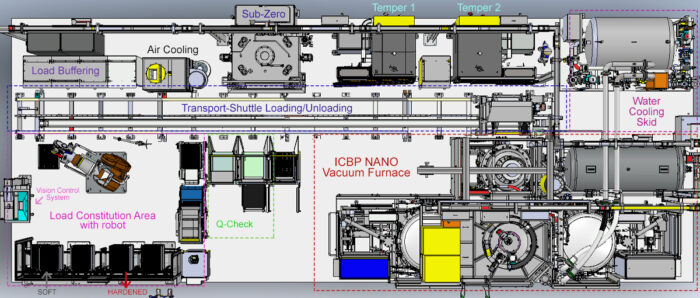
Dennis Beauchesne: The Flex is the most popular modular system, which we discussed with the animation. We also have a number of Jumbos systems, and the unit in our Synergy Center is called a Nano, which has become more and more popular these days. The Nano has three different size chambers, but they’re typically smaller, 20x24x10 inch high size chamber. I explained a little bit about the Flex and the Jumbo is the same.

Out of those three systems, we have more than 350 modular systems, not just the heating cells, but more than 350 systems that are out in the marketplace today operating, running parts every day, running millions and millions of parts every week. Those systems are comprised of about 2,000 heating cells. As much as people hear about this being a new technology, it has actually been around about 30 years, and many companies have been using these systems and have replaced a number of pusher furnaces and those style furnaces for high-capacity installations especially.

Doug Glenn: Okay, that sounds good. I really appreciate your time.


About the Guest

Dennis Beauchesne
General Manager
ECM USA

Dennis Beauchesne joined ECM over 25 years ago and has since amassed extensive vacuum furnace technology experience with over 200 vacuum carburizing cells installed on high pressure gas quenching and oil quenching installations. Within the last 10 years, his expertise has expanded to include robotics and advanced automation with the heat treat industry high-demand for complete furnace system solutions. As General Manager of ECM USA, Dennis oversees customer supply, operations and metallurgical support for Canada, U.S., and Mexico for ECM Technologies. He has worked in the thermal transfer equipment supply industry for over 30 years.

For more information: Contact Dennis at DennisBeauchesne@ECM-USA.com.


Heat Treat Radio #127: The Case for Modular Vacuum Heat Treating Read More »
Methods of Measuring Retained Austenite

Most heat treaters recognize the importance of measuring retained austenite (RA), yet many opt not to perform these measurements due to time and/or cost constraints. This Technical Tuesday installment explains why performing RA measurements is necessary, the pros and cons of traditional measurement techniques, and the benefits of using more current and in plant technologies.

This informative piece was first released in Heat Treat Today’s March 2025 Aerospace Heat Treating print edition. To read the article in Spanish, click here.


Why Retained Austenite Percentage Matters

Before examining measurement methodologies, it is important to understand the fundamentals of retained austenite and why the percentage of retained austenite (RA%) matters.

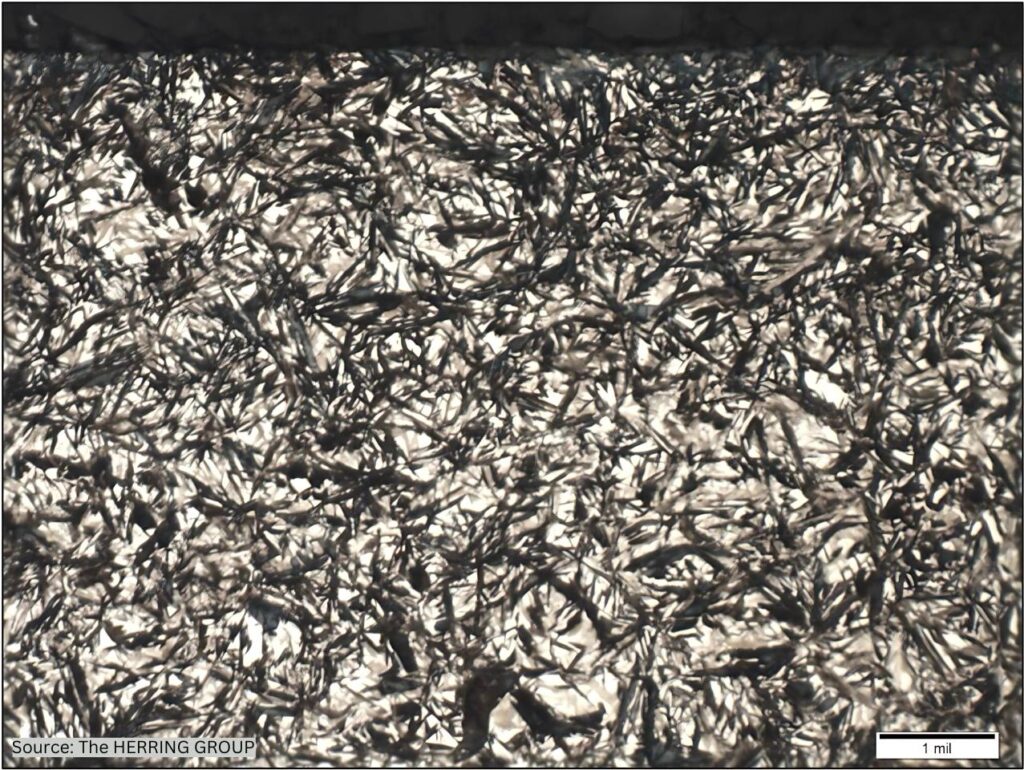
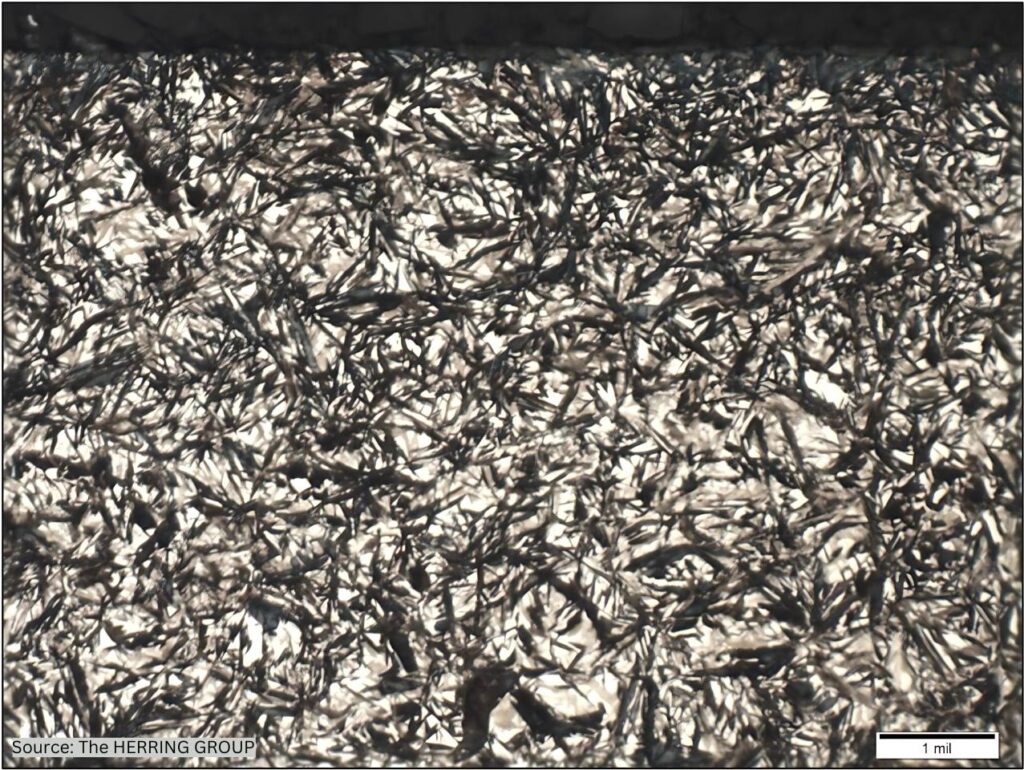
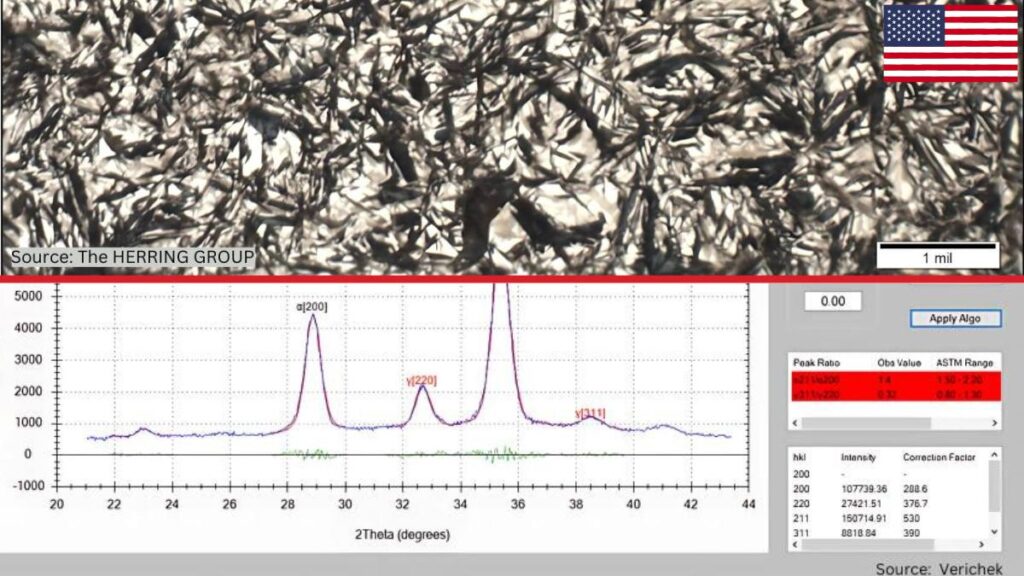
Austenite that does not transform to martensite upon quenching is called retained austenite (RA). In simple terms, retained austenite (Figure 1) occurs when steel is not fully quenched to the martensite finish (Mf) temperature; that is, low enough to form 100% martensite. Because the Mf is below room temperature in most alloys containing more than 0.30% carbon, significant amounts of retained austenite may be present within the martensite at room temperature (Herring, Atmosphere Heat Treatment).

When it comes to RA%, there is often a delicate balance between its beneficial effects (an increase in the life of certain manufactured components) and its negative attributes (the creation of parts that are prone to cracking and failure). For this reason, it is crucial that heat treaters achieve the optimal RA% for the intended application.

For example, in the aeronautics and astronautics industries, RA levels are often specified to be under 8% and, for devices such as bearings and linear actuators, RA under 3% and as close to zero as possible is required. In other applications, however, such as large gearing for power generation, wind energy, and performance platforms, in the range of 15–30% or more RA has been found beneficial (Errichello et al., “Investigations of Bearing Failures”). Also, high RA% has been found beneficial for bearings that will be subjected to contaminated lubricants.

Figure 1. 12CrNi3 (similar to SAE/AISI 9310) bearing roller path surface microstructure consisting of tempered martensite with evidence of retained austenite (white areas)

Marco DeGasperi, technical manager at Verichek, weighed in on this, noting that for fuel injectors, small pieces in medical applications, and high-level, high-volume applications like wear plates in the mining industry, RA% is critical. He summarized with the statement, “When you’re applying pressure and motion to anything that’s fine-tuned … If you have ‘precision’ in your name, you probably want [an RA% measurement device].”

The very characteristics that give retained austenite many of its unique properties are those responsible for significant problems in service. We know that austenite is the normal phase of steel at high temperatures, but not at room temperature. Because retained austenite exists outside of its normal temperature range, it is metastable. This means that in service, factors such as temperature, stress, and even time will see it transform into untempered martensite. In addition, a volume change (increase) accompanies this transformation and induces a great deal of internal stress in a component, often manifesting itself as cracks, which leads to parts failing in the field.

RA% is also important not only because of its influence on dimensional stability but on mechanical properties such as yield strength, fatigue strength, toughness, and machinability (Herring, Atmosphere Heat Treatment). For example, looking in the automotive industry, DeGasperi gives an example of the consequences of having too high or too low RA%: “Let’s say pieces in a transmission or a transfer case; this is when gears start breaking or you get issued wide-end recalls. And then usually the supply chain all starts blaming the guy before them when nobody throughout the supply chain has actually tested the parts themselves.”

Alternatively, in some cases, finely dispersed RA helps the material resist the propagation of fatigue cracks and improves rolling contact fatigue stress, so balancing the amount of RA is important in many applications. Also, the correct RA% is essential for quality control, and proper control and accurate measurement of RA% in steel alloys is crucial to guaranteeing the quality and safety of finished components, as well as protecting the reputation and profitability of heat treaters and manufacturers.

RA Measurement Methods

Accurate RA measurements are critical to determine whether the correct balance of retained austenite and martensite exists within a given part. Several RA measurement methodologies are available to heat treaters, each having their own unique set of advantages and disadvantages. For heat treaters, understanding why it is crucial to measure the percentage of RA is only half the battle. Finding a cost-effective, fast, and accurate measurement method is the other half.

X-Ray Diffraction: The Best and Most Accurate Method

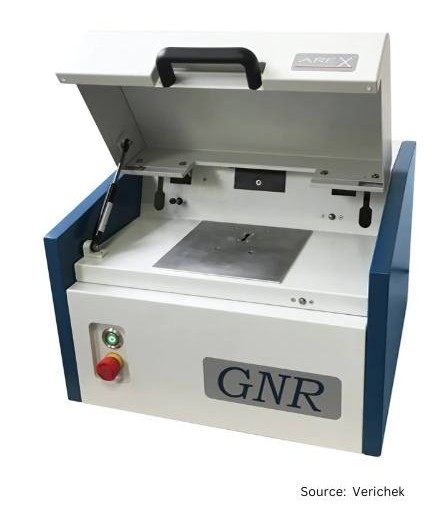
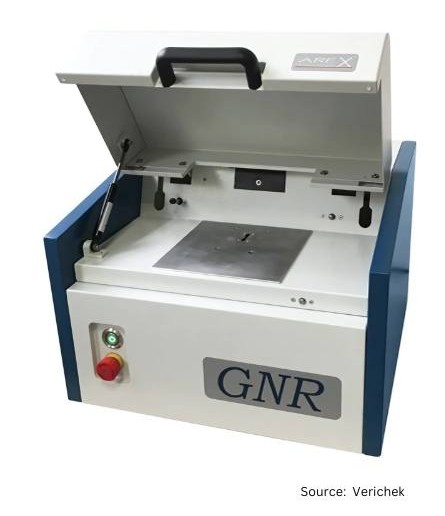
Figure 2a. An ArexD table-top unit from GNR

X-ray diffraction, which is used to identify and quantify phases in a material, is considered the most accurate method of RA measurement in steels as it can precisely determine RA levels down to the range of approximately 0.5–1% (GNR, “AreX Diffractometer,” 3). In X-ray diffraction, different crystalline phases have different diffraction patterns, allowing them to be identified and measured. In addition to phase analysis, X-ray diffraction can be used to analyze microstructural features such as texture, residual stress, and grain size.

Today, X-ray diffraction is a non-destructive, safe solution that can sample a much larger region than many other available methods and does not involve much sample preparation and analysis, making it a more efficient and effective solution. This is the option of choice for a company that needs to test RA with expected readings under 10%.

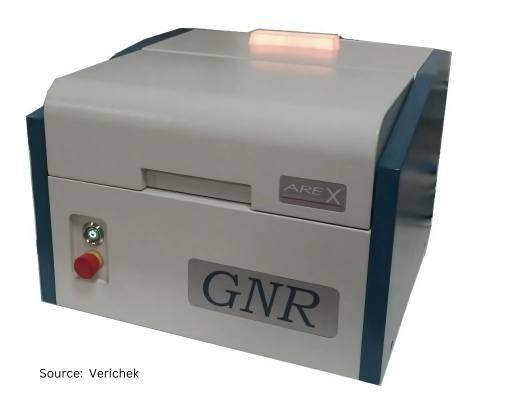
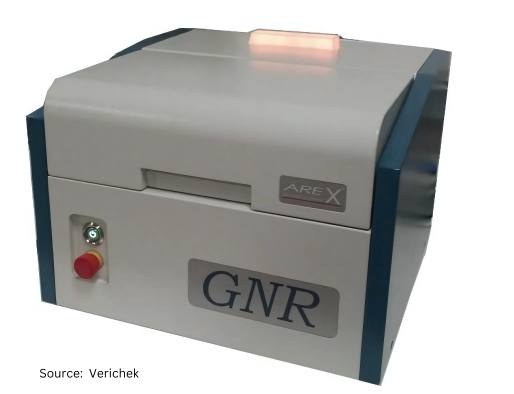
The current generation of X-ray diffractometers are tabletop sized, weighing about 25 lbs. With models under $100,000, they are also cost-effective when compared to traditional X-ray diffractometers ($200,000), which were sometimes problematic in the presence of additional phases and reflections due to grain size, carbides, or textures that could cause disturbances and variances in measurement. The new generation of X-ray equipment compensates for these obstacles via the use of multiple diffraction peaks to minimize the effects of preferred orientation and detect interference from carbides.

2b. An ArexD table-top unit from GNR

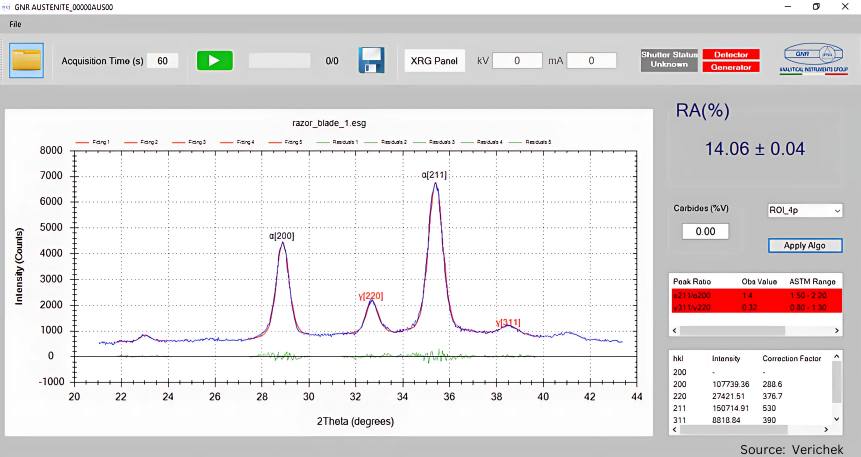
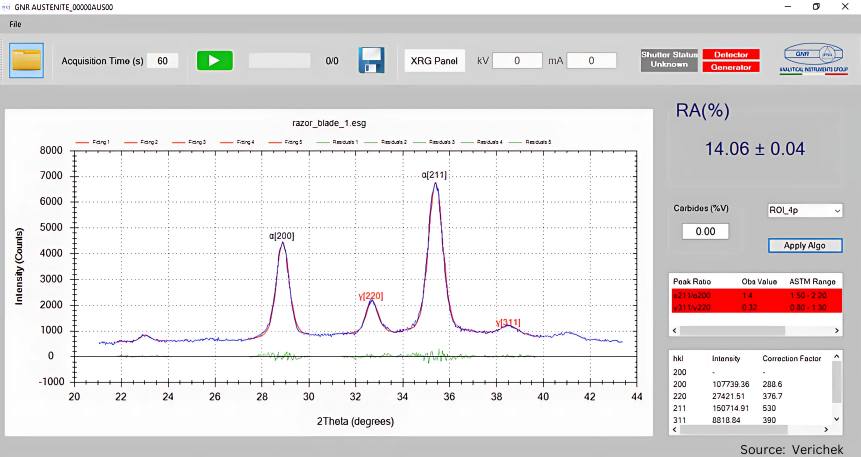
Modern X-ray diffraction machines can collect up to seven diffraction peaks (three for ferrite/martensite phase and four for austenite phase) and then determine the volume percent concentration of RA in the sample by comparing the intensities of the peaks and analyzing the peak ratios in accordance with the ASTM E975-22 (standard practice for X-ray determination of retained austenite in steel with near random crystallographic orientation).

The use of today’s X-ray diffraction equipment is not complicated. It can be measured in under three minutes by simply placing the sample in the machine and pressing the start button. These X-ray diffractometers measure various-sized samples and use intuitive software so the measurement can be performed quickly, accurately, and efficiently by any technician — with or without prior metallurgical or diffraction experience.

Optical Microscopy — A Time-Proven Method

RA can be measured metallographically with an optical microscope. An experienced metallurgist can usually determine RA% down to approximately 10–15% RA. For many applications, this is more than adequate and has the added benefit of characterizing the microstructure as well.

This method, which involves determining the austenite fraction using contrast from etching behavior or morphology, is low cost, however, it can be somewhat time consuming. Charts and diagrams in reference books are available to help determine the percentage of retained austenite by comparative methods. Optical microscopy is subjective as it is dependent upon the individual and their interpretation of the sample under the microscope.

Figure 3. Example of how RA% peaks are measured

Alternative Methods

Several other methods for measuring RA are available to heat treaters. The most common of these methods includes:

Magnetic Induction: Here, a sample is magnetized to saturation and the saturation polarization is measured. The difference between measured and theoretical saturation of the RA can then be calculated using this equation:

Magnetic induction is non-destructive and offers a higher, broader range than optical microscopy (1–30%). However, because it is a volume measurement, the instrument needs to be calibrated to the specific materials, heat treatment, and geometries, which is time consuming and highly dependent on the skill of the technician.

Electron Backscatter Diffraction (EBSD): Using this RA measurement method involves placing a sample in a Scanning Electron Microscope (SEM) to characterize the crystallographic structure as well as the microstructure. RA measurements using this technique are not particularly accurate and are reliant upon proper sample preparation. Additionally, it provides a very small measure volume and is a destructive test method.

Conclusion

Accurate measurement of the level of retained austenite allows both the design engineer and metallurgist to maximize its beneficial effects without suffering from its negative consequences. On the part of the heat treater this means taking into account the material chemistry and the heat treat process variables such as austenitizing temperature, quench rate, deep freeze or cryogenic treatments, and tempering temperatures.

References

Errichello, Robert, Robert Budny, and Rainer Eckert. “Investigations of Bearing Failures Associated with White Etching Areas (WEAs) in Wind Turbine Gearboxes.” Tribology Transactions 56, no. 6 (2013): 1069–1076.

GNR, Analytical Instruments Group. “AreX Diffractometer: GNR Proposal for measuring Retained Austenite in the industrial domain and in laboratory.”

Herring, Daniel H., Atmosphere Heat Treatment. Volume I. Chicago: BNP Media, 2014.

Acknowledgments

We’d like to thank the following contributors for the support of this article: Thomas Wingens, President & Heat Treat Specialist, WINGENS CONSULTANTS; Dennis Beauchesne, General Manager, ECM USA; Tim Moury, President & CEO, Marco DeGasperi, Technical Manager, Jeff Froetschel, VP & CFO, Verichek Technical Services, Inc.; and Dan Herring, The Heat Treat Doctor®, The HERRING GROUP, Inc.

This article is provided by the Heat Treat Today Editorial Team.


Methods of Measuring Retained Austenite Read More »

Métodos para la medición de la austenita retenida

La mayoría de quienes aplican el tratamiento térmico reconocen la importancia de medir la austenita retenida (RA, por sus siglas en inglés); no obstante, muchos optan por no realizar estas mediciones por razones de tiempo y/o de los costos asociados. Este artículo explica los motivos por los cuales se deben practicar las mediciones RA, los factores a favor y en contra de las tecnologías de medición tradicionales y los beneficios de realizar la medición en la planta misma, utilizando tecnologías más avanzadas.

This informative piece was first released in Heat Treat Today’s March 2025 Aerospace Heat Treating print edition. To read the article in English, click here.


La importancia del porcentaje de austenita retenida

Antes de entrar a examinar algunas metodologías de medición, es necesario entender lo básico en relación a la austenita retenida, al igual que la importancia que reviste el porcentaje de la misma (%RA).

Austenita retenida (RA) es el nombre que se le da a la austenita que durante el proceso de templado no se transforma en martensita. En términos sencillos, la austenita retenida (figura 1) ocurre cuando el acero se ha templado sin llegar de manera contundente a la temperatura de acabado de la martensita (Mf); es decir, la temperatura ha estado por encima de lo requerido para permitir la formación de martensita al 100%. Debido a que la Mf está por debajo de la temperatura ambiente en la mayoría de las aleaciones que contienen más del 0.30% de carbón, se pueden presentar cantidades significativas de austenita retenida en la martensita a temperatura ambiente. (Herring, Atmosphere Heat Treatment).

Al tratarse del %RA, con frecuencia existe un equilibrio muy sensible entre sus efectos benéficos (el aumento en la durabilidad de ciertos componentes manufacturados) y sus atributos negativos (la creación de piezas susceptibles de fracturas y averías). Por tal motivo es de crítica importancia que los tratadores térmicos logren el %RA óptimo para la aplicación deseada.

Por ejemplo, en las industrias de la aeronáutica y la astronáutica, con frecuencia se especifica que los niveles de RA sean inferiores al 8%, y para piezas como los cojinetes y los actuadores lineales, se requiere un RA por debajo del 3%, lo más cercano posible a cero. No obstante, en otras aplicaciones, como por ejemplo los engranajes grandes para generadores de energía, energía eólica y plataformas de rendimiento, se ha identificado que un RA en el rango del 15-30% reviste mayores beneficios. (Errichello et al., “Investigations of Bearing Failures”). De igual manera, un alto % RA es una ventaja en el caso de cojinetes que vayan a entrar en contacto con lubricantes contaminados.

Figura 1. Microestructura en la superficie de la trayectoria de un cojinete de rodamiento 12CrNi3 (o SAE/AISI 9310) compuesto por martensita templada en la que se evidencia austenita retenida (áreas blancas)

Marco DeGasperi, gerente técnico de Verichek, se pronunció al respecto señalando que el %RA es de crítica importancia para los inyectores de combustible, para piezas pequeñas en aplicaciones médicas y para aplicaciones de alto nivel y alto volumen tales como las placas de desgaste en la industria minera. Lo resumió afirmando: –Cuando tu ejercicio se trate de someter a presión y movimiento cualquier dispositivo de calibración fina…si utilizas la palabra “precisión” para darte a conocer, vas a querer hacerte a una [herramienta de medición del %RA].

Las mismas características que le dan a la austenita retenida muchas de sus propiedades particulares, son a la vez las respons ables de significativos problemas de funcionamiento. Sabemos que la austenita es la fase normal del acero a altas temperaturas, mas no a temperatura ambiente. Debido a que la austenita retenida existe por fuera del rango normal de su temperatura, es metaestable, lo que quiere decir que, cuando entre en funcionamiento, los factores como la temperatura, el estrés, y aún el tiempo, harán que se transforme en martensita no revenida. Es más, junto con dicha transformación se dará un cambio en el volumen (aumentará) generando un alto grado de estrés interno en el componente y provocando muchas veces la formación de grietas lo que podrá llevar a que las piezas fallen en el campo.

El % RA también es importante, no solo por el impacto sobre la estabilidad dimensional, sino además por las propiedades mecánicas tales como el límite elástico, la resistencia a la fatiga, la tenacidad, y la manejabilidad. (Herring, Atmosphere Heat Treatment). A manera de ejemplo, DeGasperi identifica en la industria automotriz las consecuencias de un %RA demasiado alto o demasiado bajo: –Hablemos de las piezas en una transmisión o en una caja de transferencia; aquí es donde se dan los casos en los que se empiezan a romper los cojinetes, o terminas viéndote en la obligación del retiro masivo del producto del mercado. Y por lo general toda la cadena de suministro identifica al anterior como el culpable cuando ninguno en toda la cadena se ha tomado la molestia de probar las piezas por sí mismo.

Por el contrario, en algunos casos, la RA diseminada en pequeñas cantidades aporta para que el material resista la propagación de fracturas por fatiga y disminuye el estrés por fatiga en el contacto de rodamiento, así que lograr el correcto equilibrio en la cantidad de RA es importante en muchas aplicaciones. Además, el % justo de RA es esencial para el control de calidad, al igual que para evitar problemas de seguridad y retiros masivos del mercado. El debido control y la medición precisa del % RA en las aleaciones de acero es un punto crítico para garantizar la calidad y la seguridad de los componentes terminados, salvaguardando así la reputación y el margen de ganancia tanto de los tratadores térmicos como de los fabricantes.

Métodos de medición de RA

El medir con precisión la RA es de vital importancia para establecer si existe el balance correcto entre la austenita retenida y la martensita en determinado componente. Los tratadores térmicos tienen a su disposición varias metodologías para esta medición, cada una con sus respectivas ventajas y desventajas. Para el tratador térmico entender la importancia de medir el % RA representa tan solo una parte de la batalla ganada, mientras que la otra parte se gana cuando se logra identificar un método de medición que sea rápido, preciso y rentable.

La difracción de rayos-X: el mejor y más preciso de los métodos

Figura 2a. Una unidad de sobremesa ArexD de GNR

La difracción de rayos-X, utilizada para identificar y cuantificar las fases en un material, se considera el método más preciso de medición de RA en acero ya que logra establecer los niveles de RA hasta el rango aproximado de 0.5-1% (GNR, “AreX Diffractometer,” 3). En la difracción de rayos-X, las diferentes fases cristalinas demuestran diferentes patrones de difracción, lo que permite que sean identificadas y medidas. Además del análisis de fases, la difracción de rayos-X se puede utilizar para analizar car acterísticas microestructurales tales como la textura, el esfuerzo residual y el tamaño del grano.

Hoy en día, la difracción de rayos-X es una solución segura y no-destructiva que permite valorar una región mucho más amplia que la de varios de los otros métodos disponibles, sin necesidad de gran preparación ni análisis de la muestra, haciendo de ésta una solución más eficiente y efectiva. Es la tecnología más opcionada para una empresa que requiera valorar la RA con un resultado esperado inferior al 10%,

La actual generación de difractómetros de rayos-X ostenta un diseño de sobremesa con un peso aproximado de 25 libras. Existen modelos con costos inferiores a los USD $100.000, lo que los hace rentables frente al costo de un difractómetro tradicional (USD $200.000) que tenía además la desventaja de presentar dificultades cuando la muestra tuviera fases y reflexiones adicionales, ya fuera por el tamaño del grano, por los carburos o por las texturas que pudieran provocar disturbios y variaciones en la medición. La nueva generación de equipos de rayos-X logra superar estos obstáculos utilizando múltiples picos de difracción para minimizar los efectos de la orientación preferida y detectar la interferencia de los carburos.

Figura 2b. Una unidad de sobremesa ArexD de GNR

Las máquinas modernas de difracción de rayos-X tienen la capacidad de recoger hasta siete picos de difracción (tres para la fase ferrítica/martensítica y cuatro para la fase austenítica) para luego establecer la concentración de porcentaje por volumen de RA en la muestra al comparar las intensidades de los picos y analizar las relaciones entre éstos de acuerdo con el ASTM E975-22 (práctica estándar para la determinación por rayos-X de austenita retenida en acero con orientación cristalográfica cercana a la aleatoria).

No es complicado usar los equipos modernos de difracción de rayos-X. En menos de tres minutos se logra la medición con tan solo ubicar la muestra en la máquina y oprimir el botón de inicio. Estos difractómetros realizan mediciones en muestras de diferentes tamaños y se valen de software intuitivo, dando lugar a que cualquier técnico, tenga o no experiencia previa en metalurgia o difracción, efectúe la medición de manera rápida, precisa y eficiente.

La microscopía óptica: un método a prueba del tiempo

La RA se puede medir de manera metalográfica con un microscopio óptico. En la mayoría de los casos, un metalúrgico con experiencia puede establecer el %RA en el rango hasta del 10-15%, lo cual es más que suficiente para muchas aplicaciones, con el beneficio adicional de que también caracteriza la microestructura.

Este método, que implica establecer la fracción de austenita mediante el contraste derivado del comportamiento de grabado o morfología, es de bajo costo; sin embargo, puede ser demorado. En libros de referencia existen tablas y diagramas que ayudan a determinar el porcentaje de austenita retenida utilizando métodos comparativos. La microscopía óptica es subjetiva ya que depende del individuo y la interpretación que haga de la muestra bajo el microscopio.

Figura 3. Ejemplo de la técnica para medir los picos de %RA

Métodos alternos

Los tratadores térmicos también disponen de otros varios métodos de medición de la RA. Entre los más comunes se encuentran:

La inducción magnética: Aquí se magnetiza una muestra al punto de saturación y se mide la polarización de saturación. Con esto, se calcula la diferencia entre la saturación medida y la saturación teórica de la RA utilizando la ecuación.

La inducción magnética no es destructiva y ofrece un rango más alto y amplio que el de la microscopía óptica (1-30%). Sin embargo, al ser una medición de volumen, es necesario que el instrumento sea calibrado a los materiales específicos, junto con sus tratamientos térmicos y geometrías, lo cual exige mucho tiempo y depende en un alto grado de la habilidad del técnico.

Difracción de electrones por retrodispersión (EBSD, por sus siglas en inglés): Utilizar este método de medición de RA implica ubicar la muestra en un microscopio electrónico de barrido (SEM, por sus siglas en inglés) para caracterizar la estructura cristalográfica al igual que la microestructura. Las mediciones de RA con base en esta técnica no suelen ser muy precisas y dependen de la correcta preparación de la muestra. Adicionalmente, es un método destructivo y arroja una medida sobre un volumen muy pequeño.

En conclusión

El medir acertadamente el nivel de austenita retenida permite que tanto el ingeniero de diseño como el metalúrgico maximicen los efectos benéficos que ofrece, al mismo tiempo evitando sus consecuencias negativas. El tratador térmico, por su parte, deberá tener en cuenta la química del material y las variables del proceso de tratamiento térmico tales como la temperatura de austenización, la rapidez de enfriamiento, los tratamientos criogénicos o de congelación profunda y las temperaturas de templado.

Referencias

Errichello, Robert, Robert Budny, and Rainer Eckert. “Investigations of Bearing Failures Associated with White Etching Areas (WEAs) in Wind Turbine Gearboxes.” Tribology Transactions 56, no. 6 (2013): 1069–1076.

GNR, Analytical Instruments Group. “AreX Diffractometer: GNR Proposal for measuring Retained Austenite in the industrial domain and in laboratory.”

Herring, Daniel H., Atmosphere Heat Treatment. Volume I. Chicago: BNP Media, 2014.

Agradecimientos

Queremos agradecer a los siguientes contribuyentes por su aporte en el desarrollo de este artículo: Thomas Wingens, presidente y especialista en Heat Treat, WINGENS CONSULTANTS; Dennis Beauchesne, gerente general, ECM USA; Tim Moury, presidente & CEO, Marco DeGasperi, gerente técnico, Jeff Froetschel, vicepresidente y director financiero, Verichek Technical Services, Inc.; y Dan Herring, The Heat Treat Doctor®, The HERRING GROUP, Inc.


Métodos para la medición de la austenita retenida Read More »

Heat Treat Future with AM and 3D Printing

OC

All the buzz in our industry seems to indicate that additive manufacturing (AM) and 3D printing are the next hot topics in heat treat, particularly in vacuum heat treat. Heat Treat Today decided to find out how these new technologies are shaping the industry. Read what five heat treat industry leaders had to say about how their companies are preparing for the next generation of AM and 3D printing.

This Technical Tuesday article bringing together the responses from these five companies was first published in Heat Treat Today‘s November 2022 Vacuum print edition.


What changes have you made to accommodate the AM/3D printing marketplace?

Dennis Beauchesne
General Manager
ECM USA, Inc.

The most important changes relate to the build plate size and how it connects to our standard size systems. Build plates are ever-changing, it seems, as customers have new applications and mostly larger build plates are being requested. In addition, the process parameters – such as temperature and time at temperature and quantity of material – are important. These two items have the most to do with reconfiguring equipment for the AM market. We have also been able to implement our wide range of automation and robotics skills into this equipment as the market scales up for high production.

How will your products and/or services change to accommodate this marketplace?

We are/will be introducing equipment that is in line with standard-build plate dimensions along with reducing operating costs.

Share how 3D printing or AM products/services help heat treaters.

Contact us with your Reader Feedback!

Recent debind and sinter applications have involved, as previously mentioned, complete robotics to handle parts after printing, to debind, to sinter, and then to process specialized by ECM, such as low-pressure carburizing. ECM has also provided equipment to provide all three processes in the same furnace without moving the load or requiring the furnace to cool and reheat. This reduces work processing time along with less handling and less utility cost.

What changes have you made to accommodate the AM/3D printing marketplace?

Mark Hemsath
Vice President
of Sales, Americas
Nitrex Heat
Treating Services

Nitrex Vacuum Furnaces, through its GM Enterprises acquisition, has moved heavily into additive manufacturing via large production MIM furnaces, which are able to both remove large amounts of powder binders and sinter the parts in the same process. We are in the process of installing and/or starting up five furnaces for these markets, and we have recently employed even more advanced concepts on high volume wax removal. A further trend is on higher value materials, like nickel and cobalt alloys and titanium, necessitating diffusion vacuum levels for processing. Nitrex Vacuum has had this experience already for many years, so moving to smaller scale 3D designs comes with years of experience.

How might your products and/or services change to accommodate this marketplace?

Smaller units are a trend to keep an eye on. We have over a decade of learning from the large units we offer, and this will allow us to compete in these lower volume markets (i.e., 3D) via our proven expertise. Several facts/ideas that we are keeping top of mind are:

  • Large potential in the future (whole new market starting to evolve)
  • Redesign the product to meet the new needs
  • Good for rapid prototyping and quick low volume parts

Furnaces need to be available with fast delivery 3D printing is finding a tremendous niche in fast part production, sourced internally or sourced quickly. These parts may cost more per piece, but having them fast is often more important, and 3D offers this ability to cut weeks or months off of supply chain sourcing.

Share how 3D printing or AM products/services help heat treaters.

The AM sector is still in growth mode. How we help is to give a full-service solution to those customers who want to really increase their volume yet use vacuum in the process. Vacuum helps to transport the binder vapors away from the parts and into the traps for removal. Full binder removal adds to the quality of the parts, as does vacuum sintering of the final parts. We have supplied a few systems over the years with higher, diffusion vacuum levels. As powder materials evolve to higher value materials, there is more interest in diffusion vacuum, and we recently supplied such a system.

What do readers need to know about AM/3D to make decisions today?

Vacuum is the proper way to debind and sinter. Additionally, 3D printing started slow and there were many technologies evolving. Now, it has started to really grow, and the need for smaller furnaces that can offer the same quality as MIM parts produced in high volumes will be a need for 3D part makers, in medium to low volume parts. This may involve furnaces for sinter only, debind and sinter, or even sinter and heat treat. We can see the need to both sinter 3D parts in a small furnace and also heat treat them with special added processes and surface treatments.

What changes have you made to accommodate the AM/3D printing marketplace?

Phil Harris
Marketing Manager
Paulo

Adding a hot isostatic press has been the most notable change Paulo has made to serve the growing AM market. It goes a step further than that though; heat treatment of AM parts has rapidly evolved, and the desire for custom cycles and more data has caused us to make instrumentation changes and do more R&D type work. Understanding the full production path of the parts and doing our part to reduce the time parts are spending in post-processing steps, including offering stress relief, HIP, EDM, and vacuum heat treatment in a one-stop-shop.

How might your products and/or services change to accommodate this marketplace?

As trials continue and boundaries are pushed for both additive and the accompanying thermal processing, we’re constantly keeping an eye on what’s next. Investing in equipment that’s capable while maintaining and instrumenting it to provide the data and reliability the market needs is the name of the game. Of course, open communication with additive manufacturers and printer designers makes this far easier. We value communication with printer manufacturers as it helps us understand demand for our services in terms of build plate size, since, as we all know, furnaces and HIP vessels aren’t one size fits all!

Share how 3D printing or AM products/services help heat treaters.

Additive parts have become commonplace and we’re now regularly providing HIP, stress relief, and solution treating for them. A more interesting example is for parts printed in Inconel 718; we’ve developed a combined HIP and heat treat (or High Pressure Heat Treat) cycle which was able meet material properties specifications when the traditional processing techniques were not. This is where we feel the real cutting edge is when it comes to heat treatment of additive parts; the slow cooling HIP cycles developed for casting decades ago aren’t always optimal for today’s additive parts.

What changes have you made to accommodate the AM/3D printing marketplace?

Trevor Jones
President
Solar Manufacturing, Inc.
Source: Solar Manufacturing, Inc.

There are several methods for 3D printing and we as heat treaters and vacuum furnace manufacturers generally classify those methods into two basic groups: those that use liquid binding polymers and those that do not.

For the group who does not use liquid binding polymers, there are no changes thus far to the design of the vacuum furnace that must be made. One significant caution is insuring there is no loose powder on the surface or cavities of the parts. Residual powder on or in the parts could have adverse effects on the parts themselves and to the vacuum furnace. The loose powder can liberate from the part during the heat treat or quench steps during the process and contaminate the vacuum furnace. The powder in the furnace is then considered FOD (foreign object debris) for subsequent heat treatments processed in that furnace. The powder could also accumulate over time and cause an electrical ground the heating elements or the quench motor, clog the heat exchanger, contaminate vacuum gauges and hot zone insulation, among other issues.

For the group that does contain liquid binding polymers, in addition to the comments about avoiding loose powder on or in the parts, care must also be taken to accommodate for the vaporization of the binder that occurs during heating of the parts. The binder, in its vapor form, will condense at cooler areas in the vacuum furnace. The condensed areas are potential contamination points and could have all the same issues and concerns of loose powder as described above. The binder collection locations, whether at intentional or non-intentional places, will also have to be routinely cleaned to maintain ideal binder collection, optimum vacuum pumping, and overall furnace performance.

How might your products and/or services change to accommodate this marketplace?

With the growth of 3D printing using liquid binder polymers, Solar Manufacturing has taken what was learned from the furnace modified at Solar Atmospheres of Western PA for MIM and AM processing and applied it to a new furnace product line specific for the debind and sinter applications. Solar Manufacturing collaborated with our affiliate company, Solar Atmospheres of Western PA, in modifying an existing vacuum furnace to accommodate the debind and sintering processes. A modified hot zone was installed, and a dedicated binder pumping port was added that helps minimize and target the condensation of detrimental binders evaporating out of parts containing binders. The modified Solar Atmospheres furnace is extremely valuable in gaining knowledge about various aspects of the process and learning what works, and what does not work, in furnace and recipe design. Combining the knowledge and experience of process development of Solar Atmospheres with the advanced Engineering Design Team at Solar Manufacturing, we believe we have a furnace design that modernizes and simplifies the debinding process while minimizing traditional maintenance issues.

Share how 3D printing or AM products/services help heat treaters.

We developed a process of debinding and sintering stainless steel parts with our affiliate company Solar Atmospheres in Souderton PA. The project started out with our Research and Development group to develop the process for the client’s parts. As the trials scaled up, test coupons became test parts, eventually full-size loads. There are always challenges to scaling up from test parts to production loads and we were able to provide the support the customer needed through that transition. The R&D eff orts were successful, and the client ended up purchasing multiple furnaces, which was the end goal for both parties.

Additionally, Solar Atmospheres is currently vacuum stress relieving a 3D component for a major U.S.-based aerospace company that is in use in aircraft today. Also, numerous large-scale components destined for deep space.

What do readers need to know about AM/3D to make decisions today?

Bob Hill, president of Solar Atmospheres of Western PA, reminded us to “realize and acknowledge that AM is still in its infancy stage. Therefore, many metallurgical uncertainties still exist for the multiple printing processes that exist. Understanding this new kind of metallurgy for each printing process, while developing standards and specifications unique to additive manufacturing, is still a huge obstacle. Until this is accomplished, AM will not be the ‘disruptive’ technology that all the experts predict it will be.” If your business is printing parts with liquid polymer binders, you should seriously consider how you plan on debinding and sintering the parts ahead of time. Printed parts in the “Green” or even “Brown” state are fragile and if you are going to ship the parts somewhere else for the debind and sinter steps, extreme care must be taken to prevent the parts from fracturing during transit. Although the shipping can be safely and successfully accomplished, ideally a furnace is available at the print shop to immediately perform the debind and sinter process to avoid those potential shipping difficulties. The other forms of 3D printing that do not contain liquid polymers generally do have this issue.

What changes have you made to accommodate the AM/3D printing marketplace?

Ben Gasbarre
Executive Vice President
Sales & Marketing
Gasbarre Thermal Processing Systems

From our inception, Gasbarre has had expertise in the powder metallurgy industry, which requires debind and sinter applications similar to that in the AM and 3D printing markets. Our ability to supply equipment for both powder and parts producers has set us up for quick adoption into this market. While considerations need to be made specific to AM, our focus has been on technical support and helping the market grow to higher volume applications.

How might your products and/or services change to accommodate this marketplace?

As adoption of these technologies grow, the volume at which parts need to be produced will grow. Our line of continuous processing equipment in both vacuum and atmosphere applications are well suited. Whether it be debind and sinter, annealing, or stress relieving, we have equipment and expertise that can grow from early production to high volumes.

Share how 3D printing or AM products/services help heat treaters.

Overall, Gasbarre is here to be a resource and support the growth of the additive market. Whether that be through new equipment, servicing existing equipment, or involvement in the industry organizations, we have the expertise to drive success today and into the future!

What do readers need to know about AM/3D to make decisions today?

Additive manufacturing is such a dynamic technology, it is difficult to state one specific item. There is the potential for significant growth opportunities for new applications, but also the potential replacement of traditional manufacturing methods. We also know there is substantial backing for the technology by both private industry and government entities. Like other emerging technologies in the automotive and energies sectors, additive manufacturing isn’t a matter of if, but when it’ll achieve wide scale adoption and high-volume applications.

It is amazing how the list of materials being utilized with this technology is growing. While metals and alloys have not been the majority of the market, it is rapidly growing. With that growth, there is a wide variety of applications and thermal processing requirements for those materials. As well, the different additive and 3D printing processing methods (i.e., binder jetting, powder bed fusion, etc.) leads to a similar diversity in thermal processing requirements.

For more information, contact the leaders:


Find heat treating products and services when you search on Heat Treat Buyers Guide.com


Heat Treat Future with AM and 3D Printing Read More »

Heat Treat Radio Review

OCTwice a month, Heat Treat Today publishes an episode of Heat Treat Radio, a unique-to-the-industry podcast that covers topics in the aerospace, automotive, medical, energy, and general manufacturing industries. Each episode features an interview with an industry leader and is full of in-depth descriptions of technical content as well as heart-felt stories from industry legends. In today's Technical Tuesday, enjoy this snapshot of four episodes from Heat Treat Today's May 2022 Induction Heating print edition.


Heat Treat Radio: Lunch & Learn with Heat Treat Today – Heat Treatment vs. Thermal Processing

Dan Herring
"The Heat Treat Doctor"
The HERRING GROUP, Inc.

There is a world outside the heat treating comfort zone! The heat treating world can be steel-centric, iron-centric, aluminum-centric, and natural-gas centric. What may come as a surprise to most heat treaters is heat treating is a part of a much larger industry: thermal processing. In the thermal processing industry, steel, iron, aluminum, and natural gas are less the star of the show — although they are still important. The thermal processing industry deals more with finished goods like jewelry, while the heat treating industry deals with semi-finished goods like gears and other unassembled components.

In this episode of Heat Treat Radio, Dan Herring, The Heat Treat Doctor®, takes the heat treating world out of its comfort zone and into the world of thermal processing. Learn the difference between the two terms and some surprising ways thermal processing is used — including producing mayonnaise! Also included in this episode are some interesting statistics about natural gas consumption in the U.S. and a description of calcining, an area of thermal processing.

Read the transcript, and listen to or watch the podcast here.

Heat Treat Radio: All About Heat Treat Boot Camp with Doug Glenn

Bethany Leone, Heat Treat Radio editor, and Doug Glenn, publisher of Heat Treat Today, sit down to discuss Heat Treat Today's newest undertaking: Heat Treat Boot Camp. Heat Treat Boot Camp will cram 3 to 5 to 7 years of information into just a day and a half of classes. Settle into the Double Tree by Hilton Hotel & Suites in Pittsburgh Downtown the evening of Monday, October 31st for a good night’s sleep. Lectures begin the morning of November 1st and will end the afternoon of Tuesday, November 2nd. It won’t be all lectures though; there will also be soon-to-be-announced events in the Pittsburgh area.

What is the content of the lectures? Doug Glenn and Thomas Wingens of WINGENS LLC International Industry Consultancy will provide information on the heat treating industry players, products, processes, markets, and materials. If you are an industry-insider, an industry-outsider, a new employee in the industry, or an investor interested in mergers/acquisitions and feel like you need to know more about the heat treating industry, this event is for you. There is no other seminar or webinar like Heat Treat Boot Camp.

Read the transcript, and listen to or watch the podcast here.

Heat Treat Radio: Robotics in Heat Treat, a Conversation With Dennis Beauchense, ECM-USA

Dennis Beauchesne,
Managing Director,
ECM-USA, Inc.
Source: ECM-USA, Inc.

Labor availability is a crucial issue in today’s heat treating shops. Are robots the solution to the ever-growing labor shortage? Dennis Beauchesne, managing director at ECM-USA, Inc. thinks mechanical arms may indeed be the solution to the lack of human arms. And robots are not replacing humans or taking away their jobs — they’re actually helping workers by doing the dull, repetitive jobs no one wants to do.

Listen to this episode of Heat Treat Radio to get up to speed on developments in robotics in heat treat. Vision recognition is a key factor in improving robots. Some heat treaters are even using robot cameras to measure distortion control on finished parts. Traceability with robots enables heat treaters to track exactly where a part was in a bin throughout the entire heat treating process. And, as Dennis puts it, robots are not just for heat treaters with a high-volume of the exact same part, because with new developments, robots can be programmed on the floor to deal with many different part shapes and sizes.

Read the transcript, and listen to or watch the podcast here.

Heat Treat Radio: Heat Treat Legends: Dan Herring, The Heat Treat Doctor®

“. . .I don’t view work as work, I view it as just a true labor of love.” In this episode of Heat Treat Radio, Doug Glenn interviews a Heat Treat Legend: Dan Herring, The Heat Treat Doctor®. Dan describes how he got his start in heat treating and manufacturing as early as six years old. Now, with six books published in the heat treating industry as well as many technical articles, Dan Herring is an easily-recognizable name. Dan is known throughout the industry as an expert problem solver who truly loves his work.

Learn advice from The Heat Treat Doctor® on how to succeed as a young person in the industry, how to contribute to science, and the first lesson of business: Be honest. Tune in to hear more words of wisdom from Dan about work-life balance, living in the moment, and having infinite patience.

Read the transcript, and listen to or watch the podcast here.


.

Search for heat treat solution providers and suppliers on Heat Treat Buyers Guide.com


Heat Treat Radio Review Read More »
Heat Treat Radio #69: Robotics in Heat Treat, a Conversation With Dennis Beauchesne, ECM-USA

Heat Treat Radio host, Doug Glenn, discusses the current state of robotics in the North American (and European) heat treat markets with ECM-USA, Inc. managing director, Dennis Beauchesne. Find out where robotics is currently being used as well as some future applications.

Below, you can watch the video, listen to the podcast by clicking on the audio play button, or read an edited transcript.


The following transcript has been edited for your reading enjoyment.

Doug Glenn (DG):  Dennis, thanks for joining us. It’s been a long time since we’ve talked about finally getting together on Heat Treat Radio to have a conversation about some interesting things. Today, we’re going to talk to Dennis Beauchesne of ECM USA about robotics. Dennis, welcome. I appreciate you joining us.

Dennis Beauchesne (DB):  Well, Doug, thank you very much for having me on. We’ve been talking about it for quite a while and I’m really glad we could finally get our schedules together to make this happen.

Photo Credit: ECM-USA

DG:  We’re recording just after the holidays. Both of us are sobered up and back to be able to think clearly. We do want to talk about robotics, but just to give the listeners and/or viewers a sense of Dennis Beauchesne, your background, just briefly, tell us where you’ve come from and how long you’ve been working in the North American heat treat market.

DB:  My name is Dennis Beauchesne. I am the general manager of ECM USA which is the U.S. subsidiary of ECM Technologies working out of France. I’ve been with ECM Technologies for almost 21 years. About 10 years before that I also worked with other furnace companies and some in the heat treat business as well as selling alloy baskets, fans, and those kinds of things. I also had a rep organization for 3 years where I sold probes and a number of other heat treat-related items. I’ve had my share of crawling around furnace and heat treats and getting to know the applications, loading mechanisms and all or most of the processes. I’m certainly not an expert on a lot of the heat treat processes, but one, in particular (low pressure vacuum carburizing and especially with gas quenching) is something that I’ve been working with for over 20 years, but certainly hardening and other applications, as well, and vacuum furnaces is our forte.

DG:  Based on conversations you and I have had in the past, we started talking about robotics. It’s almost an element of Industry 4.0 to a certain extent- augmented reality, virtual reality, and things of that sort. Robotics definitely fits into that some, let’s talk about that a little bit.

From your perspective, what is ECM seeing as far as the use of robotics. I’m curious about industry in general, but if you want to narrow it down also and talk a little bit about where are you currently seeing robotics used in heat treat, that would be great.

DB:  Robotics, in general, and automation. Automation has always been a leading technology for ECM USA and ECM Technologies, worldwide. A lot of our vacuum furnaces, as you know, are large scale, high production equipment as well as single chamber systems. But automation usually plays a part in our offering, and that, before, was conveyers, walking beam tables, rolling tables and those kinds of things, where we automated the process so that you would have, obviously, time control over the process, when the parts went to temper, etc.

What we’re seeing more and more, and the reason that I’m here today, is that ECM is very much involved with the robotics handling of parts before and after heat treatment as well. We’ve come across quite a few applications in the industry where these are required. You and I were just at some recent fall meetings, and labor availability is the number one issue in the world today, as we know. I really feel that robotics can do a lot to help in that area. Where we’ve seen robotics work is loading/unloading alloy fixtures, loading/unloading CFC fixtures, taking parts out of bins and putting them in heat treat fixtures, and then you have either operators move them to the furnaces or load them automatically through the automation system (conveyers, walking beams, etc.). We’ve done those systems, especially in Europe, we’ve done a number of systems there.

We are installing a system here, this summer, in North America, and it will be fully robotic-integrated. So, the customer brings us parts that will be in particular totes and we would be loading them into CFC fixtures. The fixtures will be retained in the heat treat area and then the parts will be unloaded after heat treat and then loaded back into their bins, totes, or containers.

This is a fully, completely automated process. It’s not that it’s the same part every time; there are actually 175 different parts. I think that’s a really important piece of information. And they’re not all gears, they’re not all shafts; there is a mixture of a bunch of different parts. It’s a very challenging application but also one that, with today’s technology in robotic vision systems, is a doable situation. We’re looking forward to showing off more of that.

DG:  And that was one of my questions, especially when you mentioned 175 different types of parts. Is the system that you’re speaking about or are the systems that can be made by ECM or others, I assume they are going to use vision recognition, right? They’re not just going to say, “Well, I’m going to take my robotic arm and I’m going to this position where they tell me there is this type of part,” or is that arm actually going to be able to say, “That’s that type of part, therefore I treat it thusly.”

DB:  I would say in this application, if people saw the loading/unloading, they would say, “Well, of course, the part’s going to be in the same location, it’s going to be in the same tote, it’s going to be in the same plastic locking device that it’s going to be every time.” This is true and it is very true in this application.

I think that’s one of the things that’s a challenge in the heat treat business, especially for heat treaters, not the captive operations but even in captive operations, is that parts come in in different forms- they’re in bins, they’re in tins, they’re in bins with plywood covers or plywood covers with cardboard covers, with bubble wrap, and all the things that you see across the marketplace.


As you mentioned, vision is a big, big part of robotics. Actually has some eyes for the robot to know there’s no part there, I’m not going to go get it, I change my program, I go here, or I twist the wrist of the robot a different way to pick up that part, whether it’s flat or round or whatever. Vision plays a big part. The advancements in vision and the robotics are huge, and have been huge, as they have been in vacuum furnace technology, as well, and gas quenching. Those things, moving forward, are a lot of the part of research and development at ECM and ECM USA. Things are moving forward.

DG:  Before we get too deep into what, exactly, these robots are and how they work, I want to question you about the motivation for why people are using them. You mentioned about labor shortage being one of the main reasons. I’m assuming that there are some benefits there. Are these robots replacing people or are they assisting people? What do you see?

DB:  I think it’s across the board for both. You are replacing people but not really replacing people that aren’t present. That’s part of the labor shortage is you don’t have people to replace. That’s part of the situation. We’re really adding to the capability, or the versatility, of that heat treat shop or captive heat treat by adding a robot or adding a person, if you want to look at it that way. But they’re also working together with the people, on the line or in the heat treat, to assist them.

You could have a robot that merely lifts a bin and moves it to another location where you’re helping a person not having to pick up such a heavy load. You also have robots that are placing parts precisely in a fixture or placing parts precisely in a bin, whereas the quality of that part is not impaired: you’re not dropping it or you’re not scratching it along with another part, you’re moving it very carefully like a customer would want to handle that particular part with higher quality.

I think, what was best taken from one of our fall sessions was that one of the presenters, [who] indicated they were using robots, said that in their process they were using this robot to do some of the heat treat and they said that they really no longer can do that heat treat process any more with a human because the robot was so precise at getting them heat correctly on that part for what they were doing. In that way, you are increasing the quality and the value of your heat treat and the robot integration.

DG:  Right. The repeatability is the issue and the real advantage there: precise placement and processing of that item which even the best of us humans can’t do.

Realistically speaking, from ECM’s perspective, can you give us a sense of what the growth in interest in robotics has been? Let’s take a snapshot: 10 years ago, what was it like? What was it like 5 years ago? What is it today? What kind of growth are we seeing? What percentage of your RFPs/RFQs are actually asking for it?

DB:  That’s a great question. I would say that 10 years ago there were very few opportunities or very few discussions about robotics. We would have robotics discussions with, let’s say, large automotive companies that were doing thousands of parts a week or year, and they would, mostly, at that time talk to outside robotics companies and try to integrate robotics into a heat treat market, where a lot of robotics companies would say, “You mean this surface is going to be warped? It’s going to be changed the next time I go to put that same part in that same location?”

I can tell you that it caused a lot of havoc in the heat treat business. Also, with just handling parts in and out of the heat treat load, whether it was a new heat load that was green, or a heat treat load that was already hard — handling those parts differently, especially in a gas quench situation, knowing that they’ve been processed or not — that was also a new development in robotics.

So, 5 years ago, I would say, you started seeing more people where there were several robotic companies that were out there that were starting to say, “Hey, we can handle this.” Vision was coming along a lot faster and there was more presence of vision with the robotics.

Today, I would say in the last 18 months to 2 years, we’ve seen a real uptick in RFPs and RFQs coming in where they’re looking to a company like ECM where we have a lot of experience in automation to further that arm to get robotics involved with not only just processing a load of parts, but taking the parts single piece, building a load and then processing that, and then giving the piece part back to the operations. That’s been increasing quite a bit.

In an effort to take care of that, about 5 years ago we had purchased a company that was doing a lot of robotics internally with their furnace systems in the semiconductor industry. We had a lot of robotic technical expertise in that. If you know that industry, you’re handling a lot of thin parts and a lot of movement, very high volume, and also there is a lot of vision that’s being used in that and also vision in the quality control afterwards, as well.

So, we’re seeing requests for robots loading and unloading. We’re seeing requests for robots picking up parts, putting them in front of the camera, and actually measuring the part for distortion control. We’re also seeing parts that are being automatically hardness tested before they’re put into the finish part bins or totes, or wherever the next stage of processing is.

DG:  I assume, at that point in time, they’re able to separate the sheep from the goats, so to speak. Well hardened, not well hardened, and that type of thing.

DB:  Exactly. There are a lot more automated systems for process quality control, as well, as the parts come out of the furnace.

DG:  Let me ask you this question:  When some people think of robots, we start thinking of the Jetson’s or something like that, but I think most people with their feet on the ground and their head’s not in the clouds too much, when we think of robots, I tend to think of that robotic arm, that type of thing, right? Where it’s a stationary robot, if you will, with functions within its reach. Is this the type of robot we’re talking about now, is that what is most common, or do you anticipate that there’s going to be those, let’s say, “mobile” robots that are roaming around doing things, helping workers, or are they exoskeleton-type robots that are on the backs of people? I’m curious what your prognosticating is on that point.

DB:  A very good question, again. When we look at robotics moving parts around the plant, we usually call those AGVs, or automatic guided vehicles. We’re working on a number of projects with those types of facilities and that reduces a lot of traffic, internally, for people moving forklifts arounds and it becomes a much safer facility.

DG:  And these are not on tracks, right? They’re not on monorails or railroad tracks, it’s just free moving?

DB:  Tracks are a thing of the past, now, with AGVs. There are a number of different ways of doing it. I’m not an AGV specialist, or a robotics specialist for that matter, but they do have AGVs now that are controlled by cameras up in the plant so that the cameras know exactly where the AGV is and is located.

Photo Credit: ECM-USA

There are also ways of putting tape down or some other line in the concrete where the AGV can follow. Those methods are out there for AGVs. Usually, the AGVs are used in some of the situations we’re into right now. They’re used to promote the accurate takt time through the plant. Whether they need a part every 20 minutes or every 10 minutes, it’s well designed in that fashion. There are usually tracks or pallets that are on these AGVs that move from machining center to heat treat center to post-machining heat treat center. Those things are very much out there. AGVs have, also, grown leaps and bounds, as well, in their own right.

As far as the robot being stationary or, as you spoke about, working together with other operators in a collaborative fashion, both of these methods are being used, of course. But we still see that the larger, single-arm robot, let’s say, can be multifaceted.

In other words, we can have 3 or 4 handling devices or grippers, as we would say, on the end of this robot. It could be picking up a part, then picking up a tray, then picking up a full load, with the same gripper or same handset that’s on the gripper. These are multifaceted robots. You’re not really looking at every time you need to pick up a different part you need to have a different tool. That’s what’s being done with those, as well as trying to reduce the footprint and making a much safer robot system with the collaborative design where, if you touch it, it stops. In addition, robot programming, also, has become far less tedious, let’s say, or far less required from a specific person to do the programming.

"In other words, we can have 3 or 4 handling devices or grippers, as we would say, on the end of this robot. It could be picking up a part, then picking up a tray, then picking up a full load, with the same gripper or same handset that’s on the gripper. These are multifaceted robots."

DG:  And you mentioned the word I wanted to ask you about which is probably the hot topic, and we’ll have to make sure the lawyers get involved here. What about safety? It’s not just the mobile AGVs, I think you said, that are afraid of running somebody over or hitting somebody, but it’s also these stationary ones that have moving parts. Are there any safety concerns? What can you tell us about the safety and the advances in safety?

DB:  Well, of course, safety is always a very, very important part. We’re trying to eliminate workers by not having to pick these parts, but we still need to be safe in that environment. There are a number of ways. A lot of people are trying to get away from the full cages with light curtains and those kinds of things. Using the collaborative robots, where they’re touch-sensitive and can be shut off instantaneously, are probably the best way to go. With the AGVs running through the plant, there are a number of sensor systems on those AGVs that would stop them, as well as they move at a very slow pace, as well, throughout the plant.

There are a number of safety devices depending on the installation. Whether it’s a stand-alone system or it’s something working collaboratively with a person, safety is always important and can be working, l would say, much more advantageous these days with other workers.

DG:  In one sense, there are people who resist robotics because they may be afraid of it replacing people or hurting people and things of that sort, but in a sense, the whole advantage here is that ultimately it is better for the human worker to have these machines doing it. Typically, the robotics are taking away some of the redundant, tedious work. Would you agree with that?

DB:  I agree and that’s typically what we discuss with the customers. It’s where in your plan do you have difficulty hiring people to work? I would say 90% of those customers answer: I can’t hire anybody for a long period of time when they’re taking the part from a bin and putting it in a fixture or taking a part out of the fixture and replacing it in the bin properly. They say that those people last a few months, and they move on. The worst case is if you have someone that’s been there a long time and you put them in that position, it’s a negative for them. They finally feel like, “okay, they’ve got something on me and I have to go down and build loads.”

Like you said, people are thinking about robots and they’re a little bit hesitant, but I would say that, and maybe you’ll get to this question but, it’s more the possibilities and the way people think about robots. I would have to say the most that I’ve heard, especially from heat treaters, is, “Well, it’s not going to do what I need it to do.” “I can’t use a robot because I don’t have that many of the same part every year.” Really, that is changing. What we’re planning on doing is having a demo site here, hopefully before the end of this year, where we could have certain bins of parts and show how, with vision, we can pick up different parts and put them in heat treat loads and move them around.

DG:  Let’s go there because that actually was a question I wanted to ask: To a certain extent, we’re limited in our willingness to use robotics because we’re probably limited in our understanding of what they can do. I’m quite sure, as much as ECM has dedicated resources to developing current capabilities, there are some dreamers in your group that say, “You know, we could get robots to this if only someone would say ‘okay’.” Can you share with us maybe some of the things that you are currently doing that are a little "cutting edge" or at least useful to our captive heat treaters? And also, some of those things that could be done? I’m curious as to the extent of where we might be able to go in the next 10 years.

DB:  I am, even myself, learning as we go along, as well, of the technologies that are out there. What I’m impressed with robotics is they not only help once they’re installed, but before the concept is even put together. I’ve put on VR glasses and walked through a heat treat and you can understand exactly what the robot’s function is, what it sees, where it goes. We can actually also walk through a furnace installation and see what the height of everything is, what the level of everything is, how it moves around. Those are some of the applications even before you get the robot installed.

The other possibilities that people do think that “Oh, this is going to be expensive, first of all." They think it’s not going to work on my parts in my situation. There will be some concessions that everybody is going to need to make. For instance, the heat treat fixtures, maybe the ones that are really warped, you’re going to have to not use those as much anymore. Or, you may have to a more standard basket or a more standard fixture for all the parts. You may not get your million parts in one load (like everybody wants to get), but you would get them done more efficiently and faster.

Some of the applications we’ve done where we’ve taken very thin ceramic material and put it on setters and put them in some brazing furnaces and sintering furnaces, and then move the loads around, unstack the load, stack the load, restack the load, and done that all completely in a robotic cell, without touching the parts, ever. And then, as the parts come out, they’re electrically tested to make sure they’re good.

Like I said, in this other application or several other applications, we’ve also done bulk filling of CFC fixtures. You would have a CFC fixture that needed to be bulk loaded with small pieces, we actually have them go through a vibrating machine, fill the CFC fixture to a certain level, the robot comes over and puts a screen on top, moves the CFC fixture onto a heat treat load and does that continuously.

DG:  Is that done by weight or by vision?

DB:  Both. Because you can have the weight, but you may not have it even.

DG:  Right, the distribution -- it would vibrate it out until it’s acceptable and then the screen would come in.

DB:  Exactly. And, like I said, the possibilities of heat treat robotics is what it’s coming down to. Heat treat robotics, today, is to educate and have everybody understand that it is and could be capable of taking flat parts out of bins and putting them in fixtures properly and removing them and doing the reverse action. We need to educate people that these things are available out there. And it doesn’t have to be any particular type of furnace or any particular type of size of load of the furnace, it is a matter of setting up a station, maybe a loading/unloading station that you might have an area in your plant, to do the robotic handling of it, with our expertise in heat treating, understanding the facets of what happens to the parts and the fixtures during the heat treat process.

Those are the kinds of things that we see. Like I said, right from the design of the system and the layout, understanding how everything is going to work on a VR standpoint, all the way to implementation in a facility that takes in many different parts on a daily basis and processes them. I think that’s true to form in what’s moving forward in robotics today.

DG:  I want to throw this one at you and see what your input is on this:  Let’s think about robotics for the whole way through a process. I want to think, just for a minute, about a mesh belt furnace, let’s say. I know you guys do a lot in vacuum and things of that sort, but it could be the same type of thing.

Could we use, on the frontend, robotics to do, not only placement of the product, but product inspection, let’s say, making sure it’s a clean surface (with nitriding, for example), making sure impurities are off and things of that sort? I assume we could us robotics on that end to inspect the product, making sure it’s good to go in the basket, then we put it in the basket or in the fixture, goes through the furnace, comes out the other end, is picked up and inspected at that time for whether it be hardness or distortion or whatever, and then placed on where it needs to go. I assume all that’s possible, correct?

DB:  You assume and yes, it is possible. I, personally, haven’t seen anybody install that particular system, but I would love to be part of it. We have designed a system and quoted on a system that was using a mesh belt where the customer of the heat treat department felt that the parts (these were coin-shaped type parts) and it felt better that the parts were processed better vertically rather than just in a pile on the belt.

So, these parts were put in small fixtures on the belt (and this fixture was maybe 6" x 6" and took up a 4'-wide belt) and those were loaded in place very properly and then also on the outside on the outlet of the furnace belt were also unloaded. Then, of course, the design was for them to inspect them by coloration and then also by hardness. And I didn’t share that with you before this meeting, but that was one application that we quoted on and it’s something that is very doable.

DG:  A couple final questions for you: We talked earlier about the companies who, for example, if they high diversity of product and not high quantity of those products, I assume, and you’ve mentioned it, that robotics probably is not as likely to be helpful to them as to a company who has low variability of products but high volume of those products. Do you have any comments on that? For example, a commercial heat treater who does all kinds of crazy things and doesn’t have a lot of any one thing, is it safe to say robotics probably would not be as useful to them?

DB: I would have to say that that is the thought that we’re trying to change. We’re trying to change that thought because I’ve sat at a number of tables during the lunches and dinners at some of these presentations and that’s exactly what I hear from the heat treaters: “Robotics isn’t for me; I don’t do enough of the same part.” In reality, a lot of these robotics systems now are easily programmable by grabbing the gripper and moving it to where you want it to go. And if you have repeatable parts (maybe you don’t have a hundred million of these parts in the same month, but maybe you have ten thousand of them over 12 months) once that’s programmed in the robot, then you have that program for the next time. There may be some initial programming time that you have to apply to it. We don’t see that that is a big downside because the vision system will understand what the part looks like before the robot picks it up. The programming has become much easier and simpler for everybody so that you don’t have to have a big staff just to take care of the robots.

I think that’s the other misnomer that companies have is that if I get a robot, I not only have to pay for the robot, but I must have the five support-staff for that robot, when, in fact, that is not something that’s becoming a thing. In one of the cases, the same person that was talking about the quality of the robot was also talking about the excitement of his team to work with the robot and to be able to learn to program that robot, and that being their job rather than loading and unloading the fixtures. To them, that was more exciting and made them come to work, wanting to come to work every day, and was also a lead-in for them to hire more people, to say, “Hey, we’re implementing robotics in the plant and as an opportunity to work in that department eventually or eventually we’ll bring robotics into your department.” There are those incentives, as well, with some of the employees.

DG:  You may have hinted at this before: You’re saying that programming of the robots, sometimes, can be as easy as showing it what to do by moving it, saying, “Here’s what you do: Grab this, put this here, grab this, put this here." That’s as easy as it can be?

DB:  It’s becoming that way, yes. I’m not a programmer, but I’ve seen a lot of demos, as a lot of other people have, but yes, those things are possible. Get it in a general location and then you tweak it a little bit here and there- yes, those things are much easier to do.

DG:  Probably, to say to those who are "robotic doubters," let’s say, it would be good to not assume it’s as difficult as what you might think and to keep an open mind.

Let me ask you this:  You could be a commercial heat treater, but most of our audience or a lot of our audience are the manufacturers with their own in-house heat treat or what we call captive heat treaters. What questions should they be asking themselves about robotics, whether or not it makes sense for them? Is there a list of questions they ought to be asking or considering before they even consider robotics?

DB:  I think that when you’re doing repetitive operations in your facilities, whether it’s captive or heat treat shop, that’s where you get the most benefit from a robotic system, obviously. That’s one thing. The other one is: Are you doing similar operations in that repetitiveness? Are you always building the same type of fixture? Are you always building it for the same furnace load? Those things.

"The more similarities you can get that robot to work with, the more cost effective it becomes. But there are also a lot of benefits to having that robot be very versatile in working with a number of different size furnace loads as well as part dimensions."

The more similarities you can get that robot to work with, the more cost effective it becomes. But there are also a lot of benefits to having that robot be very versatile in working with a number of different size furnace loads as well as part dimensions. I can’t say that there’s a specific set of questions, but certainly would love to work with any customer that has even a thought that maybe they should look into this.

DG:  I think the high repeatability is critical. I would imagine, Dennis, that if they’re dealing with high-value parts, even if there’s not a huge number of them, and they’re looking to eliminate the potential for human error, even if it’s simply in the placement of that product or if they’re looking for single-part traceability, perhaps, robotic systems, definitely, it seems to me, would be also something that would be of interest.

DB:  Absolutely. In-process defects is something that it would be very good at eliminating. Also, as you said, if you were looking for traceability, I can tell you that we can build a robot system that can trace, even if you have 500 parts in a heat treat load, it can tell you exactly where that part came from in the load, where you put it in the load, where it came from and where it went after it came off of the heat treat rack.

Traceability is a good point that I didn’t bring up, thank you for that, Doug. Traceability is really important, as well- we can do that with the furnaces. And that’s for a single-piece part flow whereas a lot of people are going to that method. A single piece gets to the heat treat furnace, not a bin of parts. Then, you can trace every part through the heat treat load and back out of it.

DG:  The other thought I was having while you were talking was, and this may be only in a number of very minor cases, but a lot of times there are situations where a part has got to come out of a hot furnace, it’s got to cool off in order to be moved to the next process — it seems to me with any type of automation, robotics included, you could eliminate the amount of heat loss between furnace one and temper furnace or the next process.

DB:  I think another application is operating press quenches where you’re moving a hot part over the end of a furnace and moving it over to a quench, it’s an extremely hot part that you don’t want to touch. Obviously, there are gantry systems for that and there are a number of robot systems that can be installed to get those people out of those hazardous jobs. Also, in terms of quality because timing is very important, as well.

Photo Credit: ECM-USA

DG:  You mentioned about maintenance of these systems a little bit, or at least the programming of them. I’m assuming maintenance is somewhat of an issue. If there are moving parts and things of that sort, there is probably going to be some maintenance on it, whether it be hardware maintenance and/or software maintenance. Any comments on the amount of money or time that a person would spend maintaining these systems as opposed to maintaining a human being doing those systems?

DB:  That’s a very good question, again, and it should be something that’s part of your machine maintenance. It is a machine tool; it is going to need some maintenance, so it’s part of your maintenance requirements. If people use this same maintenance priority that they do for the heat treat furnaces, thank goodness robots work really well, as well, in hazardous environments. I would say that they hold up very well. Robots have been around a number of years and they’re very industrialized. Maintenance is not as critical as it used to be, but it is, obviously, still required.

DG:  And I’m sure they can handle the environments, too. Hopefully, the environments in the heat treat shops are getting better and not so smokey and oily and that type of thing. I’m assuming that any robots you put in would be able to handle whatever environment it’s in.

DB:  That would be part of the requirements, as well.

DG:  Any concluding thoughts? Anything I’ve missed that you want to hit on, Dennis?

DB:  When you think, “Robotics isn’t for me,” spend a little time and look into it. I’ve been blown away with the technology of today. Look at our cellphones — they aren’t even phones anymore. We use them for many, many more things than just a phone. Robotics have come to be that way, as well. There are so many more things that can be used in conjunction with the robotics to help you get your job done and service your customer appropriately and with good quality parts.

DG:  I’ve got one other question I just thought of: I perceive that a lot of times companies in Europe are a bit ahead of us on technology or at least the adoption of some of these technologies. With ECM, the mothership of which being in France, are you seeing that there is a wider acceptance of robotics from companies in Europe than here in the States?

DB:  I wouldn’t call it acceptance, but there are many more applications and customers looking into it in Europe than there are here, yes. I think that, maybe, we haven’t realized that the people aren’t there we’re not going to find them. Then, I think in Europe, where they realized, even just a few years ago, that they’re just not going to find these people and they need to automate. Or the operators that they can find are not going to get the job done the way they need it to get it done because technology has grown so fast with the quality of the parts necessary, especially with EV products today, dropping a part or having a part nicked by something, or even continuous productivity is important.

So, yes, we’ve seen more in Europe, and that’s another reason we’ve been on the leading edge of this technology and now bringing it to the U.S. in North America in a more simpler fashion with the same people having this inexperience as over in Europe.

DG:  Being somewhat facetious, the other things robots give you that humans don’t is they don’t have to pass drug tests. I’m pretty sure that the robots are okay.

DB:  They don’t have to pass drug tests and they don’t have to get COVID tests either!

DG:  And they don’t miss many days of work!

For more information, contact:

ECM-USA.com

DB@ECM-USA.com (Dennis' email)

336-210-5316 (Dennis' cell)


Doug Glenn <br> Publisher <br> Heat Treat Today

Doug Glenn
Publisher
Heat Treat Today


To find other Heat Treat Radio episodes, go to www.heattreattoday.com/radio .


.

See ECM-USA's listing on Heat Treat Buyers Guide.com


Heat Treat Radio #69: Robotics in Heat Treat, a Conversation With Dennis Beauchesne, ECM-USA Read More »
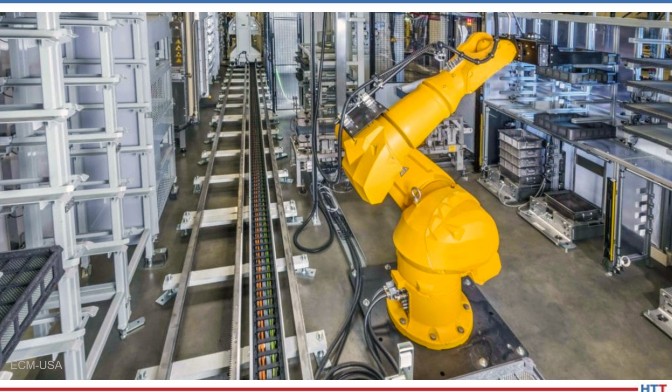
Changing the In-Line Heat Treating Paradigm

Evolution of ideas and transitions to more innovative and efficient methods of heat treating are common themes in this ever-changing world. In this article, Dennis Beauchesne, General Manager at ECM USA, Inc., explores the integration of heat treatment for in-line machining cells and the benefits and efficiencies experienced.

This article article first appeared in the latest edition (June 2020) of Heat Treat Today’s Automotive Heat Treat  magazine.


Introduction

Dennis Beauchesne, General Manager, ECM-USA, Inc.

Heat treating in the automotive industry has evolved tremendously over the last 20 years.  From the dinosaur pusher furnaces of yesterday to the low-pressure carburizing and high-pressure gas quenching of today, we are now embarking on new concepts with not only in-line processing, but also automated single piece and bulk loading in small batches. Modern heat-treating equipment is now being sized to fit into single-piece flow lines with small batches and in-line with pre- and post-machining centers. This article will examine the integration of heat treatment for in-line machining cells, and the influences for the customer to provide an overall quality system. These details will be compared to batch or continuous batch heat treatment as commonly known in the automotive industry.

Over the last 20 years, low pressure vacuum carburizing (LPC) has been proven as the choice for carburizing high production parts in a variety of markets all over the world. It is the process of choice for many high-fatigue and low-distortion parts; thus, it can be used in conjunction with vacuum oil quenching (VOQ) and, in most cases, high pressure gas quenching (HPGQ). Advantages of this process include the fact that equipment is more easily maintainable, flexible, and independent from operators’ intervention than traditional atmosphere carburizing. In addition, reduction of effluents from the process are significantly decreased. A benefit of this process is that the furnace equipment is used more along the lines of a machining cell, which has most commonly been reserved for induction heat treating in the past. With the added benefits of LPC, the importance of strength and fatigue life have increased beyond previous process capabilities; in turn, LPC in-line processing has been considered more frequently.

The rapid shut-down/cool-down (5-6 hours) of a vacuum system is a significant advantage compared to the convoluted days of cooling an atmosphere system. Simply shutting down one day per week due to scheduled maintenance, without the need for supervision, or use of additional utilities required for idling during downtime, is also highly desirable. Other facets of the equipment and process have allowed vacuum furnace equipment to be more conducive to high production manufacturing. This includes recipe ease, process repeatability, and load-to-load processing flexibility in a continuous flow environment. These additional benefits allow the use of part-specific “recipes” while allowing for high production through the system and insuring individual metallurgical requirements.

High pressure gas quenching (HPGQ), using a dedicated quenching cell, is often linked with LPC for several reasons. Some of the most important reasons are:

  • to provide a cleaner environment in the plant
  • to remove oil-quenching tanks and the need for oil on a production floor
  • to eliminate the need for pits in the floor or managing oil containment
  • to obtain a safer, more ergonomic environment via the elimination of open flame and hot surfaces
  • to achieve more precise distortion control of dimensionally critical parts
  • to reduce or eliminate post-heat treat machining needs
  • to eliminate post-heat treat blasting (for cleanup)
  • to eliminate post-heat treat washing (for quench oil removal)
  • to eliminate post-heat treat washer effluent (sludge) removal

Plan view of in-line heat treatment system

 ECM Technologies has been manufacturing LPC and HPGQ systems for over 25 years and designed an innovative in-line system, called NANO.  The name NANO is appropriate in terms of the equipment design as the load size is smaller than traditional loads and the physical equipment is more compact than furnaces more commonly used today.  The system has also been designed with maintenance and expandability in mind. The premise of the design is to be able to process loads as quickly as

In-line heat treatment system being fully-tested prior to shipment to customer

every 7.5 minutes per load. The system is modular in production capacity with growth from three to six heating cells, which can be supplied. The system is ready for a low number of loads, with flexible needs for varying part requirements, or can be maximized to provide throughput for modern high-demand production needs. The NANO consists of four basic modules, the heating module (typically two), the transfer module, and the high-pressure gas quench module. The gas quench module uses a 20 bar gas quench system. With a smaller chamber size and the ability to quench at 20 bar, materials that were not able to be quenched in gas are now applicable for gas quenching. This gas-quenching method will open up this technology to more applications that were limited by core and surface hardness requirements in the past.


Figure 1. - In-line heat treat installation showing automated robotic loading/unloading


Using the NANO as the heat treat equipment base, automation completes the overall single- piece flow system to provide true in-line heat treating. The parts can be presented to the system in bulk or in single-piece trays. These parts can then be loaded and virtually tracked through the system using vison systems.

In-line heat treat installation showing robotic arm facilitating automated loading/unloading

The NANO accommodates a workload size of 24” wide x 20” deep x 10” high (600mm wide x 500mm deep x 250mm high); see Figure 1. Workload parts can be processed on industry-typical alloy fixturing or more preferably on CFC fixtures. The goal of designing the system, beyond better maintenance accessibility and gradual production increase, is low distortion and in-line production flow.

By processing loads with less work pieces, part uniformity and distortion are identical from part to part as the “3D” or 3-sided heating elements heat the parts uniformly and homogenously. These elements are designed not to sag onto the parts and provide adequate clearance for the automated loader to perform accurate transfers within the system.

Automation and Integration

The system has been designed for manual or automated loading. Manual loading can be as simple as manually loading basic fixtures or baskets, and manually loading through the system and subsequent processes. Automated loading can be from a simple robot platform that loads parts onto a small fixture from a single part flow to the handling of many pieces in a bulk load. The robot can handle all functions of the installation from loading single parts on to the fixture to placing the loads in the furnace, and then, cryogenic treatment, tempering and eventually back to a single-piece flow. The system is also capable of checking surface hardness and registering the data to be kept with the load report. This total integration can allow for a smaller footprint and less manpower in the heat treat area.

In addition, automation can handle typical small bulk-loaded parts. Some of these parts are traditionally processed using mesh belt furnaces but can now be processed by this vacuum furnace in-line system. Bulk loads are loaded into basket-like CFC trays and can be weighed and processed as needed to ensure the quality of each load.


Low pressure carburizing installation showing easy access for maintenance

In-line heat treating is not just for carburized products, it can be for hardening, brazing, annealing, and integrated with post treatments—such as cryogenic and complex tempering operations. This allows the NANO to fit into various markets for many different types of heat treatments, not only steel parts, but for special heat-treating processes as well.

Equipment layouts are typically developed to accommodate specific applications. They can be as simple as a manual load station to a robot loading single-piece flow parts onto smaller fixtures or loading bulk parts into baskets for processing.

Maintenance Features

In-line processing, as well as bulk processing, together with automation to load and unload single-piece production are not the only key items in this design. Maintenance and operation were high on the list of criteria as well. Maintenance features such as ease of access are important on production equipment, but especially within heat treating. With the smaller load sizes and equipment, cool-down is significantly faster resulting from the smaller, water-cooled heating zones. Once cooled and released to atmospheric pressure, the system can then be opened via the full opening maintenance access door for easy, internal service effort. However, this is rare because all mechanisms that require control and quick review are located on the exterior of the system and outside the vacuum chamber. This allows for ease of access to all major components and reduces the need to stop or interrupt production.  Additionally, for hot zone service, each heating module can be rolled away from the central transfer module to allow easy access to all hot zones in that module. This allows for easy-open access without the hindrance of confined spaces.

Distortion Evaluation

Figure 2. Differential gear used for distortion evaluation

Using a differential gear (Figure 2), we monitored two characteristics, which are usually requested for this type of gear, and tabulated the results. This evaluation was done using a current day load that will be illustrated as a large batch (FLEX) and those processed in the NANO will be a small batch (NANO). The two characteristics that have the most influence: (1) Cylindricity (circularity) of the outside diameter and the runout between the same diameter and (2) “Backface” flatness of the gear teeth.

Backface flatness (Figure 3) shows greater variance through the large batch with further distance from the nitrogen used in quenching in the range of 11.9 µm.  For the small batch results, the backface flatness distortion range was limited to only 1.2 µm. This uniform result is directly connected to the uniform quenching in the smaller load. This allows for parts to be processed closer to actual machined dimensions (near net shape), as well as being handled on an in-line production basis.

The runout analysis (Figure 4) shows a uniformity for the small batch with a spread of only 3.2 µm across the load. In the large batch, you will see a wider range of distortion uniformity using 10 bar nitrogen quenching with a spread of 24 µm. This is most likely due to the lower layers being further from the vertical down flow of gas through the load. These results are quite extraordinary for a full-size load.

Figure 4. Backface flatness comparing large batch processing (FLEX LOAD) and one-piece processing (NANO)

Conclusion

In-line processing can now be a common thought in the layout of future facilities. In practice, it is a growing aspect of the heat-treating world. With the new NANO vacuum furnace system and automation options, better part-to-part quality can be achieved along with better control of metallurgical parameters and results. Overall, streamlining heat treating into production cells throughout the facility allows for better part flow, and optimally sizing products for the production of particular throughput requirements.

References

[1] Beauchesne, D., “FNA2016 - LPC with OIL & GAS Quenching” (2016)

[2] Esteve, V. & Lelong, V., “LPC - What Does it Mean to Metallurgy” (ASM-Mexico 2016)

[3] Welch, A. & Lelong, V., “How it’s done and Why: Transitioning Parts from Atmosphere Carburizing to Low Pressure Vacuum Carburizing” (HT 2015)


About the author: Dennis Beauchesne is the general manager of ECM USA and brings experience of over 200 vacuum carburizing cells installed on high pressure gas quenching and oil quenching installations. He has worked in the thermal transfer equipment supply industry for almost 30 years, 18 of which have been with ECM USA.

Changing the In-Line Heat Treating Paradigm Read More »
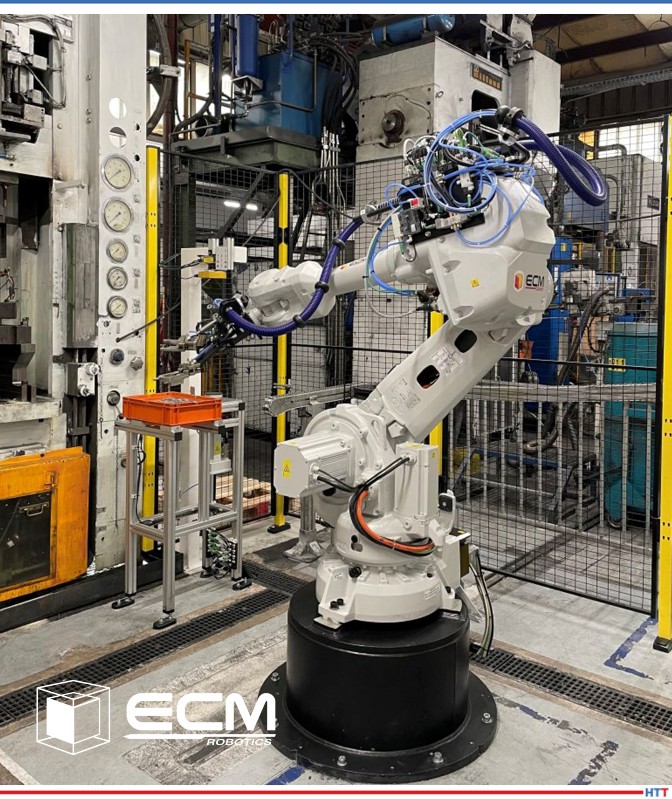
Heat Treat TV: ECM-USA

ECM-USA’s goal to bring sales and service support closer to their North American customers hasn’t changed in over 20 years. A subsidiary of ECM Technologies in Grenoble, France, they are a worldwide manufacturer of low-pressure vacuum carburizing furnaces and other products.

This video takes us through a brief history of their company, their culture, and what services they offer their customers. Take a brief break to learn more about the products and services they provide to their North American customers.

Click here for more information on ECM-USA.

If you have a video you’d like to see included on Heat Treat TV, please send an email to editor@HeatTreatToday.com and include a link to the video.

(source: ECM-USA)

Heat Treat TV: ECM-USA Read More »

Skip to content