


defense

Streamline Essential Nadcap Certifications

Nadcap certifications are integral to aerospace heat treating. Maintaining compliance, however, can be a headache. Learn how a new technology is streamlining Nadcap certifications.

This article by Chantel Soumis was originally published in Heat Treat Today’s March 2024 Aerospace Heat Treat print edition.


Challenges to Capture Nadcap Certifications

Contact us with your Reader Feedback!

The Nadcap certification (National Aerospace and Defense Contractors Accreditation Program) plays a critical role in maintaining the integrity of heat treating processes, especially in the aerospace and defense industries. Recognized globally, the certification sets rigorous standards for heat treatment facilities, ensuring that heat treating processes produce parts and materials with the necessary strength, durability, and reliability.

The certification addresses the data that needs to be documented concerning all aspects of the heat treat processing, such as temperature control, process documentation, and quality management. A survey from the Performance Review Institute (PRI) indicates that 80% of aerospace and defense companies consider Nadcap accreditation as a requirement when selecting suppliers, and 90% of aerospace and defense prime contractors would disqualify a supplier without Nadcap accreditation. And when such a strict standard is implemented and then subject to regular audits, a 40% reduction in nonconformance costs are likely, as was reported by companies in the aerospace and defense sector in a study by the National Center for Manufacturing Sciences (NCMS).

While compliance with Nadcap and other heat treat certifications demonstrates a commitment to quality and opens doors to lucrative contracts with aerospace, defense, and other precision industries, actually capturing the data can be tedious. The effort and cost of employing disconnected systems — capturing measured data from system A, making the certification documents in system B, and then emailing the certification results to clients from system C — can be cut by synthesizing these actions into one system.

Digitizing Certification Management for Complete Compliance Control

Many organizations facilitate the certification process via digital means. This may be through the use of digital quality management systems (QMS) or enterprise resource planning (ERP) software that includes modules designed for certification management. These tools help automate record keeping, provide alerts for upcoming certification renewals, and streamline the overall certification tracking process, ensuring that heat treating operations remain compliant and efficient.

Nadcap Scanner tracking a process via QR code

But more should be done.

Veterans Metal, a metal finishing plant in Clearwater, Florida, was driving manual processes: everything was written down and data was being entered into spreadsheets for tracking purposes. Like many heat treaters, each step the company took to process a part required manual intervention to write down 20+ line items of information and then incorporate the associated data entry into spreadsheets.

The company was looking to modernize their plant.

After careful evaluation of Veterans Metal’s processes and needs, Steelhead Technologies developed and deployed the Steelhead Certification Scanner (or Nadcap Scanner) line that includes a handheld scanner and a system of QR codes to facilitate an easier user experience, including an interface that allows for swift operator proficiency, typically within minutes. This digital interface allows users to measure data, create certifications, and email this from the one system.

Smart Scanning in Action

The metal processing company received a 15-minute walk-through of the Nadcap Scanner, how to process parts, and where to find the data within the system. Using the handheld device, operators scanned QR codes (specifically created by Steelhead Technologies) that were placed on processing stations. As parts were moved from one process station to the next manually, a user would scan the accompanying QR code on the next current station, locking in data from the previous process and automatically reflecting that the next step was in process.

When operators scanned a process station, the device showed the remaining time in the process and displayed all parts being processed, custom instructions, and key data collection, such as oven temperature. This timer automatically starts when a process station QR code is scanned, gives a one minute warning when the process is nearing completion, and stops automatically when the next process station QR code is scanned.

Chet Halonen, a plant optimization expert for Steelhead Technologies, presented the “Powered by Steelhead” certification to the Veterans Metal team.

With the intuitive layout and guided steps, operators were easily able to navigate the accreditation process, significantly reducing time spent on extensive training. More importantly, the Nadcap Scanner line eliminated handwritten data entry, margin of error, and additional time needed to develop certifications since the scanner automatically generates them from the data and sends them to clients. The scanner has since been adopted by many other Nadcap-compliant operations across the United States.

Take Nadcap Digital

Achieving Nadcap accreditation is crucial for showcasing a commitment to quality, aligning with industry benchmarks, and accessing lucrative business opportunities. With the advent of digitized solutions like the Nadcap Scanner implemented within a comprehensive manufacturing ERP, companies will streamline the accreditation process, enhance operational efficiency, and bolster compliance with a system that’s “literally just button clicking,” as one manufacturer observed.

Embracing innovative tools not only saves time and resources, but also strengthens market positioning and client relationships. By merging the prestige of Nadcap accreditation with digital advancements, heat treaters can elevate their operations to reach new heights of excellence.

About the Author

Chantel Soumis, Head of Marketing, Steelhead Technologies

Chantel Soumis is serving as the head of Marketing at Steelhead Technologies. With a robust background in manufacturing technology and strategic partnerships, she leverages over 15 years of experience to shape the company’s marketing landscape.

For more information: Contact Chantel at chantel@gosteelhead.com.


Find Heat Treating Products And Services When You Search On Heat Treat Buyers Guide.Com


Streamline Essential Nadcap Certifications Read More »

Heat Treat Expansion for Defense and Aviation

HTD Size-PR LogoIndian manufacturer in the defense and aviation sector TATA Advanced System Ltd. (TASL) will receive a solution heat treatment line. It is dedicated for the aviation industry and will meet the requirements of the latest aviation (AMS2750F) and material (AMS2770) standards.

This order, the third of its type from North American manufacturing parent company SECO/WARWICK to TASL, will be the largest production line for aircraft skins in the history of both companies. The equipment will be used for the production of aircraft skins, empennage and center-wings boxes. The line includes a rapid quench VertiQuench® electric furnace (drop-bottom type), mobile quenching tank, rinsing tank and additional equipment including a chiller and loading baskets.

Piotr Skarbiński
Vice President of the Aluminum Process and CAB Business Segments
SECO/WARWICK Group
Source: SECO/WARWICK

The working zone of the furnace is L7500 x W3000 x H3000mm, with the capacity to process huge sheets of aluminum. Such a large working zone reduces the number of joints in the skin. The line, as designed, will meet the client's requirements, ensuring a guaranteed +/- 5°C load temperature uniformity, load cooling in either a polymer or a water quench, and will remove the polymer sediment remaining after quench. Additionally, the system can be used for artificial aging in the furnace.

Abhishek Paul, manager and head of supply chain management of TASL said, "The new line, apart from its size, will meet a number of guidelines that will allow us to produce the highest quality airplane components that will meet the expectations of our final customers - a vast portfolio of OEMs and Tier-1s in the aerospace and defense industry. We are also confident that [the company] will be able to meet the project timelines and handover the line well within our project timelines."

"For us," explains Piotr Skarbiński, vice president of the aluminum process and CAB business segments at the SECO/WARWICK Group, "this continued cooperation directly means that the client is satisfied with the quality and efficiency of [our] equipment, services and our partnership. We hope that this partnership will continue into the future."

Heat Treat Expansion for Defense and Aviation Read More »

Vacuum Furnace Delivered to Defense Industry Heat Treater

Dan Insogna
Southeast Regional Sales Manager
Solar Manufacturing 
(photo source: solarmfg.com)

A Southeast USA heat treater in the defense industry recently acquired a vacuum furnace. It will be used to age harden precipitation hardened stainless steels and beryllium copper.

The Mentor® vacuum furnace is a model HFL-2018-2IQ, built by Solar Manufacturing. It features a graphite-insulated hot zone, a load weight capacity of up to 250 lbs., and a maximum operating temperature of 2400°F.

"We provided a complete turnkey solution," states Dan Insogna, Southeast Regional Sales Manager for Solar Manufacturing. Along with the furnace, the heat treater received "a water system, and the recipes for the heat treat cycles their materials require."

The Mentor® vacuum furnace from Solar Manufacturing
(photo source: Solar Manufacturing)


(photo source: skeez at pixabay.com)


Vacuum Furnace Delivered to Defense Industry Heat Treater Read More »

High-Temperature Box Furnace Sent to Military Defense Organization

L&L Medium Sized High Temperature Box Furnace

A government military defense organization, located in the southeastern United States, bought a medium-sized high-temperature box furnace for military ceramic composite development. It will also help with research and development for various other components.

The furnace, built by L&L Special Furnace Co., Inc., has a working zone of 24” wide by 18” high by 36” deep and is rated for continuous operating temperatures up to 2500°F (1371°C). It is equipped with silicon carbide heating elements for high temperature operation and sealed from the inside out for use with inert “blanketing gas."

This furnace is controlled by a Honeywell program control and corresponding overtemperature protection.


High-Temperature Box Furnace Sent to Military Defense Organization Read More »

World’s Fastest Fan-Driven HIP Supports AM Post-Production

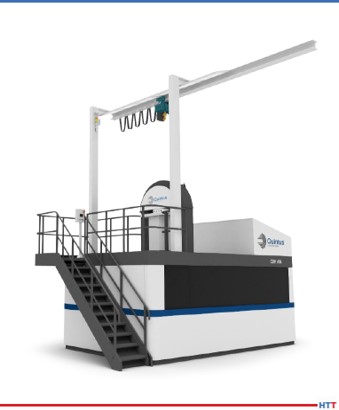
Quintus’ Hot Isostatic Press (HIP)

A U.S. manufacturer in high pressure technology has delivered the world’s fastest fan-driven hot isostatic press (HIP) to Italy’s PRES-X, a start-up established to meet the post-production needs of 3D printed metal components. Its industry focus is on aerospace, space, defense, racing, automotive, packaging, and medical device markets.

Additionally, this HIP model is specifically designed for the additive manufacturing (AM) industry. Installation of the press makes PRES-X the first company worldwide to deploy the fan-driven HIP that was  designed for this application.

The maker of the fan-driven HIP, Quintus Technologies, notes that the model, QIH 60 M URC®, has capabilities which make it possible to eliminate several operations in the AM production line, and thus create a more cost-effective process. A cooling rate of 1500K/minute can be achieved while minimizing thermal distortion and non-uniform grain growth, producing 3D printed parts with optimal material properties.

Andrea Scanavini
CEO and Founder
PRES-X
(photo source: https://www.tctmagazine.com/)

“Our vision is to become the innovation leader within HIP,” comments Andrea Scanavini, CEO and founder of PRES-X. “The QIH 60’s innovative capabilities have already prompted customers to review their parts production methods, even in application areas that have long used more traditional techniques. This is allowing us to see new project starts and growth in orders and revenue despite a very challenging global market situation.”


(photo source:
Lucas Ludwig on unsplash.com)


World’s Fastest Fan-Driven HIP Supports AM Post-Production Read More »

Heat Treat Customers in Aerospace and Defense to Receive Vacuum Furnaces

Patrick McKenna, President and CEO, Ipsen

Nine furnaces were shipped to six states in America, Canada, and the United Kingdom this past July from an international supplier of heat treat equipment. This same supplier will be providing five vacuum furnaces to four customers within the aerospace, defense, and commercial heat-treating industries. The products are all uniquely designed to meet the customers' specific heat treating requirements.

The ability for the international supplier, Ipsen USA, to deliver these products reinforces their transition into  the Vacuum Center of Excellence within Ipsen.

Ipsen Vacuum Furnace (photo source: ipsenusa.com)

"Ipsen has worked with international operations teams for decades," said Patrick McKenna, president and CEO of Ipsen USA, "shipping equipment from the US to countries all over the world[...] With the identification of Ipsen USA as the Vacuum Center of Excellence, we can continue servicing those companies with the level of quality they expect and deserve."

(photo source: NASA on unsplash.com)


Heat Treat Customers in Aerospace and Defense to Receive Vacuum Furnaces Read More »

Skip to content