

Dan Herring

Ask The Heat Treat Doctor®: What Are the Differences Between Intergranular Oxidation (IGO) and Intergranular Attack (IGA)? 

The Heat Treat Doctor® has returned to offer sage advice to Heat Treat Today readers and to answer your questions about heat treating, brazing, sintering, and other types of thermal treatments as well as questions on metallurgy, equipment, and process-related issues.

Today’s Technical Tuesday is a pre-release foretaste of the great content you can find in Heat Treat Today’s July 2025 Super Brands print edition.

Heat treaters and metallurgists speak a language unique to our industry and it can be confusing at times; terms like intergranular oxidation (IGO) and intergranular attack (IGA) are good examples, as these terms are often (incorrectly) used interchangeably. While these two phenomena sound similar, they have distinct mechanisms, causes, and impacts on material properties. Expert Dan Herring explores them more below.


What is IGO?  

Contact us with your Reader Feedback!

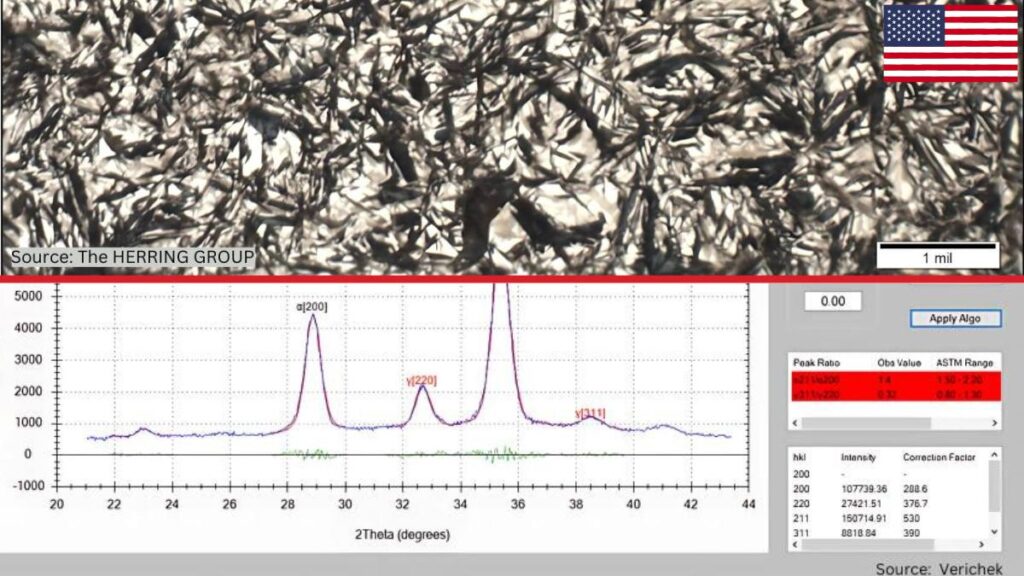
IGO is a process by which oxygen preferentially reacts with the metal surface at the grain boundaries, creating oxides (Figure 1). It is not uncommon, for example, to see IGO present after a hardening process run in an Endothermic or nitrogen/methanol atmosphere. As parts are heated to austenitizing temperature, oxygen present due to minute air leaks or produced during the various chemical reactions with the atmosphere results in IGO. The grain boundaries are highly susceptible to oxidation because these are areas where different crystallographic grains meet and are areas of high energy due to the atomic mismatch and disruption of the regular crystal lattice structure.  

Figure 1. Intergranular oxidation (IGO) along the surface of a heat treated chromium steel component. 1000X – As Polished
Source: The HERRING GROUP, Inc.

What is IGA?  
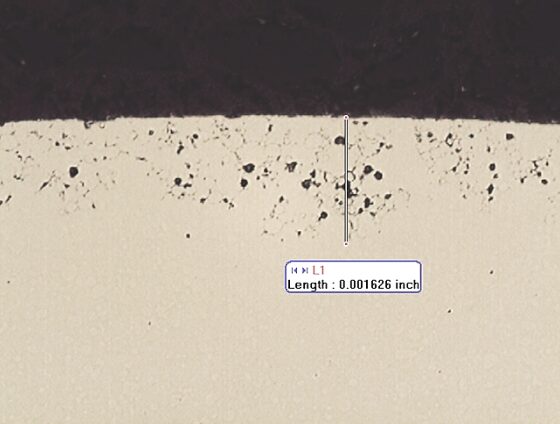
Figure 2. Intergranular attack (IGA) along the surface of a martensitic steel component caused by excessive submersion time in a citric acid solution. 1000X – As Polished
Source: The HERRING GROUP, Inc.

IGA, on the other hand, is a broader term that refers to a corrosion phenomenon (aka chemical attack) that specifically targets the grain boundaries of a material. Unlike IGO, intergranular attack (Figure 2) is not limited to oxidation reactions but encompasses a variety of forms of attack involving such things as the formation of precipitates, the dissolution of material at grain boundaries, or the creation of corrosion cracks. Common forms of IGA include stress corrosion cracking (SCC) or sensitization in stainless steel. 

In stainless steels, IGA is often triggered by high-temperature environments, usually in the range of 840º – 1560ºF (450 – 850°C) where carbon reacts with chromium to form chromium carbides at the grain boundaries, thus reducing the material’s resistance to corrosion in localized regions. In other alloys, factors like pH, chloride concentration, and temperature can lead to IGA. 

Both IGO and IGA weaken the material’s structural integrity or lead to embrittlement compromising the material’s integrity.

Effect on Material Properties 

The main effect of intergranular oxidation is the degradation of the mechanical properties, particularly a reduction in both ductility and toughness. As oxidation progresses along the grain boundaries, the material tends to become brittle, which can lead to premature failure under certain types of stress or thermal cycling. IGO often appears visually as a uniform discoloration or thin oxide layer on the surface. Surface pitting is not typically observed. 

By contrast, IGA often appears as visible cracks, pits, or localized regions where the metal has been attacked (along the grain boundaries). This leads to a reduction in mechanical strength and can lead to SCC under certain circumstances. IGA can severely compromise the integrity of the material, particularly in critical applications like pipelines, pressure vessels, and nuclear reactors.

Materials Involved 

IGO is most commonly observed in steel, aluminum, titanium, and nickel-based alloys, not only during heat treatment but when exposed to oxidizing environments in high-temperature applications, which also result in degradation and loss of material strength and other properties. 

IGA tends to be more prevalent in stainless steels, corrosion-resistant alloys, and aluminum alloys. It is especially noticeable in alloys that are susceptible to sensitization (where chromium carbides precipitate at grain boundaries), leading to localized corrosion and cracks. Alloys that form a passivating oxide layer can be more susceptible to IGA if that layer is disrupted. 

Principal Concerns 

The main concern with intergranular oxidation is material embrittlement, leading to reduced ductility and potential failure under mechanical stress, especially in high-temperature applications. It can also affect the integrity of critical components, such as those used in aerospace or power generation industries. 

By contrast, the primary impact of intergranular attack is loss of material strength, leading to structural failure, often without any clear outward signs (e.g., under chloride-induced SCC). It is more likely to cause immediate failure or a dramatic loss in performance, especially in structures exposed to corrosive environments. 

How to Detect IGO and IGA 

IGO is typically detected by examining the material’s surface using optical or scanning electron microscopy (SEM). Non-destructive techniques, such as X-ray diffraction (XRD), can also be used. 

IGA is usually detected through methods like microstructural examination, electrochemical testing, or failure analysis. Techniques, such as SEM or energy-dispersive X-ray spectroscopy (EDS), can be used to examine the grain boundary regions for signs of corrosion. 

How to Avoid IGO and IGA 

IGO can be avoided by one or more of the following: 

  • Environmental control: Making sure the heat treat furnace has no leaks, reducing oxygen partial pressure or controlling the furnace atmosphere in high-temperature heat treat operations. 
  • Alloy design: The use of materials with stable oxide-forming elements (e.g., chromium, titanium and aluminum) or alloys with high resistance to oxidation (e.g., nickel-based superalloys). 
  • Temperature control: Maintaining lower process temperatures and shorter times where possible to prevent oxidation at the grain boundaries. 
  • Coatings and surface treatments: Application of protective coatings, such as copper plating, post-heat treatment aluminizing, or chrome plating, to reduce oxygen interaction with the grain boundaries during service.  

IGA can be avoided by one or more of the following: 

  • Environmental control: Reducing exposure to aggressive chemicals (e.g., chloride ions) by maintaining proper pH levels or using inhibitors in post-cleaning processes. 
  • Proper alloy selection: Selecting materials resistant to intergranular corrosion (e.g., low carbon “L” grades of stainless steel or alloys with improved grain boundary stability). 
  • Heat treatment: Avoiding sensitization of stainless steel by proper heat treatment methods that prevent the formation of chromium carbides at grain boundaries. 
  • Stress relief: Reducing the likelihood of stress corrosion cracking by managing internal stresses during manufacturing and in-service conditions. 

Key Differences 

The differences between these phenomena are summarized in Table 1. 

Table 1. Key differences between IGO and IGA
Source: The HERRING GROUP, Inc.

Summing Up 

While both IGO and IGA involve attack at the grain boundaries, they differ in their mechanisms, causes, and effects. From a heat treater’s perspective, IGO most often results at high temperature in oxygen-bearing furnace atmospheres, while IGA often results from pre- or post-heat treatment processing (cleaning, passivation, plating, etc.). Proper material selection, furnace and environmental control, awareness of what can happen, and inspection for these effects are key to preventing them from occurring.  

References

Roberge, Pierre R., Corrosion Engineering: Principles and Practice, Mc-Graw Hill LLC, 2008.  

Stene, Einar S., Fundamentals of Corrosion: Mechanisms, Causes, and Monitoring.  

Schweitzer, Philip A., Fundamentals of Corrosion: Mechanisms, Causes and Preventative Methods, CRC Press, 2009. 

About the Author

Dan Herring
“The Heat Treat Doctor”
The HERRING GROUP, Inc.

Dan Herring has been in the industry for over 50 years and has gained vast experience in fields that include materials science, engineering, metallurgy, new product research, and many other areas. He is the author of six books and over 700 technical articles.

For more information: Contact Dan Herring at dherring@heat-treat-doctor.com.

For more information about Dan’s books: see his page at the Heat Treat Store.

Find Heat Treating Products And Services When You Search On Heat Treat Buyers Guide.Com


Ask The Heat Treat Doctor®: What Are the Differences Between Intergranular Oxidation (IGO) and Intergranular Attack (IGA)?  Read More »

Boronizing — What Is It and Why Is It Used?

The Heat Treat Doctor® has returned to offer sage advice to Heat Treat Today readers and to answer your questions about heat treating, brazing, sintering, and other types of thermal treatments as well as questions on metallurgy, equipment, and process-related issues.

This informative piece was first released in Heat Treat Today’s April 2025 Induction Heating & Melting print edition.


Of all the case hardening processes, boronizing (a.k.a. boriding) is perhaps the least understood and least appreciated. Let’s learn more.  

In this era of using coating technologies (e.g., PVD, CVD, DLC) to produce hard, wear-resistant surface layers on component parts, one often forgets that there is a thermo-chemical treatment that often can outperform many of them.  

Boronizing (a.k.a. Boriding)  

Table 1. Examples of hardness levels achieved by boronizing*
*The hardness of the boride layer depends on the compound formed. For example, FeB is 1900–2100 HV, Fe2B is 1800–2000 HV, while Ti2B is 3000 HV.

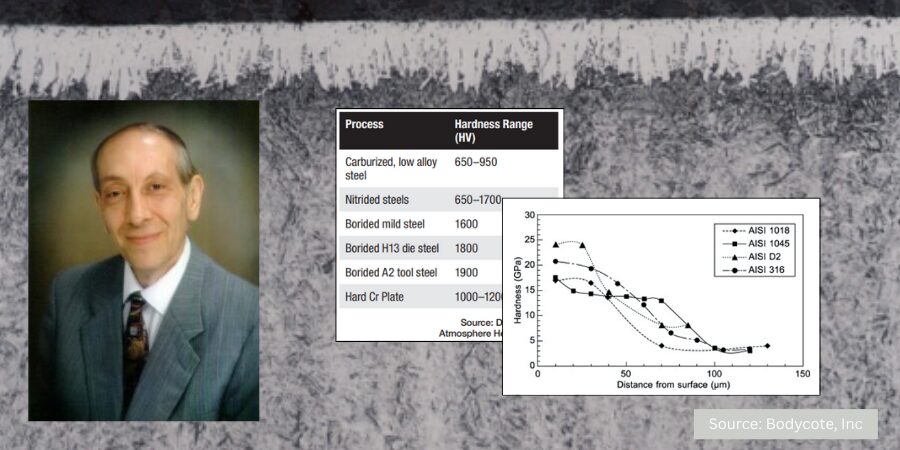
Boronizing is a case hardening process that produces a very high surface hardness in steels and is used for severe wear applications (see Table 1). The layer of borides (FeB and Fe2B) formed also significantly increases corrosion resistance of the steel.

Boron is added to steels for its unique ability to increase hardenability and lower the coefficient of (sliding) friction. In addition, boron is used to control phase transformation and microstructure since the time-temperature-transformation curve for the material when boron is diffused into the surface is shifted to the right. 

The Process

The boronizing process is typically run in a solid (pack), liquid, or gaseous medium. Each of these methods involves the diffusion of boron into the steel’s surface, but they differ in how boron is introduced and the conditions under which they operate. 

  • In the pack boronizing, a powder mixture of boron compounds (typically boron carbide or sodium tetrafluoroborate) is packed around the steel workpieces. This pack is placed in a retort-style furnace where it is heated, typically with an argon cover gas, to temperatures ranging from 1300°F to 1832°F (700°C to 1000°C). The heat causes the boron to diffuse into the steel surface, forming a boride layer (Figure 1). 
    • A key advantage of this method of boronizing is that it is highly effective for producing uniform boride coatings. It is particularly suitable for large parts or components that may not be suitable for immersion in a liquid or exposure to gaseous boron compounds. 
  • In liquid boronizing, the steel is immersed in a molten bath containing boron-bearing compounds, typically a mixture of sodium tetraborate and other chemicals. The steel absorbs boron from the bath, forming a boride layer. The liquid process tends to be faster than the solid method and can be more economical for certain applications. 
    • One of the challenges with liquid boronizing is that the process can be difficult to control in terms of coating thickness and uniformity. Therefore, this method is often used for smaller, simpler parts rather than large or complex geometries. 
  • Gaseous boronizing involves exposing the steel to a boron-containing gas, typically diborane (B2H6) or boron trifluoride (BF3), at elevated temperatures. The boron diffuses from the gas onto the surface of the steel, forming the boride layer. Gaseous boronizing allows for better control over the process compared to the other two methods, but it requires specialized equipment to handle the toxic and reactive nature of the boron gases. 
    • The advantage of gaseous boronizing lies in its ability to produce a uniform and controlled boride layer, especially for complex parts or those with intricate geometries. 

When working with any boron-containing compounds, adequate ventilation and other safety precautions (e.g., masks, gloves) are required. If boron tetrafloride is present, extra precautions are necessary since it is a poisonous gas.  

Typical processing temperature is in the range of 1300°F–1832°F (700°C–1000°C) with time at temperature from 1 to 12 hours. Typical case depths achieved range from 0.003″–0.015″ (0.076 mm to 0.38 mm) or deeper (Figure 2). Case depths between 0.024″ and 0.030″ require longer cycles up to 48 hours in duration. 

Figure 1. Typical microstructure of a boronized component

The mechanical properties of the borided alloys depend strongly on the composition and structure of the boride layers. The most desirable microstructure a er boronizing is a single-phase boride layer consisting of Fe2B2. Plain carbon and low alloy steels are good candidates for boronizing, while more highly alloyed steels may produce a dualphase layer (i.e., boron-rich FeB compounds) because the alloying elements interfere with boron diffusion. The boron-rich diffusion zone can be up to seven times deeper than the boride layer thickness into the substrate. 

The hardness of the borided layer depends on the composition of the base steel (Table 1). Comparative data on steels that have been borided versus carburized or carbonitrided, nitrided or nitrocarburized are available in the literature (see Campos-Silva and Rodriguez-Castro, “Boriding,” 651–702). The surface hardness achieved through boronizing is among the highest for case hardening processes. The boride layers typically exhibit hardness values in the range of 1000 to 1800 HV. This level of hardness helps prevent surface deformation under load, which is particularly beneficial in applications involving high contact pressures, such as gears, bearings, and automotive components. 

Contact us with your Reader Feedback!

Boronizing can also lower the coefficient of friction on the surface of the steel. This is particularly useful in applications where reduced friction is necessary, such as in sliding or rotating parts that operate under high pressures. The reduced friction helps to minimize wear and energy consumption, improving the overall efficiency and longevity of the components. 

Unlike other surface-hardening methods that can compromise the core properties of the material, boronizing tends to retain the toughness and ductility of the base steel. This means the steel remains strong and resistant to cracking or breaking while also benefiting from a hard, wear-resistant surface. 

By contrast, when boron is used as an alloying element in plain carbon and low alloy steels, it is added to increase the core hardenability and not the case hardenability. In fact, boron can actually decrease the case hardenability in carburized steels. Boron “works” by suppressing the nucleation (but not the growth) of proeutectoid ferrite on austenitic grain boundaries. Boron’s effectiveness increases linearly up to around 0.002% then levels off.  

Figure 2. Hardness-depth profiles on different borided steel*
* Notes:
1. The boriding temperature was 1740°F (950°C) with six (6) hours of exposure
2. Hardness conversion: 1 GPa = 102 HV (Vickers hardness)
3. Depth conversion: 10 micrometers = 0.00039 inches

Boronizing Applications 

Given the range of benefits that boronizing offers, it has found widespread use across many industries. Some of the most common applications include: 

  • Automotive industry: Gears, camshafts, and valve components are often boronized to enhance wear resistance and extend their service life. 
  • Aerospace: Parts exposed to high temperatures and wear, such as turbine blades, landing gears, and other critical engine components, benefit from the hard, wear-resistant coatings created by boronizing. 
  • Cutting tools and dies: The high surface hardness and resistance to abrasion make boronized tools highly effective for machining and forming hard materials. 
  • Mining and earthmoving equipment: Equipment like drill bits, shovels, and conveyor parts subjected to abrasive conditions can be boronized to improve their performance and reduce downtime. 
  • Oil and gas: Valves, pumps, and other equipment exposed to corrosive fluids in the oil and gas industry benefit from the enhanced corrosion resistance of boronizing. 

In Summary

Boronizing is not for everyone, but it is safe to say that it is the “forgotten” case hardening process, one that will find increasing use in the future as demand for better tribological properties increases. It is a highly effective surface treatment process that imparts significant benefits to steel, including enhanced wear and corrosion resistance, increased surface hardness, and improved frictional properties. By carefully selecting the boronizing method and optimizing process parameters, manufacturers can produce components with superior performance in demanding applications. As industries continue to push the boundaries of material performance, boronizing can be an essential technique for producing long-lasting, high-performance steel components.  

References

Campos-Silva. I. E., and G. A. Rodriguez-Castro, “Boriding to Improve the mechanical properties and corrosion resistance of steels.” In Thermochemical Surface Engineering of Steels, edited E. J. Mittemeijer and M. A. J. Somers. Woodhead Publishing, 2014. 

Herring, Daniel H. Atmosphere Heat Treatment, vol. I. BNP Media, 2014.  

Kulka, Michal. “Current Trends in Boriding: Techniques.” Springer Nature, 2019. 

Senatorski, Jan, Jan Tacikowski, and Paweł Mączyński. “Tribological Properties and Metallurgical Characteristics of Different Diffusion Layers Formed on Steel.” Inżynieria Powierzchni 24, no. 4 (2019).  

About the Author

Dan Herring
“The Heat Treat Doctor”
The HERRING GROUP, Inc.

Dan Herring has been in the industry for over 50 years and has gained vast experience in fields that include materials science, engineering, metallurgy, new product research, and many other areas. He is the author of six books and over 700 technical articles.

For more information: Contact Dan at dherring@heat-treat-doctor.com.

For more information about Dan’s books: see his page at the Heat Treat Store.


Boronizing — What Is It and Why Is It Used? Read More »

Métodos para la medición de la austenita retenida

La mayoría de quienes aplican el tratamiento térmico reconocen la importancia de medir la austenita retenida (RA, por sus siglas en inglés); no obstante, muchos optan por no realizar estas mediciones por razones de tiempo y/o de los costos asociados. Este artículo explica los motivos por los cuales se deben practicar las mediciones RA, los factores a favor y en contra de las tecnologías de medición tradicionales y los beneficios de realizar la medición en la planta misma, utilizando tecnologías más avanzadas.

This informative piece was first released in Heat Treat Today’s March 2025 Aerospace Heat Treating print edition. To read the article in English, click here.


La importancia del porcentaje de austenita retenida

Antes de entrar a examinar algunas metodologías de medición, es necesario entender lo básico en relación a la austenita retenida, al igual que la importancia que reviste el porcentaje de la misma (%RA).

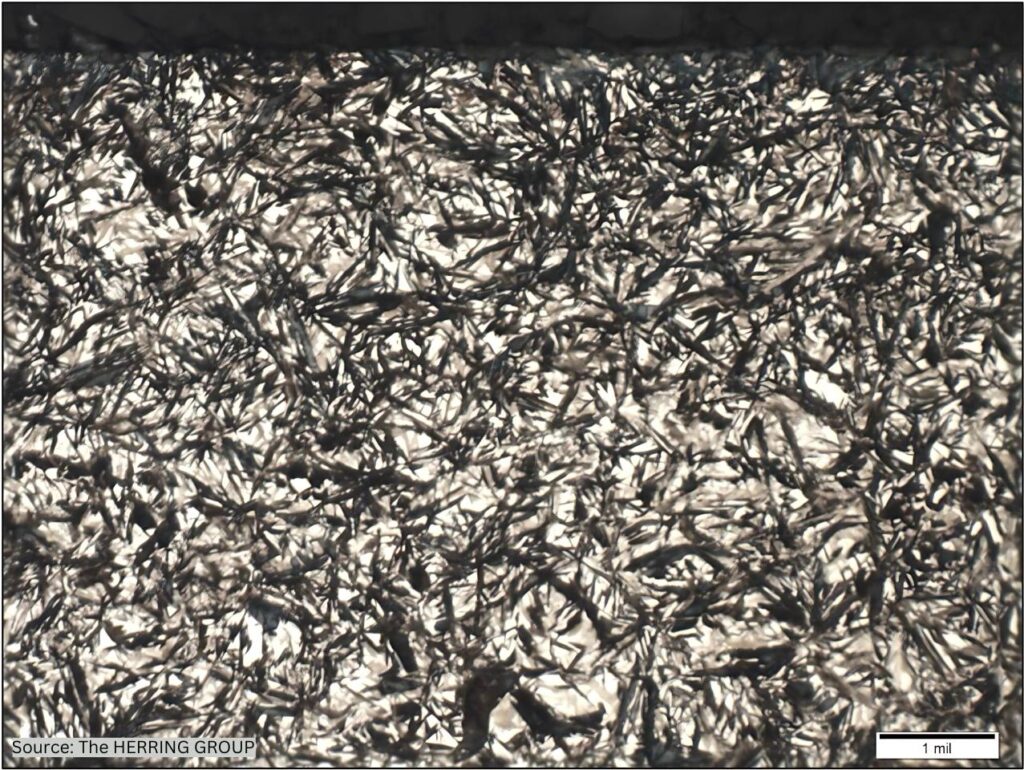
Austenita retenida (RA) es el nombre que se le da a la austenita que durante el proceso de templado no se transforma en martensita. En términos sencillos, la austenita retenida (figura 1) ocurre cuando el acero se ha templado sin llegar de manera contundente a la temperatura de acabado de la martensita (Mf); es decir, la temperatura ha estado por encima de lo requerido para permitir la formación de martensita al 100%. Debido a que la Mf está por debajo de la temperatura ambiente en la mayoría de las aleaciones que contienen más del 0.30% de carbón, se pueden presentar cantidades significativas de austenita retenida en la martensita a temperatura ambiente. (Herring, Atmosphere Heat Treatment).

Al tratarse del %RA, con frecuencia existe un equilibrio muy sensible entre sus efectos benéficos (el aumento en la durabilidad de ciertos componentes manufacturados) y sus atributos negativos (la creación de piezas susceptibles de fracturas y averías). Por tal motivo es de crítica importancia que los tratadores térmicos logren el %RA óptimo para la aplicación deseada.

Por ejemplo, en las industrias de la aeronáutica y la astronáutica, con frecuencia se especifica que los niveles de RA sean inferiores al 8%, y para piezas como los cojinetes y los actuadores lineales, se requiere un RA por debajo del 3%, lo más cercano posible a cero. No obstante, en otras aplicaciones, como por ejemplo los engranajes grandes para generadores de energía, energía eólica y plataformas de rendimiento, se ha identificado que un RA en el rango del 15-30% reviste mayores beneficios. (Errichello et al., “Investigations of Bearing Failures”). De igual manera, un alto % RA es una ventaja en el caso de cojinetes que vayan a entrar en contacto con lubricantes contaminados.

Figura 1. Microestructura en la superficie de la trayectoria de un cojinete de rodamiento 12CrNi3 (o SAE/AISI 9310) compuesto por martensita templada en la que se evidencia austenita retenida (áreas blancas)

Marco DeGasperi, gerente técnico de Verichek, se pronunció al respecto señalando que el %RA es de crítica importancia para los inyectores de combustible, para piezas pequeñas en aplicaciones médicas y para aplicaciones de alto nivel y alto volumen tales como las placas de desgaste en la industria minera. Lo resumió afirmando: –Cuando tu ejercicio se trate de someter a presión y movimiento cualquier dispositivo de calibración fina…si utilizas la palabra “precisión” para darte a conocer, vas a querer hacerte a una [herramienta de medición del %RA].

Las mismas características que le dan a la austenita retenida muchas de sus propiedades particulares, son a la vez las respons ables de significativos problemas de funcionamiento. Sabemos que la austenita es la fase normal del acero a altas temperaturas, mas no a temperatura ambiente. Debido a que la austenita retenida existe por fuera del rango normal de su temperatura, es metaestable, lo que quiere decir que, cuando entre en funcionamiento, los factores como la temperatura, el estrés, y aún el tiempo, harán que se transforme en martensita no revenida. Es más, junto con dicha transformación se dará un cambio en el volumen (aumentará) generando un alto grado de estrés interno en el componente y provocando muchas veces la formación de grietas lo que podrá llevar a que las piezas fallen en el campo.

El % RA también es importante, no solo por el impacto sobre la estabilidad dimensional, sino además por las propiedades mecánicas tales como el límite elástico, la resistencia a la fatiga, la tenacidad, y la manejabilidad. (Herring, Atmosphere Heat Treatment). A manera de ejemplo, DeGasperi identifica en la industria automotriz las consecuencias de un %RA demasiado alto o demasiado bajo: –Hablemos de las piezas en una transmisión o en una caja de transferencia; aquí es donde se dan los casos en los que se empiezan a romper los cojinetes, o terminas viéndote en la obligación del retiro masivo del producto del mercado. Y por lo general toda la cadena de suministro identifica al anterior como el culpable cuando ninguno en toda la cadena se ha tomado la molestia de probar las piezas por sí mismo.

Por el contrario, en algunos casos, la RA diseminada en pequeñas cantidades aporta para que el material resista la propagación de fracturas por fatiga y disminuye el estrés por fatiga en el contacto de rodamiento, así que lograr el correcto equilibrio en la cantidad de RA es importante en muchas aplicaciones. Además, el % justo de RA es esencial para el control de calidad, al igual que para evitar problemas de seguridad y retiros masivos del mercado. El debido control y la medición precisa del % RA en las aleaciones de acero es un punto crítico para garantizar la calidad y la seguridad de los componentes terminados, salvaguardando así la reputación y el margen de ganancia tanto de los tratadores térmicos como de los fabricantes.

Métodos de medición de RA

El medir con precisión la RA es de vital importancia para establecer si existe el balance correcto entre la austenita retenida y la martensita en determinado componente. Los tratadores térmicos tienen a su disposición varias metodologías para esta medición, cada una con sus respectivas ventajas y desventajas. Para el tratador térmico entender la importancia de medir el % RA representa tan solo una parte de la batalla ganada, mientras que la otra parte se gana cuando se logra identificar un método de medición que sea rápido, preciso y rentable.

La difracción de rayos-X: el mejor y más preciso de los métodos

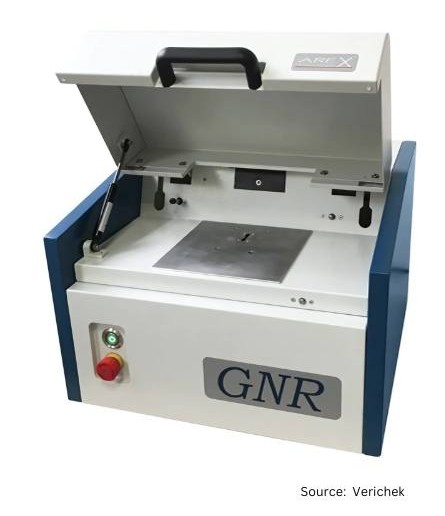
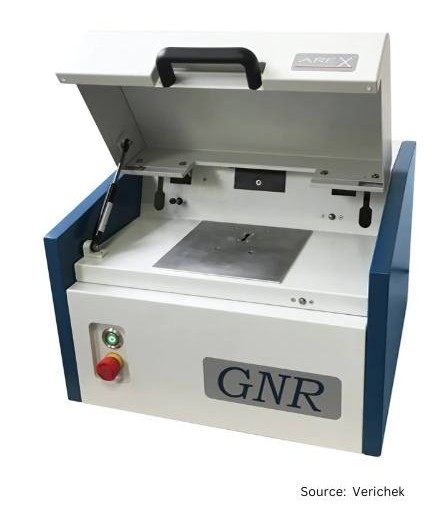
Figura 2a. Una unidad de sobremesa ArexD de GNR

La difracción de rayos-X, utilizada para identificar y cuantificar las fases en un material, se considera el método más preciso de medición de RA en acero ya que logra establecer los niveles de RA hasta el rango aproximado de 0.5-1% (GNR, “AreX Diffractometer,” 3). En la difracción de rayos-X, las diferentes fases cristalinas demuestran diferentes patrones de difracción, lo que permite que sean identificadas y medidas. Además del análisis de fases, la difracción de rayos-X se puede utilizar para analizar car acterísticas microestructurales tales como la textura, el esfuerzo residual y el tamaño del grano.

Hoy en día, la difracción de rayos-X es una solución segura y no-destructiva que permite valorar una región mucho más amplia que la de varios de los otros métodos disponibles, sin necesidad de gran preparación ni análisis de la muestra, haciendo de ésta una solución más eficiente y efectiva. Es la tecnología más opcionada para una empresa que requiera valorar la RA con un resultado esperado inferior al 10%,

La actual generación de difractómetros de rayos-X ostenta un diseño de sobremesa con un peso aproximado de 25 libras. Existen modelos con costos inferiores a los USD $100.000, lo que los hace rentables frente al costo de un difractómetro tradicional (USD $200.000) que tenía además la desventaja de presentar dificultades cuando la muestra tuviera fases y reflexiones adicionales, ya fuera por el tamaño del grano, por los carburos o por las texturas que pudieran provocar disturbios y variaciones en la medición. La nueva generación de equipos de rayos-X logra superar estos obstáculos utilizando múltiples picos de difracción para minimizar los efectos de la orientación preferida y detectar la interferencia de los carburos.

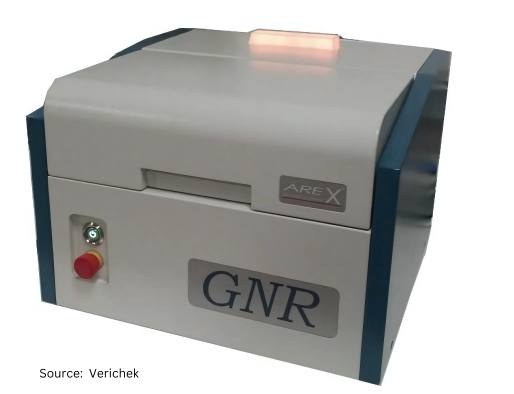
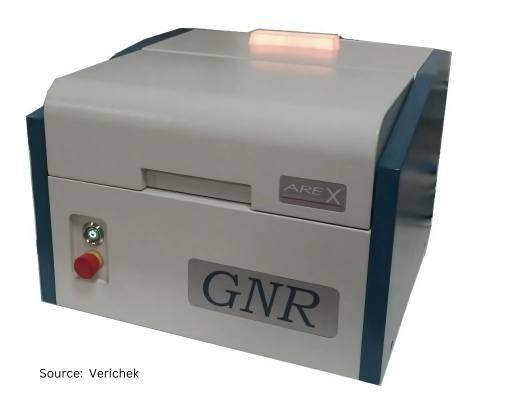
Figura 2b. Una unidad de sobremesa ArexD de GNR

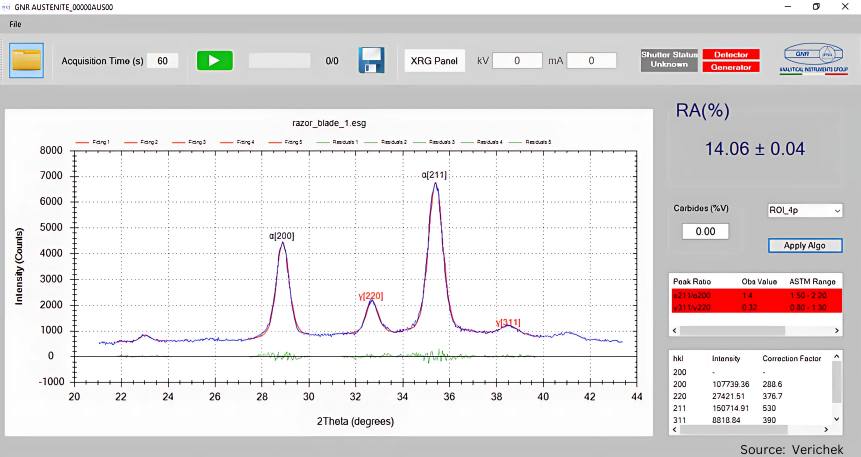
Las máquinas modernas de difracción de rayos-X tienen la capacidad de recoger hasta siete picos de difracción (tres para la fase ferrítica/martensítica y cuatro para la fase austenítica) para luego establecer la concentración de porcentaje por volumen de RA en la muestra al comparar las intensidades de los picos y analizar las relaciones entre éstos de acuerdo con el ASTM E975-22 (práctica estándar para la determinación por rayos-X de austenita retenida en acero con orientación cristalográfica cercana a la aleatoria).

No es complicado usar los equipos modernos de difracción de rayos-X. En menos de tres minutos se logra la medición con tan solo ubicar la muestra en la máquina y oprimir el botón de inicio. Estos difractómetros realizan mediciones en muestras de diferentes tamaños y se valen de software intuitivo, dando lugar a que cualquier técnico, tenga o no experiencia previa en metalurgia o difracción, efectúe la medición de manera rápida, precisa y eficiente.

La microscopía óptica: un método a prueba del tiempo

La RA se puede medir de manera metalográfica con un microscopio óptico. En la mayoría de los casos, un metalúrgico con experiencia puede establecer el %RA en el rango hasta del 10-15%, lo cual es más que suficiente para muchas aplicaciones, con el beneficio adicional de que también caracteriza la microestructura.

Este método, que implica establecer la fracción de austenita mediante el contraste derivado del comportamiento de grabado o morfología, es de bajo costo; sin embargo, puede ser demorado. En libros de referencia existen tablas y diagramas que ayudan a determinar el porcentaje de austenita retenida utilizando métodos comparativos. La microscopía óptica es subjetiva ya que depende del individuo y la interpretación que haga de la muestra bajo el microscopio.

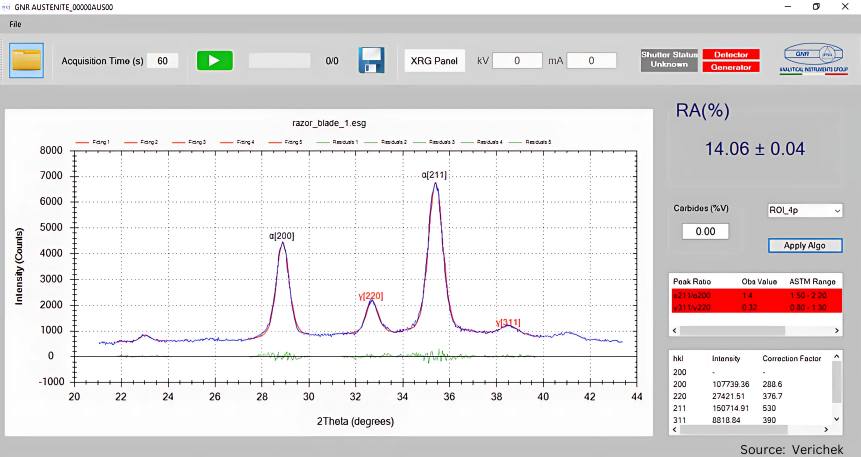
Figura 3. Ejemplo de la técnica para medir los picos de %RA

Métodos alternos

Los tratadores térmicos también disponen de otros varios métodos de medición de la RA. Entre los más comunes se encuentran:

La inducción magnética: Aquí se magnetiza una muestra al punto de saturación y se mide la polarización de saturación. Con esto, se calcula la diferencia entre la saturación medida y la saturación teórica de la RA utilizando la ecuación.

La inducción magnética no es destructiva y ofrece un rango más alto y amplio que el de la microscopía óptica (1-30%). Sin embargo, al ser una medición de volumen, es necesario que el instrumento sea calibrado a los materiales específicos, junto con sus tratamientos térmicos y geometrías, lo cual exige mucho tiempo y depende en un alto grado de la habilidad del técnico.

Difracción de electrones por retrodispersión (EBSD, por sus siglas en inglés): Utilizar este método de medición de RA implica ubicar la muestra en un microscopio electrónico de barrido (SEM, por sus siglas en inglés) para caracterizar la estructura cristalográfica al igual que la microestructura. Las mediciones de RA con base en esta técnica no suelen ser muy precisas y dependen de la correcta preparación de la muestra. Adicionalmente, es un método destructivo y arroja una medida sobre un volumen muy pequeño.

En conclusión

El medir acertadamente el nivel de austenita retenida permite que tanto el ingeniero de diseño como el metalúrgico maximicen los efectos benéficos que ofrece, al mismo tiempo evitando sus consecuencias negativas. El tratador térmico, por su parte, deberá tener en cuenta la química del material y las variables del proceso de tratamiento térmico tales como la temperatura de austenización, la rapidez de enfriamiento, los tratamientos criogénicos o de congelación profunda y las temperaturas de templado.

Referencias

Errichello, Robert, Robert Budny, and Rainer Eckert. “Investigations of Bearing Failures Associated with White Etching Areas (WEAs) in Wind Turbine Gearboxes.” Tribology Transactions 56, no. 6 (2013): 1069–1076.

GNR, Analytical Instruments Group. “AreX Diffractometer: GNR Proposal for measuring Retained Austenite in the industrial domain and in laboratory.”

Herring, Daniel H., Atmosphere Heat Treatment. Volume I. Chicago: BNP Media, 2014.

Agradecimientos

Queremos agradecer a los siguientes contribuyentes por su aporte en el desarrollo de este artículo: Thomas Wingens, presidente y especialista en Heat Treat, WINGENS CONSULTANTS; Dennis Beauchesne, gerente general, ECM USA; Tim Moury, presidente & CEO, Marco DeGasperi, gerente técnico, Jeff Froetschel, vicepresidente y director financiero, Verichek Technical Services, Inc.; y Dan Herring, The Heat Treat Doctor®, The HERRING GROUP, Inc.


Métodos para la medición de la austenita retenida Read More »

Methods of Measuring Retained Austenite

Most heat treaters recognize the importance of measuring retained austenite (RA), yet many opt not to perform these measurements due to time and/or cost constraints. This Technical Tuesday installment explains why performing RA measurements is necessary, the pros and cons of traditional measurement techniques, and the benefits of using more current and in plant technologies.

This informative piece was first released in Heat Treat Today’s March 2025 Aerospace Heat Treating print edition. To read the article in Spanish, click here.


Why Retained Austenite Percentage Matters

Before examining measurement methodologies, it is important to understand the fundamentals of retained austenite and why the percentage of retained austenite (RA%) matters.

Austenite that does not transform to martensite upon quenching is called retained austenite (RA). In simple terms, retained austenite (Figure 1) occurs when steel is not fully quenched to the martensite finish (Mf) temperature; that is, low enough to form 100% martensite. Because the Mf is below room temperature in most alloys containing more than 0.30% carbon, significant amounts of retained austenite may be present within the martensite at room temperature (Herring, Atmosphere Heat Treatment).

When it comes to RA%, there is often a delicate balance between its beneficial effects (an increase in the life of certain manufactured components) and its negative attributes (the creation of parts that are prone to cracking and failure). For this reason, it is crucial that heat treaters achieve the optimal RA% for the intended application.

For example, in the aeronautics and astronautics industries, RA levels are often specified to be under 8% and, for devices such as bearings and linear actuators, RA under 3% and as close to zero as possible is required. In other applications, however, such as large gearing for power generation, wind energy, and performance platforms, in the range of 15–30% or more RA has been found beneficial (Errichello et al., “Investigations of Bearing Failures”). Also, high RA% has been found beneficial for bearings that will be subjected to contaminated lubricants.

Figure 1. 12CrNi3 (similar to SAE/AISI 9310) bearing roller path surface microstructure consisting of tempered martensite with evidence of retained austenite (white areas)

Marco DeGasperi, technical manager at Verichek, weighed in on this, noting that for fuel injectors, small pieces in medical applications, and high-level, high-volume applications like wear plates in the mining industry, RA% is critical. He summarized with the statement, “When you’re applying pressure and motion to anything that’s fine-tuned … If you have ‘precision’ in your name, you probably want [an RA% measurement device].”

The very characteristics that give retained austenite many of its unique properties are those responsible for significant problems in service. We know that austenite is the normal phase of steel at high temperatures, but not at room temperature. Because retained austenite exists outside of its normal temperature range, it is metastable. This means that in service, factors such as temperature, stress, and even time will see it transform into untempered martensite. In addition, a volume change (increase) accompanies this transformation and induces a great deal of internal stress in a component, often manifesting itself as cracks, which leads to parts failing in the field.

RA% is also important not only because of its influence on dimensional stability but on mechanical properties such as yield strength, fatigue strength, toughness, and machinability (Herring, Atmosphere Heat Treatment). For example, looking in the automotive industry, DeGasperi gives an example of the consequences of having too high or too low RA%: “Let’s say pieces in a transmission or a transfer case; this is when gears start breaking or you get issued wide-end recalls. And then usually the supply chain all starts blaming the guy before them when nobody throughout the supply chain has actually tested the parts themselves.”

Alternatively, in some cases, finely dispersed RA helps the material resist the propagation of fatigue cracks and improves rolling contact fatigue stress, so balancing the amount of RA is important in many applications. Also, the correct RA% is essential for quality control, and proper control and accurate measurement of RA% in steel alloys is crucial to guaranteeing the quality and safety of finished components, as well as protecting the reputation and profitability of heat treaters and manufacturers.

RA Measurement Methods

Accurate RA measurements are critical to determine whether the correct balance of retained austenite and martensite exists within a given part. Several RA measurement methodologies are available to heat treaters, each having their own unique set of advantages and disadvantages. For heat treaters, understanding why it is crucial to measure the percentage of RA is only half the battle. Finding a cost-effective, fast, and accurate measurement method is the other half.

X-Ray Diffraction: The Best and Most Accurate Method

Figure 2a. An ArexD table-top unit from GNR

X-ray diffraction, which is used to identify and quantify phases in a material, is considered the most accurate method of RA measurement in steels as it can precisely determine RA levels down to the range of approximately 0.5–1% (GNR, “AreX Diffractometer,” 3). In X-ray diffraction, different crystalline phases have different diffraction patterns, allowing them to be identified and measured. In addition to phase analysis, X-ray diffraction can be used to analyze microstructural features such as texture, residual stress, and grain size.

Today, X-ray diffraction is a non-destructive, safe solution that can sample a much larger region than many other available methods and does not involve much sample preparation and analysis, making it a more efficient and effective solution. This is the option of choice for a company that needs to test RA with expected readings under 10%.

The current generation of X-ray diffractometers are tabletop sized, weighing about 25 lbs. With models under $100,000, they are also cost-effective when compared to traditional X-ray diffractometers ($200,000), which were sometimes problematic in the presence of additional phases and reflections due to grain size, carbides, or textures that could cause disturbances and variances in measurement. The new generation of X-ray equipment compensates for these obstacles via the use of multiple diffraction peaks to minimize the effects of preferred orientation and detect interference from carbides.

2b. An ArexD table-top unit from GNR

Modern X-ray diffraction machines can collect up to seven diffraction peaks (three for ferrite/martensite phase and four for austenite phase) and then determine the volume percent concentration of RA in the sample by comparing the intensities of the peaks and analyzing the peak ratios in accordance with the ASTM E975-22 (standard practice for X-ray determination of retained austenite in steel with near random crystallographic orientation).

The use of today’s X-ray diffraction equipment is not complicated. It can be measured in under three minutes by simply placing the sample in the machine and pressing the start button. These X-ray diffractometers measure various-sized samples and use intuitive software so the measurement can be performed quickly, accurately, and efficiently by any technician — with or without prior metallurgical or diffraction experience.

Optical Microscopy — A Time-Proven Method

RA can be measured metallographically with an optical microscope. An experienced metallurgist can usually determine RA% down to approximately 10–15% RA. For many applications, this is more than adequate and has the added benefit of characterizing the microstructure as well.

This method, which involves determining the austenite fraction using contrast from etching behavior or morphology, is low cost, however, it can be somewhat time consuming. Charts and diagrams in reference books are available to help determine the percentage of retained austenite by comparative methods. Optical microscopy is subjective as it is dependent upon the individual and their interpretation of the sample under the microscope.

Figure 3. Example of how RA% peaks are measured

Alternative Methods

Several other methods for measuring RA are available to heat treaters. The most common of these methods includes:

Magnetic Induction: Here, a sample is magnetized to saturation and the saturation polarization is measured. The difference between measured and theoretical saturation of the RA can then be calculated using this equation:

Magnetic induction is non-destructive and offers a higher, broader range than optical microscopy (1–30%). However, because it is a volume measurement, the instrument needs to be calibrated to the specific materials, heat treatment, and geometries, which is time consuming and highly dependent on the skill of the technician.

Electron Backscatter Diffraction (EBSD): Using this RA measurement method involves placing a sample in a Scanning Electron Microscope (SEM) to characterize the crystallographic structure as well as the microstructure. RA measurements using this technique are not particularly accurate and are reliant upon proper sample preparation. Additionally, it provides a very small measure volume and is a destructive test method.

Conclusion

Accurate measurement of the level of retained austenite allows both the design engineer and metallurgist to maximize its beneficial effects without suffering from its negative consequences. On the part of the heat treater this means taking into account the material chemistry and the heat treat process variables such as austenitizing temperature, quench rate, deep freeze or cryogenic treatments, and tempering temperatures.

References

Errichello, Robert, Robert Budny, and Rainer Eckert. “Investigations of Bearing Failures Associated with White Etching Areas (WEAs) in Wind Turbine Gearboxes.” Tribology Transactions 56, no. 6 (2013): 1069–1076.

GNR, Analytical Instruments Group. “AreX Diffractometer: GNR Proposal for measuring Retained Austenite in the industrial domain and in laboratory.”

Herring, Daniel H., Atmosphere Heat Treatment. Volume I. Chicago: BNP Media, 2014.

Acknowledgments

We’d like to thank the following contributors for the support of this article: Thomas Wingens, President & Heat Treat Specialist, WINGENS CONSULTANTS; Dennis Beauchesne, General Manager, ECM USA; Tim Moury, President & CEO, Marco DeGasperi, Technical Manager, Jeff Froetschel, VP & CFO, Verichek Technical Services, Inc.; and Dan Herring, The Heat Treat Doctor®, The HERRING GROUP, Inc.

This article is provided by the Heat Treat Today Editorial Team.


Methods of Measuring Retained Austenite Read More »

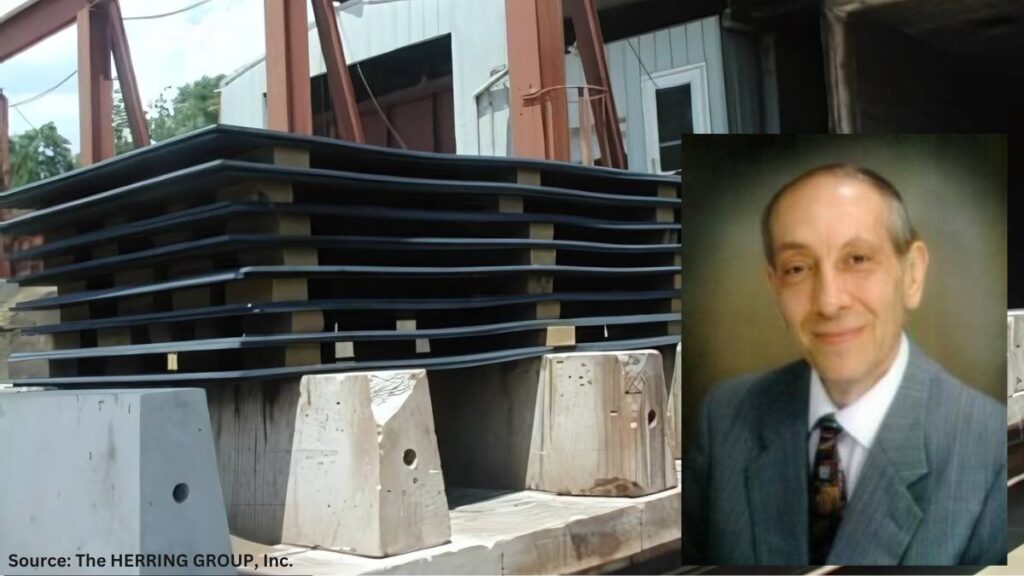
Why Normalize, and Is a ‘Still Air’ Cool Really Important? Part 2

The Heat Treat Doctor® has returned to offer sage advice to Heat Treat Today readers and to answer your questions about heat treating, brazing, sintering, and other types of thermal treatments as well as questions on metallurgy, equipment, and process-related issues.

This informative piece was first released in Heat Treat Today’s March 2025 Aerospace Heat Treating print edition.


Last time (Air & Atmosphere Heat Treating, February 2025) we addressed the question of why normalizing is necessary. Here we look at the importance of a “still air” cool on the final result. Let’s learn more.

What Is a “Still Air” Cool?

Contact us with your Reader Feedback!

As we learned last month, the term “cooling in air” is associated with normalizing but poorly defined in the literature or in practice, either in terms of cooling rate or microstructural outcome. This lack of specificity has resulted not only in many different interpretations of what is needed, but in a great deal of variability in the final part microstructure.

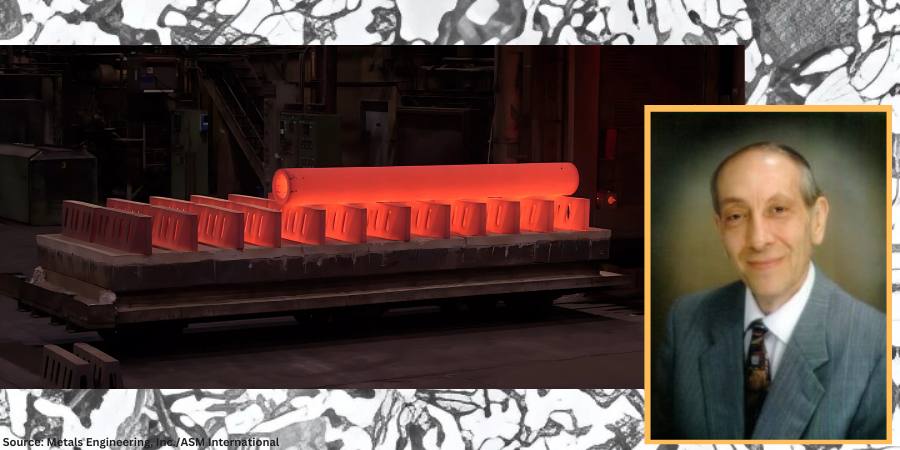
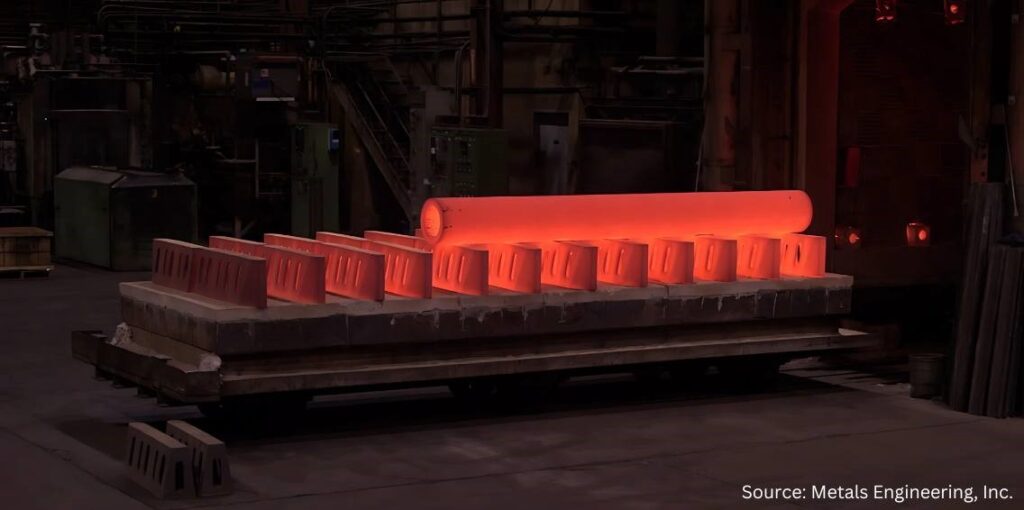
By way of example, this writer has on multiple occasions asked what changes are made to car bottom furnace cycles where cars are pulled outside of the plant for “air cooling” (Figure 1). Questions such as, is the furnace opened and the car pulled out in inclement weather? And, is this practice done on a particularly windy day, or in a rain or snowstorm or when the temperature is below zero? An all-too-common response is, “Only if it isn’t raining ‘too hard’ or snowing ‘too much’; then, we wait a while.” No wonder part microstructures are often found to vary from part to part and load to load!

Most heat treaters agree, however, that normalizing is optimized by a cooling in “still air.” This term also hasn’t been clearly defined, but it will be here based on both an extensive survey of the literature and the most common heat treat practices. In Vacuum Heat Treatment, Volume II, I define a still air cool as: “Cooling at a rate of 40°F (22°C) per minute … to 1100°F (593°C) and then at a rate of 15°F–25°F (8°C–14°C) per minute from 1100°F (593°C) to 300°F (150°C). Any cooling rate can be used below 300°F (150°C).”

Typical car bottom normalizing furnace opening to the outside environment

In addition, many consider nitrogen gas quenching in a vacuum furnace at 1–2 bar pressure to be equivalent to a still air cool. But again, so many factors are involved that only properly positioned workload thermocouples can confirm the above cooling rates are being achieved.

Also, many use the term “air cooling” to differentiate the process from “air quenching,” “controlled cooling,” and “fan cooling.”

Recall from the previous installment of this column that any ambiguity with respect to cooling rate ought to be defined in engineering specifications and/or heat treat instructions so that the desired outcome of the process can be firmly established.

From the literature, several important observations will serve as cautionary reminders. In STEELS, George Krauss points out that: “Air cooling associated with normalizing produces a range of cooling rates depending on section size [and to some extent, load mass]. Heavier sections air cool at much lower cooling rates than do light sections because of the added time required for thermal conductivity to lower temperatures of central portions of the workpiece.”

George Totten’s work in Steel Heat Treatment indicates: “Cooling … usually occurs in air, and the actual cooling rate depends on the mass which is cooled.” He goes on to state:

After metalworking, forgings and rolled products are often given an annealing or normalizing heat treatment to reduce hardness so that the steel may be in the best condition for machining. These processes also reduce residual stress in the steel. Annealing and normalizing are terms used interchangeably, but they do have specific meaning. Both terms imply heating the steel above the transformation range. The difference lies in the cooling method. Annealing requires a slow [furnace] cooling rate, whereas normalized parts are cooled faster in still, room-temperature air. Annealing can be a lengthy process but produces relatively consistent results, where normalizing is much faster (and therefore favored from a cost point of view) but can lead to variable results depending on the position of the part in the batch and the variation of the section thickness in the part that is stress-relieved.

In “The Importance of Normalizing,” this writer offers the following caution: “It is important to remember that the mass of the part or the workload can have a significant influence on the cooling rate and thus on the resulting microstructure.”

Finally, Krauss again observes: “The British Steel Corporation atlas for cooling transformation (Ref. 13.7) establishes directly for many steels the effect of section size on microstructures produced by air cooling.” (Note: Interpretation of continuous cooling transformation (CCT) curves will be the subject of a future “Ask The Heat Treat Doctor” column.)

Since hardness is one of the most commonly used criteria to determine if a heat treat process has been successful, it should also be noted that one can usually predict the hardness of a properly normalized part by looking at the J40 value when Jominy data is available.

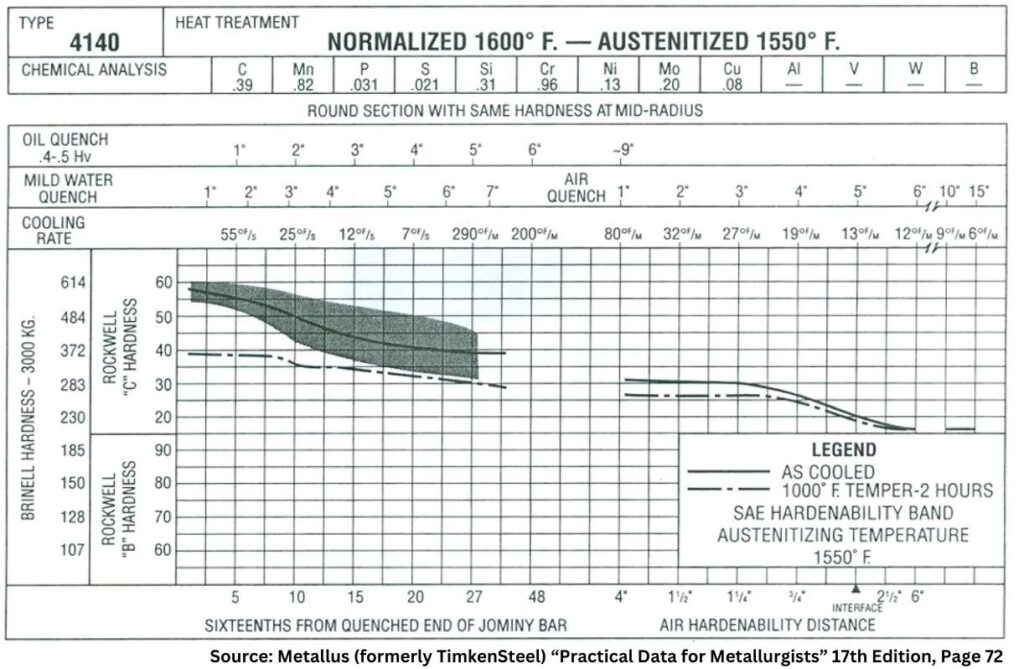
The Metallus (formerly TimkenSteel) “Practical Data for Metallurgists” provides an example of the type of data available to metallurgists and engineers to help define a required cooling rate for normalizing (Figure 2).

All literature references to normalizing agree (or infer) that the resultant microstructure produced plays a significant role in both the properties developed and their impact on subsequent operations.

Figure 2. Combined hardenability chart for normalized and austenitized SAE 4140 steel showing approximate still air cooling rates and resultant hardness (data based on a thermocouple located in the center of the bar diameter indicated)

Final Thoughts — The State of the Industry

It is all too common within the industry for some companies who wish to have normalizing performed on their products to specify only a hardness range on the engineering drawing or purchase order callout that is given to the heat treater.

Industry normalizing practice here in North America varies considerably from company to company. Normalizing instructions are sometimes, but not often enough, provided on either purchase orders, engineering drawings, or in specifications (industry standards or company-specific documents). These instructions range from, in the case of certain weldments, absolutely nothing (i.e., no hardness, microstructure, or mechanical properties) to referencing industry specifications (e.g., AMS2759/1) or specifying complete metallurgical and mechanical testing including hardness and microstructure.

Most commercial heat treaters often perform normalizing to client or industry specifications provided to them. Others prefer so-called “flow down” instructions in which the process recipe is provided to them. It is a common (and mistaken) belief that this removes the obligation of achieving a given set of mechanical or metallurgical properties even if they are called out by specification, drawing, or purchase order.

Also, the final mechanical properties that result from normalizing are seldom verified by the heat treater. Rather, a hardness value (or range) is reported, but hardness is not a fundamental material property, rather a composite value, one which is influenced by, for example, the yield strength, work hardening, true tensile strength, and modulus of elasticity of the material.

References

ASM International. “ASM Handbook, vol. 4, Heat Treating,” 1991.

ASM International. “ASM Handbook Volume 4A, Steel Heat Treating, Fundamentals and Processes,” 2013.

Chandler, Harry, ed. Heat Treater’s Guide: Practices and Procedures for Irons and Steels. 2nd ed, ASM International, 1995.

Grossman, M. A., and E. C. Bain. Principles of Heat Treatment, 5th ed, ASM International, 1935.

Herring, Daniel H. Atmosphere Heat Treatment, vol. I, BNP Media, 2014.

Herring, Daniel H. Atmosphere Heat Treatment, vol. II, BNP Media, 2015.

Herring, Daniel H. Vacuum Heat Treatment, vol. I, BNP Media, 2012.

Herring, Daniel H. Vacuum Heat Treatment, vol. II, BNP Media, 2016.

Herring, Daniel H. “The Importance of Normalizing,” Industrial Heating April 2008.

Krauss, George. STEELS: Heat Treatment and Processing Principles, ASM International, 1990. 463.

Krauss, George. STEELS: Processing, Structures, and Performance, ASM International, 2005.

Practical Data for Metallurgists, 17th ed. TimkenSteel, 2011

Totten, George E., ed. Steel Heat Treatment Handbook, vol. 2, 2nd ed., CRC Press, 2007.

About the Author

Dan Herring
“The Heat Treat Doctor”
The HERRING GROUP, Inc.

Dan Herring has been in the industry for over 50 years and has gained vast experience in fields that include materials science, engineering, metallurgy, new product research, and many other areas. He is the author of six books and over 700 technical articles.

For more information: Contact Dan at dherring@heat-treat-doctor.com.

For more information about Dan’s books: see his page at the Heat Treat Store.


Find Heat Treating Products And Services When You Search On Heat Treat Buyers Guide.Com


Why Normalize, and Is a ‘Still Air’ Cool Really Important? Part 2 Read More »

Why Normalize, and Is a ‘Still Air’ Cool Really Important? Part 1

The Heat Treat Doctor® has returned to offer sage advice to Heat Treat Today readers and to answer your questions about heat treating, brazing, sintering, and other types of thermal treatments as well as questions on metallurgy, equipment, and process-related issues.

This informative piece was first released in Heat Treat Today’s February 2025 Air/Atmosphere Furnace Systems print edition.


People often ask two fundamental questions related to normalizing. First, is it necessary? Second, just what and how important is a “still air” cool to the end result? Let’s learn more.

Why Normalize?

Contact us with your Reader Feedback!

Normalizing is typically performed for one or more of the following reasons:

  • To improve machinability
  • To improve dimensional stability
  • To produce a homogeneous microstructure
  • To reduce banding
  • To improve ductility
  • To modify and/or refine the grain structure
  • To provide a more consistent response when hardening or case hardening

For example, many gear blanks are normalized prior to machining so that during subsequent hardening or case hardening dimensional changes such as growth, shrinkage, or warpage will be better controlled.

Normalizing imparts hardness and strength to both cast iron and steel components. In addition, normalizing helps reduce internal stresses induced by such operations as forging, casting, machining, forming or welding. Normalizing also improves chemical non-homogeneity, improves response to heat treatment (e.g., hardening), and enhances dimensional stability by imparting into the component part a “thermal memory” for subsequent lower temperature processes. Parts that require maximum toughness and those subjected to impact are often normalized. When large cross sections are normalized, they are also tempered to further reduce stress and more closely control mechanical properties.

Large paper roll normalized in a car bottom furnace and cooled (due to its mass) using the assistance of a floor fan.

Soak periods for normalizing are typically one hour per inch of cross-sectional area but not less than two hours at temperature. It is important to remember that the mass of the part or the workload can have a significant influence on the cooling rate and thus on the final microstructure. Thin pieces cool faster and are harder after normalizing than thicker ones. By contrast, after furnace cooling in an annealing process, the hardness of the thin and thicker sections is usually about the same.

Micrograph of medium-carbon AISI/SAE 1040 steel showing ferrite grains (white etching constituent) and pearlite (dark etching constituent). Etched in 4% picral followed by 2% nital. (Bramfitt and Benscoter, 2002, p. 4. Reprinted with permission of ASM International. All rights reserved.)

When people think of normalizing, they often relate it to a microstructure consisting primarily of pearlite and ferrite. However, normalized microstructures can vary and combinations of ferrite, pearlite, bainite, and even martensite for a given alloy grade are not uncommon. The resultant microstructure depends on a multitude of factors including, but not limited to, material composition, part geometry, part section size, part mass, and cooling rate (affected by multiple factors). It is important to remember that the microstructure achieved by any given process sequence may or may not be desirable depending on the design and function of the component part.

The microstructures produced by normalizing can be predicted using appropriate continuous cooling transformation diagrams and this will be the subject of a subsequent “Ask The Heat Treat Doctor” column.

In this writer’s eyes, industry best practice would be to specify the desired microstructure, hardness, and mechanical properties resulting from the normalizing operation. Process parameters can then be established, and testing performed (initially and over time) to confirm/verify results.

In many cases, the failure of the normalizing process to achieve the desired outcome centers around the lack of specificity (e.g., engineering drawing requirements, metallurgical and mechanical property call outs, testing/verification practices, and quality assurance measures). Failure to specify the required microstructure and mechanical properties/characteristics can lead to assumptions on the part of the heat treater, which may or may not influence the end result.

“Normalizing is the heat treatment that is produced by austenitizing and air cooling, to produce uniform, fine ferrite/pearlite microstructures in steel … In light sections, especially in alloy hardenable steels, air cooling may be rapid enough to form bainite or martensite instead of ferrite and pearlite.”

What Is Normalizing?

The normalizing process is often characterized in the following way: “Properly normalized parts follow several simple guidelines, which include heating uniformly to temperature and to a temperature high enough to ensure complete transformation to austenite; soaking at austenitizing temperature long enough to achieve uniform temperature throughout the part mass; and cooling in a uniform manner, typically in still air” (Herring, 2014).

It is also important to remember that normalizing is a long-established heat treatment practice. As far back as 1935, Grossmann and Bain wrote:

Normalizing is the name applied to a heat treatment in which the steel is heated above its critical range (that is, heated to make it wholly austenitic) and is then allowed to cool in air.

Since this is one specific form of heat treatment, it will be realized that the structure and mechanical properties resulting from the normalizing treatment will depend not only on the precise composition of the steel but also on the precise way in which the cooling is carried out.

The term ‘normalizing’ is generally applied to any cooling ‘in air.’ But in reality, this may cover a wide range of cooling conditions, from a single small bar cooled in air (which is fairly rapid cooling) to that of a large number of forgings piled together on a forge shop floor … which is a rather slow cool, approaching an anneal. The resulting properties in the two cases are quite different.

In plain carbon steels and in steel having a small alloy content, the air-cooled (normalized) structure is usually pearlite and ferrite or pearlite alone … More rapid cooling gives fine pearlite, which is harder; slow cooling gives coarse pearlite, which is soft. In some few alloy steels, the normalized structure in part may be bainite.

The hardness of normalized steels will usually range from about 150 to 350 Brinell (10 to 35 Rockwell C), depending on the size of the piece, its composition and hardening characteristics.

Importance of Defining Cooling Rate

In 2005, Krauss underscored the importance of defining cooling rate when he wrote: “Air cooling associated with normalizing produces a range of cooling rates depending on section size [and to some extent, load mass]. Heavier sections [and large loads] air cool at much lower cooling rates than do light sections because of the added time required for thermal conductivity to lower temperatures of central portions of the workpiece.”

Microstructures Created by Normalizing

The microstructural constituents produced by normalizing for a particular steel grade can be ferrite, pearlite, bainite, or martensite. The desired microstructure from normalizing adds an important cautionary note, as addressed by Krauss in STEELS (1990 and 2005), namely: “Normalizing is the heat treatment that is produced by austenitizing and air cooling, to produce uniform, fine ferrite/pearlite microstructures in steel … In light sections, especially in alloy hardenable steels, air cooling may be rapid enough to form bainite or martensite instead of ferrite and pearlite.”

Next time: We define a “still air” cool and look at the state of normalizing in North America.

References

ASM International. “ASM Handbook, vol. 4, Heat Treating,” (1991): 35–41.

ASM International. “ASM Handbook Volume 4A, Steel Heat Treating, Fundamentals and Processes,” (2013): 280–288.

ASM International. “Metals Handbook, 8th ed., vol. 1, Properties and Selection of Metals,” (1961): 26.

ASM International. “Metals Handbook Desk Edition,” (1985): 28-11, 28-12.

Chandler, Harry, ed. Heat Treater’s Guide: Practices and Procedures for Irons and Steels. 2nd ed, ASM International, 1995.

Grossman, M. A., and E. C. Bain. Principles of Heat Treatment, 5th ed, ASM International, 1935, 197–198.

Herring, Daniel H. Atmosphere Heat Treatment, vol. I, BNP Media, 2014.

Herring, Daniel H. Atmosphere Heat Treatment, vol. II, BNP Media, 2015.

Herring, Daniel H. “The Importance of Normalizing,” Industrial Heating April 2008.

Krauss, George. STEELS: Heat Treatment and Processing Principles, ASM International, 1990. 463.

Krauss, George. STEELS: Processing, Structures, and Performance, ASM International, 2005. 253–256, 574.

Lyman, Taylor, ed. Metals Handbook, 1948 ed. ASM International, 1948. 643.

Practical Data for Metallurgists, 17th ed. TimkenSteel.

Totten, George E., ed. Steel Heat Treatment Handbook, vol. 2, 2nd ed., CRC Press, 2007. 612-613.

About the Author

Dan Herring
“The Heat Treat Doctor”
The HERRING GROUP, Inc.

Dan Herring has been in the industry for over 50 years and has gained vast experience in fields that include materials science, engineering, metallurgy, new product research, and many other areas. He is the author of six books and over 700 technical articles.

For more information: Contact Dan at dherring@heat-treat-doctor.com.

For more information about Dan’s books: see his page at the Heat Treat Store.


Find Heat Treating Products And Services When You Search On Heat Treat Buyers Guide.Com


Why Normalize, and Is a ‘Still Air’ Cool Really Important? Part 1 Read More »

What Will Heat Treating in the Mid-21st Century Look Like?

The Heat Treat Doctor® has returned to offer sage advice to Heat Treat Today readers and to answer your questions about heat treating, brazing, sintering, and other types of thermal treatments as well as questions on metallurgy, equipment, and process-related issues.

This informative piece was first released in Heat Treat Today’s January 2025 Technologies to Watch print edition.


As a very young engineer, I vividly recall our company president had a statue of a three-headed elephant in his office. One head faced forward, one faced slightly to the right, one faced slightly to the left. The moral: looking backwards is not the path forward! Let’s learn more about what the heat treatment industry will look like by the middle of this century.

The Market

A number of market studies and economic forecast models suggest that the global heat treatment market will grow to between 130–150 billion U.S. dollars by no later than 2030 and to around 200–220 billion U.S. dollars by 2040, barring another significant or sustained global economic event. These forecasts assume several minor downturns in the economy of various countries and in manufacturing segments due to economic and geopolitical factors in the coming decades.

Heat Treatment Market Shift

Contact us with your Reader Feedback!

The most significant and fundamental shift that is and will continue is in the makeup of the heat treatment equipment segment of the North American market. What began in the late 1990s and early 2000s as a transition from older, long-established practices and processes to equipment capable of meeting the rapidly evolving demands of technological innovation will continue. Standardization (for cost containment), changes in manufacturing methods and methodologies, and environmental considerations are also fueling this change.

A demand for higher performance products, end-of-life expectations (in some but not all products), an emphasis on systems with single-piece flow or small batch productivity are just a few examples of this change. Other factors such as equipment obsolescence, the need for even higher manufacturing efficiencies, long term operator health and safety concerns, predictive (as opposed to preventative) maintenance, and adaptation to both the speed at which the manufacturing landscape is changing and the type of flexible equipment/processes reinforce these conclusions.

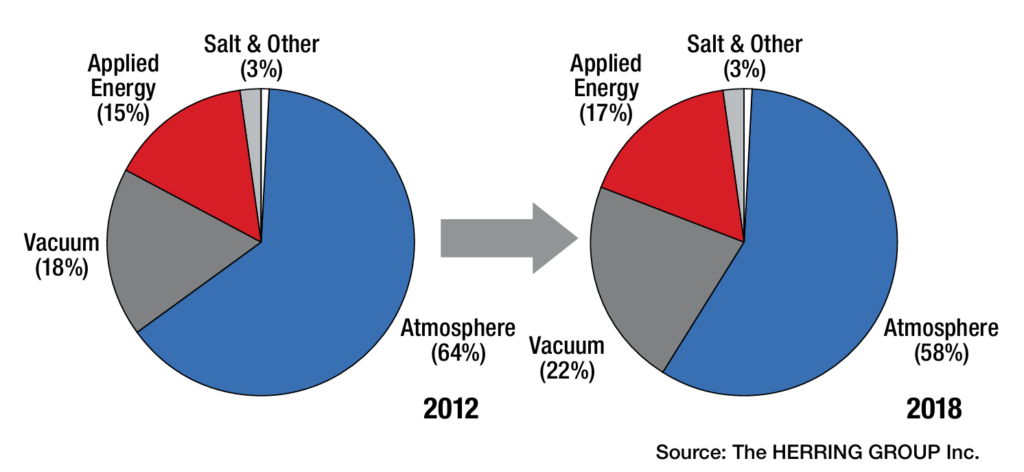
From an equipment standpoint, vacuum furnaces and applied energy systems are and will continue to experience rapid growth at the expense of more traditional atmosphere furnaces. Safety, open flames and emissions of any kind (NOx, CO2, particulates) are driving this change. As such, the dramatic reduction and control of greenhouse gases and the cooling of our planet by the mid-century will be metamorphic. This trend is not only expected to continue but to accelerate (Figures 1–2).

Figure 1. North American Industry by Equipment Segment, 2012–2018 (see Herring, Atmosphere Heat Treatment, Vol. 1, 2014)

For example, the driving force behind the development, use and integration of vacuum technology into manufacturing is not only due to the fact that it is lean, green, and agile, but also that vacuum technology best addresses the identified needs of the heat treatment industry, namely:

  • Energy efficient equipment
  • Processing with minimal part distortion
  • Optimization of heat treatment processes (especially diffusion-related processes)
  • Environmentally friendly by-products and emissions
  • Adaptability/flexibility for new and advanced materials
  • Process controls incorporating intelligent sensors
  • Designs based on heat treat modeling and simulation
  • Equipment/process integration into manufacturing

Change — Its Pace and Form

A paradigm shift in the workforce has occurred, transitioning to a vastly more mobile and younger group of individuals relying on the growing role of automation and communication in manufacturing. This shift is principally responsible for accelerating the pace of change in the heat treatment industry, from what has traditionally been a slow moving and slow-to-adapt industry, to one capable of meeting the need for rapid deployment of new products and one that keeps pace with technological innovations.

Moving forward, equipment manufacturers and suppliers to the industry will continue to look at product standardization to maximize profitability, thus driving the industry to “cookie cutter” solutions or, in a diametrically opposite philosophy, looking to provide highly customized solutions, often with risk factors incorporated into the pricing as specialized solutions with high profit margins to application-specific needs.

Figure 2. North American Industry by Equipment Segment, 2024–2035 (see Herring, Atmosphere Heat Treatment, Vol. 1, 2014)

Technology/Innovation Drivers and Industry Trends

Heat treatment will always be a core manufacturing competency, and as such, decisions will continue to be made to either heat treat in-house or outsource to commercial heat treatment shops. It is significant that the percentage of manufacturers with in-house heat treat departments (80–85%) to commercial (10–15%) heat treat shops hasn’t really changed in the last six decades! The consolidation of companies is a trend that is expected to continue.

What is more prevalent today than ever is the tremendous pressure being exerted on manufacturing from senior management to increase product velocity and lower unit cost. While recalls seem to be a way of life these days, product liability and consume demands for product performance are forcing change, even in the most extreme applications.

As a result, the most identifiable trends in today’s North American heat treatment industry are:

  • Growing the manufacturing portion (percentage) of GDP through mobility and adaptability, coupled with more sophisticated and higher paying jobs
  • Lowering product unit cost through technology adaptation
  • Obsoleting older equipment and technologies and replacing them with innovative new and/or high productivity heat treatment systems. Examples include:
    • New materials development allowing for different processing methods and/or lower temperature heat treatments while maintaining environmentally friendly equipment and processes
    • Transition of carburizing/ carbonitriding from atmosphere to low pressure vacuum processes with either oil or high-pressure gas quenching, or both
    • Use of single-piece heating and quenching of parts and/or small (versus large) batch processing to improve product velocity
    • Changes in product materials and/or designs to allow more low temperature atmosphere treatments (e.g., nitriding, nitrocarburizing)
  • Use of advanced quenching techniques and quenching technologies to better manage distortion
  • Implementing artificial intelligence-based modeling and simulation software capable of equipment control and process optimization
  • Implementing the next generation of intelligent sensors, real-time data collection methods and analytics (including cloud-based computing)
  • Changing the focus of companies from “generalization” toward “specialization” with respect to products, services, processes (proprietary or unique) and new or innovative technologies to capture greater market share or present opportunities to generate higher profit margins
  • Accelerating the implementation of lean manufacturing strategies and applying these strategies to heat treatment:
    • Eliminate high labor costs (via automation and controls), simplify operations (i.e., reduce the number of manufacturing steps), and adopt “build to order” strategies.
    • Conservation of energy, on-demand part production, shortening of process cycles, and the move toward smaller lot sizes is the order of the day.
  • Continuing the transition from heat treatment departments to integrated manufacturing cells

In Summary

It is, and will be for decades to come, a truly magical time in the heat treatment industry. The slow-moving, plodding, three-headed elephant has been replaced by a lean and agile animal — technology. This will not only ensure a greener workplace but an environment of innovation for future generations. And as I am fond of saying about the future, there’s “magic in the aire!”

References

ASM International, Vision 2020. 1999.

Herring, Daniel H. “Esoteric Heat Treatment Industry Critique: 2019 and Beyond.” Industrial Heating, January 2019.

Herring, Daniel H. Atmosphere Heat Treatment, Volume 1. BNP Media, 2014.

Wolowiec-Koreka, Emilia. Carburising and Nitriding of Iron Alloys. Springer, 2024.

About the Author

Dan Herring
“The Heat Treat Doctor”
The HERRING GROUP, Inc.

Dan Herring has been in the industry for over 50 years and has gained vast experience in fields that include materials science, engineering, metallurgy, new product research, and many other areas. He is the author of six books and over 700 technical articles.

For more information: Contact Dan at dherring@heat-treat-doctor.com.

For more information about Dan’s books: see his page at the Heat Treat Store.


Find Heat Treating Products And Services When You Search On Heat Treat Buyers Guide.Com


What Will Heat Treating in the Mid-21st Century Look Like? Read More »

AM/3D Trivia

In today’s Technical Tuesday installment, we highlight the various techniques and developments in the world of metal AM as it pertains to post-process heat treating. Check out the trivia quiz below to test your knowledge of the AM/3D industry, the processes, and the technology.

This feature was first released in Heat Treat Today’s January 2025 Technologies To Watch in Heat Treating print edition.


Additive manufacturing (AM), commonly known as 3D printing, has a history marked by constant innovation for uses across the space, aerospace, medical, food, and manufacturing industries, to name a few. While AM is known to support, streamline, and customize part production, advanced materials paired with evolving AM techniques are creating new possibilities in materials engineering and industrial manufacturing. Due to the nature of this ever-developing technology, in-house heat treaters must continually learn about AM components and how thermal processing may enhance component properties.

Emanuel “Ely” Sachs
  1. What was the original name for additive manufacturing (AM), circa 1980s?
    A) 3D printing
    B) Rapid prototyping (RP)
    C) Additive manufacturing (AM)
    D) Rapid tooling (RT)
  2. What grade of stainless steel is most commonly used for AM to achieve varying levels of strength, hardness, and elongation when heat treated?
    A) 17-4 PH
    B) 316L
    C) 304
    D) 430
  3. Who is Emanuel “Ely” M. Sachs?
    A) An engineer at GE Aviation who combined multiple parts into one huge, complex design using a laser-based additive manufacturing method called direct metal laser melting
    B) An engineer at Stratasys Ltd., an American-Israeli manufacturer that began using a material extrusion based process with their FFF (fused filament fabrication) technology to print parts, patented in 1989
    C) A professor of Mechanical and Materials Engineering at Worchester Polytechnic Institute who evaluated the post process heat treating of DMLS titanium alloy parts
    D) An MIT engineering professor who patented the process of metal binder jetting technique in 1993
  4. What do cast parts made from powder metallurgy methods and AM parts have in common?
    A) The same heat treatment cycles produce the best results
    B) Custom cycles are used in less than 2% of both applications
    C) Parts exhibit porosity
    D) None of the above
  5. What are the most commonly adjusted parameters to achieve higher yield strength when heat treating AM parts?
    A) Cooling and heating rate
    B) Temperature and time
    C) Time and pressure
    D) Temperature and pressure
  6. Why is HIP known as the “gold standard” for processing AM parts for space?
    A) Eliminates porous microstructures without compromising the part’s geometries and dimensions
    B) High level of control and uniformity
    C) Combines high temperature and pressure to improve a part’s mechanical properties
    D) All of the above
  7. What is NOT a potential benefit of additive manufacturing?
    A) Immediate cost savings
    B) Fast part production
    C) Rapid prototyping
    D) Opportunity for increased automation and use of robotics
  8. What are the two main categories for most 3D printing methods?
    A) Those that use liquid binding polymers, and those that don’t
    B) Binder jetting technology (a non-melt-based process) and melt-based processes
    C) Both A and B
    D) Neither A nor B
  9. Which alloy was originally developed for aerospace applications but became one of the most common biomedical alloys?
    A) Inconel 718
    B) Inconel 625
    C) Ti-6Al-4V
    D) Hastelloy C22
  10. What was the first rapid prototyping method to produce metal parts in a single process (and is one of the most widely used AM technologies to manufacture Ti-6Al-4V parts)?
    A) Powder-bed fusion (PBF)
    B) Directed energy deposition (DED)
    C) Sheet lamination (SL)
    D) Direct metal laser sintering (DMLS)
  11. In what way does high temperature processing — specifically HIP below the annealing temperature (1470°F/799°C) — improve DMLS Ti-6Al-4V parts?
    A) Preserves surface roughness and enhances osteointegration
    B) Reduces porosity and enhances corrosion resistance
    C) Both A and B
    D) Neither A nor B
  12. What is the ideal way to process 3D printed parts made using liquid binder polymers?
    A) Print the parts in-house followed by debind and sinter.
    B) Have AM parts delivered in-house for heat treating when parts are at the “Green” stage
    C) Have AM parts delivered in-house for heat treating when parts are at the “Brown” stage
    D) None of the above

How Did You Do?

Click here for answers.

We would like to thank Dan Herring, Animesh Bose, Ryan Van Dyke, Rob Simons, and Phil Harris for contributing their expertise to this trivia feature.


AM/3D Trivia Read More »

Experts Anticipate Key Heat Treat Technology Adoptions

Industry experts agree: 2025 is a year of significant, high-tech developments. In this Technical Tuesday, hear from three heat treat industry consultants on current and incoming technological advances, from miniaturization and customization to artificial intelligence.

Michael Mouilleseaux, general manager at Erie Steel, Ltd, opens the discussion by asking what role AI has in a perfect world of heat treating; Thomas Wingens, president of Wingens Consultants, predicts six major technologies to look for in 2025; and Dan Herring, a.k.a. The Heat Treat Doctor® and owner of The HERRING GROUP, Inc., points out how the trend toward smaller is affecting the heat treat industry.

This informative piece was first released in Heat Treat Today’s January 2025 Technologies To Watch in Heat Treating print edition.


AI’s Place in Heat Treating?

by Michael Mouilleseaux

The benefits of AI are purported to be the ability to reduce the time required to complete complex tasks, such as data analysis, while reducing human error and providing both unbiased decision making and data-driven system enhancements … and by the way, it can operate 24/7 without breaks!

Does AI have a place in heat treating?

Here’s what I would want my heat treat AI (HT AI) to be able to do with a gas-fired atmosphere furnace.

Combustion System:

  • My HT AI will continuously monitor the free oxygen of all the burners and keep them at a perfect ratio, thereby optimizing performance and gas consumption. It will track these changes and provide analysis of any trends that it “perceives,” so to speak.
  • My HT AI will continuously monitor combustion air pressure and message me in time to have the air filters changed before it affects performance. It will track this and provide historical and prescriptive information.
  • My HT AI will periodically perform a “tube check,” whereby it will shut off combustion in a tube and monitor the free oxygen, recognizing that any diminishment from “atmospheric” O2 levels indicate the potential of a tube leak. It will track this and provide analysis of any trends that it perceives.
  • My HT AI will track when system thermal stasis is achieved, monitor gas consumption for each discrete heat treat cycle, provide analysis of trends that it perceives, and recommend thermal cycle changes to optimize these cycles.

My HT AI will facilitate the optimization of the critical human assets in process engineering, product quality and equipment maintenance.”

Michael Mouilleseaux

Atmosphere Control System:

  • My HT AI will continuously monitor the atmosphere flows required to achieve the requirements for each heat treat cycle. It will track “atmosphere recovery” and provide analysis of any trends that it perceives (i.e., increased usage as a precursor to a furnace leak).
  • My HT AI will periodically perform a furnace check, whereby it compares the composition of the Endo gas in the furnace to that exiting the generator, providing a measure of furnace integrity. It will track this and provide analysis of any trends that it perceives.
  • My HT AI will confirm “tube check” data (see above) with atmosphere usage to evaluate its potential effects on process integrity and make actionable recommendations. It will track these incidents and provide analysis of any trends that it perceives.
  • My HT AI will provide assurance of system performance and actionable information.

Shoot for the Moon:

  • My HT AI will have the unique ability to integrate metallurgical results with process information and thereby provide the ability to optimize the heat treating process AND metallurgical results.
  • My HT AI will allow me to input material chemical and hardenability data and, by comparing actual results with the calculated, or prospective results, provide confirmation of the thermal and quenching segments of the process.
  • My HT AI will be able to correlate IGO results with furnace integrity checks (i.e., leaks) and over time establish hard limits for allowable leak rates.
  • My HT AI will be able to correlate actual retained austenite levels in carburized case with furnace carbon potential and make data-driven process modifications to optimize this.
  • My HT AI will be able to correlate the shape of the case depth curve with the carburizing cycle and the material type, and it will make data-driven process modifications to optimize this.
  • My HT AI will have the ability to develop new heat treat thermal cycles specific to my furnaces extrapolated from existing data.

My HT AI will provide a level of system performance heretofore not achieved, that not only assures adherence to established standards but provides a clear path of continuous improvement via data analysis and actionable actions. Product results will be validated by total process control, and total process control will assure attainment of product results.

My HT AI will facilitate the optimization of the critical human assets in process engineering, product quality and equipment maintenance.

In short, my HT AI will afford the heat treating community the ability to finally jettison the mantle of “black art” and join the community of high-tech engineered processes.

About the Author:

Michael Mouilleseaux
General Manager
Erie Steel, Ltd

Michael Mouilleseaux has been at Erie Steel in Toledo, OH, since 2006 with previous metallurgical experience at New Process Gear in Syracuse, NY, and as the director of Technology in Marketing at FPM Heat Treating LLC in Elk Grove, IL. Having graduated from the University of Michigan with a degree in Metallurgical Engineering, Michael has proved his expertise in the field of heat treat, co-presenting at the 2019 Heat Treat show and currently serving on the Board of Trustees at the Metal Treating Institute.

For more information: Contact Michael at mmouilleseaux@erie.com.


Future Outlook for 2025

by Thomas Wingens

2025 will be the year of invention and application. There are six major technologies to be looking out for: AI management software, giga casting for the EV industry, high-pressure quench furnaces, thermal processing specialty materials, processing for steel enrichment, and practices for cleaning consistency.

AI Management Software

Some new heat treat shop management software is now available. It utilizes artificial intelligence to save labor while documenting all processes in real time. The software easily adapts to the way we work and is much easier to learn and implement than the software of the past. I see this as the number one investment item for commercial heat treaters in 2025, as it is the cheapest and easiest way to automate with a great ROI while increasing quality and customer service.

Giga Casting

With Tesla as the main driver, very large so-called “GIGA” H13 aluminum dies of 3 to 8-ton weight have really taken off in the last years, in particular for new electric car models, and the demand for very high pressure quench furnaces is increasing in the U.S. (more to come in a later article).

Vacuum Oil Quenching

However, even with the most advanced designs and high-pressure efforts, gas quenching with nitrogen has its limits, and the use of helium is not considered anymore because of its immense cost, even with a recycling system in place. Vacuum oil quenching has become a viable alternative in recent years not only in combination with LPC (low-pressure carburizing) but also with the use of materials like AISI 52100 that would be typically heat treated in atmosphere integral quench furnaces but show lesser distortion with the variation of pressures over the oil bath, which can shift the oil boiling phase peak to lower temperatures (e.g., from 650°C (1200°F) at atmospheric pressure to 400°C (750°F) at 1 mbar pressure). Some new modern vacuum oil quench furnace designs have recently entered the market, showing excellent surface cleanliness and distortion results. Aside from the better quality, they offer a much safer, cleaner and more pleasant work environment.

Specialty Materials

In general, we see a higher demand for the thermal processing of specialty materials; for example this is seen with the hydrogen decrepitation of titanium, tantalum, niobium, or rare earth element materials, powder processing or sinter processes, and surface diffusion processes.

Steel Enrichment

Enriching stainless steel with nitrogen is not new, but it is gaining momentum and more applications. One method for\ low-temperature processes on austenitic stainless steels around 370°C (690°F) is called S-phase case hardening, and the high temperature version around 1100°C (2010°F) is called solution nitriding. Both processes were initially established in the early 90s in Europe but seem to be gaining momentum and more comprehensive applications worldwide over the last years.

Figure 1. For 2025, “We see more fully enclosed vacuum solvent cleaning in heat treat shops to ensure a higher standard and consistency of the surface cleaning results compared to the fading of water cleaners.” – Thomas Wingens, WINGENS CONSULTANTS

Cleaning Consistency

Speaking of surface processes: The cleaning of components has been a thankless process, especially in commercial heat treatment, as it is seen as a necessity that is not necessarily paid for by the clients but is necessary to have uniform dissociation on the surface of a part to ensure a uniform case (e.g., nitriding case). There are well-defined standards for temperature uniformity and hardness testing, but cleaning consistency needs to be addressed, as it can be very impactful. We see more fully enclosed vacuum solvent cleaning in heat treat shops to ensure a higher standard and consistency of the surface cleaning results compared to the fading of water cleaners.

About the Author:

Thomas Wingens
President
WINGENS CONSULTANTS

Thomas Wingens has been an independent consultant to the heat treat industry for nearly 15 years and has been involved in the heat treat industry for over 35 years. Throughout his career, he has held various positions, including business developer, management, and executive roles for companies in Europe and the United States, including Bodycote, Ipsen, SECO/WARWICK, Tenova, and IHI-Group.

For more information: Contact Thomas at www.wingens.com.


Miniaturization and the Heat Treat Industry

by Dan Herring

Everywhere we turn today, the products we use are getting smaller, more compact and more powerful. This is true across all industries, from aerospace to automotive, from medical to electronics, and from energy to semiconductors to name a few. Today, miniaturization, portability and customization have become major design objectives for almost all manufacturing segments.

These trends are irreversible and are, or will be, found even in the most unlikely of places — both in mining of resources taking place deep under the ocean floor and eventually on other planets. The key question then becomes, how will all of this influence our heat treating operations?

Miniaturization, Portability and Customization Today

Given the ever-increasing demand for higher performance in a smaller footprint, we have often focused our energies on taking existing products and adapting them for use. But in the long term, this is not sustainable. For example, not only is gear noise reduction critical in our submarines, but the medical and robotics markets are continuously searching for smaller, more efficient, more application specific and more intelligent drive systems and motors with increased torque density.

Heat treatment will experience a metamorphosis and emerge more broadly as thermal treatment. The age of metals as we have known it has become the age of materials: ceramics, composites, powder materials, glasses, polymers, fiber-reinforced plastics, and even nanomaterials.

Dan Herring, The Heat Treat Doctor®

Another example, although not new, is miniaturization in vehicle electronics, especially as it relates to data collection where demand is high for smaller, more powerful and, yes, cheaper components. Integration into the electronic control units via on-board power systems has seen the need for more cables in vehicles and positioning connectors, which means more contacts/connections on the electronic components without significantly increasing the installation space.

Similarly, there is a huge demand for portability. This is true not only in our electronics (just think about how cell phones or computers have changed over the last ten years), but there is a growing need for portable medical devices so that medical care can be brought to the patient rather than the other way around. For example, longer battery life and lighter weight are critical for devices such as portable oxygen concentrators.

What Does This Mean for the Heat Treatment Industry?

Looking ahead, we will see both short and long-term changes to our industry. Happening today and continuing in the near term, heat treaters are working closer than ever with design and manufacturing engineers as they focus on products that reduce environmental impact, are produced at lower unit cost, and with improved part quality. Still, the era of mass recalls must come to an end. And the cost of heat treating is less than it was even a decade ago. But as manufacturing demand evolves due to consumer expectation, process and equipment flexibility will become keys to meeting the highest quality standards in an on-demand world.

Historically, changes in the heat treat industry has been evolutionary and incremental in both nature and effect. There have been notable exceptions such as the invention of the oxygen probe or low pressure vacuum carburizing. But to meet the manufacturing demands of the future, change will need to be more revolutionary and abrupt in nature, a game changer.

Given the ever-increasing demand for higher performance in a smaller footprint, we have often focused our energies on taking existing products and adapting them for use. But in the long term, this is not sustainable. For example, not only is gear noise reduction critical in our submarines, but the medical and robotics markets are continuously searching for smaller, more efficient, more application specific and more-intelligent drive systems and motors with increased torque density.

Dan Herring,
The HERRING GROUP, Inc.

Heat treatment will experience a metamorphosis and emerge more broadly as thermal treatment. The age of metals as we have known it has become the age of materials: ceramics, composites, powder materials, glasses, polymers, fiber-reinforced plastics, and even nanomaterials. As a result, we will find ourselves needing, for example, to expand our heat treat capability and equipment to deal with such items as process temperature ranges from -200°C to 1850°C (-330°F to 3360°F) or greater or at pressure/vacuum levels heretofore only achievable in laboratories or specialty applications.

As product sizes decrease, load sizes will become smaller out of necessity. And as a result, our heat treat equipment must be small lot capable with tighter controls to achieve higher quality along with tremendous process flexibility.

Final Thoughts

History’s enduring legacy is that change is inevitable. Just think back to how the heat treatment industry has evolved, from the campfire to the blacksmith to the modern heat treater, from the artisan to the era of mass production, from the art of heat treating to the science of heat treatment. The lesson is that to adapt, one must constantly innovate and invent. Miniaturization, portability and customization in whatever form they take are here to stay. Perhaps even teleportation (the ultimate miniaturization?) isn’t that far off after all, considering flight was unheard of a little over a century ago.

About the Author:

Dan Herring
(The Heat Treat Doctor®)
The HERRING GROUP, Inc.

Dan Herring has been in the industry for over 50 years and has gained vast experience in fields that include materials science, engineering, metallurgy, new product research, and many other areas. He is the author of six books and over 700 technical articles.

For more information: Contact Dan at herring@heat-treat-doctor.com.


Experts Anticipate Key Heat Treat Technology Adoptions Read More »

What Is Thermal Expansion?

The Heat Treat Doctor® has returned to offer sage advice to Heat Treat Today readers and to answer your questions about heat treating, brazing, sintering, and other types of thermal treatments as well as questions on metallurgy, equipment, and process-related issues.

This informative piece was first released in Heat Treat Today’s December 2024 Medical & Energy Heat Treat print edition.


The subject of thermal expansion and contraction is a very important one to most heat treaters given that the materials of construction of our furnaces and our fixtures experience these phenomena every day. However, to find a simple explanation of what it is and how we can help minimize the issues caused by it can be difficult. What we need is an explanation in laymen’s terms, along with some simple science and a few examples. Let’s learn more.

Thermal Expansion Effects

Contact us with your Reader Feedback!

When exposed to a change in temperature, whether heating or cooling, materials experience a change (increase or decrease) in length, area, or volume. This not only changes the material’s size but also can influence its density. The freezing of ice cubes is a common example of a volume expansion (on freezing or cooling), while as they melt (on heating), we see a volume contraction.

As most of us recall from our science classes, as temperature increases, atoms begin to move faster and faster. In other words, their average kinetic energy increases. With the increase in thermal energy, the bonds between atoms vibrate faster and faster creating more distance between themselves. This relative expansion (aka strain) divided by the change in temperature is what is known as the material’s coefficient of linear thermal expansion.

We must also be aware, however, that a number of materials behave in a different way upon heating. Namely, they contract. This usually happens over a specific temperature range. Tempering of D2 tool steel is a good example (Figure 1). From a scientific point of view, we call this thermal contraction (aka negative thermal expansion).

Figure 1. Change in length of D2 tool steel as a function of tempering temperature (Image courtesy of Carpenter Technology — www.carpentertechnology.com)

A related fact to be aware of is that thermal expansion generally decreases with increasing bond energy. This influences the melting point of solids, with higher melting point materials (such as the Ni-Cr alloys found in our furnaces and fixtures) more likely to have lower coefficient of thermal expansion. The thermal expansion of quartz and other types of glass (found in some vacuum furnaces) is, however, slightly higher. And, in general, liquids expand slightly more than solids.

Effect on Density

As addressed above, thermal expansion changes the space between atoms, which in turn changes the volume, while negligibly changing its mass and hence its density. (In an unrelated but interesting fact, wind and ocean currents are, to a degree, effected by thermal expansion and contraction of our oceans.)

What Is the Effect of the Coefficient of Thermal Expansion?

In laymen’s terms, the coefficient of thermal expansion (Table 1) tells us how the size of an object changes with a change in temperature. Specifically, it measures the fractional change in size per degree change in temperature at a constant pressure. Lower coefficients describe lower tendency to change in size. There are several types of thermal expansion coefficients — namely linear, area, and volumetric. For most solid materials, we are typically concerned in the heat treat industry with the change along a length, or in some cases a change in volume (though this is mainly of concern in liquids).

Table 1. Comparative values for linear and volumetric expansion of selected materials

Heat Treat Furnace Examples

When calculating thermal expansion, it is necessary to consider whether the design is free to expand or is constrained. Alloy furnace muffles, retorts, mesh and cast link belts, and radiant tubes are good examples. The furnaces that use them must be designed to allow for linear growth and changes in area or volume. If not, the result is premature failure due to warpage (i.e., unanticipated movement).

If a component is constrained so that it cannot expand, then internal stress will result as the temperature changes. These stresses can be calculated by considering the strain that would occur if the design were free to expand and the stress required to reduce that strain to zero, through the stress/strain relationship (characterized by Young’s modulus). In most furnace materials it is not often necessary to consider the effect of pressure change, except perhaps in certain vacuum furnaces or autoclave designs.

A Little Science

For those that are interested, here are the formulas most often used by heat treaters to calculate the coefficient of thermal expansion.

Estimates of the Change in Length (L), Area (A), and Volume (V)

Linear expansion is best interpreted as a change in only one dimension, namely length. So linear expansion can be directly related to the coefficient of linear thermal expansion (αL) as the change in length per degree of temperature change. It can be estimated (for most of our purposes) as:

where:

  • ΔL is the change in length
  • ΔT is the change in temperature
  • αL is the coefficient of linear expansion

This estimation works well as long as the linear expansion coefficient does not change much over the change in temperature and the fractional change in length is small (ΔL/L <<1). If not, then a differential equation (dL/dT) must be used.

By comparison, the area thermal expansion coefficient (αA) relates the change in a material’s area dimensions to a change in temperature by the following equation:

where:

  • ΔA is the change in area
  • ΔT is the change in temperature
  • αA is the coefficient of area expansion

Again, this equation works well as long as the area expansion coefficient does not change much over the change in temperature ΔT(ΔT), if we ignore pressure and the fractional change in area is small (ΔA/A <<1)ΔA/A<<1. If either of these conditions does not hold, the equation must be integrated.

For a solid volume, we can again ignore the effects of pressure on the material, and the volumetric (or cubical) thermal expansion coefficient can be written as the rate of change of that volume with temperature, namely:

where:

• ΔV is the change in volume
• ΔT is the change in temperature
• αV is the coefficient of volumetric expansion

In other words, the volume of a material changes by some fixed fractional amount. For example, a steel block with a volume of 1 cubic meter might expand to 1.002 cubic meters when the temperature is raised by 90°F (32°C). This is an expansion of 0.2%. By contrast, if this block of steel had a volume of 2 cubic meters, then under the same conditions it would expand to 2.004 cubic meters, again an expansion of 0.2% for a change in temperature of 90°F (32°C).

Thermal Fatigue

In many instances, we must consider the effect of thermal fatigue as well as thermal stress. One example is on the surface of a hot work die steel as H11 or H13: one must ensure that in service, when it experiences a (rapid) change in temperature, it will avoid cracking.

The equation for thermal stress is:

where:

  • σ is the thermal stress
  • E is the Young’s modulus of the material at temperature
  • α is the coefficient of linear thermal expansion at temperature
  • ΔT is the change in temperature

Here both E and α depend on temperature and the resultant stress will either be compressive if heated or tensile if cooled, so we must use these constants at both maximum and minimum temperatures. Considering the temperature dependent stress-strain curve, this stress may exceed the elastic limit (tensile or compressive) and contribute eventually to thermal fatigue failure. There are software programs to aid in the calculation of the resultant thermal stresses. Thermal expansion at a surface at a higher temperature than the core results in a compressive stress, and vice versa.

Final Thoughts

The effects of thermal expansion will be highlighted in a forthcoming article in Heat Treat Today, but it suffices for all heat treaters to remember that this phenomenon is responsible for a great deal of downtime and maintenance in our equipment. It also can affect the end product quality (disguising itself as distortion) and hence create additional cost or performance issues for our clients.

References

Chandler, Harry, ed. Heat Treater’s Guide: Practices and Procedures for Irons and Steels, 2nd Edition. ASM International, 1995.

Herring, Daniel H. Vacuum Heat Treatment. BNP Media, 2012.

Herring, Daniel H. Vacuum Heat Treatment Volume II. BNP Media, 2016.

Special thanks to Professor Joseph C. Benedyk for his input on the topic.

About the Author

Dan Herring
“The Heat Treat Doctor”
The HERRING GROUP, Inc.

Dan Herring has been in the industry for over 50 years and has gained vast experience in fields that include materials science, engineering, metallurgy, new product research, and many other areas. He is the author of six books and over 700 technical articles.

For more information: Contact Dan at dherring@heat-treat-doctor.com.

For more information about Dan’s books: see his page at the Heat Treat Store.
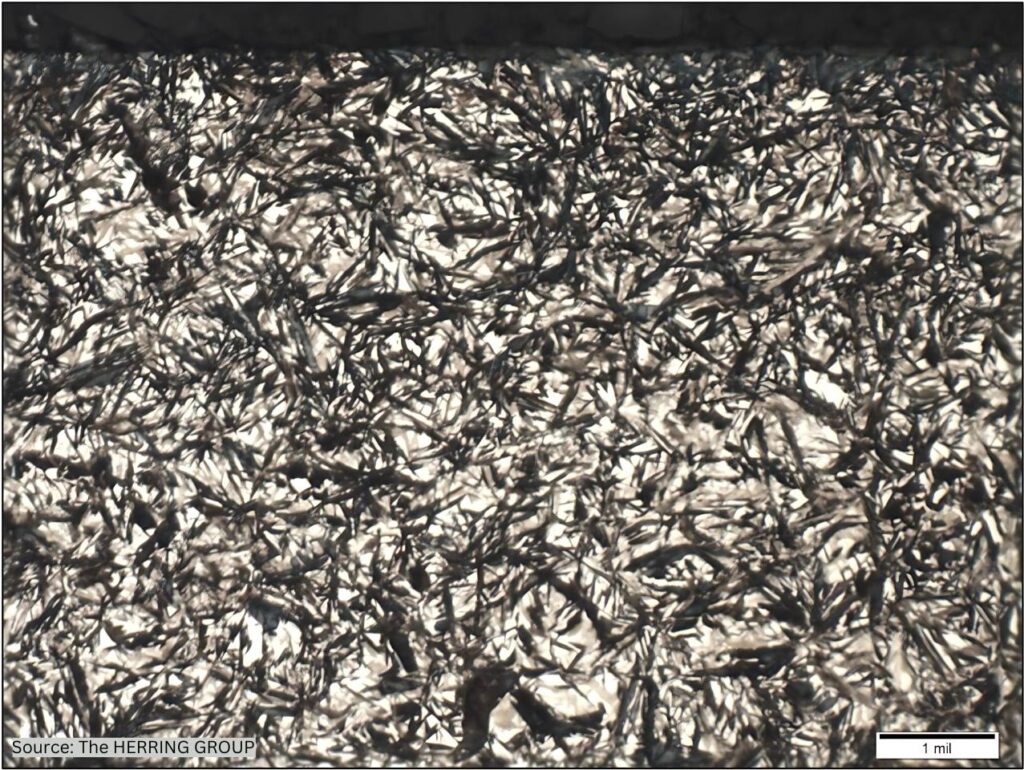

Find Heat Treating Products And Services When You Search On Heat Treat Buyers Guide.Com


What Is Thermal Expansion? Read More »

Skip to content