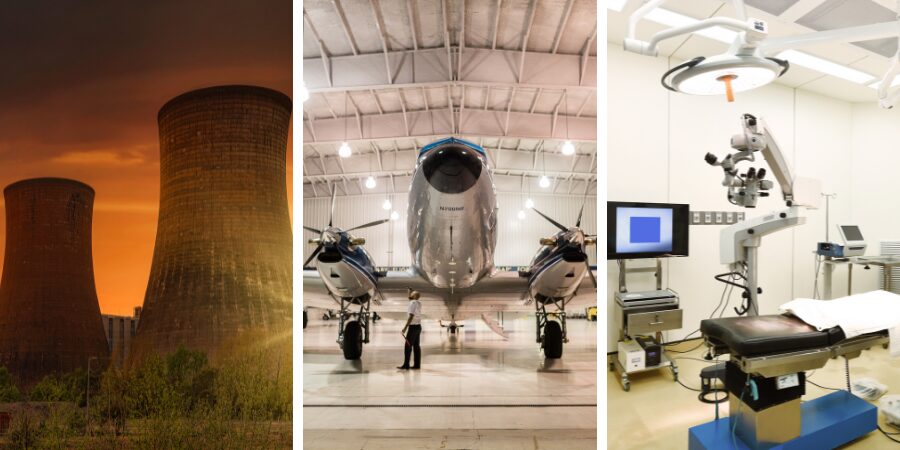
Hot isostatic pressing (HIP) is becoming essential to producing stronger, more reliable parts in aerospace, medical, and energy manufacturing. As these industries scale up, HIP technology is evolving to meet new size, performance, and sustainability demands. This Technical Tuesday installment explores the expanding interest and investment in HIP and how industry innovators are tackling challenges like large-scale systems, long cycle times, and surface cleanliness to unlock HIP’s full potential.
This informative piece was first released inHeat Treat Today’sDecember 2025 Medical & Energy Heat Treat print edition.
As a manufacturing process that enhances the mechanical properties of metal, ceramic, and plastic materials by uniformly applying high temperature and high pressure, hot isostatic pressing (HIP) techniques are essential when manufacturing high-performance parts for aerospace, energy and other industries. And, as these industries are poised for growth, the HIP market is expected to evolve alongside them. However, HIP industry challenges must be addressed by modern solutions before this advanced manufacturing process sees widespread implementation across these industries.
Still, significant growth is anticipated for the HIP industry over the next five years. A recent report by Verified Market Research (2025), Hot Isostatic Pressing Service Market Size and Forecast, states that the HIP service market size was valued at $2.25 billion in 2023 and is projected to reach over $35 billion by 2030.
According to the report, HIP technology drivers include the need for the development of more advanced materials and components in aerospace, defense, automotive, energy, and medical, where there are high standards for performance, reliability, and robustness. HIP processes, which eliminate internal flaws, porosity, and residual stresses, aid in the production of mission-critical parts in these industries.
For example, HIP can be used to increase the density of materials, remove flaws, and improve mechanical qualities of components, or to combine porous materials while enhancing microstructures to produce lightweight components for industries with energy efficiency initiatives.
HIP also serves as a post-process treatment to enhance the mechanical integrity of complex and high-performance parts made via additive manufacturing (AM) for use in critical applications. In addition, HIP supports the near-net shape manufacturing process as it increases the density and mechanical characteristics of near-net formed parts and increases the efficiency of the near-net shape process.
Aerospace and Energy Sectors Drive Interest and Investment in HIP
Cliff Orcutt Vice President American Isostatic Presses, Inc. Chad Beamer Applications Engineer Quintus Technologies
Doug Glenn, publisher of Heat Treat Today, spoke with various leaders in HIP sphere, including Chad Beamer, Cliff Orcutt, and Soumya Nag in early 2025.
Chad Beamer, applications engineer with Quintus, states that much of the interest and investment in HIP is driven by aerospace and energy: “In countries where there is investment in the supply chains for these sectors, there’s a good chance there’s going to be treatment equipment, including HIP, that supports the metallic structures and components they demand.”
The primary driver for interest in further development of HIP technologies is the need for high-performance components for use in the aerospace industry, according to Cliff Orcutt, vice president of American Isostatic Presses, Inc. (API). “Aerospace requires HIP technology to make parts,” Orcutt says, “In other industries you may be able to make parts with forging and other methods, but in aerospace technical requirements, HIP is likely part of the bill of materials.” This is especially true of larger aerospace castings — such as those over 60 inches, he says.
Additionally, recently developed guidelines are expected to help standardize the use of HIP technology in Ti-6A1-4V parts used in aerospace and other industries, according to Beamer. The newly released standard, SAE AMS7028, sets the benchmark for HIP of Ti-6A1-4V parts made via laser powder bed fusion (PBF-LB). The standard defines HIP cycle requirements, surface condition expectations, microstructure and density targets, and mechanical performance standards.
Ti-6Al-4V is ideal for the aerospace industry, where it is used for parts such as aircraft frames, landing gear components, fuselage components, and engine parts, due to its lightweight, high strength, corrosion resistance, and ability to be used in a wide operating temperature range.
According to Quintus, this standard is important because it brings the treatment industry one step closer to ensuring material integrity and repeatable performance in mission-critical applications in aerospace and other industries.
The energy sector is also interested in HIP technology for high-performing, large-scale parts and components across a range of energy-related applications. The U.S. Department of Energy (DOE) is showing significant interest in HIP and powder metallurgy HIP (PM-HIP) technologies and is working toward finding new applications for the process, which the DOE calls “an established, yet, in-flux technology.”
For reference, PM-HIP processes place metal powder into a mold or capsule and expose it to high temperature and high pressure so it fuses into a dense metal component capable of withstanding challenging conditions in difficult applications.
According to the DOE, PM-HIP may find application in the manufacture of near-net shape, complex and large-scale components for small modular reactor (SMR) construction because the process (U.S. Nuclear Regulatory Commission 2022) can help reduce the costs of materials and machining, eliminate the need for welds in some applications, and provide an alternate supply route and shorter turn-around time at a cost point that is equivalent to forging.
For example, there are certain large pieces for the small modular reactors, such as the top dome and the container itself, that could be made from powder metallurgy technologies, explains Orcutt.
And, the introduction of larger build plates will aid in making large-scale components via a variety of HIP-related technologies for both the aerospace and energy sectors, adds Beamer. “Larger build plates are suitable for large HIP equipment in toll HIP businesses and support structural castings and components made via AMD and PM-HIP,” he says. “PM-HIP is really starting to take off as we develop larger HIP equipment to produce larger PM-HIP-type components.
“There is demand in place to go even larger as the U.S. continues to address some of the supply chain challenges with forgings and castings,” says Beamer.
Beamer points to a DOE workshop held in October 2024 at its Oak Ridge National Laboratory (ORNL) in Knoxville, TN, where 200 attendees discussed the future of PM-HIP as a viable manufacturing technique for large-scale components that are becoming more difficult to source in the U.S. The workshop focused on several PM-HIP related themes, including:
Soumya Nag Senior Research Scientist Oak Ridge National Laboratory (ORNL)Jason Mayeur Senior Research Scientist Oak Ridge National Laboratory (ORNL)
modelling and capsule design
capsule fabrication and preparation
powder production
microstructure properties
large-scale HIP
economics and supply chains
PM-HIP standards
ORNL is interested in making advanced manufacturing techniques such HIP, PM-HIP, and AM more efficient and affordable because they are potential replacements for the conventional manufacturing techniques typically used to produce large parts, which are becoming more difficult to source.
“Across sectors spanning aerospace, defense, nuclear, oil, gas, renewables, and construction, sourcing large-scale components is an increasingly urgent challenge,” says Jason Mayeur, senior research scientist at ORNL. “The need is felt acutely in the U.S. where traditional techniques like casting and forging have declined or moved overseas and resulted in supply chain shortages.”
One ORNL project that is garnering attention is the application of Wire Arc Additive Manufacturing (WAAM), hybrid manufacturing, in-situ monitoring and advanced computational modelling to HIP technology to create molds faster and more accurately while leveraging established PM technology (ORNL 2024).
“PM-HIP is a pathway for diversifying the supply chain for producing large-scale metal parts that are becoming more difficult to source,” says Mayeur. “The technology is of particular interest to the nuclear and hydroelectric industrial sectors, as well as the Department of Defense.”
Soumya Nag, senior research scientist at ORNL, adds: “Additive manufacturing offers unique design flexibility, which, combined with the reliability of PM-HIP, can pave the path toward precise manufacturing of large-scale, custom and complex, energy-related parts, while also taking advantage of multi-material builds.”
The technology may be used in the nuclear, hydroelectric and aerospace sectors to manufacture large, complex components such pressure vessels and impellers with improved toughness and resistance to thermal fatigue.
HIP Industry Challenges and Solutions
While HIP technology can help ensure the construction of high-performance parts in mission-critical applications in aerospace, energy, and other sectors, there are challenges that must be addressed before widespread implementation.
Among them is a shortage of available, large-scale HIP systems needed to build the sizeable components for these industries. “There is definitely talk of bringing the supply chain back to the United States for large-scale components, which is creating a bit of interest in large HIP systems and, while these systems currently exist, there are not enough of them in the U.S.,” according to Beamer.
From developing lower-cost equipment to expanding toll HIP services, the industry has evolved rapidly since this 2023 analysis. Click on the image to read more about the foundation of today’s HIP evolution.
Orcutt estimates that there are approximately ten large HIP units currently in operation in the U.S. The main reason for the lack of large-scale HIP systems is the high initial investment required to purchase the HIP chamber, furnaces, gas handling systems, process controls, and other associated equipment, which makes it difficult for HIP service providers, many of which are small- and medium-sized businesses, to obtain the equipment.
In a July 2023 Heat Treat Today article, Orcutt said that while his company is developing lower cost equipment that will provide excellent results, they are also expanding into the toll HIP business with goals of lowering costs and providing faster turnaround. Furthermore, API has opened a facility in Columbus, Ohio, to “provide a world-class development resource to help interested manufacturers determine whether the process can be applied to their parts.”
Long HIP cycles, which involve stages of heating, pressure and cooling, are another major obstacle to the adoption of HIP. In the same 2023 HTT article, Beamer said to overcome this challenge Quintus developed a large-format HIP unit that consolidates heat treatment and cooling in a proprietary process, called High Pressure Heat Treatment (HPHT), that combines stress-relief, HIP, high-temperature solution-annealing, high-pressure gas quenching and subsequent ageing or precipitation hardening in one integrated furnace cycle.
These capabilities allow multiple functions to be performed at a single location — removing bottlenecks, saving energy, lowering capital costs, significantly reducing lead time, and enhancing product quality — while Quintus’s Uniform Rapid Cooling and control systems with digital connectivity enable repeatable performance of customized heating, densification, and cooling regimes.
Additionally, many industries demand surface cleanliness. This can be difficult to achieve as the HIP process relies on high pressures using high-purity Argon gas, which can result in oxidation and discoloration of the materials. This is not an easy challenge to overcome, according to Beamer. However, he mentions that Quintus has been working to reduce discoloration and oxides on the surface of parts by improving equipment and best practices in terms of clean HIP operations.
As these technical challenges are ironed out, standards are developed, and larger build plates and HIP systems become more commonplace, HIP and related processes will find more application in heat treatment of mission-critical and large-scale parts for sectors such as aerospace and energy, where high-performance and reliability are mandatory.
U.S. Nuclear Regulatory Commission. 2022. The Use of Powder Metallurgy and Hot Isostatic Pressing for Fabricating Components of Nuclear Power Plants. Washington, DC: U.S. Nuclear Regulatory Commission. https://www.nrc.gov/docs/ML2216/ML22164A438.pdf
Verified Market Research. 2025. Hot Isostatic Pressing (HIP) Service Market Report (Report ID 383567). 202 pages. Published February 2025.
This piece was written by the Heat Treat TodayEditorial Team.
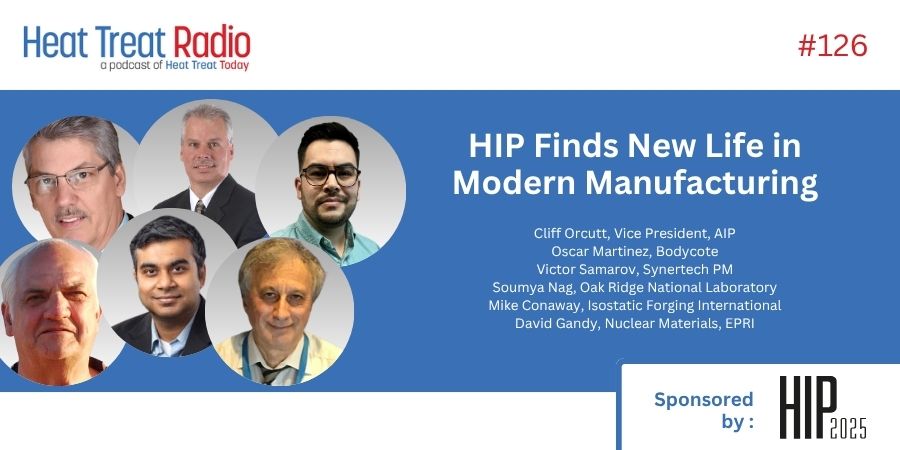
Hot isostatic pressing, or HIP, is experiencing a powerful resurgence across industries from aerospace to nuclear energy as manufacturers look for new ways to scale up. This panel of HIP experts explores how renewed investment, government collaboration, and additive manufacturing are driving HIP’s next era of growth. From large-scale production to powder-to-part innovations, discover why this decades-old process is suddenly critical to the future of U.S. manufacturing.
In this episode,Heat TreatRadiohost, Doug Glenn, is joined by Cliff Orcutt, American Isostatic Presses, Inc; Oscar Martinez, Bodycote; Victor Samarov, Synertech PM; Soumya Nag, Oak Ridge National Laboratory; Mike Conaway, Isostatic Forging International; and Dave Gandy, EPRI.
Below, you can watch the video, listen to the podcast by clicking on the audio play button, or read an edited transcript.
The following transcript has been edited for your reading enjoyment.
Introduction (00:05)
Doug Glenn: Welcome everyone to another episode of Heat Treat Radio. We have gathered a panel of experts to discuss hot isostatic pressing (HIP). I’ve asked the panel to bring us up to date on the latest developments and trends in the HIP market.
I want to jump into the questions here quickly so we can move through and let these experts do the talking. But I want these six gentlemen to very briefly introduce themselves.
Cliff, go ahead with your background, please.
Cliff Orcutt: Yes, I’m the vice president of the American Isostatic Presses. I’m also chairman of the International HIP Committee. I’ve been in isostatic pressing over forty-five years. I started building equipment and then began installing it. Now I’m mainly selling it. Our company is a small company which has supplied equipment to forty countries around the world.
Doug Glenn: Okay, very good. Victor, how about you?
Victor Samarov: I work for Synertech PM Technologies. My background goes back to the Soviet Union in Russia where I got my education and started to get involved in powder metal technology and HIP. I’ve been a part of pioneering the sophisticated and challenging tasks of building jet and rocket engines from powder materials and, since 2000, working in the United States in near net shape and net shape HIPing of parts and materials for critical applications.
Doug Glenn: Alright, thank you. That’s great. All right, Soumya, how about you?
Soumya Nag: Thanks, Doug, for having me. And good afternoon everybody. My name is Soumya Nag. I am a material scientist and metallurgist at Oak Ridge National Laboratory. I work on different types of materials and manufacturing processes to get large scale components.
The reason why I’m here is that I’m leading a big effort under the Department of Energy Office of Nuclear Energy’s a AMMT program — advanced materials and manufacturing technology program. This program actually looks at power metal HIP technology to make large scale components.
Doug Glenn: Super. And we’re going to talk about large scale things in a little bit here. Mike, how about you?
Mike Conaway: I’m the managing director of Isostatic Forging International, and we own operate and technically support about fifteen HIPs around the world.
I’ve had a lifetime involvement with HIP equipment design, construction operation maintenance. I started at Battelle when I was nineteen years old, I think. Cliff has got me beat on the youth point and maybe on a few other points too. Except for six years as a Navy pilot, I’ve done nothing else except HIP my entire life.
Our current development efforts are very large HIPs and very small HIPs at the lab scale tailored for additive manufacturing.
Doug Glenn: Appreciate your service, by the way, in the Navy. That’s great.
Mike Conaway: Well, it was great fun. Great to look back on.
Doug Glenn: Super. David, how about you?
David Gandy: Yeah, I’m a principal technical executive in EPRI’s nuclear materials areas. Doug indicated my background in metallurgy and welding for, I guess, the last fifteen years or so. I’ve spent time in advanced manufacturing looking at a variety of different topics, including PM and HIP. I have been in the business for a little more than forty years.
We’re all getting a little gray.
Doug Glenn: All well experienced, well-seasoned. All right, Oscar.
Oscar Martinez: Oscar Martinez. I’m the youngest of the group and learning from everybody here. I’m the regional sales manager for HIP North America, so I cover six different facilities in the North American market. I’m a metallurgical engineer by background. I have been in the oil and gas industry for about eight years with fader analysis and then jumped into HIP and product fabrication. Happy to be here; thanks for the invite.
Doug Glenn: Appreciate you joining us.
A New Renaissance of HIP? (7:41)
The first question really deals with what has been bringing interest back to back to HIP. It seems like a lot of what we’re hearing about HIP processing deals with 3D printing and additive manufacturing.
Is that the primary driver of the new renaissance of HIP?
Victor Samarov: No, I wouldn’t say so. Basically, there are three areas of “HIPing.” The first has been rising steadily through decades, and that is HIPing of castings. You take a bad casting and bring it to the level of a better material by healing porosity cracks and changing the microstructure.
The second area, which you mentioned, is 3D printing, which is, to some extent similar. HIPing of 3D-printed parts is similar to HIPing of castings, but there is more emphasis not on healing porosity but on changing the microstructure and making it more uniform and homogeneous. However, the parts are much smaller by far, and the share of the market is not large. Bodycote and others probably have a better understanding of this.
The third area is making parts from powders, which has been steadily at a relatively low level. This is because the only major industries interested in this have been aerospace, rocket engines, and oil and gas, all of which are well developed in Europe and Sweden. For example, there’s a company that has been doing very large parts for that for decades.
Recently, I mean the last fifteen years, we have to thank not only the Department of Energy (DOE) but David Gandy who was an enthusiast and a pioneer pushing this technology forward. There is much more interest from the nuclear industry in replacing very heavy forgings, which take years to fabricate and still usually are not good quality, by powdered metals.
This leads to open doors in many other aspects because most of the nuclear parts are large, and many of them are larger than the existing HIP furnaces. So large that it requires 4 meter, 3 meter, 5 meter, etc. — we can discuss. So, the new driver to PM HIP is mainly from the nuclear industry with large parts since they bring a lot of technical problems, serious problems.
This is very important, and this is the major perspective for HIP: rockets engines will still be there, aerospace will still be there, but nuclear is a new horizon.
Doug Glenn: David, what’s driving the new renaissance from your perspective? It seems that there is somewhat of a renaissance of HIPing, more activity. The nuclear market, will you address that?
David Gandy: Certainly the nuclear area. We are looking to build quite a number of reactors over the next 30 years. In fact, we’re discussing 600 to 800 gigawatts of new build, which is quite enormous compared to what we have today.
Much of this activity is being driven by things like data centers. There’s a lot of construction of data centers planned over the next ten years even, but certainly it will continue to grow. There’s a lot of additional power that is needed for things like electric vehicles. There’s a bit of work going on around that.
In general, as we modernize our world, electricity certainly becomes more in demand, and we have to meet those demands. The other part of this is just looking at carbon issues and trying to reduce the overall carbon footprint in the world. Nuclear electric power provides a very clean generating product that can be used throughout the world.
Doug Glenn: Larger parts seem to be a driver in HIP as well.
The issue with getting larger HIP parts is actually building the equipment to carry out HIPing because, as the equipment gets larger in diameter, for example, the complexity and the engineering of it becomes extremely difficult. Soumya, can you address this aspect?
Soumya Nag: There are very different aspects to what we are referring to when we say large parts. As you mentioned, in terms of whether you can HIP large parts, that is obviously a drawback. The other is, as you go into more complex parts or one-of-a-kind parts, can you make it cost effective and can you make it perform as well as your cast-forged counterparts?
That’s a big question. We have a sizable team at Oakridge working on looking at U.S. domestic manufacturing resilience. Can we actually make customized parts by different manufacturing modalities and use different materials that could fit to that manufacturing scheme to produce components that are built to perform the way you want them to?
PM HIP forms a big part of that portfolio. Using additive manufacturing along with PM HIP, which we call convergent manufacturing because we are converging two different manufacturing modalities using similar or even disciplined materials, is something that we are extremely focused on.
Now what is advantage of additive manufacturing? The big advantage to additive manufacturing is design flexibility and customization of the parts, which helps your end product. Like Victor mentioned, all aspects of PM HIP are still good in terms of the densification, powder consolidations, and other factors, that are still as you would expect it to form.
You are basically coupling a kind of technology: first, a newer process in the case of additive manufacturing with, second, one which has greater flexibility, that is PM HIP, a relatively well known technology.
Click below for HIP technical articles
Doug Glenn: Let’s talk to the guys who are out there selling this process and/or building the equipment. First, Oscar, what are you seeing? What are the toll processing changes?
Oscar Martinez: The majority of what toll HIP service is going to see is castings by a magnitude of 60 or 80% of the business as a whole as of now. I have seen a lot more over the last couple of years on 3D printing and additive manufacturing.
I do want to say that additive manufacturing has been growing in different markets as well. In the medical market, it is a little bit more established. We have seen the medical market take on some of the porous coating and those new technologies that help. Within the aerospace market, I think it’s getting closer and closer to being more of a critical component.
There is still a gap between those two industries. However, the business is starting to grow. For companies that are doing this, I’m noticing they are increasingly starting to get involved in having additive manufacturing either in-house with their own machines or through a sub-contractor. I do agree that in the near future castings are always going to be predominantly the factor.
The last aspect is there has to be a cost analysis. Your absolutely right on this, Victor. I’m seeing it on the additive manufacturing side; they want to implement rapid cooling and they want to implement different cycles and different properties to get various properties from the material itself. However, there’s a difference whenever we’re talking about toll HIP service. If they want to do those, then those fall into dedicated cycles, which are much more expensive.
So, there has to be a kind of in between where we consolidate features and processes, because price is going to be the leader in terms of how fast it grows in the market.
Doug Glenn: Mike, what are you seeing in your organizations?
Mike Conaway: We’ve run about 250,000 HIP cycles, and 95% of those are castings.
To lay the foundation of what we consider a small or large part: to me a small part is something that’s less than 8 inches in diameter, a medium-sized part is maybe 2 feet, and current large parts are about 5 to 6 feet in diameter, though we are now trying to make parts that may be as large as 12 or 15 feet in diameter.
We have to have some idea of what scale we’re talking about of these parts. That being said, we are essentially all castings, with very little powder metal.
Doug Glenn: Cliff, any drivers that you’re seeing for HIP?
Cliff Orcutt: The main driver is that as the world keeps advancing and as we have higher technologies and computers with FEA and so forth, we’re looking for stronger, lighter, faster materials.
The performance of materials in general is increasing throughout every industry, whether that’s a car or an airplane or a printer. Also, the technology is spreading worldwide faster because communication and the internet. I believe the United States used to have the lock on HIP, and now China and Russia and other places are all on par with us. It’s spreading throughout the whole world, and it snowballs too.
Initially, it was slow, but now it’s snowballing faster and faster. 3D printing is an exciting technology that has brought about new applications, but I think even other applications are just growing faster and spreading.
The Origin of HIP (20:12)
Doug Glenn: Is the origin of the HIPing process U.S.-based?
Mike Conaway: It’s like asking, “who had the first airplane?” Everybody agrees it was the Wright Brothers. Similarly, it’s agreed that HIP was invented at Battelle Memorial Institute in Columbus, Ohio. I came to Battelle a few years after it was invented, and I was in on the industrialization of the process. Obviously, some serious work has been done in Russia and China, but that’s where it came from. That’s where Cliff’s father and I worked together — at Battelle — and we consider ourselves “Fathers of the Industrialization of the HIP Process.”
Doug Glenn: You’re not going to take credit for creating it, though, for the internet?
Mike Conaway: No, no, that was Edwin Hodge, Stan Paprocki, and Henry Saller.
Doug Glenn: Well, your humility is showing through here, Mike.
HIP Worldwide (21:37)
Doug Glenn: Let’s address how the technology is spreading across the world.
Are there any major new players either on the manufacturing of equipment side or the use of the equipment side around the world?
Cliff Orcutt: There are both players, manufacturing, and end users. As far as manufacturers, we’re now seeing there are five Chinese domestic manufacturers. There are new ones in Russia, Korea, and India. There’s also a major player in Spain; that’s Hyperbaric. They have been building high pressure equipment, but not necessarily HIP. We see companies like that opening up and starting to build. We don’t know which ones will survive, because HIP is an up and down market. We’ve seen some companies come and go — vacuum generators, and on and on. We will see how it will all play out.
We have seen new manufacturers, as far as users or toll producers. There are large companies in China now starting up. Korea has some, India is probably the next big market, maybe ten years behind.
Victor Samarov: I want Cliff to add more, because Cliff has wonderful stories. We’re talking mainly about metals, but Cliff is a great proponent of ceramics, and ceramics not only has great applications but requires different HIP equipment for high temperature and for high pressures. Ceramics is also the future.
Cliff Orcutt: Yes, we do see a lot of ceramics. Everything from braces and teeth to ball bearings for electric motors, boron carbide armor, military applications, hafnium carbide, and odium carbide. Those things are coming.
One of the hindrances to HIP is the cost of raw materials. People tell us, if you could make silicon nitride powder cheaper, we’d HIP everything out of silicon nitride.
Soumya Nag: One thing I wanted to add is we talked about HIPing cast metal parts and several materials: HIPing is also used to densify or “heal” additive parts as well. You can look at an AM part, and we usually go through a HIPing process to kind of heal what we call the lack of fusion type of porosities, or even in some cases the gas porosities work as well if your operating temperature is not too high where the gas can come out again. HIP is being used for a lot of use cases for castings. You can actually HIP using powder for alloys that cannot be forged. So that’s another specialized use case for HIPing as well.
Interactions with the DOD and DOE (25:16)
Doug Glenn: Let’s jump into discussing how the DOD and the DOE are pressing hard on the industry to come up with a 4-meter HIP unit.
David, can you tell us what the driving force is here, what we’re trying to accomplish, and why it’s a challenge?
David Gandy: So much of this started back around 2017 when we started a DOE project. In that DOE project, we were looking at utilizing the new scale reactor design to try to produce components out of powder metallurgy HIP. We worked with Syntech quite a bit in that area, trying to build large components like the reactor head and other parts throughout. Those, ultimately, would go to about 10 feet in diameter. We are currently restricted right now by the size of the HIP units that we’ve been working on, so we’re only making things on the order of 60 or 70 inches.
The real driver there comes out of our success in producing very large components that are near net shape — we would like to be able to expand that to be able to do very large parts. The 4 meter came from a little bit of the work around the projects with the Department of Energy (DOE). It also came from DOD, which was beginning to look at whether we can actually make big parts for nuclear reactors that sit on a submarine, an aircraft carrier, or another boat.
How do we actually make some of those large parts? There is quite an interest from the DOD and from the DOE in trying to really push the technology. We kind of settled in that 4 meter range; it might be a little bigger, it might be a little smaller, but to make some of the large parts that we’re talking about, we need to have a much larger HIP unit than is available today.
Doug Glenn: Are the larger parts for a nuclear reactor specifically or are we talking about a variety of different large parts?
David Gandy: Parts of them are for the nuclear reactor, but there are a number of other components, like large valves or large pump housings — many different components that could be produced with this technology.
Doug Glenn: What are the main impediments to a 4 meter HIP unit?
Cliff Orcutt: Like anything that’s new, there are unknowns, and the big one is the ROI along with the cost of doing something on that scale. Many of us are looking at it; companies such as Bodycote are considering larger units and MTC is considering larger units. The U.S. government at one time had the largest HIP in the world. Now it’s owned by Japan. We are hoping the U.S. government will step up and try to do a large project again.
“There’s unknowns and the big one is the ROI and the cost of doing something on that scale.”
We went to the moon and we did other things, but we’ve kind of pulled back. We hardly have large forging capability in the U.S. anymore, and we need to invest in these kinds of technologies and push this forward.
David Gandy: I’d like to build just a little bit on what Cliff said. In terms of building reactors in the U.S. to support the civil fleet — the civil nuclear reactors — quite frankly, we don’t have the forging capacity in the U.S. that we once had to do that.
So this would actually supplement the forging capabilities and allow us to reshore some of those capabilities in the U.S.
Oscar Martinez: That is a good point, David, and it is part of where PM HIP will jump in and bridge the gap between the two.
One thing I wanted to mention regarding what Cliff said about the ROI is that the biggest factor for HIP companies — like Bodycote and others out there — is making sure that we have the nuclear side. We have already seen what the ramp up is going to look like and everything.
For us, if a HIP unit is not running, it’s not making money. So, we need to make sure that HIP unit is always running, and that it’s going to pay for itself. With these large units, the price of it doesn’t just double from previous one, it exponentially goes up.
Victor Samarov: Double? It’s quadruple!
Oscar Martinez: I know the DOD and DOE are working closer together to have more synergy in terms of what components they need to process. But I also think that in the industrial side of things, like general industrial, anything with heavy equipment, any of those components that probably were not something liable to use of HIP because of the size or price, it would be good to start looking at how we can incorporate those other markets to see if they would also use some of that equipment or those HIP services for their equipment.
David Gandy: On the DOD side of the house, we have something called AUS, which is the agreement between Australia, the U.S., and the UK, wherein we’re actually going to be building quite a number of ships and submarines over the next few decades. That’s going to change the way we look at our supply chain. In trying to build these components, we need to have additional forging, casting, additive manufacturing, and HIP capabilities — we need to have it all. It cannot happen without a number of different technologies engaged.
The Path to Commercial (34:00)
Doug Glenn: In discussing these additional needs and supply chain logistics, Victor mentioned that the commercial viability of the 4 meter is difficult. Victor, could you expand?
Victor Samarov: If ATLAS HIP appears tomorrow, we’re ready to make parts with it. There is powder supply and we know how to make the casts. With some small underwater stones, we can make the parts, but we’ve been waiting for this HIP system for at least ten years.
“If ATLAS HIP appears tomorrow, we’re ready to make parts with it.” -Victor Samarov
There is no commercial company to build it, and there is no commercial company to order it unless it’s the U.S., Chinese, or Korean government. The technological idea is based on very advanced developments done by EPRI and other scientists in joining already manufactured power parts.
We did try it already. We made very large parts that were cut in half and then joined by electron beam welding. It may be this faster route to provide U.S. industry with very large parts: first make parts as large as they can be and then electron-beam weld them.
Working with David Gandy’s new scale projects, one part was so large that we had to split it into six segments. So, we made the segments and then they were successfully electron-beam welded. Practically, we were keeping all the advantages of powder metallurgy and HIP: lead time, material quality, faster development, so on and so forth. So, this may be a very viable direction.
Doug Glenn: Mike, is that the path to commercial viability?
Mike Conaway: I’m not quite sure. I call it jumbo additive manufacturing where you make these parts that have to be cut apart in, in concept, and then put together physically — that’s the additive manufacturing of jumbo parts. I think it’s a great idea.
We are looking at the same sort of idea. To make a very large HIP, we would make it as a composite of segmented pieces that fit together. We call it the Lego HIP. That’s an approach, and we’re still working on that.
Oscar Martinez: To add to something Cliff mentioned about going in between. We’ve talked about ATLAS, and I think Victor mentioned it too.
From a commercial standpoint, I think it would be beneficial for us to venture into a kind of in-between size that does give us capabilities and proves out what we have to do. That would be probably a step in the right direction of where we need to be, because it will cover a lot of the components that we are not able to see.
The oil and gas industry also has some components, and even on the IGT and aerospace side, if we go in between on some of those things, they will then design based on that size. If we’re looking at just commercially what HIP unit makes most sense for us to run, toll HIP services is always going to be between the 30 to 45-inch zone because it is able to fill in quickly.
But again, that’s the biggest challenge. If we to go to an in-between larger component, what else could we bring in there that we could run all the time and make commercially viable for whoever jumps in — whether it be Bodycote, anybody else, or a collaboration — that it actually makes sense to be used.
Cliff Orcutt: From an economic standpoint, if you’re only building one 4 meter HIP and you have to decide whether it goes to the East Coast or West Coast — that’s a tough decision. But if you build a couple 2 meter HIPs, you could afford to put one on the West Coast and one on the East Coast, and you solve not only the submarine building on the East Coast, but you might solve some of the SMR building on the West Coast.
Doug Glenn: Or you put a 4 meter HIP in St. Louis and that takes care of it all.
Cliff Orcutt: If you can get it there.
Doug Glenn: Yes, if you can get it there, correct.
Powder to Part (37:05)
Doug Glenn: Let’s talk about powder to part. What is it, what current processes might it replace, and what are the obstacles to using it?
Soumya Nag: At Oakridge, we are testing whether you can actually make custom powders, scale up that powder production, and then utilize PM and AM, or different type of modalities, to make large-scale parts or customized parts. With powder to part, you have a powder and you have a certain chemistry specification for that powder. Can we actually find out whether we are going to have a PM HIP as a plausible way to make the part out of it? Make a mold, fill it up, and predict how the part will behave in the post-HIP, the machine changes, etc., and then inspect the properties.
One more caveat: When we talk about powder, where is the powder coming from?
We have to look at the feed stock that has been used to make the powder and ask: What is the chemistry of the powder? What is the shape of the powder? What’s the flowability of the powder? The physical and chemical properties of the powder itself?
Doug Glenn: Dave, what appears to be the most promising avenue to bring this about?
David Gandy: Well, I think one of the things that you’ve really got to consider for powders is powder cleanliness.
We’ve worked quite a number of years on trying to reduce things like oxygen in the powder so that as you consolidate that component, you don’t end up with oxides that are trapped at the grain boundaries or prior particle boundaries. It’s very important that we get powder manufacturers to work with us to bring the technology forward.
Understanding the molecular chain of powder: reducing oxides “Reduce things like oxygen in the powder so that as you consolidate that component, you don’t end up with oxides that are trapped at the grain boundaries or prior particle boundaries.”
In addition to that, if we start making very large parts in a 4-meter HIP unit, we’re going to have to really scale up our powder production capabilities in the U.S., and quite frankly, that’s not happened at this point.
Doug Glenn: They’re not going to want to upgrade their powder manufacturing if there’s not a market for it.
Victor Samarov: Yes, exactly. One really large part may need a hundred thousand pounds of powder in it. We have already completed these calculations. I completely agree with David.
One more piece I want to add: From powder to part, all the processes, except HIPing and maybe ceramic, are based on melting the material and then giving it some shape. Cast and rot investment casting, even additive manufacturing, is based on melting every particle. However, when powder metallurgy started in the ‘80s in the U.S. aerospace industry, the basic advantage it was looking at was the quality of the powder particles themselves. As you know, as heat treaters, the maximum cooling rates in cooling the billet are some hundreds of degrees per minute. But the powder particle crystallizes, and it crystallizes at the rate of 10,000 degrees per second because of its very tiny size. So, it can freeze almost any type of unbalanced metastable microstructure in it.
HIPing is a solid-state bonding process. Nothing is melting in HIP. This means that during this process, we can retain this unique microstructure of the powder particles and then create and transfer this to parts of any size. For steel alloys, it may not be so critical, but for nickel base and some other alloys it’s absolutely essential.
The caveat here is that going from powder to part via HIPing, you can create very large parts with unique properties brought by the rapid solidified powder particle materials.
Doug Glenn: Mike, anything you’d like to add on the powder to part?
Mike Conaway: No, I don’t have anything to offer much there.
We’re intrigued with the additive manufacturing. Our focus has been on the binder jet that’s based on sintering where I think it offers a lot more advantages than it does to the laser fusion approach.
Oscar Martinez: From our end, we’ve been doing this for a while already in Sweden with the oil and gas industry being a major, almost an established, process. However, one thing that I did want to bring up is not only is there a challenge with the current powder suppliers in the U.S. — there is some movement in terms of bringing new suppliers —but whenever we’re discussing some of these components being so critical, where the powder is coming from is going to also be critical. As David mentioned, just as much as the HIP needs to be ramped up and that large unit needs to be built, just as quickly we need to do the same thing with the powder suppliers as well. If we need to keep it in-house, the U.S. is going to have to grow very quickly as well.
Doug Glenn: Much of what was discussed at Oak Ridge recently by the DOD and DOE was about bringing home the supply chain, including powder production.
Cliff Orcutt: The technology of making parts concerns how to model those parts and how to predict shrinkage.
There’s people that understand it but making it more accessible to companies is key to expanding the market for it.
David Gandy: We are currently working with Oak Ridge National Labs and a few others to look at bringing modeling to your laptop, basically to allow you to do modeling for the HIP process, very similar to what maybe you do with forging technologies today, where you can have that capability to design as a conventional engineer. What we’re trying to accomplish in working on this project is really looking at how we make modeling more mainstream for industry. As you make the modeling portion of this more mainstream, then the HIPing technology becomes more mainstream. The more people are exposed to it, the more people are engaged in it, the more companies want to work with it. I’d also like to thank Victor Samarov because Victor has certainly been a huge proponent of this and of trying to help move the technology forward.
Oak Ridge National Lab (48:07)
Doug Glenn: Soumya, I understand Oak Ridge National Laboratory has taken an active role in the PM HIP market. What exactly are you guys doing there what are you hoping to accomplish?
Soumya Nag: We want to make components that are relevant towards nuclear in the DOE space as well as national security in the DOD space. That’s where the drivers are.
The first thing I want to mention is that we don’t want to replace your traditional manufacturing, casting, or forging by any means. As Dave was mentioning, the need for production is going to ramp up so high within the U.S. that we will need alternative manufacturing pathways to really augment some of the troubles we have on supply chain side.
PM HIP is one of the technologies that we have chosen. Under PM HIP, we have done three things. First, can we actually use an AM, what we call a directed energy deposition process or WAM, our AM process, where we are basically making these five mile long wells that are used as a shell for the outside surface. Can that withstand the temperatures, pressures, and times (i.e., a reactor or pressure vessel), can it actually withstand that cycle? So that was the big thing: Can the five mile long well actually withstand that temperature, pressure cycle, and then move or deform during the HIPing process without a failure?
Secondly, if you look at a traditional HIP cycle, what does that temperature, pressure, and hold time do to the material? Can you break it up into ramp up time, ramp up pressure, ramp up temperature, and then hold time, etc., and see microstructural changes, property changes, performance changes as a function of each of these segments that we use or take for granted for the HIP cycle. Those are more science-driven questions that we need to answer. Thirdly, where some of the challenges that we have encountered [with scalability]. When we did a PM HIP workshop here at Oak Ridge last year in October, we had about a couple of hundred people show up from academia, national labs, DOD and DOE, customers, stakeholders, etc. The question was, what is the scalability of a part when you go from a small to large part or small to a more complex part in terms of powder compaction, size and scale of the powders, property variations, and chemistry? That is another PM HIP question that we are trying to solve.
At the end of the day, the goal is to make sure that the industry can adopt this more freely and employ it for large scale production. Then, also giving them the option of using additive cans — a more customized shell. The good thing about AM and PM combination, if you choose that, is that you can use AM can as a “shell,” which you can remove afterwards or keep. When you keep it, you are basically looking at a HIP-clad type of option where you can use similar or dissimilar materials and depending on the functionality of the surface versus the core, you can utilize that combination of two materials with two different manufacturing modalities.
I think the workshop that we had in October last year was exceptionally well received from our end. It was driven for the voice of the customers — what does the customer want from us? What are the gaps and challenges around PM HIP that would really remove some of the angst that they have.
That was the first thing that we did, but we also had people from the powder side, from the modeling side.
Victor was leading the attendees, Dave Gandy was there giving plenty of talks about the need for PM HIP. Cliff was there talking about the utilization of HIP as a technology. We had industries from every bit of the segment come in and they wanted to help.
The thought was, can we actually take personal spaces out and then talk and have a cross interaction across industries to try to solve a problem on national level. Like Victor and Dave said, we need our government to instill the idea that this is an important technology for the country. Can we move towards this? We were facilitating that and saying what the voice of the customer is. This is what everybody wants. The demand is absolutely there. Can we actually build on it?
At the next workshop that we plan, we want to actually talk about real parts. We will be bringing in real parts to see how we can make it PM HIP. What are the success factors around it? I think that would be more end-product driven rather than the science part of the discussion.
Doug Glenn: Yes, more practical and specific and less theoretical, if you will, but not that it was all theory.
Soumya Nag: We have an active PM HIP steering committee with about twenty people from industry. Dave, Victor, and Cliff are a part of it. They have been tremendous in terms of providing us with guidance and seamless thoughts in terms of how we should move as an industry.
Doug Glenn: Is that next workshop scheduled?
Soumya Nag: Not yet, but that is in the planning process right now.
Doug Glenn: We’ll certainly help publish that when the time comes, so keep us posted.
Soumya Nag: We have a report from the first workshop that is in limbo right now, but we will publish it relatively soon.
It discusses what we learned from the workshop, the gaps and challenges, and how we should move forward. We have about a 60 to 65-page report that we compiled from that workshop. These are the demand signals for everybody that we compiled together.
Doug Glenn: Let us know if we can help you publish that as well and help you get it out to the right people.
Toll Manufacturing vs. Ownership of Equipment (55:47)
Doug Glenn: Cliff, let’s discuss the differences between toll processing and ownership of equipment. When it comes to HIPing, does it make sense for manufacturing companies to send their HIPing out to toll manufacturers or is it better to buy your own equipment?
Cliff Orcutt: That’s an economical question that you have to calculate and look at. Number one, if you only have one part, you’re not going to buy a HIP unit.
Evaluating the cost of toll processing versus purchasing your own HIPing equipment. Basic rule of thumb: use toll HIPing until you cannot afford it, then go in-house.
But if you have the quantity and the quality, and the cost works to the favor of owning your own HIP unit, then you should purchase it. However, if you also don’t have the floor space, location, people, or infrastructure to support it, then sometimes it’s easier to toll HIP. If you’re in the middle of nowhere and your parts are lead, and you can’t afford to ship them, then you might want to have your own HIP unit located in your facility. It’s important to analyze these aspects to decide if there’s ROI and if it’s the best way to economically make your parts.
Doug Glenn: Mike, what are your thoughts on toll processing versus owning your own?
You plan the investment for it. There may be tipping points, I don’t know how to quantify those. But I think that Cliff’s remarks are well taken. It’s a little bit complicated and you have to have a believer; let’s say you’re a user of HIP equipment and you’re getting it done by toll. Sometimes you don’t want to have it; you don’t have anybody in-house that has insight into HIPing and therefore is not a champion for it. I recommend toll HIPing until you can’t afford it, and then we go in-house.
Used Equipment Market for HIP (58:26)
Doug Glenn: Let’s discuss the International HIP Conference.
Cliff Orcutt: The 2028 conference is going to be held in South Korea in the town of Busan, very beautiful. And it’ll be a great conference, so we’re hoping to have over 200 people at it.
It will cover all aspects of HIPing, not just powder metallurgy, but it’s all the latest technology from the makers, the toll people. Everybody that’s in the HIP industry is usually there from all countries. Hopefully by 2028 we can have the Eastern Block Country there attending again as well.
Doug Glenn: If I remember correctly, it was in Columbus in 2022.
Cliff Orcutt: Yes, 2022 in Columbus, 2025 in Germany. It moves from USA to Europe to Asia every three years.
Doug Glenn: The committee is a group of people who have a common interest in putting this together.
Mike Conaway: Yes, it’s group of enthusiasts.
Doug Glenn: The most recent one was this year in Aachen, Germany, right?
Mike Conaway: Yes.
Doug Glenn: How many people attended that one?
Victor Samarov: Around 250.
Doug Glenn: HIP 2025 is currently on the website, and then when you’re ready, you’re going to have a HIP 2028.
Cliff Orcutt: It’s reserved, and it’ll be coming online probably next year.
The paper from 2025 has been released and made available to people.
Doug Glenn: Anybody else have any other comment on the HIP event?
Soumya Nag: It was my first time going there.
I felt that it was a great exposure to what the world is doing on the PM HIP side. Sometimes we are bottled down in what we are doing in the U.S., and we think we are doing the best thing in the world. That’s not true. There are countries who are superseding us and they have ideas and thoughts and future goals which are very possible for them to succeed. We want to make sure that we learn from them and really act upon that.
Cliff Orcutt: One thing we might want to mention is the Metal Powder Industry Federation, MPIF, for about 15 years has been promoting it as a green technology. I think that we all could agree that we should lean green, towards green things.
There’s less energy usage, less machining. It’s a near net shape technology, and so even if it does economically cost more, we still should look at it from that green aspect, I believe.
Doug Glenn: And you’re talking just about HIPing in general or PM HIP?
Cliff Orcutt: Mainly PM, but all forms of would be more of a green technology compared to your big carbon melting type technologies.
Doug Glenn: Good point, Cliff, thank you.
All right, gentlemen, thanks very much. I appreciate your time, your expertise, and it’s been a pleasure talking with you all.
About the Guests
Mike Conaway Managing Director Isostatic Forging International
Mike Conaway is the managing director at Isostatic Forging International. He began in the HIP field at 19 years old, where the process was invented and developed (Battelle Institute in Columbus, Ohio). Many consider Mike a pioneer in the business of HIP equipment: analysis design, construction and operations. He has ten issued patents related to high pressure design, and received the Lifetime Achievement Award by the International HIP Committee.
David Gandy Principal Technical Executive, Nuclear Materials EPRI
David Gandy is the principal technical executive in the Nuclear Materials sector for EPRI. He has 40+ years of experience in materials, welding, and advanced manufacturing. He is an ASM International Fellow and currently also is a member of ASME Section III.
Oscar Martinez Regional Sales Manager HIP North America, Bodycote
Oscar Martinez is the regional sales manager of HIP North America, Bodycote. He is a metallurgical and materials engineer with a degree from the University of Texas at El Paso. In 2022, he took his current position for the Hot Isostatic Pressure and Powdermet® divisions at Bodycote IMT, serving the North American market.
For more information: Contact Oscar at Oscar.Martinez@bodycote.com or visit his LinkedIn.
Soumya Nag Group Leader of Materials Science and Technology Oak Ridge National Library
Soumya Nag is in the group leader of the Materials Science and Technology Division at Oak Ridge National Laboratory. His research interest is understanding processing (additive and conventional) — structure (phase transformation across different length and time scales) — property (mechanical and environmental property) relationships in light weight and high temperature structural alloys.
Cliff Orcutt Vice President American Isostatic Presses, Inc.
Cliff Orcutt is vice president of American Isostatic Presses, Inc. and has been involved in more than 200 HIP installations in 25 countries over a 48 year span. Orcutt is Chaiman of the International HIP Committee , helping to organize the HIP22 and HIP25 conferences to spread HIP knowledge.
For more information: Contact Cliff at corcutt@aiphip.com or visit his LinkedIn.
Victor Samarov Vice President of Engineering Synertech PM
Victor Samarov is the vice president of Engineering for Synertech PM. He has a masters degree in mechanical engineering from MPTU in Russia and a Ph.D. and full doctor’s degree from VILS Russia. He has spent over 45 years in PM HIP, and has over 250 publications and over 50 issues patents. With more than 45 years of experience in powder metallurgy and hot isostatic pressing (PM HIP), he has authored over 250 publications and is the holder of more than 50 patents.
Over the past year, we’ve seen numerous new technologies in the way of research, new partnerships, and conversations throughout the industry. So in honor of today being #NationalTechnologyDay, we’re sharing an original content article about just several of these new technologies that are changing the work of heat treaters across North America.
Research
Using HIP to Advance Oregon Manufacturing Innovation Center Programming– “‘Today’s globally competitive manufacturing industry demands rapid innovations in advanced manufacturing technologies to produce complex, high-performance products at low cost,’ observes Dr. Mostafa Saber, associate professor of Manufacturing & Mechanical Engineering Technology at Oregon Tech.”
College Students Implement a NEW Heat Treat Solution with Induction? – “‘We were in shock,’ Dennis admitted, ‘because we didn’t expect it to [work].’ The expectation, Dennis continued, was that something would go wrong, like the lid would not be able to clamp down, or the container would leak.”
The Age of Robotics with Penna Flame Industries – “The computerized robotic surface hardening systems have revolutionized the surface hardening industry. These advanced robots, coupled with programmable index tables, provide an automation system that helps decrease production time while maintaining the highest quality in precision surface hardening.”
Heat Treat Radio: Five experts (plus Doug Glenn) discuss hydrogen combustion in this episode. An easily digestible excerpt of the transcript circulated by Furnaces Internationalhere and is available to watch/listen/read in full for free here.
Heat Treat Radio: Get on-the-ground projections of what technologies Piotr Zawistowski believes will be bringing in the future. Watch/listen/read in full here
Heat Treat Radio: HIP. The Revolution of Manufacturing, that is, according to Cliff Orcutt. Watch/listen/read in full here
Heat Treat Radio: Will indentation plastometry find its way into North America? If you’ve been listening to James Dean, it seems like it already has. Watch/listen/read in full here
Heat Treat Radio: Fluxless inert atmosphere induction brazing. That’s a mouthful! But what is it? Watch/listen/read in full here
Heat TreatToday publisher Doug Glenn discusses hot isostatic pressing with Cliff Orcutt of American Isostatic Presses, Inc. Learn about the revolution that is occurring in the heat treat industry and how it is being used across various manufacturing industries
Below, you can either listen to the podcast by clicking on the audio play button, or you can read an edited transcript.
The following transcript has been edited for your reading enjoyment.
Doug Glenn (DG): First off, Cliff, I want to just welcome you to Heat Treat Radio. Welcome!
Cliff Orcutt (CO): Thank you.
DG: If you don't mind, let's give our listeners just a brief background about you.
CO: It's been 43 quick years in the industry. I, actually, did start as a child. My father was one of the original people at Battelle where it was patented in the '50s, so, I grew up under that. Right out of school, I went to work for his company, after he and another gentleman left Battelle, Mike Conaway, and they formed Conaway Pressure Systems. By the time I was 20, I had already installed 10 HIP units around the world and helped design and build the Mini Hipper.
I was involved in 1978 in moving the world's largest HIP unit from Battelle to Crucible Steel in Pittsburgh, which is now ATI. Also, in 1979/80, we installed the very large system for Babcock and Wilcox at the Naval Nuclear Fuel Division in Lynchburg, VA. Both of those units, 40 years later, are still running.
I'm also past president of the Advanced Materials Powder Association, part of MPIF, and I was also a director of their Isostatic Pressing Association. I am currently the chairman of the International HIP Committee. We put on the triennial HIP conference every 3 years.
DG: Is that part of APMI?
CO: It's actually its own group. It was formed by all of the people in HIP around the world, in Europe and Japan and the United States back in, maybe, 1983 or so.
DG: What's the name of the organization?
CO: It's called the International HIP Committee. It's kind of a loose organization which the only thing that we do is put on this conference and we bring in speakers from around the world and promote HIP technology, basically. Our last one was in Sydney, Australia in 2017. We were supposed to have one in October 2020 and now it's pushed until September of 2021.
DG: Where will that be?
CO: It's going to be in Columbus, Ohio because that was the original founding city. Every other conference, we move to the United States, Europe or Japan. So, it's coming back to the US. I'm in charge of it. We have some other good people on the board, including Mike Conaway, who was one of the original Battelle people. Victor Samarov is on the board helping us with the meeting, programming and so forth. People can visit www.hip2020.org to see information on that.
DG: I got you a little distracted on that. Keep going with your background.
CO: Personally, in these 43 years, I've installed over 200 units, hands on. I've flown about 5 million miles, I've been to 38 countries; you name it, I've been there, good ones and bad ones. In my early years, when my father started this company, they pulled about 6 people out of Battelle and they were, basically, my teachers. So, instead of going to educational school, I went to HIP school. We had some of the top people: Roger Pinney, Hugh Hanes, Don Woesner, Gary Felton and another gentleman, Bob Tavnner, all came out of there.
In 1979, my father passed away, and his company then sold to ASEA who then became ABB who then became ABB Flow and then they became Quintus now. That's how they have a location in Columbus, as well.
A couple of people, including Bob Tavnner, left and formed International Pressure Service. That was in 1983. They hired me as operations manager, and we grew to be a force to be reckoned with and the Japanese then bought us. At that time, Rajendra Persaud, or Reggie we call him, left and formed AIP (American Isostatic Presses) and I said, “Hey, Reggie, let's have a two person company again rather than two one-person companies.” That was 1992 and so, 28 years later, now we're a force to be reckoned with again.
DG: Tell us a little about AIP.
CO: American Isostatic Presses, when the Japanese bought us, we had a lot of technology and a lot of good people. Then they hired a new CEO and he decided he didn't want to continue building HIP units, he wanted to do something else. So, Reggie formed AIP and I joined him and we pulled 5 other people back from ITS. We sold our first big job in 1994 to Horus in Singapore, a multimillion dollar job, and took off from there and haven't looked back. We started on a shoestring, no venture capitalists, no dollars, and now we have 4 buildings and locations around the globe.
"We're just a high tech blacksmith, that's all it is. Instead of hitting something with a hammer, we're using gas pressure to squeeze on it."
DG: How many units do you think you guys have installed since 1994?
CO: As AIP, around 150. It's snowballing. In the last 5 years, we've sold 5 big units. Up until that time we were mainly mid and small. We had orders for some big ones but, unfortunately, we couldn't get export licenses for them. The technology that grew out of Battelle was based on nuclear fuel rods for the submarines. Admiral Rickover wanted to extend the life of the sub, so it was protected for quite some time. And then they also had missile nose cone technologies it was used for and that's still what they're protecting it for is missile nose cones.
We had some orders in the late '90s early 2000 through China for large equipment and we were denied. Then we were denied in India, so we kind of just got stuck with the smaller to mid-size units. Here recently, it's starting to expand. Things are loosening up a little bit.
DG: AIP today is selling not only in North America, obviously, but you're pretty much selling around the world, anywhere where it is legal to sell, you'll do it.
CO: Yes, if we can get an export license, we will put it in. Some of the rules have relaxed a little bit, and, with some countries, we're more friendly with them now.
DG: I think a lot of our listeners are probably not going to be as familiar with HIPing, hot isostatic pressing, as other more common “heat treat operations” like carburizing, hardening, annealing and that type of thing. Take us back, class 101: What is HIPing?
CO: We're just a high tech blacksmith, that's all it is. Instead of hitting something with a hammer, we're using gas pressure to squeeze on it. We heat it up hot, we put pressure on it, and we're basically densifying it, making it more dense, and getting rid of imperfections in the metal.
A lot of what's done is castings. When you have a casting, the metal is hot, so it's expanded. When it cools, it cools from the outside in, so it freezes on the outside first and then the center starts to shrink. It creates internal porosity. Most of that porosity is thermal shrinking which is a void. So, you put it back in our heat treatment, apply pressure to it and you get rid of the voids that are left. You make the casting dense and better grain structure and more homogenous. It increases fatigue in property strength. That's the number one use of it right now.
Second is probably powder metallurgy where you take powder metals and you can blend powders and you can start with different grain sizes and different materials. You put them in a container because the gas would go through the container if you didn't have something around it. So, you squeeze on the container and it densifies whatever is inside of it and you make a solid part. For example, a lot of powder metallurgy billets which are then used for extruding into other products or rolls and different things. We do a lot of pump bodies and valves for deep sea work, extruder barrels, you can bond things; there are a whole lot of applications.
DG: The two things I understand with HIPing are high temperature and high pressure. Give us a sense of high temperature. What does that mean? Is it hotter than a typical heat treat operation? And how about the pressures? Give us a sense of what the pressures are looking like.
CO: A lot of people are familiar with sintering. That's where you just take the metal up, you sinter it and the grains merge together by melding and attractive forces. What we're doing is: we're not taking it up to those high temperatures to where the part actually is molten or melting, we're taking them up below that and applying pressure. Because of the pressure, we're basically pressurize sintering; we're adding force to make it sinter faster or better or at lower temperatures.
Usually, it's about 150 C degree less than sintering temperature. Again, it depends on the process of what we're trying to do with it. Typically, most parts are done around 15,000, some parts 30,000. Here, at AIP, we actually have test units up to 60,000 PSI and we've actually built 100,000 PSI HIP units. You're above the yield strength of some of the metals you're using. Most of the majority, again, in like castings, titaniums around 970, steels around 1225, but we go up to 2200 C for some things, even higher for like half-in carbide with people pushing it to 2300. It's pretty hot, a lot of pressure. Unfortunately, high temperature and high pressure costs money. You want to use the lowest pressure and the lowest temperature you can get by with, but sometimes you can't.
DG: It's harder, I would imagine. The way I've always heard it said is that the hotter it is, the more difficult it is to keep, let's say, that cylinder container that you're talking about. If it becomes hotter, it's harder to keep it together. I would guess you're right, when you've got higher temperatures, things tend to blow apart easier?
CO: Not so much. The temperature is contained in the middle of the pressure vessel, so you've got plenty of insulation around it and you keep your container cool. The goal there, in a HIP unit, because it's the expensive piece of item, you want maximize your work zone, that's where you have to have good engineering to make sure you do keep the container cool.
DG: Are most of those units water cooled jackets, or are they cold wall?
CO: They're almost all hot wall, but some of them are cooled internally and some of them are cooled externally. You still have loss to the metal, whether it's internal or external cooled, but internal gives you faster cooling than the external.
The big advantage of HIPing is, like with some materials like titanium, you can eliminate a lot of machining. Making chip that you can't really reuse real easy makes a lot of economic sense. Titanium is a very high melting temperature, so you can't take those chips and melt them cheaply. Aluminum, you can. A lot of aluminum, people can't afford to HIP it because you can just recast it.
HIP is an expense process. The equipment is expense. It uses argon gas. Swinging a hammer is cheap, but using gas pressure, it's so compressible, that you have to put a lot in. You can reclaim some, but the cost is still high. You're talking medical, aerospace and military, basically. Forty years ago, I thought every car would have HIP pistons. It's just not going to happen. They can't afford it. I do see Edelbrock and Trickflow both have HIPed aluminum race heads, though. If you get into where you have the economy of doing something like that, you can apply it. You're definitely going to get a better product, it's just price versus performance.
Watch an "oldie but goodie" on what HIP is.
DG: As far as why people want to do the HIPing, I guess, primarily, it's an elimination of, let's say, defects or inclusions or whatever, either cast parts or powder metal parts, you're increasing fatigue strength, and things of that sort.
Are there any other major reasons why people want to HIP?
CO: Well, there are some things you can't make other ways. In other words, it's like water and oil, you can't mix them very well and some metals you can't melt them and just make a molten bucket and pour it. In HIP, since you're starting with powders that are solid, you can blend things like graphite powder and steel. You couldn't blend them very well in a molten state, but in here, you can. And, you can squeeze it to solid, you can get interlocking and bonding and diffusion bonding materials that you couldn't otherwise. So, you can make things you couldn't make any other way.
Also, you can eliminate machining. For instance, you're making a titanium fitting that has a lot of holes on the inside, it might even be curved and really hard to drill, but you can lay it up and do powder metallurgy around it and make shapes that you couldn't make otherwise. A lot of parts are pressed and sintered for years, for instance, for transmissions. Something like that is real easy because it's a small disc and it's not very long. But, if you're trying to make a real long part that is a strange shape, you can't just press and sinter it. You can do it from HIPing. You can do big shapes that you couldn't get enough force on or you can't fit into a press dye. You can do big shapes that you couldn't get enough force on or you can't fit into a press dye. It opens up a lot of options. A missile nose cone, for instance. There is just almost no way to press and sinter a cone, but with HIPing you can make that shape and you can make it very uniform. There's really no other way to do it.
DG: I think that is one of the benefits of HIPing, from what I understand, it is absolutely equal pressure on all parts when you increase the pressure. It's not like you're only pushing on one part, like with a forge press, or something like that – equal pressure all round.
CO: Yes. And it gives you uniform density throughout the part, which is very difficult.
DG: HIPing is primarily used on castings, powder metal and things of that sort, helps us get a very clean part, if you will, to eliminate inclusions, and minimize the porosity.
You may have mentioned this before, but the actual history of HIPing. It started at Battelle?
CO: It started at Battelle [Memorial Institute], I think in '55 or '56. Again, for the nuclear fuel rods for cladding of the fuel rod. Four people were involved in the patent, two of them, Ed Hodge and Stan Paprocki, "the two others on the patent were Henry Saller and Russell Dayton" I worked for both of them over my years. It grew out of Battelle and then in 1975 is when my father and Mike Conaway left and formed Conaway Pressure Systems. That was kind of like the beginning of the commercialization of it. There were some other companies, like Autoclave Engineers, that were building high pressure equipment, but they weren't really offering packaged HIP units. Conaway Pressure, CPSI we called it, was really the origination of commercial HIPs as we know it.
DG: You hit on this a little bit, but I want to make sure that we're clear on it. You mentioned the industries that are using it, but let's just review that real quickly, and maybe if you can give any example of parts. You said, they've got to be higher value parts because the process is expensive, so we're looking at aerospace, medical and that type of thing. What primarily, at least in those two industries, and other industries if you want to list, are the parts being run?
We’re seeing a lot of application now in ceramics. We see pump plungers and ceramic bearings. Here, at AIP, we do a lot of military work for armor, boron carbides, spinell (21:03), things that are really hard, ceramics. . . You want them perfect because if they have a defect in it, that’s a starting point for a crack. A lot of brakes for jets and fighter jets.
CO: A lot of extruder barrels. What happens is you can use a solid steel chunk of metal for the barrel portion but then you can HIP or diffusion-bond powders on the inside of that barrel that might be very expensive. If you're doing something like a crane or something where the teeth are outside, you can weld on. A lot of times they'll weld on hard brittle materials that help you dig things with a digger. But on an extruder barrel, it's on the inside, it's internal; it's very hard to coat down on the inside. So, we can actually bond those powders to the inside of extruder barrels.
Another big application is sputtering targets. I don't know if you're familiar with sputtering targets, but they're basically sacrificial material that you plate onto other materials. The target is just something that is being hit with an electron beam inside a vacuum furnace. It creates a vapor and by charging the different particles you can attract them and plate things out. All of your mirrored windows, all of your hard drives, all of your CDs and DVDs, when you see that mirrored finish on there, that is a sputtered coating and those coatings come from these things we call targets. What happens is, if say, you're doing a chromium target, at the end, if you try to molten cast it, if you had a bath or a melt of chromium, it would get oxides in it and be terrible. But, you can make very pure powders. That's one of the good things about HIPing is they can make very pure powders by blowing argon through a stream and it makes nice pure powder. Then, we can put it in and squeeze it into a solid billet and make a target which then can be evaporated in the vacuum chamber for coating.
We're seeing a lot of application now in ceramics. We see pump plungers and ceramic bearings. Here, at AIP, we do a lot of military work for armor, boron carbides, spinell (21:03), things that are really hard, ceramics. . . You want them perfect because if they have a defect in it, that's a starting point for a crack. A lot of brakes for jets and fighter jets.
We have a process inside the HIP that we call carbon-carbon impregnation. We take pressure and we push the carbon into the 3D woven graphite fibers and make brakes and nose cones. Other materials like beryllium, it's very hard to make beryllium and machine it because it's kind of dangerous, and so forth. Again, they take powders and the HIP the beryllium to make things like space mirrors and other jet parts.
Now, we've got into more things like teeth and braces are being done with ceramics- new transparent braces made out of aluminum and different materials, zirconia caps for your teeth. Again, if you don't HIP them and they've got a defect in it, it will be like a plate when you drop it. But, if you get rid of that defect, now you've got something harder than steel. On the other end we're doing jewelry such as gold and platinum rings. The benefit there is you don't have porosity. If you have porosity, it's like trying to sand a sponge and you can never find a nice perfect surface. But if you've got rid of that and the sponge is now hard, then you can polish it and you're not taking off any material.
It hasn't really happened too much, but we're seeing rumblings on phone cases. A lot of those have been metal in the past, but now they want to do the magnetic charging and it doesn't work real well.
DG: It's got to be glass of some sort, right?
CO: Yes. We're competing with Gorilla Glass. Some companies are looking at transferring that to zirconia. The iPhone watch, or iWatch, they were making it in zirconia, and that's one of the applications and things like that. Ceramic rings, ceramic knives, ceramic scissors – they're all being HIPed.
On the diffusion front, like the vacuum plates for the fusion reactor, like ITER, they can bond copper to tungsten and different things. You couldn't really weld them, because if you try to weld tungsten, it gets real brittle and cracks, but you can diffusion bond materials and you can do things you couldn't do otherwise.
DG: Those are great examples, and I think that gives folks enough. Are there any other examples that jump to your mind that you think people ought to know about, or is that it?
CO: The big one right now is 3-D printing. There is a lot of interest in 3-D body parts, titanium, stents, spines, implants for teeth and screws. Just about anything you can put in 3-D, they're trying to print. The problem with 3-D is, it's not perfect yet. Maybe in 10 years it will be perfect, but they're making imperfect parts when they print them. If you put them in the HIP and squeeze on it, not you've got a pretty much perfect dense part that's bonded better, stronger, improved properties.
It also allows you to print faster, so maybe you'll want to print an imperfect part, but you can just print twice as fast, so you increase the range between the particle and speed up your process. Again, price versus performance. You look at what the benefits of the two ways are.
DG: I've got a question. In heat treating, a lot of times after heating, you have to worry about dimensional change of the part, right? So, I'm thinking to myself, you've got a cast part with some innate porosity and you put it in a HIPing unit. Do you have to compensate, or do you have to be careful about dimensional change, most notably, I would think, with pressure shrinkage of the part?
CO: Very little because it's isostatic and we're talking about micro macro small porosity. If you had a 1 inch hole in the center and you were squeezing that out, you might give it up, but microscopic particle size is really not that much. Now, in the powder metallurgy, we say it's isostatic but then you do have some of the stresses in the container that you put around it. You might see some distortion at the corners where you welded a container, and so forth. But, there's good software out there, there's good programming and things and a lot of empirical data. People can pretty much design to shape within a couple millimeters.
DG: You mentioned this earlier, but the gas that's used is predominantly argon, because it's a heavy gas?
CO: The reason we use argon is the furnaces we use can't run in air or oxygen. We have a choice of nitrogen or argon, the two commercial grade gases. Nitrogen also embrittles materials like molybdenum. It tears up our furnaces, so argon is the preferred choice. Also, it has poor thermal conductivity which is good for the insulating portion of the HIP unit and when you get it dense enough then it does conduct good enough that it works for the part. It's the all around cleanest, best gas but it's an inexpensive gas. We do use nitrogen on some things. A lot of ceramics like silicon nitride we'll use nitrogen, for different reasons.
One of the biggest issues right now is we see a lot of interest in oxide ceramics. I've got many customers that want us to build a real high temperature oxygen furnace and we're real close to issuing that. What it will allow is to actually sinter in the HIP unit at high temperatures under partial oxygen which hasn't been done yet.
DG: Let's change gears just a little bit. You actually have two sister companies. I want to ask you two questions and you can incorporate information about those sister companies with this: One, why would a company want to outsource a HIPing process? And, two, on the flip side of that, why would a company want to purchase their own HIPing equipment and do it in-house? Maybe you can address both of those, because you've got experience on both sides, based on your sister companies.
CO: The outsourcing is really easy. If you've only got one part to HIP, you're not going to buy a HIPing unit. It's quantity versus can you support the operation of the HIP unit. And, you've got to do it profitably. You've got to do everything profitably or you're not going to do anything. You've got to look at the capital equipment cost and the space. Maybe you don't have space in your building or you don't want to build a new building, or, maybe you just don't have the people that have the knowledge in HIPing and you don't want to hire and train a maintenance crew, and so forth. Even some big companies like Pratt &Whitney and Wyam-Gordon both owned massive HIP units at one time and they decided it was cheaper to sell the HIP unit to Bodycote and then outsource it.
Sometimes economics may play in there, but sometimes maybe you want to have in-house sourcing. Maybe your part is so heavy, you can't afford to ship it. Then, you look at that and say you might want to have your own HIP for that reason, or you've got so many parts, you just can't afford to box them all, ship them out and bring them back. So, there are reasons why you'd want to own your own HIP unit.
DG: You've got sister companies that do the service, right? AIP, American Isostatic Presses, the company that you're with specifically, they build the units. But you've got sister company that actually does the service. Tell us about them a little bit.
CO: When we started out, we were just going to build HIP units and we were selling to a lot of the toll companies and we still do. But, around 2004, after the economic downturn of 2001, we decided we would get into building our own pressure vessels. We hired an engineer, Dan Taylor from Hydropack, and started building pressure vessels because we thought we could do it better. Then we were looking at toll. A lot of people would come to use and say they were not happy with turnaround or other things and they asked if we could help them toll HIP? We kind of got drug into it. We didn't, again, want to step on our customer's toes, so we came out with a different name and sort of hid behind that a little bit and didn't really even market it for a long time. But then again we kept getting dragged in, so we opened another plant and now, this last year, we opened another one. I've never seen a toll HIP company go out of business yet or lose money. Equipment building is up and down, you're riding the waves. It helped us flatten the curve a little bit. It flattened out the cash flow curve and it helped us a lot. Our competitors weren't doing it. They still aren't really doing it like we're doing it. The original name was Isostatic Pressing Services (IPS), then when we did our plant in Oregon, we called it ITS, Isostatic Toll Services. The family wanted to have different names and different people involved and there are different investors. It's AIP, basically, but there are other family members in the Persaud family. In Spain, the big one we opened last year, it kept the ITS name, but there are five players in that one, so we're one of the players.
DG: So, the sister companies have Toll Services, I know one in Oregon. And one in Ohio?
CO: The other is in Mississippi and then one in Spain. The Ohio one is under the AIP name. Basically, what we do in Ohio is we do more research. We, again, are expanding here in Columbus. We are getting ready to build again and we'll start heading a little more into the production toll. We've got a couple customers that are, again, pulling us that way. But, right now, Columbus has 5 HIP units, up to abut 500 mm in diameter. Most of it is high temperature. In Columbus, we concentrate on 2000 C. All of our other plants are doing production work which is medical implants and turbine type parts and those are all 1225 C roughly.
DG: Let's talk about some of the more latest advances, some of the newer things that are coming onto the scene. You mentioned one, I know, and that was the ceramic oxides. Let's talk about that a little bit more, and also, are there any other advances in the HIPing world that we should know about.
CO: I've been in it from almost day one, and it hasn't changed much. If you look at HIP from 40 years ago and today, they'd look the same. We still use the same valves and fittings. The big thing that has changed is computer control. AIP was one of the very first, I won't say the first because, again, back at Battelle in 1973, they had a Foxboro PDP that was in the whole room and had tape reels in it. I remember seeing it run a HIP unit, you'd type in STOP and START. It was like a movie.
Around '93 or '94, AIP branched into computer control pretty hard and we've kind of led since then. It allows us to do a lot of things, number one is that we can run it remotely. So, in Mississippi, we actually run our plant from Columbus. They load it and we take it over here. Our guys here in Columbus, they run our units all night by staying at home and watching them. Computers really help us there. As for service, we were able to get on the computer and look at a piece of gear in Singapore and fix it. That's the thing that really helped us.
"Where we're advancing things is in furnace technology for high temperatures, getting these furnaces to last longer, making them more reliable. . . We're trying to hit the everyday guy and make him profitable, get parts in and parts out."
Where we're advancing things is in furnace technology for high temperatures, getting these furnaces to last longer, making them more reliable. That's kind of one of the keys because, again, with costs and the economics of HIP is you want not to have to be repairing it and replacing things all the time. That's what we concentrate on. We don't try to push the edge. I think some of our competitors really try to push the edge and do things that may or may not be beneficial or even needed, but they're just trying to push the edge of things. We're not. We're trying to hit the everyday guy and make him profitable, get parts in and parts out.
As far as the oxygen, that's because ceramics has been coming for a long time and it's still coming. It's just never really taken off yet, but sooner or later it has to because they're higher temperature, stronger materials in steels, it's just we are competing against forgings and we re competing against casting companies. That's kind of the whole thing with all the HIP companies. There are basically only four main players in the world. We are all kind of small. We all kind of try to work together as much as we can and we all make good equipment to try to advance HIPing technology. More than beating up on each other, we try to beat up on the forging companies and the casting companies. We want to take their business.
In the research here, a lot of what we're doing is trying to work on the higher temperatures and higher pressures. If you can go to higher pressure, you can drop the temperature which then minimizes grain growth. In many materials, that improves either clarity of the material, if it's a transparent ceramic, or it can improve the strength of a steel because you have better interlocking between small particles. We're trying to do a lot more in high pressure, high temperature than some of the other companies. A lot of the companies are just in the metals only; they really focus on that. We're doing some really odd things here. We do stuff that nobody else wants to fool with.
DG: And you have fun while you do it! I'm curious, just from my own purposes. I envision these things as kind of like bell furnaces, a cylinder. Is that true? And, how big, on average, is a HIP unit? What's the work zone dimensions, let's say?
CO: They start with our smallest one which is about the size of a desk and it has a work zone of about 3 inches x 4 inches. We can build a little bit smaller, but economy-wise, we just built that one small model and that is the smallest that anyone uses. It's the size you need for a tensile bar. Just about every university and lab has an AIP small unit. Then, they can go up to massive units. The large one in Japan that Quintus built is 82 inch hot zone. That's a big diameter. They're talking about a 100 inch or 110 inch hot zone.
DG: That's diameter. How tall was it?
CO: 3 meters. Some people are looking at 4 meters or even longer. I've been told that the Army said if you can put a whole tank in one, they'd do it. One of the drivers there is turbine blades. As the blades get bigger, like on jet engines, your turbo fan is the outer blades and so forth, those big shrouds as they get bigger, the gas economy gets better, so they would like to build massive engines and they would like some of those parts HIPed. They want really big HIP units. Another one is in nuclear reactors for small modular nuclear power. They'd like to replace some forgings and if they could do it with powder metallurgy lids, and so forth, and those need a 3mm diameter HIP unit. The majority of the work is in the 1 meter range.