Aerospace Heat Treat News

Huake Casting Control Technology Expands Production with Vacuum Furnace

A manufacturer of components for the aviation and energy sectors is expanding its production capabilities with the acquisition of a horizontal vacuum heat treatment furnace. Huake Casting Control (Shanghai) Technology Co., Ltd., will use the equipment to manufacture precision gas turbine components and aircraft parts. 
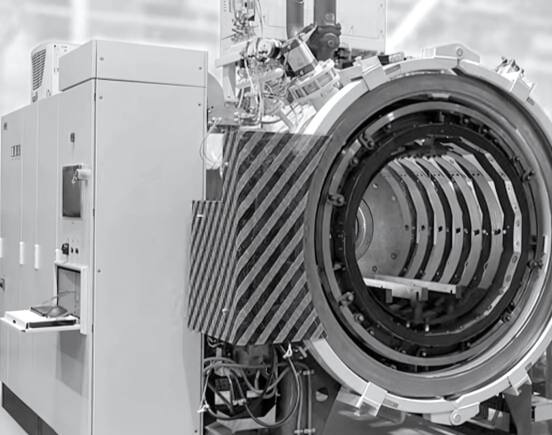
A Vector® horizontal vacuum heat treatment furnace
Source: SECO/WARWICK Group

The solution, a member of the Vector® family of furnaces provided by SECO/WARWICK Group, comes with a graphite heating chamber and a 15-bar absolute gas quenching system, can operate at temperatures up to 2550°F (1400°C), and has a maximum gross load weight of 1767 lb (800 kg).

“We were convinced to choose the Vector furnace because of its wide range of heat treatment processes and applications, fast cycles with high pressure gas quenching and low consumption of energy, process gases and other media. Another undoubted advantage is that Vector is environmentally friendly and has low process gas emissions,” said Li Naixu, chairman of Huake Casting Control (Shanghai) Technology Co., Ltd.

“Huake ​​Casting Control Technology has become our customer as the result of the SECO/WARWICK Group’s increasing reputation in Asia. . . . We want to provide partners with solutions which will allow them to grow and achieve their intended goals related to production, quality and profitability,” said Liu Yedong, managing director of SECO/WARWICK China.

The press release is available in its original form here.


Huake Casting Control Technology Expands Production with Vacuum Furnace Read More »

IperionX Delivers First Titanium Furnace Production Run

IperionX, a U.S. titanium metal and critical materials company, recently delivered its first successful titanium furnace production run at the company’s Titanium Manufacturing Campus, based in Virginia. The furnace was installed in April 2024 with full run rate target capacity of at least 125 metric tons per year anticipated by the end of the year.

Anastasios (Taso) Arima
CEO
IperionX
Source: IperionX

IperionX announced the commissioning of the Hydrogen Assisted Metallothermic Reduction (HAMRTM) furnace, noting that the titanium de-oxygenation production run represents a technological milestone for the company with a breakthrough +60x increase in titanium production capacity. The company’s titanium metal and critical minerals are processed for the consumer electronics, space, aerospace, defense, hydrogen, electric vehicles, and additive manufacturing industries.

“Over the last two years, we have successfully operated our pilot titanium production facility in Utah, producing high performance titanium products for customers and importantly – delivering first revenues for our company,” said Anastasios (Taso) Arima, CEO of IperionX. “Today, we demonstrated that our HAMR technology works at commercial scale. We successfully increased the furnace production capacity by ~60x times and produced high performance titanium that exceeds industry quality standards.”

The HAMR furnace is produced entirely from 100% scrap titanium (Ti-6Al-4V alloy, Grade 5 titanium), with a confirmed reduction in oxygen levels from 3.42% to below 0.07%, far exceeding the ASTM standard requirement of 0.2% for Grade 5 titanium. IperionX’s proprietary HAMR technologies offer a range of competitive advantages, including lower operating temperatures, reduced energy consumption, enhanced process efficiency, and accelerated production cycles.

The press release is available in its original form here.


IperionX Delivers First Titanium Furnace Production Run Read More »

Heat Treater Launches Expanded HIP Capacity Production at South Carolina Facility

A U.K.-based thermal processing service provider announced it has begun production at its facility in Greenville, SC, where it recently expanded its hot isostatic pressing (HIP) services. The site houses heat treating operations, EDM, and other capabilities to serve the aerospace, defense, power generation, medical, and general industries.

HIP Product Fabrication – metal part from powder metal
Source: Bodycote

The additional HIP capacity at Bodycote‘s Greenville location was commissioned to service the development and processing of advanced materials for industries situated within the Southeastern U.S. as well as other Bodycote facilities in the supply chain. With HIP capacity now in full production, Bodycote is able to meet the rising demand for highly reliable additive manufacturing post-processing. The company has more than HIP vessels of varying sizes in multiple locations. Processing capability can accommodate components nominally up to 6.5ft in diameter by 12ft high, and weighing over 30,000kg.

The press release is available in its original form here.

Featured photo: HIP furnace being lowered into place


Heat Treater Launches Expanded HIP Capacity Production at South Carolina Facility Read More »

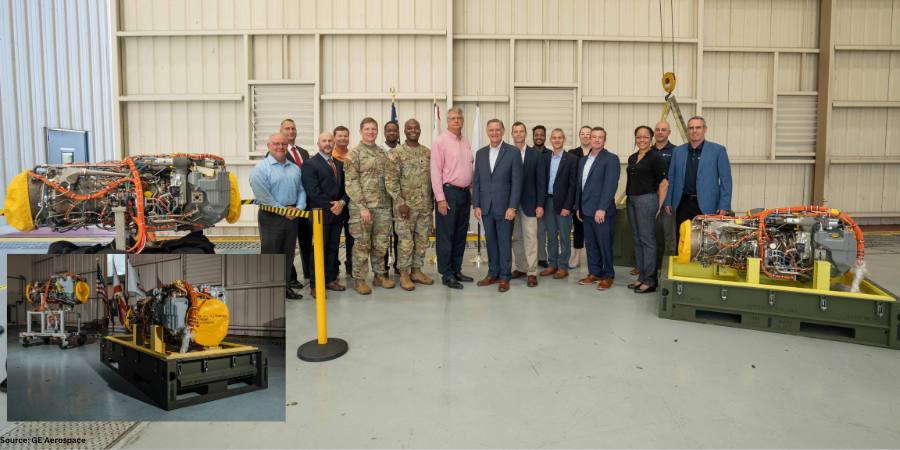
military and business personnel in aircraft hangar with inset of engines

U.S. Army Receives T901 Engines for UH-60 Black Hawk Flight Testing

U.S. Army Receives T901 Engines for UH-60 Black Hawk Flight Testing

The U.S Army recently received two T901 engines from a global aerospace propulsion, services, and systems provider. The engines have been slated for the Improved Turbine Engine Program’s UH-60 Black Hawk integration and testing.

The T901-GE-900 was developed by GE Aerospace in response to a need from the U.S. Army for increased power and reduced fuel consumption with a design that incorporates 3D-modeling, the use of ceramic matrix composites (CMCs), and 3D-printed (additive) parts. The use of CMCs and additive manufacturing enables the engine to produce more power with less weight.

Amy Gowder
President & CEO
Defense & Systems
GE Aerospace
Source: GE Aerospace

“This delivery represents the beginning of a new era and a pivotal moment in our ongoing work with the U.S. Army,” said Amy Gowder, president and CEO, Defense & Systems at GE Aerospace. “The T901 engine will ensure warfighters will have the performance, power, and reliability necessary to maintain a significant advantage on the battlefield.”

This transaction follows the first ever ground run of an aircraft powered by a T901 engine, which took place in April, when a T-901 engine powered Sikorsky’s Future Attack Reconnaissance Aircraft (FARA) prototype, Radar X, gathering data to support the engine’s integration into the service’s UH-60 Blackhawk and AH-64 Apache.

“Our team is immensely proud to announce the latest T901 deliveries to the U.S. Army,” said Tom Champion, director of GE Aerospace’s T901 program. “At every stage, these engines have demonstrated a level of performance that will undoubtedly help meet the demands of military missions for decades to come.”

Source: GE Aerospace

The next-generation rotorcraft engines were unboxed during a ceremony at Sikorsky’s facility in West Palm Beach, Florida.

Photo: GE Aerospace T901 engines unboxed during a ceremony at Sikorsky’s West Palm Beach facility. Source: GE Aerospace

The press release is available in its original form here.


Find Heat Treating Products And Services When You Search On Heat Treat Buyers Guide.Com


U.S. Army Receives T901 Engines for UH-60 Black Hawk Flight Testing Read More »

HIP: Technology that Takes Components into Space 

Hot isostatic press (HIP) processing is a manufacturing technology used to densify metal and ceramic parts to improve a material’s mechanical properties. It is based on applying high levels of pressure (up to 2,000 bar/200Mpa) and temperature (up to 3632°F (2000°C)) through an inert atmosphere in order to densify parts and components, mostly of metallic and ceramic material, and to give them improved mechanical properties.  

HIP technology has become the decisive tool for aerospace parts and components to certify materials and parts with the strictest quality and safety controls. These developments require highly advanced, complex, and processed materials capable of withstanding the demanding work they will be subjected to.  

There are strategic materials and components in the space sector that can only be manufactured by advanced manufacturing in a specific way. Rubén García, project manager of HIP at Hiperbaric, noted that “These developments need very advanced, complex, and processed materials that are capable of withstanding the demanding work they will be subjected to. Therefore, advanced processes are needed to ensure and certify that these materials can be part of a satellite or rocket.” In addition to elements that form part of satellites and rockets and their respective engines, turbomachines, burners, and more intended for space also see benefits from HIP processing. 

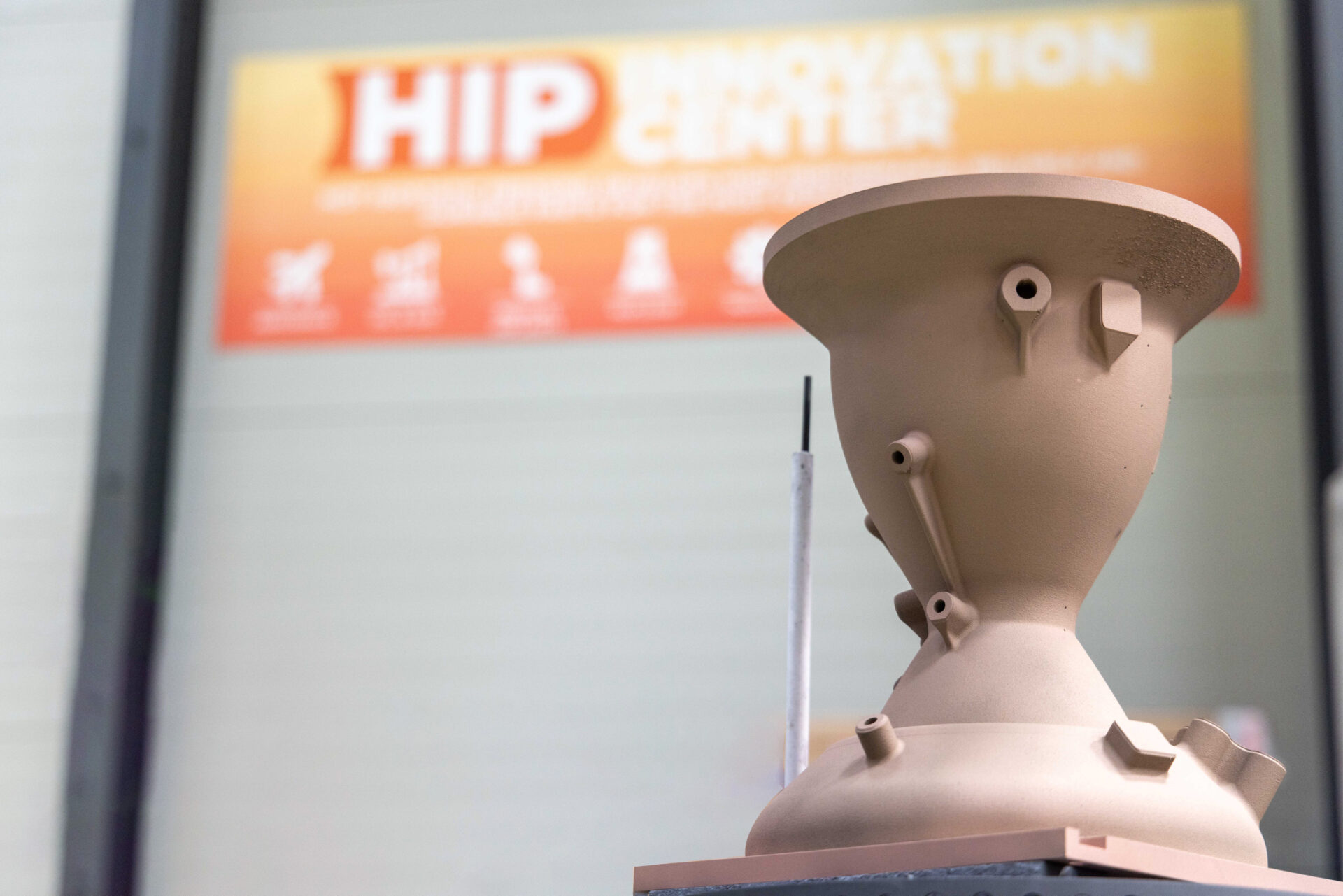
Rocket engine treated by HIP Technology
Source: Hiperbaric

An X-ray inspection of each part evaluates the suitability of the component and ensures that it will not fail during the combustion process. “If we find any pores in the part, they are repaired with HIP technology, which repairs and densifies the component,” explains García. The HIP technology supplier uses Fast Cooling technology to cool materials very quickly, especially in materials whose capabilities may be impaired if they are not cooled quickly.  

Emphasizing how HIP is the key that takes components to space, García describes, “The more complex qualification components are required to go through a HIP process to ensure that the component will not fail. Materials engineering and the metallurgical process are closely tied to these innovations to ensure what some processes can’t do 100%. That is where HIP becomes our best ally.” 

Hiperbaric has devoted a HIP press for its HIP Innovation Center in Spain for companies worldwide for the purpose of investigating and developing HIP products with a particular focus on the aeronautical sector. Here, companies will find the help and knowledge required to achieve success.

About the Expert: 

Rubén García Reizábal
HIP Project Manager 
Hiperbaric

Rubén García Reizábal is an industrial engineer with a master’s degree in Material Components and Durability of Structures and has recently obtained his PhD. After his first stage in Hiperbaric, where he held the position of Quality Manager, he has been working as project manager of several R&D projects for more than 11 years. In this role, he leads all the actions of the Spanish-based company related to its hot isostatic pressing (HIP) business line, including R&D and business development efforts. 

Contact Rubén at r.garcia@hiperbaric.com

HIP: Technology that Takes Components into Space  Read More »

military helicopter against a blue, red and gold colored evening sky; logos of Spirit AeroSystems, Boeing, and Airbus in upper half

Spirit AeroSystems Announces Split Acquisitions by Boeing, Airbus

Spirit AeroSystems, a global manufacturer of aerostructures for commercial airplanes, defense platforms, and business/regional jets recently announced it has entered into a definitive merger agreement with The Boeing Company. Additionally, Spirit has agreed to a subsequent agreement in which aerospace manufacturer Airbus acquires certain Spirit assets that serve Airbus programs.

Dave Calhoun
President & CEO
The Boeing Group
Source: Linked In

The $8.3 billion Boeing transaction, expected to close mid-2025, will include all Boeing-related commercial, defense, aftermarket operations, and a commitment to ongoing partnership with the U.S. Department of Defense and Spirit defense operations. Spirit AeroSystems manufactures fuselage structures for the Boeing 737 MAX and 787 Dreamliner, among other aircraft programs.

Patrick M. Shanahan
President & CEO
Spirit AeroSystems
Source: U.S. Department of Defense

“This is an opportunity to bring back critical airplane manufacturing work on Boeing airplanes into our factories–where Boeing and Spirit world-class engineers and mechanics can work seamlessly together, focused on a common mission to build safe and quality airplanes for our customers,” said Dave Calhoun, president and CEO of Boeing, in a statement to employees on July 1, 2024.

The Airbus transaction will run concurrently with the closing of Spirit’s acquisition by Boeing and involves the potential acquisition of major activities related to Airbus, notably the production of A350 fuselage sections in Kinston, North Carolina, U.S., and St. Nazaire, France; of the A220’s wings and mid-fuselage in Belfast, Northern Ireland, and Casablanca, Morocco; as well as of the A220 pylons in Wichita, Kansas, U.S.

“Bringing Spirit and Boeing together will enable greater integration of both companies’ manufacturing and engineering capabilities, including safety and quality systems,” said Patrick M. Shanahan, president and CEO of Spirit. “We are proud of the part we have played in Airbus’ programs and believe bringing these programs under Airbus ownership will enable greater integration and alignment.”

In taking over those operations, Airbus will pay a nominal $1.00 and will be compensated with $559 million from Spirit AeroSystems.

Related press releases are available in their original form here, here, and here.


Find Heat Treating Products And Services When You Search On Heat Treat Buyers Guide.Com


Spirit AeroSystems Announces Split Acquisitions by Boeing, Airbus Read More »

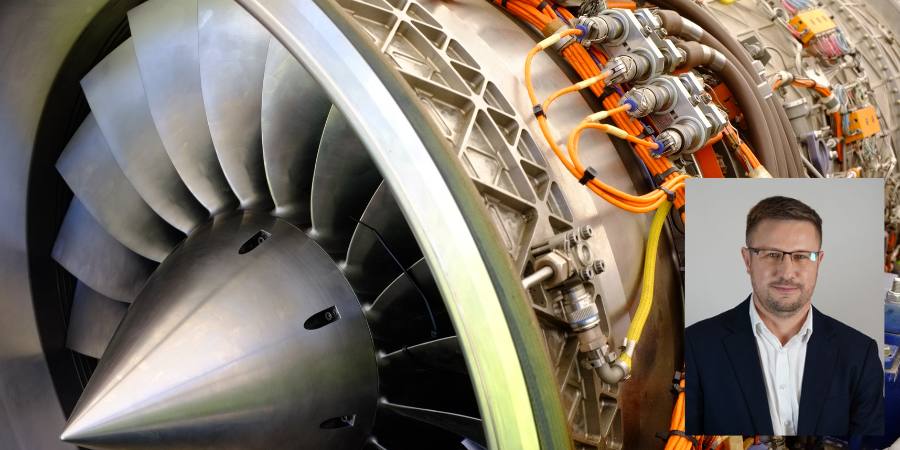
jet engine exposed parts in bg; inset of man, glasses, beard, suit jacket

Aerospace Parts Manufacturer Upgrades Vacuum Heat Treating Capabilities

A global manufacturer of aircraft parts has ordered a single-chamber vacuum furnace for brazing jet engine parts. The new equipment will replace a 30-year-old unit previously operating in its Poland-based plant.

Jędrzej Malinowski
Sales Manager
SECO/WARWICK Group
Source: LinkedIn

The new Vector® vacuum furnace is being supplied by SECO/WARWICK, which also manufactured the retiring equipment. The upgrade is based on a standard Vector vacuum furnace with a working space of 900 x 900 x 1200 mm, with screen insulation and metal heating elements. The solution has been adapted to industry specific needs and can heat treat jet engine components, such as complex gears or main shafts.

“This unit is distinguished by the ability to carry out efficient and clean high vacuum processes thanks to the use of a molybdenum heating chamber and a very efficient pumping system. This ensures very high purity and the dynamics required for brazing processes. Another big advantage is the very good temperature uniformity in the molybdenum heating chamber and compliance with the strict requirements of industry standards such as AMS2750,” said Jędrzej Malinowski, sales manager, SECO/WARWICK Group.

The press release is available in its original form here.


Aerospace Parts Manufacturer Upgrades Vacuum Heat Treating Capabilities Read More »

blue bg, left image of airplane on airstrip with sunset, right image of automotive engine

Doncaster’s Atmosphere Furnace Purchase To Bolster In-House Heat Treatment Capabilities

An aerospace, industrial gas turbine, and automotive market leader has expanded its heat treatment operations with a recently purchased air atmosphere furnace. Connecticut-based Doncaster Precision Castings will use the new furnace to support annealing, tempering, and heat treatment of steel and castings.

Doncaster Precision Castings previously received a similar model for use in its heavy-duty industrial processes within the aerospace and automotive sectors. The furnace, supplied by L&L Special Furnace, has a maximum temperature of 1850°F (1010°C) and a capacity to handle a typical load weight of 2,000 pounds.


The press release is available in its original form here.

Find Heat Treating Products And Services When You Search On Heat Treat Buyers Guide.Com

Doncaster’s Atmosphere Furnace Purchase To Bolster In-House Heat Treatment Capabilities Read More »

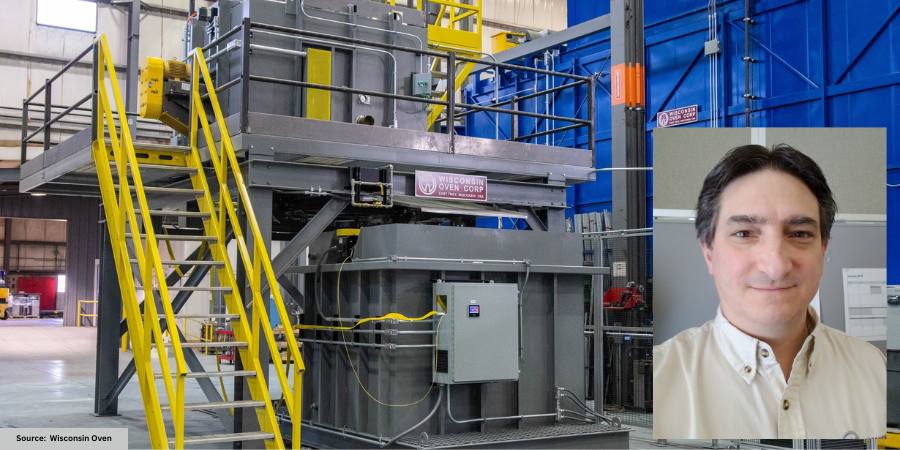
Gray drop bottom furnace bg with headshot male, dark hair, white shirt

Aerospace Heat Treating Upgrades Capacity with Drop Bottom Furnace

An electrically heated drop bottom furnace with a traveling quench tank and a maintenance platform has been shipped to an aerospace company for the solution heat treatment
Mike Grande
Vice President of Sales
Wisconsin Oven Corporation
Source: Wisconsin Oven Corporation
of aluminum parts.
 
Wisconsin Oven designed the drop bottom furnace with sufficient capacity to heat 600 pounds of aluminum per load and provide a quench delay that does not exceed 5 seconds. The system also includes a slow drop speed program to be used for heating applications that do not require a quench.
 
“This drop bottom furnace was designed with a 5 second quench delay, and a temperature uniformity of +/- 5°F at the set points 850°F and 1,100°F. In addition, the system was tested to be in compliance with AMS2750F, Class 1 furnaces and instrumentation Type C prior to shipment from our manufacturing facility,” said Mike Grande, vice president of sales at Wisconsin Oven.
 
 
The press release is available in its original form here.

Find Heat Treating Products And Services When You Search On Heat Treat Buyers Guide.Com

Aerospace Heat Treating Upgrades Capacity with Drop Bottom Furnace Read More »

NASA Aids AM’s Adoption

NASA has selected Elementum 3D (a developer and supplier of metal additive manufacturing (AM) advanced materials, print parameters, and services) to be one of four companies that will produce and distribute GRX-810 material under a commercial co-exclusive license. This is a material that has undergone significant post-processing heat treat research.

The 3D printable high-temperature metal superalloy material has been noted as “breakthrough technology” and will be offered to original equipment manufacturers of airplanes and rockets as well as the entire supply chain.

NASA’s goal of the licensing agreement is to accelerate the adoption of GRX-810 to benefit U.S. technologies, industry, and space exploration. The 3D printer supplier notes that engineers are eager to print with a material capable of creating lighter and thinner engine parts, reducing fuel burn, lowering operating costs, increasing durability, and lowering the tolerance for failure for critical applications.

GRX-810 is an oxide dispersion strengthened (ODS) alloy that can endure higher temperatures and stress. Its strength is derived from the dispersion of tiny particles containing oxygen atoms. The breakthrough superalloy was specifically developed for the extreme temperatures and harsh conditions of aerospace applications, including liquid rocket engine injectors, combustors, turbines, and hot-section components, capable of enduring temperatures up to 1,100°C. Compared to other alloys, GRX-810 can endure higher temperatures and stress up to 2,500 times longer. It’s also 3.5 times better at flexing before breaking and twice as resistant to oxidation damage.

Jeremy Iten Chief Technology Officer Elementum 3D Source: LinkedIn

Over the past nine years, Elementum 3D has gained extensive knowledge and experience in developing, commercializing, and distributing “impossible-to-print” dispersion-strengthened materials similar to GRX-810.

“We are excited to be working with Tim Smith and NASA to bring this exceptional new alloy to the commercial market,” said Jeremy Iten, chief technology officer at Elementum 3D.

NASA’s investment in developing GRX-810 demonstrates its dedication to advancing additive manufacturing. Elementum 3D and the other co-exclusive licensees now assume the responsibility of investing the time and resources to supply the industry with a stronger, more durable superalloy.

The original press release is available here.


Find Heat Treating Products And Services When You Search On Heat Treat Buyers Guide.Com

NASA Aids AM’s Adoption Read More »

Skip to content