The online ticket shop for ITPS 2017, 2nd International Thermprocess Summit, held at the InterContinental Hotel in Düsseldorf, Germany on June 27 and 28, 2017 is now open at www.itps-online.com. The tickets for the two-day conference cost Euro 950 (approximately $1,010) plus VAT. Reduced rate tickets (Euro 800/$850 plus VAT) are available for members of VDMA Metallurgy and CECOF (European Committee of Industrial Furnace and Heating Equipment Association).
The ITPS 2017 conference program has also been finalized. High-profile international speakers will include Prof. Dr. Ernst Ulrich von Weizsäcker (Club of Rome / keynote address), Dr. Paul Rübig (EU Parliament) and Dr. Richard Mark Soley (Industrial Internet Consortium). The conference will address not only scientific and practical aspects of thermo process technology but also the general global, economic and industry policy conditions. The impact of digitization on industry will be presented, in addition to the latest news from selected industrial customer groups (e.g. car manufacturing and the metal processing industry) and new business models. The complete ITPS 2017 program is available at www.itps-online.com.
Successful Duo: Conference and Exhibition
The second part of the Thermprocess Summit will be the exhibition in the foyer of the InterContinental Hotel, complementing the conference. The sponsor this year is LOI Thermprocess GmbH, presenting its capabilities alongside other well-known companies such as Himmelwerk GmbH, Elster GmbH (Honeywell Thermal Solutions), IBS and ITG Induktionsanlagen GmbH. Companies can book stands and sponsor packages. Contact Jennifer Dübelt (e-mail: DuebeltJe@messe-duesseldorf.de; (Tel.: +49 211-4560520) for application forms or visit www.itps-online.com/exhibition-and-sponsorship.
ITPS & The Bright World of Metals
Four years ago, Messe Düsseldorf, VDMA Metallurgy/Frankfurt, the European thermo process association CECOF and the trade magazine “heat processing” published by Vulkan Verlag launched the ITPS conference and exhibition with great success. Every two years, Düsseldorf becomes the hotspot for the global thermo process industry and the industries that use its products – with ITPS and THERMPROCESS taking place alternately. The international portfolio includes events in Asia and the U.S. The four international technology trade fairs GIFA (International Foundry Trade Fair), METEC (International Metallurgical Trade Fair), THERMPROCESS (International Trade Fair for Thermo Process Technology) and NEWCAST (International Trade Fair for Castings) will take place from June 25 – 29, 2019 in Düsseldorf, Germany. A high-quality program consisting of seminars, international congresses and lecture series will support the exhibits. Further information is available at www.gifa.com,www.metec-tradefair.com, www.thermprocess-online.com, www.newcast.com and www.tbwom.com.
For further information about ITPS 2017, contact Messe Düsseldorf North America, 150 North Michigan Avenue, Suite 2920, Chicago, IL 60601. Telephone: (312) 781-5180; Fax: (312) 781-5188; E-mail: info@mdna.com; Visit our web sites www.itps-online.com , www.tbwom.com and
A natural gas fired four zone solution treatment furnace was shipped to a manufacturer of aluminum components. The solution treatment furnace will be used to heat forged aluminum parts for AR15 rifles prior to quenching in water and was manufactured by Wisconsin Oven Corporation.
The maximum operating temperature is 1,100°F and the work chamber dimensions are 4’2” W x 60’0” L X 1’0” H. Each of the four (4) work zones will have dimensions of 4’2” W X 15’0” L X 1’0” H. The design capacity of the furnace is 1,500 pounds per hour of aluminum. The equipment achieved temperature uniformity of +/-10°F at 750° F and 1,100° F.
The conveyor furnace shell features “CAN” type, double-wall construction and includes 2” of 14# density high temperature industrial mineral wool insulation, backed with 6” of 6# density, industrial board type insulation, for a total of 8”. The shell, including the roof, consists of Wisconsin Oven’s patented high efficiency Expandable Surface Design®. The solution treatment furnace utilized a flat wire belt to transfer parts through the work zones.
“Temperature control and uniformity was a critical feature in the design of this system. The equipment achieves the tightest temperature tolerances available in the industry for a furnace of its type.”– Mike Grande, Sales Manager
Unique features of this industrial furnace include:
Temperature uniformity of ±10°F from the set point at 750°F and 1,100°F
Guaranteed soak of +/-10° F for 20 minutes
Heavy duty flat wire belt system to transfer parts into the quench tank
One (1) 6,750 CFM exhaust blower V-belt driven by a 5 HP motor
Four (4) 56,000 CFM recirculating blowers, each with 50 HP TEFCBB motor
Each zone is equipped with burners rated at 3.0 MMBTUH, for a total of 12.0 MMBTUH
Heat treat industry veterans Wally Bamford, Chairman of HARPER INTERNATIONAL and founding partner of CAN-ENG, along with William R. Jones, CEO of the Solar Atmospheres group of companies, discussed a cooperative exchange of business benchmarks between Can-Eng, Harper International, and Solar Manufacturing, Inc. The purpose of this innovative business data exchange was to review operating parameters such as cost of materials, engineering and manufacturing labor rates, sales, marketing, R&D, and other cost centers. Since each of the companies is in the furnace manufacturing business, yet not competitors, it was agreed that an exchange of information would be helpful in improving each companies’ operations and identifying efficiencies. The most recent management team meeting took place in Niagara Falls, Ontario, Canada, where the photo associated with this release was taken.
Photo Courtesy of Solar Manufacturing, Inc.
L to R: Michael Klauck, President, Can-Eng Furnaces International Ltd.; James Nagy, President, Solar Manufacturing, Inc.; Scott Jacoby, Controller, Solar Manufacturing; Diane Weller, Controller, Can-Eng; Mark Young, Vice President, Purchasing and Procurement, Can-Eng; Wally Bamford, Chairman, Harper International; and William R. Jones, CEO, Solar Atmospheres Group of Companies.
Steel producer Nucor has purchased new turn-key production lines for its new specialty cold rolling mill complex at the company’s sheet steel mill in Hickman, Arkansas, USA. The contract was awarded to International technology Group ANDRITZ. Start-up of the plant is scheduled for the second half of 2018. The 650,000 short ton p. a. expansion project will increase Nucor Steel Hickman’s production of specialty grades, including third-generation, advanced high-strength steels, high-strength low-alloy steels, and high-efficiency electrical steels.
The ANDRITZ METALS scope of supply includes a high-performance push pickling line with line speeds of up to 200 m/min for pickling hot-rolled carbon steel. Besides complete ANDRITZ in-house electrics and automation, an advanced ANDRITZ multi-roll leveler for highly effective shape correction and a powerful ANDRITZ 4-high skin pass mill are included. Thanks to the multi-roll-leveler and the skin pass mill, the push pickling line will achieve superior material flatness in addition to the well-known, excellent ANDRITZ strip surface.
The order also comprises a reduction cold rolling mill equipped with the ANDRITZ S6-high technology as well as a temper rolling mill in 4-high design, including reduction mode (prepared for future S6-high mode as well). With rolling speeds of up to 800 m/min, the mills process advanced high-strength steel of the third generation and even beyond for material grades of up to 2,000 MPa. All rolling units (skin pass, reduction, and temper mill), which are operated with state-of-the-art ANDRITZ in-house electrics and automation, are equipped with correspondingly fast and automated roll change equipment, integrated bridle rolls, advanced strip drying, and gauge controls to ensure tightest tolerances.
This is the third in a series of articles by AMS 2750 expert, Jason Schulze. Please submit your AMS 2750 questions for Jason to Doug@HeatTreatToday.com.
Introduction
Of all the changes made to AMS2750 through the years, the Alternate Systems Accuracy Test (ALT SAT) is arguably the one that has had the largest impact within the heat treat industry. The requirements for the ALT SAT, as presented in AMS2750E, make up just 0.008% of the specification as a whole; yet these requirements account for an inordinate amount of time spent on discussion and debate.
Below, we’ll discuss the requirements of the ALT SAT as they are presented in both AMS2750E, and in the Nadcap Pyrometry Guide.
ALT SAT Applicability
Prior to revision E of AMS2750, a load thermocouple that was single-use, or which was replaced more often than the applicable SAT frequency, did not require an SAT of any kind. During the time period when Revision D was in effect, the Alternate SAT did not exist. This meant that if you used a load thermocouple and had a documented single-use statement or replacement schedule, which ensured the usage did not exceed the applicable SAT frequency within your internal procedures, that particular load sensor was not subject to the SAT requirements of AMS2750D.
AMS2750D page 14, paragraph 3.4.1.2
3.4.1.2 An SAT is not required for sensors whose only function is over-temperature control, load sensors that are limited to a single use (one furnace load/cycle), sensors not used for acceptance as part of production heat treatment, or load sensors whose replacement frequency is shorter than the SAT frequency. See 3.1.8.4 and 3.1.8.5.
When AMS2750E replaced AMS2750D, the ALT SAT was introduced. In addition to the ALT SAT, paragraphs 3.4.4 through 3.4.4.3 were also inserted:
AMS2750E pg 19, para 3.4.4
3.4.4 The SAT can be accomplished using any one of 3 methods:
3.4.4.1 Perform an SAT following the requirments in 3.4.5
3.4.4.2 Alternate SAT process defined in 3.4.6
3.4.4.3 SAT Waiver process, as described in 3.4.7
By stating that the SAT “…can be accomplished using any one of 3 methods”, this section has often been misinterpreted to mean that a supplier may simply choose which type of SAT they wish to implement. This is not the case.
An ALT SAT must be performed on any thermocouple that is either
single use, or
replaced more often that the applicable SAT frequency.
Throughout the industry, these two items typically apply to load thermocouples. As an example, let’s assume that a non-expendable load thermocouple is used in a furnace that is designated as a Type A, Class 5 furnace. This would put the standard SAT frequency at quarterly (no SAT extension & parts-furnace). If the non-expendable load thermocouple that was used had a documented replacement frequency of monthly, the ALT SAT requirements would apply to this particular load thermocouple.
In the example above, a supplier could not accomplish the SAT “…using any one of the 3 methods” – the ALT SAT requirements would be required for that particular load thermocouple system and would need to be accounted for in the supplier’s internal pyrometry procedure.
ALT SAT Requirements
The ALT SAT requirements can be split up into a single main requirement and two sub-requirements which suppliers may choose to implement. The main requirement is:
Calibration of instruments at the point at which the sensor is connected.
This means that, wherever the thermocouple is connected directly, instrument calibration must take place at this point. Let’s look at a vacuum furnace as an example.
Vacuum Furnace showing Location A and Location B for an Alternate SAT (photo courtesy: PVT Inc.)
Location A indicates where load thermocouples will be plugged in directly. Location B is where the extension wire from inside the furnace travels to the outside of the furnace and then on to the recording instruments. Location A is where the calibration of the recording instrument must take place per the ALT SAT requirements. This requirement in no way changes the standard requirements for instrument calibrations as they are presented in AMS2750E; it only specifies exactly where the instrument calibration must take place within the furnace sensor system. Your internal pyrometry procedure must state that this is a requirement.
The next paragraphs, 3.4.6.1.1 & 3.4.6.1.2, are where the supplier must read and understand both paragraphs in order to make a choice regarding which option best suits their furnace set-up and production. Let’s break both paragraphs down.
Option Number 1
3.4.6.1.1 - Establish appropriate calibration limits for sensors which when combined with the calibration of the instrument/lead wire and connector, will meet the SAT requirements of Table 6 or 7, as appropriate.
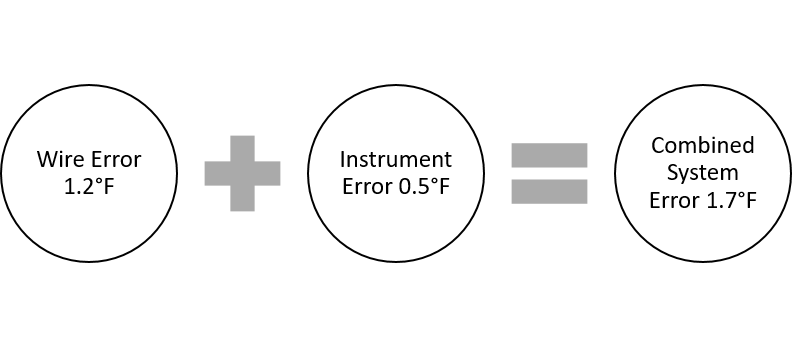
There are several ways to go about conforming to this paragraph. Keep in mind, that when choosing an option you are dealing with 2 variables; the error of the instrument which records the thermocouples in question and the error of the thermocouples themselves.
a) This option relieves you of one of the variables stated above. When calibrating your instruments which the thermocouples are plugged in to, ensure there is absolutely no error at all. Adjustments (offsets) may need to be made to accomplish this. This means that, if you do not permit offsets currently, you will either need to account for them in your procedures or choose option “b” below. Once you’ve established that your instrument has no error, you restrict the error of the thermocouples you purchase not to exceed the appropriate SAT difference stated in Table 6 or 7.
As an example, let’s assume you have a vacuum furnace that uses 2 load thermocouples which are single use only. The furnace is classified as a Type A, Class 2 furnace – this means the Maximum SAT difference is ±3°F or 0.3% of the reading. You would ensure that the recording instrument for those 2 channels recording the load temperature have no error. Then, order load thermocouples which have an error of ±3°F or 0.3% of the reading, or less.
b) This option is most attractive to those who do not wish to allow offsets within their heat treat operation. To accomplish this, you compare the error of the specific channels of the instrument the thermocouples in question plug into, to the error of the thermocouples themselves. The resulting value cannot exceed the maximum error permitted for the appropriate furnace class. Internal pyrometry procedures specifically state how thermocouple wire will be received and the ALT SAT calculation accomplished prior to releasing the thermocouple wire to production. There are two variables that must be verified in this option. Anytime one of these two variables change, the calculation must be obtained. The Nadcap Pyrometry Reference Guide requires that this calculation be evaluated at the instrument (chart recorder) calibration points (min, max & middle 1/3rd.)
Overview of a Calculation – Single Temperature
For Your Consideration
There has been some confusion in the industry that the ALT SAT process, specifically Option B above, must be accomplished at the furnace. This misunderstanding includes suppliers using a Field Test Instrument to simulate the min, max and middle 1/3rd of the instrument calibration temperatures in an effort to obtain the error of the instrument channels in question. This amounts to nothing more than an additional instrument calibration; one could simply obtain the error from the current instrument calibration instead of performing extra work at the furnace.
Option A and B above would be performed as a desk operation; none of the tasks would be performed at the actual furnace.
Conclusion
The ALT SAT process has been successfully implemented by many suppliers in the Aerospace Industry; both Nadcap approved and non-Nadcap. As with any AMS2750E process, detailed procedures and training are key to executing the ALT SAT process.
Submit Your Questions
Please feel free to submit your questions and I will answer appropriately in future articles. Submit your questions by sending an email to doug@heattreattoday.com.
A leading North American aerospace supplier ordered a 36 ft. diameter pancake style rotary hearth furnace for the production of large fixed wing aircraft titanium and nickel based alloy closed-die structural forgings. The open hearth configuration furnace system which allows for more flexible loading and uniform heating, was supplied by Can-Eng International Ltd. and features an advanced low NOx combustion system designed to meet the most stringent environmental and temperature uniformity requirements. Special dual-door design provides the customer with significant flexibility for forging to press manipulation within in their existing plant layout. The system is capable of processing up to 250,000 pound load capacity in a 24/7 production environment. The furnace system complies with thermal performance requirements laid out in AMS2750E, integrates a low shrinkage ceramic fiber lining, unique rotating hearth drive and sealing system. The system is scheduled to be commissioned to the United States in the third quarter of 2017.
Triumph Group, Inc. was selected by Harbin Hafei Airbus Composite Manufacturing Centre Company Ltd. to supply composite parts for the Airbus A350 XWB aircraft. Triumph Precision Components’ Composites Center of Excellence site in Thailand will produce the composite details for the rudder, which will be assembled at HHACMC in Harbin, China.
The contract, valued at approximately $26M, covers the delivery of 700 shipsets of rudder component kits over the next 5–7 years for the A350 XWB program. Triumph leveraged recent investments in its Thailand facility to increase capability and expand capacity to position itself to win and execute this new agreement.
“We are pleased to enter into a new customer relationship with HHACMC,” said Ronald Vuz, president of Composites Center of Excellence site in Thailand. “Our focus on performance, coupled with our demonstrated ability to obtain the necessary qualifications and transfer work on schedule, provided us with this opportunity to further demonstrate our capability to produce complex composite aerostructures.”
This agreement allows Triumph to help meet the strong demand for services in the burgeoning Asian aerospace market. The Asia-Pacific region is expected to lead the market for new aircraft over the next 20 years.
Pratt & Whitney, a division of United Technologies Corp., announced today that it will invest approximately $386 million in its Columbus, Georgia, facility to increase the production of parts and maintenance services and to reduce costs for new and existing engine programs. The investments will go toward the purchase of automated machinery and equipment upgrades and construction of two new buildings on the property.
The building construction will include a 200,000-square-foot facility to overhaul GTF engines. A 20,000-square-foot specialized manufacturing facility and related infrastructure will also be built to house a new isothermal forge press that will be used to manufacture turbine disks and compressor rotors for Pratt & Whitney engines. Other upgrades to equipment and machinery are also planned.
“We’re investing heavily in our Columbus facility to support the increased production and services planned for our F135 and GTF engines,” said Chris Calio, president, Pratt & Whitney Commercial Engines. “This investment will help ensure that we have the appropriate infrastructure, tooling and trained workforce in place to provide the best products and services to our customers worldwide. The tremendous support we receive from the community and state have contributed to our success in Georgia.”
“Pratt & Whitney has maintained a presence in Muscogee County since 1984 and this latest expansion speaks to Georgia’s support for our robust aerospace industry,” said Georgia Gov. Nathan Deal. “Georgia’s pro-business structural framework and deep talent pool help to retain industry leaders such as Pratt & Whitney. By adding these new high-quality manufacturing jobs, Pratt & Whitney is making a significant investment in the Columbus community and we look forward to strengthening this longstanding partnership as the company continues to grow.”
Pratt & Whitney has also expanded its relationship with Columbus Technical College to provide new and existing employees with robust training programs. The school will offer four- to nine-week programs focused on aerospace mechanics and advanced manufacturing technologies to better support the company’s growth. This is one of several skills development programs the company has in place with community colleges and technical schools throughout the U.S.
“This announcement from Pratt & Whitney is the latest example of the hard work put forth every day by our economic development team locally and the professionals at the Georgia Department of Economic Development,” said Brian Anderson, president and CEO of the Greater Columbus Georgia Chamber of Commerce. “The project would not have happened without the tremendous relationships we have with the local Pratt & Whitney leadership team here in Columbus as well as those at both Pratt & Whitney and United Technologies Corporation in Connecticut.”
The Columbus Engine Center maintains PW1100G-JM, V2500, PW2000, F117 and F100 engines. Columbus Forge produces compressor airfoils and nickel and titanium forgings, which are machined into critical rotating components for Pratt & Whitney’s military and commercial engines. Both facilities are located on one campus about 90 miles south of Atlanta.
Welcome to another episode of Heat Treat Radio, a periodic podcast where Heat Treat Radio host, Doug Glenn, discusses cutting-edge topics with industry-leading personalities. Below, you can either listen to the podcast by clicking on the audio play button, or you can read an edited version of the transcript. To see a complete list of other Heat Treat Radio episodes, click here.
Audio: Former Bodycote CEO Re-Enters Heat Treat Market
In this conversation, Heat Treat Radio host, Doug Glenn, interviews John Hubbard, longtime CEO of Bodycote who retired in 2009 and has recently re-entered the market with an aggressive capital investment company located in Baltimore, Maryland. This 20-minute Heat Treat Radio interview gives you all the important news about what Mr. Hubbard and theCalvert Street Capital Partners (CSCP) are planning. To date, CSCP, under the leadership of Mr. Hubbard, have snagged top talent from the industry, including Mike Sobieski and Don Longenette, and are actively pursuing the acquisition of well-established and profitable commercial heat treat across North America.
Our aerospace, automotive, medical, and energy manufacturers with in-house heat treats will find it encouraging to hear what John has to offer.
Click the play button below to listen.
Doug Glenn, Heat Treat Todaypublisher and Heat Treat Radio host.
To find other Heat Treat Radio episodes, go to www.heattreattoday.com/radio and look in the list of Heat Treat Radio episodes listed.
One hundred Boeing 737 planes are scheduled to be delivered from the first overseas factory in China beginning in 2018. China is expected to become the world’s first trillion-dollar aviation market within 20 years. Read more to find out what needs to be developed in order to support this new manufacturing.