The primary supplier of automotive body sheets for both closures and inner parts of the new Audi A6 model recently announced the extension of the partnership to provide a high-tech crash absorption alloy for the hood of this model.
Dieter Höll, Vice President of Global Automotive at Constellium
Constellium produces components, such as doors and trunks, for its partner Audi to achieve its lightweighting, design and safety targets, specifically Surfalex® with high surface quality and particular hemming and roping properties. This highly formable alloy has been designed to fulfill the most demanding pedestrian safety requirements.
“Constellium is proud to extend its long-term partnership with Audi and to accompany them in their mission to build high-quality automobiles. To do so, Constellium supports Audi in solutions not only for closures but also for body-in-white parts requiring specific crash and mechanical performance such as the ones offered by Securalex®,” said Dieter Höll, Vice President of Global Automotive at Constellium.
John Hubbard, chairman of Thermal Process Holdings
Following the acquisition of a Wisconsin heat treat company, finalized last week, an industry holdings group recently announced the purchase of a high-quality heat treat provider focused in tool and die work.
Thermal Process Holdings (TPH) acquired P & L Heat Treating (P&L) of Youngstown, Ohio, in their continuing efforts to build a leading thermal processing company based on value-added services.
“We are delighted to partner with Bill Pociask and the P&L team. P&L is a well-run heat treating operation providing high-quality service. Both Bill Pociask and P&L are excellent additions to the TPH group,” said John Hubbard, chairman of TPH.
Bill Pociask, founder and president of P&L
“I am excited to work with the TPH group of companies. There are many opportunities for us to help each other grow and continue to serve our customers. The future is very bright for P&L,” said Bill Pociask, founder and president of P&L.
TPH also owns and operates: Diamond Heat Treat, based in Rockford, Illinois; Certified Heat Treating, based in Springfield, Ohio; and Hudapack Metal Treating, based in Elkhorn and Franklin, Wisconsin.
TPH was formed by Calvert Street Capital Partners and John Hubbard (former CEO of Bodycote, PLC) to pursue a buy-and-build strategy in the thermal processing industry. You can listen to an interview with John Hubbard regarding the strategy of Calvert Street Capital Partners, conducted by Heat Treat Today‘s publisher, Doug Glenn, at this Heat TreatRadiolink.
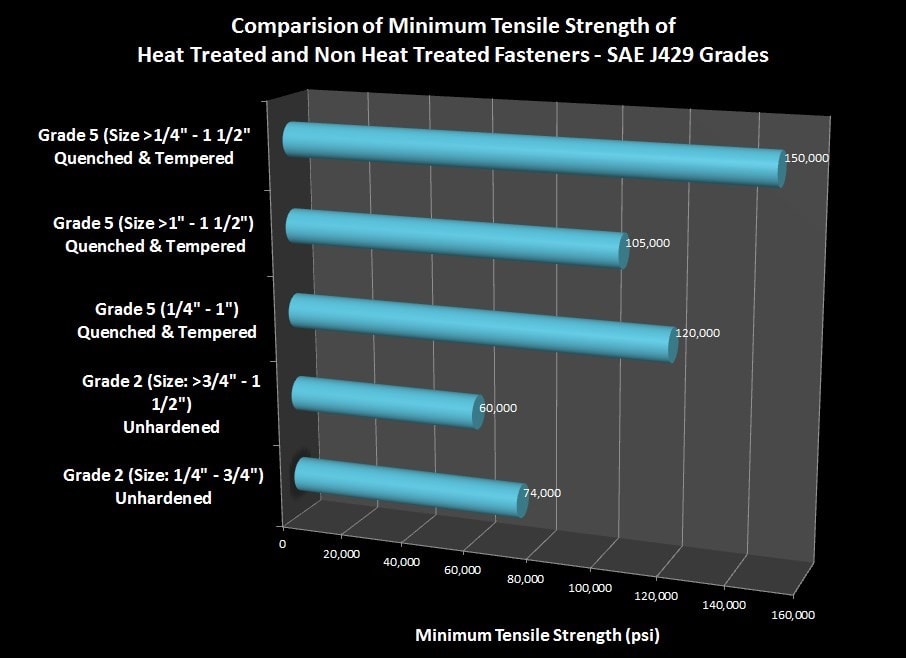
A comparison of minimum tensile strength of heat-treated and non-heat-treated fasteners
One would be hard-pressed to find an industry that isn’t served by high-strength or heat-treated bolts and fasteners. They are required in the automotive, construction, transportation, marine, aerospace, oil & gas, petrochemical, and presses and molds manufacturing fields. In oil & gas and petrochemical manufacturing, for example, high-strength bolts and fasteners are necessary in order to achieve seal closure on flanged joints, fittings, and closures; withstand tensile stresses within the bolts; and provide the strength needed for bolts and pins to withstand forces from high horsepower equipment. You name the industry sector, and the manufacturing process will be just as dependent upon bolts and fasteners to answer the demands of the equipment, the process, and/or the application.
In this overview of the importance of heat treating in fastener and bolt production, Bayou City Bolt provides:
an explanation of the heat treating processes used depending upon the material and the application,
a comparison of the minimum tensile strength of heat-treated and non-heat-treated fasteners (see image to the right),
grade steels best used for heat treating fasteners and bolts,
the case hardening process, and
the proper use of hardened steel fasteners.
An excerpt:
“About 90 percent of fasteners are steel based and the required strength level is usually developed in steel fasteners using quenching and tempering processes. Accordingly, the terms “high strength” with “heat treated” or “hardened” are often equivocated with the fastener world. However, heat treatment includes a wide range of processes. Some heat treatments like annealing soften a metal, while others harden and strengthen.”
Vehicle sales, durable goods orders, capacity utilization, and factory orders were four of the five indices trending upward.
Housing, metal prices, capital expenditures, and the purchasing manager’s index were among the seven indices that suffered in October. According to IHEA’s economist, the most disturbing of the declining indexes is the decline in the Purchasing Manager’s Index, which was more than anticipated. Overall, however, all of the declining numbers are still well above historic averages showing that the economy continues to be strong.
“. . . but it is important to note that even with the declines in some sectors, the overall status of these readings remains higher than it had been in several years.”
~ Excerpt from IHEA’s Monthly Executive Economic Summary
The Purchasing Managers Index took a significant dip in October.Automobile and light truck sales continue to be strong in October.
Analysis of all 12 indices is presented monthly to IHEA member companies and is available by contacting Ann Goyer at ann@goyermgt.com or at (941) 373-1830.
Heat TreatTodayoffers News Chatter, a feature highlighting representative moves, transactions, and kudos from around the industry.
Personnel and Company Chatter
Tracy Dougherty has been named Vice President of Sales at AFC-Holcroft. Dougherty has been with AFC-Holcroft since 2008 and served in several sales-related roles, most recently as the company’s Sales Manager. As Vice President of Sales, Dougherty will now have a number of added responsibilities, including overseeing the company’s activities in Europe.
Retech Systems, which has been manufacturing vacuum melting systems in Northern California, will transition much of the manufacturing and assembly to facilities in Świebodzin, Poland. All of the future work done at the SECO/Warwick facilities in Poland will be per the established Retech standards with the focus on maintaining all expectations associated with the Retech brand. The Ukiah office will be downsized and will retain engineers, technical directors, technologists, and service staff. Retech’s unique R&D Center will continue to be built up, maintaining a west coast office along with the recently opened east coast office in Buffalo, NY.
Philip Wrisley, Project Manager at Plibrico‘s Salem, Ohio, office, is the recipient of an API STD 936 Refractory Personnel Certification from the American Petroleum Institute (API). This internationally recognized certification verifies Wrisley’s knowledge of API Refractory Installation Quality Control Guidelines for field-testing of monolithic refractory materials, as well as best practices in the installation and repair of refractory linings.
A new 57,500 square foot building dedicated to vacuum furnace manufacturing is under construction at Solar Manufacturing‘s campus in Sellersville, Pennsylvania. As can be seen in the photo below, the four bridge cranes are in place, the full plant and office roof is complete, and much of the concrete floor poured.
A thermal technology company recently announced the opening of its new sales and operations office in Norway. Chromalox, based in Pittsburgh, Pennsylvania, manufactures process heating and heat tracing products.
A global leader in aluminum rolling and recycling recently announced an expansion at the company’s Pindamonhangaba, Brazil, plant. This $175 million investment of its flagship facility in South America will bolster Novelis‘s capacity with 100 kilotonnes of additional rolling production and 60 kilotonnes of increased recycling and bring total capacity of the Pindamonhangaba facility to approximately 680 kilotonnes per year of aluminum sheet and 450 kilotonnes annually of recycled metal.
Nucor Corporation has announced that it is acquiring Corporacion POK, S.A. de C.V. (POK), a fully integrated precision castings company with a facility in Guadalajara, Mexico. POK produces complex castings and precision machined products used by the oil and gas, mining and sugar processing industries.
A new automotive structures facility opened in Zilina, Slovakia, dedicated to the production of aluminum crash management systems and body structure components. Constellium‘s 5,200 square meter facility in Zilina features advanced technologies for forming, machining, welding, and heat-treating aluminum automotive components, along with a state-of-the-art quality lab to ensure products meet customer specifications. Constellium plans to expand its facility to 15,000 square meters by mid-2019.
Construction underway for Solar Manufacturing\’s new building. at Sellersville, PA.
Equipment Chatter
A Japanese manufacturer of precision tool steels components recently commissioned a precision vacuum furnace system from SECO/WARWICK. This specialized system reduces energy consumption through power optimization and cycle time reduction, customized to work within the tight physical space limitations.
In addition, an American manufacturer which produces transportation components recently ordered a new precision gas nitriding furnace with ZeroFlow® from SECO/VACUUM (SVT), a SECO/WARWICK Group company.
L&L Special Furnace Co., Inc., has supplied a custom designed and manufactured oil quench tank to a metal stamping manufacturer in the Midwest. The quench tank is specifically used to quench metal stamping dies that are heated to 1,550°F.
Advanced Heat Treat Corp recently posted to Facebook a video of the installation of one of three new nitriding vessels delivered to the company’s MidPort Blvd location as part of an ongoing building expansion.
An international heat treating equipment manufacturer with a location in California, JGEF Furnace, recently sold 6 furnaces to a Japanese heat treating company. Four nitriding horizontal furnaces are front-loading and designed specifically for precision gas nitriding in a retort style with vacuum purge, and two tempering horizontal furnaces are designed to temper workloads after hardening.
SECO VACUUM sells gas nitriding furnace with ZeroFlow®.
L&L Special Furnace Co., Inc., delivers oil quench tank.
AHT installs new intriding equipment
JGEF Furnace ships 6 furnaces to Japanese manufacturer.
Kudos Chatter
Hydro Extruded Solutions Hoogezand B.V. (Netherlands), which produces aluminum profiles as well as anodized and painted components, has become the first aluminum extrusion company to be certified with ASI’s Performance Standard for environmental, social and governance performance.
SECO/WARWICK was recently awarded the Honorary Badge for Meritorious Performance in the area of innovation in a badge award ceremony held at the Royal Castle as part of the celebrations of the 100-year anniversary of the Patent Office and industrial property protection system in Poland. The badge, given to entities and organizations having outstanding achievements in their pro-development activities, was received by Bartosz Klinowski, Managing Director (Europe), Member of the Management Board of SECO/WARWICK.
Hydro Extruded Solutions Hoogezand B.V. certified by ASI.
SECO/WARWICK awarded the Honorary Badge for Meritorious Performance.
Heat TreatTodayis pleased to join in the announcements of growth and achievement throughout the industry by highlighting them here on our News Chatter page. Please send any information you feel may be of interest to manufacturers with in-house heat treat departments especially in the aerospace, automotive, medical, and energy sectors to the editor at editor@heattreattoday.com.
A Wisconsin heat treating company has been acquired by an industry holdings group in a bid to build a leading thermal processing company based on value-added services.
Thermal Process Holdings, Inc. (TPH), purchased Hudapack Metal Treating, Inc., which owns and operates heat treat facilities in Elkhorn and Franklin Wisconsin. In TPH’s acquisition of Hudapack, co-founded by Gary Huss, Charles Davis, and Earl Pack, the company’s strategy is to identify and bring together leading businesses that share a focus on world-class safety, quality, service, and advanced technology. TPH also owns and operates Diamond Heat Treat, based in Rockford, Illinois, and Certified Heat Treating, based in Springfield, Ohio.
Gary Huss, co-founder and President of Hudapack
“We are excited to announce the third acquisition in our strategy to build a best-in-class company that offers a range of advanced services,” said John Hubbard, Chairman of TPH. “I have known and respected Gary Huss for over 30 years and am appreciative that he has entrusted us with the two businesses he has successfully built. I am also pleased that Greg Huss has agreed to become the General Manager of both Elkhorn and Franklin and look forward to working with him as we seek to grow Hudapack.”
“We began operations in 1985 and have been more successful than I ever imagined. When making the difficult decision to sell the business and retire, an important consideration was finding a buyer who would ensure the continued success of the business and provide opportunities for the Hudapack employees. I am confident that John Hubbard and the TPH team will carry out those objectives. I am also delighted that Greg will become GM of both locations. He has spent his career in the business and this transition provides an exciting leadership opportunity for him,” said Gary Huss, co-founder and President of Hudapack.
The first titanium wheel created using EBM technology was recently unveiled during the official announcement of a partnership agreement between the two companies responsible for its design and manufacture.
HRE Wheels, headquartered in Vista, California, and GE Additive launched the new technology, which is a type of 3D printing to test the capabilities of additive manufacturing in a practical application and to create a highly-sophisticated wheel design with an elusive material like titanium. The new prototype wheel is known as “HRE3D+”.
With a traditional aluminum Monoblok wheel, 80% of material is removed from a 100-pound forged block of aluminum to create the final product. With additive manufacturing, only 5% of the material is removed and recycled, making the process far more efficient. Titanium also has a much higher specific strength than aluminum and is corrosion resistant, allowing it to be extremely lightweight and to be shown in its raw finish.
There was an intensive design collaboration between the Vista, California-based, team at HRE and the GE AddWorks team out of Ohio. Using design queues from two existing models of HRE wheels, the two companies worked together to create a stunning example of what is possible with additive manufacturing.
HRE President Alan Peltier
The wheel was produced on two Arcam EBM machines – Q20 and a Q10 in five separate sections, then combined using a custom center section and titanium fasteners.
“This is an incredibly exciting and important project for us as we get a glimpse into what the future of wheel design holds,” said HRE President Alan Peltier. “Working with GE Additive’s AddWorks team gave us access to the latest additive technology and an amazing team of engineers, allowing us to push the boundaries of wheel design beyond anything possible with current methods. To HRE, this partnership with GE Additive moves us into the future.”
Robert Hanet, senior design engineer, GE Additive AddWorks
“HRE prides itself on its commitment to excellence and superior quality in the marketplace. It was a natural fit for AddWorks to work on this project with them and really revolutionize the way wheels can be designed and manufactured,” said Robert Hanet, senior design engineer, GE Additive AddWorks.
A company providing industrial process control and automation in the heat treatment and combustion industry recently announced plans to relocate its U.S. headquarters from West Chester, Ohio to Oak Creek, Wisconsin.
United Process Controls (UPC) will complete the second phase of the company’s initiative to unify its US operations to one centralized location in December. Earlier this summer, UPC completed the first phase that saw its two Wisconsin facilities come together under a larger facility in Oak Creek, WI. At present, the 30,000-square-foot campus located in the southeastern corner of Milwaukee county accommodates the growing flow controls business and will provide additional manufacturing space for the company’s diverse product lines.
“This latest move is an exciting development for UPC and has been coming for a while, as the company has grown steadily over the past few years,” said Paul Oleszkiewicz, President of UPC. “With the acquisition of Atmosphere Engineering in 2017, we understood that moving all USA facilities to a new location was necessary to create operational synergy across our business units – heat treating controls, flow controls, and combustion optimization solutions. Sharing the same facility will bring more cross development and cross manufacturing opportunities, and this interactivity means that the latest products and systems are designed and delivered with better efficiency to our customers. Additionally, cross training will enhance the proficiency of our engineers, manufacturing and service technicians, building a greater team that can interact more effectively with our customers and sales network.”
“UPC operations in the USA have outgrown its current space,” said Pat Torok, VP Sales & Marketing. “The larger facility in Wisconsin allows for greater flexibility in inventory management and streamlined manufacturing and will house an expanded laboratory, as well as engineering, manufacturing, sales, and service personnel. The space at 6724 South 13th Street also has room to accommodate future growth for product development.”
During the day-to-day operation of heat treat departments, many habits are formed and procedures followed that sometimes are done simply because that’s the way they’ve always been done. One of the great benefits of having a community of heat treaters is to challenge those habits and look at new ways of doing things. Heat TreatToday‘s 101 Heat TreatTips, tips and tricks that come from some of the industry’s foremost experts, were initially published in the FNA 2018 Special Print Edition, as a way to make the benefits of that community available to as many people as possible. This special edition is available in a digital format here.
In today’s Technical Tuesday, we continue an intermittent series of posts drawn from the 101 tips. The category for this post is Induction Heating, and today’s tips–#29, #73, and #83–are from Dr. Valery Rudnev, FASM, Fellow of IFHTSE, “Professor Induction”, Director of Science & Technology at Inductoheat Inc., an Inductotherm Group company. Dr. Rudnev is a regular contributor to Heat TreatToday.
Heat TreatTip #29
Induction Heating Non-Ferrous Metals & Alloys
Dr. Valery Rudnev, FASM, Fellow IFHTSE, Professor Induction, Director Science & Technology, Inductoheat Inc., an Inductotherm Group company
Steel components by far represent the majority of hot worked and heat-treated parts for which electromagnetic induction is used as a source of heat generation. At the same time, many other non-ferrous metals and alloys are also inductively heated for a number of commercial applications. Induction heating of low electrically resistive metals such as Al, Mg, Cu, and others typically require using lower electrical frequencies compared to carbon steels, cast irons, or high resistive non-magnetic metals (such as Ti or W, for example) and metallic alloys. The lower value of electrical resistivity results in smaller current penetration depth (depth of heat source generation), making it possible to apply much lower frequencies without facing the danger of eddy current cancellation.
Heat TreatTip #73
Induction Hardening Powder Metal
When induction hardening powder metallurgy (P/M) materials, it is good practice to have a minimum density of at least 7.0 g/cm3 (0.25 lb/in.3). This will help obtain consistent induction hardening results. When hardening surfaces that have cuts, shoulders, teeth, holes, splines, slots, sharp corners, and other geometrical discontinuities and stress risers, it is preferable to have a minimum density of 7.2 g/cm3 (0.26 lb/in.3). Low-density P/M parts are prone to cracking due to a penetration of the gases into the subsurface areas of the part through the interconnected pores. Interconnected pores contribute to decreased part strength and rigidity compared with wrought materials. In addition, the poor thermal conductivity of porous P/M parts encourages the development of localized hot spots and excessive thermal gradients and also requires the use of quenchants with intensified cooling rates to obtain the required hardness and case depths. This is so because an increase in pore fraction and a reduction in density negatively affect the hardenability of P/M materials compared to their wrought equivalents.
Heat TreatTip #83
Induction Hardening Cast Iron
Induction hardening of cast irons has many similarities with hardening of steels; at the same time, there are specific features that should be addressed. Unlike steels, different types of cast irons may have similar chemical composition but substantially different response to induction hardening. In steels, the carbon content is fixed by chemistry and, upon austenitization, cannot exceed this fixed value. In contrast, in cast irons, there is a “reserve” of carbon in the primary (eutectic) graphite particles. The presence of those graphite particles and the ability of carbon to diffuse into the matrix at temperatures of austenite phase can potentially cause the process variability, because it may produce a localized deviation in an amount of carbon dissolved in the austenitic matrix. This could affect the obtained hardness level and pattern upon quenching. Thus, among other factors, the success in induction hardening of cast irons and its repeatability is greatly affected by a potential variation of matrix carbon content in terms of prior microstructure. If, for some reason, cast iron does not respond to induction hardening in an expected way, then one of the first steps in determining the root cause for such behavior is to make sure that the cast iron has not only the proper chemical composition but matrix as well.
If you have any questions, feel free to contact the expert who submitted the Tip or contact Heat TreatToday directly. If you have a heat treat tip that you’d like to share, please send to the editor, and we’ll put it in the queue for our next Heat TreatTipsissue.
Heat TreatTodayrecently unveiled its Heat TreatConsultantspage in the October 2018 print edition (available in digital format here) and at FNA in Indianapolis, Indiana. We offer this comprehensive listing of heat treat industry consultants as part of our efforts to help minimize the effects of heat treat “brain drain.” With so many heat treat brains growing older, the expertise that once used to reside inside of manufacturing operations is dwindling. Where, then, do manufacturers with in-house heat treat departments go when they need heat treat answers?
Turn toHeat TreatTodayand our comprehensive list of heat treat industry consultants, which we will introduce to you one by one in this occasional feature, “Meet the Consultants”. There is no more comprehensive list of heat treat consultants. Learn more about Dan Kay of Kay and Associates, and then click through to the page to read more details about each consultant. We are adding more regularly. Contact them directly, or call us and we’ll introduce you to them. Whether it’s a technical process question, a safety concern, a compliance issue, or a business related question, one of our heat treat consultants will be able to help. If you are a consultant and would like to be listed, please contact Doug Glenn.
Name: Daniel Kay Company Name: Kay & Associates Location: Simsbury, Connecticut Years in Industry: 45+ Consulting Specialties:
Dan Kay has been involved full-time in brazing engineering for more than 45 years and has been operating his own brazing consulting and training business since 1996, regularly consulting in areas of vacuum and atmosphere brazing, as well as in torch (flame) and induction brazing. Dan has become known worldwide as an excellent seminar leader, trainer, speaker, and well-versed brazing auditor, traveling all over the world not only providing consulting and problem solving but also teaching brazing seminars and conducting in-house brazing-training programs. Numerous publications include his articles on the subject of brazing; in addition, he is a regular contributor to several online resources, including Industrial Heating, VAC AERO, and the Heat Treat Forum. Dan’s extensive knowledge and experience in brazing have also proven useful over the years when companies are seeking an “Expert Witness” in legal matters, enabling clients to bring about resolution to their legal issues, usually without having to go inside a courtroom.
Publications or Significant Accomplishments:
Head brazing engineer on corporate engineering staff for Handy & Harman, New York, N.Y, customer liaison, brazing-training, new product development, and the marketing and advertising for the brazing product line. Also responsible for trade show development, salesmen training, and problem solving for customers. (1974-1980)
Asst. Vice President of Manufacturing, Wall Colmonoy Corporation, Madison Heights, Michigan. Also: plant general manager for the Detroit Processing Plant; Brazing Products Manager (worldwide); Director of the Brazing Engineering Center (WCC’s Detroit-based R&D center for development of brazing products and applications for same). 1980-1995
Conducted semi-annual 3-day furnace brazing seminars in Detroit for Wall Colmonoy along with Robert Peaslee; taught the ASM Brazing Fundamentals course in Materials Park, Ohio, for several years; taught 3-day torch brazing seminars several times each year for more than 7 years while at Handy & Harman.
Authored several articles published in Industrial Heating, Practical Welding Today, AWS Welding Journal, Heat Treating magazineand ASM International from 1993 to present.
Recipient of Materials Engineering Institute Instructor of Merit Award by ASM International for “excellence in technical expertise, presentation skills, and quality support materials.”
Expert Witness in legal disputes.
Wrote and published the Nicrobraz NewsTM, a highly successful, technical brazing newsletter for Wall Colmonoy Corporation (which was issued 2-3 times per year). It achieved worldwide distribution to over 4,000 recipients.
Technical speaker, technical-session chair, host at hospitality suites, and working in booths at numerous international and regional industry trade shows.
Has conducted intensive brazing-engineering training seminars for 45 years (varying in length from 1-day to 5-days) around the U.S., Canada, Mexico, and several Pacific-basin countries, consisting of regionalized general brazing seminars, as well as intensive in-house specialized training seminars for individual companies.
Links to Heat Treat Today or Other Online Resources