

Refractory Anchor Design: 3 Important Things You Need to Know

Dan Szynal,
VP of Engineering and Technical Service,
the Plibrico Company

A significant number of refractory lining failures can be traced to either faulty design or improper installation of the anchor system. The tips of anchors in particular need special consideration due to their exposure to the highest temperatures.

In this Technical Tuesday feature for Heat Treat Today, Dan Szynal, Vice President of Engineering and Technical Service for the Plibrico Company, a manufacturer of monolithic refractories, gives 3 important tips for refractory engineers and managers to use in achieving an improved anchor design.


It is estimated that up to 40% of refractory lining failures can be attributed to a problem with the design of the anchor system or improper installation. This is a significant number. When designing a refractory lining for an industrial application, anchor design becomes one of the most important factors in creating an improved lining that is supported properly. In particular, the tips of the anchors experience the highest temperatures because they are closest to the hot face and thus become an important consideration.

Anchors have several functions. They hold the refractory to the wall to keep it from falling in. They also prevent wall buckling due to the internal thermal stresses created by high temperatures. And, to a lesser degree, anchors can also help support the load of the refractory weight.

To create a monolithic refractory lining that is properly supported and maximizes service life, here are three important metallic anchor tips you need to know.

Anchor Types and Service Temperatures

Figure 1.0: Recommended anchor tip temperature limits for various common alloys

For refractory linings using metallic anchor systems, refractory engineers and designers almost always use Class III austenitic stainless-steel anchors of various qualities. The typical grades of stainless steel used are AISI 304, 309, and 310. These contain chromium and nickel to provide the best corrosion resistance and ductility at high temperatures. For some applications in which temperatures are more extreme and the use of ceramic tile anchors is not practical for various reasons, AISI 330 and even Inconel 601 is sometimes used. These anchors have higher nickel content for superior oxidation resistance and tensile strength at temperatures of 2000°F or higher. Inconel 601 gives the added advantage of good resistance to both carburization and sulfidation in extreme applications.


Industry Best Anchor Practices

Anchor sizing for a refractory lining depends on the refractory thickness and number of components. Some designers use the practice of sizing the anchor height to be 75-85% through the main dense castable or gunned lining. Other rules of thumb used in the industry dictate that the anchor tip should be no more than two inches from the hot face of the refractory for thicker lining designs greater than 6-7″.

For refractory applications, it is useful to know the temperature gradient through the refractory lining–from the hot face to the cold face–to choose the proper anchor size so that one doesn’t exceed the temperature limit of the alloy being used. To help calculate the correct temperatures at different points in the refractory lining, many industry professionals will use a heat loss calculator/estimator. By using a heat loss calculator/estimator, one can choose the proper anchor height by determining the anchor tip temperature it will experience. There are numerous heat loss applications that can estimate the cold face of a furnace lining given the input conditions of a thermal unit. As part of its value-added service as a refractory solutions provider, Plibrico Company, LLC, has a web-based heat loss application that gives a good estimation of the thermal gradient of the refractory lining from hot face to cold face to maximize anchor thermal performance.

Figure 2.0: Typical refractory anchor lining configuration

For example, look at figure 2.0. You can see a 9″ side wall of refractory lining using 6″ of a typical 60% alumina low-cement castable and 3″ of 2300°F lightweight insulating castable for an application operating at 2000°F with an ambient temperature of 80°F. For this application, we would select 309 SS or 310 SS metallic anchors because the intermediate temperature at about 80% of the main lining thickness is at about 1900°F. Although 304 SS anchors would be more cost effective and are most commonly used in the industry, the anchor tips would oxidize at this temperature and would essentially burn out.


A Word on Anchor Tips

Standard practice for several years now has been to allow for expansion of the anchor tines by covering the anchor tips with plastic caps, dipping them in a wax, or putting tape on them. Metallic anchors expand at about three times the rate of alumino-silicate refractories. The expansion material affixed to the anchor tips burns out at low temperature and allows the anchor space to expand without causing cracks in the refractory.

Best practices in metallic anchor design also must include anchor spacing. Greatly a function of the specific equipment and geometry size, refractory engineers must consider the specific installation area. For example, anchor spacing patterns will be different in a flat wall or roof as compared to a section that has a transition of geometry or a less critical area of a vessel.

Anchor spacing should be based on the features of each specific project, such as mechanical properties of the anchor, and the refractory lining as a function of the temperature. Refractory engineers will use these properties in mathematical models to help create the optimal anchor spacing pattern and plan.

Often, failures commonly attributed to the refractory component can, in fact, be caused by deficiencies in the anchoring system. A strong anchoring system is key to maintaining monolithic refractory lining integrity, even when it is cracked, to prevent a total structural collapse.

To prevent vessel lining failures, increase service life, and maximize refractory performance, incorporate these metallic anchor tips. With these tips, it is possible to design and optimize an anchoring system that will work well with the demanding needs of refractory linings today.

For more information about metallic anchors and refractory anchoring systems, contact the Plibrico Company at contact@plibrico.com


Refractory Anchor Design: 3 Important Things You Need to Know Read More »

The Class of 2019 40 Under 40: Heather Falcone & Trisha Rouse

Heat Treat Today is privileged to oversee the 40 Under 40 recognition awards highlighting a group of young, up-and-coming talent in the North American heat treat industry every year. This year’s Class of 2019 is no disappointment–a group of industry elite, significant contributors to the heat treat market.

Every couple of weeks we highlight two of the current class of recipients. This week we introduce Heather Falcone of Thermal Vac Technology Inc. and Trisha Rouse of General Motors.


Name: Heather Falcone

Company: Thermal Vac Technology Inc.

Position: CEO

Heather’s passion lies in breaking things: whether it’s revenue goals, glass ceilings, or tired rhetoric, her 17-year track record in one of the world’s most exacting industries shows a dedication to destroying the status quo. As CEO of Thermal-Vac Technology, she has led the company to a 65% growth rate in the past four years, resulting in the company being recognized in several awards. She is a recognized trainer, writer, and public speaker on a variety of topics and her professional associations include: voting member of NADCAP heat treat task group, professional member of MTI, and participant in other professional societies and peer advisory groups. Her impact at Thermal-Vac is demonstrated in the implementation of several projects, such as a fully compliant NIST 800-171 and DFAR 252.204-7012 cyber security program and a foundational business management system called EOS, as well as the implementation and successful accreditation to AS 9100:D and ISO 9001:2015. As an Ironman triathlete, alpine hiker, wife, and mother, Heather seeks to promote growth and opportunity outside of people’s comfort zones with an invitation to be “Green and Growing”, to reject mediocrity, and embrace their unique talents to create meaningful and lasting legacy impact.

Nominated by: Thermal Vac Technology


Name: Trisha Rouse

Company: General Motors

Position: Senior Materials Engineer

Trisha Rouse is a brilliant materials engineer. Holding a position of Senior Materials Engineer at GM, she is currently supporting the Transmission Gear and Shaft Program Management Team of GM, providing metallurgical expertise for new product development as well as supporting the resolution of production and customer concerns. Her experience in the industry is unique as she has background in not only design but also running metallurgical labs, working with customers, and overseeing production deadlines. Trisha has a great personality and is alumna of Michigan Technological University’s Material Science and Engineering program.

Nominated by: Dr. Valery Rudnev, FASM, IFHTSE Fellow, “Professor Induction”; Director, Science and Technology, Inductoheat, Inc, an Inductotherm Group Company


Read more about the feature at Heat Treat Today’s 40 Under 40 resource page and find out more about each of this year’s winners by clicking on their image. To nominate someone for the Class of 2020 40 Under 40, please click here.

The Class of 2019 40 Under 40: Heather Falcone & Trisha Rouse Read More »

Inside GKN Powder Metallurgy’s Acquisition of Forecast 3D

Picture two men sitting at a bar table watching a video on a smartphone. As they enthuse about how much they love it, a bystander might be tempted to think they’re just killing time goofing off. “It’s fantastic technology,” the man with the phone, Forecast 3D founder and CEO Corey Weber, says of the Multi Jet Fusion (MJF) process featured in the time-lapse video that shows a Californian facility in the dead of night illuminated only by the passing of a dozen lights flashing over a dozen powder beds through until the morning. As he pulls back his smartphone, he and Guido Degen, GKN Powder Metallurgy’s President of Additive Manufacturing, look pleased with both the technology and themselves.

Corey and Donovan Weber, Forecast 3D, and Guido Degen, GKN

GKN Powder Metallurgy’s acquisition of Forecast 3D appears to be natural synergy. Much of Forecast 3D’s expertise exists in polymer 3D printing, serving the aerospace and medical markets on the West Coast. GKN’s focus is metal parts, the bulk of which is for the automotive market in Central Europe and the Midwest of the United States. When GKN highlighted the contrasting technological expertise that exists in both companies, the figureheads at Forecast were on the same wavelength.

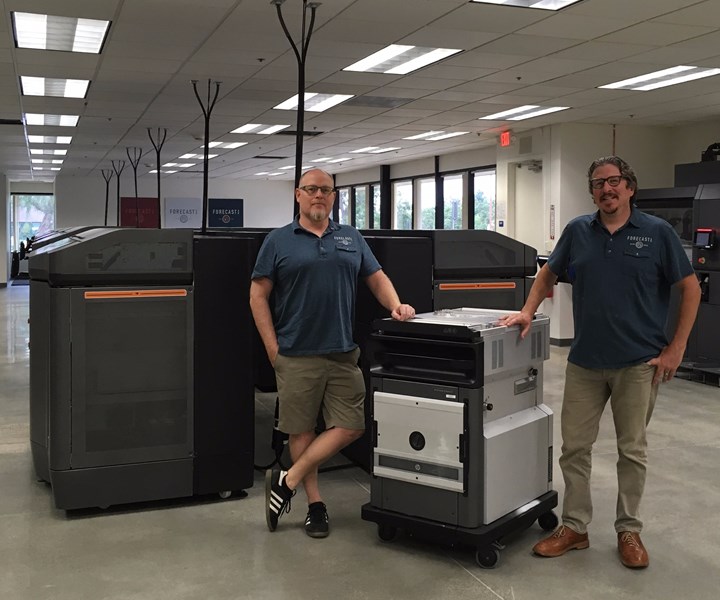
Corey and Donovan Weber, the two brothers who founded Forecast 3D, shown in 2017 at their 3D Manufacturing Facility in Carlsbad, California.

“We knew that the opportunity is much bigger than the size of our pockets,” Weber acknowledges. “We needed resources and our goal was to get someone that shared our vision. We found those with GKN. . . . And, honestly, it’s kind of a relief because now we can really focus on polymers and let them handle metals.”

To read more from the original article, click here: https://www.tctmagazine.com/3d-printing-news/gkn-powder-metallurgy-forecast-acquisition-deal/


Inside GKN Powder Metallurgy’s Acquisition of Forecast 3D Read More »

DELTA H Commissions Heat Treating System to AAR Corp

DELTA H commissioned a Dual Chamber Aerospace Heat Treat (DCAHTTM) to AAR Corp. at Indianapolis International Airport. AAR is a leading provider of aviation services to commercial airlines and governments worldwide. At its Indianapolis MRO facility it performs heavy maintenance with a focus on the Boeing 737.

Kelly Sauer,
VP of Quality, AAR

The DELTA H dual chamber furnace meets our needs as an effective, efficient and complaint heat treatment solution,” stated Kelly Sauer, AAR Corp’s Vice President of Quality.

Ellen Conway Merrill,
VP, DELTA H

“As the largest independent MRO in North America and one of the top five MRO providers in the world, it’s truly humbling to have earned AAR’s trust for their in-house heat-treating capabilities,” stated Ellen Conway Merrill, DELTA H Vice President. “The commissioning service at AAR Indianapolis included full qualification testing as well as training certificates for operators and QC/QA. The DELTA H DCAHTTM furnace system enabled AAR to quickly qualify for not only aluminum, but also aging of PH stainless steel and titanium.”

The DELTA H DCAHTTM furnace features dual chambers operable to 1200°F and 500°F with precision control and temperature uniformity, and a roll-away stainless-steel quench tank. The system qualifies as Class 2 (+/-10°F) per AMS2750E and includes all controls, data acquisition technology, and spares parts package to be in full compliance with all aerospace pyrometry standards and National Aerospace and Defense Contractors Accreditation Program (Nadcap).

DELTA H Commissions Heat Treating System to AAR Corp Read More »

Powder Metal Company Serving Automotive Industry to Add Sintering Furnace

A company specializing in manufacturing high volume, ferrous-based powder metal components in the automotive market has placed an order with Abbott Furnace Company for an electrically heated continuous belt sintering furnace to be delivered in the 2nd quarter of 2020. The furnace is rated at 2,150° F and also includes the unique Abbott Varicool Cooling System.

Additionally, Abbott is also fulfilling an order for an electrically heated continuous belt soft magnetic alloy processing furnace from a manufacturer in the powder metal industry providing components to the metals and mining market. Their furnace will also ship in the 2nd quarter of 2020. The furnace has a maximum temperature of 1850° F in an air, nitrogen, or steam atmosphere and includes a Delube chamber, oxidation chamber, water-jacketed cooling chamber, and a Thermostack thermal oxidizer.  The furnace will be controlled through an Allen Bradley Micrologix PLC. This furnace design will help the P/M industry to grow in the electrification segment of the market.


Powder Metal Company Serving Automotive Industry to Add Sintering Furnace Read More »

Meet Rio Tinto’s Revolutionary New Alloy

Global mining and metals specialist Rio Tinto is taking orders for its new aluminum wheel alloy known as Revolution-Al™. Researchers at its Arvida Research and Development Centre in Quebec, Canada, have spent more than five years developing a stronger car wheel alloy that would help cut fuel consumption and improve both safety and handling. The London-based firm says it received its first order for the new Revolution-Al™ alloy in September 2019 and that it designed the alloy to be easy to recycle.

Jerome Fourmann,
Technical Director,
Rio Tinto

“We wanted to offer automakers a new, innovative alloy that allowed them, through styling and design, to reduce the weight of the wheels, which is very important to improving fuel efficiency – because, in the end, people want to drive not just the safest but also the greenest and most innovative cars,” states Jerome Fourmann, a technical director at Rio Tinto.

According to Rio Tinto, Revolution-Al™ is 15 to 20 percent stronger than the current predominant wheel alloy, A356.2. They claim this translates to a 7 percent weight reduction and improved fuel efficiency or battery range. Additionally, Rio Tinto claims, Revolution-Al™ can be cast in existing facilities and requires less time to produce a wheel, thereby reducing the cost and increasing the rate of production.

The improved alloy features numerous claims; for instance, it is said to be 15 to 20% stronger than the traditional A356.2 alloy, has a seamless transition with existing casting processes, and requires a 2-hour shorter ageing cycle for heat treatment than the A356.2 alloy.

Jean-Francois Laplante,
Industrial Product and Investment Director,
Rio Tinto

It is worth noting that industrial trials of the new alloy, along with an official OEM test program, featured an optimized automotive wheel design, and Revolution-Al™ passed all OEM trials. What’s more, the alloy can be recycled onto itself, eliminating the need for selling the scrap at a discount.

“The current wheel alloy has been around for a long time and now we’re coming to the market with a new way of doing things,” says Rio Tinto Industrial Product and Investment Director Jean-Francois Laplante. “We were super excited when we saw the result.”

Photo Credit: Light Metal Age

Meet Rio Tinto’s Revolutionary New Alloy Read More »

IHEA Online Fundamentals Course Set for April 13, 2020

IHEA’s Fundamentals of Industrial Process Heating Online Learning Course is scheduled to begin April 13, 2020.  The course content provides an overview of the essential areas used throughout the industrial process heating industry. The program offers vital tools to operators and users of all types of industrial heating equipment. Students learn safe, efficient equipment operation, how to reduce energy consumption. and ways to improve a company’s bottom-line.

The course agenda includes the basics of heat transfer, fuels and combustion, energy use, furnace design, refractories, automatic control, and atmospheres as applied to industrial process heating.  Weekly coursework, quizzes and a final exam project are administered to guide students on their progress and evaluate their knowledge of the material.

Jack Marino

Industry expert Jack Marino, in his third year as an IHEA instructor, will lead students in this 6-week online course. Jack is a registered professional engineer with over 40 years’ experience in the heat processing business. He graduated from Rensselaer Polytechnic Institute with a bachelor’s degree in Aeronautical Engineering and has a master’s degree in Engineering Science from Penn State.

Both IHEA members and non-members alike will benefit from the flexible online format that includes interactive forums with other students and scheduled office hours with the instructor. It’s an affordable alternative to campus-based classes and allows students to go at their own pace without needing to take time away from the office.

Registration for the Fundamentals course is now open through April 6 at www.ihea.org/event/FundamentalsSpring20.  Click the Training and Events tab on the top menu bar then scroll down to Online Course.  Cost for IHEA members is $700 or one member voucher, and cost for non-members is $875, which includes an electronic course handbook, course instruction, quizzes and projects, class forums, and the opportunity to contact the instructor throughout the course.  Printed materials are available for an additional fee.

For a complete listing of the topics covered, visit www.ihea.org/event/FundamentalsSpring20.

IHEA Online Fundamentals Course Set for April 13, 2020 Read More »

StandardAero Expands Component Repair Capabilities

StandardAero has acquired a global services subsidiary based in Cork, Ireland, that provides specialized component repair and manufacturing processes for industrial, aeroderivative, and aircraft gas turbines.

TRS Ireland is a privately held company that has extensive experience as an OEM-approved specialty coating provider of engine component repair and MRO services on blades, vanes, and other hot section components for both new engines and a rising number of mature engines and a variety of applications.  The company, which has more than 180 OEM approvals/licenses and unique FAA and EASA certifications, also supports gas turbine users worldwide through its services.

Russell Ford,
Chairman & CEO,
StandardAero

“TRS Ireland has a long-standing, hard-earned reputation in the industry as a reliable service partner and will bring immediate growth and opportunity for StandardAero,” said Russell Ford, Chairman & CEO of StandardAero.

Rick Stine,
President of StandardAero’s CH&A Division

“TRS Ireland’s robust and long-tenured engineering and development team has extensive intellectual property around turbine airfoil and coating technologies and we see significant opportunities to leverage these capabilities and capacity to the fast growing aerospace and aeroderivative turbine engine repair markets,” added Rick Stine, President of StandardAero’s CH&A Division.

With the addition of TRS Ireland, StandardAero now has 40 primary repair facilities located on five continents.

StandardAero Expands Component Repair Capabilities Read More »

The Nadcap Accreditation Process Explained

          Source: Vac Aero International Inc.

Nadcap accreditation is looked on by most of the heat treating world as a significant achievement and a guarantee of quality. It not only permits a company to perform heat treating for the Aerospace/Defense industries but also tells customers that this company has a high standard of quality.

So what is it, and how does it work?

In this HTT Best of the Web Technical Tuesday feature, Vac Aero International takes readers through the entire Nadcap accreditation process from start to finish, examining what it is, how it works, and troubleshooting problem areas.

An excerpt: “Nadcap accreditation benefits not only the company being audited but helps ensure their customers receive products and services that meet or exceed both their expectations and requirements. The audit and accreditation processes result in continuous improvement in multiple areas, with deficiencies (i.e., nonconformances) identified and corrected based on specific rules (i.e., guidelines) to ensure each process meets or exceeds industry standards.”

Vac Aero gives a detailed look at the common pitfalls in the accreditation process, useful resources and training courses to help companies prepare for their audit, and what to do after the audit is complete.

Read More: The Nadcap Accreditation Process by Vac-Aero International

Photo Credit: TAV Vacuum Furnaces

The Nadcap Accreditation Process Explained Read More »

Stack Metallurgical Group Adds Vacuum Furnace to its Capabilities

Stack Metallurgical Group, a Nadcap accredited and Northwestern U.S. commercial heat treater, recently installed  a TITAN® vacuum furnace at its location in Spokane Valley, Washington. Formerly known as Inland NW Metallurgical Services, Stack Spokane is one of the company’s four locations offering metal processing services such as vacuum heat treating, induction heat treating, aluminum chemical processing, and ion nitriding. Ipsen USA  completed the installation.

Ron Decker,
General Manager, Stack Metallurgical Services, Inc.

“It was an easy choice adding another Ipsen furnace to our offering,” said General Manager Ron Decker. “We count on Ipsen for a versatile product that delivers great results.”

Installation of the TITAN® H6 2-bar vacuum furnace was completed in late 2019 and will be used to process aerospace components. Stack operates four Ipsen furnaces in Spokane and a dozen more in Portland.


Stack Metallurgical Group Adds Vacuum Furnace to its Capabilities Read More »