


NITROCARBURIZING TECHNICAL CONTENT

Heat Treat Radio #88: Lunch & Learn — 3 Most Underrated Processes

Get ready to watch, listen, and learn about the three most underrated heat treat processes in today’s episode. This conversation marks the continuation of Lunch & Learn, a Heat Treat Radio podcast series where an expert in the industry breaks down a heat treat fundamental with Doug Glenn, publisher of Heat Treat Today and host of the podcast, and the Heat Treat Today team.

Below, you can watch the video, listen to the podcast by clicking on the audio play button, or read an edited transcript. 



The following transcript has been edited for your reading enjoyment.

Doug Glenn: There are some underdog heat treat processes out here. I’d like to get to three today. What do you think is number one?

Michael Mouilleseaux: Let’s start with stress relieving. All ferrous materials, all steels, during the course of manufacturing or processing, have some residual stress that is left in them. A common thought about stress relieving is you have a weldment, and you stress relieve it so that the weldment stays.

Contact us with your Reader Feedback!

There is a mechanical action in the material during any cold working operation (cold forging, stamping, fine planking, etc.) because it's done at ambient temperature. Those all impart stress on the part.

Machining, turning, grinding. . . all of those things impart stress into a part. How is that relieved? It can be done thermally, or it can also be done mechanically. Thermally is the most common of them.

What I would like to talk about is not so much stress relieving weldments, it is stress relieving manufactured components. If you’re going to have a comprehensive analysis of the heat treat operation that needs to be performed on a manufactured component, a gear, a shaft, something of that nature, they need to take into consideration what are the prior existing stresses in the part. Then what effect is that going to have on the part?

Many times during the course of my career, I’ve had a customer come to me and say, “The part I gave you was correct, and you’ve given it back to me and then fill-in-the-blank. It’s warped, it’s changed size, it’s shrunk, all of those things.” What have you done in your heat-treating process? You have to back up all the way to the beginning of how this part was manufactured and deal with all of those component steps in order to answer that question properly.

Stress relieving is one of the answers. It’s not the answer. It’s not the only answer, but it is one of them that has to be considered.
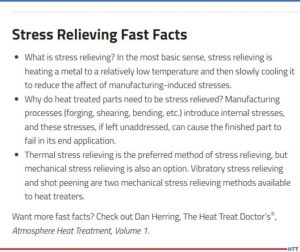
"Stress Relieving Tips from Heat Treat Today"

Doug Glenn: For those of us who might not know what a “stress” is in a part, can you simply explain? For example: a coat hanger. If I bend it, is that inducing stress? Is that what’s causing stress? What makes stress in a part?

Michael Mouilleseaux: You’ve cold-worked the part. In the cold working, you’ve passed the yield strength. You’ve bent it, and it’s not going to snap back. You’ve cold-worked it enough that you’ve actually got plastic deformation, and there is stress.

Doug Glenn: That’s one way we get stress. That’s the mechanical way of getting stress.

Michael Mouilleseaux: Right. Now, consider stamping. Even though a stamping is flat (because the die has come down in the perimeter of that and maybe internal holes and things), where you’ve sheared the material, you’ve imparted stress there.

If you harden it or case harden it or whatever you might do with that stamping, you have to take into consideration how much stress is there. If I don’t relieve it, is it going to do that at some point in the part’s future that’s going to be detrimental to the part?

Doug Glenn: When you get a stress in a part, that’s the area that’s a weak spot, right? It potentially could break before other parts?

Michael Mouilleseaux: At the absolute extreme, that could happen, yes. More often than not, what you have is an area that’s been cold worked, and it’s been deformed. When it stresses, it’s going to somewhat relieve itself. It may not relieve itself 100% all the way, but it will somewhat relieve itself. Whatever shape of form you’ve put that part into; it’s not going to hold that form forever.

Alyssa Bootsma: You mentioned that stress relieving is not the only way to alleviate the problems. What would be some alternatives to stress relieving?

Michael Mouilleseaux: Thermal stress relieving is, by far, the most common. There is a process that’s called vibratory stress relieving. In order to relieve the stresses in a part, you have to impart some energy in it. Something between 800 and 1200 Fahrenheit is typically used in stress relieving. That thermal energy goes into the part and relieves the stresses.

You could also do that mechanically by a high frequency vibration. It’s not as common. I believe that it’s actually a propriety process, if not patented. It would be for something that you did not want to subject to 800-1000 degrees Fahrenheit because that doesn’t come for free. Obviously, in a ferrous material at that temperature, you’re going to have some oxide forming on the part. You may or may not be able to utilize the part in its final function with that oxide on it.

Those are typically the two ways to do it. Can it occur naturally over time? Yes, but none of us have that kind of time.

Alyssa Bootsma: You did mention how it doesn’t necessarily mean that it’s more likely to break if that part is not relieved, but what parts would suffer the most if this process was done incorrectly?

Michael Mouilleseaux: Probably weldments. The detrimental effects of not having stress relieved of weldment would be the most significant. In welding there is a whole range of temperatures proximate to the weld — everything from room temperature to maybe 3000 degrees. That whole range of things changes the structure of the steel.

Leaving it in that condition makes it susceptible to any number of things — embrittlement, accelerated corrosion, and others. There is every reason to stress relieve something like that and almost no reason not to.
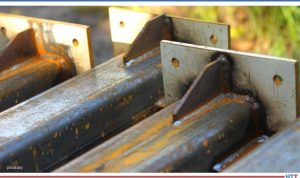
Doug Glenn: That’s weldment. Do they do a stress relieve after a braze as well, or is that not as common?

Michael Mouilleseaux: Typically not. The reason for that is, in brazing, the entire assembly is brought up to the same temperature. Then it’s cooled at the same rate.

Bethany Leone: I have two brief questions: 1. How long does stress relieving typically take? 2. Would we see the effects of incorrect stress relieving, or failure to, once something goes to quench?

Michael Mouilleseaux: The first question — would you necessarily see a failure? Those would be extremes. I’m more familiar with stress relieving fabricated components that are machined. Take a gear. They forge a blank and maybe machine out the center of the gear, machine the exterior of the gear, cut the teeth in a shaping operation (a hobbing operation or skiving or other ways of generating teeth).

"You have this part, and it needs to be heat treated. To assume that all of those machining operations would have no effect upon that whatsoever is not a good thought."

Then comes a comprehensive program of evaluating how best to heat treat a part. It doesn’t matter if it’s out of a medium carbon alloy steel or it’s a low alloy steel and we’re going to carburize it, what’s critical is that it’s going to get heated. The material is going to transform into austenite and cool rapidly or quench it. That’s what’s going to cause the hardening operation on the part.

In doing that, there are going to be changes in size. In hardening a part, you get a volumetric expansion. Thin sections are not going to expand as much as larger sections. A misnomer is, “You shrunk the hole.” You haven’t shrunk the hole! The material around the hole has expanded, the exterior portion of that area has increased, and the interior portion of that has decreased.

If you have a spline in that hole, now you’re on for something else because their teeth form in that spline. If it’s in a long section, then how uniform it’s been hardened has to do with whether or not it goes out of round or their taper. There are any number of things there. Those are all critical to the operation of this gear.

But what we have to take into consideration is the broaching operation. We drill a hole, and we put a broach bar through it and cut all of these teeth. All of that has imparted stress in the part.

One of the preliminary things that needs to be done is you stress relieve the part and give it back to the manufacturer. They measure it and say, “Oh, oh, it changed!” That change is not something the heat treater can do anything about. That’s the physics of what happens when you work-harden a part. This all has to be taken into consideration and addressed before we talk about what’s the heat treat distortion.

Bethany Leone: And the other question I had: How long does it take to stress relieve?

Michael Mouilleseaux: Typically, if it’s held at an hour or two at temperature, it’s thought that 1000 degrees for an hour at temperature will relieve most stresses.

Now, in a component part, we’re going to go higher in temperature. Although we’re not going to go high enough to austenitize the part, we’re going to go high enough in temperature that we know we’re going to relieve it.

Michael Mouilleseaux: They’re cousins. Stress relieving, the implication is that you are doing that simply to relieve prior existing stresses. In annealing, the implication is that you are going to reduce the hardness of the microstructure for the purposes of machining or forming. In annealing, there’s subcritical and supercritical and a hundred different flavors of that.

Doug Glenn: I’m trying to get a sense of what percentage of heat treating is stress relieving. Is it super popular? It seems to me it would be very common.

Michael Mouilleseaux: Interestingly enough, I’m going to say that the majority of the gearing product that we do, we incorporate a stress relief in the initial stages of heat treating. By putting the part in and raising the temperature to a stress relieving temperature and then taking it up into the austenitizing temperature, you’re not shocking the part. You’re not just taking it from room temperature to carburizing temperature or hardening temperature, and thereby you’re reducing the thermal stresses. So, you’re not imparting any more.

Doug Glenn: Stress relieving may often be done as a part of another process?

Michael Mouilleseaux: It can be, definitely.

Doug Glenn: Let’s move on to the second forgotten heat treatment.

Michael Mouilleseaux: I don’t know about forgotten. I’m going to say that it’s getting short shrift, and that is conventional atmosphere carburizing. What’s sexy in heat treating? It’s low pressure carburizing and gas quenching. It’s growing very rapidly and it’s being used in a lot of applications.
We’re subject to the same ills that Mark Twain identified years ago, and that is, “To a man with a hammer, every problem looks like a nail.” Low pressure carburizing and gas quenching, they can save every distortion issue that’s ever been known to man in heat treating, and they don’t. They are other tools in the box, applicable to a lot of application. They are great processes, very targeted and specific. You know, sometimes you need a screwdriver instead of a hammer.

Conventional carburizing: It’s been around for a hundred years. What’s different today than what it ever was? Certainly it has everything to do with the control systems that are being used to control it. It’s eminently more controllable now than it has ever been. It is a precision operation, and it has many applications. By the way, it’s far more cost effective than carburizing would be. In vacuum carburizing, the cost is multiple; is it two, three or four times more expensive? It depends on how you calculate cost of capital and all of those things. But it’s a multiple, more expensive than conventional carburizing.

Doug Glenn: To do vacuum carburizing?

Michael Mouilleseaux: To do vacuum carburizing, yes. Should it be used in every application? I’m going to say no. Are there definite applications? Definitely.

Doug Glenn: Conventional carburizing, atmosphere carburizing is another area largely forgotten. I know it’s quite popular, but it’s not getting a lot of discussion these days.

Michael Mouilleseaux: Right. Any time there is an issue with a carburized part, everyone knows to ask the question, “Why don’t you vacuum carburize it?” The answer to that is, “Let’s solve the problem before we decide what it is that we need to do.”

Karen Gantzer: Mike: At a very basic level, can you explain why do heat treaters use endothermic gas?

Michael Mouilleseaux: In atmosphere carburizing, we need a method of conveying carbon to the part so that we can enrich it; that’s what carburizing is. The carburizing portion of the atmosphere in endothermic gas is carbon monoxide. Carbon monoxide — that’s the reaction at the surface of the part — the carbon diffuses into the part. That’s how you generate a case in the part.

It’s a relatively inexpensive form of carburizing. You use natural gas and air in what we call a “generator”, and that’s how endothermic gas is generated. Then, it’s put into the furnace. There’s almost no air in a furnace. People think you’re going to look in a furnace, and you’re going to see flame. You never do because the amount of oxygen in the furnace is measured in parts per million. You put additional natural gas to boost the carburizing potential of the atmosphere, and that’s what allows you to diffuse carbon into the part. That is the case hardening process.

Doug Glenn: Conventional carburizing is done in a protective atmosphere, typically as an endothermic atmosphere which is rich in carbon monoxide.

Michael Mouilleseaux: Yes.

Doug Glenn: A lot of times we’re worried about oxygen in the process because of potential oxidation. Why is it that we use a gas that has oxygen in it to infuse carbon? I know it’s got carbon, but it’s also one C and one O, right? Don’t we run into problems of potential oxidation?
"Comparative Study of Carburizing vs. Induction Hardening of Gears"

Michael Mouilleseaux: In endothermic gas there is hydrogen, nitrogen and carbon monoxide, and there are fractional percentages of carbon dioxide and some other things. The hydrogen is what scrubs the part; that’s what kind of takes care of all of the excess oxygen. The nitrogen is just a carrier portion of it, and the carbon monoxide is what is the active ingredient, if you will, in the carburizing process.

The carbon diffuses into the part. If there is an oxygen, it’s going to combine with the hydrogen. Preferentially, you’re not going to have any free oxygen in the furnace, but you can have a little water vapor. One of the ways of measuring the carbon potential in the furnace is a dewpoint meter. The dewpoint meter is measuring the temperature at which the gas precipitates out, and that’s a monitor or a measure of the carbon potential.

Doug Glenn: A dewpoint analyzer helps you know what the carbon potential is.

Michael Mouilleseaux: Yes. It’s not as good as an oxygen analyzer.

Doug Glenn: An oxygen probe.

Michael Mouilleseaux: The oxygen probe is in the furnace, measuring constantly. You get a picture; you have continuous information. It’s not that there aren’t continuous dewpoint analyzers, but you have to take a sample from the furnace. It has to be taken to an analyzer wherein it is then tested. Best case scenario is you have both of them and you compare the two of them. That gives you a really great picture of what the atmosphere conditions are in the furnace.

Alyssa Bootsma: For a bit of background knowledge: What is the difference between endothermic gas and exothermic gas?

Michael Mouilleseaux: Endothermic gas has 40% hydrogen and 20% carbon monoxide. 60% of it is what you would call a reducing atmosphere. The way that you make endothermic atmosphere is 2.7 parts of natural gas and one part of air. You heat it up to 1900 degrees, and it’s put through a nickel catalyst. You strip off the hydrogens. The gas dissociates, and that’s what results.

Exothermic gas is six parts of air in one part of natural gas. You only have 10 or 15% hydrogen. Although it’s not an oxidizing atmosphere, it’s very mildly reducing.

It can be used in annealing, clean annealing. If you’re annealing at 12-1300 degrees or more or in that ballpark, that kind of an atmosphere is going to keep the work clean. If you did it in air, it would scale.

Bethany Leone: Is there an industry (automotive, aerospace, energy) that it would be most helpful for those parts to be typically atmosphere carburized, and/or is it just generally helpful for all types of industries?

Michael Mouilleseaux: First of all, the transportation industry is the lion’s share of heat treating — automotive, truck, aircraft. Atmosphere carburizing is extremely popular and commonplace in those industries.

If we said that we were going to have a seminar and I’m going to talk about atmosphere carburizing. Somebody else is going to talk about low pressure carburizing in a vacuum furnace. Everybody’s going to go over to the other room. Folks feel they already know what this is all about, and they know what all the problems are. They think that the vacuum carburizing is going to solve all of them.

When you work with the proper kinds of controls, the proper kinds of furnace conditions, the right way of fixturing parts and cleaning them ahead of time, you can have extremely consistent results. You can have extremely clean parts, and you can have very good performance from these things.

What the Europeans call “serial production”: we run millions of gears per year, and we have very consistent case steps in hardnesses as a result of good practice. All of these things need to be monitored and controlled and taken care of. But the results are also very consistent and very predictable.

Doug Glenn: Interesting. And it’s more cost-effective, I’m guessing. Conventional atmosphere carburizing, on a per part basis, is going to be substantially less expensive.

Michael Mouilleseaux: We’ve looked at it. Is it two times, is it three times, is it four times more expensive to vacuum carburize a part? The answer is yes. The question is, does that component justify that? There are any number of them where it does.

Doug Glenn: Where it does justify it?

Michael Mouilleseaux: Yes, absolutely.

Doug Glenn: Let’s go on to #3, the third underdog in heat treating.

Michael Mouilleseaux: Number three is marquenching. Marquenching, martempering, and hot oil quenching are in the family that describes this process.

Martempering is different than just quenching in oil, quenching in regular fast oil. Regular oil is going to be 100 vis, and it’s going to be from 90 degrees to 150 degrees. All kinds of low hardenability, or parts that don’t have a lot of adherent alloy in them, you utilize that so that they can be fully hardened. But components that are distortion-critical, quenched in that manner in regular oil, there is going to be a high degree of distortion. How is that addressed? It’s addressed in marquenching.

Let’s take an example of a carburized gear. A carburized case is heated to 16-1700 degrees and carburized. Best practice would say that I’m going to reduce the temperature before I quench it, and then I’m going to quench it in oil. Do I understand that: I have to have loading that spaces the part; and the parts need to be fixtured in such a way that, physically, they don’t impede on each other; and I get full flow of oil, and all of those things? The answer is yes, yes, and yes.

The martensite starts to form in the case at, let’s say, 450 and it’s plus or minus 25 or 30 degrees or so. Take that part and put it into the range where the martensite starts to form, and hold it at that temperature and let the entire part cool down to that 450 degrees where the martensite is starting to form. Then we remove the part from the furnace and allow it to cool in air to room temperature. At that point, the cooling rate is much lower than it it’s going to be where you’re conducting that in a liquid medium. Because of that, the stresses are going to be less, the distortion is going to be less. That is a strategy for reducing distortion.

You ask, “Why do you need to do that.?” Again, the man with the hammer: I’m going to gas quench this part because I have the opportunity to gas quench it, and the gas quenching doesn’t come for free. The shadowing effects of a gas flow has to be taken into consideration, orientation of the parts. There are a number of things that need to be taken into consideration.[blocktext align="left"]There are a number of applications where in marquenching a part, the distortion can be controlled. We process a lot of gears, and we maintain 20/30 microns of total distortion in ID bores on gears. It is a viable way of controlling distortion.[/blocktext]

Doug Glenn: We say marquenching.

Mike Mouilleseaux: Or martempering or hot oil quenching.

Doug Glenn: The “mar” part of that comes from martensite? I want have you explain what exactly martensite is. But is that where it comes from?

Mike Mouilleseaux: Yes. We’re getting right into the start of the martensite transformation.

Doug Glenn: There are different microstructures in metals. Austenite is pretty much the highest temperature, and it’s where the molecules are almost “free floating.” They’re not liquid, but they can move around. (This is very layman’s terms.) That’s austenite.

What causes distortion is when you’re cooling from austenite down to the point where that thing is, kind of, locked in; that can cause distortion in there because the molecules are still free to move. Some areas cool faster than others, and when you have that, you can get twists and turns or bulges. Once it gets down to the martensite temperature, that’s when things are, locked in. Is that fair?

Michael Mouilleseaux: The other thing that happens is you’re going from a cubic structure to a tetragonal structure. You’re asking, “Why are we there?” That’s where the expansion comes. The close-packed tetragonal structure takes up more volume than the austenitic or cubic structure. That’s where the volumetric expansion takes place.

Doug Glenn: At a higher temperature, the molecules are arranged in such a way that they take up more space; there’s more space between them.

In the cooling process with marquenching, if you bring it down just to the point where it’s, what Mike referred to as, the ‘martensite start temperature,’ that’s the temperature where things are just locking in. But it’s not so drastic that you’re dropping way down in temperature so that there are larger temperature differentials and things are really starting to get torqued out of contortion because of the difference in the cooling rates in the part.

Michael Mouilleseaux: The other part of that is that the formation of martensite is not time dependent. It’s not like you would have to hold it at 400 degrees for a longer period of time than you would at 200 degrees to get martensite. At 400 degrees, you’ve got some percentage of transformation. Say, it’s 30%. The transformation is temperature dependent. Because it’s temperature dependent, you can take it out and slow down the cooling rate. Then, as the transformation takes place, there is less stress, and if there’s less stress, then there is less distortion.

Again, it’s typically going to be distortion-sensitive parts.

The simplest geometric shape is a sphere. There aren’t any changes in section size in a sphere. It can be rotated, and you’ve got the same section size. You don’t have the kind of thing where one area is cooling more rapidly than another.

A major source of distortion is varying mass. Like a hole in a block: one portion of the block is two inches wide, and another portion is an inch wide. To think that that hole is going to stay straight all by itself, that won’t happen because there’s more mass around one end. By marquenching it and slowing down the transformation, you’re giving yourself an opportunity to reduce the amount of stress that’s generated. It’s the volumetric expansion in the thicker section than in the thinner section. Your opportunity to maintain that hole so that it stays round and it stays straight is much better. Otherwise, the thin section is going to completely transform before the thicker section does.

Doug Glenn: Transform to martensite or whatever, yes.

Michael Mouilleseaux: The extreme case in that is if that happens rapidly enough, and there’s a large enough differential in section size, the part cracks.

Doug Glenn: That’s the nightmare for the heat treater.

Guest Michael Mouilleseaux with the Heat Treat Today team

Bethany Leone: Are there any instances where it’s definite that another way to manage distortion would be better than marquenching?

Michael Mouilleseaux: Sure. Again, what’s currently sexy in this industry is gas quenching things. I’m going to say that cylindrical parts that have a thin wall, when properly gas quenched, will give you better distortion control, better size control than it would if you’d quench them in a liquid medium such as oil. We don’t want to forget that marquenching can be performed in salt, as well.

If we were going to talk about a fourth one, it might be salt quenching because that’s one of those things that’s not commonly utilized. There is some real opportunity with it.

Doug Glenn: Mike, thanks for ‘dumbing this down’ for us. We appreciate it! It’s sometimes a struggle to state things simply, but you did a great job.

Are there any closing thoughts you’d like to leave with us regarding the nearly-forgotten, popular heat treat processes, or anything else?

Michael Mouilleseaux: How about the combination of all three that I just spoke about?

Doug Glenn: Okay. Well, how about that?

Michael Mouilleseaux: I’ve got a distortion sensitive gear, and we’ve figured out that there is some stress in the part as a result of the final machining operation. We stress relieve the part, we carburize it conventionally, and then we marquench it. Those gears that I spoke about where we’ve got 20 or 30 microns of ID bore distortion — that’s exactly what’s done there.

Doug Glenn: Okay. Stress relieve first, conventional carburize, and then marquench. A combination of three.

Mike, thank you very much. This has been really helpful and it’s been good to learn a little bit on our Lunch & Learn. We’ll hope to have you back sometime to make other things understandable for us.


About the expert: Michael Mouilleseaux is general manager at Erie Steel LTD. Mike has been at Erie Steel in Toledo, OH since 2006 with previous metallurgical experience at New Process Gear in Syracuse, NY and as the Director of Technology in Marketing at FPM Heat Treating LLC in Elk Grove, IL. Having graduated from the University of Michigan with a degree in Metallurgical Engineering, Mike has proved his expertise in the field of heat treat, co-presenting at the 2019 Heat Treat show and currently serving on the Board of Trustees at the Metal Treating Institute.

Contact: mmouilleseaux@erie.com



Doug Glenn <br> Publisher <br> Heat Treat Today

Doug Glenn
Publisher
Heat Treat Today


To find other Heat Treat Radio episodes, go to www.heattreattoday.com/radio .


Search heat treat equipment and service providers on Heat Treat Buyers Guide.com


Heat Treat Radio #88: Lunch & Learn — 3 Most Underrated Processes Read More »
19th Century Guns vs. 21st Century Corrosion Resistance

Source: Advanced Heat Treat Corp.

Let's talk about guns.

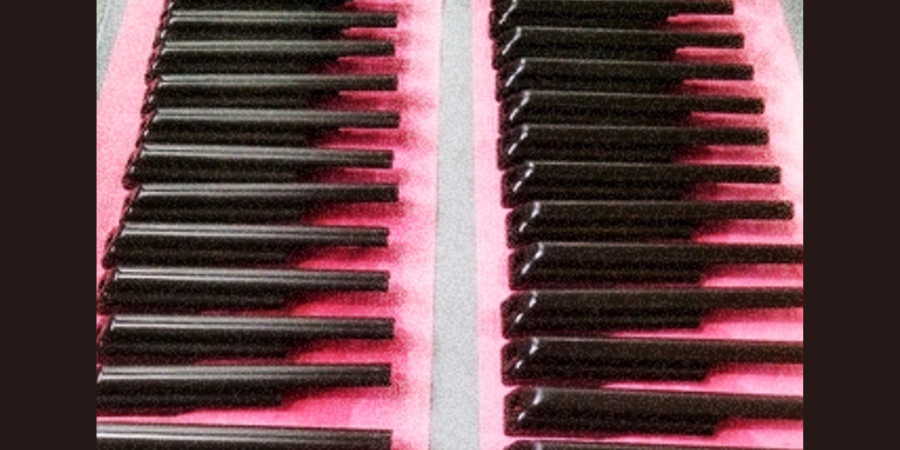
To create a durable and corrosion resistant barrel, guns in the 19th century were made with blackening, a process related to heat treat. This application also increased the general look, reduced light reflection, and increased wear resistance in general.

This best of the web will cover general blackening of ferrous metals and summarize key points about nitriding and nitrocarburizing with blackening.

An excerpt:

"There are three types of blackening in common use: Caustic Black Oxidizing, Room Temperature Blackening and Low-temperature Black Oxide."

Read more at "Decorative and Technical Aspects of Ferrous Metals Blackening"


Find heat treating products and services when you search on Heat Treat Buyers Guide.com


19th Century Guns vs. 21st Century Corrosion Resistance Read More »

Looking to a Future with FNC or Nitriding?

OCWhat's the future of ferritic nitrocarburizing and how does it compare to other hardening processes? When it comes to metal hardening, there are many variations on central processes, including recent innovations in how to apply hardening processes.

This Technical Tuesday brings you a quick overview of how hardness technologies differ, specifically nitriding and FNC, and how certain heat treaters have developed these specific hardness technologies.


Understanding the Various Hardening Processes

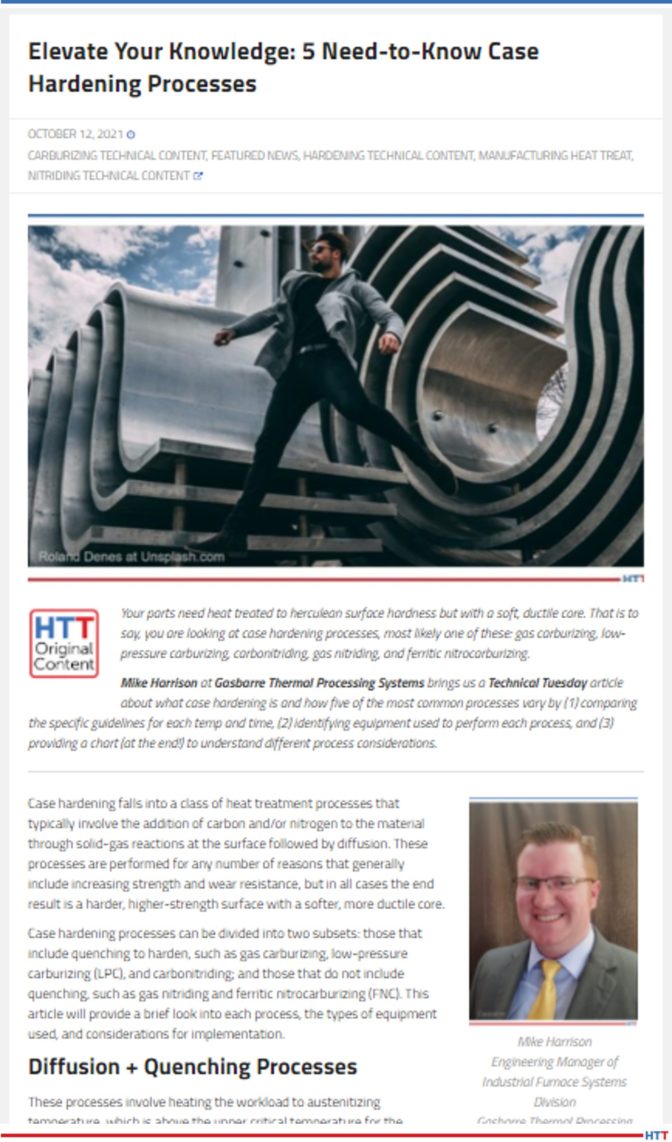
If you want to know the future, the best you can do is understand the past and present. Let’s begin with looking at the most common hardening processing methods. Here are a few excerpts from “Elevate Your Knowledge: 5 Need-to-Know Case Hardening Processes” by Mike Harrison, engineering manager of Industrial Furnace Systems Division at Gasbarre Thermal Processing Systems:

Read more about these 5 processes in Mike Harrison's article. Click to read.

Carburizing: “Gas carburizing is a process where carbon is added to the material’s surface. The process is typically performed between 1550-1750°F, with carburizing times commonly between 2-8 hours [this spec is disputed, and times may run up to 24 hours]; of course, these values can vary depending on the material, process, and equipment. The most common atmosphere used for atmosphere gas carburizing is endothermic gas with additions of either natural gas or propane to increase the carbon potential of the furnace atmosphere.”

Nitriding: “Gas nitriding is a process where nitrogen is added to the material surface. The process is typically performed between 925-1050°F; cycle times can be quite long as the diffusion of the nitrogen is slow at these temperatures, with nitriding times typically ranging from 16 – 96 hours or more depending on the material and case depth required. Nitriding can be performed in either a single or two-stage process and has the potential to produce two types of case, the first being a nitrogen-rich compound layer (or “white layer”) at the surface that is extremely hard and wear-resistant but also very brittle.”

Carbonitriding: “Despite its name, carbonitriding is more closely related to carburizing than it is to nitriding. Carbonitriding is a process where both carbon and nitrogen are added to the material surface. This process is typically performed in a range of 1450-1600°F [this spec is disputed, and temperatures may go up to 1650°F] and generally produces a shallower case depth than carburizing.”

Ferritic Nitrocarburizing (FNC): “In the author’s opinion, just like with carbonitriding, ferritic nitrocarburizing (FNC) is named incorrectly as it is more closely related to nitriding than it is with carburizing. FNC is a process that is still mostly nitrogen-based but with a slight carbon addition as well. The added carbon helps promote compound layer formation, particularly in plain carbon and low alloy steels that do not contain significant nitride-forming alloys. This process is typically performed in a range of 1025-1125°F with cycle times much shorter than nitriding, typically 1-4 hours.”

Low Pressure Carburizing (LPC): “Low-pressure carburizing (LPC), or vacuum carburizing, is a variation of carburizing performed in a vacuum furnace. Instead of the atmospheres mentioned previously, a partial pressure of hydrocarbon gas (such as acetylene or propane) is used that directly dissociates at the part surface to provide carbon for diffusion. After LPC, the workload is transferred to a quench system that could use oil or high-pressure gas, typically nitrogen.”

Nitriding

Learn more about the basics of hardening at Heat Treat Radio. Click to listen,

Gas nitriding, a process over 100 years old, is a hardening process that involves diffusing nitrogen into the surface of steel to create a hard, wear-resistant case. Among many benefits, the part will have enhanced fatigue properties, anti-galling properties under load, and a resistance to softening at elevated temperature. This makes it an excellent choice for the aerospace industry.

There is some recent history regarding problems related to the “white layer”. In a typical microstructure, the “white layer” is a nitrogen-rich surface layer and the diffusion layer exists beneath it.1 It is essential that the surface layer be controlled to avoid an overly brittle part. Mark Hemsath the vice president of Sales – Americas for Nitrex Heat Treating Services, elaborated on this in a Heat Treat Radio episode:

"Doug Glenn: I assume, with all the modern day technology and whatnot, we're able to control that white layer and/or depth of nitriding layer through your process controls and things of that sort."

"Mark Hemsath: Yes. Nitriding has been around a long time, but one of the problems that they had was controlling the white layer. Because they basically would just subject it to ammonia and you kind of got what you got. Then they learned that if you diluted it, you could control it. That's with gas nitriding. Then plasma nitriding came around and plasma nitriding is a low nitriding potential process. What that means is it does not tend to want to create white layer as much. It's much easier to control when the process itself is not prone to creating a lot of white layer, unlike gas. Now, in the last 10 – 15 years, people have gotten really good at controlling ammonia concentrations. They've really learned to understand that."

Recently, SECO/WARWICK shared their nitriding technological developments in their product, ZeroFlow.

"ZeroFlow nitriding is ammonia-based gas nitriding," commented Dr. Maciej Korecki, PhD Eng., vice president of the Vacuum Furnace Segment at SECO/WARWICK Group. "It is distinguished by the fact that the nitrogen potential is controlled by introducing the right portion of ammonia at the right time and only ammonia, instead of a continuous flow of a mixture of ammonia and diluent gas."

"Consequently, the ZeroFlow method uses the minimum amount of ammonia needed to achieve the required nitrogen potential and replenish the nitrogen in the atmosphere, taking into account the situation where no ammonia is supplied to the furnace at all, no flow, hence the suggestive name of the solution," he continued. "Using ammonia alone in the nitriding process, we are dealing with a stoichiometric reaction (as opposed to some traditional methods), that is, one that is uniquely defined and predictable based on the monitoring of a single component of the atmosphere. Therefore, the ZeroFlow process controls very precisely through the analyzer only one gas, obtaining an improvement in the quality and repeatability of the results compared to various traditional methods."

According to Dr. Korecki, the process is about going back to the basics of nitriding: "The inventor of the method is Prof. Leszek Maldzinski of the Poznan University of Technology, who developed the theoretical basis and confirmed it with research. Then, more than 10 years ago, a partnership between SECO/WARWICK and the Poznan University of Technology initiated a project to develop and build the first industrial furnace designed to perform the ZeroFlow nitriding processes. The furnace was launched at SECO/WARWICK's research and development department (SECO/LAB®), where the method has been implemented and validated on dozens of industrial-scale processes."

Ferritic Nitrocarburizing

This nitrogen-based process can produce a deeper compound layer than nitriding, which is great for industrial machinery applications where this deep layer is needed for increased wear resistance and the critical strengthening of a deep case depth is not essential.

FNC has gone through a technical evolution with different heat treaters in the industry developing their own unique applications with method in mind. We'll look at two recent examples: AHT's Super Ultra Ox and Bodycote's Corr-I-Dur.

Edward Rolinski
Senior Scientist
Advanced Heat Treat, Corp.
(Source: https://www.ahtcorp.com/)

According to experts at Advanced Heat Treat Corp. (AHT), Edward Rolinski (Dr. "Glow"), Jeff Machcinski, Vasko Popovski and Mikel Woods, "Thermochemical surface engineering of ferrous alloys has become a very important part of manufacturing. Specifically, nitriding and nitrocarburizing (FNC) processes are used since their low temperature allows for treatment of finished components. They are applied to enhance the tribological and corrosion properties of component surfaces.2 In many situations, nitriding replaces carburizing even if the nitrided layer is not as thick.3 A post-oxidizing step, applied at the end of FNC, leads to significant enhancement of corrosion properties by formation of a magnetite layer (Fe3O4).

"AHT’s newly developed process, UltraOx® Hyper, results in superior wear and corrosion resistance and allows for good control of the parts’ blackness. The latter is very important when the treatment is used for firearms. While the parts’ corrosion resistance improves with nitriding alone, the additional steps in UltraOx® Hyper significantly extend corrosion resistance. AHT is committed to achieving its customers’ desired metallurgical and cosmetic results through R&D and investing in state-of-the-art equipment. These innovations allow for flexibility in these areas."

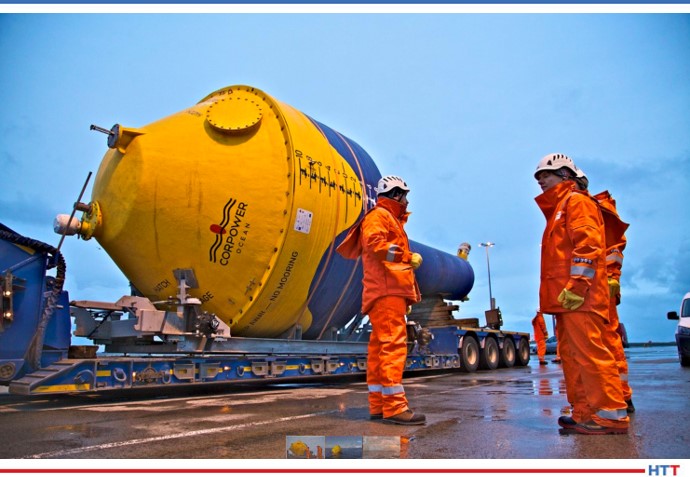
In recent news, wave energy pioneer CorPower Ocean will be using Bodycote's thermochemical treatment, Corr-I-Dur®, for CorPower’s high-efficiency WECs.
Image Source: www.waterpowermagazine.com

From Bodycote, they say that their proprietary Bodycote thermochemical treatment “Corr-I-Dur® is a combination of various low temperature thermochemical process steps, mainly gaseous nitrocarburising and oxidising.”

They explain, "In the process, a boundary layer consisting of three zones is produced. The diffusion layer forms the transition to the substrate and consists of interstitially dissolved nitrogen and nitride precipitations which increase the hardness and the fatigue strength of the component. Towards the surface it is followed by the compound layer, a carbonitride mainly of the hexagonal epsilon phase. The Fe3O4 iron oxide (magnetite) in the outer zone takes the effect of a passive layer comparable to the chromium-oxides on corrosion resistant steels.

"Due to the less metallic character of oxide and compound layer and the high hardness abrasion, adhesion and seizing wear can be distinctly reduced. Corr-I-Dur® has very little effect on distortion and dimensional changes of components compared to higher temperature case hardening processes."

How to Implement?

We’ve seen a lot of development in way of nitriding and ferritic nitrocarburizing (FNC), but for many heat treaters, you inherit specific processes and traditions of accomplishing heat treatment and do not have the chance to understand how to implement each process. Read the full 21 point comparative resource at FNC vs. Nitriding

Conclusion

The more informed you are, the better decisions you can make. For example, knowing these recent developments in metal treating and hardening is sure to help you decide whether to shift directions in how you company process parts for electric vehicles, or if you are ready to expand your offerings for your aerospace clients. It is clear that each of these processes have a future all-their-own. It’s up to you to decide whether that future should be yours, too.

For more information on the basics of hardness, listen to the what, why, and how of hardening with Mark Hemsath, an expert on metal hardness and vice president of Sales – Americas for Nitrex Heat Treating Services, on this Heat Treat Radio episode with Doug Glenn, publisher of Heat Treat Today. You can also review the resources below that were referenced in today’s article.


References

1 Daniel H. Herring, “The Heat Treat Doctor”, “Case Hardening of Steel, Part Three: Gas Nitriding,” PowerPoint Presentation, © 2004 – 2010 The HERRING GROUP, Inc.

2 “Thermochemical Surface Engineering of Steels”, Woodhead Publishing Series in Metals and Surface Engineering: Number 62, Ed. Eric J. Mittemeijer and Marcel A. J. Somers, Elsevier, 2015, pp.1-769.

3 J. Senatorski, et. al, Tribology of Nitrided and Nitrocarburized Steels”, ASM Handbook Vol 18, Friction, Lubrication and Wear Technology, ed. G. Totten ASM International, 2017, pp. 638-652.


Resources

  1. Herring, “Case Hardening of Steel, Part Three: Gas Nitriding,” PowerPoint Presentation, © 2004 – 2010 The HERRING GROUP, Inc.
  2. Harrison, “Elevate Your Knowledge: 5 Need-to-Know Case Hardening Processes,” Heat Treat Today, https://www.heattreattoday.com/processes/hardening/hardening-technical-content/comparative-study-of-5-case-hardening-processes/.
  3. Hemsath and D. Glenn, “Heat Treat Radio: Metal Hardening 101, Part 2 of 3,” Podcast and Transcript, Heat Treat Today, https://www.heattreattoday.com/media-category/heat-treat-radio/heat-treat-radio-metal-hardening-101-with-mark-hemsath-part-2-of-3/.
  4. Orosz, T. Wingens, and D. Herring, “Nitriding vs. FNC,” Heat Treat Today, https://www.heattreattoday.com/processes/nitrocarburizing/nitrocarburizing-technical-content/integrated-nitriding-and-fnc/.
  5. Senatorski, J. Tacikowski, E. Rolinski and S. Lampman, “Tribology of Nitrided and Nitrocarburized Steels”, ASM Handbook Vol 18, Friction, Lubrication and Wear Technology, ed. G. Totten ASM International, 2017.
  6. “Thermochemical Surface Engineering of Steels”, Woodhead Publishing Series in Metals and Surface Engineering: Number 62, Ed. Eric J. Mittemeijer and Marcel A. J. Somers, Elsevier, 2015, pp.1-769.

Looking to a Future with FNC or Nitriding? Read More »

Nitriding vs. FNC

OCHow well do you know hardness processing? Can you draw the line where nitriding and ferritic nitrocarburizing (FNC) differ? In this Technical Tuesday feature, skim this straight forward data that has been assembled from information provided by four heat treat experts: Jason Orosz and Mark Hemsath at NitrexThomas Wingens at WINGENS LLC – International Industry Consultancy, and Dan Herring, The Heat Treat Doctor at The HERRING GROUP, Inc.

Let us know what you think! What is the next comparison you'd like to see? What facts were you surprised by? Email Heat Treat Daily editor Bethany Leone at bethany@heattreattoday.com.

Nitriding Descriptor Ferritic Nitrocarburizing
480º-590C (896º-1094ºF) typical Temperature Range 565º-590ºC (1049ºF-1094ºF) typical
Wrought and powder metallurgy materials including alloy steels (e.g., 4140), stainless steel (e.g., 304L, 420), tool steels (e.g., H11, H13) and special nitriding steels (e.g,, Nitralloy 135M, Nitralloy EZ) are typical examples. Many other steel grades are possible. Materials Commonly Processed Plain and medium carbon steels (e.g., 1015, 1018, 1045), alloy steels (e.g., 4140, 4340) and tool steels (e.g., H11, H13) are typical examples. Many other steels grades are possible.
Wear (as in abrasion resistance), bending, torsional and rolling contact, fatigue resistance, lubricity, and adhesive strength improvements. Materials Commonly Processed: Why to Process Them with These Methods Wear resistance, lubricity, fatigue, and corrosion resistance are primary benefits with improved fatigue strength and adhesive strength possible.
3-48 hours at temperature. May be up to 72 hours. Relative Cycle Times 2-6 hours at temperature.
Pit retort furnaces and front load retort furnaces for gas nitriding, although bell retort furnaces have also been used. Equipment Types Used for the Process Pit retort furnaces and front load retort furnaces for gaseous ferritic nitrocarburizing. Bell retort furnaces have also been used.
Ammonia and nitrogen or ammonia and dissociated ammonia. Atmospheres Used/Required Ammonia and nitrogen and carbon-bearing gas such as CO2, CO, or endothermic gas.
Dies, gears, pump bodies, springs, gun barrels, shafts and pinions, pins, brake rotors and may other types of component parts produced from bar, plate, rod, forgings and castings formed by stampings, machining, rolling, forging, casting, etc. Typical Parts Processed Wear plates, washers, clutch plates, gas pistons, brake pistons, brake rotors, barrels, slides, differential cases and other types of component parts produced from bar, plate, rod, etc., and formed by stampings, rolling, machining, casting, etc.
Automotive, aerospace, oil & gas, industrial machinery (e.g., pumps), and tool & die. Typical Industries Served Automotive and industrial machinery hydraulics.
Cost is often higher for gas nitriding as opposed to other case hardening processes (including FNC) based on the type of component parts run. In many cases, cost is a function of the longer cycle time and/or more labor involved. Relative Cost Per Unit Cost is often lower than many other case hardening processes (including gas nitriding) based on the type(s) of component parts run. In many cases, cost is a function of a shorter cycle time and/or less labor involved.
Basic specifications are easily achieved with good equipment and/or controls; difficulty increases when attempting to produce specialized layer compositions/phases. Ease of Use/Control Basic specifications are easily achieved with good equipment and/or controls; difficulty increases when attempting to produce specialized layer compositions/phases. Hardware/control requirements are more complicated than for nitriding when controlling for carbon potential.
It can range from very simple to medium-high depending on application. Relative Expertise Necessary to Perform Medium-high depending on the application. The user will want to look for clean parts, a good loading system, and PLC controlled cycle.
Aqueous (clean chemistry) including rinse/dry, vapor degreasing (clean chemistry). Cleaning Requirements Aqueous (clean chemistry) including rinse/dry, vapor degreasing (clean chemistry).
White glove Handling Requirements White glove
Pre- and post-oxidation Process Options Pre- and post-oxidation
AMS 2759, AMS 2759/10, (latest revisions) Applicable Specifications AMS 2757, AMS 2759/12, AMS 2759/13 (latest revisions)
Time, temperature, gas flow, nitriding potential (Kn) and/or percent dissociation, hydrogen sensors. Controls Time, temperature, gas flow, nitriding potential (Kn), carbon potential (Kc) and oxygen potential (Ko). Hydrogen sensor and oxygen (carburizing) sensor may be used.
electric and gas-fired equipment Fuel Source electric and gas-fired equipment
Hardness (surface, core), case depth determination (via microhardness – typically core hardness + 50 HV), microstructure (compound and diffusion zone depths), composition, core structure, presence of absence of nitride networking (aka nitride needles), and the presence or absence of cracking or spalling of the case. Testing Required Hardness (surface, core), case depth determination (via microhardness – typically core hardness + 50 HV), microstructure (compound and diffusion zone depths), composition, core structure, porosity (type and depth), and the presence or absence of cracking or spalling of the case.
Warm wall plasma nitriding, as well as advances in controls, sensors, temperature uniformity, and reduced gas volumes. Latest Advances Black oxide, hydrogen sensors, and fast cooling techniques as well as advances in controls, sensors, and temperature uniformity.
(1) simple equipment, (2) can offer beneficial tribological changes part/metal, (3) performed after part machining, (4) little-to-no distortion. Pros (Strengths) (1) fast, cheap, repeatable results, (2) excellent corrosion resistance, especially with (black) oxide, (3) performed after part machining, (4) minimal distortion/almost distortion free
(1) long cycle time, sometimes a multi-day process if deep case is required, (2) effective pre-cleaning required, (3) weldability becomes reduced, (4) ammonia is used, (5) embrittlement with too much white layer. Cons (Weaknesses) (1) Focused on part surface, mainly with inexpensive materials, (2) effective pre-cleaning required, (3) weldability becomes reduced, (4) ammonia is sometimes a concern.


original content

Nitriding vs. FNC Read More »

Heat Treat Radio #48: The World of Ferritic Nitrocarburizing with Thomas Wingens

Heat Treat Radio host, Doug Glenn, talks with Thomas Wingenspresident of WINGENS LLC – International Industry Consultancy, about the growing popularity of ferritic nitrocarburizing (FNC) and whom this process would benefit most. Listen and learn all about FNC and how it might be a help to your production process.

To find the previous episodes in this series, go to www.heattreattoday.com/radio.

Below, you can listen to the podcast by clicking on the audio play button or read the edited transcript.


The following transcript has been edited for your reading enjoyment.

Doug Glenn (DG):  We want to welcome Mr. Thomas Wingens who is from WINGENS LLC – International Industry Consultancy.  Thomas is no stranger to Heat Treat Radio.  Thomas, you’ve been here before and, in fact, you’ve got one of the more popular  Heat Treat Radio (as far as downloads).  It’s one of the ones we did several years ago, actually, on megatrends in the heat treat industry.  But, anyhow, Thomas, welcome back to Heat Treat Radio.

Thomas Wingens (TW):  Thankful to be back, Doug.

DG:  If you don’t mind, Thomas, let’s start off very briefly and give the listeners a brief idea of your history and your current activities in the heat treat industry.

TW:  My name is Thomas Wingens.  I am an independent consultant to the heat treat industry for 10 years now.  I have been in the heat treat industry for over 30 years.  As a matter of fact, my parents actually had a heat treat shop and I was born and raised above the shop.  We had various heat treat processes in our shop.  Vacuum heat treating we started in the early ’70s, but also atmosphere heat treating and nitriding.

Nitriding – I am also familiar with this, now for over 30 years.  I work with different companies and manufacturers on the one hand, but also other commercial heat treat shops (like Bodycote and Ipsen).  I am a metallurgist by trade.  I studied material science.

Today, I live in Pittsburgh, Pennsylvania with my family (not far away from you, Doug), and we really enjoy it here.

DG:  It’s very obvious you’ve got heat treat in your blood.  You were born and raised in Germany, but you’ve been here in the States for quite a few years now.  You’re well acquainted, and I think this is important, with not only the European technology that we’re going to talk about today – which is ferritic nitrocarburizing – but you’re also familiar with the U.S. market.  It gives you a good “in” in both of those markets and so a good perspective to share with our listeners.

This episode is basically going to just cover FNC, ferritic nitrocarburizing.  We want to start at the basic level and work down through a few questions for anyone interested in what it is, how to do it, and that type of thing.  If you don’t mind, FNC 101.

What is ferritic nitrocarburizing?

TW:  It is aligned with carburizing and nitriding into fusion treatment.  It is thermal process diffusion, not a coating.  As it is ferritic, it means it is not austenitic.  So, we’re not heating parts as high as we would do with carburizing or carbonitriding, which is more the range of 950 Celsius; nitriding in general is operated in a temperature range of 500 Celsius range and ferritic nitrocarburizing is in the 560 – 590 Celsius range.  We are not austenitic, and that makes a huge difference, especially when it comes to distortion.  We are treating with FNC parts which are ready to build in.  It is the final step, very often.  That is a huge difference.  We can do this because we do not experience any distortion.

FNC Image
Source: Paulo

DG:  So, you’re doing it at a lower temperature range, we don’t have to worry about distortion and things of that sort, and it is, more or less, the final step.

TW:  It is.  Like nitriding, the nitriding is taking place in the 500 – 540 Celsius, and usually the nitriding takes longer; it is up to 90 hours very often, so deep case nitriding is very popular for some applications.  The rise and the popularity of FNC is that we can achieve results very fast.  First of all, we are at elevated temperature versus nitriding as we are operating at 580 – 590 degrees Celsius.

But there is also the carbon content.  The additional carbon, in conjunction with the nitrogen, also accelerates the diffusion.  We are achieving faster diffusion layers with FNC than with nitriding.  So, shorter cycle times means lower costs and faster turnaround.  Instead of having 24 or 90 hours cycle times, we often have 4-6 hours.

DG:  Let’s do the comparisons again of the processes.  You’ve got nitriding which is probably the lowest temperature process, but it’s a much longer cycle.  If we’re moving up in temperature, probably ferritic nitrocarburizing would be next.  It’s going to be a much shorter cycle because you’ve got the addition of carbon as well, which is helping diffusion into the metals.  Then you’ve got nitrocarburizing or carburizing, both at much higher temperatures.  In fact, when you get to carburizing, you need to worry about distortion, I would assume, correct?

TW:  Exactly.  That makes a big difference because it is not the final step after carburizing or carbonitriding which is taking place at 950 degrees Celsius, or, if you go into a vacuum furnace with LPC, you can go even higher (up to 1000 Celsius).  Nevertheless, you’re in the austenitic field.  When your part is cooler when being quenched, you transform from austenitic to martensitic, and then you get distortion associated with quenching and the ensuing transformation.  That means you need to grind the parts to have finished parts.  That’s not the case with nitriding or nitrocarburizing or FNC.

DG:  As an example, can you list off some parts that typically go under FNC?  What are people typically ferritic nitrocarburizing? What types of parts?

TW:  Due to the fact that we have a couple of micron layer only, (that means you don’t have huge parts, for the most part), you are doing .3mm up to 3 or 6mm for deep case for windmill gears.  With the size of the part, usually the surface treatment layer is growing as well, so it really depends on the wear.

Nitriding certainly can be applied on large parts and it is done on very large parts, meaning 7 meter long extrusion screws and such; but it is because of the wear.  The work technique you have on a very unique surface layer with nitriding and nitrocarburizing is formed from friction.  When you have chemical wear, when you have fatigue wear, you get a couple of things.  One of them is you have compressive stresses that are holding up to some degree of fatigue, and then you have, of course, a high surface hardness of 1200 vickers.  You have a very high surface hardness and then if you have galling or pitting where metal on metal is wearing.  The nitriding layer is very supportive here.  But also, the chemical resistance is a very big factor.

A big part of the success of FNC is the combination with post oxidation.  That is a big part because the combination of ferritic nitrocarburizing with post oxidation leads not only to a mechanical strong surface with compressive stresses, it also has a very high corrosion resistance.  That combination is a wonder combination for several automotive parts.  A lot of components have been hard chrome plated in the past.  So you have several ball pivots, ball joints, in the car.  When you have an older car with chrome plated ball pivots, you maybe have heard an itchy noise, when the car makes a noise when you go over a curb or when you go up and down.  That is very often due to the fact that these ball joint pivots are corroded and were chrome plated.  That is a huge application.  That became the standard in the automotive industry.  Every ball joint is now FNC and post oxidized.

The other application that you see a lot is if you have a pneumatic trunk lift piston.  The piston, you remember, has been hard chrome plated so that you have the chrome finish.  You will see in a newer car, in the front hood, you have a gas piston that is FNC treated and post oxidized.  Everything that is exposed to corrosion, which are so many parts on the automobile, even the light building of the body.  This is something to mention.

[blockquote author=”Thomas Wingens, WINGENS LLC – International Industry Consultancy” style=”1″]A big part of the success of FNC is the combination with post oxidation. That is a big part because the combination of ferritic nitrocarburizing with post oxidation leads not only to a mechanical strong surface with compressive stresses, it also has a very high corrosion resistance. [/blockquote]

All of these components I’m mentioning here are body parts predominantly and have nothing to do with electrification or with internal combustion drive trains.  They are not impacted by that, so we will not see any change here in the future.  A lot of under body components, where there is stone chipping and all the corrosion, people are tending to use FNC and black oxide because they can make it on thinner sheet metal part with compressive stresses so they have higher strength built in and they have the corrosion protection on top of it.  It’s a good combination.  And, of course, it’s virtually distortion free.  You may see that on some parts, due to very high compressive stresses, there is a buildup on the corners, but other than that, it is virtually distortion free and that’s a big, big plus of FNC.

DG:  That explains why it is growing in popularity.  I think that’s one thing you and I talked about earlier; there seems to be within the last, I don’t know, five years for sure, it seems like you’re hearing a lot more about FNC than you used to hear about.  Nitriding is still popular and carburizing is still popular, but you’re hearing a lot more about FNC, primarily because of the things you said.  Are there any other reasons, or is that primarily it?  Cost savings and good qualities.

TW:  If you look back, Doug, in the early days, in the beginning of the early nineties, I was running our nitriding department in our heat treat shop, and I had this little shaker bottle where it can determine the disassociation of ammonia and that determined the nitrogen potential.  The outcome was mediocre, to tell you the truth.  We did not clean the parts, we just put ammonia on it, and we had no way of controlling it other than the time and the temperature, so the outcome was a big variation. That’s why it was limited.  You could not find anything in the aerospace industry.  Nitriding was not accepted in aerospace at all.  Even in the automotive industry in the nineties, you did not find anything nitrided.  It was only used on tooling applications, and such.

But with the controls you have today, with the probes and sensors, you can determine everything, and you can see exactly what’s going on.  That has been a big factor.  There is the reproducibility of the layer you achieve and that is only possible with the good controls that you have and a better understanding of the process.

And, it is very important to mention, the cleaning of the surface.  There is no other heat treat process which benefits from good cleaning than nitriding and nitrocarburizing or FNC.  That makes a huge difference because you’re operating at a lower temperature and you don’t necessarily get rid of all the impurities and the ammonia gas, which, speaking of the process, really relies on the surface cracking of the material to dissociate in.  We have seen a huge impact if parts are not cleaned well on the different surface layers of FNC where we have missed the wide layer in total and such, so that is a big difference.

DG:  And the cleaning, I assume, besides just particles, I assume we’re talking about removal of grease and chemicals and things of that sort so that there can be good diffusion.

TW:  Exactly.  The surface has to be active.  The chips and the dirt to remove, that’s the easy part, but you have, sometimes, salts and residue from cutting and forming, especially the forming agents, sulfur phosphate, which are very hard to remove, especially for parts that are often FNC treated, like deep drawn parts or cheap metal components that are cut and there we see a big difference if they’re not cleaned well.

DG:  Run our listeners through a typical FNC process.  How does it happen?

TW:  I think it’s important to mention, as we haven’t done it yet, that we have three different processes.  We have salt bath nitriding or nitrocarburizing, gas, and plasma.  Each process has pros and cons.

FNC Image
Source: Bluewater Thermal Solutions website

The salt, there is a [cleaning] process or…QPQ, there are a lot of names out there for salt bath nitrocarburizing.  It is wonderful in that you just dunk it in, it’s quick.  The problem is the cyanide salts.  You have to carry it over, you have to clean it, you have to appropriately handle it, store it, and not everyone likes to do that.  Other than that, you have wonderful mechanical results with salt bath nitrocarburizing.

And then there is the plasma process.  The plasma is excellent for certain geometries, not so much for bulk.  You can place the parts in the furnace; it’s wonderfully clean and environmentally friendly.  Everything is good.  The problem is twofold: it is hard with bulk loads, it’s not as flexible on various parts and the other is with the post-oxidation, you cannot do it with plasma because it technically doesn’t work, so you need the… of gas nitriding in the plasma furnace to have the oxidizing part of the process, if you wish to go that route.

Having that said, the most widely accepted process is gas nitriding and gas nitrocarburizing.  Everyone knows that in pit furnaces this is one of the arrangements.  You put the parts in the furnace either vertically pit or modern now love horizontal arrangements, so if there is a loader you just have a batch.  Then you either purge with nitrogen gas or with a newer equipment that have a vacuum pump, so they have a vacuum purge system and instead of flushing with a lot of gas that draw a vacuum, they heat up the load and the convection to 580–590 degrees Celsius.  That can be done with so called “pre-oxidation process.”

Some people, especially if you have higher alloy chrome 4140 – “chrome alloyed” steels – they’re better to nitride if they are pre-oxidized on the way up.  Other than that, you would nitrocarburize ammonia gas, when you do gas nitriding, in conjunction with either endogas or CO2 gas.  Both, in combination, over a cycle time of 1 hour to 4 hours, soaking time and process time, and then you cool down with gas.  Not with the ammonia.  A lot of people make that mistake.  They heat up with ammonia or maybe even cool down with ammonia, but that is not correct.  Depending on, of course, what you’re trying to achieve, the best way is to flush it out because you have different disassociation processes going onto the surface and you have whatsoever surface combination nitrides if you don’t do it properly.

DG:  Are we gas cooling with nitrogen then?

TW:  You’re better off cooling with nitrogen.  Or you go interrupted cooling and then you oxidize on your way down, then you have this so called post oxidation.  You cool down to 300 – 350 C, and you have an FEO to layer which is dense, which is important.  You don’t want to have a flaky one or rough one, you want to have a dense oxidized layer as a surface and then you continue to cool.  That is basically the recipe of FNC.

DG:  I didn’t ask you before, and I should ask you: metals with which you can nitride or FNC, are they basically all steels?  Are there some steels you can’t do it with?  How about aluminum?  Titanium?  What can you do FNC with and what can’t you do it with?

TW:  I would say that nitriding is applied to a much broader spectrum of steels and even other alloys, let’s say.  People even do titanium and nickel alloys and try to put in nitrogen surface, calling it nitriding.  That is much broader.  FNC with nitrocarburizing is typically done with low carbon steels or carbon steels rather than high alloy steels.  That is why we have sheet metal parts very often.  So, low carbon or plain carbon steels.

DG:  And that’s maybe another reason, Thomas, why it’s become a more favorable process, right?  You can get some of the mechanical properties out with less expensive materials.  Is that safe to say?

TW:  Yes, that can be part of it.  But you should have a pre-hardened material, that’s important.  You need some carbon content in to have some hardness which sustains the high hardness of the surface.  It’s all prehard metals, for the most part.  Not necessary, but it certainly helps if you have some strength in the sub-strength which is supporting the hard layer.  It truly depends on your application.  But, you’re right: you can save on the materials to some degree and still get the mechanical properties that you’re looking for, especially in combination with the carbon.

DG:  Two final questions that maybe will help some of our listeners who are thinking about moving into the FNC direction.  The first question is, Who are the companies, and I know we can’t be exhaustive here, but who are some of the companies that actually manufacture this type of equipment that they could speak to?  And secondly, What are some of the things that companies ought to be asking themselves before they decide to go down the FNC rabbit trail, if you will?

So, first a list of companies if you have them.  We’ll try to be more exhaustive in our transcript of this.  If we miss any here, we’ll list them in the transcript.  But if you could rattle off a few that you’re comfortable with.

TW: There are the plasma people, that is RÜBIG GmbH & Co KG and Eltropuls and PlaTeG.  On the salt side, you have HEF Group, Degussa, and Kolene.  On the gas nitriding, you have Lindberg/MPH and Surface Combustion.  On the horizontal, very recently over the last 20 years, a very popular design is a horizontal vacuum perch retort nitriding and nitrocarburizing furnaces.  There you seen Ipsen, a German company called KGO, but also you have SECO/WARWICK with some proprietary designs (zero flow is also a good concept), and lately Gasbarre came into this business and Solar as well; they have the vacuum purge nitriding firms.

DG:  I want to back up a little.  On the salt bath companies you mentioned several, I also know Ajax Electric, also Upton Industries.  I don’t know if they do FNC units, but I’m assuming that they do.  There are a lot of other companies.

TW:  Salt bath is unique to salt.  There are only two, or three maybe, companies left in the world who supply these salts.  It’s more popular in Japan, by the way.  Anyway, it’s not as big as the gas process.

DG:  So, I’m a company thinking about maybe converting from some other surface hardening process over to FNC.  What kind of questions should I be asking myself?

TW:  It all starts, of course, with the product and the application.  Then you need to understand the wear and the corrosion methods.  That has to be well understood.   If that leads to FNC being the most suitable solution for this application, you need to understand the details of how you want to build up the surface layer, the thickness of your diffusion layer, the compound layer, the wide layer on the top and if you want to do post oxidation, so you will also need to do the oxide layer, which by the way, very often needs to be polished at the end, as well, to increase corrosion resistance.  These kinetics need to be well understood and the wear and what you want to achieve with this.

Then, of course, you have to see the design.  If you have sheet metal components which are cut, the cutting corner usually receives a higher layer and then the corners themselves that built up due to stresses, so there are a couple of minor things that need to have attention.  Then, of course, you need to have an expert who really refines the process, and that has to be done in conjunction with good controls.  There are two or three companies in the market.  UPC is one of them.  Oh, I forgot to mention Nitrex, a big brand.

DG:  UPC is part of Nitrex, but they also do the process.

TW:  Right.  Very important.  Somebody who really understands the nitriding and the control part of it.  UPC Marathon, they have very good controls.  SSI also has the probes.  There is STANGE in Germany as well.  You have two or three companies which have good knowledge in the controls and the probes and how to control this nitriding process.  Then you can build up your desired layer system.  In the layers, you have a diffusion, then you have a compound, a white layer, and then maybe you have an oxide layer on top and that needs to be well understood.  And, of course, as mentioned before, it is essential to have  parts cleaned thoroughly and if you maybe need a polishing afterwards.  Then, of course, how you put them in the furnace (placement) so that the gas can uniformly penetrate the parts.  These are the essential things.

DG:  There you have it, folks.  That’s FNC 101.  Those are the basics in ferritic nitrocarburizing from Thomas Wingens.  Thank you, Thomas.  I appreciate it very much.  I know that if people have questions, you, specifically, would be more than happy to help them out.  The company again is WINGENS LLC – International Industry Consultancy.  Thomas, www.wingens.com.

TW: That’s it!


Doug Glenn, Publisher, Heat Treat Today

Doug Glenn, Heat Treat Today publisher and Heat Treat Radio host.


To find other Heat Treat Radio episodes, go to www.heattreattoday.com/radio.

Heat Treat Radio #48: The World of Ferritic Nitrocarburizing with Thomas Wingens Read More »
Nitrocarburizing for Automotive and Large-Volume Production

Mark Hemsath

Conventional wisdom says that batch processing is for smaller volumes. Anytime large volumes of 1 million or more parts per year are envisioned, for instance with ferritic nitrocarburizing, the go-to technology is a roller hearth or other continuous systems like rotary retort or mesh belt furnace. In this article, which originally appeared in Heat Treat Today’s June 2019 Automotive print edition, Mark Hemsath urges end-users and engineers who use, or specify, continuous systems to not undervalue automated batch processing for large volume production.


There are a number of trends in the automotive arena:

  • More parts are being light-weighted. This means they need more precise and repeatable heat treating.
  • Parts need to be cheaper and lighter. The trend we see are increased and more sophisticated stampings.
  • The trend is away from carbonitriding and toward ferritic nitrocarburizing due to less distortion on lighter parts.
  • Gears and such are smaller and require exact carburizing, minimized quench distortions, and less hard machining.

A deep discussion of all of these is beyond this article, but we will touch on each as we focus on nitrocarburizing for large-volume production.

Batch v. Continuous

What is the difference between a classic “batch” furnace and a classic “continuous” furnace? The answer is material handling. By definition, heat treating is a “batch” operation. In virtually all instances, the product must be brought to temperature and held—or “soaked”—for a specific time. Ferritic nitrocarburizing is no different. This ramp heat, hold, and cool is a “batch”. Thus, virtually all heat treating is batch and only material handling is the difference. The basic difference is that in batch we move the product in its cold state and heat it in one place (batch). In continuous furnaces, we move it while it is heating.

Advances in Material Handling

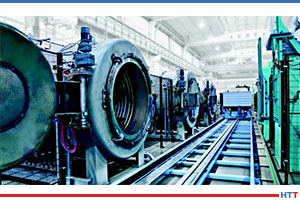
Figure 1: Roller hearth conveyor furnace with heating section, cooling tunnel and after cooling. Note the right angle turn via automatic conveyors to meet space requirements.

Advanced, fully automated, and reliable material handling has made great advances over the last two decades from more recent industries like Amazon, where millions of packages need to be moved through the shipping process, to older industries like heat treating which moves steel parts through furnaces and other equipment. Automation, such as conveyors with self-driven rollers and photo sensors or proximity switches, or robots and automated self-guided vehicles—all coordinated by a PLC—have made material handling more reliable. Manufacturers have a lot of options.

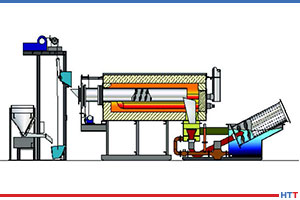
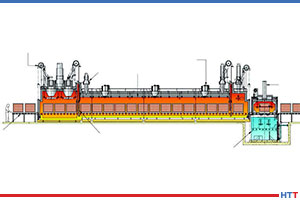
A continuous furnace like a roller convey-or—or “roller hearth”—furnace conveys the product while it is heating (Figures 1, 5 & 8). A mesh belt furnace conveys parts while heating, and a rotary retort furnace (Figure 4) moves parts via a heated rotating barrel to the next process step which is typically cooling or quenching. Moving parts while hot is a challenge, but reliable high volume heat treating is why these furnaces have seen such success over the years. Roller furnaces and rotary retort furnaces are still built and used in a wide variety of industries, and they make sense for a number of reasons. Lower energy use is one main factor.

With robots placing the load, both batch and continuous processes can be fully automated. With such options, batch processing has increased in use.

Automated Batch

Figure 2: The doors have actuators for automatic opening.

A leading manufacturer of heat treating furnaces has implemented the high volume automation approach many times using batch technologies. In 2013, a fully automated batch FNC installation for gears was installed for processing 1 million gears annually.[1] As a result of this success, the customer added more batch furnaces to the line.

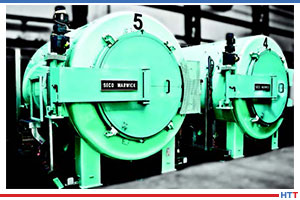
The furnaces in Figures 2 and 3 are retort-based nitriding and ferritic nitrocarburizing furnaces. With automatically opening doors, complete PLC control, and automated batch load movement, no humans are needed. A load car operates in both directions for a heavy load of two metric tons or more, allowing furnaces to be placed facing each other.

Automated, High-Volume System Design

Figure 3: This line consisted of pre-oxidizing ovens on one side to save time in the more expensive FNC furnaces. Cooling stations after heating are also added to reduce time in the batch furnace and make the parts safe for handling.

As mentioned, the company supplied nitrocarburizing technology using its ZeroFlow™ method (Figures 2 and 3) for an automated thermal treatment line for the production of a variety of gears. The line consisted of six large, front-loaded retort-style batch furnaces, a four-chamber vacuum washer, two ovens for pre-activation in air, additional post-cooling of the furnace charges, and an automatic robotic loader/unloader, which ensured charge transport within the system (seen in Figure 3). The automated line also included safety monitoring. System workload dimensions were 32″ wide x 32″ high x 60″ long with a gross workload capacity of 4,400 pounds. Production totaled 2,000 pounds of gears per hour. Good equipment design, retort technology, and use of ZeroFlow control technology resulted in a very successful project.

Cooling the Load and Vacuum Purging

Figure 4: Whirl-Away Quench on a Rotary Retort line for small part efficient quenching/cooling.

There are advantages to continuous furnaces like a conventional roller hearth furnace; however, special options like fast cooling and vacuum purging present challenges to these conventional furnace designs. In batch, this is usually not a problem. Vacuum (and even cooling) is more difficult to attempt in continuous variations due to sealing challenges in the chamber designs. An example of a good solution is the rotary retort furnace shown in Figure 4, which offers single piece quenching where each piece falls into a water or oil quench and is “whirled-away,” a continuous furnace design which works well for small parts with a relatively small footprint. In batch, the whole load needs to be quenched together; this can present challenges that understanding the part needs and configurations can lead the process engineer to different solutions.

In a roller furnace, slow cooling means the furnace gets longer (Figure 1).

Variations in Continuous Batch – Semi-Continuous Processing

Figure 5: Hardening roller conveyor furnace with integral pre-heat and oil quench system

In Figure 6, an automated batch hardening line is shown. In Figure 7, the same process is shown, but with an added pre-heat chamber to allow faster processing via the pre-heat and use the single quench in a more productive manner. An oil quench is an expensive piece of equipment. The cycles are also always much shorter for quenching than heating, so we want to maximize the use of the quench. In a pure batch system, you need one quench per furnace. In the semi-continuous approach, the quench is used more frequently and there is higher productivity per capital dollar invested. In a roller hearth or rotary retort installation, the quench can be properly sized to handle all of the heating production. In an installation using pure batch systems, there might be 3 to 6 quench tanks. In a fully continuous roller furnace, there would be one quench (see Figure 5).

Figure 6: This automated batch line is for low pressure carburizing and vacuum hardening, with oil quench, automated washer, and batch temper furnace. The smart loader makes the cell fully automated.

Case History and Take-Aways

The automated batch system referred to in Figures 2 and 3 went online in 2014 and is currently operating at full capacity, while meeting the stringent requirements of the automotive industry. It achieved the planned production goal of 1 million gears per year with 99% process reliability and 98% equipment availability. The customer previously had a continuous conventional pusher furnace. The new line achieved an 80% reduction in the consumption of ammonia from that consumed using in the pusher furnace to nitrocarburize. Endothermic gas was also eliminated by the supply of a new methanol CO generator as the carbon source in the process.[1]

Figure 7: Triple chamber vacuum hardening line with oil quench and pre-heat chamber. Tray flow is right to left.

The take-away from this successful project is that in order to increase production even more, automated batch systems need to exhibit two factors to compete with a continuous system like a roller hearth furnace. First, the loads need to be optimized and very densely packed. Second, the batch loads need to be larger than the continuous loads. A standard size of 40″ x 40″ x 60″ has since been created which has 50% more volume than the unit in the example above. Making the furnace a bit larger is not that difficult. Additionally, in a recent application, CFC tooling has been utilized to assure more dense loading geometry with much lighter parts, giving reliable rack geometry for a load of 1,000 pieces.

Gas Usage – Benefit Batch

Figure 8: Cooling tunnel and exit of continuous roller hearth furnace for instrument transformer electrical steels annealing.

The biggest advantage of batch furnaces is the lower process gas usage. In continuous furnaces, in order to keep the process safe and clean, pressure must be maintained by flowing a significant volume of gases. With the constant opening of doors during the process and the need to keep operating pressures high enough to prevent air infiltration, atmosphere gas usage is always high. To keep the costs down, gases are typically generated with the use of an endothermic generator (40% Nitrogen, 40% Hydrogen, and 20% CO) or a lean exothermic generator with a low dewpoint. In all instances, the generator is another piece of thermal equipment to maintain and purchase.

Energy Costs – Benefit Continuous

In most instances, batch processing uses more energy—or more expensive energy—such as electricity. Electricity costs can vary tremendously from location to location whereas natural gas prices are more consistent and lower. Batch nitriding furnaces are available in gas-fired heating options at an added capital cost. However, the batch process still uses more energy per pound. If electricity is available at a reasonable rate, then the difference is not as great on a per pound basis. In a recent analysis, it was estimated that an electrically heated batch system came to cost the equivalent of about $0.06 per pound of FNC operating costs, versus $0.03 per pound of FNC operating costs in a continuous gas-fired variation (energy and consumables only).

Summary

Batch or continuous in large volume scenarios is no longer a clear-cut answer. Your heat treating professional and your furnace suppliers should understand this. There are literally dozens of variables that need to be assessed, and only after a careful analysis tailored for each customer can an optimized solution be designed with either batch or continuous furnace solutions.

Notes

1. Hemsath et al, “Nitrocarburizing Gears using the ZeroFlow Method in Large-Volume Production”, Thermal Processing, 10/2015

About the Author: Mark Hemsath is Director of Nitriding and Special Vacuum Furnaces at SECO/VACUUM Technologies, LLC and acting Thermal General Manager at SECO/WARWICK Corp. in Meadville, Pennsylvania. With 30 years of experience in the industrial furnace and heat treat equipment market, he is in charge of all North American atmosphere furnace sales, gas nitriding, and gas carburizing. This article originally appeared in Heat Treat Today’s June 2019 Automotive print edition and is published here with the author’s permission.

Nitrocarburizing for Automotive and Large-Volume Production Read More »

What Gun Aficionados Say About FNC Barrels


Source: Shooting Illustrated


Applying the slow quench-polish-quench (QPQ) to a rifle barrel

Steve Adelmann at Shooting Illustrated gets the conversation going among gun aficionados about the pros and cons of using a surface treatment on rifle barrels called “liquid salt bath ferritic nitrocarburizing non-cyanide bath”, more commonly known as FNC. Experts weigh in on nitrided barrels and agree that accuracy in the heat treating process known as slow quench-polish-quench (QPQ) produces long-term results that substantially outweigh other types of barrel treatments.

Read more: “The Pros and Cons of Nitride Barrel Finishes”


What Gun Aficionados Say About FNC Barrels Read More »

Skip to content