When there is a need to provide a uniform, pearlitic structure at a microscopic level, many heat treaters turn to normalizing to increase or restore metal strength, but experts at Bluewater Thermal Solutions note the need to assess all aspects of the material before choosing this process.
“It is possible with given alloys and metals that the process may also cause a decrease in overall strength.”
We begins this month’s economic report with a special request: Please register and attend the International ThermProcess Summit (ITPS) in Atlanta next week, July 30-August 1. This event, sponsored by IHEA, is meant for high-level executives in the heat treating industry including manufacturers with in-house heat treat as well as industry suppliers and contract heat treaters. Click here for more information. Thank you. Now on to our report…
Transportation was up strongly in June. Source: IHEA Monthly Economic Report
This month’s Industrial Heating Equipment Association (www.ihea.org) economic summary report shows sustained growth in nearly all sectors. The report, issued monthly to key executives whose companies are members of IHEA, summarizes approximately 12 indicators determined to be important to the thermal processing market. These indices include metal prices, housing starts, durable goods orders, purchasing managers index, credit managers index, a transportation index, new car & light truck sales, as well as others. The 12-13 page report, provided to IHEA by The Armada Group, IHEA’s exclusive economic advisor, provides not just a summary of the index movements, but an in depth explanation of the factors affecting each index. The report has been a valuable tool for key executives in IHEA member companies.
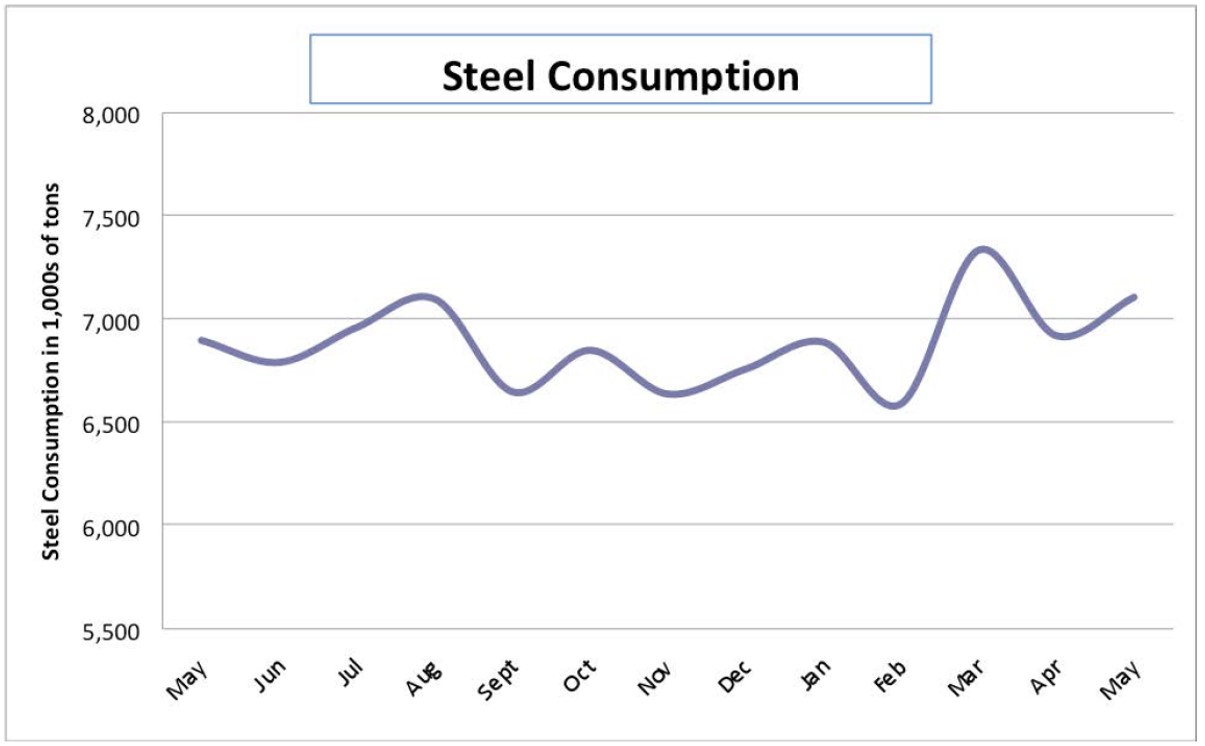
Steel consumption was up significantly in June. Source: IHEA Economic Survey
This month’s report showed an increase in the transportation index, steel consumption, and housing starts. Flat this month were factory orders, durable goods, and capital expenditures, as well as the PMI and industrial capacity utilization. Tariffs, or the threat of tariffs, continue to loom large over the direction of the economy. It is speculated that steel consumption is up strongly due to preemptive purchases, purchases made by many manufactures in advance of what they consider will be significant tariff price hikes.
For a complete copy of the monthly report, please email Anne Goyer.
A leading global iron ore and HBI producer and supplier, as well as a producer of high-quality steel, recently launched heat treatment systems with advanced technology for a Russian steelmaking and metal rolling company.
Andrey Varichev, CEO, Management Company Metalloinvest
Metalloinvest, based in Moscow, installed the Roller Hearth Heat Treatment Furnace #1 and Rolling Quenching Machine #1 at Ural Steel. Mosgipromez provided the design and engineering work for the new facility, while Tenova LOI Thermprocess was responsible for equipment delivery.
The installation of Roller Hearth Heat Treatment Furnace #1 and Rolling Quenching Machine #1 at Sheet Rolling Facility #1 enables Ural Steel to increase the production capacity of the heat treatment furnace from 28.6 to 30.7 tonnes per hour. Over the next 10 years, between 2019-2028, Ural Steel will be able to increase the production of heat-treated heavy plate by three times, and the output of steel for bridge construction by 39%. Production volumes will increase due to the introduction of a new product variety, which will be developed at the heat treatment facility.
Roller Hearth Heat Treatment Furnace #1 and Rolling Quenching Machine #1 will also help to improve the characteristics of the heavy plate, ensuring the physical uniformity of the rolled steel products following heat treatment, by improving heating and cooling conditions.
“The project has been completed as part of Metalloinvest’s comprehensive investment programme to reorganize production processes at Ural Steel, which will boost the operational and management efficiency of the enterprise,” said Andrey Varichev, CEO, Management Company Metalloinvest. “This new high-tech facility will strengthen the Company’s position in the market for heat-treated rolled products.”
Andrea Lovato, CEO, Tenova
“Metalloinvest is a special client for Tenova, to whom we supply our full range of products and technological solutions,” said Andrea Lovato, CEO, Tenova. “Taking part in the reorganization and modernization of Ural Steel’s production processes is a great opportunity for us, and we are confident that our partnership with Metalloinvest will help the enterprise to progress its development even further.”
This project follows Metalloinvest’s recent agreement to build a heat treatment facility for hot-rolled steel at the OEMK’s finishing plant #2, which will include the construction of a building for the heat-treatment facility and two thermal furnaces, and the creation of heavy-lifting and transmission equipment, as well as associated infrastructure. The first furnace is planned to be launched in 2019, and the second will begin operations in 2020.
The new facility will enable OEMK to carry out various kinds of heat treatment from 750-1800°F (400-980°C), a wide range of temperatures, in order to produce high-quality rolled steel products with a specific microstructure. Heat treatment is required in the production of various kinds of steel for springs, ball and roller bearings and construction, as well as for high-strength metal.
Varichev said: “We are seeing a high level of demand among customers for high-quality bars, which require heat treatment. Creating this new production facility will enable Metalloinvest to increase sales volume of this premium product and reinforce its position on the SBQ market.”
Metalloinvest expands steel heat treatment capacity as part of SBQ client-orientation and quality development.
Heat treating thermocouples are thermal processing sensors that allow equipment operators to accurately measure and maintain the right temperatures for softening, hardening, and material modification. A faulty thermocouple can result in inaccurate measurements, so it’s critical for quality management personnel to determine when and why thermocouple failure has occurred. GeoCorp, Inc., has provided a series of short articles that walk operators through assessment and troubleshooting of thermocouples that go bad.
Sometimes the smallest issues can lead to big problems. When your business relies on crucial temperature readings from your thermocouples, it can pay to pay identify individual factors that may have cause part failure. ~ James LaFollette, GeoCorp, Inc.
When troubleshooting thermocouple failure, the authors, James LaFollette and John Ochenas, recommend reviewing three key issues: system wiring, probes, and wire and junction. In addition, the following could cause misreadings:
A Cincinnati-based heat treat technology solutions provider recently completed a controls and software upgrade for the bearings brand of an engineering and manufacturing group at the latter’s facility in Dahlonega, Georgia, including instrumentation and software for hardening furnaces, quench, washer/rinse, and temper equipment.
Super Systems Inc. and JTEKT Corporation’s Koyo Bearings brand announced that the scope of the upgrade includes all engineering, installation, controls, and software for Koyo’s gas-fired hardening furnace line. The new automation included a turnkey retrofit of new control cabinets as well as software necessary for furnace control and historical process data review. The controls and software provide JTEKT with the confidence to heat treat parts to meet the highest standards with complete traceability for its Koyo brand bearings.
Michael Rebula, Heat Treat Supervisor at JTEKT
“We have been fortunate to work with JTEKT on a number of automation projects over the years and we are looking forward to participating in more innovative heat treating opportunities in the Dahlonega facility,” says Bob Fincken, Super Systems National Sales Manager.
“SSi’s ability to understand our needs and provide customized solutions has been a tremendous benefit to us,” says Michael Rebula, Heat Treat Supervisor at JTEKT.
When steel needs to be softened to alter ductility, toughness, or properties, or to produce a specific microstructure, a heat treater can turn to any one or combination of processes to suit the material or the application.
Metlab Heat Treat’s primer series includes a short explanation of the options available, whether it is
annealing, which “removes the internal stresses, which build up as a result of cold working and other fabrication processes;”
protective atmosphere normalizing, which “refines the grain size and enhances the uniformity of the microstructure;” or
spheroidize annealing, which “is generally done on parts which have been work hardened, to allow them to be further worked, either rolled in the case of coils, or drawn for wire.”
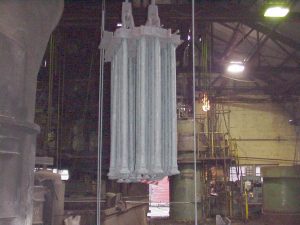
1.) Load of torsion bars, manufactured from 4340 steel, normalized in the vertical position to maintain straightness. Parts measure approximately 3\” in diameter by 6\’ long.
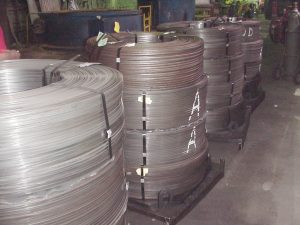
2.) 26,000 pounds of low carbon steel flat wire being prepared for spheroidize annealing. Spheroidize annealing is an intermediate processing step to allow the wire to be further rolled to a smaller gage without cracking.
A California-based, full-service brazing and heat treating company recently installed several pieces of equipment, including an indirect temper furnace as well as a generator that has clocked less downtime than the previous unit.
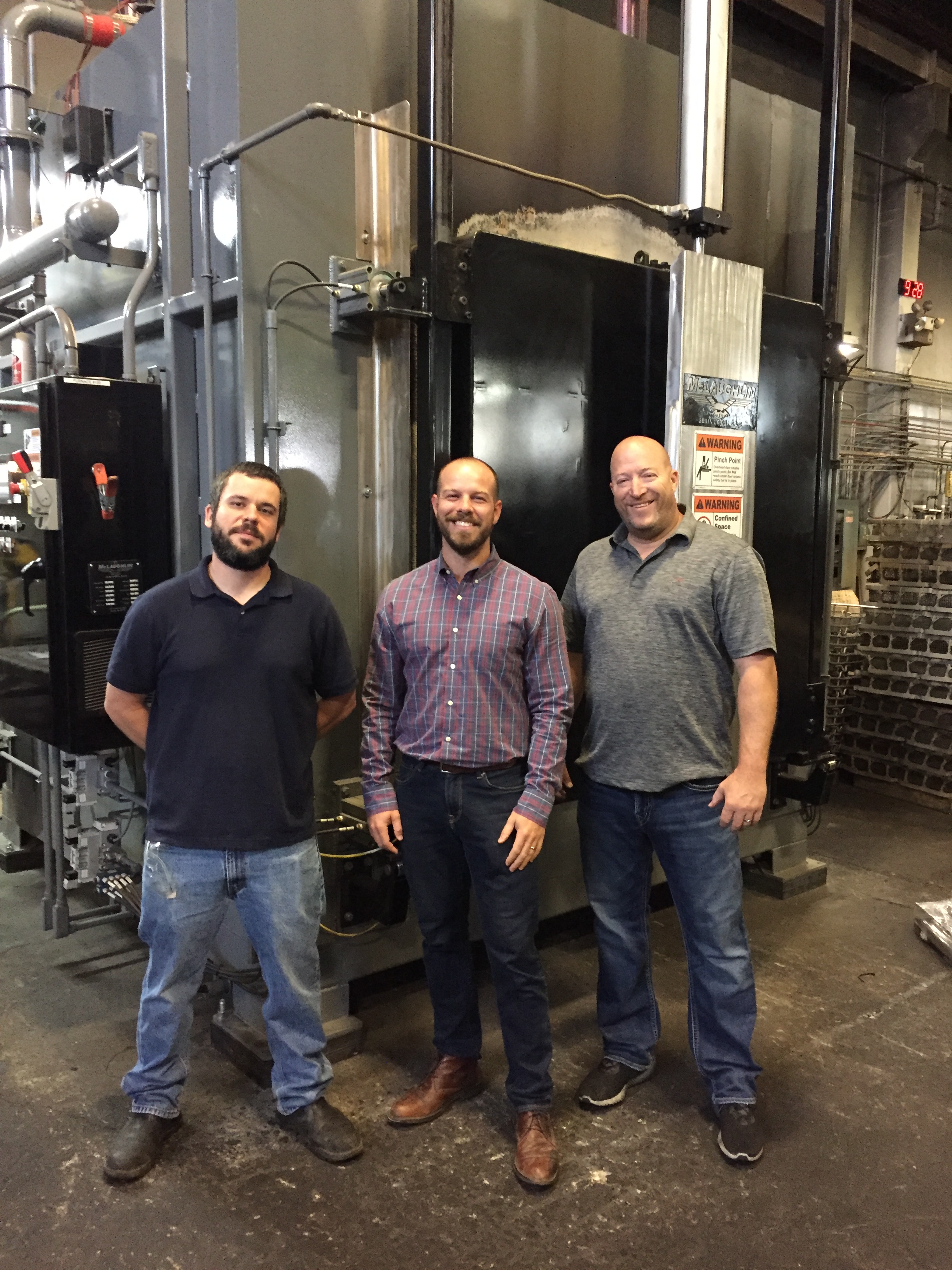
Nick Schreiber, Quality Manager of ThermoFusion; Glen Ottinger, President of ThermoFusion; and Jeff McLaughlin, owner of McLaughlin Furnaces and Equipment
ThermoFusion’s investment of the 2200 Tru-Mix Generator and indirect temper furnace, both McLaughlin Services products, are part of the company’s commitment to support customers in the automotive, aerospace, medical, and energy industries, as well as for multiple other application.
The Tru-Mix 220 is supporting two of ThermoFusion’s internal quench furnaces and a high-temperature tool furnace, almost twice as much equipment as the generator it replaced. According to Glen Ottinger, president of ThermoFusion, the results were better than he had anticipated when researching the 2200 Tru-Mix and other gas generators.
The McLaughlin Indirect Temper Furnace was fully functional and ready for operations only two days after arrival, according to Nick Schreiber, quality manager at ThermoFusion, and has been surveyed at +/- 10F or less, between 300ºF and 1400ºF.
A new vacuum furnace will be tasked to stress test parts for the LM2500 turbine, which is used by the U.S. Navy to power Spruance and Kidd-class destroyers, Olive Hazard Perry-class frigates, Ticonderoga-class cruisers, and Arleigh Burke-class destroyers.
Ashleigh Burke-class destroyer
Fleet Readiness Center Southwest (FRCSW) commissioned the $1.9 million furnace from SECO/Warwick Group, which manufactured the 2,800°F unit to specification for technicians to test the engine’s components after the heat treat process. It will not be used for the heat treating or plating of LM2500 parts.
“The furnace was custom made for our use and took almost a year to manufacture,” said Martha Hoffman, project manager for FRCSW’s Capital Investment Program (CIP), which invests in new technologies and equipment to improve production efficiencies. “The equipment arrived May 15, and the sign off (acceptance) was July 2.”
The new unit replaces a model that was more than 50 years old with a four-year history of sporadic operation. Difficulty in maintenance and increasingly obsolete replacement parts often resulted in a 60-80 percent down time, causing some LM2500 work to be contracted out.
Sailors check a gas turbine engine. (U.S. Navy photo by Mass Communication Specialist 3rd Class Brian M. Brooks/Released via Wikimedia)
Hoffman said that the new unit will save the command about six months in turn-around time per part vice contracted workload and that 12-15 components will be tested weekly.
FRCSW is scheduled to overhaul about 15 LM2500 engines annually.
Photo caption:
FRCSW teammates who were instrumental in the procurement, installation and acceptance of the Seco/Warwick Group furnace are, from left, materials engineers Michael Schutt and Jessica Porras, CIP project manager Martha Hoffman, metrology calibration Hung Pham, and material engineers David Arenas and Blake Whitmee. (U.S. Navy photo)
It’s no secret to heat treaters that not all methods work well on all parts and specifications. It’s also a hard fact that false readings can result when applying hardness measuring systems, therefore, says Charles D. Schulz of Gear Technology, “critical service parts often require a few ‘sacrificial lambs’ to be processed along with the production parts.”
“I cannot emphasize enough that if you are not cutting up parts or coupons you do not know what is really happening during your thermal processing.” — Charles D. Schulz
A manufacturing company based in Loves Park, Illinois, recently purchased a vacuum furnace with 2 bar gas quenching that will be used at its facility in Ho Chi Minh City, Vietnam.
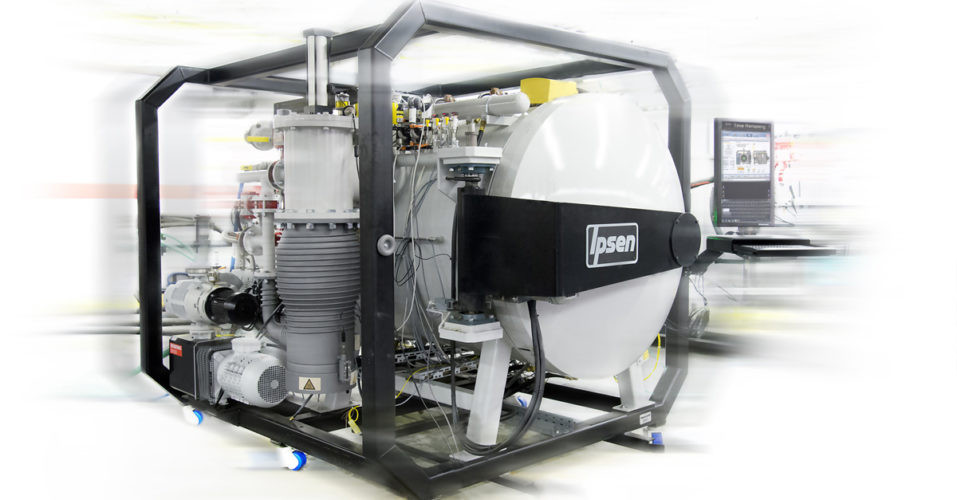
The TITAN® H6 furnace
Zenith Cutter, which manufactures industrial knives, cutter blades and related accessories for multiple applications, is transitioning its shop from atmosphere heat treating to using vacuum equipment for production and commissioned a TITAN® H6 furnace from vacuum furnace maker Ipsen for its Metkraft location.
The TITAN® H6 furnace has a graphite work zone measuring a 36″ x 48″ x 36″ (915 mm x 1,220 mm x 915 mm) with a 3,000-pound (1,360 kg) load capacity and is capable of operating at temperatures of 1,000 °F to 2,400 °F (538 °C to 1,315 °C) with ±10 °F (±6 °C) temperature uniformity.











 brand announced that the scope of the upgrade includes all engineering, installation, controls, and software for Koyo’s gas-fired hardening furnace line. The new automation included a turnkey retrofit of new control cabinets as well as software necessary for furnace control and historical process data review. The controls and software provide JTEKT with the confidence to heat treat parts to meet the highest standards with complete traceability for its Koyo brand bearings.