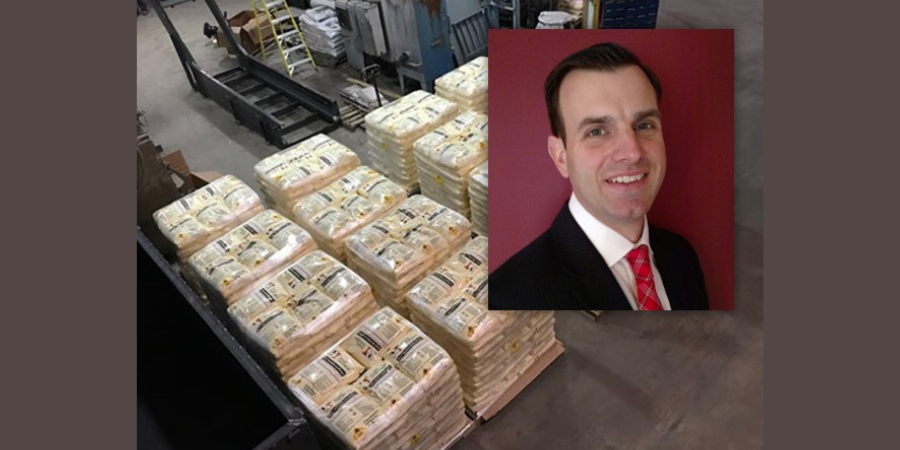
A leader in the “Tool & Dies” sector — voestalpine High Performance Metals Polska -- placed an order for a retort tempering furnace with vacuum purging. The furnace will be used for tempering tool steel after the gas quenching process.
While this is the first opportunity for the company and SECO/WARWICK to cooperate after the global-pandemic-caused crisis, the contract is the result of long-term cooperation between the supplier and voestalpine High Performance Metals Polska Sp. z o.o. (formerly Bohler Uddeholm Polska). A retort tempering furnace with vacuum purging will complete the production line installed in Łomianki near Warsaw. The facility is currently operating the equipment delivered previously from the supplier, including a hardening furnace and a tempering furnace. Another furnace will significantly increase the capacity of the hardening plant.
Cezary Żurada President of the Management Board voestalpine High Performance Metals Polska
“Voestalpine High Performance Metals Polska is a partner whom we’ve known for many years," said Maciej Korecki, VP of the Vacuum Business Segment, SECO/WARWICK Group. "We know their needs, we are able to provide advice and most importantly, customize the equipment to their specific needs. Our relationship is not just superficial — we learn from each other, and thus we know the challenges they face in their day-to-day production."
Vacuum furnaces are perfect for hardening and tempering. They are characterized by the high-quality of processed parts, much lower number of hardening deformations and the absence of batch oxidation which directly translates into significant money savings.
“Our main goal was to increase the capacity. Our machinery park has already included a SECO/WARWICK tempering furnace, which has proved itself perfectly," summarized Cezary Żurada, president of the Management Board of voestalpine High Performance Metals Polska. He continued, "It is worth noting that despite being less demanding, the tempering process usually takes more time than the hardening process. Therefore, in order to be able to make full use of the hardening furnace, for tooling steel we needed two tempering furnaces. Now we will be able to make production more dynamic and conquer new markets."
How do sintering parameters, especially the sintering atmosphere, affect the quality achievable from parts? Do you know what your three gas options are? Find out this and more, including an evaluation of some interesting solutions for your heat treating needs.
An excerpt:
"However vacuum furnaces operating with hydrogen require additional safety measures. For this reason, specific design solutions (such as double seals on all the furnace flanges) and software safeties are adopted. Despite the increased degree of complexity of the equipment and the higher process costs, vacuum furnaces operating with hydrogen over-pressure bring several advantages. . ."
Heat TreatToday publisher Doug Glenn and James Dean of Plastometrex discuss indentation plastometry, a new technique for obtaining important mechanical property values for a wide variety of materials. The company’s equipment is just barely 6-months old and is already finding its way into heat treat applications in North America.
Below, you can either listen to the podcast by clicking on the audio play button, or you can read an edited transcript.
The following transcript has been edited for your reading enjoyment.
DG: Today, we're going a bit international. We're going to have a conversation with Mr. James Dean from Plastometrex in the UK, which is obviously a far spell from Pittsburgh, where I'm located. James, welcome to Heat Treat Radio. We're looking forward to talking with you.
JD: Thanks, Doug, it's nice to be here.
DG: We want to talk about materials characterization, testing and things of that sort. We'll get into, specifically, what part of that in just a bit. But first, James, if you don't mind, briefly, let people know who you are, the qualifications you have to be talking about the topic that we will be hitting on, and about your history in the heat treat industry or in the materials characterization industry.
JD: Quick background: I'm a materials scientist from the UK. I first studied materials as a young undergraduate at Imperial College in London. That was way back in the year 2000. I subsequently went on to do a PhD in Cambridge, also in materials science. It was during that period when I really first became interested in the mechanical behavior of materials, particularly strength characteristics and the relationship between those strength characteristics and underlying microstructural features. In fact, one vivid memory that I have from an undergraduate laboratory class was measuring Vickers hardness numbers on age hardening aluminum copper alloys and monitoring the changes that occurred with different heat treatment times. That all struck me as being quite powerful because it meant that we could tune mechanical properties. Up until that point, I hadn't fully appreciated that that was possible.
What's a little more unfortunate is that I've also since learned that if we want to achieve a particular characteristic, high strength for example, we often have to do so at the expense of another, usually the ductility. I guess that's why material scientists all over the world continue to look for new compositions, new alloy systems, even novel heat treatments that offer mechanical performance improvements that, perhaps, haven't yet been realized. My involvement in this industry is driven simply by my interest in these things, which is why I feel extremely lucky to be leading a company like Plastometrex.
DG: Tell us a bit about the company. You're the CEO there. As I mentioned earlier, you're located in Cambridge, UK. Tell us about the company, its history and about the products and things of that sort.
JD: Plastometrex is a company that develops novel mechanical testing systems that are powered by advanced software tools. By advanced, what I really mean is state of the art modeling methods, things like finite-element analysis, optimization algorithms and also, forgive the buzz words but, machine learning tools, as well. These are needed because our machines measure stress strain curves and metal strength parameters from quick and simple indentation tests.
There is some justification to say that people have been indenting materials for centuries and, of course, that is true. But people have been doing this simply to measure hardness numbers, predominantly, at least. We might argue that anybody that understands a little bit about hardness testing probably also understands that hardness numbers are not fundamental material properties. They would understand that a material's hardness number actually changes if you change the shape of the indenter that you use or if you change the load that you apply.
Hardness numbers can only really be used in a semiquantitative way to rank materials. They can't be used in a design calculation or in a finite-element analysis. So, to use them as proxies for strength, which is often done, can, in fact, be potentially dangerous. I would go on to say that, unfortunately, hardness numbers are often accorded a much higher significance than they really deserve. My own view is that it is much better to have access to fundamental strength characteristics which is why we've been spending our time developing these new machines and their associated software packages.
So, to wrap up the question, the technique is called indentation plastometry and it was developed over a 10 – 12 year period of research, led mostly by Professor Bill Clyne and his research group in Cambridge. On the back of that, we established Plastometrex in late 2018 to commercialize the technology.
DG: You're saying the company, Plastometrex, was established in 2018. So, you're about 3 years into this. Are you fairly successful so far? I mean, are you happy with the progress?
JD: I would say that we're reasonably happy with our progress so far. Of course, like a lot of companies, we're just coming out of this rather difficult period because of Covid. What that means, for a company like ours, which I guess you could still class as a start-up, is that it's just much harder to sell equipment.
What we're finding right now is that lots of companies rationalized their organizations in various different ways. One of the first things that companies seem to have done, which is quite understandable, is put restrictions on their CapEx spending. That's something that we, like most companies, have to deal with at the moment.
But, notwithstanding that, I would say we still make good progress with monies to secure quite substantial amounts of investment. One of our leading investors is Element Materials Technology. They're one of the world's leading providers of testing inspection certification services. We're still employing more people. At this stage, we're launching new initiatives and we are selling machines, despite the current climate. Our trajectory looks quite good right now.
DG: Where are you selling, primarily? Is it mostly Europe?
JD: It's mostly Europe, at the moment. We have sold one of our machines, actually, to Worcester Polytechnique Institute in North America. We're actually having conversations right now, I won't disclose them, with other North American universities who have expressed an interest in technologies like ours.
DG: Good. It's good to see a young company doing well even in the midst of Covid, so congratulations on that.
Broadly speaking, your company is dealing with materials characterization testing. The equipment you produce: what properties is it, in fact, intended to characterize? You've already hit on this a little bit- stress, strain, etc. Maybe briefly explain each of those properties for those who might not know what the difference of those things are. A quick “materials 101.”
JD: The very quick answer to your question, Doug, is that we are measuring plasticity characteristics or strength characteristics. They're often best captured, or best represented, in the form of the stress strain curve.
Now, stress strain curve of material is really quite important since from it you can deduce important features like the stiffness of a material. But then there are other features, such as those I've described that relate to the plasticity characteristics. These are things, like the yield stress of the material, which is the stress at which the material starts to plastically deform or, i.e., permanently change its shape.
You can also view the hardening behavior as the material continues to strain, which is often quite important. And, you can also extract from the stress strain curves things, like an ultimate tensile strength or a fracture strength, and these things can be used in things like design calculations.
From the stress strain curve you can also extract a ductility value, which is a nominal strength fracture for those people in the know. But, as with hardness numbers, the ductility value is also not a fundamental material property and this is often not understood. The ductility value actually changes depending on the test geometry that you use. That's an important thing to understand because people often use the ductility in things like engineering critical assessments not fully understanding that that value can be different depending on the test that you did.
I think the important message here is indentation plastometry can be used to measure things like the yield stress, to measure the uniform elongation strength, to measure the ultimate tensile strength of the material. But, our technique can also be used, if you want to, to calculate things like the Vickers and the Brinell hardness numbers, as well. But, the limitations around hardness numbers that I've already outlined still apply.
DG: Your product is basically offering a new way of doing some of these tests. Basically, it almost looks like just a hardness test because you're doing the indentation, but you're getting a heck of a lot more out of it. Maybe, again, just 101, how have these tests been done in the past and what is the method that you've been developing over the past 3 years? How does that differ and what is the benefit?
JD: The current gold standard for mechanical testing is the uniaxial tensile test. To us, at least, that is another mechanical test that hasn't fundamentally changed for almost a century, actually. In principal, it is a rather simple test where you take a test specimen in the form of a testing coupon and you stretch it (or strain it, to use the proper term), and you do that until it breaks. If you monitor the forces in the displacements during the test, it's very easy to calculate the stresses and strains within the sample. But, there are a number of problems with this type of testing machine.
The first is that you need to have access to quite a lot of the material that you want to test because the test specimens are usually quite large, often in the centimeter dimension range. That also means that the material that you want to test needs to be machinable, and not all materials are; I'm referring mostly to metals here. In fact, some are actually quite difficult to machine so that this process of machining test coupons can be quite a cumbersome one. Often quite time consuming, too, especially if you need to outsource these procedures.
The test itself also requires access to a large, often very expensive, universal test machine, and, in addition, a suitably trained technician, as well. There can be further problems with things like specimen gripping, alignment of the specimen, machine compliance, and other things like that.
Whereas, and of course I'm biased, a machine like the indentation plastometer, really combines the very best attributes of hardness testing, which is speed, ease and simplicity of testing, with the very best attributes of tensile testing, which is acquisition and access to forced stress strain curves.
I would add to that, as well, that with a machine like ours, you can test real components and you can map spacial variations in properties across surfaces, such as those, for example, that might exist across a weld. Again, in summary, we think you get the best of both worlds with our machine and, in some cases, even things that are better than other machines.
DG: You may have already stated this a little bit, but briefly: indentation plastometry is basically taking an indentation to be able to test, not just hardness or not even necessarily hardness, but the deformation or the strain of material. Do you have to know the microstructure of the material when you're doing these tests?
JD: That's a good question. In principle, no. If we were to dig deep into the mechanics of what's going on within our system and our software package, you'd come to recognize that it's, from a mathematical point of view at least, insensitive to microsctructural features. There is a numerical method underlying this – a finite-element analysis – therefore, treating this as a continuum system doesn't take account explicitly of the microstructure.
When you're doing the test, it's actually helpful to know something about the microstructure simply because our technology is all about extracting bulk mechanical behavior engineering properties. Therefore, when we do our indentation test, it is important that we are indenting a representative volume of the material.
It is important that we are capturing all of the microstructural features that give rise to the behavior you would measure in a microscopic stress strain test. Otherwise, you can't pull out those bulk, core engineering properties, and therefore, the scale on which you do the indent is important. Your indenter has to be large relative to the scale of the microstructure. So, it's only at that level that you need to understand or know anything about the microstructure.
DG: This test is a nondestructive test, right? You said you can actually test live materials, correct?
JD: Yes.
DG: You don't have to destroy them, you don't have to machine them, you don't have to make them into something you can rip apart, right?
JD: Right.
DG: Is there a limitation on the size of the product that you can test? Do you have to put this thing into a machine to clamp it down to do the indentation?
JD: Yes. There are some limitations. I'll come back to those in a second. I just want to address the first point. It wasn't a question, but you actually referenced it, so I'm going to pick up on it, and it's about whether this test is nondestructive or not.
It's an interesting question. I think, really, it's a matter of perspective, or sometimes, a matter of even industry. We don't destroy test samples in the same way you do during a normal tensile test. But, we do create small indents in the surface of the specimen. Whether that can be regarded as destructive is really open to interpretation. Our colleagues in the aerospace industry probably would be comfortable testing a turbine blade and then putting it back into service even if the indent is relatively small. So, on that basis, they might consider the test to be a destructive one. But, for many other applications, we, and others actually, would regard our test as a nondestructive one and, indeed, that is often how we pitch it.
Then, to the second question which is about limitations on size. . .
DG: Yes, size, geometry, shape, or anything of that sort.
JD: There are no restrictions on shape, per se. It's important that the specimen has two parallel sides. When you put in on the plinth, under which when you do the testing, when you come down normal to that surface with the indenter, you want them to be as flat as possible. You can accommodate small inclines up to 2-3 degrees, but ideally they would be parallel. So, that's one constraint.
In terms of total size, if you look at a bench top machine, (and anybody visiting our website would be able to see it), it's got sort of like a window, a cavity, where you can put your specimens into which has got a width of about 20 cm, height of about 7 cm and a depth which is also probably about 20 cm, as well. That is what is governing/dictating the maximum size of sample you can put in there, at the moment.
In terms of the other direction, how small can you go, we advised people not to indent anything that has lateral dimensions less than about 5 x 5 mm and that is because if you start to indent close to edges, you can get edge effects and therefore in our software package, behind the scenes, the modeling assumptions that we impose start to break down.
In addition to that, in terms of the sample thickness, we typically impose a minimum height of about 2 mm. Then again, that is because, in our underlying software package, the modeling assumptions assume that what you're indenting is essentially semi infinite in size and if you indent thin samples, that assumption breaks down too. That's what is driving those constraints on sample size.
DG: And, being able to run a test on a spherical object is not a problem as long as you can get it flat, I mean, like pipe tube and that type of stuff?
JD: Pipes are interesting, actually. One of the things we're working on right now as a company is an in-field testing kit, or portable detection plastometer. Our immediate focus is on the pipeline materials. In fact, you might know this, there is some new legislation in North America called the Gas Mega Rule which is now mandating that pipeline operators inspect their pipes, I think it's probably every one mile into this. One of the tests that they need to do is a strength test.
There's a big opportunity out there, potentially, for the testing of pipe materials. A technology like ours is something that could support and enable that. But then, coming back to your question about indenting a surface that is curved, which is what this really relates to. And that is simply, again, a matter of scale. If it's got extremely high curvature and you come down with an indenter such that the curvature is large with respect to indenter size, then you can now have problems. If the curvature is small relative to the scale of the indent, then it's okay; i.e., if you come down and it still looks like a flat surface, it's the indenter because of the differences in scale, then you're okay.
DG: And, I think you said the 2-3 degree the tolerance which would come into play there.
JD: Indeed.
DG: Most anybody that's going to buy this equipment is going to say, “OK, what's in it for me? Why should I buy this thing as opposed to going the normal route, or things of that sort?” Talk to us a little bit about the overall expense, overall experience with your equipment. Why would it be something that people would pick up?
JD: From an experience point of view, I think one of our key objectives while developing the technology and, indeed, the supporting software, has been to ensure that the experience of using the system is a smooth one. We've attempted to minimize the level of interaction to these it needs to have with the machine and the software and also to try to maximize the degree of automation. I think that we've been able to strike the right balance. I think the workflow is simple and intuitive. And, importantly, we present the results in a format that the users would recognize if they've previously done conventional mechanical testing.
I think one of the key attributes, if you like, one of the key salable attributes of our system, is that you can measure full stress strength strain curves in just a few minutes, 2 – 3 minutes, so almost in real time. When you're doing this thing in real time, it's potentially transformative for lots of businesses in lots of different ways because it unlocks that materials testing bottleneck that lots of companies are already familiar with. I don't like the term, but the value proposition, if you like, is speed of testing, ease of testing and simplicity of testing. That's where you're going to derive the most value from a machine like ours.
DG: Do you have any examples of where somebody has used this? You don't need to mention names, of course, I'm not asking for company names, but maybe an industry where somebody's been able to kind of move their testing into real time testing? And if you don't, that's also okay.
JD: I can give you a couple of examples which we can disclose. We've got some people using our machine for high thru port testing and combinatorial analysis with things like additively manufactured metals. That is basically where companies that are using additively manufactured systems are very keen to understand how changes in process parameters and changes in alloy composition and changes in powder type and powder size distribution, what effect that has on the mechanical properties.
If you want to do this using conventional systems, you've got to print tensile specimens or other types of bonds, and they you've got to print them and test them. This is quite cumbersome. Whereas, with our machine, you can just print a small cube or small disc or something like that, and then you can immediately indent it and get stress strength curves. You can do, essentially, rapid design exploration and rapid process optimization.
This is not just specific to end processes. Wherever you've got all the types of thermomechanical processes taking place to develop or design the metals and you need to characterize the corresponding strength characteristics and you want to do it quickly, then you need a machine like ours.
DG: They wouldn't even need to print the actual part; they'd print a suitably large enough cube, test it, and then you'll know.
JD: Absolutely. And that cube, as I've described, could be quite small, it might just be 1 cm cubed in volume and that would be sufficient. So, actually, the cost of doing this test comes down, as well, because you're not printing lots of material.
We're working with additive manufactured companies right now that are validating the technology. We're having some of these companies print material for us and it's extremely expensive unfortunately and it's just a process that we have to go through at the moment to prove out the technology. They can see the benefit themselves of being able to rapidly characterize the strength of their materials.
DG: Do you want to address, at all, as far as overall lifetime expense investment in a product like yours as opposed to other testing methods? We talked about workflow, ease of use, ease of reporting and things of that sort. Any comments on lifetime costs of use?
JD: Yes, I can say a few things. First off, our machines typically retail at prices which are comparable to a low end universal mechanical test machine, mid-range for hardness test machines, so sort of right in the middle there. Although, as I've said before, I think our machine benefits from having the best attributes involved. It is a robust machine, it's just doing indentation tests, so the longevity and the robustness is good and strong.
There are very few aftermarket parts that you might, conceivably, want to buy to bolt on. You don't need suitably trained technicians either with backgrounds in mechanical testing or material science; you can press the button and run it. The lifetime costs, we think, are substantially better than a conventional tensile test machine. If people want to talk a bit more about the commercial aspect of these machines, they, by all means, can get in touch.
It might be worth mentioning, it's not necessary to buy our machines. We do have leasing agreements specifically because of these CapEx restrictions that we're seeing out there in market right now, but also because of a certainty you can anyway. If these go on to operational expenses, then there are certain tax advantages, as well, to doing that.
DG: Types of companies that would find this to be really helpful. In other words, are you seeing that a certain industry or a certain type of company are interested in your product, or an industry that should be that is not yet?
JD: A good question. We've been extremely surprised, actually, at the level of traction we've been able to generate so far. We officially launched our machine in November of last year, so we're only 4 or 5 months since the launch. We're already talking to probably 50 or 60 companies right now, including some major, major tier 1 companies across the world.
I think one of the great things about materials testing is that it is not set or industry specific. Almost all industries need access to the strength of their materials in order to design new products, for example, or to ensure that the materials or products that they produce are safe to operate and fit for purpose. At the moment, we're getting a lot of interest from metal producing companies, processing companies from the additive manufacturing community which, traditionally, have been quite difficult to measure the strength of their materials, from aerospace companies to automotive companies to companies engaged in things like failure analysis and also from universities and research institutes, too.
We're really seeing an interest from a very broad range of organizations and I think that is reflective of what I said in the beginning of this question which is that materials testing is not sector or industry specific, it's kind of ubiquitous of all those industries.
DG: What are you most excited about with this company? You're, what, 6 months into it maybe as far as actual product out there? What puts a smile on your face?
JD: That's a good question. There are a couple of things that put a smile on my face. One, I really enjoy working with the people that I've got on my team, who are as enthusiastic and as motivated as me to see this company do well. And, I also really enjoy talking to the wide range of customers, because what I see when we talk, is them saying, “Gosh, if we would have known about this 5 years ago, we'd be already using it.” or they say, “This is fantastic. This is exactly what we've been looking for and it can solve this problem and that problem.” Then, they start coming to me and saying, “Can you also change something up so that we can do this or we can do that?”
So, there's always new potential opportunities arising because of it. That really excites me, because what it points to is additional opportunities for plastometry.
DG: What do you worry about? What keeps you up at night?
JD: I guess, the immediate concern right now is what the recovery post Covid looks like, especially in certain industries like aerospace which, in ordinary times, would have been an ideal market for a technology like ours. That's the type of thing that makes me worry. So, we're keeping a very close eye on what the recovery looks like, not just here in the UK, but also abroad.
The other thing that, I wouldn't so much say worries me, but it is something that we're thinking very hard about, is the standardization methodology, as well. If you want to get a technology like ours used broadly across all industries, then one thing that crops up a lot is, Is it certified? Is there a testing standard? At the moment, there isn't.
We are compliant with a couple of testing standards around instrumented indentation testing. We're also working, right now, with the National Physical Laboratory in the UK, which is, I guess, our equivalent of your NIST (National Institute of Standards and Technology). They are working with us, right now, as a precursor to supporting our efforts towards standardizing our test technology. It's a 3 – 5 year program, but I think if we can tread that long path properly and get the test methodology certified, then, again, additional opportunities will open to us in those more conservative industries.
DG: Do you have a presence in North America, or do you have a way of dealing with customers in North America?
JD: We have no formal way of doing this, and at the moment, it's manageable because we're not getting hundreds of requests every day. We are shipping machines to North America. We are managing it internally by ourselves, at the moment. One of the things that we do have in our back pocket, so to speak, is our relationship with Element, one of our leading investors. We have a huge North American presence and they can certainly support us where needed, if, for example, we need to set up a base in North America or engage with distributors in North America or something like that.
DG: We talked before we turned the recording button on about how to properly pronounce your company; it's not plastometrics, it's Plastometrex. Where would people go if they want to find out more? If you're comfortable, James, you can give out whatever personal type of information, if you want your cellphone out there or email or whatever, feel free to do that, as well as your website.
JD: The first place we encourage people to visit is our website, and that is www.plastometrex.com and there is information there about our machine, about its capabilities, there are some FAQs, there are lots of technical articles sort of describing the underlying science, and there are research publications. It's a really good source of information for people.
One of the other places I point people to is our LinkedIn channel. We have a very active presence on LinkedIn where we're constantly pushing our material- some technical, some promotional, some lighthearted, some serious. It's a really good place to engage with us. We've got lots of educational content going out, as well. And, of course, people can reach out to me directly at my LinkedIn by searching for James Dean Plastometrex. They are the three best ways, I would say.
Doug Glenn
Publisher Heat TreatToday
To find other Heat Treat Radio episodes, go to www.heattreattoday.com/radio and look in the list of Heat Treat Radio episodes listed.
VIZ-Stal (NLMK Group) awarded an order for a decarburization and coating line (DCL) for its plant in Ekaterinburg, Russia to an international furnace provider for sustainable solutions in the metals industry. The company expects that the DCL will start production by the end of 2021.
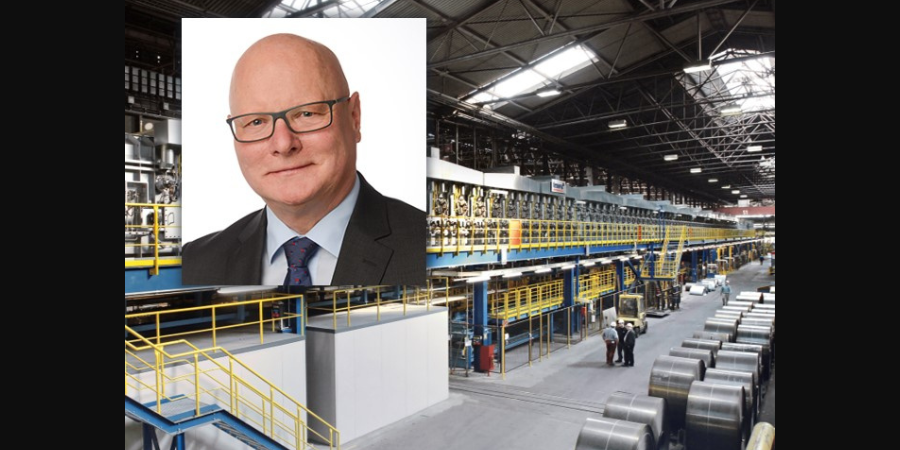
International heat treat plant provider with locations in North America, Tenova received the VIZ-Stal (NLMK Group) contract through its company Tenova LOI Thermprocess, an industrial furnace plant provider based in Essen. Through the cooperation between this competence center, which specializes in heat treatment furnaces, as well as Tenova Italimpianti, the competence center for strip processing, the new line will provide one of the important stages of grain-oriented (GO) electrical strip production. Steel final processing will be carried out at a newly-built plant located in India.
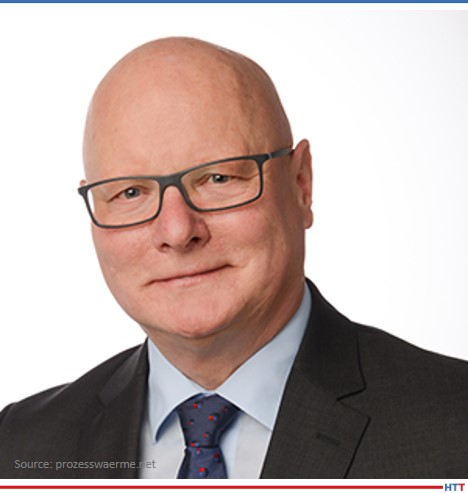
Peter Wendt Vice President Tenova LOI Thermprocess prozesswaerme.net
The contract includes the engineering, the supply and supervision services of mechanical and process equipment, the furnace system, and the related electrical, measuring, and control systems for the DCL.
"We are very pleased for this new order which confirms the reliability of the leading Tenova technology and underlines our strategic partnership with NLMK and VIZ-Stal," said Peter Wendt, vice president of Tenova LOI Thermprocess. "The NLMK Group is one of our most faithful clients with more than ten orders over the past fifteen years. The new DCL Line will ensure the highest surface and best magnetic properties required by the market."
"NLMK selected Tenova on the basis of the large number of references for similar heat treatment lines," explained Valery Shevelev, general director of Silicon Production at NLMK Group. “The short execution time is another important factor that led us to choose Tenova as partner for this project."
thyssenkupp Steel Europe will receive more than 250 new recuperative burners. These are designated for single ended radiant tubes (I-tubes) and W-Type radiant tubes. Final installation will be at FBA 7 of thyssenkrupp Steel Europe, Bochum (Germany), and delivery of the new combustion system will take place at the end of 2021. Commissioning is scheduled for the first quarter of 2022.
Tenova LOI Thermprocess placed the order and is part of a wider modernization project of a continuous galvanizing line at thyssenkrupp Steel Europe. The new combustion system, provided by German based burner manufacturer IBS Industrial Burner Systems, meets the highest requirements by targeting NOx-emissions lower than 140 mg/Nm³ @3%O2 – reference at target strip temperatures above 1652°F (900°C).
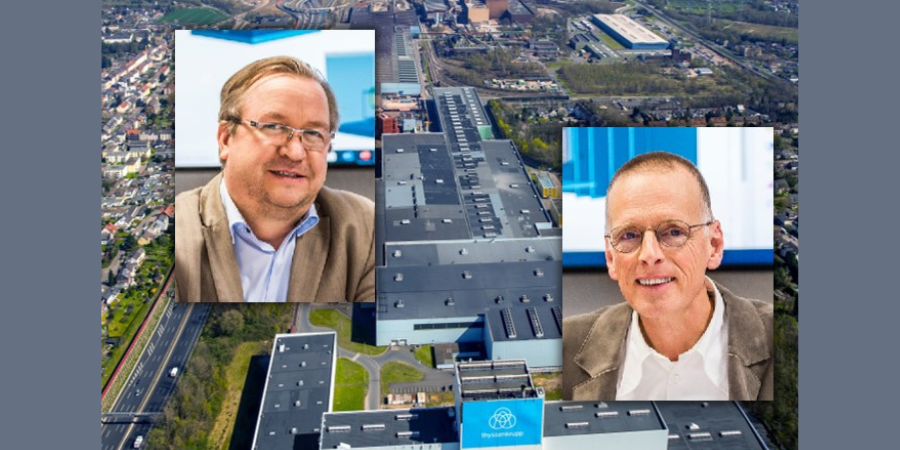
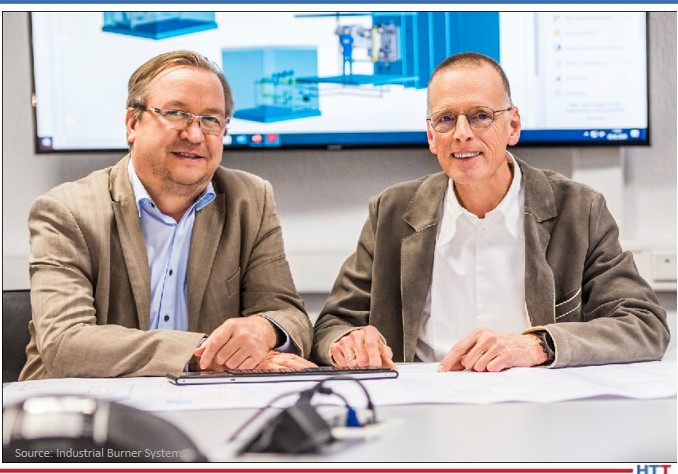
Thomas Wolf and Bernd Machovsky Managing Partners IBS Industrial Burner Systems GmbH
“This order is the latest of numerous appreciations of our efforts to provide state-of-the-art combustion systems for our customers,” states Bernd Machovsky, managing partner of IBS. His co-partner, Thomas Wolf, emphasizes, “Our ambition [. . .] is to provide environmentally sound and energy efficient solutions for all kinds of continuous strip lines, no matter if W-, double-P or I-Radiant Tube fired.”
With their LOOPFIRE®-technology, the burner manufacturer is able to achieve very low NOx-emissions simultaneously with highest thermal efficiencies of W-Type radiant tube burners, even when burning gases such as Coke Oven Gas (COG) and Coke-Oven / Blast-Furnace (COG/BFG) Mixed Gas.
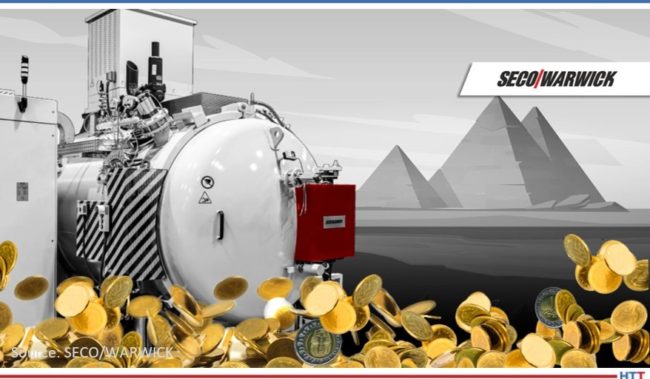
The Mint of Egypt which manufactures both circulation and numismatic coin will receive a vacuum heat treat furnace. The furnace will be used to heat treat circulation and numismatic coin, embossing dies, medals, and special orders. This furnace to the Mint of Egypt is the first furnace provided by the furnace manufacturer to the country of Egypt.
The Mint of Egypt was established in 1950. After 70 years of operation, the first Egyptian Museum of Circulating Coins was created at the mint. It displays a rare collection of special coins representing important historic figures and events, such as the construction of the Suez Canal and the Aswan High Dam. The Vector furnace will be used by the Mint of Egypt mostly for producing collection seals.
"We needed equipment that would significantly increase our production capacity," commented General / HossamKhedr, head of Egyptian Mint Authority, "With heat treatment in the vacuum furnace, our embossing dies will provide the highest possible quality and the durability that is important for the customers. Mints are very special companies. The ban on carrying embossing dies outside the mint prevents us from using commercial hardening plants. That is why it was extremely important to us that the equipment for upgrading our mint represented the highest quality."
Vector Vacuum Furnace by SECO/WARWICK
The Vector® vacuum furnace with 15 bar high-pressure gas quenching -- a product sold by North American SECO/VACUUM Technologies, which is the sister company to vacuum furnace supplier SECO/WARWICK -- is equipment that fits the operating performance requirements of mints. Furnaces with a graphite round heating chamber can be used for a majority of standard hardening, tempering, annealing, solution heat treating and brazing processes.
In the mint industry, these vacuum furnaces are popular as they ensure powerful, uniform gas cooling, which guarantees the high hardness and durability of mint tools. The perfect quality of mint punches and other products is ensured by the very high purity vacuum atmosphere. The parameters of the equipment purchased by the Egyptian Mint are very similar to the solutions delivered by SECO/WARWICK last year to the Mint of Poland — one of the most technologically advanced mints in the world. Some of the equipment installed by the Polish supplier has been operated by this customer for over 9 years.
Maciej Korecki Vice President of the Vacuum Furnace Segment SECO/WARWICK (source: SECO/WARWICK)
"Mints are very demanding customers. They manufacture high quality products that requires perfect details and production repeatability. Collectors, who are the customers of mints, expect the highest care, durability and quality of the finished products," said Maciej Korecki, Vice-President, Vacuum Furnace Segment, SECO/WARWICK Group. "This makes us even more happy that our flagship product — the Vector vacuum furnace — will be installed in another national mint."
Worldwide, there are 70 national mints and several dozen privately-owned mints, manufacturing almost 800 various coin denominations. The oldest mint in the world that has been continuously operated since 864 and the eighth oldest company in the world is Monnaie de Paris in France. The British Royal Mint is the tenth oldest company in the world, established in 886. National Mints provide the official currency for their home countries. They need to comply with rigorous standards that guarantees the weight, purity, and face value of the bullion they produce. This guarantee enables the bullion products manufactured by the state to enjoy a global reputation as the ideal source for investment in high-quality noble metals.
Heat TreatToday publisher Doug Glenn discusses hot isostatic pressing with Cliff Orcutt of American Isostatic Presses, Inc. Learn about the revolution that is occurring in the heat treat industry and how it is being used across various manufacturing industries
Below, you can either listen to the podcast by clicking on the audio play button, or you can read an edited transcript.
The following transcript has been edited for your reading enjoyment.
Doug Glenn (DG): First off, Cliff, I want to just welcome you to Heat Treat Radio. Welcome!
Cliff Orcutt (CO): Thank you.
DG: If you don't mind, let's give our listeners just a brief background about you.
CO: It's been 43 quick years in the industry. I, actually, did start as a child. My father was one of the original people at Battelle where it was patented in the '50s, so, I grew up under that. Right out of school, I went to work for his company, after he and another gentleman left Battelle, Mike Conaway, and they formed Conaway Pressure Systems. By the time I was 20, I had already installed 10 HIP units around the world and helped design and build the Mini Hipper.
I was involved in 1978 in moving the world's largest HIP unit from Battelle to Crucible Steel in Pittsburgh, which is now ATI. Also, in 1979/80, we installed the very large system for Babcock and Wilcox at the Naval Nuclear Fuel Division in Lynchburg, VA. Both of those units, 40 years later, are still running.
I'm also past president of the Advanced Materials Powder Association, part of MPIF, and I was also a director of their Isostatic Pressing Association. I am currently the chairman of the International HIP Committee. We put on the triennial HIP conference every 3 years.
DG: Is that part of APMI?
CO: It's actually its own group. It was formed by all of the people in HIP around the world, in Europe and Japan and the United States back in, maybe, 1983 or so.
DG: What's the name of the organization?
CO: It's called the International HIP Committee. It's kind of a loose organization which the only thing that we do is put on this conference and we bring in speakers from around the world and promote HIP technology, basically. Our last one was in Sydney, Australia in 2017. We were supposed to have one in October 2020 and now it's pushed until September of 2021.
DG: Where will that be?
CO: It's going to be in Columbus, Ohio because that was the original founding city. Every other conference, we move to the United States, Europe or Japan. So, it's coming back to the US. I'm in charge of it. We have some other good people on the board, including Mike Conaway, who was one of the original Battelle people. Victor Samarov is on the board helping us with the meeting, programming and so forth. People can visit www.hip2020.org to see information on that.
DG: I got you a little distracted on that. Keep going with your background.
CO: Personally, in these 43 years, I've installed over 200 units, hands on. I've flown about 5 million miles, I've been to 38 countries; you name it, I've been there, good ones and bad ones. In my early years, when my father started this company, they pulled about 6 people out of Battelle and they were, basically, my teachers. So, instead of going to educational school, I went to HIP school. We had some of the top people: Roger Pinney, Hugh Hanes, Don Woesner, Gary Felton and another gentleman, Bob Tavnner, all came out of there.
In 1979, my father passed away, and his company then sold to ASEA who then became ABB who then became ABB Flow and then they became Quintus now. That's how they have a location in Columbus, as well.
A couple of people, including Bob Tavnner, left and formed International Pressure Service. That was in 1983. They hired me as operations manager, and we grew to be a force to be reckoned with and the Japanese then bought us. At that time, Rajendra Persaud, or Reggie we call him, left and formed AIP (American Isostatic Presses) and I said, “Hey, Reggie, let's have a two person company again rather than two one-person companies.” That was 1992 and so, 28 years later, now we're a force to be reckoned with again.
DG: Tell us a little about AIP.
CO: American Isostatic Presses, when the Japanese bought us, we had a lot of technology and a lot of good people. Then they hired a new CEO and he decided he didn't want to continue building HIP units, he wanted to do something else. So, Reggie formed AIP and I joined him and we pulled 5 other people back from ITS. We sold our first big job in 1994 to Horus in Singapore, a multimillion dollar job, and took off from there and haven't looked back. We started on a shoestring, no venture capitalists, no dollars, and now we have 4 buildings and locations around the globe.
"We're just a high tech blacksmith, that's all it is. Instead of hitting something with a hammer, we're using gas pressure to squeeze on it."
DG: How many units do you think you guys have installed since 1994?
CO: As AIP, around 150. It's snowballing. In the last 5 years, we've sold 5 big units. Up until that time we were mainly mid and small. We had orders for some big ones but, unfortunately, we couldn't get export licenses for them. The technology that grew out of Battelle was based on nuclear fuel rods for the submarines. Admiral Rickover wanted to extend the life of the sub, so it was protected for quite some time. And then they also had missile nose cone technologies it was used for and that's still what they're protecting it for is missile nose cones.
We had some orders in the late '90s early 2000 through China for large equipment and we were denied. Then we were denied in India, so we kind of just got stuck with the smaller to mid-size units. Here recently, it's starting to expand. Things are loosening up a little bit.
DG: AIP today is selling not only in North America, obviously, but you're pretty much selling around the world, anywhere where it is legal to sell, you'll do it.
CO: Yes, if we can get an export license, we will put it in. Some of the rules have relaxed a little bit, and, with some countries, we're more friendly with them now.
DG: I think a lot of our listeners are probably not going to be as familiar with HIPing, hot isostatic pressing, as other more common “heat treat operations” like carburizing, hardening, annealing and that type of thing. Take us back, class 101: What is HIPing?
CO: We're just a high tech blacksmith, that's all it is. Instead of hitting something with a hammer, we're using gas pressure to squeeze on it. We heat it up hot, we put pressure on it, and we're basically densifying it, making it more dense, and getting rid of imperfections in the metal.
A lot of what's done is castings. When you have a casting, the metal is hot, so it's expanded. When it cools, it cools from the outside in, so it freezes on the outside first and then the center starts to shrink. It creates internal porosity. Most of that porosity is thermal shrinking which is a void. So, you put it back in our heat treatment, apply pressure to it and you get rid of the voids that are left. You make the casting dense and better grain structure and more homogenous. It increases fatigue in property strength. That's the number one use of it right now.
Second is probably powder metallurgy where you take powder metals and you can blend powders and you can start with different grain sizes and different materials. You put them in a container because the gas would go through the container if you didn't have something around it. So, you squeeze on the container and it densifies whatever is inside of it and you make a solid part. For example, a lot of powder metallurgy billets which are then used for extruding into other products or rolls and different things. We do a lot of pump bodies and valves for deep sea work, extruder barrels, you can bond things; there are a whole lot of applications.
DG: The two things I understand with HIPing are high temperature and high pressure. Give us a sense of high temperature. What does that mean? Is it hotter than a typical heat treat operation? And how about the pressures? Give us a sense of what the pressures are looking like.
CO: A lot of people are familiar with sintering. That's where you just take the metal up, you sinter it and the grains merge together by melding and attractive forces. What we're doing is: we're not taking it up to those high temperatures to where the part actually is molten or melting, we're taking them up below that and applying pressure. Because of the pressure, we're basically pressurize sintering; we're adding force to make it sinter faster or better or at lower temperatures.
Usually, it's about 150 C degree less than sintering temperature. Again, it depends on the process of what we're trying to do with it. Typically, most parts are done around 15,000, some parts 30,000. Here, at AIP, we actually have test units up to 60,000 PSI and we've actually built 100,000 PSI HIP units. You're above the yield strength of some of the metals you're using. Most of the majority, again, in like castings, titaniums around 970, steels around 1225, but we go up to 2200 C for some things, even higher for like half-in carbide with people pushing it to 2300. It's pretty hot, a lot of pressure. Unfortunately, high temperature and high pressure costs money. You want to use the lowest pressure and the lowest temperature you can get by with, but sometimes you can't.
DG: It's harder, I would imagine. The way I've always heard it said is that the hotter it is, the more difficult it is to keep, let's say, that cylinder container that you're talking about. If it becomes hotter, it's harder to keep it together. I would guess you're right, when you've got higher temperatures, things tend to blow apart easier?
CO: Not so much. The temperature is contained in the middle of the pressure vessel, so you've got plenty of insulation around it and you keep your container cool. The goal there, in a HIP unit, because it's the expensive piece of item, you want maximize your work zone, that's where you have to have good engineering to make sure you do keep the container cool.
DG: Are most of those units water cooled jackets, or are they cold wall?
CO: They're almost all hot wall, but some of them are cooled internally and some of them are cooled externally. You still have loss to the metal, whether it's internal or external cooled, but internal gives you faster cooling than the external.
The big advantage of HIPing is, like with some materials like titanium, you can eliminate a lot of machining. Making chip that you can't really reuse real easy makes a lot of economic sense. Titanium is a very high melting temperature, so you can't take those chips and melt them cheaply. Aluminum, you can. A lot of aluminum, people can't afford to HIP it because you can just recast it.
HIP is an expense process. The equipment is expense. It uses argon gas. Swinging a hammer is cheap, but using gas pressure, it's so compressible, that you have to put a lot in. You can reclaim some, but the cost is still high. You're talking medical, aerospace and military, basically. Forty years ago, I thought every car would have HIP pistons. It's just not going to happen. They can't afford it. I do see Edelbrock and Trickflow both have HIPed aluminum race heads, though. If you get into where you have the economy of doing something like that, you can apply it. You're definitely going to get a better product, it's just price versus performance.
Watch an "oldie but goodie" on what HIP is.
DG: As far as why people want to do the HIPing, I guess, primarily, it's an elimination of, let's say, defects or inclusions or whatever, either cast parts or powder metal parts, you're increasing fatigue strength, and things of that sort.
Are there any other major reasons why people want to HIP?
CO: Well, there are some things you can't make other ways. In other words, it's like water and oil, you can't mix them very well and some metals you can't melt them and just make a molten bucket and pour it. In HIP, since you're starting with powders that are solid, you can blend things like graphite powder and steel. You couldn't blend them very well in a molten state, but in here, you can. And, you can squeeze it to solid, you can get interlocking and bonding and diffusion bonding materials that you couldn't otherwise. So, you can make things you couldn't make any other way.
Also, you can eliminate machining. For instance, you're making a titanium fitting that has a lot of holes on the inside, it might even be curved and really hard to drill, but you can lay it up and do powder metallurgy around it and make shapes that you couldn't make otherwise. A lot of parts are pressed and sintered for years, for instance, for transmissions. Something like that is real easy because it's a small disc and it's not very long. But, if you're trying to make a real long part that is a strange shape, you can't just press and sinter it. You can do it from HIPing. You can do big shapes that you couldn't get enough force on or you can't fit into a press dye. You can do big shapes that you couldn't get enough force on or you can't fit into a press dye. It opens up a lot of options. A missile nose cone, for instance. There is just almost no way to press and sinter a cone, but with HIPing you can make that shape and you can make it very uniform. There's really no other way to do it.
DG: I think that is one of the benefits of HIPing, from what I understand, it is absolutely equal pressure on all parts when you increase the pressure. It's not like you're only pushing on one part, like with a forge press, or something like that – equal pressure all round.
CO: Yes. And it gives you uniform density throughout the part, which is very difficult.
DG: HIPing is primarily used on castings, powder metal and things of that sort, helps us get a very clean part, if you will, to eliminate inclusions, and minimize the porosity.
You may have mentioned this before, but the actual history of HIPing. It started at Battelle?
CO: It started at Battelle [Memorial Institute], I think in '55 or '56. Again, for the nuclear fuel rods for cladding of the fuel rod. Four people were involved in the patent, two of them, Ed Hodge and Stan Paprocki, "the two others on the patent were Henry Saller and Russell Dayton" I worked for both of them over my years. It grew out of Battelle and then in 1975 is when my father and Mike Conaway left and formed Conaway Pressure Systems. That was kind of like the beginning of the commercialization of it. There were some other companies, like Autoclave Engineers, that were building high pressure equipment, but they weren't really offering packaged HIP units. Conaway Pressure, CPSI we called it, was really the origination of commercial HIPs as we know it.
DG: You hit on this a little bit, but I want to make sure that we're clear on it. You mentioned the industries that are using it, but let's just review that real quickly, and maybe if you can give any example of parts. You said, they've got to be higher value parts because the process is expensive, so we're looking at aerospace, medical and that type of thing. What primarily, at least in those two industries, and other industries if you want to list, are the parts being run?
We’re seeing a lot of application now in ceramics. We see pump plungers and ceramic bearings. Here, at AIP, we do a lot of military work for armor, boron carbides, spinell (21:03), things that are really hard, ceramics. . . You want them perfect because if they have a defect in it, that’s a starting point for a crack. A lot of brakes for jets and fighter jets.
CO: A lot of extruder barrels. What happens is you can use a solid steel chunk of metal for the barrel portion but then you can HIP or diffusion-bond powders on the inside of that barrel that might be very expensive. If you're doing something like a crane or something where the teeth are outside, you can weld on. A lot of times they'll weld on hard brittle materials that help you dig things with a digger. But on an extruder barrel, it's on the inside, it's internal; it's very hard to coat down on the inside. So, we can actually bond those powders to the inside of extruder barrels.
Another big application is sputtering targets. I don't know if you're familiar with sputtering targets, but they're basically sacrificial material that you plate onto other materials. The target is just something that is being hit with an electron beam inside a vacuum furnace. It creates a vapor and by charging the different particles you can attract them and plate things out. All of your mirrored windows, all of your hard drives, all of your CDs and DVDs, when you see that mirrored finish on there, that is a sputtered coating and those coatings come from these things we call targets. What happens is, if say, you're doing a chromium target, at the end, if you try to molten cast it, if you had a bath or a melt of chromium, it would get oxides in it and be terrible. But, you can make very pure powders. That's one of the good things about HIPing is they can make very pure powders by blowing argon through a stream and it makes nice pure powder. Then, we can put it in and squeeze it into a solid billet and make a target which then can be evaporated in the vacuum chamber for coating.
We're seeing a lot of application now in ceramics. We see pump plungers and ceramic bearings. Here, at AIP, we do a lot of military work for armor, boron carbides, spinell (21:03), things that are really hard, ceramics. . . You want them perfect because if they have a defect in it, that's a starting point for a crack. A lot of brakes for jets and fighter jets.
We have a process inside the HIP that we call carbon-carbon impregnation. We take pressure and we push the carbon into the 3D woven graphite fibers and make brakes and nose cones. Other materials like beryllium, it's very hard to make beryllium and machine it because it's kind of dangerous, and so forth. Again, they take powders and the HIP the beryllium to make things like space mirrors and other jet parts.
Now, we've got into more things like teeth and braces are being done with ceramics- new transparent braces made out of aluminum and different materials, zirconia caps for your teeth. Again, if you don't HIP them and they've got a defect in it, it will be like a plate when you drop it. But, if you get rid of that defect, now you've got something harder than steel. On the other end we're doing jewelry such as gold and platinum rings. The benefit there is you don't have porosity. If you have porosity, it's like trying to sand a sponge and you can never find a nice perfect surface. But if you've got rid of that and the sponge is now hard, then you can polish it and you're not taking off any material.
It hasn't really happened too much, but we're seeing rumblings on phone cases. A lot of those have been metal in the past, but now they want to do the magnetic charging and it doesn't work real well.
DG: It's got to be glass of some sort, right?
CO: Yes. We're competing with Gorilla Glass. Some companies are looking at transferring that to zirconia. The iPhone watch, or iWatch, they were making it in zirconia, and that's one of the applications and things like that. Ceramic rings, ceramic knives, ceramic scissors – they're all being HIPed.
On the diffusion front, like the vacuum plates for the fusion reactor, like ITER, they can bond copper to tungsten and different things. You couldn't really weld them, because if you try to weld tungsten, it gets real brittle and cracks, but you can diffusion bond materials and you can do things you couldn't do otherwise.
DG: Those are great examples, and I think that gives folks enough. Are there any other examples that jump to your mind that you think people ought to know about, or is that it?
CO: The big one right now is 3-D printing. There is a lot of interest in 3-D body parts, titanium, stents, spines, implants for teeth and screws. Just about anything you can put in 3-D, they're trying to print. The problem with 3-D is, it's not perfect yet. Maybe in 10 years it will be perfect, but they're making imperfect parts when they print them. If you put them in the HIP and squeeze on it, not you've got a pretty much perfect dense part that's bonded better, stronger, improved properties.
It also allows you to print faster, so maybe you'll want to print an imperfect part, but you can just print twice as fast, so you increase the range between the particle and speed up your process. Again, price versus performance. You look at what the benefits of the two ways are.
DG: I've got a question. In heat treating, a lot of times after heating, you have to worry about dimensional change of the part, right? So, I'm thinking to myself, you've got a cast part with some innate porosity and you put it in a HIPing unit. Do you have to compensate, or do you have to be careful about dimensional change, most notably, I would think, with pressure shrinkage of the part?
CO: Very little because it's isostatic and we're talking about micro macro small porosity. If you had a 1 inch hole in the center and you were squeezing that out, you might give it up, but microscopic particle size is really not that much. Now, in the powder metallurgy, we say it's isostatic but then you do have some of the stresses in the container that you put around it. You might see some distortion at the corners where you welded a container, and so forth. But, there's good software out there, there's good programming and things and a lot of empirical data. People can pretty much design to shape within a couple millimeters.
DG: You mentioned this earlier, but the gas that's used is predominantly argon, because it's a heavy gas?
CO: The reason we use argon is the furnaces we use can't run in air or oxygen. We have a choice of nitrogen or argon, the two commercial grade gases. Nitrogen also embrittles materials like molybdenum. It tears up our furnaces, so argon is the preferred choice. Also, it has poor thermal conductivity which is good for the insulating portion of the HIP unit and when you get it dense enough then it does conduct good enough that it works for the part. It's the all around cleanest, best gas but it's an inexpensive gas. We do use nitrogen on some things. A lot of ceramics like silicon nitride we'll use nitrogen, for different reasons.
One of the biggest issues right now is we see a lot of interest in oxide ceramics. I've got many customers that want us to build a real high temperature oxygen furnace and we're real close to issuing that. What it will allow is to actually sinter in the HIP unit at high temperatures under partial oxygen which hasn't been done yet.
DG: Let's change gears just a little bit. You actually have two sister companies. I want to ask you two questions and you can incorporate information about those sister companies with this: One, why would a company want to outsource a HIPing process? And, two, on the flip side of that, why would a company want to purchase their own HIPing equipment and do it in-house? Maybe you can address both of those, because you've got experience on both sides, based on your sister companies.
CO: The outsourcing is really easy. If you've only got one part to HIP, you're not going to buy a HIPing unit. It's quantity versus can you support the operation of the HIP unit. And, you've got to do it profitably. You've got to do everything profitably or you're not going to do anything. You've got to look at the capital equipment cost and the space. Maybe you don't have space in your building or you don't want to build a new building, or, maybe you just don't have the people that have the knowledge in HIPing and you don't want to hire and train a maintenance crew, and so forth. Even some big companies like Pratt &Whitney and Wyam-Gordon both owned massive HIP units at one time and they decided it was cheaper to sell the HIP unit to Bodycote and then outsource it.
Sometimes economics may play in there, but sometimes maybe you want to have in-house sourcing. Maybe your part is so heavy, you can't afford to ship it. Then, you look at that and say you might want to have your own HIP for that reason, or you've got so many parts, you just can't afford to box them all, ship them out and bring them back. So, there are reasons why you'd want to own your own HIP unit.
DG: You've got sister companies that do the service, right? AIP, American Isostatic Presses, the company that you're with specifically, they build the units. But you've got sister company that actually does the service. Tell us about them a little bit.
CO: When we started out, we were just going to build HIP units and we were selling to a lot of the toll companies and we still do. But, around 2004, after the economic downturn of 2001, we decided we would get into building our own pressure vessels. We hired an engineer, Dan Taylor from Hydropack, and started building pressure vessels because we thought we could do it better. Then we were looking at toll. A lot of people would come to use and say they were not happy with turnaround or other things and they asked if we could help them toll HIP? We kind of got drug into it. We didn't, again, want to step on our customer's toes, so we came out with a different name and sort of hid behind that a little bit and didn't really even market it for a long time. But then again we kept getting dragged in, so we opened another plant and now, this last year, we opened another one. I've never seen a toll HIP company go out of business yet or lose money. Equipment building is up and down, you're riding the waves. It helped us flatten the curve a little bit. It flattened out the cash flow curve and it helped us a lot. Our competitors weren't doing it. They still aren't really doing it like we're doing it. The original name was Isostatic Pressing Services (IPS), then when we did our plant in Oregon, we called it ITS, Isostatic Toll Services. The family wanted to have different names and different people involved and there are different investors. It's AIP, basically, but there are other family members in the Persaud family. In Spain, the big one we opened last year, it kept the ITS name, but there are five players in that one, so we're one of the players.
DG: So, the sister companies have Toll Services, I know one in Oregon. And one in Ohio?
CO: The other is in Mississippi and then one in Spain. The Ohio one is under the AIP name. Basically, what we do in Ohio is we do more research. We, again, are expanding here in Columbus. We are getting ready to build again and we'll start heading a little more into the production toll. We've got a couple customers that are, again, pulling us that way. But, right now, Columbus has 5 HIP units, up to abut 500 mm in diameter. Most of it is high temperature. In Columbus, we concentrate on 2000 C. All of our other plants are doing production work which is medical implants and turbine type parts and those are all 1225 C roughly.
DG: Let's talk about some of the more latest advances, some of the newer things that are coming onto the scene. You mentioned one, I know, and that was the ceramic oxides. Let's talk about that a little bit more, and also, are there any other advances in the HIPing world that we should know about.
CO: I've been in it from almost day one, and it hasn't changed much. If you look at HIP from 40 years ago and today, they'd look the same. We still use the same valves and fittings. The big thing that has changed is computer control. AIP was one of the very first, I won't say the first because, again, back at Battelle in 1973, they had a Foxboro PDP that was in the whole room and had tape reels in it. I remember seeing it run a HIP unit, you'd type in STOP and START. It was like a movie.
Around '93 or '94, AIP branched into computer control pretty hard and we've kind of led since then. It allows us to do a lot of things, number one is that we can run it remotely. So, in Mississippi, we actually run our plant from Columbus. They load it and we take it over here. Our guys here in Columbus, they run our units all night by staying at home and watching them. Computers really help us there. As for service, we were able to get on the computer and look at a piece of gear in Singapore and fix it. That's the thing that really helped us.
"Where we're advancing things is in furnace technology for high temperatures, getting these furnaces to last longer, making them more reliable. . . We're trying to hit the everyday guy and make him profitable, get parts in and parts out."
Where we're advancing things is in furnace technology for high temperatures, getting these furnaces to last longer, making them more reliable. That's kind of one of the keys because, again, with costs and the economics of HIP is you want not to have to be repairing it and replacing things all the time. That's what we concentrate on. We don't try to push the edge. I think some of our competitors really try to push the edge and do things that may or may not be beneficial or even needed, but they're just trying to push the edge of things. We're not. We're trying to hit the everyday guy and make him profitable, get parts in and parts out.
As far as the oxygen, that's because ceramics has been coming for a long time and it's still coming. It's just never really taken off yet, but sooner or later it has to because they're higher temperature, stronger materials in steels, it's just we are competing against forgings and we re competing against casting companies. That's kind of the whole thing with all the HIP companies. There are basically only four main players in the world. We are all kind of small. We all kind of try to work together as much as we can and we all make good equipment to try to advance HIPing technology. More than beating up on each other, we try to beat up on the forging companies and the casting companies. We want to take their business.
In the research here, a lot of what we're doing is trying to work on the higher temperatures and higher pressures. If you can go to higher pressure, you can drop the temperature which then minimizes grain growth. In many materials, that improves either clarity of the material, if it's a transparent ceramic, or it can improve the strength of a steel because you have better interlocking between small particles. We're trying to do a lot more in high pressure, high temperature than some of the other companies. A lot of the companies are just in the metals only; they really focus on that. We're doing some really odd things here. We do stuff that nobody else wants to fool with.
DG: And you have fun while you do it! I'm curious, just from my own purposes. I envision these things as kind of like bell furnaces, a cylinder. Is that true? And, how big, on average, is a HIP unit? What's the work zone dimensions, let's say?
CO: They start with our smallest one which is about the size of a desk and it has a work zone of about 3 inches x 4 inches. We can build a little bit smaller, but economy-wise, we just built that one small model and that is the smallest that anyone uses. It's the size you need for a tensile bar. Just about every university and lab has an AIP small unit. Then, they can go up to massive units. The large one in Japan that Quintus built is 82 inch hot zone. That's a big diameter. They're talking about a 100 inch or 110 inch hot zone.
DG: That's diameter. How tall was it?
CO: 3 meters. Some people are looking at 4 meters or even longer. I've been told that the Army said if you can put a whole tank in one, they'd do it. One of the drivers there is turbine blades. As the blades get bigger, like on jet engines, your turbo fan is the outer blades and so forth, those big shrouds as they get bigger, the gas economy gets better, so they would like to build massive engines and they would like some of those parts HIPed. They want really big HIP units. Another one is in nuclear reactors for small modular nuclear power. They'd like to replace some forgings and if they could do it with powder metallurgy lids, and so forth, and those need a 3mm diameter HIP unit. The majority of the work is in the 1 meter range.
Heat TreatRadio is a podcast where Doug Glenn, publisher of Heat TreatToday discusses cutting-edge topics with industry-leading personalities. Among many cutting-edge interviews and conversations on the latest technologies and commercial happenings in the industry are topics like AMS2750F, ferritic nitrocarburizing, and supply chain options.
You can subscribe to Heat TreatRadioon iTunes or SoundCloud, and even listen to these episodes on PodBean, iHeart Radio, and ListenNotes. Check out some of the top heat treat topics from the list of episodes below.
1 - The World of Ferritic Nitrocarburizing with Thomas Wingens
"A big part of the success of FNC is the combination with post oxidation. That is a big part because the combination of ferritic nitrocarburizing with post oxidation leads not only to a mechanical strong surface with compressive stresses, it also has a very high corrosion resistance."
"One of the things I always had in my mind when I first got involved with the specification was that the specifications were written by the aerospace 'primes,' but that’s not the case; it involves people, such as myself, who are end-users of this specification. I’m an end-user, so I’m able give my input and say, 'Hey, this doesn’t make sense. What you want to add into the spec is not real world.' It’s nice that people such as us get involved with these specifications."
3 - Rethinking Heat Treating for the 21st Century with Joe Powell (Part 1 of 4)
"I am a commercial heat treater who believes that part design should be integrated for heat treating by the part-maker. It’s a nuance, but what it really boils down to is that sometimes commercial heat treaters do it best, but sometimes the part-maker can do it better."
4 - Metal Hardening 101 with Mark Hemsath, Part 3 of 3
"[Nitriding], and really its cousin FNC (ferritic nitrocarburizing), are actually fairly inexpensive treatments and they can be performed on final dimension parts. There is no post machining and there is minimal distortion. That’s kind of my opinion of why it has done well.”
"Who wouldn't want to have a smoother operation? Not have to schedule people, pay overtime, justify it. We're three years into the project and I think we have a very viable tool for heat treaters to see what they currently cannot see."
6 - James Jan & Andrew Martin on Development of Modeling Software
"We model what happens with FIRE CFD code, we model what is happening at the transition of the interface between the metal component and the water. Because when something that hot gets plunged into water, it is quite an interesting thing that happens—it is called the Leidenfrost Effect. Initially, what happens is the component is so hot, it forms a film around the outside of it, a vapor film, and perversely that vapor film then insulates the component from the water. That film slowly breaks down then you get into nucleate boiling and things like that, and that becomes a lot more aggressive and the cooling happens much faster until you eventually get a single phase. But actually modeling the boiling process is what the CFD code does. That is the secret sauce that we’re bringing to the party here."
7 - A Discussion with Carl Nicolia, PSNergy President
"Their recovery cycle was reduced by 25%. Now, a recovery cycle is from the time I close the door to the time I start my controlled cycle. 25% reduction. And in that total cycle, they dropped gas consumption 5% which eventually led to an increase in output of that furnace by 10%. What we love about this, and this is kind of the theme of the article really, is that the total cost to implement this was less than $10,000. This is a perfect example of high value solution. I hate to say ‘low cost’ because cost is relative, but this is high value. If I can deliver 25% improvement with less than $10,000, or if I can deliver 10% double-digit output increases for less than $10,000, that’s a high value solution."
"The other one I think that’s going to emerge is most probably making more and more parts by powder metallurgy from metal powder which are 100% free alloyed. In other words, all the elements are in each metal powdered particle. In other words, you’re starting with a micro ingot as opposed to a big ingot that you normally use to make bars, and then from bars you cut pieces, and then from those pieces you do hard forging or machining."
9 - Justin Rydzewski on CQI-9 Rev.4 (Part 1 of 4) – Pyrometry
"Perhaps the most significant change within the temperature uniformity survey section is to the alternative temperature uniformity survey testing methods. In instances when I can’t perform a survey with sensors being trailed in, or I can’t send a data pack sort of unit or a PhoenixTM unit through that furnace system itself to collect the data, for systems like that, in the third edition, there were three or four paragraphs of information about what you could do."
"The interesting thing is that there is a phenomena precipitation hardening that goes on in aluminum and titanium. But it also goes on in these high alloy steels. It is a secondary hardening mechanism. We’ve been working on that and we feel that once we can handle secondary hardening in steel, then the jump to aluminum and titanium should be pretty straightforward."
Global leader in industrial cleaning products based in North America acquires a Canadian chemical division, expanding its offerings to include molten salt for the heat treat market.
Kolene Corporation has acquired the chemical division of Park Thermal International Corporation. The president of Park Thermal, Jay Mistry, will work with Kolene going forward to assure the transition of all Park Thermal standard and proprietary heat treat chemical blends, as well as providing customer support.
Peter Shoemaker Vice President of Purchasing Kolene Source: PRNewsWire
"We are very excited to broaden our molten salt offerings into the heat treat market and utilize Jay’s extensive chemical knowledge and excellent technical customer support to do so," says Peter Shoemaker, VP of purchasing at Kolene. "It’s great to have Jay as a partner with Kolene as we relaunch the industry trusted Iso-Therm product line."
"We were challenged with the Covid downturn in our business," stated Jay Mistry, "and we were looking for a strong partner to continue supporting our established customer base. I am glad to have found the Kolene team, a trusted and competent North American partner who has the technical and commercial bandwidth to carry our heat treat salt business into the next phase."
Kolene Corporation has been a trusted brand for both ferrous and non-ferrous metal cleaning products for 82 years and is also known for their ferritic nitrocarburizing (FNC) salts.
Park Thermal International Corporation of Georgetown, Ontario, Canada, was founded in 1938. Jay Mistry started as chemist at Park Thermal in 1989 and bought out the company from Brian Reid in 2017. Since then, Park Thermal has developed chemical blends for special client demands.
Today's shared content is provided by the global information partnership between leading European heat treat news provider heatprocessing and the team at Heat TreatToday.
What's next in heat treating carbon materials? In this best of the web feature from our European industry partner, heatprocessing, take a moment to see how computer modelling demonstrates the technical feasibility and the efficiency of this dynamic combination of induction heating and radiation heat transfer. Could this method be a practical integration in your heat treating process needs? Would adopting this method save you energy? Take a read and let us know!
An excerpt:
"This dynamic combination of induction heating and radiation during the baking process improves greatly the energy efficiency and permits a very precise control of the temperature profile in the carbon."
While we typically try to send our readers to free content, this article requires a nominal fee to access. We hope that you will find this content beneficial.




 A leader in the “Tool & Dies” sector — voestalpine High Performance Metals Polska -- placed an order for a retort tempering furnace with vacuum purging. The furnace will be used for tempering tool steel after the gas quenching process.