


HEAT TREAT RADIO

Heat Treat Radio #100: Cooling Off the Heat (Treat)!

Keeping your heat treat equipment cool is as critical as it is an oxymoron.

If you have old cooling systems or are looking to purchase new ones, hear from Matt Reed, director of Sales and Technologies at Dry Coolers, as he shares purchasing considerations, maintenance, and latest technologies with Heat Treat Radio host, Doug Glenn.

Attend a digital field trip, as Matt Reed gives a tour of some equipment in action. Finally, listen in as we reflect on 100 episodes of Heat Treat Radio!

Below, you can watch the video, listen to the podcast by clicking on the audio play button, or read an edited transcript.


HTT · Heat Treat Radio #100 Cooling Off the Heat (Treat)!


The following transcript has been edited for your reading enjoyment.

Contact us with your Reader Feedback!

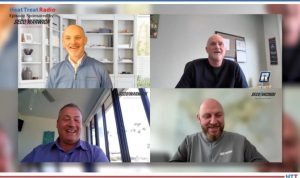
Doug Glenn:  Well, welcome everyone. We’re back to another episode of Heat Treat Radio. This is going to be a “cool” episode — pardon the pun! We’re going to be talking about furnace cooling systems.

When everybody thinks of furnaces, they think of heat. Probably one of the even more important things is keeping the equipment cool, as well as potentially cooling parts. That’s not so much what we’ll talk about today (part cooling), but it’s keeping equipment cool.

With us today is a cooling expert out of the North American heat treat market, Matt Reed from Dry Coolers, Inc.

Matt, first off, welcome to Heat Treat Radio.

Matt Reed:  Thank you for the opportunity.

Doug Glenn: I’m really looking forward to talking with you!

I want to cover some basics, just to give our listeners a sense of where we’re going. Let me just run down through what I’m hoping that we’ll cover today: First, we’re going to talk just a little bit about you, Matt, and your company so people know who you are and how long you’ve been in the industry.

We’re going to do a very high level look at: What are cooling systems and why do we need them? It’s a very fundamental thing, but there may be some people that need to know that information.

Then, we’re going to talk about: If we need to purchase a cooling system, what are the questions we should be asking?

Next, the ever pervasive and always a thorn in our flesh: maintenance issues. These things are not maintenance-free. Briefly, what are some of the signs that maintenance needs to be done, etc.?

Finally, if we have time: we will explore some of the newer developments in cooling systems.

Meet Matt Reed (02:12)

Matt Reed
Director of Sales and Technology
Dry Coolers
Source: Dry Coolers

Doug Glenn: Matt, again, welcome. Could you give our listeners a sense of who you are, how long you’ve been in the industry, and why you’re qualified to talk about cooling systems?

Matt Reed:  Thank you, Doug. I have been at Dry Coolers for 28 years, and when you invited me to speak about this, I really had to think about it. It’s been 28 years! By default, I have so much experience that I never knew that I had!

Doug Glenn:  Exactly. It’s amazing how quickly it goes.

Matt Reed:  Eight years before coming to Dry Coolers, I was at another corporation. But I’ve been in heat transfer and design and thermodynamics and dealing with that side of the engineering forever. I love it. I love working with the customers.

Doug Glenn:  What is your role at Dry Coolers, right now?

Matt Reed:  I am the director of Sales and Technology which is a title. Really, I’m overseeing a lot of the engineering, the design. The best part of my job is talking to customers and sorting through what works for them, how we can solve their problems.

I thoroughly enjoy it. And Brian and Margy Russell, the owners of Dry Coolers, allow me to do that.

The Basics of Dry Cooling Systems (03:37)

Doug Glenn:  Let’s talk just a bit, on a very elemental level, cooling systems. What are they, and why do we need them?

Matt Reed:  Right. When you started this interview, you said, “Cooling, you know, it’s cool, or whatever.” It’s funny because Dry Coolers has a logo that we love, “Dry Coolers. Keeping it cool for 30 years.”

Furnaces are our core market as well as our first love. Brian saw an opportunity, saw a problem in the industry and said, “Hey, I can solve this.”

Vacuum furnaces, around the 1960s and 1970s, when they were being developed, focused on heat treating materials. Cooling is required because you’ve got these inner walled jackets in the furnace, jackets in the heads, you’ve got diffusion pumps, mechanical pumps — all these ancillary pieces of equipment that require cooling.

Originally, you could use city water and flow city water right through the furnace. Customers soon find out that that’s a lot of water consumption, so the next step was to look at an evaporative cooling tower. You start recirculating evaporative cooling tower water directly through the furnaces.

Evaporative Cooling Tower: cooling is done by evaporation
Source: Dry Coolers

For those of you that don’t know what an evaporative cooling tower is — not to get into too much of the detail here — but cooling is done by the process of evaporation. Water circulates through this tower on a roof or outside, and a small portion of that water is evaporated to produce cooling.

Let’s say you’re flowing 100 gallons a minute through a furnace. 100 gallons a minute goes through that cooling tower, and one gallon a minute is evaporated to reject heat. Now you’ve got 99 gallons a minute coming back. Now you’ve got to make up 1 gallon of water from the city water. You keep recirculating. As water evaporates, it’s just like boiling a pot on a stove — you keep boiling that pot, filling it back up and you’re going to end up with calcium and you’re going to have scaling on the inside. This is what’s happened to furnaces. It runs great for a couple of years, and then you start getting hotspots.

A lot of the old furnaces that are out there have had a rough early history because of open tower water. You had to be really diligent with your water treatment, bleeding water off from the system, adding water treatment chemicals to keep the jackets clean, and things like this. Brian saw that as an opportunity in 1985 and said, “Hey, let’s close it up. Let’s take these open water systems and recirculate them in a closed loop to protect these furnaces and stop all the scaling, all the buildup, and all this kind of stuff.

Our primary job has been trying to guide customers into what would be an appropriate closed-loop system for them whether for old furnaces or new furnaces.

Doug Glenn:  Let me ask you this question: What parts, primarily, on the furnace, are we worried about cooling? I know in a vacuum furnace, we’re talking about essentially the entire shell, assuming it’s a cold-wall furnace, meaning it’s being cooled. What other things are typically cooled?

Matt Reed:  They are all very important, but the shell is a big user. If you were to put 100 gallons a minute into a furnace, a large portion of that water is going to circulate through the jacket. The furnace has an inner wall and an outer wall; it’s a big annulus. Imagine you’ve got two cylinders inside of each other. That annulus is full of water, and it constantly circulates.

The other pieces of that furnace could be a diffusion pump. The diffusion pump is especially sensitive. It likes to run cool; it has small passages. If there are any flow issues or particles or debris in the system, boy, that’s one of the first places customers have trouble with plugging. Feedthroughs, mechanical pumps — these are all other ancillary.

Another big user is the quench coil or the fan. In a vacuum furnace, you’ve got a fan mounted on the back or alongside the furnace, and there is a heat exchanger inside the furnace that allows that furnace to quick-cool. We specialize in looking at the size load in a furnace and the period of time the load needs to be cooled in order to create the material property. We can guide the customer in selecting a system that would work.

Fan helps the furnace to quick cool
Source: Dry Coolers

Doug Glenn:  Right. We’re talking about high pressure gas quenching there.

Matt Reed:  Yes.

Doug Glenn:  I’m assuming you guys do more than vacuum furnaces. I know in a lot of atmosphere furnaces, let’s say, or air furnaces, there are potential cooling opportunities: door seals, fans, cooling jackets for continuous furnaces, etc.

Questions To Ask When Considering a Cooling System (09:33)

Doug Glenn: I’m sure you’ve got a lot of people calling you and asking you for systems. Let’s just talk about some basics. What are some of the questions that you need answered from a customer who would call in and say, “Listen, I need a cooling system” or “I think I need a cooling system.”? What do you need to know about the system in order to size the thing, or what type, even, to purchase?

Matt Reed:  Flow is the first thing that we need to know. Through the furnace supplier or some other means there would be some information on what that flow requirement is, and we have a lot of that information here at Dry Coolers.

We also look at location. Somebody in Tulsa will need a different cooling system than somebody in Vermont. We know that in certain parts of the U.S., (LA, for instance), there might be water requirements. The cooling requirements in one location are very much different from another.

Some environmental regulations restrict water usage. You can’t discharge water; you can’t have a cooling tower because you’re going to have to haul your water away if you have to discharge anything. We look at the options. Very often, we go with a dry cooler.

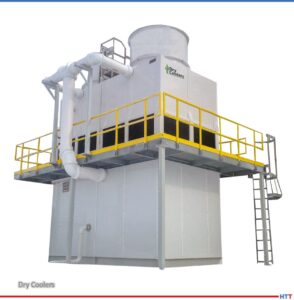
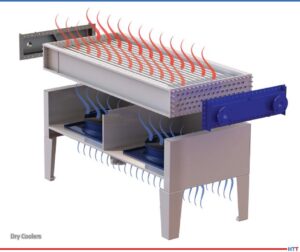
That’s our namesake which, I really haven’t talked about. “Dry cooling” is essentially our version of an air-cooled heat exchanger with fans and a radiator that exchange heat directly with the ambient air. There’s no water usage; we fill it with glycol for freeze protection. Our happiest customers use this kind of a product because it just protects their furnace forever.

Doug Glenn:  Let’s talk about Dry Coolers. What is the namesake? Why do we call it that?

Saguaro cactus, the "perfect brand label for Dry Coolers"
Source: Unsplash/dborisoff

Matt Reed:  It’s funny because Dry Coolers is a cactus, right? If you’ve ever seen Dry Cooler’s logos at the shows or anything, we’ve got this cactus. Brian can tell this story, but there was a period of time he lived down in Arizona and realized that the saguaro cactus was a perfect brand label for Dry Coolers. Our office is not in Arizona, it’s north of Detroit, but it is a cactus logo!

I want to say half of our business, or more, in terms of heat treating, is cooling using air-cooled heat exchangers directly cooling the furnaces using glycol water.

Imagine your car radiator filled with glycol. You just don’t have to worry about the interior of that engine anymore because it’s cooled. That is what we’re doing with vacuum furnaces.

Now, we have to be careful about temperatures. If you’re in southern Texas (or it could be Alaska, these days), temperatures get extremely high. Your water temperature, your glycol temperature, is going to go up. We need to address sensitive parts on the furnace — the diffusion pump or feedthroughs or whatever — and make sure the solution that we have for this furnace is going to be appropriate.

We are very pleased with the development of our air coolers.

Maintenance Issues and Solutions (13:18)

Doug Glenn:  Let’s talk a little bit about maintenance of these systems because that is always a sticking point. What are the signs that your system is probably going to be needing some sort of maintenance?

Matt Reed:  I want to talk about two different types of cooling systems. These are the main types of systems that we build. One is a closed-loop evaporative system where we’ve got the open tower which originally everybody used, but now we’ve put a plate heat exchanger in between. Now we’ve got one loop that’s for the furnace that is closed, and then we’ve got another loop that’s outside for the cooling tower water. That’s one.

The other system I want to talk about is our air-cooled system, but let’s do the ugly one first. The ugly one is the evaporative system. The first signs of issues are hotspots on a furnace. An operator knows:  My water temperature is getting high. Feel the bottom of your furnace, feel the upper side of the jackets. If you’re starting to get heat down below, that means you’re getting sediment built up in that furnace. This is a very early sign of water troubles in a lot of vacuum furnaces. In older furnaces, you’ll see cutouts in the jackets where it has been cut out, so they can get in there and rod it out, clean it out, and then weld it back together.

For an evaporative tower system, with a closed loop, you’re generally well protected on the furnace side. Essentially, you have a clean loop side for the furnace that circulates water, and you have treated water in that side. For the most part, once it’s treated and started and running — it’s good. There is very little maintenance needed on that side of the furnace. The furnace is protected.

The cooling tower, however, is exposed to the outside air. It’s always scouring the air for any dust/debris, so the plate heat exchanger gets clogged up. You start losing temperature. It could be every year, every few years, but that heat exchanger must be cleaned. A customer calls because they’re not getting enough cooling; they’re getting too warm. More than likely, the plate heat exchanger is losing flow and needs to be cleaned.

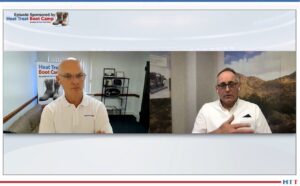
Doug Glenn and Matt Reed discuss cooling
Source: Heat Treat Today

Now, with the other side of the cooling tower, 1% of the water usage (as a rule of thumb) is evaporated in the process of evaporation. You’re always making up water. To keep that water in balance — without going into too much detail on water treatment — what happens is you have to bleed water off of that loop and then make up water in order to keep the solid’s concentrations at a level that they don’t plate out on your heat exchangers.

This was always a balancing act with the furnaces. You have a water treatment supplier that you really need to monitor this stuff. The problem here, that we found, is that maintenance crews are becoming less and less available, experienced, or knowledgeable. You’ve got a lot of attrition and then, all of a sudden, people see, “How come we’re bleeding water off this? This is just wasting money, over here, just shut that valve!” and think everything is fine.

Imagine you’re evaporating one gallon out of every hundred gallons a minute. After an hour, you’ve just evaporated 60 gallons. It really adds up. Now you look at it and say, “Oh my gosh, I’ve evaporated the entire volume of water in that cooling tower, twice a day, in order to keep up with the heat cooling requirement.” Do you know what I’m saying? Boy, you really must be on it.

In a matter of a few days of turning off that valve, you will start scaling up. You’re going to start seeing crud on the cooling tower and, unfortunately, that all accumulates in the hotspots in the system. Your plate heat exchangers will get fouled up — that’s where most of the minerals will drop out is on hot surfaces, warmer surfaces. The worst case would be if you’re circulating this water directly through a furnace, those hotspots are on the jackets, and that’s why we see that.

Cooling towers are kind of necessary for large water systems. Our internal guide is if you’ve got 300–500 gallons a minute of cooling required or above, you probably need a cooling tower just because of the amount of cooling that’s required. Anything below that, you really should be looking at air-cooled. It’s usually more cost effective, has a smaller footprint, it’s excellent for winter use and summer use, it’s just the way to go.

As far as maintenance with an air-cooled system, there is only one thing you must do — clean the fins.

Doug Glenn:  Because of things that may be coming from the air that may be clogging it up?

Cottonwood fluff from trees can clog the system.
Source: Unsplash/nionila

Matt Reed:  Yes. It could be cottonwood fluff or bags or whatever is in the area that wants to get sucked underneath it. We need to either add filters, or we need to periodically clean those air coolers.

With an air-cooled system, usually the comment is, “I’m getting hot.” That usually means the air cooler needs to be cleaned.

Doug Glenn:  Is the closed-loop portion of the air-cooled systems glycol?

Matt Reed:  Yes.

Doug Glenn:  So, glycol is in the furnace, running around cooling the furnace, and comes out and goes through the inside of the air fin where the air is being pulled in or pushed over (whichever way the air is going) it cools the glycol, and then back. I know with water systems — especially open loop, but probably even with closed loop water systems, if there is such a thing — you’ve got to monitor the water. With glycol, are there any concerns? I mean, how long does the glycol last, or is it “ad infinitum”?

Matt Reed:  You know, how often do you check the coolant in your car?

Doug Glenn:  Not very often.

Matt Reed:  I would like to say, “Oh, yes, you need to regularly check this,” but you kind of don’t! The glycol, now that you’ve purchased, will have inhibitors in it. You can, periodically, take a sample and have it checked to make sure that it still has the proper amount of inhibitors. Essentially, if you had to add more inhibitor, it’s a matter of adding more of this chemical to the existing glycol. You don’t have to pull the glycol all out, right? It’s a pretty minor thing.

Let’s say a company gets sold, or a furnace gets sold. The furnace shows up at a new location, and it is pristine. That was a glycol system. There was glycol in that furnace. You look in there and say, “Oh my gosh, this is clean,” like the day it was first bought. That’s the beauty of the air-cooled system.

The other thing is, air coolers are often put on roofs, and they’re kind of forgotten. A lot of times it’s the last thing to be maintained, and that’s okay because they really are simple devices. The fact that they get forgotten about sometimes suggests that they don’t need a lot of attention. Our happiest customers — honestly, and I’m not selling you the business here — have air-cooled systems. We like it for that reason too. It’s very robust.

Doug Glenn:  If you’re needing 300–500 gallons per minute or over that, you’re going to tend towards an evaporative system. When we’re talking about the air-cooled stuff, completely closed loop — as far as the liquid goes — that’s going to be less than 500 gallons per minute, less than 300 gallons per minute?

Matt Reed:  To be clear, we have customers that have 1000 GPM systems, and they are air cooled. Those customers have 10 air coolers in a bank. We have customers that say, “Oh, no no, they are strictly air cooled. We’ll take those 10 air coolers because they are zero maintenance, and they’re very energy efficient.”

One of the big motivating factors is electricity. In some locations in the United States, it is very expensive. All of our air coolers have variable speed fans. In the wintertime or when it’s 40 degrees outside, you might have 24 fans, but only four of them are running. They  ramp up and down to regulate temperature. You’re directly cooling that glycol with the ambient air, so when it’s cool outside, boy, you’re just as energy efficient as you can be. It’s terrific!

On the flip side, if you have an evaporative cooling tower, in the winter, you’re always running water outside. It’s splashing down, and you get a little bit of mist coming out that creates icicles. Now you’re getting either rooftops or parking lots with ice on them — this is not uncommon. The cooling tower that you use needs to have very low drift and things. We deal with them.

Doug Glenn:  There are more considerations.

Matt Reed:  Yes. If you’re 300 GPM or less, even if you’re in Mississippi — some place hot or muggy — we’re going to look at it. We’re seeing more and more customers, further south, using our air-cooled heat exchangers, in these applications, just to get away from water usage.

Doug Glenn:  For manufacturers who are doing their own in-house heat treat, who have maybe a variety of different furnaces, do you tend to find that they are using one system per furnace, or are we typically combining systems and have a building-wide cooling system? What are the considerations there, Matt?

Matt Reed:  Usually it doesn’t start out that way. A customer buys one furnace and then another one or two more, and so you end up with — oh, we’ve got one here, we’ve got one here and we’ve got one here. We have had customers with 10 furnaces and 10 water systems, and it takes up so much floor space. There is some regret on the part of the customers for having to maintain 10 different cooling systems.

Yes, in an ideal world, we would definitely be looking at a central system where you would have your built-in redundancy, and you would only use as many cooling systems or fans as needed.

Whether a furnace is running or not, oftentimes the water system is let run. An operator will just let it run. Even if it’s out of cycle, while it might not be fully cooled, the water is just left running. All of these systems could be running, but they are not producing. That’s really wasting energy. A central system allows you to take the entire plant load up and down more efficiently. Ideally, we would want to look at central systems.

Doug Glenn:  And you can control the output of that central system just the same as you can for an individual system, always keeping the outlet glycol at a certain temperature, I assume?

Matt Reed:  Yes. In fact, I think, even a little bit better. If you’ve got 10 furnaces, operators can’t load all 10 furnaces at the same time, so they’re never in cycle at the same time. You get this diversity. You might have one furnace going into quench, for example. A large system really kind of evens that all out; it runs pretty efficiently.

Latest Developments in Cooling Systems (26:48)

Doug Glenn:  Before we wrap up, some questions about some of the latest developments. We have talked about some considerations when we want to buy new equipment. We have talked about some of the maintenance and some basic maintenance things. What are you seeing as far as new developments in this area? Are there new products, processes, materials that are being used to design these systems, or how they’re used?

Matt Reed:  We’re seeing more and more air-cooled systems being installed. When I started 28 years ago, a lot of them were evaporative cooling towers and a little bit of air coolers. It was a little bit of both and a little bit more cut and dry. Now we are seeing more and more customers requiring variable speed drives per pump. Now, our default is variable speed drives on all fans. If you buy an air cooler from us, it will have drives that will just ramp up and down to match your load; it’s really efficient.

We’re seeing a lot more requests for adiabatic air cooling, where you’re using an air cooler but you’re providing a little bit of a mist assist on a hot day to knock the edge off of that. When there is a 100-degree day, turn the misting on. We are precooling the air before it goes through the air cooler.

Doug Glenn:  I’m assuming you can only do that in some geographies because that doesn’t work so well wherever it’s humid.

Matt Reed:  That’s right.

Those are the big areas. A lot of facilities have less and less maintenance people. There is a lot of attrition, and we’re losing a lot of experience, unfortunately, in maintaining these facilities.

In the past five years, we’ve been on this development kick on our ABI series air coolers that led to the variable speed fans, leaning more and more towards maintenance. The main area where we see our air coolers needing assistance is those climates/locations where you’ve got cottonwoods. You need filters for the air coolers, and how do you clean them easily? We’ve made some developments on our air cooler that allow us to slide our fan out of the way. A wand gets down in there to clean out, to spray in some foam detergent to clean out the units. There are some features that we’re adding to these units to make it easier to maintain. They’re pretty easy, really.

Doug Glenn:  Has the focus on sustainability and green technologies affected you guys, at all? I’m thinking, primarily, are we seeing more companies moving to vacuum furnaces and therefore that affects the number of units you guys are putting out? Are you seeing anything in the sustainability area that is impacting your business?

Matt Reed:  I think Dry Coolers has been perfectly positioned for that. I think we’ve been environmentally friendly and focused on the environment right out of the gate. The whole closed loop idea with air coolers falls right in line with minimal emissions, minimum discharge to your water, to your environment, storm drains, etc. I think that we’re in a good position there.

From a trend standpoint, this is something that Brian and I have discussed many times. Brian is convinced, and it’s true, that people really want to move away from cooling towers. The choice is going to be: Do you get an air cooler or a chiller? It’s all closed loop; there is no evaporation, there is no water treatment and there is no discharge and all that. These two pieces — a refrigerant chiller and an air cooler — are the two main selections. We’re seeing a lot more chillers being purchased, at the expense of electricity, because chillers consume a lot more electricity. Air coolers are much more favorable from an energy usage standpoint and therefore for the environment.

We’re seeing combinations where we use a chiller in the summer during the heat, but we’ll use an air cooler the rest of the year. We call it a hybrid system where a customer really must have 85 degrees, but they only want to use a closed loop air cooled system with glycol. Okay, air cooler 90% of the air and here’s the chiller, for a small portion of the year, to take the edge off the heat — zero water discharge.

We’re able to be creative like that and work with the customer’s footprint, their location, etc.

Doug Glenn:  Are you seeing any, let’s say, closed-loop monitoring of equipment? For example, on your fans — fan vibration on your air cooling systems — are you seeing any of that going on, as far as helping with maintenance?

Matt Reed:  I will tell you, we’re seeing a lot of requests for link-IO. I know that’s a very specific term, but this is where we take our instrumentation off our cooling system and we tie it into this central link or ethernet hub. There is no PLC, there is no HMI, but now we’ve got temperatures, pressures, flow, level — whatever critical measurements a customer wants — and boom, here it is. Now, they can take it directly back to their building management system.

I’m floored by how many customers want that, and they just buy it. That’s a much easier solution for us to provide than a full-blown PLC or custom PLC for every customer. Every customer is a little different — this building management system is Siemens, this one’s CompactLogix, or whatever — you’re dealing with all these different networks and things.

I’m fortunate enough to not have to get into that nitty-gritty. Dry Coolers has an awesome team. I didn’t mention it, but we’ve got 65 employees now. When I started, there were five of us. I’ve got nine engineers, I’ve got so many designers and electricians, and it’s just fun. It really is. I’ve got so many experts in all these different spots that are liking what they do — it just makes the day go by.

Doug Glenn:  That’s great!

Thanks for being with us, Matt.

Matt Reed:  Thanks for the opportunity. This was fun.

Supplemental "Field Trip" for Tips on Air Coolers (36:05)

Join Matt as he gives some live-action tips on how to check air coolers to ensure they are plug free and working properly.

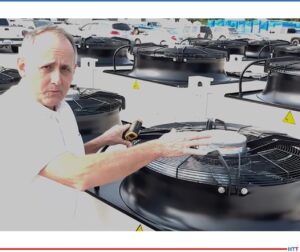
Matt Reed: I wanted to show you our air-cooled heat exchanger. These are very helpful tips for your commercial heat treaters. If they’re walking around the unit, trying to find out if it’s clean, how it’s working, there are some easy things that they can do.

Here’s what I would like to share with your audience: If the fans are working well, that air is coming straight up and out. If it’s dirty, if the fin surface is dirty and it’s having a hard time moving air, that air is going to want to push out to the side.

This fan does not get as much of the out-blowing as you do on our legacy unit. We have a lot of customers with a different style fan. Boy, that air will really push out to the side, if your coil is dirty.

Now, it’s not easy to crawl underneath there and check your fins. And it might look like the fins are clean and your guy might have said, “Yes, it’s clean. I just cleaned the air cooler.” I’m telling you, if your air is pushing out the side like this, it’s still dirty.

Matt Reed gives tips on air cooler maintenance and checks.
Source: Dry Coolers

So, what do you do if it’s dirty? We have a bulletin that we can send to you, but here is the short version of it: For this air cooler, you would unbolt these bolts on this fan and you would prop it up with a 4x4 or something so that you can get underneath it. You can blow out with air or a gentle spray of water or you can use a there are different refrigerant or evaporator foaming solutions you can spray with a wand in there and the foam will push out any dust and debris, cottonwoods or whatever has been sucked into it. It makes a huge difference.

You want the air cooler to run as close to ambient as you can. If it’s dirty, you’re wasting energy. It’s way better for your process to run as cool as possible.

Let’s check one other thing:  That’s the air cooler. Compared to a cooling tower, that’s like nothing. There is very little maintenance. These are usually sitting on a roof and you kind of forget that they’re up there and running. But they do get dirty and they have to be checked.

Here’s the other thing:  These are the inlets. Now, this is a new unit, and of course this would all be hooked up to your process. So, your inlet is on the top going in, and your outlet is on the bottom. You should be able to put your hands on here and feel a difference. It should be warm coming in and cool coming out. The thing you want to look at is if you’re 60 degrees outside, you should be able to make 70 degrees coming out of this process. If it’s really warm, that’s another indicator that you’ve got a dirty heat exchanger coil.

We usually size these or design these so that you can get within five to 10 degrees of whatever the ambient is. Again, it’s 90 degrees outside, you should be getting 95 – 100 degrees feeding your equipment.

Heat Treat Radio's 100th Episode! (38:47)

Milestone 100th episode. Thank you for all the support!
Source: Heat Treat Today

Celebrate this 100th episode with us and listen to Doug reflect on his past seven years of Heat Treat Radio leadership….


About the expert: 

Matt Reed (P.E.), director of sales and technology at Dry Coolers, Inc., graduated Michigan Tech in 1987 where he met his wife, Carol. They moved to Ohio to work for B&W/McDermott for 8 years. He started working with Brian Russell at Dry Coolers, Inc. in 1995 building closed-loop cooling systems for furnaces.  Back then, the company had about 5 employees. Today they have 65 employees and build cooling equipment for a wide range of industries. Matt thoroughly enjoys working with customers and colleagues in the heat treat industry and is happy to share his experience with our readers and listeners.

Contact Matt at matt.reed@drycoolers.com


To find other Heat Treat Radio episodes, go to www.heattreattoday.com/radio.


Search heat treat equipment and service providers on Heat Treat Buyers Guide.com


Heat Treat Radio #100: Cooling Off the Heat (Treat)! Read More »

Heat Treat Radio #99: 365° Look at Troubleshooting Vacuum Furnace Maintenance Issues

You’ve built your vacuum furnace maintenance program, but still looking for maintenance tips for common issues?

Don Marteeny and Caleb Johnson at SECO/VACUUM Technologies lay out their expert advice to assess your vacuum furnace maintenance issues from all angles. Thanks to Doug Glenn, publisher of Heat Treat Today, for hosting this interview.

Below, you can watch the video, listen to the podcast by clicking on the audio play button, or read an edited transcript.


HTT · Heat Treat Radio #99: 365° Look at Troubleshooting Vacuum Furnace Maintenance Issues


Contact us with your Reader Feedback!

The following transcript has been edited for your reading enjoyment.

Doug Glenn:  With us today is Don Marteeny. Don is from SECO/VACUUM Technologies LLC and is the VP of engineering. Don has a lot of experience in this industry, so his input will be valuable.

Don Marteeny
VP of engineering
SECO/VACUUM Technologies

Also with us is Caleb Johnson who is the field service manager, also for SECO/VACUUM Technologies. Gentlemen, we appreciate you joining us.

We’re just going to jump right in. We’re talking about top vacuum furnace maintenance concerns.

Trouble Reaching Vacuum Levels (01:35)

Doug Glenn:  Probably the most dire concerns is: “Dang it, I can’t get this doggone vacuum furnace down to the vacuum levels that I want.” Where do we go? What do we do?

Caleb Johnson: Yes, that is probably one of the more critical problems on a vacuum furnace. There are a lot of issues that would stem from that.

Caleb Johnson
Field Service Manager
SECO/VACUUM Technologies
Source: LinkedIn

One of the first checks I would ask to look at is the vacuum gauge itself. Does the trending look okay? Do we think the gauge is still functioning properly? What does your scaling look like? Since those are electronic items, they do have a life on them. It’s an easy one to rule out, right off the bat.

The next place to check would be your vacuum pumps. Are they functioning okay? Has the oil been changed recently? Is the pump still working well? Just going through some of the basic checks like this can tell us how the furnace is doing.

Doug Glenn:  Is it typical that the vacuum gauge will fail slowly over time? Does it start to get off target? Maybe it immediate: “Boom. This thing is just gone.”

Caleb Johnson: I think it can be either way. On the one hand, it could just not read. On our furnaces, they usually fail high. It will just say it’s at atmosphere even though you’re under vacuum. On the other hand, the low level on the vacuum gauge won’t reach as good a vacuum. Maybe the furnace is there, but the gauge doesn’t register that. The gauge itself just starts drifting. So, yes, either way — they are both common.

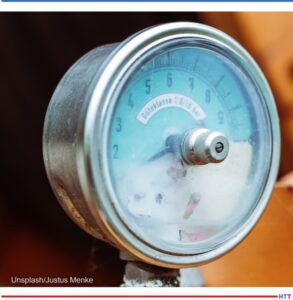
Check the gauge
Source: Unsplash/Justus Menke

Doug Glenn:  Alright. So, the gauge first and then the pump. Was there anything else?

Caleb Johnson:  For the pump, I think you could look at the amp draw on it and make sure the motor is still functioning properly — that’s a big one.

Doug Glenn:  Yes, good.

Don Marteeny:  Another thing that I’ve seen commonly is that a customer is running a process that may, in some way, present some contamination to the furnace. Usually, one of the questions that I ask after that process is, “How long has it been since you have done a cleaning cycle?” By that I mean, having the furnace run a hundred degrees over the process temperature for 8 hours just to basically bake everything out of the insulation.

A further question to ask: Was the furnace open over the weekend? Did somebody accidentally leave it open, didn’t pump it back down, and there’s moisture.

I would expect the first run that there would be problems reaching vacuum. There’s an easy answer to that. Yes, you might not get through the production that day, but you’ve got to put it through a cleaning cycle first. Let it run over night then start back in the morning and see where you are.

Furthermore, this can also apply to the gauge. Sometimes it’s not necessarily that the gauge has failed, but there is some contamination. There are ways to prevent that, like the installation of what we call “a clarifier” — basically a copper tube that allows anything that might be in the environment to condense before it reaches the vacuum gauge.

There are several remedies for these common issues, and we have to go through the list of all of them when this comes up.

Caleb Johnson: I would say, too, that cleaning cycle gives us a baseline because all our vacuum leak checks are specified in a clean, dry, empty furnace. After a burnout, you try to get rid of all that contamination. When the door hasn’t been opened yet, that’s the best time to do a leak-up check and say, “Is any air getting into the furnace?”

A lot of times, you’ll see discoloration on your load or the furnace itself — if you’re getting air or moisture in there — some blue or green colors that allude to that. Now, if the load is off-gassing, maybe that’s a common color that you’re getting, but specifically, if you’re getting air in the furnace, you may see the discoloration. The leak check would show that.

A lot of times we’re specified at 10 microns an hour, and, over time, furnaces might not meet that spec. As you get further and further from that spec, then it’s time to come back and do a helium leak check. Sometimes they’re called “using the mass spectrometer”  — we call it a leak detector — but that’s a surefire way to find out exactly where any air might be getting in the furnace.

Doug Glenn:  That was my next question on this, before we get off the topic of not being able to reach the vacuum level: Let’s say it’s not the gauge, let’s say it’s not the pump. What are the common areas? The one that jumps to my mind: Did you check the door seal? Is that valid? Are there other places that we can be checking right off if we’re failing the leak-up test? What are the most common places where we’re going to see failure to hit the vacuum levels?

Caleb Johnson:  Door seals, obviously, are the number one issue because that’s constantly opened and closed. They might dry out. The seal needs to be constantly cleaned and greased. Dirt could fall in there. That’s definitely one. Also, the furnace is going through heating cycles, so the power feedthroughs, they’ll get hot. As they expand with the heat and contract with the cold, it creates a potential for a leak because those seals are constantly shifting a little bit.

Really, any penetration that goes from outside the furnace into it is a potential for a leak. Looking at what’s going to see the heat; what’s going to move a little bit; and like the door seal — what’s been opened or even if maintenance was done and some valve was replaced or a seal was touched — that’s usually the first thing to go for.

Doug Glenn:  That was the other common sense point worth mentioning: If something was replaced in the furnace, especially anything that penetrates the shell, and you weren’t having troubles before that, obviously you want to go check that stuff out.

Don Marteeny: More to that point, we’ve come across a couple times where a valve was replaced, and that valve was, say, on the incoming gas line, maybe nitrogen or argon. All of a sudden, we have a leak, but we can’t find it. We’ve leak checked the entire furnace multiple times and still can’t find a leak.

Well, the next place to look — and it seems illogical — but the next place to look is that valve because that did change. Maybe there’s no outward appearance of any oxidation, but low and behold, there is some nitrogen or argon leaking into the furnace through a valve seep that we didn’t expect. It doesn’t happen all the time, but it does happen. That one is especially frustrating to find because it’s the last place you’ll ever look.

Waterflow alarm (08:49)

Doug Glenn:  Let’s say you’ve got a waterflow alarm. What’s the first thing we are looking for?

Don Marteeny:  I’ll jump in on that one, Doug. It’s not just a cold-wall furnace because certainly there are atmosphere-style furnaces out there that have water-cooled flanges that do require some water cooling. Many of those passages that feed those flanges or, like we talked about, power feedthroughs are very small.

All of a sudden you look down and say, “Oh, there’s an alarm on one of the power feedthroughs that’s not getting enough water; the temperature is too hot.” Okay, chances are good that there could have been some contamination that was somewhere in the system that is now blocking one of those small holes — and I’m talking a half inch or a quarter inch hole — and we just don’t have the flow that’s expected.

The natural first step is: How long has it been since you’ve cleaned the system? How long has it been since the system has been flushed? Again, it’s going to be something that you don’t typically think of, don’t do that often, but if, for some reason, there has been some exposure to air in the system (and exposure to air will develop and typically promote the growth of bacteria which can cause issues in the system) or just from natural deterioration.

A lot of those systems are steel pipe, and they develop some scale. That scale goes somewhere, and the first place you’ll see it is on the small passages because it blocks the passage.

There are a couple biodegradable descalers, at least, that I’m aware of, available on the market. If you’ve got glycol, that glycol can be pumped out of the system, screened, filtered, and put back in. At the same time, you can purchase a descaler which typically can be mixed with city water, and you basically flush the system. After maybe one or two flushes, you can be fairly confident that you’ve removed a lot of that scale and reintroduced the glycol if you need to or reintroduced the water coolant.

The important thing is that you’ve replaced the rust inhibitor or any other chemical treatments that you think are necessary or you’ve been told are necessary by the equipment manufacturer.

Doug Glenn:  On this water-cooling system, what percentage of vacuum furnaces out there have closed-loop cooling systems, as opposed to somebody just running city water through a furnace for cooling?

Caleb Johnson:  I think the majority of our customers do have closed-loop, but it also depends on how much equipment they’re cooling. If it’s a single furnace, the best scenario is usually just a closed-loop, small system. But when you have multiple furnaces in a room, then you’re on a much larger system. It takes more cooling power, and it may not be city water they’re running through. It might be an open-looped system or just multifaceted with their stations.

Doug Glenn:  It’s been quite a while, and I don’t know if it still happens that you’ve got somebody that’s running a cold-wall vacuum furnace and they’re running city water through it. Soon all you’ve got is just a bunch of sludge and stuff, and you’re not a cold-wall anymore — you’re basically just heating sludge.

Don Marteeny:  Yes. City water can be especially challenging, unlike having a glycol mixture with DI water (deionized water) or DI water that you input into the system initially. That city water can be hard, so it has a lot of dissolved solids. It can have organics that can end up causing issues if there’s a certain section of the vessel that doesn’t get the right circulation. All of a sudden you get a settlement of those sediments in the water. There are lots of different challenges that are brought on by using city water.

Caleb Johnson:  And heat is an activator, as well, right? So, as it’s trying to pull that heat off, now that’s activating some of the stuff — that’s what causes some of the scale buildup or the bacteria. Making sure that the size of the system is adequate is necessary, as well.

Doug Glenn:  On modern-day vacuum furnaces, do they have regular flow monitoring of water? Do you know if water is going through and can you tell, over time, “Hey, my flow is slowing down” — can you see it coming?

[blocktext align="right"]I would recommend if you do a routine check-out of the furnace for maintenance, maybe in the summertime, that’s the time to do it. Flushing the furnace, removing the coolant, etc., is quite an undertaking.[/blocktext]Caleb Johnson:  In our furnaces, we use digital indicators. Some furnaces actually show a flow rate, but a majority of them are just like a dial indicator with LEDs. We start with max flow and, over time, those LEDs drop out and show that you’re losing flow. Then, when it drops below the set point, that’s when you get an alarm.

Doug Glenn:  You get an alarm and then you’ve got to do all your cleaning out?

Caleb Johnson:  Those are on individual circuits, so you can tell, pretty much, which part of the equipment needs washed out.

Doug Glenn:  Before we move on to the third one, any rule of thumb on how frequently you think a vacuum furnace should be descaled or flushed out? Let’s say, even if you’re not experiencing trouble, is there a best practice time frame?

Don Marteeny:  Typically, Doug, this is a not a two-hour process, right? I would recommend if you do a routine check-out of the furnace for maintenance, maybe in the summertime, that’s the time to do it. Flushing the furnace, removing the coolant, etc., is quite an undertaking.

It also depends on the type of cooling system you have. If it’s truly closed-loop, and like a lot of the systems we work with today, they actually have a nitrogen blanket so there’s very little oxygen in the system. They typically don’t require flushes as frequently. But if the water that’s going through the furnace can be exposed to oxygen, then we should probably think about more frequent flushes because then you’re introducing the potential for oxidation and organic material that can cause issues.

Overtemperature Alarm (15:40)

"Too hot in here"
Source: Unsplash/siora 18

Doug Glenn:  Let’s move on to another alarm issue that’s overtemperature. It’s getting too hot here — what do we do?

Caleb Johnson:  The overtemperature is a big issue because it’s a critical part of your process, especially when it’s your control thermocouple. Thermocouples have a life, and they can fail in different ways. I think the hope would be that the reading just drops out and shuts everything down. But sometimes it shorts against the jacket, and you have a small break or it’s an erratic reading.

An erratic reading can cause bigger issues because now, maybe, the furnace is running hotter than you think or colder, and you don’t really know there’s an issue. Eventually, it will breach the max temperature and shut things down. If everything’s looking okay on the screen, you don’t really know what’s going on.

Watch your trending, make sure the temperature isn’t erratic (it should be stable), and also measure against your overtemperature controller. We usually have two thermocouples, whether it’s a dual element or two individual ones. You will have some redundancy there, but you can compare numbers to make sure they’re within a few degrees and reading accurately.

Don Marteeny:  Aerospace requires more frequent temperature uniformity surveys and system accuracy tests to be Nadcap certified. If you’re outside that realm and don’t have that audited requirement, we recommend at least an annual temperature uniformity survey and SAT.

There are two schools of thought: I can replace the thermocouple before it fails and just do it and say it’s part of doing business, or I will run it until it breaks and deal with the consequences. It’s totally up to you. Some customers do it one way, others will choose the opposite.

Both ways work, it’s just you’ve got to be, as Caleb mentioned, watching it closely. As we all know, with vacuum furnaces, we can’t see what’s going on in the furnaces, so we must rely on instrumentation. If the instrumentation is lying to you, that can cause more grief.

Doug Glenn:  Whether you’re replacing those thermocouples in advance as a precautionary step or if you’re waiting, I would assume it has a lot to do with the value of the product that you’re running in the furnace. The higher the value, I assume you’re going to say, “You know what, if I miss this and mess up the product, it’s better to replace that thermocouple.”

Don Marteeny:  Right. And how much are you running the furnace? If it’s a 24/7 operation, obviously, if you can get to the 3-month period and you’re starting to see issues, maybe you just say, “from now on, I’m just going to replace it every 3 months.”

Or, if you’re running two to three cycles a week because that’s what you need the furnace for and that satisfies your production, you might get a year out of it and it’s no big deal. But you’re right, if it’s a $1,000 thermocouple and the load in the furnace is $15,000, you really must consider that.

Caleb Johnson:  Another thing to check is just visual inspection. The control thermocouples are usually just hanging out there in the air, so if you’re running larger loads, it’s really easy to bump it. Even if you’re running a survey for aims full size of the working area, make sure that it hasn’t gotten bent or even the tip chipped off. If it does get bumped, then maybe you pay extra attention, or replace it as a precautionary measure.

Doug Glenn:  It’s safe to say: “Don’t ignore it!”

Caleb Johnson:  When it comes to alarms, yes, and don’t power through it either.

Doug Glenn: That could be catastrophic. You don’t want to open the furnace up and have a nice pool of metal!

Furnace Software (21:04)

Doug Glenn:  Let’s go on to another issue. This is probably a pretty big category because the question deals with software and software issues. Let’s say you’re having issues with the furnace software. What are some good techniques here?

Don Marteeny:  Indeed, software is quite a broad topic. The first thing that we typically look at is, is it operational, meaning is it a controller issue or is it a display issue? A lot of times, we’ll have a customer call to say, “The furnace stopped in cycle, and it won’t finish the cycle and we can’t get it to end cycle.” It turns out, usually when you start investigating, it’s not really a software issue — although it may appear to be — the software is actually doing its job. There is some underlying mechanical issue that we have to find.

As I mentioned earlier, we can’t see in the vacuum furnace when it’s running, so you have to really dig deeply sometimes to figure out what is actually happening. I think a lot of times we tend to blame the software, but that isn’t always the case.

That being said, let’s take a step back to the aforementioned display. These are Windows machines, quite frequently, and that’s a good thing because that means we can communicate with the rest of our network in any facility.

However, we all know, too, that Microsoft comes with its own set of frustrations, at times. Those obviously aren’t exempt from the display. Whether or not to update the host computer is a topic that I would highly recommend you discuss with the manufacturer. Updates can sometimes cause headaches because Microsoft is changing things in the background.

Maybe you have another manufacturer’s computer that’s not Windows-based. I would definitely talk to that manufacturer at that point. From my experience, most are typically Windows-based, and the interplay between Microsoft and the manufacturer is very important. The manufacturer of the equipment should be telling you how to handle that process.

Be careful. Most furnaces now have a LAN or local area network, so all the components are communicating via ethernet or PROFINET. Often, customers want to extract data from the equipment, which is fine, but make sure that you discuss how to do that with the equipment manufacturer. We don’t want to interfere with the addressing in that LAN. That will cause issues immediately if the equipment isn’t communicating, within that network, to each other.

Back to the beginning, it is always well-advised to look at what the equipment is telling you, what the alarms are, what the software is telling you. Then take a step back and say, “Ok, what else is going on in the furnace?”

Again, the goal, at least to the equipment manufacturer, is that we’re designing the software to help diagnose. Is it always spot-on? No. It’s still a machine. It still can have irregularities, or maybe we just didn’t think of all the scenarios. We do our best, but we don’t always catch everything.

It’s a matter of stepping back and looking at the situation. Of course, if you can’t find it, that’s when we, or any other manufacturer, can step in and say, “Hey, in this scenario, you need to go look at these items.”

Caleb Johnson:  Don was touching on software glitches, but the other thing is maybe you’re losing data. It may be a hardware issue with the computer, as well. A lot of these industrial PCs are pretty robust, and they outlive the Windows operating system. You need to check if it’s still supported by Windows, or if your hard drive is full. Because we collect trend data on our computer, there are files that will start to fill up the hard drive. Once it’s out of space, then the computer doesn’t know where to put stuff. It will start glitching and having issues. That’s another thing to check.

Doug Glenn:  Alright guys, thanks. That was the top four. What I want to do now is go into the “rapid fire round.” I’m going to give you probably four to five additional items. We don’t want to go into a lot of depth on these, and we’ll see how quickly we can run down through these.

Hot Zone Replacement (26:04)

Doug Glenn:  The first one is this: When do I know that it’s time to reline and/or replace my hot zone?

Caleb Johnson:  I think the quick answer would be a uniformity survey. Are you still uniform within your working area? Are you within the calibration, or do you have hot spots and cold spots? Another thing to check would be the energy usage for the hot zone for the heating elements. Are you pulling more power because you’re losing more heat? As the insulation erodes away, then the heat starts escaping out the hot zone area.

Doug Glenn:  Any validity just to looking at it?

Caleb Johnson:  I’d say you can see the erosion quickly. A lot of the seams where the insulation meets each other will start to become a crevice.

Discolored Parts (27:02)

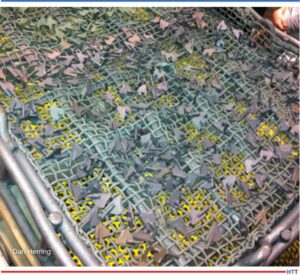
"Severe discoloration of stainless steel parts and fixturing discolored by a water leak."
Source: Dan Herring, "The Heat Treat Doctor"

Doug Glenn:  This is fairly typical. We mentioned it here earlier: I’m getting discolored parts. What am I looking for?

Don Marteeny:  Discolored parts are a common complaint. “Hey, I was fine last week and now, all of a sudden, it’s coming out looking like a rainbow.” It typically depends on the material being treated, but colors such as rainbow are oxidation of some sort. In a short answer — it’s a leak check. Have you done a leak test lately? What is the leak-up rate? Has it changed? That’s the first place to start.

Doug Glenn:  I have also heard: If you’re running a variety of different parts or different items/materials through your furnace, you’ve got to be careful that the previous load may have deposited some sort of material on a cold spot in the furnace. Then, when you heat it back up again, it can react with the current load. Is there validity to that one?

Caleb Johnson:  Yes, if you’re running parts that have coolant or cut-in oil or something, then that’s stuff that off-gases. If you run a high specialty metal that needs pure air, and maybe it’s a higher temperature too, then all of that is off-gassing. Normally if you’re running a special load like that, you should look at running a cleaning cycle beforehand to ensure that there is nothing in an off-gas from the previous load.

Door Seals (28:36)

Doug Glenn:  We talked about replacing the hot zone. How about replacement of door seals?

Caleb Johnson:  If it hasn’t been greased regularly or if it’s old, it will start to crack and split. Just look at the condition of the door seal and the seam, too, because a lot of times they’re glued together at a seam. If that seam starts splitting apart, that can introduce a leak. It’s time to get it replaced.

Doug Glenn:  Basically perform a mechanical inspection, unless you’re getting leak-up. Then if you can isolate that the door seal is the issue, then obviously it’s got to be replaced.

This is probably “Vacuum Furnace 101”: Every time you’re closing it, you should be wiping down the seal and the main, right? Is that a good practice?

Caleb Johnson:  Yes. And you don’t always have to clean it, clean it, but even just wiping it to make sure that the grease didn’t catch a lot of dirt in there and is still lubricating the seal.

Doug Glenn:  Two more: Let’s say you’re getting the strange black spots or black marks on the inside of the furnace, typically around heating elements and/or feedthroughs and things of that sort. What causes that?

Don Marteeny:  Back to that watching the power consumption. Some of the newer furnaces are equipped with gauges that monitor power, current, etc. If you go back and look at the trends and see a lot of current spikes, that’s a surefire indication of arcing. If you open the furnace and see black marks, what’s happening is that that carbon graphite insulation is being destroyed from an electrical arc.

The next thing to ask after that is are the insulators still in place? Have they been contaminated with something that is now preventing them from being a good electrical insulator? The other thing that comes up once in a while is what is the environment like in the furnace? Are you introducing a gas that could be creating a short, a path to ground for the electricity passing through the heating elements? Those are all some things to consider.

Doug Glenn:  If you’ve got black marks in the furnace, more than likely you’re having an arc party in there when the door is closed.

Caleb Johnson:  Yes. Make sure your heating element hardware is tight because they expand with the heat, so they will start to loosen up. You want to do periodic inspections to make sure that all the hardware is still tight.

High Velocity Fans (31:19)

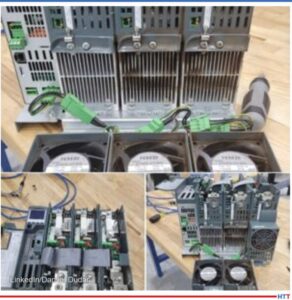
"We're pushing those fan motors pretty hard during quench."
Source: LinkedIn/Daniel Dudar

Doug Glenn:  A lot of vacuum furnaces have high pressure gas quenching. There are some pretty big fans in there. Is there an A-#1 thing we need to be thinking about when we talk about high velocity fans and things of that sort? What are our concerns there?

Don Marteeny:  There are a couple different things to be aware of: Number one, when they’re in operation, most of the equipment has a failsafe to keep it from, say, drawing too much current for too long a time and overheating.

We’re pushing those fan motors pretty hard during quench, so the wear during that period is very high. Over time, of course, things like bearings are going to be a concern because they don’t always run for that long. When they are running, they’re running at 100/110%. We’ve got to keep that in mind.

The next thing to consider is how they’re cooled. It depends on the manufacturer. Some are still a fan-cooled motor inside, so they are still relying on gas cooling. It’s got to be kept clean, so that the cooling rate is correct. In our case, we’re water cooling them. We just have to maintain water flow, so we’re back to that conversation. But those, I think, would be a couple of the key things.

Maybe Caleb can expand on some of the erosion that can happen in the hot zone as a result of high velocity/high pressure quench.

Caleb Johnson:  As it erodes especially, and creates air leaks, then that air forges its path through there and makes it worse and worse. If you start to see erosion to the point where you think air is getting through, you’re going to want to try and remedy that whether by replacing the insulation or even a short-term patch until you get a new hot zone.

Doug Glenn:  You’re talking about erosion and you’re talking about where the high-pressure gas is actually eroding the, let’s say, graphite or whatever, so that now you’re exposing the shell of the furnace.

Caleb Johnson:  The rollup for the hot zone, yes.

Another thing you mentioned is high pressure. We put a lot of pressure in there, and it’s high velocity. If you have small parts, depending on the direction of flow, you want to make sure smaller parts fix nice because if they blow off your fixturing, they can cause damage within the hot zone.

Don Marteeny:  One other point to that, too, is the heat exchanger. We typically don’t think about the heat exchanger, but it’s actually doing a lot of the work in that process. Over time, typically there are rather densely packed fins in those heat exchangers to achieve the amount of heat transfer that’s required for the process, and they can get contaminated, as well. Periodically, it’s not a bad idea — certainly if you’re replacing a hot zone — to clean that heat exchanger.

Doug Glenn:  Clean and/or replace. Excellent.

Guys, thanks so much. I really appreciate your expertise. Thanks very much for being with us and sharing your expert knowledge and field experience.

Caleb Johnson:  Thank you, Doug.

Don Marteeny:  Thank you, Doug.


About the experts: 

Don Marteeny has been vice president of Engineering for SECO/VACUUM for over five years. He is a licensed professional engineer and has been a leader at the company over the last several years filling project management and engineering leadership responsibilities. Don is a member of Heat Treat Today's 40 Under 40 Class of 2021.

Caleb Johnson has worked as a field service engineer for SECO/VACUUM for several years before transitioning to field service manager. He now puts his knowledge of vacuum furnaces to good use by directing and assisting the Field Service Team, as well as by providing technical support to customers.

If you’d like to get in contact with Don or Caleb, go to www.secovacusa.com.


To find other Heat Treat Radio episodes, go to www.heattreattoday.com/radio.


Search heat treat equipment and service providers on Heat Treat Buyers Guide.com


Heat Treat Radio #99: 365° Look at Troubleshooting Vacuum Furnace Maintenance Issues Read More »

Heat Treat Radio #98: Heat Treat NextGen Sasha Tupalo

Sasha Tupalo, the manager of Thermatool Labs at Thermatool Corp., was recognized in 2019 as a 40 Under 40 rising star, and she has more than lived up to this award; she answers the call of leadership through educating others and managing a variety of projects. In this Heat Treat NextGen series (formerly called “Metallurgical Posterchild”), we join Doug Glenn, publisher of Heat Treat Today and host of this podcast, to learn what brought her to metallurgy, her training and leadership initiatives, and more.

Below, you can watch the video, listen to the podcast by clicking on the audio play button, or read an edited transcript.


The following transcript has been edited for your reading enjoyment.

Meet Sasha Tupalo (01:08)

Doug Glenn:  Welcome. I’m looking forward to the conversation.

Contact us with your Reader Feedback!

Sasha Tupalo: Thank you so much for having me, Doug. It’s a great honor and pleasure.

Doug Glenn: Yes, great. And we should start off by mentioning that Sasha was in the 2019 class of Heat Treat Today’s 40 Under 40! Congratulations on that.

Sasha Tupalo: Thank you. That was a huge honor, as well.

Sasha Tupalo
Manager of Thermatool Labs
Thermatool Corp.
Source: LinkedIn

Doug Glenn: I want to get a little bit more about your background; we’re just getting to know you a little bit better because you’re one of the younger, rising leaders in the industry.

Where do you work right now? What’s your title, and what do you do?

Sasha Tupalo: I work at Thermatool Corporation, located in East Haven, Connecticut. We manufacture high frequency welders, heat treating equipment, as well as cutting equipment for the pipe and tube industry.

Doug Glenn: You guys are part of the Inductotherm Group of companies, correct?

Sasha Tupalo: Correct. Inductotherm Group consists of over 40 companies.

We have different divisions for melting and heat treating.

Doug Glenn: For those in the heat treating industry, we might be a little more familiar with companies like Inductoheat Inc., Radyne Corporation, Lepel … there are a number of them.

You are the manager of the lab?

Sasha Tupalo: Yes. My current title is manager of Thermatool Labs. Thermatool Labs is a characterization laboratory here at Thermatool where we do studies from heat treating, weld sample analysis, any R&D projects involving welding of new materials (perhaps with high frequency welding), creating heat treating recipes for our customers for post weld heat treating of seams or full body, annealing and heat treating. I have the most fun here!

Thermatool Corporation located in East Haven, Connecticut.
Source: Thermatool Corp.

Doug Glenn: Yes, good — every day is exciting!

Sasha, I want to go, very briefly, through your upbringing, from where you were born, where you were raised, what your education was. Can you give us the, “I was born in _____” and up through college?

Sasha Tupalo: Absolutely. I was born and raised in Ukraine in the town of Dnipro. It’s kind of centrally located, right on the river. I went to high school there, and went to undergraduate school in my hometown, as well. Then I moved to the U.S. to pursue my master’s degree. Both my undergraduate degree and my master’s degree were in Material Science and Engineering.

Doug Glenn: And your undergraduate degree was from Ukraine, or did you get it here in the States?

Sasha Tupalo: It was from the Ukraine, my bachelor’s degree.

Doug Glenn: What year was it that you came to the U.S. for your master’s?

Sasha Tupalo: It was 2014. I had a gap year, actually. I got my bachelor’s degree in 2013, and then I had a gap year. When I was studying in undergrad school, I’d had an opportunity to come to the U.S. for two summers. There used to be an exchange student program, so I participated in that. After I received my bachelor's degree, I thought it would be really neat to get my education somewhere overseas.

Doug Glenn: So, where did you go for your master’s degree?

"I thought it would be really neat to get my education somewhere overseas."
Source: Worcester Polytechnic Institute

Sasha Tupalo: For my master’s, I went to Worcester Polytech Institute in Worcester, Massachusetts.

Doug Glenn: At WPI with Richard Sisson and that crew.

Sasha Tupalo: He was my professor!

Doug Glenn: Yes, we know Dr. Sisson very well. He’s a nice man.

Sasha Tupalo: We collaborate on things, but he will always be Professor Sisson to me.

Doug Glenn: It’s difficult, once you know someone by their title, to call them by their first name.

Since you’re from Ukraine, it’s incumbent upon me to ask: Are your family and others all okay, that you know of?

Sasha Tupalo: That I know of, yes. My mom’s been fortunate enough to be staying with me for a little while. The rest of my family is still over there. Thankfully, they are okay. I mean, you know, it’s war, but it is difficult.

Doug Glenn: Well, as you know, a lot of people in the United States have our thoughts and prayers with the folks of Ukraine. They’re certainly taking it on the chin.

Sasha Tupalo: I would like to say, from the all the Ukrainian people I know, a lot of people are very, very grateful for your support.

Beginnings in Materials Science (06:10)

Doug Glenn: Thank you; I appreciate that.

Let’s talk about how you got interested in metallurgy. Here you are, a young high school student or so — what intrigued you with materials and metallurgy?

Sasha Tupalo: This is kind of funny, but it’s true: It was pure curiosity. I was graduating high school, and I was 16 at the time. I really had no clue what I wanted to do with my life, so I started going through majors. I had a list of things I knew I wasn’t as interested in — I knew I didn’t want to go into the medical field. My grandma was a doctor, but that’s just not for me. Law, also, was not for me.

My dad is an engineer. I was always good at math and sciences, so I considered engineering. I just didn’t know which kind of engineering. I started looking through lists of majors, and looking through different leaflets, and I found something that was called “materials engineering.” I was like, “Hmm, I’m curious.”

As I’m reading what it’s about, in a leaflet from the undergrad school where I went to, the first sentence was: “Just look around you. Everything that you see is made out of materials and this is what we study.” I thought, “Wow, that’s fascinating!” I started reading more, and I leaned more into metals — that was my choice of materials.

Doug Glenn: Any reason why metals?

Sasha Tupalo: No, not really. It’s just what fascinated me. As I started reading more and getting more into it, I said, “Wow, I want to study this. This is very, very interesting and unique.”

Doug Glenn: It’s an interesting and healthy perspective: you look around and you see, like you said, everything is all materials! So many people today want to go into computer sciences and similar things, stuff that you really have a hard time getting your hands on. But there is a real world out there made up of real things!

You mentioned that your grandmother was a doctor, and your father was an engineer. And your mother?

Sasha Tupalo: She is an English teacher, actually.

Doug Glenn: What did your family think when you said, “You know what? I think I’m going to go this materials/metals route.” Were they supportive, or did they say, “What were you thinking?”

Sasha Tupalo: My dad was very excited. He was, like, “Oh, another engineer in the family, that’s great!” He actually went to the same undergrad school as I did. For him, that was a very proud moment. My mom was supportive, but she was kind of scratching her head. She was, like, “If that’s what you want to do, just do it well. You’ll succeed.”

"At WPI, we actually had a pretty diverse group for our master's degree."
Source: Unsplash.com/thisisengineering

My grandma, she’s older, and she expressed, “I don’t think girls do engineering.” That was kind of the mindset. My grandma is 82 now, so, at the time, she just thought, “That’s an odd choice.” And really, when I went to school, there weren’t a whole lot of girls, especially in materials engineering.

Doug Glenn: It’s still relatively true.

Sasha Tupalo: Yes, it’s still true. At WPI, we actually had a pretty diverse group for our master’s degree; but once you get into metallurgy and the heat treating industry, it’s still predominantly a male industry.

Doug Glenn: The very first interview of this type that we did, in fact, the very first podcast that Heat Treat Today did, was with a female graduate from WPI. Her name was Hayley Sandgren (now Hayley Sandgren-Fox), and she was the very first podcast that we ever did.

Sasha Tupalo: That’s amazing!

Doug Glenn: It is. Years ago we did a survey of the thermal processing market. It was basically 98% male and 2% female. That was quite a few years ago, but I doubt that it’s changed significantly. If it’s 10–15% women, I would be surprised.

Sasha Tupalo: I think the latest research from the census bureau, that I’ve seen — in the workforce and STEM careers, it’s around 27–28% women.

Doug Glenn: Is that right?

Sasha Tupalo: Yes, something like that. And then, they have further distinguished between computer science and engineering; and the engineering numbers are quite low.

Sasha’s Experience in Heat Treating (10:55)

Doug Glenn: When you got to WPI, what did you study, specifically? What was your master’s thesis?

Sasha Tupalo: I had a master’s independent project. It was actually about heat treating: It was the microstructural and grain growth kinetics of 8620. It was a pretty neat project. It was very hands-on, which a lot of people who go to WPI will tell you that we really appreciate the projects the students have. They’re very involved; they’re hands-on. It gives you a better perspective of how to actually take what you’ve learned and bring it to the real world or to your job.

Doug Glenn: So, what is the application? I mean, is there a practical application of what you studied, or is it more theoretical?

Sasha Tupalo: It was pretty applicable just to the heat treating industry — austenitizing, quenching and tempering — grain growth kinetics, hardness variations, microstructural evolution. It’s actually all of the things I do now, so that was really helpful!

Doug Glenn: Workwise, specifically, what are some of the projects with which you’re involved?

Sasha Tupalo: I am very heavily involved on the high frequency induction welding side. That was something new to me, as I was graduating. I did a lot of continuing education in terms of welding, welding metallurgy, and now I’m the expert of high frequency induction welding.

Now, as far as the heat treating side goes, I am now involved in and looking into new 2-step, post-weld heat treating for high frequency induction welds to improve their toughness performance, especially for pipelines. Low temperature pipelines seem to be the trend these days, so we’re trying to help our customers to improve their Charpy properties.

Doug Glenn: Did you enjoy WPI?

Sasha Tupalo: Yes, absolutely. I had a really good experience.

Doug Glenn: What did you enjoy most? Was it the technical part, was it something outside of school, what was it?

Sasha Tupalo: Just the school itself, the campus. There’s a real sense of community at WPI. I had very good classmates and had a lot of, as I mentioned before, hands-on stuff, and practical training and seminars. It was very involved. It was nice to be in that atmosphere — where everybody is striving to do their best and learn something new.

Doug Glenn: After you got out, have you enjoyed the industry?

Sasha Tupalo: Yes. I enjoy industry very much so! There is something about putting your knowledge to actual, practical solutions that I really enjoy.

Doug Glenn: Do you get to go out into the field much? I know that you do R&D, but are you out in the field?

Sasha Tupalo: I do.

Doug Glenn: Tell us about that a little bit.

Sasha Tupalo: When I started at Thermatool, my first title was applications engineer, so I was traveling quite a bit. I would mostly visit our pipe and tube mills of our customers. They don’t differ much from steel mills.

Doug Glenn: You started as application engineer, and you are now lab manager? What was the progression there?

Sasha Tupalo: Applications engineer, materials engineer, senior materials engineer, and now lab manager.

Doug Glenn: You’ve been “climbing the corporate ladder.”

Industry Tips (15:50)

A couple other questions here: You mentioned that you continue to grow in your knowledge. If you were to recommend one helpful tool, for people similar to you in the industry, some sort of metallurgical resource or materials resource — do you have anything that’s a favorite?

Sasha Tupalo: I’d have to go with ASM. They have vast knowledge; they have classes and webinars; they publish books. There is just pretty much anything you might need, and you can find it. I have taken a couple of the classes myself because they were very niche; that’s not something you learn in school. I think if someone was looking for some resource, that’s a great resource.

Doug Glenn: Is there anything you would say, in way of encouragement, to younger people (I don’t know that many young people will be listening to this that aren’t in the industry already) but would there be anything you could say that would encourage people to say, “You know, you really ought to look into this industry”?

Heat Treat Today's 40 Under 40 Award
Source: Heat Treat Today

Sasha Tupalo: Yes. There are a lot of opportunities — and I’m sure you’ve heard it from other people too — we’re having a really hard time finding new workforce, especially younger people. There are lots of opportunities for growth. It’s fun. It’s a really fun industry — for me, it is, at least. If it’s something that interests you, I say go for it!

Rapid Fire Round (17:38)

Doug Glenn: Very good. This has been great, Sasha, we appreciate it. I want to wrap this up with maybe some stuff a little bit more away from business and education; just kind of some fun things to show people that, you know what, materials engineers are people too.

I’m going to give you a couple quick questions and you can give me a one-word answer, or you can give me an embellished answer. This is the “rapid fire round.”

Doug Glenn: Are you a MAC or a PC user?

Sasha Tupalo: I would have to go with PC. I’ve been a PC user since elementary school.

Doug Glenn: When you consume media (any type of media), what do you prefer — print or digital, both?

Sasha Tupalo: I would say both. I really enjoy getting email digests, either weekly or daily or whatever they are, but there is something about reading through an actual magazine, in print, that I prefer much better.

Doug Glenn: Very interesting. That’s great.

Which do you value more — I’m going to give you two options? Flexible work schedule or high pay? If you had to give up one or the other? Would you rather be paid high and have a rigid work schedule, or do you like the flexibility and maybe you’ll take a little pay cut for the flexibility?

Sasha Tupalo: I would probably say flexible schedule. It’s a tough one but . . . . I wonder if you would ask me that maybe 5 years from now if my answer would change. But, as of right now, it would be flexible schedule.

Doug Glenn: I ask that question because I’m a “baby boomer”; I was born in 1961, so I’m one of the old-timers, supposedly. I don’t feel like it, but they tell me I am. The stereotype is that we tend to be out for the higher paying jobs, but that the younger generation tends to be, “You know, money is not that important. I’m more interested in flexibility.” It has been interesting:  Almost everybody, all of the younger people that we interview, most of them do say they’d rather have the flexibility. It’s not that money is not important.

Sasha Tupalo: Right. But if you have to choose one . . .

Doug Glenn: Yes, right, one or the other. It’s kind of an unfair question, but that’s okay; nobody said the questions were going to be fair.

The people at Thermatool, I’m sure, know that you love your job and that you’re not going anywhere. But, if money were no object whatsoever, what would be your dream job? If you didn’t have to worry about money, and you just did something you really enjoyed doing, what would you do?

Sasha Tupalo: I’ve never thought about it because I enjoy what I’m doing.

Doug Glenn: Yes, it could be that this is it!

Sasha Tupalo: Yes, this might be it for me!

Doug Glenn: So, nothing else? You’ve never thought, “You know, if I could just do this, that would be really interesting.”

Sasha Tupalo: No, I really haven’t, to be honest with you. I really enjoy being an engineer, working on solutions and being challenged.

Doug Glenn: Good for you. It’s good to be content.

So, outside of work, what occupies your time? Are you an outdoor person, or what do you do?

"[M]y husband and I are trying to visit all the national parks in the U.S."
Source: Unsplash.com/Jeremy Bishop

Sasha Tupalo: Yes, I am. I really like hiking and camping. In fact, my husband and I are trying to visit all the national parks in the U.S. We’ve got a ways to go, but when we first started, there was 59 or 60 of them and now it’s up to 63. But we’ve got 20 on our list, so far.
Doug Glenn: That you have been to? You’ve been to 20 so far? What’s a highlight? What’s the best one (or two), so far?
Sasha Tupalo: The most recent trip was actually last year — we went to Utah — Zion National Park and Arches National Park. It was absolutely gorgeous.
Doug Glenn: I’ve never been there, but I’ve heard it’s outstanding.
Sasha Tupalo: If you get a chance to go, I would highly recommend it.I like being grounded, being next to nature; that’s how I relax and enjoy the outdoors.
Doug Glenn: What does your husband do? What is his work?
Sasha Tupalo: He is actually also an engineer. He is a chief engineer at a hotel — more of maintenance and building engineering.
Doug Glenn: That makes for interesting dinner conversations, I’m sure. “So, dear, what kind of calculation do we want to do tonight?”Last question, Sasha. It’s been really enjoyable talking with you.

Again, this doesn’t have to be technical, but can you tell us your favorite app, phone app, movie or magazine? Or you can give us one of each, if you’d like.

Sasha Tupalo: Favorite app? I guess I would go with the one that I use pretty much daily:  I use Audible a lot lately.

"I've found that audiobooks work for me . . . ."
Source: Unsplash.com/distingue

Doug Glenn: For audio books?

Sasha Tupalo: Correct, yes. I do so much reading for work, so when I do get a chance sometimes, I’ll do that. A lot of people do podcasts, and I do listen to some podcasts, as well, but I’ve found that audiobooks work for me too. And I can combine it if it’s commute or if I’m working out, I can do both.

Doug Glenn: So, how long is your commute?

Sasha Tupalo: Mine is actually not that long.

Doug Glenn: And what types of books are you listening to?

Sasha Tupalo: You know, same thing. I’m trying to be intriguing. I read a lot for work. I’m trying to go somewhere in a different direction. I’m working my way through the Game of Thrones series. I’m a little late to the party, but you know . . .

Doug Glenn: Very good, Sasha. It’s really been very much a pleasure to meet you and talk with you a bit. Congratulations, again, on the 40 Under 40 award.

Sasha Tupalo: It’s been a pleasure talking to you and thank you so much for having me.

Doug Glenn: You’re welcome.


About the expert: Sasha Tupalo began her career as a materials engineer at Thermatool Corp. in 2016 after finishing her master’s degree in Materials Science and Engineering at Worcester Polytechnic Institute.  She has been very active supporting the Fabricators and Manufacturer’s Association educational programs, as well as ASM Heat Treat events. She provides process troubleshooting support for tube, pipe, and closed roll formed shape producers. She routinely evaluates weld samples and heat treat specimens as part of this process. Sasha delivers training both in-house at Thermatool and at customers’ sites and leads continuing education classes such as “Weldability of Advanced Steels, Stainless Steels and Aluminum” (delivered 2018 at LeTourneau University, Longview, TX), and “Oilfield Metallurgy” (an ASM Continuing Education Class) in 2017. She has written several papers and delivered presentations in her field just since 2016. Sasha is an active member of numerous scientific and technical committees such as ASM, ASTM (A01, E04 and E28), TMS, AIST and WAG (Welding Advisory Group) at AISI.

For more information: contact Sasha through the company website  www.thermatool.com


To find other Heat Treat Radio episodes, go to www.heattreattoday.com/radio.


Search heat treat equipment and service providers on Heat Treat Buyers Guide.com


Heat Treat Radio #98: Heat Treat NextGen Sasha Tupalo Read More »

Heat Treat Radio #97: Lunch & Learn, Ovens vs. Atmosphere Furnaces

Are you trying to figure out what heat treat equipment investments you need to make in-house and what is better being outsourced? This conversation marks the continuation of Lunch & Learn, a Heat Treat Radio podcast series where an expert in the industry breaks down a heat treat fundamental with Doug Glenn, publisher of Heat Treat Today and host of the podcast, and the Heat Treat Today team. This conversation with Dan Herring, The Heat Treat Doctor®, zeros in on heat treat ovens versus atmosphere furnaces.

Below, you can watch the video, listen to the podcast by clicking on the audio play button, or read an edited transcript.



The following transcript has been edited for your reading enjoyment.

Contact us with your Reader Feedback!

Doug Glenn: Welcome everybody. This is another Lunch & Learn event with the staff of Heat Treat Today and the illustrious Dan Herring, The Heat Treat Doctor®. Dan, we’re always very happy to spend some time with you.

We are here to learn a little bit about some basics about heat treat equipment, mostly ovens, air and atmosphere furnaces, and possibly vacuum furnaces.

Dan Herring: It’s always a pleasure, Doug, and hello everybody.

It is an exciting topic for me because I happen to love heat treat equipment. Let’s start with industrial ovens.

All About Ovens (01:42)

Years ago, industrial ovens were very easy to differentiate from furnaces. I’m going to give you my understanding of the differences between ovens and furnaces, and then talk a little bit about some general characteristics of all types of heat-treating equipment.

Ovens are typically designed for low-temperature operation. When I talk about low-temperature operation, years ago the definition was “under 1,000° F.” That definition has changed over the years. We now usually say either under 1250°F or under 1400°F. All of that being said, there are some ovens that run all the way up to 1750°F. But what we’re going to concentrate on are, what I call, “the classic temperature designations for ovens.”

Universal oven from Grieve
Source: Grieve

First of all, ovens are typically rated at 500°F, 750°F, 1000°F, or 1250°F. If you see a heat treat operation that’s running — certainly under 1450°F — but even under 1250°F, it may be being done in either an oven or a furnace.

Let’s talk about some of the distinguishing characteristics of ovens, so everyone gets a feel for it.

Ovens always have a circulating fan. If you see a piece of equipment without a circulating fan, it can’t be an oven. At these low temperatures, the heat transfer — in other words, how you heat a part — is done with hot air or circulating hot air. So, ovens always have fans.

In most cases — and years ago in all cases, but today in most cases — ovens are metal lined. If you were to open the door of an oven and look in, and you see a metal-lined chamber, that would typically be an oven.

The fan and the type of insulation or lining that’s used is very characteristic for distinguishing features of ovens.

Today, however, there are ovens that use fiber insulation and even some ovens that have refractory-insulated firebricks, refractory in them. The lines are a little bit blurred, but typically you can distinguish them by the fact that they have fans and are metal lined.

Ovens come in either “batch” or “continuous” styles. If the workload inside the unit, the piece of equipment, is not moving, we call that a batch style furnace. If the workload is somehow being transferred through the unit, we call that a continuous furnace. Ovens and furnaces can be both batch and continuous.

Ovens and furnaces can both be either electrically heated or gas fired.

One of the distinguishing characteristics of ovens is that if they are gas fired, they are, what we call, “indirectly heated.” This means your burner, your combustion burner, is firing into a closed-ended tube, a radiant tube, as we call it, so that the products of combustion do not “intermix.” They do not create an atmosphere that’s used inside the oven. In fact, the majority of ovens run with an air atmosphere – that’s another distinguishing feature.

However, there are ovens that can run inert gases. Those ovens typically have continuously welded shells. Again, that’s an exception rather than a rule, but there are ovens of that type.

There are also vacuum ovens out there. We actually have an oven chamber on which we can pull a vacuum. They are less common than their cousins, the air ovens, but they are out there in industry.

We have the method of heating and type of movement of the hearth or movement of the load that typically is consistent between ovens and furnaces.

What I’d like to do is just show everybody a couple of pictures of some very typical, what I’m going to call, “batch ovens.”

Doug Glenn: Because ovens are typically low temperature, you’re able to have metal on the inside, right? If it was higher temperature, you’d start experiencing warping. Is that the primary reason why you tend to see metal in an oven and not in a furnace?

Dan Herring: That’s correct, Doug.

"Metal lined oven"
Source: Dan Herring

The lining can be made of steel: it can be made of “aluminized’ steel,” it can be made of zinc-gripped steel (those are just coatings), it can be just steel, and they can be made of stainless steel (a 300 series stainless steel). That’s why you have the different temperature ratings and the different types of materials that this metal interior can be made from.

If you open the door of a metal-lined oven or an oven that had a metal lining, you would typically see what’s pictured here.

"Double door shelf oven"
Source: Dan Herring

Ovens can be very small or they can be very, very large. What you’re seeing on the screen is a “double door shelf” oven.

It is very similar to your ovens at home. You open the door, there are shelves, and you can put trays on the various shelves. These can be small, to the point where, sometimes, they can sit on a benchtop. Sometimes they can be very, very large and be floor-mounted, as this one is.

This is an example of a batch oven, something that you would load, and the load stays stationary within the oven. Then, when you’re ready, you unload it.

Ovens can come in slightly larger sizes.

"A larger horizontal oven . . . . a fan system sitting at back"
Source: Dan Herring

That’s a picture of a larger, horizontal oven. The door on this particular oven is closed shut, but you can see the fan system — that’s that yellow arrangement that’s sitting in back of this particular oven.

There is another style of oven.

"Walk in oven"
Source: Dan Herring

We call this a “walk-in” oven — very creative, because you can walk into it. I’ve seen batch ovens that are very, very small and very, very large — ones that will fit on a benchtop and ones that are a hundred feet long.

You can see the heat source on the right hand side. Remember, whether it’s electrically heated with sheathed elements or if it’s gas-fired with, typically, an atmospheric-type burner, again, you have circulating air past either the electric elements or circulating air past the tube into which the burner is firing. You’re relying on convection — or moving hot air — to transfer that heat energy to your load.

These are just some different styles of different types of ovens, so everyone can see them. I don’t want to take too long, but I’ll show you another picture of one.

"Industrial oven . . . . typical oven in typical heat treat shop"
Source: Dan Herring

This is an industrial oven. You can see the fan; it has a yellow safety cover on it. You can see the fan mounted on top, and this is a typical oven that you’d find at a typical heat treat shop.

Ovens have the characteristics that I pointed out. I’ll bring up one more picture which you might find interesting.

"Monorail conveyor oven . . . . with u-shaped radiant tubes"
Source: Dan Herring

Since there are a variety of oven shapes and sizes, this happens to be a monorail conveyer oven. What you’re looking at is the inside of the oven. You’ll notice that in the ceiling there are hooks. The loads are actually placed on the hooks and sent through or pulled through the oven. This happens to be a gas-fired unit, and you can see that it has U-shaped radiant tubes into which you’re firing.

This oven is fiber-lined and not metallic-lined. You’ll also notice that because you see different colors of the tubes, this particular shot was taken and you destroyed the uniformity of temperature within the oven. Usually, they’re very tight.

Ovens are typically in the ±10°F range for temperature uniformity, sometimes in the ±5°F range.

Those are basically some pictures of ovens, whether they be batch or continuous, for everyone to see and think about, from that standpoint.

Q&A on Ovens (16:58)

Bethany Leone: What is the reason for the increase in temperature range for what classifies an oven?

Dan Herring: The main reason is the materials of construction have gotten better, so we’re able to withstand higher temperatures. But going to some of these temperature ratings, one of the things that heat treaters look at is if I have a process that runs at 1,000°F or 970°F (let’s take an aluminum heat treat example where a process is running at 970°F), I could run that in an oven rated at 1,000°F but I’m right at the upper limit of my temperature.

It's much better to buy an oven rated at 1250°F and then run a process such as 970°F where I have a margin of safety of the construction of the oven, so the oven will last longer.

However, industrial ovens tend to last forever. I’m the only person on this call old enough to have seen some of these ovens retired. It’s not unusual that an oven lasts 40 or 50, or sometimes 60 years.

Ovens are used in the heat treating industry for processes such as tempering, stress relief, for aluminum solution heat treatment, aluminum aging operations, and to do some precipitation hardening operations that run in these temperature ranges. Ovens are also commonly found in plating houses where you’re doing a hydrogen bake-out operation after plating. You also do various curing of epoxies and rubbers and things of this nature in ovens.

There are a variety of applications. Ovens are used also for drying of components. Ovens are used for drying of workloads, these days, prior to putting in your heat treating furnace. Many times, our washers are inefficient when it comes to drying. You take a wet load out of a washer and put it into a low-temperature oven, maybe running between 300°F and 750°F. Consequently, you both dry the washing solution off the parts and you even preheat the load prior to putting it into the furnace.

Heat Treat Today team enjoying a Lunch & Learn session

Doug Glenn: One of the things I’ve always distinguished ovens by is the term “panel construction” opposed to “beam construction.”

If you can imagine a sheet of metal, some insulation, and another sheet of metal – that’s a panel. It’s got enough insulation in it because the temperatures are not excessively high, but you really only need those three layers. You take those panels, you put them in a square or whatever, put a lid on it, put a bottom on it, and you basically have an oven, right?

Where furnaces are not typically constructed that way; they are constructed more where you have a support structure on the outside and then a heavy metal plate and then you build insulation on the inside of that. It doesn’t even need to have metal on the inside — it can be brick or another type of insulation.

Many people claim — and I’m sure there are some very strong ovens — that the oven construction is not as hardy, not as rugged. That’s one other minor distinction, but the main distinction is ovens tend to be lower temperature.

Dan Herring: Yes, that’s very correct, Doug. In panel-type construction, there is typically mineral wool insulation in between the two panel sheets; and it’s rated for obviously very low temperature.

There are, what we call, “light duty” and “heavy duty” ovens. Heavy duty ovens have that plate and support structure — those I-beams or channels — supporting the external structure.

Doug Glenn: You reminded me of something, Dan: We talk about ratings – oven ratings, furnace ratings, and that type of stuff. That’s pretty important and we haven’t really discussed that much. But if a furnace is rated at a certain temperature, you do not want to take that furnace beyond that temperature because there are real safety issues here.

There was one picture that Dan showed where you could see the metal interior, and there was like a gasket, if you will, around the whole opening. That gasket is only rated to go up so high in temperature. If you go over that temperature, you’d end up deteriorating that gasket, if you will. It could cause a fire, it could cause a leak, it could cause all kinds of issues. And that’s only one example.

One other one he mentioned was fans. There is almost always a fan in an oven, and if you take the temperature of that oven over its rated temperature, all of sudden the bearings in that fan start . . . well, who knows what’s going to happen.

You always want to know the rating of your oven and furnace, and don’t push the rating.

Dan Herring: Yes, if you exceed temperature in an oven, typically the fan starts to make a lot of noise and you know you’re in trouble. You only do that once. But those are excellent points, Doug, absolutely.

So, the world of ovens -- although it’s they’re an integral part of heat treating -- are a “beast unto themselves,” as I like to say. Construction is a factor, and other things.

All About Atmosphere Furnaces (24:50)

Furnaces, interestingly enough, can be rated both to very, very low temperatures all the way up to very, very high temperatures. In other words, you can see industrial furnaces running at 250° or 300°F or 500°F or 1000°F, — at typical temperatures that you would associate with oven construction — but you can also see furnaces running at 1700°F, 1800°F, 2400, 2500, 3200°F. There are some very interesting furnaces out there.

But furnaces, although they can run in air — and there are a number of furnaces that do — they typically run some type of either inert or combustible atmosphere inside them. Furnaces typically have an atmosphere, and they do not always have a fan. The rule is the higher you go up in temperature, the more any moving part inside your furnace becomes a maintenance issue. Many times, furnaces do not have fans in them.

They can be electrically heated. They could also be gas-fired. In this particular case, they can either be direct-fired or the burners are actually firing into the chamber; and the products of combustion become your atmosphere. They could be indirect-fired — like we discussed with ovens — into a radiant tube as a source of heat or energy.
Furnaces typically have plate construction. It’s typically continuous welded, they have channels or I-beams surrounding the structure to make it rigid, insulation is put on the inside. Traditionally it’s been insulating firebrick, but in what I’ll call recent years (20 years or so) fiber insulations have come about, and they perform very, very well.

Fiber insulations reduce the overall weight. They have advantages and disadvantages. A refractory-lined unit can have a great thermal mass due to the storage of heat inside the insulation, so when you put a cold load into a brick-lined furnace, the heat from the lining will help heat the load up quickly.

You don’t have quite the same heat storage in a fiber insulation. At the same time, when you go to cool a furnace, a fiber-lined furnace will cool very quickly as opposed to a refractory furnace which cools a lot slower.

Again, furnaces can be batch style, they can be continuous style, they can be fairly small in size. The smallest ones that I’ve seen, typically, are about the size of a loaf of bread. Conversely, you have furnaces that are so large you can drive several vehicles or other things inside of them.

A 14-foot long car bottom furnace
Source: Solar Atmospheres of Western PA

As a result of that, what distinguishes them are typically their temperature rating and the fact that they use an atmosphere. Some of the atmospheres are: air, nitrogen, argon. I’ve seen them run endothermic gas and exothermic gas which are combustible atmospheres, or methanol or nitrogen-methanol which are also combustible atmospheres; they can run steam as an atmosphere. I’ve seen furnaces running sulfur dioxide or carbon monoxide or carbon dioxide as atmospheres. The type of atmosphere that is used in an industrial furnace can be quite varied.

We have several different furnace categories that typically are talked about: Batch style furnaces are configured as box furnaces. They are very similar in shape to the ovens that we looked at. Pit style furnaces are where you have a cylindrical furnace that actually is quite tall and fits down, usually, into a pit that’s dug in the factory floor.

You also have mechanized box furnaces. Those, typically, today, would be called integral quench furnaces or sometimes batch quench furnaces or “IQs.” There are belt style furnaces, gantry, tip-up, and car-bottom furnaces. There is a wide variety of batch style furnaces, all of which have the characteristic that once you put the load into the chamber, it sits there until it’s been processed and until it's time for you to remove it.

The exception is in an integral quench furnace. You push the load typically either directly into the heating chamber or into a quench vestibule and then into a heating chamber; you heat it in one chamber, you transfer it out, and you quench it into another chamber.

Those are some of the distinguishing features of batch style equipment. I’ve got a couple of pictures here that you might find interesting.

"A box furnace . . . . sometimes difficult by sight alone to tell an oven or box furnace"
Source: Dan Herring

Here is a “box furnace.” You might say, “Oh, my gosh, it looks like an oven!” I see a fan on top, and it’s a box style. From the outside, it’s hard to tell whether it’s an oven or a furnace.

When you look at this unit, you might see that it’s made of plate construction. It would be difficult to tell if this unit were a heavy-duty oven or furnace unless you, of course, opened the door and looked inside. You would typically see either fiber insulation or insulating firebrick in these types of units.

Sometimes, just by sight alone, it’s very difficult to tell if it’s an oven or a furnace. But there are other telltale signs.

"A box furnace with retort"
Source: Dan Herring

Now, this is a box furnace with a retort inside it. The workload is placed, in this case, into a metal container that’s physically moved on a dolly into the furnace itself. This is what we call a box furnace with a retort.

The process takes place inside the retort. You’ll notice that there’s a flow-meter panel there, of different gases, that are introduced directly into the retort. This style of furnace is very interesting because the furnace itself, outside the retort, is simply heated in air. It’s a relatively inexpensive construction. Also, when the time comes that the process is finished, usually you can remove the retort and introduce or put a second retort into the furnace while the first retort is cooling outside the furnace. It lends to increased production, from that standpoint.

But this is typically a box furnace; it looks like a big box. The shell does not have to be continuously welded because the process takes place inside the retort. You might be able to see, just past the dolly, there is a dark color and that is the blackish retort that’s actually being put in.

Doug Glenn: I think the reasoning of the retort is to protect the airtight atmosphere, right?

Dan Herring: That’s correct, Doug. The idea is the fact that it’s an effective use of your atmosphere.

The other thing you can do with a box furnace with a retort is you can pull a vacuum on the retort. As a result of this, you can actually have a “hot wall” vacuum furnace. That is what is defined as a hot wall vacuum.

The next type of atmosphere furnace we’re going to look at is pretty distinct or pretty unique: This is a pit style furnace.

"A pit style furnace . . . . there is probably 4X as much furnace below the floor"
Source: Dan Herring

What you’re seeing here is only that portion of the furnace that is above the floor. There is probably four times as much furnace below the floor as there is above. OSHA has certain requirements: there must be 42 inches above the floor not to have a railing or a security system around the pit furnace, because you don’t want to accidentally trip and fall into a furnace at 1800°F. We don’t want to say, “Doug was a great guy, but the last time I saw him . . .”

In this particular case, there is a fan which is mounted in the cover of this pit style furnace. Most pit furnaces are cylindrical in design; however, I have seen them rectangular in design. Some of them have a retort inside them; unlike the picture of the box furnace with the retort, the retort is typically not removable, in this case. Of course, there are exceptions. There are nitriding furnaces that have removable retorts.

I think this is a very distinctive design. If you walked into a heat treat shop, you’d say, “You know, that’s either a box furnace or an oven.” Or, if you looked at this style of furnace, you can clearly see it’s a pit furnace, or what we call a pit furnace.

Two other examples, one of which is just to give you an idea of what we call an “integral quench furnace.” I think this is a good example of one:

"An integral quench furnace, an in-out furnace"
Source: Dan Herring

They’re made by a number of manufacturers. The integral quench furnace is probably one of the more common furnaces you’re able to see. It has, in this case, an oil quench tank in front and a heating chamber behind.

This would be an “in-out” furnace; the workload goes in the front door and comes out the front door. But once the workload is loaded into an area over the quench tank (which we call the vestibule), an inner door will open. The load will transfer into the heating chamber in back. That inner door will close, the workload will be heated and either brought up to austenitizing temperature, carburized or carbonitrided, the inner door will then open, the load will be transferred onto an elevator and either lowered down into a quench tank (typically oil) or, if the unit is equipped with a top cool, the load is brought up into the top cool chamber to slowly cool.

These styles of furnaces do processes like hardening, carburizing, carbonitriding, annealing, and normalizing. You typically don’t do stress relief in them, but I’m sure people have. These furnaces have a wide variety of uses and are quite popular. Again, the style is very distinctive.

They typically run a combustible atmosphere, and you can see some of that atmosphere burning out at the front door area.

There are also, what we call, continuous furnaces or continuous atmosphere furnaces. They are furnaces where you have a workload and somehow the workload is moving through the furnace. A good example of that is a mesh belt conveyor furnace.

There are also what we call incline conveyor, or humpback-style furnaces. The mesh belts are sometimes replaced, if the loads are very heavy, with a cast belt: a cast link belt furnace. The furnaces can sometimes look like a donut, or cylindrical, where the hearth rotates around. We put the workload in, it rotates around, and either comes out the same door or comes out a second door.

A lot of times, rotary hearth furnaces have a press quench associated with them. You’re heating a part, or reheating a part in some cases, getting it up to temperature, removing it, and putting it into a press that comes down and tries to quench it by holding it so that you reduce the distortion.

There are other styles of furnaces typical of the “faster” industry which are rotary drums. Those furnaces you would load parts into, and you have an incline drum (typically, they’re inclined) with flights inside it. The parts tumble from flight to flight as they go through the furnace, and then usually dump at the end of the furnace into a quench tank.

For very heavy loads, there are what we call walking beam furnaces where you put a workload into the furnace. A beam lifts it, moves it forward, and drops it back down. Walking beam furnaces can handle tremendous weights; 10,000 to 100,000 lbs in a walking beam is not unusual. Any of the other furnaces we’re looking at wouldn’t have nearly that type of capacity.

There are some other fun furnaces: shaker furnaces. How would you like to work in a plant where the furnace floor is continuously vibrating, usually with a pneumatic cylinder so it makes a tremendous rattle, all 8 or 10 hours of your shift? That and a bottle of Excedrin will help you in the evening.

As a last example, the monorail type furnaces where we saw that you hang parts on hooks. The hooks go through the furnace and heat the parts.

I’ll show you just a couple of examples of those. These are not designed to cover all the styles of furnaces but this one you might find interesting.        

"A humpback style furnace"
Source: Dan Herring

This is a typical continuous furnace. This would be a humpback style furnace where the parts actually go up an incline to a horizontal chamber and then go down the other side and come out the other end. These furnaces typically use atmospheres like hydrogen, which is lighter than air and takes advantage of the fact that hydrogen will stay up inside the chamber and not migrate (or at least not a lot of it) to floor level.

Atmosphere Furnaces Q&A (47:30)

Evelyn Thompson: Are the inclined sections of the furnace heated? Why do the parts need to go up an incline? Just to get to the heated part of the furnace?

Dan Herring: If you’re using an atmosphere such as hydrogen, it’s much lighter than air. If you had a horizontal furnace just at, let’s say, 42 inches in height running through horizontally, the hydrogen inside the furnace would tend to wind up being at the top of the chamber or the top of the furnace, whereas the parts are running beneath it! So, the benefit of hydrogen is lost because the parts are down here, and the hydrogen tends to be up here.

By using an incline conveyor, once you go up the incline, the hydrogen covers the entire chamber and therefore the parts are exposed to the atmosphere.

I did a study a few years ago: About 5–6% of the types of mesh belt furnaces in industry are actually this incline conveyor type.

Another good example is the fact that people like to run stainless steel cookware. I’ve seen pots, pans, sinks, etc. Sometimes you need a door opening of 20 or 24 inches high to allow a sink body to pass into it. Well, if that were a conventional, horizontal furnace, you’re limited to, perhaps, 9 to maybe, at most, 12 inches of height.

Typically you never want to go that high, if you can help it. 4–6 inches would be typical. So, there would be a tremendous safety hazard, among other things, to try to run a door opening that’s 24 inches high. But in an incline furnace, the height of the door can be 20, 24, 36 inches high. The chamber is at an 11° angle, and you must get up to the heat zone, but they run very safely at that.

Karen Gantzer: Could you explain what a retort is?

Dan Herring: Think of a retort — there are two types — but think of one as a sealed can, a can with a lid you can open, put parts in and then put the lid back on. The retort we saw in that box style furnace is that type. It is a sealed container. We typically call that a retort.

Now, in that pit furnace we saw, there could be a retort inside that one and they could be sealed containers, but typically they’re just open sides, that are made of alloy. Sometimes we call those “retorts” as opposed to “muffles” or “shrouds,” in another case. Muffles don’t have to be a sealed container, but they typically are. That’s the way to think of them.

Karen Gantzer: Thank you, Dan, I appreciate that.

Bethany Leone: Dan, thank you for joining us. It was really a valuable time.

Dan Herring: Well thank you, my pleasure.


For more information:

www.heat-treat-doctor

dherring@heat-treat-doctor.com


To find other Heat Treat Radio episodes, go to www.heattreattoday.com/radio.


Search heat treat equipment and service providers on Heat Treat Buyers Guide.com


Heat Treat Radio #97: Lunch & Learn, Ovens vs. Atmosphere Furnaces Read More »

Heat Treat Radio #96: Making the Leap to Laser Heat Treat with Nic Willis

If you are considering making the leap to laser heat treat, buckle up. Nic Willis, metallurgist/heat treat supervisor of Emerson Professional Tools — RIDGID® TOOLS, and recipient of Heat Treat Today's 40 Under 40 recognition in 2020, shares how he led the company to look at laser hardening for some of their induction heat treated projects. It’s a fascinating story that includes the decision-making process, the transition itself, and the continued implementation of this technology.

Below, you can watch the video, listen to the podcast by clicking on the audio play button, or read an edited transcript.


The following transcript has been edited for your reading enjoyment.

Doug Glenn: We’ve interviewed you before, and it’s good to have you back. You are one of our 40 Under 40 Class of 2020 winners. Give a brief history about yourself.

Class of 2020, 40 Under 40
Source: Heat Treat Today

Contact us with your Reader Feedback!

Nic Willis: I’ve been in the heat treat world for about 5 years now. I’m the metallurgist and heat treat supervisor at RIDGID® TOOLS in Elyria, Ohio. We have a captive heat treating department where we specialize in neutral hardening, carburizing, carbonitriding, salt tempering. We do some induction hardening, vacuum hardening, and flame hardening, as well. There are a lot of heat treating applications at RIDGID, and it’s pretty exciting.

The Project: Bringing Induction Hardening In-House (02:56)

Doug Glenn: RIDGID is a manufacturer with in-house heat treat. You do some outsourcing, but for the most part, you do your own heat treating.

Let’s talk a bit about your recent decision to change from one type of heat treating over to another type of heat treating.

Induction hardening
Source: Advanced Heat Treat Corp.

Nic Willis: This particular project started when I was tasked with finding a way to bring an outsourced process in-house to our facility. That process was the induction hardening of a particular product line. I began by reaching out to different machine builders of induction hardening equipment.

One thing I noticed when I started to get some quotes was how much the tooling cost was going to be and what percentage of the project that was going to account for. Being somewhat new to induction hardening at the time, I was really taken aback.

We had also seen some quality issues with cracking of these components. I just happened to listen to an episode of Heat Treat Radio that had to do with laser hardening. After I got done listening to the podcast, I reached out to Laser Hard, Inc. We started a conversation about learning more about laser hardening and if it was a fit for this particular product line.

Doug Glenn: So, you heard the podcast episode Heat Treat Radio #11: Laser Heat Treating with Laser Hard and decided to check it out.

Heat Treat Radio #11

Did you consider any other possibilities besides bringing an induction process in or laser?

Nic Willis: It was pretty much between those two technologies. These components, like a lot of parts that are going to make use of either of these two technologies, have one area we want to keep ductile and then another (contact) area we want to have wear resistance. These particular components will get furnace-hardened first, and then they go out for the selective hardening process.

Induction vs. Laser Heat Treating (06:48)

Doug Glenn: What did the rest of the process look like? How long did it take, who was involved, what were some of the key questions that needed to be answered before a final decision could be made?

Nic Willis: For this particular application, it just so happened that the specifications that we required were a good fit for the laser process, namely case depth. One of the limitations of laser hardening versus induction is you’re not able to get as deep of a case with laser as you can with induction. For these components, that wasn’t really a factor. So, there was some initial vetting that went on.

After that, we sent some sample parts to Laser Hard that they would have processed. It took some testing on that end to get their parameters set up, and they cut up a lot of parts to check the case depth. Once we got that dialed in, the parts would’ve come back here to RIDGID where we did some life testing. We have a test apparatus that we use that basically cycles these parts to failure. From there, it turned out that these met or exceeded the life of the induction hardened components. At that point, we would have updated the drawings and approved laser hardening as a substitute process.

The Cost (08:34)

"[The project] needs to be somewhat, or at least, cost neutral."
Source: Unsplash.com/Alexander Mills
Doug Glenn: Do you have any sense or was there any calculation done of what you anticipated the cost savings would be?
Nic Willis: I can’t get into any specifics; but in order to get any type of substitution like this off the ground, it needs to be somewhat, or at least, cost neutral.
Doug Glenn: How about the maintenance of the equipment — laser versus induction?
Nic Willis: Like I mentioned before, the maintenance of the coils themselves is something that you don’t have to account for with laser. Any type of specialized tooling for laser is going to be on the work-holding end of the spectrum which can be adapted after the fact to improve cycle times and things like that.

Laser does not make use of a quenchant. The parts self-quench, meaning that the core material doesn’t get heated up and is cool enough to quench out the heated area. Anybody that’s familiar with induction knows that the quenching process can be kind of messy and needs to be contained.

The Winner: Laser Heat Treating (10:30)

Doug Glenn: Those are all good additional cost savings items. Laser won the day on this one. Have there been other parts that you’ve looked at potentially going to laser but decided to not do it?

Nic Willis: Yes. In Elyria, the parts that we make are our pressing tools to make our pipe wrenches and threading machines. With the threading machines, there is a lot of gearing. We’ve looked at some of our gears that we flame hardened, and they’re a lot bigger. It’s just not a good fit with laser. You would have to go tooth by tooth, which is going to really increase your cycle time. In those parts, you run into that issue with case step requirement.

Doug Glenn: Can you tell us what laser hardening is?

Nic Willis: It’s a form of selective hardening where you want some of the part to have a hard case for wear resistance. The rest of the part keeps its ductility. In this case, you’re using a laser — rather than an induction field or a flame — to heat up this specific area that you want to harden.

Doug Glenn: You mentioned “part holding.” I don’t want you to give away more than you can and want to respect all the propriety measures. Is this something where you’re spinning a part and laser, so you’re just actually lasering a specific area?

Nic Willis: Correct.

Doug Glenn: I know with flame hardening they’re actually spinning the part as it goes — or they can spin the part. Is laser something you can do that with?

Nic Willis: Yes, absolutely. But then you’re starting to talk about additional costs to build a specialized machine to do the hardening process. For me, I wanted something “off the shelf,” for lack of a better term. I didn’t want a super specialized piece of equipment.

Doug Glenn: In the decision-making process itself, did you and the team require to see laser hardening be done other places or did you work basically just with Laser Hard and make sure they could prove the process? How much of a pioneer were you willing to be? Were you willing to be one of the first people to ever do laser heat treating?

"[W]e sent some sample parts to Laser Hard that they would have processed."
Source: Laser Hard
Nic Willis: There is a company that is pretty close to Laser Hard, and some of their products are laser hardened (it’s not the same but it’s a similar application). I was aware of them. Laser hardening has been around for a long time. I think what’s made it more attractive nowadays is that the laser equipment itself has become more affordable. It’s not a new process, by any means. I would assume that it’s been around since lasers have been around.

Success with Laser Heat Treating for RIDGID® (16:40)

Doug Glenn: You’ve been through the decision-making process, and you’ve got it up and running. I assume you’re happy with what’s going on now. You’ve got it down now, and it’s a relatively smooth process?

Nic Willis: Absolutely. We’re looking at bringing the process in-house in the next few years. I’d like to say that it’s a dream of mine to see it done here on site in Elyria.

Doug Glenn: Looking back on the whole process of moving from wanting to bring it in-house, to deciding to go with laser — is there anything you would’ve done differently now, knowing what you know?

Nic Willis: That’s a good question. I think one thing that I really learned through the process was anytime you’re switching from a tried-and-true process to something new, whatever your reasons may be, it takes some time to get people on board. [blocktext align="left"]I think one thing that I really learned through the process was anytime you’re switching from a tried-and-true process to something new, whatever your reasons may be, it takes some time to get people on board.[/blocktext]

Like I mentioned earlier, we were setting the parameters with the laser, doing the metallurgical testing, doing the life testing — it wasn’t a bang, bang, bang type thing. More and more people were brought into the discussion. The commercial side has to be addressed, as well. There are always some question marks when you’re moving from one supplier to another, and that took some time.

I don’t know if I’d do anything different, but I’d tell myself to be a little more patient, given the opportunity.

Doug Glenn: That’s probably the great lesson, honestly. It does take patience and a little perseverance because you’ve got to prove the process. You’ve got to prove it, not only metallurgically, like you said, but you’ve got to prove it commercially.

Nic Willis: From the conceptual stage to when we actually were putting parts into the field, it was probably about two years.

Doug Glenn: When you first started, how long did you think it was going to take?

Nic Willis: I thought it would be relatively quick!

Doug Glenn: Right. A 6-month process turns into 2 years, easily, huh?

Nic Willis: Exactly.

Doug Glenn: Are there any other thoughts regarding the whole process of that transition or laser heat treating or anything that you’d like to share?

Nic Willis: A challenge that I’ve run into is you see success with one product line, and you want to see how far you can take it and expand it to these other product lines. We talked about how sometimes it’s not a good fit. I mentioned that with some of the gears and larger cylindrical-type components. I think induction definitely still has its place.

I’m working on some projects to bring some of our induction parts in-house. In these cases, based on case depth, part geometry, and things like that, induction, in some cases, is a better fit than laser. Although in this particular case, it made sense to switch from induction to laser, it’s not always a one-for-one type switch.

Doug Glenn: That’s excellent advice; you’ve got to take each part in its turn and figure out which is the best process for it.


About the expert:

Nicolas Willis is metallurgist/heat treat supervisor at Emerson Professional Tools — RIDGID® TOOLS. Nic is the metallurgical authority for all Emerson Professional Tool operations worldwide. He has been leading the modernization of the heat treatment department throughout the company, upgrading capital equipment and developing new processes to improve safety, increase throughput, and improve quality of RIDGID and Greenlee brand products. He was elected to the position of secretary of the Cleveland ASM chapter in 2020 and has served on the Research Committee of the Heat Treat Society.

Contact:

Email: Nicolas.Willis@Emerson.com


To find other Heat Treat Radio episodes, go to www.heattreattoday.com/radio.


Search heat treat equipment and service providers on Heat Treat Buyers Guide.com


Heat Treat Radio #96: Making the Leap to Laser Heat Treat with Nic Willis Read More »

Heat Treat Radio #95: Heat Treat Legend John Becker

We have the honor to speak with another Heat Treat Legend in our industry, John L. Becker, president and founder of Heat Treat Equipment. Doug Glenn, publisher of Heat Treat Today and host of this podcast, has been chatting with the legends walking among us who’ve been involved with the North American heat treat to get a sense of where they’ve been, what they’re doing, and what advice they would share with the current generation. “Tenacious” is the word that comes to mind from this conversation.

Below, you can watch the video, listen to the podcast by clicking on the audio play button, or read an edited transcript.


The following transcript has been edited for your reading enjoyment.

A Summer at Ford Motor Company (01:20)

Doug Glenn: John, you were the founder and owner of the J.L. Becker Company which was recently purchased by Gasbarre Furnace Group. You’re no longer associated with that company, since you sold it. You are associated with Heat Treat Equipment, Inc., which you also started.

Contact us with your Reader Feedback!

How did you get started in the heat treat industry?

John Becker: It goes back to the summer of 1964 when I had been going to a junior college, and I started dating my wife. Her father was in the steel division at Ford Motor Company, and I needed a summer job in 1964. Through his contacts, I was able to get a job there. My position was very "prestigious." I had my own tool; it was called a broom! Through sweeping up, I was a first-class janitor. Then, I was able to move up to a helper’s position.
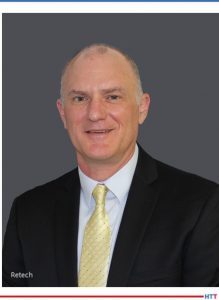
In working there for the summer, I saw a lot about the making of steel and the production processes. I used to hang around the lab, because in the summer, the lab was air conditioned; and I could pretend that I was interested in that area. By the end of the summer, they asked if I would consider going on co-op for metallurgy. I thought, “Well, that sounds easy. I can do that,” not realizing what I was in for.

"I received a BES in 1968"
Source: Western Michigan University

I started in metallurgy, and worked for Ford and went to Western Michigan University where I received a BES (Bachelor of Engineering Science) in 1968. During that time of co-op, I worked and took classes. I used to take classes at Wayne State, Lawrence Tech, and other places where I could get some hours or get a class.

After I graduated, they put me in an area called the AADGO (Automotive Assembly Division General Office) where I was a fastener engineer. We were dealing with nuts, bolts, screws, and washers. I started visiting heat treat shops. At the same time, they put me on the MBA management program through the University of Michigan.

There were a lot of people in Rockford, IL, that made fasteners. One of the areas we were concerned with was heat treating. That thing called the Delta or appendix C, the Q101 (Quality 101 points) for Ford.  I would go around inspecting plants, and I got to know several people in heat treating. I was a bit fascinated by it.

In 1970, Ford laid me off. I was still finishing up school, and I had a child. I actually started teaching school part time and did that for a while. I was a “the permanent substitute,” so I would work a lot of different days. That was quite enjoyable!

I started working for a company that sold high temperature materials: conveyer belts, etc. and was pretty successful. I looked at what I was getting paid. At this company, some reps were getting 10%. I was getting a salary and expenses, and I understood that it was a pretty good deal. But I still looked at reps and figured I made 10% of that value.


Starting a Business in a Basement (06:18)

I decided to really go on my own, and I started the J.L. Becker Company out of my house as a rep. I had four principals, and a few others in the industry. I didn’t represent these, but I could sell their products. Two examples were the wire mesh conveyer belt of Canada and I Squared R, which provides silicon carbide heating elements. We had a line of hearth plates, thermocouples. I became the Lockheed engineering rep. Because of that, I called on a lot of OEMs like Surface Combustion and Atmosphere Furnace and others.

"My dad gave me an old phone."
Source: Unsplash.com/Nguyen Dang Hoang Nhu

We built it up. Everybody in Michigan had a basement. My dad had given me a used desk and, in those days, you had a phone that was wired to the wall. My dad had given me an old phone, so I started a company. In the basement of the house, I had a little cubby, about 4 ft by 7 ft, and that was my world headquarters.

After 6 months, I started to interview for a new job with salary and benefits, and all the things I didn’t have, because it wasn’t as great as I thought.

I had been calling on Monroe Auto Equipment in Monroe, Michigan. Monroe Auto Equipment has four plants that do powdered metallurgy; they make components for shock absorbers. I had become friends with a guy there, Fleming Pruitt. I still remember his name to this day.

He called me and asked for a particular product. I got a price for it, called him back, and he said, “I made a mistake. I didn’t want 20 pieces, I wanted 200.” I was going to make 10 bucks a piece or some number like that. All of a sudden, I was, like, “Whoa!” That started it.

Then I got another order, another order, and another order. Over time, I started thinking: “Why don’t I have some of my own products where I can control the price?” I could buy it for X and add my overhead to it.

Growing the Business (09:13)

In 1974, I moved to an office in Livonia, Michigan. It was in a multitenant-type building, and the fellow had rented two spots, and there was one empty office. I started there. I ended up hiring a gal by the name of Carol Campbell, right about then, for $90 a week and no benefits. She did an outstanding job for me.  Around 1976, I hired Dave Peterson. Dave still, as you know, works with me today. I couldn’t chase him away. I tried and failed.

"I added another piece of the puzzle."
Source: Unsplash.com/Nathalie Segato

From there, I added another piece of the puzzle. Each year we expanded. I got busy enough where I visited someone who I was selling different components to, and they had a piece of equipment they wanted to get rid of. I had visited someone else the day before who was looking for the same thing. I didn’t have to be that bright to understand that this guy wanted a dollar, and this guy was willing to pay two dollars. That worked out pretty well, and I did that a few times. But then the next time I did it, the person said, “You need to take it out.” So, I was able to; there was a group of guys and my office, at that time, was right behind Holcroft in Livonia. I got to know a lot of guys that worked there, and they would come and work for me on weekends. We would dismantle, move things, and ship them out.

Eventually, I got a little shop. I hired a fellow, whose name is Charlie Hatala, who now has Great Lakes Industrial Furnace. Charlie ran the shop, and then we started refurbishing equipment.

Then, in 1978 or 1979, BorgWarner Corporation in Michigan asked me if I could build a tempering furnace. I was doing maintenance for them installing components. I did a lot of brazing and sintering furnaces and some batch furnaces. They needed to do temper. I said yes, having never done it before.

Eventually, we figured it out.

I hired an engineer who worked for us part time for a while, and the shop became a busier situation. We started to build some equipment.

I hired an engineer, a fellow by the name of Don LaFore, who has now passed away. Don came in and helped shepherd us along to do design work. We started to build some belt-type furnaces for sintering and brazing. There were other people in the industry who had small operations to do refractory work or do electrical. We leaned on those individuals and started to build.

By 1980, I had two guys in engineering, Dave in sales, Carol in the office, and my wife, Eileen, was our CFO, as she still is today. It just went from there!

By 1983, we moved to another larger building.

In 1989 we moved again, and then in 2000, we moved to an even larger facility.

So, we had gone from about $700k–$800k to about $25 million in my last couple of years. In fact, we have equipment we built in the Ukraine for which my son, Matt, did the startup. We just looked at it in satellite, and it’s still standing and hasn’t blown up yet. That particular system, we duplicated twice for Russia.

Becker Goes International (14:16)

We built equipment in Israel, Dubai, Saudi Arabia, Thailand, and China. Korea was the first place, out of the country, where I sold a piece of equipment. That was right at the beginning, probably in the later part of the 1970’s, maybe very early 1980’s.

"We built equipment in Israel, Dubai, Saudi Arabia, Thailand, and China."
Source: Unsplash.com/Lucas George Wendt

At Ford Motor Company, there was a research scientist; he was a Korean doctor. He  had gone back to Korea to head a thing called KIMM (Korea Institute of Machinery and Materials) and he called me and ordered a furnace. We built the furnace, a research-type sintering furnace and endo generator, and I actually went to Korea and did the startup. That was one of the first international ones. We’ve shipped equipment to Canada, to Mexico, and to quite a few different places.

At 68 years old, in 2011, I sold the company to Gasbarre.

 Becker’s Network in the Heat Treating Industry (16:02)

Doug Glenn: Give us a recap of some of the people with whom you’ve interacted.

John Becker: There was a startup company in around 1970/71 called Custom Electric Furnace, where Tim Mousseau worked as an engineer. Charlie Hatala was basically the president and shop manager. They had all come from a company called Alexander Engineering which goes way, way back.

I started repping them, and I sold a few furnaces for them.

Another guy that was repping around there was Jeff Smith; he worked for the which represented a company out of New York that made heat exchangers. Jeff came up with the idea of making his own heat exchangers, and that’s when they started SBS Corp.

During that same time period, I became friends with John Young. John’s father had Perfection Heat Treating Company, and his father, unexpectedly, died just before Christmas around 1976, I believe. John and I became friends. His wife’s name was Eileen, and my wife’s name was Eileen. We both had degrees in metallurgy; our backgrounds were very parallel to one another.

John and I ended up buying the heat treating company called Steel Improvement Company, and John ran that company successfully for about 10 years. Also, John and I got in on a few other companies too.

1984 and 1985 hurt the heat treat industry in Detroit, so we ended up liquidating both those companies.

Just like Jeff Smith, people from, refractory people, we interfaced with so many people here. In the metropolitan Detroit area, you have everything you can think of: Electrical supplies, wire, refractory, engineering help, machining, fabricating, steel suppliers. Everything is right at our fingertips. You have a real cornucopia of support-type people from lawyers to accountants to medical to whatever. It was a good place to nurture a company.

Like I said, we built the company up, and I was really motivated to sell.

In 2009, my oldest boy died. That hurt me personally, obviously. Then, in 2010, my younger son, Matt, who’s kind of a Mensa kid, announced he was going to leave to open a brewery. He has been extremely successful.

Then, Gasbarre approached me. My thoughts of passing the business on to my sons were trash, so I sold the company. After I sold it I consulted with them for a couple years; it was all part of the contract. I realized I really didn’t want to get out of it; I had pulled the trigger a little too quickly.

I’m 79, and I still work almost every day. I love the business, and I’ve come to know so many people in the business that I interface with. I’ve had some very, very strong supporters over the years for the equipment that we’ve built.

One guy that was probably the nicest guy — you couldn’t have asked for a better friend — was Jim Hendershot who had Carolina Commercial Heat Treat. Jim sold it to Gibraltar and on and on. Now, most of their plants are part of Bodycote.

John’s Supporters (22:32)

Doug Glenn: Are there two or three people who had a significant impact, people that encouraged you to carry on?

John Becker: You know, I really can’t point to anybody individually. Obviously, my wife was a supporter. She was burdened with the accounting side of the business.

"It was more people believing in me..."
Source: Unsplash.com/Brett Jordan

I had a lot of different people. There was a buyer at Ford who was very supportive. Another guy at AC Spark Plug up in Flint; I did a lot of work for them and built several pieces of equipment. So, it was more people believing in me and believing that I could do the job and giving me the opportunity to do it.

My best friend just passed away a week ago (he was a Ford dealer). He would listen to me all the time and give me advice. He had built up a company where he was the number one Ford dealer for 1921 and 1922 in volume, worldwide, in the small little town of Livonia. It was very prestigious. He was a very well-liked individual. He gave me a lot of advice about not trying to micromanage, about giving up control and giving control to other people, hiring people and trusting them to let them do their job, and how to treat individuals. I think I learned a lot from that.

John’s Significant Accomplishments (25:20)

Doug Glenn: What are one or two your significant accomplishments?

John Becker: Dave Peterson worked with a company (and I won’t mention their name), and I joined him. This company had bought a used piece of equipment and did some converting on it to do a process. They had built one, and then we built their next one and “upgraded” it to the next phase.

We worked on the design and built and built and built it to where they had about 50 of these units. I think, between myself and Gasbarre, there may be 55 of them built. If you look at it, it’s roughly a million dollars apiece; they were very successful. They were using my son, Matt, who developed the software and automated all the controls to mass flow sensors, etc. This was early on before a lot of things that we have today. If you look back, this was all new technology at the time.

That was a “feather in our cap,” and that was a whole team. The engineering department did the engineering, the shop and the people in fabricating all had ideas and those were incorporated into it, and Matt redeveloped the software and the controls and developed all the programming. Before they had a lot of mechanical and timing issues where a bell would ring and an operator would have to do something, this was all automated. It took the operator out of what was a 30, 40, 50-hour process.

It’s very successful. That shows how the whole group pulled together and did it.

"I'm tenacious like a bulldog..."
Source: Unsplash.com/MattODell

My success has been talking. Sales. I’ve been able to connect with people. I’m tenacious like a bulldog on an ankle; it’s hard to get me off. My middle initial is “L” and I tell everybody it’s for “Lucky.” I’ve been very fortunate to have a very loyal group of individuals. Like, we’re here now at Heat Treat Equipment. Bill Richardson started me in 1980 and was chief engineer and is with me now. Dave Peterson was my sales manager since 1976/77 and is with me now. The people in our shop, I did not solicit them. They came to me. When I had J.L. Becker, they were the ones that made the clock work.

I would go out, do the sales, contribute to them, and try to close the deal. I had more people — we had four or five gals, plus the CPA, plus my wife in the office, for insurance, employee benefits, payroll, paying the bills, etc. That worked very well, but that wasn’t my department. I looked at it macro work, but the micro work was done by all of them. They were very organized. The same was true for the shop and in engineering.

I really have to say they’re the ones that made the business keep moving. I would come in and say, “I’ve sold another standard piece of equipment except everything is different.”

Lessons Learned (30:43)

Doug Glenn: Over your work career, were there any disciplines that you developed? Were there any disciplines you developed you felt were beneficial for you and for your company?

John Becker: I can’t think of anything specifically. They always say, “Never quit. Never take ‘no’ for an answer.” So, I never quit. I used to tease some of the other guys because they would call on a customer for years, literally 4–10 years, and nothing would happen. Then, there was that lucky change in personnel. All of sudden, everything started to happen. We became “their guys.”

I was tenacious, and I listened. I do a lot of talking, but people don’t realize I do listen. Understanding, in sales, what does your customer want, what’s the expectation? I’m not going to pick on any other company, but some, more or less, “fell from the catalog.”

I always thought we were willing to change to try to modify or make our equipment fit our customer’s needs, not our customer needs fitting our equipment. We always went in and would change things. As I said, “Another standard piece except everything is different!”

I know when I sold the company, Gasbarre enjoyed quite a bit of repeat business from our customer base. I think our customer base was loyal; the loyalty came back from being loyal to them. We, like everyone else, had problems. My point was: We need to fix the problem, not fix blame. We didn’t worry about the cost. When it was done and resolved, then we could go back and look at it to find out if the problem arose from something we did, was it improper usage, etc.?

We never walked away from a problem and trust me, I had them over the years.

Doug Glenn: Did you ever lose any big money on them?

John Becker: Yes. More than once, and we lived to tell about it! The problem was sometimes I was quick on the draw. A guy that draws fast can shoot his foot off. The gun goes off a little too quick. Every time I would try to jam a square peg into a round hole — like I said, I was tenacious. I would fight and fight and fight for an order and get it and get creamed.

Work-Life Balance (34:55)

Doug Glenn: How did you handle work-life balance?

John Becker: It was never a struggle. I worked 6 days a week; when the kids were growing up, I coached baseball. I had a soccer team I coached in Northville for both my boys. We loved Florida because my grandparents were down there. My mother’s parents were down there, and my parents moved there. I had a brother and sister that lived there, etc.

We started going down to Florida very early in our lives in the 1970’s. We took vacations with the boys. There are plays and things they did at school; we did all that. We had a pretty good life.

Over the years, I’ve developed a lack of memory. When I walk out the door of work, my memory just falls off somewhere. I’m driving home and when I get home, I can’ remember things. Even though Eileen was involved in the business, I didn’t go home and talk about the business. I left it at work.

[blockquote author="" style="1"]One thing I’ve learned is that the work you didn’t do today will be there tomorrow. The work will be there.[/blockquote]One thing I’ve learned is that the work you didn’t do today will be there tomorrow. The work will be there. Early on, I did a few things. I missed a funeral for a friend that I still look back at, 30 years later, and say, “I could’ve cancelled or rescheduled those appointments, and I could’ve gone there.” I still think I should have gone to the funeral, and I didn’t and I’m sorry, today. The appointments that I went to never turned out to be anything.

I’ve always carried that around, that I should have been there for that person even though they had passed. You make decisions, and I think you’ve got to remember that a lot of these things will be there tomorrow that you don’t get to today.

Advice to Young Leaders in the Industry (37:48)

Doug Glenn: Were there one or two lessons you learned along the way, words of wisdom you would give?

John Becker: Send your resumes out somewhere else? Find a different career! I don’t mean that; the industry has been good to me.

I think that one of the things for younger people, especially in sales, is this: I would go work on a sale and I would think, “Boy, I’ve got this thing,” and find out I lost to a competitor, not realizing the purchasing guy’s brother-in-law was my competitor. So, understanding the politics of situations, the relationships. I’ve had people that I’ve been very, very close to and they would go out for bids, but I knew I was getting the work. Get to understand the relationship, who they’ve worked with in the past.

The other thing I think is important is technical society. I belong to ASM (ASM International, formerly known as the American Society for Metals). I used to belong to MPIF (Metal Powder Industries Foundation), the APMI (American Powder Metallurgy Institute).

I was one of the original associate members of  MTI (Metal Treating Institute), but actually I was an MTI member back in the 70’s because we (John Young and I) owned the heat treat shop. John was the member, and I was the alternate. They were very, very down on a salesperson, like me, coming to those types of meetings. I did go to a couple. In fact, the very first or second meeting that Lance ever had, I met a guy who was from out in Oklahoma, by the name of John Hubbard. That was back in, probably, 1980, roughly, ’81 maybe; it was in that time.

Doug Glenn: So, for those who are listening that might not know, Lance Miller was the executive director of the Metal Treating Institute (not anymore, Tom Morrison is currently in that position). John Hubbard ended up being the CEO of Bodycote for years and years.

John Becker: I think in establishing relationships, try to be as honest as you can with your customers. There is a certain point that, I think, to maybe be a little guarded in your answers. Be as honest as you can without giving away your company secrets or whatever. Say you’ve had something in the background in your company that’s gone on and it’s affecting something. You don’t need to broadcast that, but you should maybe tell your customers you’ve had some issues that are going to delay or change things. That’s the best thing.

Just be yourself; don’t try to be somebody else. And you know what, if you don’t come home laughing and having a good time and enjoying yourself, you’re in the wrong business.


About the expert:

John Becker, president at Heat Treat Equipment: Founder and president of Heat Treat Equipment (est. 2011), has a long and distinguished career in the heat treat industry as the founder and long-time president of J. L. Becker Company, a manufacturer of new furnaces and heat treat equipment.

Contact:

Website: www.heattreatequip.com

Email: john@heattreatequip.com


To find other Heat Treat Radio episodes, go to www.heattreattoday.com/radio.


Search heat treat equipment and service providers on Heat Treat Buyers Guide.com


Heat Treat Radio #95: Heat Treat Legend John Becker Read More »

Heat Treat Radio #94: A North American Alliance — 3 Managing Directors Speak

In a special Heat Treat Radio episode, three managing directors based in SECO/WARWICK Group’s North American companies speak with Doug Glenn, host of this podcast and Heat Treat Today founder and publisher, about the working synergy amongst heat treat and metallurgical market efforts. Watch, listen, and learn about how Earl Good, managing director at Retech; Marcus Lord, managing director at SECO/WARWICK; and Peter Zawistowski, managing director at SECO/VACUUM, lead the North American market with their heat treat solutions.

Below, you can watch the video, listen to the podcast by clicking on the audio play button, or read an edited transcript.


The following transcript has been edited for your reading enjoyment.

Meet the Managing Directors (01:20)

I want to start with Peter Zawistowski, managing director at SECO/VACUUM Technologies, one of the newer companies of the SECO/WARWICK GROUP.  Then, we have Marcus Lord, managing director at SECO/WARWICK Corporation. Both of those  companies are currently located in Meadville, western Pennsylvania. We also have Earl Good, managing director at Retech Systems, LLC, located in the Buffalo, NY, area.

Contact us with your Reader Feedback!

Earl Good
Managing Director at Retech Systems, LLC
Source: Retech

Earl Good: I’ve been with Retech 6 years in April. Time has flown by fast. There have been, certainly, some interesting developments with Retech over the years. We relocated the business from Ukiah, California to Buffalo, New York. We originally had an office on Main Street in Williamsville in 2018. We found a new facility here that allows us to do manufacturing and assembly as well as have office space. We have about 40,000 feet for manufacturing and assembly, 10,000 square feet of office space. We are actually looking for additional space because of the growth and development we’ve experienced over the last few years.

When I came into Retech, there were some issues and some challenges that the company was facing. We’ve overcome those, and we’ve certainly moved in a good direction.

Prior to Retech, I was with Metso Minerals. I worked with Metso Minerals for about 13 years. I was moved through various positions there. My last position, for the last 7 years, was the vice president of ETO  (“engineer to order” group). I was responsible for four different divisions on a global basis and increased that business from about 150 million euros to about 250 million euros a year. It became the second most profitable division within Metso.

This opportunity came along, and it was a different challenge. That’s what piqued my interest here.

Marcus Lord
Managing Director at SECO/WARWICK Corporation
Source: SECO/WARWICK

Marcus Lord: I’ve been with SECO for 9 months now. I came on board at the end of June (2022), basically looking at reestablishing the SECO/WARWICK manufacturing footprint in Meadville. That’s a “work in process” right now, rebuilding the team. We have a considerable amount of folks that are looking at retirement and trying to pass on some of that legacy knowledge to new people to spur additional business growth.

Prior to SECO, I worked for Carpenter Technology Corporation for 3 years, metal manufacturing for specialty alloys. Prior to that, I did two greenfields, one for Oerlikon Metco and one for Wyman-Gordon PCC. Both of those were powder atomization materials, so a lot of “end use” more so than manufacturing of the equipment, which gives me a good understanding of what people want from equipment.

Peter Zawistowski
Managing Director at SECO/VACUUM Technologies
Source: SECO/VACUUM

Peter Zawistowski: I’m in Meadville, PA. It’s hard to say how long I have been with SECO/WARWICK. I’ve been there 20 years, officially, but to be honest, it’s been since as long as I can remember that I’ve been around vacuum furnaces. I was basically born inside a SECO/VACUUM furnace, so that’s how long I’ve been with the company.

I’ve gone through several different positions: service engineer, engineering, sales, and currently, managing SECO/VACUUM here in the U.S. We are responsible for our vacuum furnaces for North America.

Doug Glenn: For those who don’t know: the global headquarters for the SECO Group is in Poland. Peter actually comes from there. You agreed to relocate your family, and you’ve been in the States now for how long?

Peter Zawistowski: For quite some time; I think it’s 10 ½ years or 11.

Doug Glenn: Peter is the link back to Poland which we will talk briefly about.

Markets and Products (07:00)

Can you give a snapshot of the markets you serve and the products you supply?

Peter Zawistowski: 50% of our products are single chamber furnaces, standard from toolbar up to 25 bars of gas quench furnaces multigraphite.

The next would be vacuum oil quench furnaces in which we’ve developed a new design, I believe, 15 or 20 years ago. This is where, I think, we are leading the market. I believe the competition is 5 to 10 years behind us in this product.

We have a lot of new developments or new products like pit LPC, like 4D Quench, which is like a single piece quench. We are always looking for some custom projects. We like those; we are not afraid of those and we can do them.

Doug Glenn: In a nutshell, SECO/VACUUM Technologies is dealing primarily with vacuum heat treat furnaces and all things around that including any type of specials, customs, etc. That’s where your strengths are. Marcus, how about SECO/WARWICK Corp.?

Marcus Lord: SECO/WARWICK Corporation has a pretty big portfolio of equipment. Right now, I know a major view is on CAB lines. We’re seeing a lot of inquiries on the continuous or controlled aluminum brazing process as well as aluminum processing equipment for annealing large coils of aluminum or sheet and foil-type aluminum. Then, back to some of the roots as atmospheric-type furnaces, so roller hearths, mesh belt and things of those sort. Those are, basically, customized to the customer’s preference, so we have a huge catalog. Lately, we’ve sold some actual aluminum melting-type furnaces, so large tilt melting furnaces.

Doug Glenn: Earl, let’s go to you.

Earl Good: We supply vacuum melting equipment — melting of metals and alloys that have a high melting temperature. Our typical industry markets are aerospace, medical, defense, and energy storage. Our primary furnace types are the electron beam furnace, a PAM (plasma arc melting) furnace, and a VIM  (vacuum induction melting in a bar). We also have powder atomization technology and our melt spinner technology.

R&D in melting is growing for us, because we have a couple different furnaces we can operate. We have a lot of customers who don’t have the need for an excessive amount of material. They don’t want to purchase a furnace, so they come to us asking us to melt a certain amount over the course of a month or a year.

We have a broad base of technologies that we can offer the market, which is good, because some of the aerospace work can be cyclical in nature; but the other furnaces and other options that we have make up for that.

We work with mostly titanium, nickel, and various alloys associated with aluminum and nickel.

Technological Niches (11:25)

Doug Glenn: Is there a specific technology that you feel is really your company’s strong suit? Something you really feel comfortable doing?

Earl Good: I’m going to highlight two different technologies: I think our PAM technology, or plasma melting technology, is the best on the market. We have more installations than anybody out there. All of our furnaces have, basically, satisfied their performance requirements.

PAM Furnace
Source: Retech Systems, LLC

Another area I’d like to highlight is our powder technology. We’ve been a little bit behind some of our competitors in the market, but we’ve really developed some good things that are going to provide opportunities for us in the market. We have a number of customers coming to us to look at those opportunities now. I think those are probably the two most unique and best that we have to offer.

Peter Zawistowski: Our single chamber vacuum furnaces are one of the best in the world, currently. We also have some new products. We are trying to get to the market our 4D Quench furnace. It is a special system to vacuum carburize and then single piece quench. This is the unit we are implementing in the U.S. We are getting good references, and we are getting great results.

4D Quench Furnace
Source: SECO/VACUUM

We are also focused on LPC, in general. All of our furnaces are equipped with LPC which, I think, the industry is moving to vacuum carburizing. That’s the big focus right now with SECO/VACUUM.

Doug Glenn: People are saying in many areas in heat treat, we ought to be focusing much more on quench than heating. Anybody can heat the thing up. The real key is, can you quench it? Especially when you’re talking about surface hardening and things of that sort.

Peter Zawistowski: Exactly. And in 4D Quench, this is where we can control the distortion to the level close to gas quenching; that’s the key to success.

Marcus Lord: I would say that our CAB (controlled atmosphere brazing) lines are probably the best in the world. We have a lot of competitors that we’re seeing pop up out of Asia, but I believe that we still hold the market share for that type of equipment. Like many of our other pieces of equipment, we are able to customize based upon what the customer really is needing to achieve.

I would say that with the big push to reduce carbon footprint of these manufacturers, SECO still has the technology for their bayonet electric heating processes. We’re not held up by somebody else supplying us with that type of product; we can build that in-house and supply a very efficient furnace when it comes to electric heating.

New Technologies (15:20)

Doug Glenn: Does SECO/WARWICK have anything to offer in the aluminum market?

Marcus Lord: In Poland, we are starting to offer the vortex 1 and 2.0, which is being developed. Those are options we are going to introduce along with predictive maintenance programs that have been developed out of Poland.

Doug Glenn: I want next ask about new technologies, things that either are currently commercialized, or soon to be, that you feel good about. Peter, why don’t we start with you? What do you think as far as vacuum technologies?

Peter Zawistowski: We have quite a few new technologies, but I think I will tell you more about LPC. As I said, all of our products are equipped with vacuum carburizing. I think that this is where the industry is going right now with the current trend of limiting the carbon footprint and sustainability. I know that in the U.S., it’s maybe not that common right now, but you are aware that most or all of the big European companies will have to report carbon footprint starting in 2024.

If any of the U.S. companies would like to do business with Europe, like with German automotive industrial airbuses of the world, you’ll have to do the same. To do that, you have to limit your carbon footprint.

"To do that [facilitate business in Europe], you have to limit your carbon footprint."
Source: Unsplash.com/Matthias Heyde
In carburizing, you must switch technology. Right now, the most common carburizing technology or equipment is Integral Quench (IQ) furnaces, and you must do something with it. There is a need. It will happen that there will be a switch to low pressure carburizing; this is where we can help.Earl Good: A lot of our furnaces are customized. Through the R&D trials and toll melting we do, we are able to develop new technologies. There are two areas that I want to highlight.We put some time and effort into developing a small-scale atomizer that is more like a lab-type atomizer. Ours is a little bit more robust than our competitors’ units, and it has more capabilities. For example, you can melt different materials on it. We’re very eager to get that out into the market and make our first sale.

The second is our plasma gas atomizer. We do receive a lot of interest in this product right now. It’s different from what’s out there. Much of the market today, as far as powder and atomization, is batch process; the yields are not great. We believe that the plasma gas atomizer will increase yields. It allows ongoing melting which is going to provide a lot of options to customers who have the need for a more robust process, as far as their powder production.

We’re really excited about both of those and getting those out.

Doug Glenn: Is development of those products driven by the AM market 3D printing?

Earl Good: Yes, but you have universities and others who want to do things on a smaller scale, on the trial basis so as to not invest a significant amount of money. They want to see that the technology is going to work or see the products they’re developing. There is a real need for that, and I think there’s a need for something more robust than what’s on the market.

Marcus Lord: We have new technologies on aluminum processing.

The Vortex 2.0 is a new technology. I believe three Vortex 2.0 systems have been sold and are not yet fully commissioned. This will give us an upper hand on how we go about heating our materials on an efficiency standpoint, especially when we’re looking at the carbon footprint and how we are going about processing our materials.

Other than that, we have some technologies based on a customer preference, technologies that may not be a staple or standard on all our equipment.

Collaboration (22:53)

"Is it helpful that you’ve got the three separate companies working together?"
Source: Unsplash.com/krakenimages

Doug Glenn: There are very few thermal processing technology companies that have the breadth of capabilities from everything from atomizing, arc melting, heat treating, vacuum heat treating, and air atmosphere heat treating. How do you cooperate to synergize these technologies? Do you find it beneficial, and/or is it helpful that you’ve got the three separate companies working together?

Earl Good: In my opinion, we haven’t worked great during my previous years here. We do get along. I think we have the opportunity to work together much more as we move forward. We started to do that in some different areas. We’re looking for a facility, right now, to spread our U.S. footprint for manufacturing and assembly. I think it will be a shared work facility.

Each of us brings a different set of skills and talents to the industry. We have the opportunity to leverage some of those to the benefit of the whole. Products are in demand that are made in the U.S., and I think we’re going to be in a good position to service that market. I think all of us are in positions where we’ve seen our businesses start to grow and improve, so I think it gives us a great opportunity to work together.

Marcus Lord: I think it is beneficial to have collaboration amongst all three of us and our different businesses. We’re able to support one another, especially from a technology aspect. If there are questions, you have an outreach program, and we are open to work with each other. Like Earl said, we’re all looking to expand. SECO Corp is looking at making an expansion and still retain the offices in Meadville, but we’re also looking for another location to be able to give us a little bit more bandwidth.

For my group, we’re looking at a lot of operations happening in Mexico. That’s something that we really need to look at from a support aspect. Being three businesses relatively close to one another, it is overall beneficial for all of us.

Peter Zawistowski: It’s not only beneficial for us, but I it is beneficial for our customers. For example: Earl is offering a furnace, and my equipment is like auxiliary equipment to his, so we can offer a full package to the customer. We have expertise across the three companies that we can support and provide all that is needed to customers. I think that is a big benefit.

Manufacturing in the United States: Present and Future (26:50)

Doug Glenn: How has manufacturing in the U.S. been in the past and what are the future plans?

Earl Good: I can throw a couple comments out. Our past manufacturing in the U.S. was done out in Ukiah, for Retech specifically. Ukiah is a great place for wineries and vineyards, but maybe not an industrial furnace manufacturer!

Originally, there was a desire for us to leave all manufacturing and assembly in the United States, by the past CEO, and then we found this facility here in Buffalo. The new CEO, Sławomir Woźniak, said, “Hey, could you guys do some manufacturing and assembly here?”

I said, “Yes!” I think my chin hit the floor, and I was drooling because I thought it was exactly what we needed.

We have the 40,000 square foot facility here that we’ve already filled. We have a customer base that wants more manufacturing and assembly. Having additional manufacturing and assembly, with what we have within Retech — in Poland, in some of the areas, China, and India — gives us a way to support all of our customers’ needs. Some customers are looking for low price options, some want things built here in the U.S. As we become maybe less globalized and more centralized as far as focus, I think we’re going to be able to support all of those different needs for our customers and do it well.

Peter Zawistowski: We are looking to start manufacturing and assembling vacuum furnaces here in the U.S. As Earl said, we had our facility in Ukiah; we had our facility in Meadville. We had two or three companies in the U.S., and we were doing it in different places. Now, we would like to consolidate and leverage the fact that we have three companies here in the U.S.

"It’s not only about manufacturing. We are also thinking about bringing some R&D activities here to the U.S."
Source: Unsplash.com/Getty Image

It’s not only about manufacturing. We are also thinking about bringing some R&D activities here to the U.S. Currently, I think that more often we sell technology, not furnaces. We would like to be able to provide that service to our customers, as well, here in the U.S.

Marcus Lord: Manufacturing was part of the deal of me coming on to SECO. It was really to reestablish what was being done.

Whether or not it makes sense to do full-blown manufacturing (because that’s a huge capital expense upfront) is one thing, and then, of course, training people to be able to do the processes. It makes more sense for us to actually do subassemblies or manufacturing of maybe a smaller part of what we’re looking at, as far as the equipment, and being very specialized on what we do manufacture. That will leave the larger projects either internally or external. As you said, we can’t be really good at everything we do, so we’ll pick and choose what we’re really good at and just exploit it from that point and then grow.

Doug Glenn: There have been major supply chain disruptions over the last couple of years. Can you address supply chain issues for each of your businesses? Are you seeing any difficulties? How much is re-shoring driven by supply chain issues?

Marcus Lord: Part of the directive is to try to be able to control our supply chain and also have better control of when we’re able to deliver equipment — that’s key for most of the customers. They want lead time even more than price. Where we’re seeing the impact for our pieces of equipment is definitively PLC systems. Outside of that, we don’t see much of a disruption. Maybe with some high nickel product that we use in our bayonet heaters; outside of that, it’s restricted to those two items.

Peter Zawistowski: I think we can see the supply chain getting better. But it’s not only the supply chain, it’s also transport cost and time. Right now, we would like to ship the equipment from overseas; but it’s twice as much money and twice as much time. That’s another problem we would like to address.

Earl Good: I think the supply chain varies. What’s kind of unusual in the market right now is you have a project where part of the supply chain works well and the other part not so well. Then, with the next project, it’s the exact opposite. The feedback I get from a lot of suppliers and even some of our customers is that they still have a difficult time finding people, and when you don’t have the people it’s hard to deliver.

Generally, things are improving and hopefully they continue to go in that direction. In the electronic PLC control-type technology, that’s where we see the biggest delays, as Marcus has indicated. That’s an area that is not showing signs of getting better right now. I think, as some of these chip manufacturing facilities come online, you’ll see a big improvement there.

Doug Glenn: How would you categorize upper management in Poland and their vision and their support of what’s going on in North America?

Peter Zawistowski: Expansion in North America is one of the primary goals on the group level right now. All of us are getting a lot of support from the group management. [blocktext align="left"]Expansion in North America is one of the primary goals on the group level right now.[/blocktext]This is the philosophy of the company. We have companies in India; we have companies in China and in the U.S. That’s why we have companies in the local market because they understand the market the best. Our company, in my opinion, is very important.

Doug Glenn: Do you characterize the presence in Europe as being supporting but not micromanaging? They’re giving you freedom and giving some goals to hit and saying, “Go at it, team.”

Peter Zawistowski: There is a direction we all follow but, yes, we have a lot of freedom, ultimately, in the U.S.

Earl Good: I think the support has been great. I think we are given a lot of flexibility as far as how we go about our business and operating it. I think there is definitely a desire to see us grow in the U.S., and I think they’ll give us the tools, the technology, and the ability to do so.

Doug Glenn: Some people, in North America, will say that it’s going to be very difficult for SECO/WARWICK (any one of these three companies, not just SECO/WARWICK Corporation, but SECO/VACUUM or Retech), to survive in the North American market because they have a global headquarters in Europe. What do you say to people that would say that?

Marcus Lord: I would definitely tell them that’s untrue. This is actually the second company I’ve worked for that has most of their operations in Europe. Both of the companies have been very, very successful at going out and putting their footprint on the industry and the marketplace and actually providing equipment, depending on the technologies, that is far superior than what our competitors have.

As far as being able to go into North America: There are directives, there are things you have to follow, but that’s with all corporations. At that point, they might want others to believe we won’t be successful because we’re European-driven, but that’s very untrue.

As Peter has said, we have a lot of autonomy to run the business, we have objectives, we have KPIs that we have to hit. The major idealism is to be profitable and have quality product. With those, it’s easy to drive a business to be successful; it doesn’t matter where it’s managed from.

Peter Zawistowski: My competitor in vacuum heat treating has headquarters in Germany, and nobody seems to care. I think it’s normal. We have a big presence here in the U.S., and that’s all the better.

Earl Good: I think I would add that our competitors try to push that our headquarters are in Poland and maybe our products aren’t as good. I’m a firm believer that if you deliver a good product on time, if the product starts up well, and if you take care of your customer, it doesn’t matter where your headquarters are. Customers are going to find you. They’re going to enjoy the experience and come back to you. We’re seeing a lot of our customers come back to us for additional equipment. I think that our competitors can push that all they want. The reality of it is, if you deliver on your customer’s needs, you’re going to have success.

The Future of SECO/WARWICK in North America (37:53)

Doug Glenn: What are you optimistic about regarding the future of your specific company?

Earl Good: That’s a broad-based question, but we had a very good year in 2022. I think we’re headed to a very good year in 2023, and our focus is on continuing to grow, continuing to develop products that the market needs and wants. I think we have some good things that we’re working on in R&D, so I’m very optimistic about our future and about our direction. We’re on the right path and doing a lot of the right things.

Heat Treat Radio
Source: Heat Treat Today

Marcus Lord: With SECO/WARWICK Corp., we closed the year out with a very large sale. That is continuing into 2023 where we have a growing backlog which is good. It shows we’re continuing to service the industry and also providing quality equipment. I don’t foresee that diminishing at all; I just see it growing. As we support one another, that’s the best way to continue our paths.

Peter Zawistowski: We will continue to grow. I see a big opportunity for us in the U.S. SECO/VACUUM is a fairly young company; it’s 5½ years old. I think we will get more market share by having satisfied customers.

Doug Glenn: What is most exciting about what you’re doing in the market right now?

Marcus Lord: I guess I’m a workaholic, so that really helps. I’m actually on vacation right now and here I am working. I’ve been doing emails and that’s just part of the business, right? For me, it’s putting the bridges back in place that should have always been there, that deteriorated just through the history of SECO Corp. along with SWSA, and really growing the label. All I’ve heard is negativity and what that negativity does to me is it actually drives me to make the business better. It’s more personal than it is a corporate thing because I like proving people wrong. That’s what drives me.

Earl Good: I think the energy comes from the fact that we’ve made tremendous progress over the last 5+ years. We’ve seen Retech change our image in the market; there were definitely issues and problems. The fact that we see customers coming back to us with repeat orders indicates that we are delivering to our customers, meeting their needs, and satisfying them.

I always say if you go above and beyond the customer’s expectations, everything else takes care of itself. That’s where I’d like to leave it. I think we’ve made great progress and I see good things in our future.

Peter Zawistowski: Personally, I like the fact that every day is different and every customer is different. One day I will talk to a heat treater because he needs a furnace to heat treat nuts and bolts. The next day we have to develop a new power train for a helicopter, or we have to set up a reactor for new fusion energy. I don’t think there is any other industry or anything else than heat treating that you can actually touch a number of different industries. That’s what I personally like and what drives me every day.


About the experts:

Earl Good, president and managing director at Retech Systems: He graduated from Penn State University, where obtained a Bachelor of Science Degree in Electrical Engineering. Eight years later, he received a Master of Business Administration Degree from Lebanon Valley College. Earl has spent a majority of his working career with three different companies, General Electric Environmental Services, Marsulex Environmental Technologies, and Metso Minerals. He has held roles of increasing responsibility throughout his career, including various management positions. Earl Good was appointed to the position of Member of the Management Board of SECO/WARWICK S.A. starting on January 2, 2019. Currently Vice President, Business Segment Vacuum Melting & Managing Director at Retech Systems LLC.

Marcus G. Lord, president and managing director at SECO/WARWICK USA: He earned his Business Administration BBA Executive Management degree at Cleary University. He has worldwide executive leadership experience in innovative manufacturing processes, operational excellence, sustainability initiatives in the supply chain, and operations management. Marcus has served in a multitude of roles, including Manager of new tooling and dies repair( at National Set Screw (PCC)), Director of operations( at Wyman-Gordon and Oerlikon – Metco), Executive Manager BMO (at Carpenter Technologies), General Manager – Manufacturing (at Carpenter Technologies). Currently President and Managing Director at SECO/WARWICK Corp.

Peter Zawistowski, Managing Director a SECO/VACUUM, USA: He graduated from Technical University of Czestochowa where he earned a Master’s Degree in Material Engineering. He also graduated from Executive Program in General Management (EPGM) from the Sloan School of Management at MIT (Massachusetts Institute of Technology) completing extensive training in a variety of business management courses. His work experience at SECO/WARWICK began in 2005 as melt team service manager. In 2009, he assumed director duties of the vacuum carburizing furnace group. In 2013, became Global Product Manager of the vacuum carburizing and vacuum oil quenching group and in 2014 ascended to the General Manager position for product management and sales at SECO/WARWICK Corp. in Meadville, Pennsylvania. Currently, he is Managing Director of SECO/VACUUM, North America’s newest vacuum furnace company.


To find other Heat Treat Radio episodes, go to www.heattreattoday.com/radio.


Search heat treat equipment and service providers on Heat Treat Buyers Guide.com


Heat Treat Radio #94: A North American Alliance — 3 Managing Directors Speak Read More »

Heat Treat Radio #93: Why Ion Nitride? An Exploration with Gary Sharp

Today’s Heat Treat Radio episode illuminates how Gary Sharp, founder and CEO of Advanced Heat Treat Corp, began the company. Heat Treat Radio host and Heat Treat Today publisher, Doug Glenn, will hear from Gary about the technical highlights and capabilities of ion nitriding, including: common applications, real-world benefits, and true limitations.

Below, you can watch the video, listen to the podcast by clicking on the audio play button, or read an edited transcript.


The following transcript has been edited for your reading enjoyment.

Contact us with your Reader Feedback

Advanced Heat Treat Corp.’s Beginnings with Ion Nitriding (01:20)

Doug Glenn: We’re going to be talking about nitriding, specifically, ion nitriding. Gary Sharp has a long history with the technical aspects of ion nitriding.

Tell us a little bit about yourself and Advanced Heat Treat.

Gary Sharp:  I started with John Deere in the Chemistry department. I have a degree in Science Chemistry. Then I went into various other areas: production support and different management positions before I ended up ultimately leaving to start Advanced Heat Treat.

The way I became oriented and introduced to ion nitriding was a company who we had done work with wanted to sell John Deere some new technology. They came in for some meetings, and we had several meetings with top management. But in 1979/80, that was one of the first real downturns in the ag market. So, Deere wasn’t really interested in taking on a new technology at that time. While I was still interested, I talked to various management people. Ultimately, I got permission to invest and investigate, on my own, the ion nitriding process.

Doug Glenn: Even while you were still at Deere?

Doug Glenn (l) and Gary Sharp (r)
Source: Heat Treat Today

Gary Sharp:  While I was still at Deere, but I had to do it on my own. All of my vacations, my holidays, and things were spent doing market surveys, talking to various potential users and so forth, in the marketplace, to see if it had a “fit.” Because, obviously, when an equipment supplier comes in, everything is nice and rosy and so forth and the equipment works for everything. That’s not always the case, of course.

After discussion with the management, they gave us permission to continue our investigation. From 1979 to 1981, we did a lot of research. I took vacations and went and did market surveys with different potential customers and found out that ion nitriding still seemed to have a lot of the glitz and the shine from the company that came in to talk to us.

We went ahead and, after a period of time and evaluation, put together an investor base. We put together a building, equipment was purchased, and then we began to do ion nitriding. We started with a 25 KW lab unit and a 160 kW unit that we would transfer from development into production-sized lots.

Doug Glenn:  You say “we,” so this was not Deere though — these were the people outside of Deere — yourself and some others, right?

Gary Sharp:  Yes, myself and several others, at the time. Unfortunately, some things happened and partnerships are not always the easiest. That dissolved, and it was pretty much me and my wife and our employee base. That was the start anyway.

The trouble is, early on, the small lab unit worked fine, and we could do out development; but it didn’t transfer over to the larger production unit. We kept having power supply issues. This went on for months and months and months. Ultimately, I had to get legal involved. That churned around for over a year, probably. Here we’re trying to have a startup business and, at the same time, we’re fighting with everything else. The building came together, the lab we put in worked well, but we just had issues.

We weren’t aware of how many pieces of equipment had been sold in the marketplace by this company until we got into legal, and then we started having more serious discussions. They replaced the power supplies with a new source and solved the arc suppression problems and some of the things that were taking place. Basically, we would get into the range of an unstable arc discharge; and instead of heat treating we were melting the parts. Unfortunately, we couldn’t keep many customers doing that! That got resolved, we got additional equipment in the settlement, and then we took off.

Doug Glenn:  When did you actually start the company?

Gary Sharp:  1981/82 timeframe.

From the market surveys, we knew there was considerable interest. Obviously, we went back to some of those folks and started doing some development work with them, particularly on applications where ion nitriding was a significant advantage over some other treatments. Where I was in Iowa, they were doing gas nitriding on cylinder liners. Again, with the market going south for a while, they weren’t interested in any new technologies; and they just continued to do the gas nitriding.

Doug Glenn:  So, you ran through a little bit of legal issues. When would you say was the first time you felt you were up and running?

Gary Sharp:  I think last week, maybe! It took a while.

In our investigation, we found out they had sold quite a few pieces of equipment; and they’d all been mothballed and put on the shelf. In a way, it was a bad deal, but it was good for us because we had the solutions to fix them.

I went around and purchased equipment, 10 cents on the dollar, and bought additional capacity. We would get up to around 70–80% capacity on one vessel, and then I’d go buy another. I’d get that up and established in our plant. It worked out quite well for us, being dumb and stupid, I guess.

Gary Sharp:  It kind of evolved over time. We’ve got 50+ units now — ion nitriding as well as gas nitriding. The nitriding field has been our baby for many, many years. We’ve done a lot of development with other suppliers to make sure the applications they run are using the right process.

What Is Nitriding? (09:03)

Doug Glenn:  Let’s talk a little bit about nitriding. Then I want to hone in a little bit more into ion nitriding. What is nitriding? How is it different from ion nitriding? What are we doing, and why do we do it?

Gary Sharp:  Nitriding is a case hardening process. It is used on a variety of components to improve wear, abrasion resistance, fatigue strength, etc. It’s generally a lower temperature process (than, say, carburizing or anything like that), so you don’t have the resultant distortion and post machining requirements that you do with some of the existing treatments that are out there.

Nitriding is a case hardening process. It is used on a variety of components to improve wear, abrasion resistance, fatigue strength, etc.

As you mentioned, there is ion nitriding, there is gas nitriding, there is salt bath nitriding. All three do similar things, they just have different requirements. Obviously, there are materials and chemistry that are involved with each of those materials, but you can nitride almost anything, at least putting a compound zone or an outer layer on that’s very abrasion resistant. Where the process gets developed is when you have alloy (Chromalloy, malatium, aluminum); these are nitride formers which, combined with the nitrogen at and below the surface, give you a diffusion zone that has longevity and a very high hardness.

Doug Glenn:  In the simplest terms, nitriding is in one sense hardening the surface of a metal by infusing nitrogen, basically. It’s done in a variety of ways, and that’s what I wanted to ask you a question about.

If the total universe of nitriding is 100%, what percent of that, do you think, is gas nitriding, salt nitriding and ion nitriding? Your best guess.

Gary Sharp:  I’ve heard different numbers. Ion nitriding has grown significantly over the years. Up until that point, gas nitriding and salt bath nitriding were probably 70/80%, I would guess. Ion nitriding is quite visual — it has a purple glow. That’s why I’ve got this purple tie on.

Doug Glenn:  I was going to ask why you have the purple tie on. I wondered why www.ahtcorp.com is purple.

The purple glow
Source: Advanced Heat Treat Corp.

We won’t go into the details of gas nitriding or salt nitriding; that can be a topic for another day. Let’s talk a little bit about how ion nitriding gets the nitrogen into the surface of the metal. How does that happen? How does that differ from, if you will, gas and/or salt?

Ion Nitriding (13:40)

Gary Sharp:  It’s a diffusion process. If you look at a piece of equipment, a hearth plate is a cathode in a DC circuit. The vessel wall is the anode, and the gas is your carrier.

Through the transfer of energy, you bombard the part with ions and neutral atoms. They transfer their kinetic energy, and that is what actually heats up the parts. In the early years, that was the only way you could heat the parts. Later came more developed equipment.

Now, you have auxiliary heating in the walls which adds some advantage, but it also adds a little more complexity in terms of keeping and maintaining a current density on the part adequate to diffuse into the metal itself. Sometimes you put it in a vessel, and you turn on the power supply. All the energy is coming from somewhere else, and you don’t actually diffuse or harden the part itself. It’s been solved, obviously, over the years.

Doug Glenn:  Are you making a positively and negatively charged item?

Gary Sharp:  The ions bombard the surface.

Doug Glenn:  Right. The ions bombard it because they’re attracted magnetically?

Gary Sharp:  Yep. And they transfer the kinetic energy. That’s what heated the workpiece up in the early equipment. Like I said, in later equipment, they had auxiliary heating, as well, in the chambers.

Applications of Ion Nitriding (15:17)

Doug Glenn:  Typically, what are some of the more common applications? Is it mostly agriculture, like John Deere?

Gary Sharp:  By no means. When I was still at Deere and left Deere, we made sure we didn’t have conflict of interest. I didn’t even solicit any Deere parts, and that went on for quite a few years. Since, we’ve done parts for them and so forth.

Anything that has high wear and abrasion. One of the advantages that we haven’t talked about is the ability to selectively harden and the ease of masking. “Ease of masking” means instead of using copper paints or stop-off materials, you can just interrupt the plasma from touching that surface. If you have some threads, you just put a nut on there. It blocks the plasma from touching the threads, and they won’t get hard. It is a physical block. And you have maybe an 8–10 thousandths/8–15 thousandths gap and you still don’t diffuse beyond the masking itself.

There are a lot of ways of masking parts with ion nitriding. Those are generally done on customers’ parts that are repeating, so you don’t have to paint them every time they come in. You let the copper paint dry and all of that. We would just use mechanical masking and just use them over and over. They basically last forever.

Doug Glenn:  I’ve heard one of the other real advantages of ion nitriding is blind holes and areas like that where gas flow wouldn’t necessarily get. Even salt might have a little of bit of difficulty getting in there.

Gary Sharp:  It is an advantage. There is an L/B ratio we must be aware of. You conform that plasma to go down in the hole, if it intersects itself with the other side (it’s called hollow cathoding). That is extremely hot and can melt the parts.

That’s what we learned early on, before we got some of the equipment issues resolved, is that we would get in that unstable arc discharge range. We’d basically melt the work piece. And the customers weren’t happy with that!

Doug Glenn:  It’s a bad day when you open the furnace to a pool of metal. That is not a good day!

We’ve got certain benefits there. Any industry, you’re saying, can do it, anywhere where there’s high resistance. So, automotive parts, yes?

Gary Sharp:  Automotive, aerospace. We did the submarine gear for the Seawolf-class submarine, 35,000 pounds, 160 inch diameter. That ran, probably, 400+ hours. Not because it was big, but because they had an extremely deep case requirement. The diffusion took longer, particularly at the lower temperatures that you run, versus other kinds of treatments.

Sea-wolf class submarine
Source: Wikipedia.com/Defense.com News photo

Doug Glenn: With ion nitriding, you are typically below the temperature where distortion could occur, I believe. So, you shouldn’t have to do post hardening processes.

Gary Sharp:  Yes. That is one of the big advantages, for sure. We found that one of the reasons a lot of our customers transition out of one process into ours was because we eliminated some subsequent operations which they typically had to have and reduced their cost. Even though it wasn’t a direct cost in nitriding, it definitely affected that.

Challenges with Ion Nitriding (

Doug Glenn:  What are some possible challenges with ion nitriding?

Gary Sharp:  Loading a chamber and the part spacing you need, depending on what level of backing they’re going to run at, will determine how wide the plasma is. That, in turn, affects then how close you can put parts together or close to each other so that you still get treatment on both products or both pieces. And it does allow you to do mixed loads of different types of things, depending on the level of vacuum and how wide the plasma that you’re conducting surrounds that part.

This is a concern, and that’s why we review all those. Generally, we even run some test samples for the customer. We let them compare our metallurgy with theirs before they commit even further production loads.

We had a steering torsion bar we probably ran 10,000 pieces in a load. We masked the bottom portion of that because it got cross-drilled in the assembly and, of course, they didn’t want to have to drill through a hardened piece of material. Consequently, it worked out really well for us; and we did that for 15/20 years.

Special Consideration: Parts Cleaning (22:17)

Doug Glenn:  I have heard that when you’re ion nitriding, part cleanliness is a critical part. Can you address that?

Parts cleaning
Source: Advanced Heat Treat Corp.

Gary Sharp:  Yes. Of course, we clean everything before it goes in the chamber. Typically, it has been either with an alkaline wash or vapor degrease to get rid of any contaminants off the surface. The early part of the cycle, when you turn the DC power supply on, you begin to sputter. So, any oxides and things like that on the surface get sputtered away before you actually ramp up and start the diffusion phase of the cycle.

Cleaning is important. If you have plating, that often blocks out. If you have dirty parts, that will prevent nitriding. Or, an even worse case, it will sputter off and onto other parts and then you contaminate those as well.  Cleaning is an important part of the equation.

Doug Glenn:  Are there any other common misperceptions about ion nitriding that you would like to address?

Gary Sharp:  I don’t know any more. Back then, when we first started, that’s how we learned some of the things we did, of course. The spacing is important, the gaps are important so that you don’t hollow cathode. And, as you touched on a little bit ago, the cleanliness; if it’s really dirty and contaminated, you’re going to have a void in that area and it won’t nitride. Even a fingerprint could cause an issue.

Cleaning parts it’s getting more difficult, right now, with the push to restrict the use of vapor degreasing and things like that. We have to come up with other cleaning methods that are suitable and still meet the end-product requirements.

Wear and abrasion are big benefits. Treating parts at a low enough temperature that you don’t have distortion. You don’t have to set up and post heat treat machine. Those are all key benefits from the process itself.

It’s repeatable. Over and over, we do thousands and thousands of parts and loads at our different locations. It’s been quite successful for us.

Ion Nitriding and FNC (26:07)

Doug Glenn:  Can you put ion nitriding (or nitriding, generally) in perspective with things like ferritic nitrocarburizing, maybe carbonitriding? Where does it fall on the scale? What are the differences between those processes?

Gary Sharp:  Ion nitriding is most effective when you have Chromalloy, malatium, aluminum, and those types of elements in your product. Of course, with carburizing, that’s not a requirement. With carbonitriding, typically, it isn’t a requirement. Both of those processes are done at considerably higher temperatures which then gets you back into the questions: Is the part going to distort, do we have to post heat machine?

Doug Glenn:  I have one last question for you about people who, potentially, could use your services, but I want to dive a little bit deeper into your company before we wrap up. You’ve got three locations, now, correct?

Gary Sharp:  We have four.

Doug Glenn:  Four locations? Where are they?

Gary Sharp:  Three of them do ion nitriding and the nitriding process. Here, in Waterloo, we have the corporate headquarters where we have the largest ion nitriders. As a matter of fact, we are installing one right now that will do parts upwards of about 30 feet. We have Waterloo, Iowa, and we have the two facilities here in essence where we started. It was risky enough, leaving John Deere, without going somewhere else.

Here, in Waterloo, we have the corporate headquarters where we have the largest ion nitriders. As a matter of fact, we are installing one right now that will do parts upwards of about 30 feet.

Then we added Michigan. Dr. Ed Rolinski was our key “go-to” guy up in Michigan. He lived with me for a year and half. Meanwhile, we were building the facility in Michigan; so he could go back to it.

Then we started a plant in Cullman, Alabama. We’ve got the central Midwest pretty well covered with all types of applications. We’re starting to add some other types of treatments: the black oxide treatment® to kind of subsidize the ion nitriding, if you will.

Doug Glenn:  Let me wrap up with this question:  Let’s say there is a company out there, a manufacturer, who currently is doing some sort of a case hardening process. They’re thinking, “I wonder if I should look into nitriding/ion nitriding.” What would be your guidance for them? What questions should they be asking themselves?

Gary Sharp:  Companies have to go through the some of the same steps we did early on —  testing, making sure the parts/the treatment they select is repeatable, and it fits their end-use.

It’s rather expensive equipment. Some equipment is in excess of $600,000–$700,000 apiece. Depending on the size, they can get even more expensive than that.

We do make some of our equipment, now. We have in the past, particularly, when there were things that weren’t available.

If you’re looking to outsource ion nitriding, you’d start first with the material chemistry and see what materials are used. It has to fit the requirements of the end application, as well. That’s probably the biggest thing.

Then, if it’s got alloy in it and you figure out your case steps and your diffusion requirements, next you would do some development testing on parts and see how it worked in the application and go from there.

Doug Glenn:  And it’s probably best just to ask an expert! At least call and check it out.

Is there any part (or maybe there is more than one) that if you have this part, you shouldn’t even consider ion nitriding — it’s just not going to work?

Gary Sharp: In ion nitriding, a key thing to be cautious of — assuming the material is compatible with the nitriding reaction — is wide holes, or holes we can’t conform the plasma tight enough to reach. In those cases, you’d have hollow cathode and then you’d have a melting issue or damage to the parts.

Parts that have to be nitrided all over can also be problematic. Oftentimes, in those cases, you would nitride for half cycles and then flip them because where it’s sitting is actually getting masked, where it’s sitting on the hearth plate or on your fixture plate or something similar. So, those are the kinds of applications that you have to give more thought to.

Doug Glenn:  We appreciate your time, Gary. You folks have been around a long time, and your reputation is one for doing great work. I hope people will get in touch with you.


About the expert: Gary Sharp founded Advanced Heat Treat Corp., “AHT” for short, in 1981. The company initially went to market with its UltraGlow® ion nitriding & ion nitrocarburizing services, but since then, has expanded its offerings to also include gas nitriding, gas nitrocarburizing and UltraOx® as well as more traditional heat treatments such as carburizing, induction hardening, carbonitriding, through hardening and more.

For more information: Contact with Gary or learn more about Advanced Heat Treat Corp. at www.ahtcorp.com, or call 319-232-5221.


To find other Heat Treat Radio episodes, go to www.heattreattoday.com/radio .


Search heat treat equipment and service providers on Heat Treat Buyers Guide.com


Heat Treat Radio #93: Why Ion Nitride? An Exploration with Gary Sharp Read More »

Heat Treat Radio #92: Navigating OSHA.gov with Rick Kaletsky

To determine what safety standards are relevant in your heat treat operations and be prepared for the future, tune into this special Heat Treat Radio episode. We’ll walk through the OSHA.gov website with our guest and expert safety consultant, Rick Kaletsky. Rick will help you understand how to use the website and find relevant standards, definitions, explanations, and more to make sure your heat treat operations are in compliance. He will also bring these navigation skills together at the end with two case studies.

Below, you can watch the video, listen to the podcast by clicking on the audio play button, or read an edited transcript.


The following transcript has been edited for your reading enjoyment.

Contact us with your Reader Feedback

Rick Kaletsky with his book on prepping for and responding to OSHA inspections
Source: Rick Kaletsky

Bethany Leone: Welcome everyone to another episode of Heat Treat Radio. We are sitting down with Rick Kaletsky. He has a lot of experience, as a consultant, with occupational safety. Rick, can you tell our listeners and viewers a little bit more about yourself, your background, and anything else you want?

Rick Kaletsky: Thank you. I’ve been in occupational safety for 50 years. I live in Connecticut, always have. The main parts of my career were 20 years with U.S. Department of Labor (OSHA) in Connecticut. As a compliance officer, I conducted hundreds of inspections. As assistant area director, I assigned and reviewed thousands, and held informal conferences. On many days, I acted as area director for the whole state, but still through the federal office.

Rick is an expert on Muhammad Ali.
Source: Rick Kaletsky

I’ve been on my own as a self-employed safety consultant for 30 years. Although I’ve done a wealth of inspections in that situation, I’ve pretty much gotten into now, in almost all cases, working for attorneys. These very serious occupational injuries, and occasionally nonoccupational, like  trips and falls in a mall, etc. I testified either by deposition or in court more than 60 times, and I’ll provide information about a book I wrote (see end of transcript, or purchase book here). Sidenote, the book I wrote about Muhammad Ali is even better than the OSHA book!

Bethany Leone: We’re here with Rick to specifically navigate osha.gov.

Rick Kaletsky: It is osha.gov. It’s important for everyone to know, please do not use .com, .net, or .edu. You’ll get something else.

United States Department of Labor Occupational Safety and Health Administration
Source: OSHA

I have the screen in front of me now. This is United States Department of Labor Occupational Safety and Health Administration. You all should see a red banner across the top. It’s quite user friendly. You can use it for many, many purposes. It’s free — why not use it? You can use it to find OSHA standards. You can use it to find directives and interpretations which give you an idea of what are some special things about standards that do not appear in them:

  • For instance, an interpretation is generally when Johnny Smith from the ABC company in Nebraska writes to OSHA and wants to know, “Regarding this standard, am I in violation if . . . Or what are alternative means, etc.?” OSHA will answer. But those answers are not in the standard, so there are some special things there.
  • A directive is a similar thing that the national office of OSHA communicates to its people in the field, mainly for compliance officers who do inspections, on how to view certain situations, how to look at what might be a violation or what is not a violation.

You can also use this site for tutorials, for finding publications, downloading them, printing them, and certainly to find the records of companies. You will find, not their injury and illness record, but rather, when they were they cited by OSHA for allegations, and which particular standards.

In roughly half the states, the federal government enforces the standards. Now, there is a Nuclear Regulatory Commission; there is a railroad administration — there are a few things that aren’t covered and few people working absolutely alone.

Just figure: If you have an employer-employee relationship, barring some unusual exceptions, they’re covered by OSHA. If you figure we have a small family heat treating business of 6 people, yes, you’re in.

In about half the states, the federal government does the enforcing. In the other half, the state does the enforcing. A few states have even addressed standards and come up with rules (laws) that federal OSHA doesn’t cover, like ergonomics.

If you’re in a federal state, you are dealing with 29 CFR (Code of Federal Regulations, 1910 ). Some iterations of CFR 1910 refer to exits, some to powered industrial trucks or vehicles, some to lock out/tag out, some to personal protective equipment, some to ladders, etc.

Some of the states that do their own enforcing and use the exact same standards as OSHA. For the heat treating industry, it is going to be 1910 point. There are a few that begin with something like 1902 or 03, regulating injury/illness records and posters. Just about everything else is 1910. So, that tells you a lot about standards.

To find an OSHA office, click on “Find an OSHA office.” The offices are organized by state.

The offices are organized by state.
Source: OSHA

In Maine, there’s a federal OSHA office in Augusta, Maine and in Bangor, Maine. You might have to figure out which one covers you if you have a question.

Now, every state has a consultation program. As a relatively small company, you can get the state to come in for free as long as you’re not in the middle of an enforcement inspection. You could say, “I don’t want to pay a private consultant.” The state comes in, and they tell you what they think is wrong. If you’re concerned that they’ll run back to federal OSHA — no, no; they know that that would freeze your interest.

They will tell you what needs to be done, where you may be breaking the law, and they give you a while to deal with it. There is no penalty. Will they run back to the enforcement people, whether it be the federal people or the state people? They will not . . . unless you steadfastly refuse to correct something even with extensions of time.

"Standards" and "Law and Regulations"
Source: OSHA

We’re going over to “Standards," and you see the arrow that points down. When you hit that, you see “Law and Regulations." For now, let’s try that.

When we hit “Law and Regulations” on the left there should be a column where it says “General Industry." These are the federal numbers for standards, but they often apply to states anyway. Here we find specific standards. I’ll try to stop on a few.

On the left, you’ll see “Ladders” and that goes back into 1910 point 20. You’ve got to know whether you’re talking about a stepladder or an extension ladder or a fixed ladder.

“Walking/working surfaces” applies to anything to do with fall protection. In your industry, that could mean you may a mezzanine that doesn’t have perimeter protection or a tie-off to a person. And sometimes you have somebody working on top of a furnace, more than four feet high. If that person isn’t protected, there is a problem.

Where in these standards do I find heat treating?
Source: OSHA

Where in these standards do I find heat treating?

Well, it’s possible those particular words are somewhere, but there is no particular section here just for heat treating. There are very, very few specific industries that have a section that is dedicated to them. But pretty much all of 1910 can apply whether you manufacture submarines or bowling balls, or you just have a store or a warehouse or an ice cream factory.

Let’s look at “133 Eye and Face Protection”. This is what I really wanted to show you. See it says “Standard Interpretations”?

"Here you're right in the standard."
Source: OSHA

Now, there are other ways you could have done that by just the general OSHA search bar “Interpretations” or “Eye protection interpretations” perhaps. But here you’re right in the standard. So, when you hit “Standard interpretations”, we see “Request to provide” list of corrosive materials and concentrations requiring use of emergency eyewashes and showers. That actually applies to another standard also, it’s not just eye protection. It’s the fountains. Let’s hit “Request to provide”.

Here someone wrote to OSHA and said, “When do I need an eye fountain or eye protection or both?” And OSHA wrote back and said, “Well, there might be some twists, this isn’t all encompassing. This is where we try to answer your questions.”

Emergency eyewash station
Source: Heat Treat Today

Many years ago, a heat treater comes to me and says their company got cited for a problem with dip tanks. Now, this standard has been changed since. Dip tanks are an example, when you read that standard, you should always see what the application and scope are.

Does this apply to me? But with dip tanks, it gets so specific that you’ve got to have this kind of substance, and this is only if dip tanks have so much volume or so much surface area, etc. Well, they got cited for a few things.

I said, “Let’s look at the standard. Not just the way it applied and is shown on the citation but the complete writeup of the standard.” Is your dip tank this size or bigger? Yes. Does it have this much stuff in it? Yes. Is it flammable? Yes. Well, they got you. You’re going to have to do what it says.

The heat treater said, “But, Rick, we’re not even concerned about this penalty, but to correct that is going to cost us well over $100,000 because of permits and  outside location.” I said, “I don’t know what I can do for you.” They said, “Do something!”

So, I found an interpretation or directive which did not get added to the standard that indicated an alternative abatement to what I said. Not even all the compliance officers get to remember these things.

It said as long as you also have a written plan, and you have redundant extinguishing automatically, even though that, in itself, is not required by a standard. If you do these special things, don’t sweat the reservoir.

I went into the office with him, in Massachusetts, and even the assistant area director said, “What are you showing me? I’ll get back to you.” And he looked it up and said, “Well, the[blocktext align="left"]And according to this company, it saved them tens and tens and tens of thousands. So, you do need to know where that kind of thing is in the whole body of the standards.[/blocktext] citation stands, but abatement will be considered complied with if you just do this other thing which is a lot easier.”

And according to this company, it saved them tens and tens and tens of thousands. So, you do need to know where that kind of thing is in the whole body of the standards.

Now, before I go too much further on the standards, when I mentioned application and scope, don’t forget to look at definitions. Sometimes, very close to a particular standard, it will literally say definitions. Other times, at the beginning of a subpart, it has sets of standards, and this is not as complicated as you might think. You’ll see this when you go in. It might have the definitions up front. So, somebody might say, “Well, aren’t most things obvious?”

Just to give you an example: In the world of OSHA, “a hole” and “an opening” are not necessarily the same. So, sometimes whether you have to do something or whether you supposedly violated a standard, it has to do with the definitions.

Definitions help you follow the standards.
Source: OSHA

You will also see exceptions sometimes. You’ve got to read carefully.

“Topics” is the next one. It has some, but not all, topics.

You can also use the “Search OSHA” option with key words. There is also an A-Z index.

“Help and Resources” and “News” are also available.

Under “News,” — on March 9, 2023 — we have an item about an auto parts seller. The point is, they got a bill for 1.2 million dollars. Are they going to argue that? Sure. I want you to know there are some serious penalties out there. The penalties went up again in January of 2022. That is the maximum allowable for OSHA to cite under different categories.

Now let’s look at the A-Z index.

A-Z Index
Source: OSHA

There are publications under “P”. You don’t have to get them sent to you, and they print less. Now they want you to download them, or they’re in English or  Spanish. They’re not all-encompassing. They might say that this is not a substitute for a standard. But there are other things under there.

There is something I really want to show everybody in the A-Z list. Look under says “Data and Statistics” and the “Establishment Search”. “Establishment Search” means a particular company and specifically where they are, where OSHA visited. It doesn’t matter if corporate was in another state.

Now look at “Search Inspections” by NAICS (North American Industry Classification System). It shows that near the bottom of this list. A SIC code is a standard industrial classification.

What does that mean?

Every company has given them a SIC number.

"What the federal government likes to use now is an NAICS number."
Source: OSHA

What the federal government likes to use now is an NAICS number.

Metal treating is generally 332811. You can find that with key words on the left.

Now, everybody who makes pillows, let’s say, could be a 35062. Everybody who is primarily a septic tank service is a 17682, and every department store is a 48605.

When the government does that, it can start to get close to figuring out in what industries there are the most problems of certain sorts. And you can find here, where is says “Frequently Cited OSHA Standards”, what is most commonly found in your industry.

Here is a major caution in your particular business. There are certain kinds of factories that are all over the place, certain kinds of warehouses and stores. OSHA is shorthanded, and in the particular coding for metal treating and heat treating, the sampling for a year isn’t that large.

So, when you see these citations, they could be skewed. OSHA might have only gone into a few places, and they may find different things at your place.

Now, let’s go to “Establishment Search”. I went ahead on this so I could give you an example. See where it says “Establishment”? I’m not picking on anybody; as a matter of fact, I found a couple companies that don’t have a lot of stuff, and nobody should be embarrassed or anything like that.

Bethany Leone: We're typing the name of a company into the search engine and reviewing what other items one ought to refine when searching the company records.

Rick Kaletsky: You see where it says 2017–2022? I would not go back more than five years for this reason: This system has a problem with large bites.

So, for this example company, you’ll see the OSHA inspection started September 13th. It was a planned inspection. So, OSHA did not go in to just look at where something bad happened, or just look at a very particular area of concentration that OSHA was doing a priority on.

It gives that NAICS of 332811. It indicates three violations. It was mainly safety.

A safety person could find a little something with industrial hygiene or vice versa — that wasn’t their main reason why they were in. The safety person might have wondered about some hygiene stuff and did an intraoffice referral; a hygienist could come in later. There was a closing conference in October. The case closed in January of 2020.

Let’s look at the violation summary for this company. The only confusion here, is they group citations sometimes. You may wonder how can that say “3” or “1” but below it looks like you see more? I’ll explain how they group some items but overall make all that 1 item.

Originally, OSHA found what they allege to be 3 serious violations, but something happened where it was either contested or they made a deal with the OSHA office. They went in and said, “Look, we’ll be good. It’s a mistake. Here are the extra things that happened.” Or they said, “You’re wrong OSHA. Can we work it out that way? Can you fix this?” So, they had an informal settlement agreement. The initial penalty was $26,000, and it was cut to $7,000.

The way it stands now is this: OSHA doesn’t usually have that many “others”, it’s usually a lot of “serious”, but they made a deal with the company.

Violations chart
Source: OSHA

The most important thing here is you don’t have “willful”, “failure to abate”, or “repeated”. Those have a stigma to them. And those dollar amounts could be things you don’t want to get involved in.

So, in the end, here’s what the IT people in DC should fix: Under standard — you see something that looks like, “What? What is that? Is that 19 million or 1 million 900 thousand?” No, no, no  we should fix this. 1910.28(B)(3)(ii).

If a person doesn’t have experience with OSHA, they could say, “What is B03, etc.? What is 1 million 900?” It means 1910 point, not a dollar amount. It means the current penalty is nothing, even though the initial was more by informal settlement agreement, and it explains it.

They then group two things. Now what is the 28? We could look it up, but it has something to do with fall protection. 178? Two things to do with power industrial vehicles, probably meaning fork trucks or something similar. 219 has to do with power transmission equipment, belts, chains gears, etc.

That’s how this works. You can look up any company to see how your competitors are doing or to really find out what your history was with OSHA.

Bethany Leone: We are back to the “Establishment Search” and searching another company and scrolling through those results.

Rick Kaletsky: In this example, we’ve dates here. They had an initial penalty of $50,000 and a current penalty of $16,000 — that’s just on “Serious”. Then they had some other things change. The penalty went from $50,000 to $20,000.

I do not want to leave the impression that as you walk into an OSHA office in 2022 and you say, “We’re sorry, can you take $30,000 off?” Don’t bet on it.

You better have a darn good reason to say we really should have a break, you shouldn’t have cited us for it, or there were mitigating circumstances you didn’t know about, or we really would appreciate it if you didn’t call this a “repeat” but called this a “serious”. You’ve got to have something to say.

"OSHA completely took out that 132A."
Source: OSHA

In one case here, you see “deleted” for number 2. So, OSHA completely took out that 132A that way. They left off this personal protection one. Now, sometimes they take one out, and they add one. So, this company was cited for 1910.28 and change, that is 28B1i, something to do with fall protection. 132A, that’s not there anymore though, personal protection 147 is lockout/tagout, 215 is abrasive wheel machinery (usually meaning a grinder), and 219 is power transmission equipment.

All this was dealt with by an informal settlement agreement. The company did not contest; it was done by a deal with the office.

CTRL+ F is a great tool for the OSHA website. You may not want to read 80 pages, and with this tip, you can get to these things in a hurry.

Bethany Leone: For heat treaters, this is really important. If you know you’re being cited for something, or if you’re interested to see what type of standards might be pertinent to you. For the heat treat industry, it’s not going to be that particular, but you might find that there are things that you do repeatedly that you need to know about. For example, working on top of a big furnace, this is how you navigate this site.

Rick Kaletsky: There are two things I want to say:

It’s one thing if you call me, we’re going to go on for an hour or so. Then, somewhere along the line I would tell you what I’m going to charge.

However, as kind of special to Heat Treat Today, if any of you want to call me and say, “Rick, this isn’t going to take too long, but I don’t know where find this, I don’t know where to navigate. What did you mean about this?” No charge! Just call me and ask me. If it’s not too long, done! We’ll take care of it right up front.

Bethany Leone: Nice. Thank you!

Is there an email address or a website that they could visit?

Rick Kaletsky: In the end, the most important thing is going to be the phone. There are times when I get an email, and they’ll say something like, “When’s a good time to talk next week?” If you call me now, I’d either say, “If you can’t talk now, let’s set it up right now.” I’m not going to send you an Excel sheet and tell you what blocks I have available. I can maybe give you the answer right now or if you want to do it tomorrow, we’ll have a conversation. To have a lot of back and forth and emails, no. If we’re on the phone, we take care of it. Efficiency.

Bethany Leone: If there’s anything I’ve learned about Rick in the past time that we’ve been able to talk is you like to get things done NOW. And you’re helpful. If anyone is listening -- please take advantage. This is really great of Rick to be offering this to us. Give him a call. He’s a great explainer and great teacher, but also has a wealth of knowledge.

Rick Kaletsky: I appreciate the opportunity to do this. I hope it’s helpful.


Get your own copy!
Source: Rick Kaletsky

About the expert: Rick Kaletsky recently finished a book on how a company should prepare for an OSHA inspection and how to respond to the results of an OSHA inspection. This book addresses safety management for loss prevention and compliance. It also dives into practical and in-depth issues and examples that are geared towards maintaining a safer and more healthful work environment, and it delves into creative approaches on how to address occupational safety beyond the standard. If you found today’s episode helpful, go out and grab this third edition (published by the National Safety Council) for your heat treat operations so that you have an easy-to-access tool to mark up and bookmark. You can grab your edition here.

For more information: Rick Kaletsky at rkaletsky@gmail.com or 203-393-1233


To find other Heat Treat Radio episodes, go to www.heattreattoday.com/radio .


Search heat treat equipment and service providers on Heat Treat Buyers Guide.com


Heat Treat Radio #92: Navigating OSHA.gov with Rick Kaletsky Read More »

Heat Treat Radio #91: Understanding the ±0.1°F Requirement in AMS2750, with Andrew Bassett

Where did the ±0.1°F AMS2750 requirement come from and how should heat treaters approach this specification, an important change that entails major buy-in? Andrew Bassett, president and owner of Aerospace Testing and Pyrometry, was at the AMS2750F meeting. He shares the inside scoop on this topic with Heat Treat Today and what he expects for the future of this standard.

Heat Treat Radio podcast host and Heat Treat Today publisher, Doug Glenn, has written a column on the topic, which you can find here; read it to understand some of the background, questions, and concerns that cloud this issue.

Below, you can watch the video, listen to the podcast by clicking on the audio play button, or read an edited transcript.


The following transcript has been edited for your reading enjoyment.

Doug Glenn: Andrew Bassett, president and owner of Aerospace Testing and Pyrometry, Inc., somewhere in eastern Pennsylvania. We don’t know because you’re on the move! What is your new address, now, by the way?

Contact us with your Reader Feedback

Andrew Bassett: We are in Easton, Pennsylvania at 2020 Dayton Drive.

Doug Glenn: Andrew, we want to talk a bit about this ±0.1°F debate that is going on. It was actually precipitated by the column that I wrote that is in the February issue.

I just wanted to talk about that debate, and I know that you’ve been somewhat involved with it. So, if you don’t mind, could you give our listeners a quick background on what we are talking about, this ±0.1°F debate.

Andrew Bassett: To be honest with you, being part of the AMS2750 sub team, one of the questions came up for us during the Rev F rewrite was this 0.1°F readability — wanting to kind of fix this flaw that’s been in the standard ever since the day that AMS2750 came out. With instrumentation, for instance, you have ±2°F (the equivalent would be 1.1°C). At 1.1°C, the question became, If your instrumentation does not show this 0.1 of a degree readability, how can you show compliance to the standards?

Andrew Bassett
President
Aerospace Testing and Pyrometry
Source: DELTA H

Then, it morphed into other issues that we’ve had in the previous revisions where we talk about precise temperature requirements, like for system accuracy testing: You’re allowed a hard number ±3° per Class 2 furnace or 0.3% of reading, whichever is greater. Now, we have this percentage. With anything over 1000°F, you're going to be able to use the percentage of reading to help bring your test into tolerance. In that example, 1100°F, you’re about 3.3 degrees. If your instrumentation doesn’t show this readability, how are you going to prove compliance?

That’s what it all morphed into. Originally, the first draft that we proposed in AMS2750F was that all instrumentation had to have 0.1°F readability. We got some feedback (I don’t know if I want to say “feedback” or "pitchforks and hammers") that this would be cost-prohibitive; most instrumentation doesn't have that readability, and it would be really costly to go out and try to do this. We understood that. But, at the end of the day, we said: The recording device is your permanent record, and so that’s what we’re going to lean on. But we still had a lot of pushback.

We ended up putting a poll out to AMEC and the heat treating industry to see what their opinions were. We said that with the 0.1 readability (when it came to a percentage reading), recording devices would read hard tolerances. So, for instance, an SAT read at 3° would be just that, not "or .3% of reading."

There was a third option that we had put out to the community at large, and it came back as the 0.1° readability for digital recorders, so that’s where we ran with the 0.1° readability.

When it was that big of an issue, we didn’t make the decisions ourselves; we wanted to put it out to the rest of the community. My guess is not everyone really thought the whole thing through yet. Now people are like, ok, well now I need to get this 0.1° readability.

Again, during the meetings, we heard the issues. Is 0.1° going to really make a difference to metal? If you have a load thermocouple that goes in your furnace and it reads 0.1° over the tolerance, does it fail the load? Well, no, metallurgically, we all know that’s not going to happen, but there’s got to be a line in the sand somewhere, so it was drawn at that.

"...that hard line in the sand had to be drawn somewhere..."
Source: Unsplash.com/Willian Justen de Vasconcellos

That’s a little bit of the background of the 0.1° readability.

Doug Glenn: So, basically, we’re in a situation, now, where people are, in fact (and correct me if I’m wrong here),  potentially going to fail SATs or tests on their system because of a 0.1° reading, correct? I mean, it is possible, correct?

Andrew Bassett: Yes. So, when the 0.1° readability came out in Rev F, we gave it a two-year moratorium that with that requirement, you still had two more years. Then, when Rev G came out, exactly two years to the date, we still had a lot of customers coming to us, or a lot of suppliers coming back to us, and saying, “Hey, look, there’s a supply shortage on these types of recorders. We need to buy some time on this.” It ranged from another year to 10 years, and we’re like — whoa, whoa, whoa! You told us, coming down the pike before, maybe you pushed it down the road, whatever, probably Covid put a damper on a lot of people, so we added another year.

So, as of June 30th of 2023, that requirement is going to come into full play now. Like it or not, that’s where the standard sits.

Doug Glenn: So, you’re saying June 30th, 2023?

Andrew Bassett: Yes.

Doug Glenn Alright, that’s good background.

I guess there were several issues that I raised. First off, you’ve already hit on one. I understand the ability to be precise, but in most heat treatment applications, one degree is not going to make a difference, right? So, why do we push for a 0.1° when 1° isn’t even going to make a difference?

Andrew Bassett: We know that, and it’s been discussed that way. But, again, that hard line in the sand had to be drawn somewhere, and that was the direction the community wanted to go with, so we went with that. Yes, we understand that in some metals, 10 degrees is not going to make a difference, but we need to have some sort of line in the sand and that's what was drawn.

Doug Glenn: So, a Class 1. I was thinking the lower number was a tighter furnace. So, a Class 1 (±5), and you’re saying, that’s all the furnace is classified for, right, ±5? So, if you get a reading of 1000°, it could be 1005° or it could be 995°. Then, you’re putting on top of that the whole idea that your temperature reading has got to be down to 0.1°. There just seems to be some disconnect there.

So, that was the first one. You also mentioned the instrumentation. It’s been pointed out to me, by some of the instrumentation people, that their instruments are actually only reading four digits. So up to 99.9 you actually have a point, but if it goes to 1000°, you’re out of digits; you can’t even read that. I mean, they can’t even read that down to a point.

"So, if you get a reading of 1000°, it could be 1005° or it could be 995°."
Source: Unsplash.com/Getty Images

Andrew Bassett: Correct. On the recording side of things, we went away from analog instrumentation. The old chart papers, that’s all gone, and we required the digital recorders with that 0.1° readability, as of June 30th of this year.

Again, the first draft was all instrumentation. That would be your controllers, your overtemps, and we know that limitation. But everyone does have to be aware of it. We still allow for this calibration of ±2 or 0.2%. If you’re doing a calibration, let’s say, on a temperature control on a calibration point at 1600° and the instrument only reads whole numbers, you can use the percentage, but you would have to round it inward. Let’s use 1800°, that would be an easier way to do it. So, I’m allowed ±2 or 3.6° if I’m using the percentage of reading, but if the instrument does not read in decimal points for a controller or overtemp, you would have to round that down to ±3°.

Doug Glenn: ±3, right; the 0.6° is out the window.

Andrew Bassett: Correct. I shouldn’t say we like to bury things in footnotes, but this was an afterthought. In one of the footnotes, in one of the tables, it talks about instrumentation calibration that people need to be aware of.

Doug Glenn: Let’s just do this because I think we’ve got a good sense of what the situation is, currently. Would you care to prognosticate about the future? Do you think this is going to stand? Do you think it will be changed? What do you think? I realize you’re speaking for yourself, here.

Andrew Bassett: I’m conflicted on both sides. I want to help the supply base with this issue but I’m also on the standards committee that writes the standard. I think because we’re so far down the road, right now — this requirement has been out there since June 2022 — I don’t see anything being rolled back on it, at this point. I think if we did roll it back, we have to look at it both ways.

If we did roll this back and say alright, let’s just do away with this 0.1° readability issue, we still have to worry about the people processing in Celsius. Remember, we’re pretty much the only country in the world that processes in Fahrenheit. The rest of the world has been, probably, following these lines all along. If we rolled this back, just think about all the people that made that investment and moved forward on the 0.1° readability and they come back and say, “Wait a minute. We just spent a $100,000 on upgrading our systems and now you’re rolling it back, that’s not fair to us.”

At this point, with the ball already rolling, it would be very interesting to see when Nadcap starts publishing out the audit findings when it comes to the pyrometry and this 0.1° readability to see how many suppliers are being hit on this requirement and that would give us a good indication. If there are a lot of yeses on it then, obviously, a lot of suppliers haven’t gone down this road. My guess is, for the most part, anybody that’s Nadcap accredited in heat treating — and this goes across chemical processing, coatings, and a few other commodities — I think has caught up to this.

Personally, I don’t think this is going to go away; it’s not going to disappear. It’s going to keep going down this road. Maybe, if people are still struggling with getting the types of devices that can have that 0.1° readability, then maybe another year extension on it, but I don’t know where that is right now. I haven’t gotten enough feedback from aerospace customers that say, "Hey, I can’t get the recorder." I mean,

Doug Glenn: I just don’t understand, Andrew, how it’s even physically possible that companies can record something as accurately as 0.1° if the assembly or thermocouple wire is rated at ±2°? How is that even possible that you can want somebody to be accurate down to ±0.1° when the thing is only accurate up to ±2°?

Andrew Bassett: Right, I get that. We can even go a lot further with that and start talking about budgets of uncertainty. If you look at any reputable thermocouple manufacturer or instrument calibration reports that are ISO 17025, they have to list out their measurements of uncertainty, and that gives you only the 98% competence you’re going to be within that accuracy statement.

Yes, I get the whole issue of this .1° readability. There were good intentions were to fix a flaw, and it spiraled. We’ve seen where PLCs and some of these high logic controllers now can show the .1° readability, but they automatically round up at .5°. Are you now violating the other requirements of rounding to E29? Now, I think we’ve closed out the poll in the standard, but you’re right. We were trying to do the right thing. Personally, I don’t think we gave it all that much further thought on that except hey, let’s just make recorders this way and this should be okay.

Doug Glenn: Right. No, that’s good. Let me be clear, and I think most everybody that was involved with the standards are excellent people and they’re trying to do the right thing. There is no dissing on anybody that was doing it. I’m not a furnace guy, right, I’m a publisher — but when I look at it, I’m going: okay, you’re asking somebody to be as accurate as 0.1° on equipment that can only do ±2°. That’s a 4° swing and you’re asking them to be within 0.1°, basically.

Andrew, this has been helpful. It’s been good hearing from you because you’re on the frontline here. You’ve got one foot firmly planted in both camps.

Andrew Bassett: I’m doing my best to stay neutral with it all.

Doug Glenn: Anyhow, I appreciate it, Andrew. You’re a gentleman. Thanks for taking some time with us.

Andrew Bassett: Thanks, Doug. Appreciate it.


About the expert: Andrew Bassett has more than 25 years of experience in the field of calibrations, temperature uniformity surveys, system accuracy testing, as well an expertise in pressure, humidity, and vacuum measurement calibration. Prior to founding Aerospace Testing & Pyrometry, Andrew previously held positions as Vice President of Pyrometry Services and Director of Pyrometry Services for a large commercial heat treater and Vice President and Quality Control Manager for a small family owned business.

For more information: Andrew Bassett at abassett@atp-cal.com or visit http://www.atp-cal.com/

Doug Glenn at Doug@heattreattoday.com


Doug Glenn <br> Publisher <br> Heat Treat Today

Doug Glenn
Publisher
Heat Treat Today


To find other Heat Treat Radio episodes, go to www.heattreattoday.com/radio .


Search heat treat equipment and service providers on Heat Treat Buyers Guide.com


Heat Treat Radio #91: Understanding the ±0.1°F Requirement in AMS2750, with Andrew Bassett Read More »

Skip to content