

FEATURED NEWS

New Monolithic Refractories Manufacturing Facility to be Built in Ohio

The Point Industrial Park in South Point, Lawrence County, Ohio will be the location for the construction of a new, state-of-the-art monolithic refractories manufacturing facility by Harbison Walker International. The site is subject to completion of the company’s due diligence and finalization of one additional grant application that is in process.

Citing monolithics as a growth area, HWI announced in February 2017 that it is investing $30 million to build a technologically advanced monolithics plant as the next step in its strategy to continuously improve performance and respond to customers’ needs. The new facility will be one of the most technologically advanced refractories plants built in the U.S. and will be operational by early 2018.

The Point: Unique Location and Amenities

“Unlike any other location, The Point offers unique transportation, logistics and business amenities that combine to create an ideal and cost-effective match for the requirements of our new facility. The intermodal transportation features at The Point will ensure efficient delivery of raw materials from nearby suppliers and finished products to customers. The site offers efficiencies that are simply not possible elsewhere,” said Douglas Hall, senior vice president, Integrated Supply Chain, HarbisonWalker International.

Further, the close proximity to suppliers, a supporting infrastructure, incentives, and the potential for long-term partnerships in the area led to the location selection, according to Hall.

“HarbisonWalker International’s progressive attitudes, commitment to its workforce and customers, and emphasis on quality and technology are a perfect fit with our overall approach. We’re so pleased to welcome such an exciting and dynamic company to The Point,” said Bill Dingus, executive director of the Greater Lawrence County Area Chamber of Commerce and the Lawrence Economic Development Corporation (LEDC), developers of The Point.

Encompassing 500 acres and located in Ohio River Valley in the northern Kentucky / southern Ohio region of the United States, The Point is one of Ohio’s fastest-growing industrial parks. The site is strategically positioned to provide HarbisonWalker International with the capability to move its monolithics from the southern-most point in Ohio to any location around the globe.

Set on the section of the Ohio River that is the largest weight/volume inland port in the United States, The Point invested $4.5 million to build a port that offers a direct link to destinations around the world at the lowest possible price.

Businesses residing at the Point also benefit from the only public rail and truck scales in the area, a utility and road infrastructure built for heavy manufacturing, a four-lane rollout to Interstate 64 and competitive incentive programs. In addition, plans are well underway for a $20 million wellness center to serve employees at The Point and an R&D facility that presents opportunities for future partnerships.

“We are delighted that HarbisonWalker International chose South Point for its new state-of-the-art monolithic refractories manufacturing facility. The site’s excellent road, river and rail transportation assets were a major factor in the decision to make the investment here”, commented John Molinaro, president and CEO of the Appalachian Partnership for Economic Growth (APEG), the region’s JobsOhio partner.

The New Plant: HWI’s Advanced Monolithic Refractories

With a history that spans more than 150 years, HarbisonWalker International (HWI) has created many of the refractory industry’s most significant technologies.

Monolithic refractories (those which can be molded or shaped for a variety of requirements) pose one of the strongest product growth categories for both HWI and the industry. For HWI, the new state-of-the-art plant will enable the company to further elevate product quality and consistency, and it illustrates the company’s forward-thinking strategy to harness new technology and invest for future growth.

HWI expects initial capacity at the new monolithic plant to be approximately 80,000 metric tons per year. The plant will feature new state-of-the-art automation and technology, and will utilize new lean techniques throughout its operations to maximize material flow efficiency and production. It will employ highly-trained and highly-skilled technicians and staff in a team-based environment. In addition, the facility will introduce advanced packaging technologies that are new to the North American market.

Groundbreaking for the new facility is expected to occur in early summer, 2017. Additional details about the new facility and construction plans will be announced as they become available.

New Monolithic Refractories Manufacturing Facility to be Built in Ohio Read More »

Manufacturing Space Purchased from Plymouth Tube

A  facility offering over 130,000 square feet of manufacturing space has been purchased from Plymouth Tube.  Wisconsin Oven recently closed on this property located on Young Street in East Troy Wisconsin, between two other Wisconsin Oven factories. Wisconsin Oven’s total investment in the community will exceed $2.5M after purchase and renovation. Wisconsin Oven President and CEO, Dave Strand, commented “ We are very excited to secure this facility. Over the next year we will be doing some extensive renovation, and plan on hiring 80-90 employees between 2017-2019.” Wisconsin Oven Corporation was founded in 1973, and has grown to be a world leading manufacturer of industrial  ovens and heat treating equipment.

Manufacturing Space Purchased from Plymouth Tube Read More »

Premier Global Tier One Auto Supplier Formed by Union

Metaldyne Performance Group Inc. has been acquired by American Axle & Manufacturing Holdings, Inc. . The transaction was unanimously approved by the boards of directors of both companies and recently approved by stockholders of AAM and MPG.

“Today is an historic day where we combine the strengths of both AAM and MPG into a premier, global Tier 1 automotive supplier with broader capabilities across multiple product lines,” said David C. Dauch, AAM Chairman and Chief Executive Officer. “This transformational acquisition will allow us to maximize stakeholder value by creating a company with greater size, scale and increased business diversification that delivers efficient, powerful and innovative solutions for our customers.”


Premier Global Tier One Auto Supplier Formed by Union Read More »

AR-15 Rifle Parts to be Heat Treated

A natural gas fired four zone solution treatment furnace was shipped to a manufacturer of aluminum components. The solution treatment furnace will be used to heat forged aluminum parts for AR15 rifles prior to quenching in water and was manufactured by Wisconsin Oven Corporation.

The maximum operating temperature is 1,100°F and the work chamber dimensions are 4’2” W x 60’0” L X 1’0” H. Each of the four (4) work zones will have dimensions of 4’2” W X 15’0” L X 1’0” H. The design capacity of the furnace is 1,500 pounds per hour of aluminum. The equipment achieved temperature uniformity of +/-10°F at 750° F and 1,100° F.

The conveyor furnace shell features “CAN” type, double-wall construction and includes 2” of 14# density high temperature industrial mineral wool insulation, backed with 6” of 6# density, industrial board type insulation, for a total of 8”. The shell, including the roof, consists of Wisconsin Oven’s patented high efficiency Expandable Surface Design®. The solution treatment furnace utilized a flat wire belt to transfer parts through the work zones.

“Temperature control and uniformity was a critical feature in the design of this system. The equipment achieves the tightest temperature tolerances available in the industry for a furnace of its type.”– Mike Grande, Sales Manager

Unique features of this industrial furnace include:

  • Temperature uniformity of ±10°F from the set point at 750°F and 1,100°F
  • Guaranteed soak of +/-10° F for 20 minutes
  • Heavy duty flat wire belt system to transfer parts into the quench tank
  • One (1) 6,750 CFM exhaust blower V-belt driven by a 5 HP motor
  • Four (4) 56,000 CFM recirculating blowers, each with 50 HP TEFCBB motor
  • Each zone is equipped with burners rated at 3.0 MMBTUH, for a total of 12.0 MMBTUH
AR-15
AR-15 (photo: The Washington Post)

AR-15 Rifle Parts to be Heat Treated Read More »

Steel Producer NUCOR to Purchase Turn Key Production Lines

Steel producer Nucor has purchased new turn-key production lines for its new specialty cold rolling mill complex at the company’s sheet steel mill in Hickman, Arkansas, USA. The contract was awarded to International technology Group ANDRITZ. Start-up of the plant is scheduled for the second half of 2018. The 650,000 short ton p. a. expansion project will increase Nucor Steel Hickman’s production of specialty grades, including third-generation, advanced high-strength steels, high-strength low-alloy steels, and high-efficiency electrical steels.

The ANDRITZ METALS scope of supply includes a high-performance push pickling line with line speeds of up to 200 m/min for pickling hot-rolled carbon steel. Besides complete ANDRITZ in-house electrics and automation, an advanced ANDRITZ multi-roll leveler for highly effective shape correction and a powerful ANDRITZ 4-high skin pass mill are included. Thanks to the multi-roll-leveler and the skin pass mill, the push pickling line will achieve superior material flatness in addition to the well-known, excellent ANDRITZ strip surface.

The order also comprises a reduction cold rolling mill equipped with the ANDRITZ S6-high technology as well as a temper rolling mill in 4-high design, including reduction mode (prepared for future S6-high mode as well). With rolling speeds of up to 800 m/min, the mills process advanced high-strength steel of the third generation and even beyond for material grades of up to 2,000 MPa. All rolling units (skin pass, reduction, and temper mill), which are operated with state-of-the-art ANDRITZ in-house electrics and automation, are equipped with correspondingly fast and automated roll change equipment, integrated bridle rolls, advanced strip drying, and gauge controls to ensure tightest tolerances.

Steel Producer NUCOR to Purchase Turn Key Production Lines Read More »

Jason Schulze on Understanding AMS 2750E — Alternate SAT

Heat Treat Today Original ContentJason Schulze, Conrad Kacsik Instruments, Inc.


This is the third in a series of articles by AMS 2750 expert, Jason Schulze. Please submit your AMS 2750 questions for Jason to Doug@HeatTreatToday.com.


Introduction

Of all the changes made to AMS2750 through the years, the Alternate Systems Accuracy Test (ALT SAT) is arguably the one that has had the largest impact within the heat treat industry. The requirements for the ALT SAT, as presented in AMS2750E, make up just 0.008% of the specification as a whole; yet these requirements account for an inordinate amount of time spent on discussion and debate.

Below, we’ll discuss the requirements of the ALT SAT as they are presented in both AMS2750E, and in the Nadcap Pyrometry Guide.

ALT SAT Applicability

Prior to revision E of AMS2750, a load thermocouple that was single-use, or which was replaced more often than the applicable SAT frequency, did not require an SAT of any kind. During the time period when Revision D was in effect, the Alternate SAT did not exist. This meant that if you used a load thermocouple and had a documented single-use statement or replacement schedule, which ensured the usage did not exceed the applicable SAT frequency within your internal procedures, that particular load sensor was not subject to the SAT requirements of AMS2750D.

AMS2750D page 14, paragraph 3.4.1.2

3.4.1.2 An SAT is not required for sensors whose only function is over-temperature control, load sensors that are limited to a single use (one furnace load/cycle), sensors not used for acceptance as part of production heat treatment, or load sensors whose replacement frequency is shorter than the SAT frequency. See 3.1.8.4 and 3.1.8.5.

When AMS2750E replaced AMS2750D, the ALT SAT was introduced. In addition to the ALT SAT, paragraphs 3.4.4 through 3.4.4.3 were also inserted:

AMS2750E pg 19, para 3.4.4

3.4.4 The SAT can be accomplished using any one of 3 methods:

3.4.4.1 Perform an SAT following the requirments in 3.4.5

3.4.4.2 Alternate SAT process defined in 3.4.6

3.4.4.3 SAT Waiver process, as described in 3.4.7

By stating that the SAT “…can be accomplished using any one of 3 methods”, this section has often been misinterpreted to mean that a supplier may simply choose which type of SAT they wish to implement. This is not the case.

An ALT SAT must be performed on any thermocouple that is either

  1. single use, or
  2. replaced more often that the applicable SAT frequency.

Throughout the industry, these two items typically apply to load thermocouples. As an example, let’s assume that a non-expendable load thermocouple is used in a furnace that is designated as a Type A, Class 5 furnace. This would put the standard SAT frequency at quarterly (no SAT extension & parts-furnace). If the non-expendable load thermocouple that was used had a documented replacement frequency of monthly, the ALT SAT requirements would apply to this particular load thermocouple.

In the example above, a supplier could not accomplish the SAT “…using any one of the 3 methods” – the ALT SAT requirements would be required for that particular load thermocouple system and would need to be accounted for in the supplier’s internal pyrometry procedure.

ALT SAT Requirements

The ALT SAT requirements can be split up into a single main requirement and two sub-requirements which suppliers may choose to implement.  The main requirement is:

  • Calibration of instruments at the point at which the sensor is connected.

This means that, wherever the thermocouple is connected directly, instrument calibration must take place at this point. Let’s look at a vacuum furnace as an example.

Vacuum Furnace showing Location A and Location B for an Alternate SAT
Vacuum Furnace showing Location A and Location B for an Alternate SAT (photo courtesy: PVT Inc.)

Location A indicates where load thermocouples will be plugged in directly. Location B is where the extension wire from inside the furnace travels to the outside of the furnace and then on to the recording instruments. Location A is where the calibration of the recording instrument must take place per the ALT SAT requirements. This requirement in no way changes the standard requirements for instrument calibrations as they are presented in AMS2750E; it only specifies exactly where the instrument calibration must take place within the furnace sensor system. Your internal pyrometry procedure must state that this is a requirement.

The next paragraphs, 3.4.6.1.1 & 3.4.6.1.2, are where the supplier must read and understand both paragraphs in order to make a choice regarding which option best suits their furnace set-up and production. Let’s break both paragraphs down.

Option Number 1

3.4.6.1.1 - Establish appropriate calibration limits for sensors which when combined with the calibration of the instrument/lead wire and connector, will meet the SAT requirements of Table 6 or 7, as appropriate.

There are several ways to go about conforming to this paragraph. Keep in mind, that when choosing an option you are dealing with 2 variables; the error of the instrument which records the thermocouples in question and the error of the thermocouples themselves.

a) This option relieves you of one of the variables stated above. When calibrating your instruments which the thermocouples are plugged in to, ensure there is absolutely no error at all. Adjustments (offsets) may need to be made to accomplish this. This means that, if you do not permit offsets currently, you will either need to account for them in your procedures or choose option “b” below. Once you’ve established that your instrument has no error, you restrict the error of the thermocouples you purchase not to exceed the appropriate SAT difference stated in Table 6 or 7.

As an example, let’s assume you have a vacuum furnace that uses 2 load thermocouples which are single use only. The furnace is classified as a Type A, Class 2 furnace – this means the Maximum SAT difference is ±3°F or 0.3% of the reading.  You would ensure that the recording instrument for those 2 channels recording the load temperature have no error. Then, order load thermocouples which have an error of ±3°F or 0.3% of the reading, or less.

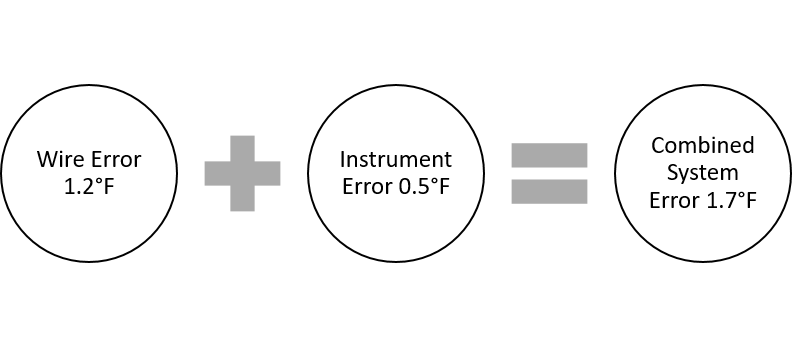
b) This option is most attractive to those who do not wish to allow offsets within their heat treat operation. To accomplish this, you compare the error of the specific channels of the instrument the thermocouples in question plug into, to the error of the thermocouples themselves. The resulting value cannot exceed the maximum error permitted for the appropriate furnace class. Internal pyrometry procedures specifically state how thermocouple wire will be received and the ALT SAT calculation accomplished prior to releasing the thermocouple wire to production. There are two variables that must be verified in this option. Anytime one of these two variables change, the calculation must be obtained. The Nadcap Pyrometry Reference Guide requires that this calculation be evaluated at the instrument (chart recorder) calibration points (min, max & middle 1/3rd.)

Overview of a Calculation – Single Temperature

For Your Consideration

There has been some confusion in the industry that the ALT SAT process, specifically Option B above, must be accomplished at the furnace. This misunderstanding includes suppliers using a Field Test Instrument to simulate the min, max and middle 1/3rd of the instrument calibration temperatures in an effort to obtain the error of the instrument channels in question. This amounts to nothing more than an additional instrument calibration; one could simply obtain the error from the current instrument calibration instead of performing extra work at the furnace.

Option A and B above would be performed as a desk operation; none of the tasks would be performed at the actual furnace.

Conclusion

The ALT SAT process has been successfully implemented by many suppliers in the Aerospace Industry; both Nadcap approved and non-Nadcap. As with any AMS2750E process, detailed procedures and training are key to executing the ALT SAT process.

Submit Your Questions

Please feel free to submit your questions and I will answer appropriately in future articles. Submit your questions by sending an email to doug@heattreattoday.com.

Jason Schulze on Understanding AMS 2750E — Alternate SAT Read More »

Aerospace Supplier Orders Titanium Rotary Hearth Forging Furnace

A leading North American aerospace supplier ordered a 36 ft. diameter pancake style rotary hearth furnace for the production of large fixed wing aircraft titanium and nickel based alloy closed-die structural forgings. The open hearth configuration furnace system which allows for more flexible loading and uniform heating, was supplied by Can-Eng International Ltd. and features an advanced low NOx combustion system designed to meet the most stringent environmental and temperature uniformity requirements. Special dual-door design provides the customer with significant flexibility for forging to press manipulation within in their existing plant layout. The system is capable of processing up to 250,000 pound load capacity in a 24/7 production environment.  The furnace system complies with thermal performance requirements laid out in AMS2750E, integrates a low shrinkage ceramic fiber lining, unique rotating hearth drive and sealing system. The system is scheduled to be commissioned to the United States in the third quarter of 2017.

Aerospace Supplier Orders Titanium Rotary Hearth Forging Furnace Read More »

Airbus A350 XWB to Receive Rudder Components

Triumph Group, Inc. was selected by Harbin Hafei Airbus Composite Manufacturing Centre Company Ltd. to supply composite parts for the Airbus A350 XWB aircraft. Triumph Precision Components’ Composites Center of Excellence site in Thailand will produce the composite details for the rudder, which will be assembled at HHACMC in Harbin, China.

The contract, valued at approximately $26M, covers the delivery of 700 shipsets of rudder component kits over the next 5–7 years for the A350 XWB program. Triumph leveraged recent investments in its Thailand facility to increase capability and expand capacity to position itself to win and execute this new agreement.

“We are pleased to enter into a new customer relationship with HHACMC,” said Ronald Vuz, president of Composites Center of Excellence site in Thailand. “Our focus on performance, coupled with our demonstrated ability to obtain the necessary qualifications and transfer work on schedule, provided us with this opportunity to further demonstrate our capability to produce complex composite aerostructures.”

This agreement allows Triumph to help meet the strong demand for services in the burgeoning Asian aerospace market. The Asia-Pacific region is expected to lead the market for new aircraft over the next 20 years.


Airbus A350 XWB to Receive Rudder Components Read More »