FEATURED NEWS

Applying PID to Temperature Variances in Vacuum Furnaces


Source: Solar Manufacturing


Controlling process temperature with accuracy and without extensive operator involvement is a crucial task in the heat treat shop and calls for the use of a temperature controller, which compares the actual temperature to the desired control temperature, also known as the setpoint, and provides an output to a control element. This comparative process relies upon an algorithm, the most commonly used and accepted in the furnace industry being the PID, or Proportional-Integral-Derivative, control.

“This popular controller is used because of its robust performance in a wide range of operating conditions and simplicity of function once understood by the processing operator,” writes Real J. Fradette, a Senior Technical Consultant with Solar Atmospheres, Inc, and the author of “Understanding PID Temperature Control as Applied to Vacuum Furnace Performance” (with William R. Jones, CEO, Solar Atmospheres, Inc, contributing).

The PID algorithm consists of three basic components, Proportional, Integral, and Derivative which are varied to get optimal response. If we were to observe the temperature of the furnace during a heating cycle it would be rare to find the temperature reading to be exactly at set point temperature. The temperature would vary above and below the set point most of the time. What we are concerned about is the rate and amount of variation. This is where PID is applied. ~ Fradette

In this week’s Technical Tuesday, we direct our readers to Fradette’s article at Solar Manufacturing’s website where he and Jones cover the following on PID temperature controllers:

  • Definitions, e.g., Closed Loop System; Proportional (GAIN); Integral (RESET); and Derivative (RATE)
  • Actual operation of a PID temperature controller, including understanding PID dimensions and values; and general rules for manually adjusting PID
  • The art of tuning, a manual
  • Autotuning
  • Tweaking the furnace PID controller
  • and other factors


Read more: “Understanding PID Temperature Control as Applied to Vacuum Furnace Performance”

Photo credit

Applying PID to Temperature Variances in Vacuum Furnaces Read More »

Aerospace Tech Provider Refines Focus with Acquisition, Spin Offs

In one of the largest acquisitions in aerospace history, a high technology product and service provider to the building and aerospace industries recently announced the completion of its purchase of a company that provides avionics and information technology systems and services to government agencies and aerospace manufacturers.

United Technologies Corporation’s (UTC) acquisition brings together Rockwell Collins and UTC Aerospace Systems to create Collins Aerospace Systems.

Gregory Hayes, United Technologies Chairman and Chief Executive Officer

“Collins Aerospace brings together two great companies with unmatched expertise in developing electrical, mechanical and software solutions,” said Gregory Hayes, United Technologies Chairman and Chief Executive Officer. “We will have a laser focus on developing innovative solutions for customers and generating strong returns for shareowners.”

In addition, the Farmington, Connecticut-based, UTC announced its intention to spin off its commercial businesses, Otis and Carrier (renamed, formerly Climate, Controls & Security), into independent entities. The acquisition and separation will result in three global companies:

  • United Technologies, comprised of Collins Aerospace Systems and Pratt & Whitney, to be a systems supplier to the aerospace and defense industry; Collins Aerospace was formed through the combination of UTC Aerospace Systems and Rockwell Collins;
  • Otis, the world’s leading manufacturer of elevators, escalators and moving walkways; and
  • Carrier, a global provider of HVAC, refrigeration, building automation, fire safety, and security products.

“Our decision to separate United Technologies is a pivotal moment in our history and will best position each independent company to drive sustained growth, lead its industry in innovation and customer focus, and maximize value creation,” said Hayes. “Our products make modern life possible for billions of people.  I’m confident that each company will continue our proud history of performance, excellence, and innovation while building an even brighter future.  As standalone companies, United Technologies, Otis and Carrier will be ready to solve our customers’ biggest challenges, provide rewarding career opportunities, and contribute positively to communities around the world.”


Aerospace Tech Provider Refines Focus with Acquisition, Spin Offs Read More »

Titanium Implants Improve Surgical Accuracy, Outcomes for Man’s Best Friend

Dogs come in all shapes, sizes, and colors, and in the case of certain breeds, they are also prone to higher incidences of hereditary defects, deformities, or infirmities.

Dr. Kevin Parsons, an orthopedic veterinarian, Langford Vets

Small dogs can present particular health issues that are a challenge to correct because their size and weight offer little to no margin for error. In dachshunds and Shih Tzus, abnormal bone growth can sometimes cause their front paws to point outwards. And pugs, and other breeds with corkscrew tails, are susceptible to spinal problems caused by misshapen bones. Fortunately, if diagnosed in time, these conditions can be treated with surgery, but with such small animals, corrective surgery to drill and cut bones, stabilize vertebrae or reposition limbs is a laborious and intricate process.

Two animal specialists from Britain, Dr. Kevin Parsons, an orthopaedic vet based at the small animal hospital at Langford Vets, in Bristol, and a former colleague Tom Shaw a neurosurgeon, now at Willows Veterinary Centre and Referral Service in Solihull are pushing the boundaries of additive manufacturing in veterinary science and are applying it to both scenarios. They have been exploring the world of 3D-printed anatomical guides and titanium implants, manufactured on a GE Additive Arcam EBM Q10plus in South Wales, as a means to provide animals suffering from malformation an opportunity to live longer, pain-free lives.

Integral to Langford Vets’ additive journey has been its partnership with Swansea-based CBM Wales (CBM) – a commercially focused advanced research, product development and batch manufacturing facility, established by the University of Wales Trinity Saint David.

Dr. Ffion O’Malley, CBM Wales

Dr. Ffion O’Malley and an experienced team of additive manufacturing designers and engineers at Swansea-based CBM Wales (CBM) — a commercially focused advanced research, product development and batch manufacturing facility, established by the University of Wales Trinity Saint David — oversee production of bespoke surgical guides (either in polymer or metal) and titanium implants to match exactly to each individual patient’s anatomy to restore mechanical and/or aesthetical functions. Each implant design, follows precise specifications from the Langford Vets’ surgical team, using CT or MRI diagnostic imaging data.


The Q10plus is particularly well-suited for medical implant manufacture and has been developed for easy powder handling and fast turnaround times. The EBM process takes place in a vacuum and at elevated temperatures, which results in stress-relieved implants with properties better than cast and comparable to wrought materials.

The bespoke implants are built in Titanium Ti6Al4V ELI, which is certified to the USP Class VI standard for biocompatibility and is extensively used for FDA and CE marked implants. CBM has ISO 9001:2015 certification for the provision of a design, prototyping and small batch manufacturing service and ISO 13485:2016 & EN ISO 13485:2016 certification for the design and manufacture of custom made 3D-printed surgical guides and implants.


Click here for additional images and more information.

Photo credit: Langford Vets, CBM Wales

Titanium Implants Improve Surgical Accuracy, Outcomes for Man’s Best Friend Read More »

Heat Exchanger Supplier Purchases CAB Cooling System

An India-based independent heat exchanger manufacturer for the domestic automobile industry recently purchased a controlled atmosphere brazing system to reduce energy costs as well as improve production quality and operate within the latest environmental regulations.

NBR Cooling Systems commissioned the signature controlled atmosphere brazing (CAB) cooling system from SECO/WARWICK.

Liu Yedong, Managing Director, SECO/WARWICK RETECH

“We selected SECO/WARWICK because they provided a high-quality production assurance which we needed to keep our plant running efficiently along with low atmosphere consumption, minimum maintenance, and repeatable process results, all at a low capital cost investment,” said Aarif Hussain, NBR Cooling Systems managing director. “A SECO/WARWICK CAB system was definitely our first option – the company leverages many years of experience and guarantee continuous trouble-free operation at a high technological level and provides local contact, care and service.”

“We are pleased to support NBR Cooling Systems’ vision to become the leader in the national and international market for commercial heat exchangers and air conditioning systems for the automotive industry,” said Liu Yedong, Managing Director, SECO/WARWICK RETECH (China).

Heat Exchanger Supplier Purchases CAB Cooling System Read More »

Ohio Heat Treat Provider Acquired, Joins Holdings Group

John Hubbard, chairman of Thermal Process Holdings

Following the acquisition of a Wisconsin heat treat company, finalized last week, an industry holdings group recently announced the purchase of a high-quality heat treat provider focused in tool and die work.

Thermal Process Holdings (TPH) acquired P & L Heat Treating (P&L) of Youngstown, Ohio, in their continuing efforts to build a leading thermal processing company based on value-added services.

“We are delighted to partner with Bill Pociask and the P&L team. P&L is a well-run heat treating operation providing high-quality service. Both Bill Pociask and P&L are excellent additions to the TPH group,” said John Hubbard, chairman of TPH.

Bill Pociask, founder and president of P&L

“I am excited to work with the TPH group of companies. There are many opportunities for us to help each other grow and continue to serve our customers. The future is very bright for P&L,” said Bill Pociask, founder and president of P&L.

TPH also owns and operates: Diamond Heat Treat, based in Rockford, Illinois; Certified Heat Treating, based in Springfield, Ohio; and Hudapack Metal Treating, based in Elkhorn and Franklin, Wisconsin.

TPH was formed by Calvert Street Capital Partners and John Hubbard (former CEO of Bodycote, PLC) to pursue a buy-and-build strategy in the thermal processing industry. You can listen to an interview with John Hubbard regarding the strategy of Calvert Street Capital Partners, conducted by Heat Treat Today‘s publisher, Doug Glenn, at this Heat Treat Radio link.

Ohio Heat Treat Provider Acquired, Joins Holdings Group Read More »

The Workhorses of Industry: High-Strength, Heat-Treated Bolts & Fasteners


Source: Bayou City Bolt


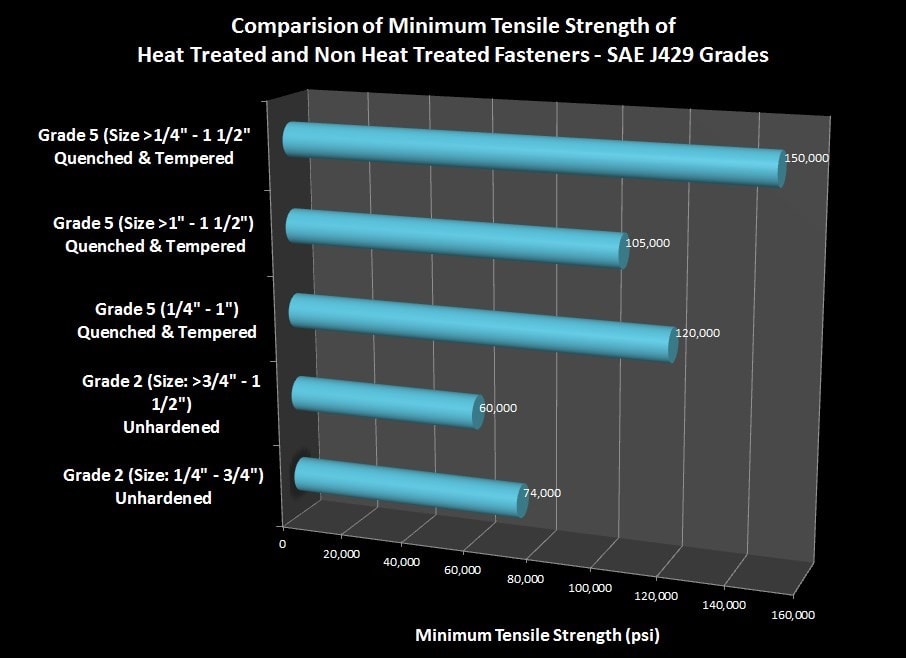
A comparison of minimum tensile strength of heat-treated and non-heat-treated fasteners

One would be hard-pressed to find an industry that isn’t served by high-strength or heat-treated bolts and fasteners. They are required in the automotive, construction, transportation, marine, aerospace, oil & gas, petrochemical, and presses and molds manufacturing fields. In oil & gas and petrochemical manufacturing, for example, high-strength bolts and fasteners are necessary in order to achieve seal closure on flanged joints, fittings, and closures; withstand tensile stresses within the bolts; and provide the strength needed for bolts and pins to withstand forces from high horsepower equipment. You name the industry sector, and the manufacturing process will be just as dependent upon bolts and fasteners to answer the demands of the equipment, the process, and/or the application.

In this overview of the importance of heat treating in fastener and bolt production, Bayou City Bolt provides:

  • an explanation of the heat treating processes used depending upon the material and the application,
  • a comparison of the minimum tensile strength of heat-treated and non-heat-treated fasteners (see image to the right),
  • grade steels best used for heat treating fasteners and bolts,
  • the case hardening process, and
  • the proper use of hardened steel fasteners.

An excerpt:

“About 90 percent of fasteners are steel based and the required strength level is usually developed in steel fasteners using quenching and tempering processes. Accordingly, the terms “high strength” with “heat treated” or “hardened” are often equivocated with the fastener world. However, heat treatment includes a wide range of processes. Some heat treatments like annealing soften a metal, while others harden and strengthen.”


Read more: “Heat Treatment of Bolts & Fasteners”


The Workhorses of Industry: High-Strength, Heat-Treated Bolts & Fasteners Read More »

IHEA Monthly Economic Indices — 5 Up, 7 Down

Vehicle sales, durable goods orders, capacity utilization, and factory orders were four of the five indices trending upward.

Housing, metal prices, capital expenditures, and the purchasing manager’s index were among the seven indices that suffered in October. According to IHEA’s economist, the most disturbing of the declining indexes is the decline in the Purchasing Manager’s Index, which was more than anticipated. Overall, however, all of the declining numbers are still well above historic averages showing that the economy continues to be strong.

“. . . but it is important to note that even with the declines in some sectors, the overall status of these readings remains higher than it had been in several years.”

~ Excerpt from IHEA’s Monthly Executive Economic Summary


The Purchasing Managers Index took a significant dip in October.
Automobile and light truck sales continue to be strong in October.

Analysis of all 12 indices is presented monthly to IHEA member companies and is available by contacting Ann Goyer at ann@goyermgt.com or at (941) 373-1830.

Ann Goyer, Executive Director of IHEA

IHEA Monthly Economic Indices — 5 Up, 7 Down Read More »

15 Quick Heat Treat News Items to Keep You Current

15 Quick Heat Treat News Items to Keep You Current

Heat Treat Today offers News Chatter, a feature highlighting representative moves, transactions, and kudos from around the industry.

Personnel and Company Chatter

  • Tracy Dougherty has been named Vice President of Sales at AFC-Holcroft. Dougherty has been with AFC-Holcroft since 2008 and served in several sales-related roles, most recently as the company’s Sales Manager. As Vice President of Sales, Dougherty will now have a number of added responsibilities, including overseeing the company’s activities in Europe.
  • Retech Systems, which has been manufacturing vacuum melting systems in Northern California, will transition much of the manufacturing and assembly to facilities in Świebodzin, Poland. All of the future work done at the SECO/Warwick facilities in Poland will be per the established Retech standards with the focus on maintaining all expectations associated with the Retech brand. The Ukiah office will be downsized and will retain engineers, technical directors, technologists, and service staff. Retech’s unique R&D Center will continue to be built up, maintaining a west coast office along with the recently opened east coast office in Buffalo, NY.
  • Philip Wrisley, Project Manager at Plibrico‘s Salem, Ohio, office, is the recipient of an API STD 936 Refractory Personnel Certification from the American Petroleum Institute (API). This internationally recognized certification verifies Wrisley’s knowledge of API Refractory Installation Quality Control Guidelines for field-testing of monolithic refractory materials, as well as best practices in the installation and repair of refractory linings.
  • A new 57,500 square foot building dedicated to vacuum furnace manufacturing is under construction at Solar Manufacturing‘s campus in Sellersville, Pennsylvania. As can be seen in the photo below, the four bridge cranes are in place, the full plant and office roof is complete, and much of the concrete floor poured.
  • A thermal technology company recently announced the opening of its new sales and operations office in Norway. Chromalox, based in Pittsburgh, Pennsylvania, manufactures process heating and heat tracing products.
  • A global leader in aluminum rolling and recycling recently announced an expansion at the company’s Pindamonhangaba, Brazil, plant. This $175 million investment of its flagship facility in South America will bolster Novelis‘s capacity with 100 kilotonnes of additional rolling production and 60 kilotonnes of increased recycling and bring total capacity of the Pindamonhangaba facility to approximately 680 kilotonnes per year of aluminum sheet and 450 kilotonnes annually of recycled metal.
  • Nucor Corporation has announced that it is acquiring Corporacion POK, S.A. de C.V. (POK), a fully integrated precision castings company with a facility in Guadalajara, Mexico. POK produces complex castings and precision machined products used by the oil and gas, mining and sugar processing industries.
  • A new automotive structures facility opened in Zilina, Slovakia, dedicated to the production of aluminum crash management systems and body structure components. Constellium‘s 5,200 square meter facility in Zilina features advanced technologies for forming, machining, welding, and heat-treating aluminum automotive components, along with a state-of-the-art quality lab to ensure products meet customer specifications. Constellium plans to expand its facility to 15,000 square meters by mid-2019.

Equipment Chatter

  • A Japanese manufacturer of precision tool steels components recently commissioned a precision vacuum furnace system from SECO/WARWICK. This specialized system reduces energy consumption through power optimization and cycle time reduction, customized to work within the tight physical space limitations.
  • In addition, an American manufacturer which produces transportation components recently ordered a new precision gas nitriding furnace with ZeroFlow® from SECO/VACUUM (SVT), a SECO/WARWICK Group company.
  • L&L Special Furnace Co., Inc., has supplied a custom designed and manufactured oil quench tank to a metal stamping manufacturer in the Midwest. The quench tank is specifically used to quench metal stamping dies that are heated to 1,550°F.
  • Advanced Heat Treat Corp recently posted to Facebook a video of the installation of one of three new nitriding vessels delivered to the company’s MidPort Blvd location as part of an ongoing building expansion.
  • An international heat treating equipment manufacturer with a location in California, JGEF Furnace, recently sold 6 furnaces to a Japanese heat treating company. Four nitriding horizontal furnaces are front-loading and designed specifically for precision gas nitriding in a retort style with vacuum purge, and two tempering horizontal furnaces are designed to temper workloads after hardening.

Kudos Chatter

  • Hydro Extruded Solutions Hoogezand B.V. (Netherlands), which produces aluminum profiles as well as anodized and painted components, has become the first aluminum extrusion company to be certified with ASI’s Performance Standard for environmental, social and governance performance.
  • SECO/WARWICK was recently awarded the Honorary Badge for Meritorious Performance in the area of innovation in a badge award ceremony held at the Royal Castle as part of the celebrations of the 100-year anniversary of the Patent Office and industrial property protection system in Poland. The badge, given to entities and organizations having outstanding achievements in their pro-development activities, was received by Bartosz Klinowski, Managing Director (Europe), Member of the Management Board of SECO/WARWICK.
Heat Treat Today is pleased to join in the announcements of growth and achievement throughout the industry by highlighting them here on our News Chatter page. Please send any information you feel may be of interest to manufacturers with in-house heat treat departments especially in the aerospace, automotive, medical, and energy sectors to the editor at editor@heattreattoday.com.

15 Quick Heat Treat News Items to Keep You Current Read More »

Acquisition of Wisconsin Heat Treat Company to Expand Value-Added Services

John Hubbard, Chairman of TPH

A Wisconsin heat treating company has been acquired by an industry holdings group in a bid to build a leading thermal processing company based on value-added services.

Thermal Process Holdings, Inc. (TPH), purchased Hudapack Metal Treating, Inc., which owns and operates heat treat facilities in Elkhorn and Franklin Wisconsin. In TPH’s acquisition of Hudapack, co-founded by Gary Huss, Charles Davis, and Earl Pack, the company’s strategy is to identify and bring together leading businesses that share a focus on world-class safety, quality, service, and advanced technology. TPH also owns and operates Diamond Heat Treat, based in Rockford, Illinois, and Certified Heat Treating, based in Springfield, Ohio.

Gary Huss, co-founder and President of Hudapack

“We are excited to announce the third acquisition in our strategy to build a best-in-class company that offers a range of advanced services,” said John Hubbard, Chairman of TPH. “I have known and respected Gary Huss for over 30 years and am appreciative that he has entrusted us with the two businesses he has successfully built. I am also pleased that Greg Huss has agreed to become the General Manager of both Elkhorn and Franklin and look forward to working with him as we seek to grow Hudapack.”

“We began operations in 1985 and have been more successful than I ever imagined. When making the difficult decision to sell the business and retire, an important consideration was finding a buyer who would ensure the continued success of the business and provide opportunities for the Hudapack employees. I am confident that John Hubbard and the TPH team will carry out those objectives. I am also delighted that Greg will become GM of both locations. He has spent his career in the business and this transition provides an exciting leadership opportunity for him,” said Gary Huss, co-founder and President of Hudapack.


Acquisition of Wisconsin Heat Treat Company to Expand Value-Added Services Read More »

First Titanium Wheel Created with 3D Unveiled in California

The first titanium wheel created using EBM technology was recently unveiled during the official announcement of a partnership agreement between the two companies responsible for its design and manufacture.

HRE Wheels, headquartered in Vista, California, and GE Additive launched the new technology, which is a type of 3D printing to test the capabilities of additive manufacturing in a practical application and to create a highly-sophisticated wheel design with an elusive material like titanium. The new prototype wheel is known as “HRE3D+”.

With a traditional aluminum Monoblok wheel, 80% of material is removed from a 100-pound forged block of aluminum to create the final product. With additive manufacturing, only 5% of the material is removed and recycled, making the process far more efficient. Titanium also has a much higher specific strength than aluminum and is corrosion resistant, allowing it to be extremely lightweight and to be shown in its raw finish.

There was an intensive design collaboration between the Vista, California-based, team at HRE and the GE AddWorks team out of Ohio. Using design queues from two existing models of HRE wheels, the two companies worked together to create a stunning example of what is possible with additive manufacturing.

HRE President Alan Peltier

The wheel was produced on two Arcam EBM machines – Q20 and a Q10 in five separate sections, then combined using a custom center section and titanium fasteners.

“This is an incredibly exciting and important project for us as we get a glimpse into what the future of wheel design holds,” said HRE President Alan Peltier. “Working with GE Additive’s AddWorks team gave us access to the latest additive technology and an amazing team of engineers, allowing us to push the boundaries of wheel design beyond anything possible with current methods. To HRE, this partnership with GE Additive moves us into the future.”

Robert Hanet, senior design engineer, GE Additive AddWorks

“HRE prides itself on its commitment to excellence and superior quality in the marketplace. It was a natural fit for AddWorks to work on this project with them and really revolutionize the way wheels can be designed and manufactured,” said Robert Hanet, senior design engineer, GE Additive AddWorks.

First Titanium Wheel Created with 3D Unveiled in California Read More »