FEATURED NEWS

Heat Treating Melanin for Modern Biotechnology Applications


Source: Discover Magazine


In furnaces and ovens all over the world, most of the material being heat-treated at 1000°F or above is metal or a metal alloy, with a fair percentage being other materials like glass and ceramics.

Thermal processing is used to heat other materials, as well, though, as we all know, but perhaps one of the most unusual purposes is found at the source article for Heat Treat Today’s Best of the Web feature for today.

Our story focuses on researchers who have developed an annealing process for eumelanin, an electrically conductive type of melanin —  yes that natural chemical pigment that gives color to our eyes, hair, and skin, and which protects our skin from harmful radiation, yet which also can lead to cancer. Vacuum heating films of eumelanin at 1112°F (600°C) modifies its properties and makes it more useful for modern biotechnology applications and perhaps even to create devices to help treat Parkinson’s, control artificial limbs, and more.

The researchers have published their findings in an article titled, “Evidence of Unprecedented High Electronic Conductivity in Mammalian Pigment Based Eumelanin Thin Films After Thermal Annealing in Vacuum” in the journal Frontiers in Chemistry.


Read more: “High-tech Melanin Might Help Put Technology Inside Our Bodies”


Photo credit:


Heat Treating Melanin for Modern Biotechnology Applications Read More »

Heat Treatment Gases Supplier Expands in U.S. with Acquisitions, New Construction

A global industrial gases company, which supplies specialty gases used in heat treatment, recently announced expansions in its U.S. investments through acquisitions and new construction.

Stefan Messer, owner and CEO of Messer Group GmbH

Messer Group GmbH, based in Bad Soden, Germany, and CVC Capital Partners Fund VII (London, UK) completed the acquisition of certain gases businesses in North and South America from UK-based Linde plc, launching a new name in the Americas market: Messer Americas, offering largely the same products and services.

“In creating this strategic partnership, we are seizing a unique opportunity to return to the North and South American markets,” said Stefan Messer, owner and CEO of Messer Group GmbH. “This will turn Messer into a global player in this sector and consolidate its position as the largest family-run industrial gases specialist worldwide. It is a once-in-a-lifetime opportunity. We intend to fully integrate the joint venture into the family-run Messer Group within a few years. In the medium term, we want to use the merger of the two companies to become a global player again with a presence in the relevant industrial gases markets.”

In addition, Messer is investing in the construction of a new CO2 plant in Keyes, California. With an output of 450 tons of carbon dioxide a day, the plant will supply numerous companies in northern California and surrounding areas. Start-up is planned for the end of 2019.

Jens Luehring, President and CEO of Messer Americas

“This investment represents our commitment to strategic US expansion to meet growing market demand,” said Jens Luehring, President and CEO of Messer Americas. “We’re dedicated to providing a reliable supply of industrial gases to our customers and look forward to breaking ground on this plant to further meet that need.”

Messer currently operates two CO2 plants and two air separation units in California.


Heat Treatment Gases Supplier Expands in U.S. with Acquisitions, New Construction Read More »

Heat Treated Steel to be Produced at Ohio River Plate Mill

A steel manufacturer recently announced that it will build its new state of the art steel plate mill in Brandenburg, Kentucky, producing cut-to-length, coiled, heat-treated, and discrete plate.

Nucor Corporation will invest approximately $1.35 billion to build the mill along the Ohio River southwest of Louisville, which will be capable of producing 1.2 million tons per year of steel plate products and is expected to be fully operational in 2022, pending permit and regulatory approvals.

John Ferriola, Chairman, CEO & President of Nucor Corporation

“This strategic investment will enable us to build a clear market leadership position in the U.S. plate market. Kentucky is an excellent location for this mill, right in the center of America’s largest plate consuming region,” said John Ferriola, Chairman, CEO & President of Nucor Corporation. “Our acquisition of the Gallatin sheet mill in Ghent, Kentucky five years ago has been a tremendous success, and we are pleased to add a second mill in the state.”

The new plate mill will give Nucor the ability to produce 97 percent of the products demanded in the domestic plate market, including the specialty higher-margin products, including the discrete plate ranging from 60 to 160 inches wide, and in gauges from 3/16 of an inch to 14 inches. The selected location on the Ohio River will give Nucor logistical advantages in sourcing raw materials and serving customers throughout the Midwest. Nucor currently operates plate mills in North Carolina, Alabama, and Texas.

Nucor has two additional major investment projects underway at its Gallatin sheet mill in Kentucky. Nucor Steel Gallatin’s new galvanizing line will be operational during the second quarter of this year. And, its project to increase Gallatin’s hot-rolled coil capacity at expanded widths of up to 73 inches is expected to come online during 2021. The new plate mill and the projects at Nucor Steel Gallatin represent more than $2 billion in investments in the state of Kentucky.


Heat Treated Steel to be Produced at Ohio River Plate Mill Read More »

Dr. Valery Rudnev on . . . Equipment Selection for Induction Hardening: Continuous and Progressive Hardening, Part 2

This article continues the ongoing discussion on Equipment Selection for Induction Hardening by Dr. Valery Rudnev, FASM, IFHTSE Fellow. Dr. Rudnev previously reviewed equipment selection for scan hardening in three parts. The first part on equipment selection for continuous and progressive hardening is here; the third part is here. To see the earlier articles in the Induction Hardening series at Heat Treat Today as well as other news about Dr. Rudnev, click here


Frequency Selection

Depending on the application specifics, continuous and progressive hardening lines may use the same frequency for various in-line coils. In other cases, power levels and frequencies may be different at different heating positions. The presence of three general process stages (described in Part 1) makes a marked impact on a selection of process parameters and the design of an induction system.

When using different frequencies for the various heating stages, the coil design may need to change as well (e.g., a number of coil turns may need to be adjusted for load matching purpose). Just as the eddy current penetration depth in the heated part is affected by the frequency, the current flow in the inductor is affected as well. The wall thickness of the inductor turns (i.e., copper tubing wall) might need to be adjusted to accommodate different frequencies to maximize the coil electrical efficiency.¹

The wall thickness of an inductor’s heating face should be increased as frequency decreases. It is highly desirable for the current-carrying copper wall thickness to be 1.6 times greater than the current penetration depth in the copper (δCu). Increased kilowatt losses in the copper, which are associated with reduced electrical efficiency and greater water-cooling requirements, will occur if the wall is thinner than 1.6∙δCu. In some cases, the copper wall thickness can be noticeably thicker than the recommended value of 1.6∙δCu. This is because it may be mechanically impractical to use a tubing wall thickness of, for example, 0.25 mm (0.01 in.).

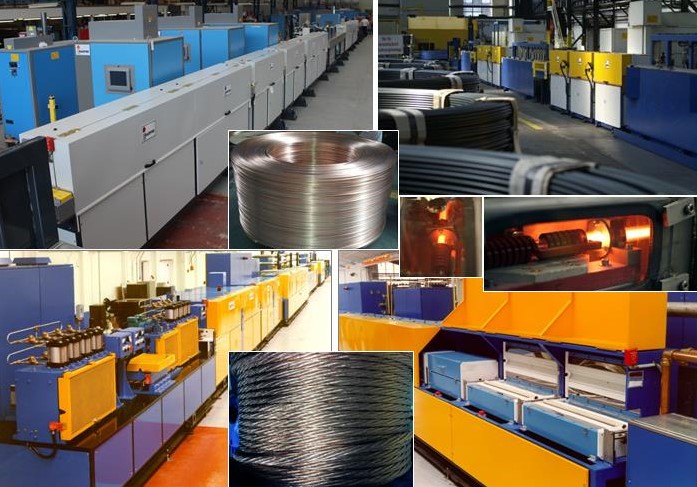
As an example, Figure 1 shows a number of continuous in-line multi-coil systems for induction heat treating wire products.²

Several continuous in-line systems for heat treating wire products (Courtesy of Radyne Corp., and Inductotherm Heating & Welding, UK. Both are Inductotherm Group companies.)

There are noticeable benefits of compact induction systems compared to fluidized beds, infrared heaters, and gas furnaces, such as quick response and the ability to provide a rapid change in the process operating parameters to accommodate the required temperature of the wire/cable being processed at speeds up to 5 mps. Frequencies that are in the range of 10 to 800 kHz are commonly applied. A dual-frequency concept can be beneficial to enhance electrical efficiency of while heating different diameters/thicknesses or it can be advantageous for through heating of metallic alloys that exhibit low toughness/high brittleness.

According to the dual-frequency concept, a lower frequency is used during the initial heating stage when the steel is magnetic. In the final heating stage, when the steel becomes nonmagnetic with significantly increased current penetration depth δsteel and becomes substantially more ductile, it is beneficial to use a higher frequency.

Case study¹:

As an example, consider the induction heating of a 1/8 inch-diameter (3.2 mm-diameter) steel rod from ambient to 2000°F (1100°C) using both a single 10-kHz frequency and dual 10-kHz/200-kHz frequencies (see Figure 2). When using the single frequency of 10 kHz (Figure 2, left), the rod’s final temperature experiences very little change regardless of the coil power that is increased more than fivefold (from 17 to 90 kW). The only noticeable difference is related to the initial slope of the temperature-time curve, where the steel is ferromagnetic. Upon reaching the Curie point, there is no noticeable temperature rise. This is the result of severe eddy current cancellation making the steel rod transparent (practically speaking) to the electromagnetic field of the induction coil.

Illustration of the dual-frequency concept when induction heating a 1/8 inch-diameter (3.2 mm-diameter) carbon steel rod from room temperature to 2012°F (1100°C) using both a single frequency of 10 kHz (a) and dual frequencies of 10 kHz/200 kHz (b). (Source: V.Rudnev, Systematic analysis of induction coil failures, Part 11c: Frequency selection, Heat Treating Progress, January/February, ASM Intl., 2008, pp. 27–29.)

In contrast, Figure 2, right, shows that a dual-frequency approach provides a remarkable improvement in the ability to heat the rod above the Curie temperature. A power of 14 kW/10 kHz was used to heat the rod below the Curie point and a power of 19 kW/200 kHz was used above it. The total required power is only 33 kW, compared with 90 kW using just 10 kHz, which was still unable to provide the required temperature rise.

Note: The target temperature of 2000°F (1100°C) is above typical target temperatures when hardening plain carbon or low alloy steels and it is more suitable for hot forming applications. This temperature was selected here to better illustrate a dual-frequency concept and the importance of avoiding eddy current cancellation when choosing operating electrical frequencies. It should be noted though that it is not unusual that the heat treating protocols/recipes for some alloyed steels and stainless steels may require target temperatures of 1900°F to 2100°F (1050°C to 1150°C) range.

In some not too often cases, three frequencies may be used. Lower frequency is applied for preheating inductors, a medium frequency is used for mid-heat inductors, and a high frequency is used for final heat inductors.

Sometimes, it is required that the induction system should be able to heat a variety of sizes using a single frequency. In these cases, in order to provide efficient steel heating, it is necessary to choose a frequency that will guarantee that the “diameter-to-current penetration depth (δsteel)” ratio exceeds 3.6 for any workpiece diameter or heating stage. Thus, it is important to remember that when calculating δsteel, the values of electrical resistivity and relative magnetic permeability of the heated material should correspond to their values at the highest temperature that occurs during the entire heating cycle.

The next installment of this column will review a variety of styles of inductors used in continuous and progressive induction hardening applications.


References

  1. V.Rudnev, D.Loveless, R.Cook, Handbook of Induction Heating, 2nd Edition, CRC Press, 2017.
  2. J.Mortimer, V.Rudnev, D.Clowes, B.Shaw, “Intricacies of Induction Heating of Wires, Rods, Ropes, and Cables”, Wire Forming, Winter, 2019, p.46-50

Dr. Valery Rudnev, FASM, IFHTSE Fellow, is the Director of Science & Technology, Inductoheat Inc., and a co-author of Handbook of Induction Heating (2nd ed.), along with Don Loveless and Raymond L. Cook. The Handbook of Induction Heating, 2nd ed., is published by CRC Press. For more information click here.

Dr. Valery Rudnev on . . . Equipment Selection for Induction Hardening: Continuous and Progressive Hardening, Part 2 Read More »

Heat Treat Line Expanded at Ontario Facility

A family-owned commercial heat treating company recently expanded the capabilities of its Ontario-based facility with the purchase of two batch furnaces.

Cambridge Heat Treating, located in Cambridge, Ontario, purchased two new Allcase® Batch Integral Quench Furnaces in addition to two used Allcase furnaces to be used in the same line, along with a previously purchased 30”x30”x48” Allcase with top cool.

Surface Combustion, headquartered in Maumee, Ohio, commissioned the new furnaces. which are all serviced by Surface’s charge car, Uni-DRAW® Batch Tempering Furnaces, washers, and RX® Endothermic Atmosphere Gas Generator.  The 36”x48”x36” batch heat treat line expands Cambridge’s capacity for carbonitriding, carburizing, neutral hardening, and has added ferritic nitrocarburizing (FNC) and normalizing capacity with the atmosphere top cool chambers on the two new Allcases.

“We could not be happier with our Surface purchases,” said Peter Robbins, owner of Cambridge Heat Treating. “Their robust equipment is built for longevity, and we appreciate that they are easy to operate and maintain. Surface’s Aftermarket parts department ensures that we always have the necessary parts for maintenance in a timely manner, and their customer service department is always available for a telephone or service call.”


Heat Treat Line Expanded at Ontario Facility Read More »

A Dozen & a Half Quick Heat Treat News Items to Keep You Current

A Dozen & a Half Quick Heat Treat News Items to Keep You Current

Heat Treat Today offers News Chatter, a feature highlighting representative moves, transactions, and kudos from around the industry.

Personnel and Company Chatter

  • Dustin Lawhon was recently promoted to Regional Sales Manager at Paulo, responsible for establishing relationships with new customers in the Great Lakes Region.
  • A manufacturer of metal components for the automotive industry recently inaugurated its new plant in San Luis Potosí, Mexico. Gestamp‘s new plant for manufacturing chassis parts will be equipped with state-of-the-art machinery for hot stamping and hydroforming, among other technologies.
  • A large oil pipeline project in South America will have its nickel-based, flat-rolled products supplied by Allegheny Technologies Incorporated (ATI), with shipments beginning in second quarter 2019 and scheduled to be completed by year-end.
  • A company providing machine safeguarding solutions announced that it has launched a new Combustion Safety division that provides turnkey solutions for organizations that use thermal processes in their operations. Rockford Systems LLC‘s new expanded division will be led by Robert Sanderson P.E. who has been appointed to the position of Director of Business Development.
  • A mutual cooperation has been declared for the realization of a revolutionary concept for a significantly CO2-reduced steel production, commonly developed by two companies: Tenova–a company of the Techint Group specialized in innovative solutions for the metals and mining industries–and Salzgitter AG– among the leaders in innovative and sustainable steel and technology products. The name of the concept is SALCOS (SAlzgitter Low CO2 Steelmaking) and its aim is to undergo a stepwise transformation process of the integrated steelmaking route, moving from carbon-intensive steel production based on Blast-Furnaces towards a Direct Reduction and Electric Arc Furnace route, including the flexible incremental utilization of hydrogen. This concept is capable of reducing CO2 emissions up to 95% with respect to the entire steel production route.
  • Vacuum heat treating has been added to Paulo’s Monterrey Division plant which has been focusing on stress relieving and ferritic nitrocarburizing since startup. Since startup processing has been focused on stress relieving and ferritic nitrocarburizing.  Adding vacuum equipment is the first step to expanding critical aerospace brazing to include both argon and nitrogen quenching.  The working zone measures 48”x48”x48” with a 3500lb capacity and a maximum temperature of 2400F. The installation will include tempering and testing equipment to support both annealing and hardening processes for a variety of materials.
  • Timothy J. Harris will join ATI as Senior Vice President, Chief Digital and Information Officer, effective May 6, 2019.
  • A Cleveland-based distributor of heat treat furnaces, pumps, and products, Mountain Rep, has partnered with RÜBIG, an Austrian industrial furnace manufacturer.
  • Andrew Yazot will move from his position as International Sales Manager for Ipsen to Midwest Regional Sales Owner, effective immediately. In this position Yazot covers nine states in the Midwest, replacing former Midwest Regional Sales Owner Matt Clinite, who was promoted to Ipsen Customer Service Sales Manager last month. Yazot, who joined the company in 2009, holds a degree in mechanical engineering and has worked in technical sales for more than two decades.

Equipment Chatter

  • A 2200°F (1200°C) crucible furnace was shipped to a company in the energy industry by Lindberg/MPH. The crucible furnace may be used for a number of applications and processes, including annealing, ashing, carbon firing, ceramic firing, hardening, melting, metalizing, normalizing, sintering, solution treating, and stress relieving.
  • A southeastern US manufacturer of various items used in the production of heavy equipment and transportation devices has purchased a dual chamber heat treating furnace from L&L Special Furnace Co, Inc. The furnace will be used to heat treat the tooling used to manufacture these items.
  • A cooling chamber is currently being used for cooling oven trucks of steel parts at the customer’s facility. The No. 807 was supplied by Grieve Corporation.
  • A manufacturer in the composite industry has purchased a natural gas-fired heavy duty walk-in furnace from Wisconsin Oven Corporation.

Kudos Chatter

  • An aerospace maintenance and heat treatment manufacturer based in Elizabeth, Indiana, has launched a new website in order to reach clients across the U.S. and internationally. SAS-INC. is made up of Simpson Alloy Services Inc. and Simpson Aerospace Services.
  • GE Aviation was selected by Aviation Week & Space Technology as a winner of the 62nd annual Laureate Awards, honoring extraordinary achievements in aerospace.
  • PhoenixTM Ltd has been accredited in accordance with recognized International Standards ISO/IEC 17025:2017, general requirements for competence in testing or calibration laboratories.
  • Aleris has been recognized for the second consecutive year with the accredited supplier award by Airbus at a Supply Chain and Quality Improvement Program (SQIP) event in Toulouse, France.
  • Cambridge Heat Treating Inc. CFO Cheryl Mortimer is the recipient of the Women Entrepreneurship Fund and was recognized at an event with Ontario MP Bryan May. Cambridge Heat Treatment Inc. was selected to receive a contribution of up to $100,000 through the WEF program.

Heat Treat Today is pleased to join in the announcements of growth and achievement throughout the industry by highlighting them here on our News Chatter page. Please send any information you feel may be of interest to manufacturers with in-house heat treat departments especially in the aerospace, automotive, medical, and energy sectors to the editor at editor@heattreattoday.com.


A Dozen & a Half Quick Heat Treat News Items to Keep You Current Read More »

Aerospace Manufacturer Acquires Plasma Nitriding & Annealing Systems

A leading aerospace engine and components company based in Mobile, Alabama recently partnered with a global heat treat specialist to improve its nitriding and annealing processes with plasma nitriding technology.

Continental Aerospace Technologies™ (formerly Continental Motors), which is recognized for manufacturing piston engines for small aircraft, sought to improve its nitriding systems with high ammonia emissions and turned to RÜBIG Industrial Furnaces, an Austrian metal hardening company. RÜBIG supplied two “EVEREST 100/180 Duo” plasma nitriding and annealing furnaces, as well as a cleaning solution. The equipment provides independent multi-heating and cooling zones and the Micropuls® technology.


Photo credit: Rubig


Aerospace Manufacturer Acquires Plasma Nitriding & Annealing Systems Read More »

Heat Treat Control Panel: Best Practices in Digital Data Collection, Storage, Validation

When processing critical components, heat treaters value and demand precision in every step of the process — from the recipe to data collection — for the sake of accurate performance of the furnace, life expectancy of all equipment, as well as satisfactory delivery of a reliable part for the customer.

So what’s the obstacle to achieving those goals? Gunther Braus of dibalog GmbH/dibalog USA Inc. says, “The general problem is the human.” Indeed, the need to remove the variable of human fallibility plays a significant role in the search and development of equipment that could sense, read, and record data separate from any input from the operator. “As long there is a manual record of values there is the potential failure,” adds Braus.

Now, as part of the quest for precision, particularly in the automotive and aerospace industries, many control system requirements are driven by the need to prove process compliance to specified industry standards like CQI-9 and AMS 2750. These standards allow for and frequently require digital data records and digital proof of instrumentation precision.

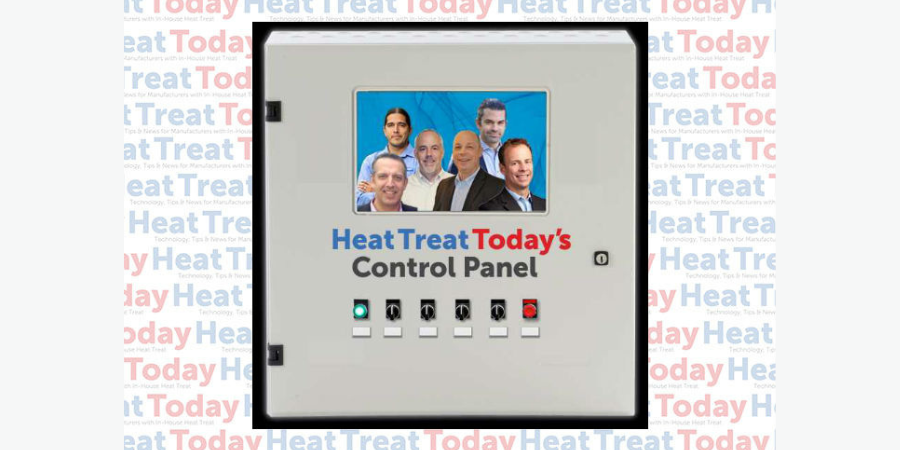
With this in mind, Heat Treat Today asked six heat treat industry experts a controls-related question. Heat Treat Control Panel will be a periodic feature so if you have a control-related question you’d like addressed, please email it to Editor@HeatTreatToday.com and we’ll put your question to our control panel.

Q: As a heat treat industry control expert, what do you see as some of the best practices when it comes to digital data collection and storage and/or validation of instrumentation precision?

We thank those who responded: Andrew Bassett of Aerospace Testing & Pyrometry, Inc.; Gunther Braus, dibalog GmbH/dibalog USA Inc; Jim Oakes of Super Systems, Inc; Jason Schulze, Conrad Kascik Instrument Systems, Inc.; Peter Sherwin, Eurotherm by Schneider Electric; and Nathan Wright of C3Data.

Calibration and Collection

Jim Oakes (Super Systems Inc.) starts us off with an overview of the equipment review process, the crucial component of instrument calibration, and digital data collection:

“Industry best practices are driven by standards defined by the company and customers they serve. Both the automotive and aerospace industries have a set of standards which are driven through self-assessments and periodic audits. Instrument precision is defined by the equipment’s use and is required to be checked during calibrations. The frequency of these calibration depends on the instrument and what kind of parts and processes it is responsible for.

The equipment used for these processes can be defined as field test instrumentation, controllers, and recording equipment. Calibration is required with a NIST-traceable instrument that has specific accuracy and error requirements. Before- and post-calibration readings are required (commonly identified as “as found” and “as left” recordings). During calibration, a sensitivity check is required on equipment and is recorded as pass/fail. The periodic calibration procedure is carried out not only on test equipment but also on control and recording equipment, to ensure instrument precision.

Digital data collection is a broad term with many approaches in heat treatment. As mentioned, requirements are driven by industry standards such as CQI-9 and AMS 2750. Specifically when it comes to digital data collection, electronic data must be validated for precision; checked; and calibrated periodically as defined by internal procedures or customer standards. Data must be protected from alteration, and have specific accuracy and precision. Best practice tends to be plant wide systems that cover the electronic datalogging that promotes ease of access to current and historical data allowing use for quality, operational, and maintenance personnel. Best practices in many cases are defined by the standards within each company, but the hard requirements are often the AMS 2750 and CQI-9 requirements for digital data storage.”

Industry Guidelines and Requirements

Andrew Bassett (Aerospace Testing & Pyrometry) has provided us with a reminder of the industry guidelines for aerospace manufacturing (via AMS-2750E, paragraph 3.2.7.1 – 3.2.7.1.5)

  1. The system must create electronic records that cannot be altered without detection.
  2. The system software and playback utilities shall provide a means of examining and/or compiling the record data, but shall not provide any means for altering the source data.
  3. The system shall provide the ability to generate accurate and complete copies of records in both human readable and electronic form suitable for inspection, review, and copying.
  4. The system shall be capable of providing evidence the record was reviewed – such as by recording an electronic review, or a method of printing the record for a physical marking indicating review.
  5. The system shall support protection, retention, and retrieval of accurate records throughout the record retention period. Ensure that the hardware and or software shall operate throughout the retention period as specified in paragraph 3.7.
  6. The system shall provide methods (e.g., passwords) to limit system access to only individuals whose authorization is documented.

“One of the biggest issues I see with one of these requirements will be point 5,” says Bassett. “The requirement is to be able to review these records throughout the retention period, which in some instances is indefinite. I always recommend to clients who may be upgrading or purchasing new digital systems that they should consider keeping a spare system in place to be able to satisfy this requirement. Who knows — today we are working on Windows 10, but in 50 years, will our successor be able to go back and review heat treat data when everything is run on Windows 28?”

Jason Schulze, Aerospace Heat Treating“This is a topic that yields great discussions,” adds Jason Schulze (Conrad Kascik). He directs us to a challenge he sees from time to time.

Within the Nadcap AC7102/8 checklist, there is this question: “Do recorder printing and chart speeds meet the requirements of AMS 2750E Table 5 or more stringent customer requirements?” This correlates with AMS2750E, page 12, paragraph 3.2.1.1.2 “Process Recorder Print and Chart Speeds shall be in accordance with Table 5”.

“To ensure the proper use of an electronic data acquisition unit used on furnaces and ovens, these requirements must be understood,” continues Schulze. “Because this system is electronic, it should be designated a digital instrument and not an analog instrument. In doing so, this helps determine what requirements apply in Table 5. The only remaining requirement in Table 5 for digital instruments is ‘Print intervals shall be a minimum of 6 times during each time at temperature cycle. Print intervals shall not exceed 15 minutes.’

With this in mind, it is important to realize that, if your time at temperature cycles are short cycles (such as vacuum braze cycles), the sample rate of data collection may need to be adjusted to ensure it is recorded 6 times during the cycle.

As an example, if the shortest cycle processed is 4 minutes at temperature, a sample rate of every 60 seconds would not conform to AMS2750E because, in theory, the maximum amount of recordings would be 4 times during the time at soak. Now, if the sample rate was modified to every 30 seconds, this would allow ~8 recordings during the time at soak, which then would be conforming to AMS2750E.

Within the realm of electronic data acquisition on furnaces/ovens, this seems to be a frequent challenge for suppliers.”

A Critical Variable: Process Temperature

Nathan Wright (C3Data) agrees and zeroes in on process temperature as a critical variable to be measured:

“No matter the heat-treating process being carried out, complying with AMS-2750 and/or CQI-9 requires that the heat treater measure, record, and control several different variables. One of the more common variables that must be measured, recorded, and controlled is process temperature.

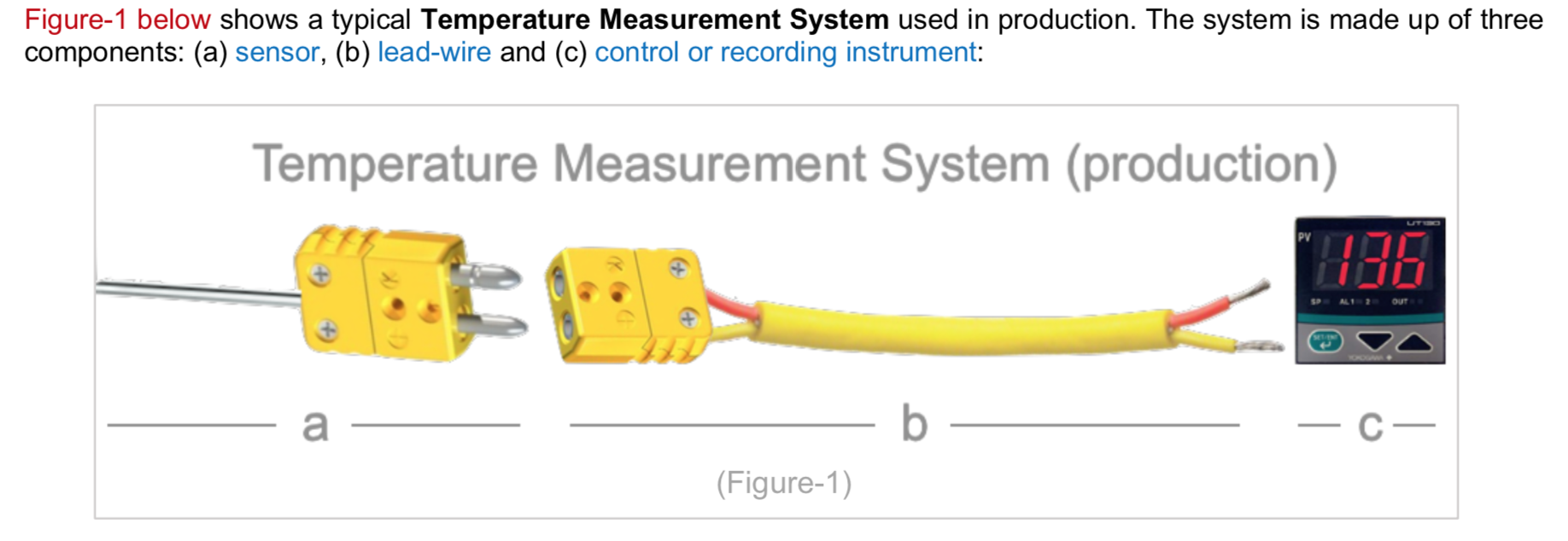
Measuring process temperatures requires the use of a precise measurement system (Figure-1 below), and the accuracy of said measurement system must be periodically validated to ensure its ongoing compliance.”

“The validation process is carried out through a series of pyrometric tests (Instrument Calibration and SAT), and historically these validation processes are highly error-prone.

In order to help ensure process instrumentation, process temperatures, and any other variable that impacts quality is properly validated it is good practice to begin automating compliance processes whenever and wherever possible. C3 Data helps automate all furnace compliance processes using software.”

A “Standard” Mindset

Gunther Braus (dibalog) chimes back in with some pertinent wisdom: “It is not sufficient only to record, you must live the standards like CQI-9, AMS, Nadcap or even your own standard you have set up, so you must survey the data. However, in the old times, there was a phrase: the one who measures, measures crap. In the end, it is all about surveillance of the captured data.

Where you store the data is a question of philosophy: personally, I prefer local storage in-house. Yes, we all talk about IOT, etc., and I do not want to start a discussion about security; it is more about accessing the data. No internet, no data. So simple. We are overly dependent upon cloud usage on the internet.

The automation of the instrumentation precision is so much effort in terms of automated communication between testing device and controller, from my point of view we are not there yet.”

A Look at the Standards In and Outside the Industry

Interesting question! writes Peter Sherwin (Eurotherm by Schneider Electric).

The aim is to record the true process temperature seen by the components being treated. However, there are many practical factors that can alter the accuracy of the reading. From the position of the thermocouple (TC), the TC accuracy (over time), suitability of the lead or extension wire, issues with CJC errors and instrument accuracy as well as electrical noise impacting the stability of the reading.

The standards do a good job to help by prescribing the location of TC, accuracies required for both TC and instrument, and frequent checks over time through TUS and SAT checks but note the specification requirements are maximum “errors”. And if you truly want to reach world-class levels of process control and reap the inherent benefits of better productivity and quality, you should aim to be well inside those tolerances allowed.

With 30yrs+ of data required to be stored (in certain cases, particularly aerospace), there should be some thought as to how and what form this should be stored in. There are many more options of storage when the data is in digital format.

  • Paper is very costly to store and protect.
  • The virgin data file should be secure and tamper-resistant and identical copies made for backup purposes held offsite.
  • The use of FTP is becoming more common to move files automatically from the instrument to a local server (with its own backup procedures to ensure redundant records in case of disaster).
  • Regular checks should be made to examine the availability and integrity of these electronic records.
  • Control and Data Instrument suppliers should ideally have many years of supplying instrument digital records with systems that can access even the earliest of data record formats.

We also look outside of the heat treat standards for truly best practices. The FDA regulation 21CFRPart11 and associated GAMP Good Automated Manufacturing Practice have been extended with the new document “Data Integrity and Compliance with Drug cGMP, Questions and Answers, Guidance for Industry”. These updates leverage A.L.C.O.A to describe the key principles around electronic records (see below). This industry is also leading the requirement for sFTP a more secure format of the FTP protocol.


Heat Treat Today will run this column regularly featuring questions posed to and answered by industry experts about controls. If you have a question about controls and/or data as it pertains to heat treating, please submit it to doug@heattreattoday.com or editor@heattreattoday.com.


Heat Treat Control Panel: Best Practices in Digital Data Collection, Storage, Validation Read More »

Heat Treat Today’s Aerospace Digital Edition Goes Live

Heat Treat Today has launched Aerospace Heat Treating special edition in print and digital form, the second print magazine and the first in a series of industry-specific quarterlies.

The print edition of Aerospace Heat Treating entered the mail stream on March 27 and landed in the mailboxes of 6,000 aerospace manufacturing suppliers and OEMs. The digital edition is available by clicking here or on the image to the right.

In this special magazine, Heat Treat Today delivers quality content both new and original as well as a round up of past aerospace-related news, technical articles, and tips, including:

  • “Airplanes Don’t Fly Without Heat Treating” / An introduction to vacuum heating, the unsung hero of commercial and military aviation.
  • “Not Your Grandfather’s Heat Treat Shop” / What has changed in the heat treat industry over the last few decades?
  • “The Heat Treatment of Aerospace Fasteners” / The critical issue of strength-to-weight in fastener applications and materials.
  • “What To Do With All the Data?” / Data capture and management are the topic of this abridged transcription of a recent Heat Treat Radio interview.
  • “Diffusion Bonding in Vacuum Furnaces” / In aerospace heat treating, one application many manufacturers turn to is diffusion bonding.
  • A whirlwind tour of a heat treat shop from the perspective of an industry safety consultant.
  • “How Much Does Poor Quality Cost?” / There’s good quality cost and poor quality cost – and one will cost your bottom line more than the other.
  • “In-Situ Hardness Testing of Large Aerospace Structures: A Case Study” / How a custom-designed fixture and hardness testing unit solved a major aerospace engine manufacturer’s hardness testing dilemma.

In June, Heat Treat Today will be publishing another special edition, this time focusing on the automotive industry. It will be sent to 6,000+ automotive industry contacts. If you have automotive-related editorial content or if you would like to have your promotional message in this issue, please email doug@heattreattoday.com or editor@heattreattoday.com as soon as possible.

If you haven’t done so already, you might want to join Heat Treat Today’s “Leaders in Aerospace Heat Treat” LinkedIn Group. Click here or on the image to the left to be taken there. You’ll need to sign in to LinkedIn before you can join the group.


Heat Treat Today’s Aerospace Digital Edition Goes Live Read More »

Where’s the Heat Treat Economy Headed: Up, Down, Flat?

Finding the right metric to measure the ubiquitous heat treat economy is like trying to take the temperature of the ocean. It can be hot in some spots, cold in others, and an average temperature really doesn’t help anyone. Finding economic data that can help suppliers to the heat treat industry plan future business fluctuations is all but impossible. Industrial Heating magazine has been publishing its Economic Indicators for well over a decade. This is one of the best sources for heat treat-specific economic data freely available to the public. Click here for the latest numbers from Industrial Heating.

Durable Good Orders for December 2018

The Industrial Heating Equipment Association (IHEA) provides a monthly Executive Economic Summary to their members as well. According to the most recent report from IHEA, the signals are mixed as to where the heat treat economy is headed. Below are a few highlights. To access the full report, please contact Anne Goyer, Executive Director of IHEA by clicking here.

  • Factory Orders — headed up.
  • Durable Goods — headed up.
  • Transportation Index — headed up.
  • Steel Consumption — headed up.

All of the above indices are headed north, but exactly what impact does each have on the heat treat industry?

  • Industrial Capacity Utilization — headed down.
  • Metal Prices — softening.
  • Purchasing Managers Index — down.
  • Capital Expenditures — down.
Steel Consumption for February 2019

Likewise, these four indices headed south but their impact on the heat treat industry is not easily discernible.

A more complete understanding of the direct impact of the above eight (8) indices plus three (3) others on the heat treat industry can be gained by the analysis provided in the IHEA Executive Economic Summary report. The monthly report dedicates one page to each of eleven (11) heat treat-related indices with in-depth analysis by IHEA’s contracted economist.

In my eyes, the data and analysis provided by IHEA is one of the most valuable pieces of economic heat treat data a heat treat industry supplier can have.

Contact Anne Goyer for more information on this report.

Ann Goyer, Executive Director of IHEA


Where’s the Heat Treat Economy Headed: Up, Down, Flat? Read More »