


AEROSPACE HEAT TREAT NEWS

Jason Schulze on Understanding AMS 2750E — Standard SAT Description

Dan Bender, Understanding the Short Circuit Current RatingJason Schulze, Conrad Kacsik Instruments, Inc.


This is the second in a series of articles by AMS 2750 expert, Jason Schulze. Don't miss the Q&A section at the bottom of this article and please submit your AMS 2750 questions for Jason to Doug@HeatTreatToday.com.


Introduction

Considering the abundant number of Nadcap heat treat audits performed in a single year, the area receiving the most findings is pyrometry, and within this group, system accuracy testing (SAT) is the third most common finding.

The SAT process has been refined through each revision of AMS2750 (C through E). We’ve seen SAT thermocouple requirements, for example, gradually incorporated into the tables but not within the body of the specification. Also, we’ve seen the definition of a SAT incorporated into revision D within the definitions section; however, with revision E it was added to the body of the specification.

AMS2750E presents three optional methods for performance of SATs that must be implemented; the Standard (or Regular) SAT, the Alternate SAT, and the SAT Waiver. Within this article, we will focus on the Standard SAT process.

Standard SAT Description – AMS 2750E

AMS2750E has defined the Standard SAT as:

An on-site comparison of the instrument/leadwire/sensor readings or values, with the readings or values of a calibrated test instrument/leadwire/sensor to determine if the measured temperature deviations are within applicable requirements. Performed to assure the accuracy of the furnace control and recorder system in each control zone.

Put simply, an SAT is a comparison of two systems: the furnace system (whether control, monitoring, or load) against a test system. It’s important to recognize that the comparison is being made against two systems and not against an instrument or thermocouple alone. Each system is made up of three variables:

  1. the instrument
  2. the lead wire
  3. the sensor


image-1

SAT Procedure

There is no general SAT procedure that can be applied for every supplier. Each supplier has their own needs as well as their own mechanical arrangement of thermocouples within their furnace system. The key to conformity is to ensure that, once a method for performing an SAT on a furnace is established, it is documented (i.e., in detail, including photos, if necessary) and repeated each time an SAT is performed. Some requirements to incorporate into your system are:

1) The tip-to-tip distance between the furnace system thermocouple and the test system thermocouple cannot exceed 3 inches.

2) The test thermocouple shall be in the same position/depth as the initial test.

3) The furnace is cycled and maintained at a temperature normally used during production.

4) Each system that makes up the applicable instrumentation type must be tested.

SAT Difference

Many findings arise from suppliers calculating the SAT Difference incorrectly. AMS 2750E states the following as a way to calculate the SAT Difference.

The difference calculated between the reading of the furnace sensor system being tested (sensor, lead wire, and instrument) and the corrected reading of the test sensor system (after test sensor and test instrument correction factors are applied) shall be recorded as the system accuracy test difference. Applicable correction factors shall be applied algebraically.

I’ve highlighted the word “corrected” as it applies to the test instrument systems because this seems to be a source of frequent findings. The furnace system does not get corrected, the test system does get corrected.
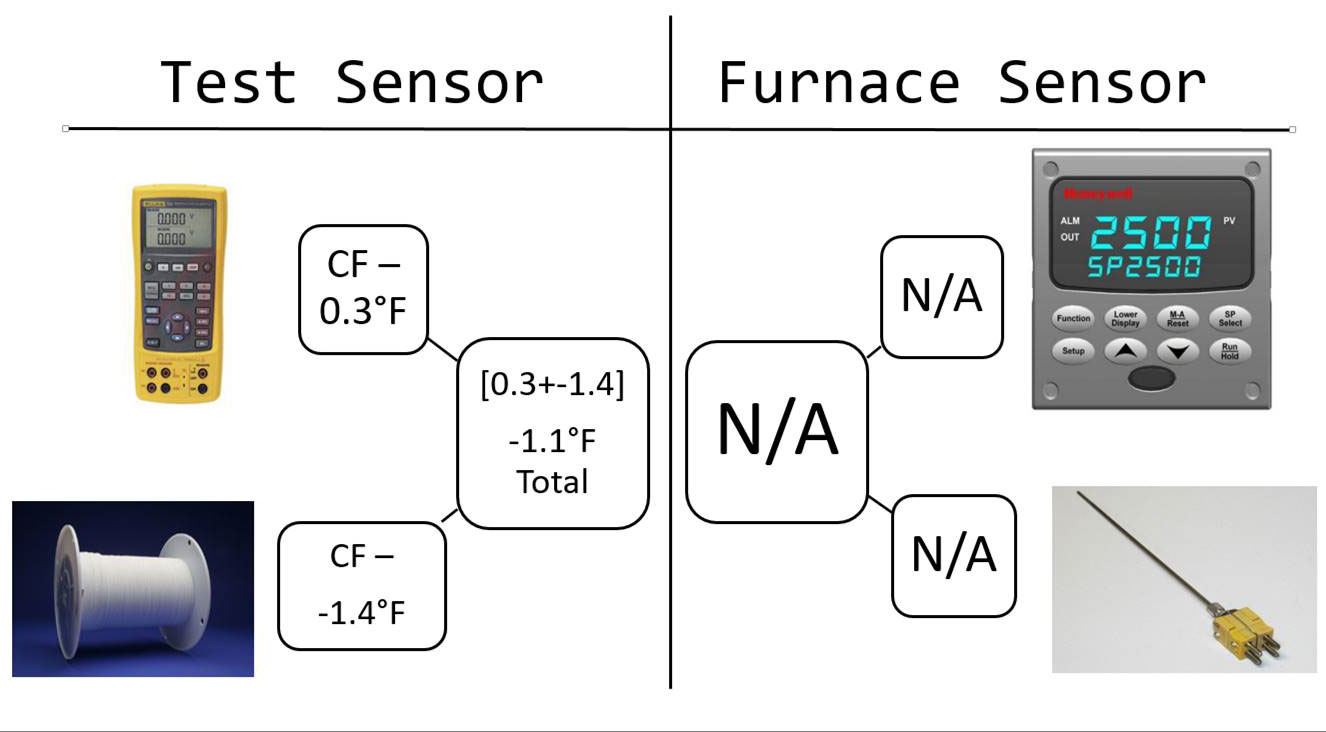
 

image-2

As an example, let’s consider a vacuum furnace which has had an SAT performed. The vacuum furnace is designated a Class 3 (±15°F) Type D furnace. Let’s assume no additional furnace thermocouples are employed and we are performing an SAT on the control and recording systems. The readings obtained are below in the picture.
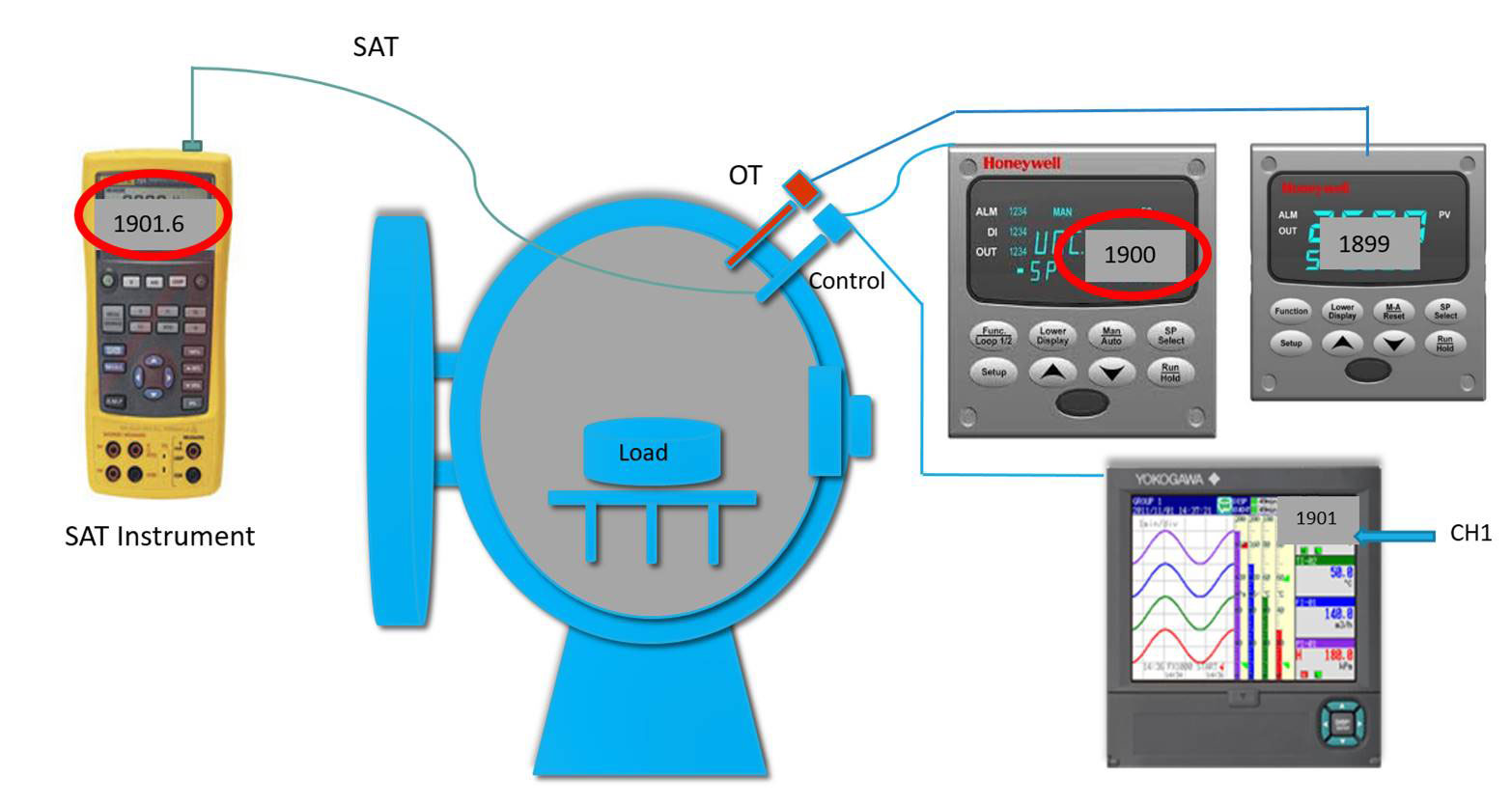
image-3


*The example above is not an SAT Certification. It’s an example of how to calculate the SAT Difference in a given situation.

Conclusion

SATs can be difficult depending on the equipment and processes suppliers have. As always, it’s important to receive comprehensive training regarding the specific requirements of System Accuracy Testing as they apply to your facility. There are many particular aspects of SATs that may not have been accounted for in this article. If you have specific questions, please email them to doug@heattreattoday.com, and I will answer them in an upcoming article.

Submit Your Questions

Please feel free to submit your questions, and I will answer appropriately in future articles.

Out next topic will focus on the requirements and execution of an Alternate SAT per AMS2750E, the requirements of AC7102/8 and the Pyrometry Guide.   


Q/A with Jason Schulz

Q: When calculating the SAT Difference, should I include the correction factors of the furnace sensor?

A: No, the correction factor from the furnace sensor is not to be included in the SAT Difference calculation.

Q: How do I account for an internal (pre-programmed) TUS offset within the controller when calculating the SAT Difference?

A: Internal or electronic TUS offset must be algebraically removed when calculating the SAT Difference.  Below is an example that includes an electronic TUS offset of -2°F.


sat-qa

Q: I operate a furnace with 2 load sensors. One of them is used to signal the start and end of each soak cycle, the other is reference only. Do I have to perform an SAT on the load thermocouple I use as a reference only thermocouple?

A: Any thermocouple that is not used as product acceptance may be deemed reference only and is not subject to the SAT requirements of AMS2750E. Nadcap requires that the reference only thermocouples be accounted for in internal procedures.

Q: When performing my bi-weekly SAT, I get a difference of +2.6°F on one test and two weeks later I get a difference of -3°F; this constitutes a spread (within two weeks) of 5.6°F. Would this be cause for SAT failure?

A: According to AMS2750E and Nadcap, no, this would not constitute a failed SAT, though is something to be cautious of. This type of shift in SAT results does reflect some sort of change or degradation of the system being tested. A well-established tack, in this case, is to plot SAT results as part of an SPC (statistical process control) program which will govern future replacement of system thermocouples and/or leadwire (in the case when large difference is SAT results over a pre-determined amount). A documented SPC system for SAT results would also satisfy the requirements of AC7102/8(NA) page 2, paragraph 3.12.

Jason Schulze on Understanding AMS 2750E — Standard SAT Description Read More »

NTSB: American Airlines Engine Failure Caused by Fatigue

BOTW-50w

Source: Airways Magazine


Gary Berwick, Dry Coolers

Special thanks goes to Gary Berwick of Dry Coolers, one of our first (and best) advertisers, for informing Heat Treat Today about the below article in Airways Magazine.


MIAMI — The National Transportation Safety Board (NTSB) issued and Investigative Update of American Airlines flight AA383, which caught fire on runway 28R at Chicago O’Hare International Airport after aborting its take-off.

The report states that the right engine number 2 stage high pressure turbine (HPT) disk failed and fractured into at least four pieces. A large disk fragment landed in a UPS warehouse located about 2,920 feet (890 meters) from the aircraft.

Read more about this failure in Airways Magazine.

NTSB: American Airlines Engine Failure Caused by Fatigue Read More »

Ampco-Pittsburgh Acquires ASW Steel Inc.


John Stanik CEO Ampco-Pittsburgh

John Stanik - CEO Ampco-Pittsburgh

Ampco-Pittsburgh said it would pay $3.5 million in cash and assume $9.6 million of the Welland, Ontario, company's liabilities. ASW will become a part of the Union Electric Steel Corp. division of Ampco-Pittsburgh. The manufacturing plant, with an electric arc furnace, is located close to the U.S.-Canadian border near Niagara Falls, N.Y., and Buffalo. It was founded in 1918 as the Dillon Crucible Steel Alloy Co. and was acquired by MMFX in 2010.

"This acquisition is a very important element in Ampco-Pittsburgh’s strategic diversification plan," said John Stanik, CEO of Ampco-Pittsburgh, in a statement. "ASW’s proven broad expertise in flexible steel refining methods will provide us with the capabilities to manufacture the additional chemistries needed to expand our reach in the open-die forging market. The transaction also enhances our ability to grow in markets in which we currently participate and to add new markets for customers in the oil and gas, power generation, aerospace, transportation, and construction industries.”

Ampco-Pittsburgh Acquires ASW Steel Inc. Read More »

AMRICC to Use Field-Enhanced Sintering Pilot Plant

The Applied Materials Research, Innovation and Commercialisation Company (AMRICC) is a high-technology center where advanced materials and processes will be fast-tracked into commercial products rapidly and economically – and at the same time scientists of the future will be developed to create a ‘talent pipeline.’

Focused on putting Stoke-on-Trent and Staffordshire at the heart of the global advanced materials economy, AMRICC’s research laboratory, pilot plant and educational facility will be used to channel the expertise and heritage in steel and ceramics within the region for a new generation.

The launch event, which took place at the Moat House Hotel in Festival Park, followed the official opening of the Ceramic Valley Enterprise Zone, with which AMRICC will be closely associated.

Dr Cathryn Hickey, AMRICC chief executive, said: “AMRICC offers the UK – and Stoke-on-Trent and Staffordshire in particular – a unique opportunity to become the world leader in the commercialisation of materials and materials process development.”

Traditionally, once a new material or process is discovered, bringing it to commercial use in the marketplace has taken up to 20 years or more.

This is quite an unbelievable time lag which can result in a host of missed opportunities for all involved.

In some cases the flow of innovation to fully commercialised products never happens and it’s this ‘valley of death’ which AMRICC will address.

AMRICC’s unique collaboration between academia and industry partners will help companies drive innovation to develop, manufacture and deploy advanced materials much faster and at a fraction of the cost.

This will enable new business models and approaches to collaboration to be achieved, and these will extend beyond the current open innovation concept.

Fully integrated solutions involving material innovation, as well as new process technology will enable unmet customer needs and new market challenges to be addressed.

With its state-of-the-art facilities, AMRICC will not only deliver commercialisation expertise, it will also be a centre of excellence for a number of exciting new disruptive technologies, which are on their way to market and are set to shake up current ways of working.

These areas include the development of unique encapsulation materials for drug abuse deterrent formulations, which are in significant market demand in the US.

And with the world’s first field-enhanced sintering pilot plant, which is a unique way of reaching extremely high temperatures very rapidly, AMRICC will be developing, with partners, a number of beneficial applications to bring to market.

These include thermal barrier coatings for the aerospace and automotive sectors as well as sensor technologies for the electronics industry.

But it’s not just about developing materials and technologies – at AMRICC we’re also proud to be developing people.

Working with some of the world’s leading universities, AMRICC will be delivering Master’s Degrees and PhDs to develop the ‘commercial technocrats’ of the future – materials scientists with both business acumen and a wide range of commercial and industrial experience.

AMRICC is being set up with the support of the international materials technology company Lucideon as well as Stoke-on-Trent City Council and the Stoke–on-Trent and Staffordshire Local Enterprise Partnership.

It will be initially based alongside Lucideon’s headquarters in Penkhull and, in future, is set to establish within the Ceramic Valley Enterprise Zone – to be developed on along the A500 corridor in Stoke-on-Trent and Newcastle under Lyme.

Dr Hickey added: “The launch of the Ceramic Valley Enterprise Zone and AMRICC today marks a significant and exciting day for the region.

In the future, we plan for AMRICC to be positioned within the Ceramic Valley Enterprise Zone where it will help to attract companies to the area, so it’s quite fitting that the company is launched today alongside the Enterprise Zone.

We look forward to working with our colleagues in the Ceramic Valley to drive the reputation of Stoke and Staffordshire in manufacturing and materials processing.

AMRICC to Use Field-Enhanced Sintering Pilot Plant Read More »

Nadcap 18 Month Merit Status for Heat Treating Awarded to Solar Atmospheres

Solar Atmospheres announces that it has been awarded Nadcap 18-month Merit status for Heat Treating at the Souderton, PA facility.

Solar Atmospheres in Souderton has held Nadcap accreditation since 1995, maintaining merit status for the majority of that time. Having demonstrated their ongoing commitment to quality by satisfying customer requirements and industry specifications, the Nadcap Task Group has determined that Solar Atmospheres has again earned this special recognition.

“Achieving Nadcap accreditation is not easy; it is one of the ways in which the aerospace industry identifies those who excel at manufacturing quality product through superior special processes. Companies such as Solar Atmospheres go above and beyond achieving Nadcap accreditation to obtain Merit status and they should be justifiably proud of it,” said Joe Pinto, Executive Vice President and Chief Operating Officer at the Performance Review Institute. “Benefiting from a less frequent audit schedule reduces audit costs and associated pressures and demonstrates the trust that the aerospace industry has in Solar Atmospheres based on their past performance in Nadcap audits. PRI is proud to support continual improvement in the aerospace industry by helping companies such as Solar Atmospheres be successful and we look forward to continuing to assist the industry moving forward.”

Nadcap 18 Month Merit Status for Heat Treating Awarded to Solar Atmospheres Read More »

HEAT TREAT BASICS: Hot Forging vs. Cold Forging — What’s the Difference?

BOTW-50w  Source:  Weldaloy

What exactly is the difference between hot forging and cold forging? Are there advantages to one over the other? In this article, we explain both the differences and the advantages of each method.

Read More:  Hot Forging vs. Cold Forging: What’s the Difference?

HEAT TREAT BASICS: Hot Forging vs. Cold Forging — What’s the Difference? Read More »

Weldaloy’s Aluminum Heat-treating Capacity Increased

On the heels of a recent expansion of their seamless rolled ring capabilities, Weldaloy continues to grow with the addition of a new low temperature aluminum aging oven. The new oven will increase Weldaloy’s aluminum heat-treating capacity.

Ovens created specifically for aluminum can reduce cycle times and increase productivity by optimizing temperature uniformity through adequate airflow. This translates to a better product that can be made in a repeatable recipe.

“We’re receiving more and more requests for large aluminum work, so we needed to add this low temperature aluminum aging oven to be able to increase our capacity and meet production needs. This addition will allow us to produce more parts in the same amount of time for our customers while maintaining quality,” said Kurt Ruppenthal, Vice President & General Manager at Weldaloy.

Many of the new opportunities for aluminum work have come from the oil and gas industry and the aerospace industry, as well as from the private space sector. Weldaloy recently achieved the AS9100C certification for their Quality Management System, which has opened the door for them to work with more aerospace companies that require certification of their suppliers.

“We look forward to continuing to grow our aluminum capabilities to meet the increase in demand,” said Ruppenthal.

Weldaloy’s Aluminum Heat-treating Capacity Increased Read More »

New MB Aerospace Technologies (Poland) to Focus on Heat Treating Processes

International aerospace engineering group MB Aerospace has completed the acquisition of Vac Aero (Poland) from its Canadian parent company Vac Aero International.

The business, which employs over 100 employees at two sites in Kalisz (central Poland) and Rzeszow (south-east Poland), specializes in providing protective and performance enhancing coatings for aero-engine and industrial gas turbine components. These OEM licensed and proprietary coatings provide wear, corrosion and heat resistance properties across performance critical compressor, combustor and turbine components. Since the company was founded in 2003, it has developed an extensive range of special process capabilities including heat treatment and vacuum brazing, vacuum carburizing, air plasma spray (APS) and high-velocity oxygen fuel (HVOF) protective coatings, as well as corrosion and oxidation resistant paint coatings. The former Vac Aero subsidiary will continue to serve key customers in Europe including UTC, Pratt & Whitney and Siemens.

The business will remain at its two current sites and will be immediately rebranded as MB Aerospace Technologies (Poland). In order to support the existing customer base and growing aerospace market in Eastern Europe, MB Aerospace is planning to invest across the business with particular focus on its surface coating services, including thermal and plasma coatings and a range of paint capabilities, as well as heat treatment and brazing processes.

Craig Gallagher, MB Aerospace chief executive officer, said: “We are delighted to acquire the Polish operations of Vac-Aero – now trading as MB Aerospace Technologies (Poland) – as its extensive range of capabilities and skilled employees will help us broaden our offering to existing customers and the expanding aerospace market in Poland and the surrounding industrial areas of Western and Eastern Europe.

“With thermal and plasma coating capabilities now available to us in the region, we can provide customers with fast, responsive lead times for aero-engine and industrial gas turbine component treatments, whilst mitigating the logistics, and cost, of shipping products long distances to have such critical work done.”

Dave Farmery, managing director of MB Aerospace Poland, added: “We have inherited a well-established and respected business in Poland with highly skilled employees and a wide range of customer approvals. Working closely with the existing team, we will invest heavily to provide the local market with the capabilities and capacity required to ensure customers continue to receive a world-class service.”

Tomasz Krążyński, General Manager, of MB Aerospace Technologies (Poland) said: “After more than a decade of growth and success under Vac-Aero we look forward to starting a new chapter within the MB Aerospace family of companies. The acquisition offers a fantastic opportunity for the business and the planned investment will help us establish ourselves as one of the premier providers of thermal processes and surface coating services in Europe.”

New MB Aerospace Technologies (Poland) to Focus on Heat Treating Processes Read More »

Safran Celebrates the Completion of 500th Landing Gear for Boeing 787 Dreamliner

Ajax, Ont, 12 September 2016

Safran Landing Systems announces the completion of the 500th landing gear set (nose and main landing gear) for Boeing 787 Dreamliner in its Canadian facility located in Ajax, Ontario.

Since being awarded with the contract in 2006, Safran Landing Systems has been responsible for the design, development, qualification, testing, manufacture and support of the Boeing 787 Dreamliner main and nose landing gear.

“This milestone is a testament to our commitment to technology and research,” said Deane Weatherby, VP, North American Programs at Safran Landing Systems. “Our Boeing 787 landinggear features a number of innovations in material technology aimed at reducing landing gear weight, corrosion and providing higher resistance to fatigue.”

Production activities for the 787 program are shared across Safran Landing Systems facilities in Canada, USA, China, France, Mexico and the UK. Final integration takes place at the company’s Everett, Wash. and Ajax facilities as well as its sister company Safran Electrical and Power site in Charleston, S.C., where the system components are integrated with the landing gear structure prior to delivery to Boeing’s final assembly lines in Seattle and Charleston. The 500th landing gear set is scheduled to be shipped to Boeing’s final assembly line in Seattle.

“This is a significant landmark for Safran Landing Systems,” said Deane Weatherby. “Since the launch of this program, more than 113 million passengers have flown on the 787 Dreamliner equipped with our landing gear. We are pleased to be a part of the Boeing 787 family and we look forward to our continued partnership.”

Safran Celebrates the Completion of 500th Landing Gear for Boeing 787 Dreamliner Read More »

Schafer Gear Works Transfers its Fort Wayne, Ind., Commercial Aviation Shafts and Small Gear Capabilities to South Bend, Ind.

Shafer Gear Works, Aerospace Heat Treat, Automotive Heat Treat, Medical Heat Treat, Manufacturing Heat TreatTo meet Schafer Gear Works’ growing demand for high-precision commercial aviation shafts and gears, the company recently moved its Fort Wayne, Ind., operations to its larger production facility in South Bend, Ind. “Acquisition of new, state-of-the-art equipment at our South Bend plant and the ability to better leverage our gear manufacturing expertise led to the transfer,” said Paresh Shah, operations manager for the South Bend facility. The transition was seamless and the plant now produces precision-critical shafts and small-diameter gears with tolerances to 0.0004” and microfinishes to 16 RMS.

Shah said moving the small-diameter gear production 90 miles west to Schafer Gear Works South Bend will improve design and manufacturing efficiencies as well as customer support. By centralizing the facility’s small- and medium-diameter gear engineering, production and quality control expertise, the company is expanding its presence in the aerospace and automotive industries as well as with medical instruments, light and heavy industrial products, recreation vehicles, and material handling companies. Its efforts to reduce tool costs and downtime keep pricing competitive and delivery among the fastest in the gear-making industry. Because of the South Bend facility’s continuous equipment improvements and stringent quality standards, it has earned ISO 9001-2008 and AS9100 certification.

Schafer Gear Works manufactures one of the widest ranges of custom-engineered, precision-cut gears for off-highway markets. In addition to the small-diameter gears and precision components, the South Bend plant produces 1.5- to 10-inch diameter spur, internal and helical gears as well as shafts.

Schafer Gear Works Transfers its Fort Wayne, Ind., Commercial Aviation Shafts and Small Gear Capabilities to South Bend, Ind. Read More »

Skip to content