

Karen Gantzer

Merry Christmas from Heat Treat Today

What does heat treating have to do with Christmas? Beyond providing heat in a time of winter chill for the northern hemisphere and playing a role in the manufacturing of many gifts under the Christmas tree this week, it’s not an easy correlation to make. Similar to the dilemma of some of the lesser-known Christmas carols.

For example, what is a Wenceslas, and why do we sing about it at Christmas time? What is it about this jaunty little tune by John Mason Neale that has earned it a place in the Christmas carol repertoire as well as in the hearts of many for the past 160 years—even though not a word about Christmas is mentioned anywhere in the lyrics?

Good King Wenceslas

Good King Wenceslas looked out
On the feast of Stephen,
When the snow lay round about,
Deep and crisp and even.
Brightly shown the moon that night,
Though the frost was cruel,
When a poor man came in sight, 
Gathering winter fuel.

Let’s start with when the event of this ballad-narrative took place to answer that dilemma about Christmas not even being referenced in the lyrics. “The feast of Stephen” refers to St. Stephen’s Day, the day after Christmas in the liturgical calendar, also known as Boxing Day in Great Britain—traditionally a day on which good deeds are done and gifts are given by the noble classes to tradespeople and servants in the name of the Christ child. Furthermore, the story about Good King Wenceslas is over 1,000 years old and yet still contains much to intrigue the mind and the heart even to this day.

Wenceslas was thirteen when his father, the Duke of Bohemia, died in 921 A.D., although he had already been under the care of his grandmother, Ludmila, who taught him the faith and instilled in him a desire to be as much like his Savior as possible. As the song indicates, he was a good, honest, and strongly principled man, taking seriously the charge to live out his faith in practical ways for the good of those around him. Thus, here on this bitter night of St. Stephen’s feast, when Wenceslas sees a poor man out gathering wood for his fire, his heart goes out to him and he questions his page as to the identity of the man.

Hither, page, and stand by me.
If thou know it telling:
Yonder peasant, who is he?
Where and what his dwelling?
Sire, he lives a good league hence,
Underneath the mountain,
Right against the forest fence
By Saint Agnes fountain.

Appalled that the man was so far from home collecting fuel to keep his hovel warm, and would have “a good league” to go to get home, Wenceslas springs into action.

Bring me flesh, and bring me wine.
Bring me pine logs hither.
Thou and I will see him dine
When we bear them thither.
Page and monarch, forth they went,
Forth they went together
Through the rude wind’s wild lament
And the bitter weather.

As Duke and page trudge through the drifts, each step made more laborious than the one before by “the rude wind’s wild lament,” what Wenceslas hears rising on the gusts is his servant’s own lament.

Sire, the night is darker now, 
And the wind blows stronger.
Fails my heart, I know not how.
I can go no longer.

“Fails my heart, I know not how. I can go no longer.” A common cry in hearts around the world. Perhaps in yours, or in the hearts of family, or friends, or employees, colleagues, or customers.

Mark my footsteps, my good page, 
Tread thou in them boldly:
Thou shalt find the winter’s rage
Freeze thy blood less coldly.

Look, says Wenceslas, at the path I have marked out for you. Keep to the footsteps I have made, falling neither to the right nor to the left. You can boldly press on, he tells his servant, and the very chill of the dark night will be lessened.

In his master’s step he trod, 
Where the snow lay dented.
Heat was in the very sod
Which the saint had printed.

The page’s very salvation that night depended upon the life-giving warmth from his master’s passage ahead of him. This is how it is with us, for “in Christ, we live and move and have our being.” (Acts 17:28) Neale’s closing words give the charge to all those who would be like Wenceslas:

Therefore, Christian men, be sure, 
Wealth or rank possessing,
Ye who now will bless the poor
Shall yourselves find blessing.

Wenceslas’s reign was short, but one that is recalled every year at Christmas time when we sing of his deeds. His example of selfless leadership and compassionate, dignifying regard for those not as fortunate as he provides a worthy model for all as we look toward a new year. The babe who came that Christmas night many years ago has also marked out a way for us. It is our Christmas wish at Heat Treat Today that you follow the Man that babe became.

Merry Christmas from the Heat Treat Team!

We will be celebrating the holidays with family, so look for your next Heat Treat Today e-newsletter on January 2!

Merry Christmas from Heat Treat Today Read More »

16 Quick Heat Treat News Chatter Items to Keep You Current

Heat Treat Today offers News Chatter, a feature highlighting representative moves, transactions, and kudos from around the industry.

Personnel & Company Chatter

  • Global aluminum producer Constellium SE recently announced that its casting and rolling operations in Singen, Germany, will offer ASI-certified aluminum rolled solutions, having been granted the chain of custody certification by the Aluminium Stewardship Initiative (ASI).
  • An insulated metal panel manufacturing company was recently acquired by Nucor Corporation. TrueCore LLC, with a facility in Laurens, South Carolina, produces insulated metal panels serving the cold storage market, with future plans for additional commercial and industrial applications.
  • Michael K. Smith has joined Magnetic Specialties, Inc., as the company’s business development manager.
  • Leon J. Topalian and John H. Walker have been elected by the board of directors of Nucor Corporation as a director and non-executive chairman, respectively. Topalian is the president and COO of Nucor and will become the CEO on January 1, 2020. Walker, who has more than 35 years of experience in metal-related manufacturing and fabricating industries, has served as a member of Nucor’s Board of Directors since 2008 and as lead director since 2017.
  • Don P. Newman will join Allegheny Technologies Incorporated as senior vice president, finance and chief financial officer, effective January 6, 2020. Newman succeeds Pat DeCourcy, who will remain as senior vice president and special advisor to the CEO until his retirement on March 31, 2020, after a 31-year career with the company.
  • Mike Otero has been appointed chief operating officer of Braidy Industries, effective January 6, 2020.
  • GFG Alliance, owned by British commodities tycoon Sanjeev Gupta, recently reached an agreement to purchase the Duffel aluminum plant in Belgium from Novelis.
  • James K. Kamsickas has recently been elected president and CEO of Dana Incorporated. The board of directors elected Kamsickas to the additional post of chairman of the board. In addition, Keith E. Wandell, who has served on Dana’s board since July 2008 and as non-executive chairman since September 2016, will continue on the board as lead independent director.
  • The acquisition of Essar Steel India Ltd (ESIL) has reached completion. ArcelorMittal in a joint venture with Nippon Steel Corp. completed the acquisition. The venture, hereby called ArcelorMittal Nippon Steel India Ltd. (AM/NS India) will own and operate ESIL.
  • To support rapid growth within their mechanical testing department, Solar Atmospheres of Western Pennsylvania has recently invested in a new Haas ST-10 CNC lathe.
  • A new special walk-in oven, No. 942, from Grieve Corporation, is currently being used for curing epoxy at the customer’s facility.
  • An Ecomelt-PS150 melting furnace and two tiltable holding and casting furnaces have been supplied to Otto Fuchs KG and installed in the company’s Meinerzhagen casthouse by Hertwich Engineering, a company of SMS group.
  • A new rotary furnace for recycling aluminum scrap was recently started at the Villadangos, Spain, facility of Latem Aluminium. The new 30-ton furnace was designed by GHI Smart Furnaces.
  • Process Cooling Systems Inc was recently chosen along with 15 other companies to receive the Sixteenth Annual Team Massachusetts Economic Impact Award. MassEcon, the state’s private sector partner in promoting business growth in Massachusetts, recognized the sixteen companies for their outstanding contributions to the Massachusetts economy. The companies were selected on the basis of job growth, facility expansion, investment, and community involvement since January 1, 2018. The winners were honored at a luncheon on November 26, 2019.

    Paulo announces that three of its facilities have been awarded Gulfstream approval
  • Paulo announces that three of its facilities have been awarded Gulfstream approval following on-site audits in St. Louis, Cleveland, and Kansas City. The scope of the approval encompasses several Gulfstream specifications for various materials and processes. Paulo is approved for GAMPS 5101, 5102, 5103, 5104, 5105. Paulo’s Cleveland facility was also approved for hot isostatic pressing and furnace brazing.
  • LAI International marks its 40-year anniversary as a global leader in advanced manufacturing technologies for the aerospace, defense, medical, and industrial sectors. Founded in 1979 as a regional contract manufacturer specializing in laser welding and laser heat-treating processes, the company expanded its capabilities with proprietary waterjet machining, laser drilling, and additive manufacturing capabilities. Over the years, LAI has manufactured highly engineered components for some of the world’s leading innovators, including Lockheed Martin, Northrup Grumman, and GE.

Heat Treat Today is pleased to join in the announcements of growth and achievement throughout the industry by highlighting them here on our News Chatter page. Please send any information you feel may be of interest to manufacturers with in-house heat treat departments especially in the aerospace, automotive, medical, and energy sectors to editor@heattreattoday.com

16 Quick Heat Treat News Chatter Items to Keep You Current Read More »

Titanium-Copper Alloy May Improve 3D Process for Medical, Aerospace Applications


Source: Today’s Medical Developments


A new category of high-performance titanium-copper alloys for 3D printing is being considered for medical device, aerospace, and defense applications, and heat-treating may improve the process further.

In a collaborative project, leading researchers from RMIT University, CSIRO, the University of Queensland, and The Ohio State University studied the problem of titanium alloys being prone to cracking or distortion due to cooling and bonding together in column-shaped crystals during the 3D printing process. But a titanium-copper alloy developed by the research team seems to have solved this dilemma.

“Of particular note was its fully equiaxed grain structure,” said Professor Mark Easton from RMIT University’s School of Engineering in Today’s Medical Developments. “This means the crystal grains had grown equally in all directions to form a strong bond, instead of in columns, which can lead to weak points liable to cracking. Alloys with this microstructure can withstand much higher forces and will be much less likely to have defects, such as cracking or distortion, during manufacture.”

More from this Best of the Web:

CSIRO Senior Principal Research Scientist, Dr. Mark Gibson, says their findings also suggest similar metal systems could be treated in the same way to improve their properties.

“Titanium-copper alloys are one option, particularly if the use of other additional alloying elements or heat treatments can be employed to improve the properties further,” Gibson says. “But there are also a number of other alloying elements that are likely to have similar effects. These could all have applications in the aerospace and biomedical industries.”


Read more: “Adding Copper Strengthens 3D-Printed Titanium”

Main photo credit / caption: RMIT University / 3D-printed titanium-copper bars with titanium powder and copper powder.

Titanium-Copper Alloy May Improve 3D Process for Medical, Aerospace Applications Read More »

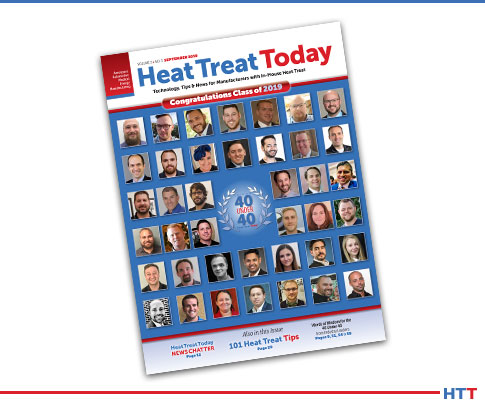
The Class of 2019 40 Under 40: Meet Neal Conway & David Cunningham

Heat Treat Today is privileged to oversee the 40 Under 40 recognition awards, highlighting a group of young, up-and-coming talent in the North American heat treat industry every year. This year’s Class of 2019 is no disappointment, a group of industry elite, significant contributors to the heat treat market.

Every couple of weeks we highlight two of the current class of recipients. This week we introduce Neal Conway of DELTA H TECHNOLOGIES and David Cunningham of L&L Special Furnace Co., Inc.


Name: Neal Conway

Company: DELTA H TECHNOLOGIES

Position: Senior Contract Specialist

Neal is a passionate professional who has been instrumental in the rapid growth of DELTA H TECHNOLOGIES, LLC. As a second-generation member of a family business, having grown up around the heat treating industry, Neal has been exposed to and mastered the wide variety of technical disciplines necessary to be successful in this unique field. Over the past 10 years, Neal has managed multiple and extensive concurrent projects. He is a natural and charismatic leader, and his customer/detail-oriented approach has made him a vital, highly respected member of DELTA H’s talented team. Currently, Neal oversees industrial sales and contracts along with product support and technical services.  Neal holds a BA in Business Administration and Management from Ohio University.

Nominated by: DELTA H TECHNOLOGIES


Name: David Cunningham

Company: L&L Special Furnace Co., Inc.

Position: Process & Mechanical Design

As L&L’s front-line heat treating furnace engineer, David has a strong work ethic and an innate ability to learn and communicate his knowledge to his co-workers and to the company’s customers. He is always willing to learn new processes and to revise previous generations of designs to current applications. David has become an expert in interpreting codes such as AMS2750E and NFPA 86 to continuously improve L&L’s furnace, oven, and quench tank designs for the modern industrial environment.

Nominated by: L&L Special Furnace Co., Inc.


Read more about the feature at Heat Treat Today’s 40 Under 40 resource page and find out more about each of this year’s winners by clicking on their image. To nominate someone for the Class of 2020 40 Under 40, please click here.

The Class of 2019 40 Under 40: Meet Neal Conway & David Cunningham Read More »

Steel Dynamics Expands Rolling Mill, Includes 3-MW Induction Furnace

A steel producer based in Fort Wayne, Indiana, recently announced the expansion of their rolling mill, which will include a 3-MW induction furnace to heat the stock coming from the existing mill.

Steel Dynamics USA announced the expansion at their Columbia City, Indiana, location. Among other equipment being added are a 70-m conveyor connecting the existing medium section mill to the new spooler line, six housingless SHS 180 roller stands, complete with quick stand-changing table, a 6-pass Delta-type finishing block driven by a low-voltage- 2.5-MW motor and finishing services.

SDI and Danieli teams studied a temporary removable solution, steel support structure to support the existing furnace-exit roller table, allowing the execution of the Billet Welder concrete foundation with only minor impact to the MSM (Medium Section Mill) production schedule.

Steel Dynamics Expands Rolling Mill, Includes 3-MW Induction Furnace Read More »

PA Heat Treater Completes Brazing/Assembly Room

A western Pennsylvania heat treat provider recently completed construction of a new brazing and assembly room, built primarily to accommodate a large aluminum brazing project for a specific customer.

Bob Hill, president of Solar Atmospheres of Western PA

Solar Atmospheres of Western PA, based in Hermitage, Pennsylvania, stated that the room will also be used for other brazing and assembly work.

“During successful development and prototype runs, our customer, along with Solar management, understood that in order to bring this critical aluminum brazing project to full production a separate braze/assembly room would be needed,” said Bob Hill, president of Solar Atmospheres of Western PA. “We worked together with our customer to develop the best space that is in close proximity to the vacuum furnace being utilized.”


Main photo credit/caption: Solar Atmospheres / The inspection of critical braze joints being analyzed within Solar’s newly constructed Braze-Assembly room.

PA Heat Treater Completes Brazing/Assembly Room Read More »

Heat Treat Tips: Maximizing Carbon Probe Life

One of the great benefits of a community of heat treaters is the opportunity to challenge old habits and look at new ways of doing things. Heat Treat Today’s 101 Heat Treat Tips is another opportunity to learn the tips, tricks, and hacks shared by some of the industry’s foremost experts.

For Heat Treat Today’s latest round of 101 Heat Treat Tipsclick here for the digital edition of the 2019 Heat Treat Today fall issue (also featuring the popular 40 Under 40).

Today’s Technical Tuesday features a tip from Jim Oakes of Super Systems, Inc,  covering Probes. Jim's tip suggests some fundamental procedures that should be performed properly to maximize carbon/oxygen probe life.

If you have a heat treat-related tip that would benefit your industry colleagues, you can submit your tip(s) to doug@heattreattoday.com or editor@heattreattoday.com.

Jim Oakes, Super Systems, Inc

Are you not getting the life that you would expect from your carbon/oxygen probe? There are some fundamental procedures that should be performed properly to maximize probe life.

1. Clean reference air. The probe needs a fresh source of air provided in the reference air fitting to ensure that the partial pressure of air is consistent. This will provide accuracy in the carbon calculation, and assuming the air does not contain any contaminates, it will lead to longer life under normal use.

2. Proper burnoff procedures. Make sure that you follow the manufacturer's recommendation on probe burnoff. Frequency and duration are dependent on the application (temperature, atmosphere, cycle time, and furnace), but regardless of these, ensuring a probe burnoff's effectiveness can be measured by watching what happens during the burnoff.

a. Probe mV. The probe mV is the best indication that a burnoff is effectively performed. Soot deposition occurs in two critical locations: the annular space between the sheath and the measuring surface, and at the measuring junction between the zirconia and the contact point with the sheath, which is the measuring electrode. The burnoff is performed to remedy this. Burnoff air is forced down the probe on the inside of the sheath but the outside of the probe substrate to force any buildup of soot/carbon on the probe where it can cause electrical connection issues and attack the probe sheath or create a carbon ring internal to the probe. By watching the mV during the burnoff, you should see them drop to 200mV or below during the burnoff process. This information will provide evidence that the burnoff is effective. If you are not getting the mV below that value, then there is not enough air flowing through the airway to force out any soot. Reasons could be:

i. The burnoff pump is not providing enough flow (Super Systems Inc.-SSI recommends 10 scfh or greater.).

ii. The pressure/agitation of the furnace is greater than what the burnoff pump can provide. If the burnoff pump is sized properly and properly working, the timing of the burnoff may need to occur when there is a relief in pressure (inner door opens) or temporarily turning the fan off during the burnoff.

iii. The probe has already been sooted up and should be evaluated for a carbon ring and blockage in that airway.

b. Assuming you have a thermocouple in the tip of the probe, you can monitor the temperature. If the tip superheats, it can damage the tip and in some cases oxidize the tip of the probe. The probe tip should not exceed the furnace temperature by more than 100 degrees.

3. Frequency is dependent upon the environment the probe is exposed to. At the least, SSI recommends performing a burnoff once a day but will suggest increasing that based on the atmosphere setpoint, use of stop-off paint, and length of heat treat cycles. Avoid a frequency of fewer than 6 hours if possible. The duration of the burnout should not exceed 90 seconds. A good way to measure the effectiveness is based on the mV reading dropping below 200.

Heat Treat Tips: Maximizing Carbon Probe Life Read More »

Nippon Light Metal North America Inc. & ITOCHU Metals Corporation Launch Joint Venture in Georgia


Source: Light Metal Age


Nippon Light Metal North America Inc. and ITOCHU Metals Corporation have launched a joint venture to construct an aluminum forging plant in Adairsville, Georgia, for the manufacturing of aluminum automotive parts.

The two Japanese metals companies began construction on this new facility in an effort to meet the demand for lighter-weight vehicles.

An excerpt:

“As tighter environment[al] regulations are implemented around the world and the need for lighter-weight vehicles grows, it is expected that demand for aluminum products will also expand further in North America. In establishing a new facility in North America, Nippon Light Metal is aiming to strengthen its global supply structure by drawing on ITOCHU Metals’ business experience and network.”


Read more: “Nippon Light Metal Georgia to Build Automotive Aluminum Forging Plant”


Nippon Light Metal North America Inc. & ITOCHU Metals Corporation Launch Joint Venture in Georgia Read More »

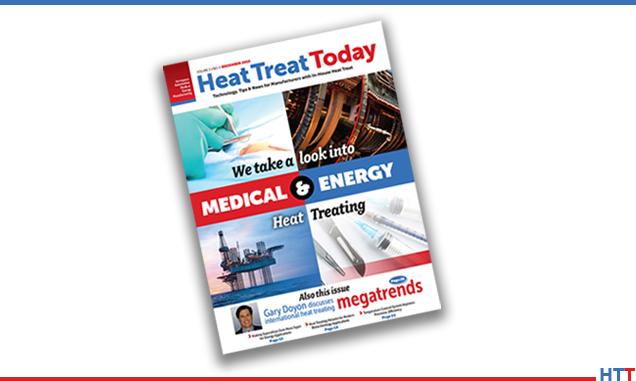
Heat Treat Today Launches Live Link to Digital Edition of 2019 Medical/Energy Heat Treat Issue

Heat Treat Today has launched Medical & Energy Heat Treating special edition in print and digital form, the fifth print magazine and the third in a series of industry-specific quarterlies.

The print edition of Medical & Energy Heat Treating entered the mail stream mid-December and landed in the mailboxes of 6,000 medical and energy manufacturing suppliers and OEMs. The digital edition is available by clicking here.

In this special magazine, Heat Treat Today delivers quality content both new and original as well as a round-up of past medical- and energy-related news, technical articles, and tips, including:

  • “Medical Alloys: Their Uses & Heat Treatments” / Diagnostic guidewires, minuscule screws for implants, complex surgical tools operated robotically, and the sophisticated metals and alloys used in their development.
  • Making Superalloys Even More Super for Energy Applications
  • “Heat Treating Melanin for Modern Biotechnology Applications” / Developing an annealing process for eumelanin, an electrically conductive type of melanin.
  • “Temperature Control System Improves Precision, Efficiency on Heat Treat Equipment: A Case Study” / A century-old die-forgings producer’s journey of improving its temperature process control system.
  • “Megatrends with Gary Doyon” / During a wide-ranging conversation, Gary Doyon, president and CEO of the Inductotherm Group, discusses international heat treating megatrends, as well as cybersecurity, immigration, the impact of electric vehicles on the heat treat supply chain, and Brexit.

If you haven’t done so already, you might want to join one of Heat Treat Today’s LindedIn Groups: “Leaders in Medical Heat Treat” and “Leaders in Energy Heat Treat“.  You’ll need to sign in to LinkedIn before you can join the group.

Go here for the digital edition, or go to www.heattreattoday.com and click on the Resources tab to link to the Digital Edition.


Heat Treat Today Launches Live Link to Digital Edition of 2019 Medical/Energy Heat Treat Issue Read More »

Publisher’s Page: Infinite Energy from the Earth

Heat Treat Today publishes four print magazines a year, and included in each is a letter from the publisher, Doug Glenn. This letter first appeared in Heat Treat Today‘s Medical & Energy Heat Treating magazine, December 2019


Doug Glenn, Publisher, Heat Treat Today

The fingers of heat treat reach into nearly every area of our life. Some of the effects of heat treating are obvious, like the landing gear on an airplane that is able to take repeated high-impact landings without snapping in two. There are other effects of heat treating that are not as obvious but are no less important. Take for example the amazing things that go on inside that same airplane’s jet engines at super-high temperatures and super high stress and strain levels. The jet engine is a modern marvel usually taken for granted by millions of travelers each day.

Graphene has the potential of being able to transport heat from the core of the
earth to the surface with essentially zero losses.

Some of the effects of heat treating are mundane. One of my favorite examples of a very practical and understandable heat treatment is the annealing process for aluminum foil. “Why is it,” I ask, “that you are able to bend this thin sheet of metal and yet it doesn’t shatter, break, or even crack?” Answer: heat treat–specifically, foil annealing.

In this issue, we take a look as some rather fascinating heat treatments in the medical and energy industries. It’s not that these two industries have anything to do with each other; they really don’t. In fact, much of what is done in the medical industry is done in vacuum furnaces in cleanroom settings. Energy heat treatments, on the other hand, can be done in a vacuum, especially when stainless steels or other more exotic materials are used (think nuclear reactors), or they can be done in the down and dirty atmosphere furnaces and oil quench tanks. But they are both heat treat-intense industries and both worthy of some attention–thus we’ve combined them into one issue.

Pulling Energy from the Earth’s Core

One of the more fascinating “heat treat” applications is the emerging possibility of being able to extract what appears to be an infinite supply of energy from the earth’s core using a material that will transfer the energy from the core to the surface with essentially zero losses. The material capable of doing this is graphene, and the graphene is currently made in vacuum furnaces. In fact, there are a number of vacuum furnace companies in the heat treat industry that are dabbling in this field.

The ability to extract energy from the core of the earth with essentially zero losses is the focus of the Limitless Energy Graphene Project headed by Manoj Bhargava and Ravi Sajwan. These gentlemen propose to transfer energy from roughly 4.5+ miles below our feet to the surface by using graphene, which is 100-times better at conducting than copper, lighter than air, and stronger than steel.

It transfers heat ultra-efficiently. According to Mr. Sajwan, if you apply 100°F to one end of a graphene pathway, you’ll instantly get 100°F heat at the other end of the pathway, but the middle of the pathway will remain perfectly cool. What they’re describing is 100% heat transfer with zero transmission losses. And according to Mr. Bhargava, you can go 10 feet or 10 miles, and the result is the same.

The temperature 4.5 miles below our feet ranges anywhere from 1,000°F to 7,000°F. Imagine being able to dig just deep enough to reach temperatures capable of boiling water and bring those temperature to the surface to fuel electricity-creating, steam-powered turbines.

Graphene is an atomic-scale hexagonal lattice made of carbon atoms.

If you’re not familiar with graphene, go to “The Google” and search for “What is graphene?” You’ll have no problem finding many explanations. I suggest looking for a short video from the University of Manchester.

CLICK HERE to be taken to an amazing YouTube video entitled, “5 Amazing Renewable Energy Ideas & Solutions for the Future.” HTT

Publisher’s Page: Infinite Energy from the Earth Read More »

Skip to content