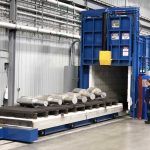
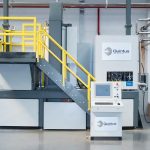
Solar Atmospheres of Western PA (SAWPA) will expand their material hardening repertoire by adding vacuum oil quench (VOQ) capabilities. The decision to go with a vacuum oil quench was influenced by serious concerns for the environmental and furnace operator safety. The Safety & Health Achievement Recognition Program (SHARP) provides standards for health and safety, some of which caused Solar Atmospheres to question heat treating processes that utilize explosive endothermic gases and flammable open oil quench tanks. As a result of these concerns, Solar Manufacturing and Solar Atmospheres commenced engineering meetings in 2019 to design and build a US-manufactured, safe and quality VOQ.
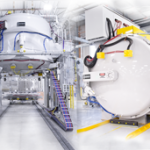
Solar Atmospheres Vacuum Oil Quench Furnace (Photo source: Solar Atmospheres)
Early this week, Bob Hill, president, SAWPA, Hermitage, PA, announced that the company had purchased and will install a new 36” x 36” x 48” VOQ furnace capable of safely quenching 2,000-pound loads without carbon potential concerns. The furnace, the first of its kind manufactured by Solar Manufacturing, Sellersville, PA, will be operational in early 2021.
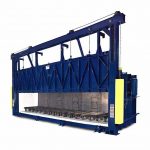
Additionally, SAWPA is constructing a 15,000 square foot building to make room for the VOQ furnace line. Besides the VOQ furnace, the line also includes a parts washer, two tempering furnaces, and a charge car. The building expansion will be completed mid-summer 2020 making the entire SAWPA complex 120,000 square feet under one roof.
Heat TreatToday offers News Chatter, a feature highlighting representative moves, transactions, and kudos from around the industry.
Personnel & Company Chatter
Global aluminum producer Constellium SE recently announced that its casting and rolling operations in Singen, Germany, will offer ASI-certified aluminum rolled solutions, having been granted the chain of custody certification by the Aluminium Stewardship Initiative (ASI).
An insulated metal panel manufacturing company was recently acquired by Nucor Corporation. TrueCore LLC, with a facility in Laurens, South Carolina, produces insulated metal panels serving the cold storage market, with future plans for additional commercial and industrial applications.
Michael K. Smith has joined Magnetic Specialties, Inc., as the company’s business development manager.
Leon J. Topalian and John H. Walker have been elected by the board of directors of Nucor Corporation as a director and non-executive chairman, respectively. Topalian is the president and COO of Nucor and will become the CEO on January 1, 2020. Walker, who has more than 35 years of experience in metal-related manufacturing and fabricating industries, has served as a member of Nucor’s Board of Directors since 2008 and as lead director since 2017.
Don P. Newman will join Allegheny Technologies Incorporated as senior vice president, finance and chief financial officer, effective January 6, 2020. Newman succeeds Pat DeCourcy, who will remain as senior vice president and special advisor to the CEO until his retirement on March 31, 2020, after a 31-year career with the company.
Mike Otero has been appointed chief operating officer of Braidy Industries, effective January 6, 2020.
GFG Alliance, owned by British commodities tycoon Sanjeev Gupta, recently reached an agreement to purchase the Duffel aluminum plant in Belgium from Novelis.
James K. Kamsickas has recently been elected president and CEO of Dana Incorporated. The board of directors elected Kamsickas to the additional post of chairman of the board. In addition, Keith E. Wandell, who has served on Dana’s board since July 2008 and as non-executive chairman since September 2016, will continue on the board as lead independent director.
The acquisition of Essar Steel India Ltd (ESIL) has reached completion. ArcelorMittal in a joint venture with Nippon Steel Corp. completed the acquisition. The venture, hereby called ArcelorMittal Nippon Steel India Ltd. (AM/NS India) will own and operate ESIL.
Equipment Chatter
To support rapid growth within their mechanical testing department, Solar Atmospheres of Western Pennsylvania has recently invested in a new Haas ST-10 CNC lathe.
A new special walk-in oven, No. 942, from Grieve Corporation, is currently being used for curing epoxy at the customer’s facility.
An Ecomelt-PS150 melting furnace and two tiltable holding and casting furnaces have been supplied to Otto Fuchs KG and installed in the company’s Meinerzhagen casthouse by Hertwich Engineering, a company of SMS group.
A new rotary furnace for recycling aluminum scrap was recently started at the Villadangos, Spain, facility of Latem Aluminium. The new 30-ton furnace was designed by GHI Smart Furnaces.
Kudos Chatter
Process Cooling Systems Inc was recently chosen along with 15 other companies to receive the Sixteenth Annual Team Massachusetts Economic Impact Award. MassEcon, the state’s private sector partner in promoting business growth in Massachusetts, recognized the sixteen companies for their outstanding contributions to the Massachusetts economy. The companies were selected on the basis of job growth, facility expansion, investment, and community involvement since January 1, 2018. The winners were honored at a luncheon on November 26, 2019.
Paulo announces that three of its facilities have been awarded Gulfstream approval
Paulo announces that three of its facilities have been awarded Gulfstream approval following on-site audits in St. Louis, Cleveland, and Kansas City. The scope of the approval encompasses several Gulfstream specifications for various materials and processes. Paulo is approved for GAMPS 5101, 5102, 5103, 5104, 5105. Paulo’s Cleveland facility was also approved for hot isostatic pressing and furnace brazing.
LAI International marks its 40-year anniversary as a global leader in advanced manufacturing technologies for the aerospace, defense, medical, and industrial sectors. Founded in 1979 as a regional contract manufacturer specializing in laser welding and laser heat-treating processes, the company expanded its capabilities with proprietary waterjet machining, laser drilling, and additive manufacturing capabilities. Over the years, LAI has manufactured highly engineered components for some of the world’s leading innovators, including Lockheed Martin, Northrup Grumman, and GE.
Heat TreatToday is pleased to join in the announcements of growth and achievement throughout the industry by highlighting them here on our News Chatter page. Please send any information you feel may be of interest to manufacturers with in-house heat treat departments especially in the aerospace, automotive, medical, and energy sectors to editor@heattreattoday.com
A western Pennsylvania heat treat provider recently completed construction of a new brazing and assembly room, built primarily to accommodate a large aluminum brazing project for a specific customer.
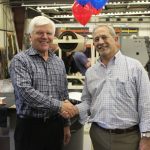
Bob Hill, president of Solar Atmospheres of Western PA
Solar Atmospheres of Western PA, based in Hermitage, Pennsylvania, stated that the room will also be used for other brazing and assembly work.
“During successful development and prototype runs, our customer, along with Solar management, understood that in order to bring this critical aluminum brazing project to full production a separate braze/assembly room would be needed,” said Bob Hill, president of Solar Atmospheres of Western PA. “We worked together with our customer to develop the best space that is in close proximity to the vacuum furnace being utilized.”
Main photo credit/caption: Solar Atmospheres / The inspection of critical braze joints being analyzed within Solar’s newly constructed Braze-Assembly room.
Heat TreatTodayoffers News Chatter, a feature highlighting representative moves, transactions, and kudos from around the industry.
Personnel & Company Chatter
A leading provider of metal and carbon fiber 3D printers, Markforged, recently announced the opening of a new manufacturing facility in Billerica, Massachusetts. The 25,000 square-foot space will enable the company to more than double its production capacity, support increased demand for Markforged 3D printers, and create new jobs.
Rodrigo Belloc has been appointed the president of Gerdau Special Steel North America, Jackson, Mich. He replaces Mark Marcucci, who is retiring from his position after 28 years with the company and 43 in the steel industry. Previously, Belloc was CEO of Gerdau Diaco in Colombia and Gerdau Metaldom in the Dominican Republic.
Allied Mineral Products opened the doors to its newest precast shapes manufacturing facility near Johannesburg, South Africa. This marks Allied’s sixth precast shapes location worldwide.
Vorteq Coil Finishers LLC, a provider of coil coating services for metal products, recently acquired the assets of California-based Western Metal Decorating, which produces coated aluminum and steel products serving pre-painted markets. As part of the transaction, the Western operation will be renamed Vorteq Pacific LLC.
Leica Microsystems is delighted to announce a new UK partnership with Struers Ltd., the UK’s leading manufacturer of equipment, consumables, and services for materialographic analysis. Leica microscopes, accessories, and imaging products specifically designed for industrial and material analysis applications will now also be available from Struers Ltd. in the UK.
Getec Industries added friction stir welding (FSW) services to its Thermal Solutions division in Torrance, California. The new capabilities will enable the company to supply large extruded aluminum heat sinks to the electronics industries.
Equipment Chatter
Inductotherm Heating & Welding recently announced the successful commissioning of a new Thermatool 250kW CFI welder to GRC LLC.
Kudos Chatter
MTI recently recognized three Solar employees for their commitment to MTI. On October 5, Bob Hill, President of Solar Atmospheres of Western PA, was honored with the prestigious M. Lance Miller Legend Award, in recognition of his leadership and lifetime commitment to the heat treating industry and MTI. Hill’s heat treating career began in 1980 when he joined Precision Heat Treating, Inc. as Vice President. Hill moved on to Solar Atmospheres of Souderton PA in 1995. Within five years, Hill was promoted to President, to head Solar’s newest venture 370 miles away in Western PA. In addition to Hill’s involvement with MTI, two other employees from the Solar Family of Companies—Patrick Reilly and John Hahn—are recent graduates from YES, MTI’s Leadership Training Program
Innovation Leader awards recently went to SECO/WARWICK for the third time. The “Business Leader” event is a prestigious competition. The jury gives awards to the companies distinguished by their transparency and business honesty with innovative successes as their trademarks. On October 28, 2019, at the prestigious gala, Katarzyna Sawka, Global Group Marketing Director SECO/WARWICK, received the Innovation Leader Award on behalf of the company.
Bodycote recently celebrated Dan McCurdy, who retired in June 2019 after 21 years of service, as this year’s recipient of the prestigious HTS George H. Bodeen Heat Treating Achievement Award. Dan received the award at a ceremony during this year’s AMS International Heat Treat Conference event that was held in Detroit on October 15-17, 2019.
Katarzyna Sawka, Global Group Marketing Director SECO/WARWICK, received the Innovation Leader Award on behalf of the company.
Heat TreatToday is pleased to join in the announcements of growth and achievement throughout the industry by highlighting them here on our News Chatter page. Please send any information you feel may be of interest to manufacturers with in-house heat treat departments especially in the aerospace, automotive, medical, and energy sectors to Karen Gantzer at karen@heattreattoday.com
Heat treating is the unsung hero of the commercial and military aviation industries. Much like the support staff behind any good play or movie, or the mom behind the Olympic athlete, heat treating of critical aerospace parts is relegated to the background, to the fine print of the credits—if at all. But if it were not for heat treating, planes would not fly, ships would not sail, submarines would not dive, and cars would not drive. Bob Hill’s article, which first appeared in the 2014 edition of the SME Aerospace and Defense Yearbook, and then in Heat Treat Today’sMarch 2019 Aerospace print edition, introduces you to the technical world of vacuum heat treating and why vacuum thermal processing is vital to the aerospace and defense industries.
First, let’s nail down what we mean by “heat treating.” In simple terms, heat treating is cooking metal much like you would cook food – with a predetermined recipe and desired outcome in mind. Metal is placed into an oven, or more accurately a furnace (ovens typically operate at temperatures less than 1,000°F), and precisely held at a specified temperature for a pre-determined period. The metal is then cooled either slowly or quickly depending on what properties are desired. Thermal processing can make the metal harder, softer, stronger, more flexible, more rigid, more wear-resistant, chemically altered, or a host of other desirable metallurgical properties.
In aerospace and defense, the majority of metals must be heat treated in a special type of furnace that is void of air. These furnaces are called vacuum furnaces. Vacuum furnaces keep detrimental elements such as water molecules and oxygen from coming into contact with the metal. A vacuum furnace does this by sealing the critical metal components inside an airtight vessel, pumping out all the air from within the vessel to a deep vacuum level, and then performing the heat treatment recipe before returning the load to room temperature and breaking the vacuum. Many titanium, stainless steel, and nickel alloys are extremely reactive at elevated temperatures and will become contaminated if exposed to any air or water molecules. Vacuum furnaces help eliminate these detrimental metallurgical reactions.
Secondly, let’s look at which flight-critical airplane parts are vacuum heat treated. Critical parts are found in jet engines where turbines, stators, vanes and other engine parts are exposed to extremely high operating temperatures for sustained periods of time. Most of these parts are made of titanium and nickel alloys, and they require vacuum heat treating in order to give them the strength and wear resistance necessary to be reliably installed in jet engines. GE, Pratt & Whitney, and Rolls Royce are among the leading supplier of jet engines, and the heat treatment of these parts is critical and carefully controlled.
Today’s commercial aerospace engineers are making greater use of composite technology in airframes and primary structures. This approach offers a weight savings on average of 20% when compared to conventional aluminum designs. Carbon fiber reinforced plastic, or composites, are inferior when handling compressive loads but are excellent with tensional loads. When aerospace engineers needed another material to support the major structural and flight-critical components within the new aircraft and searched for the optimum material to address strength, weight, and resistance to galvanic corrosion, it was quickly decided that aluminum was a poor choice. Titanium, however, can withstand comparable loads better than aluminum, has minimal fatigue concerns, and is highly resistant to corrosion. Since titanium is stronger than aluminum and their weights are equivalent, less titanium by weight than aluminum can be used to achieve the same part strength. Since weight reduction drives down fuel consumption, titanium in both military and commercial aerospace is king!
Titanium
Because titanium plays such a critical role in today’s aerospace arena, let’s take a more thorough look at why titanium needs to be heat treated, and more specifically, why it needs to be vacuum heat treated. Titanium is both chemically and thermodynamically very reactive. At elevated temperatures, titanium will absorb hydrogen if present. Hydrogen, unfortunately, once diffused into titanium causes the metal to become brittle and reduces the appealing properties of titanium. When titanium is pickled or heated in an air furnace (not in a vacuum furnace), hydrogen will impregnate the titanium. The process of removing this hydrogen from titanium is called vacuum degassing. Currently, most aerospace material specifications require that all titanium have no more than 30 parts per million (ppm) of hydrogen.
Because titanium is a relatively expensive metal, more people are looking at recycling. In the titanium scrap world, there are times when infusing hydrogen into titanium is beneficial. For example, when a titanium reclaimer wants to pulverize titanium into a powder for further processing, it is much easier to do when the metal is brittle. Super-saturating hydrogen into titanium – hydriding – can only be done inside a vacuum furnace and is always followed by a dihydride once the titanium is in final powder form.
Vacuum Heat Treating—In-House or Outsource
The expertise necessary to operate a vacuum heat treating furnace is notable. Vacuum technology has immensely improved over the years and operating a vacuum furnace today is truly a science. Some manufacturers buy and operate their own vacuum furnaces. These furnaces typically run the same product day in and day out. Maintaining and troubleshooting vacuum furnaces can be a very time-consuming distraction. The true hidden costs of running and maintaining a vacuum furnace are not very well known.
That is why some companies choose to outsource their heat treating to commercial heat treaters who vacuum heat treat 24/7/365. These heat treat companies relieve their customers of the headaches of owning and operating a vacuum furnace. They benefit by allowing the vacuum heat treat experts to take care of compliance to stringent specifications that are necessary within any manufacturing scope of work.
Current Market Conditions
The aerospace industry, especially commercial aerospace, is experiencing significant growth currently. With commercial aircraft sales at an all-time high, vacuum heat treatment is extremely strong today and well into the future. Airbus’ decision to locate an assembly plant in Mobile, Alabama, is just one additional sign that the commercial aerospace industry is experiencing aggressive growth and looking to expand its supply base.
New Processes and Materials
One process that could significantly impact the aerospace community is additive manufacturing—3D printing parts utilizing various methods. Some parts are produced by laying down atomized powdered metals or laying down wire layer after layer until the entire part is fully printed or constructed. Unlike “subtractive” manufacturing which takes a bar of metal and shaves off the unneeded excess, additive manufacturing adds only that metal which is needed, so there is essentially no scrap. With subtractive manufacturing, frequently 80% of the original metal stock ends up as scrap and needs to be recycled.
Exactly how additive manufacturing will impact the aerospace world remains to be seen. There are multiple metallurgical hurdles to overcome before any flight-critical part is placed in an aircraft. Even parts additively manufactured need vacuum heat treating, most notably vacuum stress relieving or vacuum sintering. Nonetheless, additive manufacturing is a disruptive technology that machinists and vacuum heat treaters alike will be watching.
Nadcap
Any heat treater of aerospace parts must comply with the critical processing criteria enforced by Nadcap, an organization established years ago to ensure that aerospace suppliers were meeting and maintaining high-quality standards. Heat treaters also have to be AS9100D-certified before they can process aerospace parts. In addition to Nadcap, many aerospace companies have their own quality standards audited by their individual customers. These are called “prime certifications”, and these standards meet and often surpass requirements from Nadcap and AS9100D.
Conclusion
Although heat treating plays a relatively hid-den part in the aerospace and defense supply chain, it remains a critical link. Working with your local vacuum heat treater early in the development process will prove to be a good investment. Aerospace heat treating will continue to be an important link in the aerospace supply chain for many years to come.
About the Author: Bob Hill, FASM, is President, of Solar Atmospheres of Western PA. This paper originally appeared in the 2014 edition of the SME Aerospace and Defense Yearbook and then in Heat Treat Today’sMarch 2019 Aerospace print edition. It is published here with permission from the author.
A Dozen Quick Heat TreatNews Items to Keep You Current
Heat TreatToday offers News Chatter, a feature highlighting representative moves, transactions, and kudos from around the industry.
Personnel and Company Chatter
Gregory Scheuring has joined Solar Atmospheres of Western PA (SAWPA) as plant metallurgist.
Precise Metal Products, a leading manufacturer of complex metal assemblies for many of the world’s largest aerospace and defense companies, was recently acquired by an affiliate of Staple Street Capital in partnership with Thompson Capital Partners.
A leading global provider of high-performance specialty materials used in thermal management, emission control, batteries, specialty filtration and fire protection applications recently signed a definitive agreement to acquire the assets of Shenyang JiuQing Dongxiang Glass Product Co. Ltd, a leading provider of high-performance specialty fibers in China. Unifrax, which is backed by Clearlake Capital Group, L.P., acquired the assets from the Li family.
American Axle & Manufacturing Holdings, Inc. (AAM) recently announced that it has entered into a definitive agreement to sell its U.S. iron casting operations to funds managed by Gamut Capital Management. Across 10 manufacturing facilities, Grede develops, manufactures, assembles and supplies ductile, gray, and specialty iron castings and machined components for automotive, commercial vehicle and industrial markets. AAM will retain its El Carmen, Mexico, iron casting operations, which will continue to provide significant vertical integration benefits to AAM, while also continuing to serve external customers in Mexico and other global markets.
Magnetic Specialties, Inc. (MSI), which manufactures heavy-duty power supplies for the electric furnace industry, specialty transformers and reactors for various industries, and smaller specialty transformers for the electrical and electronic industry, announced the construction of a new 4,800 SF addition to its plant space in Telford, Pennsylvania. Mike Afflerbach, President of MSI, said the building addition is essential for added efficiencies and expansion of useable floor space in his main manufacturing building.
Equipment Chatter
A nitriding system was supplied to Hydro Extrusion Solutions in Trzcianka, Poland, to address the company’s need for improved process performance and more accurate control of nitriding results. The Nitrex N-EXT 812 nitriding system provided by Nitrex Metals replaces a decommissioned nitrider that was phased out several years ago due to extrusion die failures and inconsistent metallurgical results.
An electric annealing furnace was manufactured for a major manufacturer by Gasbarre Thermal Processing Systems. This is the second 48″ wide belt furnace Gasbarre has supplied this company. The furnace came equipped with 3 heating zones that can heat up to 1200 degrees Fahrenheit.
A 350°F (177°C) clean room oven, No. 1048, being used for the final cure of hardcoated optical lenses, was recently supplied by Grieve to the customer at its facility.
A leading manufacturer of calcium phosphate materials used for medical devices recently purchased a furnace from L&L Special Furnace Co, Inc. This is the fifth Model GS1714 furnace shipped to this company. The calcium phosphate powder is sintered in the furnace at a temperature of about 2,200°F (1,204°C).
ALD recently delivered a SyncroTherm system to a well-known institute in the Beijing area, the first for the Chinese market.
Kudos Chatter
Novelis’ Terre Haute, Indiana, facility recently celebrated 60 years with its 160 employees. Current and retired employees, their families and community leaders attended the celebration.
The Industrial Heating Equipment Association’s (IHEA) Infrared Equipment Division (IRED) recently completed revisions to its popular Infrared Process Heating Handbook for Industrial Applications. This quick introduction to the many applications of infrared heating in industrial processes has been updated to include new technical information, additional application examples, and new case studies.
Heat TreatTodayis pleased to join in the announcements of growth and achievement throughout the industry by highlighting them here on our News Chatter page. Please send any information you feel may be of interest to manufacturers with in-house heat treat departments especially in the aerospace, automotive, medical, and energy sectors to the editor at editor@heattreattoday.com
The new facility of an eastern Pennsylvania vacuum furnace manufacturing company is beginning to take shape as the next building phase is launched.
Construction at Solar Manufacturing’s new facility in Sellersville, Pennsylvania, advances toward completion with the exterior of the building now fully enclosed, including the nearly 20,000 square foot two-story office building situated in the front of the manufacturing area. The plant is expected to be operational by late summer or early fall 2019.
“This plant will be one of the most advanced facilities in the United States for the assembly of vacuum furnaces,” said Bill Jones. Jones and his wife Myrtle own the Solar Atmospheres family of companies, which includes:
Solar Manufacturing, Sellersville, PA
Solar Atmospheres of Souderton, PA
Solar Atmospheres of Hermitage, PA
Solar Atmospheres of Greenville, SC
Solar Atmospheres of Fontana, CA
Vacuum Pump Services Corp., Hatfield, PA
Magnetic Specialties, Telford, PA
Photo caption: Bill and Myrtle Jones, owners of the Solar Atmospheres family of companies, stand in the center of the 40,000 square foot manufacturing area during the most recent site inspection.
15 Quick Heat Treat News Items to Keep You Current
Heat TreatTodayoffers NewsChatter, a feature highlighting representative moves, transactions, and kudos from around the industry.
Personnel and Company Chatter
The purchase of a producer of fixtures and parts in refractory alloys for heat treatment, steel, incineration, power generation, automotive, and aerospace industries was recently announced. The Safe-Cronite business unit of the Safe Group was purchased by its CEO Pierre Wittmann and a group of managers in partnership with investment funds driven by CICLAD.
The central laboratory of H.C. Starck, known until recently as H.C. Starck Analytical Services, announced it became an independent company with the name ChemiLytics GmbH & Co. KG. The new company will remain part of the H.C. Starck Group. The company is presented on its new webpage www.chemilytics.com to provide interested customers with an overview of the company, its core competencies, and service range.
Paulo, a supplier of heat-treating services for a wide range of industries headquartered in St. Louis, Missouri, officially inaugurated its first plant outside the U.S., located at the GP Escobedo industrial park in the municipality of Escobedo, Nuevo Leon. The facility started operations earlier this year providing proprietary heat-treatment processes for the automotive industry in a 50,000 square-feet footprint which is expected to expand up to 110,000 sq.-ft as new equipment keeps coming into the plant in order to serve manufacturers of aerospace components and agriculture equipment, among others.
A leading producer of semi-fabricated specialty aluminum products Kaiser Aluminum Corporation recently announced that it has acquired Imperial Machine & Tool Co., a leader in multi-material additive manufacturing and machining technologies for aerospace and defense, automotive, high-tech, and general industrial applications.
Paulo inaugurated its first plant outside the U.S., in Escobedo, Nuevo Leon
Kaiser Aluminum Corporation acquires Imperial Machine & Tool Co
Equipment Chatter
Ipsen USA recently announced several furnace shipments, including several TITAN® vacuum furnaces from the platform product line, several custom horizontal and vertical vacuum furnaces and multiple atmosphere box furnaces all designed to meet customers’ specifications. Many of these shipments also included PdMetrics® software for predictive maintenance.
Gasbarre recently designed, manufactured, and commissioned a large capacity gas-fired temper furnace for a major specialty alloy manufacturing company located in the Northeastern portion of the United States. The furnace is designed to temper workloads that are 32 feet wide by 6 feet long by 4 feet high and weigh up to 40,000 lbs. The furnace utilizes the latest design and control technologies to achieve excellent temperature uniformity (±10°F) across a wide temperature range (800°F to 1400°F)
A new Hot Isostatic Press will soon be in operation at Lake City Heat Treating, expanding their Hot Isostatic Press capabilities for the aerospace and medical industries. With a much larger capacity of 2,000 pounds per load, Lake City will be able to expand load sizes and meet customer turnaround requirements. The new press will be housed in their new 6,000 square foot addition.
Solar Atmospheres of Western PA recently commissioned a new 20-foot car bottom furnace that has a total load capacity of up to 30,000 pounds. The Class 2 furnace, built by John Becker’s Heat Treat Equipment Inc., located in Canton, Michigan, was installed and fully tested for the first time in Hermitage, PA. This new piece of equipment will serve to compliment Solar’s lower temperature work – especially where surface oxidation is of little concern. It will also be used to economically process many “downstream” processes, including multiple tempering operations, which typically follow vacuum austenitizing treatments.
Quintus Technologies supplied a hot-isostatic press to a Chinese manufacturer to complement the additive manufacturing capabilities at Xi’an Bright Laser Technologies Co., Ltd. BLT produces 3DP parts in titanium and aluminum alloys, superalloys, and stainless, die, and high-strength steels, for a range of industrial applications, including automotive engine and structural parts, aircraft engine and structural components, mold/die, energy, electronics, and other customer segments.
Ipsen delivers several heat treat equipment lines.
Gasbarre delivered a gas-fired temper furnace for a major specialty alloy manufacturing company.
Lake City Heat Treating orders HIP.
Solar Atmospheres of Western PA commissioned a new 20-foot car bottom furnace.
Quintus Technologies supplied a hot-isostatic press to Xi\’an Bright Laser Technologies Co., Ltd.
Kudos Chatter
Materion Corporation recently announced that the Society of Automotive Engineers – Aerospace Material Specification Nonferrous Alloys Committee (SAE-AMS) has approved AMS4369 specification for SupremEX® 225XF metal matrix composite (MMC) and AMS4379 for SupremEX 225XE MMC. This represents the second AMS specification for SupremEX 225XE and applies to the extruded form of the material. With the two recently added specifications, the company now has a total of four AMS specifications for its SupremEX line of products, allowing engineers to reference a national standard for material properties.
Worcester Polytechnic Institute recently presented its 2018 Innovator of the Year Award to metallurgical pioneer Diran Apelian. The first WPI faculty member to receive the honor, Apelian is the founding director of WPI’s Metal Processing Institute, an internationally recognized researcher and educator, and a fellow of the National Academy of Inventors.
ASM International recently recognized several members for achievement at its ASM Awards Banquet, held in Columbus, OH on October 16, 2018. In addition, ASM International Trustee-Elects have been selected to serve on the 2018-2019 ASM Board of Trustees. ASM International’s trustees are charged with acting in the best interests of the society’s membership and help to lead the governance of the society. The ASM officers and trustees were officially installed in office at ASM’s Annual Meeting on October 15, 2018, also in Columbus, OH. Details can be found at ASM International’s website: https://www.asminternational.org/membership/awards/photos
Kanfit Ltd., a leading manufacturer of assemblies and subassemblies for the aerospace industry, announced today that it has recently achieved Nadcap re-certification for chemical processing and heat treatment following thorough audits of the Performance Review Institute. Kanfit was awarded recertification of Chemical Processing and is qualified for full Nadcap merit status of 24 months. This means that the frequency between audits has been increased from 18 months to two years. Kanfit has been Nadcap accredited for chemical processing since 2013 and has been accredited by Nadcap for heat treating since 2008.
GE Aviation recently produced 30,000th 3D printed fuel nozzle at its Auburn, Alabama, plant.
Surface Combustion Inc., Maumee, Ohio, has recently updated its website, which provides details about its standard atmosphere and vacuum furnace designs. Not only is the website mobile friendly, but also thermal processing solutions on the product, industry, and process pages are easier to navigate.
Materion Corporation receives AMS4369 and AMS4379 specification.
WPI presents 2018 Innovator of the Year Award to metallurgical pioneer Diran Apelian.
ASM International recently recognized several members.
Kanfit Ltd. achieves Nadcap re-certification for chemical processing and heat treatment.
Surface Combustion Inc., Maumee, Ohio, has recently updated its website.
Heat TreatTodayis pleased to join in the announcements of growth and achievement throughout the industry by highlighting them here on our NewsChatter page. Please send any information you feel may be of interest to manufacturers with in-house heat treat departments especially in the aerospace, automotive, medical, and energy sectors to the editor at editor@heattreattoday.com.
A leading vacuum furnace manufacturer recently announced the development of an improved process to clean heat exchanger fins that become clogged with debris and dirt. A clogged heat exchanger greatly impedes quench gas flow, resulting in reduced work cooling rates.
Solar Atmospheres of Souderton, Pennsylvania, states that its special process involves a 12-hour soak, water jets recirculating forced water, pressure washing, and nitrogen gas drying to result in an “as new” condition.
With electricity costs increasing, heat treat facilities are looking for ways to harness energy and minimize heat loss through a variety of insulating methods and applications. Heat Treat Today‘s Technical Tuesday feature comes from Reál J. Fradette of Solar Atmospheres Inc of Souderton, PA (with Nicholas R. Cordisco of Solar Manufacturing Inc. contributing), analyzing the different types of furnace hot zone insulation materials with the following points taken into consideration:
A) Hot Zone Designs
All-Metal Designs
Ceramic Fiber Included Designs
Graphite Type Insulated Hot Zones
B) Defining Hot Zone Losses For Different Hot Zone Configurations
Calculating Power Losses For A Given Size Furnace
Effect Of Hot Zone Losses On Heating Rates and Peak Power
C) Effect on Power Losses With Various Insulation Layers and Thicknesses
Projecting Relative Losses Versus Felt Thicknesses
D) Equating Insulation Designs To Actual Power Usage
Projecting Cycle Costs For Different Areas Of Operation
Impact of Hot Zone Type on Total Cycle Cost
E) Summary And Conclusions
An excerpt:
The heating rate of a load will dictate the total energy required to heat that load at that heating rate. Heating as fast as possible is not often the best solution to the application.