At Heat TreatToday, we want to make sure everyone in the North American heat treat industry is well informed so they can be happier and make better decisions. With that in mind, we have been growing our library of Spanish heat treating content.
Below, click the blue headings to learn from Víctor Zacarías about pyrometry standards in the aerospace and automotive industries, from Carlos Carrasco about selecting heat treating equipment, from Bill Munn about leadership and motivation, and from Erika Zarazúa about CQI-9's probe method A. If you'd like to view this content in English, click the America flag icon.
Víctor Zacarías General Director Global Thermal Solutions Mexico
"Las operaciones de tratamiento térmico son percibidas generalmente como cajas negras cuyos resultados son poco predecibles. Si bien, entendemos los mecanismos físicos involucrados para modificar las propiedades de un material, los hornos de tratamiento térmico son sistemas termodinámicamente imperfectos, y por ende los resultados finales en ocasiones también lo son."
Contact us with your Reader Feedback!
"Heat treatment operations are generally perceived as black boxes whose results are not very predictable. Although we understand the physical mechanisms involved in modifying the properties of a certain material, heat treatment furnaces are thermodynamically imperfect, and sometimes the final results are too."
This article first appeared Heat Treat Today's March 2022 Vacuum Furnace print edition.
Carlos Carrasco Founder Carrasco Hornos Industriales
"Este artículo ayuda a los ingenieros a comprar equipos de tratamiento térmico. Hay muchas razones para seleccionar cuidadosamente los hornos industriales. Uno, es el costo del horno en sí y otro, es que el producto que se está tratando térmicamente afectará los resultados de su empresa."
"There are many reasons to select industrial furnaces carefully. One is the cost of the furnace. Another is realizing heat treating will affect the product and the bottom line. There is more specialized engineering in heat treating equipment than is apparent from the outside."
This article first appeared in Heat Treat Today's November 2021 Vacuum Furnaceprint edition.
Bill Munn Leadership Coach Bill Munn Source: Bill Munn Coaching
Por definición, de aquí se desprende que no se desempeña solo; es más, está posicionado no solo para trabajar en conjunto con otros seres humanos sino también para liderarlos; si su potencial se ha de realizar, puede que ya haya entendido bien que en esas personas reposa la verdadera clave del éxito que a futuro pudiera conseguir ¿Cómo, pues, lograr su compromiso?
By definition, this means that you are not functioning alone. Moreover, you are positioned not only to work with fellow human beings, but to lead them. And if your potential is to be realized, you may already know well that those people are the true key to your future success. So how will you engage them?
This article first appeared in Heat Treat Today's September 2022print edition.
Erika Zarazúa Regional Purchasing Manager Global Thermal Solutions México Source: Global Thermal Solutions México
"Las pruebas SAT deben realizarse a todos los sistemas de control, monitoreo y registro de los equipos de procesamiento térmico. Esto no aplica para los sistemas de ‘alto-límite” cuya única función es la de proteger al horno de un sobre calentamiento."
"System Accuracy Tests (SATs) must be performed on all control, monitoring, and recording systems of thermal processing equipment. This does not apply to “high limit” systems, whose sole function is to protect the furnace from overheating."
This article first appeared in Heat Treat Today's August 2022 Automotive print edition.
Find heat treating products and services when you search on Heat Treat Buyers Guide.com
Heat Treat Radio host, Doug Glenn, begins a 4-part series with Justin Rydzewski about Revision 4 of CQI-9. Having served on the 4th revision of CQI-9, this expert is full of interesting information and practical advice on how to understand and comply with CQI-9 Rev.4.
Below, you can either listen to the podcast by clicking on the audio play button, or you can read an edited version of the transcript.
The following transcript has been edited for your reading enjoyment.
Doug Glenn (DG): Today, we’re beginning a new four-part series on the latest revisions to the CQI-9 specification. If you want to learn more about this series or related content, stick around ‘til the end of this episode.
We’re here with Justin Rydzewski who is the director of sales and marketing at Controls Service, Inc. in lovely Livonia, Michigan. At least, this time of year it’s still lovely, right?
Justin Rydzewski (JR): Yes, we’ve got a few weeks left, I think.
DG: Justin is involved with the new revision of CQI-9. First off, I want to welcome you. Thank you so much for joining us on Heat Treat Radio. If you wouldn’t mind, let’s give listeners/readers just a sense of who you are and what your qualifications are to talk about CQI-9 and a little bit about Controls Service.
JR: I am the director of sales and market development for Controls Service. I got my start with this company around 2009/2010 working just as a sales rep, making phone calls and quoting work. Around 2010, the then president of the company was making a presentation to the AIAG, the Automotive Industry Action Group, the organization that publishes CQI-9, regarding their standard CQI-9. We had some questions and concerns, and so they allowed us an audience. After our presentation, they inquired whether or not we’d be interested in assisting them with drafting the third edition. We obviously said yes. I indirectly helped support at that point, and then when the third edition was released, we started working on the next one almost right away. After the third was rolled out, it wasn’t too long before the fourth edition meetings started, and then I began participating in a support role, and finally as a full blown participant at the end. The fourth edition took about 8 or 9 years to complete. It’s was an involved process, but it was fun. I learned a lot, and I’m proud of what we’ve been able to kick out.
As far as Controls Service is concerned, we’re an accredited calibration laboratory. We provide various on-site calibration and pyrometry testing services within the metro Detroit area, northern Illinois, Indiana, and Ohio.
DG: According to your website, the company is an ISO/IEC 17025 accredited provider of process control systems, calibration, maintenance, and services. Just to be clear, you were, in fact, fully engaged in this Revision 4. It wasn’t that you were standing on the sidelines; you were on the committee doing the work.
CQI-9 4th Edition vs. CQI-9 3rd edition (photo source: Control Services Inc.)
JR: Yes, I, myself. The president of the company was heavily involved with the third edition, so he was firsthand in the trenches on that one. My participation was directly hands-on with the fourth edition.
DG: The point is, you can speak with a good bit of authority, and that’s great. You’ve hit on it, but give us information again on CQI-9. Give us a brief history. When did it start? Who owns it? Maintains its update? To whom does it apply? And what’s its scope?
JR: The best way I know to describe it, because perhaps the most widely known pyrometry specification is AMS2750, is CQI-9 is the automotive equivalent of AMS2750. There are obviously some differences between the two documents, but, in a nutshell, that’s the comparison. It is a document supported by the AIAG, the Automotive Industry Action Group. They oversee the publication of it, the drafting of it, and supervise the whole thing through that process. CQI-9 is the number. Officially, I think it’s called the Special Process Heat Treat System Assessment and that kind of gets the nomenclature of CQI-9 that applies to automotive heat treaters, or any performing heat treat work within the automotive industry; and several processes fall into that category. It can be from commercial heat to in-house heat treat, to organizations like mine that support. It applies to anyone participating in that effort of heat treat.
DG: Let’s talk about Rev 4. You said as soon as “3” was out, you started on “4” and it took 8 – 9 years to get done with “4.” What was the main reason why you needed to abandon “3,” if you will?
JR: They schedule these things out to be rewritten on a routine basis. Like most specifications, they are reviewed on some established interval of time. When the third edition came out, the biggest difference between the second edition of CQI-9 and the third edition was that the third edition removed all references to AMS2750. When 2750 was in the document, it created a world of confusion, and the guidance and errata sheets that followed were just so numerous that they made it a somewhat difficult document to adhere to. One of the ideas we brought to the table was that maybe we should just remove all reference to it [2750] and write our own specification. So, the third edition removed the 2750 references. In doing so, it ended up being a very well written document. It was effective. The OEMs – your GMs, Fords, FCAs – were happy with the results of the document. The prolonged active interval of that document allowed us to collect a lot of really good data about what was working, what wasn’t, what was confusing, and where additional clarity was needed. The more data we collected, the more confident we were that the fourth edition would truly make a stride toward being a more effective document. It was longer than what we would have probably prepared for – in terms of that interval of review – but I think, all in all, the result shows for itself that it is better than it was.
Click here to read the Expert Analysis Article to hear more voices on this CQI-9 Revision 4.
DG: You would say this Rev 4 is a major revision? Or is it just minor?
JR: The way the drafting process works is that you get all this feedback from the industry and review it. Everyone who participates in that work group brings their notes about things they noticed or things that they would like to see different; then we compile all of those notes together, review it, and establish a charter that drives every effort thereafter. The major items on our charter was to increase clarity and guidance, simplify, and make it easier for the end user to adapt. Largely, the changes within the fourth edition are towards that primary focus of our charter.
There are a lot of things in there that are different, but the difference there was merely to try to make it more clear: adjust syntax of a sentence, use a different choice of words, etc. One of the things I’ve learned in this process is that this document, while it might be clear as day in English, when it translates to German, it’s not. Or, when it translates to a different language, whatever the language, it’s not as clear; so, when you find out what it says in the other language, you say, “Hey, that’s not what we meant to say. We’ve got to think of another way to say it.” Largely, the changes are to increase clarity, but there are some real big changes in that effort. Like the heat treat assessment questions. The formatting was completely revamped, we changed that up dramatically, expanded it in some instances, and removed some that were redundant in terms of requirements.
So, there are some big changes, but, for the most part, it was an effort to enhance the clarity. It’s not a complete rewrite, but it is a different document.
DG: Substantial enough that people need to pay attention. You and I have talked in the past about the addition of a number of process tables. Wasn’t there a lot added there?
JR: There was one process table added to the primary document and it was Process Table I, which is regarding hot stamping. Process Table I technically existed in the third edition of the document. It was issued as an errata sheet in 2014, three years after the third edition, but it was never part of the primary document, so issuing it as an errata sheet had its complications. Not only did you have to make sure that the end user was aware of the document requirements, they had to be aware that there was an errata sheet also available to them, and this complicated things. It was very frequent for me to be out in my travels and talk to customers that were performing hot stamping that would say, “Well, it’s tough to tell what requirements in CQI-9 apply to us because we don’t have a process table.” Well, yes you do, actually; it’s an errata sheet. That caused frustration because, again, most people want to adhere to the requirements– they just want to know what the requirements are. When they don’t, it’s frustrating.
DG: For those who might not know, or have not been baptized into CQI-9 in the past, what are the major sections? Can you break it down into the three or four major sections and a very, very brief description of those sections?
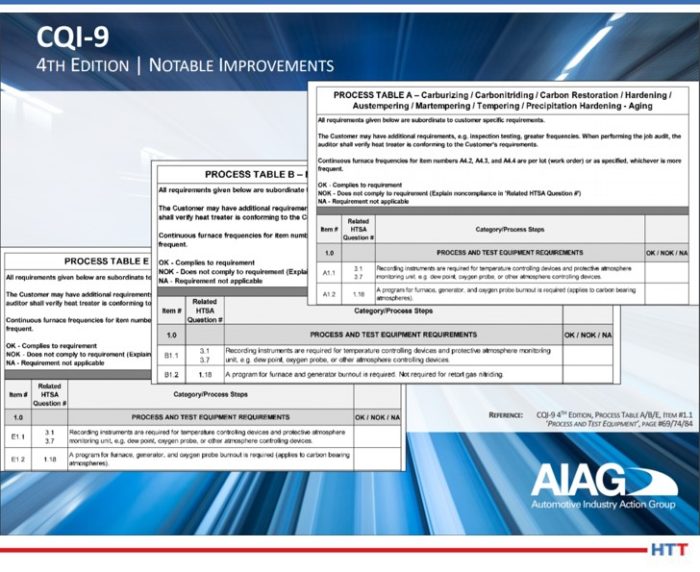
JR: It is structured very similar to the way of AMS2750 in that regard. You have four sections that divvy up a pyrometry section: thermocouples, instrumentation, system accuracy testing and temperature uniformity survey. But, unlike AMS2750, CQI-9 is a system assessment, it is a process, it is a heat treat management system. It encompasses more than just pyrometry. Where AMS2750 is a pyrometry specification, CQI-9 is a process specification; it encompasses everything. It also includes your heat treat system assessment, which is three sections of questions regarding your heat treat operation, then you have your pyrometry which is those four sections I mentioned. Then you have your process tables. Your process tables drive all of your requirements for your particular operation, in terms of frequencies and tolerances.
Process tables from Rollout Webinar (Source: Rollout Webinar PowerPoint)
DG: Let’s jump into the section that, I think, you would probably say you’re most comfortable with- the pyrometry section. You mentioned in that section there are four subsections. Let’s run down through those. I’d like to do two things. First, let’s just talk about, very briefly, what are the major changes in each of those four sections and then let’s come back and revisit each of those sections with maybe some very practical advice. Let’s talk thermocouples first; that’s the first section.
JR: The thermocouple section had a fair amount of changes made to that portion of the document, but again, they were mostly for the clarity aspect of things. I would say, from a significant standpoint, one of the things that we had in the third edition that was rather confusing was in regards to grace periods. The only area in which a grace period was stated within the third edition was within the thermocouple section, which is funny because it doesn’t apply to thermocouples, in terms of CQI-9. It applies to instrumentation and system accuracy tests, and so that portion was removed and placed into a more appropriate area within the document.
Another aspect of it was the requirement for the calibration report to include an accreditation symbol. It was already a requirement that if the thermocouples were calibrated by an outside provider or third party, that they had to be accredited. But one of the areas that that doesn’t address is that if I am an accredited calibration laboratory, and my scope includes instrument calibration, whether it be for measure or source, it doesn’t necessarily mean that I’m accredited to perform a thermocouple calibration. So, instead of trying to overcomplicate the document and write something that says that the calibration that I’m performing on the thermocouple has to be included on my scope and create something more difficult than it has to be, we decided to just establish that the accreditation symbol needed to be included on the report. Also, as an accredited lab, I can’t place that symbol on a report for calibrations that aren’t part of my scope. It kind of allows that portion of the industry to self-police a little bit. That was one of the more significant changes.
Another one was that we made some adjustments to the usage side of things. There was a requirement – in lieu of tracking uses of nonexpendable thermocouples – which allowed you could to put a nonexpendable thermocouple in use for a duration of time, and you could have unlimited uses essentially for that duration, and then you could remove it from service at that point. However, that duration of time was absent of some critical information, that being, for usage of the elevated temperatures. In the usage table, it was 90 uses for over 1800 degrees and 180 for under 1800 degrees, and you had 6 months for a placement interval. That didn’t necessarily convey what we were trying to do, so we added some usage in there for the nonexpendable for over that 1800 degree mark.
We also included RTDs. I come across them, but just because of the temperature range that most of the processes within the automotive heat treat world are operating RTDs are necessarily applicable. But, they exist and a common approach that I would come across at least, was “well, they’re not included, so I don’t have to do anything.” So, we just included them to wipe that off the board, and now we know that any sort of temperature sensor is critical to address, if that portion of the process is temperature critical.
We added some caveats around resident thermocouples and their usage, which, in the previous one, were only allowed for comparative method SAT. We added some caveats for requirements when they’re used for probe methods within the realm of CQI-9.
DG: Before we go on to the next section which will be calibration, let’s back up just for a half a second. You and your team actually did a rollout webinar. Can you briefly tell the listeners where they can find a little more thorough description of the rollout on this thing, because we’re not going to cover all the details here, obviously.
Rollout Webinar PowerPoint Cover Image. Get the webinar here.
JR: Yes. It would be really tough to dive into everything; some of the changes are so insignificant, that it’s not worthy of discussion, really. The AIG’s website has a page assigned to automotive heat treat and on that page they have some links to different content that we produced for that rollout presentation back in mid-September. There is also a page 3 of the document itself which outlines the majority of the changes, (at least the significant ones), made within the fourth edition. So there is a list, 3 ½ pages long, of the different changes made. There are summaries of those changes that exist in several different places, but one of them being the document itself.
DG: Did you not do a webinar? Is there a webinar? Can people actually see the webinar?
JR: I’ve not seen the webinar posted yet, I’ve not checked in a little while, but the intent was to post a version of that webinar.
DG: In our transcript of this podcast, we will look for it first off, and if we find it, we will put a link to it when we put this online. So if you’re listening and you want to see that webinar, if it’s out there, we’ll put the link in.
OK, let’s move on then, Justin, to the second of the four pyrometry sections which is calibration. What were the major changes?
JR: Again with reporting, the reporting requirements for calibration are updated; they are different. There are some minor revisions to the requirements for the calibration report. Those sort of things can be easily overlooked, so I wouldn’t ignore that. They are different. The biggest, perhaps most significant difference within the instrumentation section is that in June 2023, all control monitoring recording instrumentation must be digital. It is very similar to the approach taken by 2750 in removal of analog instrumentation, CQI-9 as well, is going to follow suit there, as well. [Listen to the AMS2750F episode with this update here.]
DG: I think AMS is by 2022, so you guys are an extra year, but nonetheless, you’ve got to start getting away from analog over to digital.
JR: For the most part, that’s the biggest change within the instrumentation section.
DG: Let’s move on to system accuracy tests.
JR: Within system accuracy tests, again reporting requirements are updated. They include some new requirements there. The illustrations within the system accuracy test section have all been updated and revamped. I believe the old ones, that were in the third edition, were very similar in nature to the illustrations that were included in AMS2750 C, so they were well overdue for an update. We cleaned those up. We removed nonessential information just to make it clear what it is we’re actually discussing there.
Also, we established grace periods that are specific to each method of system accuracy test. There are three different accepted methods for SAT within CQI-9- probe method A, probe method B, and a comparative method, and we established grace periods for each of those individually so that it’s clear and not an assumed grace period.
DG: And grace periods being, for example, “Well, the due date falls on a holiday, how many days afterwards do I have?” That type of thing?
JR: Yes. If my system accuracy tests were due on a Friday, let’s say they’re due on the 1st, technically. I don’t lose my compliance on that system from a system accuracy test standpoint for x period of days after the fact. It’s to allow for, like you said, a weekend coming up, a holiday coming up. You can still maintain your compliance interval without having to shut everything down and start fresh. A practical application would be, say you order some test thermocouples and they’re delayed. So now, all of a sudden, you don’t have the test materials that you need to perform the task, or your instrument that you sent out for calibration got delayed and it’s not back yet. Those uncontrollable sort of events don’t prevent you from operating.
DG: The final section under pyrometry would be temperature uniformity surveys. Any major changes there?
JR: There were a few. First, the reporting requirements are now different; they’ve been updated. They include some new things. Perhaps most notable is the requirement for when you perform a test on a semi-continuous or continuous system to indicate the soak time required versus soak time achieved. That has to be included on the report. Technically, it probably should have been there for the third edition as well, since one of the requirements is that you have to have obtained your desired soak time. This just calls it out to the forefront and makes it a bit clear. That information of the report makes assessing that aspect of things a bit more simple.
We added a specific grace period for temperature uniformity surveys so that it’s clear, it’s not assumptive. Where I’ve seen it most often is within the hot stamping world. You have a single stack furnace with multiple individually controlled chambers that are all separated by insulation or wall or some sort of means of differentiating them, so that they’re all essentially individual furnace cavities. We added in some clarity to say that it’s not good enough just to test one of those chambers, you need to test all of them, because they all can be different.
[blockquote author=”Justin Rydzewski ” style=”1″]Perhaps the most significant change within the temperature uniformity survey section is to the alternative temperature uniformity survey testing methods.[/blockquote]
Perhaps the most significant change within the temperature uniformity survey section is to the alternative temperature uniformity survey testing methods. In instances when I can’t perform a survey with sensors being trailed in, or I can’t send a data pack sort of unit or a PhoenixTM unit through that furnace system itself to collect the data, for systems like that, in the third edition, there were three or four paragraphs of information about what you could do. It was not entirely clear what other aspects of the section applied, what reporting was required, what sort of procedures needed to exist, and so you found a lot of variance in that testing practice. A lot of times, I’d have customers that say, “I don’t know how to perform a TUS on it, or I don’t think that I can, or it’s not practical, so I guess I don’t have to do anything.” And that’s not proper. It wasn’t clear that these surveys applied in instances where you couldn’t do the other, like a traditional TUS. So that whole entire section got rewritten from ground up to include a structure that is very similar to the other aspects of that TUS section, structured in the same way, in terms of data collection, when you need to perform the tests, these alternative tests like property surveys and whatnot, the procedure that needs to exist, what needs to be included in the procedure, and what needs to be included in the reporting. Basically, just more clear guidance so that in those instances where a survey can’t be performed, the heat treater at least has a degree of confidence that what it is they are going to be doing is going to be up to snuff, that it’s going to pass muster with their auditor.
DG: I want to go back and go all through those four sections again and ask you the same basic question for each of those four sections. When your company, or companies like yours, walk into a prep for an audit situation, what are the things that you’re seeing, practically, on the thermocouple end of things, the calibration end of things, the SAT and the TUS? Let’s start with the thermocouple: When you walk in, what do you most often see and what do you tell people?
JR: When I first walk into a facility, one of the first things I’m looking for is how the flow down of information is conducted. How are they approaching the flow down of information? Because, in order for me to assess whether or not you’re compliant with the document, I need certain bits of information. And it’s not just me, anyone would need it. As I go through a plant, and I’m looking for information on thermocouples, I want to know when the thermocouple was installed, I want to know if it was calibrated, what’s the number of the calibration certificate that it ties back into, what’s the location of that thermocouple and where it’s installed, what’s its purpose? I can tell you that often it happens where I ask, “What’s this thermocouple?” “Well, that’s my control thermocouple.” “Are you sure?” “Yes, I’m sure.” Then, when you go to remove it, it turns out to be the high limit. There are these little things where people ask, “Well, what’s it matter if one is a control or one is the high limit?” Especially if they’re both in the same well and it’s a dual element sort of thermocouple. It’s important for a multitude of reasons. If you don’t know that basic sort of information, or you don’t find that information to be important, what other information won’t you find important? It becomes like a mentality aspect of things. I like seeing that sort of information available and ready, that you don’t have to go digging for it. So, that’s the first thing I look for any time I walk in a plant. More often than not, I find that aspect of things can be lacking, from a documentation standpoint, from an availability of documentation standpoint, or “Can I see the calibration certificate for this specific thermocouple?” and I get, “Well, here are all of my certificates.” “Well, which one applies to that thermocouple?”
Justin Rydzewski explains the importance in knowing your thermocouple system inside and out from an auditing perspective. (Photo source: Pelican Wire)
What I also try to convey is that the more difficult that you make this for me – for someone who’s coming out to audit you or to perform this assessment to check on you – the more difficult you make it, the harder they’re going to start scratching. You want this to be easy. You want to convey confidence. You want to convey the repeatability of things. I can’t stress enough strong documentation and great documentation systems for easy recall, like availability of information at the actual thermocouple itself is such a nice convenience, and when someone sees that, it conveys confidence. Outside of just a basic compliance issue, it’s that support system for thermocouples, because everything starts there. All of it starts there. Even from the basic things like knowing what it is you have there, from a thermocouple aspect.
With one of my closer customers in our first interaction together, he called and asked for a 30” long thermocouple and to just make sure that it’s type K. “Well, I need just a little bit more information than that. What else can you tell me about it?” “That’s all I have. Just get me one.” “Well, I have a binder on my desk that’s an inch and a half thick and every thermocouple in there just about matches your description. I need more. Should I just flip a page and pick one?” There are a lot of variants that can exist there and when you introduce variants, you have an opportunity to introduce variance in your performance of that system.
So, consistency, repeatability, and assuring those things on a perpetual basis is critical. Things like insertion depth, length, diameter, type, calibration, where you have it calibrated. All of those things should be documented and standardized and that documentation should be readily available to anyone who needs it so that you can ensure that you’re replacing like with like, what was there before, if it was compliant, and what you replace it with is also compliant. The performance that you had on that system on day 1 versus day 180, you want to be able to assess that variance in performance, not based on the variables that have changed, like are they new thermocouples, are they in new locations; you want to assess it in terms of those other exterior factors. That’s why you call out thermocouples instrumentation and the like within pyrometry and CQI-9. Those things, to me, are really important, and they’re the first things that give that indicator of what things are going to be like as I go through a job site initially.
DG: Anything else under thermocouples, or should we move on to calibration?
JR: That pretty much covers it. From a thermocouple standpoint, just ensuring that you have solid documentation surrounding those things. It can be an overlooked piece of equipment, but they are so incredibly critical.
[blockquote author=”Justin Rydzewski ” style=”1″]From a thermocouple standpoint, just ensuring that you have solid documentation surrounding those things. It can be an overlooked piece of equipment, but they are so incredibly critical.[/blockquote]
DG: Right. And be able to easily access it and instill confidence in the auditor so that they know you know what’s going on.
Let’s move on to calibration then. When you walk into some place and you’re going to check their calibration processes and whatnot, what do you see usually?
JR: Especially when a new edition comes out, or a newer revision of a pyrometry specification, the first thing that I typically go there with is – again, similar to the thermocouple side of things – I want to look at documentation. If I have a new Rev, the first thing I’m going to ask is what are the new requirements for reporting? I want to know what was on the report yesterday and what needs to be different tomorrow, so that I can make sure from a documentation standpoint, I’m going to be covered, because that’s what I’m going to put in front of someone. That’s the thing they’re going to evaluate initially. And so, I want to make sure that this first impression is solid and that it checks every box that it’s supposed to. I’ll review all of the reporting requirements initially, just to make sure my reporting is going to pass muster with an audit. And I will scrutinize that thing up and down to the Nth degree, just to make sure that I’ve got it to a point where I’m comfortable with it. That’s where I typically start.
Again, similar to thermocouples, I want to make sure that I have a solid support system for my facility in terms of instrumentation. I know what instruments I have there, I know what’s required of all of them, I know where I want them calibrated, I know how I want them calibrated, I know where they operate, all of those sorts of things. I find often, especially on new job sites, an instrument and they’ll have offset in there. “Well, what’s this offset for?” “I don’t know.” “OK. What was it the last time you had calibrations? Has this changed? Is this a value that changes?” “I couldn’t tell you.” And sometimes, the level of offset there, it’s possible for it to be at a level that is not compliant with the document without that documentation to support it, without something calling out what it’s there for, what the intended purpose is of it. Anytime you have that “I don’t know” answer, or “It’s in someone else’s hands,” let’s say the provider of pyrometry services that are out there perform the calibration, they’re not aware that they have to go through some sort of approval process to change offset, pay the instruments out, I’m going to pump in some offset, and there you go. In the worlds of CQI-9, and especially within AMS, you can’t do that.
There is a right way to go about doing things, and a ladder of things to climb before you can just go ahead and jump. Having a solid foundation of understanding of your instruments, documenting the details of those instruments, and having that readily available. If you have that, the likelihood that you’re going to be compliant and have a favorable audit in terms of your instrumentation, is going to be so much higher than if you don’t. So, strong support system. Strong documentation as well.
DG: Let’s move on to the system accuracy tests.
JR: The system accuracy test is often something that we encourage our customers to take on themselves because it’s not an overly complicated process, by and large. From a third edition to fourth edition, again my first stop is at reporting. I want to make sure whatever it is the data I need to collect is going to be there at the end of the day and is going to be presented in a manner where anyone can understand at glance. I don’t have to have a training session on how to understand my reporting. I want it to be very clear, very forthright in terms of information that it’s clear. And then understanding the differences between the acceptable methods.
Probe method A in CQI-9 is most like the comparison method within AMS2750 where you have a test instrument system alongside your process instrument system and doing a comparative in terms of the calculated difference there. Understanding the math and the order of operations out there is essential. It is so easy to mess that up or forget how to do it properly. One of the benefits of the illustration within the fourth edition is that we made a very concerted effort to make sure that the means in which that math is performed is clear, and how it’s reported is clear, so that there’s no too much confusion. The goal here isn’t, “Aha, gotcha! You don’t know how to do an SAT.” The goal is that you do an SAT and that you do it in a manner that produces you with a level of confidence that you’re okay and that everything is going to have the best likelihood or repeatability and coming out as expected.
Understanding the math is also critical. The only real thing of note in the third edition that wasn’t explicitly called out, that in the fourth edition is explicitly called out, is that the SATs only apply to the control and monitoring and recording thermocouples; it does not apply to thermocouples that are dedicated to the purpose of over-temp protection. That can be a nice break for most users who were thinking that they had to do it in the previous edition.
For the most part I see that the act of actually performing it— again, that flow down of information becomes critical. If I know how long my thermocouple is, the process thermocouple is at that process thermocouple. Say, for instance, it’s identified on a tag at the thermocouple and it says it’s 40”. If I go insert my test thermocouple and it goes in 20” and I feel like I’ve bottomed out, the only indicator that I would have that I’ve not bottomed out my thermocouple and I’ve lined my measuring junctions, would be that measurement at the thermocouple, would be an indication of how long it’s supposed to be or an awareness of how long it’s supposed to be. If I don’t have that, and I drop my test thermocouple in and it feels like it bottomed out. Cool, they’re lined up. They could be dramatically different. In that case, I would go ahead and guess that you would notice that instantly as you’re failing that SAT, but an inch or two inches can make a significant difference in misalignment of junctions. Having an awareness of insertion depth of your process thermocouple, length of process thermocouple, and what’s required for insertion depth on your test thermocouple is critical to perform in that test and it’s something I see lacking often when I’m out in the field assessing how my customers are performing the tests in-house.
DG: And finally, let’s talk about what you’re seeing when you walk into a shop for temperature uniformity surveys.
JR: Uniformity surveys, again, the first thing I’m doing is assessing the reporting requirements to make sure everything is up to snuff, because that’s your first impression you’re going to convey to everyone. The requirements within the fourth edition are of note, that would require something to be done differently, for the most part, you’re going to be find them to be very similar. The thing that I’m looking for most is the repeatability of that test. How like is one test to the next one? What is your means of collecting data and what is your response plan when that data is unfavorable? Having that predetermined, so that you’re not doing in on the fly, can be incredibly helpful and it adds to expedite that process of getting good tests out of there.
[blockquote author=”Justin Rydzewski” style=”1″]How like is one test to the next one? What is your means of collecting data and what is your response plan when that data is unfavorable? Having that predetermined, so that you’re not doing in on the fly, can be incredibly helpful.[/blockquote]
One of things I’ve always recommended my customers doing is that before you perform that survey, have some sort of pre-survey list that you go through of tasks that you want to verify before that test is run, just to make sure that you’re collecting all the data that you need to collect before you perform it. In an instance where that test data is unfavorable, you can go back and take a look at it and compare it against previous tests performed and not have to be concerned about whether or not this test was performed differently than the one prior.
Consistency is the key. And again, strong documentation systems. Understanding what the operating temperature ranges are for each system, where your sensors are placed, how they’re traversed, where they’re installed at if it’s a continuous furnace. There are so many variables to performing that test, having a handle on them is incredibly important. Otherwise, the test data performed on day X compared to on day Y is a meaningless comparison, and you want that value to be there, to be able to compare them, so that you can see where performance has varied or where it’s different, and have something pointing at where you need to go investigate.
DG: Justin Rydzewski of Controls Service up in Livonia, MI, thank you very much. I think this is going to be our first. We’re going to have either three or four of these podcasts. I think next time, we’ll either deal with heat treat assessments or we’ll talk about the process tables some.
Heat Treat Radio host Doug Glenn continues his conversation with AMS2750F expert Andrew Bassett. This time the pair discusses Revision F changes to System Accuracy Tests (SATs).
Below, you can either listen to the podcast by clicking on the audio play button, or you can read an edited version of the transcript.
The following transcript has been edited for your reading enjoyment.
DG: We are back today for our second episode of a three-part series with Andrew Bassett. Andrew is the president and CEO of Aerospace Testing and Pyrometry, headquartered out of Bethlehem, PA, with offices across the county. They do a lot in pyrometry services and related things. Andrew also had a seat on the committee that was responsible for – that owned – the AMS2750 revision F, so he can speak with firsthand knowledge of some of these changes.
If you are interested, you can listen to the first part, which dealt with the major changes in thermocouples and sensors, major changes in instruments, major changes in calibration, and then we also spent a little bit of time right at the end of the last episode talking about offsets.
AB: Yes, and the offsets were one of major changes that we, as a team, did a very good job of spelling out the new requirements for the two different offsets: modification offsets and correction offsets. So that’s a valuable tool to go back and take a look at.
Episode 1 of 3 of AMS2750 series
DG: If you didn’t catch that first episode, you can certainly do that. You can go to www.heattreattoday.com, jump back into the radio section which is under heat treat media on our main navigation tab, and check that out. It would be very worthwhile.
Before we jump into the topic for today, which is the system accuracy tests (SATs), I wanted to ask you a question about this revision. Often, the AMS folks will come out with a minor modification, or not a huge modification, let’s say; other times, it’s pretty much a re-write, end to end. How would you classify this revision F? Where does it fall on that scale?
AB: It leans towards the side of a complete re-write. I think one of the big things that changed was obviously the number of pages of the document; it jumped from roughly 43 pages up to 54 pages. We expanded the number of tables that were from revision E, which had 11 tables, into 25. This was to do some more clarifications of the requirements, or to spell things out a little bit more. I would be leaning on the side of this as being more of a complete re-write. There’s going to be quite a bit in there that is the same old stuff from the previous revisions, but there is quite a bunch of new stuff.
I would lean towards saying that this was a complete re-write and that’s why there were no change bars associated with the spec. Typically, when these specs get revised, the change bars show you where the changes are, but since this was more of a re-write, we left out the change bars this time around.
DG: Instead of having someone go in and “cheat” and just look at the change bars, you’ve got to pretty much start from the beginning and go straight through.
Where do you see some of the major changes in rev F on the overall or the resident SAT?
(source: Andrew Bassett, ATP)
AB: Not a whole lot completely changed on the resident sensors. We still allowed for the same sensors as we did in the previous revisions, where you are limited to different types of sensors based on the temperature ranges, that they were going to be seeing. For instance, if you’re above 500 degrees Fahrenheit, then you’re going to be limited to type N, S, R or B thermocouples, and if you’re above 1,000 degrees, they would have to be what’s called a nonexpendable thermocouple, the metal sheathed type thermocouples. We left that stuff alone. But one of the things we did allow for with the new resident sensors, which I believe is a benefit to the supplies that are using the resident sensors, is that we’re going to allow for some things. Let’s say you have an over temperature sensor, and you also want to use that as your resident sensor. Now you’re allowed to do that as long as you follow the guidelines that say a resident sensor has to be replaced. If it’s a base metal thermocouple it has to be replaced every 90 days, or on a quarterly basis. If it is a noble metal, one of the type R, S, or Bs, it would have to be replaced or recalibrated every six months. We did allow for cases where you have an extra sensor that is being used in dual roles (that is, a resident sensor that also functions as a high limit protection), then you can go ahead and do that. I think that that is something that is beneficial to the suppliers, in that we don’t have to go out and put a third sensor into a furnace or drill a hole to put our resident sensor in.
The one thing that we really want to emphasize with these resident sensors is that their position is to be verified during the installation process and when it’s replaced. When a resident sensor is in a fixed position, we want to make sure it is not moving. Typically, you see a compression fitting that is going to tie the thermocouple down and lock it into place. We want to make sure it is not moving between tests. So, now when you replace these things, you must verify the positioning when you put it in on a replacement basis.
Also, it’s always been the requirement to put the thermocouple in for the 90 days or 180 days, and leave it in there. We’re going to allow you to take it out between the tests, but only as long as it is verified after every single time it’s replaced. I’m not a big believer in that; just because someone from Quality doesn’t come out and verify it doesn’t mean that it could be in the wrong position. But we are allowing you to independently move this thing in and out between the test if you want; that is acceptable. You still have the same replacement periods as quarterly and 180 days depending on the sensor type. We did give a little leeway on that from the resident sensor standpoint. Again, we didn’t make a whole lot of changes on it. We just wanted to spell out the little bit of differences allowing for other types of sensors to be used, or have a dual purpose, I should say.
DG: Let’s move on to the second issue, and that is the alternate SAT process, which I know has sparked a lot of questions with the articles we’ve had on our website. We’ve always had people asking about what they can do, what they can’t do. Let’s talk about that.
AB: Sure. The previous revision in rev E was kind of this dark black hole of what the alternate SAT process was all about. Finally, it was more spelled out in what’s called the “PyrometryReference Guide.” That’s the document that NADCAP puts out, the “pyrometry for dummies,” so to speak. This is basically their interpretation of AMS2750. And then kind of evolved that into what’s called a “heat treat audit advisory.” There were different interpretations of this alternate SAT which were too conflicting to the suppliers. We said, “Let’s make it more clear-cut of what the expectation of this alternate SAT process is.”
First off, the process applies to load sensors that are used once, or for any other type of sensor control or recording sensors that are replaced at the same, or less frequent than the normal, SAT intervals. One of the things that was in the previous version, which we kept, is that the calibration must be performed from where you connect the sensor. Then, once you do that calibration, one of the following three options have to be met. Option 1 is that we take the sum of the sensor calibration error. That’s when you first complete calibration from the point of connection and run through the whole system, including the connections, the lead wire, and the instruments. Then, you document those results and algebraically add that to the correction factors or the errors of the wire either being used or replaced more frequently, and if the sum of those two correction factors are within the allowable SAT tolerance of AMS2750, you would have to document that. And that’s the first option; it’s basically a math function; it’s sitting at your desk and taking the calibration report of your process instrumentation, typically from the recording, and adding it to the wire that’s being used. If you fall within that certain table of AMS2750 for SAT tolerances, you’re good to go. It’s kind of a “desk SAT,” as they call it.
The other way of doing this is to use the appropriate sensor and instrument calibration correction factors. You can either program them into the system or apply it manually as allowed by the limits in AMS2750. Basically, you’re taking the correction factors for the instrumentation that you have calibrated and the sensors that you have calibration “certs” on, and programming that into your system. Again, as long as that meets within the applicable table of AMS2750, that is the second option that is allowed. Because you’re basically using the correction values from the calibration reports for your instruments and your thermocouples, you will always be within your SAT requirements.
The third option allows you to do a couple of things. For one, you can limit your instrumentation calibration error. A company comes in and does your calibrations, and the supplier says they don’t want any of their channels to be more than one degree out of calibration, so, you adjust the instrument calibration to be within that limit. Or, you can specify when you purchase thermocouples wire that you won’t take any thermocouple wire that is no more than two degrees out throughout the whole range you need them calibrated. In that instance, you will always be compliant to the requirements of the SAT tolerances. So, if you restrict the calibrations and you restrict the error on the thermocouples, then you will always meet that requirement. All you would have to do is show, for documentation purposes, the instrument calibration reports that say it is all within 1 degree and all of the wire certifications are within two degrees, and that will always meet the most stringent requirement for SAT tolerances. As long as that documentation is there, you will be able to show compliance to the requirement.
[blockquote author=”Andrew Bassett” style=”2″]“Before, there was no requirement of how to document all this, so we actually put in some hard requirements down on how to document the alternate SAT requirements.”[/blockquote]
Those are the more defined options you have. Before, if you gave it to 100 different people to read, and they said, “I don’t know what to do with this information.” Well, now we’ve put out what we actually meant and defined it a little further now.
DG: Great, so that covers the first two that we wanted to talk about – the overall of the resident SAT and now the alternate SAT – so let’s wrap up with this SAT waiver, which is obviously of interest.
AB: First, I want to jump back real quick into the alternate SAT. We finally added some documentation requirements. Before, there was no requirement of how to document all this, so we actually put in some hard requirements down on how to document the alternate SAT requirements. You have to list out the thermal processing equipment (you have to identify which furnace you’re doing this on), what is the sensor system that’s being tested, and what sensor or roll of wire that’s being replaced. You also have to identify the reason why you’re doing the SAT; for example, because you replaced the thermocouple after every run, something simple like that. If you’re doing the full calculation method, then you’d have to show all your calculated methods. We did finally put some teeth in to help you document this well.
DG: Now, the SAT waiver. Tell us about it.
AB: In all my years out in the field of pyrometry, I rarely found many suppliers that did this SAT waiver correctly. We didn’t change a lot of the basics of the requirements, but we did change some new requirements regarding how to gather your data to make sure that you do this correctly. We still require that if you’re using noble metal load thermocouples, which are the platinum based thermocouples, you replace and recalibrate them on a quarterly basis. If you have base metal load thermocouples, if they are expendable, they should still be just a single use. If they’re nonexpendable, sheath type thermocouples, they shall meet the requirements of Table 6 in AMS2750F, and that gives you guidelines of how often those need to be replaced.
If you have any kind of observations that are made and recorded on at least a weekly basis and which reveal any unexplainable difference between observable readings and readings of two recording sensors, this is where the change really occurred on those two additional sensors. We spelled out that these weekly readings have to be conducted at one production setpoint and measured within the five minutes at the end of the production soak period. What this weekly log is supposed to be doing is to compare one sensor against another sensor that you’ve identified.
Some people have used the control sensor as the one sensor and, let’s say, the high limit thermocouple as the second sensor. These have to stay within a two-degree relationship from the last successful survey, and so people were wondering when they were to take the weekly reading. We decided to spell this out a little bit further: this weekly reading must be done at production setpoint and measured within the minutes of the production soak period. In other words, you can let your thermocouples soak out for a period of time, during which you can complete your comparison check. These have to be within two degrees of the relationship determined at the most recent TUS temperature and at the nearest temperature tested during the most recent TUS.
For example, let’s say we do a survey at 1600 degrees and the control is reading 1600 degrees and my over temp is reading 1602. Next week, we come along and we’re running a job here at 1500 degrees and my control is reading 1500 degrees and my over temp is reading 1501, you’re good. You’re within that two-degree relationship. That’s where this two-degree relationship needs to occur.
But the one thing that we’ve done now is we’ve asserted that the two sensors have to be different types. Before, you’d have, let say, two type S thermocouples in your furnace; you can’t have two type S thermocouples now. You have to make a different thermocouple type for the relationship. This is more to catch any drifting of your thermocouples over time. For instance, if you had a type S thermocouple in your furnace as your control, you’re going to have to be limited to either a type B or type N thermocouple as that secondary sensor that you’re doing your relationship check with.
That’s what a big change is. Before people just used the two same sensors. What we were concerned about is – and let’s say those two thermocouples were made from the same lot of material – that there is a good chance that when the thermocouples start to drift, they’re going to drift in the same direction.
Again, we did put some similar restrictions on resident thermocouples. For the example I used, if you had type S control thermocouple, you’d be limited to type B or N, but we also allow for R as that extra thermocouple. But R and S are very similar in the chemical composition makeup, so we don’t allow an S to go against an R and vice versa, in that case. If you had a control thermocouple that was K, then really any other thermocouple that is allowed once you’re above 500 degrees you’re limited to the B, R, S, and N. Actually, these requirements are exactly the resident sensor requirements as well.
DG: Anything else on that SAT waiver?
(source: Andrew Bassett, ATP)
AB: We do now have some documentation requirements, too. Again, before there were no requirements there. Now you have to list the equipment that you’re doing the waiver on, you have to identify the control sensor, what type of sensor it is, plus what the additional sensor is used for the sensor relationship test. You have to list out the date of when the control and the additional sensor to be used, when they were installed, and when they were replaced or recalibrated. You have to list out the run number and date, so that when you are completing the production cycle on a weekly, you have some kind of easy identifier to tell you that it was done on run #ABC123, and the date was 9/8/20, so we can go back to the records and verify it. Date and temperature of the recent TUS and the documentation, that weekly log, are necessary; we need to see that weekly log as well.
We finally put some teeth into the requirements of the SAT waiver. I don’t think it’s going to be a big change for a lot of the suppliers out there. They will have to change over that one sensor, but, for the most part, I think we tweaked it enough where we felt more comfortable, especially changing those two different sensors so that we didn’t have drift occurring at the same time. That was our biggest concern as a committee.
DG: So, you’re basically trying to ensure reliability and you’re going to actually test for what you’re testing for. That makes sense.
We talked briefly about the overall or resident SAT, the alternate SAT, and the waiver. If you, the listeners, have questions, be sure to email them into us and we can potentially get Andrew to respond to them. Send those to htt@heattreattoday.com. We’ll leave Andrew’s information at the end of each of these podcasts.
Andrew, I’ve got a final question for you, not dealing with any specific aspect of the revision, but just to give people a sense of the amount of time that folks in your shoes, people that have invested time or actually on the committee: How much time do you think you’ve invested in the rev F portion of AMS2750?
AB: It was a long process. To put it in perspective, we developed our sub team and had our first meeting back in October of 2017, during one of the NADCAP meetings. We were kind of on a fast-track to get this spec revised and put out there. It wasn’t actually released until June of 2020; so three year plus is a fast-track in the eyes of the AMS world. We did meet at least six or seven times a year, either during an AMEC meeting or during one of the NADCAP meetings, and we had numerous Webex calls. When we actually met face to face, they were good 8 – 10 hour sessions of hammering out the spec. Then, we would take it back to our own groups and muddle through what we discussed. It was a long period of time. I would hate to put an hour on it. I wish we’d gotten paid for that! Taking into account what our company is and what we do, we have to live, breathe and eat this spec, day in and day out, for our customers. I just wanted to be a part of the process of getting this documentation, so the world can understand the issues in pyrometry.
DG: I actually have one other question for you. You told us in the first episode how you got onto the committee. Are they always looking for people to participate on the committee, or do they carefully fence that and only invite in certain types?
AB: Anybody can be a member of AMEC. So anybody that wants to get involved with the revisions of any of these specifications, including the AMS2750, they’re more than welcome to show up at an AMEC meeting, get involved, and volunteer to get involved with the specifications. I remember my first meeting where the chairman said, “You’ve got to get on this 2750 team. And, oh by the way, we’re thinking about writing some other specs that we’re going to throw you under the bus for.” They’re looking for young blood to get involved with these specifications and be a part of it, so yes, anybody can get involved with these specifications.
DG: If you are listening and you’re one of those people that might be interested in participating in that, you can certainly get a hold of Andrew.
This was our second part in a three part series. Our last episode will be on temperature uniformity surveys, the issue of rounding, and quality assurance provisions. If you’d like to learn more or reach out to Andrew, you can go to www.atp-cal.com and look at their ‘about our team’ section in the main navigation bar. I’d also be happy to receive emails on behalf of Andrew. My email is doug@heattreattoday.com. Thanks for listening.
Doug Glenn,Heat Treat Today publisher and Heat Treat Radio host.
To find other Heat Treat Radio episodes, go to www.heattreattoday.com/radio and look in the list of Heat Treat Radio episodes listed.
In this first of a three-episode series on AMS2750F,Heat Treat Radiohost, Doug Glenn, discusses Andrew Bassett of Aerospace Testing & Pyrometry discusses the significant changes in the specification in the areas of thermocouples and calibrations.
Below, you can either listen to the podcast by clicking on the audio play button, or you can read an edited version of the transcript.
The following transcript has been edited for your reading enjoyment.
Doug Glenn (DG): This past June AMS2750 released revision F, but what does that mean to you? We caught up with AMS2750F committee participant, Andrew Bassett, to find out. Our conversation about this revision will stretch over 3 episodes with the first dealing with thermocouples and sensors, the second dealing with system accuracy tests and the third, temperature uniformity surveys. This first episode will be all about thermocouples, sensors and calibration.
Andrew, welcome to Heat Treat Radio. We're excited to have you to discuss this AMS2750F revision. If you don't mind, why don't you take a minute and introduce yourself to our listeners?
Andrew Bassett (AB): I'm president and owner of Aerospace Testing & Pyrometry, headquartered out of beautiful Bethlehem, Pennsylvania. I've been in the aerospace pyrometry field for going on 30 years, after graduating from college at Davis and Elkins college in Elkins, West Virginia with a degree in communications. I discovered by myself that I would end up starving in radio broadcasting, which my field was, and got involved with a company called Pyrometer Equipment Co., a family owned pyrometry business. They needed some help as they were expanding operations, and it was the father of my girlfriend (at the time)—now my wife--who had started that business in 1956. That's how I got my break into pyrometry.
Davis and Elkins College (photo source: dewv.edu)
This was also the time when NADCAP was starting to put its foothold on the aerospace industry. I kind of self-taught myself in the ways of aerospace pyrometry. I spent many years getting to know the specification and understanding what the requirements were, dealing with the auditors themselves, and having them teach me about what they look for during audits. I've taken that knowledge with me for the last 26 years.
After I left the family business, I worked for another start-up company in the field of pyrometry, left that company, and worked for a large commercial heat treat company based in the Southeast as their pyrometry director. At that time I started to feel like I wanted to start my own pyrometry business. So, in 2007, I started Aerospace Testing and Pyrometry (ATP). I was doing it part-time for a while, but then in 2009, I decided to go full force. To this day, it is not just me anymore: there are 16 of us in the company which is spread from coast to coast to take care of pyrometry services as well as other things we have branched off in with ATP. I call it our four headed monster. We have our pyrometry services, which includes calibration and testing of thermal processing equipment. We do get involved with other testing as well, like vacuum measuring systems for vacuum furnaces. We've also done humidity pressure gauges and gotten involved with different types of calibrations as well. Additionally, we have our laboratory, which is based in Ohio, where we do calibrations of secondary standards and field test equipment. Finally, we have our consultant and training arm, with which we have a full-time ex-NADCAP auditor on staff who is able to assist our customers with pre-assessments of NADCAP audits.
AMS2750 is the main aerospace material specification in pyrometry. If you actually try to do a Webster's Dictionary search on pyrometry, you'll find it is a made-up word. We've interpreted it as the calibration and testing of thermal processing equipment; that is, heat treating equipment and any type of thermal processing will fall under this specification when it comes to testing.
AMS2750 has also now been adopted by others; it is not just a heat treating specification anymore. Two years ago, the FDA adopted AMS2750. Those facilities that are heat treating medical implants or dental drill bits will now have to follow the requirements of AMS2750. The one industry that walked away from this specification is the automotive industry. They have their own requirements called CQI-9. I always make a joke that the one good thing about AMS2750 in dealing with aircraft is that we don't see planes falling out of the sky, but we do see a few more recalls on automobiles and automotive parts.
DG: Just as a little preview for our listeners, Heat Treat Radio will be doing probably a two to four-part series, similar to what we're doing here with Andrew, on CQI-9, so stay tuned for that.
Andrew, how exactly did your company get involved with AMS2750?
AB: So, they had started to revise—and this goes back several revisions ago—revision C to create revision D. Revision C, I always said, was the Bible: You can give it to 100 different people and you would get 100 different interpretations. It was a much-needed change that was needed in revision D. At this time in my career, I only had about 8 years experience in pyrometry, but I had to live and breathe this document day-in and day-out. So, I approached several members from the AMS2750B team to get involved with the spec. I didn't have the great experience like some of the other members of the team who were from Boeing, Bodycote, and Carpenter Technology and other folks, and they said, “Well, we kind of have our team set into place. We'll ask you questions if we need anything.” I didn't hear much from them, but one of the team members did keep me posted of some of the changes.
Then when it came to the rev. E, I heard rumblings that they were going to revise the spec again, and it was at this time that I decided to attend an AMEC meeting. AMEC is basically the think tank of all of the AMS specifications that are dealt with. AMEC stands for the Aerospace Metals Engineering Committee. The various segment specifications fall under various commodity groups, I believe it's A thru H. AMS2750 is actually owned by committee B for NSAE. So AMS guys write the specifications, the commodity committees own the specifications and that's how this process works.
I did attend my first AMEC meeting and the chairman at the time was a gentleman from Lockheed Martin. Anybody can join the AMEC meetings and be a part of them, but at that meeting he asked who I was and my background. I told him and said that I wanted to get involved with this specification and he said, “By all means you need to get involved with this specification. Since you do this for a living, I think we'd like to have that perspective.” So that's how I got on the AMS2750 team for rev. E. I'm still young enough, and dumb enough, to keep going on to this revision of rev. F and will probably be around for the next revision after that.
I did have my inputs in both the specs. We had a great team for rev. F which included myself, Doug Matson from Boeing, who has since just retired, Marcel Cuperman, who is a staff engineer for heat treating for PRI NADCAP, Cyril Vernault from Safran Aerospace, (he is also the heat treat task group chairman in NADCAP), Brian Reynolds from Arconic, Douglas Shuler from Pyro Consulting and a NADCAP auditor, and James LaFollette from GeoCorp. Our team has consisted of people across various parts of the industry. From Arconic’s standpoint, we were looking from the raw material producers. Obviously, with GeoCorp, it was from the thermocouple side of things. And from Cyril Vernault based in France, we wanted the European influence of what's going on over there. So, a good, broad range of people from various sectors of the industry are involved with the specification.
[blocktext align="left"]“I'm an end-user, so I'm able give my input and say, ‘Hey, this doesn't make sense. What you want to add into the spec is not real world.’”[/blocktext]One of the things I always had in my mind when I first got involved with the specification was that the specifications were written by the aerospace "primes," but that's not the case; it involves people, such as myself, who are end-users of this specification. I'm an end-user, so I'm able give my input and say, “Hey, this doesn't make sense. What you want to add into the spec is not real world.” It’s nice that people such as us get involved with these specifications.
DG: Let's talk about the main sections of this specification. If you break them down, what are the main sections?
AB: There are really only five sections of the specification. You can break it down into thermocouples, calibrations and thermal processing classification, SAT (system accuracy testing), TUS (temperature uniformity surveys), and the very last five or six paragraphs are on the quality provisions (what happens if you have a failed test). Those are the 5 main sections of AMS2750.
DG: So focusing on the topic of this episode, thermocouples and sensors, let's highlight some of the profound changes that have been made in rev. F. First, what are the biggest changes regarding thermocouples and sensors?
AB: The bigger changes relate to how we address some different thermocouple types that were not addressed in previous revisions of the spec. In rev. F, we added and gave a thermocouple designation, type M, to Nickel/Nickel-Moly thermocouple. These thermocouples have been around for a long period of time. We do know that they're being used in aerospace application, especially at very high, elevated temperatures. It's more cost-effective than going into the platinum or the noble-based thermocouples. Type M was one of the newer thermocouples we added.
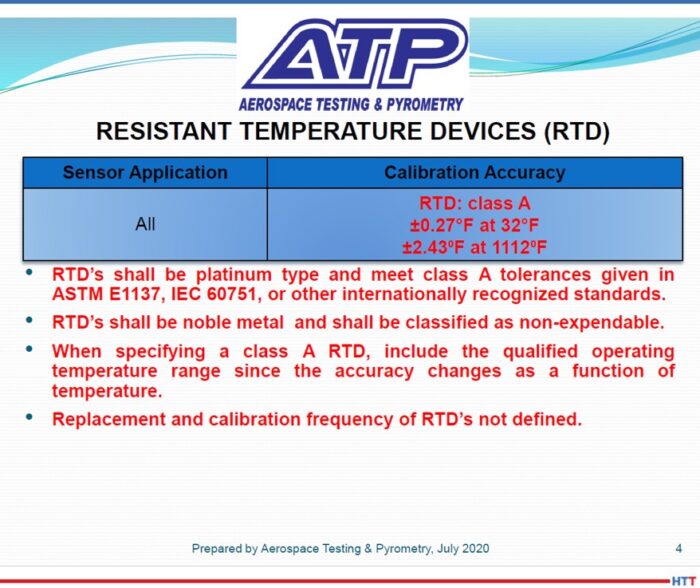
We also addressed the use of RTDs, which is, again, something that we had seen in the aerospace industry for quite a while. As I mentioned before, this is also a crossing over from the heat treat world into the chem-processing world. A lot of these chem-processing tanks use RTDs to measure chem temperatures, so we thought we better address these type of thermocouples.
RTDs in AMS2750F explained (photo source: Andrew Bassett, ATP)
Then we also added refractory thermocouples, which people weren't all that familiar with, unless you're dealing with the hot isostatic pressing (HIP) process. We're seeing more and more of the HIP furnaces out there now, with all of the additive manufacturing that is going on. We see people adding HIP furnaces everywhere, and a lot of those HIP furnaces are coming with type C thermocouples, because they are rated for these elevated temperatures that the HIP processes do. I think the type C thermocouples are rated close to 4,000 degrees Fahrenheit. We had to add some of these extra sensors that have been around for a while, but we wanted to bring them out a little bit further.
One of the other changes that was pretty significant—though I don't think it will affect the industry all that much—is that now we require thermocouples to be accurate to what's called “special limits of error.” The previous revision allowed for two different types: You were allowed special limits of error, which the accuracy is + or –2 degrees Fahrenheit, or .4% of reading. That was only required for a system accuracy test sensor or for a sensor that was being put in a Class 1 or 2 furnace. All other sensors, such as TUS of load sensors, and class 3-6, we allowed for standard limits of air, which was + or –4 or .75% of reading, whichever is greater.
We did some polling of major thermocouple suppliers out there. With my personal experience and that of some of the other people on the committee, we kind of said, “Hey, you know what? No one really orders the junky stuff, the standard limits; everyone orders special limits of error.” James LaFollette said, “Come to think of it, I don't think I've ever seen a purchase order that says give me the crappy stuff. We all order special limits.” So that's what we discovered – that no one was ordering the bare minimum because there wasn't a price difference between the two. Everyone had already been ordering the good stuff, so we just made that a little bit of a tighter requirement. Again, I don't think it's going to affect any suppliers out there.
I think the biggest change, when it came to thermocouples and sensors, was a big restriction that we put on what's called “expendable test sensors.” This was dealing with the base metal thermocouples. Base metal thermocouples are type K, type J, type T, type N, type M, and a couple other type base metals.
Click to read the Heat Treat Today article on thermocouples.
Primarily in the heat treating and thermal processing world, you pretty much see the K, J, N, and T. We had done some studies as a sub-team within 2750 to look at the drifting of thermocouples, that is, where thermocouples start to lose their accuracy. In the previous revision, we had some provisions in place that allowed people to use these expendable thermocouples that were attached to a temperature uniformity survey rack and were preserved. They could use them up to three years or 90 uses when below 1200 degrees. We thought that seemed kind of excessive on a 20-gauge wire that is covered with fiberglass coating. They're probably not going to hold up, but maybe we should see if there is any drifting of these thermocouples. So, we had one of the major thermocouple suppliers, Cleveland Electric Lab, run some drift studies on type K thermocouples, and we found out that these wires were actually starting to drift after three or four runs. The drift study included a cycling test where they ran it up to temperature and back down 30 different times. We asked, “Why don't we try to simulate how these thermocouples are going to interact coming in and out of thermal processing equipment? Why not pull them out every single time and do it that way?” Again, we found that thermocouples were drifting even further and even quicker.
At this point we decided we better put a restriction on this, and that gave the biggest uproar regarding the reuse of these thermocouples. Previous drafts before the final release of the spec was, if it's used above 500, your expendable wire is one and done above 500 degrees. A lot of the suppliers out there came screaming and said this is going to cost us millions and millions of dollars more in thermocouples. But we stood firm and said, “Hey look, if you're using these test thermocouples to validate your furnaces, either through a system accuracy test or uniformity survey, you really do not know what your error of that wire is after the first use.”
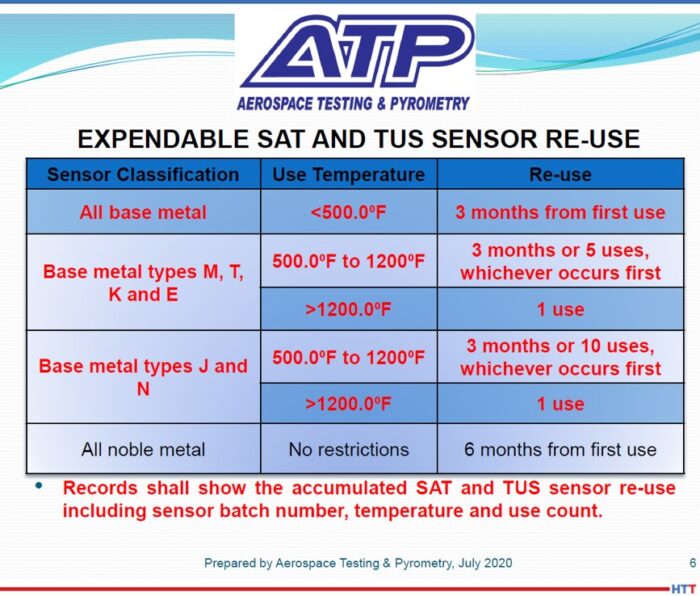
Most of the major thermocouple suppliers will even state on certifications that they will only guarantee accuracy at the time of calibration. Once it goes in a furnace, atmosphere and different conditions of the furnace will affect the wire. We stood our ground, but we ended up backing off a little bit. If you were using them strictly below 500, you're allowed to use them for 3 months (90 days) and you're going to have to keep a log. If you're using them between 500 and 1200, we're going to allow you to use them for 90 days, but now you're only restricted to five usages. And then again, above 1200, you use it once and throw it away. That was probably the biggest hassle, trying to get that. We did finally compromise on that three month or five usages. I do see the burden on the suppliers because they were used to three years or 90 usages, so now it's down to three months or five usages.
DG: I see on the chart that I've got here in front of me that base metal types of M, T, K, and E are all the three month or five use, but you've also got base metal type J and N which is three months or 10 uses. But all of them, above 1200, one and done.
Table for SAT and TUS Sensor Reuse (photo source: Andrew Bassett, ATP)
AB: Correct. That's one of the things I was trying to explain to some of the suppliers that were having heartache about the original change of 500 one-and-done. We only left it to the types M, T, K, and E; we always left this out of types J and N. My personal experience with type J has been (and we've switched over to type J wire a while ago for testing below 1200 degrees),that it's a little bit cheaper in price than the type K wire, and there was always this allowance for doubling the amount of usage if you just switch over to type J or type N.
DG: We have a few significant changes in the area of calibrations. What's another area of change in this section?
AB: One of the big things which really surprised me when we wrote it into the standard, but which was kind of overlooked by some of the suppliers, was the requirement of test instruments to have a .1 readability. So when it deals with test instruments and also now data acquisition systems. Now, if you have a chart recorder that is on your furnace (most people are going to data acquisition systems, some sort of SCADA systems), that recorder must have a .1 readability. That caused an uproar since that may create big changes.
Now, we don't put out these changes because we think it's a good idea; AMEC is data driven. The big thing with the .1 readability is that we were actually fixing a flaw that has been in the spec since the first day it was written, when it was just rev. A. We allowed for percentages of readings for your accuracy requirements. Let's say, for instance, on your instruments that are on your furnace calibrated controller an if it's in Fahrenheit, you're allowed + or –2, but if it's in Celsius, it has to be + or – 1.1. And if your instrumentation doesn't show .1 readability, how can you show compliance? That question is one of the reasons—that is, fixing a flaw in specification.
(photo source: www.atp-cal.com/laboratory/)
But we also allow for percentage of reading, which is + or –2 Fahrenheit or 1.1 Celsius or .2 % of reading, whichever is greater. Let's say you have a calibration point at 1400 degrees, you're actually allowed an error of 2.8. If you can't show that decimal point readability, how can you show compliance? That was one of the biggest issues.
Originally, the first draft said all digital instruments need to be .1 readability and then we backed that off to only say that the data acquisition system had to be .1 readability. At the end of the day, the recorders or the data acquisition system is the proof. As long as that shows the tenth of degree of readability, and it meets the requirements, then you're good to go there.
We did look at how many customers are already using digital data acquisition systems through NADCAP. There's actually a NADCAP checklist question that talks about chart speed verification, and if you answer that “N/A” then you obviously have digital data acquisition. At that time, we did look at that data and 78% of the NADCAP heat treating suppliers out there already had paperless systems. On top of that, two years after the release of 2750F, so as of June 29, 2022, you're not allowed to have paper chart recorders anymore. Everything is pushed to a digital data acquisition system 2 years after the release of this spec. I'd say, that's another one of the bigger changes when it deals with the instrumentation.
So the biggest changes are the .1 readability for your chart papers and the two years after the release requirement to go with a paperless system.
DG: Now question three: What are the changes that were made in the calibration section?
AB: There were a few changes when it came to calibration.
One of the things we added this time was the calibration of timing devices. A lot of facilities have timers or clocks that they're basing their times and temperatures, and again, there was no requirement to calibrate this. Therefore, we added a whole section on calibration of timing devices.
There was some push back on that. Certain people, who have suppliers who use certain control operated by computers and which are always synchronized in their server systems, asked if they were going to have to go out and buy calibrated stopwatches and sit at their PC to make sure it's within these new requirements. We finally said, no, you don't have to do that, but if you can procedurally address how that whole system works—that your server is always verified—you would be okay as long as you procedurally address that.
Again, we were loose on the accuracy requirements. Some of these external devices that you have only need to be calibrated every two years. Comparing it to people's standards that they use—we personally do calibration of timers as well, and our standards are required to be calibrated every two years—we ended up just tossing these devices away because it's more expensive to send them back for recalibration than it is to buy new ones. So, we gave some of the suppliers an easier way out. But we just wanted to address, again, something that has never been brought up in the specifications, which, though not technically dealing in the pyrometry world, does sit on furnaces. We need to get these things looked at every now and then as well.
“So, we gave some of the suppliers an easier way out. But we just wanted to address, again, something that has never been brought up in the specifications, which, though not technically dealing in the pyrometry world, does sit on furnaces.”
Some of the other changes come in the documentation. We did change some things that need to be required for the documentation of your calibration results. One of the things was that we need you to document the sensor that you're calibrating for that particular piece of equipment. For instance, you have a vacuum furnace and most vacuum furnace control sensors are a noble metal type S or type R thermocouple, but then the load thermocouples that measure the parts inside might be set as type K or type N. We just want you to denote that the control system is type S and the load thermocouples are type K. Not real big game changers, it's not going to cause too many issues out there from the supplier base, it's just adding basically another column in your calibration reports to say what sensor you're calibrating.
We didn't go too overly crazy on the calibration portion. The one thing, kind of in the calibration field, is we did add a new instrumentation type. When you look at thermal processing equipment, it's broken down into two different sections. You have your furnace classification which is your uniformity tolerance and then you have what's called your instrumentation type. You have class 1 - 6 and you have instrumentation A – E, now instrumentation D+. This was more for Safron Aerospace. Cyril Vernault was very adamant that we add this D+ instrumentation because Safron's specifications state that they want this extra sensor that is basically 3 inches away from the controlling sensor, so they can measure if there is a big difference between these two sensors to determine if there is drifting of your thermocouples. So we added this new D+ instrumentation. We didn't realize this was big over in Europe, but it was nice to have someone like Cyril say that a lot of European suppliers use this and that he’d like to see it in AMS2750. Again, having this broad range of people on the specification helped us find out what's going on in different parts of the world.
DG: How about we close with the fourth part of thermocouples? Could you delve into the expanded section on offsets?
AB: Absolutely. Always one of the areas, especially when it comes to NADCAP audits, is the use of offsets. We basically broke it down into two different types of offsets that are allowed. We have what's called a correction offset, which is basically either a manual or electronic means to bring an instrument back to a nominal temperature. And we have a modification offset, which is just the opposite. It takes either a manual or electronic offset or a shift in the temperature to bring it away from nominal. There are different ways that people have used these offsets. For instance, let’s say you go into a facility and you're doing your calibration of a controller, and the instrument is off linear by two degrees. People would use the offset to bring the instrument back a nominal temperature. Instead of maybe doing a full factory calibration, they would just go into the instrument, hit some magic buttons, and (say I need to offset it -2 because my instrument was two degrees high) set a two degree correction offset.
A modification offset generally is only going to be used for when you're doing a temperature uniformity survey. Let's say it is skewed to one side of your temperature median. For instance, (I always like to use this in my pyrometry training class), we know temperature uniformity and I go in and do a temperature uniformity on your furnace at 1000 degrees. I have to hold it to be + or –10. When I get my final results and I look at everything with all my calculations, I have a survey that actually comes out to be 992 – 998 degrees. It's well within the + or –10, but it’s skewed down to the lower end.
So, there's different things you can do to try to correct that. Maybe change air flow, or thermocouple location, but a lot of time, what happens is you get a furnace that was made in the 1940s and you're trying to make it comply to 2020 specifications. The only thing you can do is go in and shift the controller away from the nominal to actually make it read hotter. In this example that I'm giving you, what I would do is go in and put in an electronic offset and tell the controller to read colder now, as I will drive more heat into the furnace. So, I go in and put a -5 degree offset into the control and now, in theory, when you do the survey, you're shifting that temperature up by five degrees. Now if you look at that split, it would be 997 – 1003—it’s more centered around your set point temperature. That would be what's called a modification offset. You're taking that TUS distribution and skewing it to better center around the set point.
We really did some “spelling” on this: we put some maximums, the amount of offsets that are allowed as we don't want people to go too crazy on these things, so we did put some offsets in there. But I think we did a great job of trying to spell out what these offsets are being used for, how you're supposed to document them, and make sure that you're consistent with your practice every time. Again, procedures will have to be written to fully understand how you're going to do the offset. Am I going to put it electronically? Am I going to do a manual offset, just shift my temperature up five degrees because I know my furnace is cold by five degrees? I think with that whole new section in there, I think we did a good job of spelling that out for the suppliers.
DG: Thanks so much, Andrew for joining us on the podcast.
AB: Thanks for having me, Doug. Looking forward to chatting more with you about AMS2750F.
Finding Aerospace Materials Standards (AMS) can be a bit daunting if you haven’t done it frequently. AMS Standards are maintained by SAE International and some of the most common heat treat standards, those dealing with pyrometry (AMS 2750) can be found at this link.








 "Las operaciones de tratamiento térmico son percibidas generalmente como cajas negras cuyos resultados son poco predecibles. Si bien, entendemos los mecanismos físicos involucrados para modificar las propiedades de un material, los hornos de tratamiento térmico son sistemas termodinámicamente imperfectos, y por ende los resultados finales en ocasiones también lo son."


 Por definición, de aquí se desprende que no se desempeña solo; es más, está posicionado no solo para trabajar en conjunto con otros seres humanos sino también para liderarlos; si su potencial se ha de realizar, puede que ya haya entendido bien que en esas personas reposa la verdadera clave del éxito que a futuro pudiera conseguir ¿Cómo, pues, lograr su compromiso?
 Find heat treating products and services when you search on Heat Treat Buyers Guide.com