The new facility of an eastern Pennsylvania vacuum furnace manufacturing company is beginning to take shape as the next building phase is launched.
Construction at Solar Manufacturing’s new facility in Sellersville, Pennsylvania, advances toward completion with the exterior of the building now fully enclosed, including the nearly 20,000 square foot two-story office building situated in the front of the manufacturing area. The plant is expected to be operational by late summer or early fall 2019.
“This plant will be one of the most advanced facilities in the United States for the assembly of vacuum furnaces,” said Bill Jones. Jones and his wife Myrtle own the Solar Atmospheres family of companies, which includes:
Solar Manufacturing, Sellersville, PA
Solar Atmospheres of Souderton, PA
Solar Atmospheres of Hermitage, PA
Solar Atmospheres of Greenville, SC
Solar Atmospheres of Fontana, CA
Vacuum Pump Services Corp., Hatfield, PA
Magnetic Specialties, Telford, PA
Photo caption: Bill and Myrtle Jones, owners of the Solar Atmospheres family of companies, stand in the center of the 40,000 square foot manufacturing area during the most recent site inspection.
Heat TreatTodayrecently unveiled its Heat TreatConsultantspage in the October 2018 print edition (available in digital format here) and at FNA in Indianapolis, Indiana. We offer this comprehensive listing of heat treat industry consultants as part of our efforts to help minimize the effects of heat treat “brain drain.” With so many heat treat brains growing older, the expertise that once used to reside inside of manufacturing operations is dwindling. Where, then, do manufacturers with in-house heat treat departments go when they need heat treat answers?
Turn toHeat TreatTodayand our comprehensive list of heat treat industry consultants, which we will introduce to you one by one in this occasional feature, “Meet the Consultants”. There is no more comprehensive list of heat treat consultants. Learn more about Madhu Chatterjee of AAT Metallurgical Services LLC (who also provided the Technical Tuesday article this week, Comparative Study of Carburizing vs. Induction Hardening of Gears ), and then click through to the page to read more details about each consultant. We are adding more regularly. Contact them directly, or call us and we’ll introduce you to them. Whether it’s a technical process question, a safety concern, a compliance issue, or a business related question, one of our heat treat consultants will be able to help. If you are a consultant and would like to be listed, please contact Doug Glenn.
Name: Madhu Chatterjee Company Name: AAT Metallurgical Services LLC Location: Troy, Michigan Years in Industry: 40+ Consulting Specialties:
Manufacturing and Engineering
Process and Product Improvement
Automotive Research and Development
Send an email | Website | 614-519-0740, 352-315-9090
Briefly:
Madhu Chatterjee is a consultant with specialties in the automotive industry and experience in advanced engineering, research and development, and process and product improvement. He graduated from Indian Institute of Technology with a Bachelor’s Degree in Metallurgical Engineering and a Master’s in Ferrous Metallurgy. Madhu holds 10 patents and has won 5 awards in his areas of expertise. In 1977, he began working at General Motors as a Senior Staff Engineer. In 2001, he became the Director of Special Projects at Inductoheat during which time he gained a Master’s in Materials Engineering from Purdue University, and in 2010, he moved on to be the Director of Technology at Bodycote Thermal Processing. He returned to GM in 2014 as an Advanced Lead Engineer, working a total of 29 years at GM. He founded AAT Metallurgical Services LLC in Michigan where he is currently president of the company.
Significant Accomplishments:
Bachelor’s Degree in Metallurgical Engineering and Master’s in Ferrous Metallurgy and Material’s Engineering
Holds 10 U.S. patents in the area of Induction Hardening System and Method, Manufacturing Technique for Multi-layered Structure with Magnet Using an Extrusion Process, and Ring Assembly Manufacturing Apparatus and Method
Recognized and awarded in 5 areas of expertise
Possesses over 40 years of experience in heat treating, including 29 years in the automotive industry
Co-author of papers presented at ASM International Conferences
Regular present at ASM International, ASM Heat Treating Society, and other industry-related conferences
Scheduled Co-Presenter at ITPS/IFCS 2018 on “Cutting Edge Trends: A Consultants Panel Looks at the Future,” International ThermProcess Summit/International Finishing & Coatings Summit 2018, Atlanta, Georgia
Founded and served as president AAT Metallurgical Services, LLC
Links to Heat Treat Today Articles or Other Resources from This Consultant
Our Reader Feedback feature allows us to facilitate discussion between Heat Treat Today‘s content contributors and hard-working folks in the shop who have questions about an article.
This Reader Feedback exchange followed an inquiry to our publisher Doug Glenn about government regulation of heat treatment of firearms which we threw out to a few of our consultants and individuals who have knowledge and expertise in this field — and we added a few questions of our own. Our experts are Doug Shuler, lead auditor with Pyro Consulting LLC;John Quaglia, president of Bennett Heat Treating and Brazing; and Jamie Jones, president of Solar Atmospheres. If you have any questions about this or other topics you’ve seen covered on any Heat Treat Today platform, please submit them to editor@heattreattoday.com.
Do you know if any type of firearms license is required to heat treat firearm components?
Doug Shuler
Doug Shuler: It depends on which components are being heat treated. Barrels, slides, etc. do not require a license, but if the receiver (the part with the serial number) is heat treated, a license is required and the heat treater is subject to ATF audits. . . . Basically, if serialized parts are heat treated it must be done under an FFL (Federal Firearms License) so the ATF can audit the whereabouts of any firearm at any time.
John Quaglia
John Quaglia: To the best of my knowledge, based upon some pretty extensive experience heat treating firearm components for one of my customers, the only license I am aware of is an FFL which is required toheattreatserializedreceivers. If the components are military or ITAR controlled, you must be registered with the DDTC and have ITAR certification, [as well as] for domestic (commercial firearms) if you are heat treating serialized components of a firearm (the receiver). Barrels, slides, sights, magazines, springs, firing pins, etc., are all easily acquired and interchangeable between firearms and therefore require no special permitting.
Jamie Jones
Jamie Jones: The US Department of Justice authorizes the ATF to regulate those who are manufacturers, dealers, collectors, and importers of firearms and destructive devices. Part of that regulation requires a license (Federal Firearms License [FFL]) be applied for and held by those who are involved with any of the above. For a contract heat treat company, this essentially only pertains to serialized components. Under the “manufacturing” definition, the ATF considers any activity which results in the manufacture of firearms for sale or distribution (including installing parts in or on firearm frames and receivers, and processes that primarily enhance a firearm’s durability), constitutes firearms manufacturing, and requires a manufacturer’s license. The FFL does not include components related to fully automatic firearms or suppressors. In order to possess and process those serialized items, the ATF requires a manufacturer’s FFL plus a special occupational tax stamp (SOT). Prior to issuance of the FFL, the ATF will conduct an on-site audit of the operation and person(s) applying for the license/stamp. The FFL needs to be renewed every three years.
What is the most challenging part of heat treating gun parts?
Spring Loaded Firing Pin thetruthaboutguns.com
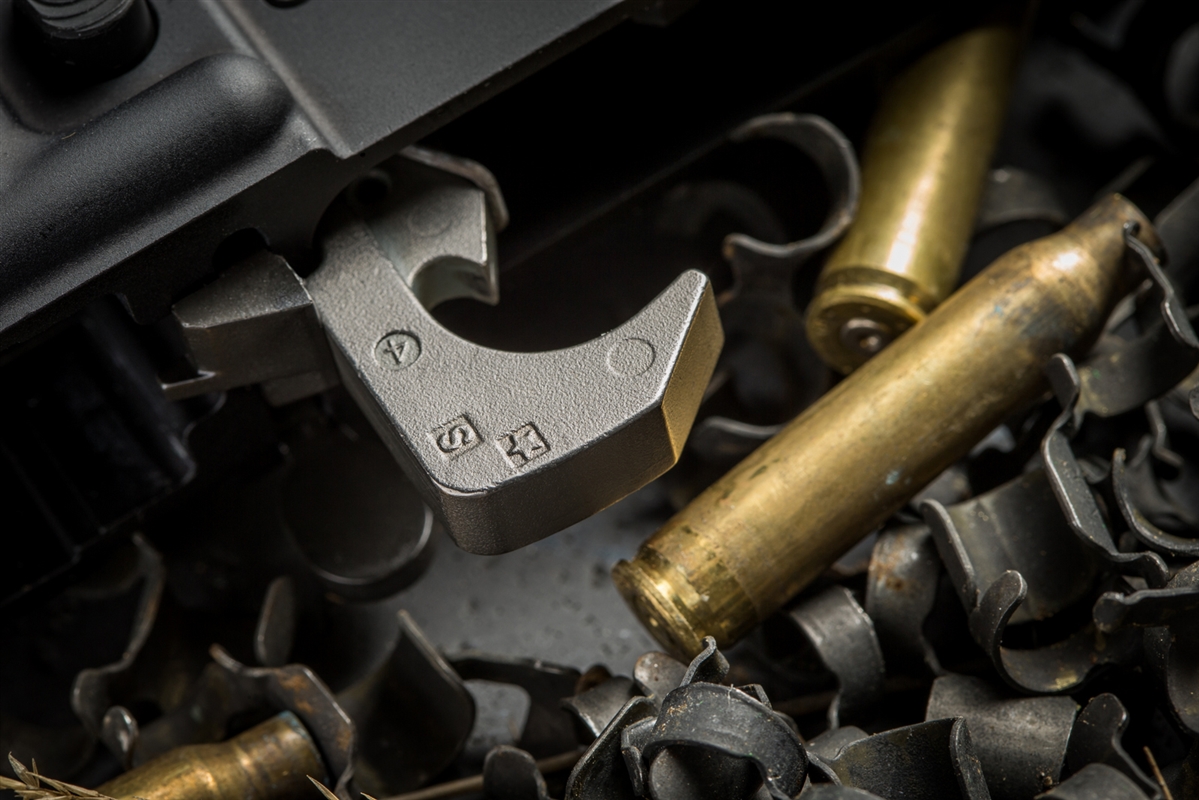
JQ: Managing distortion is probably the most challenging as most components are very close to being finished machined. Special racking and methodizing is often required. Marquenching, ausquenching, and vacuum processing are often employed to minimize or eliminate the possibility of distortion. Also, due to the small size and complex geometry present, inspection of the parts is difficult. It is important to clarify the testing location with the manufacturer prior to punching hardness holes into areas of the parts that may be exposed after assembly. After all, manufacturers want their guns to look nice afterward. We have experienced delayed rusting on barrels due to the combination of steel wire and the 4150 barrel reacting to cause anodic corrosion after processing in a salt bath which would only expose itself after a few days. We would ship parts that were perfect, and two days later I would be on the phone with my customer trying to explain a mysterious rust line through the rifling in the barrel. We solved this with some tooling changes.
JJ: Frankly, it is no more challenging or different than heat treating any other parts for any other industry. Some parts are routine and some are challenging. Some materials are more challenging than others and some designs are more challenging than others.
Which parts are the most difficult and why?
BCM PNT™ Trigger Assembly Bravo Company USA
JQ: They all present challenges. Slides and barrels present challenges due to the non-symmetrical nature which require special setup procedures. These also tend to have lots of crevices and blind or small holes which trap quenchants, salts, cleaning materials which tend to lead to unhappy customers unless the parts are thoroughly cleaned. Magazines present challenges because they are thin steel stampings which tend to distort due to the quench and induced stressed relieving themselves during heating. I could write a book on the challenges we have faced with the processing of gun parts.
JJ: Parts that require carburizing which have been machined to a finished or near-finished state, with intricate designs, cut-outs, and varying cross sections are the most challenging; a perfect example of this is an AR bolt carrier. This kind of challenge is why we developed our version of low-pressure vacuum carburizing, as we now don’t need to worry about severe quench distortion or carbon potential control. With traditional carburizing, the austenitizing temperature of the steel can change if too much carbon diffuses into the corners and edges. This can lead to retained austenite and carbide formation. Our process negates that phenomenon by using precisely controlled boost-diffuse controls instead of carbon potential. Our process also leaves the parts bright, with no post carburizing blasting or cleaning operations required.
Is it the materials that make it difficult or is it the configuration of the part?
JQ: The materials tend to be common that most heat treaters have worked with before so from a metallurgical standpoint I would say that the materials are not the problem. The configuration of the parts is definitely worse. Non-symmetrical parts tend to distort more than symmetrical parts. It also makes it difficult to inspect the parts. Test in the wrong area and you have spring-back or rocking. As I mentioned earlier, if you test in the wrong area the customer cannot sell the part. Some gun manufacturers have test methods that are unconventional, testing a shallow case depth using an HRC scale, so that the hardness reading is a combination of the case hardness, case depth, and core hardness.
JJ: It seems like you are assuming it is difficult all of the time! Please see my answer to question 2 above.
Are there any other special processes or regulations that need to be followed when heat treating gun parts? If so, what are they?
JJ: This answer is not to be taken as legal advice. If you want to apply for an FFL, or you get an FFL, you need to know the regulation. It is serious business: if you don’t follow regulation, you could end up in prison. You need to keep detailed records of EVERY serialized component that you receive, process, and ship. You don’t want to be on the tail end of a missing part or parts, especially if you don’t know about it. If something goes missing you need to report it immediately. Of course, reporting it could mean losing your license. So my advice to anyone considering this is: BE GOOD AT TRACEABILITY and RECORD KEEPING!
We welcome your inquiries to and feedback on Heat Treat Today articles. Submit your questions/comments to editor@heattreattoday.com.
United States Steel Corporation announced recently the restart of construction on a technologically advanced electric arc furnace (EAF) steelmaking facility at its Tubular Operations in Fairfield, Alabama. U. S. Steel previously initiated construction of the EAF in March 2015 in order to replace an existing aging blast furnace, but the company suspended construction in December 2015 due to unfavorable market conditions.
The investment to complete the EAF, which includes modernization of the existing rounds caster, is expected to begin immediately and the furnace is expected to be on line in the second half of 2020. The U. S. Steel Fairfield Tubular Operations custom creates seamless steel casing with an outside diameter range of 4-1/2 to 9-7/8 inches and seamless steel line and standard pipe with an outside diameter range 4-1/2 to 8-5/8 inches.
“We are pleased to announce the achievement of the market and performance stage gates required to restart our Tubular Segment EAF,” said David B. Burritt, President and Chief Executive Officer. “This investment is an important step to improve our cost structure and positions our Tubular business to win over the long-term. We are committed to investing in the sustainable steel technology required to be a value-added tubular solutions provider for our customers,” said President and Chief Executive Officer David B. Burritt.
“Thanks to the President’s strong trade actions and improved market conditions, support from the United Steelworkers and incentives from the State of Alabama and the Jefferson County Commission, we are excited to add EAF capabilities to our company’s footprint and provide sustainable tubular solutions for our customers,” added Burritt.
During the day-to-day operation of heat treat departments, many habits are formed and procedures followed that sometimes are done simply because that’s the way they’ve always been done. One of the great benefits of having a community of heat treaters is to challenge those habits and look at new ways of doing things. Heat TreatToday‘s 101 Heat TreatTips, tips and tricks that come from some of the industry’s foremost experts, were initially published in the FNA 2018 Special Print Edition, as a way to make the benefits of that community available to as many people as possible. This special edition is available in a digital format here.
Today, we offer one of the tips published under the Vacuum Furnace category.
Vacuum Furnace
Heat TreatTips #3
Make and Stick to a Clear Preventative Maintenance Program
Make sure a preventative maintenance schedule is clearly defined and adhered to. Most modern furnace control systems include diagnostics to assist in determining when certain components of the equipment require maintenance. Use these tools to prevent downtime and avoid wasting unnecessary maintenance.
Change pump oil regularly: roughing, pump, boosters, and holding.
Check hot zone for wear, loose, or missing hardware; verify element to ground resistance is greater than 10 ohms, vacuum out loose debris (monthly).
Check water chemistry and adequate flow to and from the furnace (weekly).
Check front door O-ring integrity, make sure there is no damage and that the ring is not flat; light grease as needed.
Bubble check process gas lines for potential leaks.
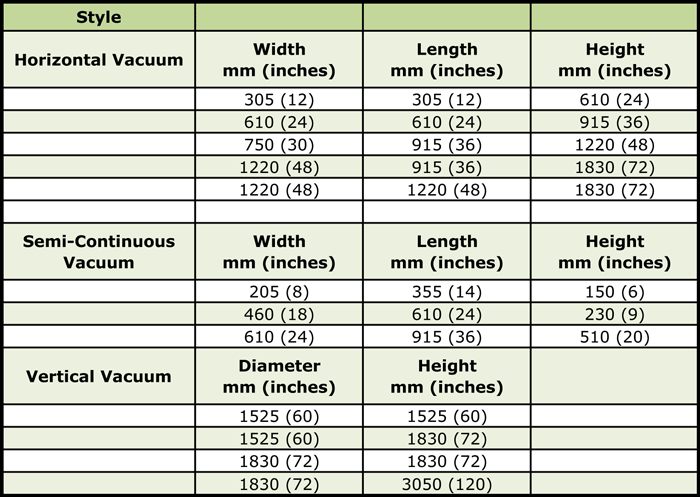
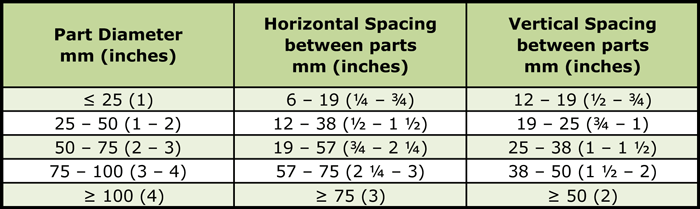
From minuscule medical implants to massive aerospace engine parts, vacuum furnaces process components that come in a variety of shapes and sizes. The challenge that faces a furnace operator is to load parts in such a way as to maximize efficiency (important) but also achieve desired metallurgical properties and minimize distortion (more important).
Understanding that loading options generally follow common sense rules can help with the puzzle of load arrangements, spacing parts properly, accommodating geometric irregularities, and loading orientation. This Technical Tuesday feature examines everything to consider about loading parts into a vacuum furnace — from the size and orientation of a workload to the “final spacing . . . [as] dictated by concerns for heating, soaking, flow (of partial pressure or backfill gases), the type and volume of quench media (e.g. oil, gas) and gross load weight.”
Many heat treat processes require protective or process gases. These gases often require careful monitoring. One of the protective and/or process gases used in many heat treat applications is an endothermic atmosphere which is made up largely of CO, CO2, H2, and N2. This article is about the creation and proper monitoring of endothermic atmospheres.
In an atmosphere furnace, the proper mix of these gases can help facilitate changes in the metal such as proper hardness and strength, resistance to temperature, or improved tensile strength to mention a few. Without careful control of temperature, time and atmosphere, metals can experience unwanted changes in properties such as hydrogen embrittlement, surface bluing, soot formation, oxidation, and decarburization. With such critical outcomes in the balance, it is necessary to control the endothermic gas.
An excerpt:
“In order for the required metal treatment to be a success, you must control and monitor the gas composition with extreme care. The concentrations of gases, CO₂, H₂O, CH₄, N₂, H₂ and CO, that make up the endothermic gas atmosphere should be measured in order to aid the prevention of unwanted reactions and ensure that the endogas generator and the furnace are operating normally.”
Registration is open for IHEA’s Fundamentals of Industrial Process Heating Online Learning Course that begins on April 15, 2019.
The course is ideal for students who wish to further their studies at home or work in a flexible web-based distance-learning format. It’s an affordable alternative to campus-based classes and allows students to go at their own pace. The program offers a vital tool to industrial process heating operators and users of all types of industrial heating equipment. Students learn safe and efficient operation of industrial heating equipment, how to reduce energy consumption, and ways to improve a company’s bottom-line.
The fundamentals course provides an overview of heat transfer, fuels and combustion, energy use, furnace design, refractories, automatic control, and atmospheres as applied to industrial process heating. For a complete listing of the topics covered visit www.ihea.org or click here.
Industry expert Jack Marino will lead students in this 6-week online course. Jack is a registered Professional Engineer with over 40 years’ experience in the heat processing business. He is a graduate of Rensselaer Polytechnic Institute with a bachelor’s degree in Aeronautical Engineering and has a master’s degree in Engineering Science from Penn State. Mr. Marino’s knowledge and experience offer invaluable resources that online students can access throughout the course.
IHEA will also offer an Advanced Industrial Process Heating course this fall. This course is a compliment to the Fundamentals of Industrial Process Heating and provides the student with an in-depth view of the control and efficient operation of industrial process heating equipment. Students will become familiar with a variety of oven, furnace, and kiln types used in industry.
The study was led by James Pikul, Assistant Professor in the Department of Mechanical Engineering and Applied Mechanics at Penn Engineering.
We’ve come a long way in the search for and application of lightweight metals, which are being used now in everything from high-performance golf clubs to airplane wings, but random defects that arise in the manufacturing process mean that these materials are only a fraction as strong as they could theoretically be.
In a new study published in Nature Scientific Reports, researchers at the University of Pennsylvania’s School of Engineering and Applied Science, the University of Illinois at Urbana–Champaign, and the University of Cambridge have designed and built materials that are stronger than anything heretofore developed, using a sheet of nickel with nanoscale pores that make it as strong as titanium but four to five times lighter.
“The empty space of the pores and the self-assembly process in which they’re made make the porous metal akin to a natural material, such as wood.
And just as the porosity of wood grain serves the biological function of transporting energy, the empty space in the researchers’ “metallic wood” could be infused with other materials. Infusing the scaffolding with anode and cathode materials would enable this metallic wood to serve double duty: a plane wing or prosthetic leg that’s also a battery.”
Photo credit/caption: Penn Engineering/A microscopic sample of the researchers’ “metallic wood.” Its porous structure is responsible for its high strength-to-weight ratio, and makes it more akin to natural materials, like wood.
Bob Sherlock CMO of Chief Outsiders will discuss “The Power of Value” at IHEA’s 90th Anniversary Annual Meeting in Sarasota, FL.
Registration has opened for the Industrial Heating Equipment Association 2019 Annual Meeting, where the organization will celebrate its 90th anniversary. The annual meeting, which this year will be 29 – May 1 at Lido Beach Resort in Sarasota, FL., provides plenty of opportunities to get involved with important industry-related developments while exploring new business contacts and growing relationships. provides plenty of opportunities to get involved with important industry-related developments while exploring new business contacts and growing relationships. IHEA members will enjoy the camaraderie created by the ever-popular social events and thought-provoking presentations.
The program will feature a dynamic presentation by Bob Sherlock, CMO of Chief Outsiders. Mr. Sherlock’s presentation, “The Power of Value,” will highlight why members should be paid for the value of their products and services rather than lowering prices to appease customers. Attendees will also hear from IHEA’s economist Chris Kuehl with his lively update on the economy, as well as a report from Omar Nashashibi from The Franklin Partnership, who lobbies in Washington D.C. on behalf of manufacturing trade associations. Mr. Nashashibi will offer insight to the government shutdown and latest developments on critical policies that will help companies plan for the unpredictable future.
IHEA members will gain valuable knowledge on cybersecurity and how to prolong the inevitable of being hacked. Chris Della Mora of HUB International Risk Services and James Moore of Goyer Management International team up to provide this critical session for anyone who uses the internet. The program also includes a presentation from IHEA member Scott Bishop with Alabama Power on the benefits of partnering with utility companies.
IHEA’s committees will meet in Sarasota as they continue to work on issues of importance to the membership and the industry at large. And the annual golf outing and beach games will provide the perfect social experience to round out the meeting agenda. Review the complete program and event details online here (or copy and paste: www.ihea.org/event/AM19).
Hotel reservations at the Lido Beach Resort can be made by clicking here. The group rate for junior suites is $209.00/night. Please book hotel reservations now to ensure you receive our group rate.
Photo caption: AM2019 Presentation – IHEA’s annual meeting presentations address timely topics and thought-provoking information for all members.