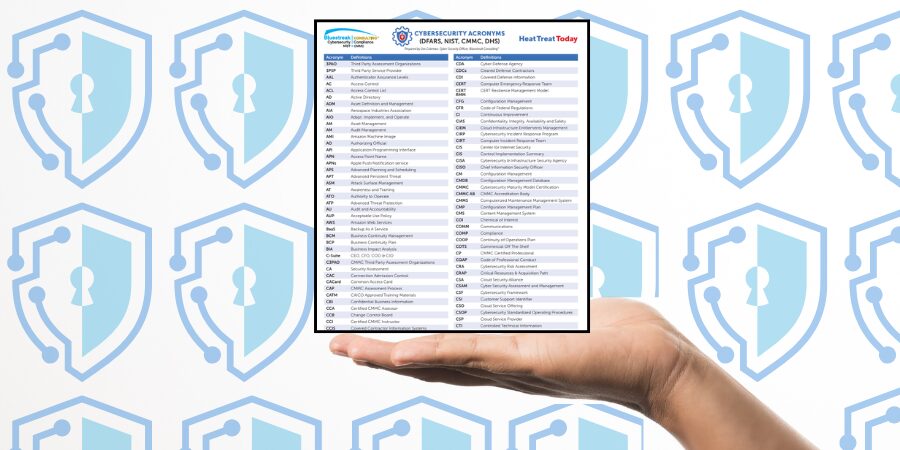
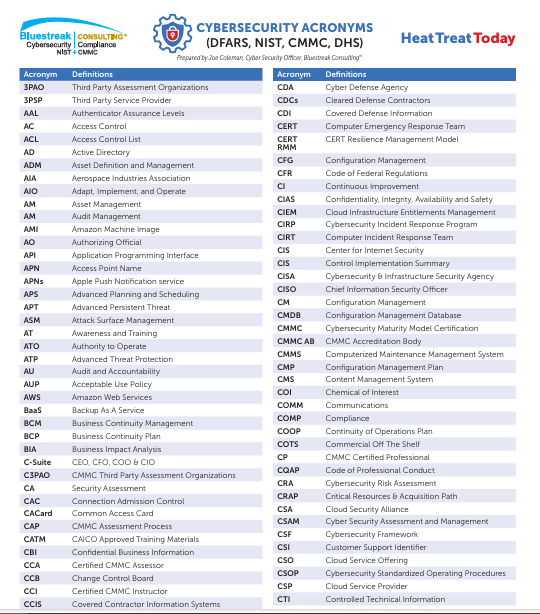
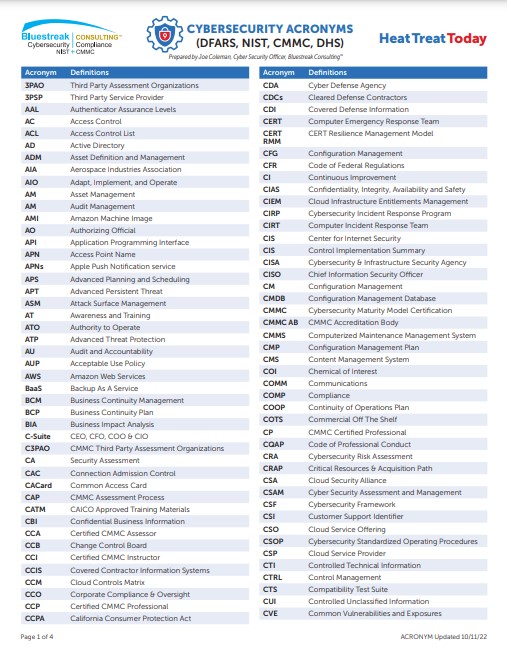
This list of cybersecurity acronyms was compiled by the late Joe Coleman, former cybersecurity officer at Bluestreak Consulting™. Joe wrote a regular column called the Cybersecurity Desk in Heat Treat Today’sprint publication.
“Even if a heat treater is not a DoD contractor or in the DoD supply chain, NIST 800-171 is a great “best practice” standard for any organization to improve overall cybersecurity health. This will help in obtaining future orders because customers will know critical data is secure.” – Joe Coleman
CLICK BELOW TO VIEW OR DOWNLOAD THE CYBERSECURITY ACRONYMS LIST
CLICK TO VIEW OR DOWNLOAD THE CYBERSECURITY ACRONYMS LIST
About The Author
Joe Coleman
Joe Coleman was the cybersecurity officer at Bluestreak Compliance, which is a division of Bluestreak | Bright AM™. Joe worked for over 35 years in diverse manufacturing and engineering positions. His background included extensive training in cybersecurity, a career as a machinist, machining manager, and an early additive manufacturing (AM) pioneer. Joe presented at the Furnaces North America (FNA 2024) convention on DFARS, NIST 800-171, and CMMC 2.0.
Despite an increasing cyber threat landscape, many small to mid-sized businesses (SMBs) in the Department of Defense (DoD) supply chain remain unprepared for compliance with NIST SP 800-171 R2 and CMMC 2.0. The Cybersecurity Maturity Model Certification (CMMC) 2.0 aims to improve cybersecurity across the defense industrial base (DIB), but many SMBs struggle to meet the standards, putting them at risk of losing crucial contracts. Surveys suggest that nearly 70% of SMBs are unready for the new requirements, and the real figure could be even higher due to some businesses inaccurately reporting compliance by inflating their assessment scores.
This is the final installment of the Cybersecurity Column penned by Joe Coleman of Bluestreak Compliance (August 6, 1968 — April 1, 2025). Joe was as kind as he was committed to helping manufacturers understand and meet cybersecurity compliance standards. This column series was born from his genuine desire to walk alongside others as they navigated the complexities of regulation and risk. We honor his memory and are grateful for the time, insight, and encouragement he shared with our readers.
Understanding CMMC 2.0
CMMC 2.0 simplifies the original five-tier framework into three levels:
Level 1: Basic cyber hygiene for contractors handling Federal Contract Information (FCI)
Level 2: Advanced practices for those working with Controlled Unclassified Information (CUI)
Level 3: Stringent requirements for contractors involved in national security projects
Compliance is mandatory for any contractor bidding on DoD contracts, including those working indirectly for federal contractors and subcontractors. SMBs should anticipate clients to inquire about their compliance as these standards will soon impact their business relationships. Achieving compliance is a lengthy process, typically taking twelve to eighteen months.
Low Readiness and Risks
The lack of readiness among SMBs threatens both business continuity and national security. Many smaller contractors lack the resources and expertise to meet CMMC 2.0’s standards. Given the defense sector’s reliance on a wide variety of contractors, this gap could create widespread repercussions.
Financial Implications of Non-Compliance
Compliance with CMMC 2.0 can be financially burdensome. Implementing measures such as multi-factor authentication, encryption, and continuous monitoring can be costly, especially for businesses with limited resources. The lack of in-house cybersecurity expertise compounds this issue, requiring companies to hire or train specialized personnel, further increasing costs.
Failing to comply with CMMC 2.0 could result in losing valuable DoD contracts, which can be a significant portion of SMB revenue. Such losses could lead to layoffs, revenue declines, or even business closures.
Challenges to Compliance
Several challenges contribute to the widespread unpreparedness among SMBs:
Challenges To Compliance Source: CanvaPro
Complexity of requirements: While CMMC 2.0 simplifies the original framework, its specific requirements remain difficult to interpret for many SMBs, particularly in identifying necessary security measures.
Resource limitations: The cost of achieving and maintaining compliance strains smaller businesses, which often lack the budgets for the required technology and expertise.
Lack of cybersecurity expertise: A shortage of qualified personnel poses a significant obstacle, as demand for cybersecurity professionals is high across industries.
Unclear timelines: Uncertainty surrounding DoD’s compliance timelines complicates planning and prioritization for SMBs.
Government Support Initiatives
To help SMBs, the DoD has introduced various programs, including training, grants, and educational resources. A phased implementation timeline also provides additional preparation time. However, industry experts suggest that further support, such as tax credits or subsidies, could help SMBs offset the costs of compliance. Clearer guidance from the DoD would also be beneficial in helping businesses navigate the certification process.
Path Forward for SMBs
To secure future contracts, SMBs must prioritize cybersecurity. This involves conducting internal risk assessments, identifying vulnerabilities, and creating compliance plans. Partnering with cybersecurity experts or managed service providers can help SMBs develop cost-effective strategies. Additionally, leveraging government resources and adopting critical security measures early will better position SMBs for CMMC 2.0 certification.
Conclusion
The widespread lack of preparedness for CMMC 2.0 poses significant risks to both SMBs and the defense supply chain. As deadlines approach, proactive measures from both businesses and the government are necessary to close the readiness gap and ensure the continued participation of SMBs in the defense sector.
About the Author:
Joe Coleman Cyber Security Officer Bluestreak Consulting Source: Bluestreak Consulting
Joe Coleman was the cybersecurity officer at Bluestreak Compliance, which is a division of Bluestreak | Bright AM™. Joe worked for over 35 years in diverse manufacturing and engineering positions. His background included extensive training in cybersecurity, a career as a machinist, machining manager, and an early additive manufacturing (AM) pioneer. Joe presented at the Furnaces North America (FNA 2024) convention on DFARS, NIST 800-171, and CMMC 2.0.
The Cybersecurity Maturity Model Certification (CMMC) 2.0 compliance process is detailed and complicated, and businesses in the defense industrial base (DIB) may be tempted to delay this regulatory hurdle. In this Cybersecurity Desk column, which was first released inHeat Treat Today’sMarch 2025 Aerospace print editionJoe Coleman, cybersecurity officer at Bluestreak Compliance, a division of Bluestreak | Bright AM™, explains why companies putting off CMMC 2.0 compliance may end up scrambling to meet deadlines, incurring costly delays, and even facing potential disqualification from future DoD contracts.
Introduction
The Cybersecurity Maturity Model Certification (CMMC) 2.0 is not only a regulatory hurdle, it represents a fundamental shift in the cybersecurity landscape for the Defense Industrial Base (DIB). Ignoring this critical initiative can have severe and potentially irreversible consequences for your company’s future.
Many companies mistakenly believe they can afford to delay their CMMC 2.0 compliance efforts, assuming they have plenty of time to prepare. This is a dangerous assumption. Achieving CMMC 2.0 compliance is a detailed and complicated process that typically takes 12–18 months. Delaying implementation can leave your company scrambling to meet deadlines and increase the risk of costly delays, missed opportunities, and even potential disqualification from future DoD contracts.
The High Cost of Inaction
The consequences of failing to prioritize CMMC 2.0 compliance are significant:
Loss of revenue and market share: Non-compliance directly impacts your ability to bid on and win DoD contracts. This translates to lost revenue, limiting growth and a significant competitive disadvantage against companies that have already achieved compliance
Erosion of trust and reputation: Failing to meet cybersecurity standards can damage your company’s reputation within the DIB. This loss of trust can impact not only your relationship with the DoD, but also with other key stakeholders, including clients, contractors, partners and investors. Some of your clients may have already asked if you are compliant.
Increased vulnerability to cyberattacks: A weak cybersecurity posture leaves your company highly susceptible to cyberattacks. These attacks can have devastating consequences, including data breaches, system disruptions, and significant financial losses. The key cybersecurity component of CMMC is NIST Special Publication 800-171.
Significant financial penalties: Non-compliance can result in substantial financial penalties, including fines and contract termination. These penalties can severely impact your company’s bottom line and long-term growth.
Operational disruption: The process of implementing and maintaining CMMC 2.0 controls can require significant amounts of time and resources. Delaying these efforts can disrupt your company’s operations, impacting productivity and potentially hindering critical projects.
The Benefits of Proactive Action
By proactively addressing CMMC 2.0 compliance, your company can gain a significant competitive advantage to win more business:
Competitive head start: Companies that prioritize CMMC 2.0 compliance gain a significant first-mover advantage. They can demonstrate their commitment to enhanced cybersecurity to the DoD, build stronger relationships with government agencies, and position themselves as preferred partners for future contracts.
Reduced stress and increased efficiency: Starting early allows for a more gradual and less stressful implementation process. This reduces the risk of last-minute scrambling and allows for a more efficient and effective integration of cybersecurity measures into your existing workflows.
Enhanced cybersecurity posture: The CMMC 2.0 framework provides a structured approach to enhancing your overall cybersecurity posture. By implementing these controls, you not only improve your compliance but also strengthen your defenses against a wide range of cyber threats.
Improved operational resilience: A robust cybersecurity program enhances your company’s operational resilience. By minimizing the risk of cyberattacks and their potential disruptions, you can ensure business continuity and maintain a competitive edge in the market.
Building a culture of security: CMMC 2.0 implementation encourages a shift towards a culture of security within your company. This includes raising awareness among employees about cybersecurity risks, fostering a sense of shared responsibility, and promoting best practices at all levels.
Conclusion
Click image to download a list of cybersecurity acronyms and definitions.
CMMC 2.0 is not an option; it is a critical requirement for any company seeking to do business with the DoD, its prime contractors, and/or downstream service providers. Procrastination is not an option. By taking proactive steps to understand and address CMMC 2.0 requirements, your company can mitigate risks, enhance its cybersecurity posture, and gain a significant competitive advantage in the evolving defense landscape.
For an up-to-date resource list of common cybersecurity acronyms, click the image to the right.
About the Author:
Joe Coleman Cyber Security Officer Bluestreak Consulting Source: Bluestreak Consulting
Joe Coleman is the cybersecurity officer at Bluestreak Compliance, which is a division of Bluestreak | Bright AM™. Joe has over 35 years of diverse manufacturing and engineering experience. His background includes extensive training in cybersecurity, a career as a machinist, machining manager, and an early additive manufacturing (AM) pioneer. Joe presented at the Furnaces North America (FNA 2024) convention on DFARS, NIST 800-171, and CMMC 2.0.
“The Cybersecurity Maturity Model Certification (CMMC) 2.0 aims to improve cybersecurity across the defense industrial base (DIB), but many small to mid-sized businesses (SMBs) struggle to meet the standards, putting them at risk of losing crucial contracts.” In this Cybersecurity Desk column, Joe Coleman, cybersecurity officer at Bluestreak Compliance, a division of Bluestreak | Bright AM™, raises the alarm ifsmall to mid-sized heat treaters neglect compliance standards and guides companies through the minefield of cyber threats facing all SMBs.
Read more Cybersecurity Desk columns in previousHeat Treat Today’s issues here.
Despite an increasing cyber threat landscape, many small to mid-sized businesses (SMBs) in the Department of Defense (DoD) supply chain remain unprepared for compliance with NIST SP 800-171 R2 and CMMC 2.0. The Cybersecurity Maturity Model Certification (CMMC) 2.0 aims to improve cybersecurity across the defense industrial base (DIB), but many SMBs struggle to meet the standards, putting them at risk of losing crucial contracts. Surveys suggest that nearly 70% of SMBs are unready for the new requirements, and the real figure could be even higher due to some businesses inaccurately reporting compliance by inflating their assessment scores.
Understanding CMMC 2.0
Contact us with your Reader Feedback!
CMMC 2.0 simplifies the original five-tier framework into three levels:
Level 1: Basic cyber hygiene for contractors handling Federal Contract Information (FCI).
Level 2: Advanced practices for those working with Controlled Unclassified Information (CUI).
Level 3: Stringent requirements for contractors involved in national security projects.
Compliance is mandatory for any contractor bidding on DoD contracts, including those working indirectly for federal contractors and subcontractors. SMBs should anticipate customers clients inquiring to inquire about their compliance as these standards will soon impact their business relationships. Achieving compliance is a lengthy process, typically taking 12 to 18 months.
Low Readiness and Risks
The lack of readiness among SMBs threatens both business continuity and national security. Many smaller contractors lack the resources and expertise to meet CMMC 2.0’s standards. Given the defense sector’s reliance on a wide variety of contractors, this gap could create widespread repercussions.
Financial Implications of Non-Compliance
Irreversible consequences from waiting to comply
Compliance with CMMC 2.0 can be financially burdensome. Implementing measures such as multi-factor authentication, encryption and continuous monitoring can be costly, especially for businesses with limited resources. The lack of in-house cybersecurity expertise compounds this issue, requiring companies to hire or train specialized personnel, further increasing costs.
Failing to comply with CMMC 2.0 could result in losing valuable DoD contracts, which can be a significant portion of SMB revenue. Such losses could lead to layoffs, revenue declines or even business closures.
Challenges to Compliance
Several challenges contribute to the widespread unpreparedness among SMBs:
Unclear timelines: Uncertainty surrounding DoD’s compliance timelines complicates planning and prioritization for SMBs.
Complexity of requirements: While CMMC 2.0 simplifies the original framework, its specific requirements remain difficult to interpret for many SMBs, particularly in identifying necessary security measures.
Resource limitations: The cost of achieving and maintaining compliance strains smaller businesses, which often lack the budgets for the required technology and expertise.
Lack of cybersecurity expertise: A shortage of qualified personnel poses a significant obstacle, as demand for cybersecurity professionals is high across industries.
Government Support Initiatives
To help SMBs, the DoD has introduced various programs, including training, grants and educational resources. A phased implementation timeline also provides additional preparation time. However, industry experts suggest that further support, such as tax credits or subsidies, could help SMBs offset the costs of compliance. Clearer guidance from the DoD would also be beneficial in helping businesses navigate the certification process.
Path Forward for SMBs
Click image to download a list of cybersecurity acronyms and definitions.
To secure future contracts, SMBs must prioritize cybersecurity. This involves conducting internal risk assessments, identifying vulnerabilities, and creating compliance plans. Partnering with cybersecurity experts or managed service providers can help SMBs develop cost-effective strategies. Additionally, leveraging government resources and adopting critical security measures early will better position SMBs for CMMC 2.0 certification.
Conclusion
The widespread lack of preparedness for CMMC 2.0 poses significant risks to both SMBs and the defense supply chain. As deadlines approach, proactive measures from both businesses and the government are necessary to close the readiness gap and ensure the continued participation of SMBs in the defense sector.
About the Author
Joe Coleman Cyber Security Officer Bluestreak Consulting Source: Bluestreak Consulting
Joe Coleman is the cybersecurity officer at Bluestreak Compliance, which is a division of Bluestreak | Bright AM™. Joe has over 35 years of diverse manufacturing and engineering experience. His background includes extensive training in cybersecurity, a career as a machinist, machining manager and an early additive manufacturing (AM) pioneer. Joe presented at the Furnaces North America (FNA 2024) convention on DFARS, NIST 800-171, and CMMC 2.0.
In Department of Defense (DoD) compliance, many acronyms and standards define how businesses manage processes to stay compliant. In this Cybersecurity Desk column, which was first released inHeat Treat Today’sSeptember 2024 People of Heat Treat print edition.In it, Joe Coleman, cybersecurity officer at Bluestreak Compliance, a division of Bluestreak | Bright AM™, discusses the similarities and differences between the Cybersecurity Maturity Model Certification (CMMC) 2.0 and NIST Special Publication 800-171 Rev. 2.
What Is CMMC?
The Cybersecurity Maturity Model Certification (CMMC) evaluates the maturity of an organization’s cybersecurity program. Developed by the DoD, it aims to equip over 300,000 Defense Industrial Base (DIB) contractors with robust defenses against cyber threats. Once formally published, CMMC 2.0 will be a mandated framework for private contractors and subcontractors seeking government contracts.
CMMC’s comprehensive approach includes NIST SP 800-171, NIST SP 800-172, and the Cybersecurity Framework (CSF), incorporating industry-leading practices. It ensures the effective implementation of critical controls and safeguards the integrity of the supply chain. CMMC 2.0 compliance certification has three levels:
Level 1: Foundational: For companies handling Federal Contract Information (FCI) but not Controlled Unclassified Information (CUI).
Level 2: Advanced: For companies that store, process, or transmit CUI.
Level 3: Expert: For companies implementing highly advanced cybersecurity practices.
It will be referred to as DFARS 242.204-7021 when integrated into government-awarded contracts.
Source: Department of Defense
What Is NIST SP 800-171?
NIST SP 800-171 is the National Institute of Standards and Technology Special Publication 800-171 Rev. 2. It outlines security standards for non-federal organizations that handle CUI, ensuring they maintain strong cybersecurity practices. Compliance is mandatory for DoD primes, contractors, and supply chain service providers.
NIST 800-171 specifies five core cybersecurity areas: identify, protect, detect, respond, and recover. These areas serve as a framework to protect CUI and mitigate cyber risks. The standard comprises 110 security controls within 14 control families, leading to 320 control or assessment objectives. Compliance is measured on a 110-point scale, with a possible range from -203 to 110. An initial negative score is not uncommon.
Even for organizations with some cyber/IT security measures, retaining a qualified DFARS/NIST 800-171 consultant or a CMMC Registered Practitioner (RP) or CMMC Registered Practitioner Advanced (RPA) is highly recommended to guide you through the process.
Similarities Between NIST SP 800-171 and CMMC
Both CMMC and NIST SP 800-171 aim to strengthen information security and protect sensitive data, ensuring the confidentiality, integrity, and availability of organizational information assets. Here are some of the key similarities:
Control Alignment: CMMC 2.0 Level 2 aligns with NIST SP 800-171 Rev. 2’s 110 controls.
Focus: Both frameworks emphasize protecting data confidentiality, integrity, and availability.
Role Definitions: They describe roles within an organization’s cybersecurity program and interactions among those roles.
Asset Identification: Both require identifying assets and vulnerabilities and creating a risk management plan.
Cybersecurity Program Development: Organizations must develop a program with policies, procedures, and standards.
Risk Management: Both require identifying, assessing, prioritizing, and responding to risks, though CMMC is more comprehensive.
Differences Between NIST SP 800-171 and CMMC
While both frameworks enhance cybersecurity, they have distinct features:
Assessment: NIST SP 800-171 compliance is self-assessed, while CMMC requires an independent third-party assessment.
Levels: CMMC has three certification levels, each more stringent than NIST SP 800-171 alone.
Scope: CMMC integrates additional NIST SP 800-172 practices and industry standards beyond NIST SP 800-171.
Conclusion
Click image to download a list of cybersecurity acronyms and definitions.
Understanding the differences between CMMC 2.0 and NIST SP 800-171 Rev. 2 is crucial for organizations enhancing their cybersecurity posture. Both frameworks are essential for assessing maturity in governance, risk management, incident response, data protection, and technology assurance. Adopting these frameworks ensures proactive adaptation to evolving threats and compliance with regulatory standards.
About the Author:
Joe Coleman Cyber Security Officer Bluestreak Consulting Source: Bluestreak Consulting
Joe Coleman is the cybersecurity officer at Bluestreak Compliance, which is a division of Bluestreak | Bright AM™. Joe has over 35 years of diverse manufacturing and engineering experience. His background includes extensive training in cybersecurity, a career as a machinist, machining manager, and an early additive manufacturing (AM) pioneer. Joe presented at the Furnaces North America (FNA 2024) convention on DFARS, NIST 800-171, and CMMC 2.0.
Furnaces North America(FNA) 2024 begins Monday, October 14, and runs through Wednesday, October 16. If you haven’t registered yet, you can still do so onsite, and one look at the technical sessions planned over the two days of training says all you need to know about the caliber of instruction at the event.
All of the sessions will be worth your time! Presenters are highly qualified to speak on the topics, which range from processes and equipment to technology to security:
Emerging Technologies
Furnace Maintenance & Equipment
Heat Treat Business & Digital Transformation
Energy & Gases
Operational Efficiencies
Quality, Compliance & Materials
Process Advancements
If you want to do a little prereading to prepare for the sessions, Heat TreatToday is pleased to direct your attention to technical session presenters who have contributed to our radio, print, and digital resources during this year:
On Tuesday at 8:50 a.m., Bryan Stern, product development manager at Gasbarre Thermal Processing Systems, will be speaking on “The Impact of Oil Quenching – A Look at the Carbon Footprint and Cost of Vacuum vs. Atmosphere Processing.” On June 20, 2024, Bryan was our guest on Heat TreatRadio, episode #110, “Isolated Heat, the Future of Vacuum Furnaces,” which you can listen to here.
Later that morning, at 9:40, Peter Sherwin, global business development manager of Heat Treatmentat Watlow, will focus on “Smart Heat Treatment: Industry 4.0 Innovations for Environmental & Energy Efficiency.” Peter co-authored “Thermal Loop Solutions: A Path to a Sustainable Future in Heat Treatment,” a two-part series published in both the magazine and on our website. You can read the first part here and the second part here.
During that same time slot, Brian Turner, sales application engineer at RoMan Manufacturing, is scheduled to speak on “Efficient Furnace Power Solutions”. Brian joined fellow RoMan employees who have contributed technical content to an ongoing series on controls. You can read that article, “Basic Definitions: Power Pathways in Vacuum Furnaces,” originally published July 16, 2024, here.
On Wednesday at 8 a.m., Sefi Grossman, founder and CEO of CombustionOS, is scheduled to present a session on “Maximizing Heat Treat Operational Efficiency: Digitize Your Data for Automation.” Sefi wrote a piece for our August Automotive print edition on “A New Era: Tracking Quality Digitally,” which was later republished at the website. You can read the digital version here.
At 8:50, Joe Coleman, cybersecurity officer at Bluestreak Compliance, will address “CMMC’s Impending Impact On The Metal Treating Industry.” Just last month, he joined Heat TreatRadio in an interview about “NIST and CMMC: What Heat Treaters Need To Know,” which you can listen to here.
Chad Beamer, senior applications engineer at Quintus Technologies, will speak on “Quintus Purus: Development of Clean HIP Processing” at 9:40 on Wednesday morning. Earlier this year, he collaborated with fellow Quintus employees on an article, “HIP Innovation Maximizes AM Medical Potential,” which you can read here.
Bryan Stern Product Development Manager Gasbarre Thermal Processing SystemsPeter Sherwin Global Business Development Manager Heat TreatmentBrian Turner Sales Applications Engineer RoMan Manufacturing, Inc. Source: RoManSefi Grossman Founder & CEO CombustionOS Source: AuthorJoe Coleman Cyber Security Officer Bluestreak ConsultingChad Beamer Senior Applications Engineer Quintus TechnologiesHeat Treat Today contributors leading technical sessions at FNA 2024
Stop by Heat TreatToday‘s booth (424/426) to let us know how the sessions went and if you did your homework beforehand!
Joe Coleman, cybersecurity officer at Bluestreak Compliance, discusses critical aspects of NIST 800-171 and CMMC with host Doug Glenn. Joe touches on how to become compliant, how long compliance takes, compliance pricing, and the limitations companies may face if not compliant. Learn more in this episode of Heat TreatRadio.
Below, you can watch the video, listen to the podcast by clicking on the audio play button, or read an edited transcript.
The following transcript has been edited for your reading enjoyment.
What Is CMMC? (03:34)
Doug Glenn: Let’s jump in. Cybersecurity, while it’s not unique to heat treaters, is across all manufacturing sectors. But there are some unique elements of it that tie into the metal treating industry.
Let’s start with some basic definitions for those who don’t know: What is CMMC and what’s the purpose of it?
Joe Coleman: CMMC stands for Cybersecurity Maturity Model Certification. And we’re currently on version 2.0. It’s a verification program to ensure that defense contractors and subcontractors are able to protect sensitive information from the DoD (Department of Defense). That includes FCI, which is federal contract information, and CUI — or some people call it “coui” — which is Controlled Unclassified Information.
Cybersecurity acronyms “cheat sheet” available as a free download. Click on the image for a link.
It’s going to affect about 300,000 companies in the U.S. Also, it’s going to start impacting companies later this year or early next year. That’s when it’s said to be fully released, and they’ll start adding it to contracts and RFQs and things like that.
Doug Glenn: So, in CMMC 2.0 version, the DoD is asking companies, “Do you comply with CMMC 2.0?”
Joe Coleman: Rather, it is saying you must comply by 2025 and at a certain level; there are three levels.
Doug Glenn: What are these requirements based on?
Joe Coleman: DFARS 252.204-7012 was implemented in 2016. In it, they were saying that people must be NIST 800-171 compliant by December 2017. If you’re not, you’re way behind the ball. They just haven’t pushed it until recently. Now they’re really pushing it. It’s based on NIST 800-171 recommendations — that’s Rev 2, and a subset of NIST 800-172.
Doug Glenn: You mentioned DFARS. Can you just briefly explain that?
Joe Coleman: DFARS is Defense Federal Acquisition Regulation Supplement.
Doug Glenn: Also, I’m kind of curious about this: Who’s actually pushing it? Is it the Department of Defense, or is it government in general, or is it controlled by (kind of like Nadcap and things of that sort) an independent organization outside of the federal government?
Joe Coleman: No, CMMC does cover other things, but it’s mostly by the DoD. They are the ones pushing itbecause of foreign adversaries stealing our information and ransomware attacks and things like that.
Doug Glenn: Right, okay. So that’s CMMC 2.0. Is NIST 800-171 is a sub part of that, or is NIST 800-171 something different?
Joe Coleman: That’s something different. NIST 800-171 is published by the National Institute of Standards and Technologies. DoD doesn’t have a lot to do with NIST. They are two different standards; the DoD is just borrowing NIST 800-171 for CMMC’s requirements.
Doug Glenn: I see. They’re using NIST’s package that’s already there as part of their requirement.
I think you’ve already kind of hit on it, but let’s just be explicit about it. What started the push by the DoD to require CMMC or require any type of enhanced security?
Joe Coleman: The DoD finally realized just how vulnerable defense contractors are and how vulnerable their computer systems and networks are to cyberattacks and to sensitive information being leaked by the DoD or contractors, that kind of thing. They’re trying to pull everything together to improve national security and to help secure this important data.
Doug Glenn: So, in a sense, it’s really the DoD just trying to cover their rear end, so to speak, and protect sensitive, national defense type information.
What Is DFARS? (08:45)
We talked about DFARs briefly. I’ve heard a DFARS interim rule mentioned. What is that?
Defining DFARS
Joe Coleman: That came about in November of 2020. It plays along with the DFARS 7012 — 252.204-7012. They came up with three new clauses to improve how cybersecurity is handled and enforced.
The first one is clause 252.204-7019. It mandates that you when you do your assessment: you come up with an assessment score based on 110 controls, and your score can be from a positive 110 (the perfect score) to a negative 203. That score needs to be turned into the SPRS, the Supplier Performance Risk System, so other companies can see what your score is.
So, 7019 mandates that you do turn in your score and that it can be no older than three years old. They are requesting that if they say you’re DFARS-required on a contract, things like that, you need to be NIST 800-171 compliant.
The next one is 252.204-7020. And that one states that you have to give full access to your company — your internet system, your IT, all of your information, and your employees, if they decide to come in and do a medium or high assessment or just an audit. You will have to turn over that control to them.
Joe Coleman: There are three different levels of assessments that can be done under NIST 800-171. There is a basic level which you attest yourself. It’s all self-attestation for NIST 800-171. There’s a medium level which means you have to have a DoD official come in and do your final assessment. And then there’s a high, which you also need a DoD official to come in and do that. The majority of them are basics, which you can self-attest to.
Doug Glenn: How does a company know if they need to even have the CMMC?
Joe Coleman: If your company is a defense contractor, subcontractor, vendor/supplier, or if you’re in the DIB (the defense industrial base), you will need to be compliant if you process, store, transmit, or handle FCI or CUI in any way. If you handle CUI or FCI, you must become CMMC certified at one level or another.
Doug Glenn: Let’s just take an example. Say I’m almost third tier down in a supply chain, and the guy I’m doing business for is obviously doing defense work. Do I need to be CMMC certified at that point, even on the basic level?
Joe Coleman: Well, it depends on what type of data you’re handling. There is a flow down process. It starts with the prime contractor. Then it goes to the contractor and then on down the line. And if you are dealing with CUI or FCI, you need to have that same certification level as your client or as your contractor.
Doug Glenn: Would my client in that case, the person I’m doing business with, would it be incumbent upon them to tell me that I am dealing with FCI or CUI?
Joe Coleman: Yes. It would be in your contract.
Doug Glenn: If someone listening has a specific question about whether they’re required, I’m sure they could contact you and you could probably help them on that just to make sure.
Joe Coleman: Anytime. I also have an ebook that I made that is ready to be sent out, so I can always send them a free copy of that.
Doug Glenn: Now, I think you’ve already answered this question, but how many maturity levels are in CMMC and what are they?
Joe Coleman: A little, there are three levels. There is level one, which is the foundational level, and that is for contractors or vendors or suppliers that deal with only FCI. They do not deal with CUI. So, there’s a much smaller set of requirements for level one. And about 60% of the 300,000 companies will be going for level one.
Then there’s level two, which is advanced, and that is for contractors and vendors and suppliers that deal with CUI in any way. It can come in an email and leave. But as long as they have access to CUI, they need to be at least a level two certification. And there are about 80,000 companies that are going to be impacted by that of the 300,000.
Level three is expert, and level three is based on the 110 controls in NIST 800-171 plus a subset of controls that are in 800-172. Level two mirrors NIST 800-171. It’s borrowing all the requirements from NIST 800-171, enhancing them a little bit, and putting them into CMMC. So, there are a few more hoops you have to jump through to be CMMC certified.
Doug Glenn: We’ve talked about two different sets of levels. We talked about a basic, medium, and high. And then we talked about level one, two, and three. Are these things the same or are they different? Can you help me understand the difference between those?
Joe Coleman: The basic, medium, and high is an assessment level that assesses your whole system and facility, and that’s based on NIST 800-171. CMMC, you have three different maturity levels, and that’s level one, level two, and level three.
Doug Glenn: When you say maturity levels, that shows the degree to which your company has gone to implement these things.
Joe Coleman: Yes. It is a certification.
On CMMC level one, you can self-attest your own certification. Level two and level three, you will have to have it’s called C3PAO (or a CMMC third-party assessment organization). They will have to come in and do your final assessment. Bluestreak Compliance can take you all the way to that assessment audit ready. But then you’ll have to have a C3PAO come in and do the final audit and the certification level.
Doug Glenn: That was going to be one of my questions because you guys mentioned that you’re a registered practitioner organization. You don’t actually do the assessments, but you can get everybody up to the door, right? You prepare them for it?
Joe Coleman: Yes. You would need a CMMC certified assessor to do that.
Doug Glenn: All right. And when is all this going to be required? Right now, it’s not required but it will be required?
CMMC: Mark Your Calendars! Companies will need to prepare for the eventual implementation of CMMC level two certification. A phased rollout is planned to simplify the process; however, a shortage of registered practitioner organizations (RPO) may lead to a backlog.
Joe Coleman: CMMC is not required currently. It’s in the last phase of being released for approval. Either late this year or early next year, it’s going to be a phased rollout. Later this year or early next year, you’re going to have phase one, which is that if you need to be level one certified, you will need to become certified right away. That’s the one you can self-attest.
Six months after that, they’re going to start requiring that CMMC level two is implemented. This means you’ll have to go through the process of getting a C3PAO. And that’s when it comes time to hire an RPO (registered practitioner organization), because they’ve got the training and the certification to get you there.
Now, one thing on the C3PAO: there are currently only 54 C3PAOs in the entire country. So, there’s going to be a huge backlog. You could be talking a year backlog, so plan accordingly.
Finally, at level three, an enhanced version of level two because it has more requirements, you’re also requiring a C3PAO for certification.
What’s Involved in Becoming NIST Compliant? (21:14)
Doug Glenn: Joe, let’s talk for a second about the process, if you will. What’s involved in becoming CMMC certified?
Joe Coleman: That all depends on if you are NIST 800-171 compliant already. If you are not NIST compliant already, you need to get NIST compliant as soon as possible. That has a big impact on your CMMC implementation.
Doug Glenn: Can you address that then: What do you have to do to become NIST compliant?
Joe Coleman: To become compliant, you have to do an assessment on your network and your facilities to come up with an assessment score. So, it’s the same as CMMC.
Then, you will have to do a gap analysis. You will come up with a POAM list (a plan of action and milestones); that is your to-do list based on your assessment, your shortcomings, or what you’re not compliant to. And you’ll need to come up with a system security plan (an SSP). That’s mandatory; you cannot be compliant without an SSP.
Once you get your SSP and your POAM list, then you need to take your score, your beginning score/baseline score, and submit that to the SPRS. And that is the library that holds all of the scores and shows your level.
From there, you start remediating and implementing your POAM list. But that also includes coming up with policies and procedures, plans, and a lot of documentation — everything gets documented based on where you stand and where you’re going, until the end when you do your final score.
Now, the SSP is a living document. It’s going to constantly change. If you have a change in your network, a major change, you’ll need to go in and update that right away.
How To Become CMMC Compliant? (23:46)
Doug Glenn: So that’s how you get to be NIST compliant. For CMMC, is there more to it?
Joe Coleman: There’s a few more requirements in CMMC, but the major difference is that with NIST 800-171 it’s all self-attestation. CMMC you will need to have a C3PAO.
Doug Glenn: That is, somebody’s going to need an outside validator, so to speak.
Joe Coleman: And they’re very expensive.
Now, another reason they came up with CMMC is because people were saying that they were compliant to NIST 800-171, and they really weren’t. That gets into the False Claims Act and things like that. They really go after people that do that.
Doug Glenn: Yeah. Any sense of the time frame for either becoming NIST compliant and/or CMMC compliant?
Joe Coleman: If you are not NIST compliant yet, that can take up to 6 to 12 months. I’ve seen it take more. You can do CMMC and NIST together if you need to because you’re using the same documents. If you’re not NIST compliant, that can take up to 18 months or more. If you are NIST compliant already, you’re talking 6 to 12 months to be CMMC certified.
Joe discusses the limitations of not being NIST compliant.
Doug Glenn: Okay. You just alluded to it, but I just want to make it clear. Can you do them both at the same time in parallel tracks?
Joe Coleman: Yeah, I’m working with clients that are not currently NIST compliant. So, we’re just rolling it into one using the same documents. It’s just that we’ll have to have a different assessor at the end.
Doug Glenn: Let’s say a company just decides they’re not going to be either NIST or CMMC compliant. You can still be a company, right?
Joe Coleman: Oh yeah, you can still do business; you just can’t do business with the DoD. A lot of companies base it on how much of their workload or how much of their business percentage is based on DoD work or from a contractor or subcontractor. If it’s 1%, 2%, 3%, 5%, you need to take a good hard look and say, is it worth putting a lot of money into?
Cost of Certification (26:52)
Doug Glenn: So, they can still be in business and doing well, but they just can’t do any DoD work. So, any ballpark figures? And I realize this probably varies widely depending on the size of the company and everything, but any ballpark sense of how much change we’re talking about here?
Joe Coleman: There’s no official word from the DoD on this, but there are some guesses out there. For NIST 800-171 compliance, depending on your current cybersecurity program that you currently have and how involved it is, I’ve seen it from $15,000 to $60,000.
Doug Glenn: Okay. That’s just for NIST?
Joe Coleman: Just for NIST. For CMMC, and again depending on if you’re NIST compliant, if you are not NIST compliant you’re going to do them together, it could be over $200K (probably easily) to become CMMC certified because you’re also becoming NIST compliant.
Doug Glenn: I’m curious. How come it’s going to cost you maybe 3x as much?
Joe Coleman: One of the main reasons is that with CMMC, you’ll want to hire a registered practitioner organization to guide you through the process and to do the documentation for you. The other is the C3PAO. There are only 54, and they can name their own price.
I can imagine it’s going to be over $100K just for the final assessment.
Doug Glenn: Right, that’s helpful. I think that gives everybody a pretty good sense of what we’re talking about here with CMMC 2.0 and NIST 800-171.
What Can a Registered Practitioner Do for You? (29:02)
Your division of your company, which is Bluestreak Compliance (you’ve already mentioned you’re a registered practitioner), can you give a brief summary of what it is? What do you guys bring to the table?
Joe Coleman: A registered practitioner organization has been certified by the Cyber Accreditation Board (Cyber AB), or CMMC accreditation body. A registered practitioner organization (RPO) works with and hires RPs (registered practitioners) or RPAs (registered practitioner advanced). I happen to be an RPA. And we’ve gone through all the training that we need to have so that the Cyber AB says, okay, you are qualified to do this.
So, when I quote a job, I usually quote it two different ways. One way is just guiding you through the process, so you’re going to do all the heavy lifting. I can supply you with templates and things like that for your documentation and guide you through each step. Or I can quote it where we manage the whole process. We will do all your documentation for you.
Joe Coleman: “You’re going to have at least 1 or 2 full-time employees doing nothing but this.”
Your team will have to be involved in the implementation process. And that’s true both ways. But we normally quote it two different ways, and they choose which one they want based on their budget and things like that.
Doug Glenn: It sounds like what you’re bringing to the table is the ability to get that company from where they are now, wherever they self-assess to start with, up to the point where they can bring in one of the third-party auditors and actually have a reasonable shot at passing the CMMC 2.0 assessment.
Joe Coleman: Correct. And it’s going to take a lot of input from the client or from the companies, too, because you’re going to have at least 1 or 2 full-time employees doing nothing but this. You’ve got to build that cost into it.
That’s what I tell people when we say we can quote it either guiding you or leading the project. It’s not as much work if I am leading the project. But if I’m not leading the project, you’re going to need a team of people to do this. It’s a lot of work.
Cybersecurity Areas To Be Aware Of (31:48)
Doug Glenn: I’m not sure there is an easy answer to this question, but can you give a list of top 3 to 4, or 4 to 5, areas that a company needs to look at when they start doing the NIST and CMMC checklists? Where do you see most companies falling down, or what are the areas they need to be aware of?
Joe Coleman: A lot of the smaller companies do not have a robust cybersecurity program. That is going to be a big pitfall. That’s going to be a big jump for them, not just the work that they have to put into it, but the expense; a lot of small companies just can’t afford that.
Joe Coleman: Some of the things are making sure that your network is totally secure and locked down, firewalls. Along with that, you’re going to need endpoint protection on all your devices, mobile device manager. You’re going to have to track every device that has access or could have access to CUI. You have to have a full inventory of that. Your IT system has to be locked down.
Now, this also includes your facility; it includes physical security. That’s talking about your door locks, your alarm systems, things that are going to protect CUI. Camera systems, your server rooms have to be locked down. It’s a lot of physical security, too.
Doug Glenn: Interesting. As well as the protocols for how you handle emails, how data is transferred, where it’s stored, and backups, stuff like that?
Joe Coleman:Yes. And you need to have a policy and a procedure for each one of those. They have to be fully documented every step of the way.
Doug Glenn: Wow. Okay. Sounds like fun, Joe.
Joe Coleman: It is. I enjoy it, but it’s a lot of work.
Doug Glenn: Well, that’s good, I appreciate it. The columns and things that you’ve written for our publication have been helpful to people, I know. And I think this podcast will also be helpful to them. But do you know, for those who are listening and might be attending Furnaces North America, do you know when your talk is?
Joe Coleman: It’s going to be on the 16th at 8:50 a.m., and it’s in room 222.
Doug Glenn: All right.
All right, Joe. Thank you very much. I appreciate your time. We’ll look forward to more of your input.
Thanks everyone for listening.
About The Guest
Joe Coleman Cyber Security Officer Bluestreak Consulting
Joe Coleman is the cybersecurity officer at Bluestreak Compliance, which is a division of Bluestreak | Bright AM™. Joe has over 35 years of diverse manufacturing and engineering experience. His background includes extensive training in cybersecurity, a career as a machinist, machining manager, and an early additive manufacturing (AM) pioneer. Joe will be speaking at the Furnaces North America (FNA 2024) convention, presenting on DFARS, NIST 800-171, and CMMC 2.0.
2024 is a big year for heat treaters who work for the DoD.AsJoe Coleman, cybersecurity officer at Bluestreak Consulting, explains, Controlled Unclassified Information is a key topic you need to understand if you want to maintain or grow contracts with the DoD this year.
This Cybersecurity Corner installment was released in part inHeat Treat Today’s March 2024 Aerospace print edition.
If you are a prime contractor for the Department of Defense (DoD) or a subcontractor, then you have CUI in one form or another whether it is in paper or digital format. Learn what is, and is not, considered Controlled Unclassified Information (CUI).
What Exactly Is Considered CUI?
Click to share your Reader Feedback!
The DoD handles CUI in many forms across its operations. CUI includes sensitive information that requires safeguarding but does not meet the criteria for classification as classified information. Examples of DoD CUI include:
Click image to download a list of cybersecurity acronyms and definitions.
Export Controlled Information (ECI): Information that is subject to export control laws and regulations, such as technical data related to defense goods and services.
For Official Use Only (FOUO): Information that is not classified but still requires protection from unauthorized disclosure for official government use.
Critical Infrastructure Information (CII): Details about critical infrastructure elements like facilities, systems, networks, and assets that are essential for national security, economy, or public health.
Privacy information: Personal information of individuals (e.g., Social Security numbers, medical records) that needs to be protected under privacy laws and regulations.
Sensitive But Unclassified (SBU) Information: Information that, although unclassified, is sensitive and requires protection due to its potential impact if disclosed.
Contract-related information: Non-public details within contracts, such as proprietary information, financial data, or technical specifications.
Proprietary information: Data owned by an entity and protected by intellectual property rights or confidentiality agreements.
In the heat treating industry, DoD CUI might include various sensitive details related to heat treatment processes, materials, or specifications used in defense-related applications. Here are some potential examples of DoD CUI within the heat treating industry:
Material specifications: Specifications for heat treated materials used in defense equipment, weapons systems, or components. This could include details about specific alloys, heat treatment methods, tempering, or hardening processes required for certain applications.
Process documentation: Detailed procedures and technical information regarding heat treatment processes employed in the production of defense-related materials or components. This might involve specific temperature ranges, cooling rates, or other proprietary methods used in heat treating.
Quality control data: Information related to quality control measures specific to heat treating in defense-related manufacturing. This could involve data on testing methodologies, inspection techniques, or standards compliance for heat treated materials used in critical defense systems.
Research and development (R&D) information: Research findings, experimental data, or proprietary knowledge related to advancements in heat treatment technologies tailored for defense applications. This may include innovative heat treatment methods for enhancing material properties, durability, or performance in defense systems.
Supplier information: Details about suppliers providing heat treatment services or materials to the defense industry, including contractual agreements, proprietary processes, or specifications specific to DoD projects.
Cybersecurity measures: Information about cybersecurity measures employed within heat treatment facilities that handle DoD contracts or projects to safeguard sensitive data from cyber threats.
Facility security protocols: Details regarding security protocols, access controls, and clearance requirements within heat treating facilities handling defense-related projects to prevent unauthorized access to sensitive information.
Other items that may be identified as CUI provided by the DoD or generated in support of fulfilling a DoD contract or order include, but are not limited to (in both paper and digital formats):
Research and engineering data
Engineering drawings and lists
Technical reports
Technical data packages
Design analysis
Specifications
Test reports
Technical orders
Cybersecurity plans/controls
IP addresses, nodes, links
Standards
Process sheets
Manuals
Data sets
Studies and analyses and related information
Computer software executable code and source code
Contract deliverable requirements lists (CDRL)
Financial records
Contract information
Conformance reports
What Is Not Normally Considered CUI?
Here are several examples of items that may not typically fall under DoD CUI for the heat treating industry:
General industry standards: Information related to commonly accepted industry standards, processes, or procedures that are widely available and not specific to defense-related applications.
Non-proprietary heat treatment techniques: Basic information about standard heat treatment methods or techniques that are publicly known and not proprietary to a particular organization or application within the defense sector.
Publicly available research: Scientific or technical research findings, publications, or data that are publicly accessible, not subject to proprietary rights, and not specifically tied to defense-related advancements.
Commonly shared best practices: Information regarding widely accepted best practices in heat treating that do not involve proprietary or classified techniques applicable solely to defense-related materials or components.
Non-sensitive business operations: Routine business operations, administrative documents, or general non-sensitive communications within the heat treating industry that do not pertain to defense contracts or projects.
Information approved for public release: Data that has been officially approved for public release by the DoD or other relevant authorities, ensuring it does not contain sensitive or classified details.
Basic material specifications: Information about materials, alloys, or heat treatment processes widely used in commercial applications and not specifically tailored or modified for defense-related purposes.
I hope this information has been helpful to you. Please contact me with any questions and for a free consultation, with a complimentary detailed compliance ebook.
For more information: Contact Joe Coleman at joe.coleman@go-throughput.com.
Find Heat Treating Products and Services When You Search on Heat Treat Buyers Guide.com
Artificial intelligence remains a hot topic for every industry, not least heat treating. Understanding the how and why of AI’s potential impacts on the industry, however, is not so easily apparent.
Today’s article, written by Joe Coleman, cybersecurity officer at Bluestreak Consulting, breaks down the pros and cons of implementing AI, to help you decide if artificial intelligence might be a beneficial addition to your heat treat operations.
Joe Coleman, cyber security officer, Bluestreak Consulting
As all of you are aware, artificial intelligence (AI) is getting more and more attention, and companies are beginning to use AI to help with many aspects of running their businesses. I’m sure you’ve heard of ChatGPT and other intelligent user interfaces (IUI). You may be one of those businesses considering the idea or experimenting with it to access its potential benefits for your business.
Like any industry, there are quite a few pros and cons associated with using AI to improve the heat treating processes. This article will outline some of these advantages and disadvantages. Always make sure you do your own research before jumping into the AI world because it’s not always what it seems.
What Is Artificial Intelligence (AI)?
Artificial Intelligence is the simulation of human intelligence in machines that are programmed to think and learn like humans. It includes a wide range of techniques and approaches, including machine learning, allowing computers to perform tasks that typically require human intelligence, such as understanding natural language, recognizing patterns, solving problems, and making decisions. AI systems are designed to learn from data, improving their performance over time without direct programming. These technologies find applications in many areas, from virtual assistants and language translation services to autonomous vehicles and industrial diagnostics, revolutionizing industries and helping to shape the future of technology
Pros of AI in Heat Treating
Quality Improvement:
AI systems can monitor and help control the heat treatment process in real time, ensuring you have consistent quality and to minimize defects.
Predictive analytics in AI can anticipate potential defects, allowing for corrective actions before they occur.
Increased Efficiency:
AI algorithms can optimize processing parameters and reduce bottlenecks, leading to faster and more efficient heat treating processes.
AI-driven automation can improve employee labor throughput and increase overall production speed.
Cost Reduction:
By optimizing utilities usage and resources, AI can help reduce the plethora of operational costs within heat treating facilities.
Predictive maintenance generated by AI can prevent costly equipment breakdowns and production downtime.
Customization and Personalization:
AI algorithms can analyze customer requirements and tailor heat treating processes to their specific needs.
Improved data analysis can lead to the development of new and specialized heat treatments for different metals and alloys.
Data Analysis and Information:
AI systems can process enormous amounts of data generated during heat treatment, collecting valuable information that can be used for process improvements and better-quality management.
Pattern recognition and statistical process control (SPC) analysis by AI can identify trends and correlations that could normally be overlooked.
Click image to download a list of cybersecurity acronyms and definitions.
Cons of AI in Heat Treating
Initial Investment:
Implementing an AI system requires a significant initial investment in the technology, training, and infrastructure, which may be a showstopper for smaller businesses.
Dependency on Technology:
Dependencies on AI systems can be a problem if there are technical glitches or breakdowns, disrupting the entire heat treating process.
Data Security and Privacy:
AI systems rely heavily on data. Ensuring the security and privacy of sensitive data is critical, especially when dealing with Controlled Unclassified Information (CUI), your proprietary heat treating processes, and sensitive customer information.
Ethical Concerns:
AI decision-making processes raise ethical questions, especially if the technology is used in critical applications, ensuring fairness, transparency, and accountability in AI decision-making is essential.
Skilled Workers Replaced:
Automation using AI might reduce the need for certain manual tasks, potentially leading to skilled workers losing their jobs without the necessary skills to operate or maintain AI systems.
Here’s the bottom line: You should always do your own research to see if AI is a good fit for your business. AI is not always better. There are upsides of using it, and there are definitely downsides to using it. You can’t always trust AI to give you the best information, so always make sure you confirm the information it is giving you through V&V (verification and validation).
At the Metal Treating Institute’s (MTI) national fall meeting, held October 9–11 in Tucson, AZ, Jay Owen gave an excellent presentation entitled, “Artificial Intelligence: Be Afraid or Be Excited.” Contact MTI by visiting www.heattreat.net.
This seventh article in the series from the Cybersecurity Desk helps you determine if CMMC applies to your business, learn about what changes were made to CMMC 1.0., know what you should be doing NOW to prepare for CMMC 2.0., and more.
Today’s read is a feature written by Joe Coleman, cybersecurity officer at Bluestreak Consulting™. This column is in Heat Treat Today’sMay 2023 Focus on Sustainable Heat Treat Technologies print edition.
Introduction
Joe Coleman Cybersecurity Officer Bluestreak Consulting™ Source: Bluestreak Consulting™
Along with determining if CMMC (Cybersecurity Maturity Model Certification) applies to your business, this 7th article in the series from Heat Treat Today’s Cybersecurity Desk will give you a better understanding of what the certification is all about and the requirements to become certified. Also, we will cover the changes that were made to CMMC 1.0, the current status of CMMC’s proposed rule, and what you should be doing NOW to prepare for when the CMMC 2.0 rule is finally released.
What Is Changing in CMMC 2.0
In November 2021, the Department of Defense (DoD) announced a major update to the CMMC program. To safeguard sensitive national security information, the DoD launched CMMC 2.0, a comprehensive framework to protect the Defense Industrial Base’s (DIB’s) sensitive unclassified information from frequent and increasingly complex cyberattacks. Manufacturers or suppliers that handle sensitive or Controlled Unclassified Information (CUI) in any way or those within the DIB need to pay attention. CMMC 2.0 condenses the original 5 CMMC maturity levels into 3 levels, eliminating levels 2 and 4, and removing CMMC unique practices and all maturity processes. They have also revised the number of controls required for each of the three new levels. Level 1 includes 17 controls, Level 2 has 110 controls, and the total number of controls in Level 3 is still to be determined. There are also several other changes made that somewhat relax the requirements from CMMC 1.0.
Who Does CMMC Impact?
Manufacturers in the DIB are going to be held accountable to safeguard sensitive information and must comply with CMMC 2.0. Any contractor, subcontractor, supplier, or manufacturer that provides parts or services to the DoD or anyone within the DIB (no matter how minuscule) will need to comply with one of the three levels of CMMC compliance.
What Should Heat Treaters Be Doing Now?
Although CMMC 2.0 is still in the rulemaking phase, the new CMMC proposed rule is expected to be released sometime in mid-2023. This will give some much needed clarity on how to move forward and will help streamline the implementation of CMMC. Warnings will be issued to the DIB through DoD primes and will be passed down through the supply chain. Manufacturers that do not comply will be at risk of losing contracts.
If you (or your clients) are doing work for any DoD primes (or NASA), such as Raytheon, Lockheed Martin, McDonnell Douglas, Northrup Grumman, or L3Harris (and many more), then this applies to your business. If you are unsure, check the fine print in your contracts, and/or ask your clients about their requirements.
If you handle CUI in any way, you need to be at a CMMC Level 2 or Level 3. The most common level is Level 2. If you don’t handle CUI in any way, but you do handle FCI (Federal Contract Information), you will need to be certified at a Level 1.
On average, it can take a company of up to 100 employees between 12 to 18 months for NIST 800-171 (CMMC Level 2) implementation. Meaning, even though CMMC 2.0 is not completed yet, don’t wait until it is. You’re already a year behind if you haven’t started your NIST 800-171 implementations and you want to be ready for when the CMMC 2.0 rule is released
CMMC certification requires government oversight whereas NIST 800-171 compliance can be self-attested. You should always hire a qualified CMMC consultant to ensure that you’re “audit-ready” for your certification audit.
What’s the Difference Between FCI and CUI?
FCI is information not intended for public release. FCI is provided by or generated for the Federal Government under a contract to develop or deliver a product or service. CUI and FCI share important similarities and a particularly important distinction. Both CUI and FCI include information created or collected by or for the government, as well as information received from the government. However, while FCI is any information that is “not intended for public release,” CUI is information that requires safeguarding and may also be subject to dissemination controls. In short: All CUI in possession of a government contractor is FCI, but not all FCI is CUI.
About the Author:
Joe Coleman is the cybersecurity officer at Bluestreak Consulting™, which is a division of Bluestreak | Bright AM™. Joe has over 35 years of diverse manufacturing and engineering experience. His background includes extensive training in cybersecurity, a career as a machinist, machining manager, and an early additive manufacturing (AM) pioneer. Contact Joe at joe.coleman@go-throughput.com.
Find heat treating products and services when you search on Heat Treat Buyers Guide.com