Women are taking on increasingly influential technical, operational, and leadership roles across the heat treat industry. Learn about the importance of building community and connection through Women in Heat Treat and preview the learning, leadership, and networking opportunities coming to Cleveland this November.
This community-focused feature was first released inHeat Treat Today’sSeptember 2026 People of Heat Treat print edition.
Women Are Here. But How Many?
How many women are actually working in heat treating? It is a surprisingly difficult question to answer.
The only industry-level data point we have found comes from a 2005 EEO Aggregate Report. At that time, women represented 14.8% of the commercial heat treating workforce. That number is more than 20 years old, and it doesn’t tell us how today’s workforce breaks down across commercial heat treaters, captive operations, suppliers, engineers, operators, and leadership.
So, is the number higher today? Lower? We don’t really know.
What we do know is that women are here. We are increasingly seeing women step into technical, operational, leadership, and decision-making roles throughout the industry. These women are bringing technical expertise, discipline, and a passion for their work to wherever their boots land every day.
That matters because heat treating has long been a field defined by a certain kind of culture: practical, technical, problem-solving, action oriented. If you’re here to do good work, you’re welcome.
But being welcome and feeling fully at home are not necessarily the same thing.
Making Space to Just Be
It isn’t controversial to acknowledge that heat treating has traditionally been a male-dominated industry. There are norms that don’t need to be spoken because the people who have been in the room for generations already understand them.
For women entering that room, some of those norms can be more noticeable. For women who have been in the industry for many years, those norms may still stand out as unwritten rules to navigate.
Sometimes it is wondering whether the way you speak in a meeting will be received differently than it would from one of your male colleagues. Sometimes it is second-guessing what to wear to an industry event. Sometimes it is walking into a social setting and realizing that the conversation, atmosphere, or expectations don’t quite resonate with you.
Women shouldn’t have to become less themselves to be taken seriously as professionals. Nor should any woman have to spend valuable energy wondering whether she is presenting herself in the “right” way when what matters most is the knowledge, experience, judgment, and value she brings to the room.
The answer lies in making room for women to bring their whole professional selves to the industry, even in spaces where doing so may not come naturally.
An Invitation
Creating that space where the women of this industry can bring their strengths with confidence is one reason we’re excited about Women in Heat Treat. For two and a half days in Cleveland, women from across the industry will have the opportunity to learn from experienced professionals, build technical expertise, explore the technologies shaping the future of heat treating, and have candid conversations about leadership and professional growth.
The most important part may be simpler than any of that: standing side-by-side in a room full of women who understand the work. From the challenges you’re trying to solve, to navigating a career decision you’re facing now, to simply being introduced to interesting people you want to know — and who want to know you — this space is designed for you.
Professional growth doesn’t happen in isolation. It happens through technical learning, mentorship, relationships, and conversations that continue long after a formal session ends. As a team made up largely of women ourselves, we’re especially excited to create more of those connections.
A Community Worth Building
There have been commendable efforts over the years to create more opportunities for women to be recognized, heard, and taken seriously in heat treating. Women in Heat Treat builds on that momentum by creating something very simple, but very intentional: a place for women in this industry to gather as professionals, learn from one another, and simply be in the room together.
So, if you’re a woman working in heat treating — whether you’re building technical expertise today, operating equipment, engineering processes, managing a team, making strategic decisions, or preparing for the next stage of your career — consider this your invitation.
Come learn. Come contribute. Come meet the women who are shaping where this industry goes next.
Katie Rucker Co-Owner, Strategic Insights & Foresight Partner MacKenzie Corp & Next Gen Collaborative
Katie will encourage attendees through her presentation, “The Other Side of Your Comfort Zone.” The other side of your comfort zone isn’t just about doing something scary. Sometimes it’s about giving yourself permission to imagine something you haven’t seen modeled before. You are in for a treat!
Susan Lanz Educator & Writer
“What’s Your 100 Miles?” That’s the question Sue will explore. We live in a culture that celebrates breakthrough moments and overnight success. But real transformation rarely happens in a single leap. It is built through small, courageous decisions — often made when no one is watching, and there is no guarantee of success.
Sneak Peek of Some of the Sessions
Live Recorded Panel Discussion
A live podcast filming devoted to the unique challenges and opportunities of being a woman leader in heat treating. Women on this panel include metallurgy and engineering decision-makers and OEM leaders.
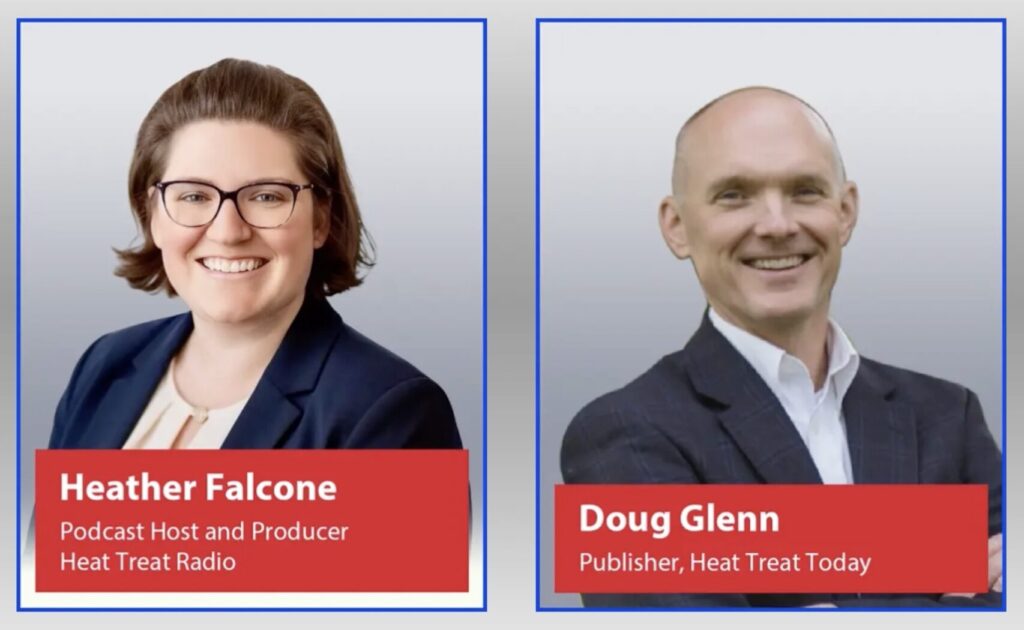
The panel will be hosted by leading industry voice and founder/president of Falcone Consulting, Heather Falcone. Heather is the host of Heat Treat Radio, a podcast by Heat Treat Today, where the recording of the panel will be broadcast and made available to a wider audience.
Breakout Session: Claiming Technical Authority at the Standards Table
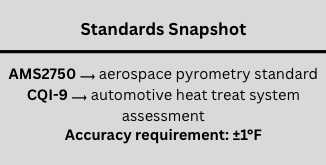
Women in quality, engineering, and operations are often responsible for turning dense technical requirements into work the shop floor can execute and records an auditor can follow. This session will examine common requirements, including AMS2750 for pyrometry and other major material processing specifications, Nadcap audit criteria, and ASTM testing methods. Andrew Bassett and Sarah Lombardo will also discuss how AMEC, ASTM committees, and the Nadcap Heat Treating Task Group influence industry requirements. Attendees will strengthen their ability to interpret revisions, manage flow downs, resolve conflicts, and lead specification compliance with confidence.
Breakout Session: Programming for Advanced Manufacturing
Programming and digital fluency can expand the paths available to women in manufacturing, from process engineering and automation to research, operations leadership, and entrepreneurship. Zachary Menard will explore the skills required to design, run, and improve advanced manufacturing systems. Drawing on research and development work and the experience of launching a new company, he will discuss emerging tools, workforce readiness, and the connection between technical knowledge and reliable production. Attendees will gain a clearer view of what is available now, where the field is heading, and how women can prepare themselves, mentor others, and help shape the next generation of manufacturing technology.
Breakout Session: The Ins and Outs of Process Change
Women in engineering, quality, and operations frequently carry responsibility for coordinating process changes across technical teams, production, customers, and suppliers. Our speaker will walk through the questions that help leaders evaluate a change before implementation, including technical risk, validation, customer approval, specification requirements, documentation, and communication. The session will also address how women can build credibility when raising concerns and keep the right voices involved throughout the decision. Attendees will leave with a practical framework for moving improvements from idea to controlled execution while protecting product performance and customer confidence.
Speaker TBD
Breakout Session: Future-Proofing Heat Treat: Digital Tools That Strengthen People and Performance
Digital transformation is changing the way heat treaters operate, but technology alone isn’t the solution. Explore how modern digital systems are reducing administrative burden, simplifying workforce training, preserving institutional knowledge, improving compliance, and helping organizations adapt more quickly to changing customer and industry requirements. Matthew will discuss practical strategies for implementing technology that supports people, drives consistency, and prepares companies for the future.
In North American manufacturing, trust is built differently across cultures — but trust remains essential to quality partnerships. What are the differences in professional expectations from Mexico-based professionals and U.S. Why do technically strong projects sometimes fail? Where do misunderstandings originate? How can purchasing, quality, and operations improve collaboration? Attendees will leave with practical insights for navigating cultural differences, strengthening communication, and building more effective working relationships.
Women working in operations, quality, and technology have an important opportunity to shape how AI enters manufacturing. Our speaker will examine practical applications for AI in process monitoring, data analysis, traceability, exception management, and operational decision-making. The session will explore the data discipline, cybersecurity, governance, and human oversight required to introduce these tools responsibly. Attendees will leave with a grounded framework for evaluating AI, asking informed questions, and determining where it can improve consistency and performance. The conversation will also encourage women to take an active role in the technology decisions influencing the future of their organizations.
Speaker TBD
Breakout Session: The Power of the Seat You’re In
Women often carry leadership responsibility before authority and title catch up. Our speaker will explore how women can build influence, earn trust, make sound decisions, and create momentum from wherever they sit in an organization. Through practical examples, they will discuss communicating with confidence, developing others, advocating for ideas, and staying grounded when the path forward is unclear. Attendees will be encouraged to recognize the leadership opportunities already within reach and consider how their experience, judgment, and perspective can strengthen the teams around them. They will leave with practical ways to contribute, grow, and lead with purpose in the work directly in front of them.
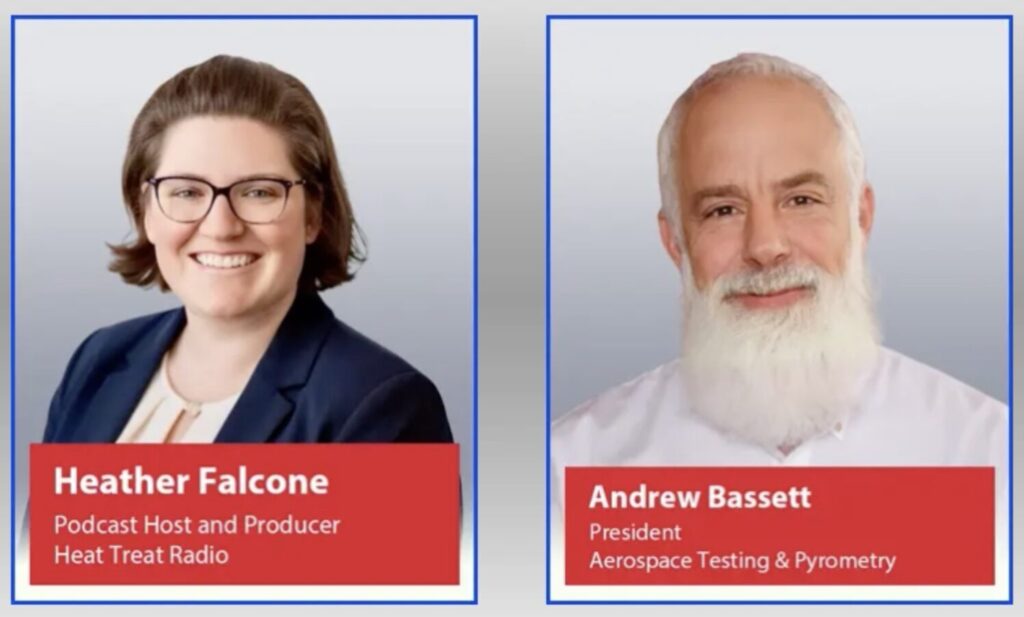
In aerospace heat treatment, few specifications carry as much weight — or as much apprehension — as AMS2750. This Technical Tuesday installment, adapted from a recent Heat Treat Radio conversation with ATP President Andrew Bassett and podcast producer/host Heather Falcone, offers insight into the evolution of AMS2750 and practical strategies for managing pyrometry compliance.
This informative piece was first released inHeat Treat Today’sAugust 2026 Annual Automotive Heat Treating print edition.
The Evolution of AMS2750
For many heat treat operations, AMS2750 represents the backbone of pyrometry compliance, yet it also presents a complex web of requirements that must coexist with broader quality management systems, client specifications, and audit expectations. Despite decades of revisions and clarifications, pyrometry continues to generate a disproportionate share of audit findings.
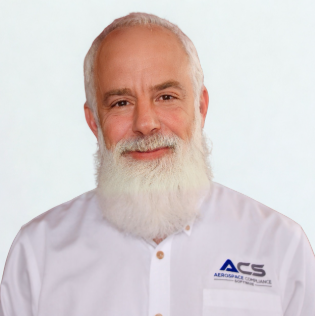
According to Andrew Bassett, president of Aerospace Testing and Pyrometry (ATP) and a long-time member of the teams responsible for writing the specification, the challenge is not simply the complexity of the standard; it’s how organizations manage it day to day.
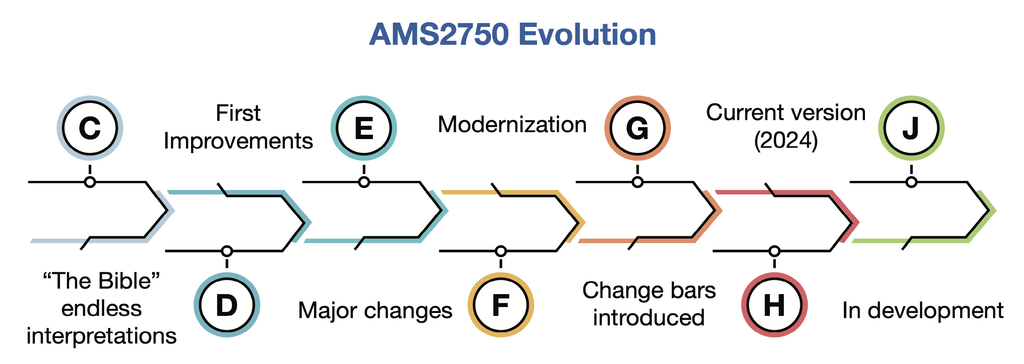
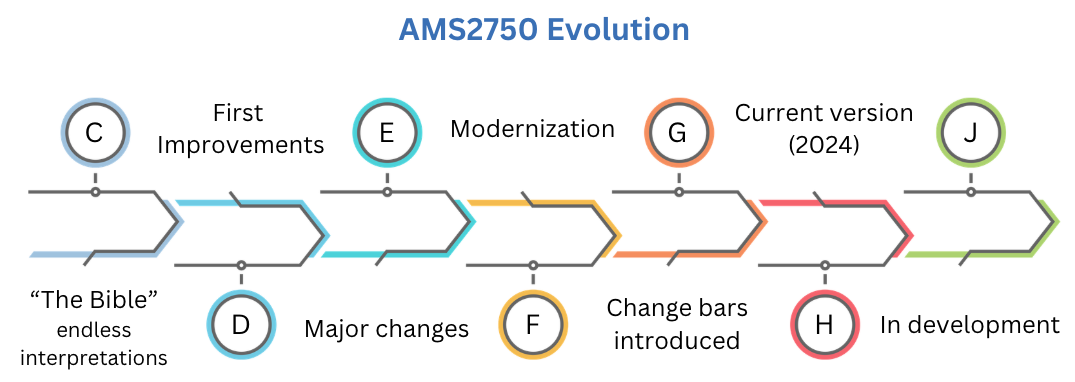
When Andrew first entered the industry, AMS2750 was at Revision C, a version many longtime heat treaters remember well. “Those who’ve been around long enough know that this revision of the spec was like the Bible,” Andrew says. “You gave it to a hundred different people, and you got a hundred different interpretations.”
Ambiguity in early versions of the specification created inconsistent interpretations across the industry. Over time, successive revisions, particularly the transitions through Revisions D and E, introduced significant changes aimed at improving clarity and consistency. The current Revision H reflects years of refinement.
Even so, Andrew believes the industry can continue improving how the specification communicates its intent. “My goal personally is to make sure that document is clear and understandable,” he explains. “Even if it’s 300 pages and we use stick figures and crayons to explain what the intent is — I’m okay with that.”
While aerospace heat treating specifications are generally clear about their purpose, pyrometry has historically been viewed as more difficult to interpret. Andrew hopes continued revisions and education will eventually eliminate that perception.
To Aerospace and Beyond
Although AMS2750 originated as an aerospace specification, its influence has expanded. According to Andrew, the standard is now widely used internationally and has been adopted by industries outside of aerospace manufacturing. In particular, the U.S. Food and Drug Administration has begun requiring compliance with AMS2750 for certain medical manufacturing processes. This means companies producing items such as dental drill bits or orthopedic implants must follow the same pyrometry standards used in aerospace heat treatment.
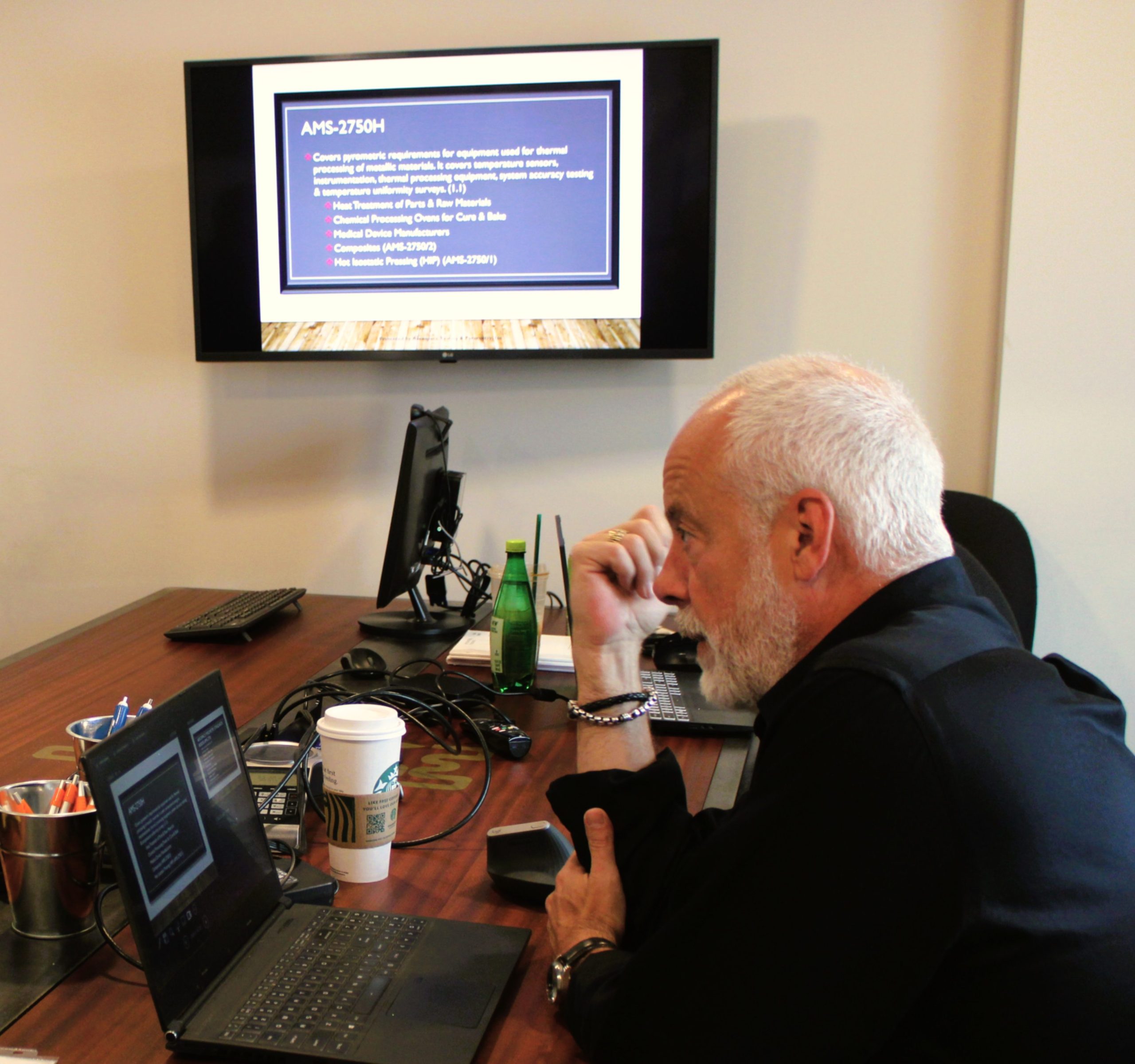
Andrew Bassett of ATP providing AMS2750 training | Image Credit: ATP
The expansion highlights the importance of understanding the intent of the specification, not just the literal wording of its requirements, for accurate interpretation at specific heat treat operations. For many organizations, achieving that understanding requires training and careful study.
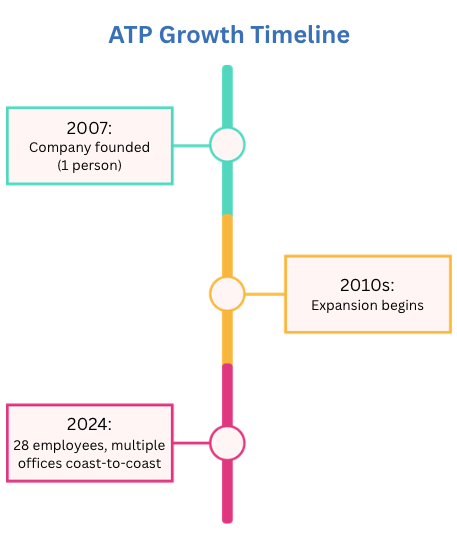
Andrew notes that explaining the specification in practical terms has become increasingly important. When Andrew originally began providing training on AMS2750 at ATP, it was a 6- to 8-hour day class, providing a 30,000-foot view of the standard. Now, this has evolved into an easier to digest training program extended over two days at a “crop-dusting training level” that is designed to help suppliers interpret and apply the standard in real operating environments.
The Challenge of Managing Compliance
Understanding AMS2750 is one challenge; managing it alongside other requirements is another. Many heat treaters must balance pyrometry requirements with broader quality management frameworks such as ISO and Nadcap, as well as client-specific specifications from aerospace primes.
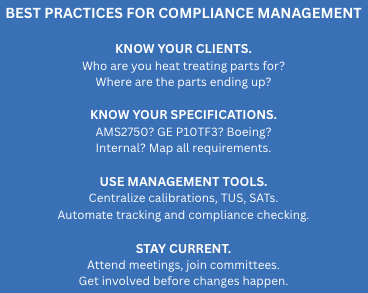
Andrew emphasizes that the first step in managing this complexity is gaining a clear understanding of what work is being performed and who the ultimate client is. For example, a commercial heat treater may receive a purchase order from one supplier, but the parts may ultimately be destined for a major aerospace manufacturer with its own pyrometry requirements. Without that insight, organizations can unknowingly miss critical compliance obligations. Once the applicable requirements are understood, companies must establish systems to manage them consistently, particularly when multiple specifications overlap or conflict.
In some cases, individual client specifications may differ from or extend beyond AMS2750 requirements, creating additional layers of oversight. For example, certain aerospace primes have their own pyrometry requirements that differ slightly from the standard. Managing those differences across multiple furnaces, calibration schedules, and testing procedures can quickly become a significant administrative challenge.
Documentation Drives Compliance
For many heat treaters, managing pyrometry compliance historically meant relying on manual systems: spreadsheets, paper logs, and physical binders containing calibration reports, temperature uniformity surveys (TUS), system accuracy tests (SAT), and thermocouple records.
Andrew remembers those early days well. “When we would get a new client, I would go buy a bunch of notebooks from Staples and put in their little dividers of a pyrometry program together,” he recalls. While the system worked, spreadsheet-based tracking introduced the possibility of human error, as it relied heavily on manual data entry and careful recordkeeping. But Andrew emphasizes, “When it comes to compliance audits, human errors cannot happen.”
Why Pyrometry Generates So Many NCRs
One of the most striking statistics in aerospace heat treatment audits is that 80% of nonconformance reports (NCRs) is tied to pyrometry. For someone involved in writing the specification, that statistic raises an important question: why?
Andrew believes part of the issue lies in how requirements are interpreted and implemented across different organizations. Even when the specification is clear, documentation gaps or process breakdowns can lead to findings.
A common example involves maintenance documentation. When a furnace undergoes preventive or unscheduled maintenance, the work must be recorded and reviewed to determine whether additional pyrometry testing is required. In some cases, maintenance may be completed and documented, but the required quality approval is never recorded.
These types of seemingly small documentation gaps can easily lead to NCRs during audits.
Moving Compliance from Paper to Platform
As documentation requirements have grown more complex, many aerospace heat treaters have found that the real challenge is not only collecting the data; it is organizing, reviewing, and presenting it in a way that satisfies auditors. Nadcap accreditation, AMS specifications, and client requirements all demand rigorous process monitoring and recordkeeping.
Recognizing these challenges, ATP developed Aerospace Compliance Software (ACS), a software platform designed to support aerospace compliance and documentation requirements tied to standards such as AMS2750 while also helping companies prepare for Nadcap audits and maintain the documentation expected by aerospace primes and OEMs.
“Now we have a system that’s 100% not just a pyrometry tool — it’s also a compliance tool,” says Andrew. “New features we keep adding into the system is with the focus on compliance, just not pyrometry-related tools.” This includes preventative maintenance leak rate testing checks and thermocouple replacement schedules. Andrew adds, “It’s also and most importantly a self-checking software to not only the industry specifications, but client internal specifications. It doesn’t have to be solely what AMS2750 says,” allowing users to verify compliance with various specifications.
By organizing documentation in a structured, traceable format, tools like ACS can help heat treaters more easily verify compliance with aerospace requirements and prepare for audits. As specifications continue to progress, many in the industry are turning to digital systems to simplify documentation while maintaining the level of process control that aerospace work demands.
The Value of Industry Participation
For Andrew, one of the most effective ways companies can improve their understanding of compliance requirements is by participating directly in the industry organizations that shape them. “This is something I preach constantly with our client base,” he says. “If you’re Nadcap accredited, firstly, go to a meeting.”
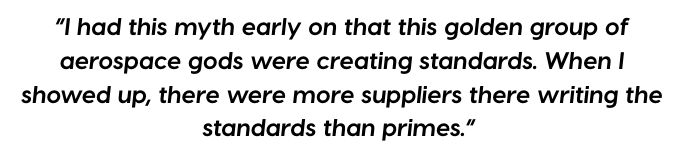
Misconceptions about who is involved in writing the standards often deter heat treat industry representatives. “I had this myth early on in my career that this golden group of aerospace gods were creating standards,” Andrew recalls. “When I showed up to the meeting, there were more suppliers there writing the standards than there were the primes.” That participation ensures the specification reflects real-world operations, and it gives companies a voice in the requirements they must ultimately follow.
Staying Ahead of the Standard
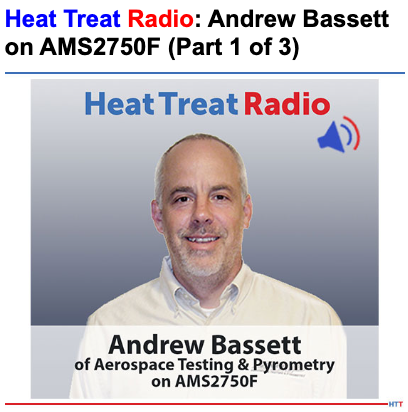
Click on the image above to get the full interview with Andrew Bassett of Aerospace Testing and Pyrometry.
In aerospace heat treating, compliance is never static. AMS2750 will continue to evolve, though Andrew expects future revisions to focus primarily on clarification rather than sweeping changes. The current review efforts for Revision J is already underway. As with previous updates, the committee maintains a running list of questions and issues that arise after each release. These items are reviewed and incorporated into future revisions when appropriate.
Maintaining precise pyrometry practices and ensuring that information is recorded and readily available during audits is key to complying with AMS2750. Standards like AMS2750 remain central to ensuring thermal processes are controlled, repeatable, and fully traceable. For heat treaters operating in aerospace, success increasingly depends not only on achieving the correct metallurgical results, but also on demonstrating compliance through clear, well-managed process data.
The Benefit of Knowledge Sharing
After more than three decades working with pyrometry and industry standards, Andrew says the most rewarding part of his work remains helping others understand the requirements. “Anytime I meet somebody and we talk pyrometry, my business card comes out,” he says. “If there’s a question you have, I’m more than happy to answer it to the best of my abilities.”
For him, the goal is simple: ensuring that suppliers understand the specification well enough to succeed. This is more than just passing audits; it means building robust and reliable thermal processing systems. Because in the end, managing AMS2750 is not just about checking boxes. It’s about building the knowledge and systems that keep the entire heat treating process running accurately, consistently, and safely.
This article was written by Heat Treat Today’s Editorial Team.
Defense suppliers gain additional time as the U.S. Department of War (formerly the U.S. Department of Defense) reviews its Cybersecurity Maturity Model Certification (CMMC) program. However, Heather Falcone, founder and principal of Falcone Consulting, LLC and Heat TreatRadio host and producer, cautions manufacturers with in-house heat treating and commercial heat treaters against interpreting the pause as a relaxation of their cybersecurity obligations.
What the Announcement Revealed
The U.S. Department of War has suspended the transition to Cybersecurity Maturity Model Certification (CMMC) Phase II requirements while it conducts a comprehensive review of the program.
The suspension pauses pending and future Phase II implementation milestones across Department of War solicitations and contracts. However, Phase I self-assessment requirements remain in effect, and contractors must continue protecting covered defense information under existing contractual requirements, including DFARS clause 252.204-7012. During the 60-day review period, cybersecurity compliance will continue through NIST SP 800-171 Revision 2 self-assessments and select government-led assessments.
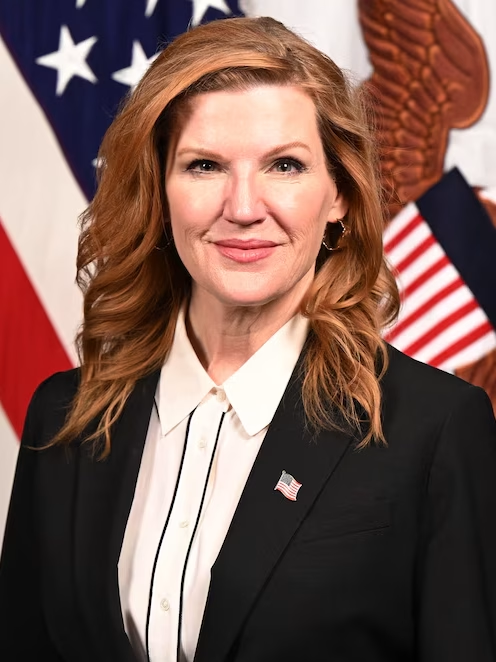
Kristin A. Davies Chief Information Officer U.S. Department of War
The review is intended to reduce compliance burdens on small, medium-sized, and non-traditional defense suppliers while maintaining cybersecurity protections. A newly established CMMC Reform Task Force will evaluate industry feedback and submit recommendations within 60 days.
“In support of Secretary Pete Hegseth’s directive to reduce compliance barriers for small and medium-sized businesses, we are suspending the CMMC Phase II requirements and initiating a 60-day study of the future of this program,” said Kristin A. Davies, chief information officer for the Department of War. “Robust cybersecurity and operational resilience remain critical to protecting American innovation and supporting warfighter readiness. We believe the Defense Industrial Base (DIB) can achieve both, while we reduce unnecessary government red tape.”
What This Means for Heat Treaters: An Industry Expert Weighs In
While the announcement delays the rollout of Phase II certification requirements, Falcone said manufacturers should avoid assuming that cybersecurity preparation can be put on hold.
Heather Falcone Founder and Principal of Falcone Consulting LLC / Host and Producer of Heat TreatRadio
“The most dangerous interpretation of this announcement would be that cybersecurity preparation can stop,” Falcone said. “Phase II has been suspended, but manufacturers remain responsible for protecting defense information and meeting their existing contractual requirements. Companies should use this period to confirm their scope, close material NIST 800-171 gaps, and strengthen the evidence supporting their compliance.”
Falcone described the announcement as a meaningful reprieve for many small and midsized captive and commercial heat treaters that supply the defense industry. Many companies, she noted, have been preparing for significant compliance costs while lacking dedicated cybersecurity staff or access to enough certified assessors.
“A rushed implementation could consume capital that would otherwise support equipment upgrades, workforce development, capacity expansion, and other investments the defense supply chain needs,” she said.
She added that the review provides an opportunity to address longstanding concerns over how controlled unclassified information (CUI) is identified, marked, and shared throughout the defense supply chain, as well as the availability of qualified assessors and the affordability of compliance for small manufacturers.
“This suspension acknowledges the capacity and cost problems small manufacturers have been raising for years,” she said. “A successful CMMC reset should preserve a serious cybersecurity baseline while giving small defense suppliers requirements they can clearly understand, afford, and execute.”
Although the November implementation deadline has been suspended, Falcone recommends that heat treaters continue strengthening their cybersecurity programs while reviewing spending decisions driven solely by the former deadline. She also encourages companies to consult with prime contractors before changing any contract-specific commitments.
Learn More About CMMC
For readers looking for additional background on cybersecurity requirements for defense suppliers:
In this episode of Heat TreatRadio, host Heather Falcone sits down with Casey O’Neill, vice president of Sales and Marketing at RoMan Manufacturing, to discuss a holistic approach to energy efficiency in thermal processing. Casey explains how furnace power systems, transformer placement, electrification strategies, and data-driven monitoring can significantly impact operating costs, maintenance requirements, and overall performance.The conversation also explores how emerging technologies such as digital twins and AI-driven analytics may help heat treaters address workforce challenges while improving energy management and productivity.
Below, you can watch the video, listen to the podcast by clicking on the audio play button, or read an edited transcript.
The following transcript has been edited for your reading enjoyment.
Introduction (00:04)
Heather Falcone: Hi, I’m Heather Falcone. Welcome to Heat TreatRadio.
Today we’re talking about holistic solutions to thermal processing system energy efficiency. We’re on-site with the sponsor of today’s episode, RoMan Manufacturing, in Wyoming, Michigan. We had the opportunity to take a tour before recording, so thank you to RoMan for hosting us. Joining me today is Casey O’Neill, vice president of Sales and Marketing. Thanks for joining me today, Casey.
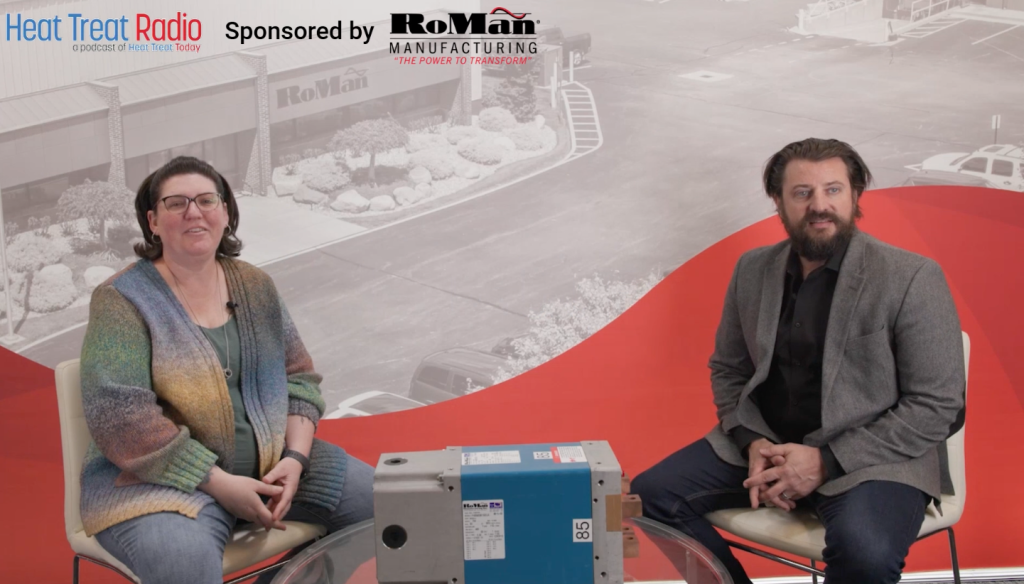
Heat Treat Radio host Heather Falcone (left) sits with the vice president of Sales and Marketing at RoMan Manufacturing, Casey O’Neill (right), on-site at RoMan Manufacturing in Michigan
Casey O’Neill: Thank you for being here. We’re excited to host you and record this on the RoMan campus.
Heather Falcone: You get the whole episode to talk about energy efficiency, but I’d like to start by having you tell us a little about yourself and your background. Since we’re at your facility, you get to do your own introduction and tell us a little about RoMan.
Casey O’Neill: I’m Casey O’Neill, vice president of Sales and Marketing at RoMan Manufacturing. I’ve been with RoMan for a number of years, and where I actually started working at RoMan was selling our products into the furnace market.
This segment of industry is really near and dear to my heart. It’s where I got my start in the business. I’m really excited to be able to discuss all the ways that RoMan Manufacturing specifically works to improve the efficiency of electrically heated furnaces within the heat treating industry and how we can help heat treaters money, while improving operational efficiency.
Heather Falcone: I think there are a lot of misconceptions about what can actually be done with energy efficiency. I’d love to dispel some of those myths and help educate people so that making changes to an energy system does not seem so intimidating.
Casey O’Neill: Absolutely. RoMan has a strong history in a variety of different industries, which allows us to take lessons that we’ve learned from one industry and apply them to other industries where that knowledge may not be understood yet.
That’s what we’ve been working to do within the furnace segment is apply our understanding of power and efficiency and how they relate to each other on different pieces of equipment and introduce those to improve the operations of heat treating companies.
Company History (2:53)
Heather Falcone: That’s really how the company got started, right?
Image Credit: RoMan Manufacturing
Casey O’Neill: Correct. RoMan was founded in 1980 by Dietrich Roth and Robert Hoffman. Dietrich was a brilliant engineer in the power transformation space. His focus was on optimizing power density in a resistance welding transformer.
He developed ways to create the power that was needed in a more compact box. As RoMan has evolved over the last 46 years, we’ve taken that concept and technology and expanded it across the products that we offer different industries.
RoMan supplies products for resistance welding, which is where the company started. We also provide power supplies for glass manufacturing, heat treating furnaces, sintering furnaces, and crystal growing furnaces. Outside of thermal processing, we develop power supplies for specialized projects that require high current. One of RoMan’s strengths is rectifying high-current AC power into high-current DC power.
The expertise needed to do that is fairly limited globally. So, we take on very specialized projects for the government and large primes to put that technology into practice for their applications.
Electrification Trends (4:58)
Casey O’Neill: As it relates to heat treating furnaces, over the last five years, there’s been a significant shift toward electrically heated furnaces. In some cases, companies are looking at converting gas-fired furnaces to electrically heated furnaces. A large part of this trend has to do with broader global electrification initiatives and decarbonization goals. As more and more furnaces are electrified and as more people are looking to buy electrically heated furnaces, our goal is to ensure this industry understands how to optimize that electric power so that the energy is being used by the furnace and not just burning into the air.
Water-Cooled Transformers (6:05)
Heather Falcone: When we talk about energy efficiency and thermal processing, beyond heat loss and leakage, what are the biggest inefficiencies that you’re seeing in heat treat operations today?
Casey O’Neill: From RoMan’s perspective, our core product is high-current, low-voltage, water-cooled transformers. We also integrate those power devices into power systems, like controls, breakers, PLCs, and communication with the main control system.
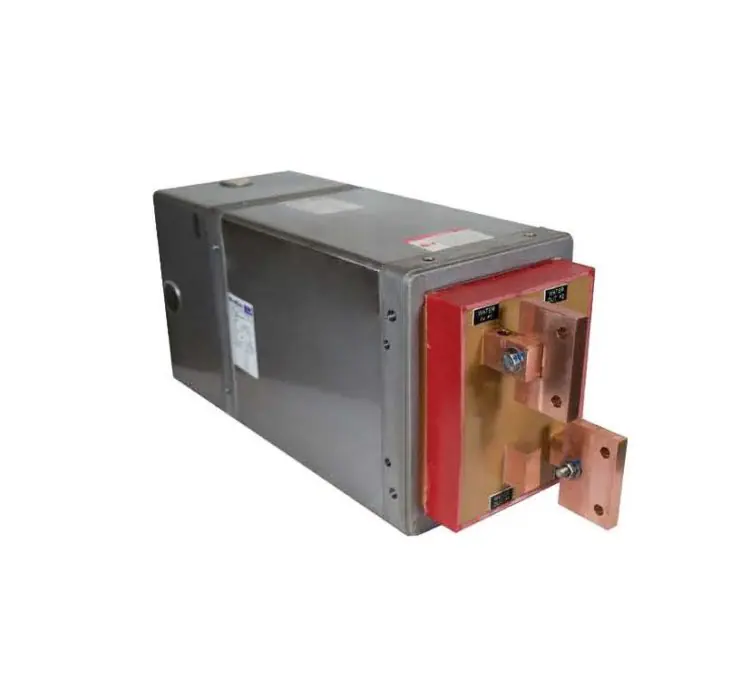
Single phase water-cooled transformer | Image Credit: RoMan Manufacturing
One of the key features is water cooling. In a lot of industries, there are applications where having a water-cooled transformer device is going to make the system more optimized than an air-cooled transformer would. While going to an air-cooled transformer may have a lower upfront cost, if you look at the total cost of ownership versus a power supply that integrates RoMan water-cooled device, because of the equipment optimizations, that will save money on energy and maintenance in the long run. RoMan builds our transformers in a way that integrates the water cooling right into the circuit of the transformer, creating a low-profile, high-power density product. The transformers are fully potted and completely sealed off from the elements. Like I said, we used to test our transformers by submerging them in a fish tank and powering them up to show that water could not get into the transformer and short it out. This allows the transformer to not have to be in a box, so it can be mounted on any equipment, because as long as you’re running the cooling water through the transformer, it’s not going to overheat. It’s impervious to any of the outside elements that you would normally put a different type of transformer in a box for. This allows the transformer to be mounted very close to a power feed-through of a furnace.
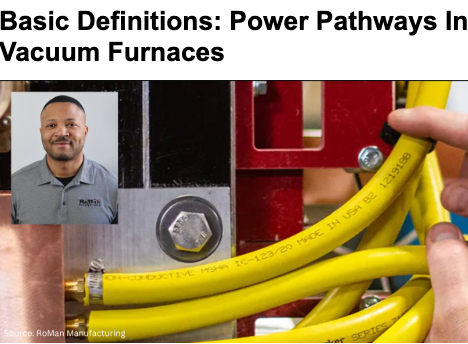
Related Reading: New to furnace power systems? Click on the image above to learn about how electricity travels through a vacuum furnace and why transformer placement matters.
Mounting the transformer in this way has many advantages. The secondary side of a transformer, the output side, is the high-current side of the furnace, and the high-current side of an electric circuit is the drastically more inefficient side of the electric circuit because current is heat.
On the primary side, it’s going to be higher voltage and lower current, but when you’re stepping down the voltage and stepping up the current, which is what you do in a transformer on a resistance-heated furnace, you’re creating a high-current, low-voltage secondary.
Well, high current is high heat. If you’re running high-current through big secondary cables from the transformer to the furnace, every foot of that cable is generating heat and wasting energy. So, you’re paying for energy that’s just going into the air.
Heather Falcone: And you’re heating the whole plant at the same time for nothing.
Casey O’Neill: Exactly. You then either have uncomfortable employees, or you need to get a bigger air conditioner.
What RoMan is working to integrate into this industry is remote mounting of transformers directly next to or close-coupled to the power feed-through of the furnace. By doing that, you’re eliminating the secondary cables altogether.
Not only does that save you energy losses in those cables, but those cables are also water-cooled, so you eliminate having to water-cool the cables. If they are air-cooled, and then they’re kicking heat off into the building. They’re also a large maintenance item and can be difficult to handle.
I’ve been to many different heat treating facilities, and I’ve talked with operators about integrating RoMan transformers where you’re closely coupling them to the power feeders and eliminating the cables. One of the operators joked with me and said he’d be my best friend forever if we could eliminate all those cables because of how difficult they are to do maintenance on. When you have a cable fail, it must be removed and replaced. RoMan is trying to eliminate those cables and mount this transformer right next to the power feed-through, making it more efficient and easier to maintain. We can do this because we’ve created a high-power, low-profile density transformer, that is impervious to elements; it can be outside of a box and mounted right next to the furnace.
Heather Falcone: That makes sense. When you’re looking for a system, you’re looking for something that decreases that, the past of least resistance, right? Faster, quicker, and easier.
Workforce Challenges (12:14)
Heather Falcone: The population of working people is shrinking, and in the next 10 years, it’s going to be the lowest it’s ever been. As such, it’s going to get harder to find and hire maintenance personnel, furnace operators, and electrical technicians. If companies eliminate that problem entirely, it’s a win-win.
Casey O’Neill: Exactly. One of the biggest challenges I see in the near-term future is a massive loss of knowledge base.
Across the heat treating industry, there are incredibly knowledgeable and experienced people that have kept heat treating companies running for the last 50 years that are approaching retirement.
As they leave the workforce, that knowledge base is not easily replaced. It’s quickly becoming one of the major challenges of not just heat treating but every industry.
Adoption of New Furnace Technology (13:30)
Casey O’Neill: At RoMan, our core product is high-current, low-voltage, water-cooled transformers, but we are also integrating some of this core product into broader power systems. As we start to integrate, we are also trying to create enough data feedback. We can monitor current, voltage, resistance values, and other parameters. With digital controls, that data can be extrapolated and fed back into the furnace system.
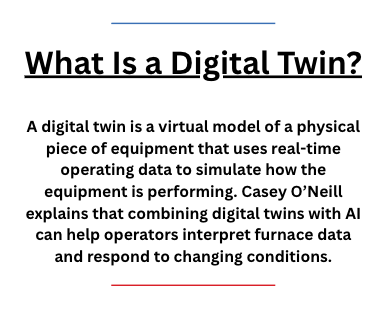
This is where we get into some fun technology. There are companies that can create a digital twin of a piece of equipment by engaging with the equipment and component manufacturers and the OEMs to understand how all of it behaves together.
If we see the transformer temperature internally rising, what does that mean or what could be causing that? If we see a certain part of the furnace inside getting a lot hotter, there are thermocouples inside reading the temperature.
They create a digital twin, and by integrating artificial intelligence, it can start to run simulations in real time, which allows them to communicate next steps with the operator based on what they are seeing with their simulations. So, as experienced personnel enter retirement, we’re going to need to start integrating more of this type of technology into systems or these systems will not operate as well as they should, which means productivity will decrease significantly.
One of the things that RoMan is actively pursuing is determining what feedback our power system can provide to the overall furnace system that’s going to feed into this digital twin and AI simulation to ensure that the furnace can continue to operate in a high productivity fashion, while simultaneously eliminating the challenge of our aging knowledge base.
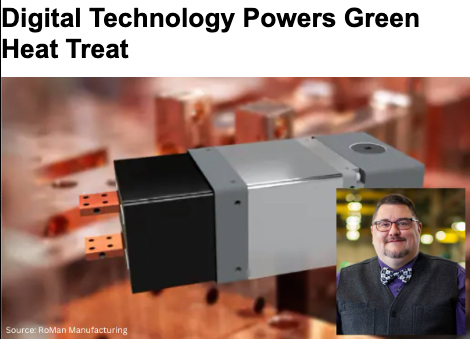
Related Reading: As furnace systems become more connected, digital controls play an increasingly important role in energy efficiency. Click on the image above to learn about how communication between power systems and furnace controls can reduce energy consumption and support sustainability goals.
Heather Falcone: Right. When you’re undertaking a project like energy efficiency, our tendency might be to focus just on that piece of equipment, and we may miss the opportunity to look at the larger picture and incorporate every piece of equipment.
Casey O’Neill: Exactly. As electrification of heat treating furnaces continues, the operational expense of electricity becomes one of the biggest expenses for heat treat operations. So, managing electric consumption has to become one of the most critical issues to address in order to be profitable.
At RoMan, we don’t just try to sell our products, we try to really engage with the users of our products in every industry that we work in so that they understand from our side how to most efficiently use our products in their system as a way to help the overall OPEX of electricity in a heat treating company, keeping it as minimal as possible or at least as efficient as possible. That way, they are only paying for electricity that is actually used to heat treat products and not paying to kick off energy into the air.
Heather Falcone: Let’s talk a little bit about that whole process that you’ve come up with, because many heat treaters are working with legacy systems. It can seem daunting to go from a VRT to this solution. What do you recommend for how they can attack this issue without being intimidated and rejecting the project entirely?
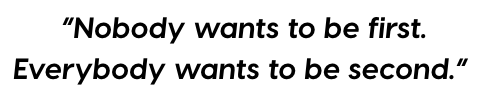
Casey O’Neill: In a number of industries that we work with, this fear is common. Nobody wants to be first. Everybody wants to be second. If we have new technology, they don’t necessarily want to be the first one to be innovative and integrate it into their system because they also don’t want to be the reason that production goes down if it fails.
So, you have systems with legacy products that have been working for decades and that makes people very comfortable with that system. Even if we can make drastic improvements on the overall operational expense, they are motivated by job security, so they want to work with products and technology they feel comfortable with.
We engage with both small and large captive and commercial heat treaters, and what I found is when you engage with a company that has a group that’s really focused on energy efficiency, especially as electrification grows, those people end up having a lot more say in what technology ends up being integrated into a system.
RoMan has a number of systems integrated into heat treating furnaces, and within our product offerings we have different types of power systems used in various applications. We have air-cooled transformers manufactured at our facility in Grand Haven, Michigan, and we have our high-current, low-voltage water-cooled transformers that are 60 hertz, 480-volt input, very basic, that are integrated into different furnace systems.
Our legacy began in resistance welding in the automotive world. If you’ve ever seen the commercials for vehicle manufacturers where you have the metal frame of a car going down an assembly line with robotic arms moving around, sparks flying — that’s resistance welding. It’s a bad example because when you’re doing the welds, you don’t want sparks, but sparks are good for TV.
That’s a resistance weld. On that robot is a weld gun, and in that weld gun is likely (if it’s in North America) a very small RoMan transformer. The input into that transformer is 1,000 hertz, 620 volts, and it’s coming from an IGBT control. In that industry, in the late ’80s/early ’90s, they started to go from larger stationary spot-welding stations to this robotic welding. They’re putting thousands of amps through that little weld gun, and if they were to use an AC transformer, it would be large, and then they would be running those big heavy cables to the weld gun. Also, robots move around so much, so you end up having a lot of maintenance issues and inefficiencies.
By integrating this IGBT control that can put out 1,000 hertz, you can exponentially shrink the core of the transformer, which makes the transformer size shrink significantly. Now since the ’90s, almost every automotive line is using an IGBT control and a really small, high-current, low-voltage, water-cooled transformer that’s in the weld gun connected to where the weld tips are.
RoMan takes something that’s been used for 40 years in one industry and realized there were many applications that would benefit from integrating this type of technology onto a furnace. When you’re running continuous heat for a long time, you end up creating a lot of inefficiencies, which can get really technical.
This system overcomes many inefficiencies using these different types of technology that all look different from what people are used to seeing. What we are trying to do is educate people on the uses of these new technologies and the benefits of their integration on furnaces, particularly the improvement of operational expenses, electrical efficiencies, and also maintenance.
Furnace Integration — Retrofits (24:24)
Heather Falcone: We have discussed RoMan and the systems. Tell me about integration at the furnace level.
Casey O’Neill: As I have mentioned, we have different furnace applications that use different versions of our technology. For commercial heat treaters, heat treating is how they make money, managing operational expenses of the equipment is absolutely critical to profitability.
We have conducted several trials and product integrations where we’ve worked directly with heat treaters to retrofit equipment so they can start to understand and see the operational gains from using our products.
Related Reading: Casey discusses how power controls affect furnace efficiency and performance. Click on the image above for a deeper look at IGBTs and matching controls to heating loads.
In one case, we had a commercial heat treater that had a vacuum furnace with a large legacy power supply. We have some different data loggers that measure and log power data. We hooked them up to a power logger, and had them operate normally, run different parts that they normally run through that furnace, and we just logged the power data, the kVA, kW, the reactive power, and the power factor — parameters that matter when it comes to power and what the utility companies bill people for. Then we examined that data, and we saw that the power supply that they had for the work that they were doing was oversized.
One of the changes that we could make to optimize the operation of the power supply was to size it more according to their needs. In this case, we retrofitted that furnace with an IGBT control and our small MFDC transformer. We sized the kVA down more to their needs to add some efficiency to the system.
We had them turn it back on and operate normally, using the same parts. We logged the power again and we were able to compare the different runs. We also had them run a burnout run so we could compare the burnouts. As we were doing that, we noticed one run that they were doing after we retrofitted the furnace that wasn’t in any of the logs from before we retrofitted it. We did not know where it came from. The company explained that there is a certain part that they heat treat for a customer and that particular process has a very, very fast ramp rate to get to a very high temperature. In their facility, they only have one furnace that they can do that particular cycle on. After we retrofitted this furnace, they decided to try this particular process, and they were able to do it.
Heather Falcone: That’s awesome.
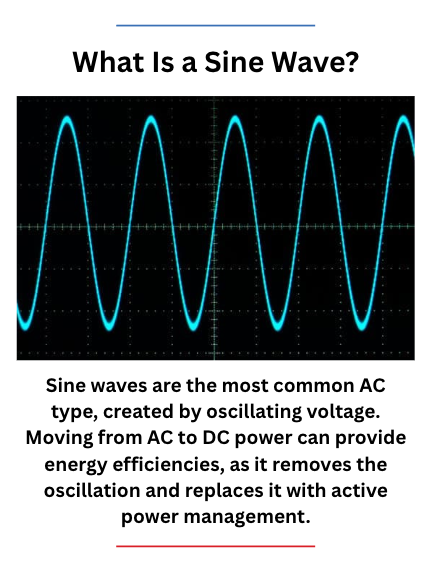
Casey O’Neill: Keep in mind; this was actually a smaller kVA transformer than what was on that furnace before. The output of this transformer is DC, not AC, and AC has a sine wave, which kind of goes like that, and there’s a zero point where it’s always crossing zero. Every time it crosses zero, it’s off for just a little bit. We’re talking milliseconds. But then it has to reheat a little bit. It continues heating, and then it’s off as it crosses zero again.
The MFDC, however, is DC power. DC power is just on, so you’re just managing how much it’s on. As a result, you never have to do that little reheat before you continue heating like you do with AC power.
The best explanation, and this is anecdotal, not data-driven, is when they retrofitted that furnace with DC power, because that DC can just stay on, they were able to ramp much faster and hotter. Even though it was a lower kVA transformer, it still had enough power to get up to temperature. Also, because of the DC power, it was a much better heat, so it could get up to temperature much faster and allow them to do that cycle.
So operationally, they’re now able to run that particular process in two furnaces instead of one. Double the capacity, which is now optimized for a commercial heat treater to be able to shift things around more and have some options when they’re in production.
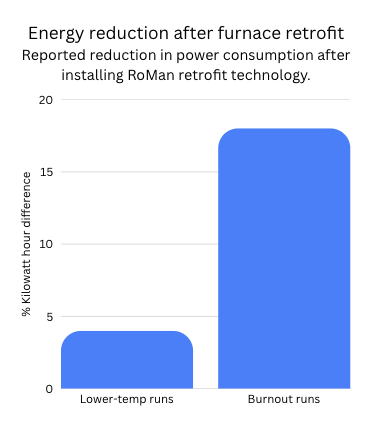
A burnout run is obviously a lot more power than a different run that’s lower temperature or a shorter period of time. On some of those lower temperature runs, there was about a 4% kilowatt hour difference in consumption after we retrofitted it. For the burnout run, the kilowatt hour difference was actually 18%. By retrofitting, it reduced the real power consumption by 18% on every burnout.
The ability to use DC in a resistance application is always going to make it more efficient. But then also by shortening the secondary, you’re eliminating energy waste, optimizing efficiency, and enhancing maintenance.
In that facility, about half of the furnaces now have that IGBT system and these small MFDC transformers. This is a more expensive system. When you look at the total cost of ownership, you have to weigh the costs, is the value there or not? There are certain cases where it is, and there are certain cases where it is not. As I mentioned, half of their furnaces have this system, and the other half do not. That’s because for half of them, there isn’t enough added value to make this change. But for other furnaces at other heat treating companies, we have AC high-current, low-voltage water-cooled transformers like this where those are integrated. We’ve closely mounted them to the power feed-through, and just by getting rid of those secondary cables, we’ve helped improve the efficiency of the furnace. That one is actually really easy to do the math on savings because different size cables have ratings of heat loss per foot. You can easily do the math. On every foot of cable we eliminate; you’re going to save this much in energy consumption.
In some other cases, the transformer, while important, actually becomes less important than the power control. In some commercial heat treaters and in many captive heat treaters, they may run one part over and over and over again. But they have to make sure that every single time it is done exactly the same. We integrate our transformers into a power system where we’re getting controls and other feedback devices that we integrate into the whole system so you can start to monitor and digitally send all that information into a main equipment PLC, which means they can make a lot more informed decisions on how to manage the equipment to ensure that the output is consistent time and time again.
Heather Falcone: Absolutely. I think that’s important to insert in part of the process. As somebody who’s looking to evaluate energy efficiency, you are looking at retrofit, so you need to get the right partner that can give you the education and the foundation to dispel any worries that you might have right up front.
Furnace Integration — New Equipment & OEMs (34:10)
Heather Falcone: But it’s not just retrofits; you can integrate with brand new equipment. Can you talk a little bit about this and working with OEMs.
Casey O’Neill: In general, RoMan has a history of trying to work with everybody in the supply chain, because I think that we offer different forms of value to different companies within that supply chain. The heat treating industry is no different. Furnace users and heat treaters are the ones that are paying their electric bill. They’re the ones that are paying the furnace operators, the maintenance personnel. They’re buying maintenance parts. For them, the value of the RoMan products is going to all be things that impact their P&L.
But we also work with a number of different furnace OEMs where the value is more on them being able to sell a more optimized piece of equipment to an end user. So, in general, most of the furnace OEMs, especially here in North America, are very familiar with RoMan products. They’re going to understandably be very sensitive to their customer needs and the demand. If I have the best product in the entire world, but my customers don’t want it, I am not going to go out of business holding the best product in the world.
As we work with OEMs, they understand how to integrate the RoMan products in various ways to optimize the equipment. At the end of the day though, it’s based on the demand from a heat treating company that will be buying that equipment. Whether they are going to integrate RoMan, add value, be more technologically advanced, or stick with the legacy equipment because that’s what they know.
Again, the education still needs to go back to the heat treating industry, commercial heat treaters and captive heat treaters, to understand the importance of having a highly optimized piece of equipment in their overall system and what it can do for their bottom line.
That’s really how the demand is going to shift. I’m part of RoMan, and so I will always say how they’re going to demand shift to RoMan. But in general, the demand is going to shift from how companies have done it for 50 years and are comfortable with seeing real value in this new technology because it’s going to optimize their system. It’s going to help them manage the system because they are losing a knowledge base. It’s going to give a better output. It’s going to lower their OPEX. As companies become more and more focused on optimization and value, I think you’re going to see a shift to more advanced technology.
However, what I tell everybody is that what RoMan sells is not new technology; it’s 40 years old. It’s just new to this industry.
Biggest Takeaways (37:48)
Heather Falcone: On that subject, what is the big takeaway that you want our readers and listeners to know from everything that we’ve talked about today?
Casey O’Neill: At Roman Manufacturing, our vision is to be the global brand of choice for industrial power conversion solutions, and the heat treating world is a part of that. We never try to just sell a product. Our goal is to work with our customers and the companies that are using our equipment, even if they’re not directly our customer, to make sure that they not only understand the added value, but also can capture the added value, because it’s one thing to know that a product can add value, and it’s another thing to make sure you’re actually capturing it.
At the end of the day, RoMan is focused on our customer and our user base. We will always support our products to make sure that people are squeezing every drop of value out of it that they can. I think that’s how you create really good partnerships when you’re working together to optimize a furnace system, for example. You start to learn from each other to be able to even optimize the equipment that they’re buying in a bigger way.
Heather Falcone: You can learn from each other, continually improve. We can’t do it without working together.
Casey O’Neill: Exactly.
Heather Falcone: Thank you so much, Casey. I really appreciate you spending time with me today.
About the Guest
Casey O’Neill Vice President of Sales and Marketing RoMan Manufacturing
Casey O’Neill is vice president of Sales and Marketing at RoMan Manufacturing, a Grand Rapids, Michigan-based manufacturer of high-current, low-voltage power conversion equipment serving industries including resistance welding, glass, furnace, and other industrial applications.
Casey leads RoMan’s sales, marketing, and market-development efforts with a focus on strategic growth, client partnerships, and expanding RoMan’s presence in global industrial markets. His background includes leadership roles in sales strategy, business development, operations, and manufacturing, giving him a practical understanding of how technical solutions, commercial strategy, and client needs intersect.
For Heat TreatToday, Casey brings a perspective shaped by working closely with industrial clients in demanding thermal-processing, furnace, and power-conversion applications.
Heat TreatRadio host Heather Falcone and guest Vincent Lelong, Senior Synergy Center Manager and Metallurgist at ECM USA, explore the realities of process qualification and recipe development in modern heat treating. Vincent shares decades of experience developing vacuum carburizing processes for automotive, aerospace, and high-volume manufacturing applications. Together, they discuss how heat treaters can balance metallurgy, fixturing, quench strategy, and production demands to achieve repeatable results. From practical troubleshooting insights to the evolution of vacuum carburizing technology, this conversation offers a grounded look at what it takes to optimize heat treating.
Below, you can watch the video, listen to the podcast by clicking on the audio play button, or read an edited transcript.
The following transcript has been edited for your reading enjoyment.
Introduction (00:05)
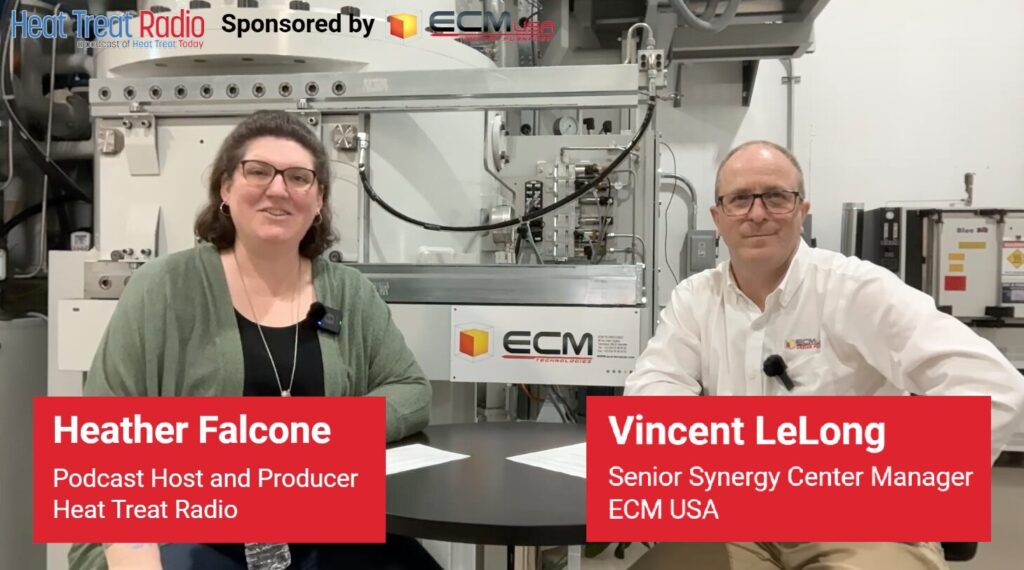
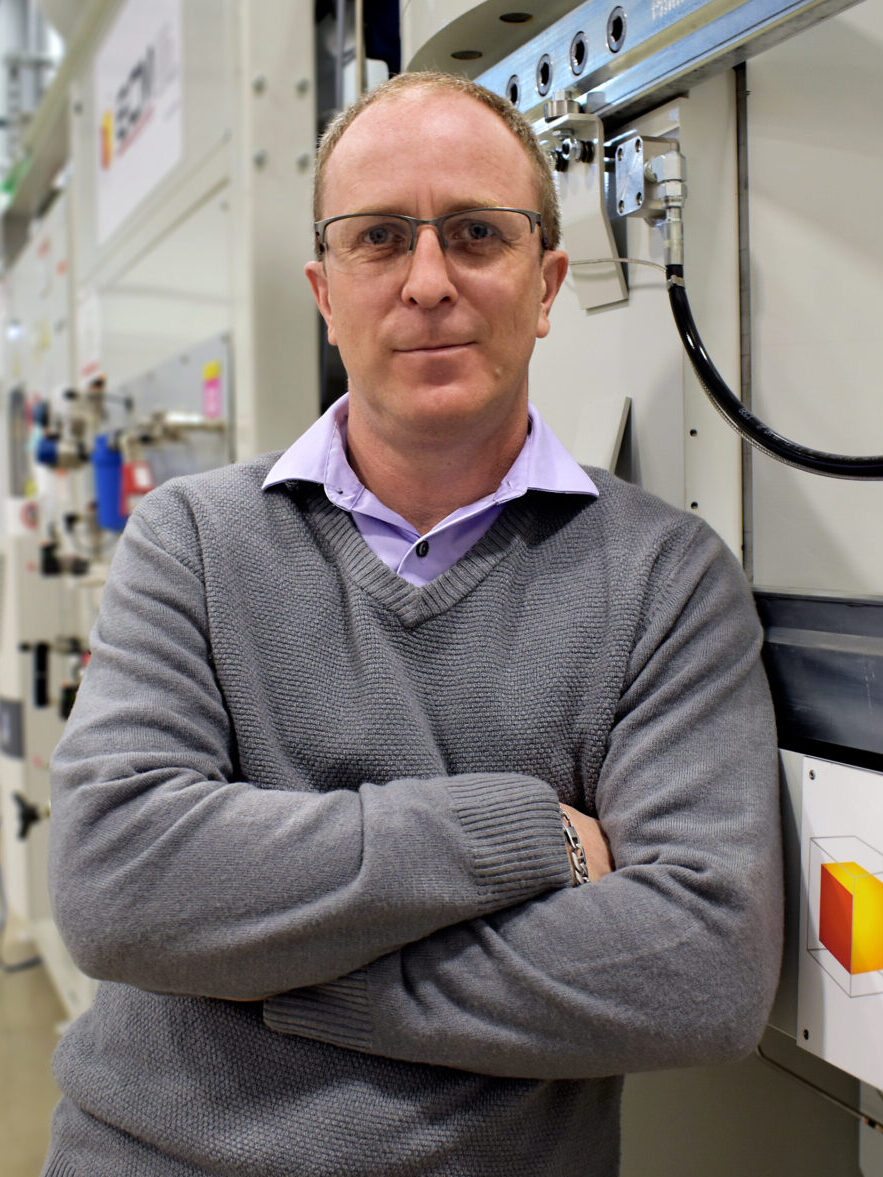
Heather Falcone: Hi, I’m Heather Falcone, and welcome to Heat TreatRadio. Today, we are asking a metallurgist, and we are talking about the ins and outs of process qualification and recipe development. We are on-site with the sponsor of our episode, ECM USA, in beautiful Pleasant Prairie, Wisconsin. It’s a real treat to be able to record on site. We hardly ever get that chance. Joining me today is Vincent Lelong, the Senior Synergy Center Manager and Metallurgist. Thanks for joining me today, Vincent.
Vincent Lelong: Thank you, Heather.
Heather Falcone: So you have the luxury, since we are in your beautiful facility, to tell me not just about yourself, but also about ECM. Start off with your background because it is extensive.
Vincent Lelong: I am a metallurgist, I went to college in France, and I started with ECM in 1999. Since then, I’ve been across the world in the U.S. for 20 years. I do presentation and testing for the furnace behind us and our larger furnace. I go on-site. This is our Synergy Center; it’s a nice environment, clean — quiet today because we’re filming.
Heather Falcone: Tell me a little bit about what ECM does.
Vincent Lelong: At ECM, we manufacture and install heat treatment vacuum furnaces. Our main focus is on low-pressure carburizing modular furnaces, large and small. We integrate not just heat treatment itself, but the pre-treatment, like washing, storage, preparation of the load with robots, heat treatment, temper, cryo… Everything is set up together, and that is our main goal: integration of a fully automatic installation.
Heather Falcone: A one-stop shop. You go to one place, and you’re going to make it all work.
Vincent Lelong: There’s a part and everything will be ready in few hours later, sometimes days, depending on the treatment.
Heather Falcone: Hopefully it all works.
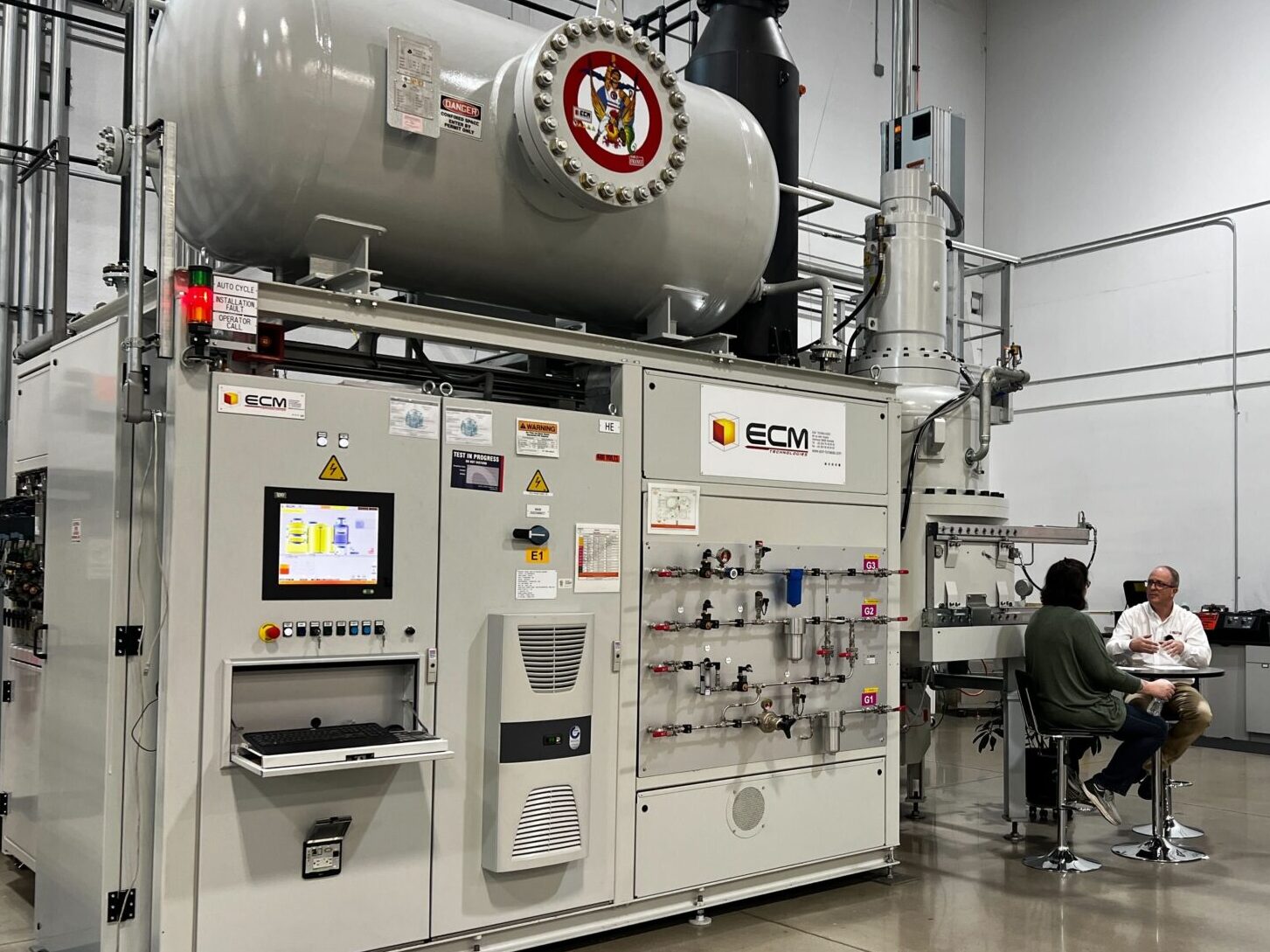
ECM Nano vacuum furnace used for client cycle development and qualification.
Vincent Lelong: Well, it always works. It’s a really repeatable modular furnace. In the U.S., we are focusing on vacuum carburizing, but we also manufacture other types of furnaces for crystal growth, silicon heat treatment, melting silicon for solar panel, and others. Within ECM Group, there’s a range of heat treatment processes that we manufacture for. And not just steel; it can be other materials. I’m specialized in steel and very restricted heat treatment with vacuum carburizing, but maybe one day we can do other materials.
Heather Falcone: Steel makes the world run.
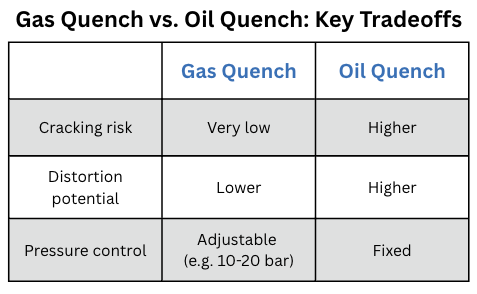
Vincent Lelong: With our modular furnace, we can do hardening, gas quench, oil quench, carburizing, gas quench, oil quench, and now we do vacuum carbonitriding and we can do nitriding in the furnace. So you can have one installation for multitask heat treatment. It’s the purpose of the modular furnace, the beauty of it.
Heather Falcone: More flexibility, more capabilities.
Biggest Challenges of Process Qualification and Recipe Development (4:08)
Heather Falcone: That brings us into the first core question that I want to ask, because when you’re evaluating bringing in another piece of equipment or if you’re trying to bring on a new process, it can be a little challenging. What do you see are the biggest pitfalls or what do you see people struggling with most when it comes to process qualification and recipe development?
Vincent Lelong: Most customers say, “I would like a good metallurgy. I would like mechanical properties.”
Heather Falcone: Right, make good parts. That’s number one.
Vincent Lelong: But you need to look at what kind of furnace you would like to use, as well as the size, the type of part, and the process. If you have a small part, do you want a bulk load? Do you want special fixtures because the main target is distortion-free? Everybody would like everything…
Heather Falcone: …distortion-free!
Vincent Lelong: Always. No problem. So, as a metallurgist, you need to think not just about heat treatment because you’ve been asked to heat treat a part. I could heat and quench in oil and say, “You have the metallurgy. My job is done.”
Heather Falcone: Right. It hit hardness.
Vincent Lelong: Exactly. Hardness, good. Vacuum carburizing, no oxidation. Good. How about the distortion? Okay, let’s speak about what we can do to reduce the power of the heat treatment itself. Then, let’s do a gas quench, but let’s work on fixtures also. It’s working with the supplier for fixtures and working with the customer with the machinists.
Sometimes, because we propose gas quench, people say, “Oh, gas quench means no distortion.” Well, the first step is to get the metallurgy right. If you need 20 bar gas quench, you might have some distortion. From experience, we know that the fixtures are also important. So we can work with the customer and supplier to propose the right fixtures and test the fixtures to target the best cooling rate and other properties.
But we also need to work with the machinists. If you have a challenging part, machinists may say, “It’s the fault of the metallurgist.” And the heat treater will say, “No, let’s work together at the table. We’ll sit, and we do the testing.” At the Synergy Center we have also the CMM, so we can measure before heat treatment and after heat treatment. It’s the best feeling when you bring not just the metallurgists together, but also the people who make the part. We work together to have the best of the best. It’s a lot of work, but we have years of experience, so we can reach the target faster than 20 years ago.
Technology has changed. As such, you also need to work with the steel manufacturer, the way the steel is made and the composition. Research has shown that if you improve the steel, you can reduce the quench pressure. If you need oil quench, then you already know that distortion will be potentially higher. If you need 20 bar, it’s one thing. Well, I did a presentation not long ago, and I found that the distortion with 10 bar or 20 bar in a Nano furnace was much better than in a larger load. For one part, that is. This might not be true if it’s other parts. There’s always that phrase in heat treatment, “that depends.” I don’t like this phrase.
Heather Falcone: It always depends.
Vincent Lelong: But it’s true, unfortunately. So, when you have worked all that together, you can bring the best analysis. I’m working before that to sell a furnace.
I need to choose whether it’s better for the customer to have a smaller furnace or a larger installation. That really depends on how many parts, the diversity of parts. If the customer has mostly small parts, the Nano may be the better choice. You have a faster answer because it’s in and out. You don’t need to buy so many fixtures. But if you have a larger part, a larger furnace is better. It’s not whether one furnace is better than the other. You need to choose which one will achieve your production target.
A customer in facility number A may need a larger furnace, but in facility B, there are other types of part, so that facility may need a smaller furnace. That’s how we work with the customer to target what is important.
Heather Falcone: Pick the right atmosphere, pick the right hot zone size, pick the right fixturing, raw material specs. All of those are going to influence how the runs going to go. I bet you have some stories about TCE from fixturing and eutectic and inadvertent bonding.
Vincent Lelong: I certainly have had a few mistakes in testing. I used a higher temperature because with vacuum carburizing we say we can go to a higher temperature. But then I used CFC fixtures at the wrong temperature!
Today however, the mixtures of fixtures can work and reduce the weight. As a metallurgist and a heat treater, I prefer to heat treat the part rather than the fixtures. When I see a customer running a load with almost more fixtures than parts, I’m asking, “What do you heat treat?” Are you losing money on heat treating fixtures more than parts?”
Heather Falcone: There is such a big weight differential between fixturing and the parts. How much lag time on your heat up and cool down are you wasting on having too much fixturing?
Vincent Lelong: It’s true.
Balancing Technical Requirements with Production (11:30)
Heather Falcone: Once you’re in recipe development, how do you balance technical requirements, the repeatability, and the realities of production?
Vincent Lelong: Repeatability is firstly about how you design the load. Then you need to know the quantity of parts. You also may know the surface of your load, but it may always be necessary, I will say. Most of the time we don’t know that and it still runs correctly.
Heather Falcone: Still a black box. It’s an art what we do.
Vincent Lelong: Technically, it’s a good thing because when we put something inside the furnace, it’s coming back, and we don’t see much difference. But the mechanical properties are completely different, so it is kind of like magic.
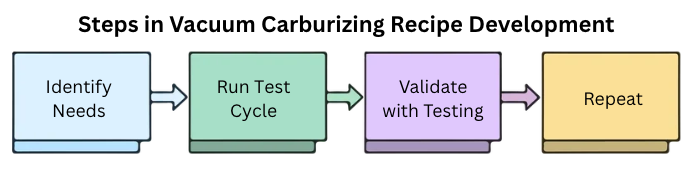
So you define your load, you define your heating time to get temperature, and when you’re sure you’re at temperature, you start to carburize. I will speak about vacuum carburizing. First, we have software for the carburizing boost and diffusion; you input your parameters and then you have your recipe. You can run it generic, or you can go into detail and improve it. But as built, the software will give you some set parameters and will work.
Heather Falcone: Technology is so cool.
Vincent Lelong: It’s getting better and better. You will also need to select the type of furnace. When you have one part, it’s not the same as when you have 3,000 parts. The density of the load will influence your gas flow and the capacity of your installation.
Most of our larger furnaces have a maximum of acetylene of 4,000 liters. But you can play with the gas and the duration of the boost and diffusion so it goes inside the part; when you have a blind hole or you need 3 millimeters, you carburize. (Acetylene is beautiful, but molecules can go everywhere, sometimes where we don’t want acetylene, which is why we have the stop off.) But you define your load, you define your recipe, your gas flow, and then you run a test and analyze the metallurgy. If it’s good, then you’re done and you don’t move from that.
Heather Falcone: That’s what production wants to hear.
Vincent Lelong: When you are a heat treater, you may receive 10 parts to heat treat. Tomorrow you may receive 20 parts, and maybe you need to run the same recipe. In general, you can run the same recipe for 10 parts or 20 parts. You would use the parameters of the larger load for the smaller, if possible. The result will be mostly the same, but the cost will not be the same.
This is where you can optimize your recipe for different types of load, like half of the load versus a full load. You can change the flow of gas, and then reduce your heating time because why set for two hours when in one hour, it is at temperature. One hour is money.
Heather Falcone: Got to turn and burn.
Vincent Lelong: This is also where you define your database and your repeatability. I once had a customer that had me create a recipe for a specific quantity of parts and a design of load. A few years later, that customer called and said, “It doesn’t work.” With modern heat treating controls, we record everything, so you have a database, the curves, and you can go back and see what was wrong.
Heather Falcone: Right. What changed?
Vincent Lelong: In this case, I discovered the customer was running the double quantity of parts in the same load without changing the recipe at all.
Heather Falcone: Makes sense. Start there.
Vincent Lelong: Heating time was not long enough. Gas flow was not long enough. And they were not working at the right pressure in the furnace, so failure occurred. I said, “Change that.” No news is good news usually. If the customer doesn’t call you, it’s because…
Heather Falcone: …Everything works.
Vincent Lelong: That’s the beauty of this furnace.
With repeatability, you always need to look at the curves. If you have an issue of temperature out of the range, there will be an alarm. So, you can check if the part is good without checking the metallurgy. If you heat treat a big part, usually you won’t cut the part. If you have six parts in a load or 10, you have samples. You have to validate your sample and your real part at the beginning.
Heather Falcone: To make sure it’s representative.
Vincent Lelong: Exactly, or if there are differences because you cannot find exactly the same material, you know the difference, and the difference would be always the same.
Heather Falcone: Right. Make it predictable.
Vincent Lelong: We have some customers that would check one load per day or per shift and not every load. If you have 3,000 parts in a load, you can check a part. When you have six parts, you will likely not cut a part. If the furnace tells you it’s good, why check? When you check repeatability, you still need a lab. Not checking the metallurgy is difficult. You should always check again. Repeatability shouldn’t be left to chance or statistics. Take a part and check. Is it good? Then continue.
Heather Falcone: That’s kind of the target of qualification, right? To get those parameters that you predefined.
Vincent Lelong: In time you need to be sure nothing changes.
Heather Falcone: What does re-qualifying look like?
Vincent Lelong: You want to be sure that nothing changes, material-wise. Sometimes, you run the same material, and you achieve 35 HRC. But at one point in time, you achieved only 25 HRC. This is the same material on the paper, but something has happened. So you need to go back in time and figure out what was originally going on. Is it the heat treatment? Is the installation of something around it?
Heather Falcone: Use all the data that’s available to you.
Vincent Lelong: This is where you check the productivity.
Quench Media (19:20)
Heather Falcone: How about the quench media?
Vincent Lelong: When you develop a recipe, if you do oil quenching you will always do austenitizing. You don’t want a crack. You will carburize, austenitize, and go to oil quench. It’s pretty easy to switch from atmosphere oil quench to vacuum oil quench because technically the recipe is pretty much the same, and we’re going to cover that ground extensively because I know it’s kind of scary to even consider that possibility.
When you go with gas quench, if you don’t know the target or are unsure, you select 20 bar.
Heather Falcone: Sure, 20 bar. That’s the easiest in the world.
Vincent Lelong: Exactly. You do 20 bar and you get what you get. There is an advantage of the gas quench. Many customers will ask, “Do I need to do a direct quench? Do I need to do austenitizing?” Most of the time we say direct quench, and we found that you don’t crack with gas quench. Whatever the pressure, we never really have much cracking. Or a customer may ask, “Will the part break due to the gas quench?” That will never happen. I once asked the competition if they ever saw a crack with gas quenching and they said no. It’s the way the gas quench quenches and cools the part down, then it’s less powerful than the liquid, so you don’t have this potential issue.
But if you don’t know, you stay at 20 bar. If you would like to optimize, you can reduce, but you need to achieve the target metallurgy.
Heather Falcone: Right. You’ve got to get your core hardness.
Vincent Lelong: Your limit is when your metallurgy is not right. When you reduce, you reduce the cost. If you reduce the pressure and the speed, you will reduce the distortion potential.
Heather Falcone: Which is always a good thing.
Vincent Lelong: If you have a shaft, you should not place it horizontal, because whenever you quench that, it will not be straight.
Heather Falcone: We’ve potato chipped a few parts over the years, yes.
Vincent Lelong: Me too. I have tried horizontal in some cases. It’s interesting, but you need more support. I think it’s possible, but nobody wants to try it.
Heather Falcone: Why bother?
Vincent Lelong: Vertical is easier.
Heather Falcone: If you’re qualifying, just make the fixture that’s going to support it.
Vincent Lelong: Yes. Why should I change? It’s always a big question; we just quench it vertically this way. We do it this way. Now for gears, in heat treat sites I see a lot of vertical positions for gears strung on a rod. As an operator, I don’t like that.
Heather Falcone: Tell me why.
Vincent Lelong: Because it’s heavy. We already have difficulty finding operators in heat treatment. If it’s heavy, nobody wants to do it.
From a robotic point of view, it’s more difficult, too. Today, with most vacuum carburized and gas quenched gears are heat treated horizontally on fixtures and most of the time with offset position. That will give you the best metallurgy, but also the least distortion overall. Vertically for machinists, it’s very difficult to re-machine something round to oval. When you place it horizontally, you can do potato chips but machinists can grind and reshape the part easily, if it’s possible.
Heather Falcone: If you’re already near net, it’s going to be a different story.
Vincent Lelong: Exactly. That’s where when you check your distortion and repeatability of process — it’s the fixtures.
Heather Falcone: I would think working with the customer as much as you can to see if material can be left on the part too, if we do need to have grinding, if we do need to have repair or recovery for any possible distortion.
Vincent Lelong: So, let’s say we are working on a six-speed. For the six-speed, everybody wants to vacuum carburizing gas quench. The objective: zero distortion, heat treat, and assemble.
Heather Falcone: In theory.
Vincent Lelong: No, in truth.
Heather Falcone: Really? Okay.
Vincent Lelong: That was the target.
Heather Falcone: Ambitious, I like it.
Vincent Lelong: Yes, but when you have a new product, you can use new technology, you can work on the fixtures, you can work on everything. We worked a lot with car manufacturers to do the best heat treatment, the best fixtures, the maximum of parts, of course, and repeatability. This furnace is running millions of parts.
That is why we know vacuum carburizing works and it’s repeatable. For this high volume, we had to work on zero distortion. But the specification then didn’t change, metallurgically speaking. Most of the time it was 0.3 to 0.7 millimeters. It’s a large gap. No problem. Then we went to the 10-speed for most of the automotive, and then the distortion was the target because of the experience we gained with the six-speed, which was the noise. People don’t want the noise. Today, with the 10-speed, we start to grind at 0.1 millimeter.
You have to compensate for your carburizing process so that it is longer and deeper, but also most customers will reduce the metallurgical requirements. From 0.3 to 0.7, they want 0.5 plus or minus 0.05, which is much thinner. With electrical applications today, you want zero noise, because you can hear everything. There’s a lot of grinding, and when I say a lot, I mean exact, 0.2 millimeter.
Heather Falcone: That is a lot of post-process work.
Vincent Lelong: You have the perfect teeth. You need to anticipate longer carburizing, and it’s great! Also, what I see with metallurgy, it’s not that you don’t have a general metallurgical specification, but each area of a part will have its own metallurgy. That means you have the pitch of the gear, the roots, a minimum, but sometimes you have a specification of the tip.
A customer may specify, “I don’t want more than 0.8.”
Heather Falcone: Just for that area.
Vincent Lelong: Yes. As the parts get more and more complex, they have more than just one application or function. You have the spline. You have double teeth. Each one will have its own requirement. With an atmospheric furnace, to get that, it doesn’t work very well. But with vacuum carburizing, you can achieve very precise requirements.
Switching from Atmospheric to Vacuum Carburizing (28:11)
Heather Falcone: To that point, is that one of the things that stops people from considering the change from atmospheric to vacuum carburizing, or is it part complexity?
Considering the switch? See how different carburizing technologies and furnace features stack up when you click on the image above.
Vincent Lelong: The larger companies do not seem to be afraid, because they know what they want and they already have experience. For the heat treaters, the smaller companies, it’s very difficult to switch with the requirements today. When you see the requirement on the drawing, it’s funny because before there was just heat treatment.
Heather Falcone: Yeah, it’s on this process sheet.
Vincent Lelong: One line. Surface condition, effective case depth, core hardness.
Heather Falcone: Right.
Vincent Lelong: Today there are different requirements, and there are several requirements: before heat treatment, after, and final. You know how much you need to take off, and not every area you take off. You said keep more material. The advantage of that is more material, less distortion. But you will have to carburize more.
Heather Falcone: Ultimately it may be more expensive for everybody.
Vincent Lelong: Exactly. The machining behind the grinding is also costly. When we develop a recipe, we have the customer machine to the final dimension, do the heat treatment, and then we will see where we are in terms of metallurgy and distortion. If we are not where we need to be, don’t take off too much. Then you adjust.
One other story is about a thread.
Heather Falcone: Oh, God, threads. The bane of every heat treater’s existence, threads.
Vincent Lelong: I get a lot of questions about threads. Do I need to make them before heat treatment? Do I need to put a mask on, paint, or make the fixture?
Vincent Lelong: Or to not do them and do them after?
Heather Falcone: That is also expensive.
Vincent Lelong: Yes, also expensive; but I think it could be a robotic application.
Heather Falcone: Oh true. Very good point.
Vincent Lelong: It’s the way I would go.
Heather Falcone: How interesting.
Vincent Lelong: To not do the thread before.
Heather Falcone: Lower risk.
Vincent Lelong: First, when you carburize, you can create a brittleness of the thread. But also operator movement of the thread from crate to the fixtures can cause damage to the thread. What do you do? Can you save the thread after heat treatment? Not always. Then that is garbage. You had to manufacture the part, heat treat the part, just to put in the garbage, which is a cost.
Heather Falcone: Probably 80 or 90% of your whole cost, gone in an instant.
Vincent Lelong: In my opinion, you could have a robot preparing the load. You would have a robot take off, and every time it’s the same movement. Then, thread or not, it’s easier.
Heather Falcone: More predictable.
Vincent Lelong: Then the robot, if you don’t do the thread, can put the shaft, usually it’s a shaft with a right connection on the thread on the end, put to a little induction machine, reheat, and then put in a crate and go back to machining. Then it’s all done.
In that instance, I think it’s my preference not to do the thread first. I have customers who ask me for paint or for a mask. Paint is not, I would say, 100% safe. You need a specialist to put on the paint. There are some tricks, as I know heat treaters know. They have been doing this for years and they know their stuff.
Heather Falcone: That’s their secret.
Vincent Lelong: I think heat treaters have more secrets about painting and protection of the part than the big companies do. They know it better.
Heather Falcone: Their lives are on the line. That’s all they do, so they have to make it perfect.
Vincent Lelong: You can learn a lot from heat treaters. They know their work.
Heather Falcone: That’s what I always recommend to the captives. Get out to as many heat treat shops as you can, because it’s going to make your in-house heat treat better.
Vincent Lelong: They have years of experience to learn from. Heat treatment is tricks after tricks. Some customers are afraid to go to in-house heat treatment. These heat treaters hold a variety of information that is helpful for these customers.
Heather Falcone: It’s an interesting point that you brought up about being afraid, because vacuum carburizing has gotten that reputation over the years that it’s difficult. It’s tough to figure out.
Vincent Lelong: Because we did a good job. We did a good job to say you can optimize. In reality, if you understand what you want to heat treat, the carburizing process is all made by software. Every company has their own software. So it is pretty simple, and though it can still be scary for the heat treater.
Heather Falcone: Process change is scary.
Vincent Lelong: There are some companies that develop vacuum carburizing software where you need to know everything about the steel, the chemistry, all the parameters. We work with carbon. For our software, you enter the carbon content originally, roughly the temperature you would like to heat treat, and what you would like on the final. The software will give you something, and it will be 95% of what you’re looking for.
Now you need to quench. Like I said, with oil quenching, it’s no problem. Gas quenching, 20 bar, no problem, very easy and straightforward. Optimization can be where it’s trickier. But it’s just like an atmospheric furnace. I work with atmospheric furnaces, and they all have their cheat sheets.
You need carbon potential, temperature, time, and in vacuum carburizing, it’s the same thing. The temperature, your carbon potential, or what you expect for carbon, the time, the case depth you would like to achieve, and here is your process.
Heather Falcone: Then you don’t need the cheat sheet. It’s gone. Then it’s documented and repeatable.
Vincent Lelong: Right, then you have to heat up and quench. So, straight heat treatment: heat it up to be sure you’re at temperature, then carburize, and you quench.
Heather Falcone: One test?
Vincent Lelong: Yes, I often do just one test.
Customers may ask me to do a test for a Flex system, a larger system. I do it here at the Synergy Center first because it’s cheaper for me because it just value add and it’s here. I can mix a different part, different design, and run. “Oh, it’s a 8620? No problem.” Usually, it’s good.
For a Nano load, it’s like a one-fifth or it’s a one fixture and the bigger load, it’s like two column of fixtures, then you stack. So, it’s not much different. You start on a smaller scale and you go bigger, and you just add a little heat up time.
And if you ask me, “What do you need?” Put everything to the maximum!! (We are here to sell you a spare part, so, you know.) But really, if you put everything to the maximum you will be good. Maybe too good, and you might have a more maintenance, but we’d be able to provide a quote to reduce the maintenance. (*joking laughter*)
Closing Thoughts (37:36)
Heather Falcone: As we finish up, if there’s one thing that you’d want our listeners to take away, rethinking about their approach to process qualification and recipe development, what do you want them to know?
Vincent Lelong: It’s not difficult. It’s like every other heat treatment; you have to test it and you will quickly see that it’s easy. At ECM USA, we provide training and testing to show you what can be achieved and answer your questions. If you’re worried, we will show you how easy it is, how clean it is. There’s no flame. If you have oil quench, there’s no flame because everything is protected. So it’s not difficult, it’s just one step. Do not be afraid.
Heather Falcone: Take that first step, and explore the process.
Vincent Lelong: I think there’s enough research and evidence in the last 25 years in the U.S., especially with large automotive and aerospace companies to know that it’s not a big deal. Most people — in heat treating or not — don’t like change.
Heather Falcone: But they can partner with you, Vincent, who has decades of experience. Reach out to ECM. Get in touch. Start exploring.
Vincent Lelong: The funny thing is, with decades of experience, what we are capable of heat treating 20 years ago we can do way better now. The technology is better. Gas quenching is made to quench, not to cool. It’s quenching. It’s hard. It’s almost as hard of a quench as an oil quench. You can do bulk load carburizing. I did carbonitriding in bulk load not that long ago. If you had asked me to do that 20 years ago, I would say, “No way that works.” But today that works. Just contact us.
Heather Falcone: Start the conversation, right?
Vincent Lelong: And I would be happy to show you. I like my job.
Heather Falcone: You love your job. I’m going to say it. You’re very passionate.
Vincent Lelong: I like testing because it’s a challenge every day. It’s pushing the limit. It’s like a movie. Is it possible? If you follow the book or internet, they will say no. I would say, “Let’s try.” I’m testing on materials other than steel as well that I would not have expected to work. Modular furnaces can be a very versatile.
Heather Falcone: Well it sounds like production is getting ready to get things done. Thanks so much, Vincent. It was great spending time with you.
About the Guest
Vincent Lelong Synergy Center Manager / Sr. Metallurgist ECM USA, INC.
Vincent Lelong, ECM USA Synergy Center Manager, transferred to ECM USA in 2005 to manage the North American Testing Program in Wisconsin after 6 years’ experience with production/testing furnaces at ECM Technologies headquarters in Grenoble, France. Vincent has degrees in Chemistry & Physics from the University of Reims, and Treatment of Materials (specializing in Heat Treatment) from BTS Roosevelt, also located in Reims, France. He began his career as a production and laboratory technician for a commercial heat treater, and joined the ECM Group in 1999 as an ECM Technician running LPC testing/metallurgical analysis within ECM vacuum furnace systems.
In this episode ofHeat TreatRadio, host Heather Falcone sits down with Doug Glenn, publisher ofHeat TreatToday, to break down the most important heat treat industry events on the horizon. From the massive international state of the THERMPROCESS trade show to the technical knowledge of Furnaces North America, they explore where those in the industry can learn, network, and grow. The conversation also highlightsHeat TreatToday’sown events, includingHeat TreatBoot Campand Helium Leak Detection seminars. Together, they offer practical guidance on choosing the right events to stay engaged and informed in today’s heat treating landscape.
Below, you can watch the video, listen to the podcast by clicking on the audio play button, or read an edited transcript.
The following transcript has been edited for your reading enjoyment.
Introduction (00:05)
Heather Falcone: Hi, I am Heather Falcone and welcome to Heat Treat Radio. Today we are talking about a variety of upcoming events in the industry in 2026 and beyond. Joining me today is Doug Glenn, publisher of Heat Treat Today, and longtime host of Heat TreatRadio. Doug has had a front row seat to this industry for years, from the technical side to the people driving it forward. He’s also someone that I consider a mentor and a friend. I’m looking forward to digging into this conversation with him.
It’s an honor to sit down together with this one, Doug, as it’s kind of a bit of a hand off and a nod to the legacy that you’ve built here.
Doug Glenn: It’s a pleasure, and I couldn’t think of a better person to hand it off to. Heather, you’re doing great, and I appreciate you taking the time to do it and having the courage to do it.
Heather Falcone: Obviously, you have recorded over a hundred episodes, so I have so much to learn for you. Thank you so much for trusting me with this.
Key Events for 2026 and Beyond (1:19)
Heather Falcone: Doug, walk us through 2026 and beyond. We have so much going on for events. What are the key events that people should have on their radar?
Doug Glenn: We often say at Heat TreatToday that we believe people are happier, and they make better decisions when they are well informed. Our whole goal is to make people happy by giving them good information so they can make better decisions, and that that always works well. We do that in a variety of ways. Primarily it’s through our print publication — the technical articles that go out in that print publication. Our most popular product is our print publication. Most of that deals with heat treating, thermal processing, technologies, materials, etc.
But there’s also the element of continuing to sharpen your saw, as Stephen Covey says; keep yourself fresh. To that extent, attending industry shows, events, and educational seminars is helpful.
There’s a there’s a big show coming up in Germany in 2027. It’s called THERMPROCESS, but it’s actually one of four events that are all metals related, so we will talk about that whole quartet of shows. I will also talk about Furnaces North America because it is the leading thermal process/heat treat event of 2026. Then also we also have two Heat TreatToday events that I think might be helpful. Our Heat TreatBoot Camp, and then also our Helium Leak Detection seminars.
Those are the events I’m going to talk about today, but there are more events than that. If you are interested in learning more about important industry events, visit our website, heattreattoday.com, and look under Resource tab. There is the Industry Events calendar. That would be a real good place to start because we try to put all of the events that we think are important to most heat treaters and suppliers of the industry.
It’s important to note, when we talk about heat treat, we have to be very careful. We are not only talking about commercial heat treaters. That’s only about 10 to 15% of the audience that we reach. We are talking about captive heat treaters. That’s who Heat TreatToday is meant to be helpful to.
Heather Falcone: Reaching the broader industry at large is always our goal. Making sure that everyone has access to this. When you have an in-house heat treat operation, sometimes you can be even more isolated. So getting those companies exposed to as much information and data as possible.
THERMPROCESS 2027 (4:26)
Heather Falcone: Speaking of that, if someone can only commit to one or two events this year, I think we should really start with THERMPROCESS, because that one kind of rises to the top. We can unpack that a little bit first.
Doug Glenn: I think that’s a really good idea. The show itself, THERMPROCESS 2027 (thermprocess-online.com), is only one of four [in a trade fair quartet]. That show does not take place until June 21–25 of 2027. It’s over a year away. But the reason we need to talk about it now is because, unlike shows here in the United States, this is a huge show, and if you want to exhibit there, which many of our listeners may be suppliers in the industry, applications need to be in by the end of May of this year, not next year. So I wanted to make sure people are aware of that.
To give you a sense of what’s going on in that event, I want to provide a site map of the campus where THERMPROCESS is taking place. First thing to know is that there are four shows altogether. It’s held only every four years in Dusseldorf, Germany. Looking at the map, they call it “The Bright World of Metals,” you’ll notice the four logos across the top, which are GIFA, METEC, THERMPROCESS, and NEWCAST.
This is a huge campus. If you were to walk from the upper left corner, the Merkur Spiel Arena, all the way down to the east entrance, that would take you probably 10 to 15 minutes.
GIFA is a foundry show, and is located in halls 11 through 17. The dark blue on the map is all GIFA.
METEC is the gray on the map, halls 1, 4, and 5. This show is basically steel making, metallurgy, etc.
THERMPROCESS is in one hall, hall 10, and it’s the largest hall. It’s larger than any heat treat show here in the United States by far.
NEWCAST is basically a metallurgy show, steel processing, some forging as well. That’s in halls 14 and 15.
This show is open five days, from 9 a.m. until 5 p.m., all five days. If you were to spend your time walking through this show, it would basically take you all five days to go through this. It’s a huge event.
Let me give you a sense of this size. The total attendance for this entire event for 2023, which was the last one that they had, was 63,000 attendees. Even if you divide that by four, because there’s four different shows, that’s almost 16,000 people per show. To give you a sense of size difference in the United States: our biggest heat treat show, typically Furnaces North America or the ASM Heat Treat Show, attendance is no more than 2,500 people, including exhibitors and everything. You can get a sense that this is the right show.
It’s held in Dusseldorf, Germany. Germany of all countries in the world knows how to do trade shows. There are booths in these halls that are double decker booths, large booth displays. There are even restaurants on the upper level — it is a full event. Companies will spend millions of dollars just on this show.
My suggestion is, if you’ve never been to this show, or if you have a need for a full understanding in the thermal processing/heat treating industry, this is the premier event in the world, as far as I’m concerned. China has some big shows as well. I believe this one is more international. You will see people from all over Europe and the United States as well. 63,000 people total.
For just THERMPROCESS, there are 276 exhibitors, and the show takes up 8,400 square meters, which is about 90,000 square feet. Over on the Foundry side, obviously the biggest show here, taking up almost six halls, there are 854 exhibitors in about 41,315 square meters or 445,000 square feet of booth space. These are big shows.
Heather Falcone: It’s massive.
Doug Glenn: It is massive. There are companies exhibiting there from all over. Not only Western Europe, but Eastern Europe too, Turkey, Middle East, Saudi Arabia, China, India, etc. The United States, to be quite honest, is not always that well represented.
I think this is probably one of the more important things that I wanted to mention about this event. Heat TreatTodayis promoting and sponsoring a pavilion there at THERMPROCESS. If you would like to be part of that pavilion, you can call me and we’ll see what we can do.
It’s a big deal, it’s a big show. May 31 of this year is the exhibitor deadline. For those of you who are interested in attending, which I highly recommend, thermprocess-online.com is the website.
If you’ve never been to Dusseldorf, it’s definitely worth going just to see Dusseldorf. There’s this place in Dusseldorf, a section of the town called the Altstadt, which is the old city. It’s a great place, hundreds of restaurants and great to experience the culture. It’s worth it after the show ends.
Also, the public transportation in Germany is very good. There are trams that run, which make it pretty convenient to get to the exhibit hall.
Heather Falcone: What kind of company roles do you think would be best suited to attend THERMPROCESS? Who do you think would most benefit from this event?
Doug Glenn: You would want more of your upper management personnel attending this event, not so much your furnace operators. You could do that — it would not be a problem taking the furnace operators over there. But it’s typically more engineers and up. One big difference between this show and most shows in Germany compared to shows in the United States: there is not a conference associated with it. They do offer some technical presentations, typically five or six a day in the small auditorium on the show floor. So you might get 30 different technical presentations, but this is primarily a trade show. It is a show where people sit down in their meeting rooms in their booths where they can close the door and have a private meeting, and they buy and sell there.
This is a show where if you want to do business, this is the premier event. In my 30 plus year experience, this has been the most impressive show, for thermal processing/heat treating, so I highly recommend attending.
Furnaces North America (14:28)
Heather Falcone: That’s a great point that you brought up, the difference between a trade show and the technical presentations. Compared to Furnaces North America (FNA), it’s a whole different ball game.
Doug Glenn: FNA is October 12–14, 2026 in Indianapolis. The website for that event is furnacesnorthamerica.com.
The difference is marked between THERMPROCESS and FNA. It’s just a whole different category in a variety of ways. The number of exhibitors is going to be somewhere in the range of 150 to 200, maybe right on the upper end. The trade show hours are typically a little bit shorter, maybe 11 a.m. to 5 or 6 p.m. It’s only a two-day show, not a five-day show. And there are a lot of technical sessions that are held. There’s a much better opportunity for more formal learning, if you will, where you can go to some classroom environments.
Furnaces North America is owned and operated by the Metal Treating Institute (MTI), which Heather and I are both members of, which is great. MTI is the world’s largest association of commercial heat treaters. While MTI is commercial heat treaters, Furnaces North America is really intended for captive heat treaters, as well as commercial heat treaters, to help advance the technology, knowledge of processes, and materials in the North American market.
It is a good event. It starts on a Monday night, the 12th of October, with a nice opening reception. Then Tuesday is a full day of conferences and the trade show. Wednesday, the conferences begin again in the morning, and then the trade show is open until around 2 p.m. So it’s a rather abbreviated show compared to THERMPROCESS.
Heather Falcone: It’s one of the more unique events because often, when you’re at a trade show, you do want to try and get some learning in, but you also want to get out and see the vendors on the floor. So they’ve set it up really well so that you never have to miss a concurrent session. In fact, they don’t even have the trade show floor open during the conferences. So, it ensures the exhibitors do not have to leave the trade show to attend session, and it lets people attend sessions without feeling guilty that they’re not out there hitting the booths at the trade show.
Doug Glenn: Exactly, they can actually go and do some of the learning as well. If I remember correctly, Heather, you’ve been involved with program development of FNA in the past.
Heather Falcone: Yes, I tend to do a session or so. Last time I think I talked about industry involvement, which is similar to the topic today. Getting involved in the industry is one of the best things you could do for yourself and your company.
Doug Glenn: That’s FNA in a nutshell. There are still some booths available. Although I don’t anticipate that will last long. Call or go to furnacesnorthamerica.com to check in on that, or contact me or Heather, and we can steer you in the right direction.
Heather Falcone: I honestly believe anyone would benefit from going to FNA because of the technical sessions. There’s a lot of learning to be had, even down to someone that’s more operational. It’s not just meant for that owner level. It’s pretty approachable.
Doug Glenn: I would agree. The expense of going to FNA is also substantially less than the expense of going to THERMPROCESS over in Germany. So you do see a good number of shop floor personnel at this, but it is also a good place to send your upper management personnel, depending on the size of your company, and your decision makers, as far as capital expenditures go. It is a good place to bring those people. You can gather a lot of information in a very short time walking around this show.
Heather Falcone: You can cover a lot of ground and really get some good relationship and networking going. It’s a great setup.
Heat Treat Today Events (19:20)
Heather Falcone: Let’s discuss the Heat TreatToday events, I think that there’s some truly unique offerings.
Doug Glenn: While Furnaces North America is not a Heat TreatToday-owned and operated event, we are the exclusive media sponsor of the event. But Heat TreatToday also has its own events.
Firstly, we have our most fun event, which is called Heat TreatBoot Camp. It was a brainchild of mine quite a few years ago because I tend to have a mile wide and an inch deep knowledge of the industry. I am no expert in any one area, but I have this experience of being here and absorbing over 30 years worth of information and relationships. So I thought to myself, wouldn’t it be nice to be able to share some of that information with people who are just wanting to get their heads wrapped around the North American heat treat market? What is it, who’s there, what are we doing, what are the materials — all that good stuff.
So we put together this event called Heat TreatBoot Camp. It is not heavily technical — you don’t need to know metallurgy or anything of that sort to attend. And it’s not just focused on any one piece of equipment, any one company’s equipment, or any one process, like brazing. It is cross-cutting. If you’re coming into the industry, or if you’ve been in the industry for a long time but have only focused on point X because that’s what you’re paid for, you can attend Heat TreatBoot Camp to get a broader view of this whole market. The added benefit of that is that you might find out there are other areas that your company could add that could potentially be profitable.
This is our fifth year coming up. It’s going to be held in Cleveland, Ohio, from Monday, September 14 to Wednesday, September 16, 2026. Our first four events were held in Pittsburgh, which is a great city. But we’re going to Cleveland this year, which should be very good.
Here are the five things that we cover: heat treat markets, materials, processes, products, and players. By players, we mean, Who are the companies that manufacture the equipment… Equipment, components, supplies, materials? That’s the players.
We start the event on Monday night with a very nice opening reception. It’s usually just a nice time to get together and meet each other. Tuesday is the bootcamp day. It’s grueling, it’s a solid day of intensive learning, talking, slideshows, passing on knowledge. Thomas Wingens from WINGENS Industrial Consultancy is my partner and we teach the lectures. Thomas focuses more on the technical side because he’s a metallurgist. So he tries to explain processes and materials in terms that people who are not metallurgists can understand.
Wednesday morning is another half day of classes, and then it’s officially over at the end of the half day. However, we offer an optional heat treat plant tour afterwards on Wednesday afternoon. It is very cool actually because people who have never been to a heat treat shop can experience one.
When we were in Pittsburgh, we went to two. We alternated between Penna Flame Industries in Zelienople, PA, and Solar Atmospheres of Western Pennsylvania in Hermitage. Both are an hour from downtown Pittsburgh. Now that we’re going to Cleveland, we will be visiting Euclid Heat Treating, which is going to be a blast.
That’s bootcamp. It’s really worthwhile. You can visit heattreatbootcamp.com to learn more or you can go to our website, heattreattoday.com and look under events and hit Heat TreatBoot Camp. Feel free to register. If your company is bringing three or more people, get ahold of me and I’ll give you a discount code so you can get a little bit of a deal on registration. It’s a great event. It’s not overly technical. We had a couple company owners who bought furnace manufacturers and so have come to listen and learn. It’s meant for personnel in sales, marketing, and engineering to a certain extent as well. It’s really targeted at suppliers, but we have had quite a few captive heat treaters and commercial heat treaters who have also attended.
Heather Falcone: It’s a very approachable event and anybody should try it. This is a good opportunity for folks that are not necessarily exposed to a lot of the operations. Your HR people even. What’s a great chance to understand what your floor people are going through so that your HR can serve them better? Or accounting or anybody who hasn’t been exposed to the ins and outs of the industry. It’ll give them such a nice strategic understanding across the board without getting too heavy. Really good bang for the buck for such a short amount of time.
Doug Glenn: “Two plus years of industry knowledge in two days.” It’s like drinking out of the proverbial fire hydrant. Very worthwhile.
Helium Leak Detection Seminars (26:00)
Heather Falcone: Let’s finish off by talking about Dave and the seminars.
Doug Glenn:Dave Deiwert is a helium vacuum leak detection expert who has been in the industry many, many years. These are single-day, in-person seminars where attendees will learn hands-on tips. Dave has leak detection equipment from several different suppliers. He will explain the theory behind helium leak detection, and provide solid, practical advice on how to do it. We had our first one this year in March in Charlotte, which was well attended.
The next helium leak detection seminar is in Philadelphia on June 10th, and then we’ll have one in Long Beach, California on August 12. Our final one is scheduled the day after the Furnaces North America event ends in Indianapolis. It’s going to be located right in that neighborhood. The idea was, go to Furnaces North America, stay an extra day, and attend the Helium Leak Detection seminar. It’s scheduled for the October 15 in Indianapolis.
Doug Glenn: It is a lot going on. It is a lot going on, and I want to give a shout out to our in-house events director who’s just taking on the role this year, Karen Gantzer. Karen’s been doing a great job squaring all this stuff away. We give her this wild thing and she’s taken it by the horns and is getting it done.
Heather Falcone: With a smile always!
We covered a lot of ground today. I’m really excited about what we’ve got to be able to offer to the industry. This has been unpacking these, helps them understand exactly what might speak to them individually.
It was a lot of fun spending a little time with you. You’re a mentor, you’re the legacy. You brought us over a hundred episodes of radio, I’m going to say it until I’m blue in the face!
Doug Glenn: Yeah, well it’s nice to not have to ask the questions. It’s nice to actually be able to answer them, so thank you. I appreciate you allowing me to come on.
About the Guest
Doug Glenn Publisher Heat Treat Today
Doug Glenn is the founder and publisher of Heat TreatToday, a thermal processing industry consultant, and a longtime industry voice and conference speaker with over 30 years of experience. He spent two decades as publisher of Industrial Heating magazine, where he helped expand its global reach, and has played a key role in launching major industry events, including Furnaces North America.
Heat Treat Today publishes twelve print magazines annually and included in each is a letter from the publisher, Doug Glenn. This letter from the March 2026 Annual Aerospace Heat Treating print edition highlights the growing presence of heat treat-focused podcasts in North American market, spotlighting both The Heat Treat Podcast with Carlos Torres and Heat Treat Radio, including the transition to a new host, Heather Falcone and the continued evolution of digital content in the industry.
It’s amazing to me that there are at least two professionally done heat treat podcasts in the North American heat treat marketplace. There are actually more than two podcasts, but the two I’m speaking of are ongoing and very targeted toward the North American heat treat industry. Check the end of this column for a link to some of the other podcasts I won’t be discussing at length here.
The Heat Treat Podcast with Carlos Torres
Let’s start with the podcast that it not part of Heat TreatToday — The Heat Treat Podcast with our friend Carlos Torres. Carlos is the CEO of TORSA Group Mattsa and a director at Mattsa Furnace Co. in San Luis Potosi, Mexico. Carlos’ video podcast is housed on YouTube (www.youtube.com/@theheattreatpodcast) and has roughly 70 episodes. Carlos cooperates with Super Systems Inc. (SSI) in Mexico, so it is no surprise that Episode #1 from 2021 featured SSI president and all-around great guy, Jim Oakes. Carlos is a very engaging podcast host and has interviewed the likes of Tracy Dougherty, AFC-Holcroft; John Hubbard, former CEO, Bodycote; Chip Keough of the Atmosphere Group; Chad Wright from Wirco; and many other industry notables including Joe Powell, Ben Rassieur, Karen Stanton, Jason Orosz, Jim and Andy Orr, Andrew Bassett, and Trevor Jones.
When Carlos first started his podcast, I joked with him that there was no way he could keep up the pace of turning out good quality heat treat interviews. That was at least four years ago — I was wrong. Carlos continues to do a great job interviewing and posting helpful, timely heat treat content.
Heat Treat Today
The podcast that is a part of Heat Treat Today is Heat TreatRadio. By the time this column is published in March of 2026, Heat Treat Radio will have deployed over 131 episodes since 2016. Initially, the podcasts were strictly audio, but since January 2023, episodes have been video, audio, and transcribed. The list of industry notables is too long, but suffice it to say, it is impressive.
Heat Treat Radio’s new host, Heather Falcone
The BIG news regarding this podcast is that starting last month (February 2026), Heat Treat Radio has a new host, Heather Falcone, former CEO of Thermal-Vac Technology and currently the CEO of Falcone Consulting. Since 2016, I’ve had the pleasure (and responsibility) of hosting the Heat Treat Radio. Heat Treat Today‘s managing editor, Bethany Leone, has been hugely instrumental in the scheduling and production of episodes for the past four years. Both Bethany and I have handed over the reins to Heather, and we are very excited about how the podcast will morph and grow under Heather’s leadership.
By the way, Heather, in her previous life, was interviewed by both The Heat Treat Podcast (Carlos Torres) and Heat Treat Radio. She is, by every measure, an industry legend in her own right.
The nice thing about having Heather take the lead is her ability to “talk turkey” with other industry experts…something I was not able to do being a lowly “publishing guy,” and her creativity and technical savvy when it comes to digital products like audio and video productions. We’re very excited to have Heather on the Heat Treat Today team.
If you have a topic you’d like to see covered on a future episode, or if you know of someone that you think Heather should interview, please reach out directly to Heather at heather@heattreattoday.com.
Whether it’s The Heat Treat Podcast or Heat Treat Radio, I hope you find some of the heat treat audio (and video) helpful.
What does it really take to achieve accurate temperature measurement in the real heat treat production? In this episode ofHeat TreatRadio, host Heather Falcone sits down with Dr. Steve Offley, product marketing manager at PhoenixTM, to explore the science behind thru-process monitoring, thermal barriers, and data logger performance. From cold junction compensation to real-world shop floor challenges, they unpack why lab accuracy doesn’t always translate to production — and what heat treaters can do about it. Tune in to learn how to ensure your temperature data is as reliable as the parts you produce.
Below, you can watch the video, listen to the podcast by clicking on the audio play button, or read an edited transcript.
The following transcript has been edited for your reading enjoyment.
Introduction (00:04)
Heather Falcone: Today we are talking about a feature article coming up in this month’s magazine, Achieving Accurate Measurements in Real Heat Treat Production. Joining me today is author of this piece, Dr. Steve Offley from PhoenixTM, who is also our sponsor for today’s episode.
Steve is a product marketing manager at PhoenixTM with responsibility for both strategic product management and global marketing of the company’s thru-process temperature, optical profiling, and TUS system product range. Steve joined PhoenixTM in April of 2018 after 22 years of experience in the industrial temperature profiling market with another well-known company.
The Role of PhoenixTM (2:35)
Heather Falcone: Tell us about your role at PhoenixTM and the role of PhoenixTM, specifically how they provide solutions for the thermal processors out there.
Steve Offley: I am the product marketing manager or product manager for the range of temperature monitoring systems that we offer to the wider industrial space. We provide support for clients in a range of industries who are faced with the daily challenges of using thermal processing as part of their key manufacturing step. We offer unique solutions for those specific applications, because not every application is the same. Our goal is to allow the customer to monitor the temperature of their specific product in some form of heat treatment process.
For instance, we could be offering a solution for the coating market, where a client wants to monitor the thermal cure of a car body. They want to ensure that that car body, as it travels through the curing oven, is achieving the correct temperature, not just in the oven itself, but at the product level. So is each part of that car body achieving the right temperature for the right duration to cure the paint?
Another day we might be dealing with a food processor who, as you can imagine, when they’re dealing with food safety and HACCP requirements, they want to prove that the core of their product, which may be a chicken fillet in a deep fat fryer, is achieving the right temperature, to make sure that it’s safe and it’s an attractive product to eat. And of course, they want to be confident that the consumer is going to be healthy after consuming the product too.
In the buildings and ceramics industry, for instance, we can offer the same sort of solution for the manufacturers of bricks, building materials, tiles, etc., where the process may actually be up to three or four days long where they’re drying the products. But it’s still critical to know what the temperature is at the product level.
Much of our focus is on heat treatment of metals. We are trying to provide different solutions across the whole gamut of the heat treating industry — from primary production, such as slab heat treatment for steel and for aluminum, proving that the raw material has been processed correctly in the furnace, to the finished product.
We are talking about the formed metal product, making sure that that is achieving the right primary metallurgical properties. It needs to do the function it’s going to be used for, from a temperature profiling perspective and also possibly even a temperature uniformity survey (TUS), which is obviously critical in many of the automotive and aerospace sectors of the market where they’re trying to prove or validate the furnace performance.
What is Thru-Process Monitoring? (6:08)
Heather Falcone: Can you explain what thru-process is and how it influences the monitoring technology that you’re talking about?
Click the image above for an introduction to the thru-process concept and data logger basics.
Steve Offley: “Thru-processes” is the term that is key to the type of solution we are trying to provide. When we’re talking about heat treatment, there are still many applications where the product may be heat treated in a static box furnace, in which case the traditional technology of using trained thermocouples is probably as easy as any other, whereby you have your field test instrument external to the furnace chamber. The thermocouples are then moved into — or traced into — the furnace, attached either to the product or, if you’re doing a thermal uniformity survey, to a test frame to locate the thermocouples at the desired coordinates within the working zone of the furnace. Then you are collecting the data externally.
I believe it was two episodes ago that you had Dennis from ECM talking about modular heat treatment. He was talking about the challenges of or the increased level of technology associated with moving batches of products around the heat treating cycle in a modular approach.
When you have that type of setup, and even in situations where you may be heat treating in a continuous furnace, the use of a trailing thermocouple becomes difficult at best, impractical and problematic in terms of safety at worst. For the modular approach, you have thermocouples going into different chambers and moving around. There are seals and automated doors in which the thermocouples will be trapped. As such, it’s very difficult to actually monitor the whole sequence of events that may be occurring in the heat treatment sequence.
Traditional vs. Thru-Process Monitoring
This brings us back to the thru-process methodology. At Phoenix, we offer a system that is designed to travel as if it was part of the product basket through the process. The field test instrument, the data logger, has to travel with the product through the furnace.
A data logger in its own right is not capable of going through a furnace if you are measuring at 800°F to 1000°F. One of the key aspects of our system solution is what we refer to as the thermal barrier. It is an enclosure that is used to protect the data logger to allow it to travel through the process. Essentially you encase the data logger inside the barrier and then place it on the conveyor or in the product basket with short thermocouples that are then rooted to the product or to the test frame that’s being moved with the whole monitoring system through the process.
The Importance of Thermal Barrier Design (9:38)
Heather Falcone: The thermal barrier design is really important then, because you’re going to see a variety of environments. How do you protect the data logger?
Steve Offley: That’s the crux of the technology that we’re trying to provide, in so much that there are many different forms of heat treatment or many different forms of thermal processing where we’re trying to provide the protection we need.
You may have, for instance, a low pressure carburizing process where you’re putting the system into a vacuum furnace, and then you may have a high pressure quench at the end. You have to protect the logger and not just from the temperature criteria inside the furnace, but certain things like pressure changes, which can distort the equipment. That is one design barrier, which would give additional protection to prevent any distortion or compressional damage to the barrier.
Click on the image above to find a real-world companion to Dr. Offley’s barrier design examples, covering oil and water quench protection in practice.
There may be some circumstances, like with a T6 aluminum process, where you have sent the system through the furnace, you then got a water quench, and now in the thru-process principle, the equipment has to go through all aspects of the process. You therefore have to have a design in which the system can tolerate both the heating process, but also the rapid cooling going into the water.
You may also have a situation where you have an Endothermic carburizing furnace with an integrated oil quench. The same approach applies. You are going from a hot environment and then rapid cooling. You are not only protecting the logger from the damage of the heat, but also the materials, like the oil or water in the water sequential and oil quench scenario, so as to not damage the fairly sophisticated electronics of the data log.
There is a lot of science and technology involved in designing unique solutions to meet the specific requirements of the applications. In most cases, we are working with the client from their working spec to develop unique solutions that will meet their unique requirements.
Protection and Accuracy (13:36)
Heather Falcone: When we’re talking about actually monitoring the surveys, what special measures are you required to design the data loggers with that provide accuracy?
Steve Offley: By the very nature that we are sending the data logger through the furnace, we have to be careful that we are not only protecting the data logger from physical damage, which is possible if we do not get the thermal barrier design correct. But we also want, at the end of the day, to guarantee that we are achieving the accurate data that we need to make sense of the profile information that we are getting. Because at the end of the process, you either have the thermal fingerprint of your process or if you’re doing temperature uniformity survey, you have the readability of the data at the respective test levels. According to the standard CQI-9 and AMS2750, the accuracy of the reading or the field test instrument has to be within ±1°F.
The purpose of the barrier is to not only protect the data logger from damage, but keep the data logger at a working temperature that allows the accuracy of the reading that conforms to the standards that you are working to.
There are different designs of thermal barriers that we can offer. The basic design is what we refer to as the microporous insulation technology. This is basically a dry barrier whereby the insulation slows down the penetration of the heat to the core of the barrier where the data logger is. But at the center of that barrier, there will be a device that we refer to as a heat sink. There’s a eutectic salt inside the heat sink, which will transfer its physical state from a solid to a liquid at a nominal temperature. It’s 58°C where the transfer occurs and that will maintain the temperature at that working temperature.
For longer processes, you may want to use a thermal barrier that uses what we call a phased evaporation protection methodology. In simple terms, it involves the use of water, which is able to absorb very large amounts of energy and heat, and obviously will boil at 212°F (100°C). While it’s maintaining that boiling state, it will maintain the temperature of the thermal barrier and the data logger inside it. So we can actually offer a high temperature data logger that is capable of operating safely at 212°F for long periods time and still be protected.
Thermocouple Use (17:00)
Steve Offley: As long as the barrier provides us with that thermal protection and the logger is working within its operating range, we are fairly safe. That being said, we have to be a little bit careful when we consider the technology of the thermocouple, because there’s some fairly serious restrictions on thermocouple use, which many people may or may not be aware of.
Many people know that the thermocouple technology was developed by Dr. Seebeck back in about 1821. He was a German physicist who discovered the fact that if you had two dissimilar metals connected at a junction or a point, at a particular temperature, those two dissimilar metals would create a millivolt reading, and that millivolt reading would be proportional to the actual temperature that those two dissimilar metals were experiencing. Hence the theory of the thermocouple.
Dr. Steve Offley showing the aluminal and the chromal leg of a type K thermocouple.
The way the thermocouple works then is that that millivolt can be cross-referenced to a calibration table or a voltage table to determine the temperature reading that the sensor. This is what we refer to as the hot junction, the very tip of the thermocouple. It’s critical that that point is where you want the measurement to be made.
What is often missed is the fact that with a thermocouple, although the hot junction is critical, there is another junction that is even possibly more critical and sometimes overlooked — the cold junction. The thermocouple does not actually record an absolute reading, it’s a ratio between the hot junction and the cold junction. The cold junction of a thermocouple is where the actual thermocouple materials, the two dissimilar metals, join what we refer to as the copper connection. This tends to be where, in the data logger or the field test instrument, the electronics make the physical measurement or process the actual reading from the thermocouple.
If you have a fixed data logger like we have at Phoenix, whereby you would designate the type of thermocouple you were plugging into the data logger — this is a data logger with 20 channels and it’s a type K — I would plug my thermocouple simply into that connector. The cold junction is not in this case at the point where I’m making the connection on the data logger. It is actually inside the logger because there is another wire that goes from the socket to the PCB board where the measurement is actually taken.
Inside the data logger, there is a connector block where the thermocouple wires from the thermocouple sockets will all join the PCB board where the measurement is taken. That’s the location where the cold junction measurement is taken. So, we have our hot junction at the end of the thermocouple, and we have our cold junction inside the data logger.
A side-by-side comparison of the two critical measurement points in any thermocouple circuit: hot junction vs. cold junction.
For some data loggers, that connector or that coal junction may actually be on the outside of the data logger, if it’s a universal connector. So it’s important that you understand where that cold junction is in-situ within your technology. The importance of the reading is the fact that you have a ratio between the hot junction where you are measuring the product and the cold junction where that physical measurement is being referenced inside the data logger.
You can imagine, therefore, if the data logger temperature changes, that change in data logger temperature can actually affect the reading you are taking inside your process. That is why it is important to either understand that and make changes so it’s prevented or do what we refer to as cold junction compensation.
Cold Junction Compensation (22:35)
Steve Offley: Inside the data logger, if you are going to compensate for that temperature difference, the data logger is protected up to a physical temperature. But the temperature is going to change. So that cold junction is going to change as it travels through the processing in the way that we do our measurements for thru-process monitoring. The logger will rise in temperature. Therefore, we have to compensate for that.
In the center of the data logger where the connection is made with the copper from the thermocouple cable to the copper-copper connection, we have a temperature sensor, a thermistor, which is accurate to 0.18°F. It measures the actual cold junction temperature of the logger, and it will then compensate automatically for that. Therefore, you can guarantee that even when your data logger temperature changes temperature, it’s compensating for that. There will be no drift in the measurement temperature that you are measuring at the hot junction at the product level.
Data logger temperature change over process time, with and without cold junction compensation, measuring a stable process temperature of 1470°F | Image Credit: PhoenixTM, taken from Achieving Accurate Measurements in Real Heat Treat Production in the March print edition of Heat TreatToday.
Heather Falcone: That was the first time that I had read about the cold junction compensation and why it’s so critical, especially when we’re doing TUS activities.
Steve Offley: With TUS, the accuracy of both the data or the field testing instrument, or the data logger and the thermocouple, are critical to the quality of the test data that you are collecting and obviously trying to comply with the very stringent requirements of the AMS and the CQI-9 standards.
In our case, where we are going through the furnace, we have a worst-case scenario because the data logger is naturally going to change in temperature. But even if we take the scenario to the shop floor, and we are doing an external temperature uniformity survey, the data logger that is sitting outside the furnace, cold junction compensation is still critical for that because within a working day, the floor temperature is generally going to be changing.
Events on the shop floor, like opening the furnace activity on the shop floor, are going to change that temperature. I’ve been in many plants where seasonal changes can make a significant difference to the temperature into which you are taking the temperature. It won’t be the first time I’m sure that people have taken equipment out a car after having traveled for many miles in the early hours of the morning only to realize that the data logger temperature may not be at room temperature. You have to be very careful that you have a stable piece of equipment and that the cold junction is working correctly.
It’s important to read the user manual because there’s often a very critical step to make sure that you are either calibrating the equipment in a real-life environment where the temperature change may be, or ensuring sure that your system has got cold junction compensation. Otherwise, what you believe is a true measurement and accurate, may be the calibration laboratory accuracy where the temperature is controlled very, very strictly. In a real life situation, you may not be seeing exactly the same results.
Heather Falcone: It is really important to consider because there are specific accuracy considerations for AMS2750 and CQI-9.
Steve Offley: I often make an analogy to racing. The Formula One racing cars are tuned up to perform highly on a racetrack environment. They can do 200 miles an hour, having been finely tuned, and they work well. If you take that same racing car off the road into the countryside, it is not going to be working quite as effectively.
The same can be said for data logger technology. A data logger that works well in a calibration laboratory and under fairly safe conditions may or may not be working as effectively on the shop floor, particularly when you consider the variation and the challenges that that environment will bring to a measuring system like this.
Linear Interpolation Correction Factor Method (27:22)
Heather Falcone: Can you explain how you use the linear interpolation correction factor method, because that’s one of the only that is allowed by AMS2750, and why it is beneficial to your data quality?
Steve Offley: We discussed the nominal requirements for the data log accuracy for its measurement, but for AMS2750, logger correction factors and also thermocouple correction factors can be applied to the test data that you are collecting with your monitoring system.
Firstly, for the data logger, we can create a data logger correction factor file, which basically shows the correction factors that need to be applied to each of the separate channels of the data logger for the data that you are collecting. Inside the data logger, we store the calibration information that was gleaned in the calibration laboratory. That can then generate an automatic calibration template, which can be automatically applied to each one of the channels on the data logger automatically as part of the test routine.
The last thing we want to do is to make some error by transferring raw data manually from a spreadsheet into a piece of software. So, the nice thing about that is that it’s automatically applying the pre-programmed offsets from the calibration routine in the laboratory itself.
Secondly, with the thermocouple, we can take a calibrated thermocouple where there will be a nominal reading at two ends of the thermocouple, and you then get the average correction factor. In some circumstances, people will apply a thermocouple correction factor of one nominal temperature below the test level that they are applying. At Phoenix, we calibrate the thermocouples across the complete temperature range of the data logger. Then, we apply what we call the linear interpretation method. What that means is that between each calibration point, we can calculate, using a linear regression line, the true correction factor at any temperature over the measurement range of the device itself.
The linear interpolation schematic showing thermocouple correction factors across the full calibration range | Image credit: PhoenixTM, taken from Achieving Accurate Measurements in Real Heat Treat Production in the March print edition of Heat TreatToday.
It cannot go beyond the bounds of the upper and lower limit, as extrapolation is not allowed as it says in the standard. But within the upper and lower bounds, we can interpolate linearly between each data point. There is a tight 140° between each point that we can then ensure that we are correcting for or playing the correct correction factor at each temperature from start to finish, not a nominal value over the whole range. In our view, that gives a far more accurate interpretation of the corrected data over the complete working range of the system as opposed to a single nominal value.
Final Thoughts (31:09)
Heather Falcone: We have talked about a variety of topics: thru-processing monitoring, thermal protection at the data logger, the benefits of making sure that you apply cold junction correction, and the specific accuracy considerations that we have to make sure we bundle in all together. What is the big takeaway you want to leave us with?
Steve Offley: Be careful you do not assume that the condition of operation in the calibration of laboratory is going to be reproduced on the shop floor because the conditions are very different. This comes back to the argument for the importance of cold junction compensation. If you are using technology or a data logger, check with the manual for what cold junction compensation should be applied and if there are any steps you need to make to ensure that that is applied correctly on the shop floor. If you do not, there is a high risk that what you think is accurate data may or may not be if you have a situation where your data logger temperature is varying with time, either in process or even on the shop floor with changing environmental conditions.
Heather Falcone: In the end, we want to make sure that we’re making good parts, and this sounds like a great system to make sure that you’re getting as accurate as possible.
Steve Offley: Quality data at the end of the day is essential for you to understand what your process is doing. It’s no good relying on data you cannot trust. Take that extra time to investigate and put steps in place to make sure that you are measuring what you think you are measuring at the hot junction and that the cold junction is being considered as part of that measurement process.
About the Guest
Dr. Steve Offley Product Marketing Manager PhoenixTM Ltd.
Dr. Steve Offley, aka “Dr.O” is a product marketing manager with PhoenixTM Ltd. with 30 years of experience of temperature monitoring in the industrial thermal processing market.
Heat TreatRadio host Heather Falcone is joined by Andrew Bassett, president of Aerospace Testing and Pyrometry, for a deep dive into AMS2750 and best practices for managing pyrometry compliance. Drawing on more than 35 years of hands-on experience and his role on the AMS2750 writing team, Bassett explains how the specification has evolved and why pyrometry continues to drive a majority of audit findings. The conversation explores common compliance pitfalls, practical system-level solutions, and how heat treaters can better prepare for audits without over testing. Falcone and Bassett also discuss the value of industry involvement in shaping standards that directly impact daily heat treating operations.
Below, you can watch the video, listen to the podcast by clicking on the audio play button, or read an edited transcript.
The following transcript has been edited for your reading enjoyment.
Introduction (00:04)
Heather Falcone: Hi, I’m Heather Falcone, and welcome to Heat TreatRadio. Today we are talking about AMS2750, and the best practice to manage pyrometry compliance. Joining me today is Andrew Bassett, president of Aerospace Testing and Pyrometry. Andrew has more than 35 years of experience working alongside manufacturers, captives, and commercial heat treaters to ensure their testing calibration and pyrometry programs meet the demands of industry specifications like AMS2750 without losing sight of how shops actually operate.
Aerospace Testing and Pyrometry (ATP) provides accredited testing, calibration, and pyrometry services nationwide that support heat treaters and aerospace manufacturers across compliance, audit readiness, and ongoing system integrity. The company also developed the Aerospace Compliance System (ACS), a software platform designed to support compliance and documentation requirements tied to testing and pyrometry programs.
Andrew is deeply involved in the aerospace, metals, and engineering committee responsible for writing AMS2750 specification and is an active contributor within the Nadcap Heat Treat Task Group. He brings practical systems level views of quality that go beyond checklists and audits.
Tell us a little bit about yourself, other than my delightful intro. There’s more about you, your industry involvement, and about ATP.
Andrew Bassett: I’ve been involved with pyrometry for 35 years now. My involvement with pyrometry started with a family-owned business. About the time when the Nadcap process was coming to fruition, some of my mentors, who are still my mentors today, dragged me to my first Nadcap meeting and said, “Well, if you’re going to do this pyrometry stuff, then you better learn it.”
Off I went to Hartford, Connecticut for my first understanding of Nadcap and how much pyrometry is a big part of the thermal processing industry. From that point forward, I dove into the specifications and wanted to be a part of a solution rather than contributing to the problem.
I got involved with AMS2750 and AMEC. When I showed up to my first meeting, the chairman at the time wanted to know who I was and what I was doing there. After explaining what I do and my desire to join the 2750 team, he said absolutely, because at that point, I was the only person in the sub-team that had hands-on experience in pyrometry and was writing the standard. I’m the one that actually picks up the thermocouple, sticks it inside a furnace, and knows what the real world is. Thankfully the chairman saw that and said, “You need to be a part of this.”
I started Aerospace Testing and Pyrometry (ATP) in 2007. When I first started the company, I wanted to dedicate my focus on helping our clients succeed, and make sure that we are the industry experts, providing the customer service that they deserve. I wanted to look at what the specification allows for frequency reductions and stop over testing the equipment, while staying within the compliance requirements of the standards.
AMS2750 is not the only pyrometry specification out there. We then got involved with the other aerospace prime specifications, ensuring our customers maintained compliance to those as well.
We have branched out since those early days of 2007, which consisted of me running around the country, taking care of pyrometry. Now we have 28 people in the business and multiple offices coast to coast with a great team behind us that shares the same vision, ensuring pyrometry service is our ultimate focus for our clients.
Heather Falcone: What is really important about that is that, as a former heat treater actively helping the heat treat industry now, there is not one system that puts all of these standards and specifications together. Companies have their records, data collection, and everything is all separate.
What is ACS? (5:37)
Heather Falcone: Tell us a little bit about ACS and how this software helps with this issue.
Andrew Bassett: The dream of the aerospace compliance software came out of us doing things the old-fashioned way, entering calibration data into an Excel spreadsheet, which enables the human factor and leads to human errors. When it comes to compliance audits, human errors cannot happen. So we tightened up our processes in the Excel world, but I knew there had to be a better way.
That is how we started down the road of developing aerospace compliance software. The idea was that it was going to be strictly an ATP tool to use for my technicians and the team to use the software. But the industry is small enough that people started hearing about what we were doing. Clients began requesting to be able to use the software. That is how the system has grown to where it is today.
Back in my early days in pyrometry when I started ATP, I would literally build pyrometry compliance notebooks, old fashioned binders. When we would get a new client, I would go buy a bunch of notebooks from Staples and put in their little dividers of a pyrometry program together. We would have information and specifications about their furnace, calibration reports, SAT reports, TUS reports, thermocouple control logs, etc. That’s where ACS has now been built, replacing my old notebooks.
Now we have a system that’s 100% not just a pyrometry tool — it’s also a compliance tool. New features we have added have a focus on compliance, just not pyrometry-related tools. We now have tools for preventive maintenance leak rate testing checks that are required and controlling your thermocouple replacement schedule. It’s bigger than a pyrometry tool now.
This software has now expanded across multiple industries, not just in heat treating and thermal processing, but also chemical processing, NDT, composites, etc. It is a fully compliant software for multiple industries.
Heather Falcone: It’s meant to be that holistic, wraparound software for your quality folks to have someplace safe that all their data can get stored, aggregated, and usable.
Andrew Bassett: It’s also and most importantly a self-checking software to not only the industry specifications, but client internal specifications. It doesn’t have to be solely what AMS2750 says. It could be 2750 or GEs requirements, or Boeing’s requirement, or an internal spec. It will parse all that information to make sure it’s compliant to those standards, and it’s completed faster than you can blink your eye.
AMS2750 (9:20)
Click the image to get a deep dive into AMS2750F fundamentals, as Andrew breaks down the core requirements of AMS2750F.Click the image to learn about navigating AMS2750F compliance challenges.Click on the image to understand the critical role of Temperature Uniformity Surveys (TUS) in ensuring repeatable heat treating processes under AMS2750F
Heather Falcone: Can you talk about AMS2750, how it has evolved beyond I think what many of us ever thought it would be, and some best practices on how you can best get your arms around that standard and manage that day to day?
Andrew Bassett: When I got into the industry, we were at Rev C, AMS2750C, and those who’ve been around long enough to know that revision of the spec was the Bible. You gave it to a hundred different people and you got a hundred different interpretations.
It was very unclear on the spec. The iterations from there have gotten better, with 2750D and then the major changes going into E, then all the way up to our current state of Rev H. It’s now more clear, though there are still some confusing parts. My goal personally is to make sure that document is clear and understandable. Even if it’s 300 pages and we use stick figures and crayons to explain what the intent is — I’m okay with that. So it shouldn’t be a document that is hard to understand. The aerospace standards for heat treating are fairly clear on the intent of the spec, but for some reason, pyrometry has always been this scary black hole that you have to try to figure it out. I’m looking forward to the day where that is not the case.
Click on the image above to check out Heat Treat Radio #91 where Andrew demystifies one of AMS2750’s most critical yet often misunderstood specs: the ±0.1°F requirement.
Coming to a understanding of that specification is not easy to do. Understanding what the intent and the requirements are takes some good studying, as well as getting the intimate training of that specification.
We do provide pyrometry training, and when I first started doing it, it was a 6- to 8-hour day class, the 30,000-foot level. Over the last several years, I’ve broken it now into a two-day class. My PowerPoint presentation has expanded to 168 slides when the spec is only 57 pages. But now I’m doing more of a crop-dusting training level so everybody can understand it. That is extremely helpful for suppliers that need to meet that standard.
Heather Falcone: Interpretation is key for suppliers, understanding how the standard applies to their shop, their floor — that’s a real challenge.
Andrew Bassett: The specification is just not a North American spec. It’s a global specification, and it’s not even just an aerospace standard anymore. It’s gone into the commercial world, the FDA. Now, if you’re doing heat treatment of dental drill bits or knee replacement parts, anything that’s metal, the FDA now requires compliance to AMS2750. Having someone walk you through the standard and reaching out, there are many ways to figure out the intent of the spec and how it applies to each organization.
Best Practices in Managing the Beast (14:40)
Heather Falcone: What are some best practices in managing this if you have to integrate AS, ISO, Nadcap? You have your whole QMS, and then you have 2750, P10TF3, etc. How do you do it?
Andrew Bassett: That’s a huge undertaking. My experience over the years is diving in with our clients and finding out what types of heat treating they are doing. I like to find out who they are heat treating parts for, who are the clients, where are the parts ending up? There could be POs coming in for the clients to heat treat “X” part, and maybe they are not doing their due diligence and the part is actually going to GE Aviation. Well, GE Aviation has their own pyrometry requirements that are offset from AMS2750 or Saffron or any of the other aerospace primes that may have a requirements from a pyrometry standpoint.
So first gathering that information altogether and making sure you are constantly up to date of what you’re processing is critical. From there, with the aerospace compliance software, now that tool can be utilized to manage all your requirements, from your calibrations, your TUS, your SATs, everything can be managed in one location.
For instance, if you’re doing work for GE, and you have to follow their requirements of P10TF3. GE does not have anything in their specification that talks about the alternate SAT that’s specified in AMS2750, but GE also do work that needs to comply with that standard. So this tool is going to keep you on track. This kind of management tool is cabale of managing that for you, so nothing gets missed.
Once that knowledge base is put together and we have a clear path of what needs to be done from the heat treater or the captive shops standpoint of who they are processing work for, then you can use something like ACS that can manage that whole aspect for you.
How Does ACS Work with Other Systems? (17:06)
Heather Falcone: From what I understand, ACS is plug and play. It comes on-site, ready to go as a standalone tool. But how does it also work with other systems that you might have?
Andrew Bassett: ACS is a standalone system. People have access to it; we have a tiered subscription for it depending on what level of the ACS you want. We have also been working with a few industry giants out there to integrate ACS software with certain systems that help manage heat treat processes. There will be an integration point there where ACS will be able to make sure that jobs don’t get processed if TUS or calibration or SATs are past due for heat treat equipment. They won’t be able to enter a job into that piece of equipment. It will stop them from putting something that shouldn’t be going into a furnace. These are some of the features that we will be integrating in 2026 where we’ll be able to work with other software solution providers out there in the heat treating realm to make sure everybody is looking at the same thing.
Heather Falcone: The reason that we want those lockouts in place is because we are trying to avoid NCRs during our audits. We’re trying to get NCRs that will be value-add, not something that we knew we should have been doing and were not. The whole point is to better the company so that we do not have a bunch of pyrometry NCRs during our audits.
Common NCRs for Pyrometry (19:08)
Heather Falcone: What are the top NCRs that you’re seeing for pyrometry currently?
Andrew Bassett: It has been well documented through the Nadcap process that 80% of NCRs actually do come from pyrometry. That has always baffled me, especially being a member of AMS2750 sub-team that writes the standard. What have we done as a team to fail the suppliers out there by not writing clear consistency?
Over the last two revisions, I think many requirements have been clarified. But there are still some pyrometry-related issues that I still see. For example, you may have your preventive maintenance or unscheduled maintenance that is being completed to a piece of equipment. You have a requirement to have that maintenance documented and then approved by a by someone from quality to make sure that no further pyrometry testing is required. Sometimes those logs are missed, or possibly a maintenance manager verifies a door seal was replaced, but then quality does not sign off and date that log.
That is an example of an issue that we identified and put into ACS. Now you can keep that preventive maintenance program in ACS for that particular piece of equipment. With unscheduled maintenance, when the maintenance is completed, it automatically shoots an email to the quality team to have them review and ensure no pyrometry requirements are missed.
That’s an example of one of those top NCRs that you always see with Nadcap. We saw the need and created a solution to that with ACS.
Benefits of Getting Involved (21:11)
Heather Falcone: We want to make sure that everybody can get more involved in shaping the face of compliance so that they do not become a victim of it. How can everybody, including captives, get more involved, and why is that valuable to their bottom line?
Andrew Bassett: This is something I preach constantly with our client base. If you’re Nadcap accredited, firstly, go to a meeting. Learn, be present. You have a say. I’ve been going to Nadcap meetings for 30+ years now, and even though I’m not a supplier, I’m not an aerospace prime, I’m a guest that that shows up. But I keep going and I raise my voice and share my concerns with the group at Nadcap and with the suppliers. Having that voice is important. I know that suppliers need to get more involved. I know it’s an expense to send several people from a company out to a Nadcap meeting, but it’s money well spent when you get involved with AMEC and with creating the specifications.
I had this myth early on in my career that this golden group of aerospace gods were creating standards. When I showed up to the meeting, there were more suppliers there writing the standards than there were the primes. It was amazing to see that we have people that are in the industry that do the heat treating or in the metallurgist or for these organizations that are in charge of the specs. It’s the everyday heat treater, the people with boots on the ground, so to speak, that get involved. So getting involved with AMEC, getting involved with Nadcap, that’s key to any success when it comes to compliance and having that say in writing standards that you know what you’re going to have to comply with.
Heather Falcone: Absolutely. They give us so many opportunities to get involved. There’s four AMECs a year and three Nadcap meetings.
Andrew Bassett: To me it’s well worth it. At least go to the Nadcap meeting that’s always once a year in Pittsburgh. It is the most well attended meeting typically out of all of them. That one is really going to get your feet wet and get that whole experience of Nadcap.
Heather Falcone: That’s usually where they’re making major decisions, like finalizing checklist changes. Being able to get out in front of that and not just wait to get the email from the automated PRI.
Andrew Bassett: I will move mountains to make sure that I am at every Nadcap meeting. For us, I can take that information for those meetings for my clients that don’t end up going and be able to disseminate that information. It doesn’t matter if it’s pyrometry or heat treating or whatever that’s coming out and say, this is coming down the pike. Where do we need to tighten some things up?
Developing Compliance Software For Complex Specifications (25:46)
Heather Falcone: Most of the time I’ve seen when I’m going in to see a heat treater that their compliance program is great at a base level, but there’s too many pieces. So what has that been like trying to develop a compliance software for literally one of the most technically complex and arguably important specifications in our industry?
Andrew Bassett: It’s been a challenge for sure. With AMS2750, at one point it was starting to be updated every two years. Thankfully, we have four developers on our software team, so all the developing for us is in-house. Being on the forefront of changes by attending Nadcap meetings and being a part of AMEC, we can jump right into development and be ready for the update.
Future Specifications and Revisions (27:30)
Heather Falcone: We are on Rev H — what’s next? Is there another spec change on the horizon?
Andrew Bassett: Letter J is on the horizon. We did start working on it. Once the spec is released, the team keeps a parking lot of issues that come up. Then we just basically put it on a storyboard, and when we’re ready to start working on them again, we start working on it. The changes over the last two revisions on G and H, have been minor. It was the first time in the history of the specification, back at Rev G, that there were change bars for the first time.
A change bar is on the left-hand side of the document, indicating where we changed something in the spec. Prior to that, we rewrote the spec and people had to read the whole thing to know what had changed.
I don’t see a time where we’re ever going to have a complete overhaul rewrite of the spec in the future. So yes, we are working on Rev J. These updates will be more clarifications that have sprung up over the last several years. We were trying to put one out every two years to keep up to date. The aerospace community, Nadcap, and AMEC, they were getting a little antsy that we were writing it so quickly, so we put a little pause on that.
We did jump back into it a couple weeks ago. We had our team meeting and worked out a few more issues that are out there. Not a big major overhaul, more clarifications and trying to get more intention of what the requirements that we’re writing.
From a Nadcap standpoint, with any changes to industry specifications, there will be updates on new checklist revisions. That’s always a grinding process to get a checklist that everyone’s going to be happy with. I did not yet look at the agenda for the next meeting in February in San Francisco, but it seems like every time we do have a meeting, there’s a checklist that we’re working on.
Heather Falcone: That is a great takeaway — get involved, right? Go to the meetings, take your opportunities, get involved with people like Andrew that have been in the industry. It’s a wealth of knowledge, and if we’re not taking advantage of your expertise, your experience, then we’re really missing out on taking knowledge back to our own shops.
Is there anything that you want to leave us with before we close out?
Andrew Bassett: You’re spot on with that. That’s that actually what brings me the most joy of what I do is being able to part the knowledge that I have to my clients. Anytime I meet somebody and we talk pyrometry, my business card comes out and I have my cell phone number on there. I tell them, go ahead and call me, text me, smoke signals, whatever you want to do. If there’s a question you have, I’m more than happy to answer it to the best of my abilities. I mean, I’m only one of 12 people on the team. It’s about parting that knowledge and assisting our clients to be successful and have a great understanding of what the requirements are and really make sure that they understand it.
About the Guest
Andrew Bassett President Aerospace Testing & Pyrometry
Andrew Bassett has more than 35 years of experience working alongside manufacturers, captives, and commercial heat treaters to ensure their testing, calibration, and pyrometry programs meet the demands of industry specifications like AMS2750 without losing sight of how shops operate. Aerospace Testing and Pyrometry provides accredited testing, calibration, and pyrometry services that support heat treaters and aerospace manufacturers across compliance, audit readiness, and ongoing system integrity. The company also developed the Aerospace Compliance System, a software platform designed to support compliance and documentation requirements tied to testing and pyrometry programs. Andrew is deeply involved in the Aerospace Metals and Engineering Committee responsible for writing the AMS2750 specification and is an active contributor within the Nadcap Heat Treat Task Group. He brings a practical, systems-level view of quality that goes beyond checklists and audits.
Heat TreatToday is excited to announce the addition of Heather Falcone to the editorial and podcast team, beginning on Monday, March 3, 2025. She will be taking on the responsibilities of content editor for the daily e-newsletter, original content writer, and Heat TreatRadio contributor.
Heather, the founder and principal of Falcone Consulting, LLC, is a servant leader with over 20 years of experience in heat treating, brazing, and chemical processing. She spent most of her formative years as a second-generation member of a family-owned heat treating and brazing business. As the former CEO of Thermal-Vac Technology, she successfully led the company through the pandemic, ensuring stability while propelling it into a new era that resulted in a successful exit in 2024. Passionate about challenging the status quo, she champions diverse teams and fair chance hiring, with a focus on developing successful teams that are future-proof and thriving.
Beyond her position as founder and principal at newly formed Falcone Consulting LLC, Heather is a board member, coach, speaker, and writer, advocating for small businesses, workforce development, and success for the heat treat community at large. She provides her expertise in aerospace specifications and the Nadcap process in an ongoing role as the special project consultant for Cook Induction Heating in Maywood, California. Additionally, she has played a pivotal role in industry organizations like the Metal Treating Institute, AMEC, and Nadcap, while also supporting local nonprofits such as Chrysalis and the Orange County Workforce Development Board.
“We’re thankful to have Heather joining the Heat TreatToday team,” said Doug Glenn, founder, owner, and publisher of Heat TreatToday. “I’ve known Heather for many years and have been impressed with her initiative, courage, and fearlessness in everything she does. As an organization that is deeply invested in making sure in-house heat treaters have the information they need to become more efficient and profitable, Heather will be an excellent addition to our editorial team. She knows the industry; she knows what our readers need. And as we all know, the happier the readers, the happier our advertisers.”
Heather is an Ironman triathlete, a Seven Summits enthusiast who has summitted Mt. Kilimanjaro and trekked in the Everest region, and a loving wife and mother to two teenage boys.
For more information, click here for Heather’s LinkedIn page, here for Falcone Consulting’s website, or here for her Heat TreatToday 40 Under 40 recognition in 2019.