



heat treat radio

Heat Treat Radio #40: Andrew Bassett on AMS2750F (Part 2 of 3) — SATs

Heat Treat Radio host Doug Glenn continues his conversation with AMS2750F expert Andrew Bassett. This time the pair discusses Revision F changes to System Accuracy Tests (SATs).

Below, you can either listen to the podcast by clicking on the audio play button, or you can read an edited version of the transcript.



Click the play button below to listen.


The following transcript has been edited for your reading enjoyment.

DG:  We are back today for our second episode of a three-part series with Andrew Bassett. Andrew is the president and CEO of Aerospace Testing and Pyrometry, headquartered out of Bethlehem, PA, with offices across the county. They do a lot in pyrometry services and related things.  Andrew also had a seat on the committee that was responsible for – that owned – the AMS2750 revision F, so he can speak with firsthand knowledge of some of these changes.

If you are interested, you can listen to the first part, which dealt with the major changes in thermocouples and sensors, major changes in instruments, major changes in calibration, and then we also spent a little bit of time right at the end of the last episode talking about offsets.

AB:  Yes, and the offsets were one of major changes that we, as a team, did a very good job of spelling out the new requirements for the two different offsets: modification offsets and correction offsets. So that’s a valuable tool to go back and take a look at.

Episode 1 of 3 of AMS2750 series

DG:  If you didn’t catch that first episode, you can certainly do that.  You can go to www.heattreattoday.com, jump back into the radio section which is under heat treat media on our main navigation tab, and check that out.  It would be very worthwhile.

Before we jump into the topic for today, which is the system accuracy tests (SATs), I wanted to ask you a question about this revision.  Often, the AMS folks will come out with a minor modification, or not a huge modification, let’s say; other times, it’s pretty much a re-write, end to end.  How would you classify this revision F?  Where does it fall on that scale?

AB:  It leans towards the side of a complete re-write.  I think one of the big things that changed was obviously the number of pages of the document; it jumped from roughly 43 pages up to 54 pages.  We expanded the number of tables that were from revision E, which had 11 tables, into 25.  This was to do some more clarifications of the requirements, or to spell things out a little bit more.  I would be leaning on the side of this as being more of a complete re-write.  There’s going to be quite a bit in there that is the same old stuff from the previous revisions, but there is quite a bunch of new stuff.

I would lean towards saying that this was a complete re-write and that’s why there were no change bars associated with the spec.  Typically, when these specs get revised, the change bars show you where the changes are, but since this was more of a re-write, we left out the change bars this time around.

DG:  Instead of having someone go in and “cheat” and just look at the change bars, you’ve got to pretty much start from the beginning and go straight through.

Where do you see some of the major changes in rev F on the overall or the resident SAT?

(source: Andrew Bassett, ATP)

AB:  Not a whole lot completely changed on the resident sensors.  We still allowed for the same sensors as we did in the previous revisions, where you are limited to different types of sensors based on the temperature ranges, that they were going to be seeing.  For instance, if you’re above 500 degrees Fahrenheit, then you’re going to be limited to type N, S, R or B thermocouples, and if you’re above 1,000 degrees, they would have to be what’s called a nonexpendable thermocouple, the metal sheathed type thermocouples.  We left that stuff alone.  But one of the things we did allow for with the new resident sensors, which I believe is a benefit to the supplies that are using the resident sensors, is that we’re going to allow for some things.  Let’s say you have an over temperature sensor, and you also want to use that as your resident sensor.  Now you’re allowed to do that as long as you follow the guidelines that say a resident sensor has to be replaced.  If it’s a base metal thermocouple it has to be replaced every 90 days, or on a quarterly basis.  If it is a noble metal, one of the type R, S, or Bs, it would have to be replaced or recalibrated every six months.  We did allow for cases where you have an extra sensor that is being used in dual roles (that is, a resident sensor that also functions as a high limit protection), then you can go ahead and do that.  I think that that is something that is beneficial to the suppliers, in that we don’t have to go out and put a third sensor into a furnace or drill a hole to put our resident sensor in.

The one thing that we really want to emphasize with these resident sensors is that their position is to be verified during the installation process and when it’s replaced.  When a resident sensor is in a fixed position, we want to make sure it is not moving.  Typically, you see a compression fitting that is going to tie the thermocouple down and lock it into place.  We want to make sure it is not moving between tests. So, now when you replace these things, you must verify the positioning when you put it in on a replacement basis.

Also, it’s always been the requirement to put the thermocouple in for the 90 days or 180 days, and leave it in there.  We’re going to allow you to take it out between the tests, but only as long as it is verified after every single time it’s replaced.  I’m not a big believer in that; just because someone from Quality doesn’t come out and verify it doesn’t mean that it could be in the wrong position.  But we are allowing you to independently move this thing in and out between the test if you want; that is acceptable. You still have the same replacement periods as quarterly and 180 days depending on the sensor type.  We did give a little leeway on that from the resident sensor standpoint.  Again, we didn’t make a whole lot of changes on it.  We just wanted to spell out the little bit of differences allowing for other types of sensors to be used, or have a dual purpose, I should say.

DG:  Let’s move on to the second issue, and that is the alternate SAT process, which I know has sparked a lot of questions with the articles we’ve had on our website.  We’ve always had people asking about what they can do, what they can’t do.  Let’s talk about that.

AB:  Sure.  The previous revision in rev E was kind of this dark black hole of what the alternate SAT process was all about.  Finally, it was more spelled out in what’s called the “PyrometryReference Guide.”  That’s the document that NADCAP puts out, the “pyrometry for dummies,” so to speak.  This is basically their interpretation of AMS2750.  And then kind of evolved that into what’s called a “heat treat audit advisory.”  There were different interpretations of this alternate SAT which were too conflicting to the suppliers.  We said, “Let’s make it more clear-cut of what the expectation of this alternate SAT process is.”

First off, the process applies to load sensors that are used once, or for any other type of sensor control or recording sensors that are replaced at the same, or less frequent than the normal, SAT intervals.  One of the things that was in the previous version, which we kept, is that the calibration must be performed from where you connect the sensor.  Then, once you do that calibration, one of the following three options have to be met. Option 1 is that we take the sum of the sensor calibration error. That’s when you first complete calibration from the point of connection and run through the whole system, including the connections, the lead wire, and the instruments. Then, you document those results and algebraically add that to the correction factors or the errors of the wire either being used or replaced more frequently, and if the sum of those two correction factors are within the allowable SAT tolerance of AMS2750, you would have to document that.  And that’s the first option; it’s basically a math function; it’s sitting at your desk and taking the calibration report of your process instrumentation, typically from the recording, and adding it to the wire that’s being used.  If you fall within that certain table of AMS2750 for SAT tolerances, you’re good to go.  It’s kind of a “desk SAT,” as they call it.

The other way of doing this is to use the appropriate sensor and instrument calibration correction factors.  You can either program them into the system or apply it manually as allowed by the limits in AMS2750.  Basically, you’re taking the correction factors for the instrumentation that you have calibrated and the sensors that you have calibration “certs” on, and programming that into your system. Again, as long as that meets within the applicable table of AMS2750, that is the second option that is allowed.  Because you’re basically using the correction values from the calibration reports for your instruments and your thermocouples, you will always be within your SAT requirements.

The third option allows you to do a couple of things.  For one, you can limit your instrumentation calibration error. A company comes in and does your calibrations, and the supplier says they don’t want any of their channels to be more than one degree out of calibration, so, you adjust the instrument calibration to be within that limit. Or, you can specify when you purchase thermocouples wire that you won’t take any thermocouple wire that is no more than two degrees out throughout the whole range you need them calibrated.  In that instance, you will always be compliant to the requirements of the SAT tolerances.  So, if you restrict the calibrations and you restrict the error on the thermocouples, then you will always meet that requirement.  All you would have to do is show, for documentation purposes, the instrument calibration reports that say it is all within 1 degree and all of the wire certifications are within two degrees, and that will always meet the most stringent requirement for SAT tolerances.  As long as that documentation is there, you will be able to show compliance to the requirement.

[blockquote author=”Andrew Bassett” style=”2″]“Before, there was no requirement of how to document all this, so we actually put in some hard requirements down on how to document the alternate SAT requirements.”[/blockquote]

Those are the more defined options you have.  Before, if you gave it to 100 different people to read, and they said, “I don’t know what to do with this information.”  Well, now we’ve put out what we actually meant and defined it a little further now.

DG:  Great, so that covers the first two that we wanted to talk about – the overall of the resident SAT and now the  alternate SAT – so let’s wrap up with this SAT waiver, which is obviously of interest.

AB:  First, I want to jump back real quick into the alternate SAT.  We finally added some documentation requirements.  Before, there was no requirement of how to document all this, so we actually put in some hard requirements down on how to document the alternate SAT requirements.  You have to list out the thermal processing equipment (you have to identify which furnace you’re doing this on), what is the sensor system that’s being tested, and what sensor or roll of wire that’s being replaced.  You also have to identify the reason why you’re doing the SAT; for example, because you replaced the thermocouple after every run, something simple like that.  If you’re doing the full calculation method, then you’d have to show all your calculated methods.  We did finally put some teeth in to help you document this well.

DG:  Now, the SAT waiver.  Tell us about it.

AB:  In all my years out in the field of pyrometry, I rarely found many suppliers that did this SAT waiver correctly.  We didn’t change a lot of the basics of the requirements, but we did change some new requirements regarding how to gather your data to make sure that you do this correctly.  We still require that if you’re using noble metal load thermocouples, which are the platinum based thermocouples, you replace and recalibrate them on a quarterly basis.  If you have base metal load thermocouples, if they are expendable, they should still be just a single use.  If they’re nonexpendable, sheath type thermocouples, they shall meet the requirements of Table 6 in AMS2750F, and that gives you guidelines of how often those need to be replaced.

If you have any kind of observations that are made and recorded on at least a weekly basis and which reveal any unexplainable difference between observable readings and readings of two recording sensors, this is where the change really occurred on those two additional sensors.  We spelled out that these weekly readings have to be conducted at one production setpoint and measured within the five minutes at the end of the production soak period.  What this weekly log is supposed to be doing is to compare one sensor against another sensor that you’ve identified.

Some people have used the control sensor as the one sensor and, let’s say, the high limit thermocouple as the second sensor.  These have to stay within a two-degree relationship from the last successful survey, and so people were wondering when they were to take the weekly reading.  We decided to spell this out a little bit further: this weekly reading must be done at production setpoint and measured within the minutes of the production soak period.  In other words, you can let your thermocouples soak out for a period of time, during which you can complete your comparison check.  These have to be within two degrees of the relationship determined at the most recent TUS temperature and at the nearest temperature tested during the most recent TUS.

For example, let’s say we do a survey at 1600 degrees and the control is reading 1600 degrees and my over temp is reading 1602.  Next week, we come along and we’re running a job here at 1500 degrees and my control is reading 1500 degrees and my over temp is reading 1501, you’re good.  You’re within that two-degree relationship.  That’s where this two-degree relationship needs to occur.

But the one thing that we’ve done now is we’ve asserted that the two sensors have to be different types.  Before, you’d have, let say, two type S thermocouples in your furnace; you can’t have two type S thermocouples now.  You have to make a different thermocouple type for the relationship.  This is more to catch any drifting of your thermocouples over time.  For instance, if you had a type S thermocouple in your furnace as your control, you’re going to have to be limited to either a type B or type N thermocouple as that secondary sensor that you’re doing your relationship check with.

That’s what a big change is.  Before people just used the two same sensors.  What we were concerned about is – and let’s say those two thermocouples were made from the same lot of material – that there is a good chance that when the thermocouples start to drift, they’re going to drift in the same direction.

Again, we did put some similar restrictions on resident thermocouples.  For the example I used, if you had type S control thermocouple, you’d be limited to type B or N, but we also allow for R as that extra thermocouple.  But R and S are very similar in the chemical composition makeup, so we don’t allow an S to go against an R and vice versa, in that case.  If you had a control thermocouple that was K, then really any other thermocouple that is allowed once you’re above 500 degrees you’re limited to the B, R, S, and N.  Actually, these requirements are exactly the resident sensor requirements as well.

DG:  Anything else on that SAT waiver?

(source: Andrew Bassett, ATP)

AB:  We do now have some documentation requirements, too.  Again, before there were no requirements there.  Now you have to list the equipment that you’re doing the waiver on, you have to identify the control sensor, what type of sensor it is, plus what the additional sensor is used for the sensor relationship test.  You have to list out the date of when the control and the additional sensor to be used, when they were installed, and when they were replaced or recalibrated.  You have to list out the run number and date, so that when you are completing the production cycle on a weekly, you have some kind of easy identifier to tell you that it was done on run #ABC123, and the date was 9/8/20, so we can go back to the records and verify it.  Date and temperature of the recent TUS and the documentation, that weekly log, are necessary; we need to see that weekly log as well.

We finally put some teeth into the requirements of the SAT waiver.  I don’t think it’s going to be a big change for a lot of the suppliers out there.  They will have to change over that one sensor, but, for the most part, I think we tweaked it enough where we felt more comfortable, especially changing those two different sensors so that we didn’t have drift occurring at the same time.  That was our biggest concern as a committee.

DG:  So, you’re basically trying to ensure reliability and you’re going to actually test for what you’re testing for.  That makes sense.

We talked briefly about the overall or resident SAT, the alternate SAT, and the waiver.  If you, the listeners, have questions, be sure to email them into us and we can potentially get Andrew to respond to them.  Send those to htt@heattreattoday.com.  We’ll leave Andrew’s information at the end of each of these podcasts.

Andrew, I’ve got a final question for you, not dealing with any specific aspect of the revision, but just to give people a sense of the amount of time that folks in your shoes, people that have invested time or actually on the committee: How much time do you think you’ve invested in the rev F portion of AMS2750?

AB:  It was a long process.  To put it in perspective, we developed our sub team and had our first meeting back in October of 2017, during one of the NADCAP meetings. We were kind of on a fast-track to get this spec revised and put out there.  It wasn’t actually released until June of 2020; so three year plus is a fast-track in the eyes of the AMS world.  We did meet at least six or seven times a year, either during an AMEC meeting or during one of the NADCAP meetings, and we had numerous Webex calls.  When we actually met face to face, they were good 8 – 10 hour sessions of hammering out the spec.  Then, we would take it back to our own groups and muddle through what we discussed.  It was a long period of time.  I would hate to put an hour on it.  I wish we’d gotten paid for that!  Taking into account what our company is and what we do, we have to live, breathe and eat this spec, day in and day out, for our customers.  I just wanted to be a part of the process of getting this documentation, so the world can understand the issues in pyrometry.

DG:  I actually have one other question for you.  You told us in the first episode how you got onto the committee.  Are they always looking for people to participate on the committee, or do they carefully fence that and only invite in certain types?

AB:  Anybody can be a member of AMEC.  So anybody that wants to get involved with the revisions of any of these specifications, including the AMS2750, they’re more than welcome to show up at an AMEC meeting, get involved,  and volunteer to get involved with the specifications.  I remember my first meeting where the chairman said, “You’ve got to get on this 2750 team.  And, oh by the way, we’re thinking about writing some other specs that we’re going to throw you under the bus for.”  They’re looking for young blood to get involved with these specifications and be a part of it, so yes, anybody can get involved with these specifications.

DG:  If you are listening and you’re one of those people that might be interested in participating in that, you can certainly get a hold of Andrew.

This was our second part in a three part series.  Our last episode will be on temperature uniformity surveys, the issue of rounding, and quality assurance provisions.  If you’d like to learn more or reach out to Andrew, you can go to www.atp-cal.com and look at their ‘about our team’ section in the main navigation bar.  I’d also be happy to receive emails on behalf of Andrew.  My email is doug@heattreattoday.com. Thanks for listening.


Doug Glenn, Publisher, Heat Treat Today

Doug Glenn,Heat Treat Today publisher and Heat Treat Radio host.


To find other Heat Treat Radio episodes, go to www.heattreattoday.com/radio and look in the list of Heat Treat Radio episodes listed.


Heat Treat Radio #40: Andrew Bassett on AMS2750F (Part 2 of 3) — SATs Read More »

Heat Treat Radio #37: Rethinking Heat Treating for the 21st Century with Joe Powell (Part 1 of 4)

In this 4-part series, Heat Treat Radio host, Doug Glenn, talks with Joe Powell of Integrated Heat Treating Solutions about bringing heat treating into the 21st century.

According to Joe, the real focus should be on the quenching portion of the process where distortion often happens. In many instances, distortion is able to be eliminated. Find out how in this episode.

Below, you can either listen to the podcast by clicking on the audio play button, or you can read an edited version of the transcript.


Click the play button below to listen.


The following transcript has been edited for your reading enjoyment.

Doug Glenn (DG):  On today’s episode, I sit down with Joe Powell, president of Akron Steel Treating Company to hear what he and his team are doing to combat heat treat distortion.  Joe Powell is a veteran in the industry and carries a wealth of knowledge with him.  Joe, your company has 75 years of experience working with different part makers, and after a very brief conversation with you, pretty much anyone would conclude that you’re a man on a mission to bring heat treating into the 21st century.  Before we turn you loose on that topic, first tell us a little bit about Akron Steel Treating and how it got started.

Joe Powell (JP):  It was founded by my father in our garage in 1943 at the behest of the Department of the Army who wanted him to heat treat some parts, and it grew along with all the tool and dye makers in Akron, OH by making machinery for making various rubber products like tires, belts and hoses . . . you name it.

DG:  You’ve also spearheaded another company: Integrated Heat Treating Solutions.  What are you doing with that company?

It should be “quench treating” not “heat treating.”  That’s the way I look at it.

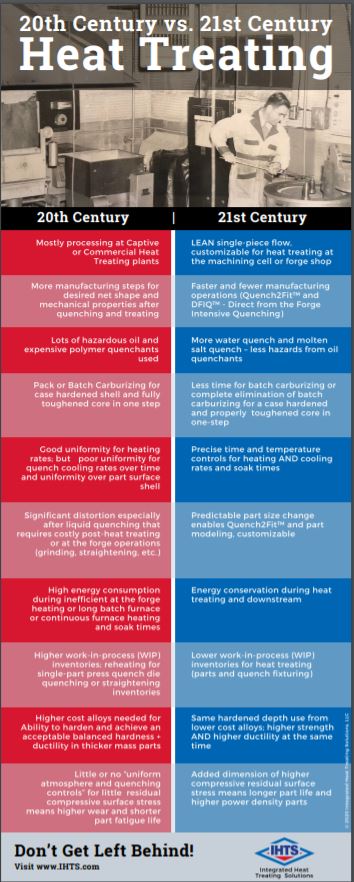
JP:  Integrated Heat Treating Solutions is the culmination of 75 years of commercial heat treating experience with literally over a 1000 different part makers.  What we’ve learned that if we can integrate our heat treating solutions with the part-making design and the optimal material selection, we can produce better parts.  And what I mean by “better parts” is they could be lighter, they could have longer fatigue life, and they could have less distortion after heat treating.  All of these benefits are brought to the table to part makers so that heat treating becomes a fully integrated part of lean manufacturing.

Once heat treating becomes a lean, integrated part of manufacturing, everybody wins.  It enables the use of leaner alloy materials; it eliminates oil quenching; it eliminates long carburizing cycles and batch carburizing cycles; and we now are able to literally do the heat treating in the manufacturing cell where the parts are made.

DG:  What do those two companies look like now?

JP:  We have about 50,000 square feet and are currently in the process of acquiring another building to our east.  We have 48 employees and there are three shifts; and again, we do salt heat treatment, vacuum heat treatment and controlled atmosphere heat treatment.  Also, we are currently getting into induction heat treating with our friends at Induction Tooling.

For the last 23 years, we have been concentrating on finding the best way to quench parts and to drive the distortion out of the part-making process.  The heat treat distortion has been a problem for centuries.  Parts crack, they distort, they come out of the heat treat process unpredictably with size change that is absolutely necessary to get the mechanical properties, but also, if it’s nonuniform, that size change can cause major problems down the line that have to be corrected by hard turning, grinding, flattening, straightening, you name it.

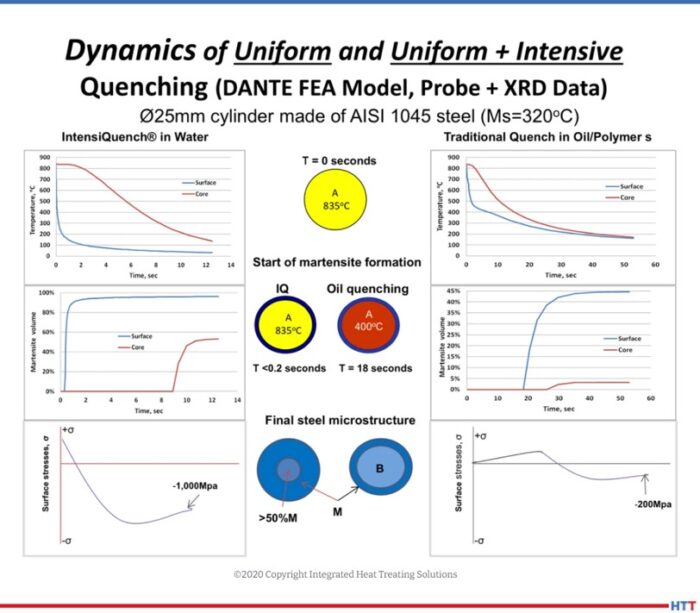
Dynamics of uniform and Uniform Intensive Quenching model (Source: integratedheattreatingsolutions.com)

We’ve also delved into the science of computer modeling, finite element modeling as well as computation of fluid dynamic modeling with our friends at DANTE Solutions.  What has happened from that modeling is seeing this concept: the surface of the part contains a bunch of grains, and those finite elements – if they are not quenched uniformly – will transform nonuniform, leading to nonuniform thermal shrinkage upon beginning quenched. Then they will also transform to martensite nonuniformly, which means that the thin and thick sections of a part will have different amounts of distortion and size change.  In order to control that, we’ve developed what we call “quench to fit” technologies where we literally build a shell on the outside of the part, using a gas quench or a uniform salt quench or uniform water quench.  Once you’ve built that shell in the first few seconds of the quench on the outside of the part, that martensite shell acts like a custom-made quench dye, and that custom-made quench dye allows the part core to cool by conduction through that shell.  So, if that cooling by conduction happens by very uniform conduction through the geometry and the mass of a given part, you will have a predictable size change after heat treat. And, you will enable the part designer to go back to the initial part design and adjust it accordingly so that it quenches to fit during the quench process.

When a commercial heat treater receives the part, 99 times out of 100, that part is using a material that was selected many, many years ago, because that is what they’ve always used.  Additionally, it’s going to be heat treated in legacy equipment that has always been used.  For instance, case carburized 8620 steel valve seats have been used for decades now, and they last about 40-70 hours in the fracking pump, but a ductile iron valve seat can be made to last many times longer; it’s cheaper to buy the material and our heat treating equipment can heat treat it in 5 minutes instead of a 20 hour case carburizing cycle in batches.  That single part flow of that new induction heat treating equipment and quenching equipment that is built into it can be built in right at the end of the CNC machines.

I am a commercial heat treater who believes that part design should be integrated for heat treating by the part-maker.  It’s a nuance, but what it really boils down to is that sometimes commercial heat treaters do it best, but sometimes the part-maker can do it better.  [Side bar quote: I am a commercial heat treater who believes that part design should be integrated for heat treating by the part-maker.  It’s a nuance, but what it really boils down to is that sometimes commercial heat treaters do it best, but sometimes the part-maker can do it better.]

I am a commercial heat treater who believes that part design should be integrated for heat treating by the part-maker. It’s a nuance, but what it really boils down to is that sometimes commercial heat treaters do it best, but sometimes the part-maker can do it better.

DG:  So, the importance in the part design process of including the heat treater is that you can more consistently predict what the distortion will be, because if I understand it correctly, you can actually predict distortion in the part and therefore design the part with the distortion that will come consistently every time you design that part, yes?

JP:  Yes.  And it doesn’t matter if it’s an air quench or a hot salt quench or a uniform water quench, it just has to be very, very uniform from the initiation of the quench.  In other words, you can’t take it out of the furnace and air cool it for 45 seconds and then begin a water quench, it doesn’t work that way.  That shell is starting to form instantaneously when the heat is turned off.  An air quench is very slow compared to an intensive water quench and so you have to introduce that quench all over the part surface shell as instantaneously, and with as much uniform impact, as possible.  That’s what we do in terms of designing equipment to do the quench process.

DG: Right now, there are a lot of companies, a contractor or commercial heat treater, that send you parts to heat treat.  Is it not possible that if the part designer and the heat treater talk in advance as they design the part, that some of these parts could be, in fact, heat treated in-house and not be sent out to a commercial heat treater?  Is that possible?

JP:  They could actually be heat treated not only in-house, but directly after the CNC machine, right in the manufacturing cell, right after the forge.  It takes the proper selection of the optimal hardened ability material. In other words, part of that part design with the heat treater has to be considerations like, “Is it going to get too hard in the core?  Is it going to swell up too much in the core?  Is it going to be unable to build that shell on the surface without blowing it off, because the core starts to harden up?”  So again, the optimal material selection and the design of the mass and the geometry of the part need to be considerations that the heat treater gets a chance to look at.

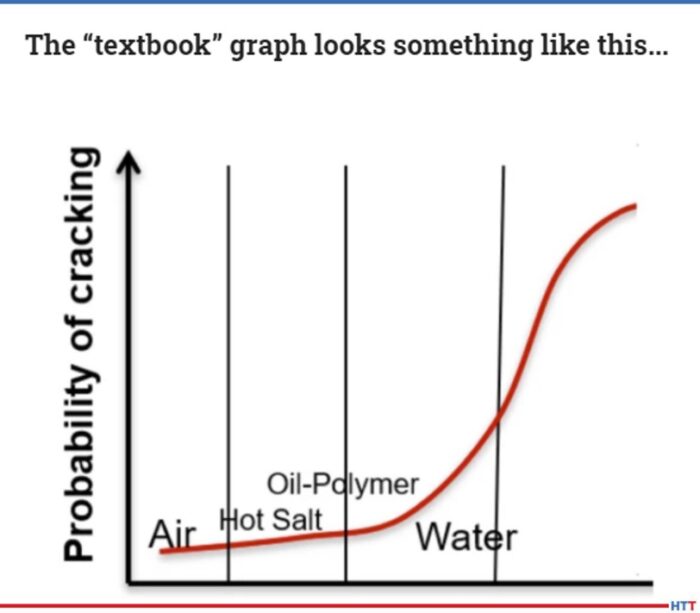
A “textbook” example of the bell curve. (Source: integratedheattreatingsolutions.com)

DG:  So, if the part designer and the heat treater get together and talk about the part design before the part is finalized, or if they’ve got a legacy part, they can sit down and talk with a heat treater that understands what you’re doing over at Akron Steel and Integrated Heat Treating Solutions. If they can understand that, and if they can talk with you about how that part might be redesigned, it’s very possible that you could use lower cost materials to get the same thing, minimize the amount of time to actually heat treat, and you may be able to put that part in a single piece or at least possibly a small batch flow so that there’s not a bottleneck at heat treat, yes?

JP:  Yes.

Sponsorship for this episode is Furnaces North America the Virtual Show.

DG:  Joe, let’s talk about the quenching bell curve as it relates to distortion.

JP:  There are many, many metallurgists and many metallurgical textbooks that indicate that the faster the quench cooling rate, the higher the probability of distortion.  There is a curve that is generated that basically says that if you quench very slowly in gas, or if you increase that quench rate and go to a hot salt or a martemper bath or an austemper bath or you increase it even further with warm oil or highly agitated oil, or you go to a brine quench where you do a polymer or a polymer water quench where you increase the rate of quench cooling, there is a point at which most of the parts are going to crack and you’re going to have major distortion.  It is not because of the quench speed being faster, it is because the uniformity tends to be less the faster your quenchant.  In other words, you need to keep the water from film-boiling and creating a situation where the initial quench is actually done under a steam blanket, or gas, very slowly.  Once the thin sections of the part quench-out under gas, then you have the thick sections that are still under that gas blanket, and you have very rapid cooling and very rapid martensite transformations that cause a shift in the size of the part where the shell now cannot contain the core swelling that’s happening underneath the surface.

Whereas 21st century heat treating practice is, what I call, a “uniform quench renewal rate” and an instant impact.  In other words, you instantly impact the shell, create that shell, and once it’s created with uniform cooling, then the rest of the cooling happens by conduction through that shell.  Whatever the geometry and the mass of the part is will determine that uniform conduction cooling which ends up being very predictable.  Once it’s predictable, then you can morph the green size of the part before heat treating so that it predictably quenches to fit during the quench process.

(source: integratedheattreatingsolutions.com)

DANTE Solutions has a method where they use their model to model the finite elements in the part so that the thin and thick sections of the part quench uniformly. IQ Technologies Inc. and my company, Integrated Heat Treating Solutions, have gone on the other side and shown that it is really a bell-shaped curve, and that the probability of distortion goes back down if you can create that shell on the outside of the part instantaneously, and then provide a uniform quench renewal rate to the part surface so that the core can cool by uniform conduction through that shell.

DG:  Let’s just put in our listener’s minds the standard bell curve.  Most of the quenching and most of the textbooks that we see these days is done on the left hand side of that bell curve, and as you approach the peak of that bell curve, the probability of distortion and/or cracking occurs.  People are saying – don’t quench too fast because you’ll get cracking.  You’re kind of switching the whole paradigm to say that it’s not the speed at which you quench, but more so: Can you create, almost instantaneously, a hard shell because of exceptionally rapid cooling on the whole part so that that shell basically holds the part in place?  If you can get that, then you can cool the rest of the part, however slow or fast, in a sense, you want, because it’s not going to distort because it’s already locked in.

JP:  Right, and this is cooling by conduction which is the physics of the material.  How fast will it give up the heat through its mass?  It’s the difference between 100 degrees or 50 degrees or 10 degrees per second of cooling and 400 to 600 degrees centigrade cooling per second, so it’s very, very intensive.  The middle of the bell curve, where most parts are cracking, is because there is not a uniform quench renewal rate.  You start off with a gas quench, then you end up with a very intensive evaporative cooling quench with nucleate boiling.  You then end up with water quenching without boiling, and so you have three different phases of cooling happening on different parts of the part. This is exacerbated by different parts in different sections of the batch which will have different cooling rates.

It’s almost impossible to get the full benefits of very, very intensive quenching or even very, very uniform gas quenching in a vacuum furnace unless you have staged the cooling in such a way that you create that uniform shell at the beginning of the quench, and you hit that martensite start temperature and cool to that martensite start temperature all over the shell of the part uniformly.  That’s the key.

DG:  There are several things that jump into my mind like questions that might arise from people.  You’ve already hit on the differences in part thickness – you may have thick sections, you may have thin sections.  It’s very possible to maybe get down to the martensite start temperature on the thin section right away, but the thick section may not be, and therefore you’re going to distort because you haven’t created that “frozen shell” uniformly around the entire part.  Let’s talk about, not just part thickness, but part geometry in the sense of the awkward curves and turns or lips and things of that sort on parts.  How would we deal with that?

JP:  That’s where new 21st century heat treating equipment needs to be designed.  Every furnace company that is selling furnaces to either captive heat treaters or commercial heat treaters calls itself a furnace company.  The reality is, yes, heating is important and it is the precursor to getting the mechanical properties, but the heat treatment is actually done, and the mechanical properties are actually obtained, in the quenching process.  It should be “quench treating” not “heat treating.”  That’s the way I look at it.

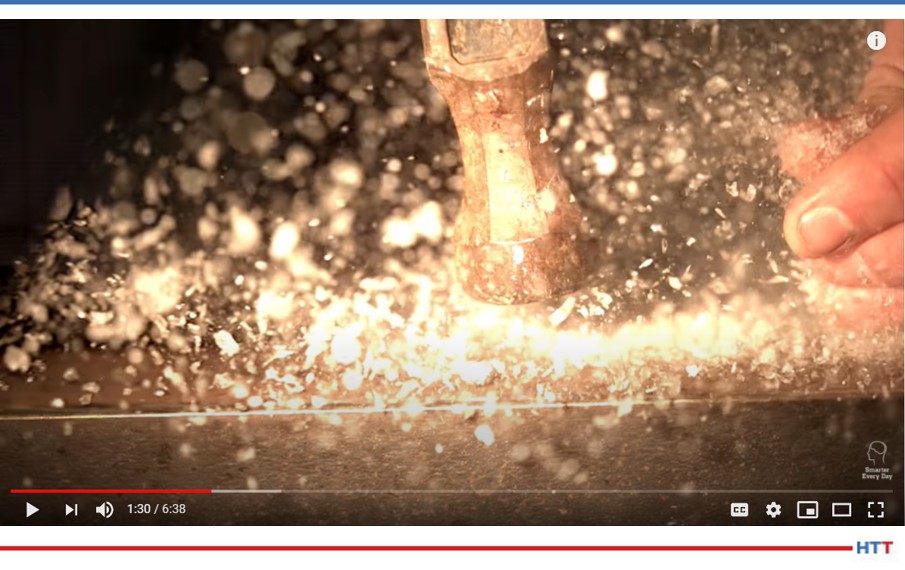
Image from Smarter Everyday YoutTube video on Prince Rupert’s Drop (source: https://www.youtube.com/watch?v=xe-f4gokRBs&ab_channel=SmarterEveryDay)

For the last 23 years that’s what has been more apparent to me.  My dad taught me how to quench stamps that were used for marking the inside of tire molds, and these steel stamps would uniformly blow up if you just quenched them.  But if you were able to uniformly quench the marking end, you could get it hard as hell and it would last a long, long time, but you had to kind of bifurcate the quench.  You had to make sure that you created that shell in the marking area of the stamp and let the rest of the stamp kind of cool much more slowly.  In other words, create the shell in the face of the stamp where the lettering is, and set those letters.  Then the rest of the stamp can basically cool much slower because you don’t need the hardness there; it’s not the working part of the part.

Also, the designers of the stamps had to integrate the right radius in the face of the stamp.  If they had sharp corners, those sharp corners would blow off during the heat treat.  So, over time, we said, “If you don’t want us to crack this stamp, you’re going to have to put a radius over here and change the design slightly.”  It didn’t take much change, but it did take a recognition of the fact that this was not going to work.  There’s no way to eliminate the nonuniform cooling in the shell if you’ve got a corner.  Steam collects in that corner and it doesn’t quench, so you can’t create the hardened shell.

DG:  Let’s take a little deviation and talk about something non-metal.  Let’s talk about the Prince Rupert’s drop to illustrate residual compressive stresses.

JP: The mystery of the Prince Rupert’s drop of glass is that glass makers noticed that if they dropped a drop of molten glass into a bucket of cold water it would form a drop that has a head and then a tail – it almost looks like a tadpole.  If you hit the head of that glass drop with a hammer or try to break it with a pair of pliers, you can’t do it.  It is literally unbreakable at the head.  However, if you snap the tail off, it instantaneously explodes.  This is because there are counterbalancing tensile stresses that are below the surface in the tail that once you break the compressive stresses off, it’s like taking the hoop off a barrel and the barrel staves explode; the elements on the surface just explode.  The reason they don’t explode on the drop of glass at the other end is because there are sufficiently high compressive stresses on that surface that hold the drop of glass and keep it from fracturing.

DG:  This is a fascinating video where you take a Prince Rupert’s drop, actually hang this Prince Rupert’s drop and shoot it with a .38 or a .45 or a 9 mm, hitting the head of that tadpole, if you will, and it shatters the bullet while the glass remains untouched.  However, if a guy just simply takes his finger, or whatever, and snaps the tail, not just the tail shatters, but the whole tadpole blows up.

JP:  What we’ve been able to do with all of the research that we’ve done is to harness those compressive stresses and make them available to the part-marker for making their parts more robust, making them lighter, and making them basically carbide hard and hammer tough.  They don’t chip when hit with a hammer.

DG:  Let’s jump back to some of the projects you’ve done at Integrated Heat Treating Solutions.  Do you have any current projects that you’re working on where this integrated solution – where you were involved with part design or improvement of part design – worked well?

JP:  Yes.  There are several case studies.  The first case study was a punch that lasts 2 – 9 times longer than an oil quench punch.

DG:  A punch for what?

JP:  Punching holes in metal plates. And the other thing that has happened is that since we’ve begun working with Induction Tooling, we’re able to then bring this down to the level of thinner parts and more complex geometry parts.  We’re able to get more hardenability out of lean hardenability alloy such as ductile iron. Plain ductile irons are now acting as carbides.  Even the people that make the material said it couldn’t be done, but we’re doing it.

DG:  Can you give an example of that?

Watch more resources at Integrated Solutions website. Click the image above to access these resources.

JP:  Yes, that would be a fracking pump valve seat made out of ductile iron and heat treated with our special heating and quenching technologies.

DG:  What was the performance prior to the treatment and afterwards?

JP:  40 to 60 hours and our initial testing we got 166 hours, so 2 ½ times longer.

DG:  So 2 ½ times better performance on this fracking valve seat, and you were using the same material?

JP:  No.  Rather, we replaced an 8620 carburized steel that needed to be carburized for 20 hours in the furnace, and we did it with a 5 minute induction heating process.

DG:  Of what type of material?

JP:  Ductile iron.

DG:  So we’ve got a punch, a valve seat in the fracking industry.  What else?

JP:  We have bevel gears that we do.  We have worked with the part manufacturer and they’ve adjusted their CNC program so that it actually quenches to fit and doesn’t require a final grind.

DG:  Expensive hard machining or hard grinding after heat treat.

JP:  Right.  And it saves them about $750 per gear in final grind costs.  And, the gear lasts longer because it has high residual compressive surface stresses versus a standard carburization process and quenching in oil that does not have as high of a residual compressive surface stress.  Especially after you grind it all off to get the final dimensions you want.

DG:  Right.  So you put all these nice hard stresses in, then you grind them off.

JP:  Exactly.

DG:  Any other examples?

JP:  We have a company that wanted to have a weldable gear rack that could be welded on in the field on mining equipment that’s out on the side of a mountain.  Because it might be cold up there, and they didn’t want to have to pre- and post-heat in order to weld on the gear rack, or repair a tooth on the gear rack, they wanted to have a material that had less hardenability but still wanted to have all of the mechanical properties.  We were able to get the mechanical properties of 4330 from a 4130 material that doesn’t need to be pre- and post-heated to prevent it from cracking when welding it onto the machinery.  They call that “field repairability.” So, we were able to enable field repairability and still maintain the mechanical properties’ requirements.

DG:  In future episodes, we’ll go into some depth on some of those applications you just described, but before we wrap up things for this episode, is there a last impression you’d like to leave with us?

JP: Professor Jack Wallace* did not believe that there was a right half of the bell-curve, he did not believe that intensive quenching would work, but, again, he became a believer. It is all key to understanding the dynamics and uniformity of quenching over time. If you get the uniformity, you’re in good shape and eliminate a lot of heat treating problems.

DG: Thanks, Joe. Looking forward to you joining us for future episodes.

JP: Thanks so much.


*Professor Jack Wallace was the “Dean of the College of Metallurgical Engineering at Case Western Reserve University in Cleveland Ohio – who said in 1997, ‘Intensive water quenching would not work!  – The parts will blow up in the quench!’  He became a convert once he figured out how compressive surface stresses worked during uniform quenching.” Information provided by Joe Powell.


Doug Glenn, Publisher, Heat Treat Today
Doug Glenn, Heat Treat Today publisher and Heat Treat Radio host.

To find other Heat Treat Radio episodes, go to www.heattreattoday.com/radio and look in the list of Heat Treat Radio episodes listed.

Heat Treat Radio #37: Rethinking Heat Treating for the 21st Century with Joe Powell (Part 1 of 4) Read More »

Heat Treat Radio #31: A Discussion with David Wolff, Nel Hydrogen, COVID-19 Update

Welcome to another episode of Heat Treat Radio, a periodic podcast where Heat Treat Radio host, Doug Glenn, discusses cutting-edge topics with industry-leading personalities. Below, you can either listen to the podcast by clicking on the audio play button, or you can read an edited version of the transcript. To see a complete list of other Heat Treat Radio episodes, click here.


In this conversation, Heat Treat Radio host, Doug Glenn, speaks with David Wolff of Nel Hydrogen about how the COVID-19 pandemic has affected supply chains, specifically those relating to hydrogen generation. Click below to learn more about what risks the supply chain for hydrogen is facing, how the ongoing crisis may affect supply and employee safety, and what the benefits of on-site hydrogen generation are during this unusual time.

Click the play button below to listen.


The following transcript has been edited for your reading enjoyment.

Doug Glenn (DG):  We’re here today with David Wolff from Nel Hydrogen. Dave is the eastern regional sales manager, and we’ve had a couple of previous Heat Treat Radio episodes with Dave talking about on-site hydrogen generation; but in light of COVID-19 and all that has happened there, we wanted to revisit this issue.

David Wolff, eastern regional sales manager, Nel Hydrogen

David Wolff (DW):  It’s been an amazing time, and I think we’re all shocked by the number of unexpected and wide-ranging effects of this COVID-19 event.  We talked about discussing supply chain interruptions, which have been unbelievable and sometimes counterintuitive.  You go to the grocery store these days and look at the shelves, the toilet paper, the rice, the meat, milk, and eggs, and they’re all empty.  People talk about going to Amazon, and even PC monitors are sold out, thermometers and jigsaw puzzles.  The most humorous is this world of zoom meetings.  Even dress shirts and blouses are selling, but not pants and skirts.  It is an interesting time.

I’ve been astounded by the wide-ranging effects on all businesses.  I’ve just recently reviewed my recent business charge card bill, and the total amount that I charged in March and April was zero.  That’s money that didn’t support restaurants, hotels, gasoline, airlines, and obviously their supply chain suffered. We’re seeing virtually every business running into raw material shortfall caused by shutdowns or logistics issues extreme in the supply chain: yeast for pizza, alcohol for chemicals and cleaners, metal parts for assembled machinery. Here in Connecticut, we have a small but healthy dairy industry, and it’s tragic to see logistics issues causing dairy farmers to dump milk [they] can’t sell, while bottled milk prices at the grocery store are surging upward.

DG:  It’s definite that the impact, as you said, and said it well, has been wide ranging, in many ways somewhat devastating and somewhat counterintuitive.  It’s hard to tell.  But we want to talk specifically today and revisit for a bit on-site hydrogen generation based on what has been happening in light of these changes.  What exactly are companies having to look at now that they weren’t having to look at before?

(source: Наркологическая Клиника on Pixabay)

DW:  What we hear from companies is that they’re focused on two priorities.  They’re focused on employee safety and the control of factors of production, their supply chain.  So they want to bring people back in a safe fashion, and that’s requiring an immense amount of accommodation.  And then they need to make sure that they have their raw material.  Hydrogen is required for most types of heat treating, sintering, as a carrier gas in fuel for analytical equipment, semiconductor processing for chemicals, and for operation of power plants.  Without hydrogen, these things do not happen.  We’ve lived this through at Nel before.

Ten years ago, just post [Hurricane] Katrina, when delivered hydrogen was limited due to plant outages, Nel Hydrogen, which was then Proton On-Site, was actually contacted by the federal government to prioritize hydrogen generator deliveries to power plants because without hydrogen, power plants can’t operate, and we were under orders to prioritize electrical supply.  So we’ve seen some aspects of this before.

DG:  Let’s talk briefly about what some of the risks are for delivered hydrogen.  What are we talking about here?

DW:  There are new supply chain risks to consider.  Most of us have seen this pretty personally.  We haven’t purchased any gasoline in weeks, that’s why the price is low.  In almost all cases, the hydrogen that is delivered to US customers is actually a co-product, or almost a byproduct, of the refinery processing of crude oil.  It is not the primary product for the plant, it is a co-product.  The excess hydrogen is then sold at relatively low prices to industrial gas providers for purification, packaging, and resale.

So if the gasoline is not in demand, the supply of hydrogen available for sale to the industrial gas suppliers will decline because it’s not being produced.  So you have that risk of the basic hydrogen supply.  You then have the fact that the hydrogen plant may be lower in business priority compared to other gases when it comes to staffing limitations.  Right now oxygen is the focus of all the industrial gas companies, and I’m going to talk about some of the implications of that.

The other thing is that the U.S. supply chain for hydrogen, particularly in cylinders, has multiple steps.  A failure in any step will result in shortfalls.  For example, because of the cost and challenges of storage, the entire industrial gas industry runs with very lean inventories.  You can’t just put industrial gases on the shelf; they need to be packaged or stored in tanks, and the amount of storage is very limited.  So logistic hiccups very quickly result in shortages.

Cylinder and tube trailer distribution chains might become frozen because empties are not being returned from customers who are closed.  Additionally, for cylinder hydrogen, cylinders have been taken out of hydrogen service and re-serviced into medical oxygen.  The suppliers are encountering delays for cleaning and disinfection around delivery of cylinder hydrogen.  And discussions about additional waves of COVID-19 and whether people have acquired resistance, and therefore can go back to work, are all delaying a return to a normal situation.

DG:  Is it possible that some of the customers might experience limitations, hydrogen supply limitations, different than other customers?

(source: Luisella Planeta Leoni on Pixabay)

DW:  It’s always tricky to guess, but my feeling is that the effect on the hydrogen supply is likely to be noticed by the smallest volume users first, and maybe most acutely.  That’s because the cylinder hydrogen logistics are the most complicated, whereas liquid hydrogen is the least.  Liquid hydrogen goes directly from the place of manufacture to the customer.  And you’re limited there primarily by driver availability and travel challenges, whereas tube trailer and tube bank users depend on an additional stage of trans-fill from liquid to gas.

Now those are the same locations that are struggling to fill oxygen orders for hospitals, and in the industrial gas industry, nothing is more important than a hospital oxygen delivery.  There it’s really a question of availability of staff and prioritization.  But cylinder filling and distribution is by far the most equipment and people-intensive form of delivery because you’ve got liquid trans-fill, cylinder management, filling, QC, and local delivery all under great pressure because of resources and priorities.  And then again, the issue of cylinder availability because every cylinder that can possibly be re-serviced is being re-serviced into oxygen service for hospitals.

Finally, for folks who are using forming gas in cylinder form in kind of low quantities, [there are] likely to be long delays because of the scarcity of the skilled people to do the blending and analysis required for performing gas blending.

DG:  You’ve laid out nicely, I think, the potential risks of what’s going on with COVID-19 and how it may impact supply and even employee safety.  Let’s do a quick review of the benefits of on-site generation as opposed to having it delivered in tubes or cylinders or whatever, and how does that impact our thinking as far as on-site hydrogen generation these days?

DW:  If hydrogen is a raw material for you, hydrogen generation can enable you to make all of your hydrogen at your site automatically with little personnel attention, so it becomes a utility.  The only raw material that you depend on to make that happen are electricity and water, which come into your facility in pipes and wires, and of all the logistics chains, electricity and water tend to be among the most reliable.  So no trucks, no people, and so forth.  And then hydrogen eliminates the space and compliance issues related to hydrogen deliveries and storage.

Finally, and this is not strictly related to COVID-19, but hydrogen generation will stabilize your hydrogen cost.  So in a time when force majeure charges tend to crop up during times of difficult logistics, you don’t see those.

Click on the image above if you’d like to get your own download of this 18-page e-book.

DG:  Dave, in addition to our two earlier podcasts together, and the eBook, Hydrogen Generation and its Benefits for Heat Treaters, which you can find on our website, where else would you direct people to find more information about on-site hydrogen generation?

DW:  I would direct them, if they wish, to go to the nelhydrogen.com website for more details on our equipment.

DG:  Any concluding thoughts?  Anything else you want to leave us with?

DW: On-site hydrogen can’t be implemented overnight, so it makes sense to plan ahead.  If this concept makes sense to you, we’d be happy to have a conversation.  The current thinking is, this COVID-19 issue may be with us for months, and there is even talk of waves lasting years.  So we will see this again. On-site hydrogen is a solution to many of the long-term problems we’ve identified that are associated with delivered and stored hydrogen. And if there is anything this strange COVID-19 experience has shown us, it’s the importance of supply chains for businesses, their employees, and their customers.

Whether the issue was [Hurricane] Katrina or COVID-19, supply and demand mismatches for hydrogen, or just the diminishing attractiveness of driving the trucks to deliver hydrogen, businesses may wish to control the factors of their own production.

Doug Glenn, Publisher, Heat Treat Today
Doug Glenn, Heat Treat Today publisher and Heat Treat Radio host.


To find other Heat Treat Radio episodes, go to www.heattreattoday.com/radio and look in the list of Heat Treat Radio episodes listed.

Heat Treat Radio #31: A Discussion with David Wolff, Nel Hydrogen, COVID-19 Update Read More »

Heat Treat Radio #30: Dr. Shahrukh Irani on Job Shop Lean

Welcome to another episode of Heat Treat Radio, a periodic podcast where Heat Treat Radio host, Doug Glenn, discusses cutting-edge topics with industry-leading personalities. Below, you can either listen to the podcast by clicking on the audio play button, or you can read an edited version of the transcript. To see a complete list of other Heat Treat Radio episodes, click here.


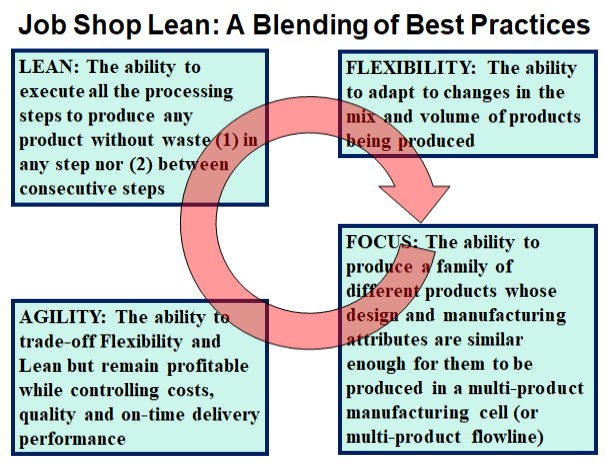
Audio: Dr. Shahrukh Irani of Lean & Flexible LLC

In this conversation, Heat Treat Radio host, Doug Glenn, interviews Dr. Shahrukh Irani of Lean & Flexible LLC about how manufacturers with in-house heat treat might implement the Job Shop Lean concept, thereby increasing profits and efficiencies. Listen to learn whether your company might benefit from examining its processes and making parts of its daily operations more lean, flexible, and ultimately more profitable.

Click the play button below to listen.


Transcript: Dr. Shahrukh Irani of Lean & Flexible LLC

The following transcript has been edited for your reading enjoyment.

DG: We're going to discuss how manufacturers with in-house heat treat might implement lean manufacturing concepts to increase profits and efficiencies. But first, I'd like to give a shout-out to John Tirpak, who I've know for many years, and his recommendation to talk to today's guest, Dr. Shahrukh Irani.  I first met John when I was involved with the creation of a magazine called Forge, a publication that is still published by BNP media and serves the North American forging industry.  John is a very accomplished engineer, metallurgist, and C level management guy with a lot of energy and vision. He knows the metals, forging, and heat treat industry, and it is on his recommendation that we're talking to Dr. Irani today, so thanks, John.

Dr. Shahrukh Irani, President, Lean & Flexible LLC

Dr. Irani is the president of a one person consulting company, Lean & Flexible LLC.  Lean manufacturing isn't a topic discussed too frequently in the heat treat world, but there are significant benefits to be gained by doing so.  That's why today's conversation with Dr. Irani should be of significant benefit to you, especially if you're a high mix/low volume manufacturer, as opposed to a low mix/high volume manufacturer.  While the bulk of heat treat today's audience are manufacturers with their own in-house heat treat departments, many of these departments heat treat a wide variety of parts and therefore qualify as high mix, low volume producers.  Our friends in the commercial heat treat world will also find this episode beneficial since most of their business is built around high mix/low volume job shop type work.

SI:  My company's name is Lean and Flexible.  I am just a one person consulting gig.  The name pretty much tells everybody what I think needs to be done.  When you are high mix/low volume, (especially if you are job shop, but not necessarily job shop), you want to be lean, which is waste-free, efficient; but then you want to be flexible.  You want to be able to do a whole variety of parts in different quantities. Everybody can talk lean; but when you try to become flexible, all of those things that your favorite consultant taught you to believe kind of work against you.  You have to be agile.  Agile is the speed with which you can change your world and do different types of heat treat. That's pretty much what my consulting company does.

DG:  Very briefly, with respect to your background, I know that you've been in academia for a while, but when you met John, you spun off this new company.  Tell us briefly about your academic background, and also if you don't mind, tell us about maybe any interaction with Toyota, which, of course, is the big company when it comes to lean.

SI:  I began my academic career after I got my PhD in 1990 and straight for about 22 years, from 1990 to 2012, I was in academia.  I read that book, Lean Thinking, which talked about Toyota in 1999, and it really got me interested.  What is called lean, or what is called the Toyota Production System, is just industrial engineering, but very hands on.  Toyota basically figured out industrial engineering the way that the rest of us, especially in America, never did. And that's basically what lean is--Toyota style industrial engineering.

When I began in 2003 when John met me, his challenge to me was, look, research is fine, but I deal with custom forge shops.  They make batches of 50 and 100.  They don't make 200,000 cars a year.  So throw all that Toyota flavor of lean out the window.  You give me some lean stuff that I can benefit these custom forging suppliers who send parts to the DOD.  That's how this whole idea of job shop lean was born. Industrial engineering, which is the math and the science, and then blended with this very hands on, very practical industrial engineering that came out of Toyota.  I think that's very key.  I don't think the world recognizes that we actually teach a profession, that there are professionals called industrial engineers, but how do they practice the Toyota method of industrial engineering, that that education is just academic.

DG:  I saw a statement on your website that maybe ties in here.  Maybe you could expound on this a little bit.  I thought it was a very interesting statement.  You have a statement on your website that says this: "Where industrial engineering meets the Toyota production system." Can you expound on that a little bit? Exactly what does that mean, and why you have that on your website?

SI:  Sure.  Look at me.  I was an academic for 22 years.  I never worked at Toyota, so I never had the benefit of their expert lean implementers teaching me.  But I was an industrial engineer.  So when I read things like value stream mapping and one piece flow and a little Japanese was Kaizen, Jidoka, Poka Yoke, Kanban; when you distill those practices down, at the bottom of it is pure industrial engineering.  Like when you smelt iron, the slag comes to the top, but what remains is that pure molten iron. That is industrial engineering.

I did not work at Toyota, but I was an industrial engineer.  So what choice did I have to develop this thing called job shop lean for John, who was like, “Hey, you've got to benefit heat treaters who have pre-machining and post-machining.” All I had was my industrial engineering, and then I remastered it.  I started asking myself if this academic theory is good.  What is the practical version?  So I looked to the Toyota production system industrial engineering, and I distilled that down and I connected it to all.  So all this is metal standard stuff I was taught and read doesn't fit.  So I did a Frankenstein kind of thing.  I took what worked, and I took the science of industrial engineering and blended it together.  And that is what I teach and practice today. It's industrial engineering done my way. It works, I fail, I succeed, learn from my mistakes.

DG:  I mentioned to you earlier that our primary audience are manufacturing companies who have their own in-house heat treat departments, so they're somewhat in-line perhaps.  But I don't know that many of the industrial manufacturing companies that we deal with really think of lean being an element of their heat treat operations.  So, my question to you is could you come up with, on the spur of the moment, say, 3 to 5 of the most common opportunities that are missed by these manufacturers with their own in-house heat treat departments, if they're not thinking lean and flexible? What are some of the opportunities that they're missing?

SI:  I'll give it a stab. First thing is you look at the total flow. Look at sawing, turning, milling, grinding, drilling, heat treating, force grind machining, assembly.  You look at heat treating as a process, as a department.  Just as you would organize any facility, you ask, ,"Can you identify your value streams?"  And heat treatment just becomes a department, a step, in those value streams.  All you care about is I get bar stock and I get forging and I machine it through and I heat treat it, improve its properties, force heat treat machining, assembly, and ship.  That's the first thing that I don't know, and please correct me, I don't know that these manufacturers who have heat treating simply as a process inside their four walls, but that's the first thing that they've done. Have they designed flexible line, flexible cells? Heat treatment is kind of un-lean. It's process driven.  It's very incompatible with, say, grinding or CNC machining, and it's batch intensive.  The control aspects of heat treating process, spherodizing and annealing and stress relieving are a lot more involved.  But that's important.  The first thing is, have we identified our value streams?

The second thing is do we schedule?  How do we schedule the shop?  There are challenges, but it's not that the challenges are insurmountable. I find that scheduling is the second massive weakness in just about any manufacturer, whether or not they're or aerospace or mining.  Whether or not they have heat treat inside or heat treat outsourced, that is the second thing.  Scheduling is a big weakness.

The third thing is that heat treatment definitely has process control software that's monitoring the recipes and the heat treat cycles of the furnaces and other processes.  Great; but what's missing is the third thing, and that's communication.  Multiple manufacturers have heat treatment right smack in the middle of their facility and their pre-heat treat and post-heat treat process steps.  I don't believe that they have utilized their control systems more as a communication system to pre-heat treat work centers and post-heat treat work centers.  They could be using the software as machine monitoring systems, but they can also use that as manufacturing execution systems.  I think that's the third weakness.  They have not really connected the heat treat to "Hey, I need to go buy money. And every time product builds up in a batch, I'm losing money." That's the cost of inventory.  That's my third observation.  They treat this incompatible area, heat treat or furnaces, and we feed them as their own little baby; but they forget the fact that there are pre- and post- links.

One last thing I did some reading about the equipment that you have for heat treatment. I'm not sure, but when I looked at these furnaces, they are all big, long boxes.  I don't know that that's the best design of the equipment in that particular industry.  In lean, in assembly, they are driven by one-piece flow.  They are driven by one person attending multiple stages.  They are driven by visual management.  And I didn't get the feeling that the big, long boxes that they built were designed for one-piece flow but that they were designed for transfer batch flow, which is what the other sectors of industry are doing.  Why should all the parts be on the bottom on the conveyor?  Could they be bucket spiral conveyors?  Could you use the vertical rather than the horizontal?  I think that machine design could learn. And especially if you've got heat treatment inside a bigger facility, you've got to be a lot more creative about how to get one-piece flow, visual monitoring, communication to other departments.  I feel that may be a lost opportunity.

DG:  The design of the equipment is an interesting aspect to discuss. A lot of times the reason those furnaces, (you're talking continuous furnaces in this case, or semi-continuous furnaces), are long, straight lines with an entrance on one end and an exit on the other, it is a design issue.  It is an expense issue. Certainly, there are furnaces out there that can do a U-shape or a serpentine shape, or things of that sort, or even use vertical.

The issue tends to be in a lot of this, the material transfer becomes quite a bit more expensive and a potential maintenance issue, which nobody wants, when we have to transfer baskets or parts on a belt. Transfer systems work well at ambient temperatures; but when you get them up in the high temperatures, you've got a problem.  But your point is well taken.  I think that the point is, let's take a look at not only the layout of the facility and how we're using it, but the design of the equipment itself could certainly benefit by that.

That brings me to a question here.  You and I talked to John Tirpak a little bit and threw this question out, and I thought it was kind of interesting.  He said recognizing heat treatment is often characterized with fixed, monumental pieces of equipment.  What can be done on either side of the heating and cooling operations to lean out the process?  I think his point is well taken.  Most people think this is a huge piece of equipment.  We can't really lean out this piece of equipment. Maybe that's true; maybe it's not. But I would like to ask you, can we lean out a large static piece of equipment, let say, and if not, are we just talking about leaning out the processes before it and after it?

SI:  I cut my teeth with the so-called job shop lean for high mix/low volume in forge shops. So I didn't have the benefit of going into some little family line area and doing one piece flow for textile products or table assembly. It was forges. So what happens with forges is you've got saws and then you've got pre-heat treat furnaces and then you have the big presses and hammers. They are monumental from the get-go.  Then once the part gets hammered, it then drops into a wire mesh container, and then some time later the forklift guy comes and drags it off and goes and dumps it some place in the yard.  Of course you look at things like right sizing.

A wonderful example that came out of the Toyota world was Ford had built this massive 10 million dollar washing machine that was supposed to be capable of washing many different types of parts, but its up-time was maybe 60%. Toyota went to the local Lowes and bought dishwashers, and they changed the inside of the dishwashers and sized the machine to the volume and the shape of the parts.  They "right-sized."  They took something that everybody thought was "Oh, that's a monument," and made it flexible, and anything flexible is unreliable.  Anything flexible is hard to learn to use.  I think that's the whole idea.  You have to look at these monuments and say, "What can we do pre-?"

I know that the furnace has to do batches.  But how much time that the furnace is just burning oil and electricity and doesn't have a load inside of it?  If you ask what is the total time that I've got metal inside the furnace, that is the true value added utilization of that big, hot, long box.  Like welding.  I don't care about how wonderful a welding station is.  I'm asking, what's the arc time?  And also, within that arc time, how many of the parts have produced with good welds? That's all I care about.  So I think that's what people have to look at, especially those who have heat treatment inside the four walls.  They have to use what is called theory of constraint.

They might say we've got heat treat as the constraint.  How do we optimize throughput? Then we have pre-heat treat work. How do I flow work so that I'm putting the right orders in the right quantity in the right sequence, always available to go and do that big, long box?  And then post constraint; how do I flow product after the heat treat process?  People have to use things like theory of constraints and continuous flow, but then they have to adapt the concept.  Personally, I believe that the monument thing, once people like you are brought to think about the process, how to break down the constraints of batch, the time that it takes to get that heat cycle stabilized from the previous cycle, I think the creativity has to be unleashed.  You recognize the limitations; but if you look at things like right-sizing, downsizing, pool scheduling, buffer management, overall shop scheduling, water spiders who know exactly when they must bring a load to the furnace, water spiders who know when they should take a load from the furnace to the grinding work centers.  I think that communication and continuous flow capability, that is how you de-monument the monument.

DG:  Your company name is Lean & Flexible, but it seems to me that one of the products, if you will, that you're offering is something called job shop lean.  Can you explain what it is and what is the value of it?

SI:  So John [Tirpak] came around and said look, I love your research, but I don't want this lean stuff that everybody and their dog is doing.  There was MIT and there was Michigan and everybody was having their own program, lean this and lean that.  Fundamentally, what they were doing was driven by going and copycating what Toyota was doing.  But the fundamental observation that I had was there are essentially two types of manufacturers, at least.  There are the OEMs, the John Deeres, the Toyotas, the Boeings.  They assemble stuff.  You can't take a jet assembly line and make dishwashers on it, right?  Then on the other hand, you have these job shops with, what I would say Mom and Pop, but they want to be flexible.  They cannot make money by making the same thing, 120,00 pieces of it in the year.  They basically are in small volumes, lots of part numbers and different requirements, mature properties, a lot of customers.  That creates a lot of uncertainty, that work environment.  But whereas the Toyota side is "we will of course use the same assembly line, we might make vans, we might make cars, but we're going to push out just these 4-wheel things. Job shop lean was born.

I stepped back and I said everybody's talking lean, but all this lean stuff is just for assembly.  Half the tools don't even work in high mix/low volume environments.  So that's when the buzz word "job shop lean" came about.  I look at those manufacturers where they've got issues of  shifting bottlenecks, they've got issues of suppliers jerking them around, they have lots of changeovers in their set-ups, all their parts go different routes around the shop – that's basically what we call a job shop.  But John says, you need to tell me what you're going to do at these fourteen companies that I'm going to set you up with. I had to come up with a plan that I'm going teach my students, thus and such, then we're going to place them at these Ford shops, I'm going to mentor them remotely from Columbus, Ohio, but they'll be so knowledgeable and they themselves are so good, they'll be able to implement this, this, this at your fourteen plants.

And those tools, what works and what doesn't work, that's true.  You can't have one-piece fluid heat treatment.  You can't do tatk time. A CNC lathe works at a totally different speed compared to a furnace.  A CNC lathe can make a piece and pass it on.  In heat treatment, you cannot.  You have to have a certain amount of mass inside at all times.  You can change over a CNC mill within 30 minutes.  Try doing that on a furnace with its own recipe from one drum to another.  That's what job shop lean is basically saying.  We're not going to learn from Toyota what 90% of US manufacturers need to because they're all high mix/low volume.  Please listen to me, I've got some knowledge.  Toyota was an inspiration, but at a certain point, because they are not telling me the answers to high mix/low volume situations, I'm going to find them myself.

DG:  There are a number of companies and people that are going to be listening to this that might ask the question, "How do I know if my company or my in-house heat treat department is a candidate for some sort of lean analysis?  Would we benefit by having some sort of lean analysis?"  What would you encourage those people inside?  What are the signs that they should be looking for in their company that says they should seriously consider some sort of lean philosophy or lean analysis of some sort?  What would be the red flags, let's say?

SI:  I have a job shop lean assessment tool.  It's a 5-page, yes/no type of questioning.  If anyone is interested, all they have to do is send me an email and they'll receive that Word document.  Put an X to answer all the questions and send it back to me, and I should be able to give them very quickly just walking down their replies, it should be very easy to figure out if yes, you are eligible for this high mix/low volume lean approach because you've got heat treatment and a lot of pre-heat and post heat treat process.  That's one step.

The second step would be to get your camera out and take a walk through the facility.  In your mind, you have a generic part that you make and you're basically imagining yourself to be that part.  You put the camera on your helmet and then you start to walk and talk me through the process.  The second thing would be to send me a video. And then we do a Zoom session and walk me through that video.

DG:  So, it's more or less a virtual video tour of a typical part and how it's processed.

SI:  Yes.  I have right now in the age of COVID-19, where instead of worrying about doing business, it's an open offer that I phone the study group for job shop lean, and the only expectation is that I will do as much as I can to work with you via remote with no strings attached; but if you want to get the job shop lean, then you should do a pilot project and you should follow the method.

I'm recording all of my lectures and posting them online on Vimeo so that anyone can access it, no strings attached, no financial expectation.  But the third thing is, do something.  Do a pilot project.  Do what we did at Sysco Forge Group 20 years ago.   Do what we did at Aluminum Precision Products.  Unless you do it, you're not going to get a sense of "Wow, I didn't even know that we've got 20 types of cutting tool inserts," you know?

DG:  Yes.  I think with lean, it's not a topic that is often discussed in the heat treat world, and I think the issue here is that there is a lot that people don't know that they don't know.  So it's really a discovery process and to that extent, I would encourage people to reach out to you to at least start that discovery process.

Let's talk quickly as we wrap up here, let's talk about some contact information, so people can get in touch with you.  What is the web address to at least go there and start looking a little bit more at what you're doing?

SI:  www.leanandflexible.com


Doug Glenn, Publisher, Heat Treat Today
Doug Glenn, Heat Treat Today publisher and Heat Treat Radio host.


To find other Heat Treat Radio episodes, go to www.heattreattoday.com/radio and look in the list of Heat Treat Radio episodes listed.

Heat Treat Radio #30: Dr. Shahrukh Irani on Job Shop Lean Read More »

This Week in Heat Treat Social Media


Welcome to Heat Treat Today's second installment of This Week in Heat Treat Social Media. As you know, there is so much content available on the web that it's next to impossible to sift through all of the articles and posts that flood our inboxes and notifications on a daily basis. So, Heat Treat Today is here to bring you the latest in compelling, inspiring, and entertaining heat treat news from the different social media venues that you've just got to see and read!

If you have content that everyone has to see, please send the link to editor@heattreattoday.com.


1. Plibrico Company Sponsors Project for Shriner's Hospitals for Children

The Plibrico Company recently sponsored a Happy Craft Day for Shriner's Hospitals for Children, during which many locations took part in assembling craft kits for kids needing a smile.


2. Innovations and Services on the Front Line

During this difficult and uncertain time, many companies are offering support to fight the spread of COVID-19, and some have come up with unique innovations.

Stack Metallurgical Group has announced its support for manufacturers in fighting the pandemic:

Similarly, Inductoheat has made a statement in the same vein:

ION HEAT has come out with the first prototype of its mechanic lung ventilator:

And Proceq USA Sales Manager Tom Ott demonstrates how to recharge a Proceq UT8000 flaw detector using a common USB power pack:


3. Good Friday Furnace Repair

Capital Refractories' Research & Development Manager Julie Hardy shared images of a 12 ton holding furnace repair that took place on Good Friday:


4. Reading and Podcast Corner

You may have a bit more time to catch up on the reading and podcast listening you've been yearning to do. May we recommend two brief written items of interest and an informative podcast.

Park Ohio Turns 100

Ipsen USA recommends their paper on vacuum furnace maintenance

And, for your listening pleasure, be sure to download the latest Heat Treat Radio episode entitled, Heat Treat Modeling with Justin Sims.


5. 101 Uses for Heat Treat Today Tape

Roseanne Brunello of Mountain Rep came up with a festive use of Heat Treat Today packing tape:

"Heat Treat Today comes through again..."


6. Launch into Your Socially Distanced Weekend with the Family Lockdown Boogie

No explanations necessary. Happy Friday, everyone!


This Week in Heat Treat Social Media Read More »

Heat Treat Radio #28: Heat Treat Modeling With Justin Sims

Welcome to another episode of Heat Treat Radio, a periodic podcast where Heat Treat Radio host, Doug Glenn, discusses cutting-edge topics with industry-leading personalities. Below, you can either listen to the podcast by clicking on the audio play button, or you can read an edited version of the transcript. To see a complete list of other Heat Treat Radio episodes, click here.


Audio: Heat Treat Modeling With Justin Sims

In this conversation, Heat Treat Radio host, Doug Glenn, interviews Justin Sims of DANTE Solutions about heat treat modeling. As the heat treat world moves farther way from mysterious black box processes, find out how the latest advances in heat treat simulation software can help your company model specific processes and materials in advance, leading to less guesswork and more profit.

Click the play button below to listen.


Transcript: Heat Treat Modeling With Justin Sims

The following transcript has been edited for your reading enjoyment.

We're going to talk to Justin Sims, lead engineer at DANTE Solutions, Inc., about heat treat modeling.  It's a pretty interesting topic.  With all the advances and sensors and computing power, the heat treat world is moving further and further away from the mysterious black box processes of yesteryear and is allowing companies to model specific processes and specific materials in advance so that there is less guesswork and more profit.  DANTE provides the means by which companies can accurately predict what is going to happen to their part during the heat treat process.

DG: Justin is not only the lead engineer at DANTE Solutions, he is also the author of an article that just appeared in the March 2020 issue of Heat Treat Today and the title of the article was Process Innovation To Reduce Distortion During Gas Quenching. It was a pretty interesting article, something worth reading if you haven't already.  It has to do with DANTE controlled gas quench.

JS:  I got my bachelors in mechanical engineering degree from Cleveland State.  I graduated back in 2015.  I actually started interning at DANTE in 2014 and went full-time in 2016.  I've been the lead/principal engineer at DANTE with mainly responsibilities of managing projects, training our DANTE users, and offering support to our DANTE users.  I helped develop our patent-pending DANTE controlled gas quenching process, which you had just mentioned, and then also a little bit of IT, marketing, sales, and shipping. Being a smaller company, we can kind of do it all.


Fig. 1: Bevel gear axial distortion comparison for an oil quench, high pressure gas quench, and a DANTE Controlled Gas Quench


DG: Tell us briefly about DANTE.

JS: DANTE Solutions is an engineering consulting and software company.  We offer consulting services as well as licensing our software.  We mainly focus on the aerospace industry, the auto industry quite a bit as well, and we've been starting to get into the mining and energy sectors also.  As I said, we are a smaller company.  There are six of us right now. Two to three guys mainly focus on the software side, and the rest of us focus on more of the training, the support, and the consulting side of the business.

DG: DANTE is located near Cleveland, OH, and Lynn Ferguson, who has been in the heat treat industry for many, many years, was one of the founders. Let's talk about the genesis of the software. Would you say the software is the core product that DANTE Solutions offers?

JS: Yes, it is. We mainly stay in consulting to stay current and to give those users who don't have the capability to run our software (either they don't have the hardware or they don't have the analysts to be able to do such a thing), so we still offer our consulting services for them. But mainly, software is our main line of business.  DANTE was actually formed back in 1982 as Deformation Control Technology, Inc., and we changed our name in 2014 to actually reflect more of the software side, so that's when we changed to DANTE Solutions, Inc.

The project itself that DANTE came out of actually started in 1994 and 1995.  It was a collaboration between Ford, GM, Eaton Corp. and then four national labs--I believe they were Los Alamos, Sandia, Oak Ridge, and Lawrence Livermore--and then us as Deformation Control Technology.  The whole project came out because those large automakers were claiming millions of dollars of lost scrap from distortion.  It was starting to become a major issue and they wanted a way to be able to model the process and be able to optimize the process a little bit better.  After that project ended, DANTE somehow ended up with the software, which has worked out well, as we've been able to commercialize it and we've been updating all the material models and the material database for the last 20 years.  It's actually come quite a long way.

DG:  How did you segue over from auto industry into aerospace?

JS:  It just happens that the aerospace components cost a whole lot more than the auto industry components.  It was a natural fit once they realized that this software was viable and could do what they needed it to do.  And aerospace seems to be more receptive to modeling because their parts are so expensive.

DG:  Let's try to put a little flesh on the bones here. For a manufacturer who has their own in-house heat treat for aerospace, automotive, energy or whatever, what makes this software attractive?  What makes it viable?  Why would someone want it, and why and how do they use it?

JS:  Let's start with viability.  The first thing is that it is easy to use.  DANTE is a set of material routines that link with Abaqus or Ansys finite element solvers.  These are solvers that engineers and analysts in the industry already know pretty well, so there is not a lot of learning of new software.  DANTE is just a material model, so all you're really responsible for is the material name and what microstructural phases you're starting with.  Then we have the ability to modify a few of our control parameters, activating different models; we've introduced stress relaxation, carbon separation, carbide dissolution, and all these different models that you can activate.  But the biggest thing that trips people up . . . [is] understanding your process.  We like to work with people a lot on trying to help them understand what type of thermal behavior their processes are actually imparting on components.  We've done a lot of work with setting up their essentially quench probes and be able to turn around and be able to take that back to heat transfer coefficients that get put into the model. As far as DANTE is concerned, it is fairly easy to use.

We've also developed what they're calling ACT (Ansys Customization Toolkit).  It is essentially a series of buttons where you would click on these buttons, fill out information, and then essentially run your models. Abaqus, for the new version of DANTE, we've also developed a plug-in that essentially does the same thing.  So DANTE has become very point-and-click.  In this world, I think people like that simplicity.

Fig. 2: Axial distortion of a press quenched bevel gear

The next big one would be the accuracy that everybody is concerned about.  Our accuracy is due to the models that we use and the algorithms that we employ.  There are two types of accuracy.  I've touched on the boundary condition accuracy, and that is how your process behaves thermally.  That accuracy can be tough to get.  It's very doable and we've helped people achieve some really amazing accuracy.  The relationship I like to use here is people know static loading models and a lot of engineers have run static loading models.  The loads that you put on these static models are going to determine what deflections you get.  If your load is not correct, then your deflection will not be correct.  In heat treat modeling, the thermal boundary condition is your load.  The more accurate your heat transfer coefficient can be, the more accurate your results are.  But, with that being said, you can still gain a lot of valuable information from being close enough.  We'll talk a little bit about that with the uses and whatnot.

The first important model type that we use is the mechanical model.  We use a multiphase internal state variable model.  A conventional plasticity model considers stress as a function of strain only, where the internal state variable model actually accounts for the history of deformation by relating the stress to dislocation density.  It actually accounts for the history of deformation, which is very important as the steel goes through all the stress reversals that it does going through the process.  Our mechanical model defines each phase, so austinite, pearlite, ferrite, bainites martensite, tempered martensite, all of them, as a function of carbon, temperature, strain and strain rate.  It also accounts for the trip phenomenon.

For our phase transformation model, we like to use analytical models instead of TTT CCT diagrams, and we do this because you don't get any transformation strain information out of the diagram.  So you have no idea how much it is deforming.  In order to figure that out, we like to use dilatometry tests to fit to our analytical models.  We also account for carbide growth and dissolution during carburizing, which is becoming a major point of interest due to the high alloy content of some of these steels that they're now trying to carburize.

DG:  Let's talk a bit more about where manufacturers, who have their own in-house heat treat, might use DANTE's software tool.

JS:  One of the big things we like to use it for is what we call sensitivity analysis.  This would be, "what happens if my normal process has a little bit of variation?"  Or, "what happens if my process parameters change a little bit?" We've also worked into the model now normal material variation.  So if your alloy content is a little on the high side, how would the material behave?  If it's a little on the low side, how will it behave? [This] is a big deal.  One example would be, "I just designed a new part and I want to make sure that it behaves given the range that I know my process can vary."  All processes will vary.  This is no way to make the process exactly the same every time.  Also, in the sensitivity, you can ask the question, “What process variable is a distortion or stress most sensitive to?"  By finding out what process variables cause the most sensitivity, then those are the process variables you really need to pay attention to during processing, then the other ones you can just make sure they're in range and leave them alone.

Development and design are two of the big ones that we're trying to get out there that this software can be used for.  Everybody knows that it can be used for troubleshooting.  Once something goes wrong, yes, sure the software is great and we help figure out a problem; but why not find the problem before it ever even happens?  We've been trying to get people to use it for development of new carburizing and nitriding schedules as well as new recipe and design, and even novel processes.  You had mentioned our DANTE controlled gas quench.  That actually was conceived through all the modeling that we do and watching the response of the material and saying, “Wait a second.  If we can control the martensite transformation rate, we can really control the distortion, so let's see if we can do this.”  Things like that can come out of the software.  Design as well, of optimizing shapes for quench.  You can even do quench to fit, which is, "I know my part distorts this much, so let me machine it distorted and then it will fall into shape."  Optimizing processes.  All of that can be done through design development, and you can find these problems before they ever happen.

Another really big one that I like, and Lynn, our owner, is really keen on this one, is the understanding of your process.  When you start to set up these models, you have to ask a lot of questions about your process.  What is the HTC of my process, which relates back to agitation in the tanks, part racking, flow directions?  You really need to know times and temperatures of every step in your process.  So not just the heat to quench, but what about all those transfers in between?  All of that needs to be done.  So you end up asking a lot of questions like that.

The other one that I always like to say is that the heat treat software removes the black box.  In the past, you know what goes in and you know what comes out, but what happens in the middle is kind of a mystery.  The software helps you figure out what exactly goes on during your process.  It can be very eye-opening.

Fig. 3: Minimum Principal stress of a carburized and oil quenched spur gear

DG:  I've talked with James Jan and Andrew Martin over at AVL, and we talked about a variety of ways they use some of their software, and they mentioned that they work with you guys as well, and they were talking about not even just like a quench agitation, flow direction, and things of that sort, but part orientation as it goes into a quench.  I assume that would be something also that you guys would be able to help analyze, right?  Which way to even put the part into the quench?

JS:  Sure, sure.  And we've done that.  The one that comes to mind is a long landing gear.  This landing gear was about 3 meters in length, and we looked at even slight angles going into the quench tank can have serious consequences on the distortion.  That is definitely something that we've looked at in the past.

DG:  Just that orientation would help, but maybe eliminate vapor stage, or whatever, I assume?  Or pockets?

JS:  Right. And even beyond that, it sets up thermal gradients in different locations of the part.  So now instead of cooling one section faster, you're cooling it a little slower and that kind of thing.  That also relates back to actual vapor stages and how bubbles get trapped.  But that goes back to defining boundary conditions, which is where software like AVL's FIRE can really be helpful in understanding flow patterns.  There is a beneficial relationship there.

DG:  There are a host of different materials that people are using.  How broad is the database, as far as the different types of materials, that you can analyze and model?

JS:  That is a good question.  We have a lot of low alloy, medium alloy, and carburizing grades of steel, the 1000 series, the 8600 series, 9300 series, those types of materials.  We've also worked with some of the high alloy aerospace grades like C64 and the Pyrowear 53 and that sort of thing.  But right now, it's all steel.  There is a lot of talk about being able to do aluminum.  We get that question a lot.

DG:  I was wondering about that specifically- aluminum and/or of course, when we talk aerospace, we're talking titanium.  So titanium is not on the table at the moment?

JS:  It is, but it isn't.  The interesting thing is that there is a phenomena precipitation hardening that goes on in aluminum and titanium.  But it also goes on in these high alloy steels.  It is a secondary hardening mechanism.  We've been working on that and we feel that once we can handle secondary hardening in steel, then the jump to aluminum and titanium should be pretty straightforward.

DG:  So to recap, for those of us who are not as well-versed in the product as you are, basically you've got a simulation software that takes into account the material that is being used, also the thermal process (the recipe), which would include both a controlled heat up and potentially a controlled quench.  Is that a reasonable way to describe it in a very broad way?

JS:  Yes. And also, even the steps before that, like carburizing.  If the part is carburized, you would carburize it first.  Or nitriding; we've just introduced those models.  You can literally do the entire process.  And it's not just quenching either.  We've done martempering, austempering, normalizing, all of these things.  Most all normal thermal processing, DANTE can handle.

DG:  The last question I want to ask is, Who is the ideal person/company that would really find the product/service that you're providing useful? I know you mentioned aerospace and automotive, but can we be more specific than that? Where are you finding the most success?

Fig. 4: Displacement versus temperature curves showing the shift in martensite start temperature for 3 carbon levels

JS:  That's a tough question. Generally, everybody that has used our software has found real benefit in it.  We've tried to get testimonials from a lot of folks, but this can be difficult because of their companies.  But from Cummins, we've gotten good responses and also from GM we've gotten good responses.  One of them has used it to actually introduce new material and replace legacy material that is now saving them quite a bit of money.  GM has used it to look at process design and optimization.  But I would say mainly the people that are going to benefit the most are the folks that have an analyst to be able to do the simulation almost on a daily basis.  It's one of those things where the more you do, the more you see and the more you understand what is happening.  But really anybody that does heat treatment can benefit from understanding what's going on in their process.

DG:  You mentioned Cummins, and I'm looking at your website, and I just want to read a paragraph:

DANTE heat treat simulation software has been a great boon to Cummins.  Since we've started using their software, we have gone through several projects that have increased our understanding of heat treatment and some of which have saved us production costs.  One example was enabling us to gain the leverage needed to make a material and process change on a legacy product that is now saving us at least 25% on material costs.  The team at DANTE Solutions has always been very accommodating and is very quick to give assistance and feedback whenever troubles arise, even when the troubles are caused by other parts of the simulation and not DANTE itself.  I look forward to working with DANTE team in the coming years as we expand our list of engineers who use this software. -- Brian W. at Cummins

So that leads me to one other question.  When a person interacts with you, are they buying software as a service?  Is it cloud-based or is it something that they purchase a license for one computer, one user?  How does it work?

JS:  There are a couple of different ways.  They can lease it annually or they can essentially buy the software and lease a license annually.  The software can go either on their computer or it can go on a server at their company.  We also have options for corporations where you can essentially get software at different locations.  We have a lot of options and we can work with customers if they [have] unique needs.  That's one of the benefits of being a smaller company, we're pretty flexible like that.

DG:  DANTE's mission statement from their website has a nice ring to it: “DANTE Solutions is determined to promote the use of simulation in the heat treat industry.  From design to troubleshooting, DANTE Solutions believes everyone can benefit from a little simulation in their life.”

If you'd like to get in touch with Justin Sims at DANTE, please email me, Doug Glenn, directly at doug@heattreattoday.com and I'll put you in touch with Justin.

Doug Glenn, Publisher, Heat Treat Today
Doug Glenn, Heat Treat Today publisher and Heat Treat Radio host.


To find other Heat Treat Radio episodes, go to www.heattreattoday.com/radio and look in the list of Heat Treat Radio episodes listed.

Heat Treat Radio #28: Heat Treat Modeling With Justin Sims Read More »
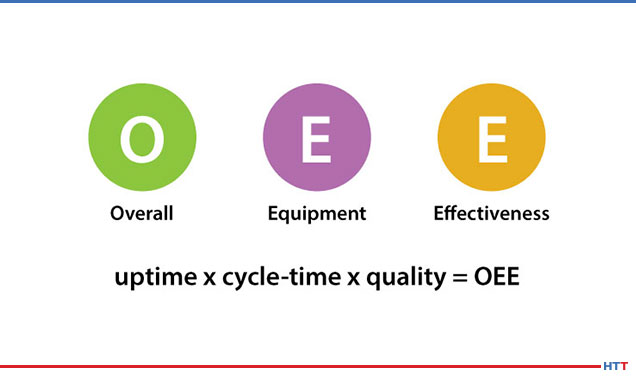
This Week in Heat Treat Social Media


Welcome to the inaugural column of Heat Treat Today‘s first offering of This Week in Heat Treat Social MediaAs you know, there is so much content available on the web that it’s next to impossible to sift through all of the articles and posts that flood our inboxes and notifications on a daily basis. So,  Heat Treat Today is here to bring you the latest in compelling, inspiring, and entertaining heat treat news from the different social media venues that you’ve just got to see and read!

If you have content that everyone has to see, please send the link to editor@heattreattoday.com.    


1. Entropic Time (Backwards Billy Joel Parody) by A Capella Science

Let’s start your Friday off with this energetic, fun, and educational video that Paul Mason of Thermo-Calc Software shared. (And, you’ll be singing the song all day! You’re welcome!)


2. COVID-19

We have all been affected by the COVID-19 virus. It has produced experiences that none of us has ever ventured through before in our lifetime.

This week in the heat treat industry, we’ve received numerous cancellations of spring and early summer trade shows. See how  Austria’s Reed Exhibitions is helping with the healthcare needs of those in Vienna.


Additionally, many of the heat treat companies have shared their statuses and plans for business via social media posts. Here are a few of them:


3. What’s So Cool About Manufacturing?

Check out Abbott Furnace Company’s collaboration with Saint Mary’s Area Middle School to introduce kids to the world of manufacturing.


4. Reading and Podcast Corner

You may have a bit more time to catch up on the reading and podcast listening you’ve been yearning to do. May we recommend two brief articles written by industry experts and an informative podcast.

Check out Gerry McWeeney’s article, “Pros and Cons of Remote Monitoring in Heat Treat”


For those of you interested in medical devices.


And, for your listening pleasure, be sure to download the latest Heat Treat Radio episode entitled, Women in Heat Treat, with Ellen Conway Merrill and Rosanne Brunello.  They will inspire you!


5. Launch into Your Weekend with a Reading by Jackson

No additional caption needed! Happy Friday, everyone!

(Editor’s Note: Users of Firefox may have difficulty playing the below video. If so, please use another browser like Chrome.)


This Week in Heat Treat Social Media Read More »
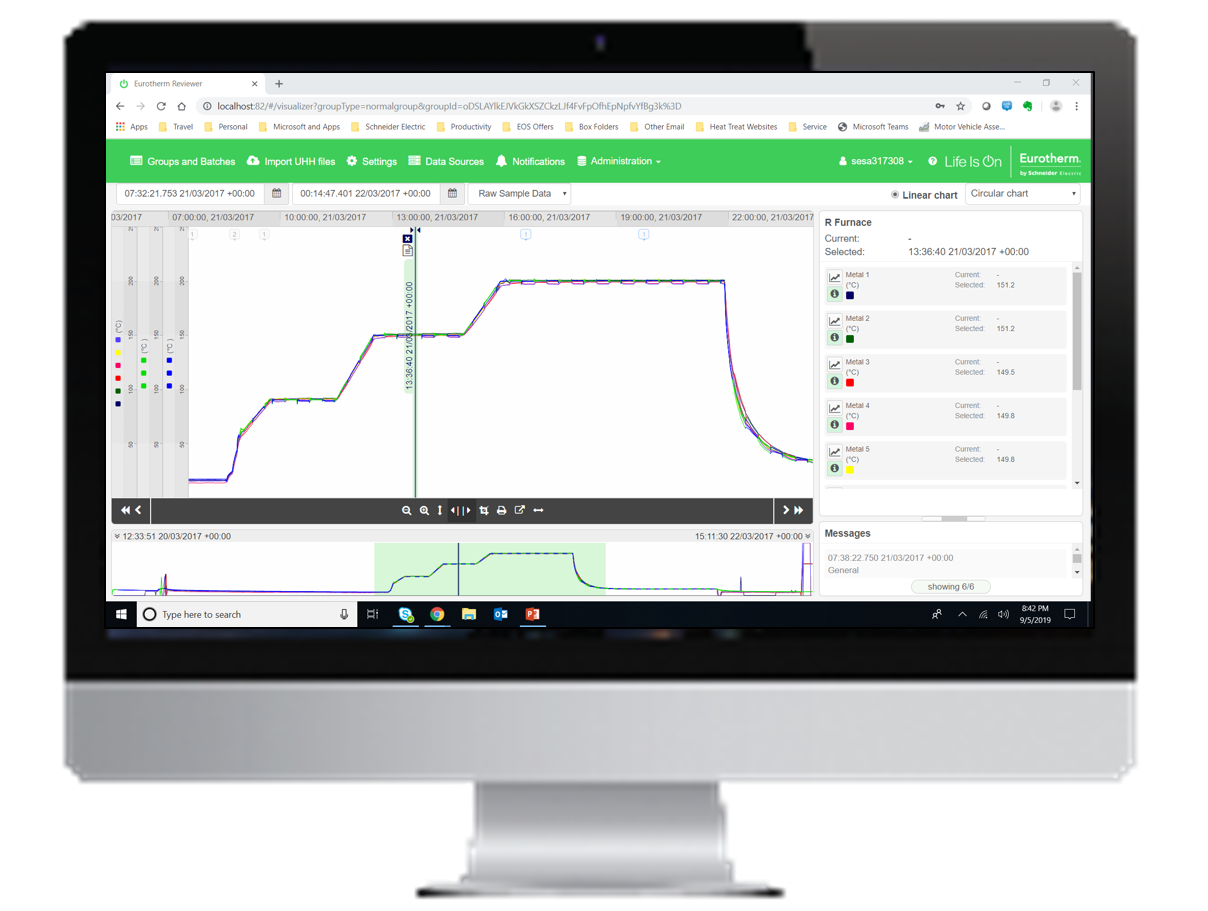
Heat Treat Radio #26: Cutting Edge Trends in Data with Peter Sherwin, Eurotherm by Schneider Electric

Welcome to another episode of Heat Treat Radio, a periodic podcast where Heat Treat Radio host, Doug Glenn, discusses cutting-edge topics with industry-leading personalities. Below, you can either listen to the podcast by clicking on the audio play button, or you can read an edited version of the transcript. To see a complete list of other Heat Treat Radio episodes, click here.


Audio: Cutting Edge Trends in Data: Peter Sherwin, Eurotherm by Schneider Electric

In this conversation, Heat Treat Radio host, Doug Glenn, discusses future trends in data with Peter Sherwin of Eurotherm by Schneider Electric. Learn more about coming trends in data collection, including bringing current technology to the heat treat world and cybersecurity.

Click the play button below to listen.


Transcript: Cutting Edge Trends in Data: Peter Sherwin, Eurotherm by Schneider Electric

The following transcript has been edited for your reading enjoyment.

DG (Doug Glenn):  Data topics are not new to Heat Treat Radio.  We’ve had multiple podcasts where we’ve talked specifically about data collection, data use, and data reporting. Jim Oakes, for example, from Super Systems Inc., spoke to us back in January of 2019 about heat treating data. Nathan Smith from C3 Data also spoke to Heat Treat Radio in September of 2018 about data and, more recently, George Smith and Daniel Graham from SBS Corporation spoke to Heat Treat Radio about heat treat data.  There were several other interviews that we did that hit on data even though it wasn’t the main topic of the interview.  You can access all of these previous episodes of Heat Treat Radio by Googling or Binging Heat Treat Radio, or by entering www.heattreattoday.com/radio into your browser.  Today, however, we’re going to discuss future trends in data.  Let’s jump into the interview with Peter Sherwin.

We are here today with Peter Sherwin from Eurotherm by Schneider Electric. Peter and I have known each other for a number of years, and he is one of my go-to guys for the latest in technology and advancements and trends in the heat treat industry, especially when it comes to data or process control, power control, temperature control and that type of thing.  We want to talk about trends. Since we’re at the beginning of 2020, I thought we would spend some time with Peter talking about some trends and things of that sort. We have a couple of preliminaries to get out of the way though.  First off, you are with Eurotherm by Schneider Electric.  If you don’t mind, elevator pitch about Eurotherm and Schneider Electric and let us know what they do.  Then I would like for you to brag about yourself for a moment and tell us a little about your background.  Let’s start with Eurotherm first.

Global Business Development Manager for Heat Treat, Eurotherm by Schneider Electric

PS (Peter Sherwin):  Eurotherm is now, for nearly 5 years, part of Schneider Electric whose overarching theme is energy and automation solutions.  As far as Eurotherm, we specialize in precision temperature power and process control as well as data management solutions, particularly impacting things like operational efficiency of the heat treat plant and reducing the cost of complying to regulations.  That’s really what we aim for.

From a personal view and background, to have an open conversation, these are my views.  They may or may not be backed up by the views of Eurotherm and Schneider Electric, but it just gives me a bit of freedom to talk openly.

I’ve been with the industry for the past 30 years.  I started in a captive heat treater called Reynold Chain in the UK and through my career have worked for different captive as well as commercial heat treaters and even a furnace OEM.  But for just over 11 years, I’ve been working for Eurotherm.  We are a supplier to the heat treat industry, and heat treatment is one of our key verticals and actually our largest vertical business within Eurotherm.  Currently, I run that vertical globally, so I am very fortunate to have the opportunity to see heat treatment from different aspects across different cultures and regions.

DG:  You are global.  We should, in fact, say that your title is a global business development manager for heat treat.  So you are ‘knee deep’ if not ‘waist deep’ in heat treat pretty much around the clock.

PS:  I am.  That’s my vertical.  That’s my background.  I grew up as a trained metallurgist and have taken that forward in my career.  I still practice that now and again, so it’s very useful to have that background.

DG:  You are global, in the true sense of the word, because before we turned on the record button, you were telling me about your upcoming trips to India, Thailand and wherever, so you’re out and about and do see a lot of things.  For our listeners edification, your perspective, because you’re not just looking at the North American market, you can speak to some global trends and things of that sort which will certainly be impactful.

So, you and I ran into each other last at the ASM heat treat show in Detroit in October of 2019, just a few months ago, and you were gracious enough to have myself and a couple of our Heat Treat Today staff people over to talk about some of the latest things Eurotherm is doing.  I would like to start by asking you about those things.  Talk about some of that stuff that’s going on and then we can dig deeper into some of the trends as we go forward.  Tell us about what Eurotherm is, in fact, doing with some of the data acquisition and whatnot.

For more Heat Treat Radio, click image above

PS:  It’s really expanding from the base of having devices that can capture data, whether its a PID controller or a data recorder, and then being able to do more with that information to really have an impact on operational efficiency.  I think we demoed a few different platforms to you.  We have to look more at cyber security these days with any kind of offer, so that’s kind of wrapped into any of the solutions that we provide today.  But we look to predictive maintenance solutions.  I think I demonstrated a health app on one of the machine advisor programs.  We looked at the way that we can now control and manage energy much better with energy SCADA systems and we even had OEM furnace solutions where you could tie in the expertise of an OEM to the end users to give them online access to certain information so they can actually provide better service. And from a shop floor perspective, I think one of the solutions that caught a bit of buzz at the show was the augmented reality solution where you can use a tablet in front of a furnace, hold it up and through the camera you’re actually getting live information about what’s happening on that furnace.  You can actually access documentation directly like electrical diagrams.  It just makes the whole process of being able to maintain and operate a furnace much more efficient.  So just a few of the solutions that we talked about.

DG:  Yes, all very fascinating and very impressive.

Heat Treat Today has done several past podcasts on process controls and trends in data, data acquisition, and things of that sort.  We talked with Jim Oakes from Super Systems, we’ve talked with Nathan Wright from C3 Data, and we’ve even talked with two gentlemen from SBS Corporation, George Smith and Daniel Graham, about some of their systems and all of them had a lot of very interesting things to say.  But historically, a lot of the data collection that has gone on has been specifically for process validation, but I think almost all of these gentlemen, and I think including yourself, I’d like to get your comment on this, they see a lot of data collection now because of the volume of data we can take going beyond process validation. What are your comments about that?

Photo credit: research.samsung.com

PS:  I think it’s quite useful to understand why we collect data for the process and then because of that we can expand it for use in other applications to have an impact on operational efficiency.  Just taking the point about validating the process.  So heat treatment is part of one of the so-called special processes because it has the ability to impact a part’s physical integrity and induce stresses within a component. And it’s in a class of thermal treatments, chemical treatments, and mechanical treatments that can actually do this.  But because you don’t then test after the treatment for those stresses, and because that is more difficult and costly, you have to be very sure about how you process.  So that means that you need qualified personnel, approved equipment, defined procedures and also have some verification of those procedures and the process that the parts have gone through.  At the core of it, it’s very important that you’ve got very good data integrity for just validating the process. One thing at Eurotherm that we’re quite lucky and fortunate about is that we do work in other industries. One of the other industries is the life science industry and requiring to work for FDA standards means that you have to follow processes such as ALCOA+. Now, that’s not the company, it’s an acronym about how you actually capture and store and attribute the data to make sure that you’ve got that level of integrity throughout the process of data management. It’s something that with certain key clients we go a little bit deeper than the AMS 2750 standard or the CQI9, as far as being able to catch full audit trails to ensure that you’ve got that good data capture. If you’ve got that good data capture, you can then move forward with that to be able to use it for other areas, and that is where we get into operational efficiency and also having an impact on quality.  From my perspective, I’ve been with the industry for the last 30 years and I’ve seen this trend.  Thirty years ago, it was very much operator heavy.  You could be one on one with an operator and a machine and the machines were either manual or semi-automated; they were not full automated like the furnaces that we’ve got today.  So there was a lot of training of operators and different skill levels that you needed back in, say, the 90’s.  As time has moved on, those processes have become more automated and they have operators running multiple machines.  For them to be able to do that, we’ve got to present information in a way where if they’ve only got a few seconds or a few minutes at a furnace, they can really pick up the detail of what’s happening.  That’s where we start to get into operational efficiency to effect how we use labor within a heat treatment department.

The other interesting trend as we’ve moved through the decades has been the development of regulations such as AMS 2750 and CQI9. There have been more requirements for tests and task tracking. We’ve actually needed additional QA personnel or resource to counter that requirement and make sure that we comply with those regulations. And that’s also for some technology solutions. I think that’s what Nate was talking about in his podcast about his platform trying to reduce the cost of compliance regulations. And we do the same.

DG:  Regarding standards, what do you see coming in the near future for the heat treat market? What’s relevant?

PS:  Relevant for the heat treaters today is what’s coming this year with the update of the standards of AMS 2750 that will go to F version, due sometime in the summer, and also CQI9 issue 4.  That will come earlier, maybe just after the first quarter.  Obviously, we look at these standards.  We have a number of people that are on the ballot or have some involvement with the standards, and the feedback is this move from being in a paper environment to paperless.  Electronic records is going to be big for both of those standards.  They are going to give heat treaters some time to actually move if they do currently still use paper.  But ultimately, over the next 2 or 3 years, you’ll see pretty much all heat treaters using electronic records and digital paperless systems because that’s the requirement of the standards.

DG:  Maybe jump into a little bit more of the operational efficiencies.  Is there anything more that we can say about that?  Are there any trends that you’re seeing on how data and data management is going to help us with operational efficiencies?

PS:  Quite an interesting trend with a subject called Overall Equipment Effectiveness (OEE).  This is a KPI (key performance indicator). I don’t think it’s widespread currently within the heat treatment industry, but I see it in pockets when I travel around the world.  OEE is made up of three components, the first being up-time (the the availability of the furnace), second component being the cycle time, so where are you against the design performance that you might have got from the furnace OEM for how fast and well that cycle should run.  And the third component is quality-how many parts do you get through right first time without needing to go back through any rework or even get into rejects.  So now there is a bit of a push of, ok, so how can we use technology solutions to help companies improve their OEE?  It used to be just on the manufacturing floor, but it’s now migrating a bit more to the heat treatment department, so this is something that we’ve looked at what we can do.  We’re fortunate to be part of the larger Schneider Electric and we can rely on some of their resources and we’ve been able to tap into platforms that already offer OEE type solutions.  So that is something that we’re seeing as a trend and something that we have solutions for, and I think it’s going to be a topic for this year.

DG:  You mentioned OEE, up-time, cycle-time, and quality. I assume that built into that also is equipment utilization, right? It’s not just that the equipment is up (as in not broken down), but also in use, correct? Are we minimizing the gap times between loads, assuming it’s a batch system?

PS: Yes. It’s actually quite specific on up-time. It ignores plant maintenance because it kind of says, you have to do that to have a good running department, but it does concentrate on maybe three areas. Furnace breakdowns, so if you have something unexpected that happens.  It also looks at waiting times, and that can be split into waiting times from a labor perspective, have you got the resources to actually run the furnace, or are you getting gaps because of that?  And it could be fixtures or parts, so what you’re going to load into the furnace, are all of those ready, or are you waiting on those because you’re waiting on your customer or are you waiting on a pre-process?   So, yes, it looks at all of those areas and identifies where those gaps are.  It shows you where you’re getting trends, maybe a trend from one shift to another, so you can actually look at taking action to resolve that because it’s very valuable, the up-time of a furnace.

DG: Let’s talk about AI, analytics, machine learning and impact on things like preventative maintenance and, to a certain extent, this effects operational efficiency as well because we’re talking up-time on equipment. What are you hearing? What are you seeing?

PS: I capture a lot of this in the bubble of IoT and Industry 4.0 solutions. There are a lot of buzz words out there. There is a lot of hype, I think, over the past few years. Now some of that hype is starting to manifest itself into real solutions, but I think those have really only come out over the past couple of years. So what we do in this space is we have some predictive maintenance solutions that include a health application. Pretty much out of the box, you have data coming into an algorithm and it gives you information about the health of that particular asset. You can track that over time and so it can give you an indication of when you’re starting to get a problem, it may be on a component level on a furnace, or it may be across the entire furnace itself, but it gives you some kind of prediction so you can take action before something fails. If I go back a year or so, you kind of had to build discrete models to make this happen, and the result was as good as the model that you built. I think those have improved and they’re a bit more user friendly. And this is just going to improve over time. So I think predictive maintenance is going to be a topic that we’ll start to see having an effect this year and, as time goes on, the value of that will just increase.

DG:  I know there are several different furnace and/or induction equipment companies in the industry that already have preventative, predictive maintenance programs out there.  Do you think that’s going to continue to grow?  Are we going to see more and more of that?

PS: Yes, without a doubt. And, in fact, one of the packages that we put together allows an OEM to provide those services to their end users. You’ve got different tiers of OEM that some can afford to invest, which is quite a substantial amount in actually providing these types of solutions. Others, not so much. There are platforms now out there that enable all OEMs to kind of jump on the bandwagon of predictive maintenance and be able to offer those remote services.

One of the areas that will come out this year, just to give you a sneak peak of it, is based on the augmented reality aspect.  We already have an augmented reality solution.  We work with a number of OEMs with that, but the technology has evolved to the extent [that] you can pick up a tablet, hold it up against the furnace, and [it] give[s] you valuable information about the running characteristics of that furnace.  You can pick documentation up and electrical drawings, all from that tablet, all live. But what we will be able to do in 2020 is also get a remote view from an OEM actually dialing directly into that tablet and seeing what that person on the shop floor is actually seeing in front of them and being able to give them far better advice and better direction in case they’re trying to sort out an issue, to hopefully resolve that issue in a much faster time as well as cut down the cost of traveling all the time to site.

DG:  Your interaction with the furnace manufacturers and/or induction equipment manufacturers, in fact you cooperate with them to help provide these systems to their end users as well.

PS:  It is because of this other trend that we’ve seen with the workforce, particularly in North America.   You’ve got quite a large set of baby boomers that have been retiring over the past few years and that is coming to an end, and then you’ve got millennials coming in with completely different skills.  They are very tech-savvy, so some of these new solutions that we’re offering, they can get on board and get up to speed very quickly, but they lack the experience that the baby boomers have had because some of the guys and girls in the industry have been working for like 30, maybe even 40 years.  They’ve amassed all of this experience and certainly that can potentially go out the business.  So we’re using some of this technology to take hold of some of that expertise and augment the knowledge that the younger engineers have so that they can get up to speed a lot quicker.

DG: The younger generation are much more comfortable with a smartphone than a furnace, but if you can put some of that knowledge about the furnace on that smartphone, voila, you’ve got yourself a more quickly trained younger generation.

PS: The side effect of that is also having modern technology within a furnace department, you can start to then attract some of these younger engineers.  Because if you don’t have that, there are opportunities for them elsewhere in different industries and higher technology.  So we’re all competing for a limited labor pool, and updating the technology is going to have an impact on you being able to employ people a lot easier.

DG: We did a Heat Treat Radio interview with the CEO of the Inductotherm Group, a gentleman by the name of Gary Doyan.  I asked him this same question.  I said, “So is all the hype about Industry 4.0, is it true?” I think that the issue he got to was, just because you can collect the data doesn’t mean you ought to collect the data.  That brings me to the question: There is so much data out there; what do we do with it?  Just because we can collect it, should we?  And what are we going to do with all the data?  How do we assimilate it?  How do we make sense out of it?

Digital Dashboards (Photo Credit: Eurotherm)

PS: Let me rewind the clock a little bit to when I first started in the industry and you had manual process cards.  Not a lot of paper chart recorders around, and those that were around were probably just logging the temperature rather than any other data point.  That has really changed.  From the 2000s onward, you’ve had paperless charts within the industry, SCADA systems, a lot of information.  So you’ve gone from this scarcity of data to data overload.  As you’re trying to do more and more with operational efficiency, we’re just getting more and more data points.  We’re fortunate, in a way, and I think Jim mentioned this on his call, that with the PLCs, etc., and the other devices we have on the shop floor, we’re collecting that data anyway.  So it’s not so much the issue about capturing data, it’s been about we’ve got this massive data, we’ve got this potential overload, we don’t have the time, resources, and even sometimes the expertise to make sense of all of this information, so where do we go from here?  I think this is another trend that we’re seeing. It developed in 2019, and it’s going to continue — the use of dashboards. I believe Nate touched on this as well in his interview. If you can collect that information and collate it and put it into a format that is just easy to understand and quick to get a view about what’s happening, what’s happened, what’s the direction, you can make better and quicker decisions.  We see dashboards and dashboarding as a trend that’s going to just explode, as far as in the heat treatment department because you need to be able to provide that information in a better way. An example of that is what we discussed about OEE. OEE comes with its own dashboard to give you a quick view about what’s happening across your process. That’s another trend for 2020.

Digital Dashboards
(Photo Credit: Eurotherm)

DG: Yes. Actually making sense of the data in bite size, quick pictures. Two more questions. I always have to ask this because I think everybody wants to know about it: cyber security. A lot of these systems that we’re talking about are either cloud-based or they have some vulnerability to outside intrusion. Can you talk a bit about any type of trends you’re seeing in cyber security?

PS: This is interesting. I started looking at all the IIOT and Industry 4.0 stuff back in 2013 and the trend for 2013–2018 was ‘what’s possible?’ What’s possible with the cloud, and with these edge devices, etc.?  The last two years, you’ve then moved into ‘what’s practical?’ Because we’ve seen a lot of these cyber security issues, even within our own industry, where you’ve had furnace OEMs and end users get involved with ransomware situations, not necessarily directed at the process control layer, but more targeted to ERP systems, etc., and you could get these potential viruses through USB connections, emails coming in where you click on one of those emails and then you open up this door for hackers to come through. So it has certainly become more of an issue. We were quite early in looking at this from an industrial product point of view, and we looked at starting to harden devices to enable them to withstand cyber security attacks. The latest range of controllers, the EPC3000 range, have a level of cyber security built in. They meet what’s called an Achilles Level One standard. We are also looking, even with our legacy products, to improve their cyber security requirements and try to meet some of the requirements from this international standard IEC62443. That is being built up to try and improve the safety, availability, integrity, and confidentiality of all of the components and systems that you’ve got within your plant. We, as well as Schneider Electric, have followed that, and it’s interesting to see the resource requirements that have gone from pretty much when we’re dealing with products in the past, there was very little talked about or even planned with cyber security, to it now being the number one. This leads everything. We have to have our software development life cycle start with cyber security. So, yes, it’s accelerated and it’s right. If you open up these ports for people to come in, it can work both ways. Obviously, you’re pushing information out, you can spread information across the plant, everyone gets to know what’s going on, but you can then have other people coming in that you don’t want. You’ve got to be a little bit more careful.

Very simple things I would promote to any heat treater today, and that is start looking at manage switchers and firewalls for your operation. We do have white pages on this that actually go through some of the rudimentary things that you should do from a cyber security perspective. I’m happy for people to contact me or maybe we can give you something, Doug, that you can put up on your website so they can just access it.

Eurotherm White PaperEditor’s Note: Click on “White Paper” image to be linked to the white paper referred to in this section.

DG:  Yes, that would be good to do.  We could at least put a link over to your site so people can look at those white papers. I think that would be helpful.

I’ve got a final question for you, and it’s regarding your average every day heat treater, manufacturer of some product, aerospace, automotive or whatever, who has his own in-house heat treat shop.  Let’s say they’re not doing a lot right now with IIOT, how would they get started?  What would be your suggestion on how to get rolling on using data more effectively, if you will?

[alert color=”green” icon=”fa-check”]Click here to be linked to the heat treat section of Eurotherm’s website.[/alert]

PS: There’s got to be a purpose, and that purpose usually is to have an effect on, say, something like operational efficiency.  Trying to assess where they are now and where they want to get to and using something like overall equipment effectiveness, it is down to a KPI so you can get a percentage.  You’ve got people that are world class that are like 85%, so the average is around 60%, and you’ve got some laggers that are around 40% as far as OEE. So getting that benchmark of where you are, getting an aspiration of where you want to be, and then contact anyone, like an instrument supplier that is touching on the IIOT world, like Eurotherm or others that are out there to help you on that journey.  There is a lot of support.  There are a lot of offers out there now that have all come up over the last couple of years.  So don’t hesitate to reach out.  There are people that know about this stuff and that can help, and they do want to sell it to you! Don’t be afraid of picking up the phone or sending an email because people are out there to support you. If the heat treat business as a whole improves, then everyone improves. That should be how people focus on things.

Doug Glenn, Publisher, Heat Treat Today
Doug Glenn, Heat Treat Today publisher and Heat Treat Radio host.


To listen to more Heat Treat Radio episodes, click here.

Heat Treat Radio #26: Cutting Edge Trends in Data with Peter Sherwin, Eurotherm by Schneider Electric Read More »
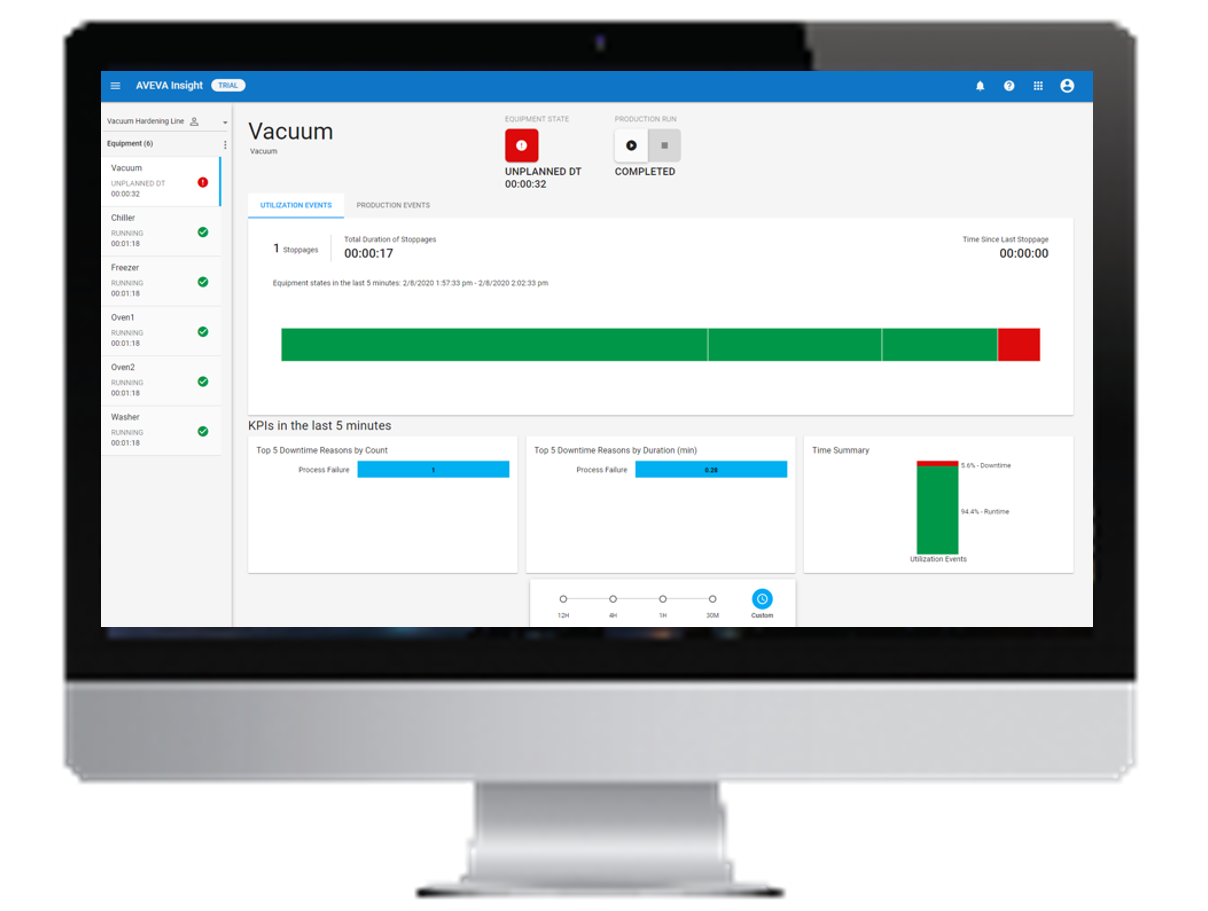
Heat Treat Radio #25: A Discussion with David Wolff, Nel Hydrogen, Part 2


Welcome to another episode of Heat Treat Radio, a periodic podcast where Heat Treat Radio host, Doug Glenn, discusses cutting-edge topics with industry-leading personalities. Below, you can either listen to the podcast by clicking on the audio play button, or you can read an edited version of the transcript. To see a complete list of other Heat Treat Radio episodes, click here.


Audio: A Discussion with David Wolff, Nel Hydrogen, Part 2

In this episode, Heat Treat Radio host, Doug Glenn, continues his conversation with Nel Hydrogen Heat Treat Manager David Wolff about the use of hydrogen in heat treat processes.  Listen to this second part of a two part conversation to find out more about the various delivery systems available, the economics of using hydrogen, and whether using hydrogen might make sense for your specific heat treat application. If you missed Part 1 of the series, click here.

Click the play button below to listen.


Transcript: A Discussion with David Wolff, Nel Hydrogen, Part 2

The following transcript has been edited for your reading enjoyment.

This Heat Treat Radio episode/transcript is based on the e-book shown above. Click on the image above if you'd like to get your own download of this 18-page e-book.

Doug Glenn (DG): Welcome to part two of this 2-part series on the use of hydrogen in heat treat processes. Today we are wrapping up a conversation we started last time with David Wolff of Nel Hydrogen.  This 2-part series is based on the content of an eBook recently published by Heat Treat Today in cooperation with Nel Hydrogen entitled “Hydrogen Generation and its Benefits for Heat Treaters.”

In part one, we discussed some hydrogen fundamentals.  Things like what purpose hydrogen plays in the heat treat process. We hit on safety issues, the processes where hydrogen is typically used, and other atmosphere generation systems and how they compare to hydrogen, as well as several other hydrogen basics.  In this episode we're going to dig deeper into several topics, including the various delivery systems available, the economics of using hydrogen, and whether or not using hydrogen might make sense for your specific heat treat application.

We're going to get back to our discussion with David Wolff of Nel Hydrogen.  Remember, this is part 2.  If you'd like to read the transcript or listen to part 1, click here. Now back to the interview.

DG:  Let's talk about typical modes of delivery for hydrogen. My understanding is we're talking about bulk delivery from some of your gas companies, generated hydrogen, which, as you mentioned, could be endo or exo, that does produce some percentage of hydrogen, but then also we've got a product that you guys are offering, which is a hydrogen generator.  Let's talk about those delivery methods just briefly, maybe summarize them, their advantages/disadvantages, etc.

Delivered atmosphere options

David Wolff (DW):  While nitrogen and argon, the diluent gases are available anywhere on earth because they are components in the air, hydrogen is only available by generating it from a hydrogen containing material, such as methane or from water. Delivered hydrogen needs to come from a hydrogen plant that may be hundreds of miles away from any particular customer.  In most cases, if you're buying hydrogen, say from an industrial gas provider, that hydrogen has come from a plant where it's made, cleaned, and then packaged or processed in a way for efficient delivery.  It might be liquefied or it might be compressed and then it's trucked to thermal processing customers for storage and subsequent use.  Your delivered hydrogen is coming from some chemical or other facility, which may be quite far away.

As you mentioned, Doug, the two historically significant sources of generated, what I will call “blended atmospheres,” typically fall under the name "generated atmospheres," and I'll group endo and exo together because they're really made in a very similar way, and then dissociated ammonia.  Endo and exo are made by thermally cracking natural gas, which is primarily methane, and endo and exo describe two very similar processes for making an atmosphere which consists of hydrogen, water, carbon monoxide, and carbon dioxide.  The ratios of those gases differ whether you're using endo or exo gas, but both gases contain all four-hydrogen, water, CO2, and CO.  As long as your process can utilize all four of those gases, then endo and exo are quite economical, particularly today when methane or natural gas is so cheap.  You don't have to be that old to remember that natural gas at one time was not so cheap. I remember not so long ago where natural gas was about five times what it costs today. There was a period of time when endo and exo were not attractive in industry because of the cost.

Now ammonia dissociation or DA (dissociated ammonia) has a popular and cost-effective technique for generating a kind of general use furnace atmosphere where you store ammonia and then you use a heated catalytic reactor to crack that ammonia into a gas which is 75% hydrogen balance nitrogen.  DA has been used for many, many decades, and in fact there are many methods which have standardized on DA.  It is still popular.  The challenge with DA is it requires the storage of ammonia, and ammonia is ever more unwelcome in communities because if it leaks, it creates a hazardous material response incident.

DG:  You've got storage issues there.  It's very obvious when ammonia leaks, you can tell with your nose, it is a harmful gas, so you've got to be very careful with the storage of it.  That is the point.

DW:  And there is one other issue, and that is if you're using DA, you can't get pure hydrogen.  Because you're starting with a gas which is 25% nitrogen, so no matter how much you dilute it by adding pure hydrogen, it is still going to have nitrogen in it.  If you want pure hydrogen for the ultimate in flexibility, it can be helpful to generate pure hydrogen.

The final thing you asked me to talk about was the equipment that Nel Hydrogen provides, which is electrolytic on-site generation of pure hydrogen.  That has become newly attractive because we've managed to reduce the capital cost of electrolysis equipment and we've managed to improve the energy efficiency, the hydrogen production versus the electricity used.  And in an environment where it is harder and harder to store hazardous materials like ammonia or pure hydrogen, it is interesting and attractive to be able to make cost-effective, process pressure, dry, pure hydrogen which you can then custom blend into whatever diluent gas you want, whether it's nitrogen or argon, in the exact ratio needed for your parts.

Atmosphere generation systems

DG:  Exactly, because you're talking about the endo or exo, you've got a range there of how much hydrogen, or what percentage of hydrogen you can have, whether you run it rich or lean, and things of that sort. With DA (dissociated ammonia),  your looking at 75% hydrogen/25% nitrogen, basically very little deviation from that. With a system where you are on-site hydrogen generating, you can dilute it at whatever percentage tickles your fancy.

DW:  Exactly. And by definition, the metallurgist will assist you to run the most dilute mixture that meets your metallurgical needs. Because that's how you save the most money, by diluting the hydrogen as much as the metallurgy will allow.

DG:  Very briefly, for those who might not know, tell us about the technology inside of your equipment, the proton exchange membrane and things of that sort.  Explain how it works, and then I'd like to ask you what kind of capacities can these systems that you supply, how many CFH or however you measure it, how much can you produce for a process.

DW:  It is easy to explain because we've all done it in high school chemistry.  Virtually every person among us, in high school chemistry, has used a direct current from a battery and two electrodes to crack water with an acid or base in it to make hydrogen and oxygen bubbles.  We're doing exactly the same thing, but we're doing it on an industrial level.  Our equipment uses an electrolyte, which is made by Dupont, to enable us to crack water into hydrogen and oxygen and maintain the two gases on two different sides of a solid membrane.  That has important safety advantages because the hydrogen and oxygen can never mix. We make very pure hydrogen.  The only impurity in that hydrogen is water.  As manufactured in our equipment, the hydrogen is wet with water.  The only purification that we do to that hydrogen is we dry it.  And we dry it to the specification for industrial grade either gas or liquid hydrogen.  In essence, it is a replacement for gaseous compressed, or liquefied hydrogen, that you might have delivered to your facility.

The raw materials that we require are simply electricity and de-ionized water, and we require also cooling water for some of our larger scale equipment.

DG:  The contention is that there are some real potential benefits to some heat treaters by having on-site hydrogen generation.  What are the advantages and then, are there some heat treaters who shouldn't even consider using hydrogen?

Stored atmosphere raw materials by the numbers

DW:  Getting rid of the need for on-site hazardous material storage is a huge benefit.  That is a major benefit- zero hazardous materials inventory.  Cost predictability is often even more important than having the lowest absolute cost at any point in time.  With hydrogen generation, most of the cost is in the capital and in the electricity that you use to drive the equipment.  So cost predictability is much better, for example, than with ammonia, natural gas, or with delivered hydrogen.

On-site electrolytic hydrogen generation makes pure hydrogen as compared with exo, endo, or DA.  And the hydrogen that you're using is very, very pure.  It is 99.9995% or better, so it's the equivalent of very, very pure delivered hydrogen.  We provide very dry hydrogen.  One of the drawbacks to the generated hydrogen in exo, endo, and DA is that those gases are not as dry, so you often need a higher hydrogen level in order to achieve similar scavenging of oxygen.  People find, for example, when they replace DA with generated hydrogen and nitrogen, they can often use a more dilute blend.  So rather than having to use 75/25, they might be able to use 50/50, saving money.

Finally, the generated hydrogen from Nel equipment is available at considerable pressure, 200 to as high as 435 Psi.  That makes it easier to use a pressure-based blender to selectively blend hydrogen and nitrogen to your desired furnace atmosphere blend.

DG:  How big are these systems?

DW:  We have equipment anywhere from 4 cubic feet an hour of pure hydrogen up to 19,000 cubic feet/hour of pure hydrogen.  The cost of the equipment goes up as you get bigger.  I think the 'sweet spot' for generated hydrogen is probably not to try to compete with the largest endo and exo facilities.  I think a thermal processor might choose to utilize a generated hydrogen for those materials and processes that require pure hydrogen or a purity of atmosphere unattainable with endo or exo.

Endo and exo are really good technologies and especially today with inexpensive natural gas.  If you can use those, God bless you, use them.  But if today you're using DA or you're using delivered hydrogen, then I think you might find it very worthwhile to choose a hydrogen generator which might have a capacity of 200 or 400 or 1000 cubic feet an hour for your process.  And, in doing so, you might find that, as compared with certainly DA, you can use a leaner blend and save money as well as get better process results.

DG:  What are the maintenance issues that we're seeing with on-site generation equipment?

DW:  There are two types of normal maintenance required.  All of our equipment is designed with internal flammable gas detectors.  That's important from a safety point of view.  That protects you from any leaks within the equipment, it also protects the facility if there was any flammable gas in the facility atmosphere, the hydrogen generator would shut down.  Those internal flammable gas detectors need to be calibrated once every 3 months.  The nice thing is that it only takes 15 minutes, but it is a planned, required maintenance operation that must take place every 3 months and takes 15 minutes.  And of course, we train you how to do that.

In terms of schedule maintenance of a more involved type, our equipment is designed to be maintained once per year.  Again, we train our customers to do that, or we can offer to come in and do it ourselves.  It is a kind of maintenance that is very straightforward and can be done by a mechanical or electrical technician.  It includes replacing parts, such as the water pump, that have a defined life-time.  And we recommend that those parts be replaced on a proactive point of view in order to eliminate nuisance failures.  For example, a water pump might last 3 years or 25,000 hours, for example.  And really, that's it.  Like any process equipment, you can have failures and we have set up a robust service capability so that we can diagnose and get people parts as quickly as possible so that they can keep their equipment running with the highest on-stream time possible.  Especially for customers in other countries, we often recommend that they have on-hand a kit of parts that we call 'recommended spares kit', which is a very cost-effective way to have the parts available that we have seen fail in the field, so that they don't have to wait for shipped parts to show up.  As soon as a failure is diagnosed, they can put in the parts and they can be right back on-stream and then we can replace any parts that were taken from the recommended spares kit.

DG:  I next asked Dave to address the economics of the system.  How does on-site hydrogen generation compare to other gas delivery systems?

DW:  In terms of economics, the cost of on-site generated hydrogen is really very straightforward.  It is the capital cost of the equipment, the cost of the electricity and water inputs and the cost of annual maintenance.  The equipment can be a purchase or a lease.  And because you're acquiring the equipment, of course there is an economy of scale to consider.  Small volumes of hydrogen is smaller equipment.  And then, in that case, we find that most people find the generator capital cost for smaller users might be around $2.00/hundred cubic feet.  That is the capital cost of the equipment depreciation.  As the size of the hydrogen generator increases (that would be tube trailer users or liquid hydrogen users), the capital cost of the equipment drops below $1.00/hundred cubic feet.  So as equipment gets bigger, the capital cost per unit of production falls.  Our largest capacity equipment, intended for very large scale manufacturing, which might be used, but might be too large for most thermal processors, has a fixed cost as low as 20 cents/hundred cubic feet.  So you can see there is economy of scale.

Now the energy cost of the hydrogen is most of the variable cost.  Water is almost nothing.  Depending on the specific model of the system chosen, it requires between 15 and 19 kilowatt hours of electricity to make a hundred cubic feet of hydrogen.  Here in the US, in 2018, the US industrial electrical rate was about .07/kilowatt hour average.  So the average in the US in 2018 was 7 cents.  If you multiply that by 15 – 19 kilowatt hours/hundred cubic feet, then you get an electric variable cost of between $1.05 and $1.53/hundred cubic feet.  So you add that variable cost to the fixed.

Your annual maintenance is somewhere between $2,000 and $5,000.  Obviously, that is a bigger hit for the smaller users than your larger users.  Altogether, the cost of hydrogen for on-site water electrolysis in the medium volume range of interest to the thermal processing industry ranges from a high, at the low end of the use, of about $4/hundred to as little as $2/hundred for users of larger volumes, say your liquid hydrogen users.

DG:  Best candidates for on-site generation and then, are there some people who shouldn't?

DW:  The best candidates for on-site hydrogen generation are those for whom the technique, equipment, and product quality, the hydrogen quality, provide competitive advantage.  So very compact equipment, zero hydrogen inventory, very pure hydrogen with relatively low maintenance, highly predictable costs and the ability to blend any hydrogen atmosphere to pure hydrogen down to forming gas, are all advantages of on-site electrolysis hydrogen.

We observe that captive heat treating operations often prioritize the characteristics of on-site hydrogen generation because they see a direct effect on product quality and ease of integrating heat treating processes into their facility.  So they are more interested in- is it safe, is it pure, is it easy to operate than is it the cheapest possible hydrogen.  Because of the capital cost (this equipment is not cheap), the best candidates for on-site hydrogen are going to use the equipment hard.  The closer to 24/7, the less expensive, the capital cost contribution to your cost structure.  So use it hard.

There are a few usage characteristics that argue against on-site hydrogen and similarly would make endo, exo, or DA less attractive.  If you've got a temporary requirement for hydrogen, or a batch process that occurs irregularly or with long time gaps between batches, or you have a portable requirement, or where your actual atmosphere required might still be under development.  In all of those cases, frankly, you'd be better to start out with delivered gases, at least until you understand the requirements of the process and the scheduling for the gas use until you establish a predictable pattern.

Finally, endo, exo, and DA are really good technologies to make a hydrogen containing atmosphere. If the cost of the atmosphere is the most important factor and the safety issues of ammonia storage and CO containing atmospheres are acceptable, and the characteristics of the exo, endo, or DA atmosphere are acceptable to your processes, then those may be a good choice.

Doug Glenn, Publisher, Heat Treat Today
Doug Glenn, Heat Treat Today publisher and Heat Treat Radio host.


End of Part 2.

Part 1 of this two-part series aired on January 30, 2020. To find that episode, click here. To find other episodes, go to www.heattreattoday.com/radio and look in the list of Heat Treat Radio episodes listed.

Heat Treat Radio #25: A Discussion with David Wolff, Nel Hydrogen, Part 2 Read More »

Heat Treat Radio #24: A Discussion with David Wolff, Nel Hydrogen, Part 1


Welcome to another episode of Heat Treat Radio, a periodic podcast where Heat Treat Radio host, Doug Glenn, discusses cutting-edge topics with industry-leading personalities. Below, you can either listen to the podcast by clicking on the audio play button, or you can read an edited version of the transcript. To see a complete list of other Heat Treat Radio episodes, click here.


Audio: A Discussion with David Wolff, Nel Hydrogen, Part 1

In this conversation, Heat Treat Radio host, Doug Glenn, engages Nel Hydrogen Heat Treat Manager David Wolff in a conversation about hydrogen generation and its purposes. Find out more about what hydrogen is best used for, what hydrogen can do for your company, why hydrogen is preferred to nitrogen, and how to safely use it to the best effect.

Click the play button below to listen.


Transcript: A Discussion with David Wolff, Nel Hydrogen, Part 1

The following transcript has been edited for your reading enjoyment.

Doug Glenn (DG):  We're here today with David Wolff from Nel Hydrogen and we're going to be talking a bit about on-site hydrogen generation.  This really has come about because of an eBook that David and one of his colleagues, a gentleman by the name of Chris Van Name, and Heat Treat Today worked on together.  The eBook was based on a presentation that you gave at FNA 2018.

Dave Wolff (DW):  You're correct.  The eBook was based on the FNA (Furnaces North America).  I did an expansion on it for Fabtech 2019.

DG:  I want our readers to know you before we jump into the content of the book.  If you don't mind, Dave, would you just give us your name, rank, serial number, etc.

This Heat Treat Radio episode/transcript is based on the e-book shown above. Click on the image above if you'd like to get your own download this 18-page e-book.

DW:  I've been in the industrial gas industry for my whole career, (hard to believe), going well over 40 years now.  I've been a little over 20 years at Nel Hydrogen.  Before we were called Nel, we were called Proton Onsite.  I joined relatively early in Proton's history.  Proton was begun in order to commercialize attractively cost on-site hydrogen using water electrolysis.  I found that incredibly exciting, as I came from the industrial gas industry, and I witnessed first hand the importance of having cost effective access to hydrogen in order to succeed in materials processing. Prior to Proton, I was with Messer, who is now back in the United States; and I was with Air Products for about 13 years prior to my time with Messer.

DG:  So you've spent, let's say, 40 years in the industrial gases industry and most recently, and a good bulk of that time, with what was called Proton Onsite, now called Nel Hydrogen.  For our reader's sake, Nel in the US is headquartered out of New England?

DW:  Yes.  Nel, in the US is headquartered in Wallingford, Connecticut, which was where Proton was based. Nel's worldwide corporate headquarters is in Norway. Nel is a corporation related to the historical Norsk Hydro, which has been around since 1927 and involved with water electrolysis since the early 20's.

DG: So today we want to talk about hydrogen, but we're going to talk specifically about on-site hydrogen generation. But before

Delivered atmosphere options

we get there, if you don't mind Dave, give us a quick rundown on just the role of hydrogen in your normal, typical heat treat process.  What does hydrogen do for us?

DW: You start with the fact that hydrogen is a reducing gas, which means that it can prevent or even reverse oxidation.  For example, you can put oxidized parts through a hydrogen atmosphere furnace and they'll come out the other end, say if it's a belt furnace, bright and shiny.  At the elevated temperatures used in metal thermal processing (heat treating), the rate of oxidation is increased, so you have to protect the metal so that it doesn't discolor from oxidation. And more concerning, oxidation will interfere with braze material flow in brazing and will prevent proper sintering of powder metal fabricated parts, so oxidation is a real problem in thermal processing.

DG: Right. So the reason of the brazing and whatnot is because of contamination on the surfaces, right? You don't get a solid braze or a solid sinter.

DW: Exactly. Now hydrogen is not the only reducing gas. CO (carbon monoxide) can also be used. But CO is highly toxic, so it is not routinely used, except if it's created incidentally in the process of making endo or exo gas.

Some people wonder why nitrogen alone is not sufficient as a heat treating atmosphere.  It's inert, right?  But it's essentially impossible to flow enough nitrogen through an atmosphere furnace to eliminate all of the oxygen molecules. And if you did try to flow that much nitrogen through the furnace, you would rob all of the heat out of the furnace.  So the attractiveness about hydrogen is it grabs and immobilizes the stray oxygen molecules preventing oxidation but still enables you to manage the flow rate in your furnace.

DG: There are some vacuum furnace heat treaters who place a piece of metal or some substance inside of their furnace (they call it a 'getter'), which basically attracts those undesirable elements out of the atmosphere.  In a sense, hydrogen (not exactly, but in a sense) can be kind of that 'getter' that goes and 'gets,' if you will, the oxygen pulls it out of that atmosphere, where nitrogen you have to be pushing it out.  You'd have to be putting so much nitrogen through, you still might not get rid of all of the oxygen, whereas if you have some hydrogen, it pulls it out.

DW:  You're exactly right.  The hydrogen acts as a chemical 'getter' and so it's analogous.  A couple of other things I should mention.  In addition to its role as a reducing gas to prevent or reverse oxidation, hydrogen has the highest heat conductivity of any gas.  So the high heat conductivity of hydrogen means that parts heat up faster in a hydrogen containing atmosphere, and they cool off faster too.  The high heat conductivity allows for higher productivity by faster cycles in batch heat treating and faster transport speed through continuous furnaces likes belts and pushers.  Parts heat up fast and they cool down quickly.  The alternative, if you have lower hydrogen content in your atmospheres, is longer furnaces, slower belt speeds, or longer back furnace cycles.

DG: Coefficient heat transfer hydrogen is the best for pulling heat out or putting heat in, so you're looking at process efficiencies there as well.

DW: Productivity. One final thing. While vacuum furnaces are widely used and yield terrific results, a vacuum furnace creates an inert atmosphere, not a reducing atmosphere.  So a high vacuum furnace can prevent oxidation, but typically not reverse it. So in many cases, a wisp of hydrogen is often used to create a partial pressure hydrogen atmosphere in vacuum furnaces.  For example, for powder metallurgy, you enhance the sintering by reducing the surface oxidation on the powder particles.

DG: We've hit on what hydrogen can do, and I think we've already hit on this next question, which is the typical heat treat processes. Brazing you've mentioned, sintering you've mentioned; what else would we typically use a hydrogen atmosphere for?

DW: Let's start with making sure that people are aware that hydrogen is used only in furnaces which are designed for hydrogen

Atmosphere generation systems

atmosphere. They have to have the right flow path, they have to have electrical parts and safety systems such as flame curtains, which are expressly designed to safely use hydrogen. Also, and importantly, the newest thermal processing equipment is highly automated for safe use of hydrogen. While hydrogen can be used safely in older equipment that is also designed to use hydrogen, it's important to follow procedures which are specifically designed around hydrogen use. So those are key considerations.

DG: I think we ought to emphasize the caveat that you're issuing. Hydrogen does have its issues, and we need to be careful with the use of hydrogen. So don't just go throw hydrogen into your furnace. It is very, very important that the safety concerns be followed.

DW:  So hydrogen is used to provide atmospheres for processes like annealing, brazing, glass metal sealing and all types of sintering including PM, MIM, and AM. Hydrogen is also widely used for processing magnetic materials, motor laminations and things like that. Keep in mind that both synthetic or blended atmospheres and also generated -- and by "generated" we typically refer to exo, endo and DA (dissociated ammonia) -- those atmospheres contain hydrogen as the primary reducing gas. As I mentioned earlier, exo and endo gas also contain CO, which is also a reducing gas, and exo and endo are often used in atmospheres for hardening. Typically you don't use a pure hydrogen atmosphere for that because that will tend to soften your parts.

DG: We've covered some of the processes that are involved, and you've alluded to this Dave, but let's flesh this out a little bit

Stored atmosphere raw materials by the numbers

more--we don't often use hydrogen alone. Often it is used as one component with other gases. Let's talk about why that is. Besides the obvious safety issues of using 100% hydrogen, let's talk about why we don't see 100% hydrogen and what we're often mixing with.

DW: I like to use an analogy here. Think of hydrogen gas in a furnace atmosphere, kind of like dish washing detergent. When you're washing dishes or processing parts, the function is to clean the parts, either the metal parts or cups and saucers. Dish washing detergent is diluted with water. Hydrogen is typically diluted with nitrogen or possibly with argon. In both cases, whether you're washing dishes or processing metal parts, the detergent is more expensive than the diluent. Hence, the idea is to use only as much detergent (hydrogen) as is needed to get the job done.

There are major differences between thermal processing and washing dishes. One major consideration is that the metal that is being thermally processed is actually chemically and metallurgically interacting with the furnace atmosphere. So you have the surface effect, which is the chemical effect, but also you have a metallurgical effect. That's how metals are softened and also, in the case of carbon, hardened. Obviously dishes are unaffected by the dish washing process other than having their surface cleaned.  So that is part of the reason that atmosphere composition is greatly dependent on the metallurgy of the parts that you're processing. That is also the area where metallurgists have the greatest knowledge and provide unique process knowledge and value.

DG: So basically, you're going to use as little, if you will, or an appropriate portion of hydrogen to get the job done, and that is very much dependent on materials being run, processes being performed, etc. Correct?

DW: Exactly. The workhorse thermal processing atmosphere is a nitrogen atmosphere with a variable amount of hydrogen depending on the metal being processed. Carbon steel, for example, can be processed in a 4–5% hydrogen blend with the balance of the atmosphere being 95–96% nitrogen. This blend is so widely used that it has been given a nickname, so called forming gas. Some metals react adversely with hydrogen and cannot be processed in a hydrogen containing atmosphere at all. An example of that would be titanium. Titanium, which is so widely used for aerospace and also medical applications, is not processed in hydrogen at all, and that is why batch vacuum heat treating is so popular in aerospace and medical because there is a lot of titanium use.

DG: My understanding is that hydrogen causes embrittlement when we're dealing with titanium.

DW: Exactly. It causes damage to titanium parts. Batch processing also enables you to do lot tracking and other things which are important in both aerospace and medical.

Aluminum is another commonly heat treated metal that doesn't require hydrogen.  Aluminum is basically generally heat treated in pure nitrogen.  But other metals that do use hydrogen containing atmosphere include copper and brass, as I mentioned, magnetic steels and stainless steels. Generally, the steels, other than carbon steel, will require an atmosphere in the 30–60% range of hydrogen in nitrogen while certain grades of stainless must be heat treated in 100% hydrogen. Often the 300 series of stainless, people prefer to use 100% hydrogen for that.

Doug Glenn, Publisher, Heat Treat Today
Doug Glenn, Heat Treat Today publisher and Heat Treat Radio host.


End of Part 1.

Part 2 is scheduled to be released on February 13th. Check back here for a link to that episode or go to www.heattreattoday.com/radio after February 13, 2020, and look for Part 2 in the list of Heat Treat Radio episodes listed.

Heat Treat Radio #24: A Discussion with David Wolff, Nel Hydrogen, Part 1 Read More »