Conrad Kacsik Instrument Systems

Vacuum Furnaces: Origin, Theory, and Parts

OC

Vacuum furnaces are widely used in the aerospace and automotive industries. These furnaces are used for multiple processes including brazing, aging, and solution heat treating for countless materials. Typically, vacuum furnaces are utilized to ensure a lack of oxidation/contamination during heat treatment. This article will talk about the origins, theory, and main parts of vacuum technology and how it is used in both aerospace and automotive industries.

This Technical Tuesday feature was written by Jason Schulze, director of technical services at Conrad Kacsik Instrument Systems, Inc., and was first published in Heat Treat Today's December 2022 print edition.


A Brief History

Vacuum furnaces began to be used in the 1930s for annealing and melting titanium sponge materials. Early vacuum furnaces were hot wall vacuum furnaces, not cold wall vacuum furnaces like we use today. Additionally, most early vacuum furnaces did not utilize diffusion pumps.

Vacuum Heat Treat Theory
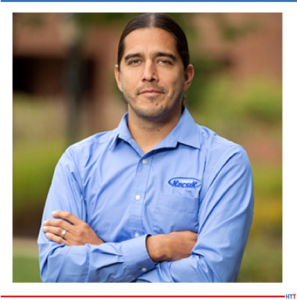
Jason Schulze Director of Technical Services Conrad Kacsik Instrument Systems, Inc.

Vacuum technology includes vacuum pumping systems which enable the vessel to be pulled down to different stages through the process. Degrees of vacuum level are expressed opposite of pressure levels: high vacuum means low pressure. In common usage, the levels shown below in Figure 1 correspond to the recommendations of the American Vacuum Society Standards Committee.

Vacuum level will modify vapor pressure in a given material. The vapor pressure of a material is that pressure exerted at a given temperature when a material is in equilibrium with its own vapor. Vapor pressure is a function of both the material and the temperature. Chromium, at 760 torr, has a vapor pressure of ~4,031°F. At 10¯5, the vapor pressure is ~2,201°F. This may cause potential process challenges when processing certain materials in the furnace. As an example, consider a 4-point temperature uniformity survey processed at 1000°F, 1500°F, 1800°F, and 2250°F. This type of TUS will typically take 6-8 hours and, as the furnace heats up through the test temperatures, vacuum readings will most likely increase to a greater vacuum level. If expendable Type K thermocouples are used, there is a fair chance that, at high readings, you may begin to have test thermocouple failure due to vapor pressure.
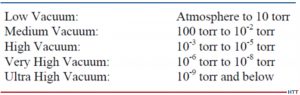
Figure 1. Vacuum levels corresponding to the recommendations of the American Vacuum Society Standards Committee
Source: Jason Schulze, Conrad Kacsik Instrument Systems, Inc.

Vacuum Furnace Pumping System

Vacuum heat treating is designed to eliminate contact between the product being heat treated and oxidizing elements. This is achieved through the elimination of an atmosphere as the vacuum pumps engage and pulls a vacuum on the vessel. Vacuum furnaces have several stages to the pumping system that must work in sequence to achieve the desired vacuum level. In this section we will examine those states as well as potential troubleshooting methods to identify when one or more of those stages contributes to failure in the system.

Vacuum furnaces have several stages to the pumping system that must work in sequence to achieve the desired vacuum level. Each pump within the system has the capability to pull different vacuum levels. These pumps work in conjunction with each other (see Figure 2).
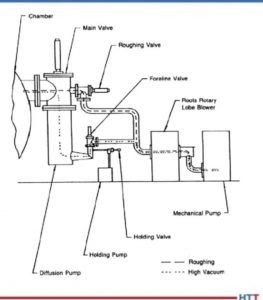
Figure 2. Vacuum pumps work in conjunction with one another
Source: Jason Schulze, Conrad Kacsik Instrument Systems, Inc.

The mechanical pump is the initial stage of vacuum. This pump may pull from 105 to 10. At pressures below 20 torr the efficiency of a mechanical pump begins to decline. This is when the booster pump is initiated.

The booster pump has two double-lobe impellers mounted on parallel shafts which rotate in opposite directions (see Figure 3).
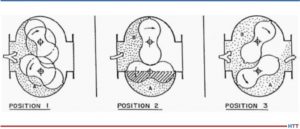
Figure 3. Booster pump positions
Source: Jason Schulze, Conrad Kacsik Instrument Systems, Inc.

The diffusion pump (Figure 4) is activated into the pumping system between 10 and 1 microns. The diffusion pump allows the system to pump down to high vacuum and lower. The diffusion pump has no moving parts.
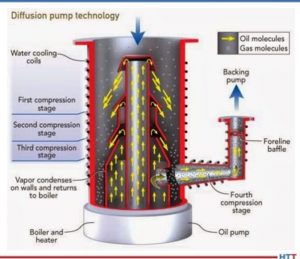
Figure 4. Diffusion Pump
Source: Jason Schulze, Conrad Kacsik Instrument Systems, Inc.

The pump works based on the vaporization of the oil, condensation as it falls, and the trapping and extraction of gas molecules through the pumping system.
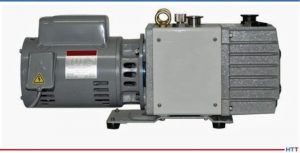
Image 1. Holding Pump
Source: Jason Schulze, Conrad Kacsik Instrument Systems, Inc.

The holding pump (Image 1) creates greater pressure within the fore-line to ensure that, when the crossover valve between the mechanical and diffusion pump is activated, the oil within the diffusion pump will not escape into the vessel.

Vacuum Furnace Hot Zone Design
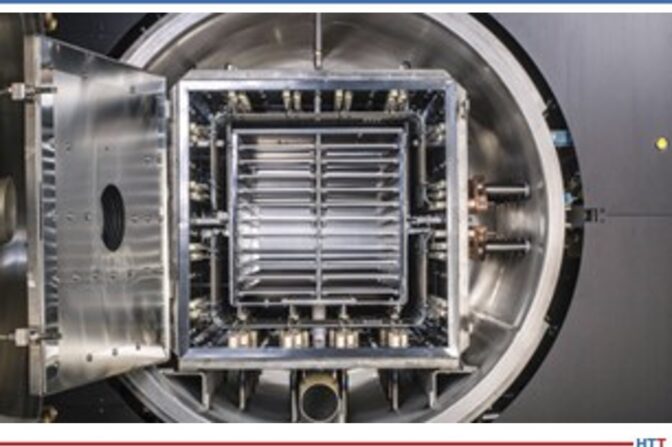
The hot zone within a vacuum furnace is where the heating takes place. The hot zone is simply an insulated chamber that is suspended away from the inner cold wall. Vacuum itself is a good insulator so the space between the cold wall and hot zone ensures the flow of heat from the inside to the outside of the furnace can be reduced. There are two types of vacuum furnace hot zones used: insulated (Image 2) and radiation style (Image 3).

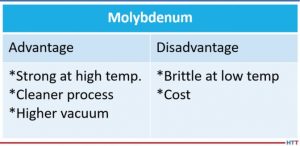
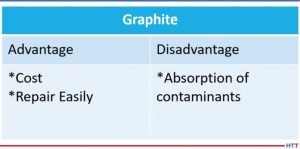
The two most common heat shielding materials are molybdenum and graphite. Both have advantages and disadvantages. Below is a comparison (Tables 1 and 2).

Table 1
Source: Jason Schulze, Conrad Kacsik Instrument Systems, Inc.
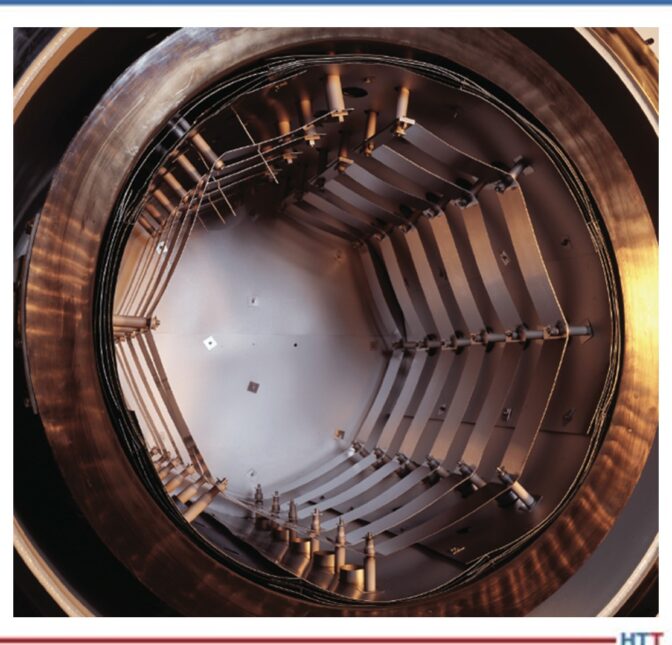
Table 2
Source: Jason Schulze, Conrad Kacsik Instrument Systems, Inc.
Vacuum Furnace Quenching System

Quenching is defined as the rapid cooling of a metal to obtain desired properties. Different alloys may require different quenching rates to achieve the properties required. Vacuum furnaces use inert gas to quench when quenching is required. As the gas passes over the load, it absorbs the heat which then exits the chamber and travels through quenching piping which cools the gas. The cooled gas is then drawn back into the chamber to repeat the process (see Figure 5).
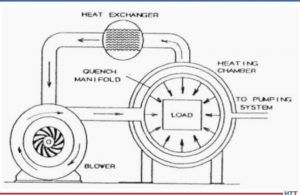
Figure 5.Diagram of gas quenching
Source: Jason Schulze, Conrad Kacsik Instrument Systems, Inc.

Vacuum Furnace Trouble Shooting

In Table 3 are some helpful suggestions with regard to problems processors may have.
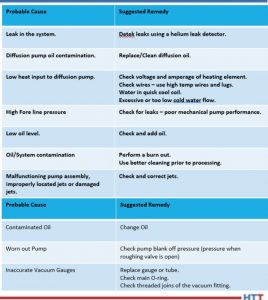
Table 3
Source: Jason Schulze, Conrad Kacsik Instrument Systems, Inc.

Summary

Vacuum furnaces are an essential piece of equipment when materials need to be kept free of contamination. However, there are times when this equipment may not be necessary, and is therefore considered cost prohibitive, although this is something each processor must research. This article is meant to merely touch on vacuum technology and its uses. For additional and more in-depth information regarding vacuum furnaces, I recommend a technical book called Steel Heat Treatment, edited by George E. Totten.

About the Author: Jason Schulze is the director of technical services at Conrad Kacsik Instrument Systems, Inc. As a metallurgical engineer with over 20 years in aerospace, he assists potential and existing Nadcap suppliers in conformance as well as metallurgical consulting. He is contracted by eQuaLearn to teach multiple PRI courses, including pyrometry, RCCA, and Checklists Review for heat treat.

Contact Jason at jschulze@kacsik.com
website: www.kacsik.com


Find heat treating products and services when you search on Heat Treat Buyers Guide.com


Vacuum Furnaces: Origin, Theory, and Parts Read More »

AMS2750F: Expert Analysis

AMS2750F, a rewrite of the specification that covers pyrometric requirements for equipment used for the thermal processing of metallic materials, was released at the end of June. For this Technical Tuesday feature, Heat Treat Today asked a few experts in the aerospace industry to share their insights of this much anticipated revision that helps to better clarify issues with the previous revision. Specifically, Heat Treat Today wanted to know what they perceived to be the top 2-3 most important changes in revision F; what companies should do to prepare for these changes; and additional thoughts about the revision as it relates to aerospace heat treating.

Industry experts who contributed to this Original Content piece are Andrew Bassett, president, Aerospace Testing & Pyrometry, Inc., Jason Schulze, director of Technical Services; Special Process – Metallurgy, Conrad Kacsik Instrument Systems, Inc., Peter Sherwin, Global Business Development manager for Heat Treat, Eurotherm by Schneider Electric, Jim Oakes, president, Super Systems, Inc., and Doug Shuler, lead auditor, owner, Pyro Consulting LLC.


Andrew Bassett was on the subteam for AMS2750F as well as the previous revision AMS2750E and has been a member of AMEC and SAE Committee B since 2006. He shares some “inside baseball” background about this four year process, “The AMS2750F subteam utilized the Nadcap Pyrometry Reference Guide, the Nadcap Heat Treat Audit Advisories that pertained to Pyrometry, and the collective experience from the sub-team which dealt with the previous revision issues and problems. The AMS2750F sub-team had a broad range of backgrounds, with representatives from Boeing, Safran, Arconic, GeoCorp Inc, Nadcap-PRI, and Aerospace Testing & Pyrometry.”

What do you believe to be important changes in revision F?

Jason Schulze, Director of Technical Services; Special Process – Metallurgy, Conrad Kacsik Instrument Systems, Inc.

Jason Schulze comments on offsets saying, “Offsets have often been a confusing subject throughout the years. How they are applied, removed and documented has caused confusion and has been a source of Nadcap findings. With the changes to the offsets section of AMS2750 in the new revision, these issues will be greatly reduced. Offsets have now been split into two categories; correction offsets and modification offsets. It will be important for suppliers to understand and implement the new requirements as well as use the same verbiage as this will hopefully alleviate further confusion.”

Andrew Bassett, President, Aerospace Testing and Pyrometry

Andrew agrees this is an important change regarding the offsets and further clarifies, “A “Modification Offset” is when an instrument is purposely, either through electronic means or manual means, shifts the accuracy away from the nominal temperature. This is typically done to “center a temperature uniformity” that may be skewed in one direction or another. The modification offset, when used properly, will shift the temperature uniformity more towards the set point of the thermal processing equipment. A “Correction Offset” is used to bring the instrument back to the nominal temperature. As always, a well defined procedure will be required on how the “Correction Offset” and “Modification Offset” will be introduced into your system.”

One of the biggest changes that caused a lot of controversy was the restricted re-use of expendable test thermocouples,” Andrew notes. “The AMS2750F subteam provided studies and data that showed that there was considerable drift of certain types of base metals thermocouples, especially when it came to Type “K” thermocouples. The previous revision of AMS-2750 already had restrictions on these types, but after providing data of the drift of these thermocouples, the team felt further restrictions were required for Expendable Base Metal SAT & TUS Sensors. Section 3.1.7.3 describes the limitations of these type thermocouples. Types “M”, “T”, “K” & “E” shall be limited to 3 months or five uses, whichever occurs first between 500F and 1200F (260C and 650C) and is limited to single use above 1200F (650C). Types “J” and “N” shall be limited to 3 months or ten uses, whichever occurs first between 500F and 1200F (260C and 650C) and is limited to single use above 1200F (650C).”

Peter Sherwin, Global Business Development Manager for Heat Treat, Eurotherm by Schneider Electric

Peter Sherwin comments on instrumentation, “From an instrument perspective our no.1 focus is the instrument accuracy specification. This has not changed for Field Test or Control and Recording Instruments (now in Table 7), however the impact of the decimal place for digital recorders could cause some issues for less precise instrumentation. In 3.2.3.1 All control, recording and overtemp instruments shall be digital 2 years after release of AMS2750F – this was not a surprise, and today’s overall cost (paper, pens, storage etc.) of paper chart recorders cannot match their digital counterparts. Digital time synchronization (3.2.3.19) is also sensible to ensure you have an accurate time record across a number of Furnaces/Ovens and charts – we are used to this for other regulations (e.g. FDA 21 CFR Part 11) and offer a SNTP/Time Synchronization feature in our Recorders.”

Jim Oakes, President, Super Systems, Inc.

Jim Oakes shared his pleasure with section 3.2.3.12, “I was happy to see the document address integrated recording/controlling data.  It states in section 3.2.3.12 when the control and recording system is integrated such that the digitally displayed control value and digitally recorded value are generated from the same measurement circuit and cannot be different, it is only necessary to document a single displayed/recorded value for the control reading.  This is happening through direct communications, so what you see on the controller is what you are recording electronically.  This saves a step and eliminates the need for additional documentation.”

Doug Shuler, Lead Auditor, Owner, Pyro Consulting LLC

Doug Shuler cites the auditor advising piece, “The top of the list has to be the overall progress we made by incorporating auditor advisories and pyrometry reference guide FQS into the body of the specification so users don’t have to ask themselves “What did I miss.”

How should companies prepare for these changes?

Jason Schulze’s advice to companies focuses on training, “Companies should receive concise training regarding the revisions within AMS2750F, including administrative and technical. As with any training, continuous courses may be necessary to ensure comprehension. I recommend performing a characteristic accountability for each and every requirement stated within AMS2750F.”

Peter Sherwin encourages companies to ready instrumentation for the standards, “Recent feedback from the MTI indicated that 3rd party audits to the new standard would probably start next year. However, if you are in the market for a new instrument then it only makes sense to ensure this meets the requirements of the updated standard.”

Doug Shuler sees the benefit of analysis, “Users should prepare by performing an internal or perhaps an external gap analysis to establish where their pyrometry system is today, and what has to be changed going forward.  Users don’t have to wait until AMS2750F and AC7102/8 Rev A are released and in effect before making changes.  The key is that if a user has an audit before the revised Nadcap Checklist AC7102/8 Rev A becomes the law of the land, they will have to declare compliance to AMS2750E or AMS2750F in full and will be held to that revision’s requirements.  Once AC7102/8 Rev A takes effect (best guess after January 1, 2021)  all audits will be done to AMS2750F.”

Andrew Bassett recommends, “First and foremost, get a copy of AMS2750F and start the review process. Since the document was a complete re-write, there is no change summary or change bars to point the supplier in the direction of what has changed. Spend time creating a matrix of the previous requirements (AMS2750E) and comparing to the new requirements (AMS2750F). I would suggest breaking this matrix down into four main sections: Thermocouples, Calibrations, System Accuracy Testing, and Temperature Uniformity Surveys. This will allow suppliers to work on each section without getting overwhelmed by the entirety of the specification. Currently at the time of writing this, there is no formal implementation requirement for AMS2750F. Typically this will either be dictated by the suppliers’ customers, or in the case of Nadcap, they will issue a “Supplier Advisory” as to when their expectation for implementation will be.”

Final Thoughts

Planning for the future will serve companies well for the long term encourages Doug Shuler,  “With a number of significant changes, nearing a complete rewrite, now is a good time to take a look at your internal procedures that may have become fragmented over the years and streamline them to the new revision.  Auditing for Nadcap for over 10 years has shown me one thing for sure.  Those companies that have a thermocouple procedure, a calibration procedure, a SAT procedure, an alternate SAT procedure, a TUS procedure, and maybe even multiple TUS procedures for different kinds of furnaces (Air, Vacuum, Atmosphere, etc.)  usually have a more difficult time with audits because the SAT procedure also addresses thermocouples, but doesn’t address correction factors because that’s in the instrument calibration procedure… See where this is going?  Consider writing one pyrometry procedure with sections in it just like the specification.  Then, the SAT section can refer to the thermocouple section for test thermocouples and to the instrument section for test instruments, etc.  It’s like re-writing AMS2750, but customized for your facility, your equipment, and your practices.  In the end, remember that the pyrometry portion of your Nadcap audit follows my P.I.E. acronym.  Procedures that Include all requirements and Evidence to show compliance.”

Paying close attention to the right data solution will alleviate potential headaches when dealing with both the new AMS2750F revision and the CQI9 (V.4 update) says Peter Sherwin, “Many commercial heat treaters will also have to cope with the update to CQI9 Version 4 at the same time! According to the MTI, your ‘end’ customers may request you perform your self-audit to the new standard from this point forward. There is a bit more time allocated to move to digital (3 years), but my advice would be to take advantage of digital solutions sooner rather than later. The right data solution should save you money over time compared to the paper alternative.”

Finally, amidst all the new changes AMS 2750F has offered, Jim Oakes assures, “…the pyrometric requirements that most of us are used to will still be very familiar as this document becomes the new standard.”


(Photo source: pixabay.com)


AMS2750F: Expert Analysis Read More »

Temperature Control System Improves Precision, Efficiency on Heat Treat Equipment: A Case Study

A century-old producer of die forgings recently needed to improve the process controls on its heat treating furnaces.

With process controls well over 10 years old, Clifford-Jacobs turned to Conrad Kacsik to improve its temperature process control system. The company, which serves a number of industries, including energy, aerospace, construction, mining, forestry, and rail, was eager to improve its temperature process control system, particularly because the incumbent system was producing inconsistent work.

The Challenge

Bud Kinney, Vice President of Innovation and Technology at IMT Corporation

Clifford-Jacobs was not getting consistent, repeatable results from its furnaces. The company also wanted more efficient and automated processes with data acquisition and electronic operating capability.

“We looked at a number of controls companies throughout the Midwest and interviewed them to learn about their experience with system controls and data acquisition,” said Bud Kinney, Vice President of Innovation and Technology at IMT Corporation, the parent of Clifford-Jacobs. “We knew we wanted an integrated system so we started looking at companies that did that as a matter of course. Most companies are limited to traditional controls, but Conrad Kacsik has a lot of experience doing the exact type of job we needed.”

Increasing Demands

Clifford-Jacobs makes forged parts for a variety of clients. Although forging does not generally require as much precision as other types of processes, customers are increasingly demanding, said Kinney.

“We believe that sooner rather than later things like Nadcap will come into forging, and our customers are very interested in us being able to demonstrate that our processes are always in control, even forge heating,” Kinney said. “This project helps ensure that we meet those needs. We couldn’t track things like set-point input values before. That’s another element we wanted to manage.”

The System

Retrofitting Clifford-Jacobs heat treating system.

Conrad Kacsik built a full process temperature control system that includes SCADA software from SpecView. They were able to retrofit the system on Clifford-Jacobs’ existing 16 furnaces, saving the company considerable expense and time. The temperature process control system uses Watlow F4T controllers paired with SpecView SCADA software, which allows for programming jobs/recipes, remote operation, secure (password protected) operation of furnaces and accurate automatic temperature recording. Conrad Kacsik also added alert lights that allow the operators to quickly see the status of each furnace from the shop floor.

H2: Benefits of Temperature Control System Integration

Clifford-Jacobs has noted several beneficial results from the new temperature control system. These include:

  • Increased accuracy. The new system runs each recipe exactly and records the results. The company can also control which employees can adjust temperature settings, preventing operators from rushing jobs with a higher temperature or inadvertently setting the furnace incorrectly.
  • Higher efficiency. With preprogramming, each furnace is always at the exact temperature it needs to be for the given task. An automatic preheat setting also safely prepares the furnace for the workday—eliminating downtime or the need to send an employee in early to start the furnaces.
  • More speed. Clifford-Jacobs can pre-program any recipe it needs, allowing for highly accurate and fast running of complex processes.
  • More convenience. Clifford-Jacobs can operate their furnaces from anywhere with an internet connection, or via an iPad used by an approved employee.
  • Precision for the future. The new system can be part of a Nadcap-approved process should the need arise. The SpecView software and advanced controllers automatically record each job and retain all data for verification.

The Results

“We used to have to use all kinds of resources to provide oversight on temperature control,” said Kinney. “This has given us a heating strategy. We write the recipes we want and just select from those. In addition to that, we know exactly what every furnace is doing at all times.”

The company is also pleased with the increased efficiency. They only heat product when they are ready to run production, and the furnace only uses the exact energy needed for each recipe. They are also saving on staffing, as they used to have to schedule people to ensure the furnace was at the right temperature.

“With this system, we can develop recipes for each part we make, which is both convenient and precise. It’s doing exactly what we expected it to do,” said Kinney.

Temperature Control System Improves Precision, Efficiency on Heat Treat Equipment: A Case Study Read More »

Heat Treat Control Panel: Best Practices in Digital Data Collection, Storage, Validation

When processing critical components, heat treaters value and demand precision in every step of the process — from the recipe to data collection — for the sake of accurate performance of the furnace, life expectancy of all equipment, as well as satisfactory delivery of a reliable part for the customer.

So what’s the obstacle to achieving those goals? Gunther Braus of dibalog GmbH/dibalog USA Inc. says, “The general problem is the human.” Indeed, the need to remove the variable of human fallibility plays a significant role in the search and development of equipment that could sense, read, and record data separate from any input from the operator. “As long there is a manual record of values there is the potential failure,” adds Braus.

Now, as part of the quest for precision, particularly in the automotive and aerospace industries, many control system requirements are driven by the need to prove process compliance to specified industry standards like CQI-9 and AMS 2750. These standards allow for and frequently require digital data records and digital proof of instrumentation precision.

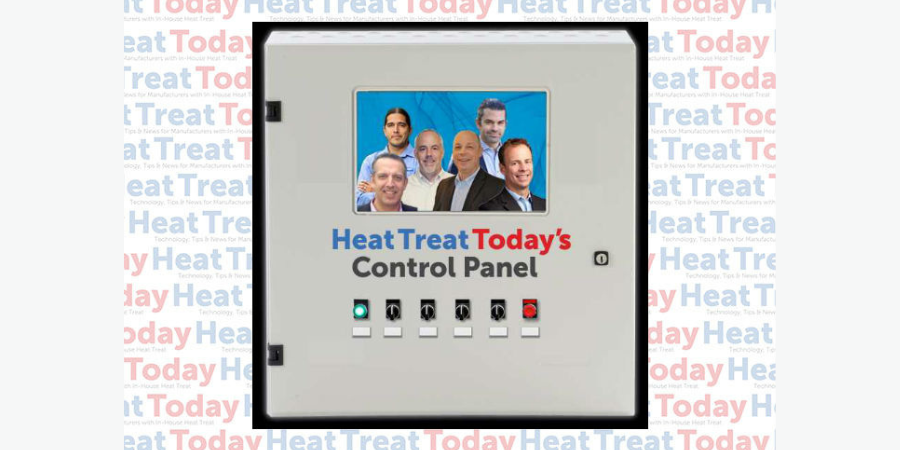
With this in mind, Heat Treat Today asked six heat treat industry experts a controls-related question. Heat Treat Control Panel will be a periodic feature so if you have a control-related question you’d like addressed, please email it to Editor@HeatTreatToday.com and we’ll put your question to our control panel.

Q: As a heat treat industry control expert, what do you see as some of the best practices when it comes to digital data collection and storage and/or validation of instrumentation precision?

We thank those who responded: Andrew Bassett of Aerospace Testing & Pyrometry, Inc.; Gunther Braus, dibalog GmbH/dibalog USA Inc; Jim Oakes of Super Systems, Inc; Jason Schulze, Conrad Kascik Instrument Systems, Inc.; Peter Sherwin, Eurotherm by Schneider Electric; and Nathan Wright of C3Data.

Calibration and Collection

Jim Oakes (Super Systems Inc.) starts us off with an overview of the equipment review process, the crucial component of instrument calibration, and digital data collection:

“Industry best practices are driven by standards defined by the company and customers they serve. Both the automotive and aerospace industries have a set of standards which are driven through self-assessments and periodic audits. Instrument precision is defined by the equipment’s use and is required to be checked during calibrations. The frequency of these calibration depends on the instrument and what kind of parts and processes it is responsible for.

The equipment used for these processes can be defined as field test instrumentation, controllers, and recording equipment. Calibration is required with a NIST-traceable instrument that has specific accuracy and error requirements. Before- and post-calibration readings are required (commonly identified as “as found” and “as left” recordings). During calibration, a sensitivity check is required on equipment and is recorded as pass/fail. The periodic calibration procedure is carried out not only on test equipment but also on control and recording equipment, to ensure instrument precision.

Digital data collection is a broad term with many approaches in heat treatment. As mentioned, requirements are driven by industry standards such as CQI-9 and AMS 2750. Specifically when it comes to digital data collection, electronic data must be validated for precision; checked; and calibrated periodically as defined by internal procedures or customer standards. Data must be protected from alteration, and have specific accuracy and precision. Best practice tends to be plant wide systems that cover the electronic datalogging that promotes ease of access to current and historical data allowing use for quality, operational, and maintenance personnel. Best practices in many cases are defined by the standards within each company, but the hard requirements are often the AMS 2750 and CQI-9 requirements for digital data storage.”

Industry Guidelines and Requirements

Andrew Bassett (Aerospace Testing & Pyrometry) has provided us with a reminder of the industry guidelines for aerospace manufacturing (via AMS-2750E, paragraph 3.2.7.1 – 3.2.7.1.5)

  1. The system must create electronic records that cannot be altered without detection.
  2. The system software and playback utilities shall provide a means of examining and/or compiling the record data, but shall not provide any means for altering the source data.
  3. The system shall provide the ability to generate accurate and complete copies of records in both human readable and electronic form suitable for inspection, review, and copying.
  4. The system shall be capable of providing evidence the record was reviewed – such as by recording an electronic review, or a method of printing the record for a physical marking indicating review.
  5. The system shall support protection, retention, and retrieval of accurate records throughout the record retention period. Ensure that the hardware and or software shall operate throughout the retention period as specified in paragraph 3.7.
  6. The system shall provide methods (e.g., passwords) to limit system access to only individuals whose authorization is documented.

“One of the biggest issues I see with one of these requirements will be point 5,” says Bassett. “The requirement is to be able to review these records throughout the retention period, which in some instances is indefinite. I always recommend to clients who may be upgrading or purchasing new digital systems that they should consider keeping a spare system in place to be able to satisfy this requirement. Who knows — today we are working on Windows 10, but in 50 years, will our successor be able to go back and review heat treat data when everything is run on Windows 28?”

Jason Schulze, Aerospace Heat Treating“This is a topic that yields great discussions,” adds Jason Schulze (Conrad Kascik). He directs us to a challenge he sees from time to time.

Within the Nadcap AC7102/8 checklist, there is this question: “Do recorder printing and chart speeds meet the requirements of AMS 2750E Table 5 or more stringent customer requirements?” This correlates with AMS2750E, page 12, paragraph 3.2.1.1.2 “Process Recorder Print and Chart Speeds shall be in accordance with Table 5”.

“To ensure the proper use of an electronic data acquisition unit used on furnaces and ovens, these requirements must be understood,” continues Schulze. “Because this system is electronic, it should be designated a digital instrument and not an analog instrument. In doing so, this helps determine what requirements apply in Table 5. The only remaining requirement in Table 5 for digital instruments is ‘Print intervals shall be a minimum of 6 times during each time at temperature cycle. Print intervals shall not exceed 15 minutes.’

With this in mind, it is important to realize that, if your time at temperature cycles are short cycles (such as vacuum braze cycles), the sample rate of data collection may need to be adjusted to ensure it is recorded 6 times during the cycle.

As an example, if the shortest cycle processed is 4 minutes at temperature, a sample rate of every 60 seconds would not conform to AMS2750E because, in theory, the maximum amount of recordings would be 4 times during the time at soak. Now, if the sample rate was modified to every 30 seconds, this would allow ~8 recordings during the time at soak, which then would be conforming to AMS2750E.

Within the realm of electronic data acquisition on furnaces/ovens, this seems to be a frequent challenge for suppliers.”

A Critical Variable: Process Temperature

Nathan Wright (C3Data) agrees and zeroes in on process temperature as a critical variable to be measured:

“No matter the heat-treating process being carried out, complying with AMS-2750 and/or CQI-9 requires that the heat treater measure, record, and control several different variables. One of the more common variables that must be measured, recorded, and controlled is process temperature.

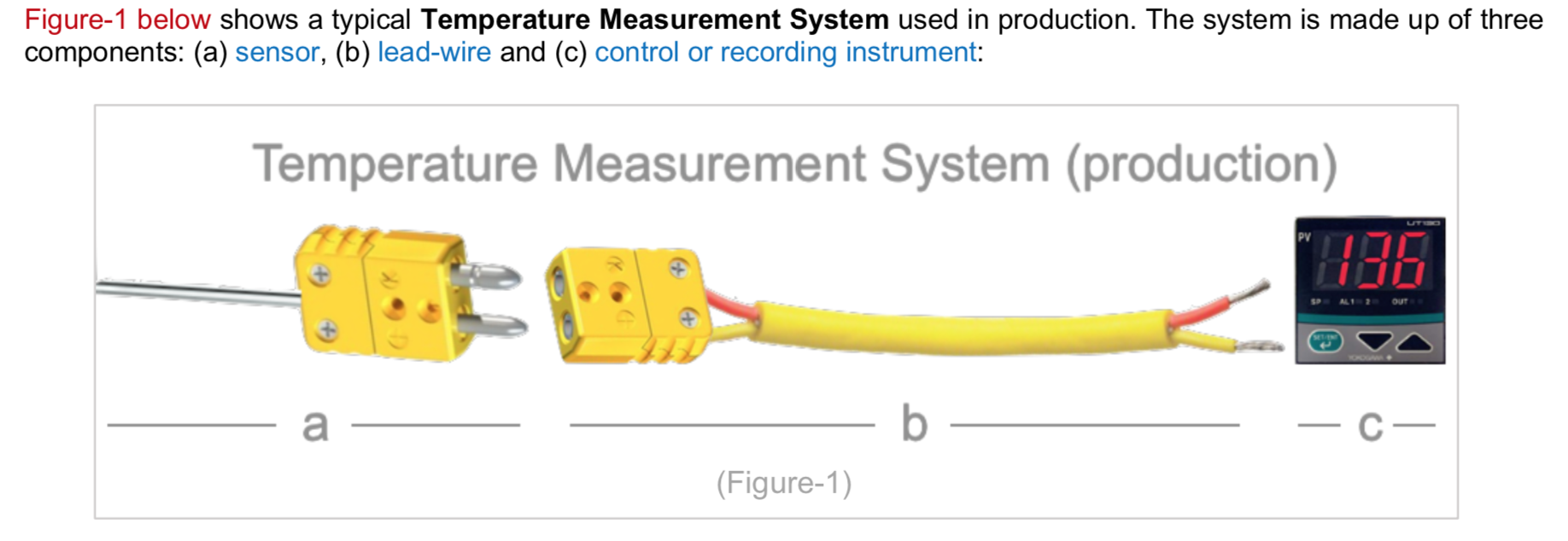
Measuring process temperatures requires the use of a precise measurement system (Figure-1 below), and the accuracy of said measurement system must be periodically validated to ensure its ongoing compliance.”

“The validation process is carried out through a series of pyrometric tests (Instrument Calibration and SAT), and historically these validation processes are highly error-prone.

In order to help ensure process instrumentation, process temperatures, and any other variable that impacts quality is properly validated it is good practice to begin automating compliance processes whenever and wherever possible. C3 Data helps automate all furnace compliance processes using software.”

A “Standard” Mindset

Gunther Braus (dibalog) chimes back in with some pertinent wisdom: “It is not sufficient only to record, you must live the standards like CQI-9, AMS, Nadcap or even your own standard you have set up, so you must survey the data. However, in the old times, there was a phrase: the one who measures, measures crap. In the end, it is all about surveillance of the captured data.

Where you store the data is a question of philosophy: personally, I prefer local storage in-house. Yes, we all talk about IOT, etc., and I do not want to start a discussion about security; it is more about accessing the data. No internet, no data. So simple. We are overly dependent upon cloud usage on the internet.

The automation of the instrumentation precision is so much effort in terms of automated communication between testing device and controller, from my point of view we are not there yet.”

A Look at the Standards In and Outside the Industry

Interesting question! writes Peter Sherwin (Eurotherm by Schneider Electric).

The aim is to record the true process temperature seen by the components being treated. However, there are many practical factors that can alter the accuracy of the reading. From the position of the thermocouple (TC), the TC accuracy (over time), suitability of the lead or extension wire, issues with CJC errors and instrument accuracy as well as electrical noise impacting the stability of the reading.

The standards do a good job to help by prescribing the location of TC, accuracies required for both TC and instrument, and frequent checks over time through TUS and SAT checks but note the specification requirements are maximum “errors”. And if you truly want to reach world-class levels of process control and reap the inherent benefits of better productivity and quality, you should aim to be well inside those tolerances allowed.

With 30yrs+ of data required to be stored (in certain cases, particularly aerospace), there should be some thought as to how and what form this should be stored in. There are many more options of storage when the data is in digital format.

  • Paper is very costly to store and protect.
  • The virgin data file should be secure and tamper-resistant and identical copies made for backup purposes held offsite.
  • The use of FTP is becoming more common to move files automatically from the instrument to a local server (with its own backup procedures to ensure redundant records in case of disaster).
  • Regular checks should be made to examine the availability and integrity of these electronic records.
  • Control and Data Instrument suppliers should ideally have many years of supplying instrument digital records with systems that can access even the earliest of data record formats.

We also look outside of the heat treat standards for truly best practices. The FDA regulation 21CFRPart11 and associated GAMP Good Automated Manufacturing Practice have been extended with the new document “Data Integrity and Compliance with Drug cGMP, Questions and Answers, Guidance for Industry”. These updates leverage A.L.C.O.A to describe the key principles around electronic records (see below). This industry is also leading the requirement for sFTP a more secure format of the FTP protocol.


Heat Treat Today will run this column regularly featuring questions posed to and answered by industry experts about controls. If you have a question about controls and/or data as it pertains to heat treating, please submit it to doug@heattreattoday.com or editor@heattreattoday.com.

Heat Treat Control Panel: Best Practices in Digital Data Collection, Storage, Validation Read More »

15 Quick Heat Treat News Items To Keep You Current


15 Quick Heat Treat News Items To Keep You Current

The heat treat industry is one of people transitioning and companies executing business, achieving goals, and receiving acknowledgments. Heat Treat Today offers News Chatter, a feature highlighting representative moves, transactions, and kudos from around the industry.

Personnel and Company Changes and Moves

  • Roberto Pancaldi, current Tenova Metals chief operating officer, has become the new Tenova Metals CEO, directly reporting to Andrea Lovato, CEO of Tenova.
  • Roberto Pancaldi, Tenova Metals CO

    The Aluminum Federation, the trade body for the UK aluminum industry, has announced that appointment of a new chief executive. Mr. Tom Jones joins the organization from MMC Hardmetal UK, part of the Mitsubishi Materials group, where he was general manager. Tom has more than 35 years experience of working in manufacturing.

  • The Board of GKN Group plc has announced that Anne Stevens, currently Interim Chief Executive, has agreed to become the Group’s new Chief Executive with immediate effect. It was added that since her appointment, Stevens has taken leadership of an ongoing and wide-ranging internal review of all GKN’s businesses which has culminated in the development of a transformation plan to improve GKN’s performance.

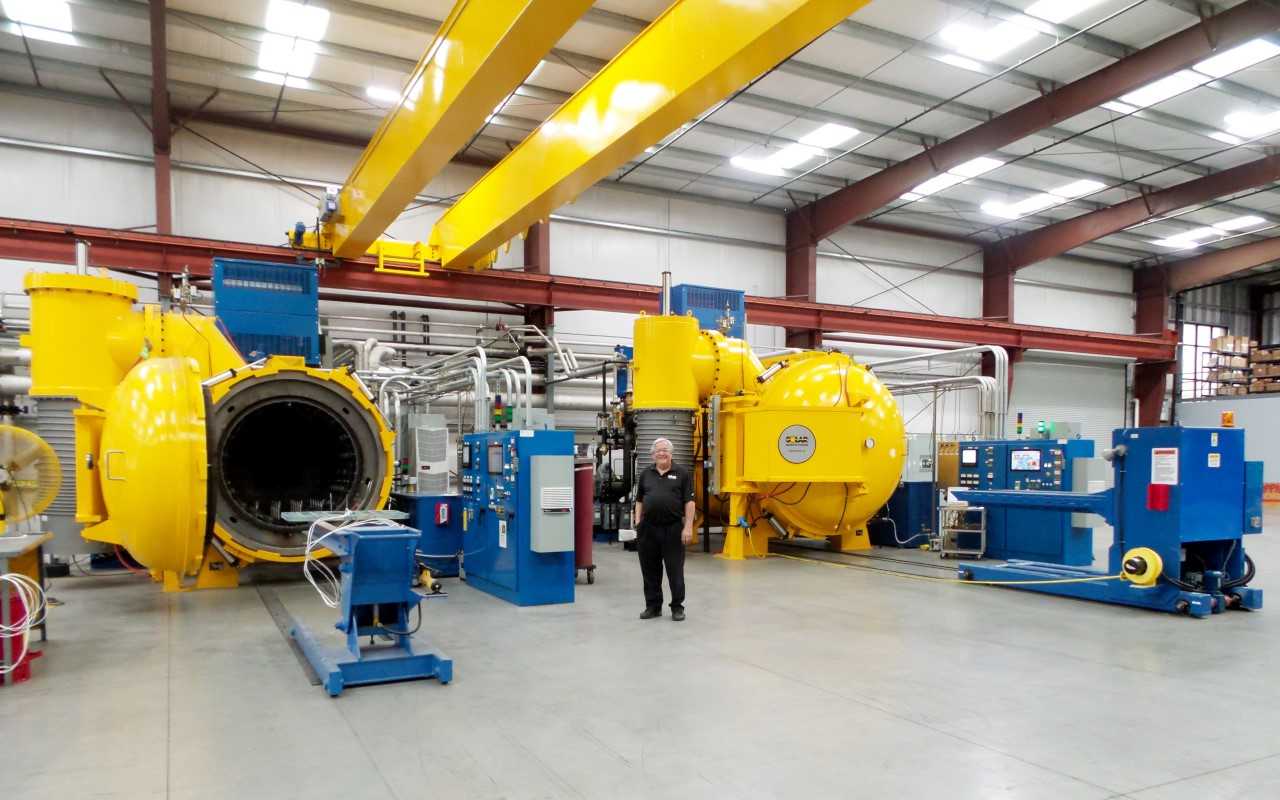
    Solar Atmospheres of California's expansion includes installation of 4 new furnaces purchased from Solar Manufacturing, Inc
  • Solar Atmospheres of California (SCA) announce the completion of its most recent facility expansion. Project expansion began taking shape in July 2016 with groundbreaking for a new 25,000 sq. ft. building. In preparation for the added growth, SCA has procured an additional four vacuum furnaces from sister company Solar Manufacturing (SMI) based in Souderton, Pennsylvania.

    Equipment Transactions

  • a heat treatment line from SMS group

    German metal processor Ilsenburger Grobblech GmbH ordered a new heat treatment line from SMS group. The line, project name "Adjustage II", will be consist of a shot-blaster, two roller hearth furnaces, the MultiFlex-Quench®, a plate leveler, a cleaning and priming line, and a water treatment plant and be capable of processing more than 300,000 tons of heavy plate annually. Commissioning is scheduled to take place early in 2020.

  • Wisconsin Oven Corporation shipped two electrically heated standard horizontal quench systems to an aluminum manufacturer, each designed to heat 1,000 pounds of aluminum to a 950°F operating temperature with qualified operating temperature ranges of 775°F and 1,075°F.

  • Grieve recently supplied a 1000°F (538°C) top-loading oven that will be used for curing composite materials in large molds at a manufacturer’s facility. Workspace dimensions measure 168 inches wide x 48 inches deep x 48 inches high, and 120 kW are installed in lncoloy -sheathed tubular heating elements. A 12,500-CFM, 10-HP recirculating blower provides horizontal airflow.

    Baker Furnace
  • Graftech Advanced Graphite Materials in Lawrenceburg, Tennessee, recently divested assets to refractory manufacturer Allied Mineral Products, Inc., located in Columbus, Ohio, and GTRefractory Solutions LLC in Wilmington, Delaware. Allied purchased the intellectual property rights to a collection of refractory cements and pastes, and GT Refractory Solutions acquired assets such as carbon and semi-graphite carbon brick, cement, pastes, porous carbons and graphite powders specialized for use in the steel, ferroalloy and iron industries.
  • Baker Furnace, Brea, Calif., the west coast division of the Thermal Product Solutions (TPS), moved to a new 40,000 sq-ft manufacturing space facility in 2017, which contributed to record shipments of custom and standard units in a variety of configurations. Among other projects, drop-bottom furnaces, crucible furnaces, car bottom furnaces, and batch ovens will be used for a variety of applications in the heat treating, foundry, composites, and automotive industries.

    HBD Industries acquires True Position Technologies LLC
  • HBD Industries announced the expansion of its Precision Components Platform through the acquisition of True Position Technologies LLC (“True Position”), based in Valencia, California. A leading provider of complex machined components for flight control applications, True Position specializes in manufacturing high specification components that require multiple machining, testing and finishing processes all within extremely tight tolerances.

Accreditations, Certifications, Patents, and More

  • Conrad Kacsik Instrument Systems, Inc., has been reaccredited for ISO-IEC 17025:2005 by A2LA, a continuous A2LA accreditation since 2000.
  • Heat treaters Metallurgical Processing Inc., based in New Britain, Connecticut, has been awarded a 24-month Nadcap accreditation after being audited to 10 checklists.
  • Bodycote HIP now counts nine Nadcap-accredited sites with the recent award to the Surahammar, Sweden, location.

    Advanced Heat Treat Corp., which has held Nadcap accreditation since 2013, has been awarded Nadcap Merit status for Heat Treating (Ion Nitriding) at the MidPort location in Waterloo, Iowa. This is the highest accreditation period that can be earned. "We are proud to achieve Merit status for the third time in a row and be granted a 24-month accreditation. We hope our customers take pride in the fact they send their parts to AHT," stated John Ludeman, Director of Metallurgy and Quality Excellence.

  • Bodycote, the world’s largest provider of heat treatment and specialist thermal processing services, announced that its Surahammar, Sweden, Hot Isostatic Pressing (HIP) location has earned its Nadcap accreditation. The Surahammar site has been producing Powdermet® Near Net Shape (NNS) and Selective Surface Net Shape (SSNS) components for many years, using its long experience of manufacturing complex, high integrity components from powder metal to serve markets such subsea, oil and gas, marine, nuclear, tool steel and automotive. Bodycote HIP now has nine Nadcap-accredited sites.
  • SAE International, Warrendale, Pa., announces that technical standard AMS2750 – Pyrometry, has received complete recognition by the U.S. Federal Drug Administration Center for Devices and Radiological Health, and it has been added to its list of recognized consensus standards database, List #47.


Heat Treat Today is pleased to join in the announcements of growth and achievement throughout the industry by highlighting them here on our News Chatter page. Please send any information you feel may be of interest to manufacturers with in-house heat treat departments especially in the aerospace, automotive, medical, and energy sectors to the editor at editor@heattreattoday.com.

15 Quick Heat Treat News Items To Keep You Current Read More »

Hardening and Tempering Line Receives Upgrade

The Ohio-based Engineering Division of Conrad Kacsik Instrument Systems completed a full system upgrade of an automated hardening and tempering line for Nelson Fastening Systems, also located in Ohio. The project involved the removal of the existing control system, VFD drives, limits, and control wiring for Nelson, and included the installation of a new system that features safety controls.

A Honeywell HC900 with a 15-inch operator interface terminal integrated with a computer running Specview HMI software controls a 2-zone hardening furnace, generator, quench tank, water cooling tank, washer, 2-zone tempering furnace, and a blackening unit. The equipment was linked with six conveyors and wired into the four control panels completed by Kacsik’s engineering team.

The old conveyor system had VFD drives that did not communicate with a PLC. The new system was programmed with safety features: in the event of a chain break or a conveyor jam, the system will alarm and automatically shut other conveyors off.

Hardening and Tempering Line Receives Upgrade Read More »

Skip to content