combustion corner

When the Pressure Gets Too Much — And It Helps

Jim Roberts of U.S. Ignition engages readers in a Combustion Corner editorial about the double-edged sword of heat recovery technology — explaining how efforts to reduce fuel consumption inadvertently drove up NOx emissions, and how flue gas recirculation (FGR) emerged as the design solution capable of cutting both fuel use and emissions by up to 50%.

This editorial was first released inHeat Treat Today’s February 2026 Annual Air & Atmosphere Heat Treating print edition.


A furnace guy walks into the heat treating plant and says to the operators standing nearby, “This exhaust system and these burners all have a negative attitude.” The other furnace guys say, “They better be negative, or they would not work well!” As if we don’t have enough negativity swirling around in our world as it is, now we are happy about it?

In the Annual People of Heat Treat (September 2025) we talked about the types of burners that were developed as heat treating and furnace sciences and combustion designs evolved. We also chatted about how the advent of new fuels and government regulations was going to take a chunk of our attention in the coming years — for example, pollution laws coming to the forefront of our industry in the late ‘70s and onwards. Interesting new burner designs sprung up, primarily, as you recall, to address the usage of gas. In other words, how can we reduce fuel usage?

But First, NOx

The cost of gas skyrocketed for a stretch and it led us first to energy reduction plans. But with heat recovery sciences came the phenomenon of higher flame temperatures. When you get higher flame temperatures, you can sometimes (okay… all the time) generate NOx. One of the primary constituents of atmospheric pollution is NOx, and it became a prime target for reduction by the EPA and other governing air quality folks. As it should be.

Just a quick step back to the “remind me again, Jim” world. What do we breathe? Air, right? We have to have oxygen. But what we tend to forget is that air is roughly 79% nitrogen. So, what we breathe is actually nitrogen spiked with oxygen, and the fuel that we generally burn, natural gas, has some nitrogen in it too.

Natural gas can have as much as 5% nitrogen in it, although membrane filtering usually controls pipeline gas content at around 1%. The point is that nitrogen is the dominant gas in our combustible portfolio, and when we make it really hot, it makes NOx. And that is considered bad for all of us. So, NOx from fuel-borne nitrogen can be released at temperatures as low as 1400°F. Sometimes that is referred to as “sudden NOx” because it releases quickly. All of us Furnace Guys know that 1400°F ain’t nothing in our world.

The second form of NOx is referred to as “thermal NOx” and that is the major source of NOx in our world. That is when we heat the air we are combusting in a burner, burning off most of the 21% oxygen. Then, flame temperature climbs, and continues to now superheat and try to burn that remaining 79% of nitrogen. As temperatures approach 2300°F, the magic happens.

Thermal NOx forms significantly at high combustion temperatures, typically starting above 1300°C (2372°F), with formation increasing exponentially as temperatures rise, especially above 2800°F (1538°C), due to atmospheric nitrogen and oxygen reacting at peak flame temperatures. Does anybody remember what happens to flame temperatures when we preheat the combustion air (recuperation, recirculation, etc.)? Flame temp and heat transfer increase and we go up to theoretical flame temperatures of 3200°F without even working at it.

Solving Energy Efficiency Through Design

So, let’s return to the original question: What happened when we tried to only save gas with heat recovery? Answer: We installed energy efficient burners but increased the emissions footprint in doing so. We cut down on energy expenditure but made exhaust an issue with the higher temps.

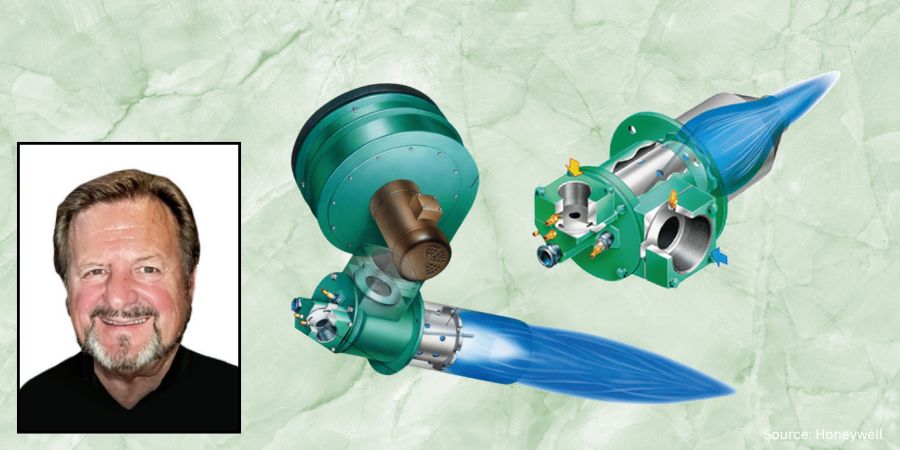
For most industrial and commercial applications, the optimal range for flue gas recirculation (FGR) is between 10% and 25% as this range offers significant NOx reduction without compromising combustion stability or efficiency. By adjusting the pressures coming into the burner and then balancing the exhaust outlet pressures over the heat exchanger body, normally with an extraction device called an “eductor,” we can dial in the percentage of recirculation the burners are operating under.
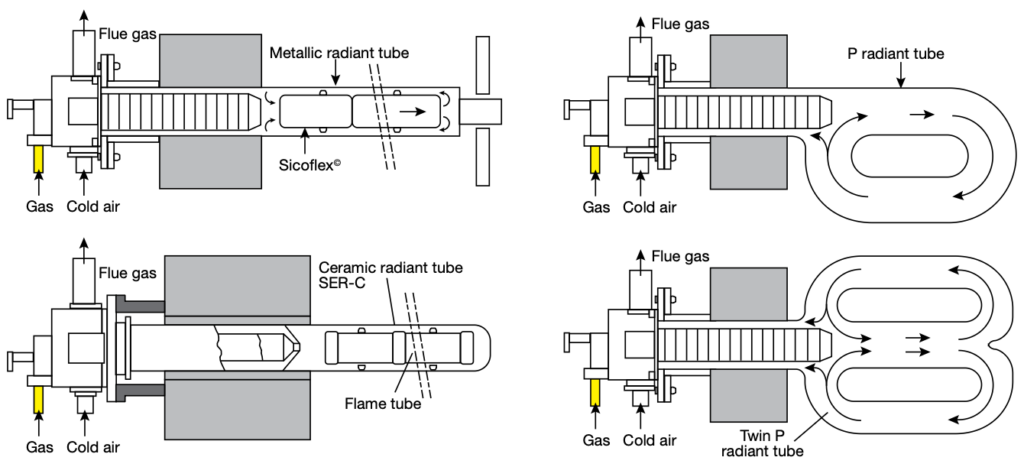
Figure 1. Flow diagrams depicting the basic design for both direct fired and radiant tube style burners | Image Credit: Honeywell

With this design, I have seen fuel and emission reductions of 50% when compared to the existing conventional combustion systems. It really is a testament to what design and research can produce for us (Figure 1).

We’ll look more closely at these designs next time.

About The Author:

Jim Roberts
President
US Ignition

Jim Roberts president at U.S. Ignition, began his 45-year career in the burner and heat recovery industry focused on heat treating specifically in 1979. He worked for and helped start up WB Combustion in Hales Corners, Wisconsin. In 1985 he joined Eclipse Engineering in Rockford, IL, specializing in heat treating-related combustion equipment/burners. Inducted into the American Gas Association’s Hall of Flame for service in training gas company field managers, Jim is a former president of MTI and has contributed to countless seminars on fuel reduction and combustion-related practices.

For more information: Contact Jim Roberts at jim@usignition.com.

When the Pressure Gets Too Much — And It Helps Read More »

Cost of Fuel Drives Change

Jim Roberts of U.S. Ignition engages readers in a Combustion Corner editorial about how rising fuel costs have driven dramatic improvements in furnace efficiency and combustion technology over the past 60 years, transforming heat treat processes from 20% to 70% fuel efficiency.

This editorial was first released in Heat Treat Today’s January 2026 Annual Technologies to Watch print edition.


A furnace guy walks into the shop and sees the cost of gasoline. “This keeps going up, what gives?”

My first car got about 10 MPG — we will not even go near to discussing when that was. Gasoline costs have since driven cars to become more efficient with 30+ MPG vehicles.

Last month’s article highlighted how there are five qualities in our heat treat processes: Quality and Accuracy, the necessary attributes; Efficiency and Performance, the variables; and Profit, which comes whenever we improve the two variables. We have discussed government regulation on emissions and technological breakthroughs that improved combustion technology in earlier articles, but now we turn to the connection of combustion and cost: how gasoline costs drove improvement of the two variable qualities of heat treat processing for combustion, Efficiency and Performance.

Gasoline Costs: A Timeline

Up until about 1960, the world of heat processing was pretty much a level playing field with Efficiency and Performance. We had tons of fuel at our disposal. Pollution was known but not yet a criterion to manage processes. So, burner efficiency and design were very low end. Nobody cared. Fuel was almost free. In doing research for this story, I found records of natural gas being less than $0.50 per million BTUs. Electricity was on par with delivered BTU costs. But then the cost of fuel started to fluctuate. The furnace guys started to notice; if nothing else changed, our friend Profit would weaken.

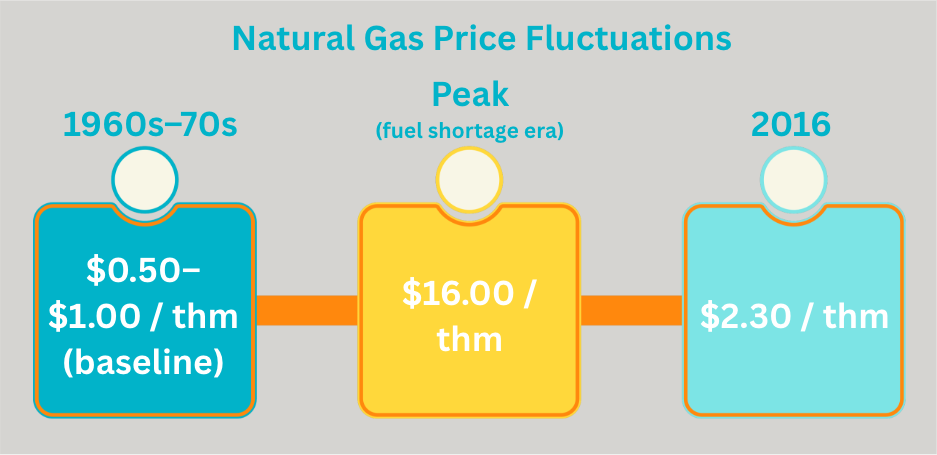
From 1930 to 1980, electricity pricing went up 500%. Natural gas started to bounce around in price. It was less than a $1.00/thm in the ’60s and ’70s, peaking during times of fuel shortage at $16.00/thm. Ten years later, in 2016, it hit $2.30/thm again. Some pretty wild fluctuations. In fact, it should be noted that the industry overseas had already begun to shift technologies — several years ahead of the U.S. — because they had been suffering with high fuel costs in Great Britain, Germany, Western Europe, and in Asian markets.

Furnace guy and the suppliers had to improve the efficiency and performance.

Troubleshooting and Combustion Design Changes

At first, you look at easy fixes to improve Efficiency and Performance. An example would be that insulation and refractory science really improved. If you can keep the heat in the furnace, you need less fuel to hold it at these high temperatures, right? So, improve the insulation.

Next, let’s get the burners from just being the opening in the furnace that you pour gas into, and make the burner more like a carburetor on an engine. Let’s get control of the air and gas ratios.

Next, let’s recover some of the flue gases and pre-heat the air coming into the burner. When you do that, the flame temp goes up, sometimes by as much as 400-500°F. That means higher heat transfer rates to the parts inside a now well-insulated furnace. Huge efficiency gains started happening.

Efficiency and Performance got a huge boost when the burners started to have high velocity discharge rates. In other words, we now had flames that were hotter and going into the furnace at several hundred miles an hour more than before. With that comes circulation improvement inside the furnace. And much like pudding in a blender, the faster the beaters, the smoother the mix. To give you an idea of the scope of these improvements, form 1960 to 1990, a matter of only 30 years, furnace and burner technology improvements went from 20% fuel utilization to estimated 60-70% fuel efficiencies, even higher in some instances. And there it was, super efficiency driven to occur by fuel cost and flucturation of supply.

To really hit home what that meant, let’s look at a 1,000-lb load of steel. Our process temp is 1750°F. Our furnace and combustion efficiency used to be 20%. That would require 1,370,000 BTU to heat up in an hour. Now, with 75% furnace and burner efficiency, that’s 352,000 BTU. You just saved approximately 1,000 ft3 of gas per hour! If we use the average industrial gas price today at $3.80/1,000 ft3, the difference of all this is $24,000/year, and that’s just a 1,000-lb load. Real world, the numbers are significantly higher, as all you furnace guys know. Imagine the dollar savings when fuel was at $16.00/thm?

And so, there it is. The well-known realization that in most markets, the dollar cost of the energy triggers improvement of technology.

Until next time…

About The Author:

Jim Roberts
President
US Ignition

Jim Roberts president at U.S. Ignition, began his 45-year career in the burner and heat recovery industry focused on heat treating specifically in 1979. He worked for and helped start up WB Combustion in Hales Corners, Wisconsin. In 1985 he joined Eclipse Engineering in Rockford, IL, specializing in heat treating-related combustion equipment/burners. Inducted into the American Gas Association’s Hall of Flame for service in training gas company field managers, Jim is a former president of MTI and has contributed to countless seminars on fuel reduction and combustion-related practices.

For more information: Contact Jim Roberts at jim@usignition.com.

Cost of Fuel Drives Change Read More »

Refine Your Process, Get Profits

Jim Roberts of U.S. Ignition engages readers in a Combustion Corner editorial about how focusing on the right priorities in the right order naturally leads to profitability in heat treating.

This editorial was first released in Heat Treat Today’s December 2025 Annual Medical & Energy Heat Treat print edition.


It’s a crisp winter day, and a furnace guy walks into the heat treat plant and says, “Something has changed here, it feels…more modern.” The rest of the furnace guys shrug and continue with the tasks at hand. But the furnace guy is right — something has been changing all along and will continue to do so in the foreseeable future, I’ll wager.

We’ve talked about how certain trends and needs have driven the growth in the industry. My ramblings have included bed posts and pipelines and the flavors of different fuels, and what it all boils down to is change. These changes are attempts to get the following qualities into our processes in the heat treating world:

  1. Quality
  2. Accuracy
  3. Efficiency
  4. Performance
  5. Profit

“But Jim, you listed profit as the last measuring stick! What is wrong with you?” It would be pretty easy to invert this list; turn these guideposts upside down and the world you are in would still work. But if we add longevity in business as an additional goal, then it will not be too long before you begin to realize that the order is listed correctly here. For the most part, in my experience, the heat treating industry has kept the order intact. It is an honorable path, I think.

Quality and Accuracy are the new givens. We do not have to spend time on this. As long as we have been wielding control over metal, those properties are the constant. From hammering out the very first horseshoes, if they did not fit the horse or cracked and broke after a couple of steps, you were not in the horseshoe business very long. These days, standards clearly map out the goal: a client tells us what is demanded, maps it out for us in a specification, and we meet it.

Items 3 and 4 are where we focus today. If we can improve Efficiency and Performance after meeting the Quality and Accuracy targets, then good old item 5 happens — Profit. It just happens. What a concept! Now you may think this is a re-run of every BUS-101 class or seminar you have seen. Maybe you are right, but this is where I veer off as a furnace guy and get back to the business of combustion as it applies to our industry.

We talked earlier about how the natural gas industry expanded and built this fantastic infrastructure to provide fuel to all of us. Electric providers did and are still doing the same thing.

At the end of the transmission line, whether gas pipe or electrical cable, sit the furnaces and ovens that heat treating needs. The buck stops here. Speaking of bucks, in order to get to profit, what must we do? If we really only have Efficiency and Performance in our control (Quality and Accuracy are presumed to be met), then let’s look at how that changed, in furnace guy world…next year [in 2026].

All the best to everyone in the Holiday seasons. May you be blessed with good health and happiness.

About The Author:

Jim Roberts
President
US Ignition

Jim Roberts president at U.S. Ignition, began his 45-year career in the burner and heat recovery industry focused on heat treating specifically in 1979. He worked for and helped start up WB Combustion in Hales Corners, Wisconsin. In 1985 he joined Eclipse Engineering in Rockford, IL, specializing in heat treating-related combustion equipment/burners. Inducted into the American Gas Association’s Hall of Flame for service in training gas company field managers, Jim is a former president of MTI and has contributed to countless seminars on fuel reduction and combustion-related practices.

For more information: Contact Jim Roberts at jim@usignition.com.

Refine Your Process, Get Profits Read More »

Flame and Fire: History of the Industrial Gas Industry

Jim Roberts of U.S. Ignition entertains readers in a Combustion Corner editorial about how the industrial gas industry evolved from its humble beginnings in the early 1900s into a precision-driven force that transformed combustion technology and modern manufacturing.

This editorial was first released in Heat Treat Today’s November 2025 Annual Vacuum Heat Treating print edition.


Let’s think about how young the industrial gas industry really is.

A Short Pipeline in Time

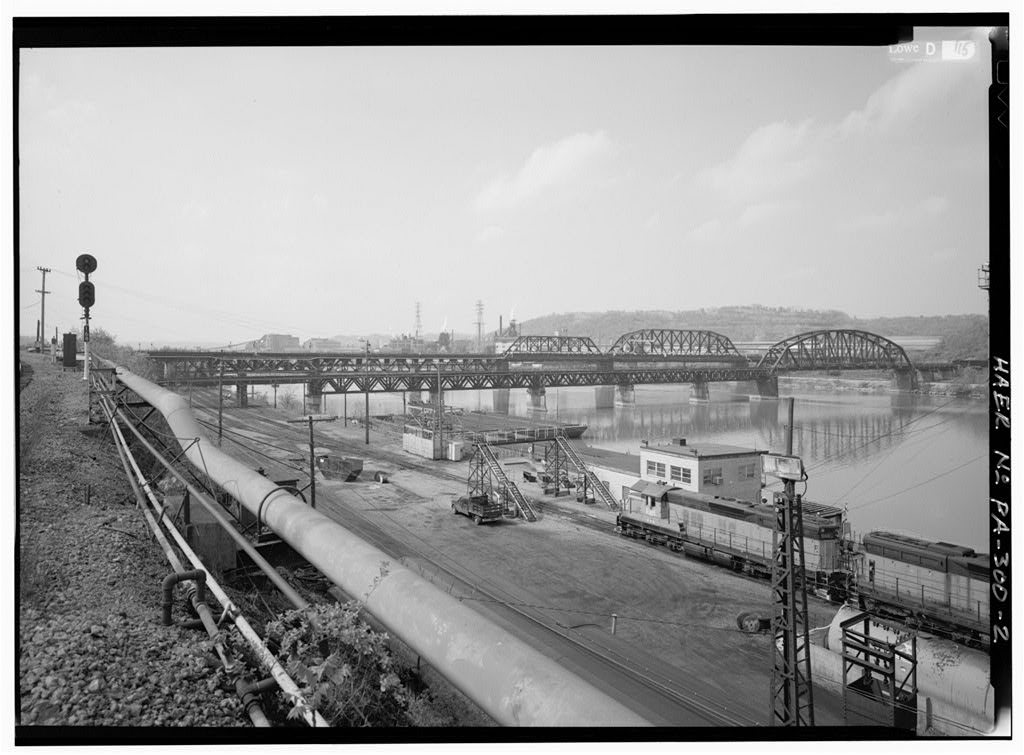
The first real industrial usage was way back in the 1800s somewhere. But there was no infrastructure, no supply other than bottled gas for industrial applications. The gas industry, as far as we recognize it, did not really take off until somewhere around the early 1920s when the first welded pipeline was installed. Then, as usage increased, it became apparent that safety was going to be a concern. The addition of mercaptan (rotten egg smell) was not until the late 1930s.

With the growth of commercial and residential usage, the demand for gaseous fuels grew by 50 times the original market size anticipated between 1910 and 1970! What does that demand look like? Today there are over 3 million miles of gas distribution lines connected to 300,000 miles of big transmission pipelines in the U.S. alone. All that growth in a span of 100 years, essentially. That means the transmission pipeline system in the U.S. could stretch around the planet 12 times!

USS coke gas pipeline in the foreground with the Conrail Port Perry Bridge spanning the Monongahela River, Port Perry, Allegheny County, PA (Lowe, 1994)
Source: Library of Congress Prints and Photographs Division

Most of that construction occurred during the post-war 1940s to 1960s timeline. That’s one busy industry! And it dragged all the thermally based markets and industries along with it. Now, we have come to accept the availability of natural gas as so commonplace that we cannot imagine life without it.

Responding with Precision

So, now you ask yourselves, “Why this history lesson, Jim?” Well, because we are supposed to be learning about combustion and the era of major combustion advancements — and if I would quit veering off into side topics we might actually get there. But it is all interconnected.

If you recall the story of the heat treater with the bedpost burners (October 2025 edition), he had no inspiration to improve efficiency or performance because those darn bedposts would burn gas just fine. So, what changed? Firstly, the world had been through a couple of military conflicts during this rise of the gas industry. And sadly, sometimes the best technological advances occur in times of conflict; engineering becomes more precise. All of a sudden, instead of hammering out horseshoes for the cavalry, we were heat treating gun barrels and crankshafts for airplanes. We needed to be more than precise — actually, we had to be perfect. So, we stepped away from the old heat treatment ways and developed systems that we could control to within a couple of degrees.

As a result, burners became specialized. Each process became unique and precise. Instead of pack carburizing components, a company called Surface Combustion developed a piece of equipment called an Endothermic generator. This device made carbon-based atmosphere out of natural gas or propane- and nickel-based catalysts. All of a sudden, we could do very precise non-scale covered heat treating. And the burners from companies like North American Combustion, Eclipse Combustion, Maxon, Hauck, Pyronics, Selas, W.B. Combustion, and on and on, all scrambled to develop the specific types of burners that the heat treaters and iron and steel makers needed.

Another important milestone hit around 1963: the Government got involved (gasp!). The Clean Air Act of 1963 essentially said we needed to burn our fuels cleanly and not spit smoke into the air. Those laws got reviewed again in 1970, 1977, and again in the updated Clean Air Act of 1990 with some of the biggest revisions.

With all of these changes, we had several drivers for innovation in the combustion world. Again, precision became a must. Heat treating became a very standards-driven industry. Metallurgists roamed the planet inventing both new materials and the processes to achieve them. Gas companies themselves became huge drivers of innovation and developed think tanks, like the GRI (Gas Research Institute), where people learned and laboratories hummed with development projects investigated in conjunction with burner and furnace companies. Academia became involved with industry in the form of organizations like The Center for Heat Treating Excellence (CHTE) and the Metal Treating Institute (MTI). Suddenly, the industry was more than just blacksmiths.

We’ll talk about how burner companies became design specialists and system efficiency experts and what that meant to various burner styles in next month’s offering.

References

Lowe, Jet. 1994. Panorama of Industry (Conrail Port Perry Bridge, Spanning Monongahela River, Port Perry, Allegheny County, PA). Historic American Engineering Record, HAER PA,2-POPER,1-2. Library of Congress Prints and Photographs Division.

About The Author:

Jim Roberts
President
US Ignition

Jim Roberts president at U.S. Ignition, began his 45-year career in the burner and heat recovery industry focused on heat treating specifically in 1979. He worked for and helped start up WB Combustion in Hales Corners, Wisconsin. In 1985 he joined Eclipse Engineering in Rockford, IL, specializing in heat treating-related combustion equipment/burners. Inducted into the American Gas Association’s Hall of Flame for service in training gas company field managers, Jim is a former president of MTI and has contributed to countless seminars on fuel reduction and combustion-related practices.

For more information: Contact Jim Roberts at jim@usignition.com.

Flame and Fire: History of the Industrial Gas Industry Read More »

Flames and Fire: Straighten Up, Move Forward… Or Not?

In this Technical Tuesday installment, Jim Roberts, president of U.S. Ignition, examines various flame profiles in heat treat operations. Today’s Combustion Corner compares gravitational lift, premix burners, fuel nozzle fixed air mixing burners, and nozzle mixing burners, while exploring design improvements to keep you well informed.

This informative piece was first released in Heat Treat Today’s August 2025 Automotive Heat Treating print edition.


A furnace guy walks into a bar and shouts, “Straighten UP!” The other furnace guys respond, “It won’t work!”

Thus begins another wander down combustion lane where we try to figure out what I’m talking about. We have discussed in other articles how various fuels and sources of air (and everything else) can affect the heating rates produced by our combustion equipment. We have talked about fire. We haven’t talked about what fire looks like.

So, in the following column and subsequent releases we are going to talk about flames and fire, and why there are a fairly substantial number of flame profiles available to heat treaters, steel makers, and all of you high-temp-type people. Why are there different flame shapes, and what does flame color do for you?

Burner Types

Figure 1. Nozzle-mixing burner ThermJet cutaway

Firstly, let’s start with the various types of burners commonly used in the art of high-temp processing work.

  1. Gravitational lift: This type of burner is exactly what it sounds like; it works just like a candle. The fuel/air mix is naturally rising with the thermal current of the flame and combusting as the flame rises, climbing the heat column.
  2. Premix burners: This is where the fuel and air are mixed together and then ignited. By controlling the percentages of fuel and air in the mixture, we control the characteristics of this flame.
  3. Fuel nozzle fixed air mixing burners: This is where a steady stream of oxidant (air) is flowing, and the fuel is throttled up and down to affect ignition and capacity of fuel.
  4. Nozzle mixing burner: Finally, and by far the most used in our industry, this is where the fuel and oxidant mix internally in the burner, and a flame configuration is determined by the burner outlet or the mixing nozzle. (See Figures 1 and 2.) You may hear burner nozzles referred to as a cup, a spinner, flame retainer, just about any type of reference. You may also hear them referred to as a danged hot thing — an accurate description as well — so don’t touch.

Design Improvements

With development of the nozzle mixing burner 60+ years ago, design improvements began in earnest. One of the first patents for nozzle mixing industrial burners was issued to Eclipse Fuel Engineering in 1967. Pretty soon there were all sorts of designs and patents, as burner companies raced to improve reliability, performance, and heat delivery characteristics.

Figure 2. Nozzle-mixing burner Eclipse Thermair

Some of the concepts that came along in the subsequent years were “air staged” burners. In this design feature, the fuel is delivered in the center of the flame nozzle. Progressively changing air holes in the nozzle stages the combustion of the fuel as it makes contact with the air. As the gas burns and the exhaust gas expands, it will often increase volumetrically by up to seven to eight times its cold state condition. That’s a lot of expansion, and it forces the pressure in the burner body to increase at an amazing rate. As the flame progresses through the burner and seeks the exit point (the part we see, you know, the fire), it can be moving along at — get this — flame speeds up to 400 feet per second!

That’s enough for today. We’ll pick this conversation back up next month.

Jim Roberts
President
US Ignition
For more information: 
Contact Jim Roberts at jim@usignition.com


Flames and Fire: Straighten Up, Move Forward… Or Not? Read More »

Step Back from the Fire, Caveman, and Think

Heat treatment is a hands-on science and it can be easy to forget about continuing education. In today’s edition of Combustion Corner, Jim Roberts, president of U.S. Ignition, encourages readers to continue cultivating their own heat treat learning and offers specific and practical educational resources to do just that.

This informative piece was first released in Heat Treat Today’s June 2025 Buyers Guide print edition.


So, a furnace guy walks into a heat treating facility and says, “What’s that?”

The Flame and Man

Since the invention of fire, we as upright, walking, opposing-thumb-equipped critters have been learning to control it. We have learned at the elemental level that we can change the properties of just about anything on the planet simply by exposing that item or material to the flames. Certainly, we hold fire as one of our most fascinating benefits of our existence.

Yet, in the grand scheme of things, we are just now really learning to control at levels that our Neanderthal cousins would never have conceived, and they didn’t! Conceive the possibilities, that is. I mean, for the first 400,000 years of our human existence, (that’s a mindblower, isn’t it?), fire had four basic purposes: warmth, light to see in the dark, protection from predators/enemies, and to cook our food. Later, we discovered that by heating up the tip of certain sticks, you could make the stick useful over a longer time. It didn’t wear out as fast. And from there we figured out ways to change other materials at our behest by using the flame. Weapons and tools followed.

In the bigger picture, we only have figured out the really cool uses in the last 5,000 years — and the really, really cool stuff in the last 300 years. So, the learning curve for us has been relatively late when it comes to the heat and the flame and the ability to understand it — to really control it.

Furthering the Science of Heat

How did we get to this stage of significant control over temperatures and systems that would melt a Cro-Magnon’s noodle right there in his big ol’ skull? We used our ever-developing brains. We used intelligence to advance the art of using the flame. Others before us thought their way into our present-day future. Shouldn’t we keep the ball rolling? Isn’t this ever-evolving commitment to responsible use of the flame what we need to do? We accept the gift of those before us and strive to improve on it for the upcoming iterations of humankind. Idealistic? I think not.

The premise of temperature is basically fixed. We can put it in a furnace, we can put it in a vacuum, we can melt the very rocks our planet is made from. So, let’s use the very latest available knowledge to further the science of heat. Let’s improve the situation, both at work and personally, by using our brains and by learning about what is going on with the furnaces, the parts, the fuels, and all the methods of heating. Let’s keep learning about the latest technologies. Let’s actually control this wondrous element.

To do that, we must embrace the knowledge, we have to know what we are looking at. We need to know the history and have a vision for the future. We need to teach and be taught.

Learning the Industry

If you or your reports need to get up to speed with our industry, indeed our very science — GO TO SCHOOL! The fact you are even reading this publication shows that you are open to learning. Let’s ace the test!

Heat Treat Today runs a drink-from-the-firehose learning experience called Heat Treat Boot Camp. You can learn the latest and greatest technologies and new technologies on the horizon in heat treating. Send yourself, send your people.

The Metal Treating Institute (MTI) runs an online certification school that teaches the ins and outs of the heat treating industry. The Industrial Heating Equipment Association (IHEA) runs an annual Combustion Seminar. Almost all the major furnace and equipment suppliers offer seminars on their specialty niche.

Educational Opportunities Include:

  • Ipsen Global has “Ipsen U”
  • Surface Combustion offers Virtual Learning Applications
  • SECO/WARWICK produces a Global Training Seminar on continuous improvement and heat treating
  • Can-Eng offers analysis of specific inquiries
  • Ajax Tocco will come to your facility to conduct the latest schooling on your equipment

All you must do is decide that you are going to continue to learn more. How can you not with these kinds of services around you?

Don’t forget Safety. National Fire Protection Agency (NFPA) seminars are available from NFPA themselves. Industry experts who have certified trainers, like Rockford Combustion, also offer multi-day seminars on equipment safety.

I can attest to the effectiveness of these kinds of learning commitments. I have been both a student and a teacher at some of the aforementioned seminars. The scope of learning can be broad or focused. It’s up to us to keep mentally expanding, so that the lessons learned don’t get lost, and the future technologies get a fair review.

I have been watching with interest how over the last 25 or so years precise control over combustion has been evolving. The major controls and process monitoring companies have been striving to gain precise control and safety on furnace equipment for years. I might add, they have been successful in varying degrees, and safety and maintenance have improved greatly.

I just spoke recently with a company in Erie, Pennsylvania. They have developed a program that monitors each individual burner. Not only does it tell if the burner is running, but if there has been a component failure, if the burner is out of tune, it can self-correct, and if there is a failure, they shut it off. Oh, and they do that for you, from THEIR office. The technology just grows and grows, doesn’t it?

So, I know some of you were wondering where I was going with the Caveman intro, and some of you probably would have preferred that I kept going up to the point where we were cooking mammoth steaks on sizzling rocks with our Cro-Magnon buddy. But we are better than him, and we need to keep proving that. Don’t you think?

Besides, this is the final month before school is out for the summer. Let’s give education a nod here.

I am sorry if I did not mention your company, no slight intended. If so, contact your customer base to alert them to any learning experiences that may be available.

Keep learning. Until next time…


About the Author

Jim Roberts
President
US Ignition

For More Information: Contact Jim Roberts at jim@usignition.com.


Step Back from the Fire, Caveman, and Think Read More »

The Future Is Coming Three Times Faster Than You Think

In this Technical Tuesday installment featuring Combustion Corner by Jim Roberts, president of U.S. Ignition, readers are enlightened about how upcoming policies might impact their burner systems, fuel mixtures, and equipment. Could certain policies impact technical requirements of heat treating? Find out more below.

This informative piece was first released in Heat Treat Today’s July 2025 Super Brands print edition.


A furnace guy goes into a bar and says, “This looks like a fast crowd… and all the players nod in agreement.”

Where are we? It’s the future! And in heat treating and combustion circles, the changes that will occur in the next several years will be very impactful to our industry. We’ve all heard these things, and we have some of the very best experts in the world working for us in this industry to make sure that we continue to grow and to be a leader in the legislation and rules that could cripple the wonderful world of heat treating and metals.

We are lucky to have industry associates at the Metal Treating Institute (MTI) who understand the impact of some of these new regulations. In this year’s Air & Atmosphere issue of Heat Treat Today magazine, Michael Mouilleseaux (Erie Steel LTD) provided updates on the proposed decarbonization initiatives. I have seen presentations by Michael and his committee composed of Heather Falcone (Cook Induction Heating Company) and Ben Gasbarre (Gasbarre Thermal Processing Systems). This is critical knowledge for us all, and we should be staying as vigilant and supportive as we can. Michael’s interview is a must-read in that February issue – if you missed it, go back and read it. Please.

And then you say, “What’s this got to do with combustion equipment and the stuff that this Roberts guy is normally talking about?”

Well, not only does the decarbonization mandate mean the possibility of costs through government burdens and penalties, but the equipment and process change requirements are going to be staggering if we don’t prepare.

As long as I’m in a name-dropping mood, I’m going to mention Brian Kelly of Honeywell. Brian is a degreed aerospace engineer, and yet he decided to come play in the mud with us furnace guys for a career. Brian has several detailed presentations online about some of the prime initiatives for all the combustion equipment companies — hydrogen Combustion. Yep, the “H” word. The holy grail of zero pollution. One of those presentations includes fascinating detailed data on hydrogen and other emission initiatives, given by Brian Kelly and Todd Ellerton on YouTube regarding future combustion technology requirements.

“So, what does the “three times faster” thing mean, Jim?”

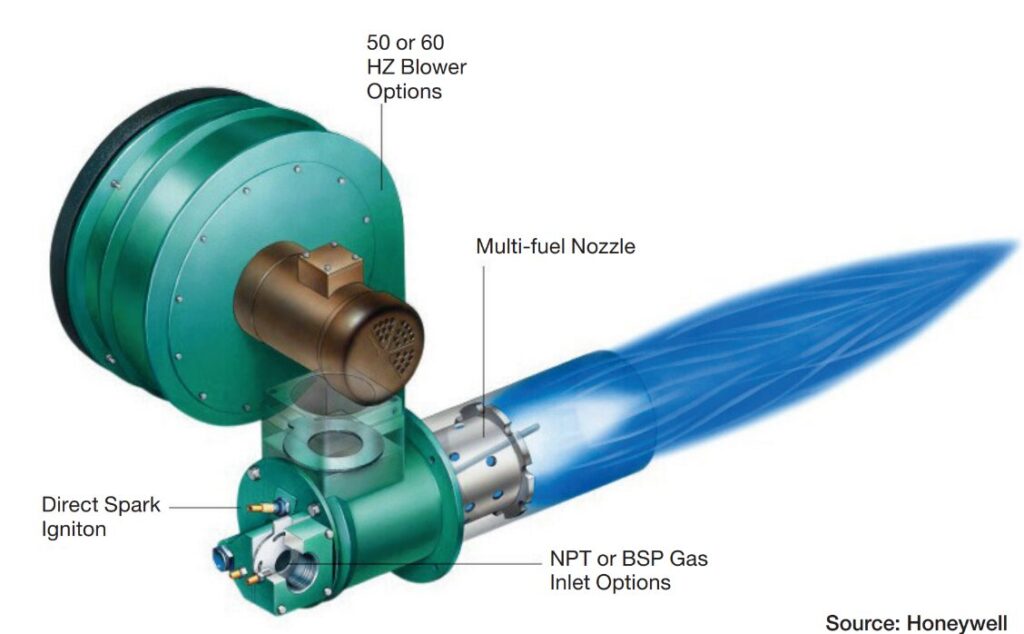
Well, all major combustion equipment companies, like Honeywell, understand that hydrogen requires three times the amount of fuel to generate the same amount of available heat as natural gas. Hydrogen also burns with seven to eight times the “flame speed” of natural gas. It burns, on average, about 400 degrees hotter (F) than natural gas. And so, from an engineering standpoint, there are a fantastic number of variations that must be considered as we look forward, especially when addressing CO₂ and other emissions. Add propane, butane, methane, producer gas, landfill gas, and anything else that is presently being utilized in the heat treat circles, and that provides a lot of possible variations!

Now, it needs to be said that a good many burners can burn hydrogen already. The anticipation of this level of scientific and ecological requirements was seen a long time ago. Conversely, many cannot. Brian Kelly explains that 17% of the present pre-mix/blended fuel systems cannot utilize this fuel. It also bears mentioning that there are three different grades of hydrogen production levels.

So, let’s start doing the math on how many iterations it will take. But here is the biggest tidbit of hydrogen science in the combustion world – hydrogen is the smallest molecule and the lightest in a molecular sense. Helium is smaller and lighter, for fact-checker purposes, but we aren’t trying to burn helium, are we? So, as we blend hydrogen with our other fuels (i.e., the most practical way to maintain some of the infrastructure and equipment), we need to have our combination equipment suppliers test and verify that which exists will work.

Obviously, if it takes three times the fuel volume, existing gas delivery lines will be an issue. At the molecular level, smaller and lighter means that many existing seals, connections, and control valves may no longer be gas-tight and may leak. That’s not good! If the flame speed of these fuels is five to eight times that of existing fuels, temperature profiles within the process will need to be reviewed and re-calibrated. And if it burns 400 to 500 degrees hotter, certainly that will require a review of the former materials of construction.

So, how does this tie into the original theme of “The future is coming fast?” Well, we have just touched briefly on one possible fuel transition that is on the horizon. Carbon points/credits are already being taxed in Europe. We can bet that these global decarbonization efforts will be moving ahead. We will need a review so that a “head in the sand” mentality does not catch any of us in the thermal processing community flatfooted and ill-prepared.

It’s easy to think that it won’t affect you. When I mentioned “three times as fast,” of course, I was alluding to the fuel references, and the best way to be prepared for the future is to see it coming. Be alert and stay current, and we will adapt as an industry, as we have so many times before. Until next time …

About The Author:

Jim Roberts
President
US Ignition

Jim Roberts president at U.S. Ignition, began his 45-year career in the burner and heat recovery industry focused on heat treating specifically in 1979. He worked for and helped start up WB Combustion in Hales Corners, Wisconsin. In 1985 he joined Eclipse Engineering in Rockford, IL, specializing in heat treating-related combustion equipment/burners. Inducted into the American Gas Association’s Hall of Flame for service in training gas company field managers, Jim is a former president of MTI and has contributed to countless seminars on fuel reduction and combustion-related practices.

For more information: Contact Jim Roberts at jim@usignition.com.


The Future Is Coming Three Times Faster Than You Think Read More »

Is It Stuffy in Here? Exhaust Systems

In each installment of Combustion Corner, Jim Roberts, president of U.S. Ignition, reinforces the goal of the series: providing informative content to “furnace guys” about the world of combustion. The previous column examined the air supply inlet — the inhale, and this month, Jim is examining the exhaust system — the exhale, and how to inspect it, maintain it, and manage it.

This informative piece was first released in Heat Treat Today’s March 2025 Aerospace print edition.


A guy walks into a room full of furnace guys and says, “Is it just me, or is it a tad stuffy in here?”

We have all been able to imagine that it is hard to focus and do your job in an environment where it seems like it’s hard to breathe. Well, our hard workin’ buddy, the furnace, is continually stuck in a cycle of trying to breathe in, breathe out — and then somewhere in between, the magic of combustion and heat happens! We talked last month about the “breathe in” part of the combustion process. This month, we are going to remind you that if you take a really good, productive, inhaled, life giving breath, you are probably going to want to exhale at some point, too!

Tip 2: Ensure Exhaust Systems Are Properly Functioning and Clean

Inhale, exhale. It makes sense that if we were earlier having issues with the air supply inlet, the exhaust should also be checked. Today’s combustion equipment is sophisticated and sensitive to pressure fluctuations. If the exhaust is restricted, the burners will struggle to get the proper input to the process. I used to use the example of trying to spit into a soda bottle. Try it. It’s tough to do and invariably will not leave you happy. Clean exhaust also minimizes any chance of fire. Read on for three examples.

A. Check the Flues and Exhausts for Soot

If you are responsible for burners that are delivering indirect heat (in other words, radiant tubes), you have a relatively easy task ahead to check the flues/exhausts. Each burner usually has its own exhaust, and one can see if the burners are running with fuel-rich condition (soot/carbon). Soot is not a sign of properly running burners and will signal trouble ahead. Soot can degrade the alloys at a chemical level. Soot can catch fire and create a hot spot in the tubes. Soot obviously signals you are using more fuel than needed (or your combustion blower is blocked, see the first column in this series).

As a furnace operator or floor person, it should be normal operating procedure to look for leakage around door seals.

Here’s a sub tip: If you cannot see the exhaust outlets directly, look around the floor and on the roof of the furnace up by the exhaust outlets. Light chunks of black stuff is what is being ejected into the room when it breaks free from the burner guts (if it can). That will tell you it’s time to tune those burners. If you do not have a good oxygen/flue gas analyzer, get one. It can be pricey, but it will pay for itself in a matter of months in both maintenance and fuel savings.

B. Seriously … Check the Flues and Leakage Around Door Seals

If you are running direct-fired furnace equipment, or furnaces that have the flue gases mixed from multiple burners, it gets a little trickier. All the same rules apply for not wanting soot. Only now, it can actually get exposure to your product, it can saturate your refractory, and it can clog a flue to the point that furnace pressure is affected. An increase in furnace pressure can test the integrity of your door seals. It can back up into the burners and put undue and untimely wear and tear on burner nozzles, ignitors, flame safety equipment, etc. As a furnace operator or floor person, it should be normal operating procedure to look for leakage around door seals.

C. Utilize Combustion Service Companies

Ask the wizards. Combustion service companies can usually help you diagnose and verify flue issues if you suspect they exist. It’s always a great idea to set a baseline for your combustion settings. Service companies can help you establish the optimum running conditions. Again, money well spent to optimize the performance of your furnaces. I’m sure you already have a combustion service team; some are listed in this publication. Otherwise, consult the trade groups like MTI and IHEA for recommended suppliers of that valuable service.

Check flues monthly. It should be a regular walk around maintenance check.

Don’t let the next headline be your plant. See you next issue.

About The Author:

Jim Roberts
President
US Ignition

Jim Roberts, president at US Ignition, began his 45-year career in the burner and heat recovery industry directed for heat treating specifically in 1979. He worked for and helped start up WB Combustion in Hales Corners, Wisconsin. In 1985 he joined Eclipse Engineering in Rockford, IL, specializing in heat treating-related combustion equipment/burners. Inducted into the American Gas Association’s Hall of Flame for service in training gas company field managers, Jim is a former president of MTI and has contributed to countless seminars on fuel reduction and combustion-related practices.

Contact Jim Roberts at jim@usignition.com.


Is It Stuffy in Here? Exhaust Systems Read More »

‘Furnace Guys’ and Filtration Systems

Jim Roberts, president of U.S. Ignition, joins us in the renewal of the Combustion Corner column. In this installment, Jim establishes that the goal of the series is to provide informative content to “furnace guys” about the world of combustion, furthering the spirit of the Heat Treat Today motto: “We believe people are happier and make better decisions when they are well informed.”

This informative piece was first released in Heat Treat Today’s February 2025 Air/Atmosphere Furnace Systems print edition.


Contact us with your Reader Feedback!

So … A guy walks into a room full of furnace guys …

And the story (or joke) begins again. I used to be one of the furnace guys. It’s a really niche group of strange, unique, and sometimes knowing people, who, by the way, are not gender specific. To me, “a guy” is a moniker as specific as saying that person over there is a swimmer.

But as furnace guys, those same individuals have a peek at the stuff that normal planet walkers don’t. They — or rather WE — know how to almost tame the beast. We have learned what it means to control temperatures that can crack stone. We can bend metal and make it do what we want at temperatures that the human eye cannot gaze upon without safety filters between us and the beast.

And what is this beast? It’s called combustion. It’s a phenomenon that allows the very air around us and anciently sourced resources to burn like hellfire and yet still do our bidding. But there are fewer and fewer guys who manage the beast these days. And that is how a column like this takes launch.

This publication, and its talented editorial staff, have always been driven to provide information that, in their own words, will allow the greater masses this privilege: “We believe people are happier and make better decisions when they are well informed.”

It was not lost on the staff that with dwindling numbers of longtime combustion people some of the benefits of being “well informed” were needed. They felt information could be presented in such a fashion that old-timers like me could share some of the tried-and-true techniques that we have used over the years. The hope is to not only make the workplace safer, but also to increase efficiency and performance in the processes that utilize combustion.

When we walk into almost any facility and go over to the underperforming furnaces, we can bet part of the problem will be inlet air source or exhaust outlet issues.

To some, this will seem like remedial information. That is GREAT. Because that means that you already understand a fair portion of the pathway to combustion performance. You can be the lead in your facility on combustion safety and understanding. Yay!

We are going to start with a visit to an article I wrote some time ago that then later became a pamphlet called “10 Combustion Tips.” It was written with plant maintenance guys in mind as they traveled the factories and facilities that they had responsibility for. We’ll turn this into a series of tips that are really intended for those less experienced to start. We’ll continue in upcoming editions of Heat Treat Today, and hopefully, everyone will feel like this was beneficial when cruising the aisles of your factories.

Tip 1: Keep the Process Air Filters Clean

I know, this seems so obvious, doesn’t it? Utilities tell us over and over to keep your home furnace filters clean. But I would be willing to bet that almost 30% of all furnace issues that we see in the field start at the blower supplying our combustion air. It’s the lungs for your burners! Any filter blockage will result in serious problems. As the system impedes under a clogged filter, your process may not get the required input. Clogged filters put undue strain on the combustion air blowers over time, so your electrical and motor maintenance costs may escalate. Additionally, the burners may go fuel rich. This wastes fuel and can create carbon, which at its best is an insulator. At its worst, it is a fire hazard.

Tip Solutions

A. Check the filters monthly: It is pretty easy to see if a filter is dirty. Your production folks may have even told you the furnace is slowing down. Less air, less heat. Take a peek … you will know. If it’s a fiber-based filter, replace it. Better yet, make it a habit to check filters every month.

B. Clean the screen: If not a replaceable filter, clean the metallic/plastic screen type with some solvent that will cut the machine/quench oil that’s probably the clog culprit. DO NOT put the filter back on dripping wet with solvent. I apologize to furnace guys out there for having to explain that, but it’s the new world, right? If you didn’t understand why, please refer to the movie “Back Draft.”

C. Get outside: Consider ducting an outside air source to the combustion air blower. Fresh air delivered at a stable temp will always help with furnace and burner performance.

So there, was that so hard? Nope, almost simple. And yet when we walk into almost any facility and go over to the underperforming furnaces, we can bet part of the problem will be inlet air source or exhaust outlet issues.

Don’t let it be your plant. See you next issue.

About the Author

Jim Roberts
President
US Ignition

Jim Roberts, president at US Ignition, began his 45-year career in the burner and heat recovery industry directed for heat treating specifically in 1979. He worked for and helped start up WB Combustion in Hales Corners, Wisconsin. In 1985 he joined Eclipse Engineering in Rockford, IL, specializing in heat treating-related combustion equipment/burners. Inducted into the American Gas Association’s Hall of Flame for service in training gas company field managers, Jim is a former president of MTI and has contributed to countless seminars on fuel reduction and combustion-related practices.

For more information: Contact Jim at jim@usignition.com.


Find Heat Treating Products And Services When You Search On Heat Treat Buyers Guide.Com


‘Furnace Guys’ and Filtration Systems Read More »

Improving Your Use of Radiant Tubes, Part 4

op-ed

In previous months, this series has explored the geometry of a tube, why radiant tubes matter, what happens inside the tube, and radiant tube control systems. For the first three installments, check out Heat Treat Today’s digital editions in November 2022, December 2022, and February 2023. For the month of May, we will continue our discussion of different modes of control for radiant tube burners.

This column is a Combustion Corner feature written by John Clarke, technical director at Helios Electric Corporation, and appeared in Heat Treat Today’s May 2023 Sustainable Heat Treat Technologies print edition.

If you have suggestions for radiant tube topics you’d like John to explore for future Technical Tuesdays, please email Bethany@heattreattoday.com.


John B. Clarke
Technical Director
Helios Electric Corporation
Source: Helios Electric Corporation

High/low and on/off controls require different control strategies from a proportional mode of control. In all cases, we assume the temperature control will be provided by a proportional-integral-derivative loop (PID loop). The function can be provided by a stand-alone instrument or a PID function in a programmable or process controller. The PID algorithm looks not only at the temperature of the process as indicated by the control element (thermocouple or RTD) and compares it to the setpoint — but it also considers the offset and rate of change as well. When properly tuned, a PID control loop can provide control accurate enough to match the process (actual) temperature to the setpoint within a degree or two.

For the lay person, another way of describing a PID loop is to consider how a driver regulates the speed of his automobile. Assume you are driving and want to catch up with and follow the car ahead of you — to do so, you need to match that car’s speed and maintain a safe distance. What you don’t do is floor the automobile until you get to the desired following distance and then hit the brakes. What you do is first accelerate to a speed faster than the target car to close the gap, then you instinctively take your foot off the accelerator when you get close, slowing gradually until your speed and position are as you desire. In this example, you have considered your speed, how close you are to the car you are attempting to follow, and the rate at which you are closing the gap. A PID loop is nothing more than a mathematical model of these actions.

The PID control loop provides an output — the format can vary, but it is in essence a percent output. It is a percent of the maximum firing rate the system needs to provide to achieve and maintain the desired furnace temperature. This percent output can be translated directly into a proportional output for proportional control — where the firing rate is proportional to the loop’s output.

On/off or high/low controls require a different approach where a time proportioning output is provided in which the burner fires on and off on a fixed time cycle. In this mode of control, the PID loop’s output is multiplied by the cycle time to determine the on or high fire period and the on or high fire time is subtracted from the cycle time to determine the off or low fire period. Cycle times can run from as little as 30 seconds to as much as a few minutes. Obviously, the shorter the cycle time, the more responsive the control, but also the more wear on the control components. The cycle time should be as long as possible but still meet the needs of the process control.

Don’t confuse these pulses with other control methods that are marketed as pulse firing. When people speak of pulse firing, they often mean a pattern with alternate burners firing to provide greater temperature uniformity and heat transfer. This is a very interesting subject and the topic for another day.


Find heat treating products and services when you search on Heat Treat Buyers Guide.com


Improving Your Use of Radiant Tubes, Part 4 Read More »

Skip to content