A global metals manufacturer recently announced sale agreements of its divisions to two buyers: two non-core forging facilities to a middle-market private equity investment firm, and its Cast Products business to a manufacturing group.
Allegheny Technologies Incorporated (ATI) has agreed to sell the two non-core forging facilities to Wynnchurch Capital, LLC for $37 million in cash, and its Cast Products business to Consolidated Precision Products Corp. (CPP).
John Sims, Executive Vice President, HPMC segment
The forging facilities, located in Portland, Indiana, and Lebanon, Kentucky, are part of ATI’s High-Performance Materials & Components (HPMC) segment. They use primarily traditional forging methods to produce carbon steel forged products for use in the oil & gas, transportation, and construction & mining industries. They will be sold to Chicago, Illinois-based Wynnchurch Capital, LLC, a leading middle-market private equity investment firm. The transaction will close during the second quarter of 2019.
The ATI Cast Products business unit is part of the High-Performance Materials & Components (HPMC) segment. It produces titanium investment castings that are primarily used by aerospace & defense OEMs in the production of commercial jet airframes and engines. A post-casting machining facility in Salem, Oregon, will remain with ATI and provide services to CPP and others. CPP of Cleveland, Ohio, operates 16 global facilities manufacturing products primarily for the aerospace, defense, and industrial industries and is a portfolio company of Warburg Pincus, a leading global private equity firm. The transaction, subject to customary regulatory approvals, is expected to close in the early part of the third quarter of 2019.
Robert S. Wetherbee, President and Chief Executive Officer of ATI
“[The forging facilities] transaction is consistent with our ongoing efforts to actively evaluate our business portfolio to ensure we’re focused on key growth opportunities for HPMC in the aerospace & defense end-markets, specifically in nickel and titanium products as well as in advanced iso-thermal and hot-die forgings,” said John Sims, Executive Vice President, HPMC segment. “With the sale to Wynnchurch Capital, these solidly-performing, independent operations will become part of a company with a proven track record of investing in, growing and successfully operating industrial manufacturing businesses.”
“ATI’s HPMC segment is at its best when we couple our materials science expertise and extensive forging experience to produce critical jet engine components in our world-class production facilities,” added Sims. “ATI’s Cast Products business is a good fit for CPP’s aerospace and industrial focused business portfolio.”
“We continue to actively evaluate our business portfolio to ensure that we are focused on the businesses that offer ATI the best combination of growth, profitability, and corporate synergies,” said Robert S. Wetherbee, President and Chief Executive Officer of ATI.
When heat treating complex parts, such as aerospace and defense components, businesses in the industry rely on an accreditation agency to enforce high standards to ensure safe, reliable products.
The Nadcap program:
Keeps aircraft in the sky, submarines underwater, satellites in orbit and weapons systems functioning as intended
Certifies heat treaters to conduct business in the aerospace and defense industries
Replaced the expensive and inefficient individual supplier audits aerospace and defense OEMs historically conducted on their own
Sets strict requirements regarding all aspects of heat treat operation.
“Nadcap requirements are quite prescriptive. Other industry standards programs give suppliers varying amounts of leeway en route to achieving the benchmarks they set. Nadcap features no such liberty. It’s their way or the highway.” – Paulo
Dunkirk Specialty Steel LLC, a leading U.S. manufacturer of semi-finished and finished specialty steel products, unveiled several state-of-the-art upgrades and modernization efforts at its Dunkirk facility. These renovations are the result of a $10 million capital investment from parent company Universal Stainless and Alloy Products, Inc., and collaborative efforts by the County of Chautauqua Industrial Development Agency, City of Dunkirk Department of Development, and NYS Empire State Development.
The 800,000 square-foot facility has installed a new $10 million bar turn and burnish line, as well as a new General Electric phased array nondestructive testing system. The addition of the specialty equipment from Germany and Japan makes the Dunkirk-based unit finishing cell the most advanced in the United States.
“This is more great news for Chautauqua County,” stated Mark Geise, Deputy County Executive for Economic Development/CEO of the County of Chautauqua Industrial Development Agency, “and demonstrates how collaboration at all levels can reap rewards for the County and the region. Dunkirk Specialty Steel LLC continues to up their game, and we’re glad we could be a part of it. I just want to thank Dunkirk Specialty Steel LLC and their parent company Universal Stainless and Alloy Products, Inc.; our economic development partners; and the CCIDA staff for making this project a reality.”
Allegheny Technologies Incorporated, a global leader in the production of technically advanced specialty materials and components, announced a joint venture (JV) with GE Aviation for the development of a new meltless titanium alloy powder manufacturing technology. The JV will construct a new R&D pilot production facility. The titanium alloy powders are being developed for use in additive manufacturing applications, including 3D printing.
ATI will provide operational, technical, and project support to the joint venture. The joint venture will leverage ATI’s technology, manufacturing, and quality leadership in the production of specialty metal powders and premium-quality titanium and nickel-based alloys for critical and technically advanced applications. The JV will also draw upon GE Aviation’s engineering and development capabilities and technical knowledge of the use of alloyed titanium powders.
“We are pleased to join with GE Aviation to create this innovative next-generation technology joint venture,” said Rich Harshman, ATI’s Chairman, President and Chief Executive Officer. “The science of specialty metal powders is a transformative technology and we intend to maintain and enhance our industry-leading position.”
“Developing new materials is an important part of our vision for our business,” said David Joyce, vice chairman of GE and president and CEO of GE Aviation. “ATI is a recognized leader in advanced specialty materials, and we are excited about the collaboration this new joint venture enables.”
A North American based aerospace manufacturer is replacing two integral quench batch furnaces with an integrated vacuum furnace heat treat system. In addition to running low pressure carburizing (LPC), the vacuum heat treat furnace is also capable of austenitizing, brazing, gas quenching, cryogenic treating and tempering. The SyncroTherm(r) system, provided by ALD Vacuum Systems, Inc. a wholly owned subsidiary of Advanced Metallurgical Group N.V., is believed to be the first of its type to be installed west of the Mississippi. This is the third unit being installed in the aerospace industry capable of performing processes compliant with Nadcap (National Aerospace and Defense Contractors Accreditation Program). The vacuum heat treat furnace will have five independently controlled hot zones each rated for load sizes of 24″ x 20″ x 9″ high and up to 110 lbs. The complete systems will be a “lights-out,” fully-automated system with individual part tracking and complete process history retention along with a consistent process cadence.
This is the third in a series of articles by AMS 2750 expert, Jason Schulze. Please submit your AMS 2750 questions for Jason to Doug@HeatTreatToday.com.
Introduction
Of all the changes made to AMS2750 through the years, the Alternate Systems Accuracy Test (ALT SAT) is arguably the one that has had the largest impact within the heat treat industry. The requirements for the ALT SAT, as presented in AMS2750E, make up just 0.008% of the specification as a whole; yet these requirements account for an inordinate amount of time spent on discussion and debate.
Below, we’ll discuss the requirements of the ALT SAT as they are presented in both AMS2750E, and in the Nadcap Pyrometry Guide.
ALT SAT Applicability
Prior to revision E of AMS2750, a load thermocouple that was single-use, or which was replaced more often than the applicable SAT frequency, did not require an SAT of any kind. During the time period when Revision D was in effect, the Alternate SAT did not exist. This meant that if you used a load thermocouple and had a documented single-use statement or replacement schedule, which ensured the usage did not exceed the applicable SAT frequency within your internal procedures, that particular load sensor was not subject to the SAT requirements of AMS2750D.
AMS2750D page 14, paragraph 3.4.1.2
3.4.1.2 An SAT is not required for sensors whose only function is over-temperature control, load sensors that are limited to a single use (one furnace load/cycle), sensors not used for acceptance as part of production heat treatment, or load sensors whose replacement frequency is shorter than the SAT frequency. See 3.1.8.4 and 3.1.8.5.
When AMS2750E replaced AMS2750D, the ALT SAT was introduced. In addition to the ALT SAT, paragraphs 3.4.4 through 3.4.4.3 were also inserted:
AMS2750E pg 19, para 3.4.4
3.4.4 The SAT can be accomplished using any one of 3 methods:
3.4.4.1 Perform an SAT following the requirments in 3.4.5
3.4.4.2 Alternate SAT process defined in 3.4.6
3.4.4.3 SAT Waiver process, as described in 3.4.7
By stating that the SAT “…can be accomplished using any one of 3 methods”, this section has often been misinterpreted to mean that a supplier may simply choose which type of SAT they wish to implement. This is not the case.
An ALT SAT must be performed on any thermocouple that is either
single use, or
replaced more often that the applicable SAT frequency.
Throughout the industry, these two items typically apply to load thermocouples. As an example, let’s assume that a non-expendable load thermocouple is used in a furnace that is designated as a Type A, Class 5 furnace. This would put the standard SAT frequency at quarterly (no SAT extension & parts-furnace). If the non-expendable load thermocouple that was used had a documented replacement frequency of monthly, the ALT SAT requirements would apply to this particular load thermocouple.
In the example above, a supplier could not accomplish the SAT “…using any one of the 3 methods” – the ALT SAT requirements would be required for that particular load thermocouple system and would need to be accounted for in the supplier’s internal pyrometry procedure.
ALT SAT Requirements
The ALT SAT requirements can be split up into a single main requirement and two sub-requirements which suppliers may choose to implement. The main requirement is:
Calibration of instruments at the point at which the sensor is connected.
This means that, wherever the thermocouple is connected directly, instrument calibration must take place at this point. Let’s look at a vacuum furnace as an example.
Vacuum Furnace showing Location A and Location B for an Alternate SAT (photo courtesy: PVT Inc.)
Location A indicates where load thermocouples will be plugged in directly. Location B is where the extension wire from inside the furnace travels to the outside of the furnace and then on to the recording instruments. Location A is where the calibration of the recording instrument must take place per the ALT SAT requirements. This requirement in no way changes the standard requirements for instrument calibrations as they are presented in AMS2750E; it only specifies exactly where the instrument calibration must take place within the furnace sensor system. Your internal pyrometry procedure must state that this is a requirement.
The next paragraphs, 3.4.6.1.1 & 3.4.6.1.2, are where the supplier must read and understand both paragraphs in order to make a choice regarding which option best suits their furnace set-up and production. Let’s break both paragraphs down.
Option Number 1
3.4.6.1.1 - Establish appropriate calibration limits for sensors which when combined with the calibration of the instrument/lead wire and connector, will meet the SAT requirements of Table 6 or 7, as appropriate.
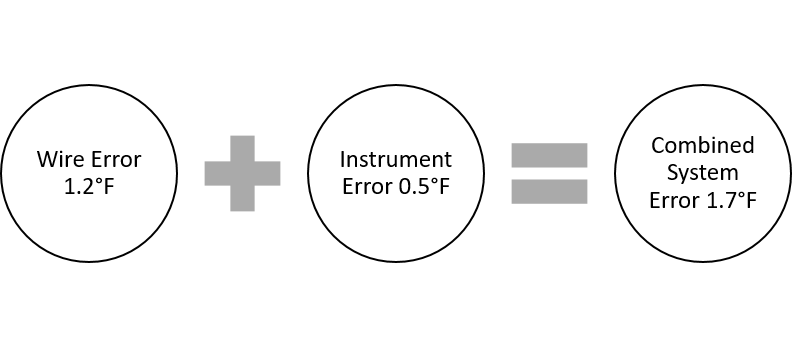
There are several ways to go about conforming to this paragraph. Keep in mind, that when choosing an option you are dealing with 2 variables; the error of the instrument which records the thermocouples in question and the error of the thermocouples themselves.
a) This option relieves you of one of the variables stated above. When calibrating your instruments which the thermocouples are plugged in to, ensure there is absolutely no error at all. Adjustments (offsets) may need to be made to accomplish this. This means that, if you do not permit offsets currently, you will either need to account for them in your procedures or choose option “b” below. Once you’ve established that your instrument has no error, you restrict the error of the thermocouples you purchase not to exceed the appropriate SAT difference stated in Table 6 or 7.
As an example, let’s assume you have a vacuum furnace that uses 2 load thermocouples which are single use only. The furnace is classified as a Type A, Class 2 furnace – this means the Maximum SAT difference is ±3°F or 0.3% of the reading. You would ensure that the recording instrument for those 2 channels recording the load temperature have no error. Then, order load thermocouples which have an error of ±3°F or 0.3% of the reading, or less.
b) This option is most attractive to those who do not wish to allow offsets within their heat treat operation. To accomplish this, you compare the error of the specific channels of the instrument the thermocouples in question plug into, to the error of the thermocouples themselves. The resulting value cannot exceed the maximum error permitted for the appropriate furnace class. Internal pyrometry procedures specifically state how thermocouple wire will be received and the ALT SAT calculation accomplished prior to releasing the thermocouple wire to production. There are two variables that must be verified in this option. Anytime one of these two variables change, the calculation must be obtained. The Nadcap Pyrometry Reference Guide requires that this calculation be evaluated at the instrument (chart recorder) calibration points (min, max & middle 1/3rd.)
Overview of a Calculation – Single Temperature
For Your Consideration
There has been some confusion in the industry that the ALT SAT process, specifically Option B above, must be accomplished at the furnace. This misunderstanding includes suppliers using a Field Test Instrument to simulate the min, max and middle 1/3rd of the instrument calibration temperatures in an effort to obtain the error of the instrument channels in question. This amounts to nothing more than an additional instrument calibration; one could simply obtain the error from the current instrument calibration instead of performing extra work at the furnace.
Option A and B above would be performed as a desk operation; none of the tasks would be performed at the actual furnace.
Conclusion
The ALT SAT process has been successfully implemented by many suppliers in the Aerospace Industry; both Nadcap approved and non-Nadcap. As with any AMS2750E process, detailed procedures and training are key to executing the ALT SAT process.
Submit Your Questions
Please feel free to submit your questions and I will answer appropriately in future articles. Submit your questions by sending an email to doug@heattreattoday.com.
LMI Aerospace Inc. has entered into a merger agreement to be acquired by Sonaca Group, a global aerostructures company headquartered in Gosselies, Belgium. Under the agreement, LMI shareholders will receive $14 per share in an all-cash transaction. Sonaca’s offer represents a 52 percent premium over LMI’s closing share price on Feb. 16, 2017, of $9.19 per share, a 63 percent premium over LMI’s 3-month volume weighted average price up to and including Feb. 16, 2017, of $8.59 per share, and a 78 percent premium over LMI’s 6-month volume weighted average price up to and including Feb. 16, 2017, of $7.88 per share.
In connection with the merger agreement, Sonaca has obtained debt and equity financing commitments. The merger agreement, however, does not include, and the consummation of the merger is not conditioned upon satisfaction of, a financing condition.
“This deal brings our combined company to the forefront as a leader in the design and manufacture of complex aerostructures while working to diversify our global customer base,” said Dan Korte, LMI Aerospace chief executive officer. “In addition, LMI and Sonaca have complementary product portfolios while largely serving different aerospace primes and Tier 1 suppliers around the world, enabling us to better serve our customers.”
“The addition of LMI Aerospace to the Sonaca Group supports our vision to expand our capabilities in the United States,” said Bernard Delvaux, Sonaca chief executive officer. “Sonaca and LMI have both distinguished themselves in the industry through capabilities such as wing movables, wing panels, complex fuselage and structural assemblies, and together we will be able to strengthen our competitive advantage in the global aerospace market.”
LMI’s independent directors unanimously approved the transaction. The deal is expected to close mid-2017, subject to LMI shareholder approval as well as certain regulatory approvals and other customary closing conditions.
Upon transaction close, LMI will operate as LMI Aerospace — A Member of the Sonaca Group, with headquarters remaining in St. Louis. Korte will continue to serve as LMI Aerospace CEO and will report directly to Delvaux. Other members of the LMI senior leadership team also will remain in place and will continue their current reporting relationships. The company will continue investing in its current footprint, continuously improving its U.S. and worldwide infrastructure and the capabilities of its teams.
Lazard served as financial advisors and Gibson, Dunn & Crutcher LLP and Polsinelli PC served as legal advisors to LMI. Credit Suisse served as financial advisors and Arnold & Porter Kaye Scholer and Husch Blackwell served as legal advisors to Sonaca.
Rolls-Royce recently announced that it is growing its presence in Southern California with a $30 million expansion into a new 62,000-sq-ft facility that will be dedicated to the research and development of ceramic matrix composite (CMC) materials and processes for use in next-generation aerospace engine components. Rolls-Royce held a dedication ceremony with federal, state, and local officials; customers; and employees at the new facility. Rolls-Royce purchased Hyper-Therm High-Temperature Composites (HTC) in May 2013 and continues to grow and invest with this new “CMC technology hub” located in Cypress, Calif.
“The development of lighter, stronger, composite fiber components is just part of our commitment to continuously improve the performance of our products by focusing on lowering fuel consumption, emissions and noise,” said Marion Blakey, Rolls-Royce president and CEO of North America. “The team here in Cypress will be dedicated to seeing the commercial application of these technologies that will soon be adopted into advanced manufacturing production methods for gas turbine components.”
“I want to welcome Rolls-Royce to its new location in Cypress, and I applaud their commitment to bring jobs and grow their innovative R&D facility here in Southern California,” said Rep. Alan Lowenthal (D-Calif.). “Today’s official opening highlights yet again that Southern California has the tools, the skills, and the talent to grow our already established aerospace industry here.”
“The turbine sits at the heart of the engine. I am very excited about several technologies we are developing across Rolls-Royce that will contribute to a significant reduction in fuel consumption,” said Andy Greasley, executive vice president of turbines, civil aerospace. “Our HTC team in California is part of a global team working on high-temperature composites. This dedication ceremony represents the completion of another major milestone and the creation of a state-of-the art facility specifically purposed for the development of our next-generation turbine materials.”
The facility reportedly will develop production-ready manufacturing processes and produce components that will be used for engine test programs. From there, manufacturing processes refined in the Cypress facility will be applied to a future dedicated production facility for manufacturing of engine components. Since Rolls-Royce acquired Hyper-Therm in 2013, it has grown from 15 employees to nearly 50. The company expects to hire at least 10 more people this year, with the potential for 40 more positions as the production and product testing increase.
The Applied Materials Research, Innovation and Commercialisation Company (AMRICC) is a high-technology center where advanced materials and processes will be fast-tracked into commercial products rapidly and economically – and at the same time scientists of the future will be developed to create a ‘talent pipeline.’
Focused on putting Stoke-on-Trent and Staffordshire at the heart of the global advanced materials economy, AMRICC’s research laboratory, pilot plant and educational facility will be used to channel the expertise and heritage in steel and ceramics within the region for a new generation.
The launch event, which took place at the Moat House Hotel in Festival Park, followed the official opening of the Ceramic Valley Enterprise Zone, with which AMRICC will be closely associated.
Dr Cathryn Hickey, AMRICC chief executive, said: “AMRICC offers the UK – and Stoke-on-Trent and Staffordshire in particular – a unique opportunity to become the world leader in the commercialisation of materials and materials process development.”
Traditionally, once a new material or process is discovered, bringing it to commercial use in the marketplace has taken up to 20 years or more.
This is quite an unbelievable time lag which can result in a host of missed opportunities for all involved.
In some cases the flow of innovation to fully commercialised products never happens and it’s this ‘valley of death’ which AMRICC will address.
AMRICC’s unique collaboration between academia and industry partners will help companies drive innovation to develop, manufacture and deploy advanced materials much faster and at a fraction of the cost.
This will enable new business models and approaches to collaboration to be achieved, and these will extend beyond the current open innovation concept.
Fully integrated solutions involving material innovation, as well as new process technology will enable unmet customer needs and new market challenges to be addressed.
With its state-of-the-art facilities, AMRICC will not only deliver commercialisation expertise, it will also be a centre of excellence for a number of exciting new disruptive technologies, which are on their way to market and are set to shake up current ways of working.
These areas include the development of unique encapsulation materials for drug abuse deterrent formulations, which are in significant market demand in the US.
And with the world’s first field-enhanced sintering pilot plant, which is a unique way of reaching extremely high temperatures very rapidly, AMRICC will be developing, with partners, a number of beneficial applications to bring to market.
These include thermal barrier coatings for the aerospace and automotive sectors as well as sensor technologies for the electronics industry.
But it’s not just about developing materials and technologies – at AMRICC we’re also proud to be developing people.
Working with some of the world’s leading universities, AMRICC will be delivering Master’s Degrees and PhDs to develop the ‘commercial technocrats’ of the future – materials scientists with both business acumen and a wide range of commercial and industrial experience.
AMRICC is being set up with the support of the international materials technology company Lucideon as well as Stoke-on-Trent City Council and the Stoke–on-Trent and Staffordshire Local Enterprise Partnership.
It will be initially based alongside Lucideon’s headquarters in Penkhull and, in future, is set to establish within the Ceramic Valley Enterprise Zone – to be developed on along the A500 corridor in Stoke-on-Trent and Newcastle under Lyme.
Dr Hickey added: “The launch of the Ceramic Valley Enterprise Zone and AMRICC today marks a significant and exciting day for the region.
In the future, we plan for AMRICC to be positioned within the Ceramic Valley Enterprise Zone where it will help to attract companies to the area, so it’s quite fitting that the company is launched today alongside the Enterprise Zone.
We look forward to working with our colleagues in the Ceramic Valley to drive the reputation of Stoke and Staffordshire in manufacturing and materials processing.
On the heels of a recent expansion of their seamless rolled ring capabilities, Weldaloy continues to grow with the addition of a new low temperature aluminum aging oven. The new oven will increase Weldaloy’s aluminum heat-treating capacity.
Ovens created specifically for aluminum can reduce cycle times and increase productivity by optimizing temperature uniformity through adequate airflow. This translates to a better product that can be made in a repeatable recipe.
“We’re receiving more and more requests for large aluminum work, so we needed to add this low temperature aluminum aging oven to be able to increase our capacity and meet production needs. This addition will allow us to produce more parts in the same amount of time for our customers while maintaining quality,” said Kurt Ruppenthal, Vice President & General Manager at Weldaloy.
Many of the new opportunities for aluminum work have come from the oil and gas industry and the aerospace industry, as well as from the private space sector. Weldaloy recently achieved the AS9100C certification for their Quality Management System, which has opened the door for them to work with more aerospace companies that require certification of their suppliers.
“We look forward to continuing to grow our aluminum capabilities to meet the increase in demand,” said Ruppenthal.